D. Pharm –I Year
Pharmaceutical Chemistry -1
Unit –II (2) Volumetric Analysis -
Precipitation titration
Mrs Vandana Sharma
Assistant Professor
Contents
• Mohr’s method,
• Volhard’s, Modified Volhard’s,
• Fajans method,
• Gay- Lussac method
• estimation of Sodium Chloride
Introduction
• Precipitation is the formation of a solid in a solution
• solid formed is called the precipitate
• A precipitation reaction occurs when water solutions of two
different ionic compounds are mixed and an insoluble solid
separates out of solution.
• KCl + AgNO3 AgCl +
KNO3
• Cl-
solution Precipitating agent White precipitate
• The precipitate is itself ionic; the cation comes from one
solution and the anion from another.
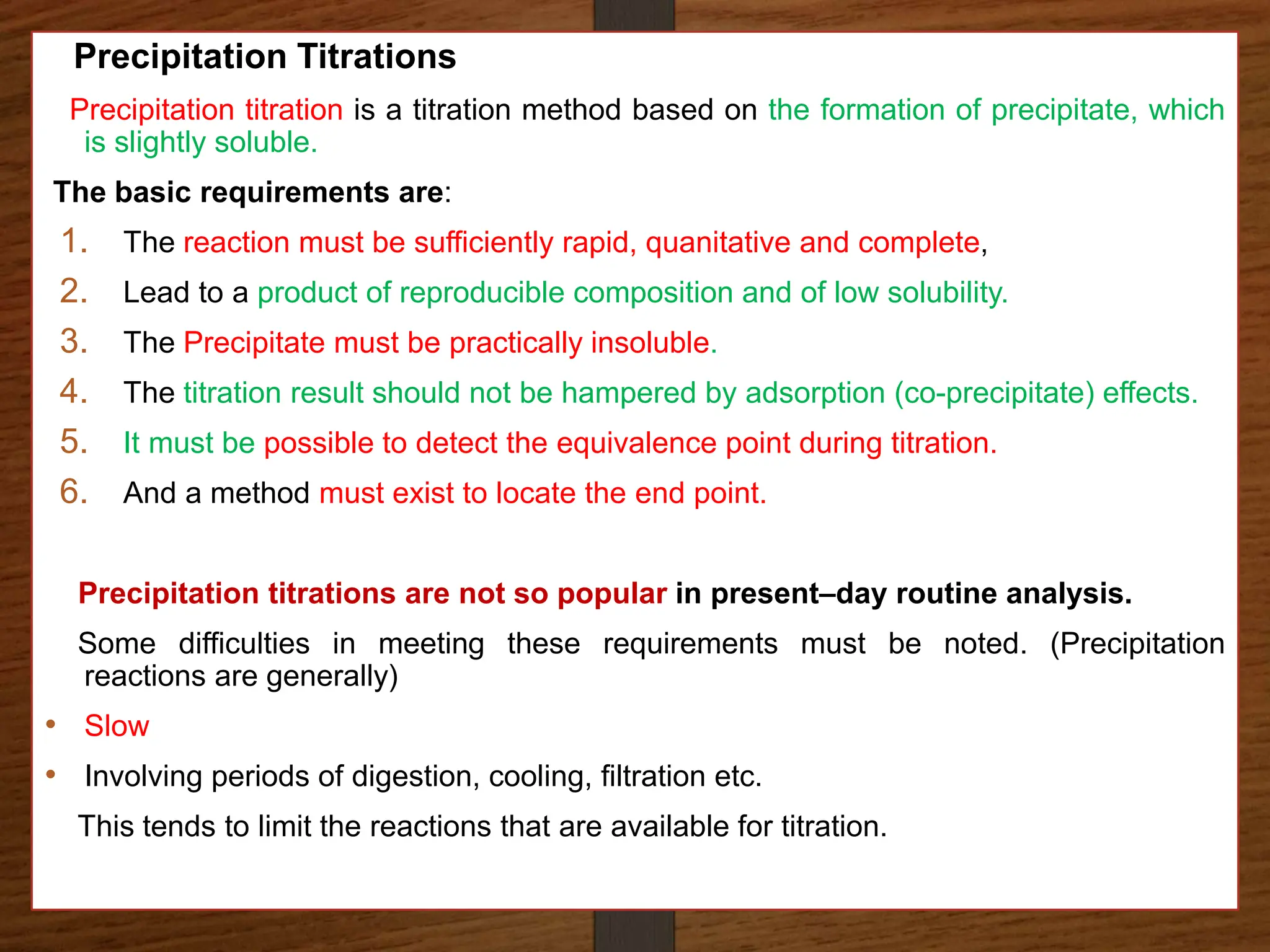
Precipitation Titrations
Precipitation titration is a titration method based on the formation of precipitate, which
is slightly soluble.
The basic requirements are:
1. The reaction must be sufficiently rapid, quanitative and complete,
2. Lead to a product of reproducible composition and of low solubility.
3. The Precipitate must be practically insoluble.
4. The titration result should not be hampered by adsorption (co-precipitate) effects.
5. It must be possible to detect the equivalence point during titration.
6. And a method must exist to locate the end point.
Precipitation titrations are not so popular in present–day routine analysis.
Some difficulties in meeting these requirements must be noted. (Precipitation
reactions are generally)
• Slow
• Involving periods of digestion, cooling, filtration etc.
This tends to limit the reactions that are available for titration.
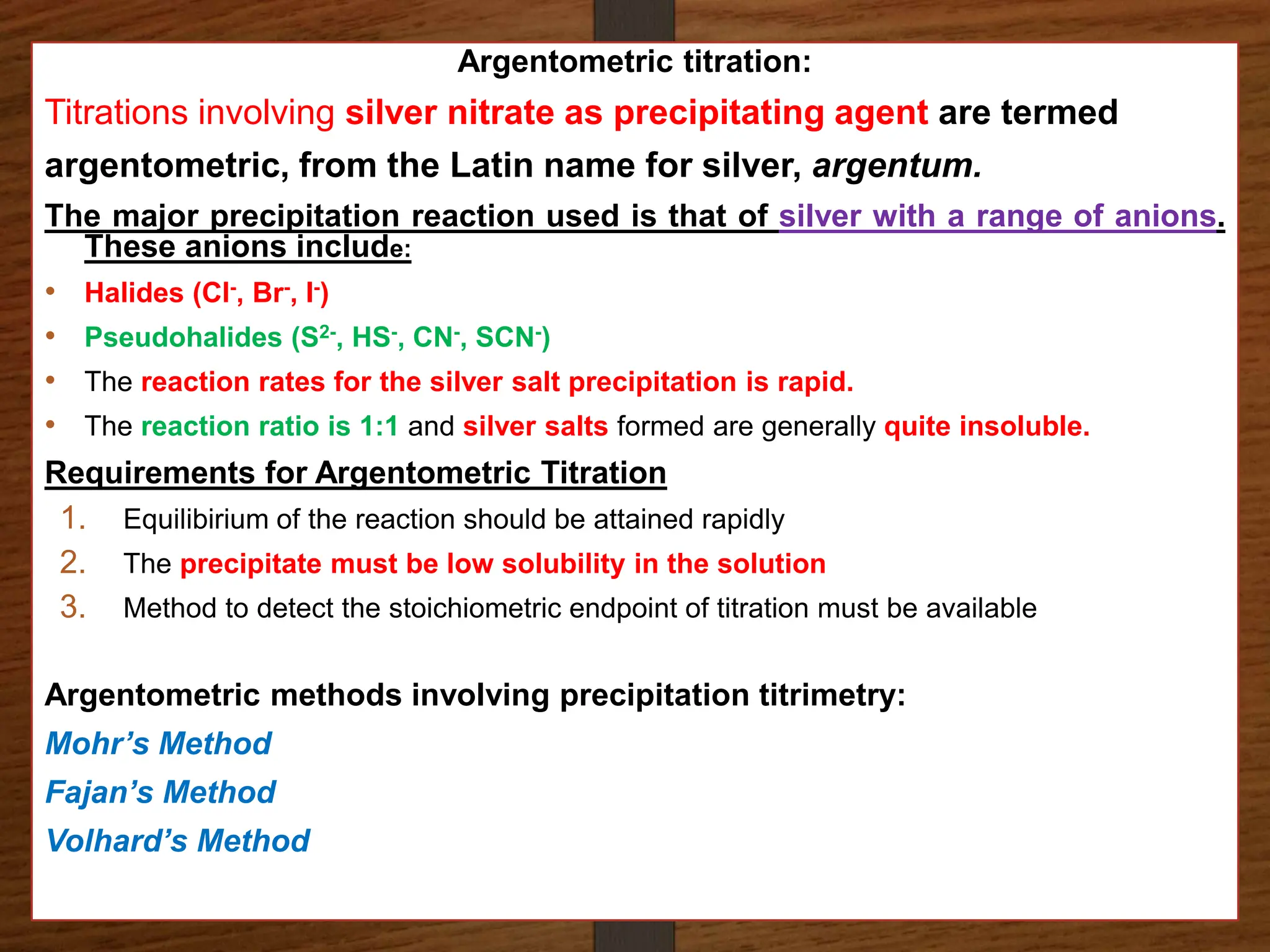
Argentometric titration:
Titrations involving silver nitrate as precipitating agent are termed
argentometric, from the Latin name for silver, argentum.
The major precipitation reaction used is that of silver with a range of anions.
These anions include:
• Halides (Cl-, Br-, I-)
• Pseudohalides (S2-, HS-, CN-, SCN-)
• The reaction rates for the silver salt precipitation is rapid.
• The reaction ratio is 1:1 and silver salts formed are generally quite insoluble.
Requirements for Argentometric Titration
1. Equilibirium of the reaction should be attained rapidly
2. The precipitate must be low solubility in the solution
3. Method to detect the stoichiometric endpoint of titration must be available
Argentometric methods involving precipitation titrimetry:
Mohr’s Method
Fajan’s Method
Volhard’s Method
 The chloride ion concentration of the MgCl2 and CaCl2 solutions is
determined by a precipitation titration with calibrated silver nitrate
solution. This procedure is known as Mohr's method.
 Note- AR Silver nitrate has purity of at least 99.9% so that standard solution
can be prepared by direct weighing
 AR Sodium chloride- has purity of 99.9 to 100%; therefore an substance is
therefore an excellent primary standard.
Mohr’s Method:
Principle
 A German chemist - Karl Friedrich Mohr devised this method in 1856
 The method involves direct titration.
 titrant -Silver nitrate
an analyte/Sample/Tirand -Halides (chloride ion) solution is used
Indicator- Potassium Chromate [chromate ions (CrO42-)] as the indicator
For the argentometric determination of bromide, chloride and cyanide
ions. Estimation is carried out – in neutral medium
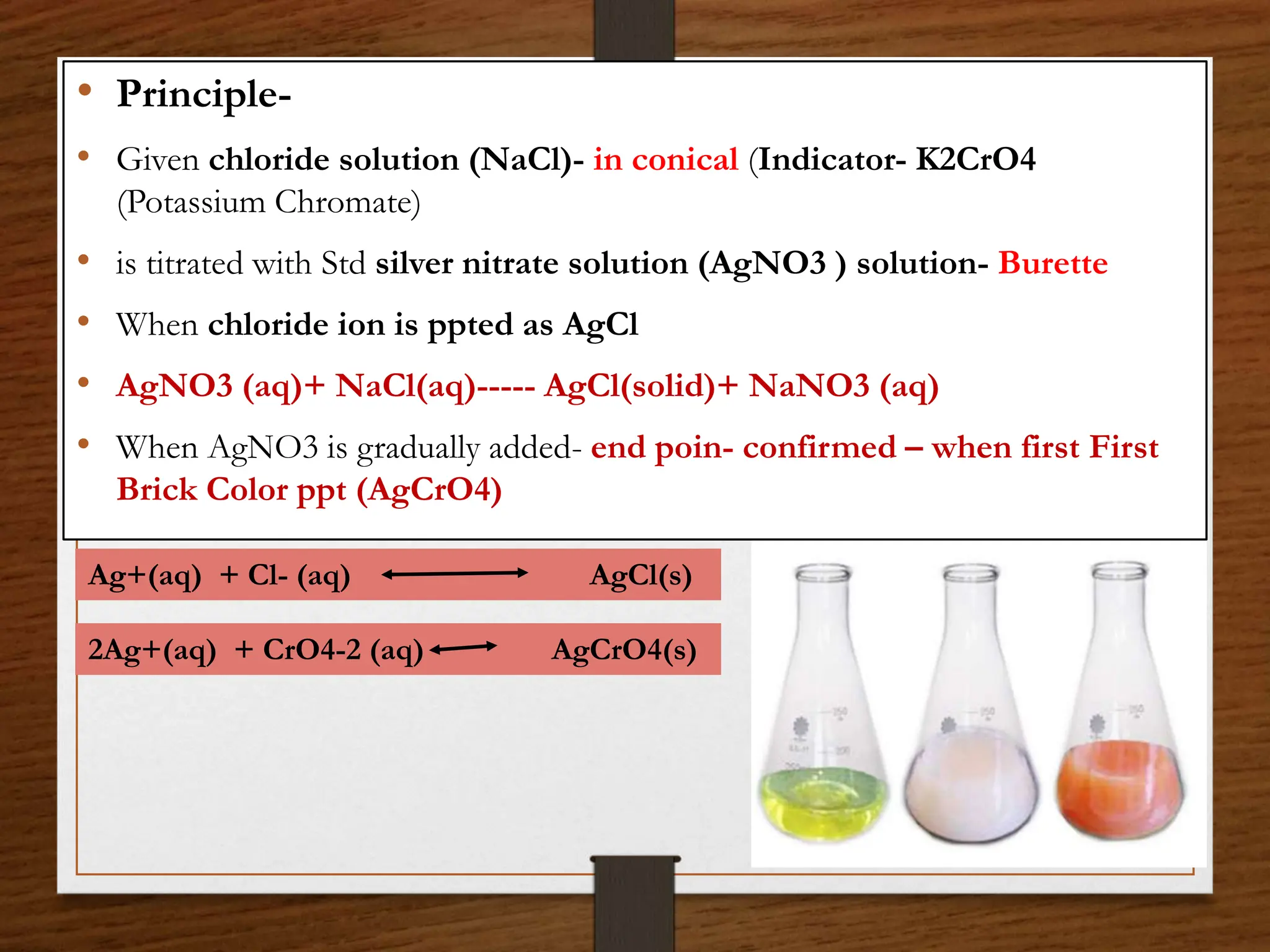
• Principle-
• Given chloride solution (NaCl)- in conical (Indicator- K2CrO4
(Potassium Chromate)
• is titrated with Std silver nitrate solution (AgNO3 ) solution- Burette
• When chloride ion is ppted as AgCl
• AgNO3 (aq)+ NaCl(aq)----- AgCl(solid)+ NaNO3 (aq)
• When AgNO3 is gradually added- end poin- confirmed – when first First
Brick Color ppt (AgCrO4)
Ag+(aq) + Cl- (aq) AgCl(s)
2Ag+(aq) + CrO4-2 (aq) AgCrO4(s)
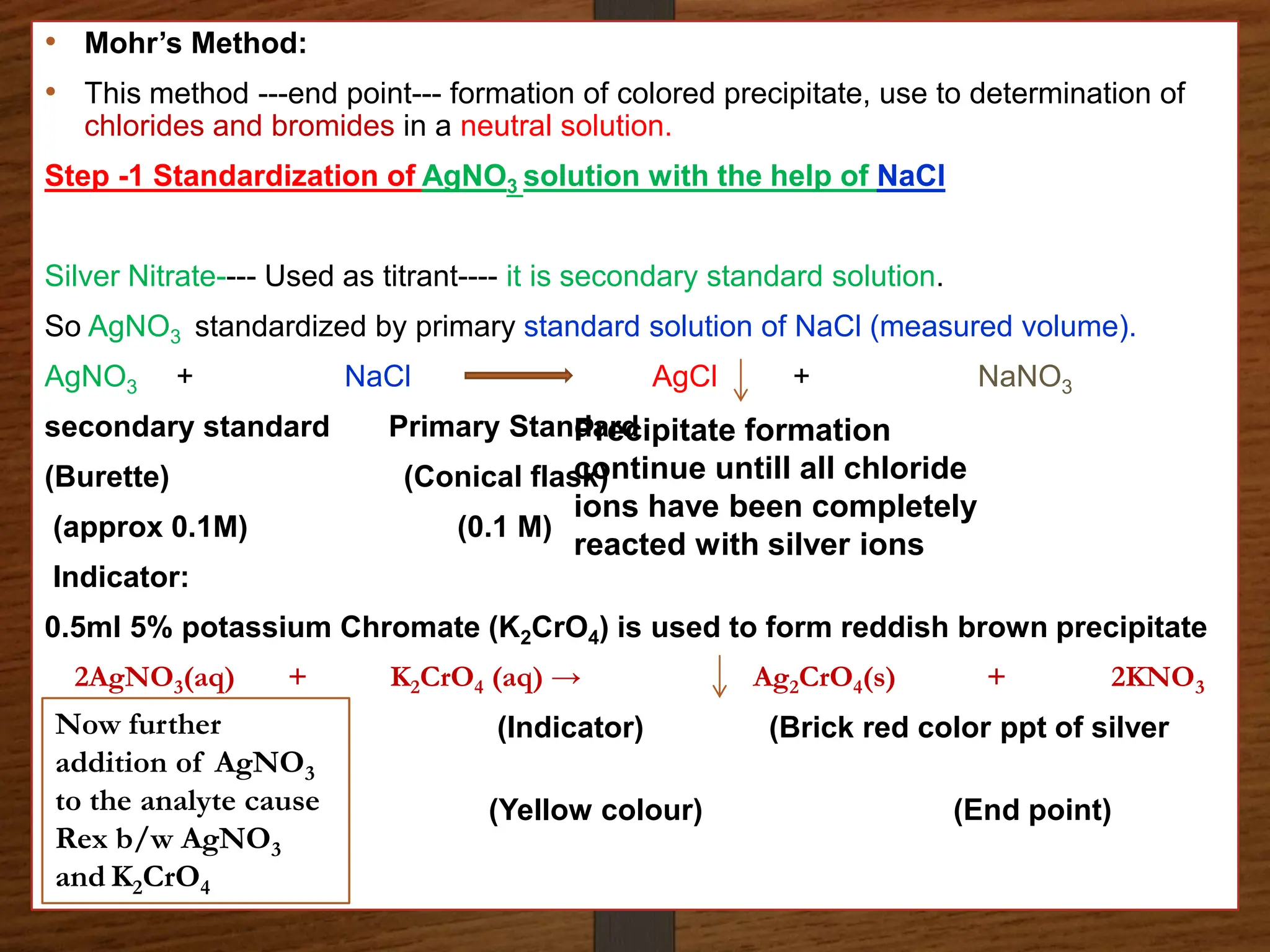
• Mohr’s Method:
• This method ---end point--- formation of colored precipitate, use to determination of
chlorides and bromides in a neutral solution.
Step -1 Standardization of AgNO3 solution with the help of NaCl
Silver Nitrate---- Used as titrant---- it is secondary standard solution.
So AgNO3 standardized by primary standard solution of NaCl (measured volume).
AgNO3 + NaCl AgCl + NaNO3
secondary standard Primary Standard
(Burette) (Conical flask)
(approx 0.1M) (0.1 M)
Indicator:
0.5ml 5% potassium Chromate (K2CrO4) is used to form reddish brown precipitate
2AgNO3(aq) + K2CrO4 (aq) → Ag2CrO4(s) + 2KNO3
(Indicator) (Brick red color ppt of silver
chromate)
(Yellow colour) (End point)
Precipitate formation
continue untill all chloride
ions have been completely
reacted with silver ions
Now further
addition of AgNO3
to the analyte cause
Rex b/w AgNO3
and K2CrO4
Procedure of preparation and standardization of 0.1M AgNO3
Preparation of 0.1M AgNO3
weight about 16.99g AgNO3 ---- add small amount of water and dissolved ---- made
up the volume to 1000ml by adding water
Standardization of 0.1M AgNO3
1.2g of NaCl gm upto 250ml distilled water in volumetric flask.
Conical flask -Pipette out 50ml from above solution to conical flask + 2ml of 0.1M
potassium chromate indicator
Burette- and titrate with 0.1M AgNO3 solution
End point- formation of white curdy AgCl lumps --- shows that end point is near
AgNO3 added to chloride solution till red color of silver chromate (Ag2CrO4(s) )
appear and spread through the solution.
Step -2 Determination of chloride and bromide ions as Analytes
• This direct method uses potassium chromate (chromate ions (CrO42-) as
an indicator in the titration of (Cl-, Br- )ions (analyte---as water sample ---
-MgCl2, CaCl2, NaCl, KCl, KCl, KBr etc) with a silver nitrate standard
solution (titrant).
• After all the chloride has been precipitated as white silver chloride, the
first excess of titrant results in the formation of a silver chromate
precipitate, which signals the end point (1). The reactions are:
• Ag +(aq) + Cl - (aq) → AgCl(s)
Ksp = 1.8 x 10⁻¹⁰
(MgCl2, CaCl2 etc) White Precipitate
Each ml of 0.1M AgNO3 = 0.005844g of NaCl
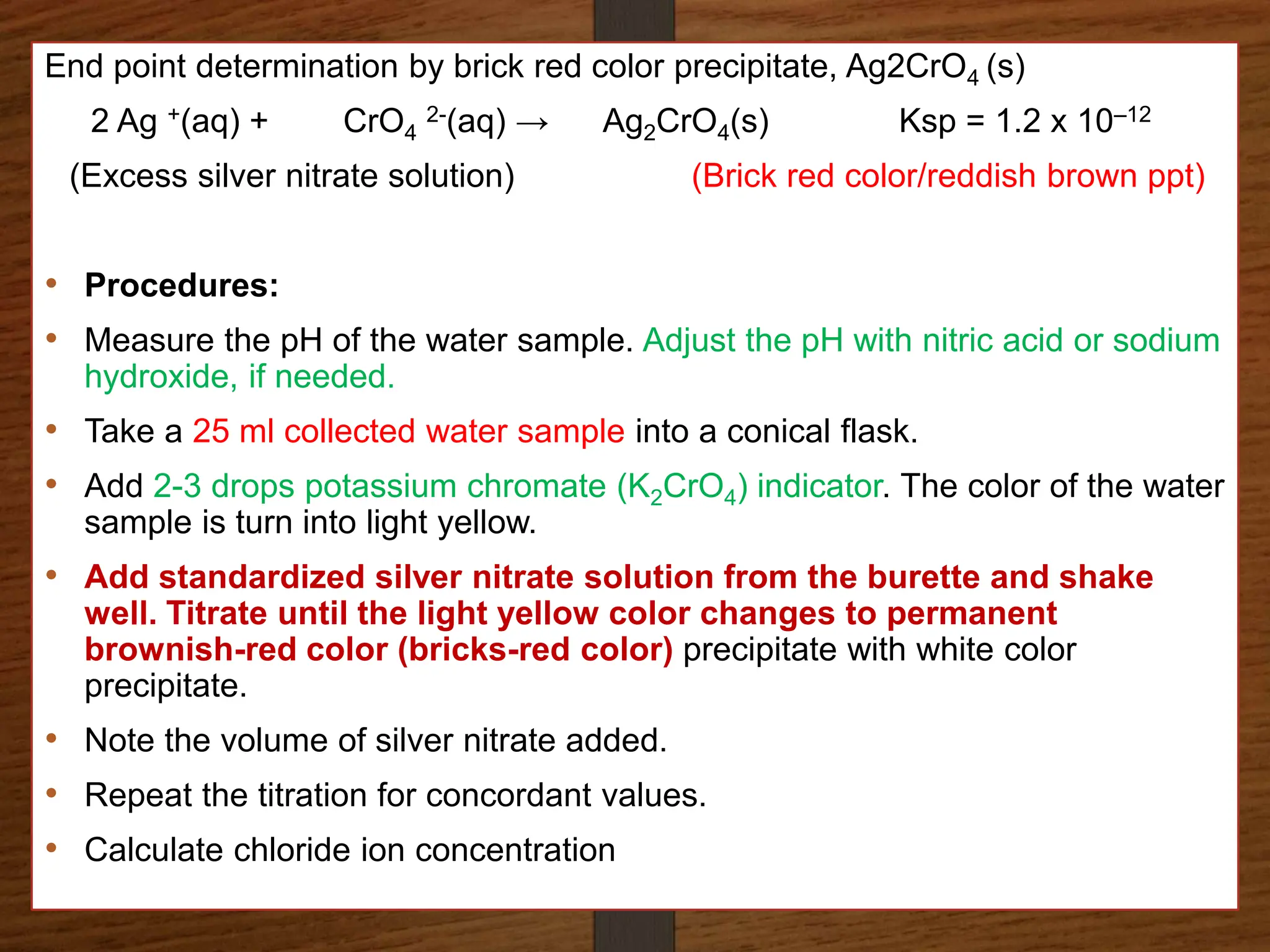
End point determination by brick red color precipitate, Ag2CrO4 (s)
2 Ag +(aq) + CrO4
2-(aq) → Ag2CrO4(s) Ksp = 1.2 x 10⁻¹²
(Excess silver nitrate solution) (Brick red color/reddish brown ppt)
• Procedures:
• Measure the pH of the water sample. Adjust the pH with nitric acid or sodium
hydroxide, if needed.
• Take a 25 ml collected water sample into a conical flask.
• Add 2-3 drops potassium chromate (K2CrO4) indicator. The color of the water
sample is turn into light yellow.
• Add standardized silver nitrate solution from the burette and shake
well. Titrate until the light yellow color changes to permanent
brownish-red color (bricks-red color) precipitate with white color
precipitate.
• Note the volume of silver nitrate added.
• Repeat the titration for concordant values.
• Calculate chloride ion concentration
Limitation
Why Mohr method is not suitable for iodide?
1.The Mohr's method is used for determination of silver, chloride and bromide (it
cannot use for iodides and thiocyanates because the results are greatly
distorted by adsorption effect
2. The Mohr method for determination of chloride in water is a pH sophisticated
method. It must be perform between the pH levels 6.5-9.0. It is better to carry out
between the pH ranges 7-8. At upper pH level, the silver ions react with hydroxide
ions and precipitated as silver hydroxide.
Ag+
(aq) + OH–
(aq) → Ag(OH)(s)
3. At lower pH level, potassium chromate may be converted into potassium
dichromate (K2Cr2O7) and mask the end point (slows down the precipitation of
silver chromate and leads to error in excess.) Consequently, accurate result
cannot be obtained.
CrO4
2-
(aq) → Cr2O7
2-
(aq)
• If the water sample is acidic, then gravimetric method or volhard’s method is
appropriate.
Step -1
standardization of AgNO3 solution
Step -2--Estimation of chloride ion conc in MgCl2 or
CaCl2
Mohr’s Method
0.1M (Approx)
AgNO3 solution
End point – Yellow
color to Brick Red
color
0.1M NaCl + K2CrO4
Standardized AgNO3 solution
End point – Yellow
color to Brick Red
color
Sample solution +
potassium Chromate
Volhard method
• The volhard method is an indirect or back titration method in which an
excess of a standard solution of silver nitrate is added to a chloride
containing sample solution.
• The excess silver is then back titrated using a standardized solution of
potassium or ammonium thiocyanate with ferric ion as an indicator.
• The amount of silver that is precipitated with chloride in the sample
solution is calculated by subtracting the excess silver from the original
silver content.
• Volhard’s method---- End point---- Colored compound
• Silver ion ----- titrated with ----- thiocyanate in acidic solution
• Indicator--- ferric ion
• Titrant ---- Silver nitrate
Ammonium thiocyanide (NH4SCN)
Potassium thiocyanate( KSCN)
Primary standard solution- NaCl
AgNO3 is standardized by NaCl
NH4SCN and KSCN --- is used as titrant (Standard in Volhard,s method
Indicator --- Iron alum
Step-1 Standardization of AgNO3 by Nacl
NaCl + AgNO3 = AgCl + KNO3
Conical Flask----
Step -2 -Addition of standard AgNO3 ( in excess) to the sample to back
titration
AgNO3 + KCl = AgCl + KNO3 + AgNO3
(excess amount)
(Some amount will remains)
Step -3 Titration of remaining amount of AgNO3 with NH4SCN / KSCN filled in
burette
AgNO3 + NH4SCN = AgSCN + NH4NO3
AgNO3 + KSCN = AgSCN + KNO3
Step -4 Reacting with indicator at the end point-
Indicator – Iron III salt--- is used as indicator in the presence of nitric acid to
form reddish color complex
Other samples like
halogenides,
thiocyanides, cyanides,
sulphides, carbonates,
chromate, oxalate can
also be used in place of
KCl
Indicator- NH4Fe(SO4)2.12H20= Ammonium iron (III) Sulphate or Ferric
ammonium sulphate or Iron alum
Fe+3 + SCN- = Fe(SCN)+2
Titration is carried in the precence of nitric acid (acidic medium)-To
prevent precipitation of iron hydroxide
Reddish color
complex
Procedure For Titration :-
Pipette out 25 ml of std. AgNO3 in 250 ml conical flask
• Add 10 ml of 0.5 or 1M nitric acid and 1 ml of feric alum indicator.
• Titration with thiocyanate solution until reddish of red blood colour begins to spread
the solution.
• It state add thiocyanate solution drop by drop.
• The end point is marked by appearance of permanent red blood colour of iron
thiocyanate complex
Precaution :-
• During the titration in resulting solution concentration of nitric acid should be 0.5 M –
1 M. Here strong nitric acid is not used because it prevent the formation of
thiocyanate iron (III) complex. Here acidic medium prevent the hydrolysis of fe (III) as
Fe(OH)3.
• The solution must be free from Nitrous acid otherwise it give the instant ref
colouration forming the thiocynic acid.
• Temperature of the solution must be maintained below 200 c since at an elevated
temperature the red colour of the ferric thiocyanate complex fades away rapidly.
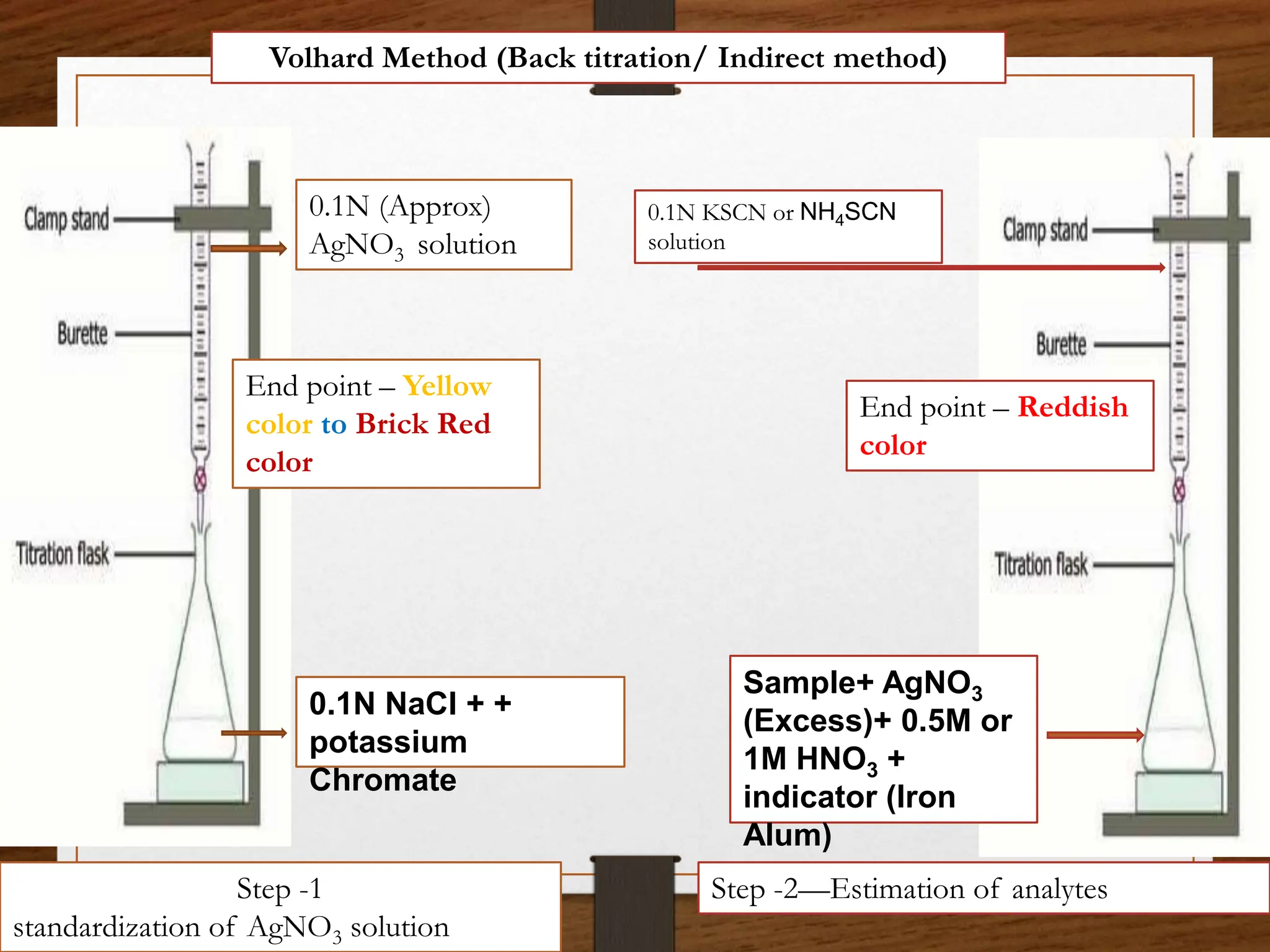
Step -1
standardization of AgNO3 solution
Step -2—Estimation of analytes
Volhard Method (Back titration/ Indirect method)
0.1N (Approx)
AgNO3 solution
End point – Yellow
color to Brick Red
color
0.1N NaCl + +
potassium
Chromate
0.1N KSCN or NH4SCN
solution
End point – Reddish
color
Sample+ AgNO3
(Excess)+ 0.5M or
1M HNO3 +
indicator (Iron
Alum)
Basis of
comparison
Mohr’s Method Volhard Method
(Back titration)
Description In this method
Titrant- Silver nitrate
Analyte- Chloride ion solution
Indicator- Potassium chromate
End point- Reddish brown complex
In the volhard method (Back
titration)chlorides are first
precipitated with excess silver nitrate,
then excess silver nitrate is titrated
with potassium (or sodium)
thiocyanate,
End point-distinct wine red color.
Nature of
titration
direct method of titration an indirect method of titration
Indicators Potassium chromate Ferric ammonium sulphate
End point Red ppt of Silver chromate Wine red color of Ferric thiocyante
Medium Neutral/Alkaline (pH 6.5 to 9) Acidic condition
Basis of
comparison
Mohr’s Method Volhard Method
(Back titration)
Use Titration can be used to determine
bromide and chloride
Titration of iodide and cyanate is not
possible
Titration can be used to determine
iodide, bromide and chloride
Temprature Titration is carried out at room
temperature because solubility of
silver chromate is increased with rising
temp. ( which is undesirable)
Titration is carried out below 20oC to
prevent the color of ferric
thiocyanate complex form fading
Modified volhard method :-
• Chloroform or other organic liquid are added after adding excess amount
of silver nitrate, because ppt of AgCl may be solubilized in solution during
estimation.
• So addition of chloroform will prevent the solubility of AgCl.
1. When chloride are analysed the volhard method has to slightly modified.
2.During Titration the solution is contact with two precipitation
stimuantaneously silver chloride and ammonium thiocyanate which has
different solubility.
3. So, after the titration excess of thiocyanate ions are react with AgCl and
the red colour of iron thiocyanate complex gradually disappear.
4. Addition of more SCN‾ cause restoration of red colour which induced
huge error in analysis
so to avoid this error before Titration with thiocyanate the solution of few
ml of organic liquid (Chloroform) which does not mix with water is added.
5. This compound will moisten the surface of the ppt forming on the surface
• FAJANS METHOD known as indicator adsorption method
• The precipitation titration in which silver ions is titrated with halide or
thiocyanate ions in presence of adsorption indicator is called fajan’s
method
• Since the adsorption of indicator takes place at end point the method
is also called indicator adsorption method •
• The indicator, which is a dye, exists in solution as the ionized form,
usually an anion.
• The method is generally used for the quantitative analysis of halide
ions or thiocyanate ions.
• For eg :titration of Cl– ions with AgN03 in presence of adsorption
indicator .here AgN03 is kept in burette and the Cl– ion solution with
indicator is taken in titration flask.
• There are indicators are acidic and basic dyes.
• Example- Acid dyes--- Fluorescein, Eosin etc
• Basic dye--- Rhodamine series
Silver nitrate (Secondary standard solution)
So standarized on primary standard on primary standard solution of NaCl (By
measured volume)
Range of the pH (6.5-10.3)-- for chloride--indicator---Dichlorofluoroscein
pH(2.0 to 10.3– for Bromides and iodides--- indicator--Eosine
a) Before the equivalence point :
before the eqv. point ,colloidal particles of AgCl are negatively charged due to
the adsorption of Cl– from the solution . The adsorbed Cl– from the primary
layer which attract the positively charged Na+ ions from the solution to form a
more looselyheld secondary layer. •
b) After the eqv.point ,excess of silver ions Ag+ displace the Cl– ions and form
the primary layer which attract the negatively charged nitrate ions N03
– .
c) At the end point ,anion of indicator in (weak organic acid or base )replace
the negatively charged ion N03
– from the second layer and give the intense
color . This intense color gives the end point of titration
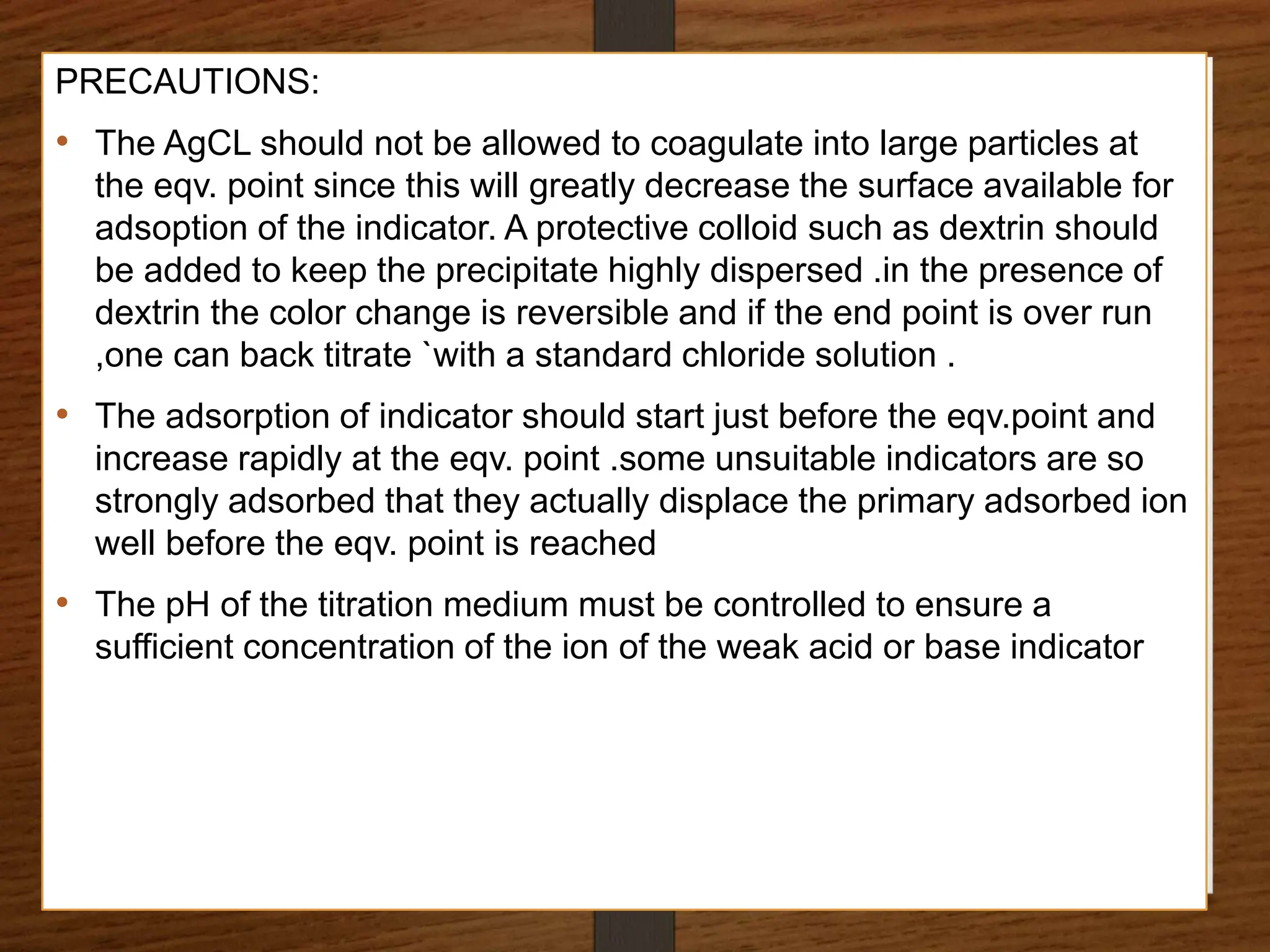
PRECAUTIONS:
• The AgCL should not be allowed to coagulate into large particles at
the eqv. point since this will greatly decrease the surface available for
adsoption of the indicator. A protective colloid such as dextrin should
be added to keep the precipitate highly dispersed .in the presence of
dextrin the color change is reversible and if the end point is over run
,one can back titrate `with a standard chloride solution .
• The adsorption of indicator should start just before the eqv.point and
increase rapidly at the eqv. point .some unsuitable indicators are so
strongly adsorbed that they actually displace the primary adsorbed ion
well before the eqv. point is reached
• The pH of the titration medium must be controlled to ensure a
sufficient concentration of the ion of the weak acid or base indicator
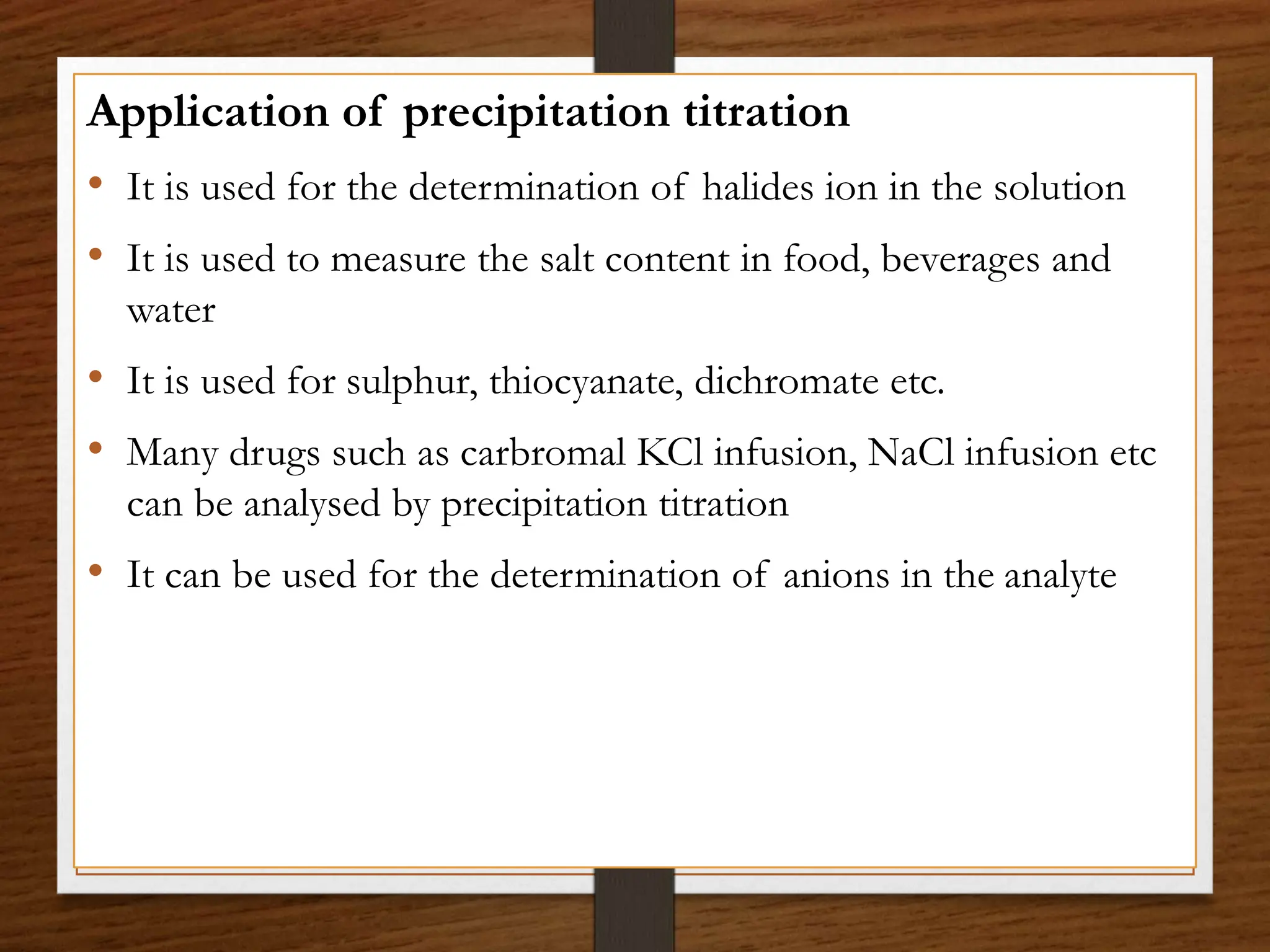
Application of precipitation titration
• It is used for the determination of halides ion in the solution
• It is used to measure the salt content in food, beverages and
water
• It is used for sulphur, thiocyanate, dichromate etc.
• Many drugs such as carbromal KCl infusion, NaCl infusion etc
can be analysed by precipitation titration
• It can be used for the determination of anions in the analyte
Precipitation titrations - D.Pharma.pptx

Precipitation titrations - D.Pharma.pptx

  • 1.
    D. Pharm –IYear Pharmaceutical Chemistry -1 Unit –II (2) Volumetric Analysis - Precipitation titration Mrs Vandana Sharma Assistant Professor
  • 2.
    Contents • Mohr’s method, •Volhard’s, Modified Volhard’s, • Fajans method, • Gay- Lussac method • estimation of Sodium Chloride
  • 3.
    Introduction • Precipitation isthe formation of a solid in a solution • solid formed is called the precipitate • A precipitation reaction occurs when water solutions of two different ionic compounds are mixed and an insoluble solid separates out of solution. • KCl + AgNO3 AgCl + KNO3 • Cl- solution Precipitating agent White precipitate • The precipitate is itself ionic; the cation comes from one solution and the anion from another.
  • 4.
    Precipitation Titrations Precipitation titrationis a titration method based on the formation of precipitate, which is slightly soluble. The basic requirements are: 1. The reaction must be sufficiently rapid, quanitative and complete, 2. Lead to a product of reproducible composition and of low solubility. 3. The Precipitate must be practically insoluble. 4. The titration result should not be hampered by adsorption (co-precipitate) effects. 5. It must be possible to detect the equivalence point during titration. 6. And a method must exist to locate the end point. Precipitation titrations are not so popular in present–day routine analysis. Some difficulties in meeting these requirements must be noted. (Precipitation reactions are generally) • Slow • Involving periods of digestion, cooling, filtration etc. This tends to limit the reactions that are available for titration.
  • 5.
    Argentometric titration: Titrations involvingsilver nitrate as precipitating agent are termed argentometric, from the Latin name for silver, argentum. The major precipitation reaction used is that of silver with a range of anions. These anions include: • Halides (Cl-, Br-, I-) • Pseudohalides (S2-, HS-, CN-, SCN-) • The reaction rates for the silver salt precipitation is rapid. • The reaction ratio is 1:1 and silver salts formed are generally quite insoluble. Requirements for Argentometric Titration 1. Equilibirium of the reaction should be attained rapidly 2. The precipitate must be low solubility in the solution 3. Method to detect the stoichiometric endpoint of titration must be available Argentometric methods involving precipitation titrimetry: Mohr’s Method Fajan’s Method Volhard’s Method
  • 6.
     The chlorideion concentration of the MgCl2 and CaCl2 solutions is determined by a precipitation titration with calibrated silver nitrate solution. This procedure is known as Mohr's method.  Note- AR Silver nitrate has purity of at least 99.9% so that standard solution can be prepared by direct weighing  AR Sodium chloride- has purity of 99.9 to 100%; therefore an substance is therefore an excellent primary standard. Mohr’s Method: Principle  A German chemist - Karl Friedrich Mohr devised this method in 1856  The method involves direct titration.  titrant -Silver nitrate an analyte/Sample/Tirand -Halides (chloride ion) solution is used Indicator- Potassium Chromate [chromate ions (CrO42-)] as the indicator For the argentometric determination of bromide, chloride and cyanide ions. Estimation is carried out – in neutral medium
  • 7.
    • Principle- • Givenchloride solution (NaCl)- in conical (Indicator- K2CrO4 (Potassium Chromate) • is titrated with Std silver nitrate solution (AgNO3 ) solution- Burette • When chloride ion is ppted as AgCl • AgNO3 (aq)+ NaCl(aq)----- AgCl(solid)+ NaNO3 (aq) • When AgNO3 is gradually added- end poin- confirmed – when first First Brick Color ppt (AgCrO4) Ag+(aq) + Cl- (aq) AgCl(s) 2Ag+(aq) + CrO4-2 (aq) AgCrO4(s)
  • 8.
    • Mohr’s Method: •This method ---end point--- formation of colored precipitate, use to determination of chlorides and bromides in a neutral solution. Step -1 Standardization of AgNO3 solution with the help of NaCl Silver Nitrate---- Used as titrant---- it is secondary standard solution. So AgNO3 standardized by primary standard solution of NaCl (measured volume). AgNO3 + NaCl AgCl + NaNO3 secondary standard Primary Standard (Burette) (Conical flask) (approx 0.1M) (0.1 M) Indicator: 0.5ml 5% potassium Chromate (K2CrO4) is used to form reddish brown precipitate 2AgNO3(aq) + K2CrO4 (aq) → Ag2CrO4(s) + 2KNO3 (Indicator) (Brick red color ppt of silver chromate) (Yellow colour) (End point) Precipitate formation continue untill all chloride ions have been completely reacted with silver ions Now further addition of AgNO3 to the analyte cause Rex b/w AgNO3 and K2CrO4
  • 9.
    Procedure of preparationand standardization of 0.1M AgNO3 Preparation of 0.1M AgNO3 weight about 16.99g AgNO3 ---- add small amount of water and dissolved ---- made up the volume to 1000ml by adding water Standardization of 0.1M AgNO3 1.2g of NaCl gm upto 250ml distilled water in volumetric flask. Conical flask -Pipette out 50ml from above solution to conical flask + 2ml of 0.1M potassium chromate indicator Burette- and titrate with 0.1M AgNO3 solution End point- formation of white curdy AgCl lumps --- shows that end point is near AgNO3 added to chloride solution till red color of silver chromate (Ag2CrO4(s) ) appear and spread through the solution.
  • 10.
    Step -2 Determinationof chloride and bromide ions as Analytes • This direct method uses potassium chromate (chromate ions (CrO42-) as an indicator in the titration of (Cl-, Br- )ions (analyte---as water sample --- -MgCl2, CaCl2, NaCl, KCl, KCl, KBr etc) with a silver nitrate standard solution (titrant). • After all the chloride has been precipitated as white silver chloride, the first excess of titrant results in the formation of a silver chromate precipitate, which signals the end point (1). The reactions are: • Ag +(aq) + Cl - (aq) → AgCl(s) Ksp = 1.8 x 10⁻¹⁰ (MgCl2, CaCl2 etc) White Precipitate Each ml of 0.1M AgNO3 = 0.005844g of NaCl
  • 11.
    End point determinationby brick red color precipitate, Ag2CrO4 (s) 2 Ag +(aq) + CrO4 2-(aq) → Ag2CrO4(s) Ksp = 1.2 x 10⁻¹² (Excess silver nitrate solution) (Brick red color/reddish brown ppt) • Procedures: • Measure the pH of the water sample. Adjust the pH with nitric acid or sodium hydroxide, if needed. • Take a 25 ml collected water sample into a conical flask. • Add 2-3 drops potassium chromate (K2CrO4) indicator. The color of the water sample is turn into light yellow. • Add standardized silver nitrate solution from the burette and shake well. Titrate until the light yellow color changes to permanent brownish-red color (bricks-red color) precipitate with white color precipitate. • Note the volume of silver nitrate added. • Repeat the titration for concordant values. • Calculate chloride ion concentration
  • 12.
    Limitation Why Mohr methodis not suitable for iodide? 1.The Mohr's method is used for determination of silver, chloride and bromide (it cannot use for iodides and thiocyanates because the results are greatly distorted by adsorption effect 2. The Mohr method for determination of chloride in water is a pH sophisticated method. It must be perform between the pH levels 6.5-9.0. It is better to carry out between the pH ranges 7-8. At upper pH level, the silver ions react with hydroxide ions and precipitated as silver hydroxide. Ag+ (aq) + OH– (aq) → Ag(OH)(s) 3. At lower pH level, potassium chromate may be converted into potassium dichromate (K2Cr2O7) and mask the end point (slows down the precipitation of silver chromate and leads to error in excess.) Consequently, accurate result cannot be obtained. CrO4 2- (aq) → Cr2O7 2- (aq) • If the water sample is acidic, then gravimetric method or volhard’s method is appropriate.
  • 13.
    Step -1 standardization ofAgNO3 solution Step -2--Estimation of chloride ion conc in MgCl2 or CaCl2 Mohr’s Method 0.1M (Approx) AgNO3 solution End point – Yellow color to Brick Red color 0.1M NaCl + K2CrO4 Standardized AgNO3 solution End point – Yellow color to Brick Red color Sample solution + potassium Chromate
  • 14.
    Volhard method • Thevolhard method is an indirect or back titration method in which an excess of a standard solution of silver nitrate is added to a chloride containing sample solution. • The excess silver is then back titrated using a standardized solution of potassium or ammonium thiocyanate with ferric ion as an indicator. • The amount of silver that is precipitated with chloride in the sample solution is calculated by subtracting the excess silver from the original silver content.
  • 15.
    • Volhard’s method----End point---- Colored compound • Silver ion ----- titrated with ----- thiocyanate in acidic solution • Indicator--- ferric ion • Titrant ---- Silver nitrate Ammonium thiocyanide (NH4SCN) Potassium thiocyanate( KSCN) Primary standard solution- NaCl AgNO3 is standardized by NaCl NH4SCN and KSCN --- is used as titrant (Standard in Volhard,s method Indicator --- Iron alum Step-1 Standardization of AgNO3 by Nacl NaCl + AgNO3 = AgCl + KNO3
  • 16.
    Conical Flask---- Step -2-Addition of standard AgNO3 ( in excess) to the sample to back titration AgNO3 + KCl = AgCl + KNO3 + AgNO3 (excess amount) (Some amount will remains) Step -3 Titration of remaining amount of AgNO3 with NH4SCN / KSCN filled in burette AgNO3 + NH4SCN = AgSCN + NH4NO3 AgNO3 + KSCN = AgSCN + KNO3 Step -4 Reacting with indicator at the end point- Indicator – Iron III salt--- is used as indicator in the presence of nitric acid to form reddish color complex Other samples like halogenides, thiocyanides, cyanides, sulphides, carbonates, chromate, oxalate can also be used in place of KCl
  • 17.
    Indicator- NH4Fe(SO4)2.12H20= Ammoniumiron (III) Sulphate or Ferric ammonium sulphate or Iron alum Fe+3 + SCN- = Fe(SCN)+2 Titration is carried in the precence of nitric acid (acidic medium)-To prevent precipitation of iron hydroxide Reddish color complex
  • 18.
    Procedure For Titration:- Pipette out 25 ml of std. AgNO3 in 250 ml conical flask • Add 10 ml of 0.5 or 1M nitric acid and 1 ml of feric alum indicator. • Titration with thiocyanate solution until reddish of red blood colour begins to spread the solution. • It state add thiocyanate solution drop by drop. • The end point is marked by appearance of permanent red blood colour of iron thiocyanate complex Precaution :- • During the titration in resulting solution concentration of nitric acid should be 0.5 M – 1 M. Here strong nitric acid is not used because it prevent the formation of thiocyanate iron (III) complex. Here acidic medium prevent the hydrolysis of fe (III) as Fe(OH)3. • The solution must be free from Nitrous acid otherwise it give the instant ref colouration forming the thiocynic acid. • Temperature of the solution must be maintained below 200 c since at an elevated temperature the red colour of the ferric thiocyanate complex fades away rapidly.
  • 19.
    Step -1 standardization ofAgNO3 solution Step -2—Estimation of analytes Volhard Method (Back titration/ Indirect method) 0.1N (Approx) AgNO3 solution End point – Yellow color to Brick Red color 0.1N NaCl + + potassium Chromate 0.1N KSCN or NH4SCN solution End point – Reddish color Sample+ AgNO3 (Excess)+ 0.5M or 1M HNO3 + indicator (Iron Alum)
  • 20.
    Basis of comparison Mohr’s MethodVolhard Method (Back titration) Description In this method Titrant- Silver nitrate Analyte- Chloride ion solution Indicator- Potassium chromate End point- Reddish brown complex In the volhard method (Back titration)chlorides are first precipitated with excess silver nitrate, then excess silver nitrate is titrated with potassium (or sodium) thiocyanate, End point-distinct wine red color. Nature of titration direct method of titration an indirect method of titration Indicators Potassium chromate Ferric ammonium sulphate End point Red ppt of Silver chromate Wine red color of Ferric thiocyante Medium Neutral/Alkaline (pH 6.5 to 9) Acidic condition
  • 21.
    Basis of comparison Mohr’s MethodVolhard Method (Back titration) Use Titration can be used to determine bromide and chloride Titration of iodide and cyanate is not possible Titration can be used to determine iodide, bromide and chloride Temprature Titration is carried out at room temperature because solubility of silver chromate is increased with rising temp. ( which is undesirable) Titration is carried out below 20oC to prevent the color of ferric thiocyanate complex form fading
  • 22.
    Modified volhard method:- • Chloroform or other organic liquid are added after adding excess amount of silver nitrate, because ppt of AgCl may be solubilized in solution during estimation. • So addition of chloroform will prevent the solubility of AgCl. 1. When chloride are analysed the volhard method has to slightly modified. 2.During Titration the solution is contact with two precipitation stimuantaneously silver chloride and ammonium thiocyanate which has different solubility. 3. So, after the titration excess of thiocyanate ions are react with AgCl and the red colour of iron thiocyanate complex gradually disappear. 4. Addition of more SCN‾ cause restoration of red colour which induced huge error in analysis so to avoid this error before Titration with thiocyanate the solution of few ml of organic liquid (Chloroform) which does not mix with water is added. 5. This compound will moisten the surface of the ppt forming on the surface
  • 23.
    • FAJANS METHODknown as indicator adsorption method • The precipitation titration in which silver ions is titrated with halide or thiocyanate ions in presence of adsorption indicator is called fajan’s method • Since the adsorption of indicator takes place at end point the method is also called indicator adsorption method • • The indicator, which is a dye, exists in solution as the ionized form, usually an anion. • The method is generally used for the quantitative analysis of halide ions or thiocyanate ions. • For eg :titration of Cl– ions with AgN03 in presence of adsorption indicator .here AgN03 is kept in burette and the Cl– ion solution with indicator is taken in titration flask. • There are indicators are acidic and basic dyes. • Example- Acid dyes--- Fluorescein, Eosin etc • Basic dye--- Rhodamine series
  • 24.
    Silver nitrate (Secondarystandard solution) So standarized on primary standard on primary standard solution of NaCl (By measured volume) Range of the pH (6.5-10.3)-- for chloride--indicator---Dichlorofluoroscein pH(2.0 to 10.3– for Bromides and iodides--- indicator--Eosine a) Before the equivalence point : before the eqv. point ,colloidal particles of AgCl are negatively charged due to the adsorption of Cl– from the solution . The adsorbed Cl– from the primary layer which attract the positively charged Na+ ions from the solution to form a more looselyheld secondary layer. • b) After the eqv.point ,excess of silver ions Ag+ displace the Cl– ions and form the primary layer which attract the negatively charged nitrate ions N03 – . c) At the end point ,anion of indicator in (weak organic acid or base )replace the negatively charged ion N03 – from the second layer and give the intense color . This intense color gives the end point of titration
  • 25.
    PRECAUTIONS: • The AgCLshould not be allowed to coagulate into large particles at the eqv. point since this will greatly decrease the surface available for adsoption of the indicator. A protective colloid such as dextrin should be added to keep the precipitate highly dispersed .in the presence of dextrin the color change is reversible and if the end point is over run ,one can back titrate `with a standard chloride solution . • The adsorption of indicator should start just before the eqv.point and increase rapidly at the eqv. point .some unsuitable indicators are so strongly adsorbed that they actually displace the primary adsorbed ion well before the eqv. point is reached • The pH of the titration medium must be controlled to ensure a sufficient concentration of the ion of the weak acid or base indicator
  • 26.
    Application of precipitationtitration • It is used for the determination of halides ion in the solution • It is used to measure the salt content in food, beverages and water • It is used for sulphur, thiocyanate, dichromate etc. • Many drugs such as carbromal KCl infusion, NaCl infusion etc can be analysed by precipitation titration • It can be used for the determination of anions in the analyte