In the endof this topic, student should be able
to:
• Understand fundamental principles of precipitation titrations
• Distinguish between Mohr’s method, Volhard Method and
Fajan Method
•
5.
Introduction
• A precipitationtitration is one in which the titrant forms a precipitate with the analyte.
• A reaction in which the analyte and titrant form an insoluble precipitate also can serve as
the basis for a titration. We call this type of titration a precipitation titration.
• One of the earliest precipitation titrations developed at the end of the eighteenth century
was the analysis of K2CO3 and K2SO4 in potash. Calcium nitrate, Ca(NO3)2, was used as
the titrant, forming a precipitate of CaCO3 and CaSO4.
• The titration’s end point was signaled by noting when the addition of titrant ceased to
generate additional precipitate. The importance of precipitation titrimetry as an analytical
method reached its zenith in the nineteenth century when several methods were
developed for determining Ag+ and halide ions.
6.
• They arefast and the stoichiometry is known and reproducible, (no
secondary reactions of interference.)
• They are complete or can be quantified depending on the amount of
solubility product (in general a precipitation titration is considered
complete when Ksp < 10-8
)
• An indicator can be used to find the equivalence point or titration end
point which, for this type of titration, corresponds to when precipitation
of the analyte under analysis is complete.
Characteristics of Precipitation Titration
7.
Characteristics of PrecipitationTitration
In these titrations, there is an abrupt
decrease in analyte concentration and
increase in titrant concentration at the
equivalence point. Therefore, a plot of
log[analyte] or log[titrant] versus volume
of the titrant added typically gives an S –
shaped titration curve with the break at
the equivalence point. The end point
(experimental determination of the
equivalence point) is found by graphical
analysis of the break or by indicators.
8.
Some difficulties inmeeting these requirements must be noted.
Precipitation frequently proceeds slowly or starts after some time. Many precipitates show a
tendency to adsorb and thereby co-precipitate the species being titrated or the titrant.
The indicator may also be adsorbed on the precipitate formed during the titration and thereby be
unable to function appropriately at the end point.
If a precipitate is highly coloured, visual detection of colour change at the end point may be
impossible, but even where a white precipitate is formed; the milky solution may still make location
of the end point difficult.
Due to these difficulties, precipitation titrations are not so popular in present–day routine analysis.
The major areas of application include the determination of silver or halides (Cl-
, Br-
,I-
) by the
precipitation of the silver salts (argentometric titrations) and the determination of sulphate by
precipitationas barium sulphate.
Characteristics of Precipitation Titration
9.
The reaction rateshould be sufficiently rapid, specifically in the titration of dilute
solutions and in the immediate vicinity of the end point; the rate of precipitation
maybe impracticably slow.
To improve the rate of precipitation, it is sometimes beneficial to change solvents
e.g., by adding alcohol or to raise the temperature.
By adding an excess of reagent and back–titrating, it may be possible to take
advantage of a more rapid precipitation in the reverse direction.
By changing an end–point method that does not require equilibrium to be reached
in the immediate vicinity of the end point,e.g., a conductometric or amperometric
method, one may be able to take advantage of a faster reaction rate at points away
from the end point.
Characteristics of Precipitation Titration
10.
• According toend point detection method, three main procedures are widely used depending on
the type of application. These are :
Methods of Precipitation Titration
Mohr’s method
Volhard method
Fahjan method
11.
• -Karl FriedrichMohr (1806-1879)
Mohr Method
-This method utilizes chromate as an indicator.
-A soluble chromate salt (K2CrO4) is added as the indicator which produces a yellow solution
-When precipitation of chloride is complete, the first excess of Ag+
reacts with the indicator to
precipitate red silver chromate
-Chromate forms a precipitate with Ag+
but this precipitate has a greater solubility than that of AgCl,
for example
Tittration reaction: Ag+
+ Cl-
AgCl (s)
Indicator reaction: 2Ag + CrO4
2-
Ag2CrO4(s)
Yellow Red
12.
• Therefore, AgClis formed first and after all Cl-
is consumed, the first drop of Ag+ in
excess will react with the chromate indicator giving a reddish precipitate.
• The molar solubility of silver chromate is nearly 5 times that of silver chloride. As a
result silver chloride precipitate first in the titration flask.
• Concentration of the indicator is important
• The Ag2CrO4 should just start precipitating at the equivalence point, where we have
a saturated solution of AgCl
• From Ksp (AgCl) , [Ag+
] at equivalence point is 10-5
M
• So Ag2CrO4 should precipitate just when [Ag+
] = 10-5
M
Mohr Method
13.
From Kspof (Ag2CrO4) = 1.1 x 10⁻¹²
, the concentration of CrO4
2-
, [CrO4
2-
] where precipitation of
Ag2CrO4 just started can be calculated:
Ksp (Ag2CrO4) = [Ag+
]2
[CrO4
2-
]
[CrO4
2-
] = 1.1 x 10-12
= 1.1 x 10⁻²
(10-5
)2
= 0.011 M
If [CrO4
2-
] > 0.011 M , Ag2CrO4 will begin to precipitate when [Ag+
] < 10-5
M (before equivalence
point)
If [CrO4
2-
] < 0.011 M , then [Ag+
] will have to exceed 10-5
M (beyond the equivalence point) before
precipitation of Ag2CrO4 begins
Mohr Method
14.
• In actualpractice, the indicator concentration is kept between 0.002 –
0.005 M.
• At higher concentration of indicator, the intense yellow color of the
chromate ion obscures the red Ag2CrO4 precipitate color and an
excess Ag+
is required to produce enough precipitate to be seen.
• An indicator blank should always be run and subtracted from the
titration to correct for errors.
Mohr Method
15.
• The Mohrtitration must be performed at a pH of about 8.
• In very acidic solution (pH < 6), some indicators exist as HCrO4
-
and
more Ag+
is required to from a precipitate.
• At pH > 8 , Ag(OH)2 could precipitate.
• pH is control by the addition of CaCO3 to the solution.
• Mohr’s method is useful in the determination of chlorides in neutral
solution or in unbuffered solution like drinking water.
Mohr Method
16.
• This isan indirect titration procedure for determining anions that precipitate with silver
(Cl-
, Br-
, SCN-
)
• It is performed in an acid (HNO3) solution
• In this procedure, a measured excess of AgNO3 is added to precipitate the anion and
then determine the excess Ag+
by back-titration with standard potassium thiocyanate
solution:
X-
+ Ag+
→ AgX + excess Ag+
excess Ag+
+ SCN-
→ AgSCN
Jacob Volhard(1834-1910)
Volhard Method
17.
• End pointis detected by adding iron (III) as a ferric alum (ferric ammonium sulfate),
which forms a soluble red complex with the first excess of titrant:
Fe3+
+ SCN-
→ Fe (SCN)2+
• If the precipitate, AgX is less soluble than AgSCN (eg. X = I-
, Br-
and SCN-
), no
filtration of the precipitate is required before titration
• In the case of I-
, the indicator is not added until all I-
is precipitated, since it would be
oxidized by the iron (III)
• If the precipitate is more soluble than AgSCN, it will react with the titrant to give a
high and diffuse end point
Volhard Method
18.
• Such isthe case with AgCl :
AgCl + SCN-
→ AgSCN + Cl-
• Hence, the precipitate is removed by filtration before titrating
• These indicators must not form a compound with the titrant that is
more stable than the precipitate or the color reaction would occur
when the first drop of titrant is added
Volhard Method
19.
Advantages of Volhard’smethod :
• 1- The acidic environment give advantage for halide analysis because anions
such as carbonate , oxalate and arsenate that do not form precipitate with silver
in acidic medium ( but they do in basic medium ) will not interfere with halides .
• 2- Give accurate results due to back titration .
• Limitations of Volhard’s method :
• 1- Can not be used in neutral or basic medium .
• 2- Time consuming .
Volhard Method
20.
• With adsorptionindicators, the indicator reaction takes place on the surface of
the precipitate
• The indicator, which is a dye, exists in solution as the ionized form, usually an
anion.
• To explain the mechanism of the indicator action, consider the titration of Cl-
with
Ag+
:
NaCl (aq) + AgNO3 (aq) → AgCl (s)
Fajan Method (Adsorption Method)
21.
21
Before equivalence point
-
-
-
Cl-
excess
Na+
10
Adsorbedlayer
20
Adsorbed layer
In-
- - - - - - - - - - -
repel
In the Fajans method for Cl–
using Ag+
as a titrant, for example, the anionic dye
dichlorofluoroscein is added to the analyte’s solution. Before the end point, the
precipitate of AgCl has a negative surface charge due to the adsorption of excess Cl–.
Because dichlorofluoroscein also carries a negative charge, it is repelled by the
precipitate and remains in solution where it has a greenish-yellow color.
22.
22
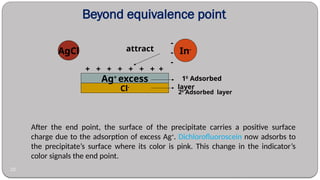
Beyond equivalence point
Cl-
In-
-
-
-
AgCl
Ag+
excess10
Adsorbed
layer
+ + + + + + + +
attract
20
Adsorbed layer
After the end point, the surface of the precipitate carries a positive surface
charge due to the adsorption of excess Ag+
. Dichlorofluoroscein now adsorbs to
the precipitate’s surface where its color is pink. This change in the indicator’s
color signals the end point.
23.
This willattract the indicator anion and adsorb it in the counter layer:
AgCl: Ag+
:: In-
• The color of the adsorbed indicator is different from that of the
unadsorbed indicator and this difference, signals the completion of
the titration
Fajan Method (Adsorption Method)
24.
• This colorchange is due to the indicator forms a colored complex
with Ag+
, which is too weak to exist in solution but where its
formation is facilitated by adsorption on the surface of the precipitate
(it becomes “insoluble”)
• The pH is also important
(1) If it is too low, the indicator which is weak acid, will dissociate too
little to allow it to be adsorbed as the anion
(2) If the indicator is too strong adsorbed at the given pH, it will
displace the anion of the precipitate (eg. Cl-
) in the primary layer
before equivalence point is reached
Fajan Method (Adsorption Method)
25.
Eg:
• Anion Br-
formsa more soluble precipitate with Ag+
and is more strongly
adsorbed
Hence, a more strongly adsorbed indicator can be used
• The degree of adsorption of indicator can be decreased by increasing the acidity
• The stronger an acid the indicator is , the wider the pH range over which it can be
adsorbed
• In the case of Br-
, using a more acidic (more strongly adsorbed) indicator, the pH
of the titration can be more acidic than with Cl-
Fajan Method (Adsorption Method)
Examples
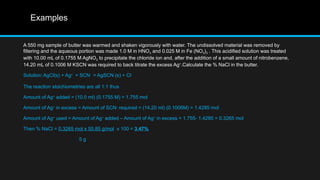
A 550 mgsample of butter was warmed and shaken vigorously with water. The undissolved material was removed by
filtering and the aqueous portion was made 1.0 M in HNO3 and 0.025 M in Fe (NO3)3 . This acidified solution was treated
with 10.00 mL of 0.1755 M AgNO3 to precipitate the chloride ion and, after the addition of a small amount of nitrobenzene,
14.20 mL of 0.1006 M KSCN was required to back titrate the excess Ag+
.Calculate the % NaCl in the butter.
Solution:AgCl(s) + Ag+
+ SCN-
= AgSCN (s) + Cl-
The reaction stoichiometries are all 1:1 thus
Amount of Ag+
added = (10.0 ml) (0.1755 M) = 1.755 mol
Amount of Ag+
in excess = Amount of SCN-
required = (14.20 ml) (0.1006M) = 1.4285 mol
Amount of Ag+
used = Amount of Ag+
added – Amount of Ag+
in excess = 1.755- 1.4285 = 0.3265 mol
Then % NaCl = 0.3265 mol x 55.85 g/mol x 100 = 3.47%
5 g
28.
Exercise 1: A0.32 g sample containing KCl ( mw = 74.6 ) is dissolved in 50 mL of
water and titrated to the Ag2CrO4 end point, requiring 16.9 mL of 0.1 M AgNO3. A
blank titration requires 0.7 mL of titrant to reach the same end point. Report the %w/w
KCl in the sample ?
Exercise 2: The %w/w I– in a 0.6712-g sample was determined by a Volhard titration.
After adding 50 mL of 0.05619 M AgNO3 and allowing the precipitate to form, the
remaining silver was back titrated with 0.05322 M KSCN, requiring 35.14 mL to reach
the end point. Report the %w/w I– ( aw = 126.9 ) in the sample ?
Exercise 3: Chloride in a brine solution is determined by the Volhard’s method. A
10.00- mL aliquot of the solution is treated with 15.0 mL of standard 0.1182 M AgNO3
solution. The excess silver is titrated with standard 0.101 M KSCN solution, requiring
2.38 mL to reach the red Fe(SCN)2+
end point. Calculate the concentration of
chloride in the brine solution in g/L
Exercises
Editor's Notes
#3 This is the question that your experiment answers
#21 In the Fajans method for Cl– using Ag+ as a titrant, for example, the anionic dye dichlorofluoroscein is added to the analyt’s solution. Before the end point, the precipitate of AgCl has a negative surface charge due to the adsorption of excess Cl–. Because dichlorofluoroscein also carries a negative charge, it is repelled by the precipitate and remains in solution where it has a greenish-yellow color
VIDEO
#22 After the end point, the surface of the precipitate carries a positive surface charge due to the adsorption of excess Ag+. Dichlorofluoroscein now adsorbs to the precipitate’s surface where its color is pink. This change in the indicator’s color signals the end point.


![Characteristics of Precipitation Titration
In these titrations, there is an abrupt
decrease in analyte concentration and
increase in titrant concentration at the
equivalence point. Therefore, a plot of
log[analyte] or log[titrant] versus volume
of the titrant added typically gives an S –
shaped titration curve with the break at
the equivalence point. The end point
(experimental determination of the
equivalence point) is found by graphical
analysis of the break or by indicators.](https://image.slidesharecdn.com/chapter10precipitationtitration-250629092405-8336724b/85/Chapter-10-Precipitation-Titration-for-engineering-students-7-320.jpg)


![• Therefore, AgCl is formed first and after all Cl-
is consumed, the first drop of Ag+ in
excess will react with the chromate indicator giving a reddish precipitate.
• The molar solubility of silver chromate is nearly 5 times that of silver chloride. As a
result silver chloride precipitate first in the titration flask.
• Concentration of the indicator is important
• The Ag2CrO4 should just start precipitating at the equivalence point, where we have
a saturated solution of AgCl
• From Ksp (AgCl) , [Ag+
] at equivalence point is 10-5
M
• So Ag2CrO4 should precipitate just when [Ag+
] = 10-5
M
Mohr Method](https://image.slidesharecdn.com/chapter10precipitationtitration-250629092405-8336724b/85/Chapter-10-Precipitation-Titration-for-engineering-students-12-320.jpg)
![ From Ksp of (Ag2CrO4) = 1.1 x 10⁻¹²
, the concentration of CrO4
2-
, [CrO4
2-
] where precipitation of
Ag2CrO4 just started can be calculated:
Ksp (Ag2CrO4) = [Ag+
]2
[CrO4
2-
]
[CrO4
2-
] = 1.1 x 10-12
= 1.1 x 10⁻²
(10-5
)2
= 0.011 M
If [CrO4
2-
] > 0.011 M , Ag2CrO4 will begin to precipitate when [Ag+
] < 10-5
M (before equivalence
point)
If [CrO4
2-
] < 0.011 M , then [Ag+
] will have to exceed 10-5
M (beyond the equivalence point) before
precipitation of Ag2CrO4 begins
Mohr Method](https://image.slidesharecdn.com/chapter10precipitationtitration-250629092405-8336724b/85/Chapter-10-Precipitation-Titration-for-engineering-students-13-320.jpg)