BIOSENSORS
Prepared by:
Ms. Harshada R. Bafna.
M. Pharm (Quality Assurances)
1
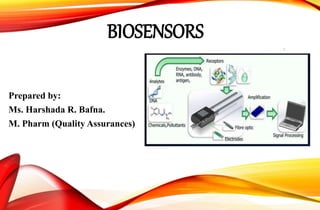
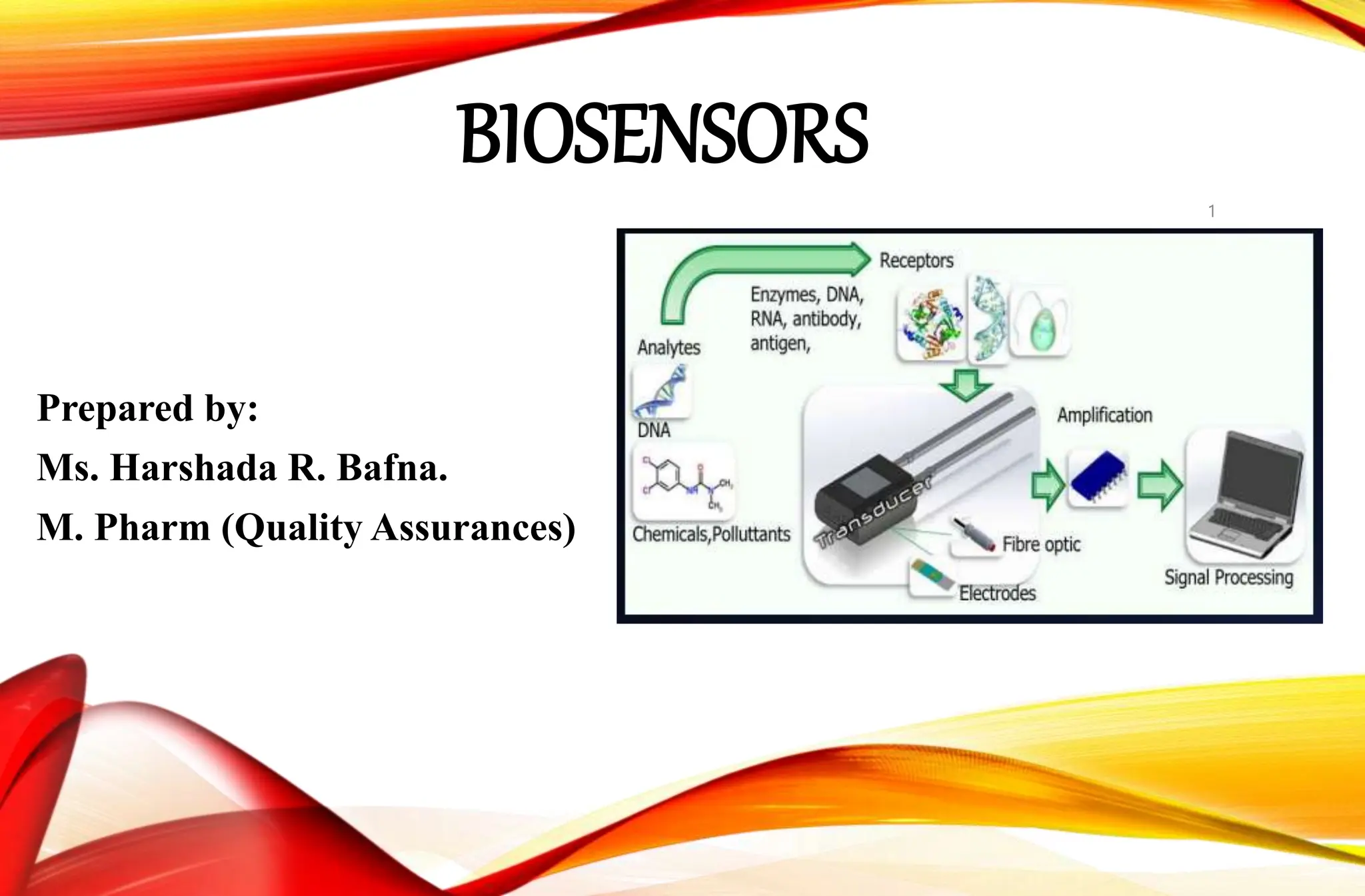
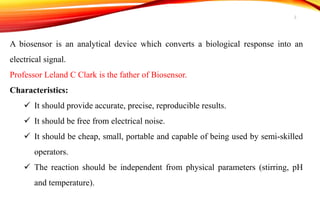
A biosensor is an analytical device which converts a biological response into an
electrical signal.
Professor Leland C Clark is the father of Biosensor.
Characteristics:
 It should provide accurate, precise, reproducible results.
 It should be free from electrical noise.
 It should be cheap, small, portable and capable of being used by semi-skilled
operators.
 The reaction should be independent from physical parameters (stirring, pH
and temperature).
2
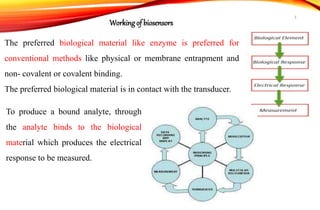
The preferred biological material like enzyme is preferred for
conventional methods like physical or membrane entrapment and
non- covalent or covalent binding.
The preferred biological material is in contact with the transducer.
Working of biosensors
To produce a bound analyte, through
the analyte binds to the biological
material which produces the electrical
response to be measured.
3
4
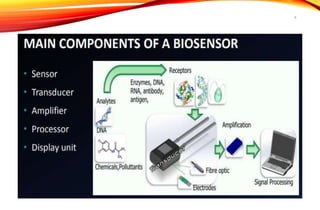
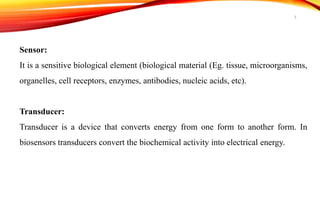
Sensor:
It is a sensitive biological element (biological material (Eg. tissue, microorganisms,
organelles, cell receptors, enzymes, antibodies, nucleic acids, etc).
Transducer:
Transducer is a device that converts energy from one form to another form. In
biosensors transducers convert the biochemical activity into electrical energy.
5
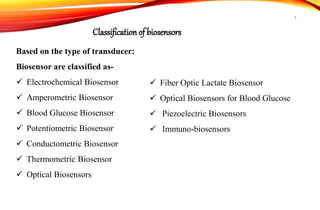
Based on the type of transducer:
Biosensor are classified as-
 Electrochemical Biosensor
 Amperometric Biosensor
 Blood Glucose Biosensor
 Potentiometric Biosensor
 Conductometric Biosensor
 Thermometric Biosensor
 Optical Biosensors
 Fiber Optic Lactate Biosensor
 Optical Biosensors for Blood Glucose
 Piezoelectric Biosensors
 Immuno-biosensors
Classificationof biosensors
6
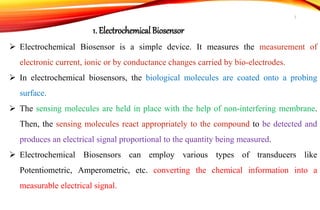
 Electrochemical Biosensor is a simple device. It measures the measurement of
electronic current, ionic or by conductance changes carried by bio-electrodes.
 In electrochemical biosensors, the biological molecules are coated onto a probing
surface.
 The sensing molecules are held in place with the help of non-interfering membrane.
Then, the sensing molecules react appropriately to the compound to be detected and
produces an electrical signal proportional to the quantity being measured.
 Electrochemical Biosensors can employ various types of transducers like
Potentiometric, Amperometric, etc. converting the chemical information into a
measurable electrical signal.
1. Electrochemical Biosensor
7
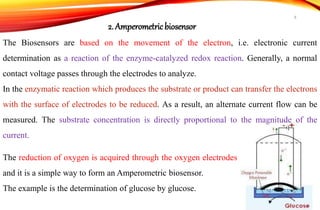
The Biosensors are based on the movement of the electron, i.e. electronic current
determination as a reaction of the enzyme-catalyzed redox reaction. Generally, a normal
contact voltage passes through the electrodes to analyze.
In the enzymatic reaction which produces the substrate or product can transfer the electrons
with the surface of electrodes to be reduced. As a result, an alternate current flow can be
measured. The substrate concentration is directly proportional to the magnitude of the
current.
2. Amperometricbiosensor
The reduction of oxygen is acquired through the oxygen electrodes
and it is a simple way to form an Amperometric biosensor.
The example is the determination of glucose by glucose.
8
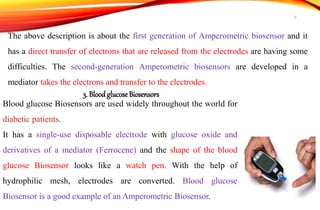
Blood glucose Biosensors are used widely throughout the world for
diabetic patients.
It has a single-use disposable electrode with glucose oxide and
derivatives of a mediator (Ferrocene) and the shape of the blood
glucose Biosensor looks like a watch pen. With the help of
hydrophilic mesh, electrodes are converted. Blood glucose
Biosensor is a good example of an Amperometric Biosensor.
3. Bloodglucose Biosensors
The above description is about the first generation of Amperometric biosensor and it
has a direct transfer of electrons that are released from the electrodes are having some
difficulties. The second-generation Amperometric biosensors are developed in a
mediator takes the electrons and transfer to the electrodes.
9
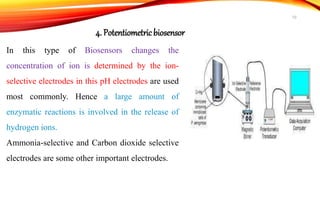
In this type of Biosensors changes the
concentration of ion is determined by the ion-
selective electrodes in this pH electrodes are used
most commonly. Hence a large amount of
enzymatic reactions is involved in the release of
hydrogen ions.
Ammonia-selective and Carbon dioxide selective
electrodes are some other important electrodes.
4. Potentiometricbiosensor
10
The Potentiometric electrode and the reference electrode can be measured with the help
of potential difference and it is directly proportional to the substrate concentration.
The Potentiometric Biosensors is the sensitivity of enzymes to ionic concentration like
H+ and NH+4.
The ion-selective field-effect transistors (ISFET) are lower-price devices. It is measured
the ion concentration in the solution. It can be used in the miniaturization (to
manufacture smaller mechanical, optical and electronic product and devices) of
Potentiometric Biosensors.
An example of the ISFET Biosensor is to monitor intra-myocardial for open-heart
surgery.
11
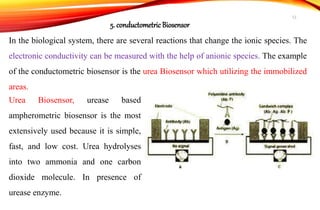
In the biological system, there are several reactions that change the ionic species. The
electronic conductivity can be measured with the help of anionic species. The example
of the conductometric biosensor is the urea Biosensor which utilizing the immobilized
areas.
5. conductometricBiosensor
Urea Biosensor, urease based
ampherometric biosensor is the most
extensively used because it is simple,
fast, and low cost. Urea hydrolyses
into two ammonia and one carbon
dioxide molecule. In presence of
urease enzyme.
12
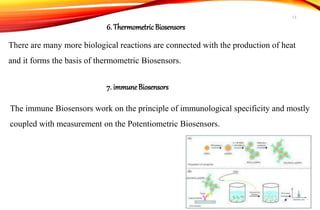
There are many more biological reactions are connected with the production of heat
and it forms the basis of thermometric Biosensors.
6. Thermometric Biosensors
7. immuneBiosensors
The immune Biosensors work on the principle of immunological specificity and mostly
coupled with measurement on the Potentiometric Biosensors.
13
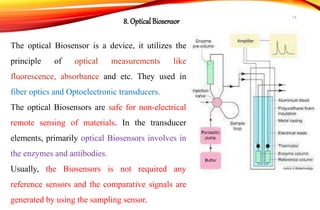
The optical Biosensor is a device, it utilizes the
principle of optical measurements like
fluorescence, absorbance and etc. They used in
fiber optics and Optoelectronic transducers.
The optical Biosensors are safe for non-electrical
remote sensing of materials. In the transducer
elements, primarily optical Biosensors involves in
the enzymes and antibodies.
Usually, the Biosensors is not required any
reference sensors and the comparative signals are
generated by using the sampling sensor.
8. Optical Biosensor
14
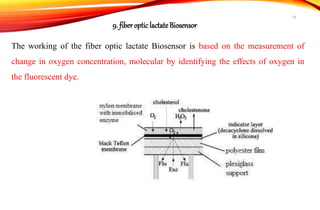
The working of the fiber optic lactate Biosensor is based on the measurement of
change in oxygen concentration, molecular by identifying the effects of oxygen in
the fluorescent dye.
9. fiberoptic lactateBiosensor
15
The enzyme glucose oxiadase is used by blood glucose biosensor to break down of
blood glucose.
First it oxidizes glucose and uses two electrons to reduce the FAD (a component of
the enzyme) to FADH2 which in turn is oxidized by the electrode in a number of
steps.
The resulting current is a measure of the concentration of glucose. In this case, the
electrode is the transducer and the enzyme is the bioreceptor.
10. OpticalBiosensor for bloodglucose level
16
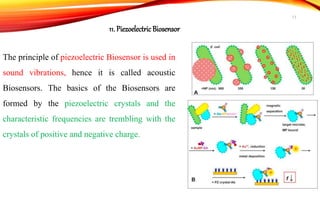
The principle of piezoelectric Biosensor is used in
sound vibrations, hence it is called acoustic
Biosensors. The basics of the Biosensors are
formed by the piezoelectric crystals and the
characteristic frequencies are trembling with the
crystals of positive and negative charge.
11. Piezoelectric Biosensor
17
Applicationof biosensors
 Food analysis
 Study of Biomolecules and their interactions
 Drug development, crime detection
 Medical diagnosis
 Environmental field monitoring
 Industrial process control
 Manufacturing of pharmaceuticals and replacement of organs.
18
1. Medicine, Clinical and Diagnostic Applications:
 The main area of interest of Biosensor is the Medicine, Clinical and Diagnostics
applications.
 Electrochemical based Biosensors are commonly used in biochemical labs and clinics
to monitor and measure glucose levels as well as lactic acid.
 Biosensors with sensing elements for nitrates and phosphates are becoming common
for battling water pollutants.
 Another important application is for the military to detect chemicals and hazardous
biological specimens that can be used a bio-weapons.
19
2. Industrial Applications:
 Fermentation is a large industrial operation used in dairy, alcohol and other similar
products.
 Large scale Bacteria and cell culture must be maintained for this purpose.
 Biosensors are designed to monitor and measure the generation of a fermented
product.
3. Food Industry:
 Biosensors are used in food industry for food quality control for measurement of
amino acids, carbohydrates, alcohols, gases, etc.
 Some of the common food industries are Wine, Beer, Yogurt, soft drinks etc.
20
3. Agriculture Industry: Biosensors in the field of agriculture are generally used for
detection of pesticides.
4. Microbial biosensors: Example is arsenic biosensor
5. DNA biosensors: they can be used for medical diagnostics and agriculture.
6. Glucose monitoring: Glucose monitors are based on amphoteric sensing of glucose
by glucose oxidase. Hydrogen peroxide is produced, which is detected by the electrode.
21
22

3. Introduction about the Biosensors.pptx

  • 1.
    BIOSENSORS Prepared by: Ms. HarshadaR. Bafna. M. Pharm (Quality Assurances) 1
  • 2.
    A biosensor isan analytical device which converts a biological response into an electrical signal. Professor Leland C Clark is the father of Biosensor. Characteristics:  It should provide accurate, precise, reproducible results.  It should be free from electrical noise.  It should be cheap, small, portable and capable of being used by semi-skilled operators.  The reaction should be independent from physical parameters (stirring, pH and temperature). 2
  • 3.
    The preferred biologicalmaterial like enzyme is preferred for conventional methods like physical or membrane entrapment and non- covalent or covalent binding. The preferred biological material is in contact with the transducer. Working of biosensors To produce a bound analyte, through the analyte binds to the biological material which produces the electrical response to be measured. 3
  • 4.
  • 5.
    Sensor: It is asensitive biological element (biological material (Eg. tissue, microorganisms, organelles, cell receptors, enzymes, antibodies, nucleic acids, etc). Transducer: Transducer is a device that converts energy from one form to another form. In biosensors transducers convert the biochemical activity into electrical energy. 5
  • 6.
    Based on thetype of transducer: Biosensor are classified as-  Electrochemical Biosensor  Amperometric Biosensor  Blood Glucose Biosensor  Potentiometric Biosensor  Conductometric Biosensor  Thermometric Biosensor  Optical Biosensors  Fiber Optic Lactate Biosensor  Optical Biosensors for Blood Glucose  Piezoelectric Biosensors  Immuno-biosensors Classificationof biosensors 6
  • 7.
     Electrochemical Biosensoris a simple device. It measures the measurement of electronic current, ionic or by conductance changes carried by bio-electrodes.  In electrochemical biosensors, the biological molecules are coated onto a probing surface.  The sensing molecules are held in place with the help of non-interfering membrane. Then, the sensing molecules react appropriately to the compound to be detected and produces an electrical signal proportional to the quantity being measured.  Electrochemical Biosensors can employ various types of transducers like Potentiometric, Amperometric, etc. converting the chemical information into a measurable electrical signal. 1. Electrochemical Biosensor 7
  • 8.
    The Biosensors arebased on the movement of the electron, i.e. electronic current determination as a reaction of the enzyme-catalyzed redox reaction. Generally, a normal contact voltage passes through the electrodes to analyze. In the enzymatic reaction which produces the substrate or product can transfer the electrons with the surface of electrodes to be reduced. As a result, an alternate current flow can be measured. The substrate concentration is directly proportional to the magnitude of the current. 2. Amperometricbiosensor The reduction of oxygen is acquired through the oxygen electrodes and it is a simple way to form an Amperometric biosensor. The example is the determination of glucose by glucose. 8
  • 9.
    Blood glucose Biosensorsare used widely throughout the world for diabetic patients. It has a single-use disposable electrode with glucose oxide and derivatives of a mediator (Ferrocene) and the shape of the blood glucose Biosensor looks like a watch pen. With the help of hydrophilic mesh, electrodes are converted. Blood glucose Biosensor is a good example of an Amperometric Biosensor. 3. Bloodglucose Biosensors The above description is about the first generation of Amperometric biosensor and it has a direct transfer of electrons that are released from the electrodes are having some difficulties. The second-generation Amperometric biosensors are developed in a mediator takes the electrons and transfer to the electrodes. 9
  • 10.
    In this typeof Biosensors changes the concentration of ion is determined by the ion- selective electrodes in this pH electrodes are used most commonly. Hence a large amount of enzymatic reactions is involved in the release of hydrogen ions. Ammonia-selective and Carbon dioxide selective electrodes are some other important electrodes. 4. Potentiometricbiosensor 10
  • 11.
    The Potentiometric electrodeand the reference electrode can be measured with the help of potential difference and it is directly proportional to the substrate concentration. The Potentiometric Biosensors is the sensitivity of enzymes to ionic concentration like H+ and NH+4. The ion-selective field-effect transistors (ISFET) are lower-price devices. It is measured the ion concentration in the solution. It can be used in the miniaturization (to manufacture smaller mechanical, optical and electronic product and devices) of Potentiometric Biosensors. An example of the ISFET Biosensor is to monitor intra-myocardial for open-heart surgery. 11
  • 12.
    In the biologicalsystem, there are several reactions that change the ionic species. The electronic conductivity can be measured with the help of anionic species. The example of the conductometric biosensor is the urea Biosensor which utilizing the immobilized areas. 5. conductometricBiosensor Urea Biosensor, urease based ampherometric biosensor is the most extensively used because it is simple, fast, and low cost. Urea hydrolyses into two ammonia and one carbon dioxide molecule. In presence of urease enzyme. 12
  • 13.
    There are manymore biological reactions are connected with the production of heat and it forms the basis of thermometric Biosensors. 6. Thermometric Biosensors 7. immuneBiosensors The immune Biosensors work on the principle of immunological specificity and mostly coupled with measurement on the Potentiometric Biosensors. 13
  • 14.
    The optical Biosensoris a device, it utilizes the principle of optical measurements like fluorescence, absorbance and etc. They used in fiber optics and Optoelectronic transducers. The optical Biosensors are safe for non-electrical remote sensing of materials. In the transducer elements, primarily optical Biosensors involves in the enzymes and antibodies. Usually, the Biosensors is not required any reference sensors and the comparative signals are generated by using the sampling sensor. 8. Optical Biosensor 14
  • 15.
    The working ofthe fiber optic lactate Biosensor is based on the measurement of change in oxygen concentration, molecular by identifying the effects of oxygen in the fluorescent dye. 9. fiberoptic lactateBiosensor 15
  • 16.
    The enzyme glucoseoxiadase is used by blood glucose biosensor to break down of blood glucose. First it oxidizes glucose and uses two electrons to reduce the FAD (a component of the enzyme) to FADH2 which in turn is oxidized by the electrode in a number of steps. The resulting current is a measure of the concentration of glucose. In this case, the electrode is the transducer and the enzyme is the bioreceptor. 10. OpticalBiosensor for bloodglucose level 16
  • 17.
    The principle ofpiezoelectric Biosensor is used in sound vibrations, hence it is called acoustic Biosensors. The basics of the Biosensors are formed by the piezoelectric crystals and the characteristic frequencies are trembling with the crystals of positive and negative charge. 11. Piezoelectric Biosensor 17
  • 18.
    Applicationof biosensors  Foodanalysis  Study of Biomolecules and their interactions  Drug development, crime detection  Medical diagnosis  Environmental field monitoring  Industrial process control  Manufacturing of pharmaceuticals and replacement of organs. 18
  • 19.
    1. Medicine, Clinicaland Diagnostic Applications:  The main area of interest of Biosensor is the Medicine, Clinical and Diagnostics applications.  Electrochemical based Biosensors are commonly used in biochemical labs and clinics to monitor and measure glucose levels as well as lactic acid.  Biosensors with sensing elements for nitrates and phosphates are becoming common for battling water pollutants.  Another important application is for the military to detect chemicals and hazardous biological specimens that can be used a bio-weapons. 19
  • 20.
    2. Industrial Applications: Fermentation is a large industrial operation used in dairy, alcohol and other similar products.  Large scale Bacteria and cell culture must be maintained for this purpose.  Biosensors are designed to monitor and measure the generation of a fermented product. 3. Food Industry:  Biosensors are used in food industry for food quality control for measurement of amino acids, carbohydrates, alcohols, gases, etc.  Some of the common food industries are Wine, Beer, Yogurt, soft drinks etc. 20
  • 21.
    3. Agriculture Industry:Biosensors in the field of agriculture are generally used for detection of pesticides. 4. Microbial biosensors: Example is arsenic biosensor 5. DNA biosensors: they can be used for medical diagnostics and agriculture. 6. Glucose monitoring: Glucose monitors are based on amphoteric sensing of glucose by glucose oxidase. Hydrogen peroxide is produced, which is detected by the electrode. 21
  • 22.