Gita Ayu Wandari 1404850
Nabilah Kinanti Putri 1401908
Nelah Roswati 1404734
ARGENTROMETRIC TITRATION
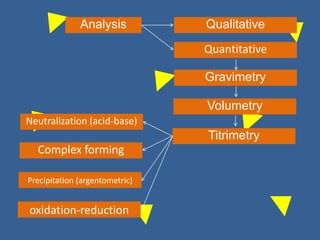
Analysis Qualitative
Quantitative
Gravimetry
Volumetry
Titrimetry
Neutralization (acid-base)
Complex forming
Precipitation (argentometric)
oxidation-reduction
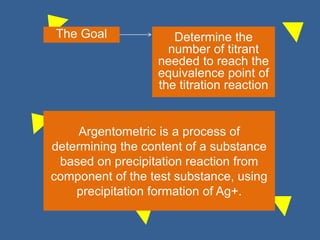
The Goal Determine the
number of titrant
needed to reach the
equivalence point of
the titration reaction
Argentometric is a process of
determining the content of a substance
based on precipitation reaction from
component of the test substance, using
precipitation formation of Ag+.
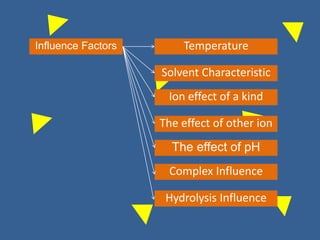
Influence Factors Temperature
Solvent Characteristic
Ion effect of a kind
The effect of other ion
The effect of pH
Complex Influence
Hydrolysis Influence
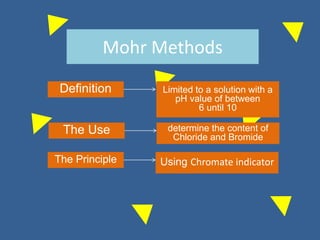
Mohr Methods
Definition
The Use
Limited to a solution with a
pH value of between
6 until 10
determine the content of
Chloride and Bromide
The Principle Using Chromate indicator
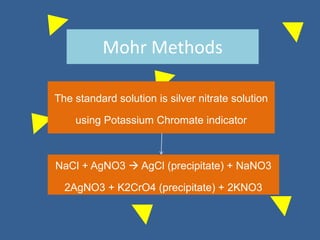
Mohr Methods
The standard solution is silver nitrate solution
using Potassium Chromate indicator
NaCl + AgNO3  AgCl (precipitate) + NaNO3
2AgNO3 + K2CrO4 (precipitate) + 2KNO3
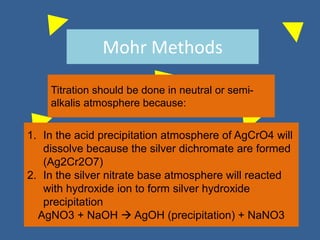
Mohr Methods
Titration should be done in neutral or semi-
alkalis atmosphere because:
1. In the acid precipitation atmosphere of AgCrO4 will
dissolve because the silver dichromate are formed
(Ag2Cr2O7)
2. In the silver nitrate base atmosphere will reacted
with hydroxide ion to form silver hydroxide
precipitation
AgNO3 + NaOH  AgOH (precipitation) + NaNO3
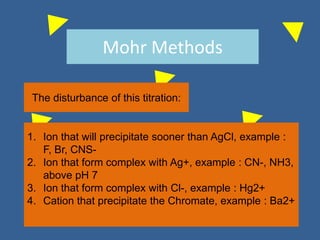
Mohr Methods
The disturbance of this titration:
1. Ion that will precipitate sooner than AgCl, example :
F, Br, CNS-
2. Ion that form complex with Ag+, example : CN-, NH3,
above pH 7
3. Ion that form complex with Cl-, example : Hg2+
4. Cation that precipitate the Chromate, example : Ba2+
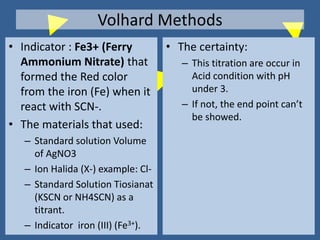
Volhard Methods
• Indicator : Fe3+ (Ferry
Ammonium Nitrate) that
formed the Red color
from the iron (Fe) when it
react with SCN-.
• The materials that used:
– Standard solution Volume
of AgNO3
– Ion Halida (X-) example: Cl-
– Standard Solution Tiosianat
(KSCN or NH4SCN) as a
titrant.
– Indicator iron (III) (Fe3+).
• The certainty:
– This titration are occur in
Acid condition with pH
under 3.
– If not, the end point can’t
be showed.
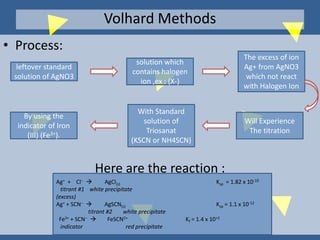
• Process:
Here are the reaction :
Volhard Methods
leftover standard
solution of AgNO3
solution which
contains halogen
ion ,ex : (X-)
The excess of ion
Ag+ from AgNO3
which not react
with Halogen Ion
Will Experience
The titration
With Standard
solution of
Triosanat
(KSCN or NH4SCN)
By using the
indicator of Iron
(III) (Fe3+).
Ag+ + Cl  AgCl(s) Ksp = 1.82 x 10⁻¹⁰
titrant #1 white precipitate
(excess)
Ag+ + SCN  AgSCN(s) Ksp = 1.1 x 10⁻¹²
titrant #2 white precipitate
Fe3+ + SCN  FeSCN2+ Kf = 1.4 x 10+2
indicator red precipitate
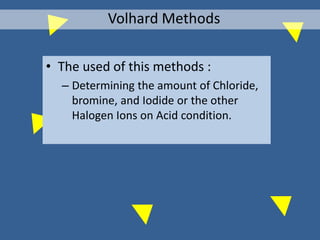
• The used of this methods :
– Determining the amount of Chloride,
bromine, and Iodide or the other
Halogen Ions on Acid condition.
Volhard Methods
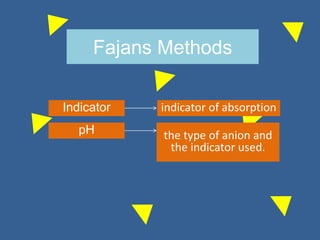
Fajans Methods
Indicator
pH
indicator of absorption
the type of anion and
the indicator used.
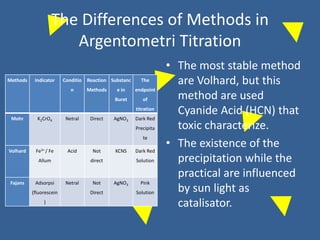
The Differences of Methods in
Argentometri Titration
Methods Indicator Conditio
n
Reaction
Methods
Substanc
e in
Buret
The
endpoint
of
titration
Mohr K2CrO4 Netral Direct AgNO3 Dark Red
Precipita
te
Volhard Fe3+ / Fe
Allum
Acid Not
direct
KCNS Dark Red
Solution
Fajans Adsorpsi
(fluorescein
)
Netral Not
Direct
AgNO3 Pink
Solution
• The most stable method
are Volhard, but this
method are used
Cyanide Acid (HCN) that
toxic characterize.
• The existence of the
precipitation while the
practical are influenced
by sun light as
catalisator.
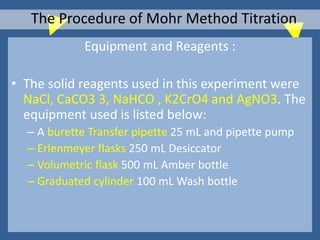
Equipment and Reagents :
• The solid reagents used in this experiment were
NaCl, CaCO3 3, NaHCO , K2CrO4 and AgNO3. The
equipment used is listed below:
– A burette Transfer pipette 25 mL and pipette pump
– Erlenmeyer flasks 250 mL Desiccator
– Volumetric flask 500 mL Amber bottle
– Graduated cylinder 100 mL Wash bottle
The Procedure of Mohr Method Titration
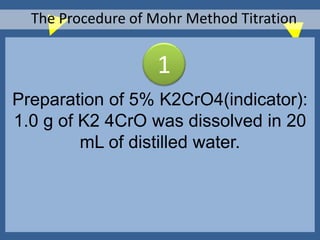
Preparation of 5% K2CrO4(indicator):
1.0 g of K2 4CrO was dissolved in 20
mL of distilled water.
The Procedure of Mohr Method Titration
1
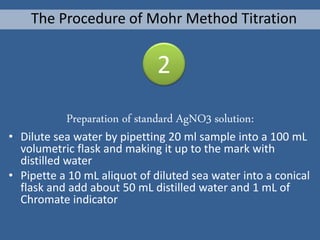
Preparation of standard AgNO3 solution:
• Dilute sea water by pipetting 20 ml sample into a 100 mL
volumetric flask and making it up to the mark with
distilled water
• Pipette a 10 mL aliquot of diluted sea water into a conical
flask and add about 50 mL distilled water and 1 mL of
Chromate indicator
The Procedure of Mohr Method Titration
2
Preparation of standard AgNO3 solution:
• Titrate the sample with 0.1 mole Liter -1 silver nitrate solution. Although the
silver chloride that forms is a white precipitate, the chromate indicator initially
gift the cloudy solution faint lemon-yellow color.
• The endpoint of the titration is identified as the first appearance of a red-brown
color of silver chromate
• Repeat the titration with further aliquots of diluted sea water until concordant
result (tetras agreeing within 0.1 mL) are obtained.
The Procedure of Mohr Method Titration
2
• Mohr Methods
– In the precipitation of chloride by silver ion, chromate
ion (CrO4
2) is used as an indicator in the formation of
Ag2CrO4, a reddish-brown precipitate formed when
excess Ag+ is present.
– The concentration of titrant rises sharply near the
equivalence point, and the solubility of Ag2CrO4 is
exceeded
– Limitation : The concentration of titrant rises sharply
near the equivalence point, and the solubility of
Ag2CrO4 is exceeded, and it has to be avoid from direct
sunlight or neon light, because silver nitrate solution is
sensitive to the light (Photochemistry reduction).
Discussion
• Volhard Methods
–Determination of Cl . For titration of silver ion
with thiocyanate (SCN) and iron(III) as an
indicator.
–The endpoint is routinely used for halide
determinations where a known excess of silver
ion is added to precipitate the halide ion.
–The titration is usually done in acidic pH
medium to prevent precipitation of iron
hydroxides, Fe(OH)3.
Discussion
• Fajans Methods
– Adsorption indicators are organic compounds that tend to
be adsorbed onto the surface of the solid precipitate in a
precipitation titration.
– Adsorption indicators work best when:
• They do not precipitate out silver ion when the indicators are at
low concentration.
• They bind to the precipitate only when excess silver ion is present
to produce color.
– Example of Adsorption Indicators: Fluorescein
– The limitations of Fajans Method :
• It has to be performed at near neutral pH values
• The endpoint determination is operator-dependent
• It cannot be easily automated
Discussion
Conclusion
• Titrations with Ag+ are called argentometric titrations.
• For argentometric titrations, three classical methods
based on color indicators can be used for end point
detection:
• Mohr titration – formation of colored precipitate at the
end point.
Conclusion
• Volhard titration – formation of a soluble,
colored complex at the end point.
• Fajans titration – adsorption of a colored
indicator on the precipitate at the end point.
References
• Marshall Cavendish Education. (2014). Qualitative Analysis of Anion
and Cation. Retrieved from https://www.mceducation.sg/resource-
for-parents/more-tips/secondary-science/understanding-
qualitative-analysis-experiments
• Anne Marie Helmenstine Ph.D. (2015). Quantitative Analysis
Definition. About Education. Retrieved from
http://chemistry.about.com/od/chemistryglossary/a/quantitativede
f.htm
• What is a Titration. Retrieved from
http://chemed.chem.purdue.edu/genchem/lab/techniques/titratio
n/what.html
• University of Canterbury. Determination of Chloride Ion
Concentration by Titration (Mohr’s Method). Retrieved from
http://www.outreach.canterbury.ac.nz/chemistry/documents/chlori
de_mohr.pdf
THANK YOU

Argentometric Titration

  • 1.
    Gita Ayu Wandari1404850 Nabilah Kinanti Putri 1401908 Nelah Roswati 1404734 ARGENTROMETRIC TITRATION
  • 2.
  • 3.
    The Goal Determinethe number of titrant needed to reach the equivalence point of the titration reaction Argentometric is a process of determining the content of a substance based on precipitation reaction from component of the test substance, using precipitation formation of Ag+.
  • 4.
    Influence Factors Temperature SolventCharacteristic Ion effect of a kind The effect of other ion The effect of pH Complex Influence Hydrolysis Influence
  • 5.
    Mohr Methods Definition The Use Limitedto a solution with a pH value of between 6 until 10 determine the content of Chloride and Bromide The Principle Using Chromate indicator
  • 6.
    Mohr Methods The standardsolution is silver nitrate solution using Potassium Chromate indicator NaCl + AgNO3  AgCl (precipitate) + NaNO3 2AgNO3 + K2CrO4 (precipitate) + 2KNO3
  • 7.
    Mohr Methods Titration shouldbe done in neutral or semi- alkalis atmosphere because: 1. In the acid precipitation atmosphere of AgCrO4 will dissolve because the silver dichromate are formed (Ag2Cr2O7) 2. In the silver nitrate base atmosphere will reacted with hydroxide ion to form silver hydroxide precipitation AgNO3 + NaOH  AgOH (precipitation) + NaNO3
  • 8.
    Mohr Methods The disturbanceof this titration: 1. Ion that will precipitate sooner than AgCl, example : F, Br, CNS- 2. Ion that form complex with Ag+, example : CN-, NH3, above pH 7 3. Ion that form complex with Cl-, example : Hg2+ 4. Cation that precipitate the Chromate, example : Ba2+
  • 9.
    Volhard Methods • Indicator: Fe3+ (Ferry Ammonium Nitrate) that formed the Red color from the iron (Fe) when it react with SCN-. • The materials that used: – Standard solution Volume of AgNO3 – Ion Halida (X-) example: Cl- – Standard Solution Tiosianat (KSCN or NH4SCN) as a titrant. – Indicator iron (III) (Fe3+). • The certainty: – This titration are occur in Acid condition with pH under 3. – If not, the end point can’t be showed.
  • 10.
    • Process: Here arethe reaction : Volhard Methods leftover standard solution of AgNO3 solution which contains halogen ion ,ex : (X-) The excess of ion Ag+ from AgNO3 which not react with Halogen Ion Will Experience The titration With Standard solution of Triosanat (KSCN or NH4SCN) By using the indicator of Iron (III) (Fe3+). Ag+ + Cl  AgCl(s) Ksp = 1.82 x 10⁻¹⁰ titrant #1 white precipitate (excess) Ag+ + SCN  AgSCN(s) Ksp = 1.1 x 10⁻¹² titrant #2 white precipitate Fe3+ + SCN  FeSCN2+ Kf = 1.4 x 10+2 indicator red precipitate
  • 11.
    • The usedof this methods : – Determining the amount of Chloride, bromine, and Iodide or the other Halogen Ions on Acid condition. Volhard Methods
  • 12.
    Fajans Methods Indicator pH indicator ofabsorption the type of anion and the indicator used.
  • 13.
    The Differences ofMethods in Argentometri Titration Methods Indicator Conditio n Reaction Methods Substanc e in Buret The endpoint of titration Mohr K2CrO4 Netral Direct AgNO3 Dark Red Precipita te Volhard Fe3+ / Fe Allum Acid Not direct KCNS Dark Red Solution Fajans Adsorpsi (fluorescein ) Netral Not Direct AgNO3 Pink Solution • The most stable method are Volhard, but this method are used Cyanide Acid (HCN) that toxic characterize. • The existence of the precipitation while the practical are influenced by sun light as catalisator.
  • 14.
    Equipment and Reagents: • The solid reagents used in this experiment were NaCl, CaCO3 3, NaHCO , K2CrO4 and AgNO3. The equipment used is listed below: – A burette Transfer pipette 25 mL and pipette pump – Erlenmeyer flasks 250 mL Desiccator – Volumetric flask 500 mL Amber bottle – Graduated cylinder 100 mL Wash bottle The Procedure of Mohr Method Titration
  • 15.
    Preparation of 5%K2CrO4(indicator): 1.0 g of K2 4CrO was dissolved in 20 mL of distilled water. The Procedure of Mohr Method Titration 1
  • 16.
    Preparation of standardAgNO3 solution: • Dilute sea water by pipetting 20 ml sample into a 100 mL volumetric flask and making it up to the mark with distilled water • Pipette a 10 mL aliquot of diluted sea water into a conical flask and add about 50 mL distilled water and 1 mL of Chromate indicator The Procedure of Mohr Method Titration 2
  • 17.
    Preparation of standardAgNO3 solution: • Titrate the sample with 0.1 mole Liter -1 silver nitrate solution. Although the silver chloride that forms is a white precipitate, the chromate indicator initially gift the cloudy solution faint lemon-yellow color. • The endpoint of the titration is identified as the first appearance of a red-brown color of silver chromate • Repeat the titration with further aliquots of diluted sea water until concordant result (tetras agreeing within 0.1 mL) are obtained. The Procedure of Mohr Method Titration 2
  • 18.
    • Mohr Methods –In the precipitation of chloride by silver ion, chromate ion (CrO4 2) is used as an indicator in the formation of Ag2CrO4, a reddish-brown precipitate formed when excess Ag+ is present. – The concentration of titrant rises sharply near the equivalence point, and the solubility of Ag2CrO4 is exceeded – Limitation : The concentration of titrant rises sharply near the equivalence point, and the solubility of Ag2CrO4 is exceeded, and it has to be avoid from direct sunlight or neon light, because silver nitrate solution is sensitive to the light (Photochemistry reduction). Discussion
  • 19.
    • Volhard Methods –Determinationof Cl . For titration of silver ion with thiocyanate (SCN) and iron(III) as an indicator. –The endpoint is routinely used for halide determinations where a known excess of silver ion is added to precipitate the halide ion. –The titration is usually done in acidic pH medium to prevent precipitation of iron hydroxides, Fe(OH)3. Discussion
  • 20.
    • Fajans Methods –Adsorption indicators are organic compounds that tend to be adsorbed onto the surface of the solid precipitate in a precipitation titration. – Adsorption indicators work best when: • They do not precipitate out silver ion when the indicators are at low concentration. • They bind to the precipitate only when excess silver ion is present to produce color. – Example of Adsorption Indicators: Fluorescein – The limitations of Fajans Method : • It has to be performed at near neutral pH values • The endpoint determination is operator-dependent • It cannot be easily automated Discussion
  • 21.
    Conclusion • Titrations withAg+ are called argentometric titrations. • For argentometric titrations, three classical methods based on color indicators can be used for end point detection: • Mohr titration – formation of colored precipitate at the end point.
  • 22.
    Conclusion • Volhard titration– formation of a soluble, colored complex at the end point. • Fajans titration – adsorption of a colored indicator on the precipitate at the end point.
  • 23.
    References • Marshall CavendishEducation. (2014). Qualitative Analysis of Anion and Cation. Retrieved from https://www.mceducation.sg/resource- for-parents/more-tips/secondary-science/understanding- qualitative-analysis-experiments • Anne Marie Helmenstine Ph.D. (2015). Quantitative Analysis Definition. About Education. Retrieved from http://chemistry.about.com/od/chemistryglossary/a/quantitativede f.htm • What is a Titration. Retrieved from http://chemed.chem.purdue.edu/genchem/lab/techniques/titratio n/what.html • University of Canterbury. Determination of Chloride Ion Concentration by Titration (Mohr’s Method). Retrieved from http://www.outreach.canterbury.ac.nz/chemistry/documents/chlori de_mohr.pdf
  • 24.