ANALYTICAL CHEMISTRY
(Precipitation Titrations)
Dr.S.SURESH
Assistant Professor
Email:avitsureshindia@gmail.com
Precipitation titration
• Titrations with precipitating agents are useful for
determining certain analyte. Example: Cl–
can be
determined when titrated with AgNO3
Determination of chloride
Principle
• Chlorides are present in all types of water resources at
a varying concentration depending on the geo-chemical
conditions in the form of CaCl2, MgCl2 and NaCl.
• Chlorides are introduced into the water resources from
the discharge of effluents from chemical industries,
sewage disposal and seawater intrusion in coastal
region.
• The concentration of chloride ions more than 250 ppm
is not desirable for drinking purpose. The total chloride
ions can be determined by argentometric method.
(Mohr’s Method)
Estimation of chloride (by Mohr’s method)
• In this method Cl‒
ion solution is directly titrated against
AgNO3 using potassium chromate (K2CrO4 ) as the indicator.
AgNO3 + Cl‒
AgCl ↓ + NO3
‒
(in water) (White precipitate)
• At the end point, when all the chloride ions are removed.
The yellow colour of chromate changes into reddish brown
due to the following reaction.
2AgNO3 + K2CrO4 Ag2CrO4 ↓ + 2KNO3
(yellow) (Reddish brown)
Estimation of chloride
Titration
Estimation of Chloride ion:
20 ml of the given water sample is pipette
out into a clean conical flask. 1 ml of
freshly prepared potassium chromate
solution is added as an indicator and
titrated against standard AgNO3 solution
taken in the burette. The end point is the
change of colour from yellow to reddish
brown colour. Repeat the titration for
concordant values.
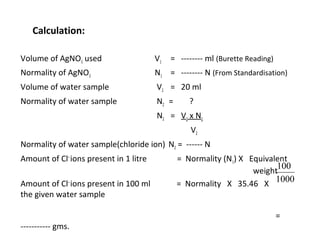
Calculation:
Volume of AgNO3 used V1 = -------- ml (Burette Reading)
Normality of AgNO3 N1 = -------- N (From Standardisation)
Volume of water sample V2 = 20 ml
Normality of water sample N2 = ?
N2 = V1 x N1
V2
Normality of water sample(chloride ion) N2 = ------ N
Amount of Cl–
ions present in 1 litre = Normality (N1) X Equivalent
weight
Amount of Cl–
ions present in 100 ml = Normality X 35.46 X
the given water sample
=
----------- gms.
1000
100
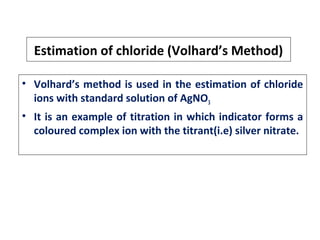
Estimation of chloride (Volhard’s Method)
• Volhard’s method is used in the estimation of chloride
ions with standard solution of AgNO3
• It is an example of titration in which indicator forms a
coloured complex ion with the titrant(i.e) silver nitrate.
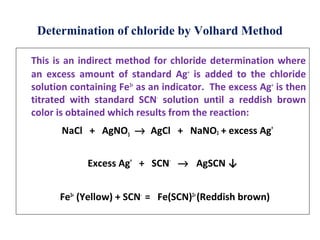
Determination of chloride by Volhard Method
This is an indirect method for chloride determination where
an excess amount of standard Ag+
is added to the chloride
solution containing Fe3+
as an indicator. The excess Ag+
is then
titrated with standard SCN-
solution until a reddish brown
color is obtained which results from the reaction:
NaCl + AgNO3 → AgCl + NaNO3 + excess Ag+
Excess Ag+
+ SCN-
→ AgSCN ↓
Fe3+
(Yellow) + SCN-
= Fe(SCN)2+
(Reddish brown)
Determination of Chloride ion
Preparation of standard ammonium thiocyanate
• By weighing appropriate quantity of ammonium
thiocyanate, its 250ml of 0.1M solution is prepared
in distilled water.
Determination of unknown chloride ions
Given chloride solution is diluted to 250ml using
distilled water. From this 20ml solution is pipetted out
into a conical flask to which 20ml of 0.1M AgNO3 is
added.
After shaking the solution,2ml of nitrobenzene and 5ml
of 30% HNO3 and ferric alum are added as indicator.
It is then titrated with standard NH4SCN till reddish
brown colour is obtained to supernatant solution.
Suppose the reading is ‘x’ ml, Then (20-x)ml will be the
amount of NH4SCN required to precipitate Cl–
ions.
Then the amount of Cl–
ions in given solution can be
calculated.
Precipitation titrations

Precipitation titrations

  • 1.
  • 2.
    Precipitation titration • Titrationswith precipitating agents are useful for determining certain analyte. Example: Cl– can be determined when titrated with AgNO3
  • 3.
    Determination of chloride Principle •Chlorides are present in all types of water resources at a varying concentration depending on the geo-chemical conditions in the form of CaCl2, MgCl2 and NaCl. • Chlorides are introduced into the water resources from the discharge of effluents from chemical industries, sewage disposal and seawater intrusion in coastal region. • The concentration of chloride ions more than 250 ppm is not desirable for drinking purpose. The total chloride ions can be determined by argentometric method. (Mohr’s Method)
  • 4.
    Estimation of chloride(by Mohr’s method) • In this method Cl‒ ion solution is directly titrated against AgNO3 using potassium chromate (K2CrO4 ) as the indicator. AgNO3 + Cl‒ AgCl ↓ + NO3 ‒ (in water) (White precipitate) • At the end point, when all the chloride ions are removed. The yellow colour of chromate changes into reddish brown due to the following reaction. 2AgNO3 + K2CrO4 Ag2CrO4 ↓ + 2KNO3 (yellow) (Reddish brown)
  • 5.
    Estimation of chloride Titration Estimationof Chloride ion: 20 ml of the given water sample is pipette out into a clean conical flask. 1 ml of freshly prepared potassium chromate solution is added as an indicator and titrated against standard AgNO3 solution taken in the burette. The end point is the change of colour from yellow to reddish brown colour. Repeat the titration for concordant values.
  • 6.
    Calculation: Volume of AgNO3used V1 = -------- ml (Burette Reading) Normality of AgNO3 N1 = -------- N (From Standardisation) Volume of water sample V2 = 20 ml Normality of water sample N2 = ? N2 = V1 x N1 V2 Normality of water sample(chloride ion) N2 = ------ N Amount of Cl– ions present in 1 litre = Normality (N1) X Equivalent weight Amount of Cl– ions present in 100 ml = Normality X 35.46 X the given water sample = ----------- gms. 1000 100
  • 7.
    Estimation of chloride(Volhard’s Method) • Volhard’s method is used in the estimation of chloride ions with standard solution of AgNO3 • It is an example of titration in which indicator forms a coloured complex ion with the titrant(i.e) silver nitrate.
  • 8.
    Determination of chlorideby Volhard Method This is an indirect method for chloride determination where an excess amount of standard Ag+ is added to the chloride solution containing Fe3+ as an indicator. The excess Ag+ is then titrated with standard SCN- solution until a reddish brown color is obtained which results from the reaction: NaCl + AgNO3 → AgCl + NaNO3 + excess Ag+ Excess Ag+ + SCN- → AgSCN ↓ Fe3+ (Yellow) + SCN- = Fe(SCN)2+ (Reddish brown)
  • 9.
    Determination of Chlorideion Preparation of standard ammonium thiocyanate • By weighing appropriate quantity of ammonium thiocyanate, its 250ml of 0.1M solution is prepared in distilled water.
  • 10.
    Determination of unknownchloride ions Given chloride solution is diluted to 250ml using distilled water. From this 20ml solution is pipetted out into a conical flask to which 20ml of 0.1M AgNO3 is added. After shaking the solution,2ml of nitrobenzene and 5ml of 30% HNO3 and ferric alum are added as indicator. It is then titrated with standard NH4SCN till reddish brown colour is obtained to supernatant solution. Suppose the reading is ‘x’ ml, Then (20-x)ml will be the amount of NH4SCN required to precipitate Cl– ions. Then the amount of Cl– ions in given solution can be calculated.