The document summarizes an experiment on determining the saponification number of corn and palm oil. The experiment involves hydrolyzing the oils with potassium hydroxide (KOH) and titrating the leftover KOH with hydrochloric acid (HCl). The saponification number, which indicates the chain length of fatty acids in the oils, is higher for corn oil, meaning it has shorter fatty acid chains than palm oil. However, the results of this experiment showed the opposite trend, likely due to errors in the experimental procedure.
In this document
Powered by AI
Introduction of the lipid saponification experiment by Dr. Rosmilah Binti Misnan and team.
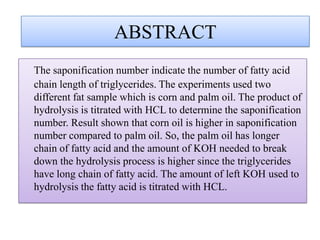
Definition and indication of saponification number using corn and palm oil, showing corn oil has higher numbers.
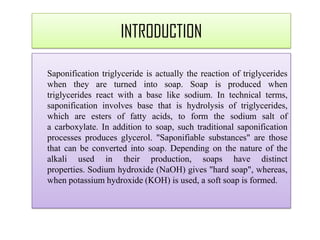
Explains triglyceride reaction to form soap through saponification and the bases used.
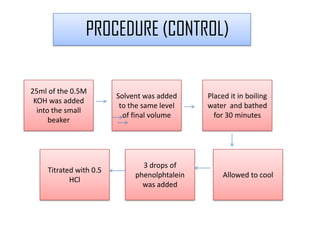
Details steps for the control procedure using KOH in the saponification process.
Similar procedure as the control with the addition of palm oil in the sample.
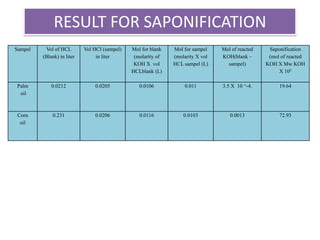
Tabulation of HCl volumes and calculations of mol for palm and corn oil showing higher saponification for corn oil.
Interpretation of results, relationship of fatty acid chain lengths to saponification numbers.
Details the importance of reactant phases and concentrations for effective saponification.
Identifies potential errors in experiment handling and suggests improvements for better yield.
Summary of KOH requirements in relation to fatty acid chain lengths and hydrolysis.
Conclusion that palm oil's saponification number is lower than corn oil indicating longer carbon chains.
Visual aids and data post-hydrolysis for palm oil sample.
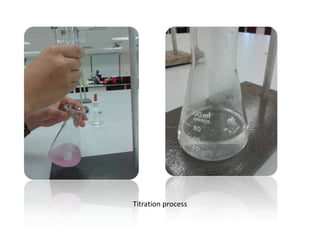
Includes visuals related to the titration process in the experiment.
Citations of sources related to saponification study.
Discusses the practical application of saponification process in soap making.
Overview of soap as sodium salts of fatty acids and the process through saponification.
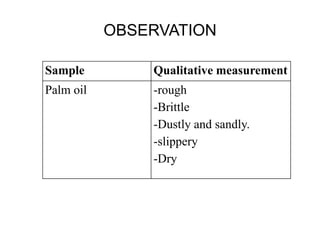
Qualitative properties observed in palm oil soap, noting its texture and characteristics.
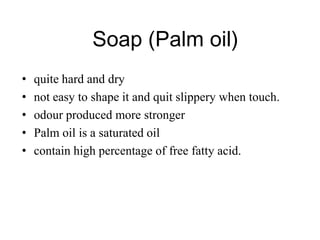
Specific properties of soap made from palm oil, including texture and odor.
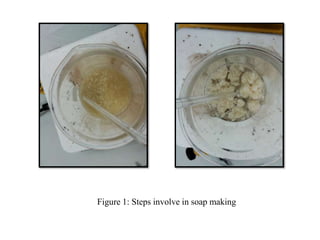
Figure illustrating the step-by-step process in making soap.
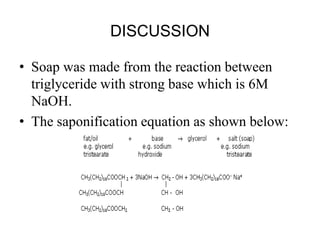
Details of the saponification reaction between triglycerides and strong base.
Explains amphiphilic nature of soap molecules allowing grease and water interaction.
Discussion on how soap interacts with grease and acts as an emulsifier.
Additional references for online resources related to saponification.
ABSTRACT
The saponification numberindicate the number of fatty acid
chain length of triglycerides. The experiments used two
different fat sample which is corn and palm oil. The product of
hydrolysis is titrated with HCL to determine the saponification
number. Result shown that corn oil is higher in saponification
number compared to palm oil. So, the palm oil has longer
chain of fatty acid and the amount of KOH needed to break
down the hydrolysis process is higher since the triglycerides
have long chain of fatty acid. The amount of left KOH used to
hydrolysis the fatty acid is titrated with HCL.
3.
Saponification triglyceride isactually the reaction of triglycerides
when they are turned into soap. Soap is produced when
triglycerides react with a base like sodium. In technical terms,
saponification involves base that is hydrolysis of triglycerides,
which are esters of fatty acids, to form the sodium salt of
a carboxylate. In addition to soap, such traditional saponification
processes produces glycerol. "Saponifiable substances" are those
that can be converted into soap. Depending on the nature of the
alkali used in their production, soaps have distinct
properties. Sodium hydroxide (NaOH) gives "hard soap", whereas,
when potassium hydroxide (KOH) is used, a soft soap is formed.
INTRODUCTION
4.
PROCEDURE (CONTROL)
25ml ofthe 0.5M
KOH was added
into the small
beaker
Solvent was added
to the same level
of final volume
Placed it in boiling
water and bathed
for 30 minutes
Allowed to cool
3 drops of
phenolphtalein
was added
Titrated with 0.5
HCl
5.
25ml of the0.5M
KOH was added
into the small
beaker
4 ml solvent was
added to the same
level of final
volume
Placed it in boiling
water and bathed
for 30 minutes
Allowed to cool
3 drops of
phenolphtalein
was added
Titrated with 0.5
HCl
PROCEDURE (SAMPLE)
Add 1.0 g palm
oil
6.
RESULT FOR SAPONIFICATION
SampelVol of HCL
(Blank) in liter
Vol HCI (sampel)
in liter
Mol for blank
(molarity of
KOH X vol
HCLblank (L)
Mol for sampel
(molarity X vol
HCL sampel (L)
Mol of reacted
KOH(blank –
sampel)
Saponification
(mol of reacted
KOH X Mw KOH
X 103
Palm
oil
0.0212 0.0205 0.0106 0.011 3.5 X 10 ^-4. 19.64
Corn
oil
0.231 0.0206 0.0116 0.0103 0.0013 72.93
7.
DISCUSSION
• The productof tryglycerides which is fatty acid and glycerol is popular in
oleochemical industry and used as raw material in food, cosmetic and
pharmaecuticel.
• The saponification value gives an indication of the nature of the fatty acids
constituent of fat and thus, depends on the average molecular weight of the fatty
acids constituent of fat.
• The greater the molecular weight (the longer the carbon chain), the smaller the
number of fatty acids is liberated per gram of fat hydrolyzed and therefore, the
smaller the saponification number and vice versa.
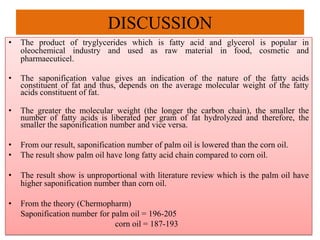
• From our result, saponification number of palm oil is lowered than the corn oil.
• The result show palm oil have long fatty acid chain compared to corn oil.
• The result show is unproportional with literature review which is the palm oil have
higher saponification number than corn oil.
• From the theory (Chermopharm)
Saponification number for palm oil = 196-205
corn oil = 187-193
8.
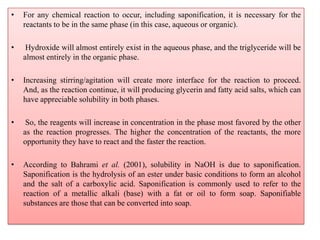
• For anychemical reaction to occur, including saponification, it is necessary for the
reactants to be in the same phase (in this case, aqueous or organic).
• Hydroxide will almost entirely exist in the aqueous phase, and the triglyceride will be
almost entirely in the organic phase.
• Increasing stirring/agitation will create more interface for the reaction to proceed.
And, as the reaction continue, it will producing glycerin and fatty acid salts, which can
have appreciable solubility in both phases.
• So, the reagents will increase in concentration in the phase most favored by the other
as the reaction progresses. The higher the concentration of the reactants, the more
opportunity they have to react and the faster the reaction.
• According to Bahrami et al. (2001), solubility in NaOH is due to saponification.
Saponification is the hydrolysis of an ester under basic conditions to form an alcohol
and the salt of a carboxylic acid. Saponification is commonly used to refer to the
reaction of a metallic alkali (base) with a fat or oil to form soap. Saponifiable
substances are those that can be converted into soap.
9.
The result showthe error in handling experiment. This maybe due to the
a) The amount of KOH added is unsufficient for the hyrolisis process.
b) The temperature of water bath provided for hydrolisis is adjusted by the
handling error.
c) The titration process which is the process for determine the reacted KOH
that hydrolysis the triglycerides.
The hydrolysis of triglycerides basicly involved two stage which is
1. Formation of glycerol through the steam hydrolysis
2. Fatty acid is neutralized in KOH to form the soap.
As the increasing need of hydrolysis product from triglycerides which is fatty
acid and glycerol lead to the alteration and improvement of method in yield
a good quality of fatty acid and glycerol.
1. Various concentration of KOH prepared
2. Temperature
3. Enzyme
10.
• The triglycerideswith longer fatty acid have lower saponification because
the amount of KOH needed to break down the hydrolysis process is higher
since the triglycerides have long chain of fatty acid.
• So, the titration shown the lower amount of KOH that react with HCL. The
KOH left is unreacted KOH from the hydrolisis process.
• The different of molar amount of HCI to neutralize the control and the
amount of HCI needed to neutralize the sample (the amount of KOH left)
= amount of reacted KOH to breakdown the ester bond of triglycerides in
the sample.
• So, this differences is equivalent with the amount of KOH used to saponify
the test sample.
11.
CONCLUSION
• The soponificationnumber of palm oil is lower than corn oil. This result is
indirectly proportional with the fact that palm oil is higher in saponification
number compared to corn oil.
• Higher the saponification number, lower the carbon chain in fatty acid.
• The difference between the blank and the test reading gives the number of
milliliters of KOH required to saponify 1g fat.
INTRODUCTION
Soap is amixture of sodium salts of various naturally
occurring fatty acids. Air bubbles added to a molten soap
will decrease the density of the soap and thus it will float on
water. If the fatty acid salt has potassium rather than
sodium, a softer lather is the result. Soap is produced by a
saponification or basic hydrolysis reaction of a fat or oil.
Currently, sodium carbonate or sodium hydroxide is used to
neutralize the fatty acid and convert it to the salt.
Soap (Palm oil)
•quite hard and dry
• not easy to shape it and quit slippery when touch.
• odour produced more stronger
• Palm oil is a saturated oil
• contain high percentage of free fatty acid.
DISCUSSION
• Soap wasmade from the reaction between
triglyceride with strong base which is 6M
NaOH.
• The saponification equation as shown below:
22.
• Soaps areamphiphiles, which means the soap
molecules have both:
polar end
non-polar end.
• One part of the soap is soluble with grease and part of
it is soluble with water.
• Soap combines with both grease and water and
washes away in a shower.
23.
• Hydroxide existin the aqueous phase, and the
triglyceride exist in the organic phase.
• In order to mixed it together, increasing will create
more interfaces for the reaction to proceed.
• As the reaction goes, it will be producing glycerol
and fatty acid (salts).
• The higher the concentration of the reactants, the
more opportunity they have to react and the faster the
reaction will go.
24.
• When greaseare mixed with a soap, the soap
molecules work as a bridge between polar water
molecules and non-polar oil molecules.
• Since soap molecules have both properties of
non-polar and polar molecules the soap can act as
an emulsifier. An emulsifier is capable of
dispersing one liquid into another immiscible
liquid.
• This means that while oil (which attracts dirt)
doesn't naturally mix with water, soap can
suspend oil in such a way that it can be removed.
The soap will form micelles and trap the fats
within the micelle. Since the micelle is soluble in
water, it can easily be washed away.
25.
REFERENCES
Obtained on May20, 2013 from http://www.elmhurst.edu/
~chm/vchembook/554soap.html.
LIPIDS: SAPONIFICATION (THE PROPERTIES AND
SYNTHESIS OF SOAP). Obtained on May 20, 2013 from
http://www.ipfw.edu/chem/112/kimble/9-Lipids%20-
%20Saponification.pdf.