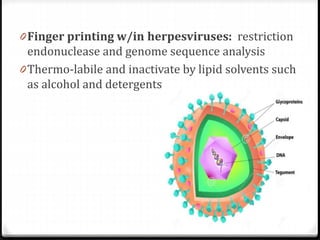
0 Finger printing w/in herpesviruses: restriction
endonuclease and genome sequence analysis

0 Thermo-labile and inactivate by lipid solvents such
as alcohol and detergents
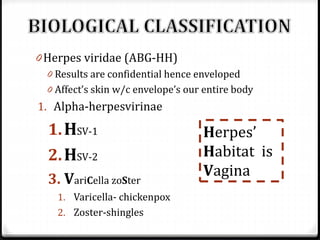
0 Herpes viridae (ABG-HH)
0 Results are confidential hence enveloped
0 Affect’s skin w/c envelope’s our entire body

1. Alpha-herpesvirinae

1. HSV-1
2. HSV-2
3. VariCella zoSter
1. Varicella- chickenpox
2. Zoster-shingles

Herpes’
Habitat is
Vagina
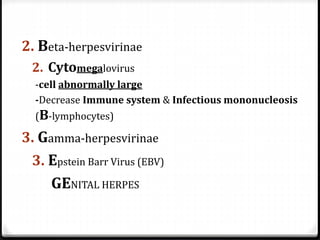
2. Beta-herpesvirinae
2. Cytomegalovirus
-cell abnormally large
-Decrease Immune system & Infectious mononucleosis
(B-lymphocytes)

3. Gamma-herpesvirinae
3. Epstein Barr Virus (EBV)

GENITAL HERPES
1
2
3
4

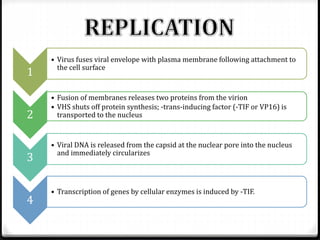
• Virus fuses viral envelope with plasma membrane following attachment to
the cell surface

• Fusion of membranes releases two proteins from the virion
• VHS shuts off protein synthesis; -trans-inducing factor (-TIF or VP16) is
transported to the nucleus

• Viral DNA is released from the capsid at the nuclear pore into the nucleus
and immediately circularizes

• Transcription of genes by cellular enzymes is induced by -TIF.
5
6
7
8
9

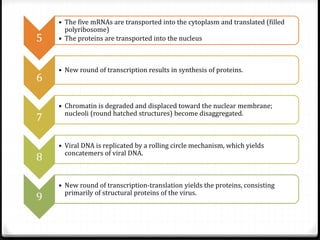
• The five mRNAs are transported into the cytoplasm and translated (filled
polyribosome)
• The proteins are transported into the nucleus

• New round of transcription results in synthesis of proteins.

• Chromatin is degraded and displaced toward the nuclear membrane;
nucleoli (round hatched structures) become disaggregated.

• Viral DNA is replicated by a rolling circle mechanism, which yields
concatemers of viral DNA.

• New round of transcription-translation yields the proteins, consisting
primarily of structural proteins of the virus.
10
11
12
13
14

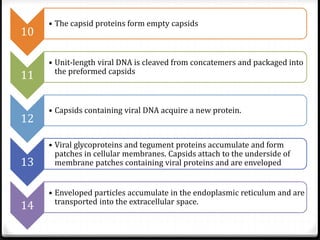
• The capsid proteins form empty capsids

• Unit-length viral DNA is cleaved from concatemers and packaged into
the preformed capsids

• Capsids containing viral DNA acquire a new protein.

• Viral glycoproteins and tegument proteins accumulate and form
patches in cellular membranes. Capsids attach to the underside of
membrane patches containing viral proteins and are enveloped
• Enveloped particles accumulate in the endoplasmic reticulum and are
transported into the extracellular space.
0HERPES SIMPLEX VIRUS
0Can grow easily in cells
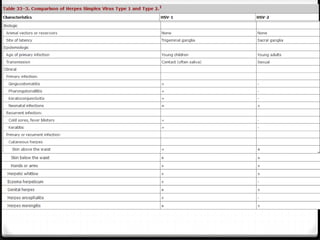
0Has TWO distinct types:

1. HSV type 1
Associated primarily with the MOUTH, EYE
and CNS

2. HSV type 2
Found most often in the GENITAL tract.
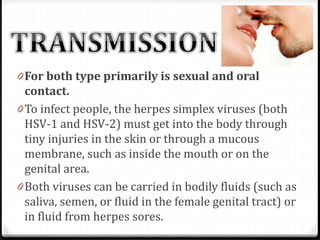
0 For both type primarily is sexual and oral
contact.
0 To infect people, the herpes simplex viruses (both
HSV-1 and HSV-2) must get into the body through

tiny injuries in the skin or through a mucous
membrane, such as inside the mouth or on the
genital area.
0 Both viruses can be carried in bodily fluids (such as
saliva, semen, or fluid in the female genital tract) or
in fluid from herpes sores.
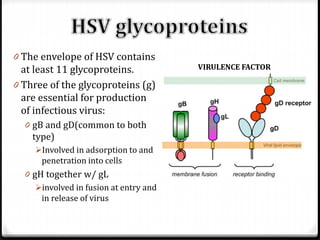
0 The envelope of HSV contains

at least 11 glycoproteins.
0 Three of the glycoproteins (g)
are essential for production
of infectious virus:
0 gB and gD(common to both

type)
Involved in adsorption to and

penetration into cells

0 gH together w/ gL
involved in fusion at entry and
in release of virus

VIRULENCE FACTOR
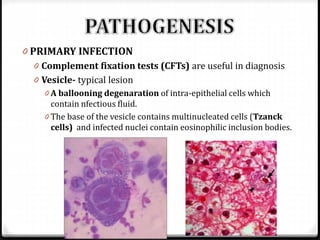
0 PRIMARY INFECTION
0 Complement fixation tests (CFTs) are useful in diagnosis
0 Vesicle- typical lesion
0 A ballooning degenaration of intra-epithelial cells which

contain nfectious fluid.
0 The base of the vesicle contains multinucleated cells (Tzanck
cells) and infected nuclei contain eosinophilic inclusion bodies.
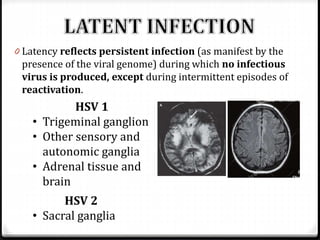
0 Latency reflects persistent infection (as manifest by the

presence of the viral genome) during which no infectious
virus is produced, except during intermittent episodes of
reactivation.

HSV 1
• Trigeminal ganglion
• Other sensory and
autonomic ganglia
• Adrenal tissue and
brain
HSV 2
• Sacral ganglia
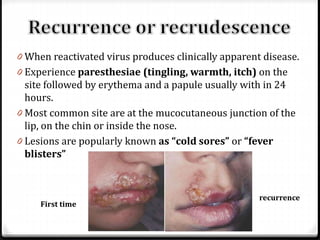
0 When reactivated virus produces clinically apparent disease.

0 Experience paresthesiae (tingling, warmth, itch) on the

site followed by erythema and a papule usually with in 24
hours.
0 Most common site are at the mucocutaneous junction of the
lip, on the chin or inside the nose.
0 Lesions are popularly known as “cold sores” or “fever
blisters”

First time

recurrence
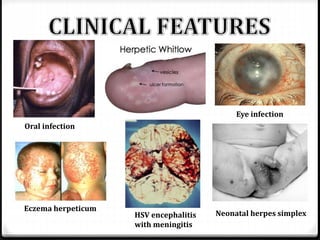
Eye infection
Oral infection

Eczema herpeticum

HSV encephalitis
with meningitis

Neonatal herpes simplex
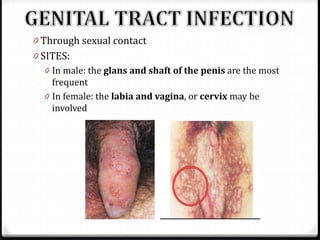
0 Through sexual contact
0 SITES:
0 In male: the glans and shaft of the penis are the most
frequent
0 In female: the labia and vagina, or cervix may be
involved
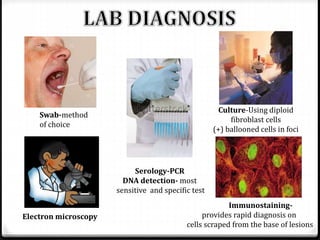
Culture-Using diploid
fibroblast cells
(+) ballooned cells in foci

Swab-method
of choice

Serology-PCR
DNA detection- most
sensitive and specific test
Electron microscopy

Immunostainingprovides rapid diagnosis on
cells scraped from the base of lesions
0 ANTIVIRAL THERAPY
0 ACYLCLOVIR-most widely used; excellent safety record; can be

used in pregnancy;for acute HSV
0 Long-term suppressive therapy- for frequently recurring genital
herpes
0 Ointment- for mild lesions

CONTROL
 Alleviating over crowding
 Good hygiene
 Education regarding the infectious stages
 Use of condoms
0 Use a dental dam for oral sex
0 Limit your number of sexual partners
0 Be aware that nonoxynol-9, the chemical spermicide used in gel

and foam contraceptive products and some lubricated condoms,
does not protect against any sexually transmitted disease
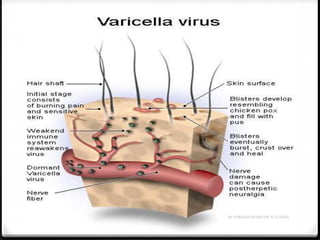
0 Genus: Varicellovirus
0 2 clinical manifestation
0 Varicella (chickenpox)

0 Zoster (shingles)

0 Primary infection is

highly contagious
0 90% adults have
antibody

0 Appears in

childhood
0 Symptoms:
0 Febrile illness
0 Rash
0 Vesicular lesion
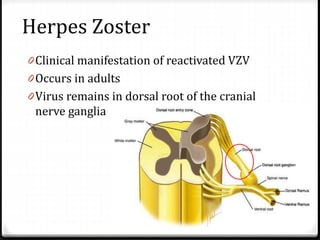
Herpes Zoster
0 Clinical manifestation of reactivated VZV
0 Occurs in adults
0 Virus remains in dorsal root of the cranial
nerve ganglia
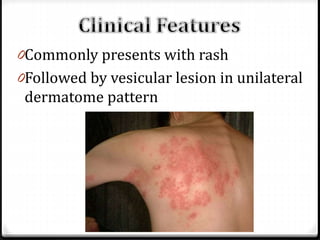
0Commonly presents with rash
0Followed by vesicular lesion in unilateral

dermatome pattern
Varicella zoster
Diagnosis
0 Use of Fluorescentlabeled monoclonal

antibody against
VZV
0 Culture of VZV in
human embryonic
lung cells

Prevention
0 Attenuated vaccine,

single dose gives
lifetime immunity.
0 Genus: Roseolovirus
0 2 variants, indistinguishable serologically
0 Variant A
0 Variant B
0Cause of disease

0 95% young adults are serologically

positive (+)
0Found in salivary glands and stool

0Saliva is the route of transmission
0Childhood disease associated,

known as “roseola infantum” or
“sixth disease”
0Children get protection from
maternal antibody until 2years and
6 months of age
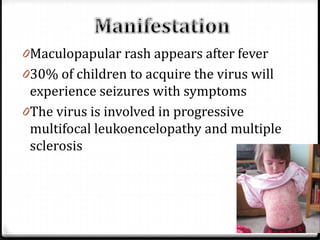
0 Maculopapular rash appears after fever

0 30% of children to acquire the virus will

experience seizures with symptoms
0 The virus is involved in progressive
multifocal leukoencelopathy and multiple
sclerosis
0Lymphocyte cell culture
0Polymerase Chain Reaction

(PCR)

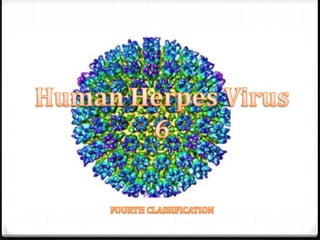
Enveloped dna viruses alpha and hhv6

  • 3.
    0 Finger printingw/in herpesviruses: restriction endonuclease and genome sequence analysis 0 Thermo-labile and inactivate by lipid solvents such as alcohol and detergents
  • 4.
    0 Herpes viridae(ABG-HH) 0 Results are confidential hence enveloped 0 Affect’s skin w/c envelope’s our entire body 1. Alpha-herpesvirinae 1. HSV-1 2. HSV-2 3. VariCella zoSter 1. Varicella- chickenpox 2. Zoster-shingles Herpes’ Habitat is Vagina
  • 5.
    2. Beta-herpesvirinae 2. Cytomegalovirus -cellabnormally large -Decrease Immune system & Infectious mononucleosis (B-lymphocytes) 3. Gamma-herpesvirinae 3. Epstein Barr Virus (EBV) GENITAL HERPES
  • 6.
    1 2 3 4 • Virus fusesviral envelope with plasma membrane following attachment to the cell surface • Fusion of membranes releases two proteins from the virion • VHS shuts off protein synthesis; -trans-inducing factor (-TIF or VP16) is transported to the nucleus • Viral DNA is released from the capsid at the nuclear pore into the nucleus and immediately circularizes • Transcription of genes by cellular enzymes is induced by -TIF.
  • 7.
    5 6 7 8 9 • The fivemRNAs are transported into the cytoplasm and translated (filled polyribosome) • The proteins are transported into the nucleus • New round of transcription results in synthesis of proteins. • Chromatin is degraded and displaced toward the nuclear membrane; nucleoli (round hatched structures) become disaggregated. • Viral DNA is replicated by a rolling circle mechanism, which yields concatemers of viral DNA. • New round of transcription-translation yields the proteins, consisting primarily of structural proteins of the virus.
  • 8.
    10 11 12 13 14 • The capsidproteins form empty capsids • Unit-length viral DNA is cleaved from concatemers and packaged into the preformed capsids • Capsids containing viral DNA acquire a new protein. • Viral glycoproteins and tegument proteins accumulate and form patches in cellular membranes. Capsids attach to the underside of membrane patches containing viral proteins and are enveloped • Enveloped particles accumulate in the endoplasmic reticulum and are transported into the extracellular space.
  • 9.
    0HERPES SIMPLEX VIRUS 0Cangrow easily in cells 0Has TWO distinct types: 1. HSV type 1 Associated primarily with the MOUTH, EYE and CNS 2. HSV type 2 Found most often in the GENITAL tract.
  • 10.
    0 For bothtype primarily is sexual and oral contact. 0 To infect people, the herpes simplex viruses (both HSV-1 and HSV-2) must get into the body through tiny injuries in the skin or through a mucous membrane, such as inside the mouth or on the genital area. 0 Both viruses can be carried in bodily fluids (such as saliva, semen, or fluid in the female genital tract) or in fluid from herpes sores.
  • 11.
    0 The envelopeof HSV contains at least 11 glycoproteins. 0 Three of the glycoproteins (g) are essential for production of infectious virus: 0 gB and gD(common to both type) Involved in adsorption to and penetration into cells 0 gH together w/ gL involved in fusion at entry and in release of virus VIRULENCE FACTOR
  • 12.
    0 PRIMARY INFECTION 0Complement fixation tests (CFTs) are useful in diagnosis 0 Vesicle- typical lesion 0 A ballooning degenaration of intra-epithelial cells which contain nfectious fluid. 0 The base of the vesicle contains multinucleated cells (Tzanck cells) and infected nuclei contain eosinophilic inclusion bodies.
  • 13.
    0 Latency reflectspersistent infection (as manifest by the presence of the viral genome) during which no infectious virus is produced, except during intermittent episodes of reactivation. HSV 1 • Trigeminal ganglion • Other sensory and autonomic ganglia • Adrenal tissue and brain HSV 2 • Sacral ganglia
  • 14.
    0 When reactivatedvirus produces clinically apparent disease. 0 Experience paresthesiae (tingling, warmth, itch) on the site followed by erythema and a papule usually with in 24 hours. 0 Most common site are at the mucocutaneous junction of the lip, on the chin or inside the nose. 0 Lesions are popularly known as “cold sores” or “fever blisters” First time recurrence
  • 16.
    Eye infection Oral infection Eczemaherpeticum HSV encephalitis with meningitis Neonatal herpes simplex
  • 17.
    0 Through sexualcontact 0 SITES: 0 In male: the glans and shaft of the penis are the most frequent 0 In female: the labia and vagina, or cervix may be involved
  • 18.
    Culture-Using diploid fibroblast cells (+)ballooned cells in foci Swab-method of choice Serology-PCR DNA detection- most sensitive and specific test Electron microscopy Immunostainingprovides rapid diagnosis on cells scraped from the base of lesions
  • 19.
    0 ANTIVIRAL THERAPY 0ACYLCLOVIR-most widely used; excellent safety record; can be used in pregnancy;for acute HSV 0 Long-term suppressive therapy- for frequently recurring genital herpes 0 Ointment- for mild lesions CONTROL  Alleviating over crowding  Good hygiene  Education regarding the infectious stages  Use of condoms 0 Use a dental dam for oral sex 0 Limit your number of sexual partners 0 Be aware that nonoxynol-9, the chemical spermicide used in gel and foam contraceptive products and some lubricated condoms, does not protect against any sexually transmitted disease
  • 20.
    0 Genus: Varicellovirus 02 clinical manifestation 0 Varicella (chickenpox) 0 Zoster (shingles) 0 Primary infection is highly contagious 0 90% adults have antibody 0 Appears in childhood 0 Symptoms: 0 Febrile illness 0 Rash 0 Vesicular lesion
  • 22.
    Herpes Zoster 0 Clinicalmanifestation of reactivated VZV 0 Occurs in adults 0 Virus remains in dorsal root of the cranial nerve ganglia
  • 23.
    0Commonly presents withrash 0Followed by vesicular lesion in unilateral dermatome pattern
  • 24.
    Varicella zoster Diagnosis 0 Useof Fluorescentlabeled monoclonal antibody against VZV 0 Culture of VZV in human embryonic lung cells Prevention 0 Attenuated vaccine, single dose gives lifetime immunity.
  • 26.
    0 Genus: Roseolovirus 02 variants, indistinguishable serologically 0 Variant A 0 Variant B 0Cause of disease 0 95% young adults are serologically positive (+)
  • 27.
    0Found in salivaryglands and stool 0Saliva is the route of transmission 0Childhood disease associated, known as “roseola infantum” or “sixth disease” 0Children get protection from maternal antibody until 2years and 6 months of age
  • 28.
    0 Maculopapular rashappears after fever 0 30% of children to acquire the virus will experience seizures with symptoms 0 The virus is involved in progressive multifocal leukoencelopathy and multiple sclerosis
  • 29.