CLEANING AND
DECONTAMINATION
Chapter 9
Objectives
• As a result of successfully completing this chapter,
students will be able to:
•  Discuss basic factors that impact cleaning and
decontamination:
• Design and location of decontamination area.
• Environmental design and controls.
• Housekeeping concerns.
• Staff safety and personal attire.
• Staff education and training.
•  Describe important selection and usage concerns
for cleaning agents (water, detergents, enzymes, and
enzymatic detergents) and for lubricants.
Objectives
•  Explain details about cleaning and
decontamination, and review manual procedures and
mechanical methods to complete both processes.
•  Discuss procedures to clean basic types of
instruments:
• General cleaning protocols.
• Delicate and hard-to-clean instruments.
• Instrument containers and basins.
• Power equipment.
• Mobile patient care equipment.
• Verification and quality control tactics
•  Review procedures to manage infectious waste.
Important Facts
• Cleaning is the first step in device
reprocessing after use
• You can clean without sterilizing, but you
can never sterilize without cleaning
• Cleaning is the cornerstone of the
sterilization process
Terminology
• Cleaning – The removal of
all visible and non-visible
soil and any other foreign
material from the medical
device being reprocessed
• Decontamination –
Removing or reducing
contamination by infectious
organisms or other harmful
substances
Design of the Decontamination Area
• Floors and walls should
be constructed of
materials that can
tolerate harsh chemicals
• Traffic should be
restricted and PPE is
required
The Decontamination Area
• Emergency
Eyewash/shower
equipment should be
available within 10
seconds or 30 meters
of a potential chemical
exposure
Housekeeping
• Horizontal work surfaces should be
cleaned and disinfected at the
beginning and end of each shift
• Spills should be cleaned immediately
• Floors should be cleaned and
disinfected daily
• Biohazardous waste should be
removed at frequent intervals
Personal Protective Equipment
(PPE)
• PPE is required at all times
• Discard PPE that is soaked
with blood or infectious
materials
• Discard torn, punctured or
nicked gloves
• Jewelry and acrylic
fingernails are not permitted
Food or Drink is NOT Permitted in the
Decontamination Area
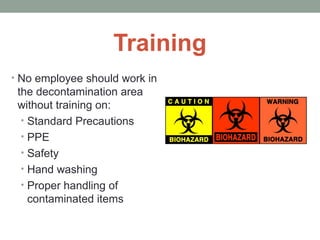
Training
• No employee should work in
the decontamination area
without training on:
• Standard Precautions
• PPE
• Safety
• Hand washing
• Proper handling of
contaminated items
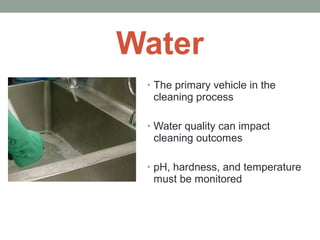
Water
• The primary vehicle in the
cleaning process
• Water quality can impact
cleaning outcomes
• pH, hardness, and temperature
must be monitored
pH Scale
14131211109876543210
• pH is used to measure acidity or alkalinity.
• Acids turn litmus paper RED.
• Alkalies (sometimes called bases) turn litmus paper
BLUE.
• Chelating Agents
• Chemicals that hold
hard water minerals in
solution, and prevent
soaps or detergents
from reacting with
minerals
• Sequestering Agents
• Chemicals that remove
or inactivate hard water
minerals
An Overview of Effective
Cleaning Agents
• Are non-abrasive
• Are low-foaming
• Are free-rinsing
• Allow for rapid soil dispersion
• Are non-toxic
• Are effective on all types of soil
• Have a long shelf life
• Are cost-effective
• Can be monitored for effective concentration and
useful life
Detergents
• Substances that dislodge, remove,
and disperse solid and liquid soils
from the surface being cleaned
• Detergents are specially formulated
for the specific uses. For example,
manual cleaning or mechanical
cleaning
Enzymes
• Breakdown or “digest” large organic
molecules to facilitate their removal
• Are very specific in their actions. Different
enzymes work on different soils
• Protease – Breaks down blood, mucous, feces,
and albumin
• Lipase – Breaks down fatty deposits such as
bone marrow and adipose tissue
• Amylase – Catalyzes (changes) starch
Enzymes and Temperature
• Temperatures above 400
C (1400
F)
can affect chemical reactions
• Cool temperatures may not activate
the enzyme
• Monitor water temperature and
check manufacturer instructions for
specific temperature requirements
Selecting an Enzymatic Detergent
• Consider the following factors:
• Water temperatures in the decontamination area
• Room temperature in the decontamination area
• Useful life and stability of the product
• Expiration date of the product
• The material used to construct the device to be cleaned
• Whether it is approved and registered by the EPA
Detergents for Ultrasonic Cleaners
• Must be low-foaming to
prevent interference with the
cleaning process
• Are usually formulated with
Surfactants and Chelating
agents
• Surfactant – A surface-acting agent that lowers
the surface tension of a liquid so it can penetrate
deeper. Surfactants also prevent debris from
being re-deposited on items
• Chelating Agent – A chemical that holds hard
water minerals in solution and prevents soaps or
detergents from reacting with minerals
Instrument Lubricants
• Prolong the life and function of instruments
• Instrument lubricants must be water-soluble
• Should be applied after cleaning
• Instrument lubricants cay be applied manually
in the clean assembly area or mechanically as
one of the final steps in a mechanical wash
cycle
CLEANING
The removal (usually with detergent
and water) of both visible and invisible
soil from the surfaces, crevices,
serrations, joints and lumens of
instruments, devices and equipment
Remove Gross Soil As Soon As
Possible to:
• Reduce the number of
microorganisms on the item
• Reduce the nutrient material that can
support microbial growth
• Reduce the potential for
environmental contamination,
aerosolization, or spillage
• Minimize damage to devices from
blood and other substances
The Importance of Cleaning
•Cleaning is the
foundation of
disinfection and
sterilization
Decontamination
• The use of physical or chemical
procedures to remove, inactivate,
or destroy bloodborne pathogens
• How an item was, or will be
used determines the level of
decontamination required
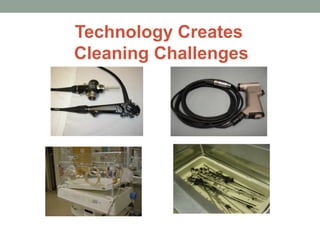
Technology Creates
Cleaning Challenges
Manual Cleaning
• May be done:
• Prior to mechanical cleaning
• When the decontamination area
does not have mechanical cleaners
• For delicate or complex instruments
• For powered-surgical instruments
• For instruments with lumens
Facilitate Cleaning By:
• Monitoring water
temperature and
hardness
• Measuring detergents
accurately
• Opening hinged
instruments to
expose hinges, jaws,
and box-locks
Cleaning
• Use a 3-Sink Set-up
• Wash sink
• Intermediate Rinse sink
• Final Rinse sink
*Brush instruments under the
surface of the water to prevent
aerosols
Cleaning Brushes
• Use the correct size brush for the item being cleaned
• Clean and disinfect/sterilize routinely or discard and
replace
Mechanical Cleaning
•Washers
• Automated equipment
used to clean,
decontaminate, or
disinfect and dry medical
devices
Ultrasonic Cleaners
• Use Cavitation
Process
• Superior to manual
scrubbing/cleaning
• Require non-foaming
detergents
Cavitation:
Ultrasonic vibrations create tiny air bubbles that grow larger until
they implode (collapse). That implosion dislodges soil from the
instrument’s surface, as well as crevices, hinges, and other hard
to reach areas within the instrument.
ImplosionImplosion
Ultrasonic Cleaner Tips
• Rinsing is necessary to remove residue that remains
on instruments
• The tank must be routinely cleaned
• Instruments must be pre-cleaned to remove gross soil.
• Must be degassed each time they are filled
• The cleaner’s lid should remain closed during
operation
• All lumens should be completely filled with cleaning
solution
• All instruments should be completely open and
submerged
Ultrasonic Cleaners
• Do not place these items in the ultrasonic
cleaner:
• Chrome-plated instruments
• Ebonized Instruments
• Plastic
• Cork
• Glass
• Wood
• Chrome
• Rubber
Automated Mechanical
Washing
• Impingement
• The spray-force action of
pressurized water against
instruments being
processed to physically
remove bioburden
Mechanical Washers
• Use several successive
steps in their cycles to
clean medical devices
• Choose the correct
cycle for the items being
processed
Mechanical Washer Tips
• Expose all surfaces
• Do not stack trays on top of one another
• Remove lids or covers from trays
• Check detergent levels frequently
Washers Need Direct Contact
• Multi-level organizing
trays may impede
mechanical cleaning
processes by
shielding the
instruments from the
wash spray
Protect Instruments from Damage during
Mechanical Cleaning
Automated Cart Washers
• Automated Cart Washers
use detergent and hot
water to clean large carts
• With special racks, they
may also be used to clean
basins, pans, etc.
Basic Instrument
Cleaning Procedures
Instrument Decontamination
• The most important
step in the sterilization
process
• Instruments that have
not been properly
cleaned cannot be
sterilized
Blood should never be allowed
to dry on instruments
• Process instruments
immediately, or:
• Cover with a moist towel
• If they can be immersed,
place in a soak basin
with the appropriate
solution
Instrument Cleaning
• Every instrument or device that enters
the decontamination area must be
treated as if it is potentially hazardous
• Should begin within 15 minutes to 1
hour after use
• Prolonged delays in instrument
cleaning can have negative impacts on
instruments
• Open boxlocks and hinges for cleaning
• Disassemble multi-part instruments
Instruments with Lumens
• Place under water to prevent
aerosols when brushing
• Brush lumens using an
appropriate size brush
• Force water and detergent
through them using a syringe
or cleaning nozzle
Defective Instruments
• When Instruments
come back from
Surgery tagged for
repair they must be
decontaminated before
they are sent for repair
Clean All Items in Accordance with
Manufacturers’ Instructions.
Power Equipment
• Must be manually cleaned.
• Do Not Immerse
• Clean cannulations (lumens)
thoroughly
• Follow Manufacturer’s
instructions
Mobile Patient Care Equipment
• Follow OEM (Original
Equipment
Manufacturer’s)
instructions
• Pay attention to details
such as access doors,
latches, etc.
Cleaning Quality Control
• Instruments are visually
inspected for cleanliness in
the clean assembly area
• There are some
commercial monitoring
products available to test
the effectiveness of
mechanical washers
Infectious Waste
• Not all healthcare facility trash is “Medical Waste”
• Healthcare facilities separate their waste
Waste Categories
• General Trash – garbage disposed of as municipal solid
waste
• Regulated Medical Waste or Infectious Waste –
waste capable of transmitting infectious disease
• Hazardous Waste – May cause serious illness or death
Must be red-bagged.
• Low-level Radioactive Waste – exhibits radioactive
characteristics such as radioactive decay
Cleaning
Summary• Follow established standards
and manufacturers’ instructions
• Pay attention to detail
• Cleaning is the most
important step in medical
device processing

Chapter 9 cleaning and decontamination

  • 1.
  • 2.
    Objectives • As aresult of successfully completing this chapter, students will be able to: •  Discuss basic factors that impact cleaning and decontamination: • Design and location of decontamination area. • Environmental design and controls. • Housekeeping concerns. • Staff safety and personal attire. • Staff education and training. •  Describe important selection and usage concerns for cleaning agents (water, detergents, enzymes, and enzymatic detergents) and for lubricants.
  • 3.
    Objectives •  Explaindetails about cleaning and decontamination, and review manual procedures and mechanical methods to complete both processes. •  Discuss procedures to clean basic types of instruments: • General cleaning protocols. • Delicate and hard-to-clean instruments. • Instrument containers and basins. • Power equipment. • Mobile patient care equipment. • Verification and quality control tactics •  Review procedures to manage infectious waste.
  • 4.
    Important Facts • Cleaningis the first step in device reprocessing after use • You can clean without sterilizing, but you can never sterilize without cleaning • Cleaning is the cornerstone of the sterilization process
  • 5.
    Terminology • Cleaning –The removal of all visible and non-visible soil and any other foreign material from the medical device being reprocessed • Decontamination – Removing or reducing contamination by infectious organisms or other harmful substances
  • 6.
    Design of theDecontamination Area • Floors and walls should be constructed of materials that can tolerate harsh chemicals • Traffic should be restricted and PPE is required
  • 7.
    The Decontamination Area •Emergency Eyewash/shower equipment should be available within 10 seconds or 30 meters of a potential chemical exposure
  • 8.
    Housekeeping • Horizontal worksurfaces should be cleaned and disinfected at the beginning and end of each shift • Spills should be cleaned immediately • Floors should be cleaned and disinfected daily • Biohazardous waste should be removed at frequent intervals
  • 9.
    Personal Protective Equipment (PPE) •PPE is required at all times • Discard PPE that is soaked with blood or infectious materials • Discard torn, punctured or nicked gloves • Jewelry and acrylic fingernails are not permitted
  • 10.
    Food or Drinkis NOT Permitted in the Decontamination Area
  • 11.
    Training • No employeeshould work in the decontamination area without training on: • Standard Precautions • PPE • Safety • Hand washing • Proper handling of contaminated items
  • 12.
    Water • The primaryvehicle in the cleaning process • Water quality can impact cleaning outcomes • pH, hardness, and temperature must be monitored
  • 13.
    pH Scale 14131211109876543210 • pHis used to measure acidity or alkalinity. • Acids turn litmus paper RED. • Alkalies (sometimes called bases) turn litmus paper BLUE.
  • 14.
    • Chelating Agents •Chemicals that hold hard water minerals in solution, and prevent soaps or detergents from reacting with minerals • Sequestering Agents • Chemicals that remove or inactivate hard water minerals
  • 15.
    An Overview ofEffective Cleaning Agents • Are non-abrasive • Are low-foaming • Are free-rinsing • Allow for rapid soil dispersion • Are non-toxic • Are effective on all types of soil • Have a long shelf life • Are cost-effective • Can be monitored for effective concentration and useful life
  • 16.
    Detergents • Substances thatdislodge, remove, and disperse solid and liquid soils from the surface being cleaned • Detergents are specially formulated for the specific uses. For example, manual cleaning or mechanical cleaning
  • 17.
    Enzymes • Breakdown or“digest” large organic molecules to facilitate their removal • Are very specific in their actions. Different enzymes work on different soils • Protease – Breaks down blood, mucous, feces, and albumin • Lipase – Breaks down fatty deposits such as bone marrow and adipose tissue • Amylase – Catalyzes (changes) starch
  • 18.
    Enzymes and Temperature •Temperatures above 400 C (1400 F) can affect chemical reactions • Cool temperatures may not activate the enzyme • Monitor water temperature and check manufacturer instructions for specific temperature requirements
  • 19.
    Selecting an EnzymaticDetergent • Consider the following factors: • Water temperatures in the decontamination area • Room temperature in the decontamination area • Useful life and stability of the product • Expiration date of the product • The material used to construct the device to be cleaned • Whether it is approved and registered by the EPA
  • 20.
    Detergents for UltrasonicCleaners • Must be low-foaming to prevent interference with the cleaning process • Are usually formulated with Surfactants and Chelating agents
  • 21.
    • Surfactant –A surface-acting agent that lowers the surface tension of a liquid so it can penetrate deeper. Surfactants also prevent debris from being re-deposited on items • Chelating Agent – A chemical that holds hard water minerals in solution and prevents soaps or detergents from reacting with minerals
  • 22.
    Instrument Lubricants • Prolongthe life and function of instruments • Instrument lubricants must be water-soluble • Should be applied after cleaning • Instrument lubricants cay be applied manually in the clean assembly area or mechanically as one of the final steps in a mechanical wash cycle
  • 23.
    CLEANING The removal (usuallywith detergent and water) of both visible and invisible soil from the surfaces, crevices, serrations, joints and lumens of instruments, devices and equipment
  • 24.
    Remove Gross SoilAs Soon As Possible to: • Reduce the number of microorganisms on the item • Reduce the nutrient material that can support microbial growth • Reduce the potential for environmental contamination, aerosolization, or spillage • Minimize damage to devices from blood and other substances
  • 25.
    The Importance ofCleaning •Cleaning is the foundation of disinfection and sterilization
  • 26.
    Decontamination • The useof physical or chemical procedures to remove, inactivate, or destroy bloodborne pathogens • How an item was, or will be used determines the level of decontamination required
  • 27.
  • 28.
    Manual Cleaning • Maybe done: • Prior to mechanical cleaning • When the decontamination area does not have mechanical cleaners • For delicate or complex instruments • For powered-surgical instruments • For instruments with lumens
  • 29.
    Facilitate Cleaning By: •Monitoring water temperature and hardness • Measuring detergents accurately • Opening hinged instruments to expose hinges, jaws, and box-locks
  • 30.
    Cleaning • Use a3-Sink Set-up • Wash sink • Intermediate Rinse sink • Final Rinse sink *Brush instruments under the surface of the water to prevent aerosols
  • 31.
    Cleaning Brushes • Usethe correct size brush for the item being cleaned • Clean and disinfect/sterilize routinely or discard and replace
  • 32.
    Mechanical Cleaning •Washers • Automatedequipment used to clean, decontaminate, or disinfect and dry medical devices
  • 33.
    Ultrasonic Cleaners • UseCavitation Process • Superior to manual scrubbing/cleaning • Require non-foaming detergents
  • 34.
    Cavitation: Ultrasonic vibrations createtiny air bubbles that grow larger until they implode (collapse). That implosion dislodges soil from the instrument’s surface, as well as crevices, hinges, and other hard to reach areas within the instrument. ImplosionImplosion
  • 35.
    Ultrasonic Cleaner Tips •Rinsing is necessary to remove residue that remains on instruments • The tank must be routinely cleaned • Instruments must be pre-cleaned to remove gross soil. • Must be degassed each time they are filled • The cleaner’s lid should remain closed during operation • All lumens should be completely filled with cleaning solution • All instruments should be completely open and submerged
  • 36.
    Ultrasonic Cleaners • Donot place these items in the ultrasonic cleaner: • Chrome-plated instruments • Ebonized Instruments • Plastic • Cork • Glass • Wood • Chrome • Rubber
  • 37.
    Automated Mechanical Washing • Impingement •The spray-force action of pressurized water against instruments being processed to physically remove bioburden
  • 38.
    Mechanical Washers • Useseveral successive steps in their cycles to clean medical devices • Choose the correct cycle for the items being processed
  • 39.
    Mechanical Washer Tips •Expose all surfaces • Do not stack trays on top of one another • Remove lids or covers from trays • Check detergent levels frequently
  • 40.
    Washers Need DirectContact • Multi-level organizing trays may impede mechanical cleaning processes by shielding the instruments from the wash spray
  • 41.
    Protect Instruments fromDamage during Mechanical Cleaning
  • 42.
    Automated Cart Washers •Automated Cart Washers use detergent and hot water to clean large carts • With special racks, they may also be used to clean basins, pans, etc.
  • 43.
  • 44.
    Instrument Decontamination • Themost important step in the sterilization process • Instruments that have not been properly cleaned cannot be sterilized
  • 45.
    Blood should neverbe allowed to dry on instruments • Process instruments immediately, or: • Cover with a moist towel • If they can be immersed, place in a soak basin with the appropriate solution
  • 46.
    Instrument Cleaning • Everyinstrument or device that enters the decontamination area must be treated as if it is potentially hazardous • Should begin within 15 minutes to 1 hour after use • Prolonged delays in instrument cleaning can have negative impacts on instruments • Open boxlocks and hinges for cleaning • Disassemble multi-part instruments
  • 47.
    Instruments with Lumens •Place under water to prevent aerosols when brushing • Brush lumens using an appropriate size brush • Force water and detergent through them using a syringe or cleaning nozzle
  • 48.
    Defective Instruments • WhenInstruments come back from Surgery tagged for repair they must be decontaminated before they are sent for repair
  • 49.
    Clean All Itemsin Accordance with Manufacturers’ Instructions.
  • 50.
    Power Equipment • Mustbe manually cleaned. • Do Not Immerse • Clean cannulations (lumens) thoroughly • Follow Manufacturer’s instructions
  • 51.
    Mobile Patient CareEquipment • Follow OEM (Original Equipment Manufacturer’s) instructions • Pay attention to details such as access doors, latches, etc.
  • 52.
    Cleaning Quality Control •Instruments are visually inspected for cleanliness in the clean assembly area • There are some commercial monitoring products available to test the effectiveness of mechanical washers
  • 53.
    Infectious Waste • Notall healthcare facility trash is “Medical Waste” • Healthcare facilities separate their waste
  • 54.
    Waste Categories • GeneralTrash – garbage disposed of as municipal solid waste • Regulated Medical Waste or Infectious Waste – waste capable of transmitting infectious disease • Hazardous Waste – May cause serious illness or death Must be red-bagged. • Low-level Radioactive Waste – exhibits radioactive characteristics such as radioactive decay
  • 55.
    Cleaning Summary• Follow establishedstandards and manufacturers’ instructions • Pay attention to detail • Cleaning is the most important step in medical device processing