Fluid And Electrolyte
Management

         Presenter
        Dr.Mithun.R

         Moderator
      Dr.Rajeev Sharma
Body Water Compartments
•   Intracellular water: 2/3 (40%)of TBW
•   Extracellular water: 1/3 (20%)of TBW

    - Extravascular water[interstitial]: 3/4 (15%)of extracellular
        water

    -    Intravascular water[plasma]: 1/4 (5%)of extracellular
        water
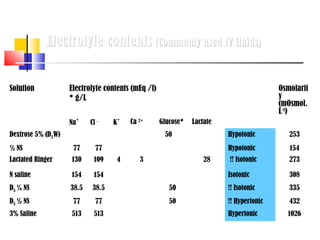
Electrolyte contents (Commonly used IV fluids)


Solution            Electrolyte contents (mEq /l)                                        Osmolarit
                    * g/L                                                                y
                                                                                         (mOsmol.
                                                                                         L-1)
                    Na+    Cl _    K+   Ca 2+       Glucose*   Lactate
Dextrose 5% (D5W)                                    50                  Hypotonic          253
½ NS                 77      77                                          Hypotonic          154
Lactated Ringer     130     109     4      3                       28    !! Isotonic        273

N saline            154     154                                          Isotonic           308
D5 ¼ NS             38.5    38.5                       50                !! Isotonic        335
D5 ½ NS              77      77                        50                !! Hypertonic      432
3% Saline           513     513                                          Hypertonic        1026
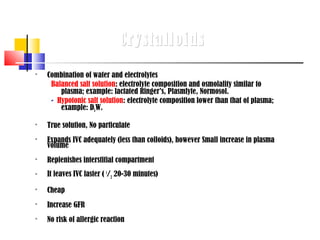
Crystalloids
   Combination of water and electrolytes
     Balanced salt solution: electrolyte composition and osmolality similar to
        plasma; example: lactated Ringer’s, Plasmlyte, Normosol.
     - Hypotonic salt solution: electrolyte composition lower than that of plasma;
        example: D5W.

   True solution, No particulate
   Expands IVC adequately (less than colloids), however Small increase in plasma
    volume
   Replenishes interstitial compartment
   It leaves IVC faster ( t/2 20-30 minutes)
   Cheap
   Increase GFR
   No risk of allergic reaction
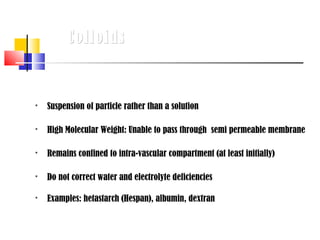
Colloids


   Suspension of particle rather than a solution

   High Molecular Weight: Unable to pass through semi permeable membrane

   Remains confined to intra-vascular compartment (at least initially)

   Do not correct water and electrolyte deficiencies

   Examples: hetastarch (Hespan), albumin, dextran
Colloids


   Antigenicity & Anaphylactic Reaction

   Blood typing

   Coagulopathy

   Never exceed 1 – 1.5 liter/day (20 ml/kg/day)
Colloids

 Most logical choice for intravascular expansion

 Since greater portion remains in IVC & for longer time
                                               ( t/2 3-6 hours)

 Less volume is required& initial resuscitation is rapid

 500 ml of colloids expands plasma by 500ml


                                                    colloids
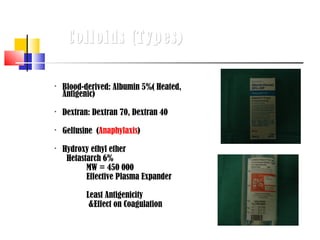
Colloids (Types)


    Blood-derived: Albumin 5%( Heated,
    Antigenic)
   Dextran: Dextran 70, Dextran 40

    Gelfusine (Anaphylaxis)

    Hydroxy ethyl ether
     Hetastarch 6%
           MW = 450 000
           Effective Plasma Expander

           Least Antigenicity
            &Effect on Coagulation
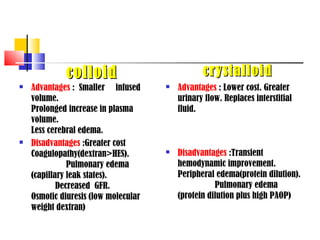
colloid                             crystalloid
   Advantages : Smaller infused         Advantages : Lower cost. Greater
    volume.                               urinary flow. Replaces interstitial
    Prolonged increase in plasma          fluid.
    volume.
    Less cerebral edema.
   Disadvantages :Greater cost
    Coagulopathy(dextran>HES).           Disadvantages :Transient
               Pulmonary edema            hemodynamic improvement.
    (capillary leak states).              Peripheral edema(protein dilution).
            Decreased GFR.                           Pulmonary edema
    Osmotic diuresis (low molecular       (protein dilution plus high PAOP)
    weight dextran)
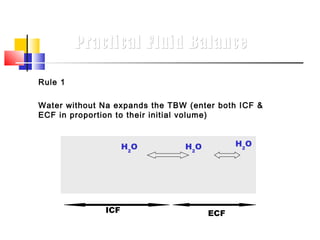
Practical Fluid Balance

Rule 1

Water without Na expands the TBW (enter both ICF &
ECF in proportion to their initial volume)


                    H2O         H2 O         H2 O


              ICF                      ECF
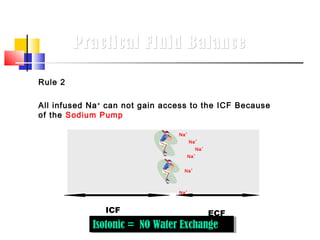
Practical Fluid Balance

Rule 2

All infused Na + can not gain access to the ICF Because
of the Sodium Pump

                                 Na +
                                        Na +
                                               Na +
                                        Na +


                                   Na +


                                 Na +


               ICF                                    ECF
            Isotonic = NO Water Exchange
             Isotonic = NO Water Exchange
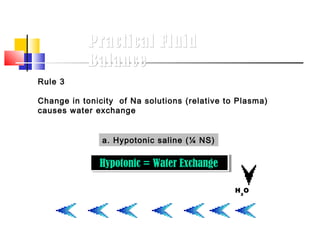
Practical Fluid
            Balance
Rule 3

Change in tonicity of Na solutions (relative to Plasma)
causes water exchange


               a. Hypotonic saline (¼ NS)


              Hypotonic = Water Exchange
              Hypotonic = Water Exchange

                                               H 2O
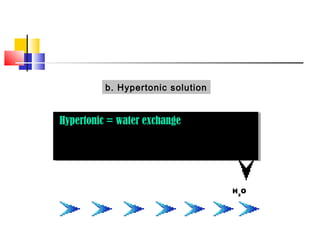
b. Hypertonic solution


Hypertonic = water exchange


                                  H 2O
Simple guide line for replacement
   Prolonged vomiting and nasogastric suction : fluid of choice normal
    saline. If urine out put is adequate, potassium is added to it after 2 nd day.
    Isolyte G can be given in an amount same as upper GI loss, provided
    urine output renal status is normal.
   Fluid loss due to small bowel fistulas causing diarrhorea : RL is ideal may
    need additional bicarbonate and potassium supplementation to treat
    metabolic acidosis and hypokalemia.
   Loss of blood : if volume is less replacement is done with three times
    volume of isotonic saline or RL. But if loss is greater , it needs blood or
    colloids for replacement.
Orthostatic Hypotension

•   Systolic blood pressure decrease of greater than 20mmHg from

    supine to standing

•   Indicates fluid deficit of 6-8% body weight

     - Heart rate should increase as a compensatory measure

     - If no increase in heart rate, may indicate autonomic dysfunction

       or antihypertensive drug therapy
Perioperative Fluid Therapy


  Pre-existing deficits


  Normal maintenance requirements


  Abnormal losses
Pre-existing losses

   Fasting (maintenance x no. of HR)
   Bowel preparation ---1L fluid loss
   Measurable fluid losses—NG suctioning,vomiting,ostomy output
   Preoperative Bleeding, fistulae
   Diarrhea
   Diuresis – ketosis
   Occult losses
      
        inflammatory traumatic edema
      
        Sequestration in third comp.
   Increased insensible losses (0.5 ml/kg/hr)
      
        Fever (add 12% for 1oC)
      
        Hyperventilation
      
        Sweating
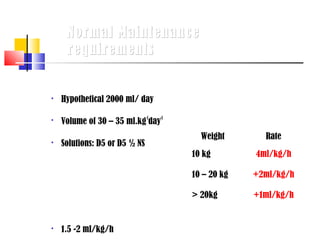
Normal Maintenance
     requirements


   Hypothetical 2000 ml/ day

   Volume of 30 – 35 ml.kg-1day-1
                                       Weight       Rate
   Solutions: D5 or D5 ½ NS
                                     10 kg        4ml/kg/h

                                     10 – 20 kg   +2ml/kg/h

                                     > 20kg       +1ml/kg/h


   1.5 -2 ml/kg/h
Surgical Fluid Losses

   Blood loss

   Obligatory losses of fluids

               Redistribution – third space
               Evaporation
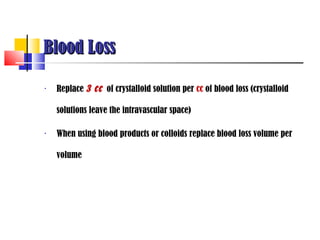
Blood Loss

•   Replace 3 cc of crystalloid solution per cc of blood loss (crystalloid

    solutions leave the intravascular space)

•   When using blood products or colloids replace blood loss volume per

    volume
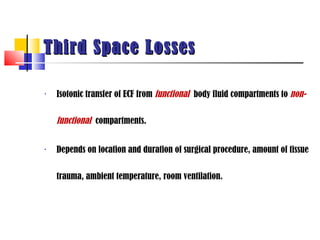
Third Space Losses

•   Isotonic transfer of ECF from functional body fluid compartments to non-

    functional compartments.

•   Depends on location and duration of surgical procedure, amount of tissue


    trauma, ambient temperature, room ventilation.
Replacing Third Space Losses

•   Superficial surgical trauma: 1-2 ml/kg/hr

•   Minimal Surgical Trauma: 3-4 ml/kg/hr

     - head and neck, hernia, knee surgery

•   Moderate Surgical Trauma: 5-6 ml/kg/hr

     - hysterectomy, chest surgery

•   Severe surgical trauma: 8-10 ml/kg/hr (or more)

     - AAA repair, nehprectomy
Monitoring fluid therapy
                             1.skin and tongue: warm extremities and normal
 elasticity of skin.                                   2.sensorium:improvement of
 anxiety and restlessness.                       3.urine output: U.O. >30-50ml/hr
 in adults or >.5 to 1.0 ml/kg/hr in children in absence of glycosuria or osmotic
 diuresis. Increased urine output with decreasing urine specific gravity and
 omolality are other dependable parameters
       4.pulse rate: correction of tachycardia to pulse rate <110/min. change from
 low volume collapsing pulse to bounding pulse
 5.blood pressure
 6.decreasing hematocrit
 7.blood urea and serum creatinine: both will become normal.
 8. increase in urinary Na excretion >25 mEq/L
Post –operative fluid therapy
   Depends upon clinical judgement of the patient’s status
   Goal of fluid therapy: to maintain blood pressure (>100/70 mm of Hg),
    pulse rate <120/min and hourly urine flow between 30-50 ml along with
    normal temperature, warm skin, normal respiration and sensorium.
   Depends upon type minor, major and nature of surgery
             short operative procedure and donot require handling of intestine
    or viscera with little morbity will require only maintenance I.V. fluid to
    correct for the NPO state. After 4-5 hrs oral fluids is restarted and I.V.
    fluid is not needed i.e. hernia, minor orthopedic operations on limbs,
    minor plastic surgery
             Patients with major surgeries where intestinal viscera need rest
    requires postoperative I.V. fluids for a few days. After ensuring normal
    movement of intestine, oral fluid intake is restarted.
   Where handling of intestine is not required I.V. fluid is required for 24-48
    hrs e.g. cardiac surgery,coronary bypass surgery, total hip replacement
Routine postoperative orders of I.V.
fluid for first three days
   First 24 hrs of surgery : 2 liters 5%-dextrose or 1.5 liters 5%-
    dextrose +500 ml isotonic saline.
   Second post operative day: 2 liters of 5%-dextrose +1liter
    0.9% saline.
   Third post operative day: similar fluid +40-60 mEq potassium
    per day.
   Maintenance fluids should be administered at a steady rate
    over an 18 to 24 hour period.
   Infants respond to dehydration with decreased blood
    pressure but without increased heart rate.
   Preoperative fluid deficit replaced with RL or ½ NS
Fluid therapy in special
surgical problems
   Turp syndrome: correction of severe and symptomatic
         syndrome
    hyponatremia should be done with slow administration of 3%
    hypertonic saline with I.V. frusemide. Hyper tonic saline must be
    given very slowly in divided doses with monitoring of serum
    sodium. Rapid administration of saline leads to pulmonary
    oedema and central pontine myelinolysis. In general TURP
    syndrome can be corrected with 200ml of 3% saline
TURP SYNDROME

Defined as serum Na+ <125mEq/L with two or more

clinical symptoms and signs.

Etiology - Intravascular absorption of irrigation fluid

   absorption of free water  dilution of serum sodium
Regional anaesthesia preferred over General
anaesthesia.
Fluid therapy in neurosurgery
   Isotonic saline, 5% albumin and 6% hestarch are iso to
    hyperosmotic,so they have minor effect on the brain’s water
    content or ICP. So these lfuids are safe to infuse.
   Osmolality of RL is 274 mOsm/L and 5%-dextrose is 278
    mOsmol/L. as both of them are hypotonic, they can increase
    ICP and cerebral oedema. So these fluid should be avoided or
    should be used judiciously.
   5%- dextrose is hypotonic accelerates ICP and cerebral
    oedema.in acute ischemic brain damage produces more
    lactic acid free radicals which further damages the brain.
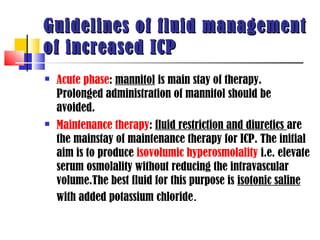
Guidelines of fluid management
of increased ICP
   Acute phase: mannitol is main stay of therapy.
    Prolonged administration of mannitol should be
    avoided.
   Maintenance therapy: fluid restriction and diuretics are
    the mainstay of maintenance therapy for ICP. The initial
    aim is to produce isovolumic hyperosmolality i.e. elevate
    serum osmolality without reducing the intravascular
    volume.The best fluid for this purpose is isotonic saline
    with added potassium chloride.
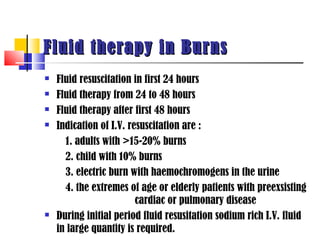
Fluid therapy in Burns
   Fluid resuscitation in first 24 hours
   Fluid therapy from 24 to 48 hours
   Fluid therapy after first 48 hours
   Indication of I.V. resuscitation are :
      1. adults with >15-20% burns
      2. child with 10% burns
      3. electric burn with haemochromogens in the urine
      4. the extremes of age or elderly patients with preexsisting
                         cardiac or pulmonary disease
   During initial period fluid resusitation sodium rich I.V. fluid
    in large quantity is required.
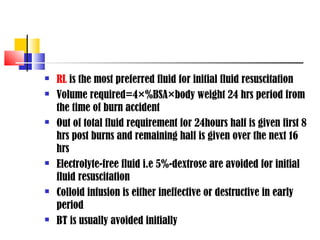
   RL is the most preferred fluid for initial fluid resuscitation
   Volume required=4×%BSA×body weight 24 hrs period from
    the time of burn accident
   Out of total fluid requirement for 24hours half is given first 8
    hrs post burns and remaining half is given over the next 16
    hrs
   Electrolyte-free fluid i.e 5%-dextrose are avoided for initial
    fluid resuscitation
   Colloid infusion is either ineffective or destructive in early
    period
   BT is usually avoided initially
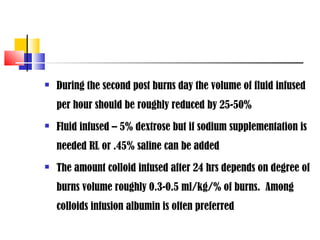
   During the second post burns day the volume of fluid infused
    per hour should be roughly reduced by 25-50%
   Fluid infused – 5% dextrose but if sodium supplementation is
    needed RL or .45% saline can be added
   The amount colloid infused after 24 hrs depends on degree of
    burns volume roughly 0.3-0.5 ml/kg/% of burns. Among
    colloids infusion albumin is often preferred
Fluid therapy after 48 hrs
   Is the sum of normal maintenance requirements plus
    replacements of abnormal losses
   Maintenance requirement contains water, sodium 3mEq/kg
    and potassium 2mEq/kg
   5% dextrose volume required is 1ml/kg/% burns. Albumin
    with aim to maintain serum albumin >2.5gm/dl.
Summary

•   Fluid therapy is critically important during the perioperative

    period.

•   The most important goal is to maintain hemodynamic

    stability and protect vital organs from hypoperfusion (heart,

    liver, brain, kidneys).

•   All sources of fluid losses must be accounted for.
SODIUM (Na + )

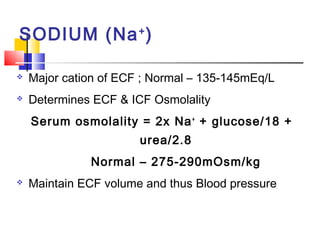
   Major cation of ECF ; Normal – 135-145mEq/L
   Determines ECF & ICF Osmolality
    Serum osmolality = 2x Na + + glucose/18 +
                       urea/2.8
              Normal – 275-290mOsm/kg
   Maintain ECF volume and thus Blood pressure
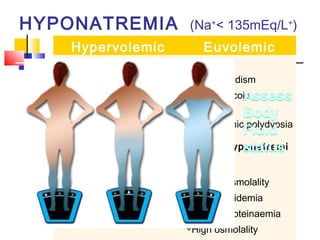
HYPONATREMIA                      (Na+< 135mEq/L+)
      Hypervolemic    Euvolemic
            Hypovolemic
  •CHF
  Extra renal loss
                                •SIADH
                        Renal loss
                                •Hypothyroidism
  (urine Na+
  •Nephrotic syndrome   (urine Na+ >15mEq/L)
  <15mEq/L )                    •Glucocorticoid
                        •Excessive diuretics
  •Cirrhosis
                                deficiency
                        •Salt losing
  TURP syndrome
  Vomiting
  •                             •Psychogenic polydypsia

  Diarrhoea
  •
  Renal Failure
  •                                  nephropathy
                              •Pseudohyponatremi
  ( urine Na+ >20mEq/L) •Diabetic ketoacidosis
  •Peritonitis                a
                        •Cerebral salt wasting
                              Normal osmolality
  •Tube drainage


  Fistula
  •                     syndromehyperlipidemia
  obstruction
  •                             hyperproteinaemia
  Burn wound
  •                              High osmolality
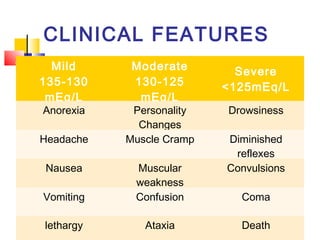
CLINICAL FEATURES
  Mild      Moderate        Severe
135-130     130-125       <125mEq/L
 mEq/L       mEq/L
Anorexia    Personality   Drowsiness
             Changes
Headache   Muscle Cramp   Diminished
                           reflexes
Nausea      Muscular      Convulsions
            weakness
Vomiting    Confusion       Coma

lethargy      Ataxia        Death
TREATMENT

              HYPONATREMIA (correct underlying
  etiology)

HYPOVOLEMIA          OEDEMATOUS
 EUVOLEMIA


Salt and water          No salt            Water restriction
supplementation        Water restriction
                       Loop diuretics
TREATMENT
   Chronic asymptomatic hyponatremia (>48hrs):

       Rate of correction - 0.5 to 1.0

        mEq/L/hour.

       MAX 8mEq/L per day.
       Rapid correction  Central pontine
        demyelination

    Dysarthria, dysphagia, flaccid paralysis or coma
TREATMENT
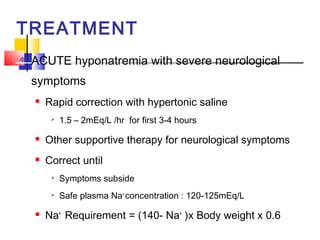
   ACUTE hyponatremia with severe neurological
    symptoms
       Rapid correction with hypertonic saline
            1.5 – 2mEq/L /hr for first 3-4 hours
       Other supportive therapy for neurological symptoms
       Correct until
         
             Symptoms subside
         
             Safe plasma Na+ concentration : 120-125mEq/L
       Na+ Requirement = (140- Na+ )x Body weight x 0.6
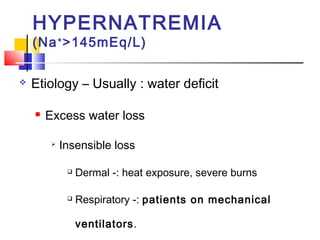
HYPERNATREMIA
    (Na + >145mEq/L)

   Etiology – Usually : water deficit

       Excess water loss

         
             Insensible loss

                 Dermal -: heat exposure, severe burns

                 Respiratory -: patients on mechanical

                  ventilators.

    Renal loss
         Diabetes insipidus
               central (ADH deficiency): pituitary surgery, basal skull
                fracture and severe head injury
               Nephrogenic – drugs (lithium, demeclocycline,
                amphoteracin B,) hypokalemia, hypercalcemia etc
         Excessive diuretics
         Uncontrolled diabetes mellitus

    Gastrointestinal loss : osmotic diarrhoea
   Water deficit due to impaired thirst

        Primary hypodypsia, confused or

         comatous condition

   Sodium Retention

   Excessive I.V. Hypertonic NaCl or NaHCO3
CLINICAL FEATURES
   Polyuria and thirst

   Neurological symptoms: altered mental

    status, weakness, neuromuscular irritability,

    focal neurological deficit, seizures & coma
    
        Hypertonicity  contracts ICF volume    brain cell

        volume  subarachnoid or intra-cerebral hemorrhage
TREATMENT

   Restoration of ECF volume:
       Water deficit :

                 Plasma Na+ concentration – 140 X    total body
                                                       water
                               140
       Rate of correction : 0.5mEq/L/hr and not more than 12 mEq/l
                          over 24 hours
ANAESTHETIC
         IMPLICATION

   Increases the MAC of inhaled anaesthetic
    agents:
       Enhanced sodium conductance during
        depolarisation of excitatory membranes.
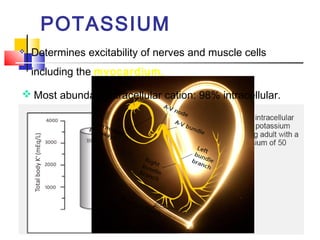
POTASSIUM
   Determines excitability of nerves and muscle cells
    including the myocardium.

 Most abundant intracellular cation: 98% intracellular.
Hypokalemia                           (K+ < 3.5mEq/L)

        Etiology
Poor             Non renal       Renal loss                     Redistribution
intake           loss
•Anorexia        •Vomiting       Diuretics
                                 •                              Metabolic

nervosa          •   diarrhoea   osmotic diuresis
                                 •                              alkalosis, insulin,

Starvation
•                excessive
                 •               •   salt wasting nephropathy   β2 agonist,
alcoholism
•                sweating,       •   Mineralocorticoid excess   Hypokalemic
                 large
                 •               (primary or secondary),        periodic
                 nasogastric     Cushing’s syndrome,            paralysis,
                 aspiration      •   Steroid therapy            Vitamin B12
    ** Surgical stress reduces
                                 Magnesium deficiency
                                 •
                                                                therapy,
     serum K by 0.5 mEq/L
             +
                                 Amphoteracin B
                                 •
                                                                Li overdose
Clinical Features

   Commonly : Fatigue, myalgia and muscular weakness of lower
    extremity
   Smooth Muscle : Constipation, ileus or urinary retention
   Progressive weakness, hyporeflexia, hypoventilation( due to
    respiratory muscle involvement)
   Polyuria due to nephrogenic diabetes insipidus
   Increased ammoniagenesis : precipitates hepatic
    encephalopathy in patients with hepatic failure
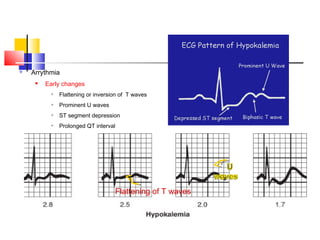
   Arrythmia
        Early changes
          
              Flattening or inversion of T waves
          
              Prominent U waves
          
              ST segment depression
          
              Prolonged QT interval


                                   Flattening of T waves
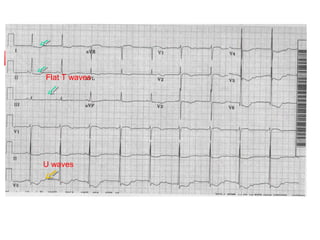
Flat T waves


U waves
   SEVERE HYPOKALEMIA

       Prolonged PR interval

       Decreased voltage

       Widening of QRS

       Ventricular arrythmia :VPC, ventricular

        tachycardia
TREATMENT
   Prevention of K+ Depletion
       Patients receiving Digitalis, long term diuretics or
        large dose steroids
       Beware in special conditions like
            hepatic failure, previous myocardial infarction or IHD,
             Diabetes Mellitus

       Post operative patients should receive 40 -50
TREATMENT
       When to Treat
       3.5 to 4 mEq/L :
         
             No potassium supplementation
         
             Add potassium sparing diuretics or decrease
             dose of diuretics
       3 to 3.5 mEq/L :
         
          Treat in high risk groups
       <3 mEq/L :
         
             Needs definitive treatment
IV KCl Therapy
    Reserved for symptomatic and severe cases
   Common Guidelines
       Continuous ECG monitoring
       Avoid till urine output is established
       Don’t give > 10- 20 mEq/L/ hour (typically 0.5mEq/kg/hr)

         ( 10ml of 15% KCL – 20 mEq/L)
       Don’t give > 40 mEq/L
       Don’t give more than 240mEq/ day
TREATMENT

       Treatment of acidosis with NaHCO3 may
        aggravate or precipitate hypokalemia.
       KCL infusion : In NaCl not in 5% Dextrose

         D5  insulin release  K+ shift ICS 
          aggravates hypokalemia(0.2-1.4mEq/L)

   20mEq/hr of K Cl raises K+ by 0.25mEq/L
        80% of this enters cells.
HYPERKALEMIA                                 (K+ >
5.5mEq/L)
     Etiology
        •Increased intake
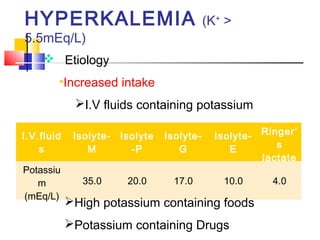
             I.V fluids containing potassium

I.V.fluid    Isolyte-   Isolyte   Isolyte-     Isolyte-   Ringer’
    s           M         -P         G            E          s
                                                          lactate
Potassiu
   m           35.0      20.0       17.0         10.0       4.0
(mEq/L)
            High potassium containing foods
            Potassium containing Drugs
HYPERKALEMIA
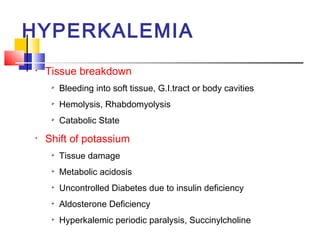
•   Tissue breakdown
        Bleeding into soft tissue, G.I.tract or body cavities
        Hemolysis, Rhabdomyolysis
        Catabolic State
•   Shift of potassium
     
         Tissue damage
     
         Metabolic acidosis
     
         Uncontrolled Diabetes due to insulin deficiency
     
         Aldosterone Deficiency
     
         Hyperkalemic periodic paralysis, Succinylcholine
HYPERKALEMIA
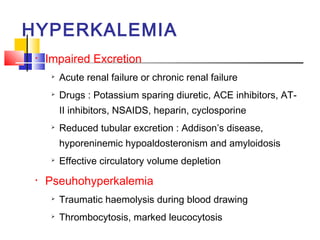
 •   Impaired Excretion
         Acute renal failure or chronic renal failure
         Drugs : Potassium sparing diuretic, ACE inhibitors, AT-
          II inhibitors, NSAIDS, heparin, cyclosporine
         Reduced tubular excretion : Addison’s disease,
          hyporeninemic hypoaldosteronism and amyloidosis
         Effective circulatory volume depletion
 •   Pseuhohyperkalemia
         Traumatic haemolysis during blood drawing
         Thrombocytosis, marked leucocytosis
CLINICAL FEATURES
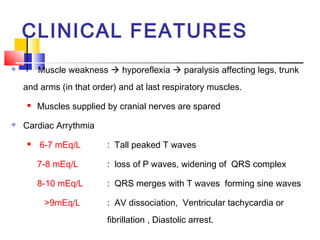
        Muscle weakness  hyporeflexia  paralysis affecting legs, trunk
    and arms (in that order) and at last respiratory muscles.
        Muscles supplied by cranial nerves are spared
   Cardiac Arrythmia
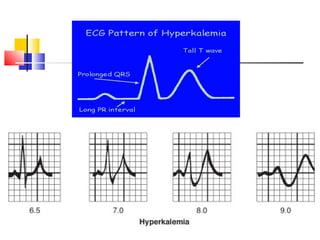
        6-7 mEq/L        : Tall peaked T waves

         7-8 mEq/L        : loss of P waves, widening of QRS complex

         8-10 mEq/L       : QRS merges with T waves forming sine waves

          >9mEq/L         : AV dissociation, Ventricular tachycardia or
                          fibrillation , Diastolic arrest.
CLINICAL FEATURES

    Lethal hyperkalemia during anaesthesia:

     Reperfusion of a large vascular bed after a

     period of ischemia. ( usually 4 hrs)

        Ischemia  acidosis  shift of K+ from ICF to

         ECF
TREATMENT

   Stop exogenous sources : K+ containing IV fluids, drugs etc.
   For mild elevation (5 to 6 mEq/L), remove potassium from the body with
        Diuretics : 40-80mg I.V
        Cation exchange Resins:
             Sodium polystyrene sulphonate (Kayexalate ) 15 to 30 g in 50 to 100 mL
              of 20% sorbitol either orally or by retention enema.
          
              Exchange sodium for potassium in G.I.tract
             Each gram binds 1mEq of K+ and releases 2-3mEq of sodium.
             Caution : CHF and volume overload patients
…TREATMENT

   For moderate elevation (6 to 7 mEq/L) , shift potassium
    intracellularly with
       Glucose plus insulin:
            mix 25 g (50 mL of D50) glucose and 10-20 U regular
             insulin and give IV over 15 to 30 minutes
            Initial bolus followed by continuous infusion with 5%
             dextrose @ 100ml/hr to avoid late hypoglycemia.
            K+ falls by 0.5-1.5mEq/L. effect begins in 15 mins and
             peaks at 60 mins. Lasts for 4-6 hours.
…TREATMENT

   Sodium bicarbonate: 50 mEq IV over 5-10
    minutes
        less effective for treatment of patients with renal
         failure : do not tolerate the sodium load and
         resultant volume expansion
   Nebulized albuterol: 10 to 20 mg nebulized over
    15 minutes or inj Salbutamol 0.5mg by I.V.infusion
     
         Preferred in ESRD for rapid lowering
     
         Tachycardia : I.V therapy > nebulization.
…TREATMENT

   Severe elevation (7 mEq/L with toxic ECG
    changes)
       Calcium chloride (10%) 500 to 1000 mg (5 to 10 mL) IV
        over 2 to 5 minutes or Calcium Gluconate 10% 10-20ml
        over 5-10mins
            to reduce the effects of potassium at the myocardial cell
             membrane (lowers risk of ventricular fibrillation [VF])
            Avoid if patient is on digitalis.
TREATMENT

    Dialysis

        Hemodialysis: removal rate – 35mEq/hr

        Peritoneal dialysis : 15 -20% as effective

         as hemodialysis.
CALCIUM                   10+/-0.5 mg/dl


   Mediates :
       Muscle contraction
       Exocrine, endocrine and neurocrine secretions
       Cell growth
       Transport and secretion of fluid and electrolytes.
   99% present in bones, 1% in cells and 0.15% in ECF.
HYPOCALCEMIA

   Weakness
   Circumoral and distal paraesthesia
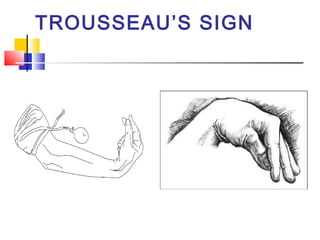
   Muscle spasm : carpopedal spasm, tetany.
   Mental changes: irritability, depression and
    psychosis.
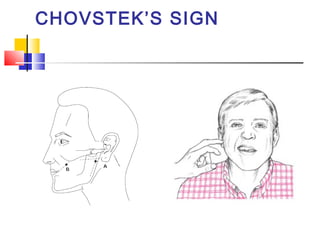
CHOVSTEK’S SIGN
TROUSSEAU’S SIGN
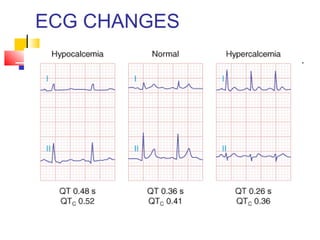
ECG CHANGES
…. CLINICAL FEATURES
   Severe hypocalcemia : lethargy, confusion ,
    laryngospasm, seizures or irreversible heart
    failure.
   Cataract and calcification of basal ganglia.
TREATMENT
   Acute Management
       10% calcium gluconate, : 10ml – 93mg of elemental calcium
       10% calcium chloride: 10ml - 273mg of elemental calcium
       10% calcium gluconate 10-20 ml IV over 10 minutes.
         +       IV infusion of 540 to 720 mg of elemental calcium (58
        to 77 mL of 10% calcium gluconate) in 500 to 1000 mL D5W @
        0.5 to 2 mg/kg/ hour (10 to 15 mg/kg).           OR
       10% calcium chloride 5 mL () over 10 minutes, followed by
        36.6 mL (1 g) over the next 6 to 12 hours IV.
TREATMENT
   Measure serum calcium every 4 to 6hours.
   Aim to maintain the total serum calcium concentration at 7
    to 9 mg/dL.
   Correct abnormalities in magnesium, potassium, and pH
    simultaneously.
   Massive transfusion : for every 4 units of blood or rate>
    1.5ml/kg/min – 10ml of 10% calcium gluconate.
   Extravasated calcium chloride – severe tissue
    destruction : Calcium gluconate preferred for peripheral
    venous administration.
HYPERCALCEMIA

   Serum calcium - 12 to 15 mg/dL.
   Neurologic symptoms :
       Depression, weakness, fatigue, and confusion at lower
        levels.
       At higher levels : Hallucinations, disorientation,
        hypotonicity, seizures, and coma.
   Renal
       Polyuria , nocturia, stone formation
CLINICAL FEATURES
        Cardiovascular symptoms:
       Upto 15mg/dl myocardial contractility increases
       The QT interval typically shortens when the serum calcium
        is> 13mg/dL.
       PR and QRS intervals are prolonged.
       Atrioventricularblock may develop and progress to
        complete heartblock and even cardiac arrest when the total
        serum calcium is > 15 to 20 mg/dL.
       Hypercalcemia can worsen digitalis toxicity and may cause
        hypertension.
CLINICAL FEATURES
       Gastrointestinal symptoms:
       Dysphagia

       Constipation

       peptic ulcers, and

       pancreatitis

   Muscle weakness due to hypercalcemia:

       decrease doses of non depolarising muscle relaxant.
TREATMENT
       Treat if
       Symptomatic and > 12mg/dl
       >15mg/dl

       Immediate therapy
       Restore intravascular volume & promote excretion
          
              infusion of 0.9% saline at 300 to 500mL/h (saline diuresis)
              until any fluid deficit is replaced and diuresis occurs (urine
              output 200 to 300 mL/h).
          
              After adequate rehydration      rate to 100 to 200 mL/h.
TREATMENT

    Hemodialysis is the treatment of choice to rapidly

     decrease serum calcium in patients with heart failure or

     renal insufficiency.

    Chelating agents (eg, 50 mmol PO4 over 8 to 12hours or

     EDTA 10 to 50 mg/kg over 4 hours) may be used for

     extreme conditions.

    Furosemide (1 mg/kg IV) but avoid thiazide diuretics.
MAGNESIUM

   Magnesium is the fourth most common mineral and the
    second most abundant intracellular cation (after potassium) in
    the human body.
   Normal serum Mg2+ 1.8 – 3mg/dl
   Magnesium is necessary for the
       movement of sodium, potassium, and calcium into and out of
        cells
       magnesium plays an important role in stabilizing excitable
        membranes.
Mg 2+ in ANAESTHESIA
   PNS –
       interferes with release of neurotransmitters at all synaptic juctions
       Potentiates action of local anaesthetics.
   Neuromuscular Junction
       Significant presynaptic neuromuscular blockade
       Enhance action of nondepolarizing muscle relaxant
       Precipitate weakness in patients with myasthenia gravis and
        Eaton-Lambert syndrome
       Prolongs action of depolarizing neuromuscular blockers.
       Prevents K+ release by succinylcholine
Mg 2+ in ANAESTHESIA

   Severe acute asthma – effective
    bronchodilator
   Obstetric practice
       Powerful tocolytic – Manage premature
        labour.
       Prophylaxis and treatment of eclampsia.
HYPOMAGNESEMIA
<1.8mg/dl


   Muscular tremors and fasciculations
   Ocular nystagmus
   Tetany
   Altered mental state
   Cardiac arrhythmias such as torsades de pointes
    (multifocal ventricular tachycardia)
   Ataxia, vertigo, seizures, and dysphagia.
TREATMENT
   For severe or symptomatic hypomagnesemia: 1 to
    2 g of IV MgSO4 over 5 to 60 minutes.
       Followed by continuous infusion of 1mEq/kg/24hours.
   For torsades de pointes with cardiac arrest : 1 to 2
    g of MgSO4 IV push over 5 to 20 minutes.
   For seizures - give 2 g IV MgSO4 over 10 min.
   Administration of calcium is usually appropriate
    because most patients with hypomagnesemia are
    also hypocalcemic.
TREATMENT
   Caution and monitoring MgSO4 therapy
       Check deep tendon reflex every 15mins (knee
        jerk)
       Periodic monitoring of serum Mg concentration.
       Reduce dose in renal failure.
       Contraindicated in heart block or extreme
        myocardial damage
       Maintain urine output – 100ml/4hours
       Overtreatment  10% calcium gluconate 10-20ml
        followed by fluid loading and diuretics.
HYPERMAGNESEMIA
(>3mg/dl)
      Etiology
          Renal failure patients : most common cause

          Treatment of pre-eclampsia with I.V MgSO4.

           ARF with acute rhabdomyolysis

          Diabetic ketoacidosis without treatment.
CLINICAL FEATURES

   Neuromuscular Manifestations
       Muscular weakness muscular paresis leading to
        respiratory depression and respiratory failure.

        No effect on central respiratory drive.
   Cardiac manifestation
       Hypotension: peripheral vasodilatation
       Bradyarrhythmia
       Cardiac asystole
   ECG changes

       Prolonged PR interval,

       QRS duration and QT interval

       Complete heart block
TREATMENT

   Eliminate source
   10% calcium chloride (5 to 10 mL [500 to 1000 mg] IV) or 10%
    calcium gluconate will often correct lethal arrhythmias.
   IV saline diuresis (administration of IV normal saline and furosemide
    [1 mg/kg]) can be used to increase renal excretion of magnesium
    until dialysis can be performed.
   Dialysis is the treatment of choice for severe hypermagnesemia.
   Artificial respiration
PHOSPHORUS

   Major Buffer anion for ICF & ECF
       Rapid shifting can occur
   Functions
       Muscle, red blood cells & nervous system
       Maintains acid-base balance
   Adequate renal function necessary to maintain
    normal balance
   90% excreted by kidneys
   PTH regulates levels
       Increases resorption from bone
       Inhibits reabsorption in renal tubules
       Increases absorption from GI tract
   Calcium and phosphate or inversely proportional
        PTH = PO4³¯&       Ca+
   Normal: 2.8 - 4.5 mg /dl
HYPOPHOSPHATEMIA < 2.8mg/d
l

       Paresthesia

       Muscle pain/weakness

       Acute respiratory failure

       Confusion/coma

       Cardiac: arrhythmias, decreased SV
TREATMENT

   Diet/supplements (mild)

   IV replacement (severe)

   Major nursing role is teaching diet

   Monitor for diarrhea if on supplements


HYPERPHOSPHATEMIA
 (> 4.5mg/dl)


    Tachycardia
    Restlessness
    Anorexia, Nausea and vomiting
    Tetany
    Tingling & numbness of fingers/lips
    Muscle spasms
TREATMENT

   Diet restrictions
   Milk, meat,fish
   Administer phosphate binding products
       Calcium acetate and calcium carbonate or
        aluminum hydroxide
   Dialysis in severe renal failure.
Fluid and electrolyte management

Fluid and electrolyte management

  • 1.
    Fluid And Electrolyte Management Presenter Dr.Mithun.R Moderator Dr.Rajeev Sharma
  • 2.
    Body Water Compartments • Intracellular water: 2/3 (40%)of TBW • Extracellular water: 1/3 (20%)of TBW - Extravascular water[interstitial]: 3/4 (15%)of extracellular water - Intravascular water[plasma]: 1/4 (5%)of extracellular water
  • 3.
    Electrolyte contents (Commonlyused IV fluids) Solution Electrolyte contents (mEq /l) Osmolarit * g/L y (mOsmol. L-1) Na+ Cl _ K+ Ca 2+ Glucose* Lactate Dextrose 5% (D5W) 50 Hypotonic 253 ½ NS 77 77 Hypotonic 154 Lactated Ringer 130 109 4 3 28 !! Isotonic 273 N saline 154 154 Isotonic 308 D5 ¼ NS 38.5 38.5 50 !! Isotonic 335 D5 ½ NS 77 77 50 !! Hypertonic 432 3% Saline 513 513 Hypertonic 1026
  • 4.
    Crystalloids  Combination of water and electrolytes Balanced salt solution: electrolyte composition and osmolality similar to plasma; example: lactated Ringer’s, Plasmlyte, Normosol. - Hypotonic salt solution: electrolyte composition lower than that of plasma; example: D5W.  True solution, No particulate  Expands IVC adequately (less than colloids), however Small increase in plasma volume  Replenishes interstitial compartment  It leaves IVC faster ( t/2 20-30 minutes)  Cheap  Increase GFR  No risk of allergic reaction
  • 5.
    Colloids  Suspension of particle rather than a solution  High Molecular Weight: Unable to pass through semi permeable membrane  Remains confined to intra-vascular compartment (at least initially)  Do not correct water and electrolyte deficiencies  Examples: hetastarch (Hespan), albumin, dextran
  • 6.
    Colloids  Antigenicity & Anaphylactic Reaction  Blood typing  Coagulopathy  Never exceed 1 – 1.5 liter/day (20 ml/kg/day)
  • 7.
    Colloids  Most logicalchoice for intravascular expansion  Since greater portion remains in IVC & for longer time ( t/2 3-6 hours)  Less volume is required& initial resuscitation is rapid  500 ml of colloids expands plasma by 500ml colloids
  • 8.
    Colloids (Types)  Blood-derived: Albumin 5%( Heated, Antigenic)  Dextran: Dextran 70, Dextran 40  Gelfusine (Anaphylaxis)  Hydroxy ethyl ether Hetastarch 6% MW = 450 000 Effective Plasma Expander Least Antigenicity &Effect on Coagulation
  • 9.
    colloid crystalloid  Advantages : Smaller infused  Advantages : Lower cost. Greater volume. urinary flow. Replaces interstitial Prolonged increase in plasma fluid. volume. Less cerebral edema.  Disadvantages :Greater cost Coagulopathy(dextran>HES).  Disadvantages :Transient Pulmonary edema hemodynamic improvement. (capillary leak states). Peripheral edema(protein dilution). Decreased GFR. Pulmonary edema Osmotic diuresis (low molecular (protein dilution plus high PAOP) weight dextran)
  • 10.
    Practical Fluid Balance Rule1 Water without Na expands the TBW (enter both ICF & ECF in proportion to their initial volume) H2O H2 O H2 O ICF ECF
  • 11.
    Practical Fluid Balance Rule2 All infused Na + can not gain access to the ICF Because of the Sodium Pump Na + Na + Na + Na + Na + Na + ICF ECF Isotonic = NO Water Exchange Isotonic = NO Water Exchange
  • 12.
    Practical Fluid Balance Rule 3 Change in tonicity of Na solutions (relative to Plasma) causes water exchange a. Hypotonic saline (¼ NS) Hypotonic = Water Exchange Hypotonic = Water Exchange H 2O
  • 13.
    b. Hypertonic solution Hypertonic= water exchange Hypertonic = water exchange H 2O
  • 14.
    Simple guide linefor replacement  Prolonged vomiting and nasogastric suction : fluid of choice normal saline. If urine out put is adequate, potassium is added to it after 2 nd day. Isolyte G can be given in an amount same as upper GI loss, provided urine output renal status is normal.  Fluid loss due to small bowel fistulas causing diarrhorea : RL is ideal may need additional bicarbonate and potassium supplementation to treat metabolic acidosis and hypokalemia.  Loss of blood : if volume is less replacement is done with three times volume of isotonic saline or RL. But if loss is greater , it needs blood or colloids for replacement.
  • 15.
    Orthostatic Hypotension • Systolic blood pressure decrease of greater than 20mmHg from supine to standing • Indicates fluid deficit of 6-8% body weight - Heart rate should increase as a compensatory measure - If no increase in heart rate, may indicate autonomic dysfunction or antihypertensive drug therapy
  • 16.
    Perioperative Fluid Therapy Pre-existing deficits Normal maintenance requirements Abnormal losses
  • 17.
    Pre-existing losses  Fasting (maintenance x no. of HR)  Bowel preparation ---1L fluid loss  Measurable fluid losses—NG suctioning,vomiting,ostomy output  Preoperative Bleeding, fistulae  Diarrhea  Diuresis – ketosis  Occult losses  inflammatory traumatic edema  Sequestration in third comp.  Increased insensible losses (0.5 ml/kg/hr)  Fever (add 12% for 1oC)  Hyperventilation  Sweating
  • 18.
    Normal Maintenance requirements  Hypothetical 2000 ml/ day  Volume of 30 – 35 ml.kg-1day-1 Weight Rate  Solutions: D5 or D5 ½ NS 10 kg 4ml/kg/h 10 – 20 kg +2ml/kg/h > 20kg +1ml/kg/h  1.5 -2 ml/kg/h
  • 19.
    Surgical Fluid Losses  Blood loss  Obligatory losses of fluids  Redistribution – third space  Evaporation
  • 20.
    Blood Loss • Replace 3 cc of crystalloid solution per cc of blood loss (crystalloid solutions leave the intravascular space) • When using blood products or colloids replace blood loss volume per volume
  • 21.
    Third Space Losses • Isotonic transfer of ECF from functional body fluid compartments to non- functional compartments. • Depends on location and duration of surgical procedure, amount of tissue trauma, ambient temperature, room ventilation.
  • 22.
    Replacing Third SpaceLosses • Superficial surgical trauma: 1-2 ml/kg/hr • Minimal Surgical Trauma: 3-4 ml/kg/hr - head and neck, hernia, knee surgery • Moderate Surgical Trauma: 5-6 ml/kg/hr - hysterectomy, chest surgery • Severe surgical trauma: 8-10 ml/kg/hr (or more) - AAA repair, nehprectomy
  • 23.
    Monitoring fluid therapy 1.skin and tongue: warm extremities and normal elasticity of skin. 2.sensorium:improvement of anxiety and restlessness. 3.urine output: U.O. >30-50ml/hr in adults or >.5 to 1.0 ml/kg/hr in children in absence of glycosuria or osmotic diuresis. Increased urine output with decreasing urine specific gravity and omolality are other dependable parameters 4.pulse rate: correction of tachycardia to pulse rate <110/min. change from low volume collapsing pulse to bounding pulse 5.blood pressure 6.decreasing hematocrit 7.blood urea and serum creatinine: both will become normal. 8. increase in urinary Na excretion >25 mEq/L
  • 24.
    Post –operative fluidtherapy  Depends upon clinical judgement of the patient’s status  Goal of fluid therapy: to maintain blood pressure (>100/70 mm of Hg), pulse rate <120/min and hourly urine flow between 30-50 ml along with normal temperature, warm skin, normal respiration and sensorium.  Depends upon type minor, major and nature of surgery short operative procedure and donot require handling of intestine or viscera with little morbity will require only maintenance I.V. fluid to correct for the NPO state. After 4-5 hrs oral fluids is restarted and I.V. fluid is not needed i.e. hernia, minor orthopedic operations on limbs, minor plastic surgery Patients with major surgeries where intestinal viscera need rest requires postoperative I.V. fluids for a few days. After ensuring normal movement of intestine, oral fluid intake is restarted.  Where handling of intestine is not required I.V. fluid is required for 24-48 hrs e.g. cardiac surgery,coronary bypass surgery, total hip replacement
  • 25.
    Routine postoperative ordersof I.V. fluid for first three days  First 24 hrs of surgery : 2 liters 5%-dextrose or 1.5 liters 5%- dextrose +500 ml isotonic saline.  Second post operative day: 2 liters of 5%-dextrose +1liter 0.9% saline.  Third post operative day: similar fluid +40-60 mEq potassium per day.  Maintenance fluids should be administered at a steady rate over an 18 to 24 hour period.
  • 26.
    Infants respond to dehydration with decreased blood pressure but without increased heart rate.  Preoperative fluid deficit replaced with RL or ½ NS
  • 27.
    Fluid therapy inspecial surgical problems  Turp syndrome: correction of severe and symptomatic syndrome hyponatremia should be done with slow administration of 3% hypertonic saline with I.V. frusemide. Hyper tonic saline must be given very slowly in divided doses with monitoring of serum sodium. Rapid administration of saline leads to pulmonary oedema and central pontine myelinolysis. In general TURP syndrome can be corrected with 200ml of 3% saline
  • 28.
    TURP SYNDROME Defined asserum Na+ <125mEq/L with two or more clinical symptoms and signs. Etiology - Intravascular absorption of irrigation fluid absorption of free water  dilution of serum sodium Regional anaesthesia preferred over General anaesthesia.
  • 29.
    Fluid therapy inneurosurgery  Isotonic saline, 5% albumin and 6% hestarch are iso to hyperosmotic,so they have minor effect on the brain’s water content or ICP. So these lfuids are safe to infuse.  Osmolality of RL is 274 mOsm/L and 5%-dextrose is 278 mOsmol/L. as both of them are hypotonic, they can increase ICP and cerebral oedema. So these fluid should be avoided or should be used judiciously.  5%- dextrose is hypotonic accelerates ICP and cerebral oedema.in acute ischemic brain damage produces more lactic acid free radicals which further damages the brain.
  • 30.
    Guidelines of fluidmanagement of increased ICP  Acute phase: mannitol is main stay of therapy. Prolonged administration of mannitol should be avoided.  Maintenance therapy: fluid restriction and diuretics are the mainstay of maintenance therapy for ICP. The initial aim is to produce isovolumic hyperosmolality i.e. elevate serum osmolality without reducing the intravascular volume.The best fluid for this purpose is isotonic saline with added potassium chloride.
  • 31.
    Fluid therapy inBurns  Fluid resuscitation in first 24 hours  Fluid therapy from 24 to 48 hours  Fluid therapy after first 48 hours  Indication of I.V. resuscitation are : 1. adults with >15-20% burns 2. child with 10% burns 3. electric burn with haemochromogens in the urine 4. the extremes of age or elderly patients with preexsisting cardiac or pulmonary disease  During initial period fluid resusitation sodium rich I.V. fluid in large quantity is required.
  • 32.
    RL is the most preferred fluid for initial fluid resuscitation  Volume required=4×%BSA×body weight 24 hrs period from the time of burn accident  Out of total fluid requirement for 24hours half is given first 8 hrs post burns and remaining half is given over the next 16 hrs  Electrolyte-free fluid i.e 5%-dextrose are avoided for initial fluid resuscitation  Colloid infusion is either ineffective or destructive in early period  BT is usually avoided initially
  • 33.
    During the second post burns day the volume of fluid infused per hour should be roughly reduced by 25-50%  Fluid infused – 5% dextrose but if sodium supplementation is needed RL or .45% saline can be added  The amount colloid infused after 24 hrs depends on degree of burns volume roughly 0.3-0.5 ml/kg/% of burns. Among colloids infusion albumin is often preferred
  • 34.
    Fluid therapy after48 hrs  Is the sum of normal maintenance requirements plus replacements of abnormal losses  Maintenance requirement contains water, sodium 3mEq/kg and potassium 2mEq/kg  5% dextrose volume required is 1ml/kg/% burns. Albumin with aim to maintain serum albumin >2.5gm/dl.
  • 35.
    Summary • Fluid therapy is critically important during the perioperative period. • The most important goal is to maintain hemodynamic stability and protect vital organs from hypoperfusion (heart, liver, brain, kidneys). • All sources of fluid losses must be accounted for.
  • 37.
    SODIUM (Na +)  Major cation of ECF ; Normal – 135-145mEq/L  Determines ECF & ICF Osmolality Serum osmolality = 2x Na + + glucose/18 + urea/2.8 Normal – 275-290mOsm/kg  Maintain ECF volume and thus Blood pressure
  • 38.
    HYPONATREMIA (Na+< 135mEq/L+) Hypervolemic Euvolemic Hypovolemic •CHF Extra renal loss •SIADH Renal loss •Hypothyroidism (urine Na+ •Nephrotic syndrome (urine Na+ >15mEq/L) <15mEq/L ) •Glucocorticoid •Excessive diuretics •Cirrhosis deficiency •Salt losing TURP syndrome Vomiting • •Psychogenic polydypsia Diarrhoea • Renal Failure • nephropathy •Pseudohyponatremi ( urine Na+ >20mEq/L) •Diabetic ketoacidosis •Peritonitis a •Cerebral salt wasting Normal osmolality •Tube drainage Fistula • syndromehyperlipidemia obstruction • hyperproteinaemia Burn wound •  High osmolality
  • 39.
    CLINICAL FEATURES Mild Moderate Severe 135-130 130-125 <125mEq/L mEq/L mEq/L Anorexia Personality Drowsiness Changes Headache Muscle Cramp Diminished reflexes Nausea Muscular Convulsions weakness Vomiting Confusion Coma lethargy Ataxia Death
  • 40.
    TREATMENT HYPONATREMIA (correct underlying etiology) HYPOVOLEMIA OEDEMATOUS EUVOLEMIA Salt and water No salt Water restriction supplementation Water restriction Loop diuretics
  • 41.
    TREATMENT  Chronic asymptomatic hyponatremia (>48hrs):  Rate of correction - 0.5 to 1.0 mEq/L/hour.  MAX 8mEq/L per day.  Rapid correction  Central pontine demyelination Dysarthria, dysphagia, flaccid paralysis or coma
  • 42.
    TREATMENT  ACUTE hyponatremia with severe neurological symptoms  Rapid correction with hypertonic saline  1.5 – 2mEq/L /hr for first 3-4 hours  Other supportive therapy for neurological symptoms  Correct until  Symptoms subside  Safe plasma Na+ concentration : 120-125mEq/L  Na+ Requirement = (140- Na+ )x Body weight x 0.6
  • 43.
    HYPERNATREMIA (Na + >145mEq/L)  Etiology – Usually : water deficit  Excess water loss  Insensible loss  Dermal -: heat exposure, severe burns  Respiratory -: patients on mechanical ventilators.
  • 44.
    Renal loss  Diabetes insipidus  central (ADH deficiency): pituitary surgery, basal skull fracture and severe head injury  Nephrogenic – drugs (lithium, demeclocycline, amphoteracin B,) hypokalemia, hypercalcemia etc  Excessive diuretics  Uncontrolled diabetes mellitus  Gastrointestinal loss : osmotic diarrhoea
  • 45.
    Water deficit due to impaired thirst  Primary hypodypsia, confused or comatous condition  Sodium Retention  Excessive I.V. Hypertonic NaCl or NaHCO3
  • 46.
    CLINICAL FEATURES  Polyuria and thirst  Neurological symptoms: altered mental status, weakness, neuromuscular irritability, focal neurological deficit, seizures & coma  Hypertonicity  contracts ICF volume  brain cell volume  subarachnoid or intra-cerebral hemorrhage
  • 47.
    TREATMENT  Restoration of ECF volume:  Water deficit : Plasma Na+ concentration – 140 X total body water 140  Rate of correction : 0.5mEq/L/hr and not more than 12 mEq/l over 24 hours
  • 48.
    ANAESTHETIC IMPLICATION  Increases the MAC of inhaled anaesthetic agents:  Enhanced sodium conductance during depolarisation of excitatory membranes.
  • 49.
    POTASSIUM  Determines excitability of nerves and muscle cells including the myocardium.  Most abundant intracellular cation: 98% intracellular.
  • 50.
    Hypokalemia (K+ < 3.5mEq/L) Etiology Poor Non renal Renal loss Redistribution intake loss •Anorexia •Vomiting Diuretics • Metabolic nervosa • diarrhoea osmotic diuresis • alkalosis, insulin, Starvation • excessive • • salt wasting nephropathy β2 agonist, alcoholism • sweating, • Mineralocorticoid excess Hypokalemic large • (primary or secondary), periodic nasogastric Cushing’s syndrome, paralysis, aspiration • Steroid therapy Vitamin B12 ** Surgical stress reduces Magnesium deficiency • therapy, serum K by 0.5 mEq/L + Amphoteracin B • Li overdose
  • 51.
    Clinical Features  Commonly : Fatigue, myalgia and muscular weakness of lower extremity  Smooth Muscle : Constipation, ileus or urinary retention  Progressive weakness, hyporeflexia, hypoventilation( due to respiratory muscle involvement)  Polyuria due to nephrogenic diabetes insipidus  Increased ammoniagenesis : precipitates hepatic encephalopathy in patients with hepatic failure
  • 52.
    Arrythmia  Early changes  Flattening or inversion of T waves  Prominent U waves  ST segment depression  Prolonged QT interval Flattening of T waves
  • 53.
  • 54.
    SEVERE HYPOKALEMIA  Prolonged PR interval  Decreased voltage  Widening of QRS  Ventricular arrythmia :VPC, ventricular tachycardia
  • 55.
    TREATMENT  Prevention of K+ Depletion  Patients receiving Digitalis, long term diuretics or large dose steroids  Beware in special conditions like  hepatic failure, previous myocardial infarction or IHD, Diabetes Mellitus  Post operative patients should receive 40 -50
  • 56.
    TREATMENT  When to Treat  3.5 to 4 mEq/L :  No potassium supplementation  Add potassium sparing diuretics or decrease dose of diuretics  3 to 3.5 mEq/L :  Treat in high risk groups  <3 mEq/L :  Needs definitive treatment
  • 57.
    IV KCl Therapy  Reserved for symptomatic and severe cases  Common Guidelines  Continuous ECG monitoring  Avoid till urine output is established  Don’t give > 10- 20 mEq/L/ hour (typically 0.5mEq/kg/hr) ( 10ml of 15% KCL – 20 mEq/L)  Don’t give > 40 mEq/L  Don’t give more than 240mEq/ day
  • 58.
    TREATMENT  Treatment of acidosis with NaHCO3 may aggravate or precipitate hypokalemia.  KCL infusion : In NaCl not in 5% Dextrose D5  insulin release  K+ shift ICS  aggravates hypokalemia(0.2-1.4mEq/L)  20mEq/hr of K Cl raises K+ by 0.25mEq/L 80% of this enters cells.
  • 59.
    HYPERKALEMIA (K+ > 5.5mEq/L)  Etiology •Increased intake I.V fluids containing potassium I.V.fluid Isolyte- Isolyte Isolyte- Isolyte- Ringer’ s M -P G E s lactate Potassiu m 35.0 20.0 17.0 10.0 4.0 (mEq/L) High potassium containing foods Potassium containing Drugs
  • 60.
    HYPERKALEMIA • Tissue breakdown  Bleeding into soft tissue, G.I.tract or body cavities  Hemolysis, Rhabdomyolysis  Catabolic State • Shift of potassium  Tissue damage  Metabolic acidosis  Uncontrolled Diabetes due to insulin deficiency  Aldosterone Deficiency  Hyperkalemic periodic paralysis, Succinylcholine
  • 61.
    HYPERKALEMIA • Impaired Excretion  Acute renal failure or chronic renal failure  Drugs : Potassium sparing diuretic, ACE inhibitors, AT- II inhibitors, NSAIDS, heparin, cyclosporine  Reduced tubular excretion : Addison’s disease, hyporeninemic hypoaldosteronism and amyloidosis  Effective circulatory volume depletion • Pseuhohyperkalemia  Traumatic haemolysis during blood drawing  Thrombocytosis, marked leucocytosis
  • 62.
    CLINICAL FEATURES  Muscle weakness  hyporeflexia  paralysis affecting legs, trunk and arms (in that order) and at last respiratory muscles.  Muscles supplied by cranial nerves are spared  Cardiac Arrythmia  6-7 mEq/L : Tall peaked T waves 7-8 mEq/L : loss of P waves, widening of QRS complex 8-10 mEq/L : QRS merges with T waves forming sine waves >9mEq/L : AV dissociation, Ventricular tachycardia or fibrillation , Diastolic arrest.
  • 64.
    CLINICAL FEATURES  Lethal hyperkalemia during anaesthesia: Reperfusion of a large vascular bed after a period of ischemia. ( usually 4 hrs)  Ischemia  acidosis  shift of K+ from ICF to ECF
  • 65.
    TREATMENT  Stop exogenous sources : K+ containing IV fluids, drugs etc.  For mild elevation (5 to 6 mEq/L), remove potassium from the body with  Diuretics : 40-80mg I.V  Cation exchange Resins:  Sodium polystyrene sulphonate (Kayexalate ) 15 to 30 g in 50 to 100 mL of 20% sorbitol either orally or by retention enema.  Exchange sodium for potassium in G.I.tract  Each gram binds 1mEq of K+ and releases 2-3mEq of sodium.  Caution : CHF and volume overload patients
  • 66.
    …TREATMENT  For moderate elevation (6 to 7 mEq/L) , shift potassium intracellularly with  Glucose plus insulin:  mix 25 g (50 mL of D50) glucose and 10-20 U regular insulin and give IV over 15 to 30 minutes  Initial bolus followed by continuous infusion with 5% dextrose @ 100ml/hr to avoid late hypoglycemia.  K+ falls by 0.5-1.5mEq/L. effect begins in 15 mins and peaks at 60 mins. Lasts for 4-6 hours.
  • 67.
    …TREATMENT  Sodium bicarbonate: 50 mEq IV over 5-10 minutes  less effective for treatment of patients with renal failure : do not tolerate the sodium load and resultant volume expansion  Nebulized albuterol: 10 to 20 mg nebulized over 15 minutes or inj Salbutamol 0.5mg by I.V.infusion  Preferred in ESRD for rapid lowering  Tachycardia : I.V therapy > nebulization.
  • 68.
    …TREATMENT  Severe elevation (7 mEq/L with toxic ECG changes)  Calcium chloride (10%) 500 to 1000 mg (5 to 10 mL) IV over 2 to 5 minutes or Calcium Gluconate 10% 10-20ml over 5-10mins  to reduce the effects of potassium at the myocardial cell membrane (lowers risk of ventricular fibrillation [VF])  Avoid if patient is on digitalis.
  • 69.
    TREATMENT  Dialysis  Hemodialysis: removal rate – 35mEq/hr  Peritoneal dialysis : 15 -20% as effective as hemodialysis.
  • 70.
    CALCIUM 10+/-0.5 mg/dl  Mediates :  Muscle contraction  Exocrine, endocrine and neurocrine secretions  Cell growth  Transport and secretion of fluid and electrolytes.  99% present in bones, 1% in cells and 0.15% in ECF.
  • 71.
    HYPOCALCEMIA  Weakness  Circumoral and distal paraesthesia  Muscle spasm : carpopedal spasm, tetany.  Mental changes: irritability, depression and psychosis.
  • 72.
  • 73.
  • 74.
  • 75.
    …. CLINICAL FEATURES  Severe hypocalcemia : lethargy, confusion , laryngospasm, seizures or irreversible heart failure.  Cataract and calcification of basal ganglia.
  • 76.
    TREATMENT  Acute Management  10% calcium gluconate, : 10ml – 93mg of elemental calcium  10% calcium chloride: 10ml - 273mg of elemental calcium  10% calcium gluconate 10-20 ml IV over 10 minutes. + IV infusion of 540 to 720 mg of elemental calcium (58 to 77 mL of 10% calcium gluconate) in 500 to 1000 mL D5W @ 0.5 to 2 mg/kg/ hour (10 to 15 mg/kg). OR  10% calcium chloride 5 mL () over 10 minutes, followed by 36.6 mL (1 g) over the next 6 to 12 hours IV.
  • 77.
    TREATMENT  Measure serum calcium every 4 to 6hours.  Aim to maintain the total serum calcium concentration at 7 to 9 mg/dL.  Correct abnormalities in magnesium, potassium, and pH simultaneously.  Massive transfusion : for every 4 units of blood or rate> 1.5ml/kg/min – 10ml of 10% calcium gluconate.  Extravasated calcium chloride – severe tissue destruction : Calcium gluconate preferred for peripheral venous administration.
  • 78.
    HYPERCALCEMIA  Serum calcium - 12 to 15 mg/dL.  Neurologic symptoms :  Depression, weakness, fatigue, and confusion at lower levels.  At higher levels : Hallucinations, disorientation, hypotonicity, seizures, and coma.  Renal  Polyuria , nocturia, stone formation
  • 79.
    CLINICAL FEATURES  Cardiovascular symptoms:  Upto 15mg/dl myocardial contractility increases  The QT interval typically shortens when the serum calcium is> 13mg/dL.  PR and QRS intervals are prolonged.  Atrioventricularblock may develop and progress to complete heartblock and even cardiac arrest when the total serum calcium is > 15 to 20 mg/dL.  Hypercalcemia can worsen digitalis toxicity and may cause hypertension.
  • 80.
    CLINICAL FEATURES  Gastrointestinal symptoms:  Dysphagia  Constipation  peptic ulcers, and  pancreatitis  Muscle weakness due to hypercalcemia:  decrease doses of non depolarising muscle relaxant.
  • 81.
    TREATMENT  Treat if  Symptomatic and > 12mg/dl  >15mg/dl  Immediate therapy  Restore intravascular volume & promote excretion  infusion of 0.9% saline at 300 to 500mL/h (saline diuresis) until any fluid deficit is replaced and diuresis occurs (urine output 200 to 300 mL/h).  After adequate rehydration rate to 100 to 200 mL/h.
  • 82.
    TREATMENT  Hemodialysis is the treatment of choice to rapidly decrease serum calcium in patients with heart failure or renal insufficiency.  Chelating agents (eg, 50 mmol PO4 over 8 to 12hours or EDTA 10 to 50 mg/kg over 4 hours) may be used for extreme conditions.  Furosemide (1 mg/kg IV) but avoid thiazide diuretics.
  • 83.
    MAGNESIUM  Magnesium is the fourth most common mineral and the second most abundant intracellular cation (after potassium) in the human body.  Normal serum Mg2+ 1.8 – 3mg/dl  Magnesium is necessary for the  movement of sodium, potassium, and calcium into and out of cells  magnesium plays an important role in stabilizing excitable membranes.
  • 84.
    Mg 2+ inANAESTHESIA  PNS –  interferes with release of neurotransmitters at all synaptic juctions  Potentiates action of local anaesthetics.  Neuromuscular Junction  Significant presynaptic neuromuscular blockade  Enhance action of nondepolarizing muscle relaxant  Precipitate weakness in patients with myasthenia gravis and Eaton-Lambert syndrome  Prolongs action of depolarizing neuromuscular blockers.  Prevents K+ release by succinylcholine
  • 85.
    Mg 2+ inANAESTHESIA  Severe acute asthma – effective bronchodilator  Obstetric practice  Powerful tocolytic – Manage premature labour.  Prophylaxis and treatment of eclampsia.
  • 86.
    HYPOMAGNESEMIA <1.8mg/dl  Muscular tremors and fasciculations  Ocular nystagmus  Tetany  Altered mental state  Cardiac arrhythmias such as torsades de pointes (multifocal ventricular tachycardia)  Ataxia, vertigo, seizures, and dysphagia.
  • 87.
    TREATMENT  For severe or symptomatic hypomagnesemia: 1 to 2 g of IV MgSO4 over 5 to 60 minutes.  Followed by continuous infusion of 1mEq/kg/24hours.  For torsades de pointes with cardiac arrest : 1 to 2 g of MgSO4 IV push over 5 to 20 minutes.  For seizures - give 2 g IV MgSO4 over 10 min.  Administration of calcium is usually appropriate because most patients with hypomagnesemia are also hypocalcemic.
  • 88.
    TREATMENT  Caution and monitoring MgSO4 therapy  Check deep tendon reflex every 15mins (knee jerk)  Periodic monitoring of serum Mg concentration.  Reduce dose in renal failure.  Contraindicated in heart block or extreme myocardial damage  Maintain urine output – 100ml/4hours  Overtreatment  10% calcium gluconate 10-20ml followed by fluid loading and diuretics.
  • 89.
    HYPERMAGNESEMIA (>3mg/dl)  Etiology  Renal failure patients : most common cause  Treatment of pre-eclampsia with I.V MgSO4.  ARF with acute rhabdomyolysis  Diabetic ketoacidosis without treatment.
  • 90.
    CLINICAL FEATURES  Neuromuscular Manifestations  Muscular weakness muscular paresis leading to respiratory depression and respiratory failure. No effect on central respiratory drive.  Cardiac manifestation  Hypotension: peripheral vasodilatation  Bradyarrhythmia  Cardiac asystole
  • 91.
    ECG changes  Prolonged PR interval,  QRS duration and QT interval  Complete heart block
  • 92.
    TREATMENT  Eliminate source  10% calcium chloride (5 to 10 mL [500 to 1000 mg] IV) or 10% calcium gluconate will often correct lethal arrhythmias.  IV saline diuresis (administration of IV normal saline and furosemide [1 mg/kg]) can be used to increase renal excretion of magnesium until dialysis can be performed.  Dialysis is the treatment of choice for severe hypermagnesemia.  Artificial respiration
  • 93.
    PHOSPHORUS  Major Buffer anion for ICF & ECF  Rapid shifting can occur  Functions  Muscle, red blood cells & nervous system  Maintains acid-base balance  Adequate renal function necessary to maintain normal balance  90% excreted by kidneys
  • 94.
    PTH regulates levels  Increases resorption from bone  Inhibits reabsorption in renal tubules  Increases absorption from GI tract  Calcium and phosphate or inversely proportional  PTH = PO4³¯& Ca+  Normal: 2.8 - 4.5 mg /dl
  • 95.
    HYPOPHOSPHATEMIA < 2.8mg/d l  Paresthesia  Muscle pain/weakness  Acute respiratory failure  Confusion/coma  Cardiac: arrhythmias, decreased SV
  • 96.
    TREATMENT  Diet/supplements (mild)  IV replacement (severe)  Major nursing role is teaching diet  Monitor for diarrhea if on supplements 
  • 97.
    HYPERPHOSPHATEMIA (> 4.5mg/dl)  Tachycardia  Restlessness  Anorexia, Nausea and vomiting  Tetany  Tingling & numbness of fingers/lips  Muscle spasms
  • 98.
    TREATMENT  Diet restrictions  Milk, meat,fish  Administer phosphate binding products  Calcium acetate and calcium carbonate or aluminum hydroxide  Dialysis in severe renal failure.