
ANALYSIS OF GROUP IV
     CATIONS
         Jessa S. Ariño
             BSE-4B
 Central Bicol State University
        of Agriculture
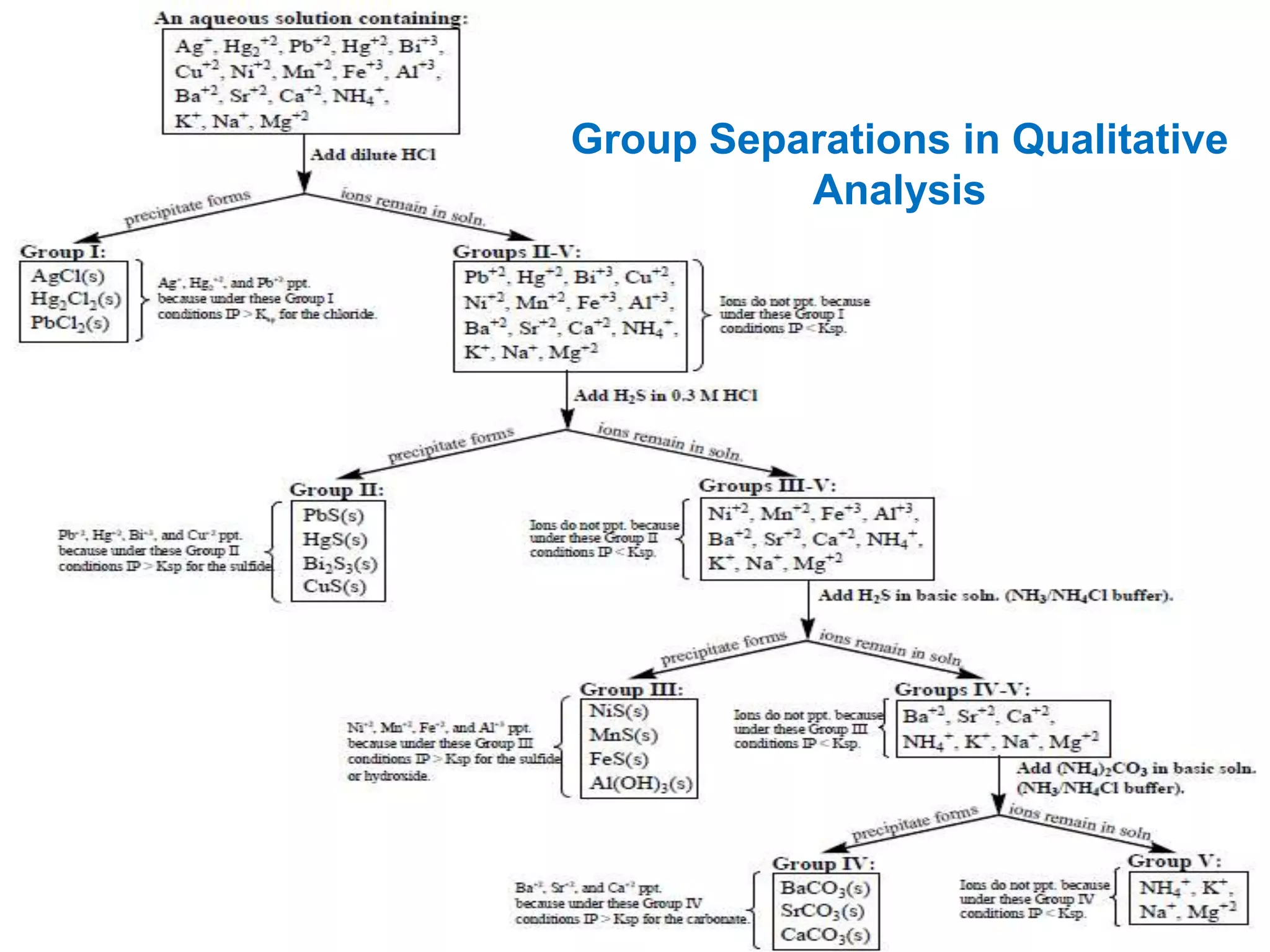
Group Separations in Qualitative
          Analysis
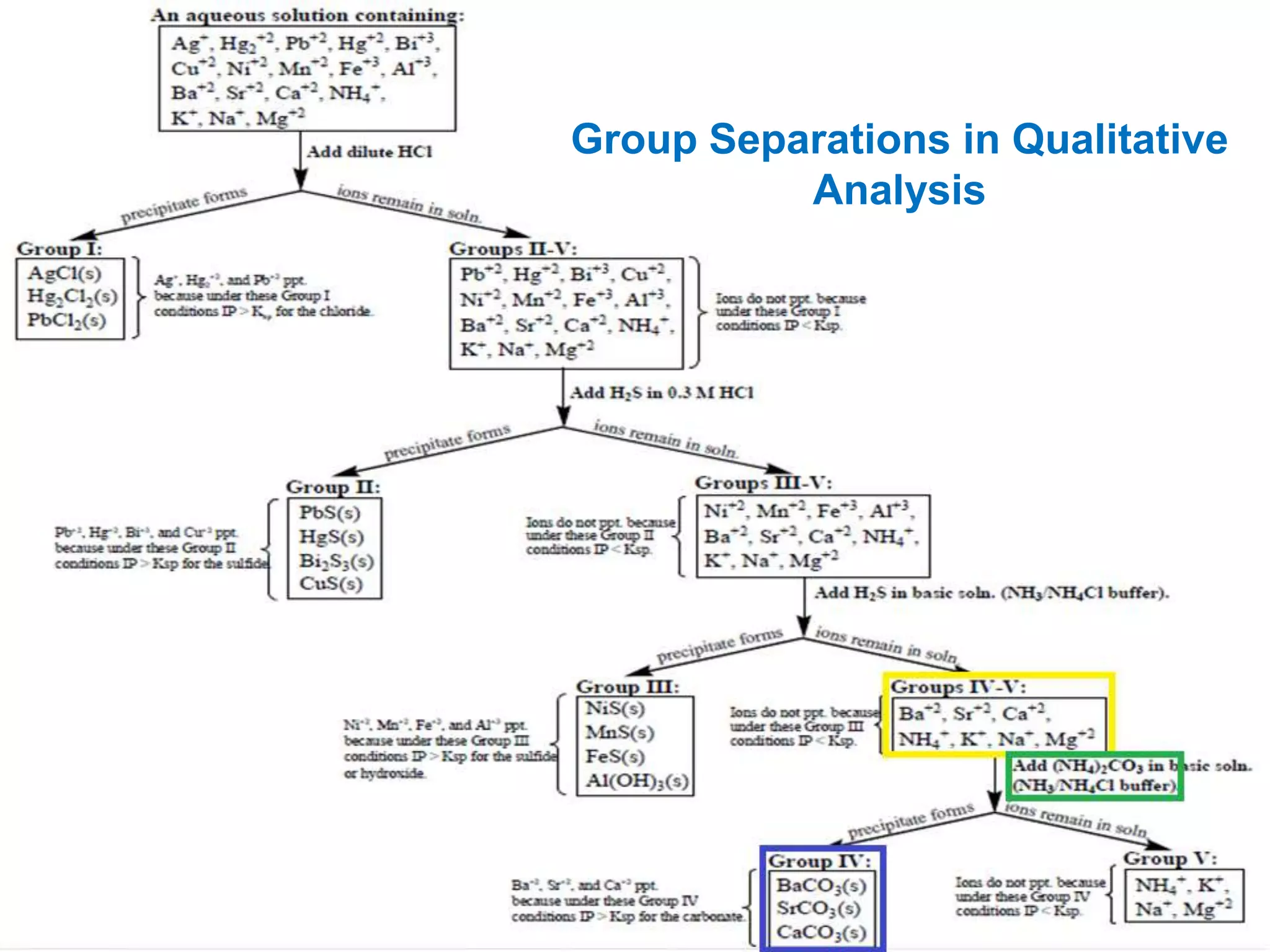
Group Separations in Qualitative
          Analysis
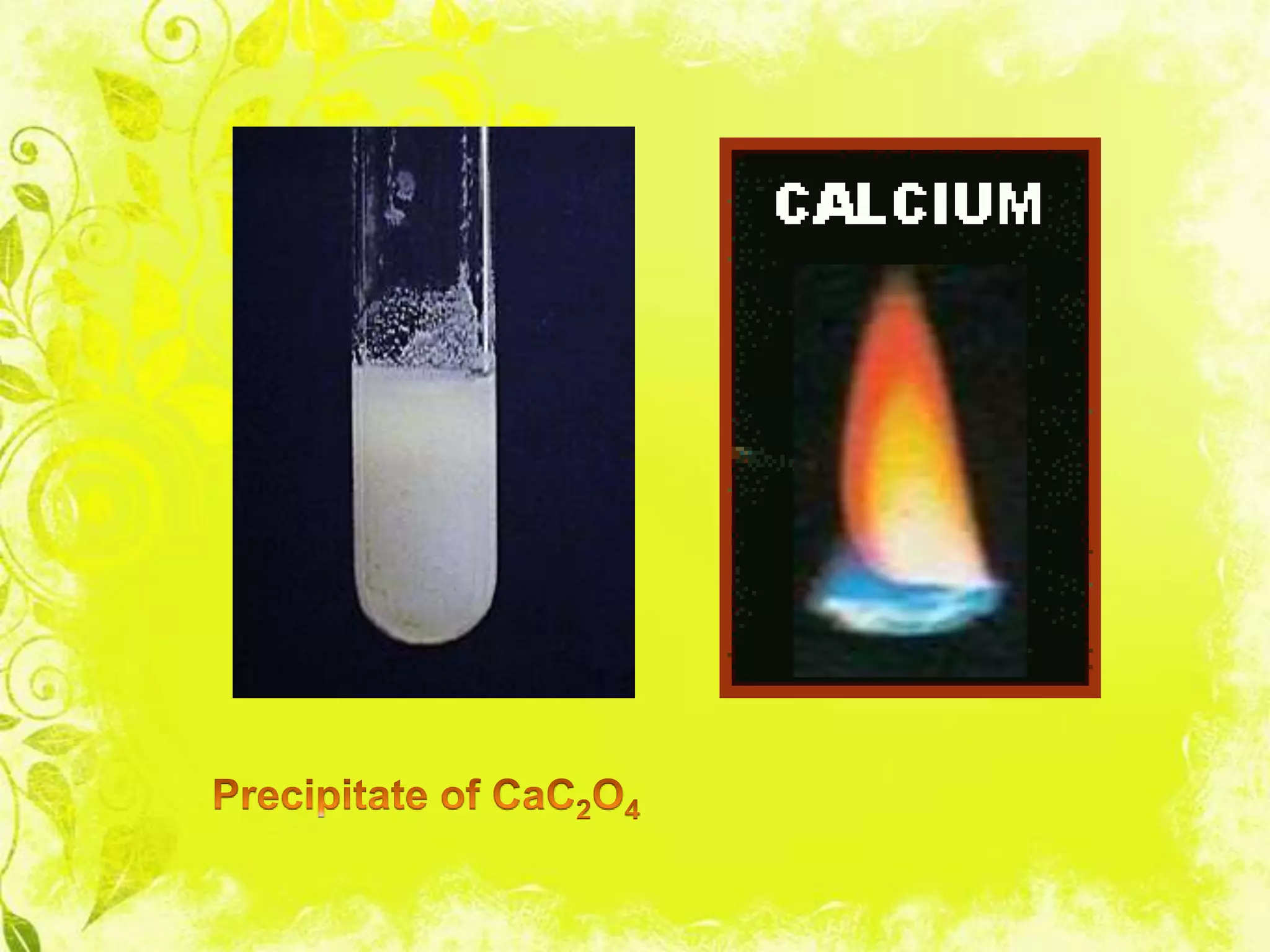
Calcium
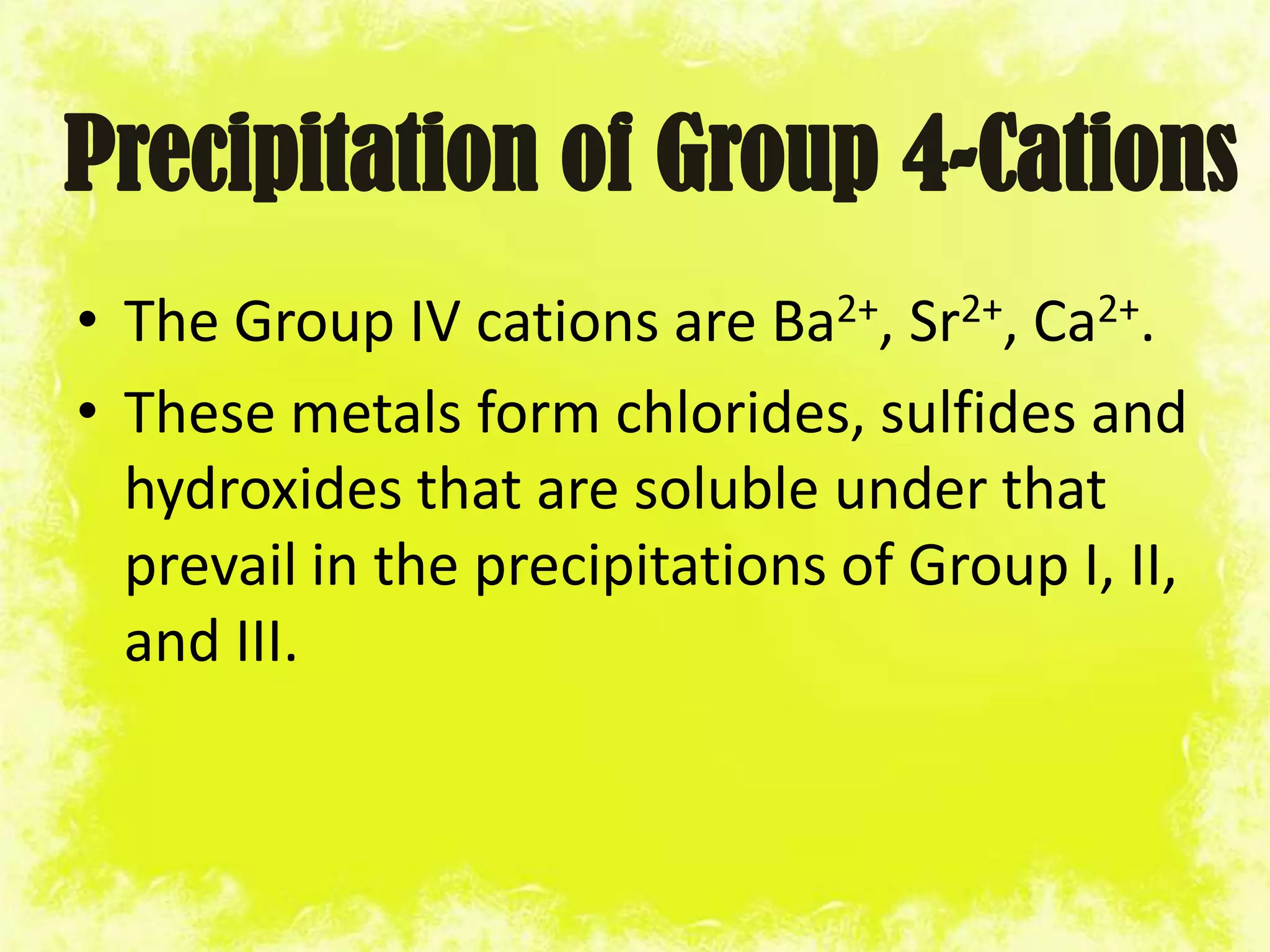
Precipitation of Group 4-Cations
• The Group IV cations are Ba2+, Sr2+, Ca2+.
• These metals form chlorides, sulfides and
  hydroxides that are soluble under that
  prevail in the precipitations of Group I, II,
  and III.
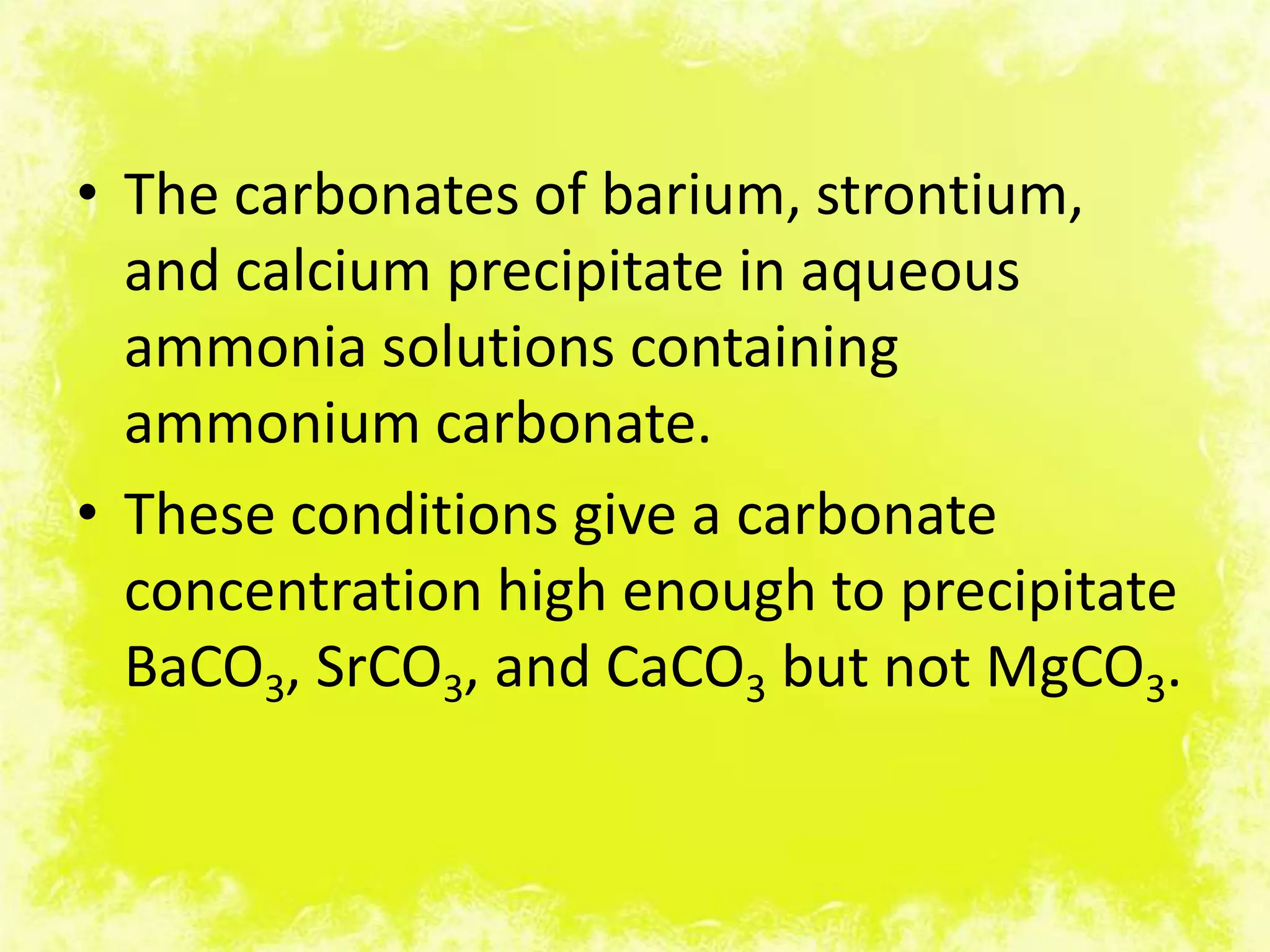
• The carbonates of barium, strontium,
  and calcium precipitate in aqueous
  ammonia solutions containing
  ammonium carbonate.
• These conditions give a carbonate
  concentration high enough to precipitate
  BaCO3, SrCO3, and CaCO3 but not MgCO3.
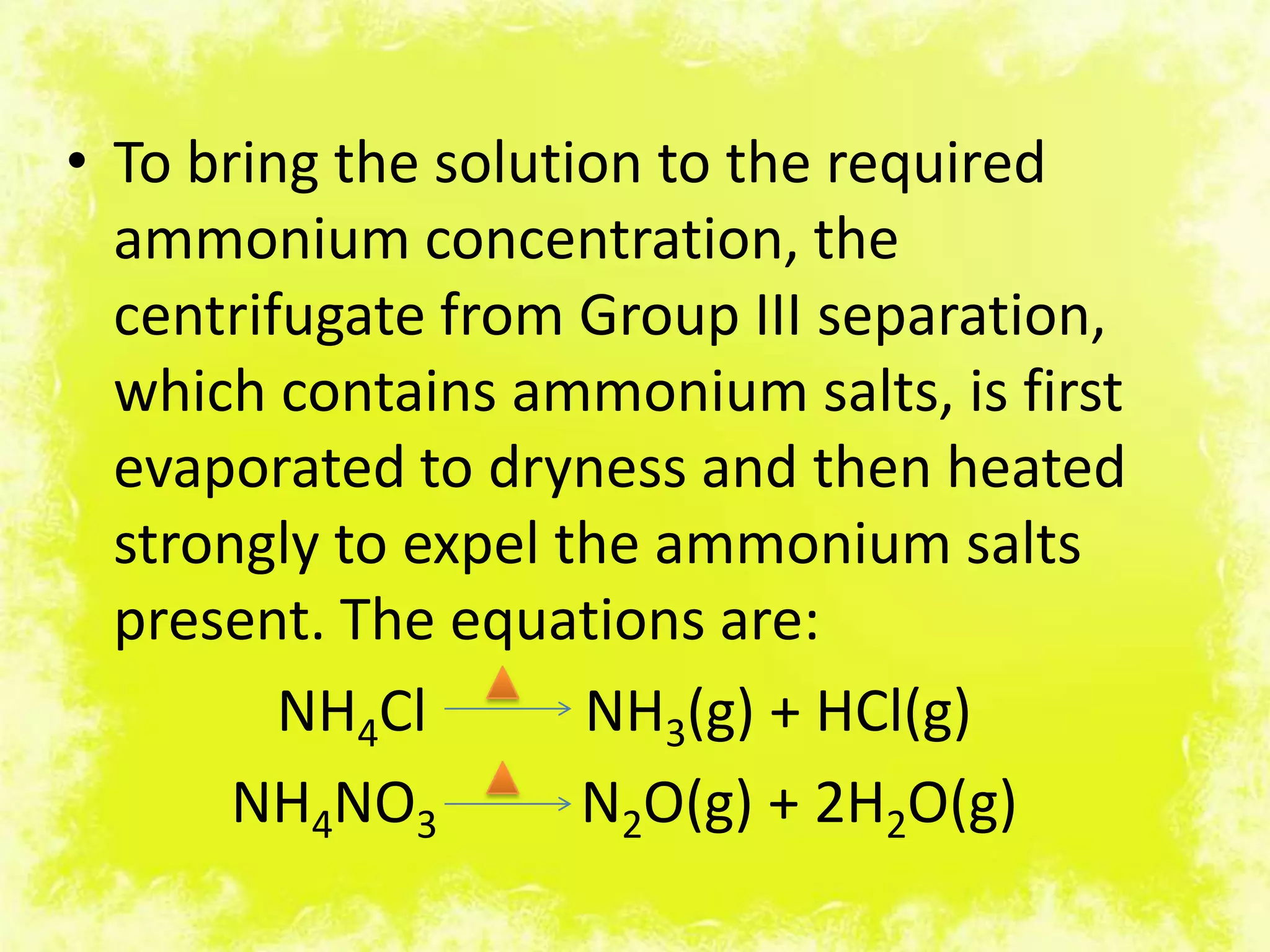
• To bring the solution to the required
  ammonium concentration, the
  centrifugate from Group III separation,
  which contains ammonium salts, is first
  evaporated to dryness and then heated
  strongly to expel the ammonium salts
  present. The equations are:
         NH4Cl       NH3(g) + HCl(g)
       NH4NO3        N2O(g) + 2H2O(g)
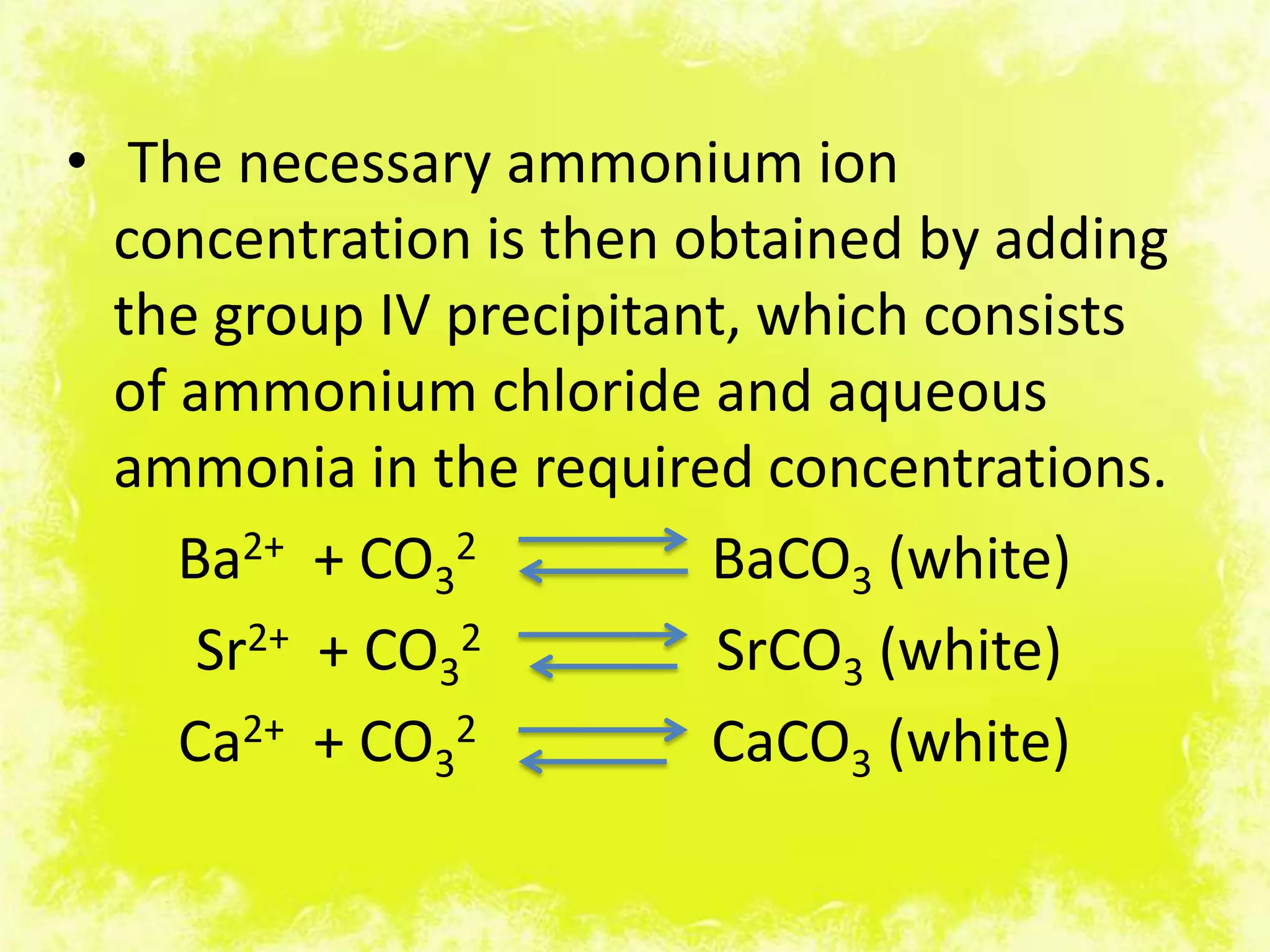
• The necessary ammonium ion
  concentration is then obtained by adding
  the group IV precipitant, which consists
  of ammonium chloride and aqueous
  ammonia in the required concentrations.
     Ba2+ + CO32         BaCO3 (white)
      Sr2+ + CO32         SrCO3 (white)
     Ca2+ + CO32         CaCO3 (white)
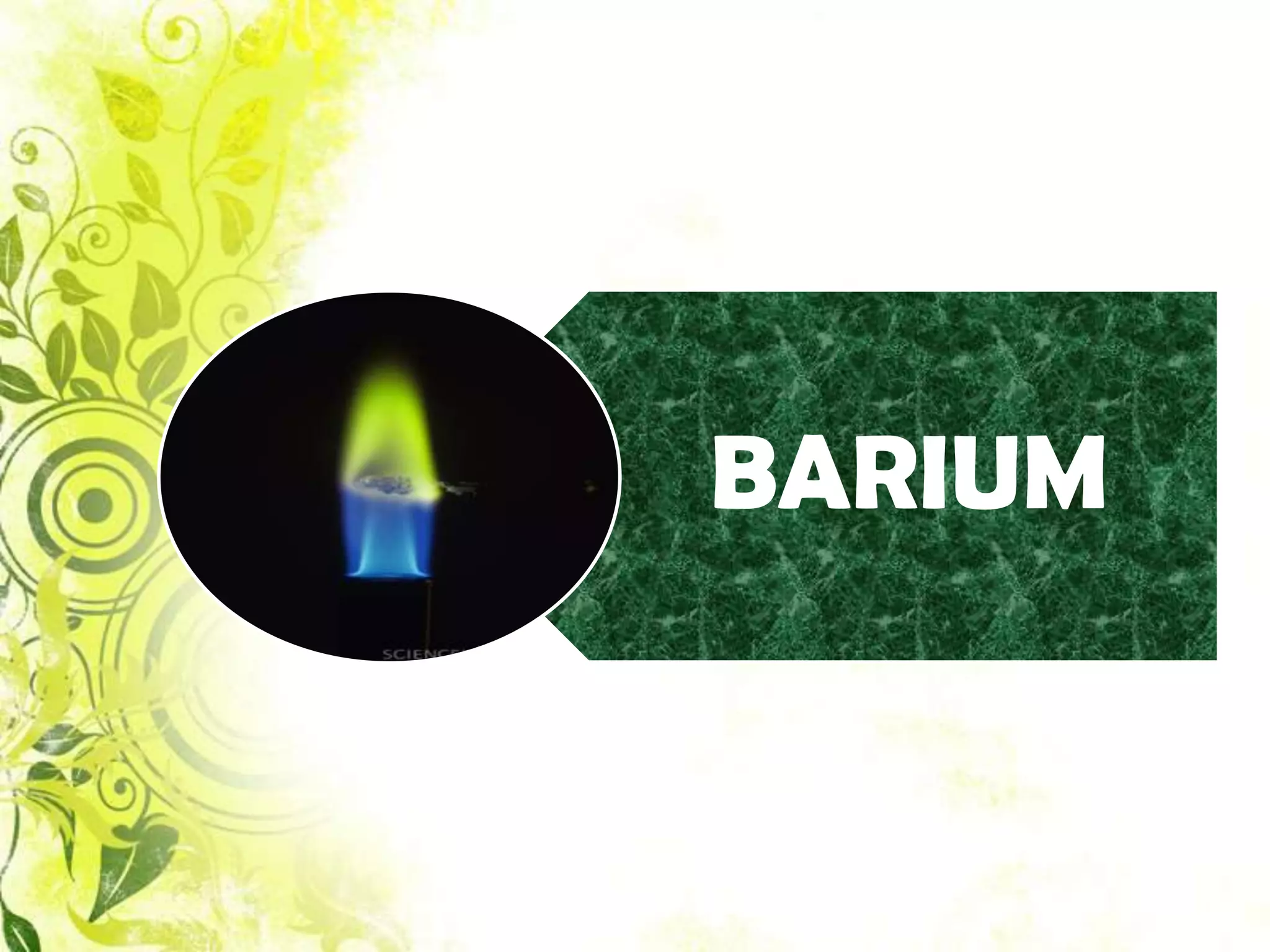
BARIUM
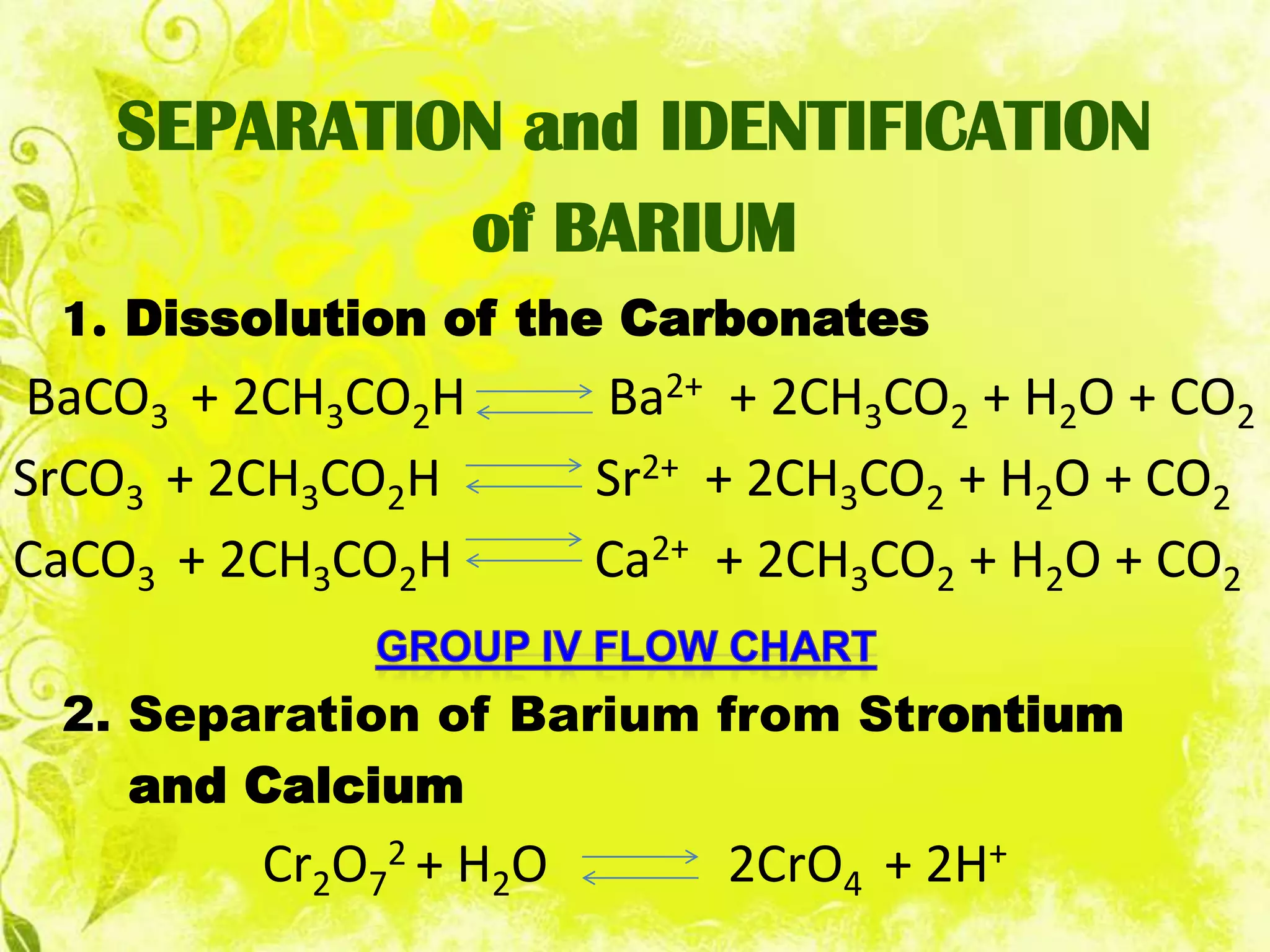
SEPARATION and IDENTIFICATION
            of BARIUM
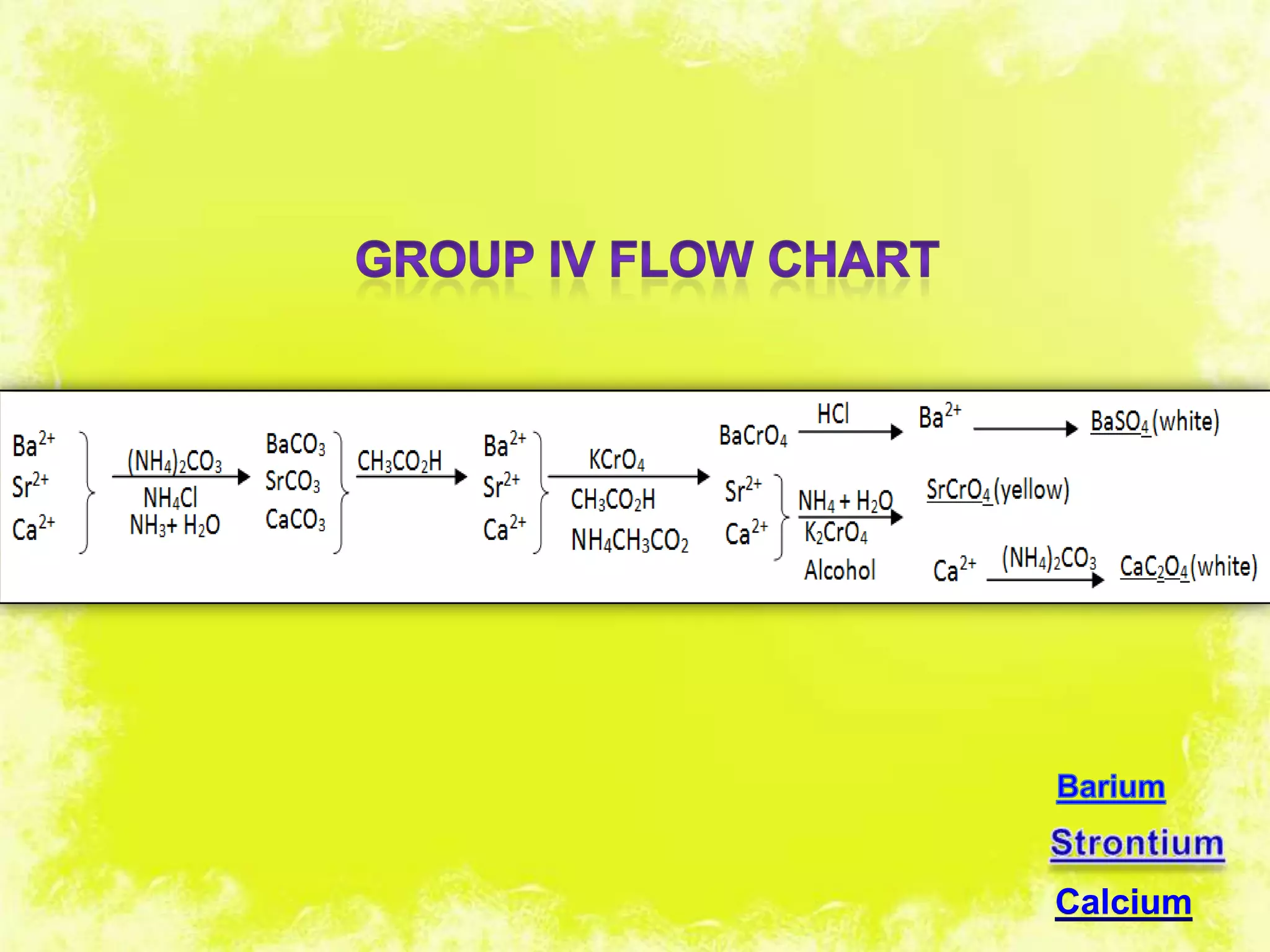
 1. Dissolution of the Carbonates
BaCO3 + 2CH3CO2H       Ba2+ + 2CH3CO2 + H2O + CO2
SrCO3 + 2CH3CO2H       Sr2+ + 2CH3CO2 + H2O + CO2
CaCO3 + 2CH3CO2H       Ca2+ + 2CH3CO2 + H2O + CO2

 2. Separation of Barium from Strontium
    and Calcium
        Cr2O72 + H2O        2CrO4 + 2H+
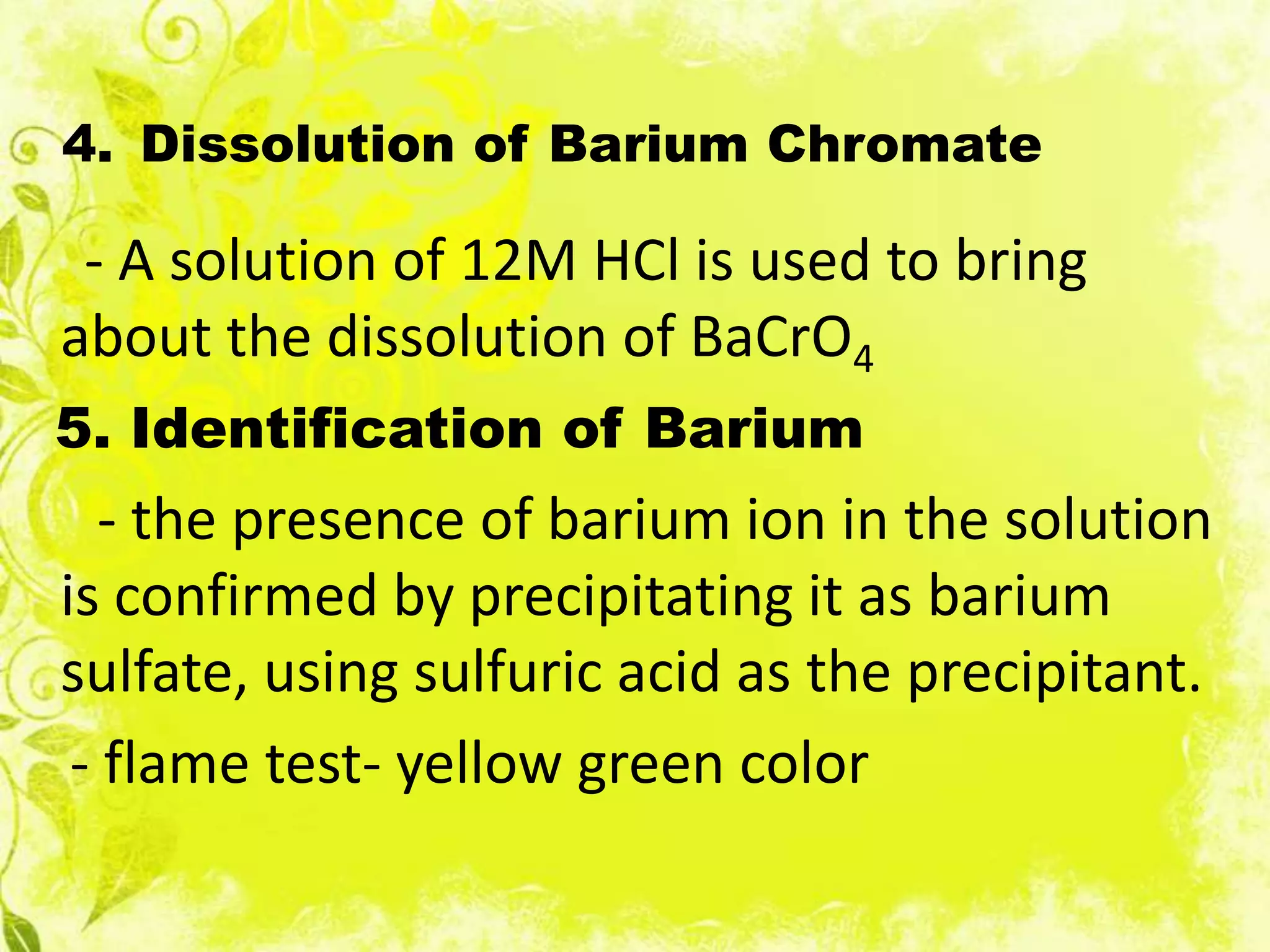
4. Dissolution of Barium Chromate

 - A solution of 12M HCl is used to bring
about the dissolution of BaCrO4
5. Identification of Barium
   - the presence of barium ion in the solution
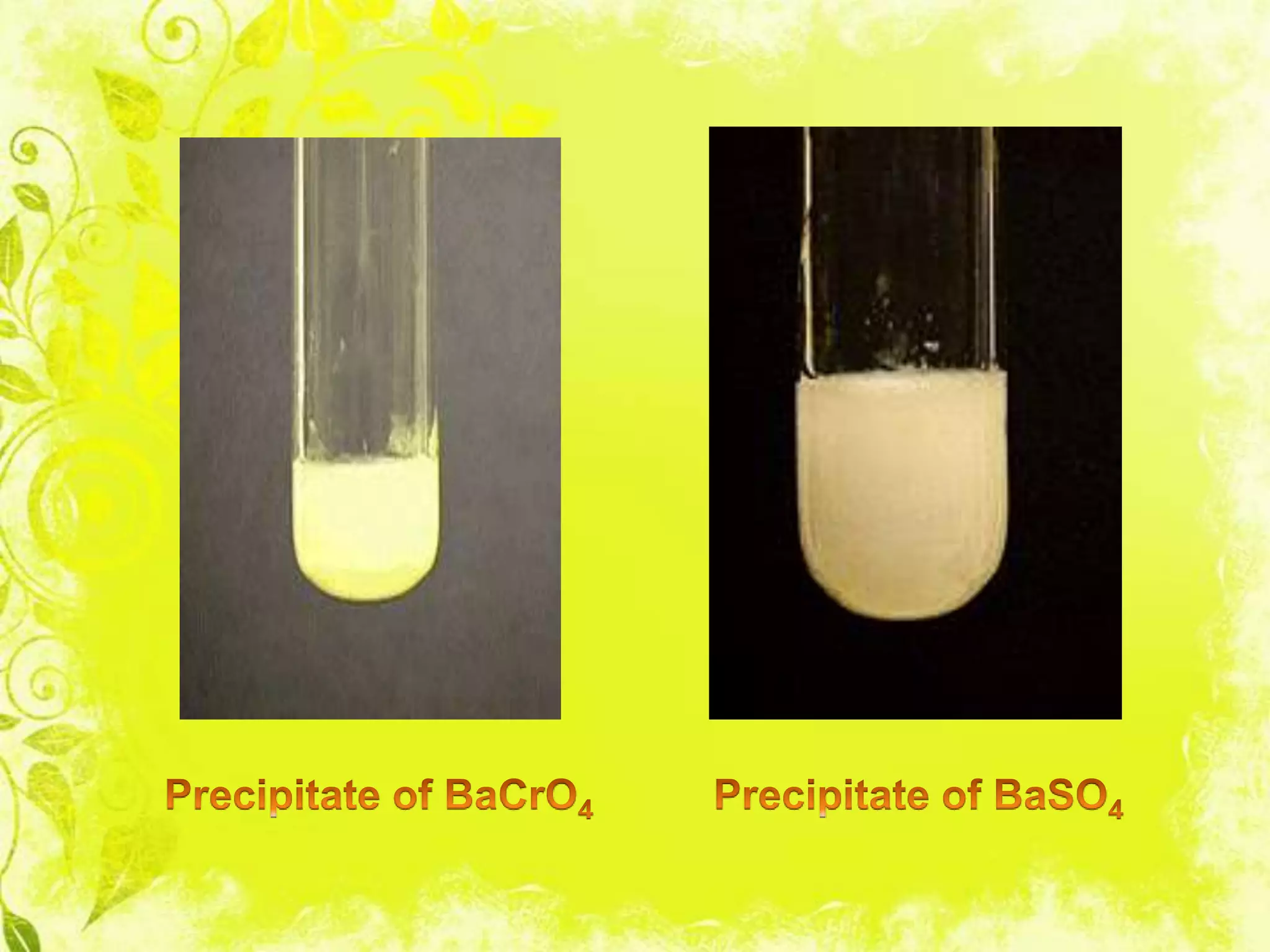
is confirmed by precipitating it as barium
sulfate, using sulfuric acid as the precipitant.
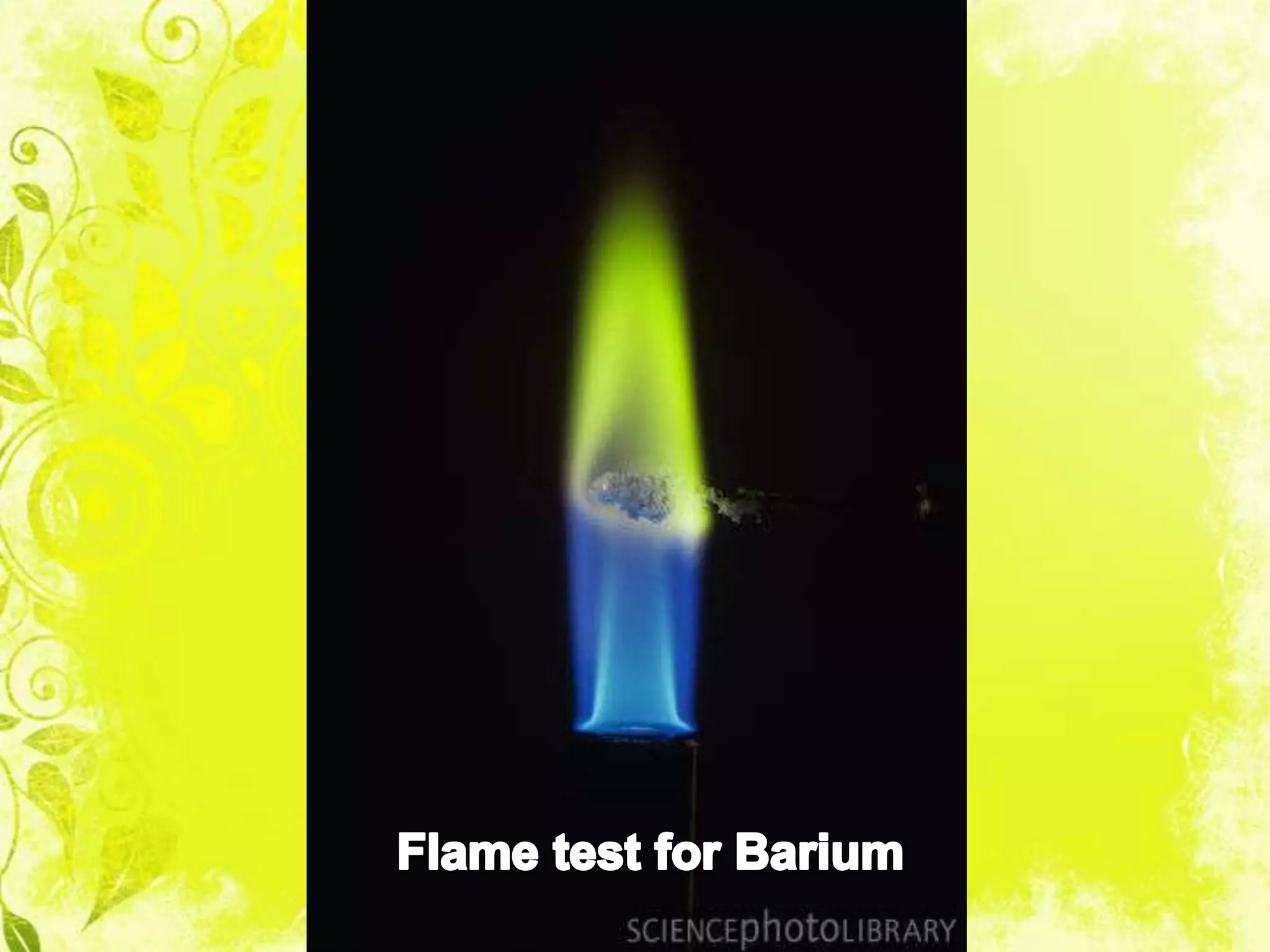
 - flame test- yellow green color
Sodium Hydroxide
a) This gave no immediate ppt.
b) After leaving for about 10 mins, a faint white ppt formed slowly, which apparently dissolved on heating. This test is regarded as no ppt was formed
Barium has a soluble (slightly unsoluble Hydroxide) and it is very hard to form a precipitate with NaOH.


Ammonium Hydroxide
a)   This also gave no immediate ppt.
     b) No reaction on heting, and trace ammounts of ppt formed slowly after 20mins or so. This test is regarded as no ppt was formed. Ammonia is unable to precipitate
     the slightly unsoluble Barium Hydroxide.


Sodium Carbonate
a) A MILKY WHITE PPT was immediately formed
b) No reaction on heating or exess
Insoluble white Barium Carbonate was immediately formed.


Potassium Sulphate
a)   A WHITE PRECIPITATE was formed at once.
     b) No further reaction on heating. Barium Sulphate is an very unsoluble white substance, and is the official test for the Sulphate anion.


SodiumThioSulphate
a)   No reaction takes place
     b) On heating and leving for about 20mins, some traces of white ppt formed slowly. Since very low ammount of ppt was formed after heating and long time, this
     result is regarded as negative. Perhaps some few thiosulphate ions yielded the sulphate ions on heating, which gave the white ppt.


Sodium Sulphite(or Sodium Metabisulphite)
a) Similar to the sulphate, a WHITE PPT was formed rapidly.
b) No further reaction on boiling
Precipitation of the insoluble Barium Sulphite.


Sodium Sulphide
a) A WHITE ppt was formed on adding the Sulphide to the Barium sol.
b) No further reaction on heating or adding Sulphide
Precipitation of white Barium Sulphide.


Sodium Fluoride
a) A faint white ppt was formed, which did not intensified on standing.
b) No further reaction on heating. An exact similar ppt took place with the Ca, Al and Mg solutions. The flouride of metals seem to be all unsoluble.
Potassium Iodate
a) A MILKY WHITE PPT was formed exhibiting the "Titanic" effect.
   b) No effect on heating or standing. White and heavy (dense) Barium Iodate was precipitated

Ammonium Phosphate
a) A dense WHITE PPT formed at once. As other phosphates, this ppt sinks rapidly to the base of the testtube.
b) No further reaction on heating. Barium also bears an insoluble phosphate.

Sodium Tetraborate
a) A WHITE PPT. was formed rapidly.
b) No further reaction on heating
White insoluble Barium Borate was formed.

Sodium Citrate
a) A dense white ppt was immediately formed.
b) On heating, no other reaction took place. Barium Citrate, like Calcium, is a white insoluble compound.

Sodium Silicate
a) A WHITE ppt was formed
b) No further reaction on heating or standing. Solid white Barium Silicate was formed

Sodium Vanadate
a) This gave a CREAM / PALE YELLOW PPT and a pale yellow/colourless solution.
b) No further reaction on heating apart from perhaps speeding up the reaction
Barium Vanadate is formed, also with the posible formation of a vanadium soluble salt which is colourless / pale yellow in colour.

Potassium Dichromate
a) The apparent precipitation is of an orange precipitate, however filtration had shown that the reaction formed a DENSE HIGH-LIGHTER YELLOW PPT at the
bottom of the tube, leaving an orange solution, propably a chromium salt.
b) No further reaction on heating. The complex dichromate ion broke to give chromate and chrome salts. Barium Chromate is a bright yellow compound, whereas
the chrome ions were orange. Adding more barium salt to the orange filtrate didn't gave off again a ppt.

Sodium Tungstate
a) A MILKY WHITE ppt was formed at once
b) No further reaction on heating, standing or adding xs Tungstate
Barium Tungstate was precipitated as a white solid.

Ammonium Molybdate
a) A MILKY WHITE ppt was formed
b) No further reaction on heat or standing
STRONTIUM
SEPARATION and IDENTIFICATION
           of STRONTIUM
1. Separation of Strontium from Calcium
     Cr2O72 + 2NH3 + H2O             2CrO42 + 2NH4+


2. Identification of Strontium
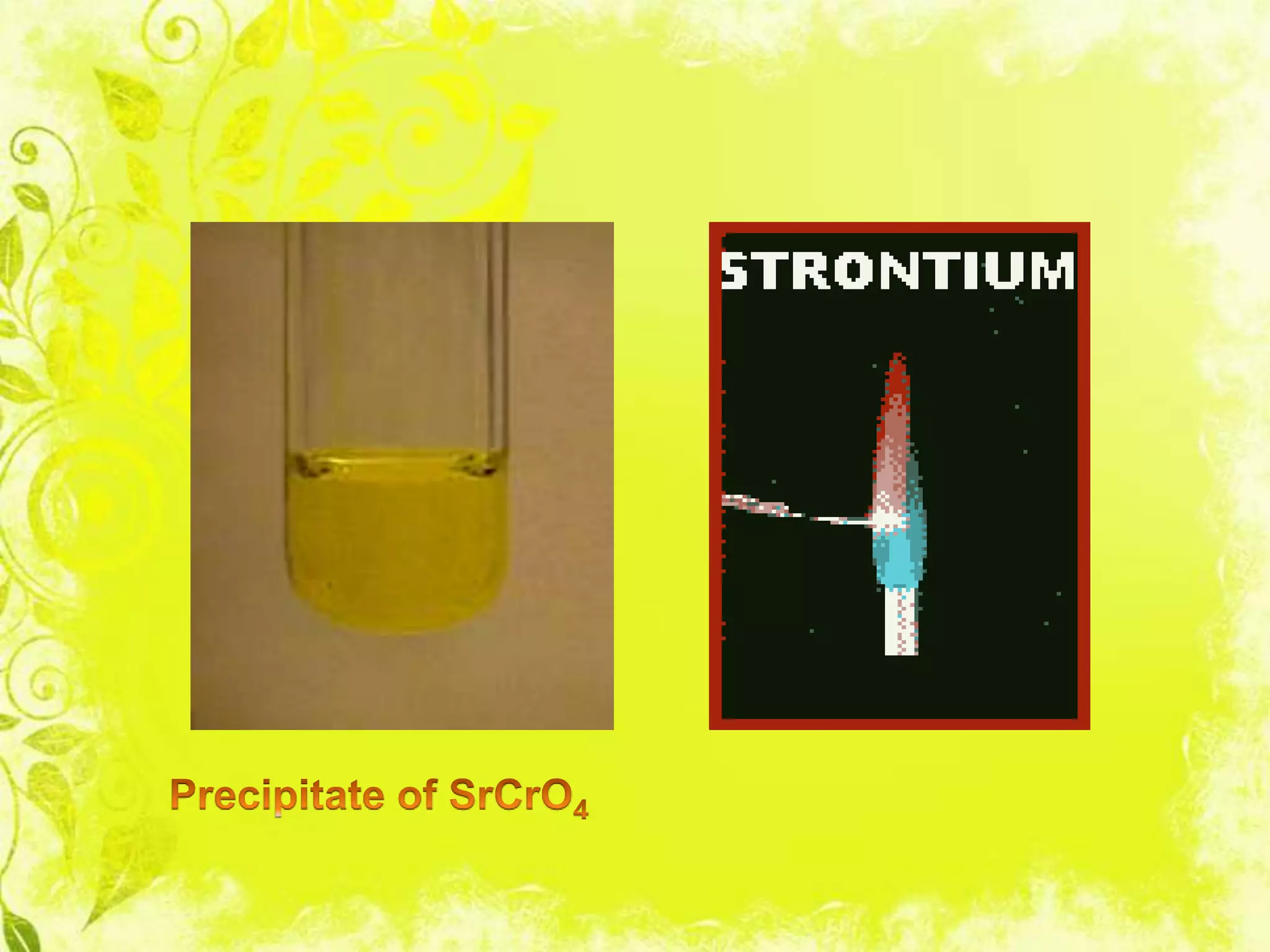
- the formation of a fine yellow crystalline precipitate of
strontium chromate confirms the presence of strontium
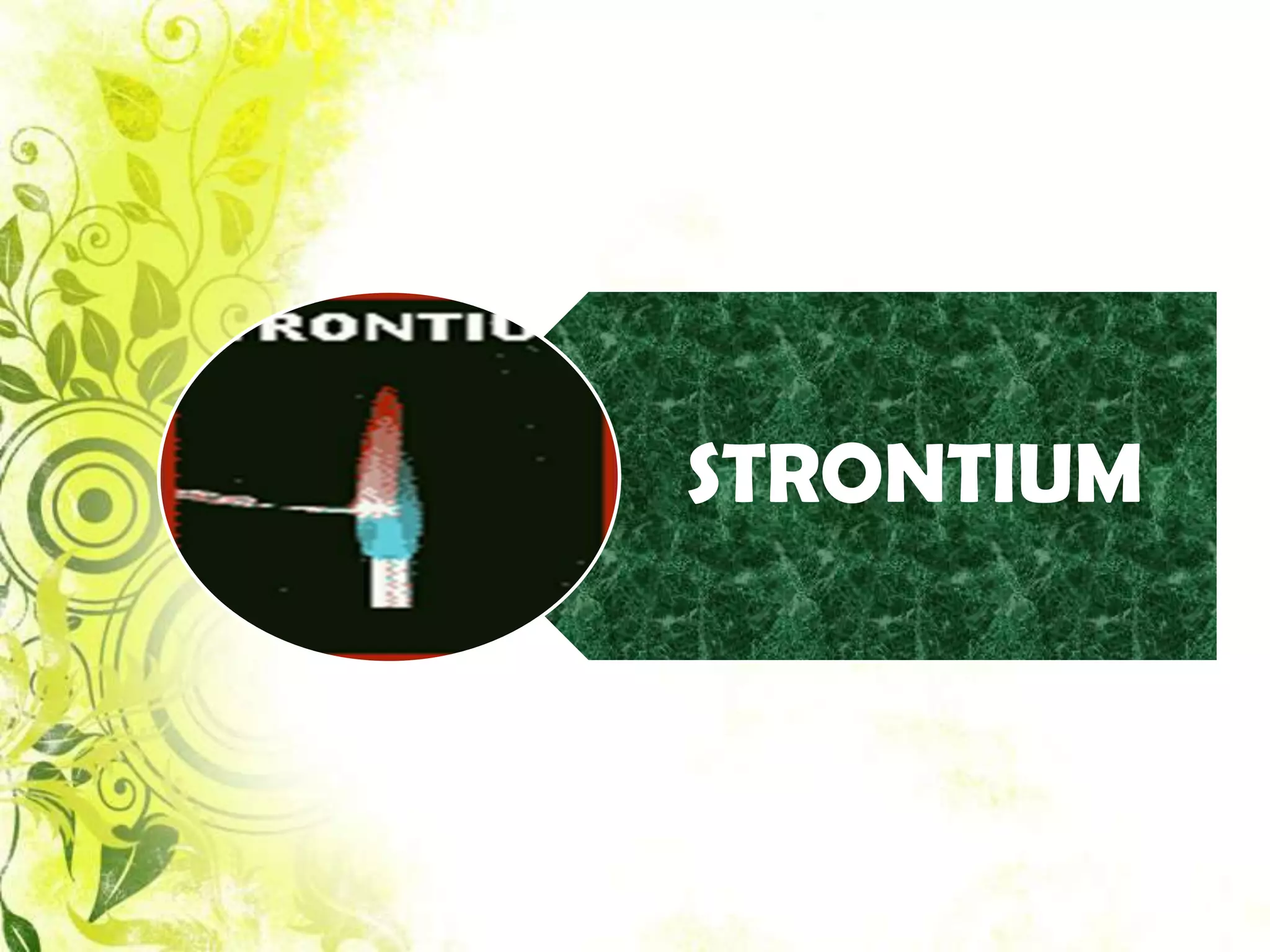
- flame test- crimson color
CALCIUM
IDENTIFICATION of CALCIUM
• The solution from the strontium chromate
  separation contains the calcium ion.
• The addition of ammonium oxalate precipitates
  calcium oxalate, CaCrO4, a white crystalline salt.
             Ca2+ + C2O42         CaC2O4


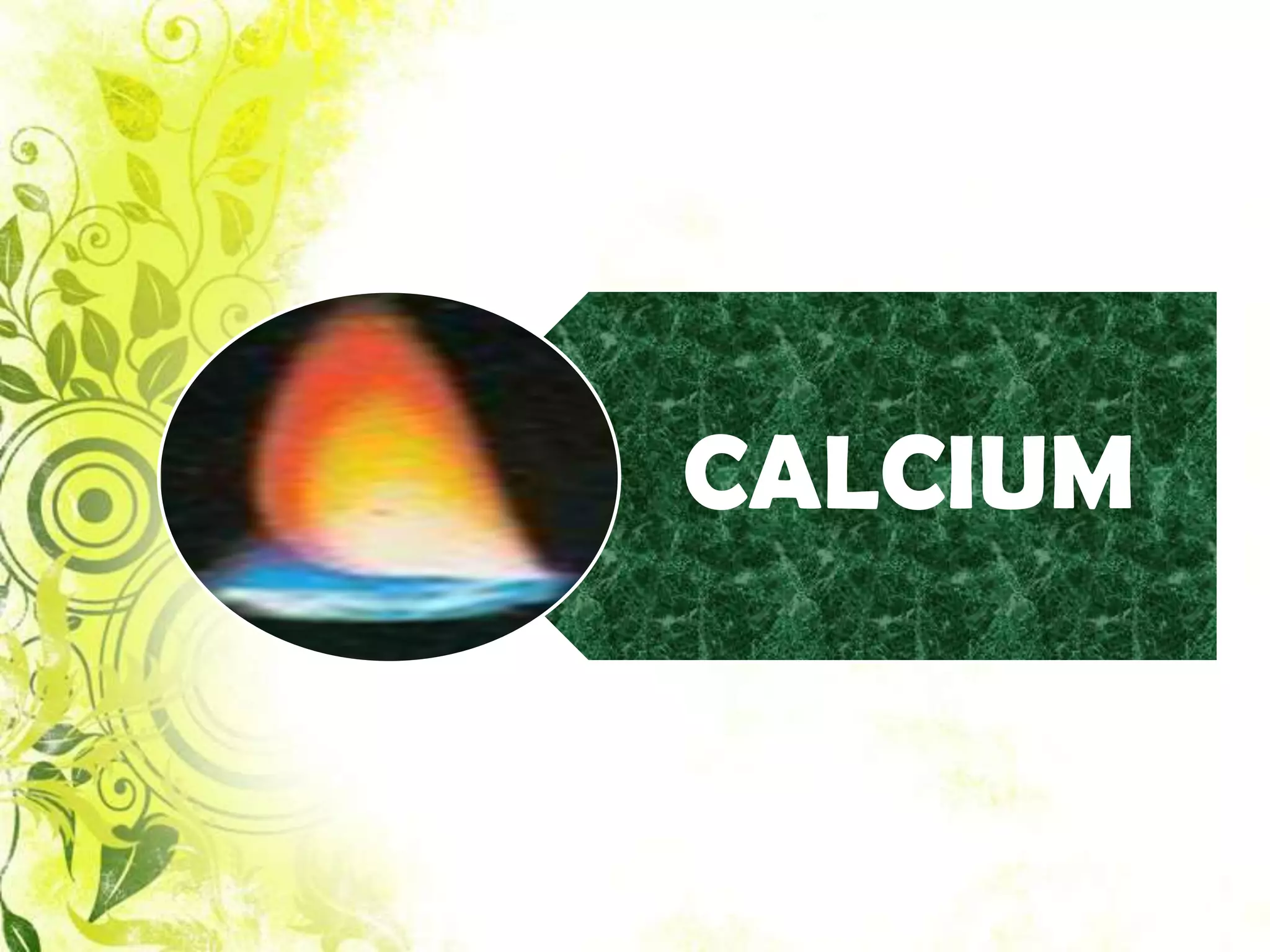
• Flame test- brick red color
01: Sodium Hydroxide
a)   This gave a MILKY WHITE PPT. insoluble in exess Hydroxide
     b) No reaction on heating Unslouble (slightly soluble) white Calcium Hydroxide was formed.


02: Ammonium Hydroxide
a) This gave no immediate ppt.
b) On heating and standing for some hours, few cloudy white ppt was formed. Ammonia is unable to precipitate the sparingly soluble Calcium Hydroxide


03: Sodium Carbonate
a) A WHITE PPT was immediately formed
b) No reaction on heating or exess Insoluble white Calcium Carbonate was immediately formed.


04: Potassium Sulphate
a) A white precipitate was formed slowly.
b) Heating the mixture, made faster the reaction, and the white precipitate was quickly formed. Calcium Sulphate is an insoluble white substance.


05: Sodium Sulphite (or Sodium Metabisulphite)
a) No reation when mixture is room temp.
b) On boiling, the reaction formed a white ppt, and the liquid bumped violently on reaching the boiling point. Propably the white compound is Sodium sulphite, and it's
reaction rate is slower from the sulphate one. Also it is possible that heating have in some way converted the Sulphite into Sulphate, and the ppt formed was due the
sulphate.


06: Sodium Sulphide
a)   After letting to stand for few minutes, the clear solution turns slightly dirty due the formation of a very faint white ppt.
     b) On heating a light grey, faint white ppt was formed and fell to tha bottom of the tube. Slow formation of the insoluble light grey Calcium Sulphide took place.
     Heating increased the rate of reaction.


07: Sodium Fluoride
a) A faint white ppt was formed, which did not intensified on standing.
b) No further reaction on heating. An exact similar ppt took place with the Al and Mg solutions.


08: Potassium Iodate
a) No immediate precipitate or colour change. c) A WHITE PPT was formed only after standing for some quite time or heating. Precipitation of the insoluble Calcium
iodate. Don't know why this was not spontanous (i.e formed as soon as the two solutions were mixed.)
09: Ammonium Phosphate
a) A WHITE PPT formed at once.
b) No further reaction on heating. Calcium also bears an insoluble phosphate.

10: Sodium TetraBorate
a) A dense WHITE PPT. was formed rapidly.
b) No further reaction on heating White insoluble Calcium Borate was formed.

11: Sodium Citrate
a) No reaction at all
b) On heating a WHITE precipitate was formed. This is an interesting test, since Citrate does not form a ppt in any way with Mg and Al. An
excellent test to distinguish between Mg and Ca for example. White insoluble Calcium Borate was formed.

12: Sodium Silicate
a) WHITE ppt was formed rapidly.
b) No reaction on heating or standing. White Calcium Silicate was formed.

13: Potassium Ferro(II)Cyanide
a) No reaction or ppt detected
b) On heating a little white fine ppt was formed. Don't know if its an experimental error, but I would not rely on and perform this test.

14: Sodium Tungstate
a) A MILKY WHITE ppt was formed rapidly.
b) No further reaction, due to heating, xstungstste or standing

15: Ammonium Molybdate
a) No initial precipitation or reaction
b) On heating, a FAINT WHITE PPt was formed.
THANK YOU!!!
           
        

Qualitative analysis of group 4 cations

  • 1.
    ANALYSIS OF GROUPIV CATIONS Jessa S. Ariño BSE-4B Central Bicol State University of Agriculture
  • 2.
    Group Separations inQualitative Analysis
  • 3.
    Group Separations inQualitative Analysis
  • 4.
  • 6.
    Precipitation of Group4-Cations • The Group IV cations are Ba2+, Sr2+, Ca2+. • These metals form chlorides, sulfides and hydroxides that are soluble under that prevail in the precipitations of Group I, II, and III.
  • 7.
    • The carbonatesof barium, strontium, and calcium precipitate in aqueous ammonia solutions containing ammonium carbonate. • These conditions give a carbonate concentration high enough to precipitate BaCO3, SrCO3, and CaCO3 but not MgCO3.
  • 8.
    • To bringthe solution to the required ammonium concentration, the centrifugate from Group III separation, which contains ammonium salts, is first evaporated to dryness and then heated strongly to expel the ammonium salts present. The equations are: NH4Cl NH3(g) + HCl(g) NH4NO3 N2O(g) + 2H2O(g)
  • 9.
    • The necessaryammonium ion concentration is then obtained by adding the group IV precipitant, which consists of ammonium chloride and aqueous ammonia in the required concentrations. Ba2+ + CO32 BaCO3 (white) Sr2+ + CO32 SrCO3 (white) Ca2+ + CO32 CaCO3 (white)
  • 10.
  • 11.
    SEPARATION and IDENTIFICATION of BARIUM 1. Dissolution of the Carbonates BaCO3 + 2CH3CO2H Ba2+ + 2CH3CO2 + H2O + CO2 SrCO3 + 2CH3CO2H Sr2+ + 2CH3CO2 + H2O + CO2 CaCO3 + 2CH3CO2H Ca2+ + 2CH3CO2 + H2O + CO2 2. Separation of Barium from Strontium and Calcium Cr2O72 + H2O 2CrO4 + 2H+
  • 12.
    4. Dissolution ofBarium Chromate - A solution of 12M HCl is used to bring about the dissolution of BaCrO4 5. Identification of Barium - the presence of barium ion in the solution is confirmed by precipitating it as barium sulfate, using sulfuric acid as the precipitant. - flame test- yellow green color
  • 15.
    Sodium Hydroxide a) Thisgave no immediate ppt. b) After leaving for about 10 mins, a faint white ppt formed slowly, which apparently dissolved on heating. This test is regarded as no ppt was formed Barium has a soluble (slightly unsoluble Hydroxide) and it is very hard to form a precipitate with NaOH. Ammonium Hydroxide a) This also gave no immediate ppt. b) No reaction on heting, and trace ammounts of ppt formed slowly after 20mins or so. This test is regarded as no ppt was formed. Ammonia is unable to precipitate the slightly unsoluble Barium Hydroxide. Sodium Carbonate a) A MILKY WHITE PPT was immediately formed b) No reaction on heating or exess Insoluble white Barium Carbonate was immediately formed. Potassium Sulphate a) A WHITE PRECIPITATE was formed at once. b) No further reaction on heating. Barium Sulphate is an very unsoluble white substance, and is the official test for the Sulphate anion. SodiumThioSulphate a) No reaction takes place b) On heating and leving for about 20mins, some traces of white ppt formed slowly. Since very low ammount of ppt was formed after heating and long time, this result is regarded as negative. Perhaps some few thiosulphate ions yielded the sulphate ions on heating, which gave the white ppt. Sodium Sulphite(or Sodium Metabisulphite) a) Similar to the sulphate, a WHITE PPT was formed rapidly. b) No further reaction on boiling Precipitation of the insoluble Barium Sulphite. Sodium Sulphide a) A WHITE ppt was formed on adding the Sulphide to the Barium sol. b) No further reaction on heating or adding Sulphide Precipitation of white Barium Sulphide. Sodium Fluoride a) A faint white ppt was formed, which did not intensified on standing. b) No further reaction on heating. An exact similar ppt took place with the Ca, Al and Mg solutions. The flouride of metals seem to be all unsoluble.
  • 16.
    Potassium Iodate a) AMILKY WHITE PPT was formed exhibiting the "Titanic" effect. b) No effect on heating or standing. White and heavy (dense) Barium Iodate was precipitated Ammonium Phosphate a) A dense WHITE PPT formed at once. As other phosphates, this ppt sinks rapidly to the base of the testtube. b) No further reaction on heating. Barium also bears an insoluble phosphate. Sodium Tetraborate a) A WHITE PPT. was formed rapidly. b) No further reaction on heating White insoluble Barium Borate was formed. Sodium Citrate a) A dense white ppt was immediately formed. b) On heating, no other reaction took place. Barium Citrate, like Calcium, is a white insoluble compound. Sodium Silicate a) A WHITE ppt was formed b) No further reaction on heating or standing. Solid white Barium Silicate was formed Sodium Vanadate a) This gave a CREAM / PALE YELLOW PPT and a pale yellow/colourless solution. b) No further reaction on heating apart from perhaps speeding up the reaction Barium Vanadate is formed, also with the posible formation of a vanadium soluble salt which is colourless / pale yellow in colour. Potassium Dichromate a) The apparent precipitation is of an orange precipitate, however filtration had shown that the reaction formed a DENSE HIGH-LIGHTER YELLOW PPT at the bottom of the tube, leaving an orange solution, propably a chromium salt. b) No further reaction on heating. The complex dichromate ion broke to give chromate and chrome salts. Barium Chromate is a bright yellow compound, whereas the chrome ions were orange. Adding more barium salt to the orange filtrate didn't gave off again a ppt. Sodium Tungstate a) A MILKY WHITE ppt was formed at once b) No further reaction on heating, standing or adding xs Tungstate Barium Tungstate was precipitated as a white solid. Ammonium Molybdate a) A MILKY WHITE ppt was formed b) No further reaction on heat or standing
  • 17.
  • 18.
    SEPARATION and IDENTIFICATION of STRONTIUM 1. Separation of Strontium from Calcium Cr2O72 + 2NH3 + H2O 2CrO42 + 2NH4+ 2. Identification of Strontium - the formation of a fine yellow crystalline precipitate of strontium chromate confirms the presence of strontium - flame test- crimson color
  • 20.
  • 21.
    IDENTIFICATION of CALCIUM •The solution from the strontium chromate separation contains the calcium ion. • The addition of ammonium oxalate precipitates calcium oxalate, CaCrO4, a white crystalline salt. Ca2+ + C2O42 CaC2O4 • Flame test- brick red color
  • 23.
    01: Sodium Hydroxide a) This gave a MILKY WHITE PPT. insoluble in exess Hydroxide b) No reaction on heating Unslouble (slightly soluble) white Calcium Hydroxide was formed. 02: Ammonium Hydroxide a) This gave no immediate ppt. b) On heating and standing for some hours, few cloudy white ppt was formed. Ammonia is unable to precipitate the sparingly soluble Calcium Hydroxide 03: Sodium Carbonate a) A WHITE PPT was immediately formed b) No reaction on heating or exess Insoluble white Calcium Carbonate was immediately formed. 04: Potassium Sulphate a) A white precipitate was formed slowly. b) Heating the mixture, made faster the reaction, and the white precipitate was quickly formed. Calcium Sulphate is an insoluble white substance. 05: Sodium Sulphite (or Sodium Metabisulphite) a) No reation when mixture is room temp. b) On boiling, the reaction formed a white ppt, and the liquid bumped violently on reaching the boiling point. Propably the white compound is Sodium sulphite, and it's reaction rate is slower from the sulphate one. Also it is possible that heating have in some way converted the Sulphite into Sulphate, and the ppt formed was due the sulphate. 06: Sodium Sulphide a) After letting to stand for few minutes, the clear solution turns slightly dirty due the formation of a very faint white ppt. b) On heating a light grey, faint white ppt was formed and fell to tha bottom of the tube. Slow formation of the insoluble light grey Calcium Sulphide took place. Heating increased the rate of reaction. 07: Sodium Fluoride a) A faint white ppt was formed, which did not intensified on standing. b) No further reaction on heating. An exact similar ppt took place with the Al and Mg solutions. 08: Potassium Iodate a) No immediate precipitate or colour change. c) A WHITE PPT was formed only after standing for some quite time or heating. Precipitation of the insoluble Calcium iodate. Don't know why this was not spontanous (i.e formed as soon as the two solutions were mixed.)
  • 24.
    09: Ammonium Phosphate a)A WHITE PPT formed at once. b) No further reaction on heating. Calcium also bears an insoluble phosphate. 10: Sodium TetraBorate a) A dense WHITE PPT. was formed rapidly. b) No further reaction on heating White insoluble Calcium Borate was formed. 11: Sodium Citrate a) No reaction at all b) On heating a WHITE precipitate was formed. This is an interesting test, since Citrate does not form a ppt in any way with Mg and Al. An excellent test to distinguish between Mg and Ca for example. White insoluble Calcium Borate was formed. 12: Sodium Silicate a) WHITE ppt was formed rapidly. b) No reaction on heating or standing. White Calcium Silicate was formed. 13: Potassium Ferro(II)Cyanide a) No reaction or ppt detected b) On heating a little white fine ppt was formed. Don't know if its an experimental error, but I would not rely on and perform this test. 14: Sodium Tungstate a) A MILKY WHITE ppt was formed rapidly. b) No further reaction, due to heating, xstungstste or standing 15: Ammonium Molybdate a) No initial precipitation or reaction b) On heating, a FAINT WHITE PPt was formed.
  • 25.
    THANK YOU!!!  