Oxyanion Nomenclature
(Naming Oxyanions)
By Dr. Shawn P. Shields
This work is licensed by Shawn P. Shields-Maxwell under a Creative
Commons Attribution-NonCommercial-ShareAlike 4.0 International License.
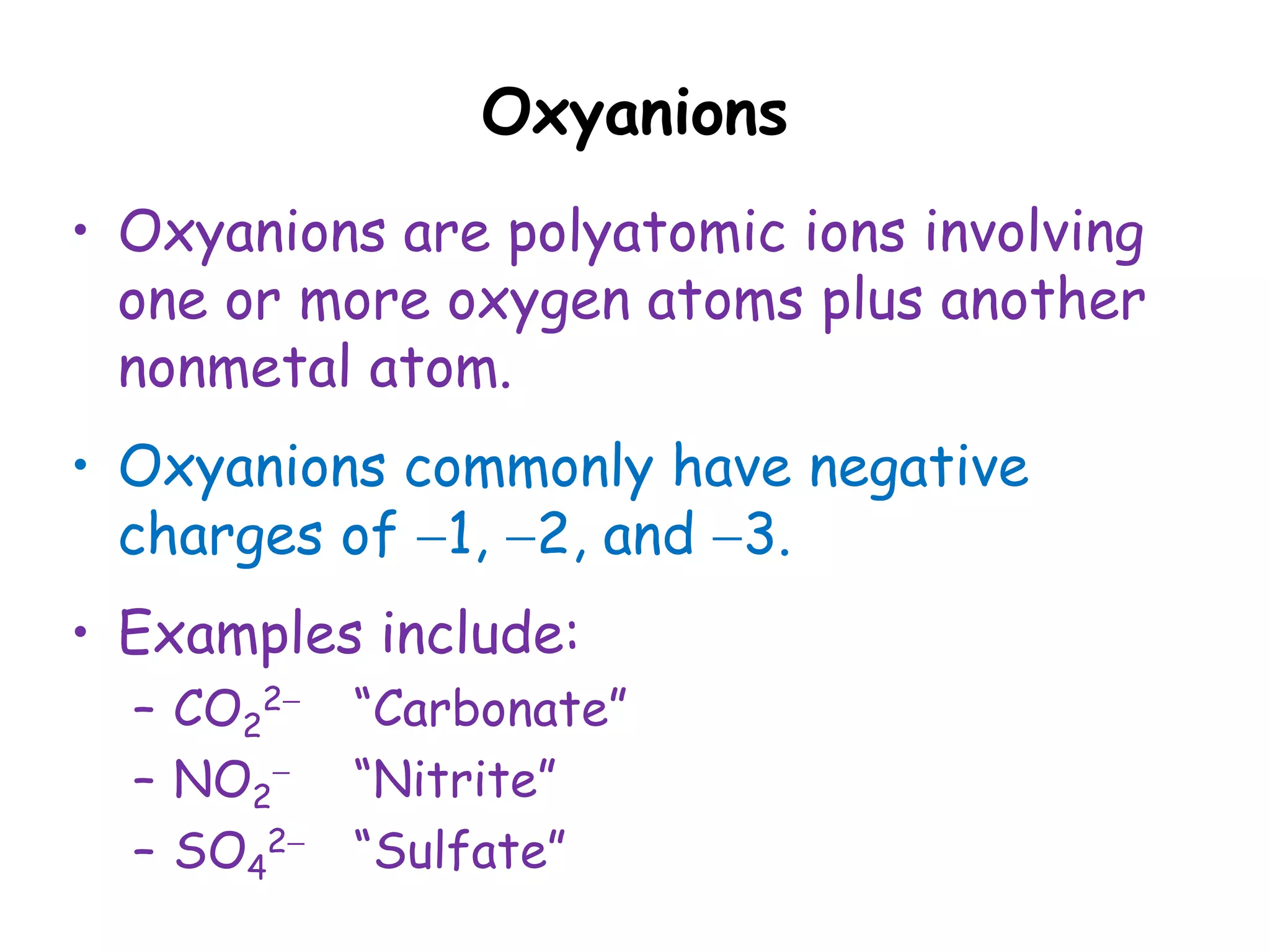
Oxyanions
• Oxyanions are polyatomic ions involving
one or more oxygen atoms plus another
nonmetal atom.
• Oxyanions commonly have negative
charges of 1, 2, and 3.
• Examples include:
– CO2
2 “Carbonate”
– NO2
 “Nitrite”
– SO4
2 “Sulfate”
General Rules for Naming Oxyanions
• Oxyanions are named according to the
steps given below.
1) Write the root of the name of the non-
oxygen element
2) Add the –ate or –ite suffix to the end of
the name, according to the rule on the next
slide.
• Examples:
– NO3
 Nitrogen is the non-oxygen element. Remove
the –ogen and add –ate “nitrate”
– SO3
2 Sulfur is the non-oxygen element. Remove
–ur and add –ite “sulfite”
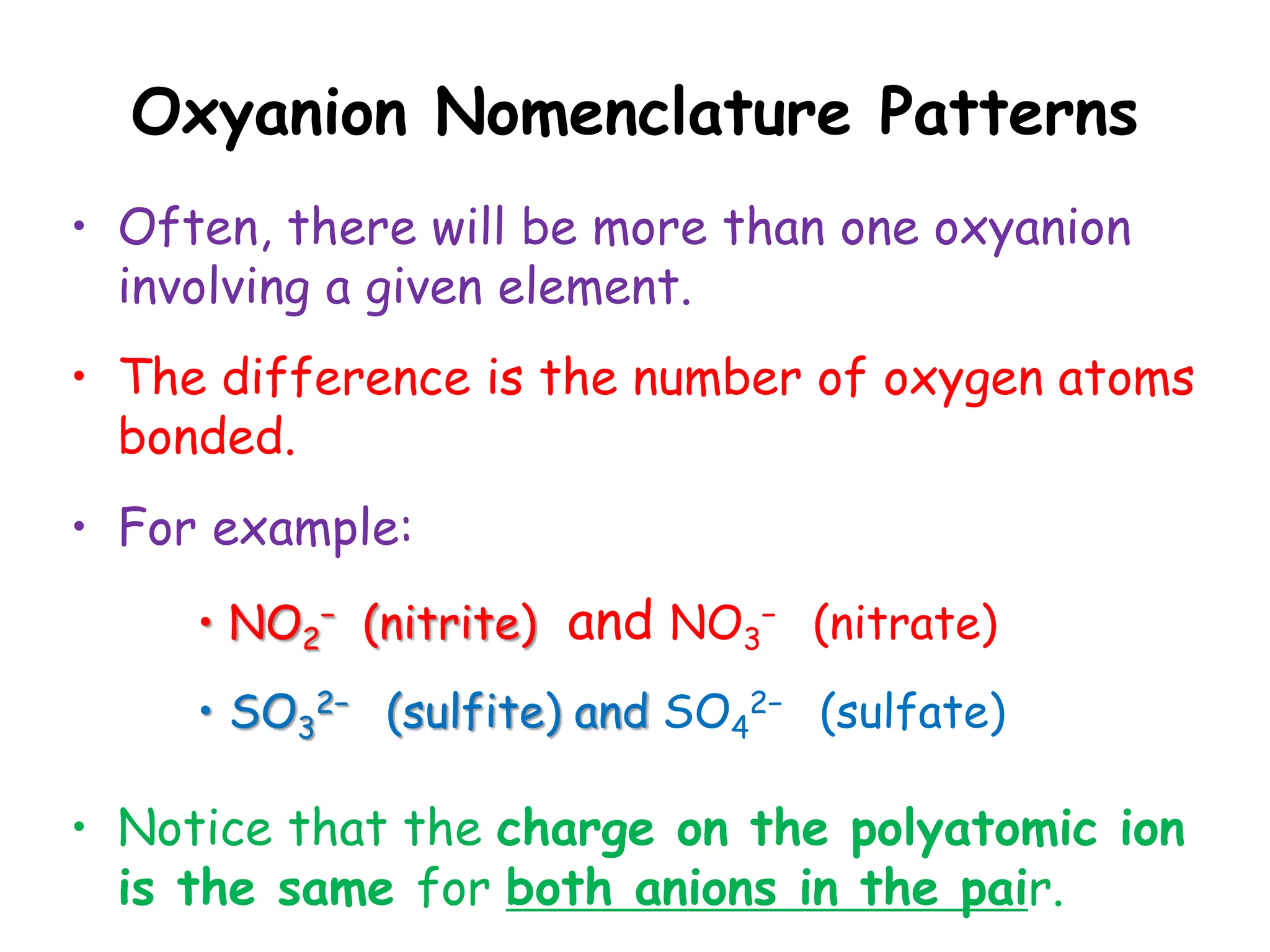
Oxyanion Nomenclature Patterns
• Often, there will be more than one oxyanion
involving a given element.
• The difference is the number of oxygen atoms
bonded.
• For example:
• NO2
− (nitrite) and NO3
− (nitrate)
• SO3
2− (sulfite) and SO4
2− (sulfate)
• Notice that the charge on the polyatomic ion
is the same for both anions in the pair.
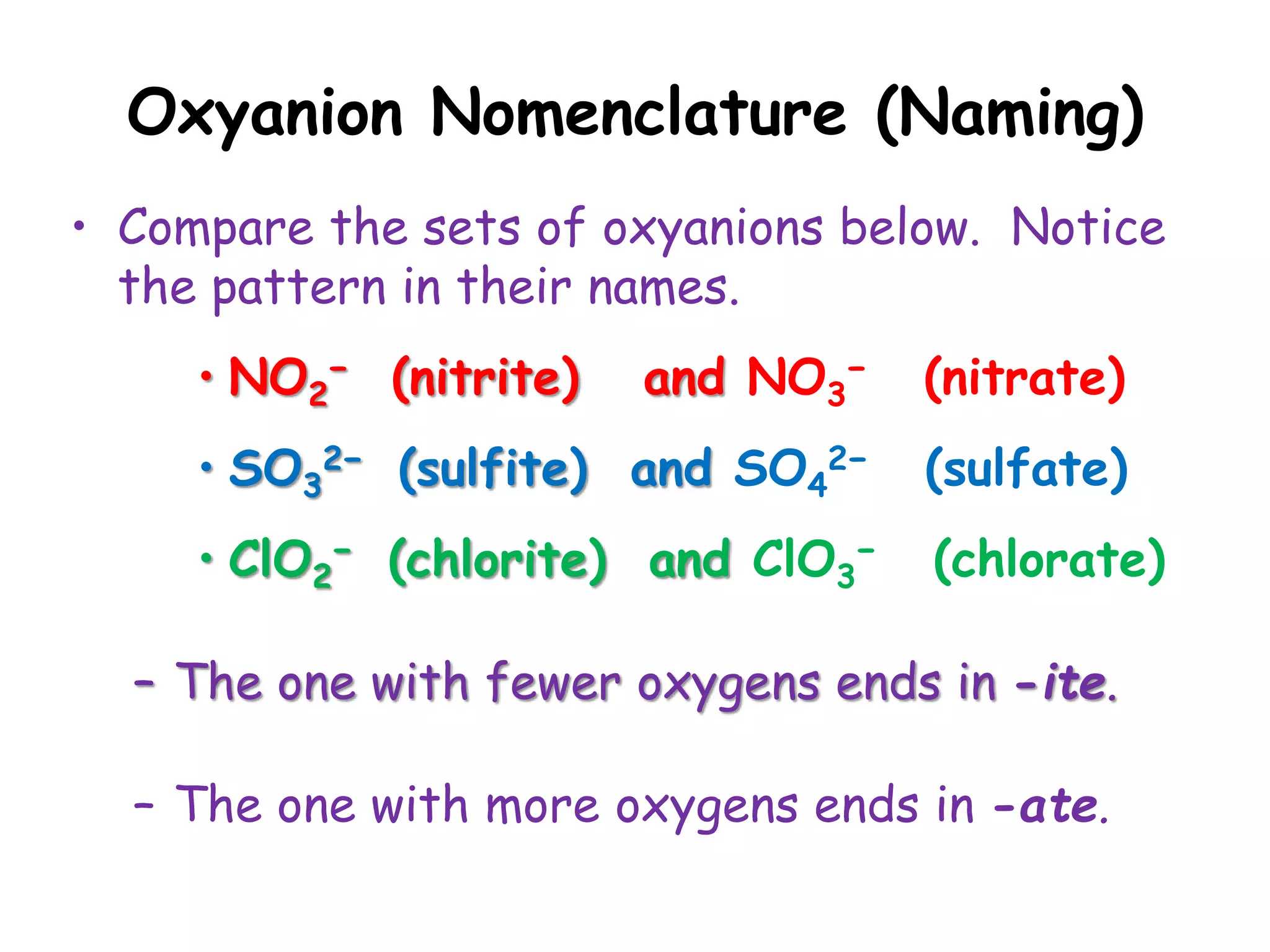
Oxyanion Nomenclature (Naming)
• Compare the sets of oxyanions below. Notice
the pattern in their names.
• NO2
− (nitrite) and NO3
− (nitrate)
• SO3
2− (sulfite) and SO4
2− (sulfate)
• ClO2
− (chlorite) and ClO3
− (chlorate)
– The one with fewer oxygens ends in -ite.
– The one with more oxygens ends in -ate.
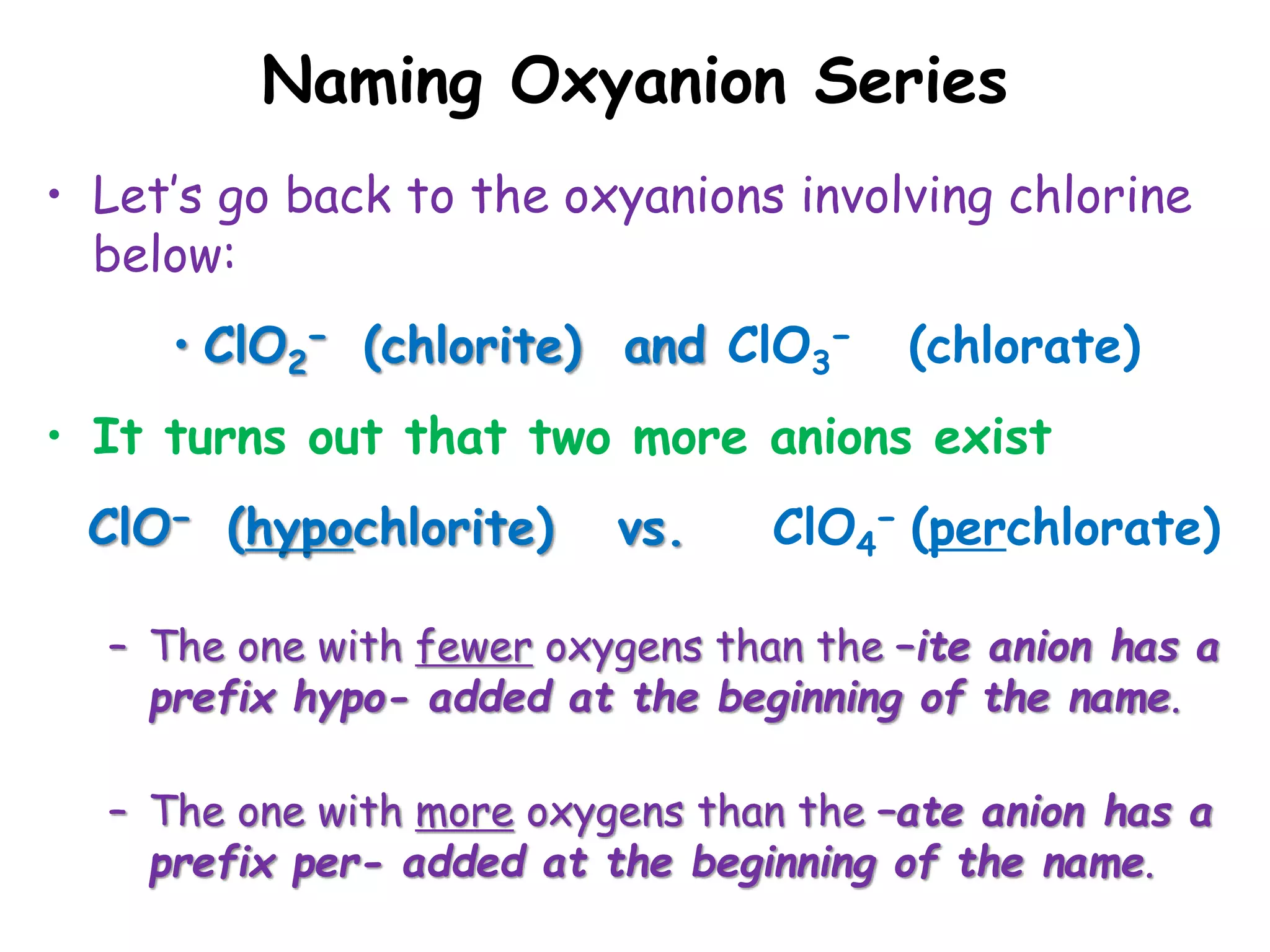
Naming Oxyanion Series
• Let’s go back to the oxyanions involving chlorine
below:
• ClO2
− (chlorite) and ClO3
− (chlorate)
• It turns out that two more anions exist
ClO− (hypochlorite) vs. ClO4
− (perchlorate)
– The one with fewer oxygens than the –ite anion has a
prefix hypo- added at the beginning of the name.
– The one with more oxygens than the –ate anion has a
prefix per- added at the beginning of the name.
Mini Quiz
• Name the oxyanions given below:
• BrO2
−
• BrO3
−
• PO4
3
• CO3
2
Mini Quiz Solutions
• Name the oxyanions given below:
• BrO2
− (bromite)
• BrO3
− (bromate)
• PO4
3 (phosphate)
• CO3
2 (carbonate)
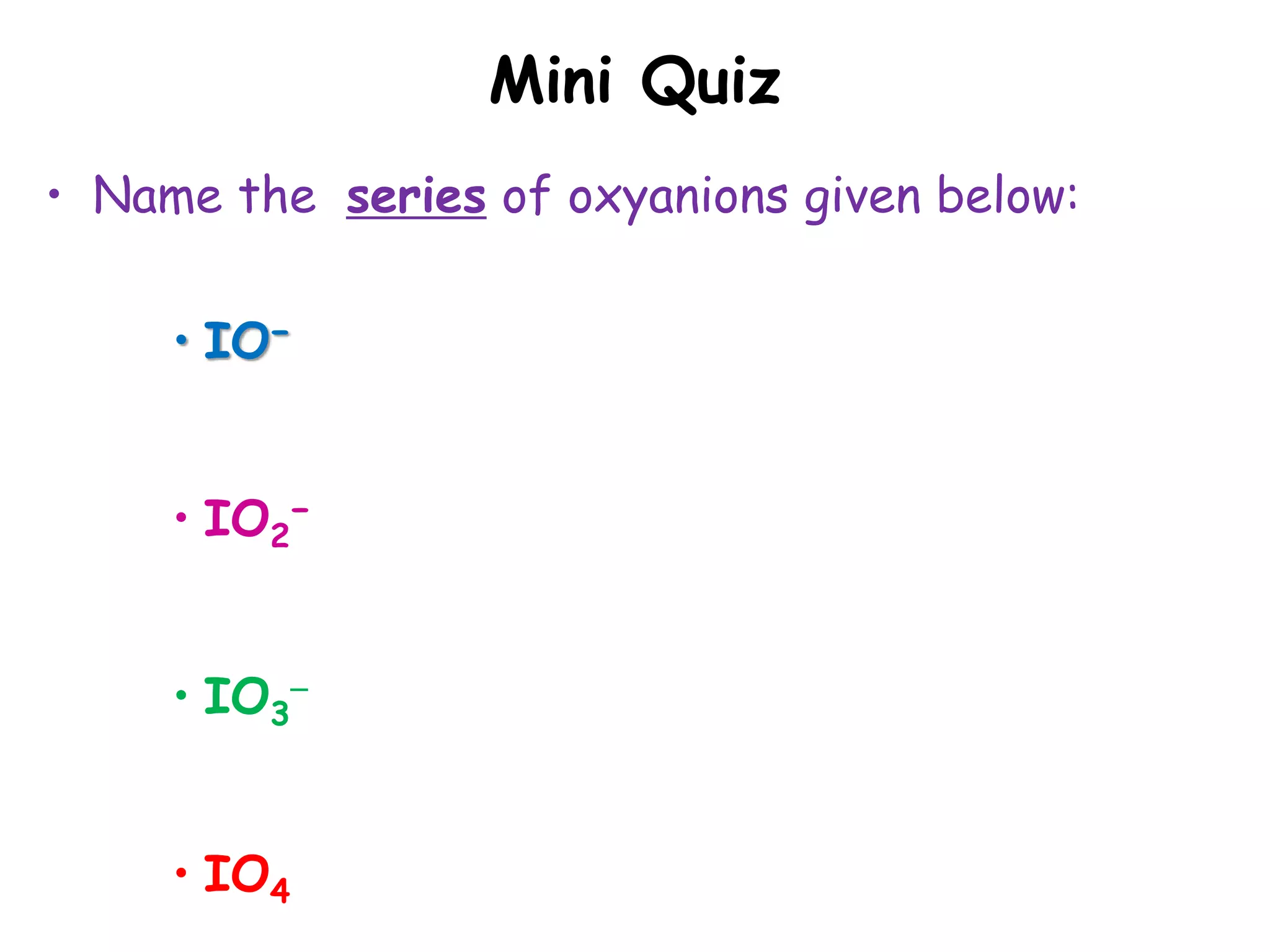
Mini Quiz
• Name the series of oxyanions given below:
• IO−
• IO2
−
• IO3

• IO4
Mini Quiz Solutions
• Name the series of oxyanions given below:
• IO− (hypoiodite)
• IO2
− (iodite)
• IO3
 (iodate)
• IO4
 (periodate)

Oxyanion nomenclature

  • 1.
    Oxyanion Nomenclature (Naming Oxyanions) ByDr. Shawn P. Shields This work is licensed by Shawn P. Shields-Maxwell under a Creative Commons Attribution-NonCommercial-ShareAlike 4.0 International License.
  • 2.
    Oxyanions • Oxyanions arepolyatomic ions involving one or more oxygen atoms plus another nonmetal atom. • Oxyanions commonly have negative charges of 1, 2, and 3. • Examples include: – CO2 2 “Carbonate” – NO2  “Nitrite” – SO4 2 “Sulfate”
  • 3.
    General Rules forNaming Oxyanions • Oxyanions are named according to the steps given below. 1) Write the root of the name of the non- oxygen element 2) Add the –ate or –ite suffix to the end of the name, according to the rule on the next slide. • Examples: – NO3  Nitrogen is the non-oxygen element. Remove the –ogen and add –ate “nitrate” – SO3 2 Sulfur is the non-oxygen element. Remove –ur and add –ite “sulfite”
  • 4.
    Oxyanion Nomenclature Patterns •Often, there will be more than one oxyanion involving a given element. • The difference is the number of oxygen atoms bonded. • For example: • NO2 − (nitrite) and NO3 − (nitrate) • SO3 2− (sulfite) and SO4 2− (sulfate) • Notice that the charge on the polyatomic ion is the same for both anions in the pair.
  • 5.
    Oxyanion Nomenclature (Naming) •Compare the sets of oxyanions below. Notice the pattern in their names. • NO2 − (nitrite) and NO3 − (nitrate) • SO3 2− (sulfite) and SO4 2− (sulfate) • ClO2 − (chlorite) and ClO3 − (chlorate) – The one with fewer oxygens ends in -ite. – The one with more oxygens ends in -ate.
  • 6.
    Naming Oxyanion Series •Let’s go back to the oxyanions involving chlorine below: • ClO2 − (chlorite) and ClO3 − (chlorate) • It turns out that two more anions exist ClO− (hypochlorite) vs. ClO4 − (perchlorate) – The one with fewer oxygens than the –ite anion has a prefix hypo- added at the beginning of the name. – The one with more oxygens than the –ate anion has a prefix per- added at the beginning of the name.
  • 7.
    Mini Quiz • Namethe oxyanions given below: • BrO2 − • BrO3 − • PO4 3 • CO3 2
  • 8.
    Mini Quiz Solutions •Name the oxyanions given below: • BrO2 − (bromite) • BrO3 − (bromate) • PO4 3 (phosphate) • CO3 2 (carbonate)
  • 9.
    Mini Quiz • Namethe series of oxyanions given below: • IO− • IO2 − • IO3  • IO4
  • 10.
    Mini Quiz Solutions •Name the series of oxyanions given below: • IO− (hypoiodite) • IO2 − (iodite) • IO3  (iodate) • IO4  (periodate)