Naming Ionic Compounds
Part 1: Cations, Anions, and Ionic Bonds
By Shawn P. Shields, Ph.D.
This work is licensed by Shawn P. Shields-Maxwell under a Creative Commons
Attribution-NonCommercial-ShareAlike 4.0 International License.
What are Ionic Bonds?
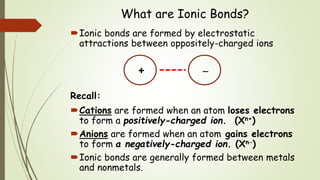
Ionic bonds are formed by electrostatic
attractions between oppositely-charged ions
Cations are formed when an atom loses electrons
to form a positively-charged ion. (Xn+)
Anions are formed when an atom gains electrons
to form a negatively-charged ion. (Xn)
Ionic bonds are generally formed between metals
and nonmetals.
+ 
Recall:
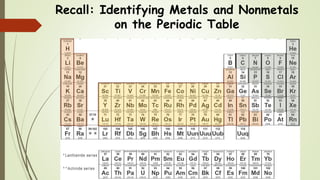
Recall: Identifying Metals and Nonmetals
on the Periodic Table
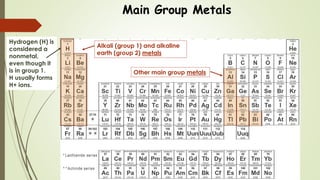
Main Group Metals
Alkali (group 1) and alkaline
earth (group 2) metals
Other main group metals
Hydrogen (H) is
considered a
nonmetal,
even though it
is in group 1.
H usually forms
H+ ions.
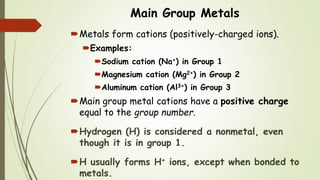
Main Group Metals
Metals form cations (positively-charged ions).
Examples:
Sodium cation (Na+) in Group 1
Magnesium cation (Mg2+) in Group 2
Aluminum cation (Al3+) in Group 3
Main group metal cations have a positive charge
equal to the group number.
Hydrogen (H) is considered a nonmetal, even
though it is in group 1.
H usually forms H+ ions, except when bonded to
metals.
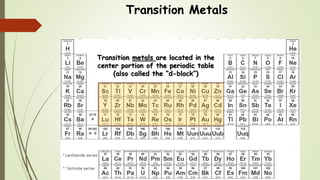
Transition Metals
Transition metals are located in the
center portion of the periodic table
(also called the “d-block”)
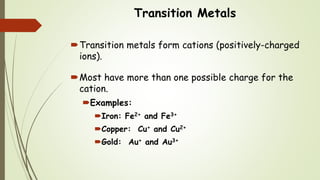
Transition Metals
Transition metals form cations (positively-charged
ions).
Most have more than one possible charge for the
cation.
Examples:
Iron: Fe2+ and Fe3+
Copper: Cu+ and Cu2+
Gold: Au+ and Au3+
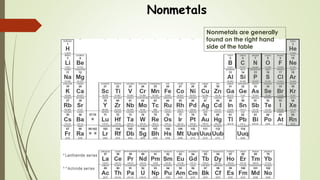
Nonmetals
Nonmetals are generally
found on the right hand
side of the table
Nonmetals in Ionic Compounds
Nonmetals generally form anions (negatively-
charged ions) when in ionic compounds.
Examples:
Chloride anion (Cl)
Oxide anion (O2)
Sulfide anion (S2)
Nonmetals form covalent, as opposed to ionic,
bonds when bonded to other nonmetals.
Noble gases (group 8) do not form ions.
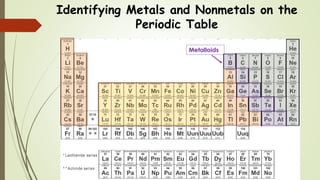
Identifying Metals and Nonmetals on the
Periodic Table
Metalloids
Metalloids
Metalloids (generally) form covalent as opposed to
ionic bonds in compounds.
In particular, compounds composed from a
nonmetal and a metalloid contain covalent bonds.
Summary
Metals form cations in ionic compounds.
Cations are positively-charged ions.
When a cation is formed, the atom loses electrons.
Nonmetals form anions in ionic compounds.
Anions are negatively-charged ions.
When an anion is formed, the atom gains electrons.
Ionic compounds form between metals and
nonmetals.
An ionic bond is an electrostatic attraction
between oppositely-charged particles (ions).

Naming ionic compounds intro

  • 1.
    Naming Ionic Compounds Part1: Cations, Anions, and Ionic Bonds By Shawn P. Shields, Ph.D. This work is licensed by Shawn P. Shields-Maxwell under a Creative Commons Attribution-NonCommercial-ShareAlike 4.0 International License.
  • 2.
    What are IonicBonds? Ionic bonds are formed by electrostatic attractions between oppositely-charged ions Cations are formed when an atom loses electrons to form a positively-charged ion. (Xn+) Anions are formed when an atom gains electrons to form a negatively-charged ion. (Xn) Ionic bonds are generally formed between metals and nonmetals. +  Recall:
  • 3.
    Recall: Identifying Metalsand Nonmetals on the Periodic Table
  • 4.
    Main Group Metals Alkali(group 1) and alkaline earth (group 2) metals Other main group metals Hydrogen (H) is considered a nonmetal, even though it is in group 1. H usually forms H+ ions.
  • 5.
    Main Group Metals Metalsform cations (positively-charged ions). Examples: Sodium cation (Na+) in Group 1 Magnesium cation (Mg2+) in Group 2 Aluminum cation (Al3+) in Group 3 Main group metal cations have a positive charge equal to the group number. Hydrogen (H) is considered a nonmetal, even though it is in group 1. H usually forms H+ ions, except when bonded to metals.
  • 6.
    Transition Metals Transition metalsare located in the center portion of the periodic table (also called the “d-block”)
  • 7.
    Transition Metals Transition metalsform cations (positively-charged ions). Most have more than one possible charge for the cation. Examples: Iron: Fe2+ and Fe3+ Copper: Cu+ and Cu2+ Gold: Au+ and Au3+
  • 8.
    Nonmetals Nonmetals are generally foundon the right hand side of the table
  • 9.
    Nonmetals in IonicCompounds Nonmetals generally form anions (negatively- charged ions) when in ionic compounds. Examples: Chloride anion (Cl) Oxide anion (O2) Sulfide anion (S2) Nonmetals form covalent, as opposed to ionic, bonds when bonded to other nonmetals. Noble gases (group 8) do not form ions.
  • 10.
    Identifying Metals andNonmetals on the Periodic Table Metalloids
  • 11.
    Metalloids Metalloids (generally) formcovalent as opposed to ionic bonds in compounds. In particular, compounds composed from a nonmetal and a metalloid contain covalent bonds.
  • 12.
    Summary Metals form cationsin ionic compounds. Cations are positively-charged ions. When a cation is formed, the atom loses electrons. Nonmetals form anions in ionic compounds. Anions are negatively-charged ions. When an anion is formed, the atom gains electrons. Ionic compounds form between metals and nonmetals. An ionic bond is an electrostatic attraction between oppositely-charged particles (ions).