








Chapter 9
Nomenclature
(naming stuff)
Seriously?!
Chemical what?!

Chemical Reactions are
cool!
A new substance with a new
property will be made!
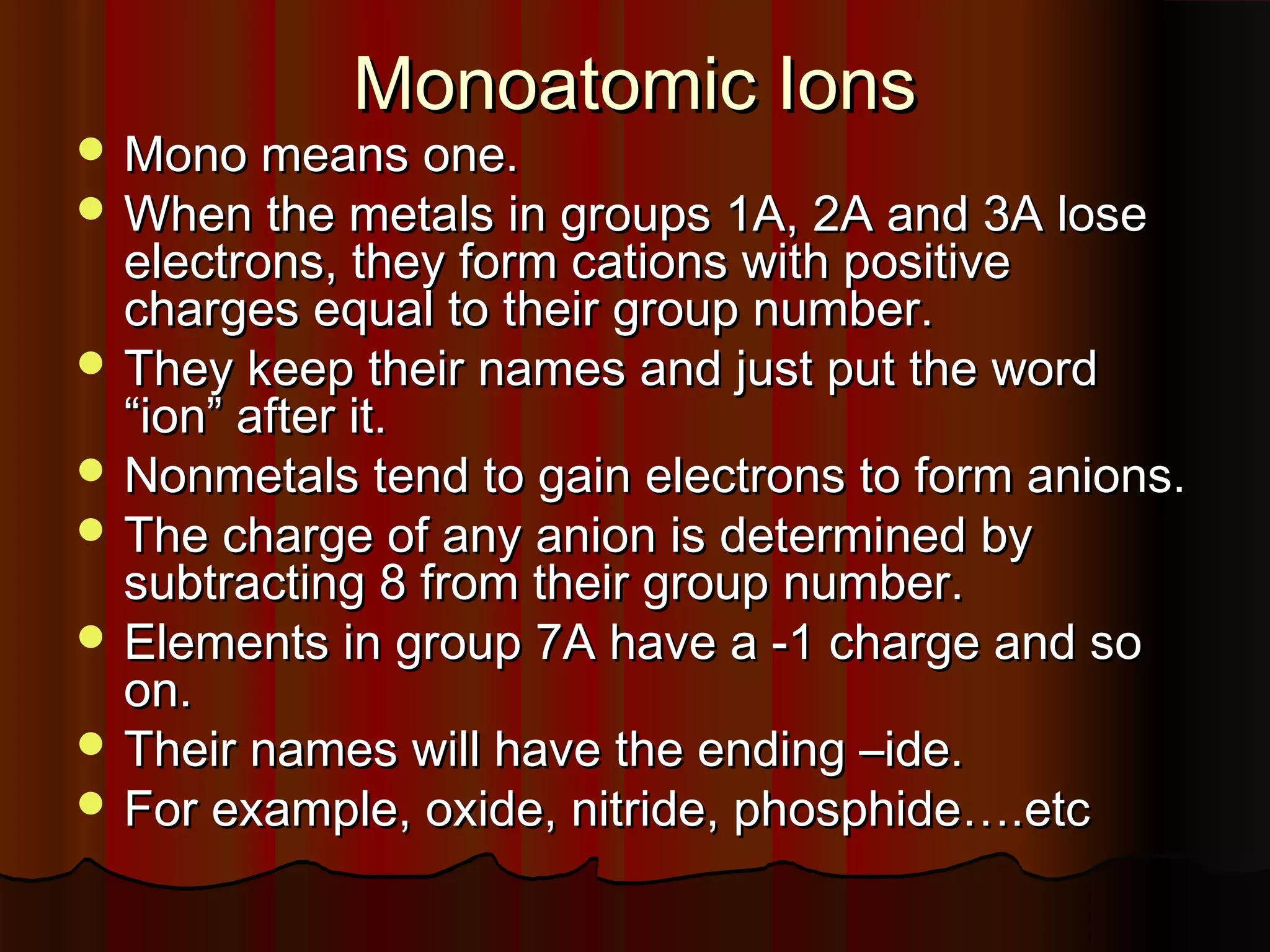
Monoatomic Ions

 Mono means one.

 When the metals in groups 1A, 2A and 3A lose

electrons, they form cations with positive
charges equal to their group number.
 They keep their names and just put the word
“ion” after it.
 Nonmetals tend to gain electrons to form anions.
 The charge of any anion is determined by
subtracting 8 from their group number.
 Elements in group 7A have a -1 charge and so
on.
 Their names will have the ending –ide.
 For example, oxide, nitride, phosphide….etc
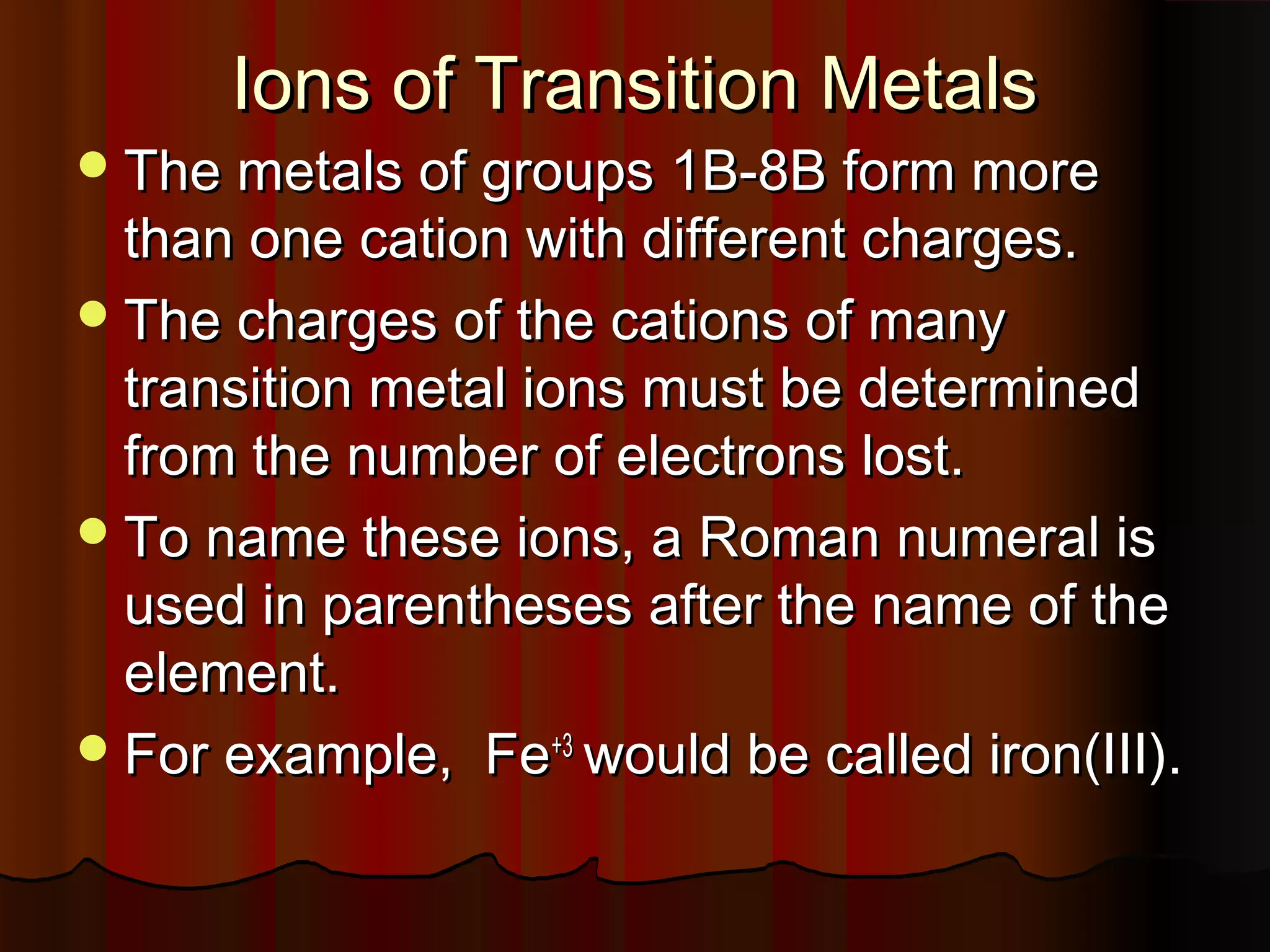
Ions of Transition Metals

 The metals of groups 1B-8B form more

than one cation with different charges.
 The charges of the cations of many
transition metal ions must be determined
from the number of electrons lost.
 To name these ions, a Roman numeral is
used in parentheses after the name of the
element.
 For example, Fe+3 would be called iron(III).
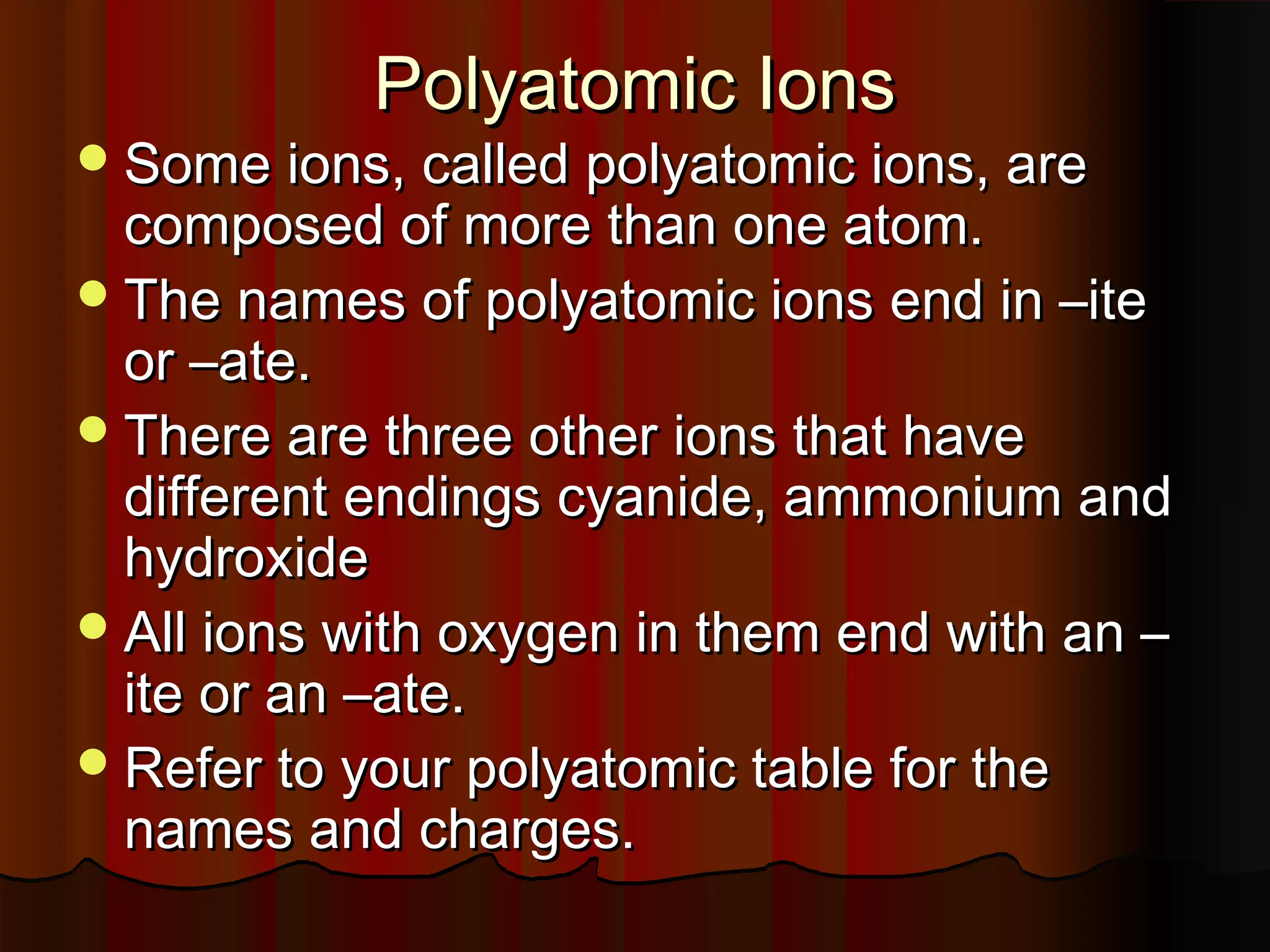
Polyatomic Ions

 Some ions, called polyatomic ions, are

composed of more than one atom.
 The names of polyatomic ions end in –ite
or –ate.
 There are three other ions that have
different endings cyanide, ammonium and
hydroxide
 All ions with oxygen in them end with an –
ite or an –ate.
 Refer to your polyatomic table for the
names and charges.
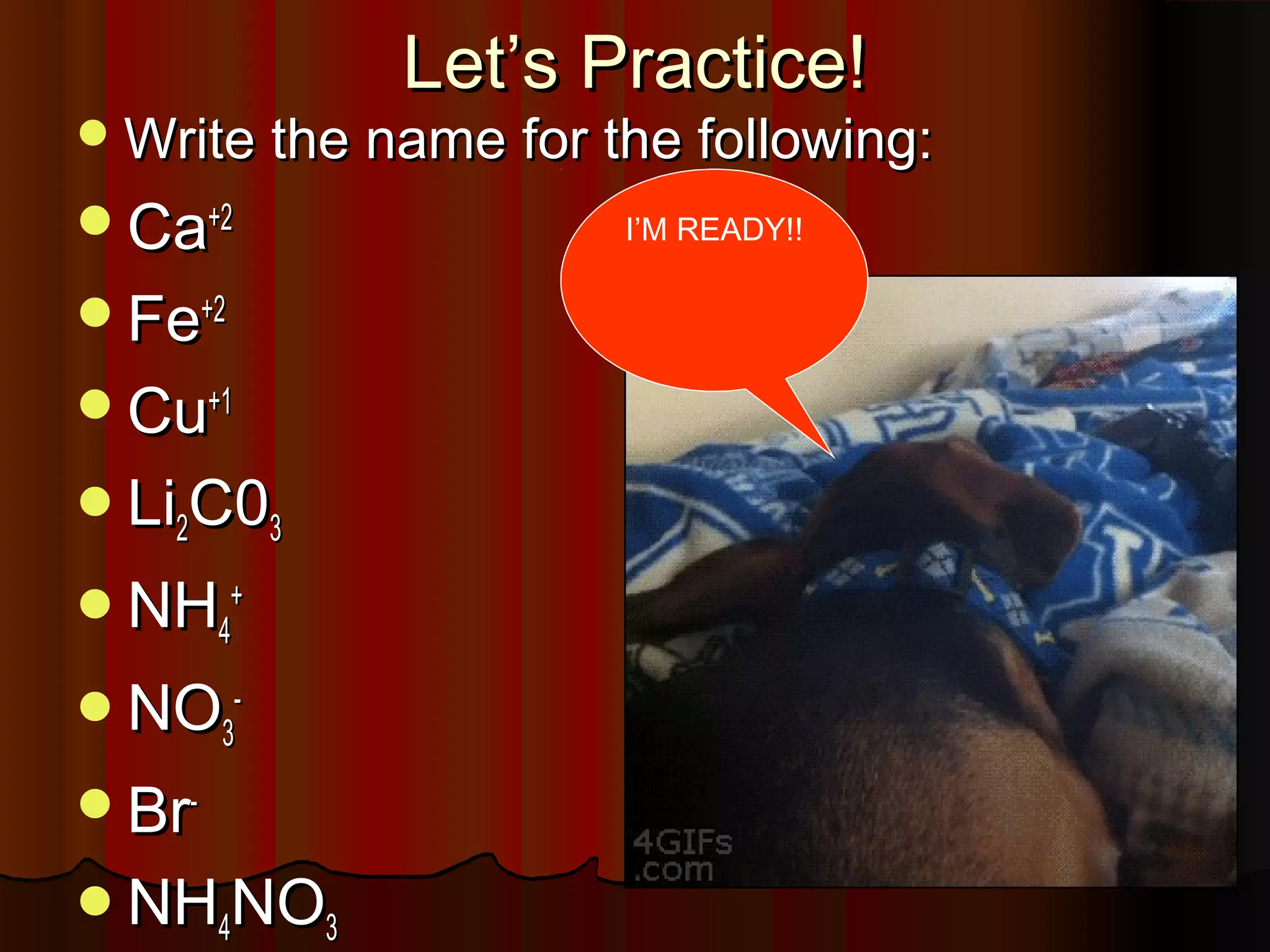
Let’s Practice!

 Write the name for the following:

Ca+2
Fe+2
Cu+1
Li2C03
NH4+
NO3BrNH4NO3

I’M READY!!
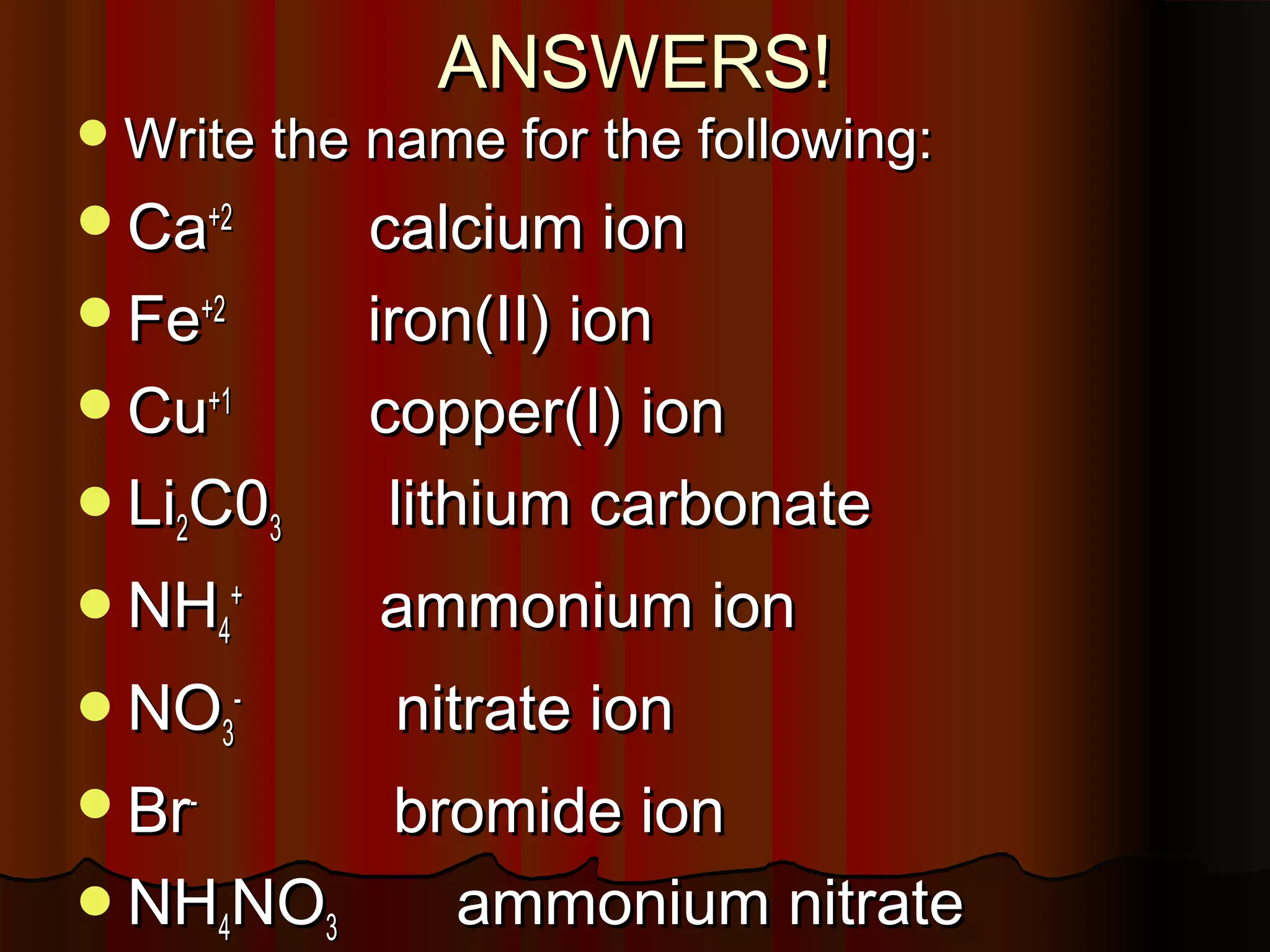
ANSWERS!

 Write the name for the following:

Ca+2

Li2C03

calcium ion
iron(II) ion
copper(I) ion
lithium carbonate

NH4+

ammonium ion

Fe+2
Cu+1

NO3-

nitrate ion

Br-

bromide ion
ammonium nitrate

NH4NO3
HIGH FIVE!
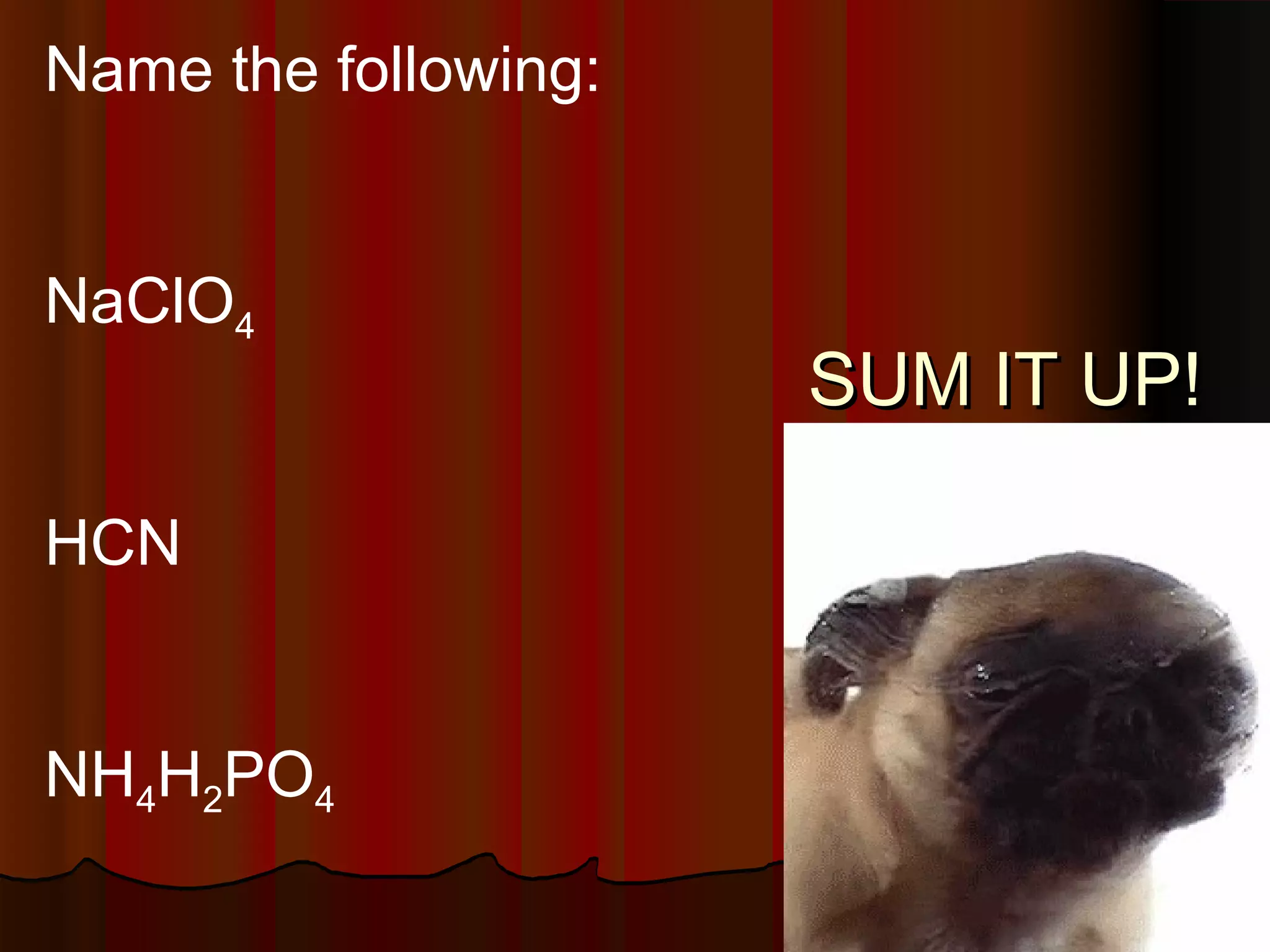
Name the following:

NaClO4

HCN

NH4H2PO4

SUM IT UP!
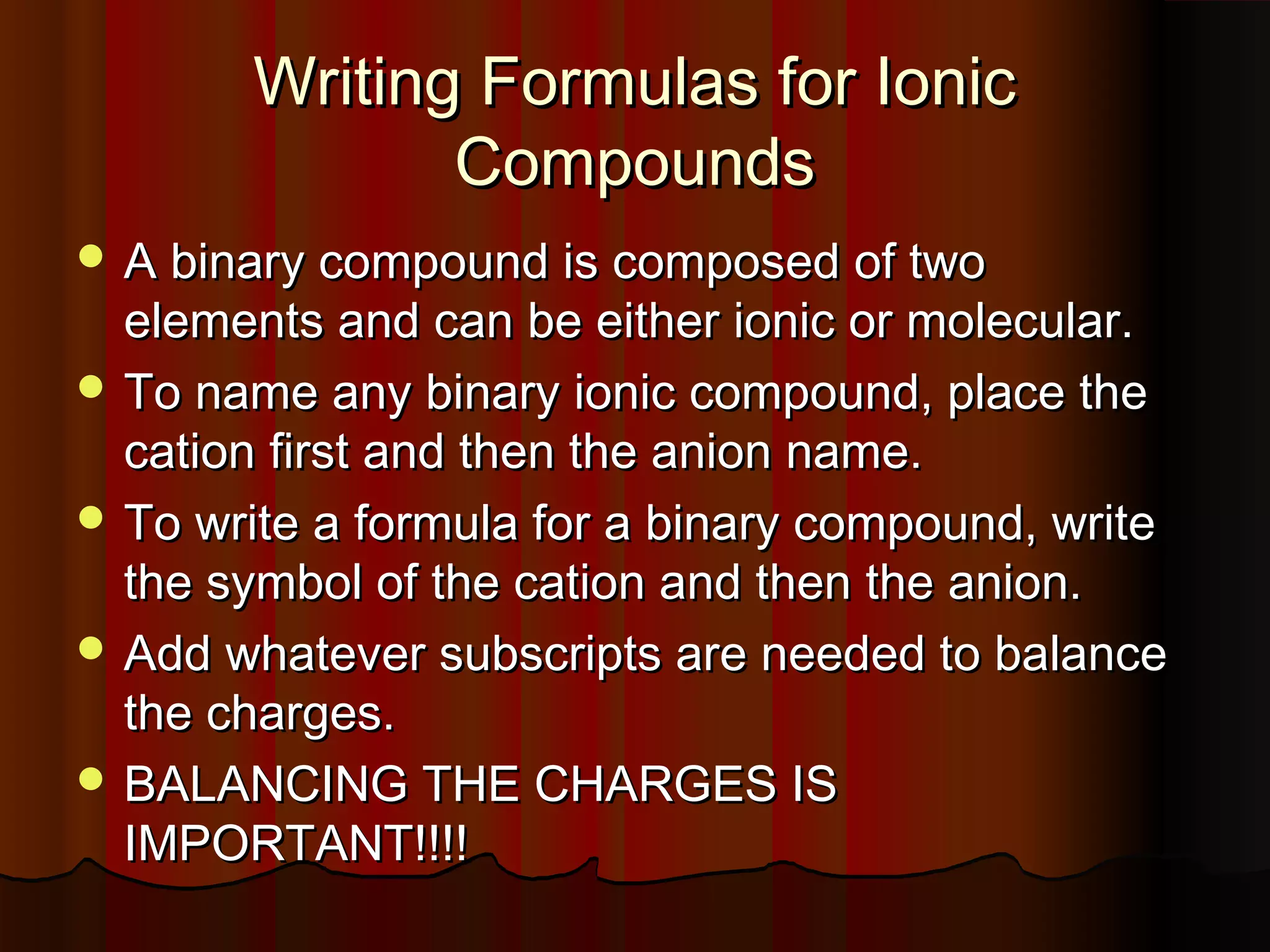
Writing Formulas for Ionic
Compounds
 A binary compound is composed of two

elements and can be either ionic or molecular.
 To name any binary ionic compound, place the
cation first and then the anion name.
 To write a formula for a binary compound, write
the symbol of the cation and then the anion.
 Add whatever subscripts are needed to balance
the charges.
 BALANCING THE CHARGES IS
IMPORTANT!!!!
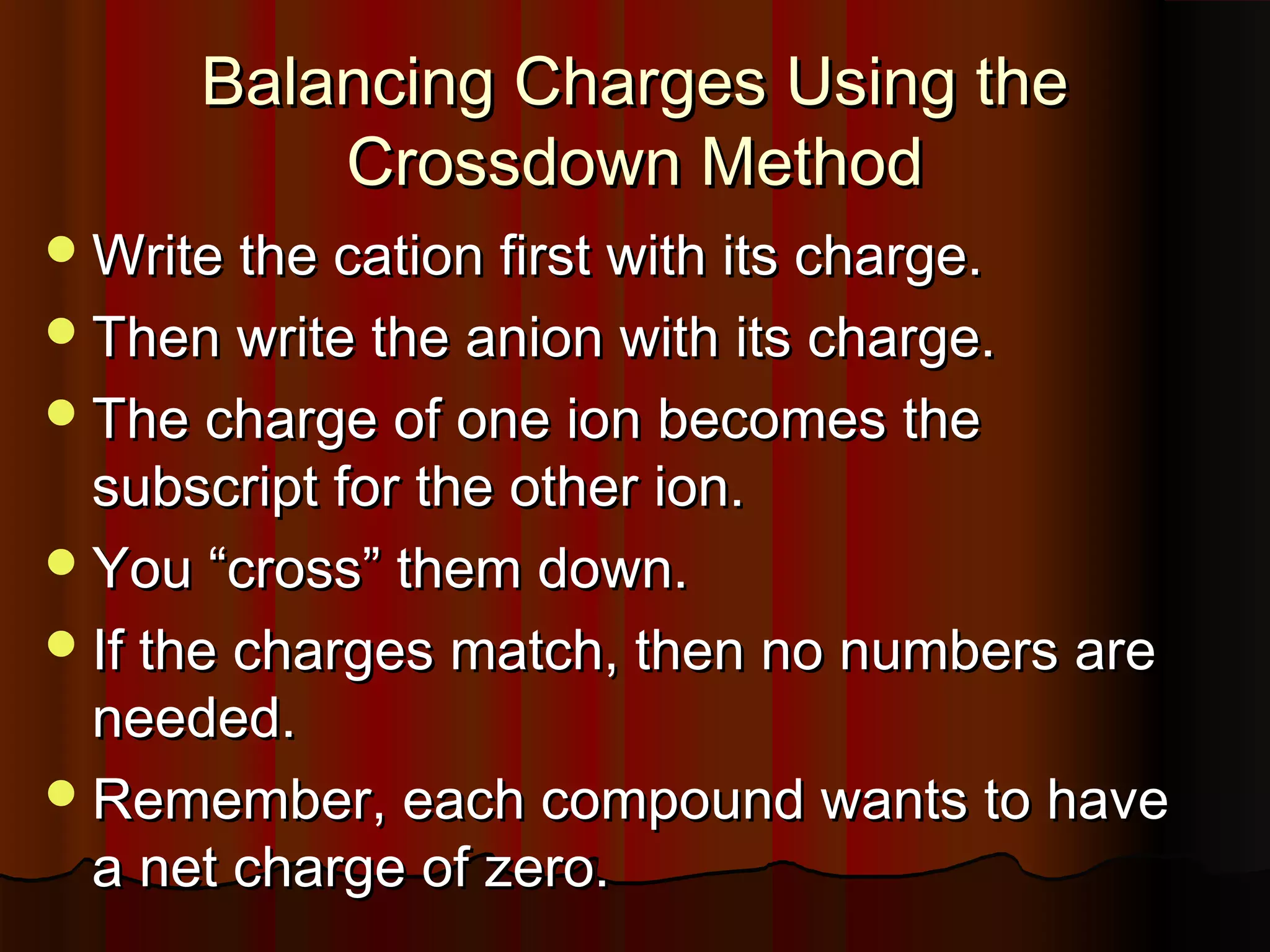
Balancing Charges Using the
Crossdown Method
 Write the cation first with its charge.
 Then write the anion with its charge.
 The charge of one ion becomes the

subscript for the other ion.
 You “cross” them down.
 If the charges match, then no numbers are
needed.
 Remember, each compound wants to have
a net charge of zero.
Let’s Practice!
 Write the formulas for the following binary

compounds.
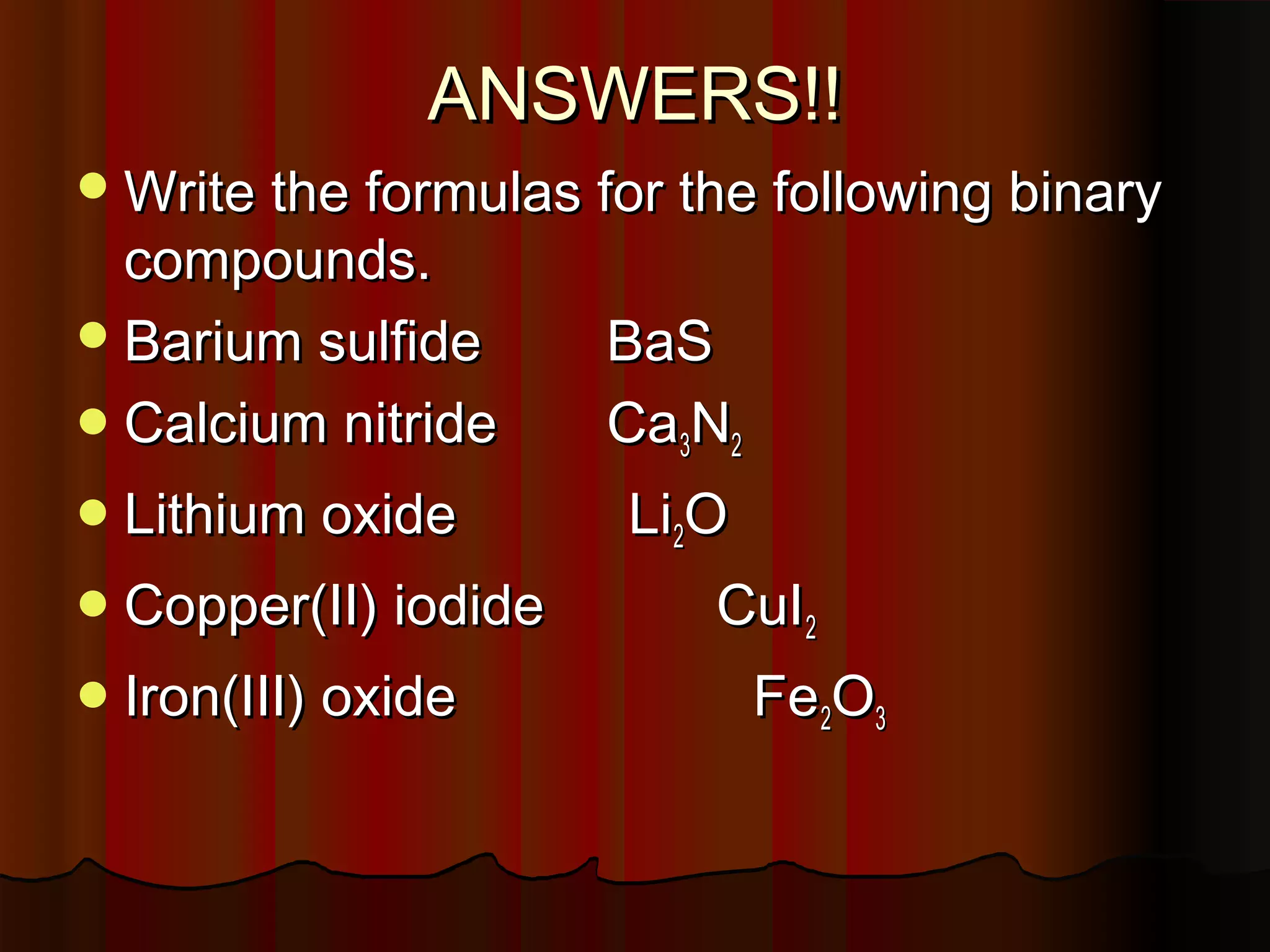
 Barium sulfide
 Calcium nitride
 Lithium oxide
 Copper(II) iodide
 Iron(III) oxide
ANSWERS!!
 Write the formulas for the following binary

compounds.
 Barium sulfide
 Calcium nitride
 Lithium oxide

 Copper(II) iodide
 Iron(III) oxide

BaS
Ca3N2
Li2O
CuI2
Fe 2O3
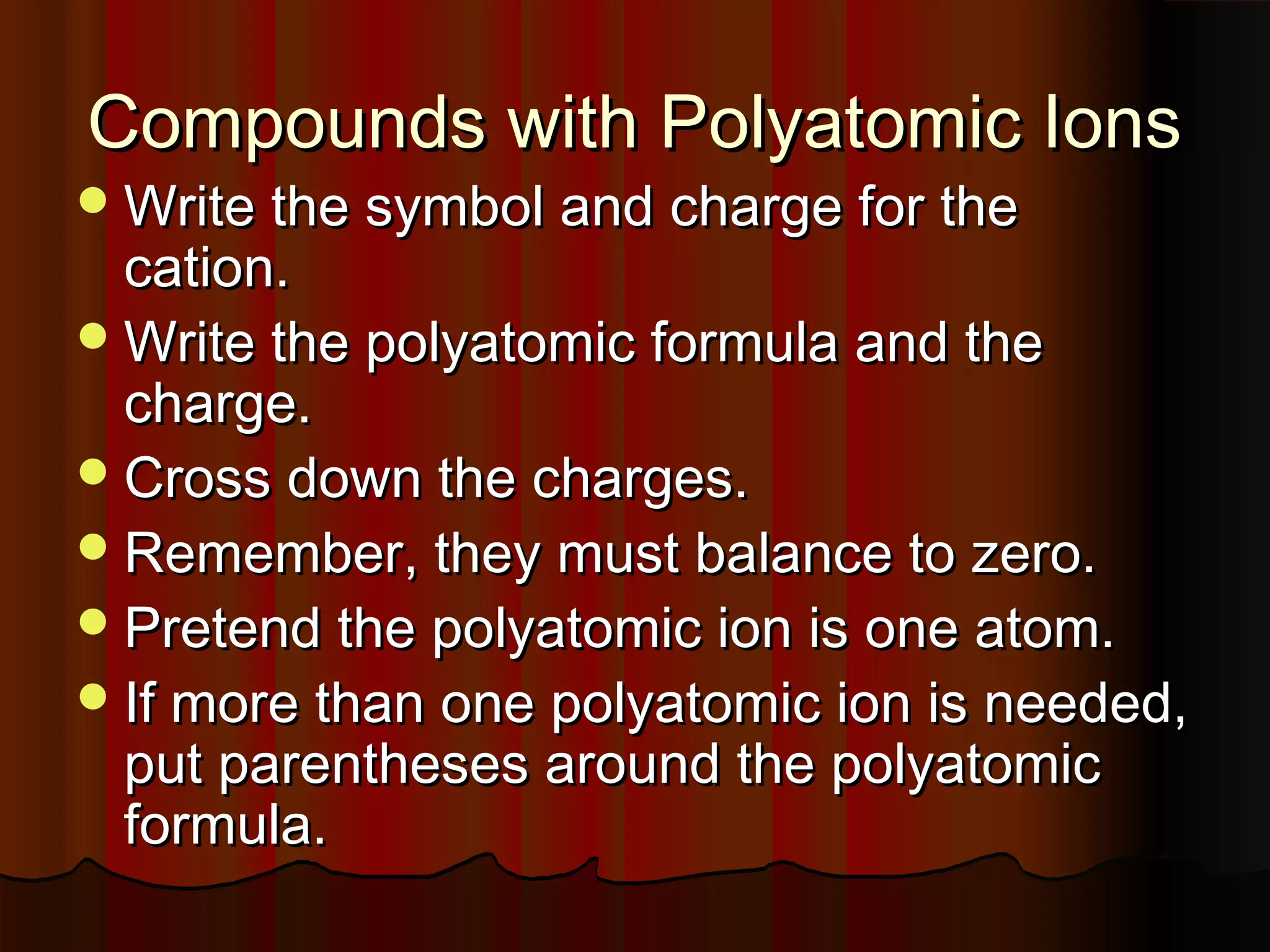
Compounds with Polyatomic Ions

 Write the symbol and charge for the

cation.
 Write the polyatomic formula and the
charge.
 Cross down the charges.
 Remember, they must balance to zero.
 Pretend the polyatomic ion is one atom.
 If more than one polyatomic ion is needed,
put parentheses around the polyatomic
formula.
Let’s Practice!
 Write the formulas for the following:
 Calcium nitrate
 Sodium carbonate
 Calcium phosphate
ANSWERS!
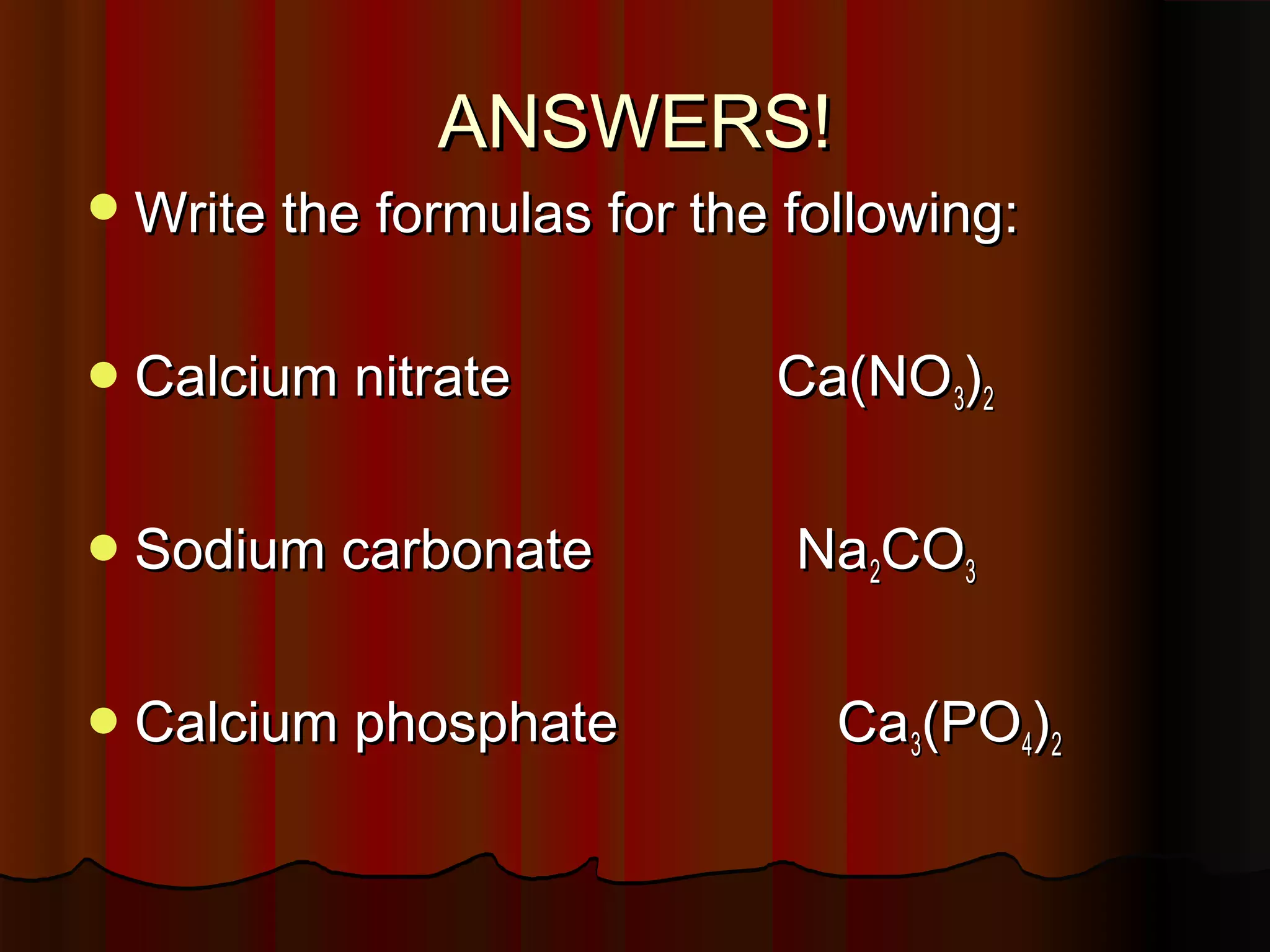
 Write the formulas for the following:
 Calcium nitrate
 Sodium carbonate
 Calcium phosphate

Ca(NO 3)2
Na2CO3
Ca3(PO4)2
Hey wait! I think I
got those problems
right!
SUM IT UP!

Write the formula for:
Potassium sulfide

Calcium carbonate
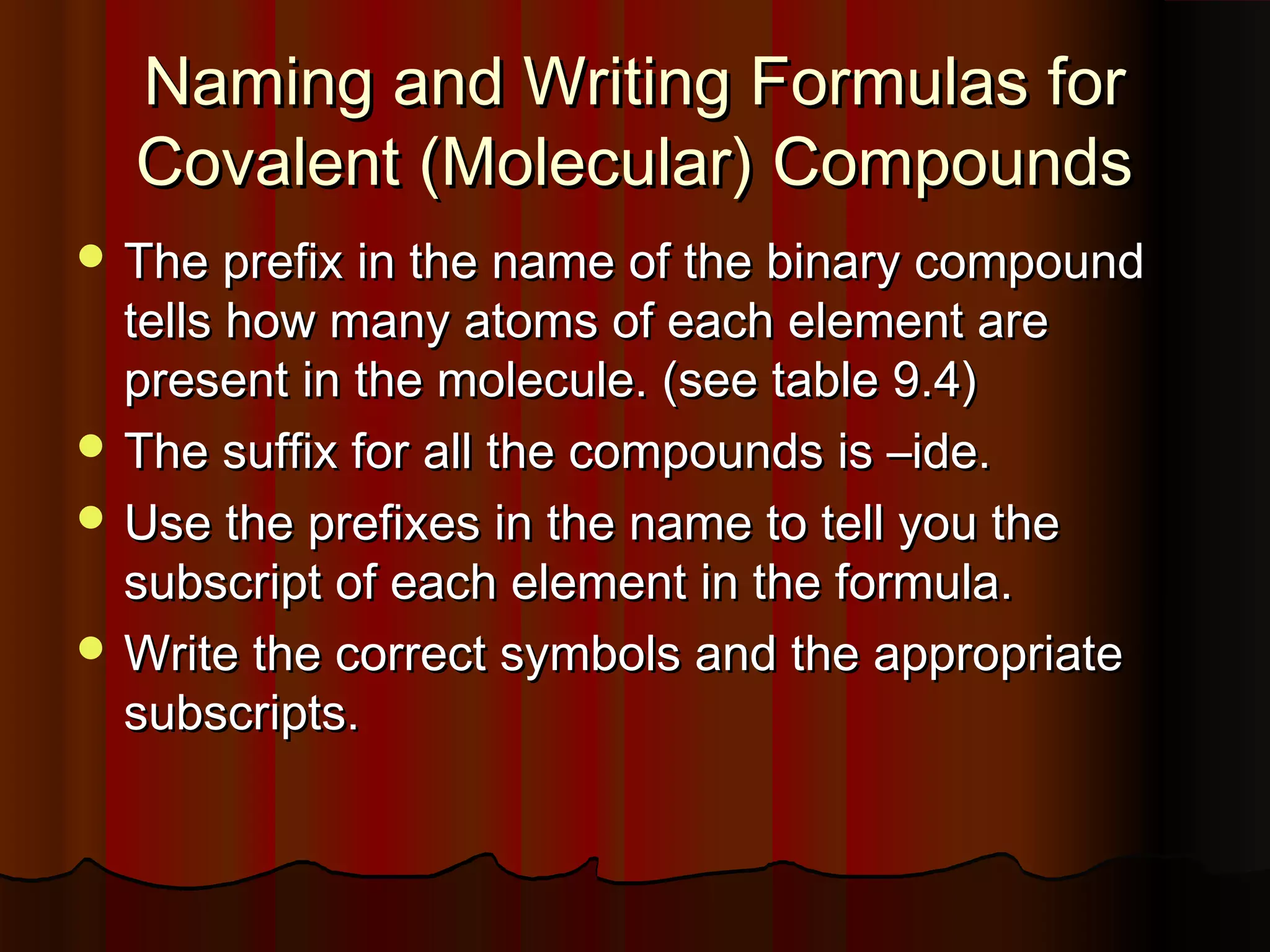
Naming and Writing Formulas for
Covalent (Molecular) Compounds
 The prefix in the name of the binary compound

tells how many atoms of each element are
present in the molecule. (see table 9.4)
 The suffix for all the compounds is –ide.
 Use the prefixes in the name to tell you the
subscript of each element in the formula.
 Write the correct symbols and the appropriate
subscripts.
LET’S PRACTICE!

 Write the names/formulas of the following

compounds.

CS2
Cl2O7
NI3
Carbon tetrabromide
Diphosphorus trioxide
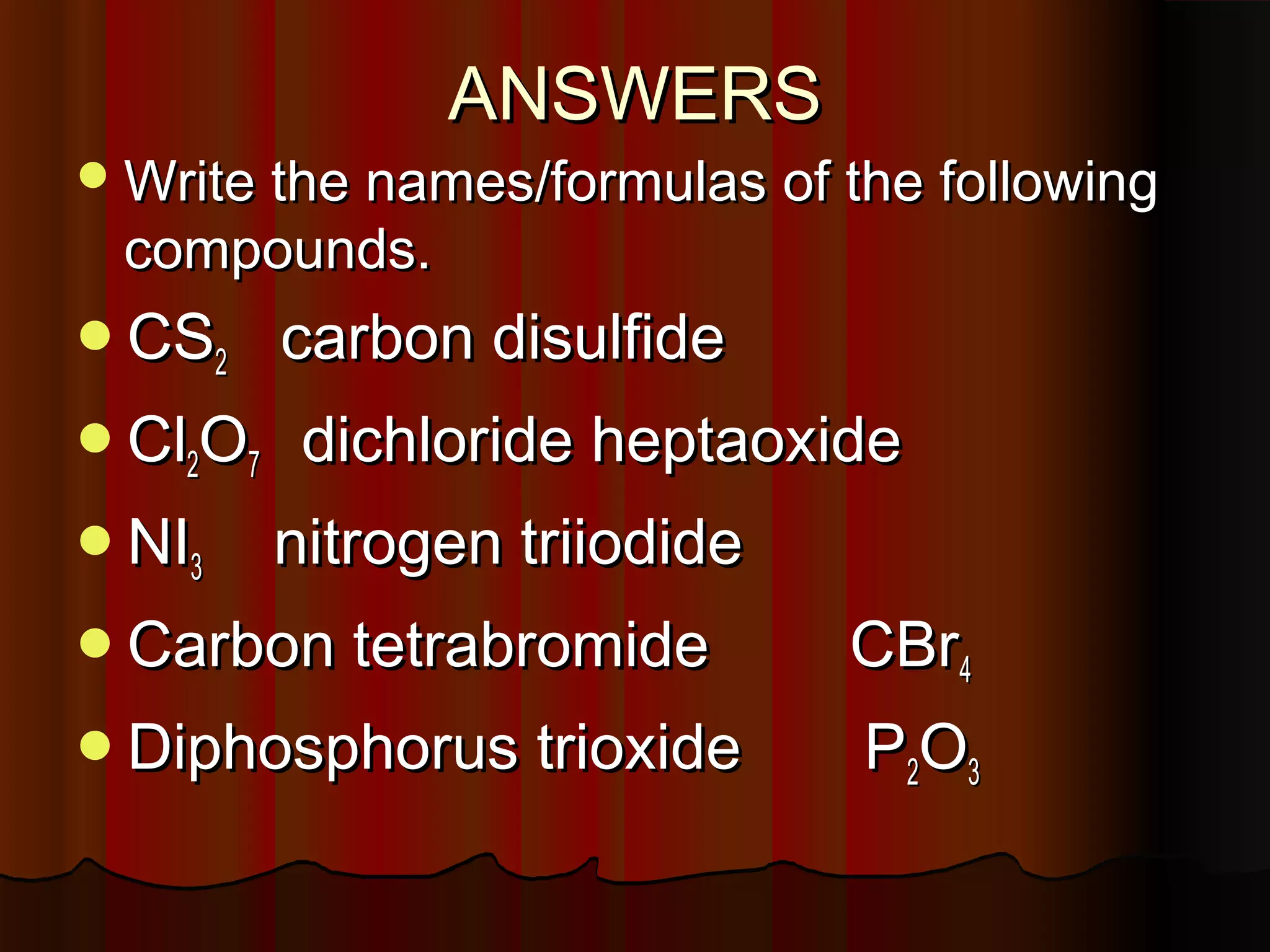
ANSWERS

 Write the names/formulas of the following

compounds.

CS2
Cl2O7
NI3

carbon disulfide
dichloride heptaoxide
nitrogen triiodide

Carbon tetrabromide

CBr4

Diphosphorus trioxide

P2O3
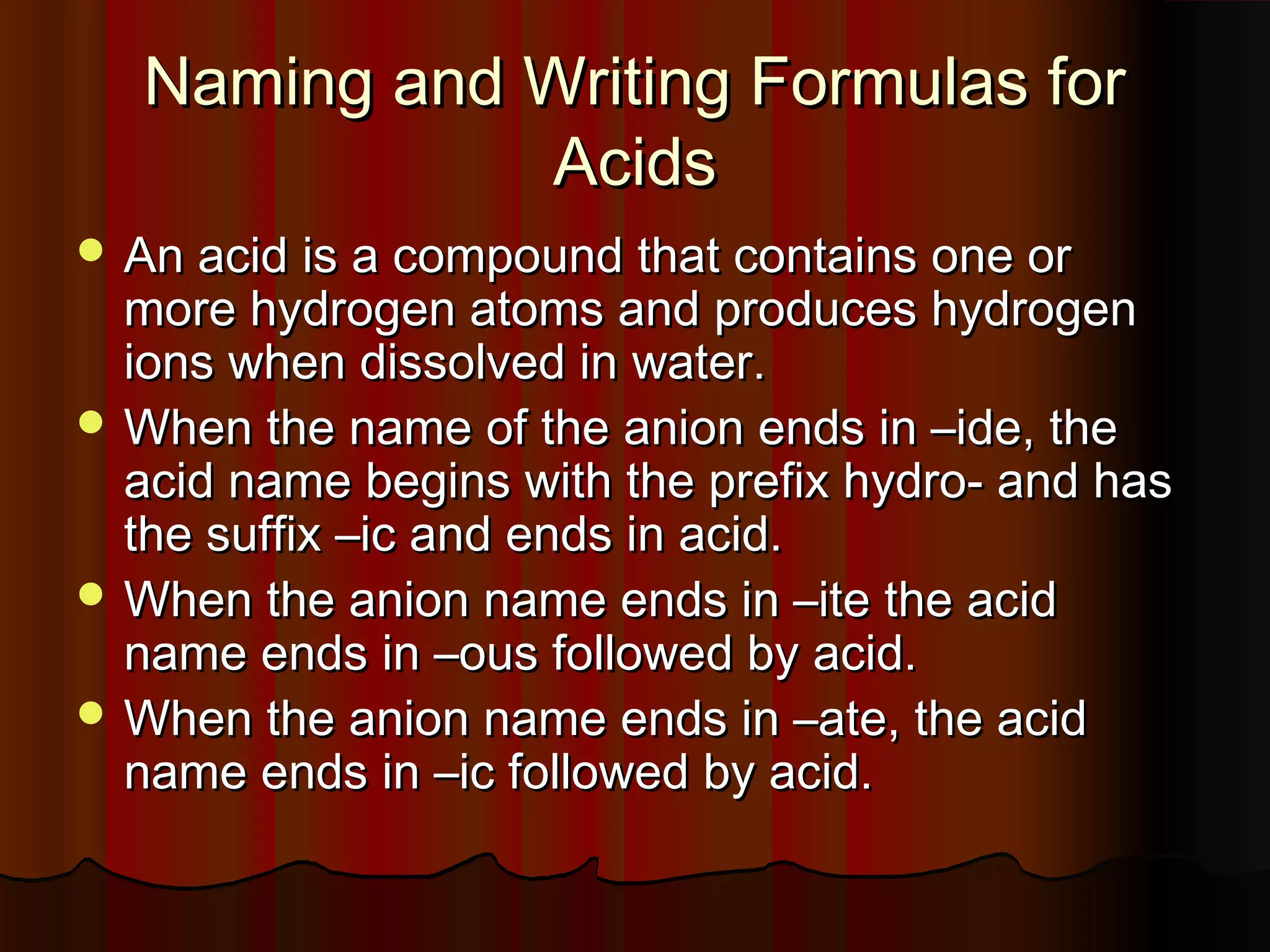
Naming and Writing Formulas for
Acids
 An acid is a compound that contains one or

more hydrogen atoms and produces hydrogen
ions when dissolved in water.
 When the name of the anion ends in –ide, the
acid name begins with the prefix hydro- and has
the suffix –ic and ends in acid.
 When the anion name ends in –ite the acid
name ends in –ous followed by acid.
 When the anion name ends in –ate, the acid
name ends in –ic followed by acid.
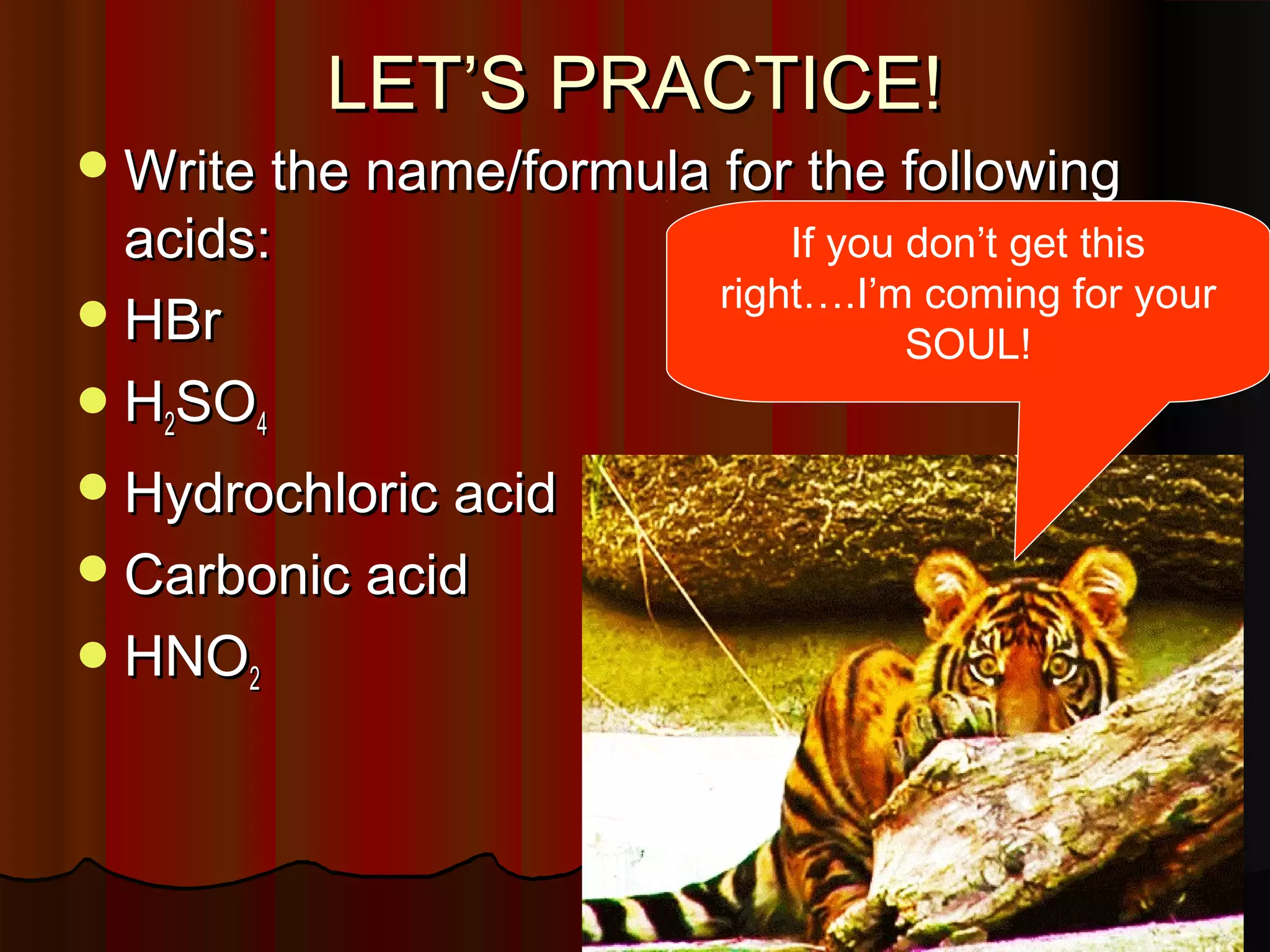
LET’S PRACTICE!

 Write the name/formula for the following

acids:
 HBr
 H2SO4

 Hydrochloric acid
 Carbonic acid
 HNO2

If you don’t get this
right….I’m coming for your
SOUL!
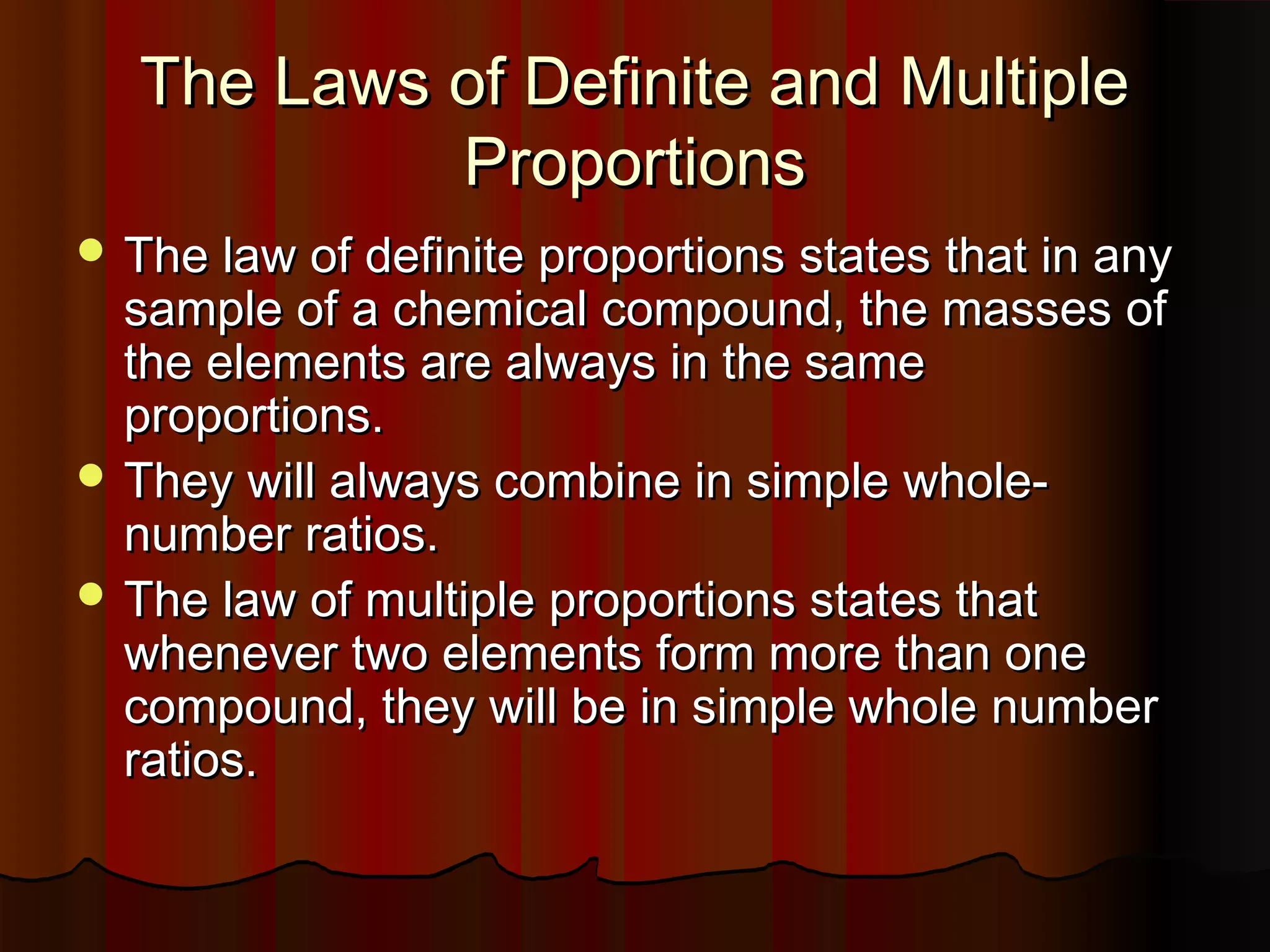
The Laws of Definite and Multiple
Proportions
 The law of definite proportions states that in any

sample of a chemical compound, the masses of
the elements are always in the same
proportions.
 They will always combine in simple wholenumber ratios.
 The law of multiple proportions states that
whenever two elements form more than one
compound, they will be in simple whole number
ratios.
SUM IT UP!

What is
the name
for HNO3 ?
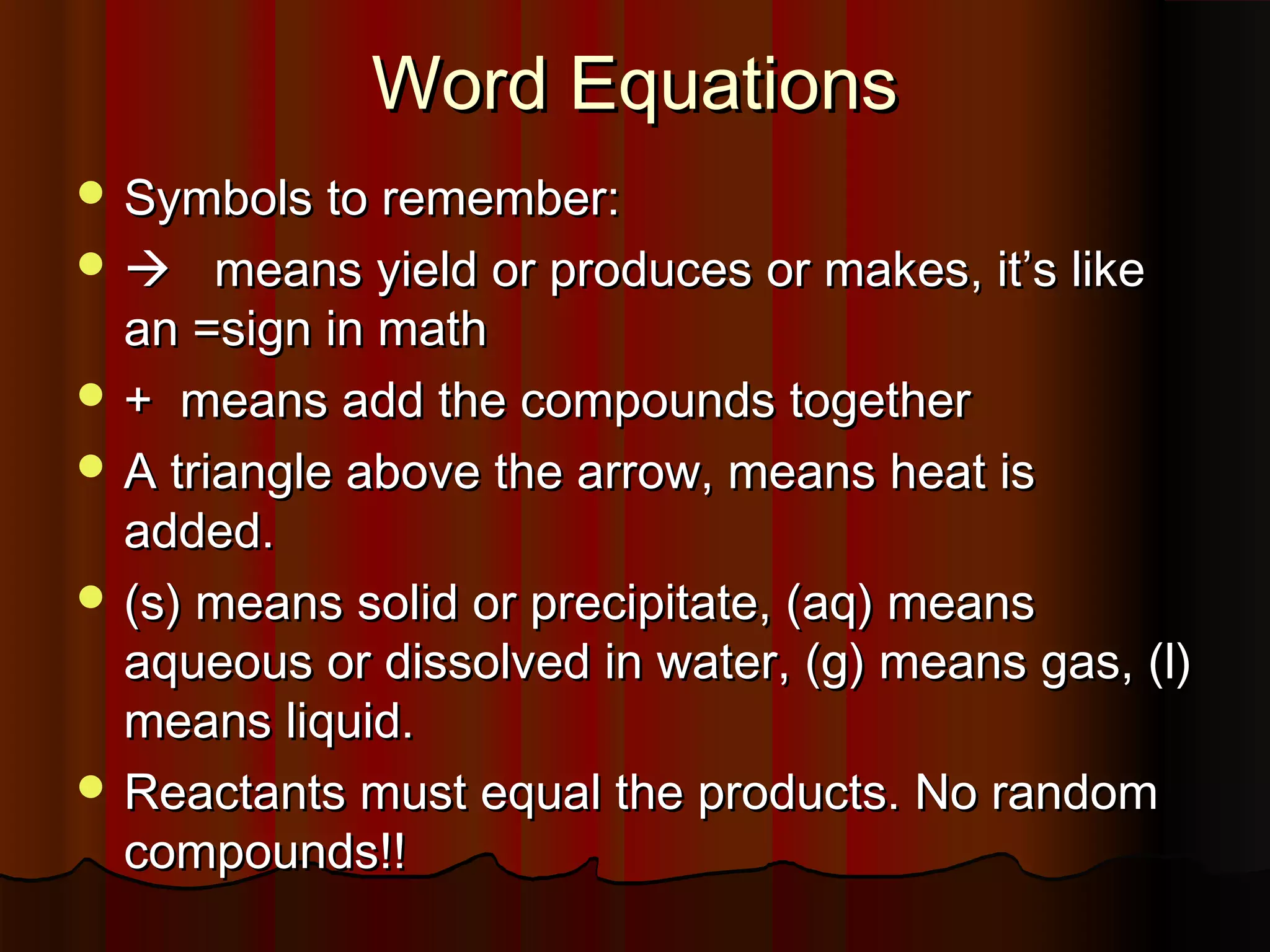
Word Equations
 Symbols to remember:

means yield or produces or makes, it’s like
an =sign in math
 + means add the compounds together
 A triangle above the arrow, means heat is
added.
 (s) means solid or precipitate, (aq) means
aqueous or dissolved in water, (g) means gas, (l)
means liquid.
 Reactants must equal the products. No random
compounds!!

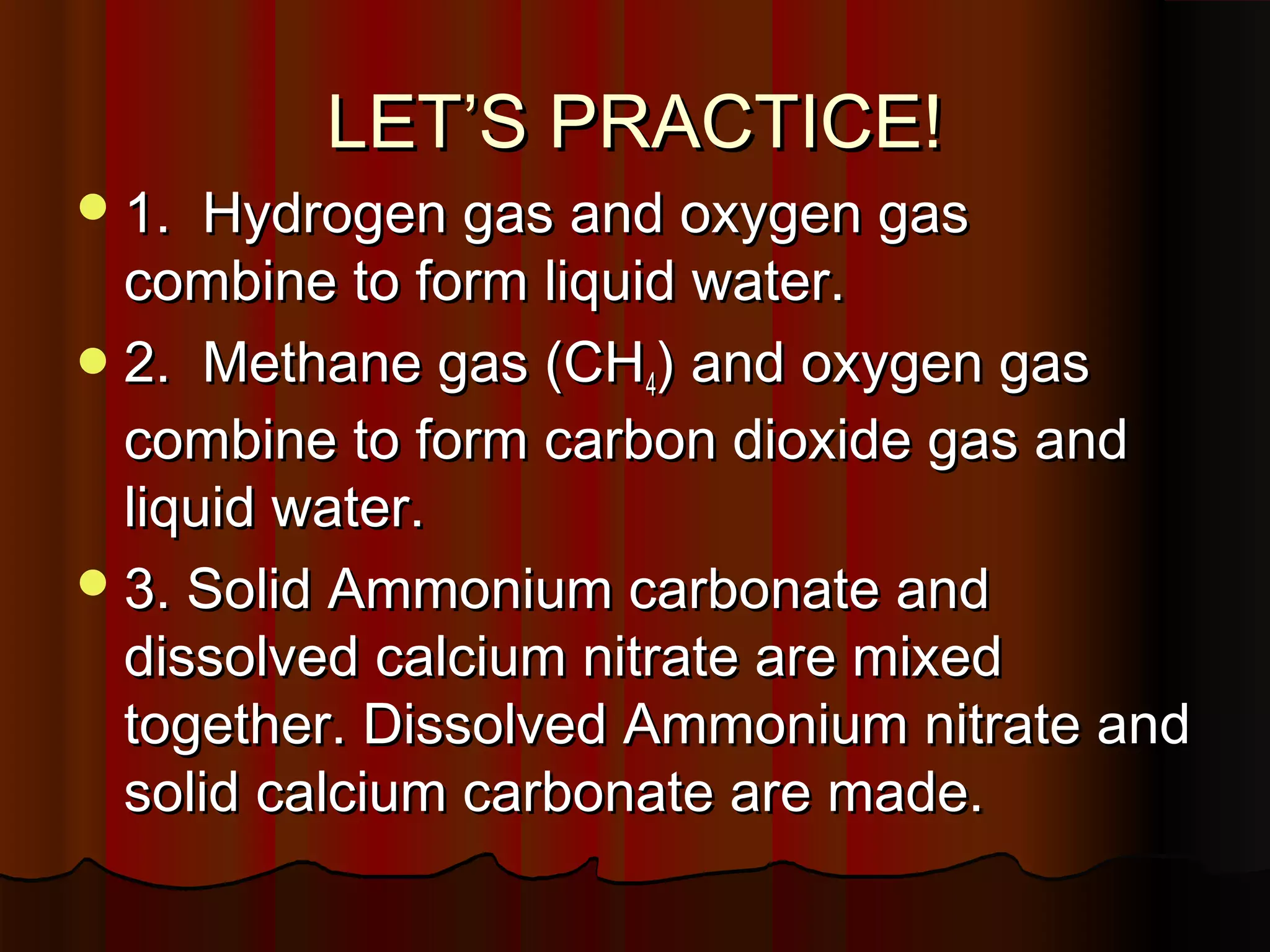
LET’S PRACTICE!
 1.

Hydrogen gas and oxygen gas
combine to form liquid water.
 2. Methane gas (CH4) and oxygen gas
combine to form carbon dioxide gas and
liquid water.
 3. Solid Ammonium carbonate and
dissolved calcium nitrate are mixed
together. Dissolved Ammonium nitrate and
solid calcium carbonate are made.
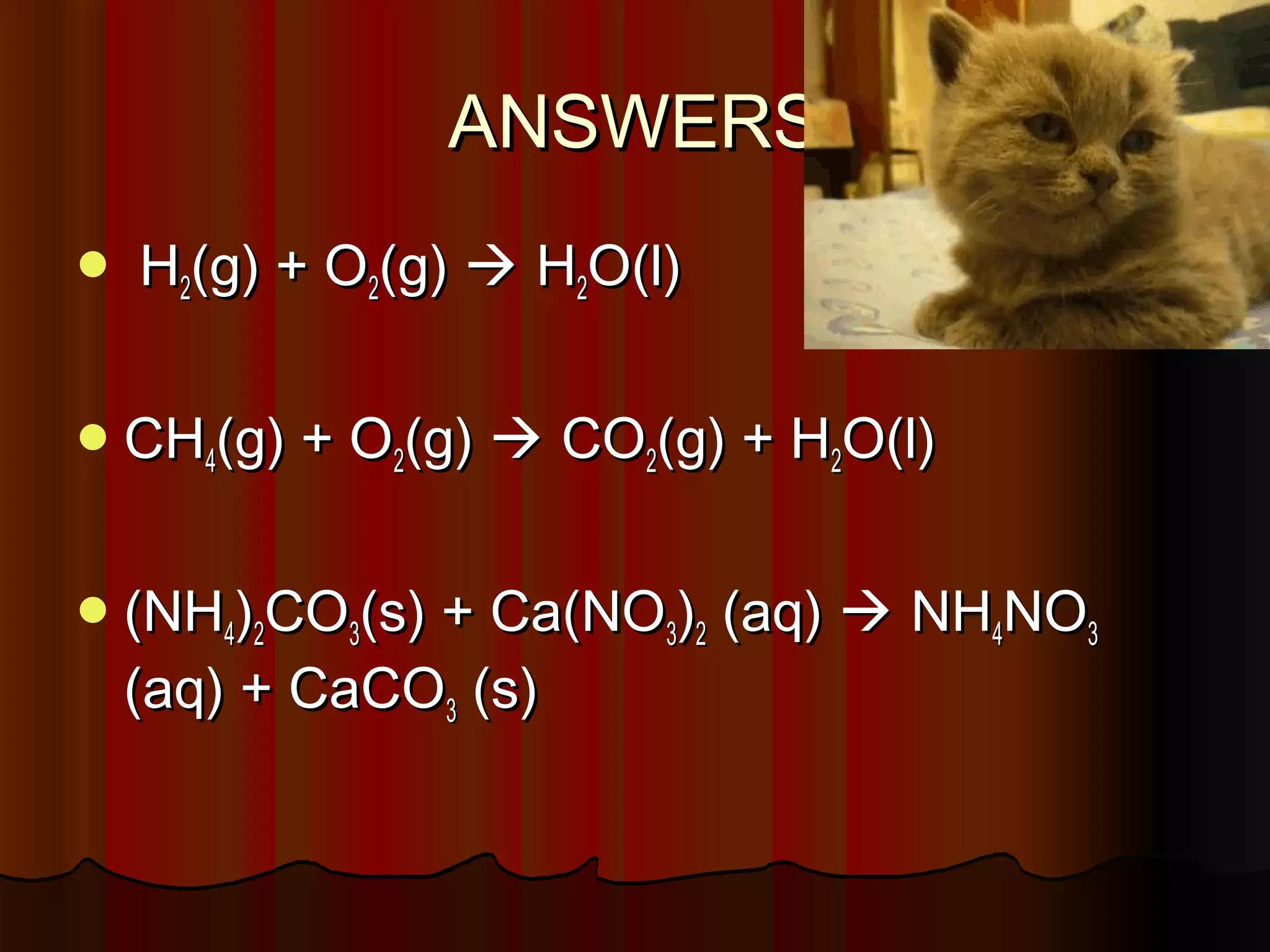
ANSWERS


H2(g) + O2(g)  H2O(l)

 CH4(g) + O2(g)  CO2(g) + H2O(l)
 (NH4)2CO3(s) + Ca(NO3)2

(aq) + CaCO3 (s)

(aq)  NH4NO3
OMG, I’M FINALLY DONE!

Chapter 9 notes-Chemistry

  • 1.
  • 2.
    Seriously?! Chemical what?! Chemical Reactionsare cool! A new substance with a new property will be made!
  • 8.
    Monoatomic Ions  Monomeans one.  When the metals in groups 1A, 2A and 3A lose electrons, they form cations with positive charges equal to their group number.  They keep their names and just put the word “ion” after it.  Nonmetals tend to gain electrons to form anions.  The charge of any anion is determined by subtracting 8 from their group number.  Elements in group 7A have a -1 charge and so on.  Their names will have the ending –ide.  For example, oxide, nitride, phosphide….etc
  • 9.
    Ions of TransitionMetals  The metals of groups 1B-8B form more than one cation with different charges.  The charges of the cations of many transition metal ions must be determined from the number of electrons lost.  To name these ions, a Roman numeral is used in parentheses after the name of the element.  For example, Fe+3 would be called iron(III).
  • 10.
    Polyatomic Ions  Someions, called polyatomic ions, are composed of more than one atom.  The names of polyatomic ions end in –ite or –ate.  There are three other ions that have different endings cyanide, ammonium and hydroxide  All ions with oxygen in them end with an – ite or an –ate.  Refer to your polyatomic table for the names and charges.
  • 11.
    Let’s Practice!  Writethe name for the following: Ca+2 Fe+2 Cu+1 Li2C03 NH4+ NO3BrNH4NO3 I’M READY!!
  • 12.
    ANSWERS!  Write thename for the following: Ca+2 Li2C03 calcium ion iron(II) ion copper(I) ion lithium carbonate NH4+ ammonium ion Fe+2 Cu+1 NO3- nitrate ion Br- bromide ion ammonium nitrate NH4NO3
  • 13.
  • 14.
  • 15.
    Writing Formulas forIonic Compounds  A binary compound is composed of two elements and can be either ionic or molecular.  To name any binary ionic compound, place the cation first and then the anion name.  To write a formula for a binary compound, write the symbol of the cation and then the anion.  Add whatever subscripts are needed to balance the charges.  BALANCING THE CHARGES IS IMPORTANT!!!!
  • 16.
    Balancing Charges Usingthe Crossdown Method  Write the cation first with its charge.  Then write the anion with its charge.  The charge of one ion becomes the subscript for the other ion.  You “cross” them down.  If the charges match, then no numbers are needed.  Remember, each compound wants to have a net charge of zero.
  • 17.
    Let’s Practice!  Writethe formulas for the following binary compounds.  Barium sulfide  Calcium nitride  Lithium oxide  Copper(II) iodide  Iron(III) oxide
  • 18.
    ANSWERS!!  Write theformulas for the following binary compounds.  Barium sulfide  Calcium nitride  Lithium oxide  Copper(II) iodide  Iron(III) oxide BaS Ca3N2 Li2O CuI2 Fe 2O3
  • 19.
    Compounds with PolyatomicIons  Write the symbol and charge for the cation.  Write the polyatomic formula and the charge.  Cross down the charges.  Remember, they must balance to zero.  Pretend the polyatomic ion is one atom.  If more than one polyatomic ion is needed, put parentheses around the polyatomic formula.
  • 20.
    Let’s Practice!  Writethe formulas for the following:  Calcium nitrate  Sodium carbonate  Calcium phosphate
  • 21.
    ANSWERS!  Write theformulas for the following:  Calcium nitrate  Sodium carbonate  Calcium phosphate Ca(NO 3)2 Na2CO3 Ca3(PO4)2
  • 22.
    Hey wait! Ithink I got those problems right!
  • 23.
    SUM IT UP! Writethe formula for: Potassium sulfide Calcium carbonate
  • 24.
    Naming and WritingFormulas for Covalent (Molecular) Compounds  The prefix in the name of the binary compound tells how many atoms of each element are present in the molecule. (see table 9.4)  The suffix for all the compounds is –ide.  Use the prefixes in the name to tell you the subscript of each element in the formula.  Write the correct symbols and the appropriate subscripts.
  • 25.
    LET’S PRACTICE!  Writethe names/formulas of the following compounds. CS2 Cl2O7 NI3 Carbon tetrabromide Diphosphorus trioxide
  • 26.
    ANSWERS  Write thenames/formulas of the following compounds. CS2 Cl2O7 NI3 carbon disulfide dichloride heptaoxide nitrogen triiodide Carbon tetrabromide CBr4 Diphosphorus trioxide P2O3
  • 30.
    Naming and WritingFormulas for Acids  An acid is a compound that contains one or more hydrogen atoms and produces hydrogen ions when dissolved in water.  When the name of the anion ends in –ide, the acid name begins with the prefix hydro- and has the suffix –ic and ends in acid.  When the anion name ends in –ite the acid name ends in –ous followed by acid.  When the anion name ends in –ate, the acid name ends in –ic followed by acid.
  • 31.
    LET’S PRACTICE!  Writethe name/formula for the following acids:  HBr  H2SO4  Hydrochloric acid  Carbonic acid  HNO2 If you don’t get this right….I’m coming for your SOUL!
  • 32.
    The Laws ofDefinite and Multiple Proportions  The law of definite proportions states that in any sample of a chemical compound, the masses of the elements are always in the same proportions.  They will always combine in simple wholenumber ratios.  The law of multiple proportions states that whenever two elements form more than one compound, they will be in simple whole number ratios.
  • 33.
    SUM IT UP! Whatis the name for HNO3 ?
  • 34.
    Word Equations  Symbolsto remember: means yield or produces or makes, it’s like an =sign in math  + means add the compounds together  A triangle above the arrow, means heat is added.  (s) means solid or precipitate, (aq) means aqueous or dissolved in water, (g) means gas, (l) means liquid.  Reactants must equal the products. No random compounds!! 
  • 35.
    LET’S PRACTICE!  1. Hydrogengas and oxygen gas combine to form liquid water.  2. Methane gas (CH4) and oxygen gas combine to form carbon dioxide gas and liquid water.  3. Solid Ammonium carbonate and dissolved calcium nitrate are mixed together. Dissolved Ammonium nitrate and solid calcium carbonate are made.
  • 36.
    ANSWERS  H2(g) + O2(g) H2O(l)  CH4(g) + O2(g)  CO2(g) + H2O(l)  (NH4)2CO3(s) + Ca(NO3)2 (aq) + CaCO3 (s) (aq)  NH4NO3
  • 37.