*Intro to Gases
and The Early
Gas Laws
By Shawn P. Shields, Ph. D.
This work is licensed by Shawn P. Shields-Maxwell under a Creative Commons Attribution-
NonCommercial-ShareAlike 4.0 International License.
*Introduction to Gases
*Gases are a phase of matter without a
fixed volume nor a fixed shape.
*Gases are described in terms of four
macroscopic observables:
*Pressure
*Temperature
*Volume
*Moles of gas
2
*Introduction to Gases
*The early gas laws described these macroscopic
observables or characteristics relative to each
other.
*Boyle’s law describes the relationship between pressure
and volume of a gas at a fixed temperature and amount
of gas.
*Charles’s law describes the relationship between
temperature and volume of a gas at a constant pressure
and amount of gas.
*Avogadro’s law says one mole of any gas at STP
(Standard Temperature and Pressure; 0C and 1 atm) will
take up a volume of 22.4 L.
3
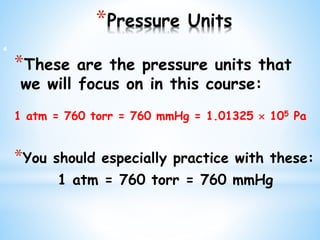
*Pressure Units
*These are the pressure units that
we will focus on in this course:
1 atm = 760 torr = 760 mmHg = 1.01325  105 Pa
*You should especially practice with these:
1 atm = 760 torr = 760 mmHg
4
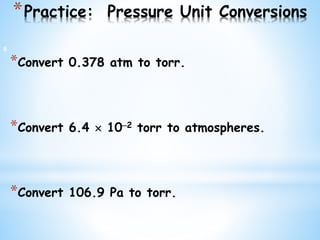
*Practice: Pressure Unit Conversions
*Convert 0.378 atm to torr.
*Convert 6.4  102 torr to atmospheres.
*Convert 106.9 Pa to torr.
5
*Practice: Pressure Unit Conversions
(Solutions)
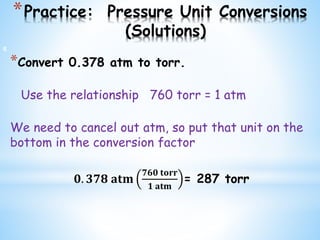
*Convert 0.378 atm to torr.
Use the relationship 760 torr = 1 atm
We need to cancel out atm, so put that unit on the
bottom in the conversion factor
𝟎. 𝟑𝟕𝟖 𝐚𝐭𝐦
𝟕𝟔𝟎 𝐭𝐨𝐫𝐫
𝟏 𝐚𝐭𝐦
= 287 torr
6
*Practice: Pressure Unit Conversions
(Solutions)
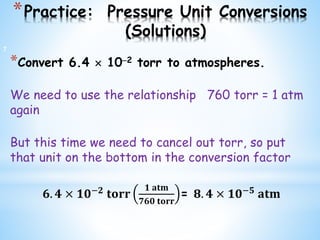
*Convert 6.4  102 torr to atmospheres.
We need to use the relationship 760 torr = 1 atm
again
But this time we need to cancel out torr, so put
that unit on the bottom in the conversion factor
𝟔. 𝟒 × 𝟏𝟎−𝟐
𝐭𝐨𝐫𝐫
𝟏 𝐚𝐭𝐦
𝟕𝟔𝟎 𝐭𝐨𝐫𝐫
= 𝟖. 𝟒 × 𝟏𝟎−𝟓
𝐚𝐭𝐦
7
*Practice: Pressure Unit Conversions
(Solutions)
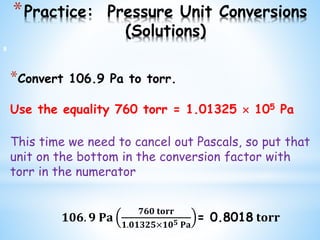
*Convert 106.9 Pa to torr.
Use the equality 760 torr = 1.01325  105 Pa
This time we need to cancel out Pascals, so put that
unit on the bottom in the conversion factor with
torr in the numerator
𝟏𝟎𝟔. 𝟗 𝐏𝐚
𝟕𝟔𝟎 𝐭𝐨𝐫𝐫
𝟏.𝟎𝟏𝟑𝟐𝟓×𝟏𝟎 𝟓 𝐏𝐚
= 0.8018 𝐭𝐨𝐫𝐫
8
*The Early Gas Laws
*Boyle’s Law
*Charles Law
*Avogadro’s Law
9
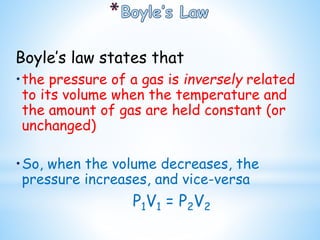
Boyle’s law states that
•the pressure of a gas is inversely related
to its volume when the temperature and
the amount of gas are held constant (or
unchanged)
•So, when the volume decreases, the
pressure increases, and vice-versa
P1V1 = P2V2
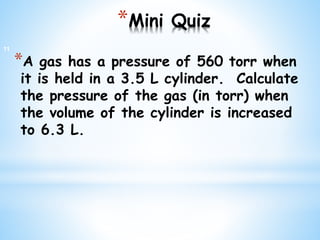
*Mini Quiz
*A gas has a pressure of 560 torr when
it is held in a 3.5 L cylinder. Calculate
the pressure of the gas (in torr) when
the volume of the cylinder is increased
to 6.3 L.
11
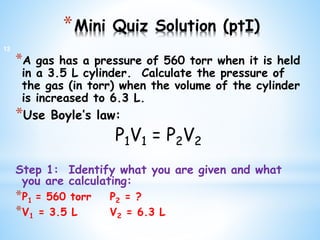
*Mini Quiz Solution (ptI)
*A gas has a pressure of 560 torr when it is held
in a 3.5 L cylinder. Calculate the pressure of
the gas (in torr) when the volume of the cylinder
is increased to 6.3 L.
*Use Boyle’s law:
P1V1 = P2V2
Step 1: Identify what you are given and what
you are calculating:
*P1 = 560 torr P2 = ?
*V1 = 3.5 L V2 = 6.3 L
12
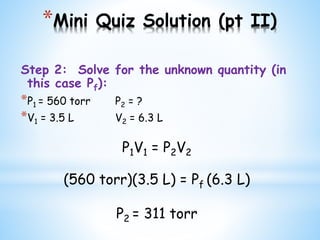
*Mini Quiz Solution (pt II)
Step 2: Solve for the unknown quantity (in
this case Pf):
*P1 = 560 torr P2 = ?
*V1 = 3.5 L V2 = 6.3 L
P1V1 = P2V2
(560 torr)(3.5 L) = Pf (6.3 L)
P2 = 311 torr
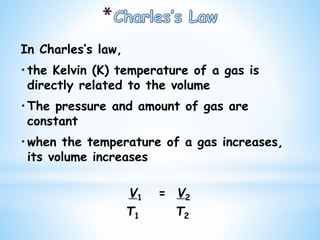
In Charles’s law,
•the Kelvin (K) temperature of a gas is
directly related to the volume
•The pressure and amount of gas are
constant
•when the temperature of a gas increases,
its volume increases
V1 = V2
T1 T2
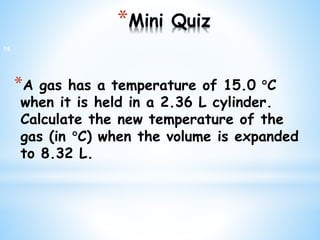
*Mini Quiz
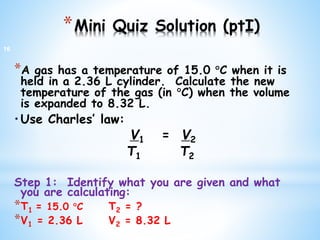
*A gas has a temperature of 15.0 C
when it is held in a 2.36 L cylinder.
Calculate the new temperature of the
gas (in C) when the volume is expanded
to 8.32 L.
15
*Mini Quiz Solution (ptI)
*A gas has a temperature of 15.0 C when it is
held in a 2.36 L cylinder. Calculate the new
temperature of the gas (in C) when the volume
is expanded to 8.32 L.
•Use Charles’ law:
V1 = V2
T1 T2
Step 1: Identify what you are given and what
you are calculating:
*T1 = 15.0 C T2 = ?
*V1 = 2.36 L V2 = 8.32 L
16
*Mini Quiz Solution (pt II)
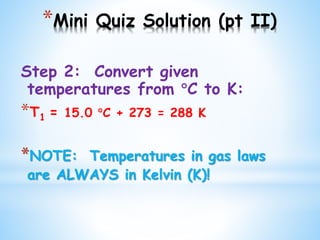
Step 2: Convert given
temperatures from C to K:
*T1 = 15.0 C + 273 = 288 K
*NOTE: Temperatures in gas laws
are ALWAYS in Kelvin (K)!
*Mini Quiz Solution (pt III)
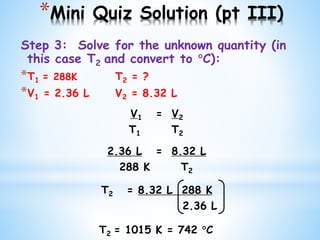
Step 3: Solve for the unknown quantity (in
this case T2 and convert to C):
*T1 = 288K T2 = ?
*V1 = 2.36 L V2 = 8.32 L
V1 = V2
T1 T2
2.36 L = 8.32 L
288 K T2
T2 = 8.32 L 288 K
2.36 L
T2 = 1015 K = 742 C
*Avogadro’s Law
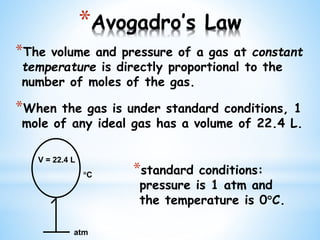
*The volume and pressure of a gas at constant
temperature is directly proportional to the
number of moles of the gas.
*When the gas is under standard conditions, 1
mole of any ideal gas has a volume of 22.4 L.
*standard conditions:
pressure is 1 atm and
the temperature is 0C.
C
atm
V = 22.4 L

Unit 10 intro&early gaslaws final

  • 1.
    *Intro to Gases andThe Early Gas Laws By Shawn P. Shields, Ph. D. This work is licensed by Shawn P. Shields-Maxwell under a Creative Commons Attribution- NonCommercial-ShareAlike 4.0 International License.
  • 2.
    *Introduction to Gases *Gasesare a phase of matter without a fixed volume nor a fixed shape. *Gases are described in terms of four macroscopic observables: *Pressure *Temperature *Volume *Moles of gas 2
  • 3.
    *Introduction to Gases *Theearly gas laws described these macroscopic observables or characteristics relative to each other. *Boyle’s law describes the relationship between pressure and volume of a gas at a fixed temperature and amount of gas. *Charles’s law describes the relationship between temperature and volume of a gas at a constant pressure and amount of gas. *Avogadro’s law says one mole of any gas at STP (Standard Temperature and Pressure; 0C and 1 atm) will take up a volume of 22.4 L. 3
  • 4.
    *Pressure Units *These arethe pressure units that we will focus on in this course: 1 atm = 760 torr = 760 mmHg = 1.01325  105 Pa *You should especially practice with these: 1 atm = 760 torr = 760 mmHg 4
  • 5.
    *Practice: Pressure UnitConversions *Convert 0.378 atm to torr. *Convert 6.4  102 torr to atmospheres. *Convert 106.9 Pa to torr. 5
  • 6.
    *Practice: Pressure UnitConversions (Solutions) *Convert 0.378 atm to torr. Use the relationship 760 torr = 1 atm We need to cancel out atm, so put that unit on the bottom in the conversion factor 𝟎. 𝟑𝟕𝟖 𝐚𝐭𝐦 𝟕𝟔𝟎 𝐭𝐨𝐫𝐫 𝟏 𝐚𝐭𝐦 = 287 torr 6
  • 7.
    *Practice: Pressure UnitConversions (Solutions) *Convert 6.4  102 torr to atmospheres. We need to use the relationship 760 torr = 1 atm again But this time we need to cancel out torr, so put that unit on the bottom in the conversion factor 𝟔. 𝟒 × 𝟏𝟎−𝟐 𝐭𝐨𝐫𝐫 𝟏 𝐚𝐭𝐦 𝟕𝟔𝟎 𝐭𝐨𝐫𝐫 = 𝟖. 𝟒 × 𝟏𝟎−𝟓 𝐚𝐭𝐦 7
  • 8.
    *Practice: Pressure UnitConversions (Solutions) *Convert 106.9 Pa to torr. Use the equality 760 torr = 1.01325  105 Pa This time we need to cancel out Pascals, so put that unit on the bottom in the conversion factor with torr in the numerator 𝟏𝟎𝟔. 𝟗 𝐏𝐚 𝟕𝟔𝟎 𝐭𝐨𝐫𝐫 𝟏.𝟎𝟏𝟑𝟐𝟓×𝟏𝟎 𝟓 𝐏𝐚 = 0.8018 𝐭𝐨𝐫𝐫 8
  • 9.
    *The Early GasLaws *Boyle’s Law *Charles Law *Avogadro’s Law 9
  • 10.
    Boyle’s law statesthat •the pressure of a gas is inversely related to its volume when the temperature and the amount of gas are held constant (or unchanged) •So, when the volume decreases, the pressure increases, and vice-versa P1V1 = P2V2
  • 11.
    *Mini Quiz *A gashas a pressure of 560 torr when it is held in a 3.5 L cylinder. Calculate the pressure of the gas (in torr) when the volume of the cylinder is increased to 6.3 L. 11
  • 12.
    *Mini Quiz Solution(ptI) *A gas has a pressure of 560 torr when it is held in a 3.5 L cylinder. Calculate the pressure of the gas (in torr) when the volume of the cylinder is increased to 6.3 L. *Use Boyle’s law: P1V1 = P2V2 Step 1: Identify what you are given and what you are calculating: *P1 = 560 torr P2 = ? *V1 = 3.5 L V2 = 6.3 L 12
  • 13.
    *Mini Quiz Solution(pt II) Step 2: Solve for the unknown quantity (in this case Pf): *P1 = 560 torr P2 = ? *V1 = 3.5 L V2 = 6.3 L P1V1 = P2V2 (560 torr)(3.5 L) = Pf (6.3 L) P2 = 311 torr
  • 14.
    In Charles’s law, •theKelvin (K) temperature of a gas is directly related to the volume •The pressure and amount of gas are constant •when the temperature of a gas increases, its volume increases V1 = V2 T1 T2
  • 15.
    *Mini Quiz *A gashas a temperature of 15.0 C when it is held in a 2.36 L cylinder. Calculate the new temperature of the gas (in C) when the volume is expanded to 8.32 L. 15
  • 16.
    *Mini Quiz Solution(ptI) *A gas has a temperature of 15.0 C when it is held in a 2.36 L cylinder. Calculate the new temperature of the gas (in C) when the volume is expanded to 8.32 L. •Use Charles’ law: V1 = V2 T1 T2 Step 1: Identify what you are given and what you are calculating: *T1 = 15.0 C T2 = ? *V1 = 2.36 L V2 = 8.32 L 16
  • 17.
    *Mini Quiz Solution(pt II) Step 2: Convert given temperatures from C to K: *T1 = 15.0 C + 273 = 288 K *NOTE: Temperatures in gas laws are ALWAYS in Kelvin (K)!
  • 18.
    *Mini Quiz Solution(pt III) Step 3: Solve for the unknown quantity (in this case T2 and convert to C): *T1 = 288K T2 = ? *V1 = 2.36 L V2 = 8.32 L V1 = V2 T1 T2 2.36 L = 8.32 L 288 K T2 T2 = 8.32 L 288 K 2.36 L T2 = 1015 K = 742 C
  • 19.
    *Avogadro’s Law *The volumeand pressure of a gas at constant temperature is directly proportional to the number of moles of the gas. *When the gas is under standard conditions, 1 mole of any ideal gas has a volume of 22.4 L. *standard conditions: pressure is 1 atm and the temperature is 0C. C atm V = 22.4 L