CHM 111 Dimensional Analysis (Solutions) CH1 Math Skills Toolbox
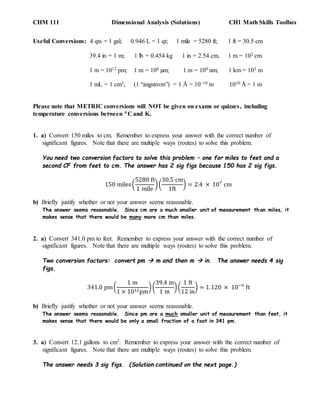
Useful Conversions: 4 qts = 1 gal; 0.946 L = 1 qt; 1 mile = 5280 ft; 1 ft = 30.5 cm
39.4 in = 1 m; 1 lb = 0.454 kg 1 in = 2.54 cm, 1 m = 102 cm
1 m = 1012 pm; 1 m = 106 µm; 1 m = 109 nm; 1 km = 103 m
1 mL = 1 cm3; (1 “angstrom”) = 1 Å = 10−10 m 1010 Å = 1 m
Please note that METRIC conversions will NOT be given on exams or quizzes, including
temperature conversions between C and K.
1. a) Convert 150 miles to cm. Remember to express your answer with the correct number of
significant figures. Note that there are multiple ways (routes) to solve this problem.
You need two conversion factors to solve this problem – one for miles to feet and a
second CF from feet to cm. The answer has 2 sig figs because 150 has 2 sig figs.
150 miles(
5280 ft
1 mile
)(
30.5 cm
1ft
) = 2.4 × 10⁷
cm
b) Briefly justify whether or not your answer seems reasonable.
The answer seems reasonable. Since cm are a much smaller unit of measurement than miles, it
makes sense that there would be many more cm than miles.
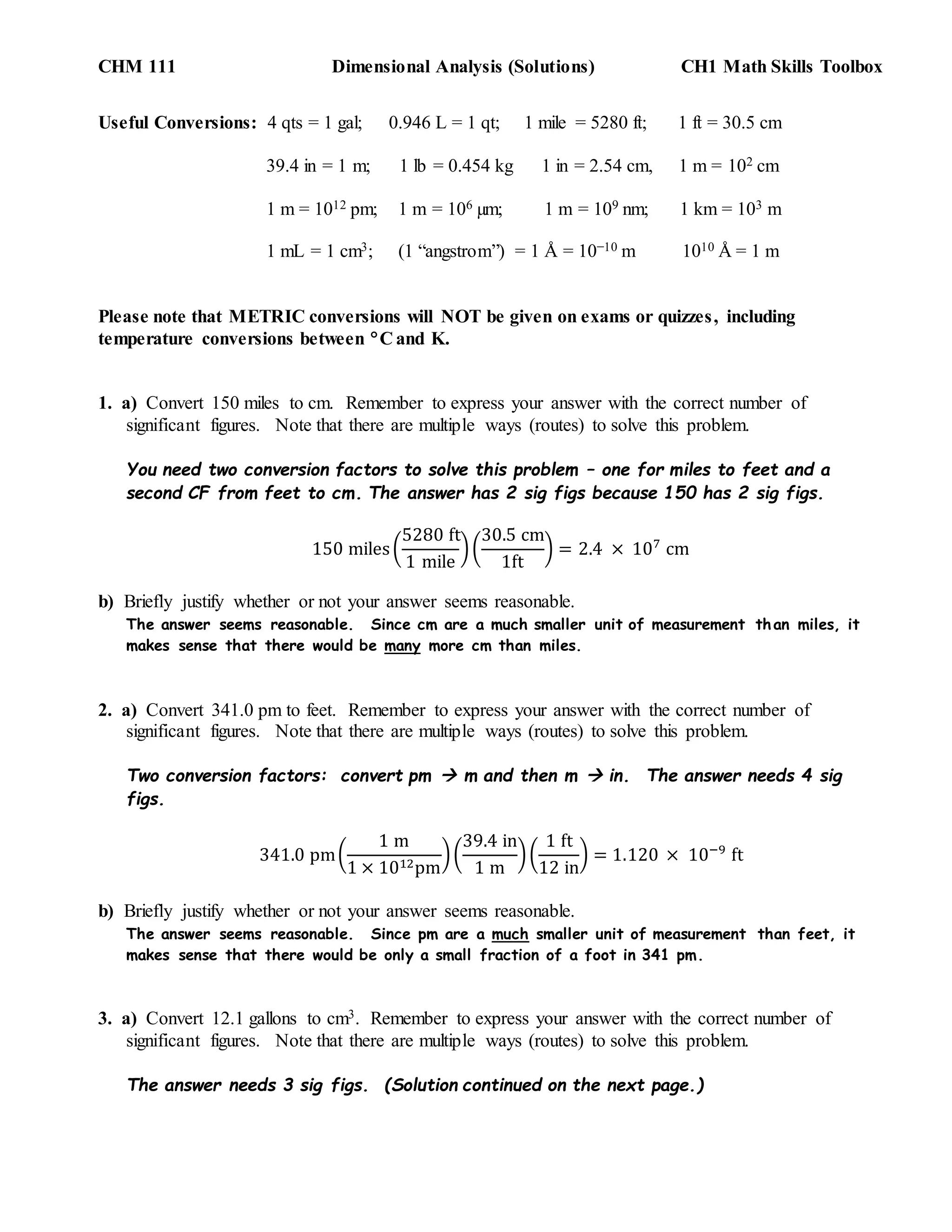
2. a) Convert 341.0 pm to feet. Remember to express your answer with the correct number of
significant figures. Note that there are multiple ways (routes) to solve this problem.
Two conversion factors: convert pm  m and then m  in. The answer needs 4 sig
figs.
341.0 pm(
1 m
1 × 10¹²pm
)(
39.4 in
1 m
)(
1 ft
12 in
) = 1.120 × 10⁻⁹
ft
b) Briefly justify whether or not your answer seems reasonable.
The answer seems reasonable. Since pm are a much smaller unit of measurement than feet, it
makes sense that there would be only a small fraction of a foot in 341 pm.
3. a) Convert 12.1 gallons to cm3. Remember to express your answer with the correct number of
significant figures. Note that there are multiple ways (routes) to solve this problem.
The answer needs 3 sig figs. (Solution continued on the next page.)
CHM 111 Dimensional Analysis (Solutions) CH1 Math Skills Toolbox
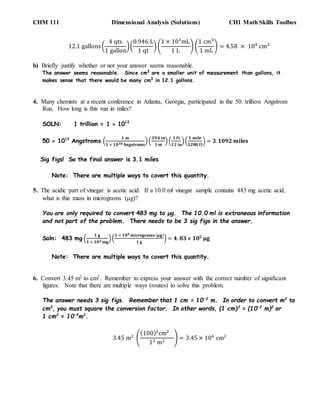
12.1 gallons(
4 qts
1 gallon
)(
0.946 L
1 qt
)(
1 × 10³
mL
1 L
) (
1 cm3
1 mL
) = 4.58 × 10⁴
cm3
b) Briefly justify whether or not your answer seems reasonable.
The answer seems reasonable. Since cm3
are a smaller unit of measurement than gallons, it
makes sense that there would be many cm3
in 12.1 gallons.
4. Many chemists at a recent conference in Atlanta, Georgia, participated in the 50. trillion Angstrom
Run. How long is this run in miles?
SOLN: 1 trillion = 1  1012
50  1012
Angstroms (
𝟏 𝐦
𝟏 × 𝟏𝟎 𝟏𝟎 𝐀𝐧𝐠𝐬𝐭𝐫𝐨𝐦𝐬
)(
𝟑𝟗.𝟒 𝐢𝐧
𝟏 𝐦
)(
𝟏 𝐟𝐭
𝟏𝟐 𝐢𝐧
)(
𝟏 𝐦𝐢𝐥𝐞
𝟓𝟐𝟖𝟎 𝐟𝐭
) = 𝟑. 𝟏𝟎𝟗𝟐 𝐦𝐢𝐥𝐞𝐬
Sig figs! So the final answer is 3.1 miles
Note: There are multiple ways to covert this quantity.
5. The acidic part of vinegar is acetic acid. If a 10.0 ml vinegar sample contains 483 mg acetic acid,
what is this mass in micrograms (g)?
You are only required to convert 483 mg to μg. The 10.0 ml is extraneous information
and not part of the problem. There needs to be 3 sig figs in the answer.
Soln: 483 mg (
𝟏 𝐠
𝟏 × 𝟏𝟎 𝟑 𝐦𝐠
)(
𝟏 × 𝟏𝟎 𝟔 𝐦𝐢𝐜𝐫𝐨𝐠𝐫𝐚𝐦𝐬 (𝛍𝐠)
𝟏 𝐠
) = 𝟒. 𝟖𝟑  𝟏𝟎 𝟓 𝛍𝐠
Note: There are multiple ways to covert this quantity.
6. Convert 3.45 m2 to cm2. Remember to express your answer with the correct number of significant
figures. Note that there are multiple ways (routes) to solve this problem.
The answer needs 3 sig figs. Remember that 1 cm = 10-2
m. In order to convert m2
to
cm2
, you must square the conversion factor. In other words, (1 cm)2
= (10-2
m)2
or
1 cm2
= 10-4
m2
.
3.45 m2
(
(100)2
cm2
12 m2
) = 3.45 × 10⁴
cm2
CHM 111 Dimensional Analysis (Solutions) CH1 Math Skills Toolbox
7. Convert 3.45 µm2 to cm2. Remember to express your answer with the correct number of significant
figures. Note that there are multiple ways (routes) to solve this problem.
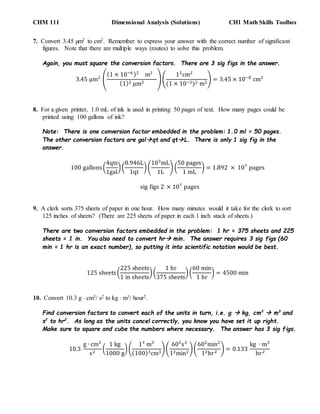
Again, you must square the conversion factors. There are 3 sig figs in the answer.
3.45 µm2
(
(1 × 10⁻⁶)2
m2
(1)2 µm2
)(
12
cm2
(1 × 10⁻²)2 m2
) = 3.45 × 10⁻⁸
cm2
8. For a given printer, 1.0 mL of ink is used in printing 50 pages of text. How many pages could be
printed using 100 gallons of ink?
Note: There is one conversion factor embedded in the problem: 1.0 ml = 50 pages.
The other conversion factors are galqt and qtL. There is only 1 sig fig in the
answer.
100 gallons(
4qts
1gal
)(
0.946L
1qt
)(
103
mL
1L
) (
50 pages
1 mL
) = 1.892 × 10⁷
pages
sig figs 2 × 10⁷
pages
9. A clerk sorts 375 sheets of paper in one hour. How many minutes would it take for the clerk to sort
125 inches of sheets? (There are 225 sheets of paper in each 1 inch stack of sheets.)
There are two conversion factors embedded in the problem: 1 hr = 375 sheets and 225
sheets = 1 in. You also need to convert hr min. The answer requires 3 sig figs (60
min = 1 hr is an exact number), so putting it into scientific notation would be best.
125 sheets(
225 sheets
1 in sheets
)(
1 hr
375 sheets
)(
60 min
1 hr
) = 4500 min
10. Convert 10.3 g  cm3/ s2 to kg  m3/ hour2.
Find conversion factors to convert each of the units in turn, i.e. g  kg, cm3
 m3
and
s2
to hr2
. As long as the units cancel correctly, you know you have set it up right.
Make sure to square and cube the numbers where necessary. The answer has 3 sig figs.
10.3
g ∙ cm3
s2
(
1 kg
1000 g
)(
13
m3
(100)3cm3
)(
602
s2
12min2
)(
602
min2
12hr2
) = 0.133
kg ∙ m3
hr2
CHM 111 Dimensional Analysis (Solutions) CH1 Math Skills Toolbox
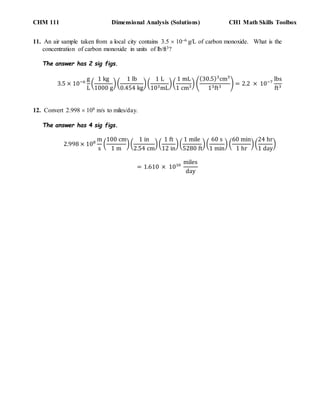
11. An air sample taken from a local city contains 3.5  106 g/L of carbon monoxide. What is the
concentration of carbon monoxide in units of lb/ft3?
The answer has 2 sig figs.
3.5 × 10⁻⁶
g
L
(
1 kg
1000 g
)(
1 lb
0.454 kg
)(
1 L
103mL
)(
1 mL
1 cm3
) (
(30.5)3
cm3
13ft3
) = 2.2 × 10⁻⁷
lbs
ft3
12. Convert 2.998  108 m/s to miles/day.
The answer has 4 sig figs.
2.998 × 10⁸
m
s
(
100 cm
1 m
)(
1 in
2.54 cm
)(
1 ft
12 in
)(
1 mile
5280 ft
)(
60 s
1 min
) (
60 min
1 hr
)(
24 hr
1 day
)
= 1.610 × 10¹⁰
miles
day

Problem Solution - Dimensional Analysis

  • 1.
    CHM 111 DimensionalAnalysis (Solutions) CH1 Math Skills Toolbox Useful Conversions: 4 qts = 1 gal; 0.946 L = 1 qt; 1 mile = 5280 ft; 1 ft = 30.5 cm 39.4 in = 1 m; 1 lb = 0.454 kg 1 in = 2.54 cm, 1 m = 102 cm 1 m = 1012 pm; 1 m = 106 µm; 1 m = 109 nm; 1 km = 103 m 1 mL = 1 cm3; (1 “angstrom”) = 1 Å = 10−10 m 1010 Å = 1 m Please note that METRIC conversions will NOT be given on exams or quizzes, including temperature conversions between C and K. 1. a) Convert 150 miles to cm. Remember to express your answer with the correct number of significant figures. Note that there are multiple ways (routes) to solve this problem. You need two conversion factors to solve this problem – one for miles to feet and a second CF from feet to cm. The answer has 2 sig figs because 150 has 2 sig figs. 150 miles( 5280 ft 1 mile )( 30.5 cm 1ft ) = 2.4 × 107 cm b) Briefly justify whether or not your answer seems reasonable. The answer seems reasonable. Since cm are a much smaller unit of measurement than miles, it makes sense that there would be many more cm than miles. 2. a) Convert 341.0 pm to feet. Remember to express your answer with the correct number of significant figures. Note that there are multiple ways (routes) to solve this problem. Two conversion factors: convert pm  m and then m  in. The answer needs 4 sig figs. 341.0 pm( 1 m 1 × 10¹²pm )( 39.4 in 1 m )( 1 ft 12 in ) = 1.120 × 10⁻⁹ ft b) Briefly justify whether or not your answer seems reasonable. The answer seems reasonable. Since pm are a much smaller unit of measurement than feet, it makes sense that there would be only a small fraction of a foot in 341 pm. 3. a) Convert 12.1 gallons to cm3. Remember to express your answer with the correct number of significant figures. Note that there are multiple ways (routes) to solve this problem. The answer needs 3 sig figs. (Solution continued on the next page.)
  • 2.
    CHM 111 DimensionalAnalysis (Solutions) CH1 Math Skills Toolbox 12.1 gallons( 4 qts 1 gallon )( 0.946 L 1 qt )( 1 × 10³ mL 1 L ) ( 1 cm3 1 mL ) = 4.58 × 104 cm3 b) Briefly justify whether or not your answer seems reasonable. The answer seems reasonable. Since cm3 are a smaller unit of measurement than gallons, it makes sense that there would be many cm3 in 12.1 gallons. 4. Many chemists at a recent conference in Atlanta, Georgia, participated in the 50. trillion Angstrom Run. How long is this run in miles? SOLN: 1 trillion = 1  1012 50  1012 Angstroms ( 𝟏 𝐦 𝟏 × 𝟏𝟎 𝟏𝟎 𝐀𝐧𝐠𝐬𝐭𝐫𝐨𝐦𝐬 )( 𝟑𝟗.𝟒 𝐢𝐧 𝟏 𝐦 )( 𝟏 𝐟𝐭 𝟏𝟐 𝐢𝐧 )( 𝟏 𝐦𝐢𝐥𝐞 𝟓𝟐𝟖𝟎 𝐟𝐭 ) = 𝟑. 𝟏𝟎𝟗𝟐 𝐦𝐢𝐥𝐞𝐬 Sig figs! So the final answer is 3.1 miles Note: There are multiple ways to covert this quantity. 5. The acidic part of vinegar is acetic acid. If a 10.0 ml vinegar sample contains 483 mg acetic acid, what is this mass in micrograms (g)? You are only required to convert 483 mg to μg. The 10.0 ml is extraneous information and not part of the problem. There needs to be 3 sig figs in the answer. Soln: 483 mg ( 𝟏 𝐠 𝟏 × 𝟏𝟎 𝟑 𝐦𝐠 )( 𝟏 × 𝟏𝟎 𝟔 𝐦𝐢𝐜𝐫𝐨𝐠𝐫𝐚𝐦𝐬 (𝛍𝐠) 𝟏 𝐠 ) = 𝟒. 𝟖𝟑  𝟏𝟎 𝟓 𝛍𝐠 Note: There are multiple ways to covert this quantity. 6. Convert 3.45 m2 to cm2. Remember to express your answer with the correct number of significant figures. Note that there are multiple ways (routes) to solve this problem. The answer needs 3 sig figs. Remember that 1 cm = 10-2 m. In order to convert m2 to cm2 , you must square the conversion factor. In other words, (1 cm)2 = (10-2 m)2 or 1 cm2 = 10-4 m2 . 3.45 m2 ( (100)2 cm2 12 m2 ) = 3.45 × 104 cm2
  • 3.
    CHM 111 DimensionalAnalysis (Solutions) CH1 Math Skills Toolbox 7. Convert 3.45 µm2 to cm2. Remember to express your answer with the correct number of significant figures. Note that there are multiple ways (routes) to solve this problem. Again, you must square the conversion factors. There are 3 sig figs in the answer. 3.45 µm2 ( (1 × 10⁻⁶)2 m2 (1)2 µm2 )( 12 cm2 (1 × 10⁻²)2 m2 ) = 3.45 × 10⁻⁸ cm2 8. For a given printer, 1.0 mL of ink is used in printing 50 pages of text. How many pages could be printed using 100 gallons of ink? Note: There is one conversion factor embedded in the problem: 1.0 ml = 50 pages. The other conversion factors are galqt and qtL. There is only 1 sig fig in the answer. 100 gallons( 4qts 1gal )( 0.946L 1qt )( 103 mL 1L ) ( 50 pages 1 mL ) = 1.892 × 10⁷ pages sig figs 2 × 10⁷ pages 9. A clerk sorts 375 sheets of paper in one hour. How many minutes would it take for the clerk to sort 125 inches of sheets? (There are 225 sheets of paper in each 1 inch stack of sheets.) There are two conversion factors embedded in the problem: 1 hr = 375 sheets and 225 sheets = 1 in. You also need to convert hr min. The answer requires 3 sig figs (60 min = 1 hr is an exact number), so putting it into scientific notation would be best. 125 sheets( 225 sheets 1 in sheets )( 1 hr 375 sheets )( 60 min 1 hr ) = 4500 min 10. Convert 10.3 g  cm3/ s2 to kg  m3/ hour2. Find conversion factors to convert each of the units in turn, i.e. g  kg, cm3  m3 and s2 to hr2 . As long as the units cancel correctly, you know you have set it up right. Make sure to square and cube the numbers where necessary. The answer has 3 sig figs. 10.3 g ∙ cm3 s2 ( 1 kg 1000 g )( 13 m3 (100)3cm3 )( 602 s2 12min2 )( 602 min2 12hr2 ) = 0.133 kg ∙ m3 hr2
  • 4.
    CHM 111 DimensionalAnalysis (Solutions) CH1 Math Skills Toolbox 11. An air sample taken from a local city contains 3.5  106 g/L of carbon monoxide. What is the concentration of carbon monoxide in units of lb/ft3? The answer has 2 sig figs. 3.5 × 10⁻⁶ g L ( 1 kg 1000 g )( 1 lb 0.454 kg )( 1 L 103mL )( 1 mL 1 cm3 ) ( (30.5)3 cm3 13ft3 ) = 2.2 × 10⁻⁷ lbs ft3 12. Convert 2.998  108 m/s to miles/day. The answer has 4 sig figs. 2.998 × 10⁸ m s ( 100 cm 1 m )( 1 in 2.54 cm )( 1 ft 12 in )( 1 mile 5280 ft )( 60 s 1 min ) ( 60 min 1 hr )( 24 hr 1 day ) = 1.610 × 10¹⁰ miles day