OUR 
POWERPOINT 
PROJECT 
ON-
CARBON AND ITS COMPOUNDS 
SUBMITTED TO:- 
MRS. ANITA 
GROUP NO.-7 
LEADER - RIBHA (47) 
Members – vasu (9) 
arsh (49) 
guransh (48) 
Oisa (18) 
Vivek (26) 
Dewak (37)
What Is 
Carbon??? 
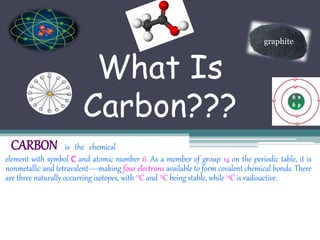
graphite 
CARBON is the chemical 
element with symbol C and atomic number 6. As a member of group 14 on the periodic table, it is 
nonmetallic and tetravalent—making four electrons available to form covalent chemical bonds. There 
are three naturally occurring isotopes, with 12C and 13C being stable, while 14C is radioactive.
ORIGIN OF CARBON IN NATURE ….. 
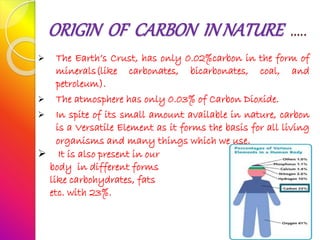
 The Earth’s Crust, has only 0.02%carbon in the form of 
minerals(like carbonates, bicarbonates, coal, and 
petroleum). 
 The atmosphere has only 0.03% of Carbon Dioxide. 
 In spite of its small amount available in nature, carbon 
is a Versatile Element as it forms the basis for all living 
organisms and many things which we use. 
 It is also present in our 
body in different forms 
like carbohydrates, fats 
etc. with 23%.
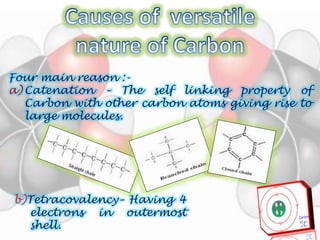
Four main reason :- 
a) Catenation – The self linking property of 
Carbon with other carbon atoms giving rise to 
large molecules. 
b)Tetracovalency– Having 4 
electrons in outermost 
shell.
Four main reason :- 
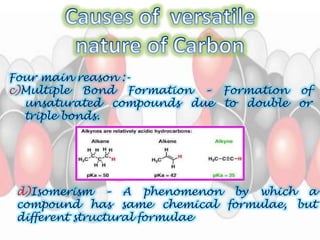
c)Multiple Bond Formation – Formation of 
unsaturated compounds due to double or 
triple bonds. 
d)Isomerism – A phenomenon by which a 
compound has same chemical formulae, but 
different structural formulae
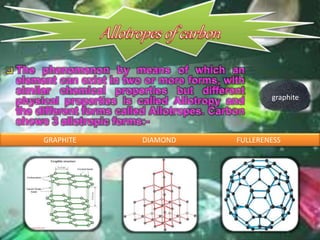
graphite 
GRAPHITE DIAMOND FULLERENESS
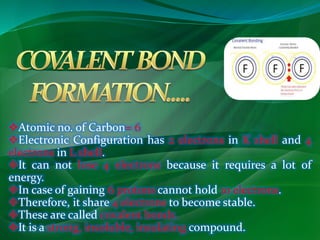
Atomic no. of Carbon= 6 
Electronic Configuration has 2 electrons in K shell and 4 
electrons in L shell. 
It can not lose 4 electrons because it requires a lot of 
energy. 
In case of gaining 6 protons cannot hold 10 electrons. 
Therefore, it share 4 electrons to become stable. 
These are called covalent bonds. 
It is a strong, insoluble, insulating compound.
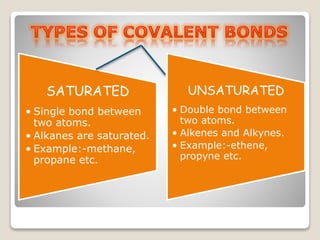
SATURATED 
• Single bond between 
two atoms. 
• Alkanes are saturated. 
• Example:-methane, 
propane etc. 
UNSATURATED 
• Double bond between 
two atoms. 
• Alkenes and Alkynes. 
• Example:-ethene, 
propyne etc.
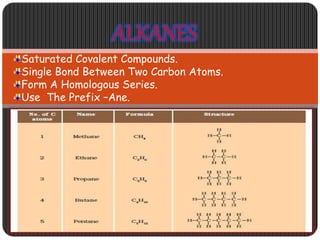
ALKANES 
Saturated Covalent Compounds. 
Single Bond Between Two Carbon Atoms. 
Form A Homologous Series. 
Use The Prefix –Ane.
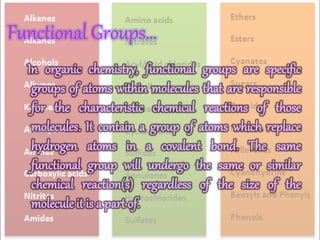
Functional Groups…
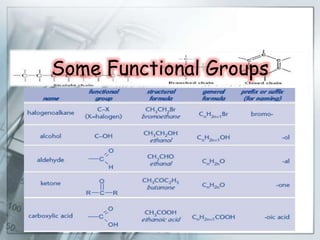
Some Functional Groups
•Series of compound in which 
the same functional group 
substitutes for hydrogen in a 
carbon chain. 
•Two consecutive compounds 
differ in mass by 14u. 
•Two consecutive compounds 
differ by CH2. 
•They have similar chemical 
properties. 
•They have different physical 
properties. 
Homologous Series
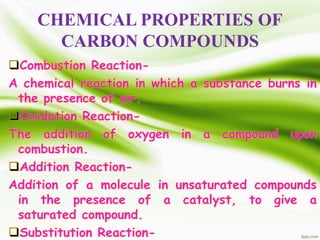
CHEMICAL PROPERTIES OF 
CARBON COMPOUNDS
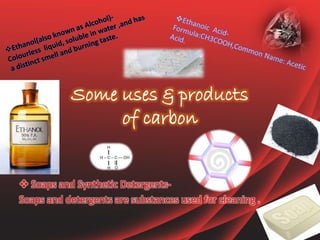
Some uses & products 
of carbon 
 Soaps and Synthetic Detergents- 
Soaps and detergents are substances used for cleaning .
Carbon and its compounds

Carbon and its compounds

  • 1.
  • 2.
    CARBON AND ITSCOMPOUNDS SUBMITTED TO:- MRS. ANITA GROUP NO.-7 LEADER - RIBHA (47) Members – vasu (9) arsh (49) guransh (48) Oisa (18) Vivek (26) Dewak (37)
  • 3.
    What Is Carbon??? graphite CARBON is the chemical element with symbol C and atomic number 6. As a member of group 14 on the periodic table, it is nonmetallic and tetravalent—making four electrons available to form covalent chemical bonds. There are three naturally occurring isotopes, with 12C and 13C being stable, while 14C is radioactive.
  • 4.
    ORIGIN OF CARBONIN NATURE …..  The Earth’s Crust, has only 0.02%carbon in the form of minerals(like carbonates, bicarbonates, coal, and petroleum).  The atmosphere has only 0.03% of Carbon Dioxide.  In spite of its small amount available in nature, carbon is a Versatile Element as it forms the basis for all living organisms and many things which we use.  It is also present in our body in different forms like carbohydrates, fats etc. with 23%.
  • 5.
    Four main reason:- a) Catenation – The self linking property of Carbon with other carbon atoms giving rise to large molecules. b)Tetracovalency– Having 4 electrons in outermost shell.
  • 6.
    Four main reason:- c)Multiple Bond Formation – Formation of unsaturated compounds due to double or triple bonds. d)Isomerism – A phenomenon by which a compound has same chemical formulae, but different structural formulae
  • 7.
  • 8.
    Atomic no. ofCarbon= 6 Electronic Configuration has 2 electrons in K shell and 4 electrons in L shell. It can not lose 4 electrons because it requires a lot of energy. In case of gaining 6 protons cannot hold 10 electrons. Therefore, it share 4 electrons to become stable. These are called covalent bonds. It is a strong, insoluble, insulating compound.
  • 9.
    SATURATED • Singlebond between two atoms. • Alkanes are saturated. • Example:-methane, propane etc. UNSATURATED • Double bond between two atoms. • Alkenes and Alkynes. • Example:-ethene, propyne etc.
  • 10.
    ALKANES Saturated CovalentCompounds. Single Bond Between Two Carbon Atoms. Form A Homologous Series. Use The Prefix –Ane.
  • 11.
  • 12.
  • 13.
    •Series of compoundin which the same functional group substitutes for hydrogen in a carbon chain. •Two consecutive compounds differ in mass by 14u. •Two consecutive compounds differ by CH2. •They have similar chemical properties. •They have different physical properties. Homologous Series
  • 14.
    CHEMICAL PROPERTIES OF CARBON COMPOUNDS
  • 15.
    Some uses &products of carbon  Soaps and Synthetic Detergents- Soaps and detergents are substances used for cleaning .