Enthalpy and Internal
Energy
By Shawn P. Shields, Ph.D.
This work is licensed by Shawn P. Shields-Maxwell under a
Creative Commons Attribution-NonCommercial-ShareAlike
Introduction to Enthalpy
When a reaction occurs under constant
pressure (which is the usual situation),
the energy changes in the reaction are
described using Enthalpy (H) instead of
the Internal Energy (U).
Enthalpy
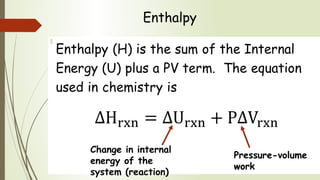
Enthalpy (H) is the sum of the Internal
Energy (U) plus a PV term. The equation
used in chemistry is
  
Change in internal
energy of the
system (reaction)
Pressure-volume
work
Enthalpy
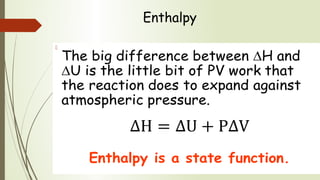
The big difference between ∆H and
∆U is the little bit of PV work that
the reaction does to expand against
atmospheric pressure.
Enthalpy is a state function.
  
Constant P versus Constant V Conditions
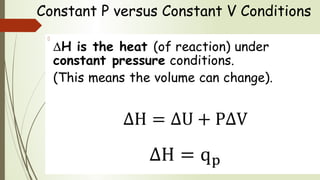
∆H is the heat (of reaction) under
constant pressure conditions.
(This means the volume can change).
  
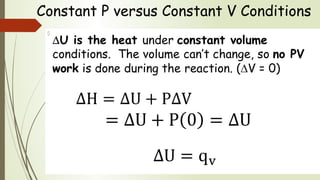
∆U is the heat under constant volume
conditions. The volume can’t change, so no PV
work is done during the reaction. (∆V = 0)
  
Constant P versus Constant V Conditions
Thermochemistry and Enthalpy
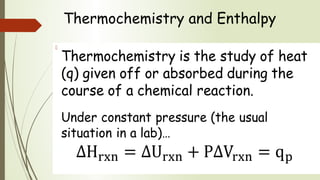
Thermochemistry is the study of heat
(q) given off or absorbed during the
course of a chemical reaction.
Under constant pressure (the usual
situation in a lab)…
  
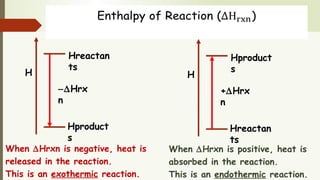
Enthalpy of Reaction () 
When ∆Hrxn is negative, heat is
released in the reaction.
This is an exothermic reaction.
Hreactan
ts
−∆Hrx
n
H
Hproduct
s
Hproduct
s
+∆Hrx
n
H
Hreactan
ts
When ∆Hrxn is positive, heat is
absorbed in the reaction.
This is an endothermic reaction.
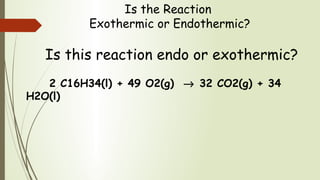
Is the Reaction
Exothermic or Endothermic?
Is this reaction endo or exothermic?
2 C16H34(l) + 49 O2(g) → 32 CO2(g) + 34
H2O(l)
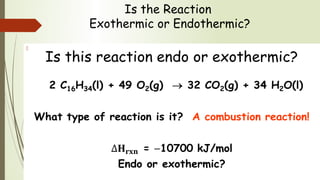
Is the Reaction
Exothermic or Endothermic?
Is this reaction endo or exothermic?
2 C16H34(l) + 49 O2(g) → 32 CO2(g) + 34 H2O(l)
What type of reaction is it? A combustion reaction!
= −10700 kJ/mol
Endo or exothermic?
  
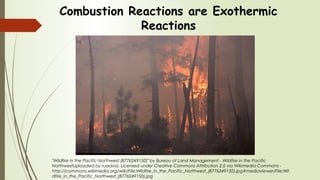
Combustion Reactions are Exothermic
Reactions
"Wildfire in the Pacific Northwest (8776249150)" by Bureau of Land Management - Wildfire in the Pacific
NorthwestUploaded by russavia. Licensed under Creative Commons Attribution 2.0 via Wikimedia Commons -
http://commons.wikimedia.org/wiki/File:Wildfire_in_the_Pacific_Northwest_(8776249150).jpg#mediaviewer/File:Wil
dfire_in_the_Pacific_Northwest_(8776249150).jpg
What You Should Be Able to Do (so
far)
Define Enthalpy and use the equation in
calculations.
Define the heat at constant volume (∆U).
Define the heat at constant pressure (∆H).
Determine whether a reaction is exo- or
endothermic from the sign of ∆H.

Enthalpy and Internal Energy

  • 1.
    Enthalpy and Internal Energy ByShawn P. Shields, Ph.D. This work is licensed by Shawn P. Shields-Maxwell under a Creative Commons Attribution-NonCommercial-ShareAlike
  • 2.
    Introduction to Enthalpy Whena reaction occurs under constant pressure (which is the usual situation), the energy changes in the reaction are described using Enthalpy (H) instead of the Internal Energy (U).
  • 3.
    Enthalpy Enthalpy (H) isthe sum of the Internal Energy (U) plus a PV term. The equation used in chemistry is    Change in internal energy of the system (reaction) Pressure-volume work
  • 4.
    Enthalpy The big differencebetween ∆H and ∆U is the little bit of PV work that the reaction does to expand against atmospheric pressure. Enthalpy is a state function.   
  • 5.
    Constant P versusConstant V Conditions ∆H is the heat (of reaction) under constant pressure conditions. (This means the volume can change).   
  • 6.
    ∆U is theheat under constant volume conditions. The volume can’t change, so no PV work is done during the reaction. (∆V = 0)    Constant P versus Constant V Conditions
  • 7.
    Thermochemistry and Enthalpy Thermochemistryis the study of heat (q) given off or absorbed during the course of a chemical reaction. Under constant pressure (the usual situation in a lab)…   
  • 8.
    Enthalpy of Reaction()  When ∆Hrxn is negative, heat is released in the reaction. This is an exothermic reaction. Hreactan ts −∆Hrx n H Hproduct s Hproduct s +∆Hrx n H Hreactan ts When ∆Hrxn is positive, heat is absorbed in the reaction. This is an endothermic reaction.
  • 9.
    Is the Reaction Exothermicor Endothermic? Is this reaction endo or exothermic? 2 C16H34(l) + 49 O2(g) → 32 CO2(g) + 34 H2O(l)
  • 10.
    Is the Reaction Exothermicor Endothermic? Is this reaction endo or exothermic? 2 C16H34(l) + 49 O2(g) → 32 CO2(g) + 34 H2O(l) What type of reaction is it? A combustion reaction! = −10700 kJ/mol Endo or exothermic?   
  • 11.
    Combustion Reactions areExothermic Reactions "Wildfire in the Pacific Northwest (8776249150)" by Bureau of Land Management - Wildfire in the Pacific NorthwestUploaded by russavia. Licensed under Creative Commons Attribution 2.0 via Wikimedia Commons - http://commons.wikimedia.org/wiki/File:Wildfire_in_the_Pacific_Northwest_(8776249150).jpg#mediaviewer/File:Wil dfire_in_the_Pacific_Northwest_(8776249150).jpg
  • 12.
    What You ShouldBe Able to Do (so far) Define Enthalpy and use the equation in calculations. Define the heat at constant volume (∆U). Define the heat at constant pressure (∆H). Determine whether a reaction is exo- or endothermic from the sign of ∆H.

Editor's Notes

  • #2 <number>
  • #3 <number>
  • #4 <number>
  • #5 <number>
  • #6 <number>
  • #7 <number>
  • #8 <number>
  • #9 <number>
  • #10 <number>
  • #11 <number>
  • #12 <number>
  • #13 <number>