Unit 4
Types of Chemical Reactions
Objectives
• Define the observations that indicate a chemical reaction has occurred.
• Classify chemical reactions according to the 5 main categories.
• Discuss the properties of water that make it the most common solvent.
• Identify whether a substance is a strong, weak, or non electrolyte.
• Calculate the concentration of solutes in units of molarity, molality, mass percent and
parts per million.
• Perform stoichiometric calculations using solution concentration.
• Recognize the common types of reactions in aqueous solution.
• Write chemical equations for the common types of reactions in aqueous solution.
• Determine the oxidation number of atoms in compounds.
• Balance oxidation-reduction reactions.
• Determine the reducing agent, oxidizing agent, which reactant is being oxidized and
which reactant is being reduced in a chemical reaction.
• Predict products of a chemical reaction using solubility rules.
• Write the net ionic equation for a chemical equation.
• Identify a Bronsted-Lowry acid and base.
• Determine the conjugate acid-base pair in a neutralization reaction.
Outline
I. Chemical Reactions
A. Signs of a Chemical Reaction
1. Color Changes
2. Gas Evolving
3. Precipitation
4. Heat Change
5. pH Change
B. Types of Chemical Reactions
1. Synthesis
2. Decomposition
3. Combustion
4. Single Replacement
5. Double Replacement
II. Aqueous Solutions
A. Water: The Most Common Solvent
B. Types of Aqueous Solutions
1. Electrolyte and Nonelectrolyte Solutions
2. Electrolytic Properties
III. Stoichiometry in Aqueous Reactions
A. Solution Concentration
1. Concentration Units
a. Molarity
b. Molality
c. Mole Fraction
d. Percent by Mass
e. Parts Per Million
2. Dilutions of Solutions
3. Using Molarity in Calculations of Solutions
4. Solution Stoichiometry
IV. Reactions in Aqueous Solutions
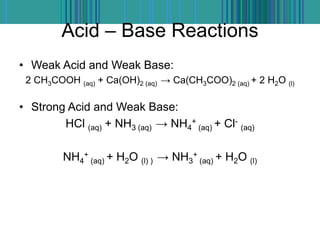
A. Oxidation-Reduction Reactions (Redox)
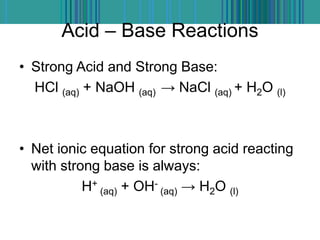
1. Oxidation States
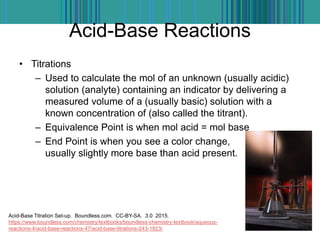
2. Types of Redox Reactions
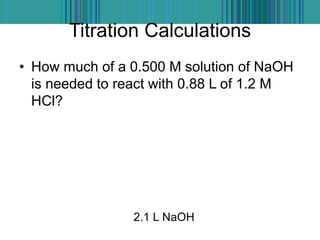
3. Balancing Redox Equations
4. Redox Titrations
B. Precipitation Reactions
1. Solubility
2. Molecular, Complete Ionic and Net Ionic
Equations
C. Acid /Base Reactions
1. Properties of Acids and Bases
2. Bronsted Acids and Bases
3. Acid-Base Titrations
D. Gas Evolution Reactions
Chemical Reactions
• Process where the starting material
(reactants) are chemical composition is
changed (to products).
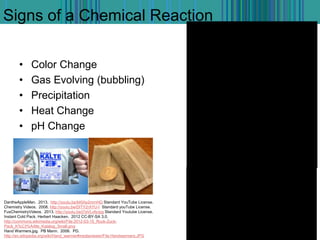
Signs of a Chemical Reaction
• Color Change
• Gas Evolving (bubbling)
• Precipitation
• Heat Change
• pH Change
DantheAppleMan. 2013. http://youtu.be/kKlXe2mrnHQ Standard YouTube License.
Chemistry Videos. 2008. http://youtu.be/DITY2rXYU-I Standard youTube License.
FusChemistryVideos. 2013. http://youtu.be/j7aVLxfsvpg Standard Youtube License.
Instant Cold Pack. Herbert Haacken. 2012 CC-BY-SA 3.0.
http://commons.wikimedia.org/wiki/File:2012-03-15_Ruck-Zuck-
Pack_K%C3%A4lte_Katalog_Small.png
Hand Warmers.jpg. PB Mann. 2006. PD.
http://en.wikipedia.org/wiki/Hand_warmer#mediaviewer/File:Handwarmers.JPG
Types of Chemical Reactions
• 5 main classifications
– Synthesis
– Decomposition
– Combustion
– Single Replacement
– Double Replacement
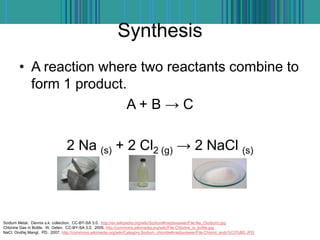
Synthesis
• A reaction where two reactants combine to
form 1 product.
A + B → C
2 Na (s) + 2 Cl2 (g) → 2 NaCl (s)
Sodium Metal. Dennis s.k. collection. CC-BY-SA 3.0. http://en.wikipedia.org/wiki/Sodium#mediaviewer/File:Na_(Sodium).jpg
Chlorine Gas in Bottle. W. Oelen. CC-BY-SA 3.0. 2005. http://commons.wikimedia.org/wiki/File:Chlorine_in_bottle.jpg
NaCl. Ondřej Mangl. PD. 2007. http://commons.wikimedia.org/wiki/Category:Sodium_chloride#mediaviewer/File:Chlorid_sodn%C3%BD.JPG
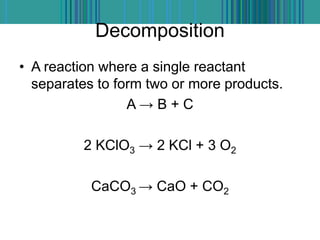
Decomposition
• A reaction where a single reactant
separates to form two or more products.
A → B + C
2 KClO3 → 2 KCl + 3 O2
CaCO3 → CaO + CO2
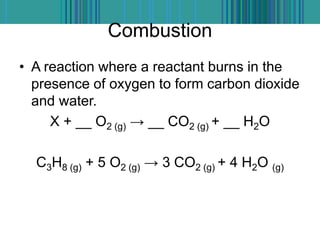
Combustion
• A reaction where a reactant burns in the
presence of oxygen to form carbon dioxide
and water.
X + __ O2 (g) → __ CO2 (g) + __ H2O
C3H8 (g) + 5 O2 (g) → 3 CO2 (g) + 4 H2O (g)
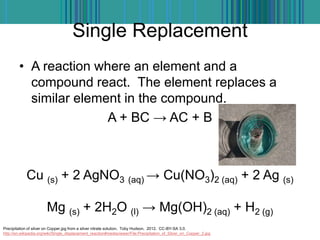
Single Replacement
• A reaction where an element and a
compound react. The element replaces a
similar element in the compound.
A + BC → AC + B
Cu (s) + 2 AgNO3 (aq) → Cu(NO3)2 (aq) + 2 Ag (s)
Mg (s) + 2H2O (l) → Mg(OH)2 (aq) + H2 (g)
Precipitation of silver on Copper.jpg from a silver nitrate solution. Toby Hudson. 2012. CC-BY-SA 3.0.
http://en.wikipedia.org/wiki/Single_displacement_reaction#mediaviewer/File:Precipitation_of_Silver_on_Copper_2.jpg
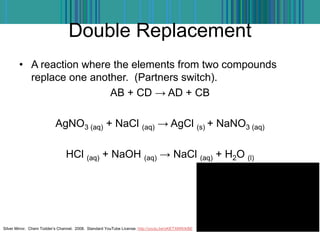
Double Replacement
• A reaction where the elements from two compounds
replace one another. (Partners switch).
AB + CD → AD + CB
AgNO3 (aq) + NaCl (aq) → AgCl (s) + NaNO3 (aq)
HCl (aq) + NaOH (aq) → NaCl (aq) + H2O (l)
Silver Mirror. Chem Todder’s Channel. 2008. Standard YouTube License. http://youtu.be/oKETXMWtkBE
Aqueous Solutions
• Water covers about ~70 percent of the
earth’s surface.
• Many reactions occur in water.
Water as a Solvent
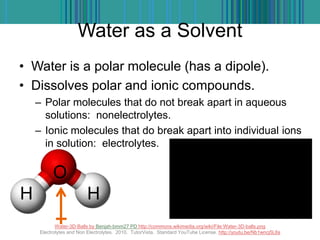
• Water is a polar molecule (has a dipole).
• Dissolves polar and ionic compounds.
– Polar molecules that do not break apart in aqueous
solutions: nonelectrolytes.
– Ionic molecules that do break apart into individual ions
in solution: electrolytes.
Water-3D-Balls by Benjah-bmm27 PD http://commons.wikimedia.org/wiki/File:Water-3D-balls.png
Electrolytes and Non Electrolytes. 2010. TutorVista. Standard YouTube License. http://youtu.be/Nb1wncj5L6s
O
H H
Electrolyte Solutions
• Conduct electricity.
• Have ions in solution.
NaCl (s) → Na+
(aq) + Cl-
(aq)
MgCl2 (s) → Mg2+
(aq) + 2 Cl-
(aq)
Chris Paul Powerade ION4 Commercial. NBANation. 2011.
http://youtu.be/I0DCcYONxRA. Standard YouTube License.
Electrolyte Solutions
• Strong Electrolytes:
– Break apart COMPLETELY in solutions.
– Are always soluble.
– Make solutions that conduct electricity very well.
• Weak Electrolytes:
– A small percentage of molecules break into ions in solution.
– Are slightly soluble.
– Make solutions that conduct electricity a little.
• Nonelectrolytes:
– Covalent molecules and nonsoluble ionic compounds that are not
soluble.
– Make solutions that do not conduct electricity.
*Rely on solubility rules to determine whether a compound is an electrolyte or not.
Angie Sadaf. Electrolytes – Testing for Electrolytic Behavior. 2011. Standard YouTube License.
<iframe width="420" height="315" src="https://www.youtube.com/embed/tZv1l_o74dU" frameborder="0"
allowfullscreen></iframe>
Stoichiometry in Aqueous
Reactions
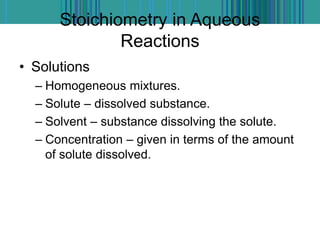
• Solutions
– Homogeneous mixtures.
– Solute – dissolved substance.
– Solvent – substance dissolving the solute.
– Concentration – given in terms of the amount
of solute dissolved.
Solution Concentration
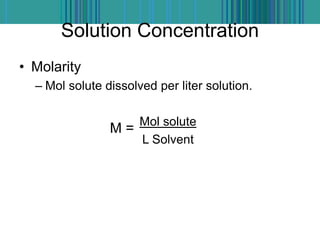
• Molarity
– Mol solute dissolved per liter solution.
Mol solute
L Solvent
M =
Solution Concentration
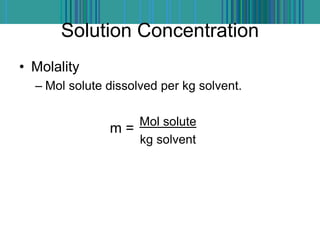
• Molality
– Mol solute dissolved per kg solvent.
Mol solute
kg solvent
m =
Solution Concentration
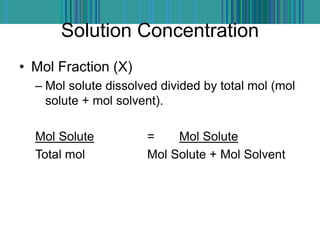
• Mol Fraction (X)
– Mol solute dissolved divided by total mol (mol
solute + mol solvent).
Mol Solute = Mol Solute
Total mol Mol Solute + Mol Solvent
Solution Concentration
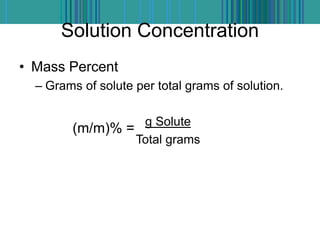
• Mass Percent
– Grams of solute per total grams of solution.
g Solute
Total grams
(m/m)% =
Solution Concentration
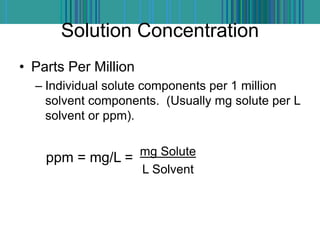
• Parts Per Million
– Individual solute components per 1 million
solvent components. (Usually mg solute per L
solvent or ppm).
mg Solute
L Solvent
ppm = mg/L =
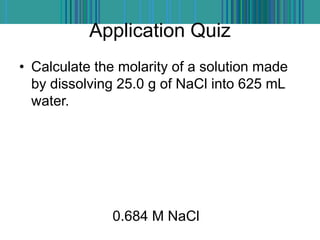
Application Quiz
• Calculate the molarity of a solution made
by dissolving 25.0 g of NaCl into 625 mL
water.
0.684 M NaCl
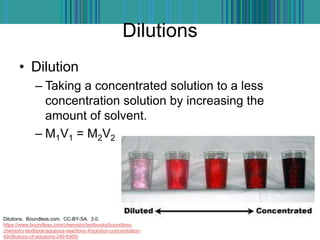
Dilutions
• Dilution
– Taking a concentrated solution to a less
concentration solution by increasing the
amount of solvent.
– M1V1 = M2V2
Dilutions. Boundless.com. CC-BY-SA. 3.0.
https://www.boundless.com/chemistry/textbooks/boundless-
chemistry-textbook/aqueous-reactions-4/solution-concentration-
49/dilutions-of-solutions-249-6900/
Dilutions
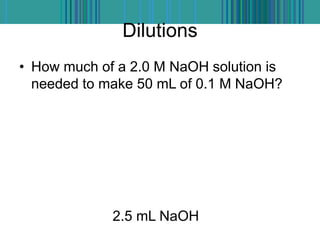
• How much of a 2.0 M NaOH solution is
needed to make 50 mL of 0.1 M NaOH?
2.5 mL NaOH
Dilutions
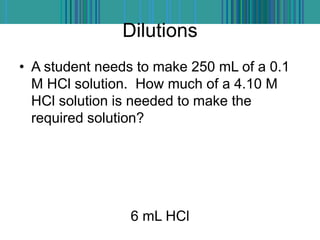
• A student needs to make 250 mL of a 0.1
M HCl solution. How much of a 4.10 M
HCl solution is needed to make the
required solution?
6 mL HCl
Solution Stoichiometry
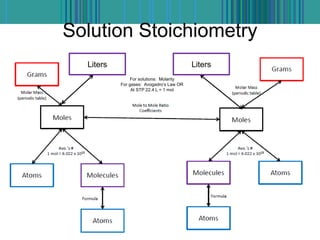
Liters
For solutions: Molarity
For gases: Avogadro’s Law OR
At STP 22.4 L = 1 mol
Liters
Solution Stoichiometry
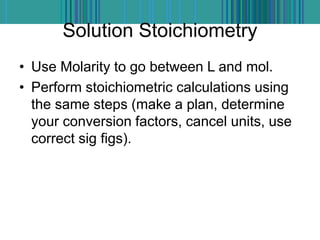
• Use Molarity to go between L and mol.
• Perform stoichiometric calculations using
the same steps (make a plan, determine
your conversion factors, cancel units, use
correct sig figs).
Solution Stoichiometry
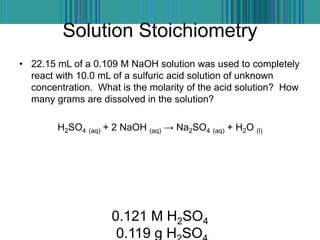
• 22.15 mL of a 0.109 M NaOH solution was used to completely
react with 10.0 mL of a sulfuric acid solution of unknown
concentration. What is the molarity of the acid solution? How
many grams are dissolved in the solution?
H2SO4 (aq) + 2 NaOH (aq) → Na2SO4 (aq) + H2O (l)
0.121 M H2SO4
0.119 g H SO
Reactions in Aqueous Solutions
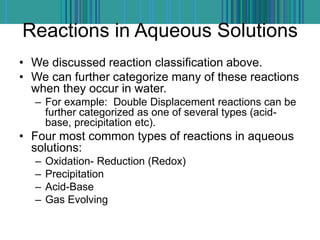
• We discussed reaction classification above.
• We can further categorize many of these reactions
when they occur in water.
– For example: Double Displacement reactions can be
further categorized as one of several types (acid-
base, precipitation etc).
• Four most common types of reactions in aqueous
solutions:
– Oxidation- Reduction (Redox)
– Precipitation
– Acid-Base
– Gas Evolving
Oxidation – Reduction Reactions
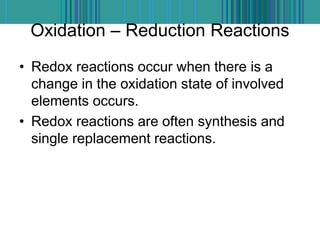
• Redox reactions occur when there is a
change in the oxidation state of involved
elements occurs.
• Redox reactions are often synthesis and
single replacement reactions.
Oxidation – Reduction Reactions
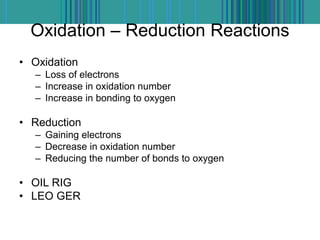
• Oxidation
– Loss of electrons
– Increase in oxidation number
– Increase in bonding to oxygen
• Reduction
– Gaining electrons
– Decrease in oxidation number
– Reducing the number of bonds to oxygen
• OIL RIG
• LEO GER
Oxidation – Reduction Reactions
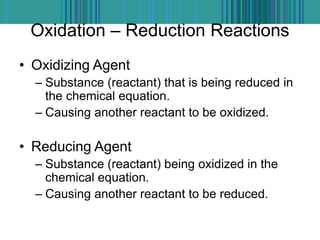
• Oxidizing Agent
– Substance (reactant) that is being reduced in
the chemical equation.
– Causing another reactant to be oxidized.
• Reducing Agent
– Substance (reactant) being oxidized in the
chemical equation.
– Causing another reactant to be reduced.
Oxidation Numbers
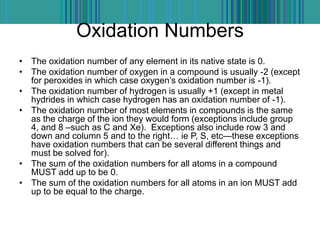
• The oxidation number of any element in its native state is 0.
• The oxidation number of oxygen in a compound is usually -2 (except
for peroxides in which case oxygen’s oxidation number is -1).
• The oxidation number of hydrogen is usually +1 (except in metal
hydrides in which case hydrogen has an oxidation number of -1).
• The oxidation number of most elements in compounds is the same
as the charge of the ion they would form (exceptions include group
4, and 8 –such as C and Xe). Exceptions also include row 3 and
down and column 5 and to the right… ie P, S, etc—these exceptions
have oxidation numbers that can be several different things and
must be solved for).
• The sum of the oxidation numbers for all atoms in a compound
MUST add up to be 0.
• The sum of the oxidation numbers for all atoms in an ion MUST add
up to be equal to the charge.
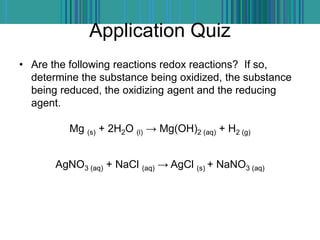
Application Quiz
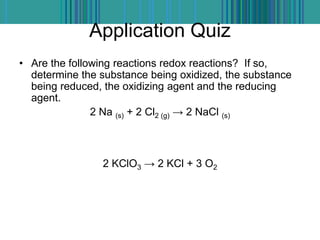
• Are the following reactions redox reactions? If so,
determine the substance being oxidized, the substance
being reduced, the oxidizing agent and the reducing
agent.
2 Na (s) + 2 Cl2 (g) → 2 NaCl (s)
2 KClO3 → 2 KCl + 3 O2
Application Quiz
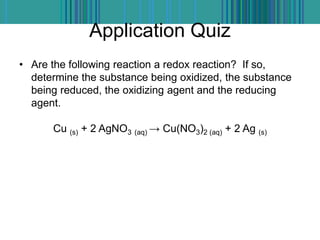
• Are the following reaction a redox reaction? If so,
determine the substance being oxidized, the substance
being reduced, the oxidizing agent and the reducing
agent.
Cu (s) + 2 AgNO3 (aq) → Cu(NO3)2 (aq) + 2 Ag (s)
Application Quiz
• Are the following reactions redox reactions? If so,
determine the substance being oxidized, the substance
being reduced, the oxidizing agent and the reducing
agent.
Mg (s) + 2H2O (l) → Mg(OH)2 (aq) + H2 (g)
AgNO3 (aq) + NaCl (aq) → AgCl (s) + NaNO3 (aq)
Balancing Redox Reactions
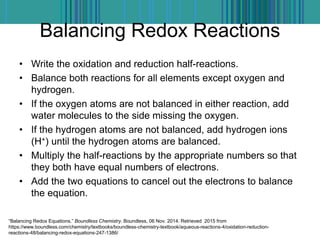
• Write the oxidation and reduction half-reactions.
• Balance both reactions for all elements except oxygen and
hydrogen.
• If the oxygen atoms are not balanced in either reaction, add
water molecules to the side missing the oxygen.
• If the hydrogen atoms are not balanced, add hydrogen ions
(H+) until the hydrogen atoms are balanced.
• Multiply the half-reactions by the appropriate numbers so that
they both have equal numbers of electrons.
• Add the two equations to cancel out the electrons to balance
the equation.
“Balancing Redox Equations.” Boundless Chemistry. Boundless, 06 Nov. 2014. Retrieved 2015 from
https://www.boundless.com/chemistry/textbooks/boundless-chemistry-textbook/aqueous-reactions-4/oxidation-reduction-
reactions-48/balancing-redox-equations-247-1386/
Application Quiz
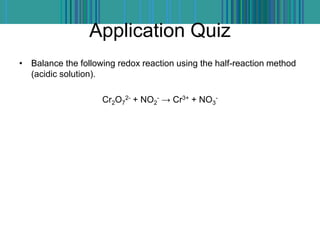
• Balance the following redox reaction using the half-reaction method
(acidic solution).
Cr2O7
2- + NO2
- → Cr3+ + NO3
-
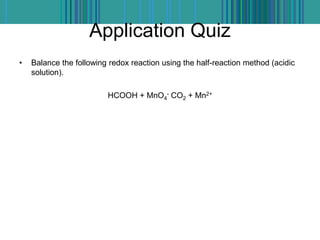
Application Quiz
• Balance the following redox reaction using the half-reaction method (acidic
solution).
HCOOH + MnO4
- CO2 + Mn2+
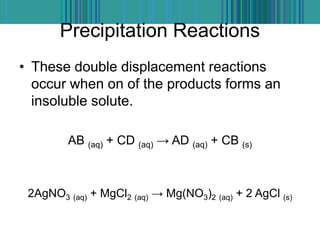
Precipitation Reactions
• These double displacement reactions
occur when on of the products forms an
insoluble solute.
AB (aq) + CD (aq) → AD (aq) + CB (s)
2AgNO3 (aq) + MgCl2 (aq) → Mg(NO3)2 (aq) + 2 AgCl (s)
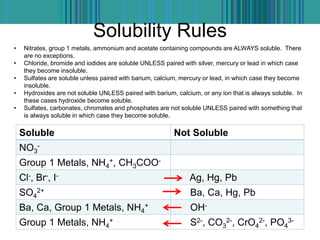
Solubility Rules
Soluble Not Soluble
NO3
-
Group 1 Metals, NH4
+, CH3COO-
Cl-, Br-, I- Ag, Hg, Pb
SO4
2+ Ba, Ca, Hg, Pb
Ba, Ca, Group 1 Metals, NH4
+ OH-
Group 1 Metals, NH4
+ S2-, CO3
2-, CrO4
2-, PO4
3-
• Nitrates, group 1 metals, ammonium and acetate containing compounds are ALWAYS soluble. There
are no exceptions.
• Chloride, bromide and iodides are soluble UNLESS paired with silver, mercury or lead in which case
they become insoluble.
• Sulfates are soluble unless paired with barium, calcium, mercury or lead, in which case they become
insoluble.
• Hydroxides are not soluble UNLESS paired with barium, calcium, or any ion that is always soluble. In
these cases hydroxide become soluble.
• Sulfates, carbonates, chromates and phosphates are not soluble UNLESS paired with something that
is always soluble in which case they become soluble.
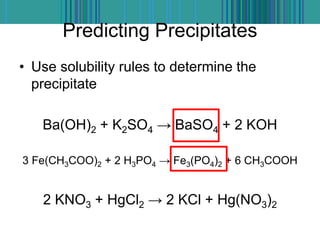
Predicting Precipitates
• Use solubility rules to determine the
precipitate
Ba(OH)2 + K2SO4 → BaSO4 + 2 KOH
3 Fe(CH3COO)2 + 2 H3PO4 → Fe3(PO4)2 + 6 CH3COOH
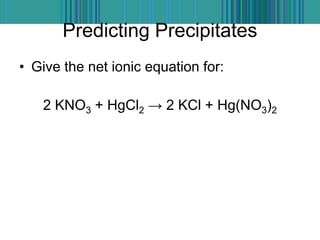
2 KNO3 + HgCl2 → 2 KCl + Hg(NO3)2
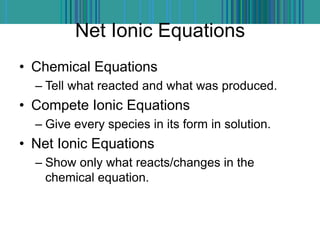
Net Ionic Equations
• Chemical Equations
– Tell what reacted and what was produced.
• Compete Ionic Equations
– Give every species in its form in solution.
• Net Ionic Equations
– Show only what reacts/changes in the
chemical equation.
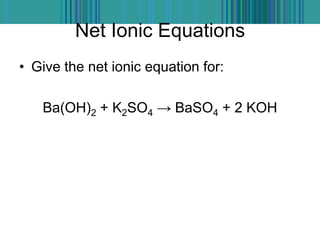
Net Ionic Equations
• Give the net ionic equation for:
Ba(OH)2 + K2SO4 → BaSO4 + 2 KOH
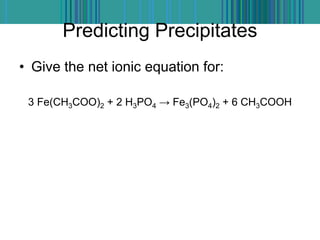
Predicting Precipitates
• Give the net ionic equation for:
3 Fe(CH3COO)2 + 2 H3PO4 → Fe3(PO4)2 + 6 CH3COOH
Predicting Precipitates
• Give the net ionic equation for:
2 KNO3 + HgCl2 → 2 KCl + Hg(NO3)2
Acid-Base Reactions
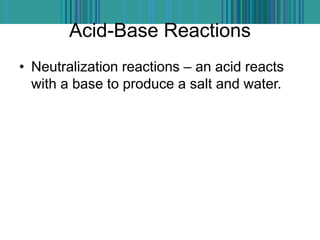
• Neutralization reactions – an acid reacts
with a base to produce a salt and water.
Acid – Base Properties
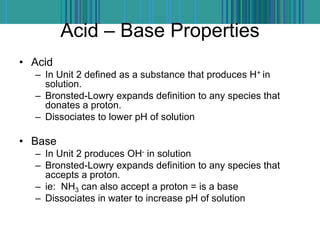
• Acid
– In Unit 2 defined as a substance that produces H+ in
solution.
– Bronsted-Lowry expands definition to any species that
donates a proton.
– Dissociates to lower pH of solution
• Base
– In Unit 2 produces OH- in solution
– Bronsted-Lowry expands definition to any species that
accepts a proton.
– ie: NH3 can also accept a proton = is a base
– Dissociates in water to increase pH of solution
pH Scale
• A measure of the acidity of a solution
• Logarithmic representation
• pH = -log[H+]
• pH <7 = acidic
• pH >7 = basic (alkaline)
pH scale. Boundless.com Connexions.
http://cnx.org/content/m44392/latest/Figure_02_02_07.jpg
https://www.boundless.com/physiology/textbooks/boundless-anatomy-and-physiology-
textbook/fluids-and-acid-base-balance-26/acid-base-balance-248/acids-and-bases-
change-the-hydrogen-ion-concentration-1216-11420/images/fig-ch02_02_07/ CC BY 3.0.
Acid – Base Strength
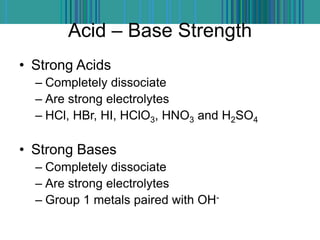
• Strong Acids
– Completely dissociate
– Are strong electrolytes
– HCl, HBr, HI, HClO3, HNO3 and H2SO4
• Strong Bases
– Completely dissociate
– Are strong electrolytes
– Group 1 metals paired with OH-
Acid – Base Reactions
• Weak Acid and Weak Base:
2 CH3COOH (aq) + Ca(OH)2 (aq) → Ca(CH3COO)2 (aq) + 2 H2O (l)
• Strong Acid and Weak Base:
HCl (aq) + NH3 (aq) → NH4
+
(aq) + Cl-
(aq)
NH4
+
(aq) + H2O (l) ) → NH3
+
(aq) + H2O (l)
Acid – Base Reactions
• Strong Acid and Strong Base:
HCl (aq) + NaOH (aq) → NaCl (aq) + H2O (l)
• Net ionic equation for strong acid reacting
with strong base is always:
H+
(aq) + OH-
(aq) → H2O (l)
Acid-Base Reactions
• Titrations
– Used to calculate the mol of an unknown (usually acidic)
solution (analyte) containing an indicator by delivering a
measured volume of a (usually basic) solution with a
known concentration of (also called the titrant).
– Equivalence Point is when mol acid = mol base
– End Point is when you see a color change,
usually slightly more base than acid present.
Acid-Base Titration Set-up. Boundless.com. CC-BY-SA. 3.0 2015.
https://www.boundless.com/chemistry/textbooks/boundless-chemistry-textbook/aqueous-
reactions-4/acid-base-reactions-47/acid-base-titrations-243-1823/
Titration Calculations
• How much of a 0.500 M solution of NaOH
is needed to react with 0.88 L of 1.2 M
HCl?
2.1 L NaOH
Titration Calculations
• How much of a 0.175 M solution of sodium
hydroxide is needed to completely react with
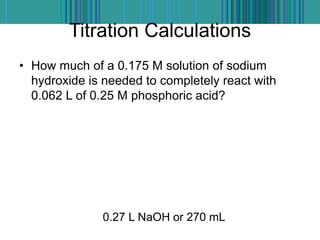
0.062 L of 0.25 M phosphoric acid?
0.27 L NaOH or 270 mL
Gas Evolving Reactions
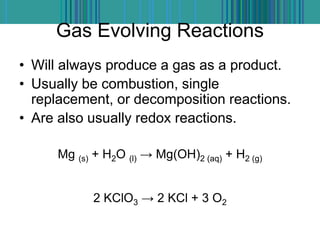
• Will always produce a gas as a product.
• Usually be combustion, single
replacement, or decomposition reactions.
• Are also usually redox reactions.
Mg (s) + H2O (l) → Mg(OH)2 (aq) + H2 (g)
2 KClO3 → 2 KCl + 3 O2
Summary
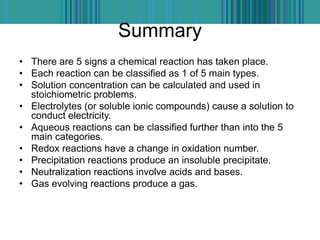
• There are 5 signs a chemical reaction has taken place.
• Each reaction can be classified as 1 of 5 main types.
• Solution concentration can be calculated and used in
stoichiometric problems.
• Electrolytes (or soluble ionic compounds) cause a solution to
conduct electricity.
• Aqueous reactions can be classified further than into the 5
main categories.
• Redox reactions have a change in oxidation number.
• Precipitation reactions produce an insoluble precipitate.
• Neutralization reactions involve acids and bases.
• Gas evolving reactions produce a gas.

Types of Chemical Reactions

  • 1.
    Unit 4 Types ofChemical Reactions
  • 2.
    Objectives • Define theobservations that indicate a chemical reaction has occurred. • Classify chemical reactions according to the 5 main categories. • Discuss the properties of water that make it the most common solvent. • Identify whether a substance is a strong, weak, or non electrolyte. • Calculate the concentration of solutes in units of molarity, molality, mass percent and parts per million. • Perform stoichiometric calculations using solution concentration. • Recognize the common types of reactions in aqueous solution. • Write chemical equations for the common types of reactions in aqueous solution. • Determine the oxidation number of atoms in compounds. • Balance oxidation-reduction reactions. • Determine the reducing agent, oxidizing agent, which reactant is being oxidized and which reactant is being reduced in a chemical reaction. • Predict products of a chemical reaction using solubility rules. • Write the net ionic equation for a chemical equation. • Identify a Bronsted-Lowry acid and base. • Determine the conjugate acid-base pair in a neutralization reaction.
  • 3.
    Outline I. Chemical Reactions A.Signs of a Chemical Reaction 1. Color Changes 2. Gas Evolving 3. Precipitation 4. Heat Change 5. pH Change B. Types of Chemical Reactions 1. Synthesis 2. Decomposition 3. Combustion 4. Single Replacement 5. Double Replacement II. Aqueous Solutions A. Water: The Most Common Solvent B. Types of Aqueous Solutions 1. Electrolyte and Nonelectrolyte Solutions 2. Electrolytic Properties III. Stoichiometry in Aqueous Reactions A. Solution Concentration 1. Concentration Units a. Molarity b. Molality c. Mole Fraction d. Percent by Mass e. Parts Per Million 2. Dilutions of Solutions 3. Using Molarity in Calculations of Solutions 4. Solution Stoichiometry IV. Reactions in Aqueous Solutions A. Oxidation-Reduction Reactions (Redox) 1. Oxidation States 2. Types of Redox Reactions 3. Balancing Redox Equations 4. Redox Titrations B. Precipitation Reactions 1. Solubility 2. Molecular, Complete Ionic and Net Ionic Equations C. Acid /Base Reactions 1. Properties of Acids and Bases 2. Bronsted Acids and Bases 3. Acid-Base Titrations D. Gas Evolution Reactions
  • 4.
    Chemical Reactions • Processwhere the starting material (reactants) are chemical composition is changed (to products).
  • 5.
    Signs of aChemical Reaction • Color Change • Gas Evolving (bubbling) • Precipitation • Heat Change • pH Change DantheAppleMan. 2013. http://youtu.be/kKlXe2mrnHQ Standard YouTube License. Chemistry Videos. 2008. http://youtu.be/DITY2rXYU-I Standard youTube License. FusChemistryVideos. 2013. http://youtu.be/j7aVLxfsvpg Standard Youtube License. Instant Cold Pack. Herbert Haacken. 2012 CC-BY-SA 3.0. http://commons.wikimedia.org/wiki/File:2012-03-15_Ruck-Zuck- Pack_K%C3%A4lte_Katalog_Small.png Hand Warmers.jpg. PB Mann. 2006. PD. http://en.wikipedia.org/wiki/Hand_warmer#mediaviewer/File:Handwarmers.JPG
  • 6.
    Types of ChemicalReactions • 5 main classifications – Synthesis – Decomposition – Combustion – Single Replacement – Double Replacement
  • 7.
    Synthesis • A reactionwhere two reactants combine to form 1 product. A + B → C 2 Na (s) + 2 Cl2 (g) → 2 NaCl (s) Sodium Metal. Dennis s.k. collection. CC-BY-SA 3.0. http://en.wikipedia.org/wiki/Sodium#mediaviewer/File:Na_(Sodium).jpg Chlorine Gas in Bottle. W. Oelen. CC-BY-SA 3.0. 2005. http://commons.wikimedia.org/wiki/File:Chlorine_in_bottle.jpg NaCl. Ondřej Mangl. PD. 2007. http://commons.wikimedia.org/wiki/Category:Sodium_chloride#mediaviewer/File:Chlorid_sodn%C3%BD.JPG
  • 8.
    Decomposition • A reactionwhere a single reactant separates to form two or more products. A → B + C 2 KClO3 → 2 KCl + 3 O2 CaCO3 → CaO + CO2
  • 9.
    Combustion • A reactionwhere a reactant burns in the presence of oxygen to form carbon dioxide and water. X + __ O2 (g) → __ CO2 (g) + __ H2O C3H8 (g) + 5 O2 (g) → 3 CO2 (g) + 4 H2O (g)
  • 10.
    Single Replacement • Areaction where an element and a compound react. The element replaces a similar element in the compound. A + BC → AC + B Cu (s) + 2 AgNO3 (aq) → Cu(NO3)2 (aq) + 2 Ag (s) Mg (s) + 2H2O (l) → Mg(OH)2 (aq) + H2 (g) Precipitation of silver on Copper.jpg from a silver nitrate solution. Toby Hudson. 2012. CC-BY-SA 3.0. http://en.wikipedia.org/wiki/Single_displacement_reaction#mediaviewer/File:Precipitation_of_Silver_on_Copper_2.jpg
  • 11.
    Double Replacement • Areaction where the elements from two compounds replace one another. (Partners switch). AB + CD → AD + CB AgNO3 (aq) + NaCl (aq) → AgCl (s) + NaNO3 (aq) HCl (aq) + NaOH (aq) → NaCl (aq) + H2O (l) Silver Mirror. Chem Todder’s Channel. 2008. Standard YouTube License. http://youtu.be/oKETXMWtkBE
  • 12.
    Aqueous Solutions • Watercovers about ~70 percent of the earth’s surface. • Many reactions occur in water.
  • 13.
    Water as aSolvent • Water is a polar molecule (has a dipole). • Dissolves polar and ionic compounds. – Polar molecules that do not break apart in aqueous solutions: nonelectrolytes. – Ionic molecules that do break apart into individual ions in solution: electrolytes. Water-3D-Balls by Benjah-bmm27 PD http://commons.wikimedia.org/wiki/File:Water-3D-balls.png Electrolytes and Non Electrolytes. 2010. TutorVista. Standard YouTube License. http://youtu.be/Nb1wncj5L6s O H H
  • 14.
    Electrolyte Solutions • Conductelectricity. • Have ions in solution. NaCl (s) → Na+ (aq) + Cl- (aq) MgCl2 (s) → Mg2+ (aq) + 2 Cl- (aq) Chris Paul Powerade ION4 Commercial. NBANation. 2011. http://youtu.be/I0DCcYONxRA. Standard YouTube License.
  • 15.
    Electrolyte Solutions • StrongElectrolytes: – Break apart COMPLETELY in solutions. – Are always soluble. – Make solutions that conduct electricity very well. • Weak Electrolytes: – A small percentage of molecules break into ions in solution. – Are slightly soluble. – Make solutions that conduct electricity a little. • Nonelectrolytes: – Covalent molecules and nonsoluble ionic compounds that are not soluble. – Make solutions that do not conduct electricity. *Rely on solubility rules to determine whether a compound is an electrolyte or not. Angie Sadaf. Electrolytes – Testing for Electrolytic Behavior. 2011. Standard YouTube License. <iframe width="420" height="315" src="https://www.youtube.com/embed/tZv1l_o74dU" frameborder="0" allowfullscreen></iframe>
  • 16.
    Stoichiometry in Aqueous Reactions •Solutions – Homogeneous mixtures. – Solute – dissolved substance. – Solvent – substance dissolving the solute. – Concentration – given in terms of the amount of solute dissolved.
  • 17.
    Solution Concentration • Molarity –Mol solute dissolved per liter solution. Mol solute L Solvent M =
  • 18.
    Solution Concentration • Molality –Mol solute dissolved per kg solvent. Mol solute kg solvent m =
  • 19.
    Solution Concentration • MolFraction (X) – Mol solute dissolved divided by total mol (mol solute + mol solvent). Mol Solute = Mol Solute Total mol Mol Solute + Mol Solvent
  • 20.
    Solution Concentration • MassPercent – Grams of solute per total grams of solution. g Solute Total grams (m/m)% =
  • 21.
    Solution Concentration • PartsPer Million – Individual solute components per 1 million solvent components. (Usually mg solute per L solvent or ppm). mg Solute L Solvent ppm = mg/L =
  • 22.
    Application Quiz • Calculatethe molarity of a solution made by dissolving 25.0 g of NaCl into 625 mL water. 0.684 M NaCl
  • 23.
    Dilutions • Dilution – Takinga concentrated solution to a less concentration solution by increasing the amount of solvent. – M1V1 = M2V2 Dilutions. Boundless.com. CC-BY-SA. 3.0. https://www.boundless.com/chemistry/textbooks/boundless- chemistry-textbook/aqueous-reactions-4/solution-concentration- 49/dilutions-of-solutions-249-6900/
  • 24.
    Dilutions • How muchof a 2.0 M NaOH solution is needed to make 50 mL of 0.1 M NaOH? 2.5 mL NaOH
  • 25.
    Dilutions • A studentneeds to make 250 mL of a 0.1 M HCl solution. How much of a 4.10 M HCl solution is needed to make the required solution? 6 mL HCl
  • 26.
    Solution Stoichiometry Liters For solutions:Molarity For gases: Avogadro’s Law OR At STP 22.4 L = 1 mol Liters
  • 27.
    Solution Stoichiometry • UseMolarity to go between L and mol. • Perform stoichiometric calculations using the same steps (make a plan, determine your conversion factors, cancel units, use correct sig figs).
  • 28.
    Solution Stoichiometry • 22.15mL of a 0.109 M NaOH solution was used to completely react with 10.0 mL of a sulfuric acid solution of unknown concentration. What is the molarity of the acid solution? How many grams are dissolved in the solution? H2SO4 (aq) + 2 NaOH (aq) → Na2SO4 (aq) + H2O (l) 0.121 M H2SO4 0.119 g H SO
  • 29.
    Reactions in AqueousSolutions • We discussed reaction classification above. • We can further categorize many of these reactions when they occur in water. – For example: Double Displacement reactions can be further categorized as one of several types (acid- base, precipitation etc). • Four most common types of reactions in aqueous solutions: – Oxidation- Reduction (Redox) – Precipitation – Acid-Base – Gas Evolving
  • 30.
    Oxidation – ReductionReactions • Redox reactions occur when there is a change in the oxidation state of involved elements occurs. • Redox reactions are often synthesis and single replacement reactions.
  • 31.
    Oxidation – ReductionReactions • Oxidation – Loss of electrons – Increase in oxidation number – Increase in bonding to oxygen • Reduction – Gaining electrons – Decrease in oxidation number – Reducing the number of bonds to oxygen • OIL RIG • LEO GER
  • 32.
    Oxidation – ReductionReactions • Oxidizing Agent – Substance (reactant) that is being reduced in the chemical equation. – Causing another reactant to be oxidized. • Reducing Agent – Substance (reactant) being oxidized in the chemical equation. – Causing another reactant to be reduced.
  • 33.
    Oxidation Numbers • Theoxidation number of any element in its native state is 0. • The oxidation number of oxygen in a compound is usually -2 (except for peroxides in which case oxygen’s oxidation number is -1). • The oxidation number of hydrogen is usually +1 (except in metal hydrides in which case hydrogen has an oxidation number of -1). • The oxidation number of most elements in compounds is the same as the charge of the ion they would form (exceptions include group 4, and 8 –such as C and Xe). Exceptions also include row 3 and down and column 5 and to the right… ie P, S, etc—these exceptions have oxidation numbers that can be several different things and must be solved for). • The sum of the oxidation numbers for all atoms in a compound MUST add up to be 0. • The sum of the oxidation numbers for all atoms in an ion MUST add up to be equal to the charge.
  • 34.
    Application Quiz • Arethe following reactions redox reactions? If so, determine the substance being oxidized, the substance being reduced, the oxidizing agent and the reducing agent. 2 Na (s) + 2 Cl2 (g) → 2 NaCl (s) 2 KClO3 → 2 KCl + 3 O2
  • 35.
    Application Quiz • Arethe following reaction a redox reaction? If so, determine the substance being oxidized, the substance being reduced, the oxidizing agent and the reducing agent. Cu (s) + 2 AgNO3 (aq) → Cu(NO3)2 (aq) + 2 Ag (s)
  • 36.
    Application Quiz • Arethe following reactions redox reactions? If so, determine the substance being oxidized, the substance being reduced, the oxidizing agent and the reducing agent. Mg (s) + 2H2O (l) → Mg(OH)2 (aq) + H2 (g) AgNO3 (aq) + NaCl (aq) → AgCl (s) + NaNO3 (aq)
  • 37.
    Balancing Redox Reactions •Write the oxidation and reduction half-reactions. • Balance both reactions for all elements except oxygen and hydrogen. • If the oxygen atoms are not balanced in either reaction, add water molecules to the side missing the oxygen. • If the hydrogen atoms are not balanced, add hydrogen ions (H+) until the hydrogen atoms are balanced. • Multiply the half-reactions by the appropriate numbers so that they both have equal numbers of electrons. • Add the two equations to cancel out the electrons to balance the equation. “Balancing Redox Equations.” Boundless Chemistry. Boundless, 06 Nov. 2014. Retrieved 2015 from https://www.boundless.com/chemistry/textbooks/boundless-chemistry-textbook/aqueous-reactions-4/oxidation-reduction- reactions-48/balancing-redox-equations-247-1386/
  • 38.
    Application Quiz • Balancethe following redox reaction using the half-reaction method (acidic solution). Cr2O7 2- + NO2 - → Cr3+ + NO3 -
  • 39.
    Application Quiz • Balancethe following redox reaction using the half-reaction method (acidic solution). HCOOH + MnO4 - CO2 + Mn2+
  • 40.
    Precipitation Reactions • Thesedouble displacement reactions occur when on of the products forms an insoluble solute. AB (aq) + CD (aq) → AD (aq) + CB (s) 2AgNO3 (aq) + MgCl2 (aq) → Mg(NO3)2 (aq) + 2 AgCl (s)
  • 41.
    Solubility Rules Soluble NotSoluble NO3 - Group 1 Metals, NH4 +, CH3COO- Cl-, Br-, I- Ag, Hg, Pb SO4 2+ Ba, Ca, Hg, Pb Ba, Ca, Group 1 Metals, NH4 + OH- Group 1 Metals, NH4 + S2-, CO3 2-, CrO4 2-, PO4 3- • Nitrates, group 1 metals, ammonium and acetate containing compounds are ALWAYS soluble. There are no exceptions. • Chloride, bromide and iodides are soluble UNLESS paired with silver, mercury or lead in which case they become insoluble. • Sulfates are soluble unless paired with barium, calcium, mercury or lead, in which case they become insoluble. • Hydroxides are not soluble UNLESS paired with barium, calcium, or any ion that is always soluble. In these cases hydroxide become soluble. • Sulfates, carbonates, chromates and phosphates are not soluble UNLESS paired with something that is always soluble in which case they become soluble.
  • 42.
    Predicting Precipitates • Usesolubility rules to determine the precipitate Ba(OH)2 + K2SO4 → BaSO4 + 2 KOH 3 Fe(CH3COO)2 + 2 H3PO4 → Fe3(PO4)2 + 6 CH3COOH 2 KNO3 + HgCl2 → 2 KCl + Hg(NO3)2
  • 43.
    Net Ionic Equations •Chemical Equations – Tell what reacted and what was produced. • Compete Ionic Equations – Give every species in its form in solution. • Net Ionic Equations – Show only what reacts/changes in the chemical equation.
  • 44.
    Net Ionic Equations •Give the net ionic equation for: Ba(OH)2 + K2SO4 → BaSO4 + 2 KOH
  • 45.
    Predicting Precipitates • Givethe net ionic equation for: 3 Fe(CH3COO)2 + 2 H3PO4 → Fe3(PO4)2 + 6 CH3COOH
  • 46.
    Predicting Precipitates • Givethe net ionic equation for: 2 KNO3 + HgCl2 → 2 KCl + Hg(NO3)2
  • 47.
    Acid-Base Reactions • Neutralizationreactions – an acid reacts with a base to produce a salt and water.
  • 48.
    Acid – BaseProperties • Acid – In Unit 2 defined as a substance that produces H+ in solution. – Bronsted-Lowry expands definition to any species that donates a proton. – Dissociates to lower pH of solution • Base – In Unit 2 produces OH- in solution – Bronsted-Lowry expands definition to any species that accepts a proton. – ie: NH3 can also accept a proton = is a base – Dissociates in water to increase pH of solution
  • 49.
    pH Scale • Ameasure of the acidity of a solution • Logarithmic representation • pH = -log[H+] • pH <7 = acidic • pH >7 = basic (alkaline) pH scale. Boundless.com Connexions. http://cnx.org/content/m44392/latest/Figure_02_02_07.jpg https://www.boundless.com/physiology/textbooks/boundless-anatomy-and-physiology- textbook/fluids-and-acid-base-balance-26/acid-base-balance-248/acids-and-bases- change-the-hydrogen-ion-concentration-1216-11420/images/fig-ch02_02_07/ CC BY 3.0.
  • 50.
    Acid – BaseStrength • Strong Acids – Completely dissociate – Are strong electrolytes – HCl, HBr, HI, HClO3, HNO3 and H2SO4 • Strong Bases – Completely dissociate – Are strong electrolytes – Group 1 metals paired with OH-
  • 51.
    Acid – BaseReactions • Weak Acid and Weak Base: 2 CH3COOH (aq) + Ca(OH)2 (aq) → Ca(CH3COO)2 (aq) + 2 H2O (l) • Strong Acid and Weak Base: HCl (aq) + NH3 (aq) → NH4 + (aq) + Cl- (aq) NH4 + (aq) + H2O (l) ) → NH3 + (aq) + H2O (l)
  • 52.
    Acid – BaseReactions • Strong Acid and Strong Base: HCl (aq) + NaOH (aq) → NaCl (aq) + H2O (l) • Net ionic equation for strong acid reacting with strong base is always: H+ (aq) + OH- (aq) → H2O (l)
  • 53.
    Acid-Base Reactions • Titrations –Used to calculate the mol of an unknown (usually acidic) solution (analyte) containing an indicator by delivering a measured volume of a (usually basic) solution with a known concentration of (also called the titrant). – Equivalence Point is when mol acid = mol base – End Point is when you see a color change, usually slightly more base than acid present. Acid-Base Titration Set-up. Boundless.com. CC-BY-SA. 3.0 2015. https://www.boundless.com/chemistry/textbooks/boundless-chemistry-textbook/aqueous- reactions-4/acid-base-reactions-47/acid-base-titrations-243-1823/
  • 54.
    Titration Calculations • Howmuch of a 0.500 M solution of NaOH is needed to react with 0.88 L of 1.2 M HCl? 2.1 L NaOH
  • 55.
    Titration Calculations • Howmuch of a 0.175 M solution of sodium hydroxide is needed to completely react with 0.062 L of 0.25 M phosphoric acid? 0.27 L NaOH or 270 mL
  • 56.
    Gas Evolving Reactions •Will always produce a gas as a product. • Usually be combustion, single replacement, or decomposition reactions. • Are also usually redox reactions. Mg (s) + H2O (l) → Mg(OH)2 (aq) + H2 (g) 2 KClO3 → 2 KCl + 3 O2
  • 57.
    Summary • There are5 signs a chemical reaction has taken place. • Each reaction can be classified as 1 of 5 main types. • Solution concentration can be calculated and used in stoichiometric problems. • Electrolytes (or soluble ionic compounds) cause a solution to conduct electricity. • Aqueous reactions can be classified further than into the 5 main categories. • Redox reactions have a change in oxidation number. • Precipitation reactions produce an insoluble precipitate. • Neutralization reactions involve acids and bases. • Gas evolving reactions produce a gas.

Editor's Notes

  • #23 (25.0 g NaCl)(1 mol NaCl/ 58.44 g NaCl) = 0.428 mol 625 mL / 1000 = 0.625 L .428/0.625 = 0.684 M NaCl
  • #29 0.2215 L (0.109 Mol NaOH / 1 L) (1 mol H2SO4 / 2 mol NaOH) = 0.00121 mol H2SO4 / 0.010 = 0.121 M H2SO4 0.00121 mol (98.08 g/ 1 mol) = 0.119 grams H2SO4
  • #55 (0.88 L HCl)(1.2 mol HCl /1L HCl) (1 mol NaOH/1 mol HCl) (1L NaOH/ 0.500 M NaOH )
  • #56 (0.062 L H3PO4)(0.25 mol H3PO4 /1L ) (3 mol NaOH/1 mol H3PO4) (1L NaOH/ 0.175 M NaOH )