The document outlines the IUPAC nomenclature system for coordination compounds, detailing various naming conventions for cations, anions, and ligands. It explains the order of naming components, the significance of ligand charges, and how to indicate the number of ligands using prefixes. Additionally, it addresses the oxidation states of metal ions and the use of bridging indices when ligands are shared between multiple metal centers.
![System of Nomenclature for
Inorganic Compounds
1. Binary type nomenclature
NaCl -sodium chloride
2. Coordinative nomenclature
[Co(NO2)3(NH3)3] –triamminetrinitrocobalt(?)
3. Substitutive type nomenclature
PCl3 -trichlorophosphane](https://image.slidesharecdn.com/nomenclature1-250122030207-20795fe0/85/Nomenclature-Part-1-coordination-compounds-2-320.jpg)
![Nature of coordination compound
Cationic [Co(H2O)6]Cl2 hexaaquacobalt(II) chloride
Anionic K3[Fe(CN)6] potassium
hexacynoferrate(III)
Neutral [Ni(CO)4]
tetracarbonylnickel(0)](https://image.slidesharecdn.com/nomenclature1-250122030207-20795fe0/85/Nomenclature-Part-1-coordination-compounds-3-320.jpg)
![1. The order of naming of cation and anion.
In ionic coordination complexes, the cationic part is named first and
then the anion.
[Co(H2O)6]Cl2 hexaaquacobalt(II) chloride](https://image.slidesharecdn.com/nomenclature1-250122030207-20795fe0/85/Nomenclature-Part-1-coordination-compounds-4-320.jpg)
![2. Naming the coordination compound
The name of the ligands are written before the central metal ion.
[Co(H2O)6]Cl2 hexaaquacobalt(II)
chloride
K3[Fe(CN)6] potassium
hexacynoiron(III)](https://image.slidesharecdn.com/nomenclature1-250122030207-20795fe0/85/Nomenclature-Part-1-coordination-compounds-5-320.jpg)
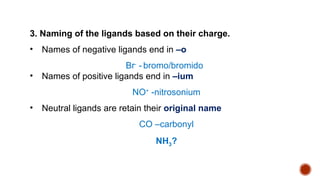

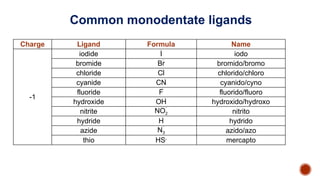

![The prefixes di-,tri-,tetra-,penta-,hexa-, etc. specify the number of
ligands.
[Co(H2O)6]Cl2 hexaaquacobalt(II) chloride
Note: The complex having two, three, four organic ligands are
represented by prefixes such as bis, tris, tetrakis, respectively.
[Cr(C6H6)2] -bis(benzene)chromium(0)
[Cr(en)3]Cl3 –tris(ethylenediamine)chromium(III) chloride
4. The numerical prefixes are used to represent the
number of ligands.](https://image.slidesharecdn.com/nomenclature1-250122030207-20795fe0/85/Nomenclature-Part-1-coordination-compounds-10-320.jpg)
![Ligands are named in their alphabetical order.
[Co(Cl)(CN)(NO2)(NH3)3]
triamminechlorocynonitritocobalt(III)
5. The order of naming ligands.](https://image.slidesharecdn.com/nomenclature1-250122030207-20795fe0/85/Nomenclature-Part-1-coordination-compounds-11-320.jpg)
![6. Ending of the metal atom/ion name.
The positive ion and neutral metal complex have no special ending but
anionic complexes, the name of central metal atom ends in -ate.
K3[Fe(CN)6] potassium hexacynoferrate(III)
[Fe(H2O)6]Cl2 hexaaquairon(II) chloride](https://image.slidesharecdn.com/nomenclature1-250122030207-20795fe0/85/Nomenclature-Part-1-coordination-compounds-12-320.jpg)
![The oxidation state of the central metal atom/ion is
written at end of metal/ion as
___nickel(0), or ____ferrate(II)
[Co(H2O)6]Cl2 hexaaquacobalt(II) chloride
[Cr(C6H6)2] -bis(benzene)chromium(0)
7. Oxidation state of the central ion](https://image.slidesharecdn.com/nomenclature1-250122030207-20795fe0/85/Nomenclature-Part-1-coordination-compounds-13-320.jpg)
![The Greek letter µn- is written before the names of ligands
which shared between two or more metal ions. Where ‘n’
(bridging index) is number of coordinating metal ceters
attached to the ligand.
[(CO)3 Fe(CO)3 Fe(CO)3] –tri-µ-carbonyl-bis(tricarbonyliron(0))
Note: If ‘n’ is 2 the bridging index is not normally indicated.
8. The bridging groups](https://image.slidesharecdn.com/nomenclature1-250122030207-20795fe0/85/Nomenclature-Part-1-coordination-compounds-14-320.jpg)


![Theory of coordination_compounds[1]](https://cdn.slidesharecdn.com/ss_thumbnails/theoryofcoordinationcompounds1-171130080838-thumbnail.jpg?width=640&height=640&fit=bounds)


