Acid Nomenclature
(Naming Acids)
By Dr. Shawn P. Shields
This work is licensed by Shawn P. Shields-Maxwell under a Creative
Commons Attribution-NonCommercial-ShareAlike 4.0 International License.
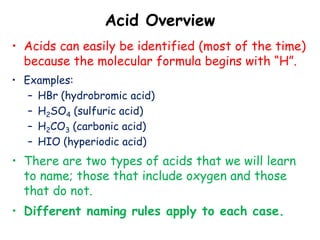
Acid Overview
• Acids can easily be identified (most of the time)
because the molecular formula begins with “H”.
• Examples:
– HBr (hydrobromic acid)
– H2SO4 (sulfuric acid)
– H2CO3 (carbonic acid)
– HIO (hyperiodic acid)
• There are two types of acids that we will learn
to name; those that include oxygen and those
that do not.
• Different naming rules apply to each case.
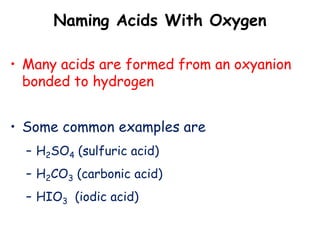
Naming Acids With Oxygen
• Many acids are formed from an oxyanion
bonded to hydrogen
• Some common examples are
– H2SO4 (sulfuric acid)
– H2CO3 (carbonic acid)
– HIO3 (iodic acid)
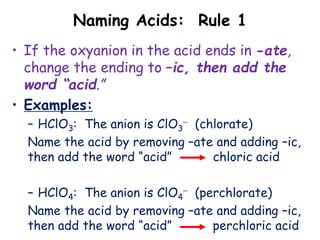
Naming Acids: Rule 1
• If the oxyanion in the acid ends in -ate,
change the ending to –ic, then add the
word “acid.”
• Examples:
– HClO3: The anion is ClO3
 (chlorate)
Name the acid by removing –ate and adding –ic,
then add the word “acid” chloric acid
– HClO4: The anion is ClO4
 (perchlorate)
Name the acid by removing –ate and adding –ic,
then add the word “acid” perchloric acid
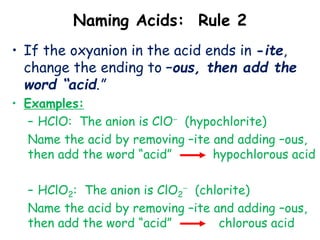
Naming Acids: Rule 2
• If the oxyanion in the acid ends in -ite,
change the ending to –ous, then add the
word “acid.”
• Examples:
– HClO: The anion is ClO (hypochlorite)
Name the acid by removing –ite and adding –ous,
then add the word “acid” hypochlorous acid
– HClO2: The anion is ClO2
 (chlorite)
Name the acid by removing –ite and adding –ous,
then add the word “acid” chlorous acid
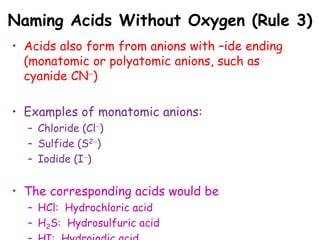
Naming Acids Without Oxygen (Rule 3)
• Acids also form from anions with –ide ending
(monatomic or polyatomic anions, such as
cyanide CN)
• Examples of monatomic anions:
– Chloride (Cl)
– Sulfide (S2)
– Iodide (I)
• The corresponding acids would be
– HCl: Hydrochloric acid
– H2S: Hydrosulfuric acid
Naming Acids (Rule 3)
• Name acids formed from monatomic anions (or
polyatomics without oxygen) with –ide ending
using the following guidelines:
a) Change the –ide ending on the anion to –ic
b) Add the prefix hydro- (to the beginning of the name)
c) Add the word “acid” to the end of the name.
• Examples:
– For an acid made form chloride (Cl):
• remove the –ide ending and add –ic
• Add the prefix hydro-
• Add the word “acid”
hydrochloric acid
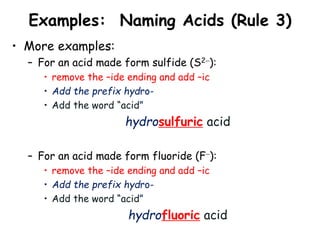
Examples: Naming Acids (Rule 3)
• More examples:
– For an acid made form sulfide (S2):
• remove the –ide ending and add –ic
• Add the prefix hydro-
• Add the word “acid”
hydrosulfuric acid
– For an acid made form fluoride (F):
• remove the –ide ending and add –ic
• Add the prefix hydro-
• Add the word “acid”
hydrofluoric acid
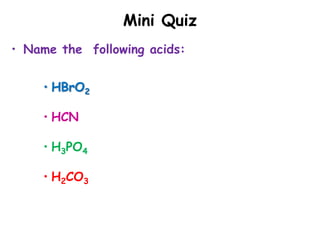
Mini Quiz
• Name the following acids:
• HBrO2
• HCN
• H3PO4
• H2CO3
Mini Quiz Solutions
• Name the following acids:
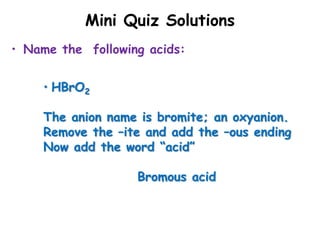
• HBrO2
The anion name is bromite; an oxyanion.
Remove the –ite and add the –ous ending
Now add the word “acid”
Bromous acid
Mini Quiz Solutions
• Name the following acids:
• HCN
The anion name is cyanide; a polyatomic ion
that does not contain oxygen.
Remove the –ide and add the –ic ending
Add the prefix hydro-
Now add the word “acid”
hydrocyanic acid
Mini Quiz Solutions
• Name the following acids:
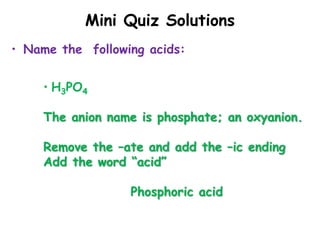
• H3PO4
The anion name is phosphate; an oxyanion.
Remove the –ate and add the –ic ending
Add the word “acid”
Phosphoric acid
Mini Quiz Solutions
• Name the following acids:
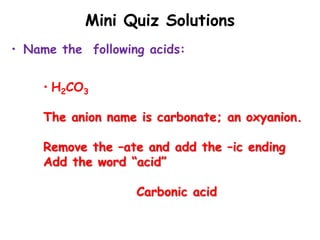
• H2CO3
The anion name is carbonate; an oxyanion.
Remove the –ate and add the –ic ending
Add the word “acid”
Carbonic acid

Acid+Nomenclature.pdf

  • 1.
    Acid Nomenclature (Naming Acids) ByDr. Shawn P. Shields This work is licensed by Shawn P. Shields-Maxwell under a Creative Commons Attribution-NonCommercial-ShareAlike 4.0 International License.
  • 2.
    Acid Overview • Acidscan easily be identified (most of the time) because the molecular formula begins with “H”. • Examples: – HBr (hydrobromic acid) – H2SO4 (sulfuric acid) – H2CO3 (carbonic acid) – HIO (hyperiodic acid) • There are two types of acids that we will learn to name; those that include oxygen and those that do not. • Different naming rules apply to each case.
  • 3.
    Naming Acids WithOxygen • Many acids are formed from an oxyanion bonded to hydrogen • Some common examples are – H2SO4 (sulfuric acid) – H2CO3 (carbonic acid) – HIO3 (iodic acid)
  • 4.
    Naming Acids: Rule1 • If the oxyanion in the acid ends in -ate, change the ending to –ic, then add the word “acid.” • Examples: – HClO3: The anion is ClO3  (chlorate) Name the acid by removing –ate and adding –ic, then add the word “acid” chloric acid – HClO4: The anion is ClO4  (perchlorate) Name the acid by removing –ate and adding –ic, then add the word “acid” perchloric acid
  • 5.
    Naming Acids: Rule2 • If the oxyanion in the acid ends in -ite, change the ending to –ous, then add the word “acid.” • Examples: – HClO: The anion is ClO (hypochlorite) Name the acid by removing –ite and adding –ous, then add the word “acid” hypochlorous acid – HClO2: The anion is ClO2  (chlorite) Name the acid by removing –ite and adding –ous, then add the word “acid” chlorous acid
  • 6.
    Naming Acids WithoutOxygen (Rule 3) • Acids also form from anions with –ide ending (monatomic or polyatomic anions, such as cyanide CN) • Examples of monatomic anions: – Chloride (Cl) – Sulfide (S2) – Iodide (I) • The corresponding acids would be – HCl: Hydrochloric acid – H2S: Hydrosulfuric acid
  • 7.
    Naming Acids (Rule3) • Name acids formed from monatomic anions (or polyatomics without oxygen) with –ide ending using the following guidelines: a) Change the –ide ending on the anion to –ic b) Add the prefix hydro- (to the beginning of the name) c) Add the word “acid” to the end of the name. • Examples: – For an acid made form chloride (Cl): • remove the –ide ending and add –ic • Add the prefix hydro- • Add the word “acid” hydrochloric acid
  • 8.
    Examples: Naming Acids(Rule 3) • More examples: – For an acid made form sulfide (S2): • remove the –ide ending and add –ic • Add the prefix hydro- • Add the word “acid” hydrosulfuric acid – For an acid made form fluoride (F): • remove the –ide ending and add –ic • Add the prefix hydro- • Add the word “acid” hydrofluoric acid
  • 9.
    Mini Quiz • Namethe following acids: • HBrO2 • HCN • H3PO4 • H2CO3
  • 10.
    Mini Quiz Solutions •Name the following acids: • HBrO2 The anion name is bromite; an oxyanion. Remove the –ite and add the –ous ending Now add the word “acid” Bromous acid
  • 11.
    Mini Quiz Solutions •Name the following acids: • HCN The anion name is cyanide; a polyatomic ion that does not contain oxygen. Remove the –ide and add the –ic ending Add the prefix hydro- Now add the word “acid” hydrocyanic acid
  • 12.
    Mini Quiz Solutions •Name the following acids: • H3PO4 The anion name is phosphate; an oxyanion. Remove the –ate and add the –ic ending Add the word “acid” Phosphoric acid
  • 13.
    Mini Quiz Solutions •Name the following acids: • H2CO3 The anion name is carbonate; an oxyanion. Remove the –ate and add the –ic ending Add the word “acid” Carbonic acid