Chemistry, Matter, and
the Elements
By Shawn P. Shields, Ph. D.
This work is licensed by Shawn P. Shields-Maxwell under a Creative Commons
Attribution-NonCommercial-ShareAlike 4.0 International License.
Introduction to Chemistry
Chemistry is the study of matter and energy
What is Matter?
Matter is systematically ordered into two
categories; mixtures versus pure substances.
Each category is then divided into more detailed groupings.
elements versus compounds
heterogeneous versus homogeneous mixtures
phases of matter
Pure Substances: Elements and Compounds
Pure substances have distinct characteristics
They can be elements or compounds
 Elements are composed of only one type of atom
Elements are found on the periodic table
 Atoms are the smallest chemically distinct form of matter.
 We will discuss atoms in greater detail later in the course.
 Examples of elements are gold (Au), oxygen gas (O2)
that we breathe, liquid nitrogen (N2), and helium (He)
Pure Substances- Compounds
Compounds are formed when more than one type of
element (or atom) bond together.
 Compounds have different types of atoms present in fixed proportions
and have properties distinct from the elements from which they are
formed, i.e., a “whole new substance”.
 There are a vast number of compounds (also called “chemicals”).
 Sucrose (C12H22O11) There are 12 carbon (C) atoms, 22 hydrogen (H) atoms,
and 11 oxygen (O) atoms bonded together in every glucose molecule.
 Other everyday examples of compounds are
 Table salt (sodium chloride, NaCl)
 Water (H2O)
Mixtures versus Pure Substances
 Mixtures are formed between two or more pure
substances.
 Each substance in the mixture retains its original
characteristics,
A mixture DOES NOT create a “whole new substance”.
 Examples of mixtures include
syrup (sucrose (C12H22O11) in water)
air (a mixture of mainly nitrogen (N2), oxygen (O2), plus a
few other gases)
milk
cucumber and tomato salad
Heterogeneous vs Homogeneous Mixtures
 A homogeneous mixture is uniform throughout and you
cannot visually separate the components
Examples include “homogenized milk”, orange juice (no
pulp), brewed coffee, and blood
 A heterogeneous mixture is one in which the components
do not appear uniformly throughout the mixture
Examples include fresh milk (with the cream floating on
top), chicken noodle soup, a nut mixture, and orange
juice with extra pulp
Phases of Matter
The phases of matter fall into three main
categories
Gases, liquids, and solids
Each phase has its own characteristic
properties
Properties of the Phases of Matter
Properties of gases (g)
Have no definite shape (They take the shape of
the container they are held in.)
Gases do not have a specific volume (They fill all
of the available volume.)
Examples include steam, air, and oxygen gas (O2)
Properties of the Phases of Matter
Properties of liquids (l)
Have no definite shape (They take the shape of
the container they are held in.)
Liquids do have a specific volume
Examples include water, canola oil, and vinegar
Properties of the Phases of Matter
Properties of solids (s)
Have a defined shape and volume
Examples include ice, salt, wood, and granite
Mini Quiz
Identify each substance as an element or compound
Sodium chloride (NaCl)
Neon gas (Ne)
Liquid mercury (Hg)
Alumina (Al2O3)
Iodine crystals (I2)
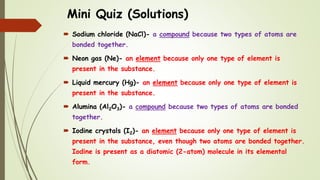
Mini Quiz (Solutions)
 Sodium chloride (NaCl)- a compound because two types of atoms are
bonded together.
 Neon gas (Ne)- an element because only one type of element is
present in the substance.
 Liquid mercury (Hg)- an element because only one type of element is
present in the substance.
 Alumina (Al2O3)- a compound because two types of atoms are bonded
together.
 Iodine crystals (I2)- an element because only one type of element is
present in the substance, even though two atoms are bonded together.
Iodine is present as a diatomic (2-atom) molecule in its elemental
form.
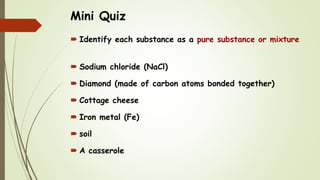
Mini Quiz
 Identify each substance as a pure substance or mixture
 Sodium chloride (NaCl)
 Diamond (made of carbon atoms bonded together)
 Cottage cheese
 Iron metal (Fe)
 soil
 A casserole
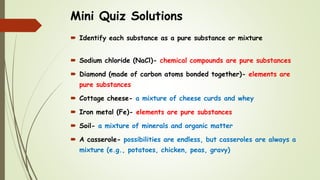
Mini Quiz Solutions
 Identify each substance as a pure substance or mixture
 Sodium chloride (NaCl)- chemical compounds are pure substances
 Diamond (made of carbon atoms bonded together)- elements are
pure substances
 Cottage cheese- a mixture of cheese curds and whey
 Iron metal (Fe)- elements are pure substances
 Soil- a mixture of minerals and organic matter
 A casserole- possibilities are endless, but casseroles are always a
mixture (e.g., potatoes, chicken, peas, gravy)
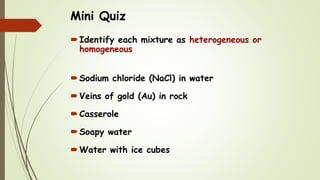
Mini Quiz
Identify each mixture as heterogeneous or
homogeneous
Sodium chloride (NaCl) in water
Veins of gold (Au) in rock
Casserole
Soapy water
Water with ice cubes
Mini Quiz Solutions
 Sodium chloride (NaCl) in water- a homogeneous mixture,
since the individual components are not observed separately
 Veins of gold (Au) in rock- a heterogeneous mixture, since
the veins of gold are observed in separate areas on the
rock
 Casserole- a heterogeneous mixture
 Soapy water- homogeneous mixture
 Water with ice cubes- heterogeneous mixture of phases

Matter and elements final

  • 1.
    Chemistry, Matter, and theElements By Shawn P. Shields, Ph. D. This work is licensed by Shawn P. Shields-Maxwell under a Creative Commons Attribution-NonCommercial-ShareAlike 4.0 International License.
  • 2.
    Introduction to Chemistry Chemistryis the study of matter and energy
  • 3.
    What is Matter? Matteris systematically ordered into two categories; mixtures versus pure substances. Each category is then divided into more detailed groupings. elements versus compounds heterogeneous versus homogeneous mixtures phases of matter
  • 4.
    Pure Substances: Elementsand Compounds Pure substances have distinct characteristics They can be elements or compounds  Elements are composed of only one type of atom Elements are found on the periodic table  Atoms are the smallest chemically distinct form of matter.  We will discuss atoms in greater detail later in the course.  Examples of elements are gold (Au), oxygen gas (O2) that we breathe, liquid nitrogen (N2), and helium (He)
  • 5.
    Pure Substances- Compounds Compoundsare formed when more than one type of element (or atom) bond together.  Compounds have different types of atoms present in fixed proportions and have properties distinct from the elements from which they are formed, i.e., a “whole new substance”.  There are a vast number of compounds (also called “chemicals”).  Sucrose (C12H22O11) There are 12 carbon (C) atoms, 22 hydrogen (H) atoms, and 11 oxygen (O) atoms bonded together in every glucose molecule.  Other everyday examples of compounds are  Table salt (sodium chloride, NaCl)  Water (H2O)
  • 6.
    Mixtures versus PureSubstances  Mixtures are formed between two or more pure substances.  Each substance in the mixture retains its original characteristics, A mixture DOES NOT create a “whole new substance”.  Examples of mixtures include syrup (sucrose (C12H22O11) in water) air (a mixture of mainly nitrogen (N2), oxygen (O2), plus a few other gases) milk cucumber and tomato salad
  • 7.
    Heterogeneous vs HomogeneousMixtures  A homogeneous mixture is uniform throughout and you cannot visually separate the components Examples include “homogenized milk”, orange juice (no pulp), brewed coffee, and blood  A heterogeneous mixture is one in which the components do not appear uniformly throughout the mixture Examples include fresh milk (with the cream floating on top), chicken noodle soup, a nut mixture, and orange juice with extra pulp
  • 8.
    Phases of Matter Thephases of matter fall into three main categories Gases, liquids, and solids Each phase has its own characteristic properties
  • 9.
    Properties of thePhases of Matter Properties of gases (g) Have no definite shape (They take the shape of the container they are held in.) Gases do not have a specific volume (They fill all of the available volume.) Examples include steam, air, and oxygen gas (O2)
  • 10.
    Properties of thePhases of Matter Properties of liquids (l) Have no definite shape (They take the shape of the container they are held in.) Liquids do have a specific volume Examples include water, canola oil, and vinegar
  • 11.
    Properties of thePhases of Matter Properties of solids (s) Have a defined shape and volume Examples include ice, salt, wood, and granite
  • 12.
    Mini Quiz Identify eachsubstance as an element or compound Sodium chloride (NaCl) Neon gas (Ne) Liquid mercury (Hg) Alumina (Al2O3) Iodine crystals (I2)
  • 13.
    Mini Quiz (Solutions) Sodium chloride (NaCl)- a compound because two types of atoms are bonded together.  Neon gas (Ne)- an element because only one type of element is present in the substance.  Liquid mercury (Hg)- an element because only one type of element is present in the substance.  Alumina (Al2O3)- a compound because two types of atoms are bonded together.  Iodine crystals (I2)- an element because only one type of element is present in the substance, even though two atoms are bonded together. Iodine is present as a diatomic (2-atom) molecule in its elemental form.
  • 14.
    Mini Quiz  Identifyeach substance as a pure substance or mixture  Sodium chloride (NaCl)  Diamond (made of carbon atoms bonded together)  Cottage cheese  Iron metal (Fe)  soil  A casserole
  • 15.
    Mini Quiz Solutions Identify each substance as a pure substance or mixture  Sodium chloride (NaCl)- chemical compounds are pure substances  Diamond (made of carbon atoms bonded together)- elements are pure substances  Cottage cheese- a mixture of cheese curds and whey  Iron metal (Fe)- elements are pure substances  Soil- a mixture of minerals and organic matter  A casserole- possibilities are endless, but casseroles are always a mixture (e.g., potatoes, chicken, peas, gravy)
  • 16.
    Mini Quiz Identify eachmixture as heterogeneous or homogeneous Sodium chloride (NaCl) in water Veins of gold (Au) in rock Casserole Soapy water Water with ice cubes
  • 17.
    Mini Quiz Solutions Sodium chloride (NaCl) in water- a homogeneous mixture, since the individual components are not observed separately  Veins of gold (Au) in rock- a heterogeneous mixture, since the veins of gold are observed in separate areas on the rock  Casserole- a heterogeneous mixture  Soapy water- homogeneous mixture  Water with ice cubes- heterogeneous mixture of phases