MPUMALANGA DEPARTMENT OF LABOUR 
CHARLES COTTER 
29-30 SEPTEMBER 2014
TRAINING PROGRAMME OVERVIEW 
• Defining effective interpersonal communication 
• Mastering the interpersonal communication process 
• Understanding and applying Non-verbal communication (NVC) 
• Applying the primary communication skills 
• Understanding the characteristics of interpersonal style 
• Mastering the other essential skills required to optimize presentations 
• Effective business presentations framework 
• Practical Assessment session
DEFINING EFFECTIVE 
COMMUNICATION 
• Communication is more than merely imparting meaning – it 
must also be understood. 
• Fundamental definition of effective communication is 
when the intended message of the sender is correctly 
interpreted, understood and acted upon by the 
recipient/listener. 
• Communication is the lifeblood of teams. No team or 
organization can exist without communication i.e. the 
transference of meaning among its team members. 
• It is only through transmitting meaning from one person to 
another that information and ideas can be conveyed.
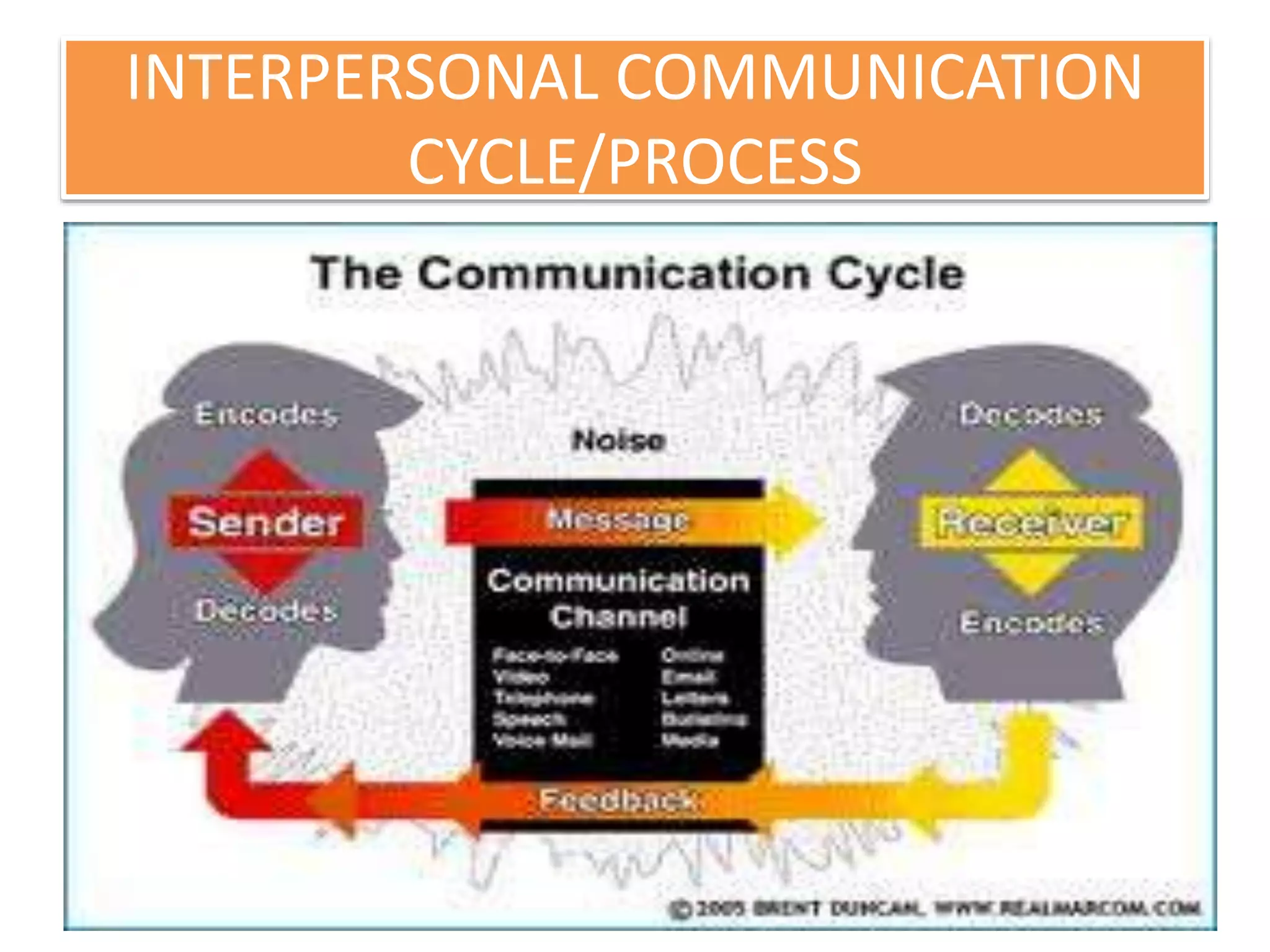
INTERPERSONAL COMMUNICATION 
CYCLE/PROCESS
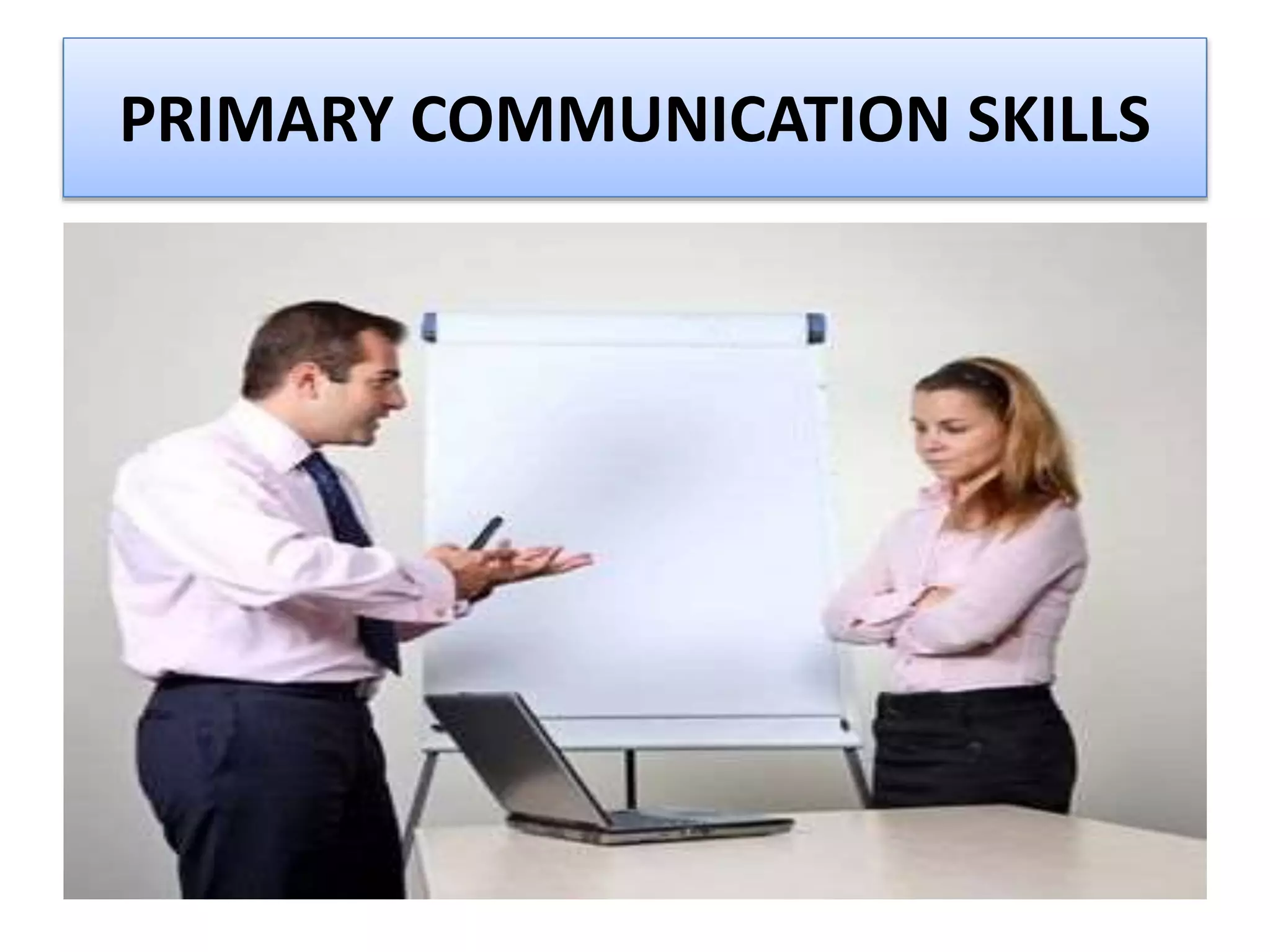
PRIMARY COMMUNICATION SKILLS
PRIMARY COMMUNICATION SKILLS 
• Informing skills – the ability to articulate and 
express ideas and thoughts (as sender) 
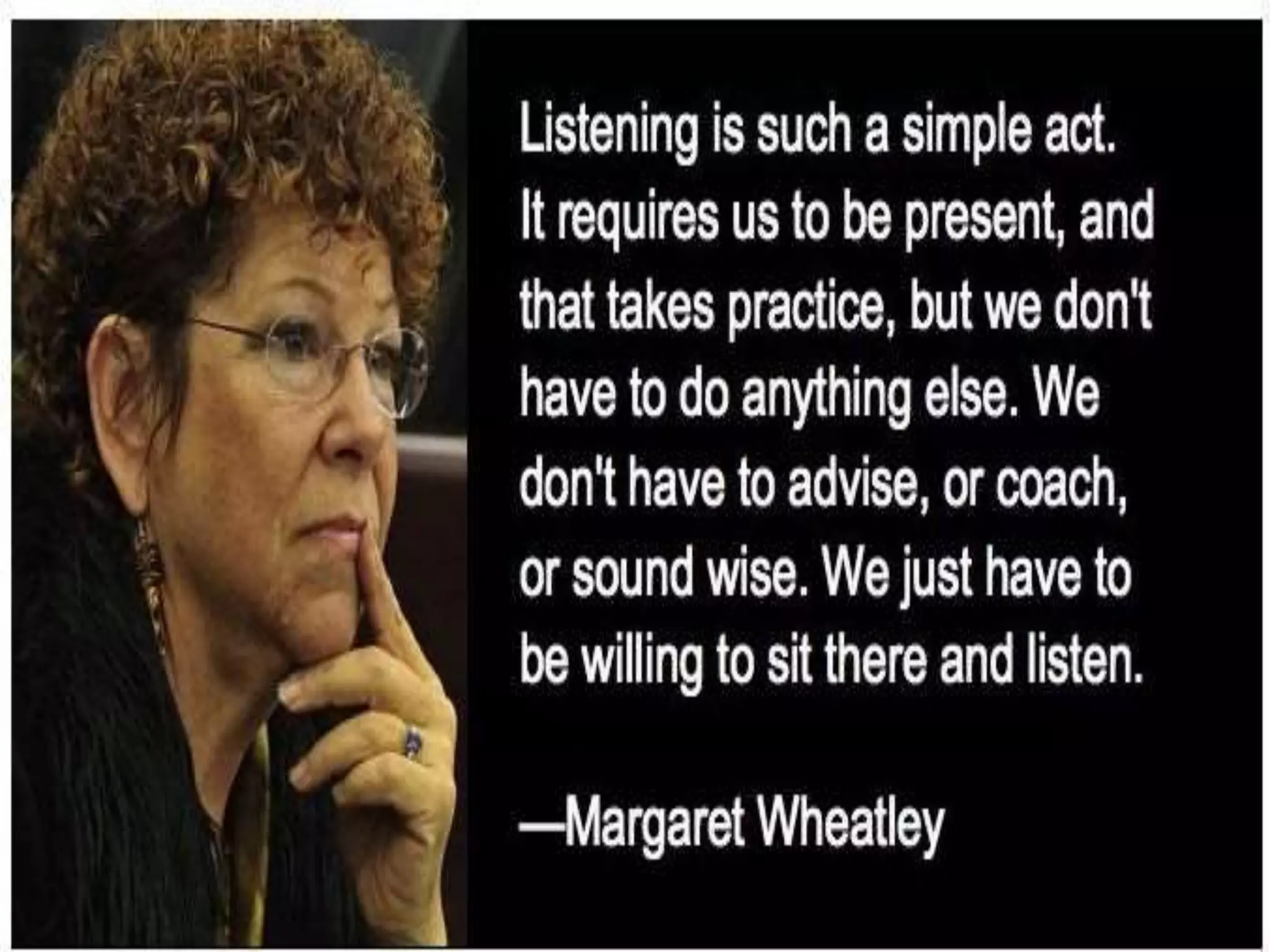
• Listening skills – the ability to listen 
attentively and actively (as receiver) 
• The ability to express, read, interpret and 
respond appropriately to non-verbal 
communication
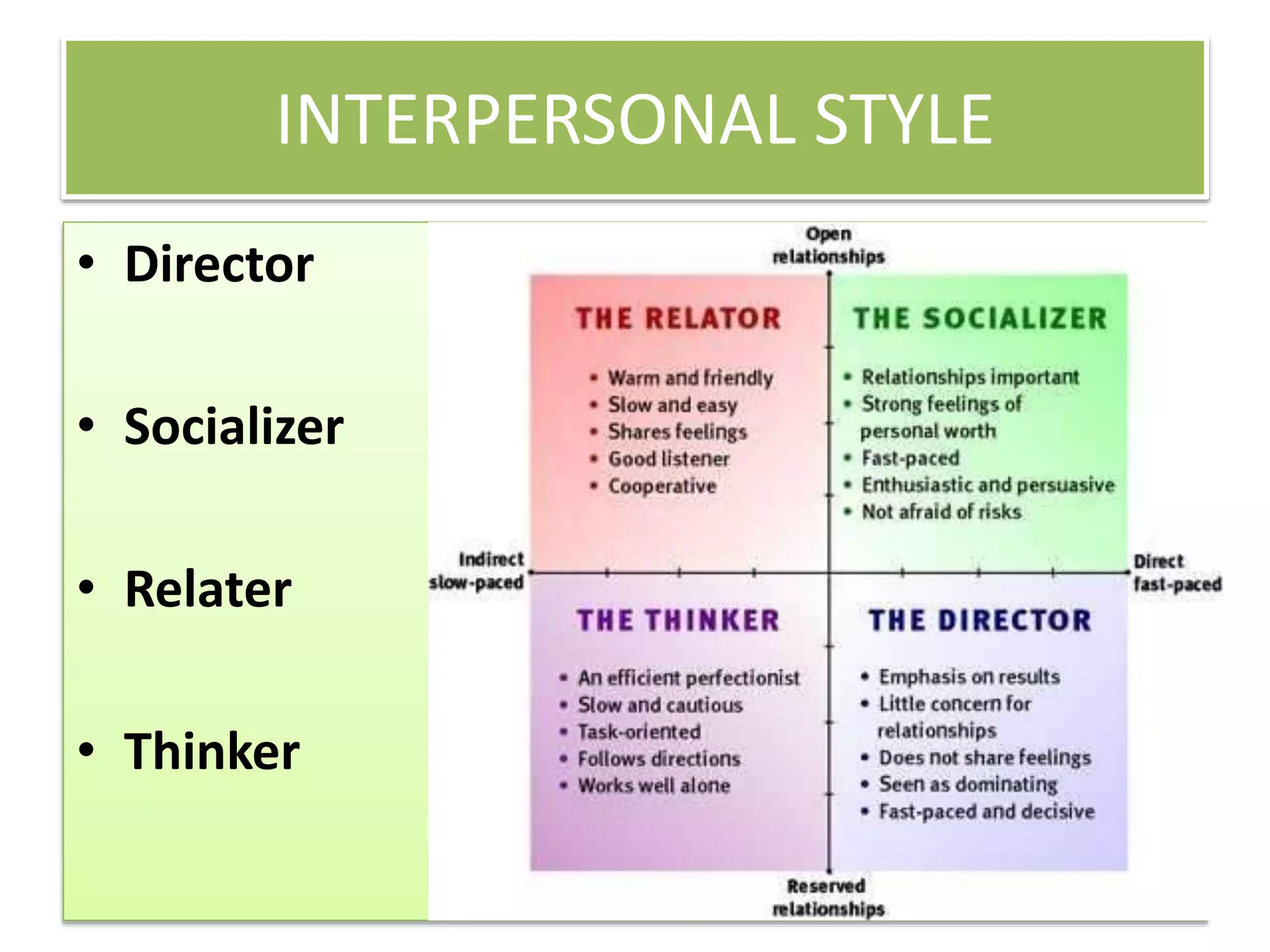
INTERPERSONAL STYLE 
• Director 
• Socializer 
• Relater 
• Thinker
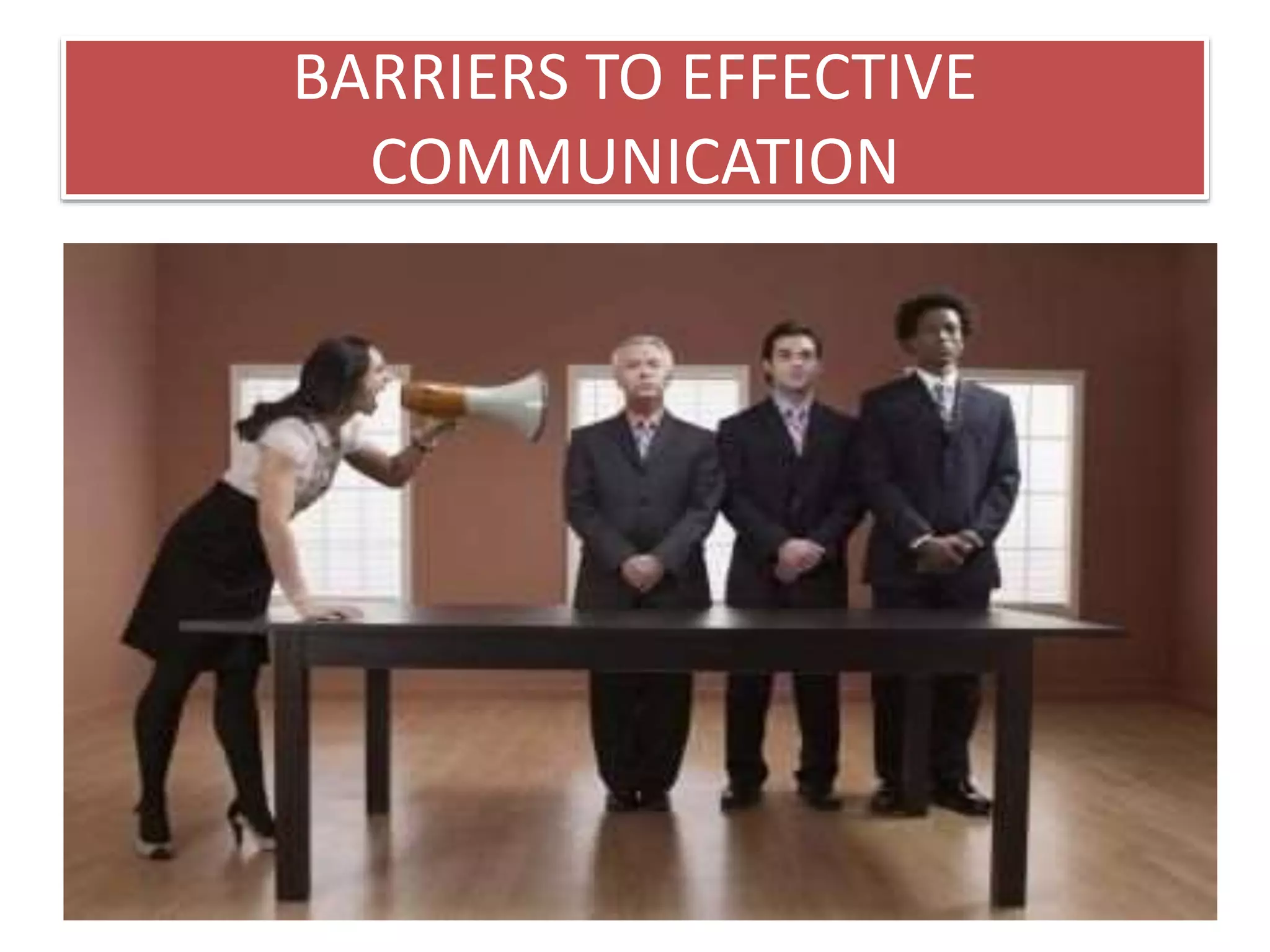
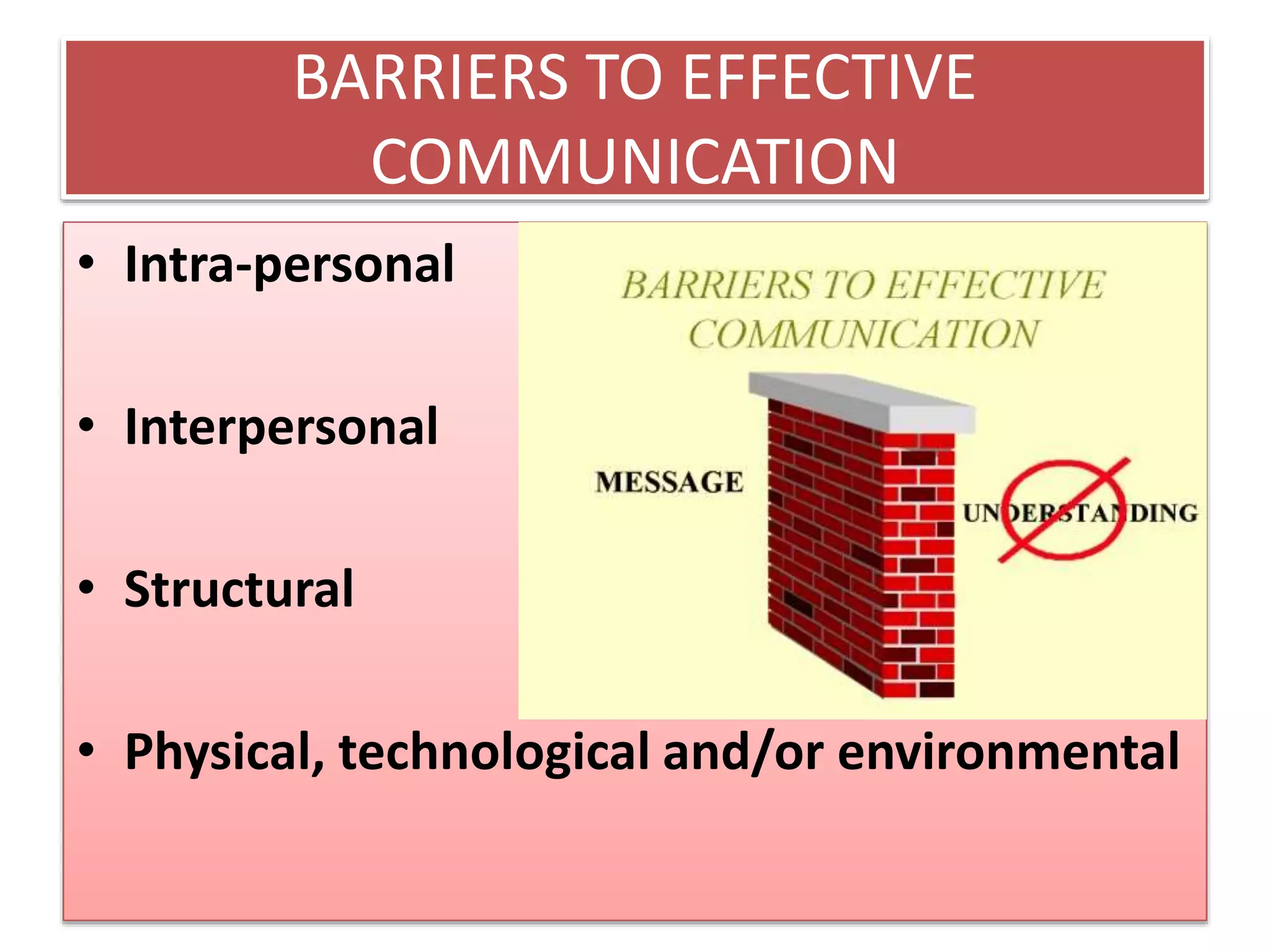
BARRIERS TO EFFECTIVE 
COMMUNICATION
BARRIERS TO EFFECTIVE 
COMMUNICATION 
• Intra-personal 
• Interpersonal 
• Structural 
• Physical, technological and/or environmental
COMMUNICATION IMPROVEMENT 
STRATEGIES 
• Plan what you want to say and how you will say it 
• Use multiple channels and mediums 
• Tailor the message to the audience 
• Use clear, simple and understandable language 
• Empathize with others 
• Remember the value of face-to-face communication 
when dealing with change
COMMUNICATION IMPROVEMENT 
STRATEGIES 
• Use two-way communication 
• Practice active listening 
• Match your words and actions (congruency) 
• Ask for feedback/questions to confirm understanding 
• Use the grapevine (as a source of employee issues) 
• Use feedback 
• Use assertive communication
DEFINING NON-VERBAL 
COMMUNICATION (NVC) 
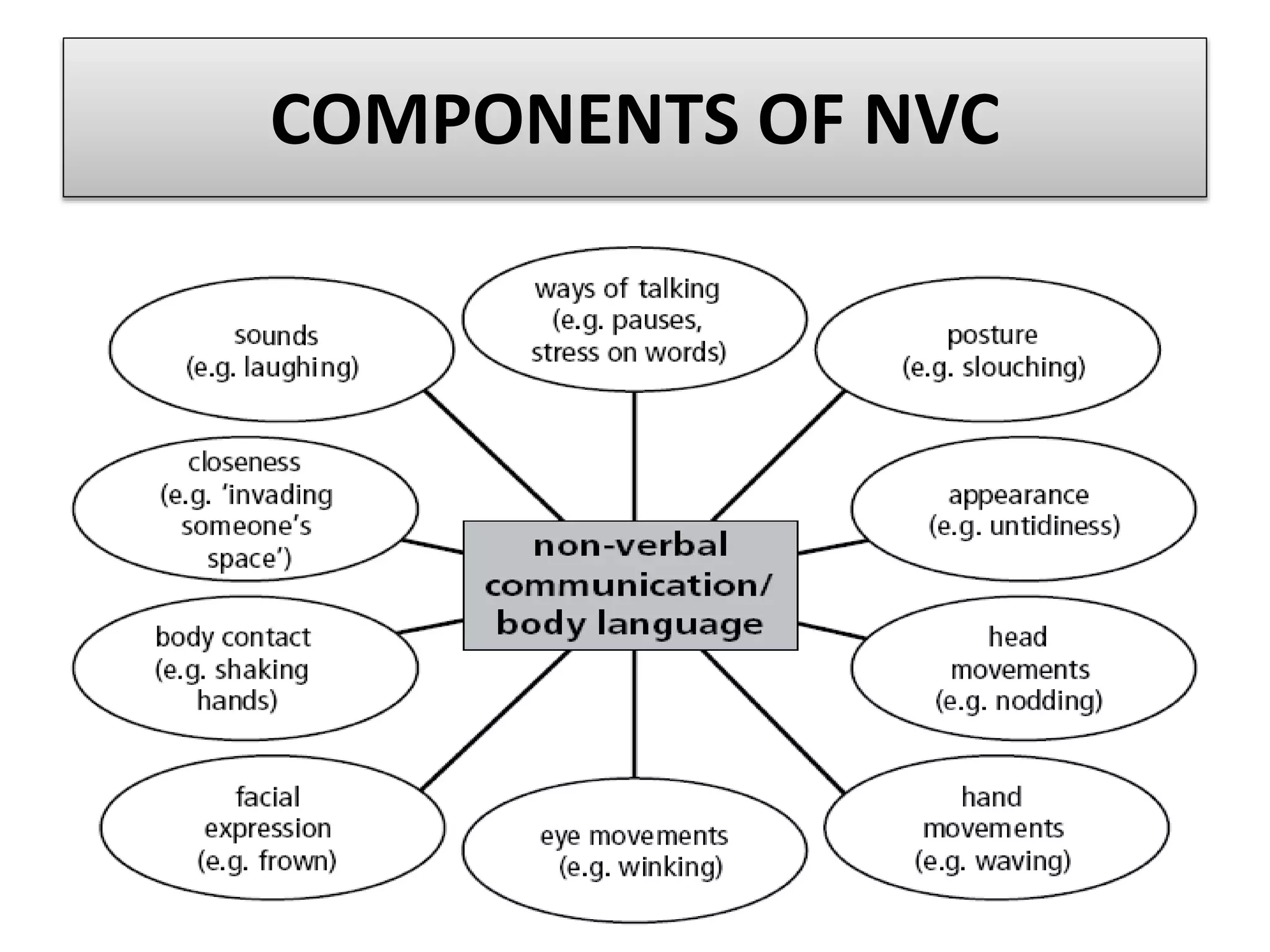
• Non-verbal communication is usually understood as the 
process of communication through sending and receiving 
wordless (mostly visual) cues between people. 
• Face-to-face interaction, NVC can be classified into three 
principal areas: 
 Environmental conditions where communication takes 
place 
 Physical characteristics of the communicators 
 Behaviours of communicators during interaction
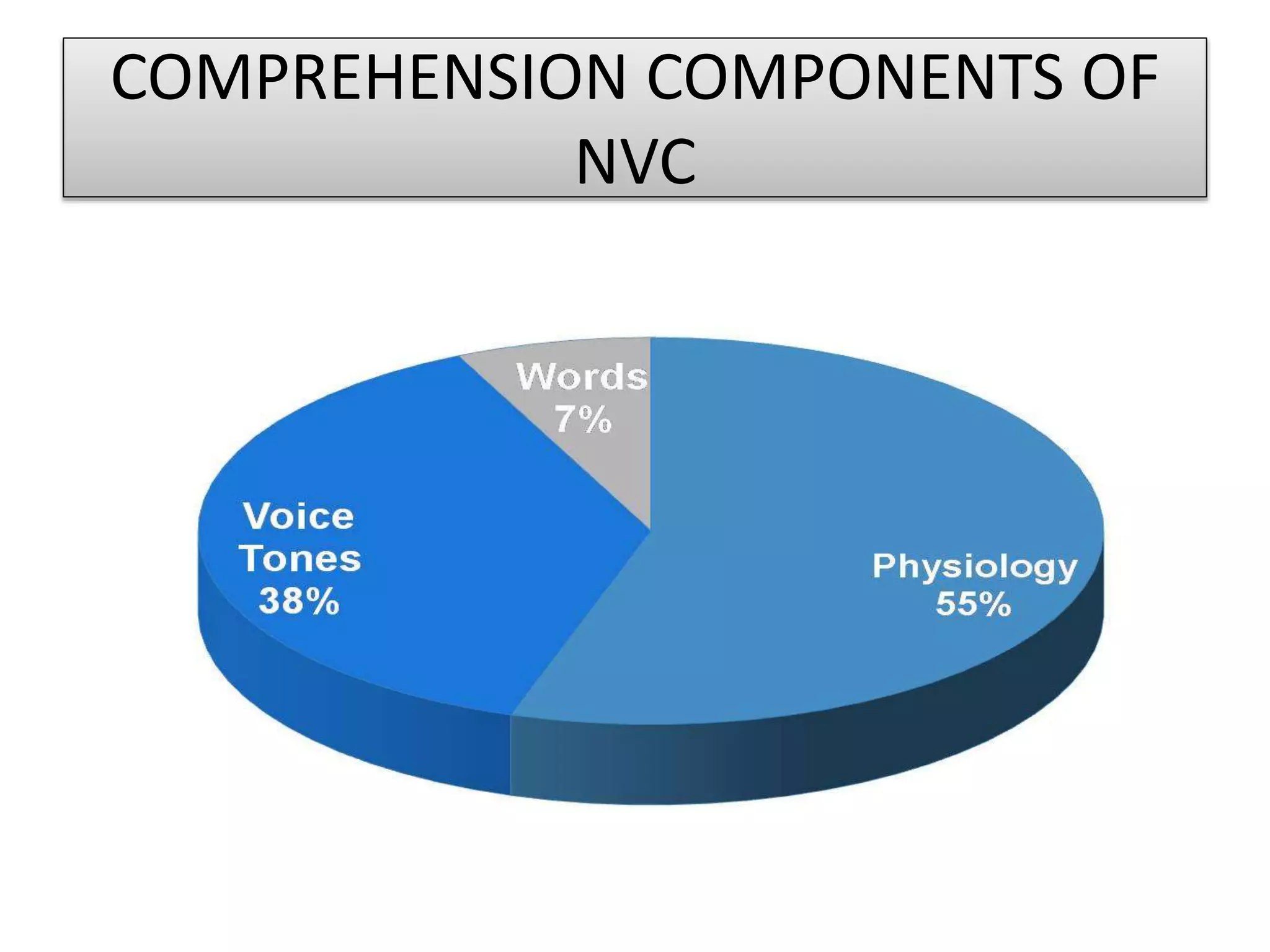
COMPREHENSION COMPONENTS OF 
NVC
COMPONENTS OF NVC
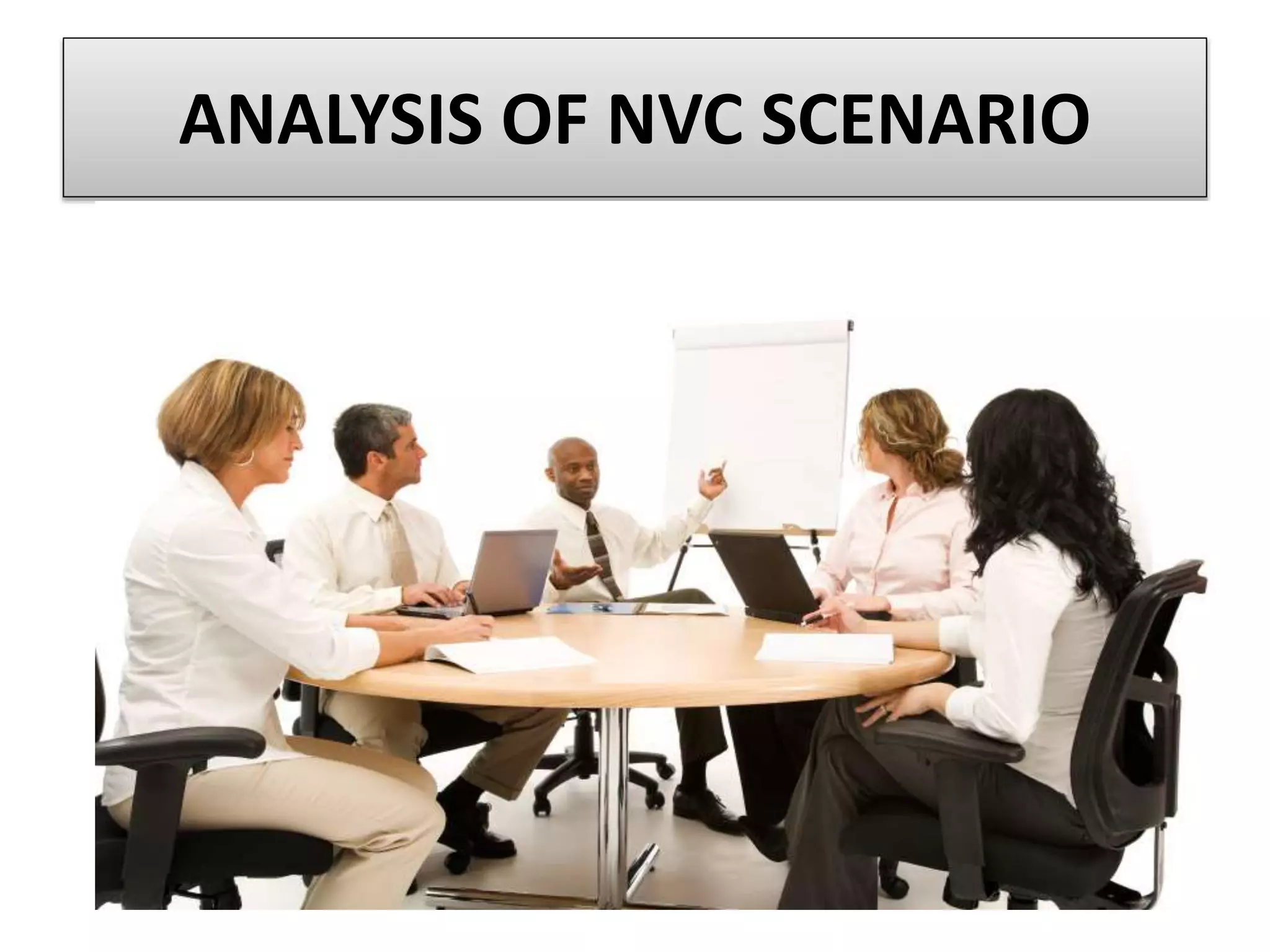
ANALYSIS OF NVC SCENARIO
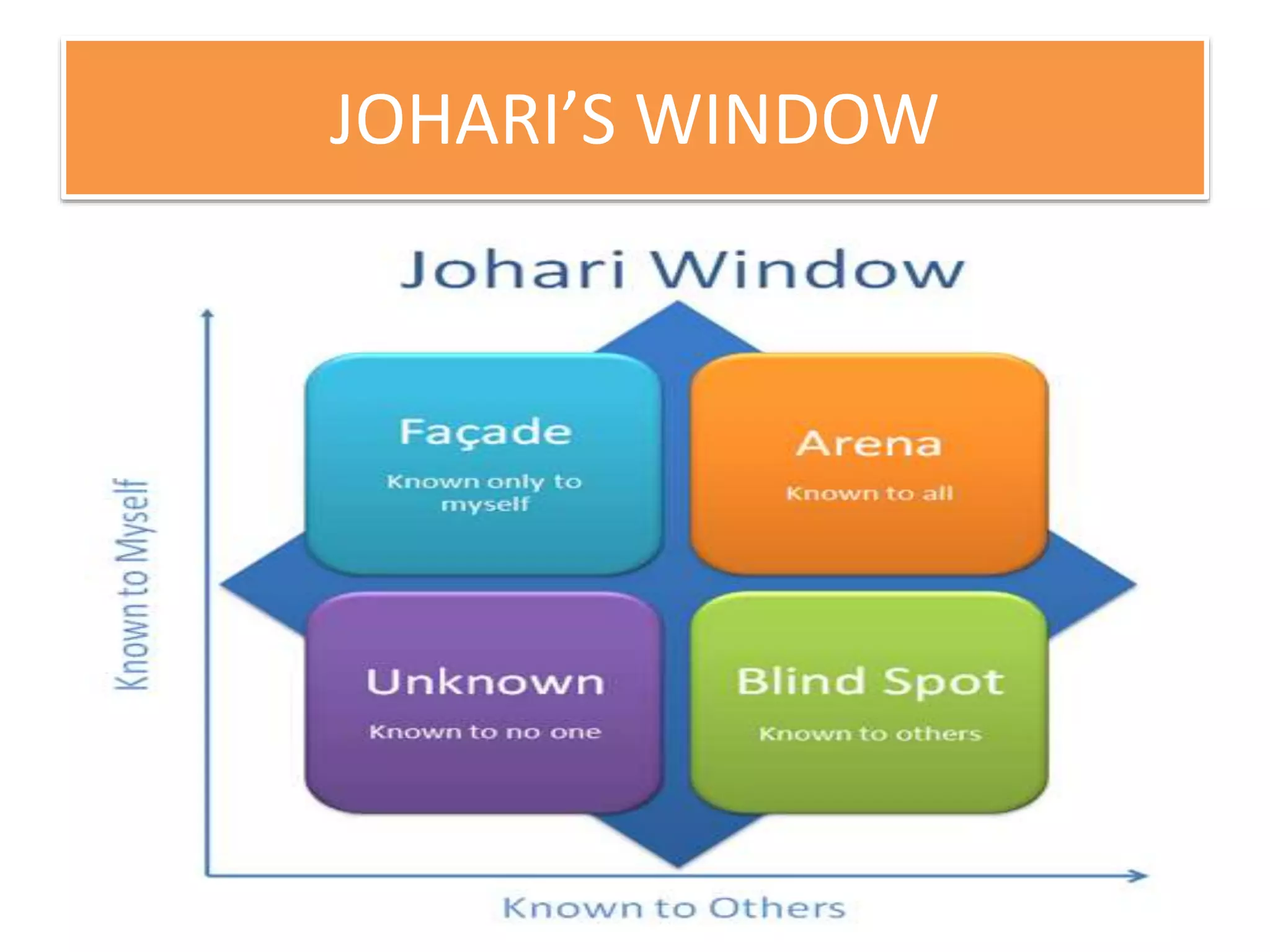
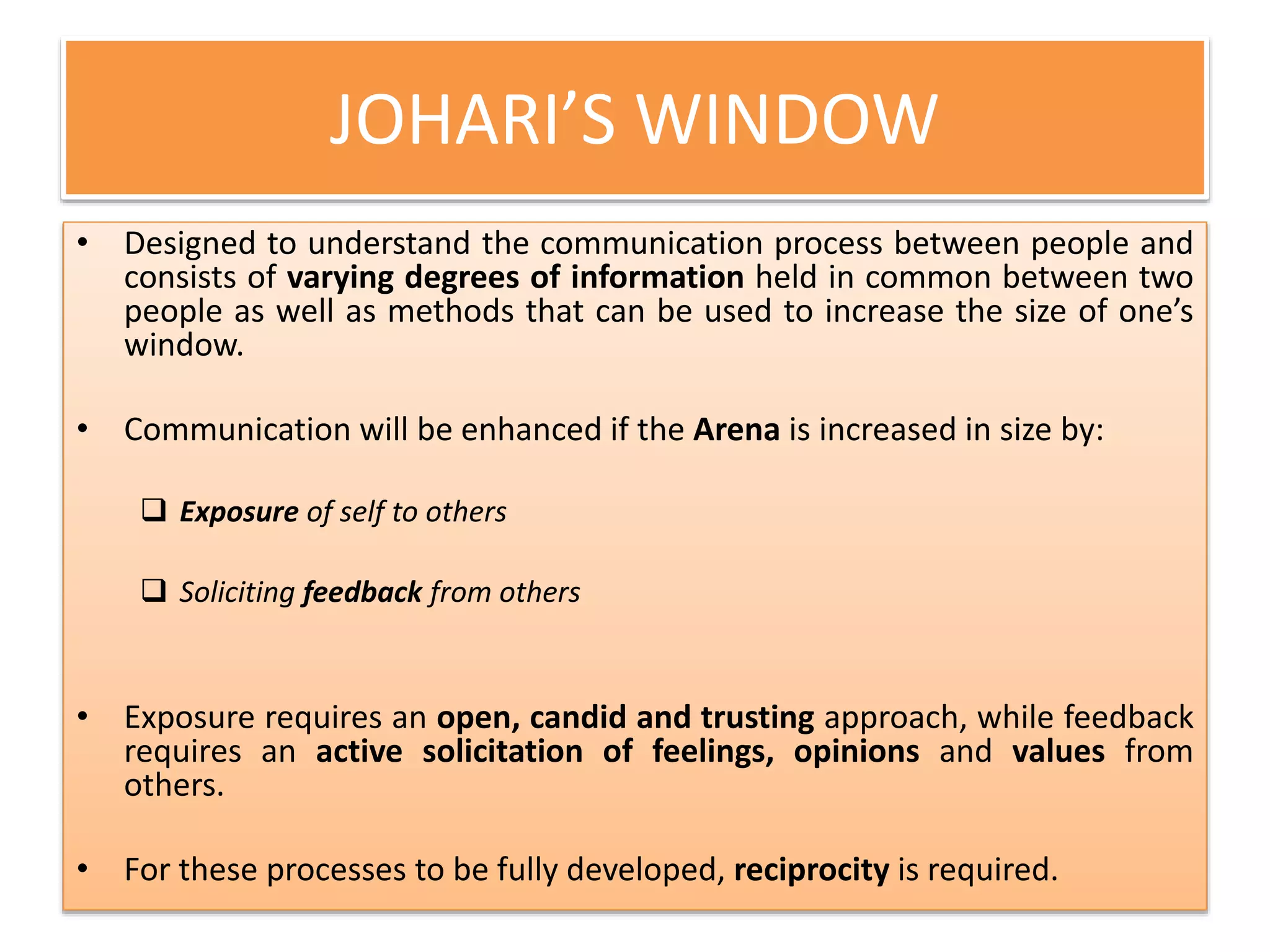
JOHARI’S WINDOW
JOHARI’S WINDOW 
• Designed to understand the communication process between people and 
consists of varying degrees of information held in common between two 
people as well as methods that can be used to increase the size of one’s 
window. 
• Communication will be enhanced if the Arena is increased in size by: 
 Exposure of self to others 
 Soliciting feedback from others 
• Exposure requires an open, candid and trusting approach, while feedback 
requires an active solicitation of feelings, opinions and values from 
others. 
• For these processes to be fully developed, reciprocity is required.
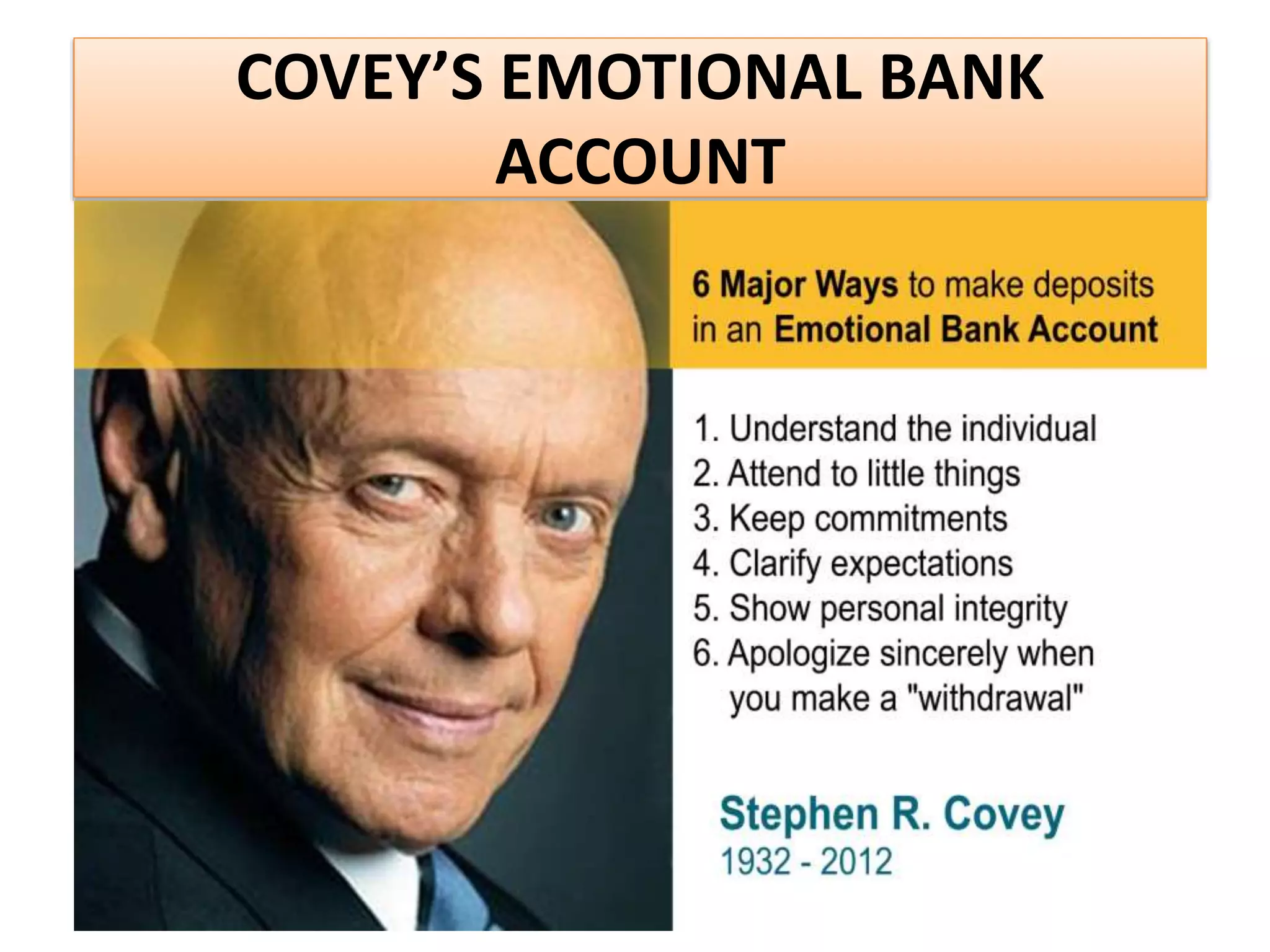
COVEY’S EMOTIONAL BANK 
ACCOUNT
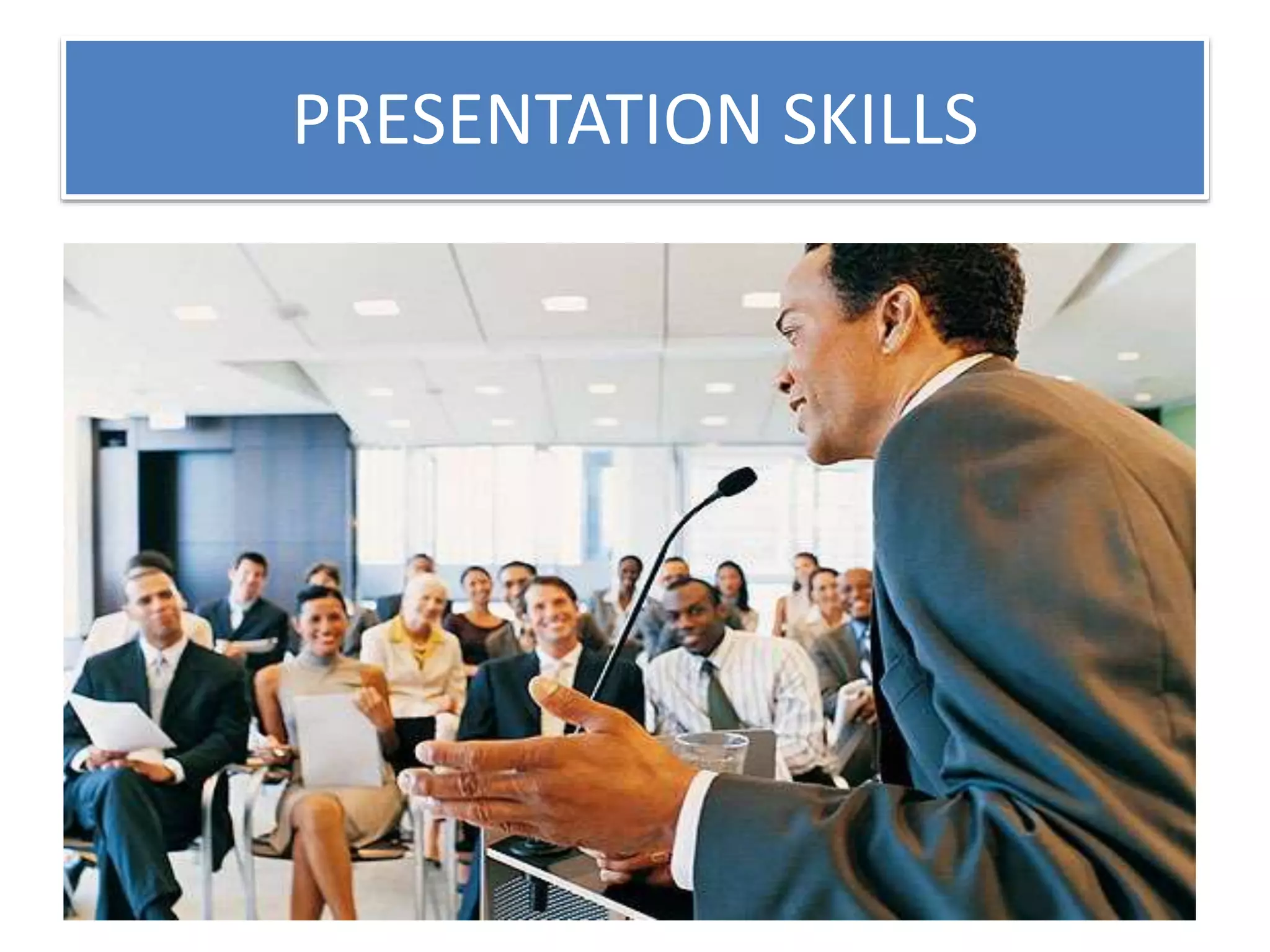
PRESENTATION SKILLS
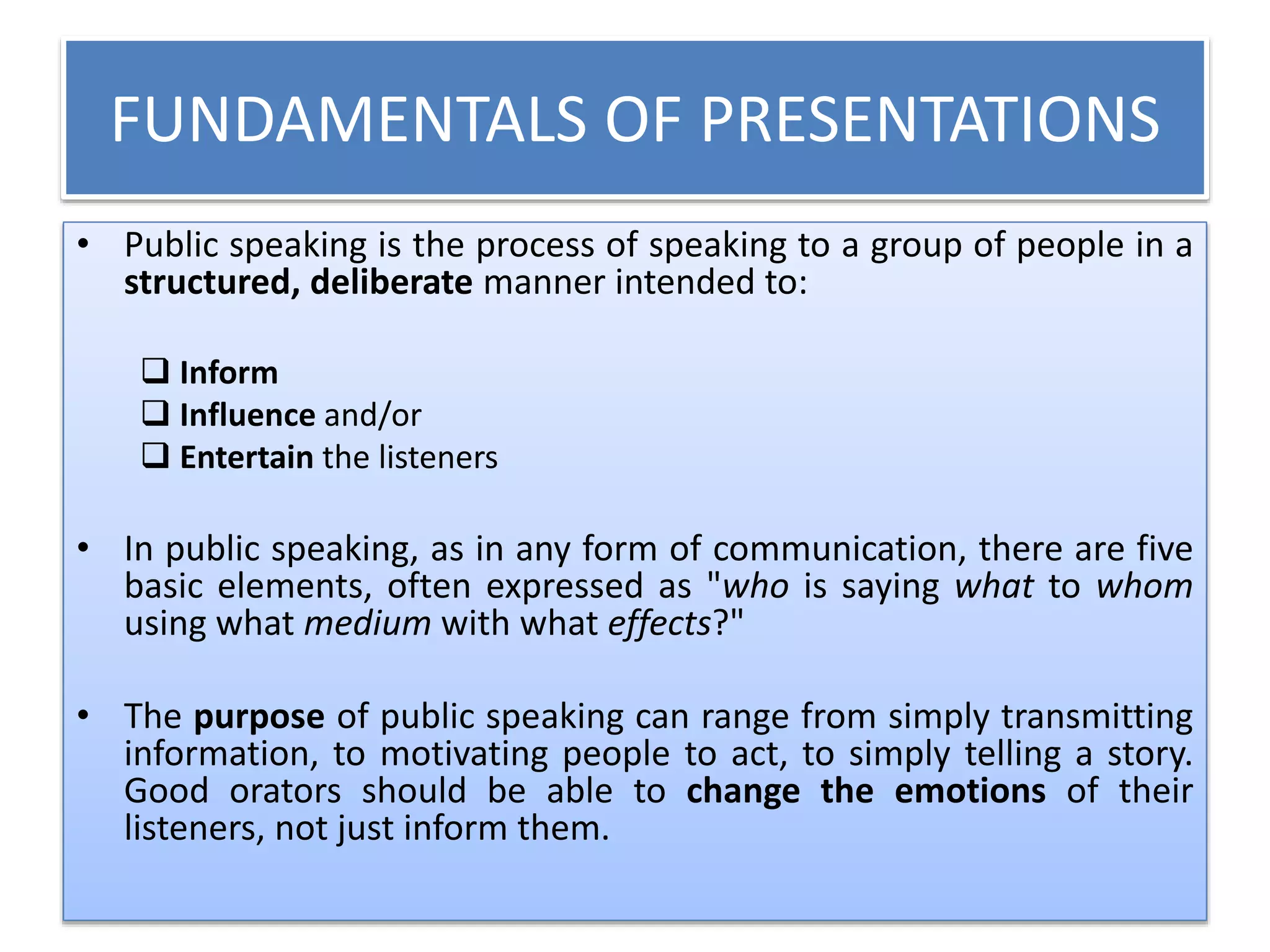
FUNDAMENTALS OF PRESENTATIONS 
• Public speaking is the process of speaking to a group of people in a 
structured, deliberate manner intended to: 
 Inform 
 Influence and/or 
 Entertain the listeners 
• In public speaking, as in any form of communication, there are five 
basic elements, often expressed as "who is saying what to whom 
using what medium with what effects?" 
• The purpose of public speaking can range from simply transmitting 
information, to motivating people to act, to simply telling a story. 
Good orators should be able to change the emotions of their 
listeners, not just inform them.
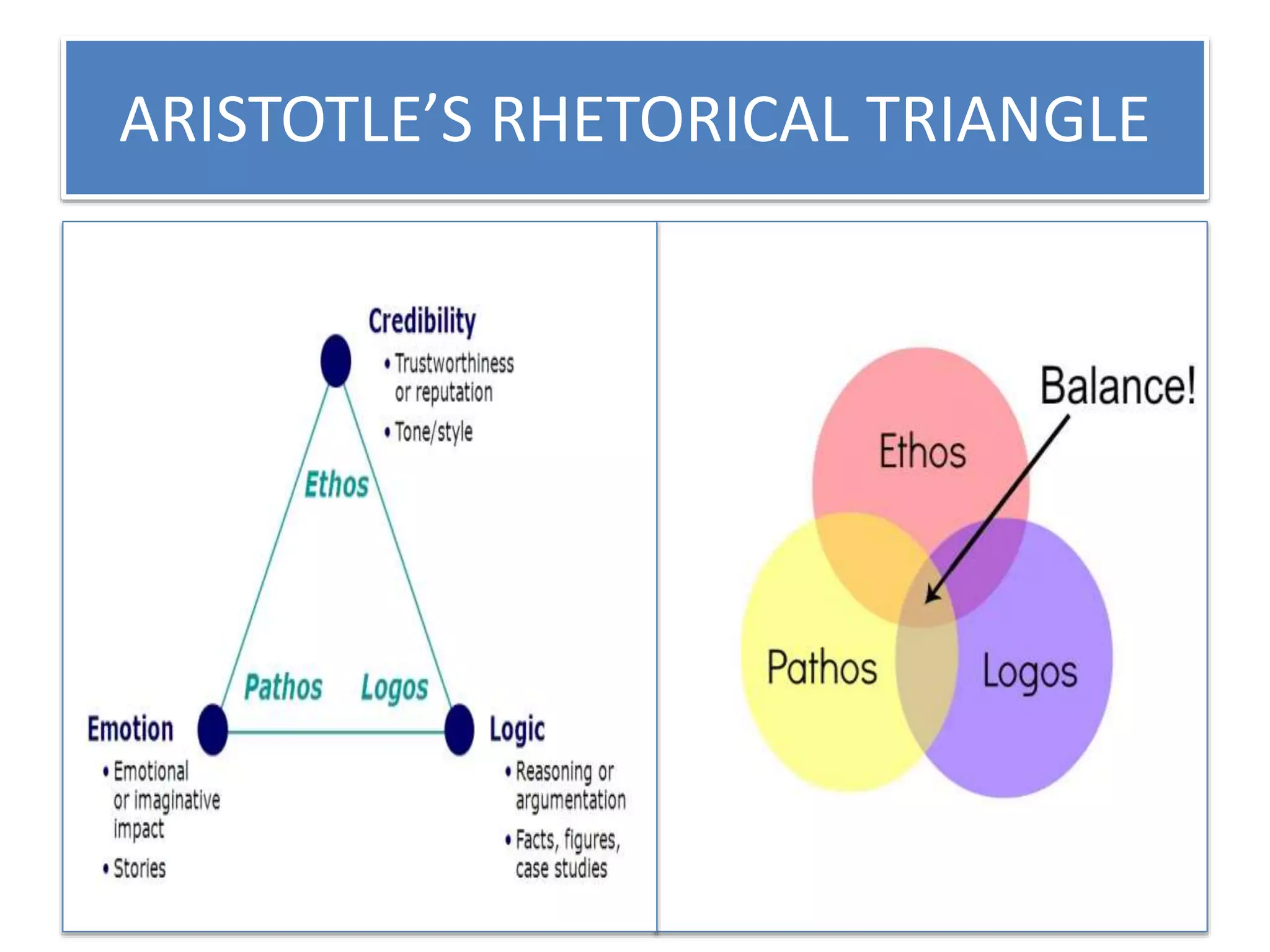
ARISTOTLE’S RHETORICAL TRIANGLE
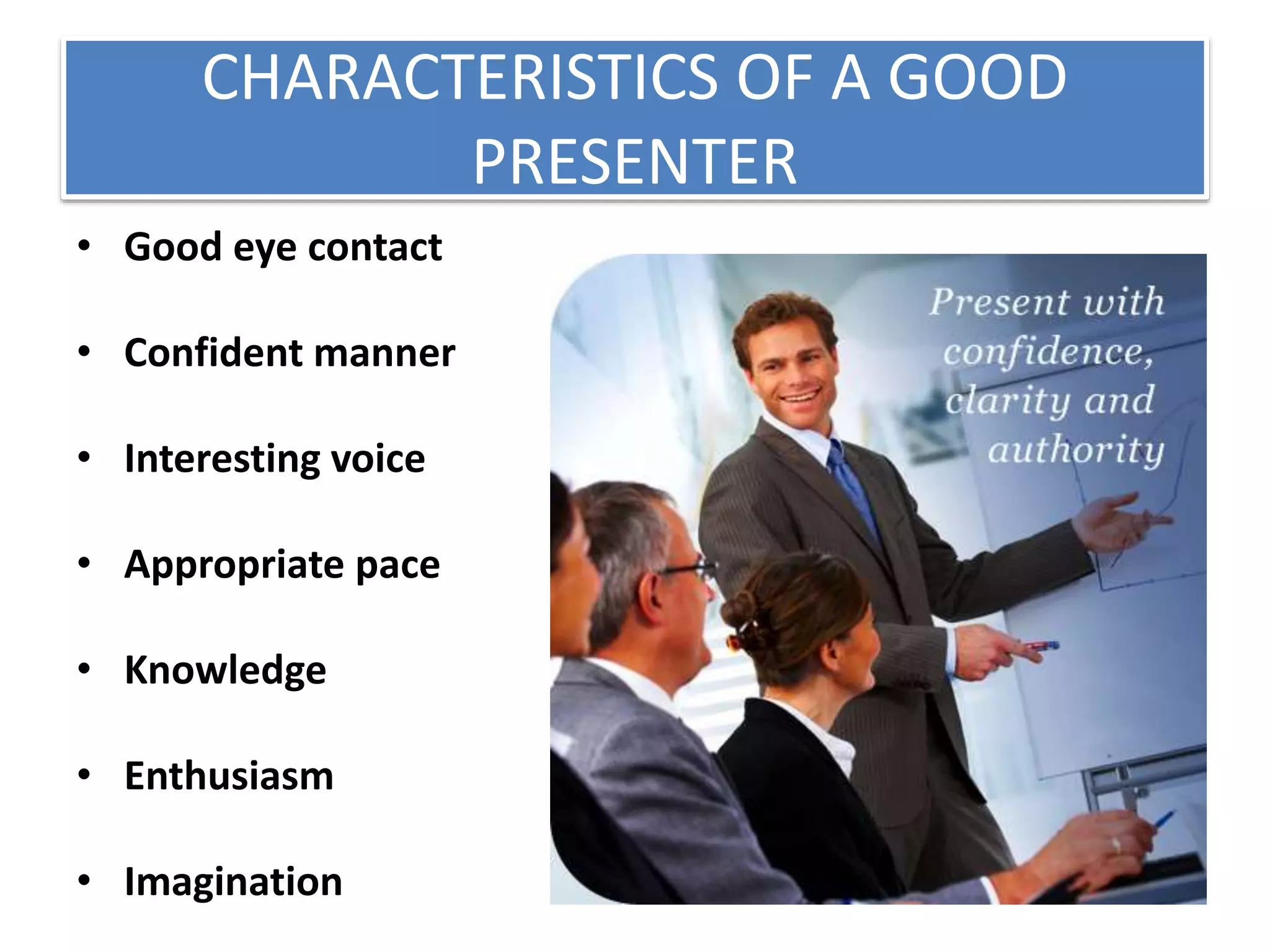
CHARACTERISTICS OF A GOOD 
PRESENTER 
• Good eye contact 
• Confident manner 
• Interesting voice 
• Appropriate pace 
• Knowledge 
• Enthusiasm 
• Imagination
SECRETS OF A GOOD PRESENTATION 
• Clear objectives 
• Logical structure 
• Visuals (as required) 
• Thorough and proper preparation 
• Correct pitch 
• Opportunity for questions
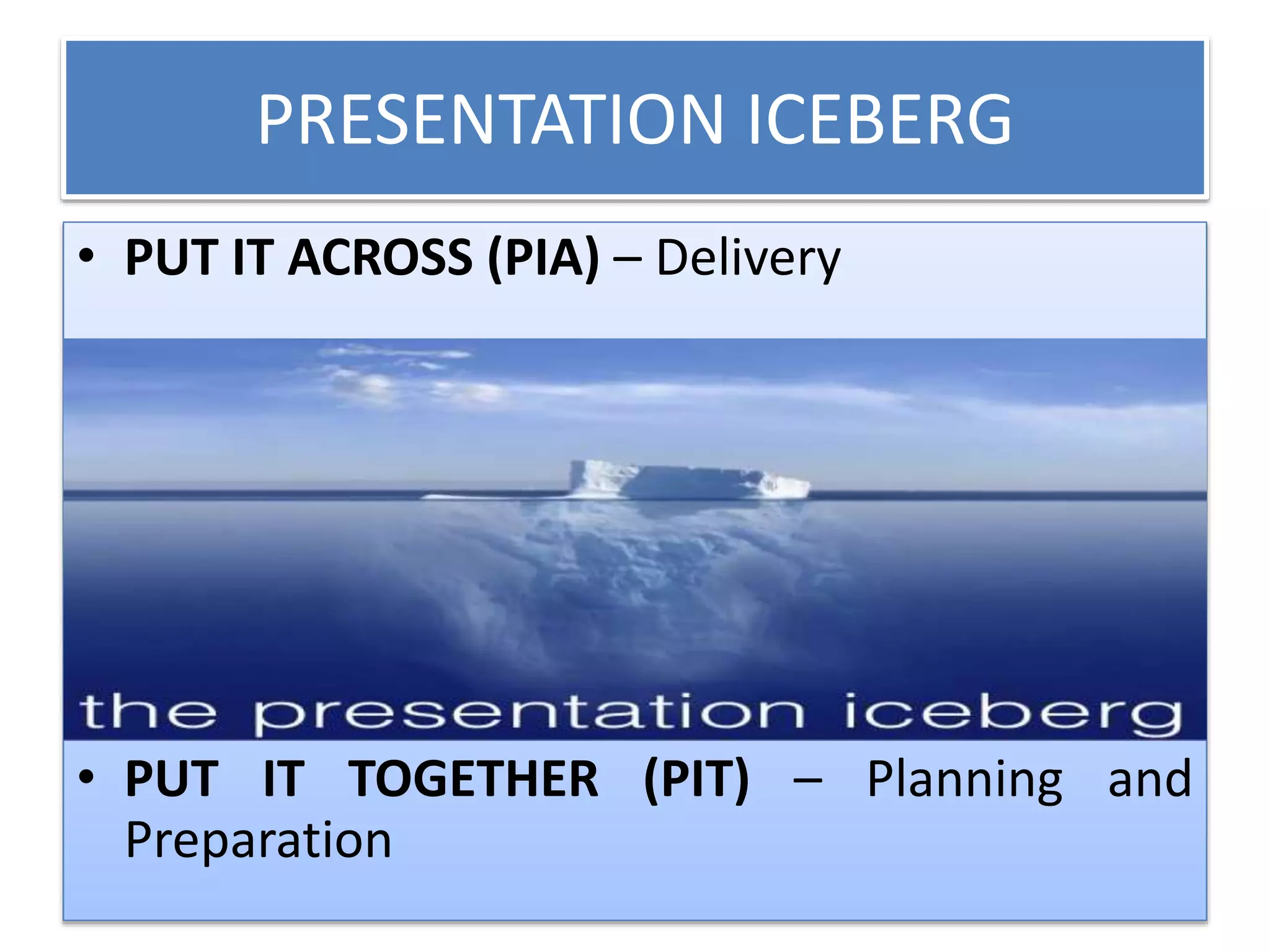
PRESENTATION ICEBERG 
• PUT IT ACROSS (PIA) – Delivery 
• PUT IT TOGETHER (PIT) – Planning and 
Preparation
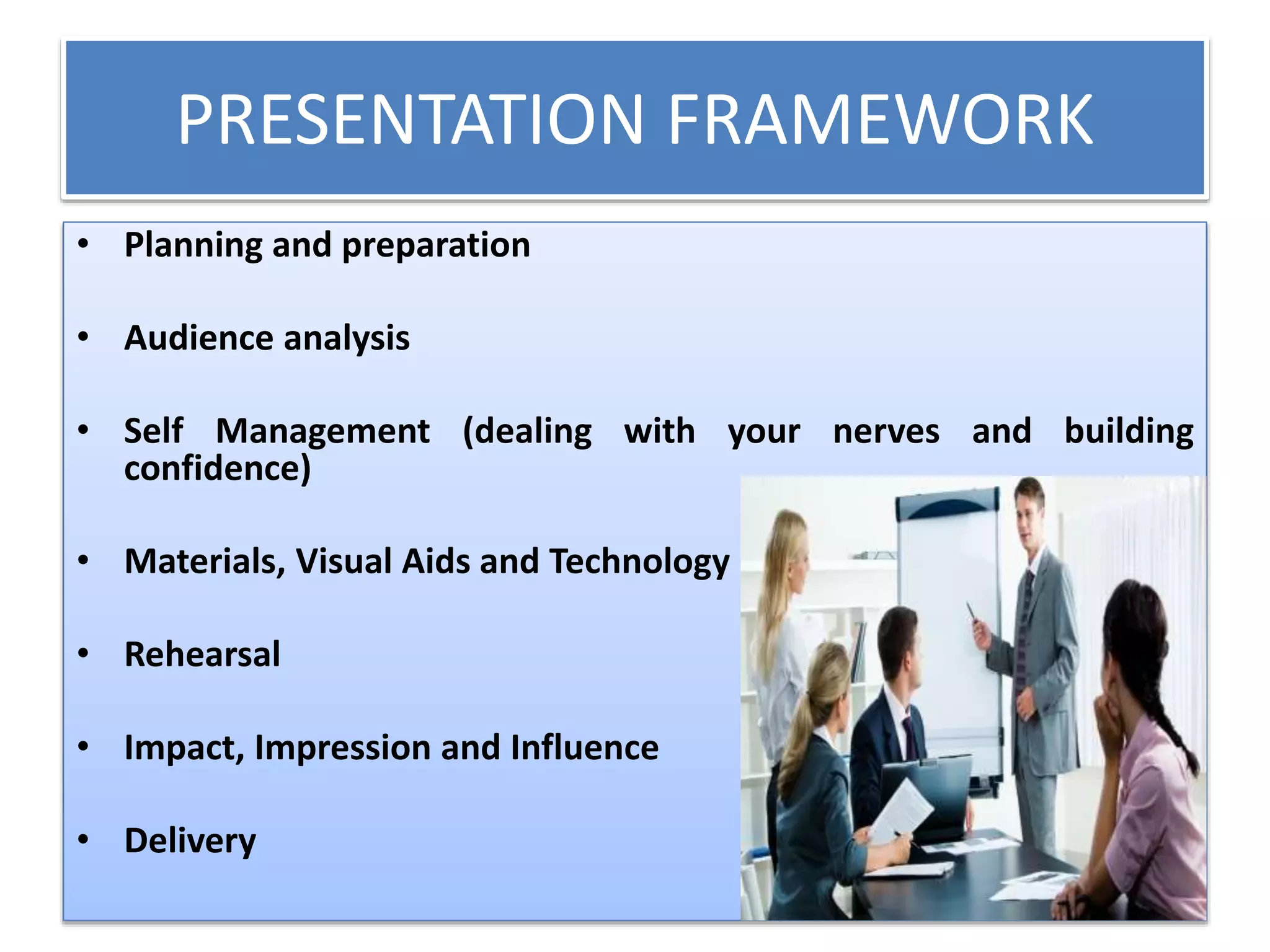
PRESENTATION FRAMEWORK 
• Planning and preparation 
• Audience analysis 
• Self Management (dealing with your nerves and building 
confidence) 
• Materials, Visual Aids and Technology 
• Rehearsal 
• Impact, Impression and Influence 
• Delivery
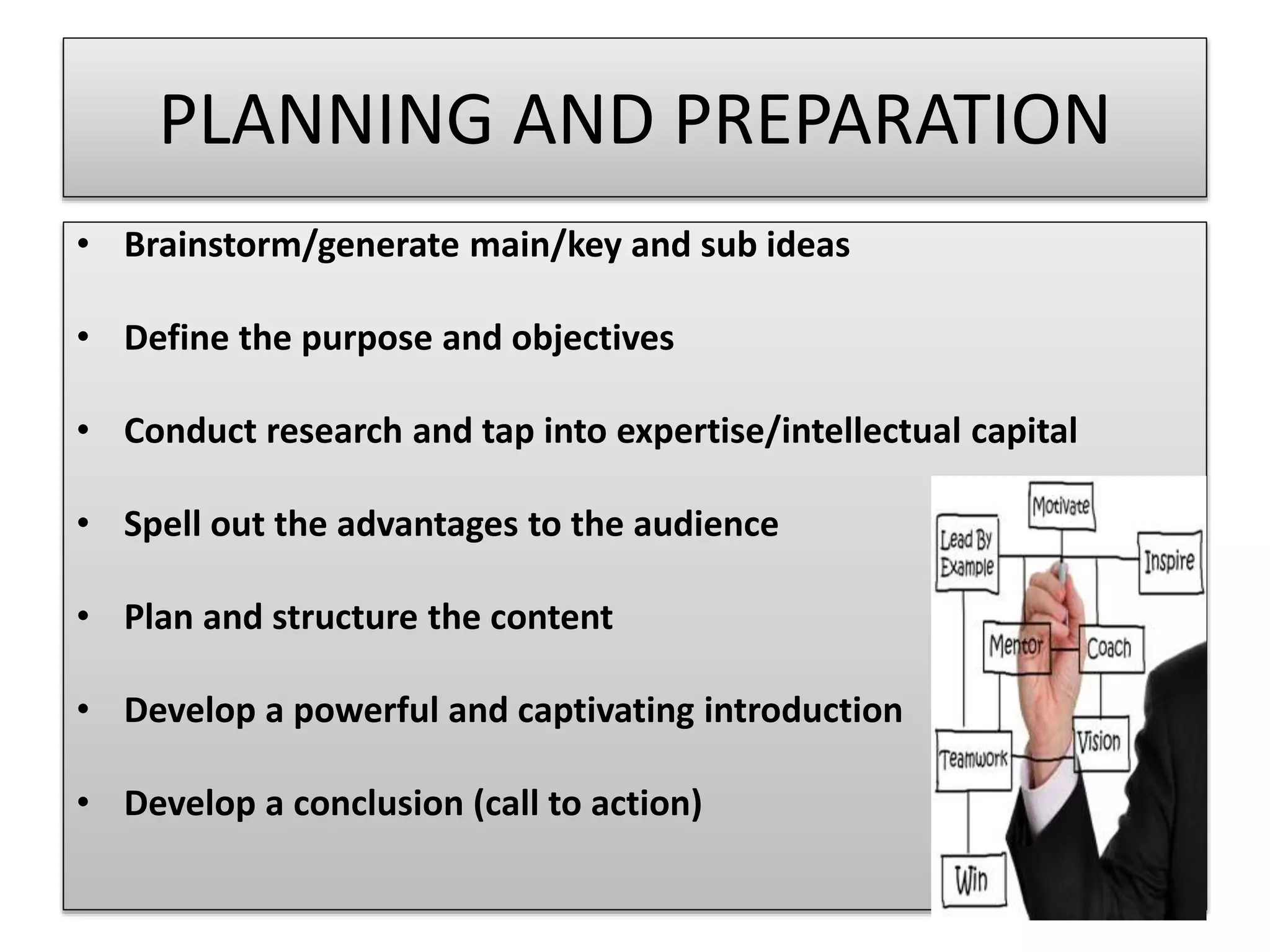
PLANNING AND PREPARATION 
• Brainstorm/generate main/key and sub ideas 
• Define the purpose and objectives 
• Conduct research and tap into expertise/intellectual capital 
• Spell out the advantages to the audience 
• Plan and structure the content 
• Develop a powerful and captivating introduction 
• Develop a conclusion (call to action)
AUDIENCE ANALYSIS 
• Analysis (Who are they? How many will be there?) 
• Understanding (What is their knowledge of the subject?) 
• Demographics (What is their age, sex, educational background?) 
• Interest (Why are they there? Who asked them to be there?) 
• Environment (Where will I stand - can they all see and hear me?) 
• Needs (What are their needs? What are your needs as a speaker?) 
• Customized (What specific needs do you need to address?) 
• Expectations (What do they expect to learn or hear from you?)
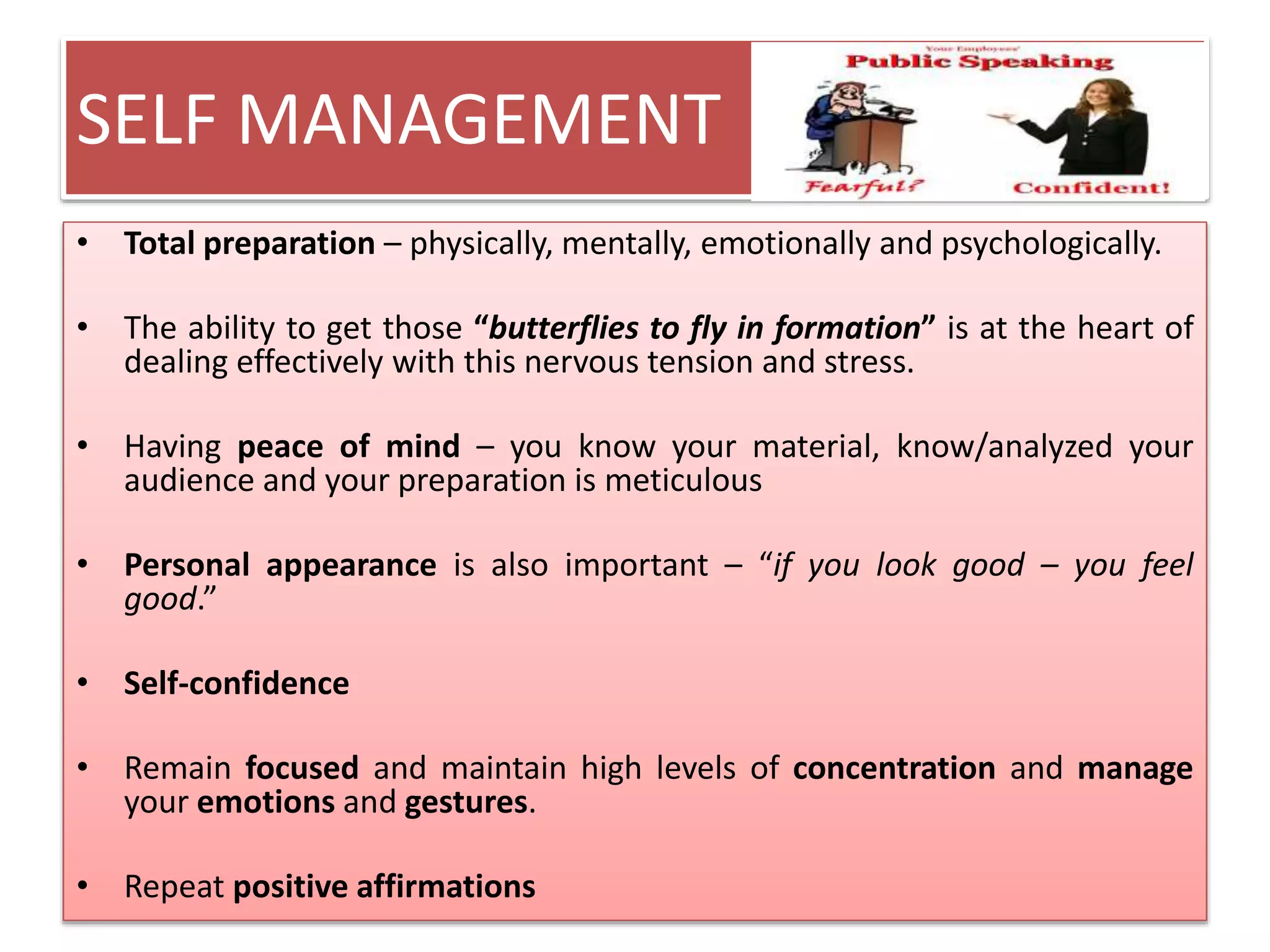
SELF MANAGEMENT 
• Total preparation – physically, mentally, emotionally and psychologically. 
• The ability to get those “butterflies to fly in formation” is at the heart of 
dealing effectively with this nervous tension and stress. 
• Having peace of mind – you know your material, know/analyzed your 
audience and your preparation is meticulous 
• Personal appearance is also important – “if you look good – you feel 
good.” 
• Self-confidence 
• Remain focused and maintain high levels of concentration and manage 
your emotions and gestures. 
• Repeat positive affirmations
MATERIALS, VISUAL AIDS AND 
TECHNOLOGY 
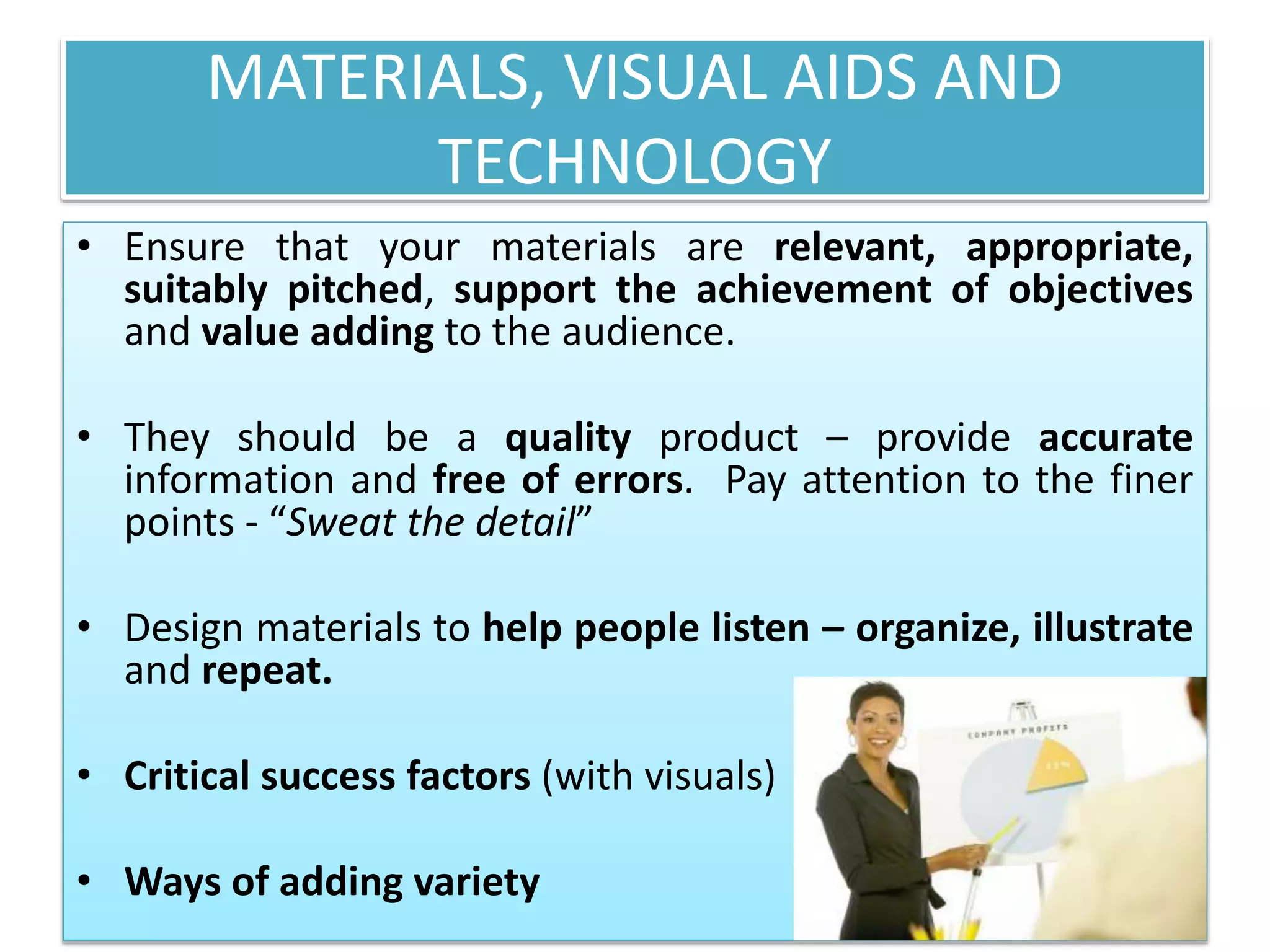
• Ensure that your materials are relevant, appropriate, 
suitably pitched, support the achievement of objectives 
and value adding to the audience. 
• They should be a quality product – provide accurate 
information and free of errors. Pay attention to the finer 
points - “Sweat the detail” 
• Design materials to help people listen – organize, illustrate 
and repeat. 
• Critical success factors (with visuals) 
• Ways of adding variety
REHEARSAL 
• It is vital to practice, practise and practice (some more) – in front of the 
mirror, for a spouse/colleague – to ensure successful delivery of your 
presentation. 
• Saying the words out aloud helps you to hear and pick up on any flaws, 
which can be rectified. It also enables you to work out and ascertain the 
following important aspects of your presentation: 
 Pacing/tempo 
 Timing/duration 
 Coherence 
 Logical structuring 
 Sequencing (of your thoughts and ideas)
POWERPOINT SLIDES 
• Avoid “Death by PowerPoint.” 
• Receive training in the use of Powerpoint – it is a specialized, computer skill 
• Use one slide per main point 
• Don’t clutter the slides with too much information (use bullet points only) 
• Practice (as part of your rehearsal) the transition between the slides 
• NB: Remember visual aids are for the benefit of your audience, and not for your 
convenience to read information from word-for-word 
• NB: Forget High-tech, media centred presentations - rather focus on a HIGH 
TOUCH presentation. Your interaction, rapport, “chemistry”, engagement and 
connection with the audience will differentiate an average from a memorable 
presentation.
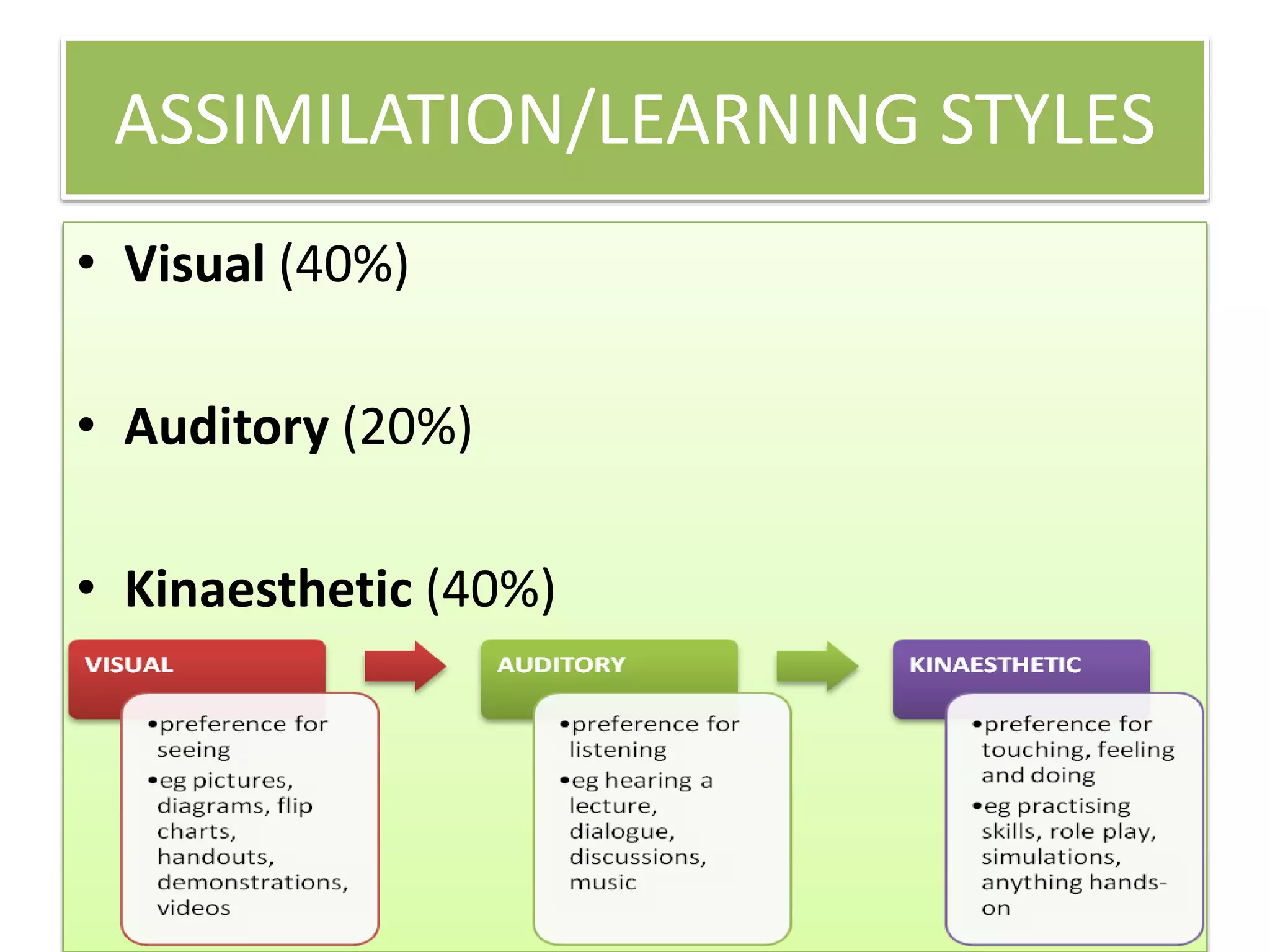
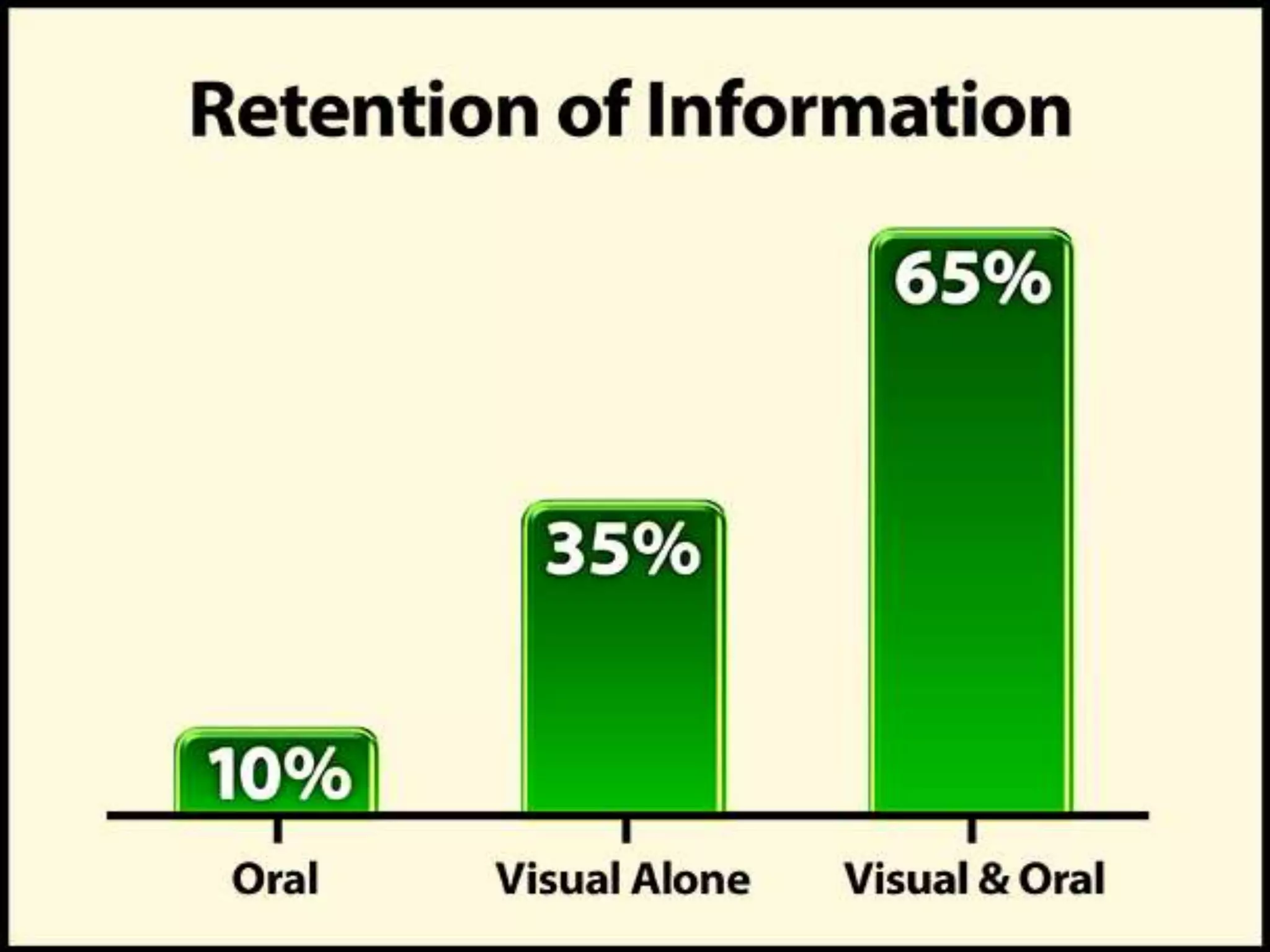
ASSIMILATION/LEARNING STYLES 
• Visual (40%) 
• Auditory (20%) 
• Kinaesthetic (40%)
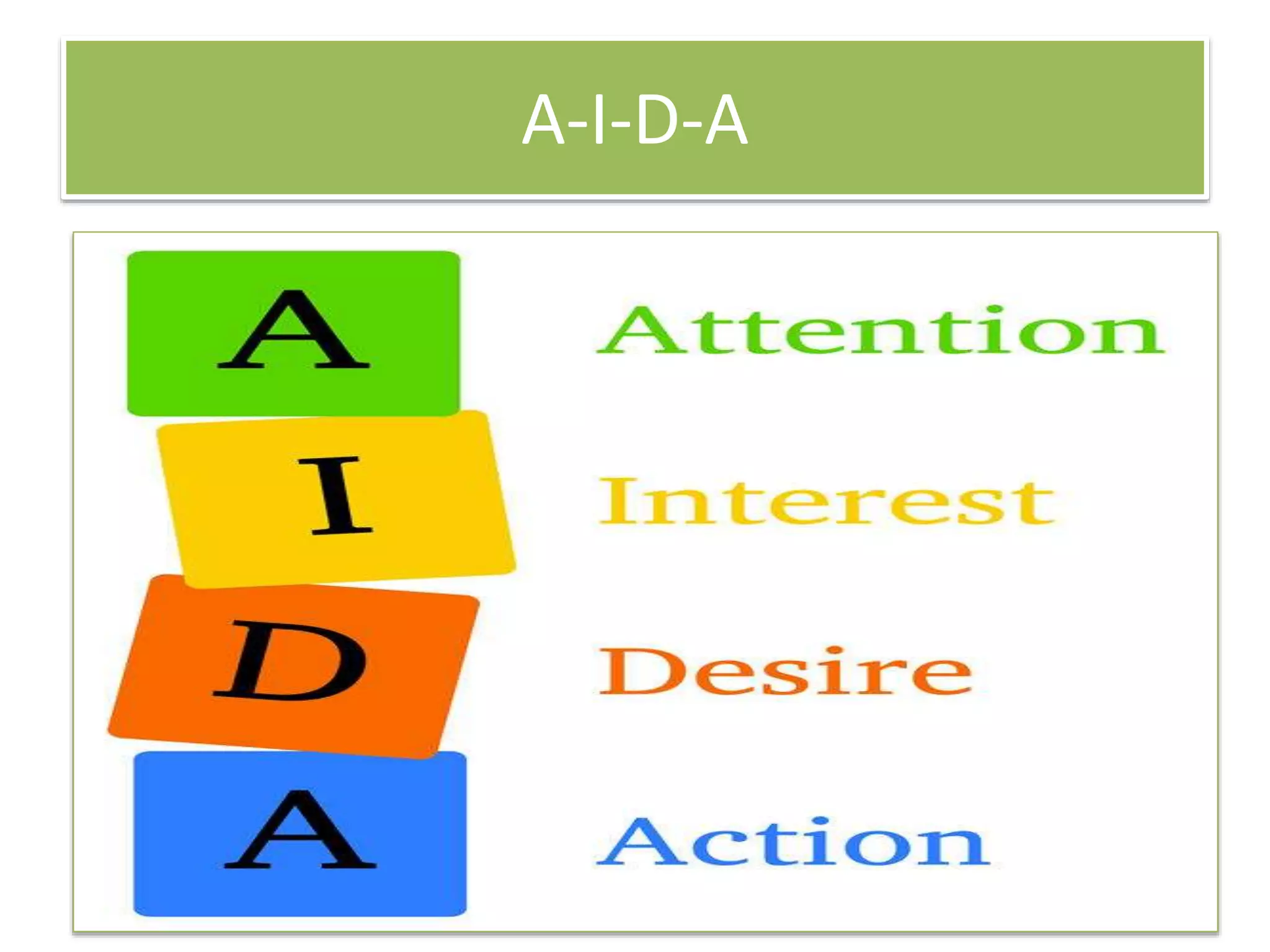
A-I-D-A
STARTING THE PRESENTATION (WITH A 
BANG) 
• Get people's attention (refer to AIDA) 
• Welcome them 
• Introduce yourself 
• State the purpose of your presentation 
• State how you want to deal with questions 
• Try to find a friendly face in audience (to relax your nerves) 
• High impact (captivating and/or startling), good impression 
(credibility) and try to win over (persuade) the audience
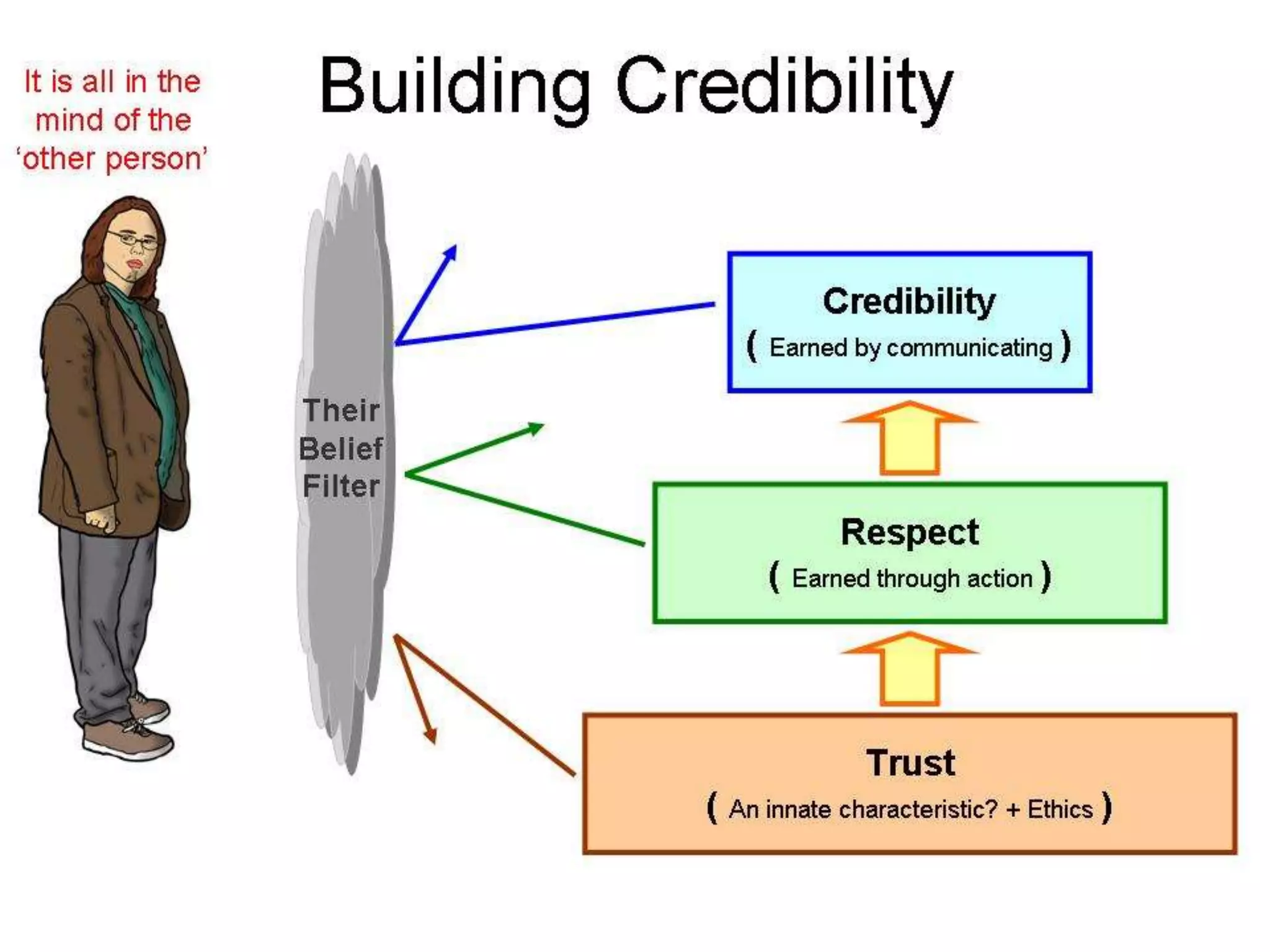
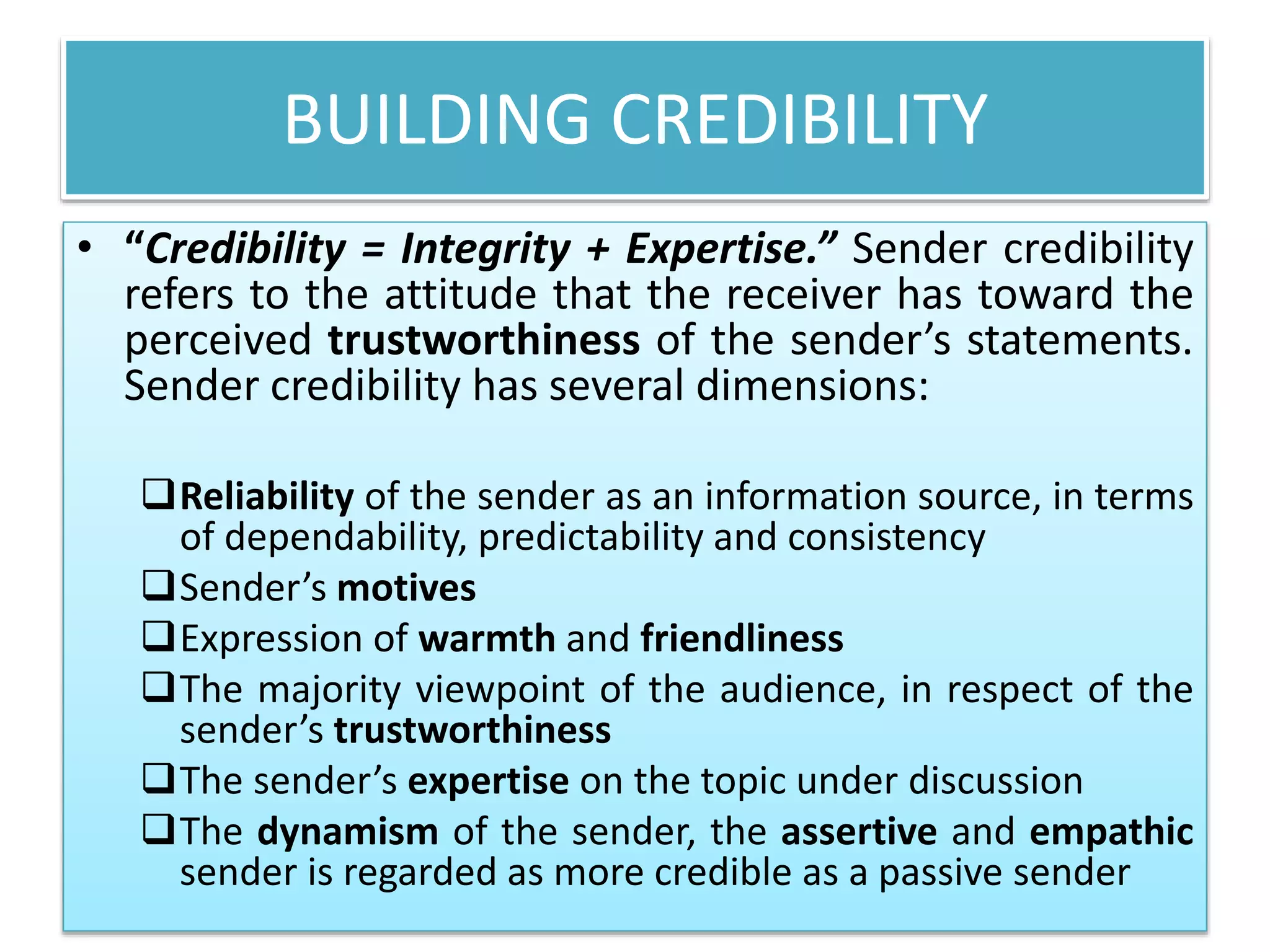
BUILDING CREDIBILITY 
• “Credibility = Integrity + Expertise.” Sender credibility 
refers to the attitude that the receiver has toward the 
perceived trustworthiness of the sender’s statements. 
Sender credibility has several dimensions: 
Reliability of the sender as an information source, in terms 
of dependability, predictability and consistency 
Sender’s motives 
Expression of warmth and friendliness 
The majority viewpoint of the audience, in respect of the 
sender’s trustworthiness 
The sender’s expertise on the topic under discussion 
The dynamism of the sender, the assertive and empathic 
sender is regarded as more credible as a passive sender
DELIVERY OF THE PRESENTATION 
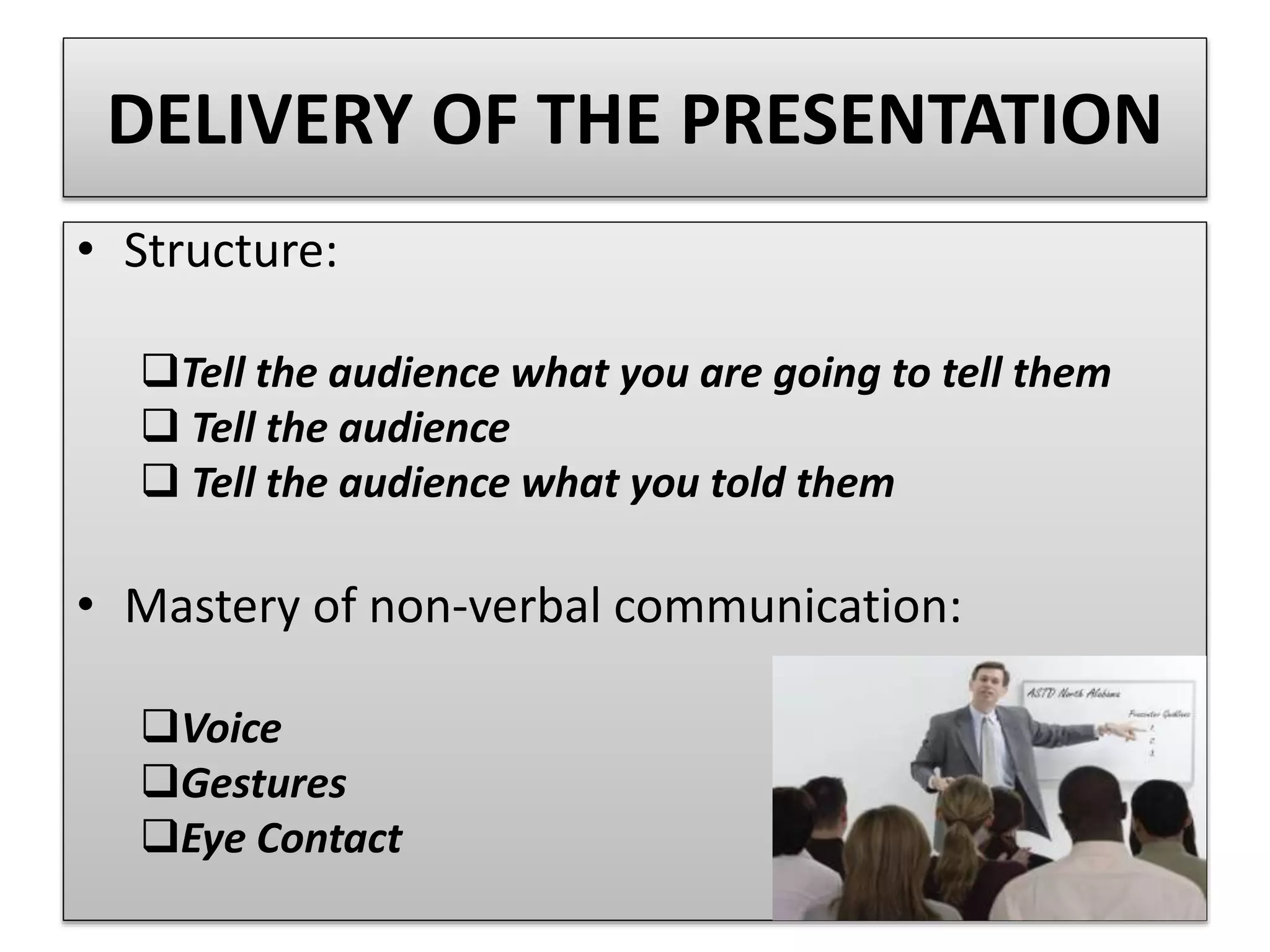
• Structure: 
Tell the audience what you are going to tell them 
 Tell the audience 
 Tell the audience what you told them 
• Mastery of non-verbal communication: 
Voice 
Gestures 
Eye Contact
PROPER VISUAL TECHNIQUE 
• Ensure proper and effective technique during the 
utilisation of visual aids and equipment. 
• Learn to direct the audience’s focus where you want it. 
• When you use visual aids, the audiences’ focus is 
divided. To ‘win them back” you need to redirect 
focus. This is usually done by closing down the visuals 
and/or taking a step or two towards the audience. 
• Seamless, well-coordinated and efficient transitioning 
between visual cues/slides
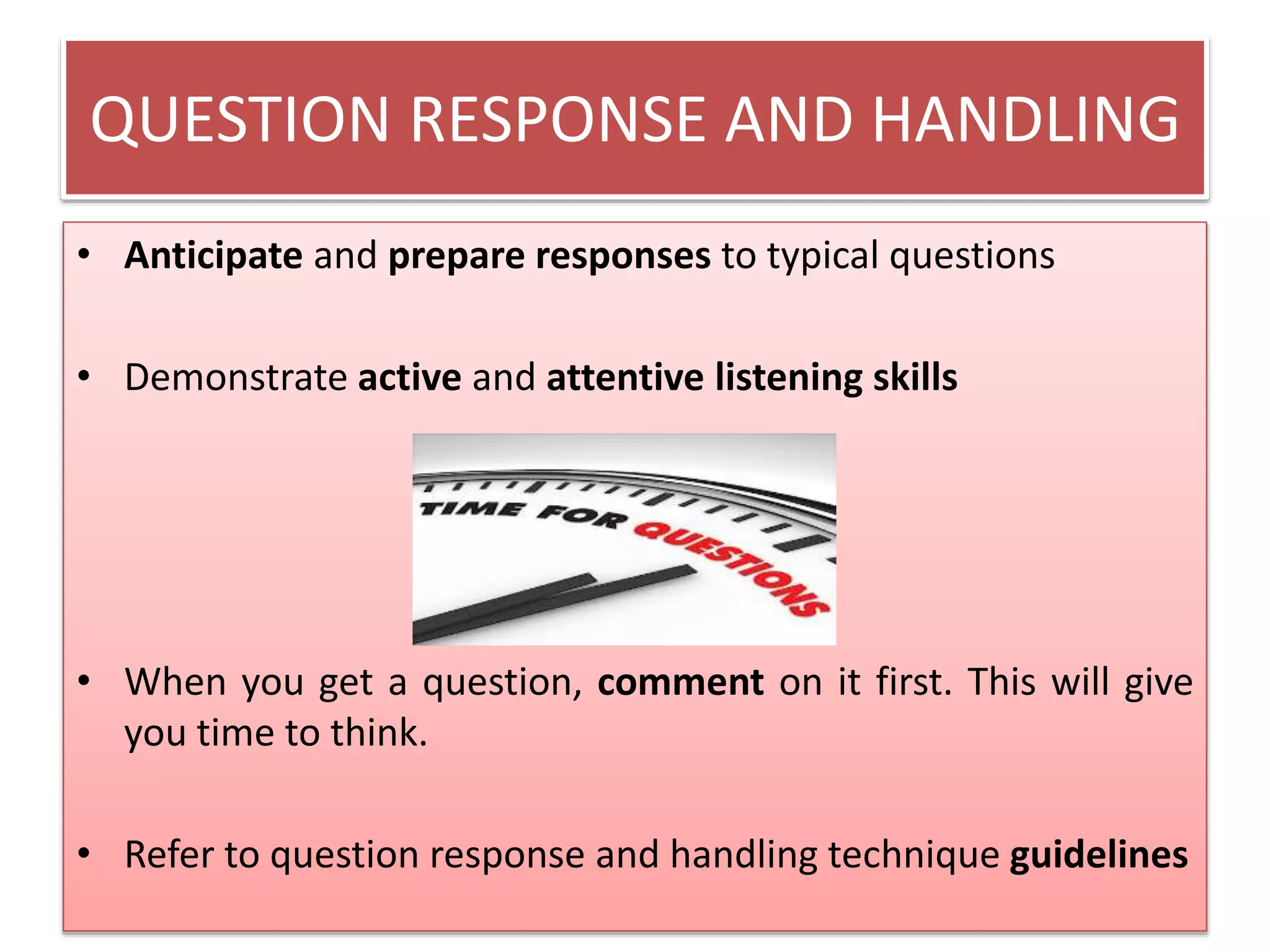
QUESTION RESPONSE AND HANDLING 
• Anticipate and prepare responses to typical questions 
• Demonstrate active and attentive listening skills 
• When you get a question, comment on it first. This will give 
you time to think. 
• Refer to question response and handling technique guidelines
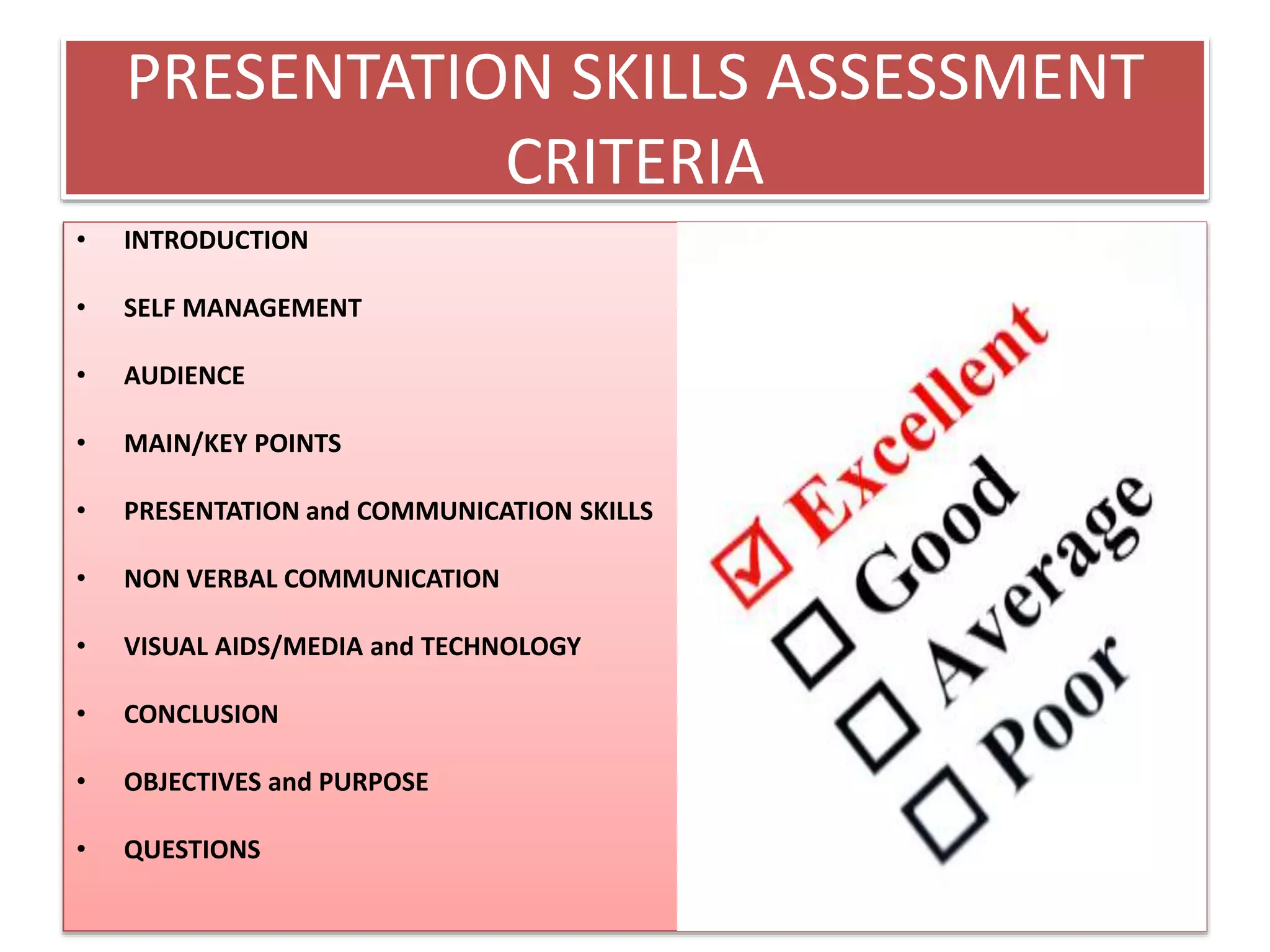
PRESENTATION SKILLS ASSESSMENT 
CRITERIA 
• INTRODUCTION 
• SELF MANAGEMENT 
• AUDIENCE 
• MAIN/KEY POINTS 
• PRESENTATION and COMMUNICATION SKILLS 
• NON VERBAL COMMUNICATION 
• VISUAL AIDS/MEDIA and TECHNOLOGY 
• CONCLUSION 
• OBJECTIVES and PURPOSE 
• QUESTIONS
CONCLUSION 
• Key points 
• Summary 
• Questions
CONTACT DETAILS 
• Charles Cotter 
• (+27) 84 562 9446 
• charlescot@polka.co.za 
• LinkedIn 
• Twitter: Charles_Cotter

Interpersonal Communication & Presentation Skills

  • 1.
    MPUMALANGA DEPARTMENT OFLABOUR CHARLES COTTER 29-30 SEPTEMBER 2014
  • 2.
    TRAINING PROGRAMME OVERVIEW • Defining effective interpersonal communication • Mastering the interpersonal communication process • Understanding and applying Non-verbal communication (NVC) • Applying the primary communication skills • Understanding the characteristics of interpersonal style • Mastering the other essential skills required to optimize presentations • Effective business presentations framework • Practical Assessment session
  • 3.
    DEFINING EFFECTIVE COMMUNICATION • Communication is more than merely imparting meaning – it must also be understood. • Fundamental definition of effective communication is when the intended message of the sender is correctly interpreted, understood and acted upon by the recipient/listener. • Communication is the lifeblood of teams. No team or organization can exist without communication i.e. the transference of meaning among its team members. • It is only through transmitting meaning from one person to another that information and ideas can be conveyed.
  • 4.
  • 5.
  • 6.
    PRIMARY COMMUNICATION SKILLS • Informing skills – the ability to articulate and express ideas and thoughts (as sender) • Listening skills – the ability to listen attentively and actively (as receiver) • The ability to express, read, interpret and respond appropriately to non-verbal communication
  • 8.
    INTERPERSONAL STYLE •Director • Socializer • Relater • Thinker
  • 9.
    BARRIERS TO EFFECTIVE COMMUNICATION
  • 10.
    BARRIERS TO EFFECTIVE COMMUNICATION • Intra-personal • Interpersonal • Structural • Physical, technological and/or environmental
  • 11.
    COMMUNICATION IMPROVEMENT STRATEGIES • Plan what you want to say and how you will say it • Use multiple channels and mediums • Tailor the message to the audience • Use clear, simple and understandable language • Empathize with others • Remember the value of face-to-face communication when dealing with change
  • 12.
    COMMUNICATION IMPROVEMENT STRATEGIES • Use two-way communication • Practice active listening • Match your words and actions (congruency) • Ask for feedback/questions to confirm understanding • Use the grapevine (as a source of employee issues) • Use feedback • Use assertive communication
  • 13.
    DEFINING NON-VERBAL COMMUNICATION(NVC) • Non-verbal communication is usually understood as the process of communication through sending and receiving wordless (mostly visual) cues between people. • Face-to-face interaction, NVC can be classified into three principal areas:  Environmental conditions where communication takes place  Physical characteristics of the communicators  Behaviours of communicators during interaction
  • 14.
  • 15.
  • 16.
  • 17.
  • 18.
    JOHARI’S WINDOW •Designed to understand the communication process between people and consists of varying degrees of information held in common between two people as well as methods that can be used to increase the size of one’s window. • Communication will be enhanced if the Arena is increased in size by:  Exposure of self to others  Soliciting feedback from others • Exposure requires an open, candid and trusting approach, while feedback requires an active solicitation of feelings, opinions and values from others. • For these processes to be fully developed, reciprocity is required.
  • 19.
  • 20.
  • 21.
    FUNDAMENTALS OF PRESENTATIONS • Public speaking is the process of speaking to a group of people in a structured, deliberate manner intended to:  Inform  Influence and/or  Entertain the listeners • In public speaking, as in any form of communication, there are five basic elements, often expressed as "who is saying what to whom using what medium with what effects?" • The purpose of public speaking can range from simply transmitting information, to motivating people to act, to simply telling a story. Good orators should be able to change the emotions of their listeners, not just inform them.
  • 22.
  • 23.
    CHARACTERISTICS OF AGOOD PRESENTER • Good eye contact • Confident manner • Interesting voice • Appropriate pace • Knowledge • Enthusiasm • Imagination
  • 24.
    SECRETS OF AGOOD PRESENTATION • Clear objectives • Logical structure • Visuals (as required) • Thorough and proper preparation • Correct pitch • Opportunity for questions
  • 25.
    PRESENTATION ICEBERG •PUT IT ACROSS (PIA) – Delivery • PUT IT TOGETHER (PIT) – Planning and Preparation
  • 26.
    PRESENTATION FRAMEWORK •Planning and preparation • Audience analysis • Self Management (dealing with your nerves and building confidence) • Materials, Visual Aids and Technology • Rehearsal • Impact, Impression and Influence • Delivery
  • 27.
    PLANNING AND PREPARATION • Brainstorm/generate main/key and sub ideas • Define the purpose and objectives • Conduct research and tap into expertise/intellectual capital • Spell out the advantages to the audience • Plan and structure the content • Develop a powerful and captivating introduction • Develop a conclusion (call to action)
  • 28.
    AUDIENCE ANALYSIS •Analysis (Who are they? How many will be there?) • Understanding (What is their knowledge of the subject?) • Demographics (What is their age, sex, educational background?) • Interest (Why are they there? Who asked them to be there?) • Environment (Where will I stand - can they all see and hear me?) • Needs (What are their needs? What are your needs as a speaker?) • Customized (What specific needs do you need to address?) • Expectations (What do they expect to learn or hear from you?)
  • 29.
    SELF MANAGEMENT •Total preparation – physically, mentally, emotionally and psychologically. • The ability to get those “butterflies to fly in formation” is at the heart of dealing effectively with this nervous tension and stress. • Having peace of mind – you know your material, know/analyzed your audience and your preparation is meticulous • Personal appearance is also important – “if you look good – you feel good.” • Self-confidence • Remain focused and maintain high levels of concentration and manage your emotions and gestures. • Repeat positive affirmations
  • 30.
    MATERIALS, VISUAL AIDSAND TECHNOLOGY • Ensure that your materials are relevant, appropriate, suitably pitched, support the achievement of objectives and value adding to the audience. • They should be a quality product – provide accurate information and free of errors. Pay attention to the finer points - “Sweat the detail” • Design materials to help people listen – organize, illustrate and repeat. • Critical success factors (with visuals) • Ways of adding variety
  • 31.
    REHEARSAL • Itis vital to practice, practise and practice (some more) – in front of the mirror, for a spouse/colleague – to ensure successful delivery of your presentation. • Saying the words out aloud helps you to hear and pick up on any flaws, which can be rectified. It also enables you to work out and ascertain the following important aspects of your presentation:  Pacing/tempo  Timing/duration  Coherence  Logical structuring  Sequencing (of your thoughts and ideas)
  • 32.
    POWERPOINT SLIDES •Avoid “Death by PowerPoint.” • Receive training in the use of Powerpoint – it is a specialized, computer skill • Use one slide per main point • Don’t clutter the slides with too much information (use bullet points only) • Practice (as part of your rehearsal) the transition between the slides • NB: Remember visual aids are for the benefit of your audience, and not for your convenience to read information from word-for-word • NB: Forget High-tech, media centred presentations - rather focus on a HIGH TOUCH presentation. Your interaction, rapport, “chemistry”, engagement and connection with the audience will differentiate an average from a memorable presentation.
  • 34.
    ASSIMILATION/LEARNING STYLES •Visual (40%) • Auditory (20%) • Kinaesthetic (40%)
  • 36.
  • 37.
    STARTING THE PRESENTATION(WITH A BANG) • Get people's attention (refer to AIDA) • Welcome them • Introduce yourself • State the purpose of your presentation • State how you want to deal with questions • Try to find a friendly face in audience (to relax your nerves) • High impact (captivating and/or startling), good impression (credibility) and try to win over (persuade) the audience
  • 39.
    BUILDING CREDIBILITY •“Credibility = Integrity + Expertise.” Sender credibility refers to the attitude that the receiver has toward the perceived trustworthiness of the sender’s statements. Sender credibility has several dimensions: Reliability of the sender as an information source, in terms of dependability, predictability and consistency Sender’s motives Expression of warmth and friendliness The majority viewpoint of the audience, in respect of the sender’s trustworthiness The sender’s expertise on the topic under discussion The dynamism of the sender, the assertive and empathic sender is regarded as more credible as a passive sender
  • 40.
    DELIVERY OF THEPRESENTATION • Structure: Tell the audience what you are going to tell them  Tell the audience  Tell the audience what you told them • Mastery of non-verbal communication: Voice Gestures Eye Contact
  • 41.
    PROPER VISUAL TECHNIQUE • Ensure proper and effective technique during the utilisation of visual aids and equipment. • Learn to direct the audience’s focus where you want it. • When you use visual aids, the audiences’ focus is divided. To ‘win them back” you need to redirect focus. This is usually done by closing down the visuals and/or taking a step or two towards the audience. • Seamless, well-coordinated and efficient transitioning between visual cues/slides
  • 42.
    QUESTION RESPONSE ANDHANDLING • Anticipate and prepare responses to typical questions • Demonstrate active and attentive listening skills • When you get a question, comment on it first. This will give you time to think. • Refer to question response and handling technique guidelines
  • 43.
    PRESENTATION SKILLS ASSESSMENT CRITERIA • INTRODUCTION • SELF MANAGEMENT • AUDIENCE • MAIN/KEY POINTS • PRESENTATION and COMMUNICATION SKILLS • NON VERBAL COMMUNICATION • VISUAL AIDS/MEDIA and TECHNOLOGY • CONCLUSION • OBJECTIVES and PURPOSE • QUESTIONS
  • 44.
    CONCLUSION • Keypoints • Summary • Questions
  • 45.
    CONTACT DETAILS •Charles Cotter • (+27) 84 562 9446 • charlescot@polka.co.za • LinkedIn • Twitter: Charles_Cotter