IV. Key Distinctions with respect to
Organizational Communication
I. Vertical Communication
 Definition
 Types
 Upward Communication
 Downward
Communication
 Merits and Demerits
 Upward vs. Downward
Communication
 Limitations of Upward and
Downward Communication
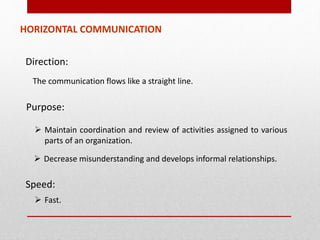
II. Horizontal Communication
 Definition
 Direction, Purpose, &
Speed
 Merits and Demerits
 Limitations
III. Diagonal Communication
 Definition
 Direction, Purpose, &
Speed
 Merits and Demerits
 Limitations
C. DIRECTIONS OF COMMUNICATION
D. INTERNAL VERSUS EXTERNAL COMMUNICATION
I. Internal Communication
 Definition
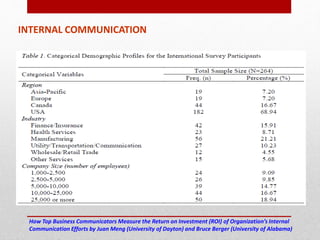
 Importance
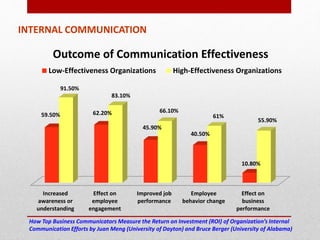
 Study: Outcome of
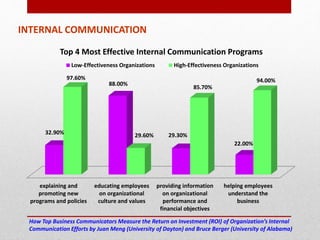
Communication
Effectiveness
 Study: Top 4 Most Effective
Internal Communication
Programs
II. External Communication
 Definition
 Importance
III. Comparison between Internal
and External Communication
IV. Illustration of Internal and
External Communication
COMMUNICATION ON THE BASIS OF DIRECTION
Communication is multidimensional or multidirectional.
There are various directions in which it flows. Within the
organization, communication may flow inter scalar or intra
scalar, upward or downward.
Let's understand these directions :
a) Vertical
b) Horizontal or lateral
c) Diagonal or crosswise
VERTICAL COMMUNICATION
Vertical communication occurs between hierarchically positioned
persons and can involve both downward and upward communication
flows.
It may use both written and oral such as:
 Instructions
 Letters
 Memoranda
 Bulletin Boards
 Meetings
 In-house Journal
Definition:
VERTICAL COMMUNICATION
 Upward Communication
Two (2) Types of Vertical Communication:
 Downward Communication
UPWARD COMMUNICATION
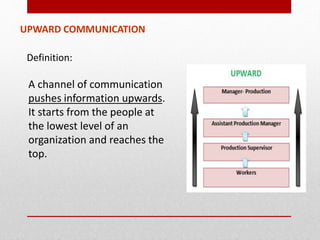
A channel of communication
pushes information upwards.
It starts from the people at
the lowest level of an
organization and reaches the
top.
Definition:
DOWNWARD COMMUNICATION
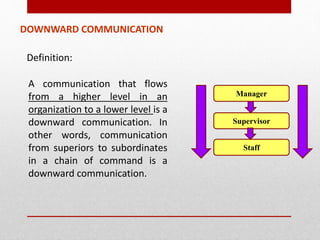
A communication that flows
from a higher level in an
organization to a lower level is a
downward communication. In
other words, communication
from superiors to subordinates
in a chain of command is a
downward communication.
Definition:
Manager
Supervisor
Staff
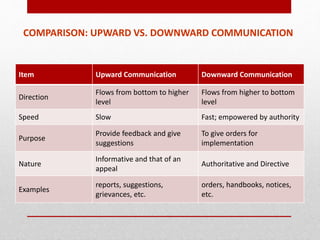
Item Upward Communication Downward Communication
Direction
Flows from bottom to higher
level
Flows from higher to bottom
level
Speed Slow Fast; empowered by authority
Purpose
Provide feedback and give
suggestions
To give orders for
implementation
Nature
Informative and that of an
appeal
Authoritative and Directive
Examples
reports, suggestions,
grievances, etc.
orders, handbooks, notices,
etc.
COMPARISON: UPWARD VS. DOWNWARD COMMUNICATION
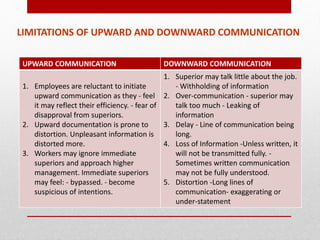
UPWARD COMMUNICATION DOWNWARD COMMUNICATION
1. Employees are reluctant to initiate
upward communication as they - feel
it may reflect their efficiency. - fear of
disapproval from superiors.
2. Upward documentation is prone to
distortion. Unpleasant information is
distorted more.
3. Workers may ignore immediate
superiors and approach higher
management. Immediate superiors
may feel: - bypassed. - become
suspicious of intentions.
1. Superior may talk little about the job.
- Withholding of information
2. Over-communication - superior may
talk too much - Leaking of
information
3. Delay - Line of communication being
long.
4. Loss of Information -Unless written, it
will not be transmitted fully. -
Sometimes written communication
may not be fully understood.
5. Distortion -Long lines of
communication- exaggerating or
under-statement
LIMITATIONS OF UPWARD AND DOWNWARD COMMUNICATION
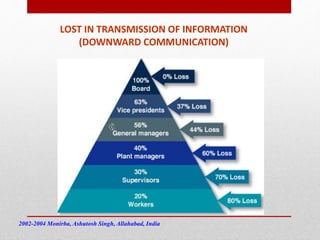
LOST IN TRANSMISSION OF INFORMATION
(DOWNWARD COMMUNICATION)
2002-2004 Monirba, Ashutosh Singh, Allahabad, India
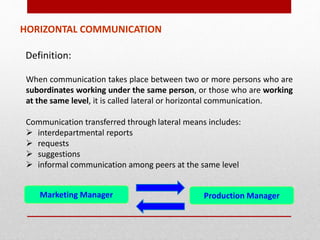
When communication takes place between two or more persons who are
subordinates working under the same person, or those who are working
at the same level, it is called lateral or horizontal communication.
Communication transferred through lateral means includes:
 interdepartmental reports
 requests
 suggestions
 informal communication among peers at the same level
HORIZONTAL COMMUNICATION
Definition:
Production ManagerMarketing Manager
HORIZONTAL COMMUNICATION
Direction:
The communication flows like a straight line.
Purpose:
 Maintain coordination and review of activities assigned to various
parts of an organization.
 Decrease misunderstanding and develops informal relationships.
Speed:
 Fast.
HORIZONTAL COMMUNICATION
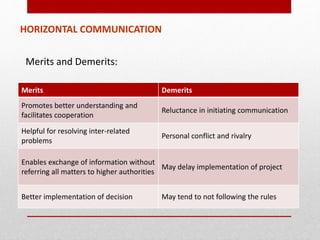
Merits Demerits
Promotes better understanding and
facilitates cooperation
Reluctance in initiating communication
Helpful for resolving inter-related
problems
Personal conflict and rivalry
Enables exchange of information without
referring all matters to higher authorities
May delay implementation of project
Better implementation of decision May tend to not following the rules
Merits and Demerits:
HORIZONTAL COMMUNICATION
Limitations:
1. Lateral communication may give birth to gossip. It can be used for
rumor on-going and spreading false information.
2. Good ideas may get suppressed because such communication
often comes without authority or sanction for implementation.
3. Lateral communication can be effective only if there is proper
coordination.
4. Subordinates making commitments / passing information
beyond their authority.
5. Harmful if subordinates do not inform superiors of
interdepartmental activities.
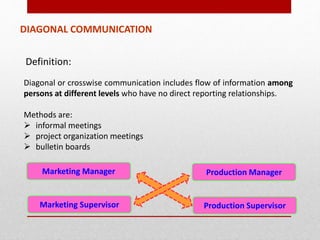
Diagonal or crosswise communication includes flow of information among
persons at different levels who have no direct reporting relationships.
Methods are:
 informal meetings
 project organization meetings
 bulletin boards
DIAGONAL COMMUNICATION
Definition:
Production ManagerMarketing Manager
Production SupervisorMarketing Supervisor
DIAGONAL COMMUNICATION
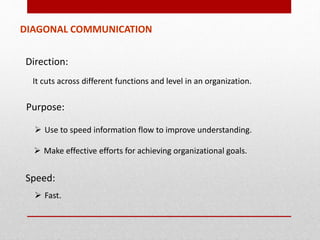
Direction:
It cuts across different functions and level in an organization.
Purpose:
 Use to speed information flow to improve understanding.
 Make effective efforts for achieving organizational goals.
Speed:
 Fast.
DIAGONAL COMMUNICATION
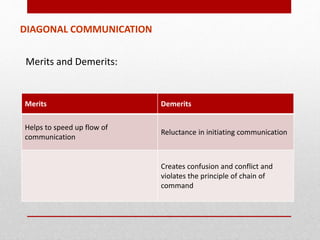
Merits and Demerits:
Merits Demerits
Helps to speed up flow of
communication
Reluctance in initiating communication
Creates confusion and conflict and
violates the principle of chain of
command
DIAGONAL COMMUNICATION
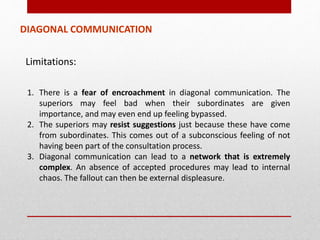
Limitations:
1. There is a fear of encroachment in diagonal communication. The
superiors may feel bad when their subordinates are given
importance, and may even end up feeling bypassed.
2. The superiors may resist suggestions just because these have come
from subordinates. This comes out of a subconscious feeling of not
having been part of the consultation process.
3. Diagonal communication can lead to a network that is extremely
complex. An absence of accepted procedures may lead to internal
chaos. The fallout can then be external displeasure.
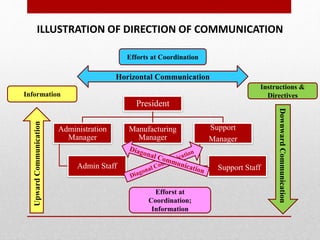
President
Administration
Manager
Admin Staff
Manufacturing
Manager
Support
Manager
Support Staff
UpwardCommunication
DownwardCommunication
Horizontal Communication
Information
Instructions &
Directives
Efforts at Coordination
Efforst at
Coordination;
Information
ILLUSTRATION OF DIRECTION OF COMMUNICATION
INTERNAL COMMUNICATION
Definition of Internal Communication:
A process of exchanging information among the people of different level or
internal participants within the organization.
It can take many forms, such as:
 face‐to-face casual conversations
 formal meetings
 phone calls
 e-mails
 memoranda
 internal wikis
INTERNAL COMMUNICATION
Definition of Internal Communication:
Broadly speaking, internal communication represents the
communication and the interactions among the members of an
organization. It targets the internal members of an organization,
including the superiors, the collaborators and the subordinates. It is
viewed as an essential process, based on which the staff exchanges
information, establishes relationships, forms a system of values,
creates an organizational culture, harmonizes the activities,
collaborates for the achievement of goals and develops formal and
informal networks (Berger, 2009).
Importance:
 Achieve the organizational goals, co-ordination among the activities of
various departments
INTERNAL COMMUNICATION
 Effective control over all matters.
 Motivate the employees of an organization
 Run the business effectively and efficiently a manager must have the
proper knowledge regarding the resources of the organization.
 Ensure the smooth operation of routine activities of an organization.
 Smooth functioning of an organization and for higher productivity
there must be mutual trust between management and employees.
 Participation of the employees in the decision making process not only
increase the quality of decision but also ensure the better
implementation of decision.
INTERNAL COMMUNICATION
 FEIEA’s (the Federation of Business Communicator
Associations in Europe) recently announced headline
results of its latest survey among nearly 5,000
practicing workplace communicators highlights the
above findings of internal communications being a key
success factor for 79% of organizations.
Definition of External Communication:
An informal exchange of information and messages between an
organization and other organizations, groups or individuals
outside its formal structure. It is very important corporate
communication element. It is crucial for creating brand image and
identity. It aims at building connections with customers,
stakeholders (Stuart et al., 2007), with institutions, (government)
agencies, administrative offices or other organizations (Juris,
2004).
EXTERNAL COMMUNICATION
Importance:
EXTERNAL COMMUNICATION
 Continuation and good relationship with customers.
 New transaction with prospective customers.
 Put your business in good standing among the general business
community.
 There might be partnership opportunities that can stretch your
communication efforts and resources.
 It can further some of your other communication goals by increasing
awareness among media and customers.
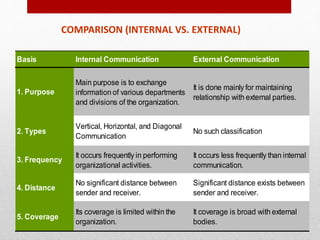
COMPARISON (INTERNAL VS. EXTERNAL)
Basis Internal Communication External Communication
1. Purpose
Main purpose is to exchange
information of various departments
and divisions of the organization.
It is done mainly for maintaining
relationship with external parties.
2. Types
Vertical, Horizontal, and Diagonal
Communication
No such classification
3. Frequency
It occurs frequently in performing
organizational activities.
It occurs less frequently than internal
communication.
4. Distance
No significant distance between
sender and receiver.
Significant distance exists between
sender and receiver.
5. Coverage
Its coverage is limited within the
organization.
It coverage is broad with external
bodies.
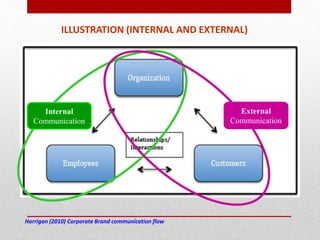
ILLUSTRATION (INTERNAL AND EXTERNAL)
Horrigan (2010) Corporate Brand communication flow
Internal
Communication
External
Communication
INTERNAL COMMUNICATION
How Top Business Communicators Measure the Return on Investment (ROI) of Organization’s Internal
Communication Efforts by Juan Meng (University of Dayton) and Bruce Berger (University of Alabama)
INTERNAL COMMUNICATION
How Top Business Communicators Measure the Return on Investment (ROI) of Organization’s Internal
Communication Efforts by Juan Meng (University of Dayton) and Bruce Berger (University of Alabama)
Increased
awareness or
understanding
Effect on
employee
engagement
Improved job
performance
Employee
behavior change
Effect on
business
performance
59.50% 62.20%
45.90%
40.50%
10.80%
91.50%
83.10%
66.10%
61%
55.90%
Outcome of Communication Effectiveness
Low-Effectiveness Organizations High-Effectiveness Organizations
INTERNAL COMMUNICATION
How Top Business Communicators Measure the Return on Investment (ROI) of Organization’s Internal
Communication Efforts by Juan Meng (University of Dayton) and Bruce Berger (University of Alabama)
explaining and
promoting new
programs and policies
educating employees
on organizational
culture and values
providing information
on organizational
performance and
financial objectives
helping employees
understand the
business
32.90%
88.00%
29.30%
22.00%
97.60%
29.60%
85.70%
94.00%
Top 4 Most Effective Internal Communication Programs
Low-Effectiveness Organizations High-Effectiveness Organizations
http://www.authorstream.com/Presentation/monirba48-1614979-iii-
organizational-communication/
REFERENCES:
http://thebusinesscommunication.com/advantages-of-internal-communication/
http://smallbusiness.chron.com/importance-external-business-communication-
19304.html
http://www.businesscommunicationarticles.com/lateral-horizontal-communication-
definition/
http://thebusinesscommunication.com/importance-of-horizontal-
communication/
Organizational Internal Communication as a means of Improving Efficiency,
Eva Tariszka-Semegine, PhD, Hungary
REFERENCES:
http://www.slideshare.net/guptayuvraj/organizational-communication-
12972727
http://www.slideshare.net/shwetharapol/pooja-ob?qid=bd397d2c-78b8-
4938-8921-21f4db6a08d8&v=default&b=&from_search=10
http://www.yourarticlelibrary.com/business-communication/business-
communication-4-directions-of-business-communication-explained/27652/
http://www.dineshbakshi.com/igcse-business-studies/people-at-
work/revision-notes/840-direction-of-flow-of-communication
http://www.aiu.edu/publications/student/english/BUSINESS%20COMMUNICATIO
N.html
2009, Business Communication by Sathya Swaroop Debasish and Bhagaban Das

Organizational Communication (Key Distinctions)

  • 1.
    IV. Key Distinctionswith respect to Organizational Communication
  • 2.
    I. Vertical Communication Definition  Types  Upward Communication  Downward Communication  Merits and Demerits  Upward vs. Downward Communication  Limitations of Upward and Downward Communication II. Horizontal Communication  Definition  Direction, Purpose, & Speed  Merits and Demerits  Limitations III. Diagonal Communication  Definition  Direction, Purpose, & Speed  Merits and Demerits  Limitations C. DIRECTIONS OF COMMUNICATION
  • 3.
    D. INTERNAL VERSUSEXTERNAL COMMUNICATION I. Internal Communication  Definition  Importance  Study: Outcome of Communication Effectiveness  Study: Top 4 Most Effective Internal Communication Programs II. External Communication  Definition  Importance III. Comparison between Internal and External Communication IV. Illustration of Internal and External Communication
  • 4.
    COMMUNICATION ON THEBASIS OF DIRECTION Communication is multidimensional or multidirectional. There are various directions in which it flows. Within the organization, communication may flow inter scalar or intra scalar, upward or downward. Let's understand these directions : a) Vertical b) Horizontal or lateral c) Diagonal or crosswise
  • 5.
    VERTICAL COMMUNICATION Vertical communicationoccurs between hierarchically positioned persons and can involve both downward and upward communication flows. It may use both written and oral such as:  Instructions  Letters  Memoranda  Bulletin Boards  Meetings  In-house Journal Definition:
  • 6.
    VERTICAL COMMUNICATION  UpwardCommunication Two (2) Types of Vertical Communication:  Downward Communication
  • 7.
    UPWARD COMMUNICATION A channelof communication pushes information upwards. It starts from the people at the lowest level of an organization and reaches the top. Definition:
  • 8.
    DOWNWARD COMMUNICATION A communicationthat flows from a higher level in an organization to a lower level is a downward communication. In other words, communication from superiors to subordinates in a chain of command is a downward communication. Definition: Manager Supervisor Staff
  • 9.
    Item Upward CommunicationDownward Communication Direction Flows from bottom to higher level Flows from higher to bottom level Speed Slow Fast; empowered by authority Purpose Provide feedback and give suggestions To give orders for implementation Nature Informative and that of an appeal Authoritative and Directive Examples reports, suggestions, grievances, etc. orders, handbooks, notices, etc. COMPARISON: UPWARD VS. DOWNWARD COMMUNICATION
  • 10.
    UPWARD COMMUNICATION DOWNWARDCOMMUNICATION 1. Employees are reluctant to initiate upward communication as they - feel it may reflect their efficiency. - fear of disapproval from superiors. 2. Upward documentation is prone to distortion. Unpleasant information is distorted more. 3. Workers may ignore immediate superiors and approach higher management. Immediate superiors may feel: - bypassed. - become suspicious of intentions. 1. Superior may talk little about the job. - Withholding of information 2. Over-communication - superior may talk too much - Leaking of information 3. Delay - Line of communication being long. 4. Loss of Information -Unless written, it will not be transmitted fully. - Sometimes written communication may not be fully understood. 5. Distortion -Long lines of communication- exaggerating or under-statement LIMITATIONS OF UPWARD AND DOWNWARD COMMUNICATION
  • 11.
    LOST IN TRANSMISSIONOF INFORMATION (DOWNWARD COMMUNICATION) 2002-2004 Monirba, Ashutosh Singh, Allahabad, India
  • 12.
    When communication takesplace between two or more persons who are subordinates working under the same person, or those who are working at the same level, it is called lateral or horizontal communication. Communication transferred through lateral means includes:  interdepartmental reports  requests  suggestions  informal communication among peers at the same level HORIZONTAL COMMUNICATION Definition: Production ManagerMarketing Manager
  • 13.
    HORIZONTAL COMMUNICATION Direction: The communicationflows like a straight line. Purpose:  Maintain coordination and review of activities assigned to various parts of an organization.  Decrease misunderstanding and develops informal relationships. Speed:  Fast.
  • 14.
    HORIZONTAL COMMUNICATION Merits Demerits Promotesbetter understanding and facilitates cooperation Reluctance in initiating communication Helpful for resolving inter-related problems Personal conflict and rivalry Enables exchange of information without referring all matters to higher authorities May delay implementation of project Better implementation of decision May tend to not following the rules Merits and Demerits:
  • 15.
    HORIZONTAL COMMUNICATION Limitations: 1. Lateralcommunication may give birth to gossip. It can be used for rumor on-going and spreading false information. 2. Good ideas may get suppressed because such communication often comes without authority or sanction for implementation. 3. Lateral communication can be effective only if there is proper coordination. 4. Subordinates making commitments / passing information beyond their authority. 5. Harmful if subordinates do not inform superiors of interdepartmental activities.
  • 16.
    Diagonal or crosswisecommunication includes flow of information among persons at different levels who have no direct reporting relationships. Methods are:  informal meetings  project organization meetings  bulletin boards DIAGONAL COMMUNICATION Definition: Production ManagerMarketing Manager Production SupervisorMarketing Supervisor
  • 17.
    DIAGONAL COMMUNICATION Direction: It cutsacross different functions and level in an organization. Purpose:  Use to speed information flow to improve understanding.  Make effective efforts for achieving organizational goals. Speed:  Fast.
  • 18.
    DIAGONAL COMMUNICATION Merits andDemerits: Merits Demerits Helps to speed up flow of communication Reluctance in initiating communication Creates confusion and conflict and violates the principle of chain of command
  • 19.
    DIAGONAL COMMUNICATION Limitations: 1. Thereis a fear of encroachment in diagonal communication. The superiors may feel bad when their subordinates are given importance, and may even end up feeling bypassed. 2. The superiors may resist suggestions just because these have come from subordinates. This comes out of a subconscious feeling of not having been part of the consultation process. 3. Diagonal communication can lead to a network that is extremely complex. An absence of accepted procedures may lead to internal chaos. The fallout can then be external displeasure.
  • 20.
    President Administration Manager Admin Staff Manufacturing Manager Support Manager Support Staff UpwardCommunication DownwardCommunication HorizontalCommunication Information Instructions & Directives Efforts at Coordination Efforst at Coordination; Information ILLUSTRATION OF DIRECTION OF COMMUNICATION
  • 21.
    INTERNAL COMMUNICATION Definition ofInternal Communication: A process of exchanging information among the people of different level or internal participants within the organization. It can take many forms, such as:  face‐to-face casual conversations  formal meetings  phone calls  e-mails  memoranda  internal wikis
  • 22.
    INTERNAL COMMUNICATION Definition ofInternal Communication: Broadly speaking, internal communication represents the communication and the interactions among the members of an organization. It targets the internal members of an organization, including the superiors, the collaborators and the subordinates. It is viewed as an essential process, based on which the staff exchanges information, establishes relationships, forms a system of values, creates an organizational culture, harmonizes the activities, collaborates for the achievement of goals and develops formal and informal networks (Berger, 2009).
  • 23.
    Importance:  Achieve theorganizational goals, co-ordination among the activities of various departments INTERNAL COMMUNICATION  Effective control over all matters.  Motivate the employees of an organization  Run the business effectively and efficiently a manager must have the proper knowledge regarding the resources of the organization.  Ensure the smooth operation of routine activities of an organization.  Smooth functioning of an organization and for higher productivity there must be mutual trust between management and employees.  Participation of the employees in the decision making process not only increase the quality of decision but also ensure the better implementation of decision.
  • 24.
    INTERNAL COMMUNICATION  FEIEA’s(the Federation of Business Communicator Associations in Europe) recently announced headline results of its latest survey among nearly 5,000 practicing workplace communicators highlights the above findings of internal communications being a key success factor for 79% of organizations.
  • 25.
    Definition of ExternalCommunication: An informal exchange of information and messages between an organization and other organizations, groups or individuals outside its formal structure. It is very important corporate communication element. It is crucial for creating brand image and identity. It aims at building connections with customers, stakeholders (Stuart et al., 2007), with institutions, (government) agencies, administrative offices or other organizations (Juris, 2004). EXTERNAL COMMUNICATION
  • 26.
    Importance: EXTERNAL COMMUNICATION  Continuationand good relationship with customers.  New transaction with prospective customers.  Put your business in good standing among the general business community.  There might be partnership opportunities that can stretch your communication efforts and resources.  It can further some of your other communication goals by increasing awareness among media and customers.
  • 27.
    COMPARISON (INTERNAL VS.EXTERNAL) Basis Internal Communication External Communication 1. Purpose Main purpose is to exchange information of various departments and divisions of the organization. It is done mainly for maintaining relationship with external parties. 2. Types Vertical, Horizontal, and Diagonal Communication No such classification 3. Frequency It occurs frequently in performing organizational activities. It occurs less frequently than internal communication. 4. Distance No significant distance between sender and receiver. Significant distance exists between sender and receiver. 5. Coverage Its coverage is limited within the organization. It coverage is broad with external bodies.
  • 28.
    ILLUSTRATION (INTERNAL ANDEXTERNAL) Horrigan (2010) Corporate Brand communication flow Internal Communication External Communication
  • 29.
    INTERNAL COMMUNICATION How TopBusiness Communicators Measure the Return on Investment (ROI) of Organization’s Internal Communication Efforts by Juan Meng (University of Dayton) and Bruce Berger (University of Alabama)
  • 30.
    INTERNAL COMMUNICATION How TopBusiness Communicators Measure the Return on Investment (ROI) of Organization’s Internal Communication Efforts by Juan Meng (University of Dayton) and Bruce Berger (University of Alabama) Increased awareness or understanding Effect on employee engagement Improved job performance Employee behavior change Effect on business performance 59.50% 62.20% 45.90% 40.50% 10.80% 91.50% 83.10% 66.10% 61% 55.90% Outcome of Communication Effectiveness Low-Effectiveness Organizations High-Effectiveness Organizations
  • 31.
    INTERNAL COMMUNICATION How TopBusiness Communicators Measure the Return on Investment (ROI) of Organization’s Internal Communication Efforts by Juan Meng (University of Dayton) and Bruce Berger (University of Alabama) explaining and promoting new programs and policies educating employees on organizational culture and values providing information on organizational performance and financial objectives helping employees understand the business 32.90% 88.00% 29.30% 22.00% 97.60% 29.60% 85.70% 94.00% Top 4 Most Effective Internal Communication Programs Low-Effectiveness Organizations High-Effectiveness Organizations
  • 32.
  • 33.

Editor's Notes

  • #6 A wealth of evidence shows that increasing the power of immediate supervisors increases both satisfaction and performance among employees. This was first discovered by Donald Pelz (1952) and is commonly referred to as the Pelz effect.
  • #10 > Upward communication leads to a more committed and loyal workforce in an organization because the employees are given a chance to raise and speak dissatisfaction issues to the higher levels. The managers get to know about the employees feelings towards their jobs, peers, supervisor and organization in general. Managers can thus accordingly take actions for improving things. > Larkin and Larkin (1994) suggest that downward communication is most effective if top managers communicate directly with immediate supervisors and immediate supervisors communicate with their staff. According to Morgan and Shieman’s (1983) research in which 30,000 employee were asked, the majority of the employees felt that productivity was not better because of downward communication. The level of satisfaction got lower as we went down the organizational hierarchy. In addition, McCelland (1988) found a number of employee-based reasons why upward communication tends to be poor, including: - Fear of reprisal – people are afraid to speak their minds - Filters – employees feel their ideas/concerns are modified as they get transmitted upward - Time – managers give the impression that they don’t have the time to listen to employees
  • #11 Communication from superiors to subordinates in a chain of command is a downward communication. This communication flow is used by the managers to transmit work-related information to the employees at lower levels.
  • #13 The main use of this dimension of communication is to maintain coordination and review activities assigned to various subordinates.
  • #14 The main use of this dimension of communication is to maintain coordination and review activities assigned to various subordinates.
  • #17 Diagonal communication is used to speed up the flow of information. Example: An accounts clerk sends out a request to all company employees for updated information about the number of exemptions they claim on their tax forms. Staff specialists use cross-channel communication frequently because their responsibilities typically involve many departments within the organization. Because they lack line authority to direct those with whom they communicate, they must often rely on their persuasive skills, as, for instance, when the human resources department encourages employees to complete a job-satisfaction questionnaire.
  • #19 Diagonal communication is used to speed up the flow of information. Example: An accounts clerk sends out a request to all company employees for updated information about the number of exemptions they claim on their tax forms. Staff specialists use cross-channel communication frequently because their responsibilities typically involve many departments within the organization. Because they lack line authority to direct those with whom they communicate, they must often rely on their persuasive skills, as, for instance, when the human resources department encourages employees to complete a job-satisfaction questionnaire.
  • #22 FEIEA’s (the Federation of Business Communicator Associations in Europe) recently announced headline results of its latest survey among nearly 5,000 practicing workplace communicators highlights the above findings of internal communications being a key success factor for 79% of organizations.
  • #23 FEIEA’s (the Federation of Business Communicator Associations in Europe) recently announced headline results of its latest survey among nearly 5,000 practicing workplace communicators highlights the above findings of internal communications being a key success factor for 79% of organizations.
  • #24 FEIEA’s (the Federation of Business Communicator Associations in Europe) recently announced headline results of its latest survey among nearly 5,000 practicing workplace communicators highlights the above findings of internal communications being a key success factor for 79% of organizations.
  • #27 FEIEA’s (the Federation of Business Communicator Associations in Europe) recently announced headline results of its latest survey among nearly 5,000 practicing workplace communicators highlights the above findings of internal communications being a key success factor for 79% of organizations.
  • #28 As far as the functions of the above types of communication are concerned, we can note that internal communication is used primarily: to issue and clarify procedures and policies; to develop new products and services; to convince the employees and the management to make improvements and changes; to coordinate the activities; to evaluate and reward the personnel (Guffey et al., 2010) etc. By comparison, the functions of external communication comprise: requiring information about products and services; convincing the public to purchase the products and services; clarifying the suppliers’ duties; establishing relations with government agencies; promoting the positive image of the organization (Guffey et al., 2010) etc. As hinted, in the life of organizations, both external and internal communications are indispensible.