Expectancy Theory of
     Motivation

      Victor Vroom


                            Srinivas M.N

          (extract from Value Based Management.net)
Expectancy Theory
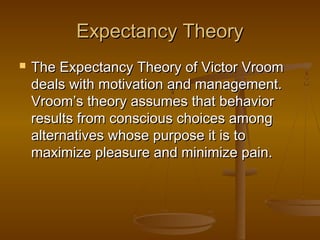
   The Expectancy Theory of Victor Vroom
    deals with motivation and management.
    Vroom’s theory assumes that behavior
    results from conscious choices among
    alternatives whose purpose it is to
    maximize pleasure and minimize pain.
Expectancy Theory             contd.,

   Together with Edward Lawler and Lyman
    Porter, Vroom suggested that the
    relationship between people’s behavior at
    work and their goals was not as simple as
    was first imagined by other scientists.
    Vroom realized that an employee’s
    performance is based on individuals
    factors such as personality, skills,
    knowledge, experience and abilities.
   The expectancy theory says that
    individuals have different sets of goals
    and can be motivated if they believe that :
-   There is a positive correlation between
    efforts and performance
-   Favorable performance will result in
    desirable reward
-   The reward will satisfy an important need
-   The desire to satisfy the need is strong
    enough to make the effort worthwhile.
Vroom’s Expectancy Theory is based upon
the following three beliefs :

1. Valence (Valence refers to the emotional
  orientations people hold with respect to
  outcomes [rewards]. The depth of the
  want of an employee for extrinsic [money,
  promotion, time-off, benefits] or intrinsic
  [satisfaction] rewards). Management must
  discover what employees value.
2. Expectancy (Employees have different
  expectations and levels of confidence
  about what they are capable of doing).
  Management must discover what
  resources, training, or supervision
  employees need.
3. Instrumentality (The perception of
  employees whether they will actually get
  what they desire even if it has been
  promised by a manager). Management
  must ensure that promises of rewards are
  fulfilled and that employees are aware of
  that.
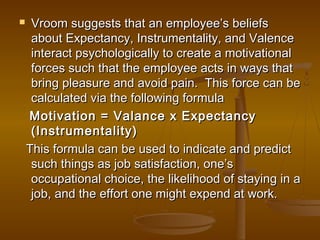
    Vroom suggests that an employee’s beliefs
     about Expectancy, Instrumentality, and Valence
     interact psychologically to create a motivational
     forces such that the employee acts in ways that
     bring pleasure and avoid pain. This force can be
     calculated via the following formula
    Motivation = Valance x Expectancy
     (Instrumentality)
    This formula can be used to indicate and predict
     such things as job satisfaction, one’s
     occupational choice, the likelihood of staying in a
     job, and the effort one might expend at work.

Expectancy theory

  • 1.
    Expectancy Theory of Motivation Victor Vroom Srinivas M.N (extract from Value Based Management.net)
  • 2.
    Expectancy Theory  The Expectancy Theory of Victor Vroom deals with motivation and management. Vroom’s theory assumes that behavior results from conscious choices among alternatives whose purpose it is to maximize pleasure and minimize pain.
  • 3.
    Expectancy Theory contd.,  Together with Edward Lawler and Lyman Porter, Vroom suggested that the relationship between people’s behavior at work and their goals was not as simple as was first imagined by other scientists. Vroom realized that an employee’s performance is based on individuals factors such as personality, skills, knowledge, experience and abilities.
  • 4.
    The expectancy theory says that individuals have different sets of goals and can be motivated if they believe that : - There is a positive correlation between efforts and performance - Favorable performance will result in desirable reward - The reward will satisfy an important need - The desire to satisfy the need is strong enough to make the effort worthwhile.
  • 5.
    Vroom’s Expectancy Theoryis based upon the following three beliefs : 1. Valence (Valence refers to the emotional orientations people hold with respect to outcomes [rewards]. The depth of the want of an employee for extrinsic [money, promotion, time-off, benefits] or intrinsic [satisfaction] rewards). Management must discover what employees value.
  • 6.
    2. Expectancy (Employeeshave different expectations and levels of confidence about what they are capable of doing). Management must discover what resources, training, or supervision employees need.
  • 7.
    3. Instrumentality (Theperception of employees whether they will actually get what they desire even if it has been promised by a manager). Management must ensure that promises of rewards are fulfilled and that employees are aware of that.
  • 8.
    Vroom suggests that an employee’s beliefs about Expectancy, Instrumentality, and Valence interact psychologically to create a motivational forces such that the employee acts in ways that bring pleasure and avoid pain. This force can be calculated via the following formula Motivation = Valance x Expectancy (Instrumentality) This formula can be used to indicate and predict such things as job satisfaction, one’s occupational choice, the likelihood of staying in a job, and the effort one might expend at work.