Software Quality Management
          Unit – V
                    G oy to y
                    G Roy Antony Arnold
                                      od
                        Asst. Prof. / CSE
and refers
to a development model that was created
after study of d t collected f
 ft     t d     f data     ll t d from
organizations that contracted with the
                                 , who
                                     h
funded the research.
• Th C bilit M t it M d l (CMM) was
  The Capability Maturity Model
  originally developed as


        .
• The CMM is based on the
           first described in the              book
                                          by
             .
• It was later published in a report in         and
  as a book by the same authors in         .
Year                              Version Published
                                      i     bli h d
1987   Software Process maturity framework (Humphrey)
1987   Preliminary maturity questionnaire (Humphrey and Sweet)
1987   Characterizing the software process: a maturity framework (Humphrey)
1989   Managing the software process (Humphrey)
1990   Draft version of CMM (v0.2)
1991   Version for discussion (v0.6)
1991   v1.0: Capability Maturity Model for Software (Paulk et al.) 
       ‘Key Practices for the Capability Maturity Model’ (Weber et al.)
       ‘K        i    f h C bili              i     d l’ (W b       l)

1993   v1.1: Capability Maturity Model for software, version 1.1 (Paulk et al.)
       Key practices for the Capability Maturity Mode, version 1.1 (Paulk et al.)
       Key practices for the Capability Maturity Mode version 1 1 (Paulk et al )
• Th
  Though this comes from the field of 
         h thi          f     th fi ld f
                , it is used as a general model to 
  aid in improving organizational business 
  aid in improving organizational business
  processes in diverse areas; Such as,
• A t it
  A maturity model can be 
                d l      b
                    that describe how well the 
                                       of an 
  organization can 
                      . 
• A t it
  A maturity model may provide, for example :
                d l           id f          l
   –   a place to start
   –   a common language and a shared vision
       a common language and a shared vision
   –   a framework for prioritizing actions
   –   a way to define what improvement means for your 
            y                  p                  y
       organization.
• A maturity model can be used as 
: a 5‐level process maturity continuum ‐ the
5th level where processes would be systematically managed
by a combination of
                        .
                     : a KPA identifies a cluster of related
activities that
           that,                                            .
        the goals of a key process area summarize the states
that must exist for that key process area to have been
                                               .
                     : There are five types of common
                                          yp
features:

                          .
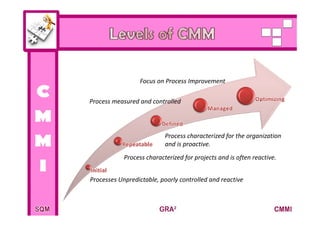
Focus on Process Improvement

Process measured and controlled


                           Process characterized for the organization 
                                                 f         g
                           and is proactive.
            Process characterized for projects and is often reactive.


Processes Unpredictable, poorly controlled and reactive
Level Designation                      Description
 1       Initial    The organization has undefined processes and 
                    controls
                    controls 
 2    Repeatable    The organization has standardized methods 
                    facilitating repeatable processes.

 3      Defined     The organization monitors and improves its 
                    processes
 4     Managed      The organization possesses advanced controls, 
                    metrics and feedback.

 5     Optimizing   The organization uses metrics for optimization 
                    p p
                    purposes.
• L k of I t
  Lack f Integration:
                ti
   – CMM has separate models for each function.
   – Such models often overlap contradict and display
                           overlap, contradict,
     different levels of maturity.
   – This lack of standardization leads to confusions and
     conflicts d i
         fli t during th i l
                         the implementation phase and
                                        t ti    h       d
     increase training and appraisal costs.
• Limitations of KPA:
   – The “Key Performance Areas (KPA),” that define CMM
     levels focus on “policing” activities such as
     specifications,
     specifications     documentation,
                        documentation     audits,
                                          audits     and
     inspections, and do not reveal architecturally
     significant flaws.
• A ti it b d A
  Activity‐based Approach: 
                        h
  – CMM is an activity‐based approach that considers
    only the completion of a specific activity and
                                       activity,
    not whether the completed activity achieved the
    desired results.
• Paperwork: 
  – CMM places great importance on paperwork and 
    meetings that take the management’s time and 
         ti    th t t k th             t’ ti      d
    effort away from actual work processes. 
  – CMM traps the organization in recording and
    CMM traps the organization in recording and 
    complying with processes, often at the cost of 
    strategic goals.
• A l i multiple models that are not i
  Applying     li l    d l h            integratedd
  within and across an organization could be costly
  in training appraisals and improvement
       training, appraisals,
  activities.
• The
  (CMMI) project was formed to sort out the
  p
  problem of using multiple CMMs.
                 g      p
• The Software Engineering Institute at Carnegie
  Mellon University developed Capability Maturity
  Model Integration (CMMI) in 2006 to integrate
  and standardize the separate models of CMM,
  and to eradicate other dra backs of CMM
                         drawbacks CMM.
• CMMI b t practices are published i d
          best      ti           bli h d in documents t
  called models, each of which addresses a different
  area of interest.
• The current release of CMMI, version 1.3, (released in
  November 2010) provides models for three areas of
  interest: development acquisition and services
            development, acquisition,    services.
   – CMMI for Development (CMMI‐DEV) addresses product
     and service development processes.
   – CMMI f A i iti (CMMI ACQ) addresses supply chain
            for Acquisition (CMMI‐ACQ) dd               l h i
     management, acquisition, and outsourcing processes in
     government and industry.
   – CMMI f S i
             for Services (CMMI SVC) addresses guidance f
                           (CMMI‐SVC) dd             id     for
     delivering services within an organization and to external
     customers.
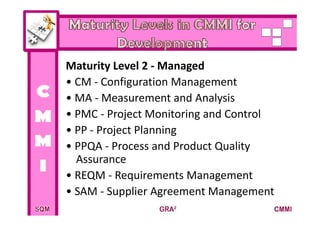
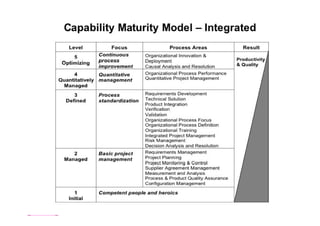
Maturity Level 2 ‐ Managed
       i       l          d
• CM ‐ Configuration Management
             g            g
• MA ‐ Measurement and Analysis
• PMC ‐ Project Monitoring and Control
• PMC Project Monitoring and Control
• PP ‐ Project Planning
• PPQA ‐ Process and Product Quality 
  Assurance
• REQM ‐ Requirements Management
• SAM ‐ Supplier Agreement Management
• SAM Supplier Agreement Management
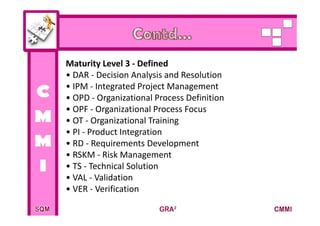
Maturity Level 3 ‐ Defined
M t it L l 3 D fi d
• DAR ‐ Decision Analysis and Resolution
• IPM  Integrated Project Management
• IPM ‐ Integrated Project Management
• OPD ‐ Organizational Process Definition
• OPF ‐ Organizational Process Focus
           g
• OT ‐ Organizational Training
• PI ‐ Product Integration
• RD ‐ Requirements Development
• RSKM ‐ Risk Management
• TS ‐ T h i l S l ti
  TS Technical Solution
• VAL ‐ Validation
• VER 
• VER ‐ Verification
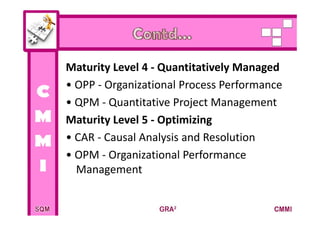
Maturity Level 4 ‐ Quantitatively Managed
• OPP ‐ Organizational Process Performance
  OPP Organizational Process Performance
• QPM ‐ Quantitative Project Management
Maturity Level 5 ‐ Optimizing
• CAR  Causal Analysis and Resolution
• CAR ‐ Causal Analysis and Resolution
• OPM ‐ Organizational Performance 
  Management
• A organization cannot b certified i CMMI i t d an
  An        i ti          t be     tifi d in CMMI; instead,
  organization is appraised.
• Depending on the type of appraisal, the organization can be
  awarded a maturity l l rating (1 5) or a capability l l
       d d        t it level ti       (1‐5)          bilit level
  achievement profile.
• Many organizations find value in measuring their progress by
  conducting an appraisal. A
     d ti              i l Appraisals are t i ll conducted f
                                 i l       typically d t d for
  one or more of the following reasons:
   – 1. To determine how well the organization’s processes compare
     to
     t CMMI b t practices, and t id tif areas where
                 best       ti      d to identify             h
     improvement can be made
   – 2. To inform external customers and suppliers of how well the
     organization s
     organization’s processes compare to CMMI best practices
   – 3. To meet the contractual requirements of one or more
     customers
• C
  CMMI can be appraised using two different 
             b        i d i           diff
  approaches: staged and continuous. 
• The staged approach yields appraisal results 
  as one of five maturity levels. 
• The continuous approach yields one of six 
  capability levels. 
• The differences in these approaches are felt 
  only in the appraisal; the best practices are 
     y         pp      ;          p
  equivalent and result in equivalent process 
     p
  improvement results.
• A t it l l i
  A maturity level is a well‐defined evolutionary plateau 
                           ll d fi d    l ti       l t
  toward achieving a mature software process. 
• Each maturity level provides a layer in the foundation 
               y       p            y
  for continuous process improvement.
• The maturity levels are measured by the achievement 
  of the
  of the specific and generic goals that apply to each
                      generic goals that apply to each 
  predefined set of process areas. 
• There are five maturity levels designated by the 
                         y            g       y
  numbers 1 through 5
   –   1) Initial
   –   2) Managed
       2) Managed
   –   3) Defined
   –   4) Quantitatively Managed
   –   5) Optimizing
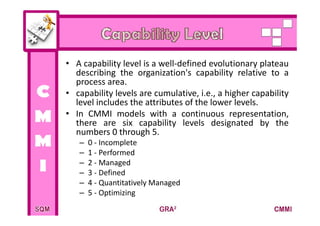
• A capability l l i a well‐defined evolutionary plateau
          bilit level is    ll d fi d      l ti       l t
  describing the organization's capability relative to a
  process area.
• capability levels are cumulative, i.e., a higher capability
  level includes the attributes of the lower levels.
• In CMMI models with a continuous representation
                                             representation,
  there are six capability levels designated by the
  numbers 0 through 5.
   –   0 ‐ Incomplete
   –   1 ‐ Performed
   –   2 ‐ Managed
   –   3 ‐ Defined
   –   4 ‐ Quantitatively Managed
   –   5 ‐ Optimizing
               i ii
Level
        l             CMM                        CMMI
Level 1      Both describes an immature organization without any
(Initial) 
(Initial)    defined processes, run in an ad‐hoc, uncontrolled, and
                                          ad hoc,
             reactive manner
Level 2       Organizations    repeat Requires management of
(Repeatable)  some processes to attain organizational requirements
(        bl )                       i       i i     l     i
              Level 2.                 through planned, performed,
                                       measured, and controlled
                                       processes.
Level 3      Mandates a set of        It is an improvement of CMMI 
(Defined)    documented standard      Level 2 and describes the 
                                      Level 2 and describes the
             processes to establish   organizational processes in 
             consistency across the   standards, procedures, tools, 
             organization.
                  i ti                and methods.
                                          d methods
Level               CMM                         CMMI
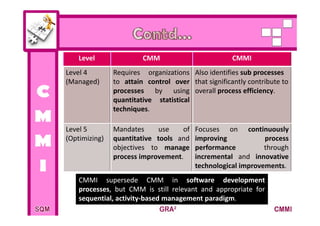
Level 4        Requires organizations Also identifies sub processes 
(Managed)      to attain control over that significantly contribute to 
               processes by using overall process efficiency.
               quantitative statistical
               techniques.

Level 5        Mandates      use   of   Focuses on continuously
(Optimizing)   quantitative tools and   improving            process
               objectives to manage     performance          through
               process improvement.     incremental and innovative
                                        technological improvements.
                                        t h l i li               t
    CMMI supersede CMM in software development
    processes,
    processes but CMM is still relevant and appropriate for
    sequential, activity‐based management paradigm.
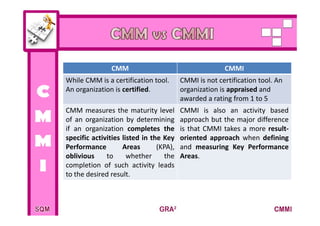
CMM                                      CMMI
While CMM is a certification tool.       CMMI is not certification tool. An 
An organization is certified.
A       i ti i        tifi d             organization is appraised and 
                                              i ti i          i d d
                                         awarded a rating from 1 to 5
CMM measures the maturity levely         CMMI is also an activity based
                                                                 y
of an organization by determining        approach but the major difference
if an organization completes the         is that CMMI takes a more result‐
specific activities listed in the Key    oriented approach when defining
Performance         Areas       (KPA),   and measuring Key Performance
oblivious     to      whether     the    Areas.
completion of such activity leads
to the desired result.
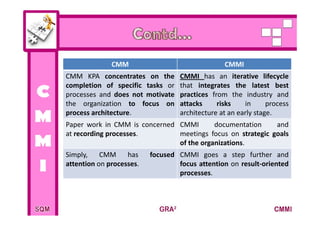
CMM                                CMMI
CMM KPA concentrates on the        CMMI has an iterative lifecycle
completion of specific tasks or    that integrates the latest best
processes and does not motivate    practices from the industry and
the organization to focus on       attacks     risks    in      process
process architecture
        architecture.              architecture at an early stage
                                                            stage.
Paper work in CMM is concerned CMMI       documentation     and
at recording processes.        meetings focus on strategic goals
                               of the organizations.
Simply,    CMM     has    focused CMMI goes a step further and
attention on processes
             processes.           focus attention on result‐oriented
                                  processes.
Capability maturity model

Capability maturity model

  • 1.
    Software Quality Management Unit – V G oy to y G Roy Antony Arnold od Asst. Prof. / CSE
  • 2.
    and refers to adevelopment model that was created after study of d t collected f ft t d f data ll t d from organizations that contracted with the , who h funded the research.
  • 3.
    • Th Cbilit M t it M d l (CMM) was The Capability Maturity Model originally developed as . • The CMM is based on the first described in the book by . • It was later published in a report in and as a book by the same authors in .
  • 4.
    Year Version Published i bli h d 1987 Software Process maturity framework (Humphrey) 1987 Preliminary maturity questionnaire (Humphrey and Sweet) 1987 Characterizing the software process: a maturity framework (Humphrey) 1989 Managing the software process (Humphrey) 1990 Draft version of CMM (v0.2) 1991 Version for discussion (v0.6) 1991 v1.0: Capability Maturity Model for Software (Paulk et al.)  ‘Key Practices for the Capability Maturity Model’ (Weber et al.) ‘K i f h C bili i d l’ (W b l) 1993 v1.1: Capability Maturity Model for software, version 1.1 (Paulk et al.) Key practices for the Capability Maturity Mode, version 1.1 (Paulk et al.) Key practices for the Capability Maturity Mode version 1 1 (Paulk et al )
  • 5.
    • Th Though this comes from the field of  h thi f th fi ld f , it is used as a general model to  aid in improving organizational business  aid in improving organizational business processes in diverse areas; Such as,
  • 6.
    • A tit A maturity model can be  d l b that describe how well the  of an  organization can  .  • A t it A maturity model may provide, for example : d l id f l – a place to start – a common language and a shared vision a common language and a shared vision – a framework for prioritizing actions – a way to define what improvement means for your  y p y organization. • A maturity model can be used as 
  • 7.
    : a 5‐levelprocess maturity continuum ‐ the 5th level where processes would be systematically managed by a combination of . : a KPA identifies a cluster of related activities that that, . the goals of a key process area summarize the states that must exist for that key process area to have been . : There are five types of common yp features: .
  • 8.
    Focus on Process Improvement Process measured and controlled Process characterized for the organization  f g and is proactive. Process characterized for projects and is often reactive. Processes Unpredictable, poorly controlled and reactive
  • 9.
    Level Designation Description 1 Initial The organization has undefined processes and  controls controls  2 Repeatable The organization has standardized methods  facilitating repeatable processes. 3 Defined The organization monitors and improves its  processes 4 Managed The organization possesses advanced controls,  metrics and feedback. 5 Optimizing The organization uses metrics for optimization  p p purposes.
  • 10.
    • L kof I t Lack f Integration: ti – CMM has separate models for each function. – Such models often overlap contradict and display overlap, contradict, different levels of maturity. – This lack of standardization leads to confusions and conflicts d i fli t during th i l the implementation phase and t ti h d increase training and appraisal costs. • Limitations of KPA: – The “Key Performance Areas (KPA),” that define CMM levels focus on “policing” activities such as specifications, specifications documentation, documentation audits, audits and inspections, and do not reveal architecturally significant flaws.
  • 11.
    • A tiit b d A Activity‐based Approach:  h – CMM is an activity‐based approach that considers only the completion of a specific activity and activity, not whether the completed activity achieved the desired results. • Paperwork:  – CMM places great importance on paperwork and  meetings that take the management’s time and  ti th t t k th t’ ti d effort away from actual work processes.  – CMM traps the organization in recording and CMM traps the organization in recording and  complying with processes, often at the cost of  strategic goals.
  • 12.
    • A li multiple models that are not i Applying li l d l h integratedd within and across an organization could be costly in training appraisals and improvement training, appraisals, activities. • The (CMMI) project was formed to sort out the p problem of using multiple CMMs. g p • The Software Engineering Institute at Carnegie Mellon University developed Capability Maturity Model Integration (CMMI) in 2006 to integrate and standardize the separate models of CMM, and to eradicate other dra backs of CMM drawbacks CMM.
  • 13.
    • CMMI bt practices are published i d best ti bli h d in documents t called models, each of which addresses a different area of interest. • The current release of CMMI, version 1.3, (released in November 2010) provides models for three areas of interest: development acquisition and services development, acquisition, services. – CMMI for Development (CMMI‐DEV) addresses product and service development processes. – CMMI f A i iti (CMMI ACQ) addresses supply chain for Acquisition (CMMI‐ACQ) dd l h i management, acquisition, and outsourcing processes in government and industry. – CMMI f S i for Services (CMMI SVC) addresses guidance f (CMMI‐SVC) dd id for delivering services within an organization and to external customers.
  • 14.
    Maturity Level 2 ‐ Managed i l d • CM ‐ Configuration Management g g • MA ‐ Measurement and Analysis • PMC ‐ Project Monitoring and Control • PMC Project Monitoring and Control • PP ‐ Project Planning • PPQA ‐ Process and Product Quality  Assurance • REQM ‐ Requirements Management • SAM ‐ Supplier Agreement Management • SAM Supplier Agreement Management
  • 15.
    Maturity Level 3 ‐ Defined M tit L l 3 D fi d • DAR ‐ Decision Analysis and Resolution • IPM  Integrated Project Management • IPM ‐ Integrated Project Management • OPD ‐ Organizational Process Definition • OPF ‐ Organizational Process Focus g • OT ‐ Organizational Training • PI ‐ Product Integration • RD ‐ Requirements Development • RSKM ‐ Risk Management • TS ‐ T h i l S l ti TS Technical Solution • VAL ‐ Validation • VER  • VER ‐ Verification
  • 16.
    Maturity Level 4 ‐ Quantitatively Managed • OPP ‐ OrganizationalProcess Performance OPP Organizational Process Performance • QPM ‐ Quantitative Project Management Maturity Level 5 ‐ Optimizing • CAR  Causal Analysis and Resolution • CAR ‐ Causal Analysis and Resolution • OPM ‐ Organizational Performance  Management
  • 18.
    • A organizationcannot b certified i CMMI i t d an An i ti t be tifi d in CMMI; instead, organization is appraised. • Depending on the type of appraisal, the organization can be awarded a maturity l l rating (1 5) or a capability l l d d t it level ti (1‐5) bilit level achievement profile. • Many organizations find value in measuring their progress by conducting an appraisal. A d ti i l Appraisals are t i ll conducted f i l typically d t d for one or more of the following reasons: – 1. To determine how well the organization’s processes compare to t CMMI b t practices, and t id tif areas where best ti d to identify h improvement can be made – 2. To inform external customers and suppliers of how well the organization s organization’s processes compare to CMMI best practices – 3. To meet the contractual requirements of one or more customers
  • 21.
    • C CMMI can be appraised using two different  b i d i diff approaches: staged and continuous.  • The staged approach yields appraisal results  as one of five maturity levels.  • The continuous approach yields one of six  capability levels.  • The differences in these approaches are felt  only in the appraisal; the best practices are  y pp ; p equivalent and result in equivalent process  p improvement results.
  • 22.
    • A tit l l i A maturity level is a well‐defined evolutionary plateau  ll d fi d l ti l t toward achieving a mature software process.  • Each maturity level provides a layer in the foundation  y p y for continuous process improvement. • The maturity levels are measured by the achievement  of the of the specific and generic goals that apply to each generic goals that apply to each  predefined set of process areas.  • There are five maturity levels designated by the  y g y numbers 1 through 5 – 1) Initial – 2) Managed 2) Managed – 3) Defined – 4) Quantitatively Managed – 5) Optimizing
  • 23.
    • A capabilityl l i a well‐defined evolutionary plateau bilit level is ll d fi d l ti l t describing the organization's capability relative to a process area. • capability levels are cumulative, i.e., a higher capability level includes the attributes of the lower levels. • In CMMI models with a continuous representation representation, there are six capability levels designated by the numbers 0 through 5. – 0 ‐ Incomplete – 1 ‐ Performed – 2 ‐ Managed – 3 ‐ Defined – 4 ‐ Quantitatively Managed – 5 ‐ Optimizing i ii
  • 24.
    Level l CMM CMMI Level 1  Both describes an immature organization without any (Initial)  (Initial) defined processes, run in an ad‐hoc, uncontrolled, and ad hoc, reactive manner Level 2  Organizations repeat Requires management of (Repeatable)  some processes to attain organizational requirements ( bl ) i i i l i Level 2. through planned, performed, measured, and controlled processes. Level 3  Mandates a set of It is an improvement of CMMI  (Defined) documented standard Level 2 and describes the  Level 2 and describes the processes to establish organizational processes in  consistency across the standards, procedures, tools,  organization. i ti and methods. d methods
  • 25.
    Level CMM CMMI Level 4  Requires organizations Also identifies sub processes  (Managed) to attain control over that significantly contribute to  processes by using overall process efficiency. quantitative statistical techniques. Level 5  Mandates use of Focuses on continuously (Optimizing) quantitative tools and improving process objectives to manage performance through process improvement. incremental and innovative technological improvements. t h l i li t CMMI supersede CMM in software development processes, processes but CMM is still relevant and appropriate for sequential, activity‐based management paradigm.
  • 26.
    CMM CMMI While CMM is a certification tool.  CMMI is not certification tool. An  An organization is certified. A i ti i tifi d organization is appraised and  i ti i i d d awarded a rating from 1 to 5 CMM measures the maturity levely CMMI is also an activity based y of an organization by determining approach but the major difference if an organization completes the is that CMMI takes a more result‐ specific activities listed in the Key oriented approach when defining Performance Areas (KPA), and measuring Key Performance oblivious to whether the Areas. completion of such activity leads to the desired result.
  • 27.
    CMM CMMI CMM KPA concentrates on the CMMI has an iterative lifecycle completion of specific tasks or that integrates the latest best processes and does not motivate practices from the industry and the organization to focus on attacks risks in process process architecture architecture. architecture at an early stage stage. Paper work in CMM is concerned CMMI documentation and at recording processes. meetings focus on strategic goals of the organizations. Simply, CMM has focused CMMI goes a step further and attention on processes processes. focus attention on result‐oriented processes.