EFFECTIVE COMMUNICATION AT
         WORKPLACE

          YOGESH J


VIJAYLAXMI S     SHAILESH P


 YOGESH U         ANIL R
                              1
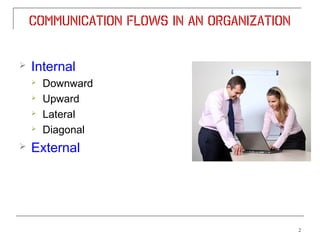
Communication Flows in an Organization


   Internal
       Downward
       Upward
       Lateral
       Diagonal
   External


                                             2
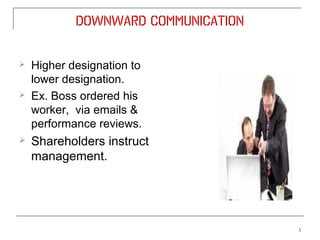
Downward communication

   Higher designation to
    lower designation.
   Ex. Boss ordered his
    worker, via emails &
    performance reviews.
   Shareholders instruct
    management.


                                     3
Purpose

   Sharing Business Goals
   Providing feedback on employees performance
   Giving job instructions
   Communicating the organizations mission & vision
    to the employees.
   Highlighting the areas of attention.


                                                   4
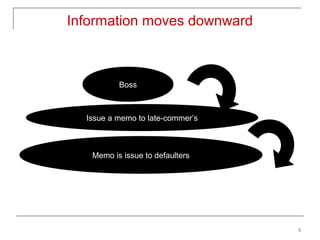
Information moves downward


          Boss


  Issue a memo to late-commer’s


   Memo is issue to defaulters


                                  5
Error-free downward communication

   Specify communication objective
   Ensure that the message is accurate, specific &
    unambiguous.
   Utilize the best communication technique to convey
    the message to the receiver in right form


                                                     6
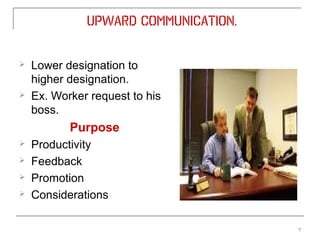
Upward communication.

   Lower designation to
    higher designation.
   Ex. Worker request to his
    boss.
           Purpose
   Productivity
   Feedback
   Promotion
   Considerations

                                      7
Lateral

   Communication that takes place at same levels of
    hierarchy in an organization.
   Types.
     Horizontal: between same level department.

        Vertical : between bosses and their employees
        (higher and lower levels)


                                                         8
Purpose

   It is time Saving
   It Facilities co-ordination of the task.
   It Facilities Co-ordination among team members
   It Provides emotional & social assistance to the
    organizational members.
   It help in solving Various Organizational problem
   It can also be used for resolving conflicts of a
    department with other department or conflicts within a
    department.


                                                        9
Diagonal communication.

   The path is mixture of vertical and horizontal
    movement.
   In large communications various departments need
    communication support from each other.


                                                       10
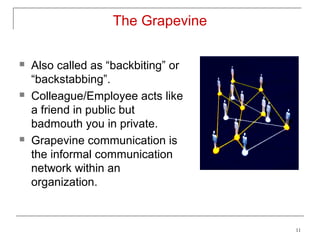
The Grapevine

   Also called as “backbiting” or
    “backstabbing”.
   Colleague/Employee acts like
    a friend in public but
    badmouth you in private.
   Grapevine communication is
    the informal communication
    network within an
    organization.


                                     11
External Communication

   Communication that takes place between                  a
    manager & external groups.
   Such as-suppliers, vendors, banks, FI etc.
       For eg.:- To raise capital the Managing director would
        interact with the Bank Manager.


                                                            12
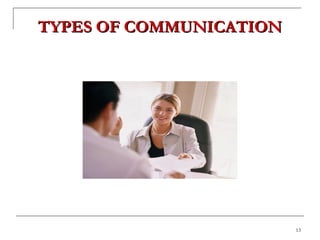
TYPES OF COMMUNICATION


                         13
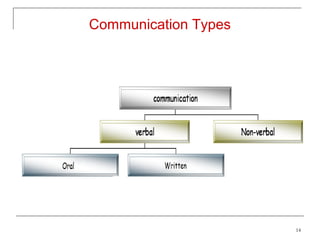
Communication Types


                      14
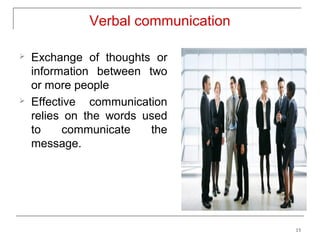
Verbal communication

   Exchange of thoughts or
    information between two
    or more people
   Effective communication
    relies on the words used
    to    communicate    the
    message.


                                     15
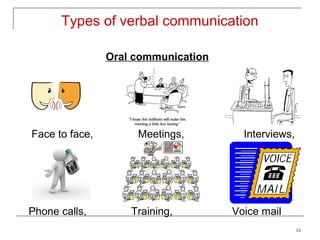
Types of verbal communication

                Oral communication


Face to face,        Meetings,         Interviews,


Phone calls,        Training,        Voice mail
                                                     16
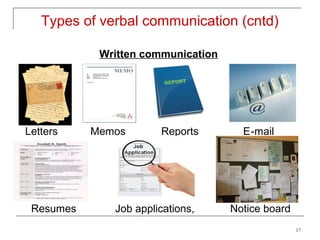
Types of verbal communication (cntd)

            Written communication


Letters    Memos       Reports        E-mail


 Resumes      Job applications,     Notice board
                                                   17
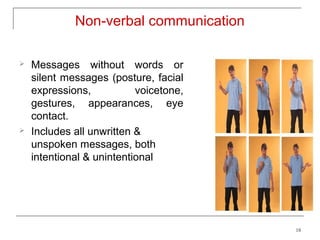
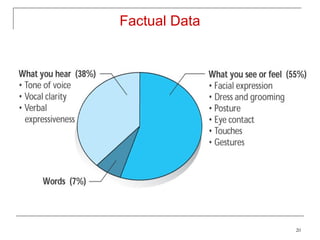
Non-verbal communication

   Messages without words or
    silent messages (posture, facial
    expressions,           voicetone,
    gestures, appearances, eye
    contact.
   Includes all unwritten &
    unspoken messages, both
    intentional & unintentional


                                        18
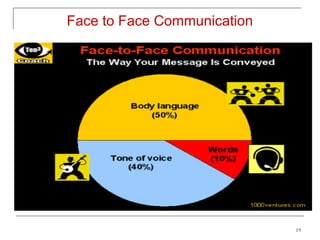
Face to Face Communication


                             19
Factual Data


               20
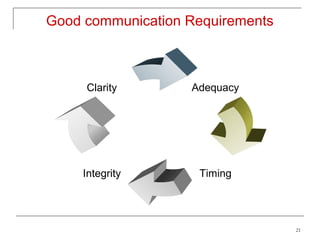
Good communication Requirements


     Clarity       Adequacy


     Integrity      Timing


                                  21
Why it is necessary?


   To control
   To motivate
   To balance the needs & goals
   To inform
       Within the organisation
       Between organisations

   To direct
   To evaluate


                                          22
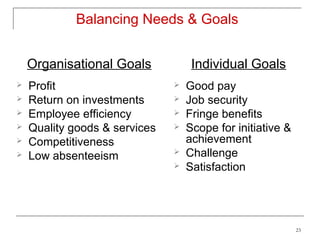
Balancing Needs & Goals


    Organisational Goals            Individual Goals
   Profit                        Good pay
   Return on investments         Job security
   Employee efficiency           Fringe benefits
   Quality goods & services      Scope for initiative &
   Competitiveness                achievement
   Low absenteeism               Challenge
                                  Satisfaction


                                                            23
Problems                          Solutions
   Relevant Employees are not informed/updated
   Employees Not Receiving Timely Messages
      Method need to devised for informing relevant

       employees, minutes of briefing need to be circulated on
       regular interval.
   Disbursement medium of information is not specific –
    select relevant medium for communicating with masses.
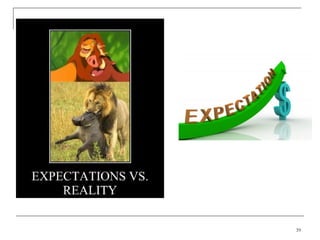
   Expectations are not clear
        S e t t i n g C l e a r Expectations
   No transparency in terms communication
    maintain transparency in acting with employees
   Plan for the future is not known/disclosed – discuss plan 24
Problems                    Solutions (cntd)
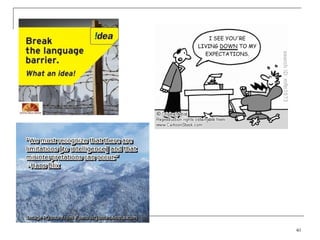
   Language Problems Affect Communication –
    Message should be communicated in properly, and
    acknowledged with employees.
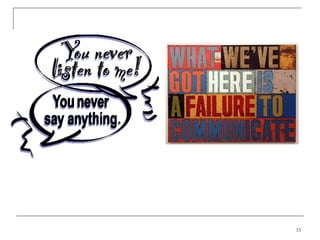
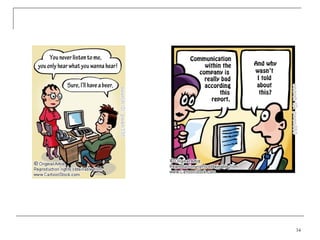
   Poor Listening Skills – Let Others speak and
    you listen.
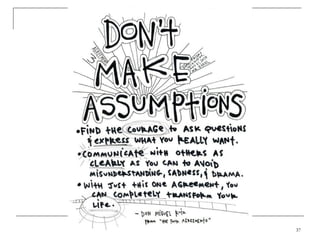
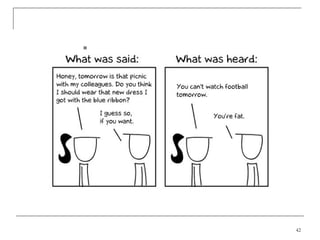
   Misinterpretations/Assumptions/Perception
   Distance Affects Workplace Communication
   Lack of Standards – Documentation should be
    recorded for official communication
   Mixing Work & Personal Communications – need to
    keep balance in personal and official one
                                                      25
Problems                      Solutions
                       (contd)
    Lack of Factual Communication – Find out the
    responsible defaulters of this communication and
    should be warned for misleading & disrupting peers
   Failure to Disperse Communications
   Privacy - it should be maintained for safety and
    integrity of information and should be done in
    private.
   Attitude/Ego’s – employees should be informed
    about their role and values in organization,
   Lack of Follow Through on upcoming projects –
    minutes of meeting should be documented and
    employees should be assigned jobs.
                                                         26
Problems                Solutions
                    (contd)
   Employees not open with each other –
    regular employees orientation program
    should be conducted.
   Non-equality in communication – related
    to hierarchy, suggestion box should be
    created.
   Gossips – it should be discouraged
   NEO Program (induction) – proper
    hierarchy chart created, employees
    handbook be given.                        27



    28



    29



    30



    31



    32



    33



    34



    35



    36



    37



    38



    39



    40



    41



    42



    43



    44



    45



    46

Sp

  • 1.
    EFFECTIVE COMMUNICATION AT WORKPLACE YOGESH J VIJAYLAXMI S SHAILESH P YOGESH U ANIL R 1
  • 2.
    Communication Flows inan Organization  Internal  Downward  Upward  Lateral  Diagonal  External 2
  • 3.
    Downward communication  Higher designation to lower designation.  Ex. Boss ordered his worker, via emails & performance reviews.  Shareholders instruct management. 3
  • 4.
    Purpose  Sharing Business Goals  Providing feedback on employees performance  Giving job instructions  Communicating the organizations mission & vision to the employees.  Highlighting the areas of attention. 4
  • 5.
    Information moves downward Boss Issue a memo to late-commer’s Memo is issue to defaulters 5
  • 6.
    Error-free downward communication  Specify communication objective  Ensure that the message is accurate, specific & unambiguous.  Utilize the best communication technique to convey the message to the receiver in right form 6
  • 7.
    Upward communication.  Lower designation to higher designation.  Ex. Worker request to his boss. Purpose  Productivity  Feedback  Promotion  Considerations 7
  • 8.
    Lateral  Communication that takes place at same levels of hierarchy in an organization.  Types.  Horizontal: between same level department.  Vertical : between bosses and their employees (higher and lower levels) 8
  • 9.
    Purpose  It is time Saving  It Facilities co-ordination of the task.  It Facilities Co-ordination among team members  It Provides emotional & social assistance to the organizational members.  It help in solving Various Organizational problem  It can also be used for resolving conflicts of a department with other department or conflicts within a department. 9
  • 10.
    Diagonal communication.  The path is mixture of vertical and horizontal movement.  In large communications various departments need communication support from each other. 10
  • 11.
    The Grapevine  Also called as “backbiting” or “backstabbing”.  Colleague/Employee acts like a friend in public but badmouth you in private.  Grapevine communication is the informal communication network within an organization. 11
  • 12.
    External Communication  Communication that takes place between a manager & external groups.  Such as-suppliers, vendors, banks, FI etc.  For eg.:- To raise capital the Managing director would interact with the Bank Manager. 12
  • 13.
  • 14.
  • 15.
    Verbal communication  Exchange of thoughts or information between two or more people  Effective communication relies on the words used to communicate the message. 15
  • 16.
    Types of verbalcommunication Oral communication Face to face, Meetings, Interviews, Phone calls, Training, Voice mail 16
  • 17.
    Types of verbalcommunication (cntd) Written communication Letters Memos Reports E-mail Resumes Job applications, Notice board 17
  • 18.
    Non-verbal communication  Messages without words or silent messages (posture, facial expressions, voicetone, gestures, appearances, eye contact.  Includes all unwritten & unspoken messages, both intentional & unintentional 18
  • 19.
    Face to FaceCommunication 19
  • 20.
  • 21.
    Good communication Requirements Clarity Adequacy Integrity Timing 21
  • 22.
    Why it isnecessary?  To control  To motivate  To balance the needs & goals  To inform  Within the organisation  Between organisations  To direct  To evaluate 22
  • 23.
    Balancing Needs &Goals Organisational Goals Individual Goals  Profit  Good pay  Return on investments  Job security  Employee efficiency  Fringe benefits  Quality goods & services  Scope for initiative &  Competitiveness achievement  Low absenteeism  Challenge  Satisfaction 23
  • 24.
    Problems Solutions  Relevant Employees are not informed/updated  Employees Not Receiving Timely Messages  Method need to devised for informing relevant employees, minutes of briefing need to be circulated on regular interval.  Disbursement medium of information is not specific – select relevant medium for communicating with masses.  Expectations are not clear S e t t i n g C l e a r Expectations  No transparency in terms communication  maintain transparency in acting with employees  Plan for the future is not known/disclosed – discuss plan 24
  • 25.
    Problems Solutions (cntd)  Language Problems Affect Communication – Message should be communicated in properly, and acknowledged with employees.  Poor Listening Skills – Let Others speak and you listen.  Misinterpretations/Assumptions/Perception  Distance Affects Workplace Communication  Lack of Standards – Documentation should be recorded for official communication  Mixing Work & Personal Communications – need to keep balance in personal and official one 25
  • 26.
    Problems Solutions  (contd) Lack of Factual Communication – Find out the responsible defaulters of this communication and should be warned for misleading & disrupting peers  Failure to Disperse Communications  Privacy - it should be maintained for safety and integrity of information and should be done in private.  Attitude/Ego’s – employees should be informed about their role and values in organization,  Lack of Follow Through on upcoming projects – minutes of meeting should be documented and employees should be assigned jobs. 26
  • 27.
    Problems Solutions (contd)  Employees not open with each other – regular employees orientation program should be conducted.  Non-equality in communication – related to hierarchy, suggestion box should be created.  Gossips – it should be discouraged  NEO Program (induction) – proper hierarchy chart created, employees handbook be given. 27
  • 28.
    28
  • 29.
    29
  • 30.
    30
  • 31.
    31
  • 32.
    32
  • 33.
    33
  • 34.
    34
  • 35.
    35
  • 36.
    36
  • 37.
    37
  • 38.
    38
  • 39.
    39
  • 40.
    40
  • 41.
    41
  • 42.
    42
  • 43.
    43
  • 44.
    44
  • 45.
    45
  • 46.
    46

Editor's Notes

  • #3 http://www.managementstudyguide.com/communication-flows.htm http://www.managementstudyguide.com/communication-flows.htm 03/19/13 07:45 AM
  • #4 A manager explains a task to an employee Shareholders instruct management. Downward communication consists of communications sent from management to workers, like emails & performance reviews. Senior management finds out from shareholders, or the board of directors, how owners want to apply the money they've invested. Let's focus first on downward communication in the workplace, & a couple of its important characteristics. Consider these common, downward forms of workplace communication: Example: On 17 th Sep 2012 New Yahoo CEO Marissa Mayer sent an email to all of Yahoo's full time & part time employees in the US, promising them a new Apple, Samsung, Nokia, or HTC smartphone. Read more: Barriers to Upward Communication | eHow.com http://www.ehow.com/list_6698401_barriers-upward-communication.html#ixzz25yEQyhLx 03/19/13 07:45 AM
  • #5 Providing a complete understanding of the employees job as well as to communicate them how their job is related to other jobs in the organization. 03/19/13 07:45 AM
  • #6 While on presentation.. 1. &, as information moves downward in the workplace, it grows increasingly detailed. 2. All organizations of more than one person must use workplace communication in one way or another. One person must give another instructions before any activity can occur. 3. At each stage in the downward flow of communication, people in the organization receive information to help them do their jobs. &, at each stage the information become less abstract, more specific, & more detailed. 03/19/13 07:45 AM
  • #8 A second major flow of communication is upward, from employee to supervisor, supervisor to department head, department head to vice president, & so on. Upward communication manifests itself in different ways. One-on-one meetings are a type of upward communication. For example, if an employee meets with her manager to discuss work-related issues, the upward communication is between the two people.  information flow from the lower levels of a hierarchy to the upper levels, Communication that flows to a higher level in an organization is called upward communication. It provides feedback on how well the organization is functioning. The subordinates use upward communication to convey their problems & performances to their superiors. Benefits: Productivity Upward communication ensures that assignments, projects & tasks are being completed. The employee reports to his supervisor, the supervisor reports to her manager & the manager reports to upper management. It maintains a high level of effectiveness & productivity because each person remains aware of the progress being made. This prevents upper management from becoming disconnected from the details that make the organization run smoothly. Benefits: Feedback Upward communication provides feedback that can help improve organizational development & encourage change. Employees that are encouraged to provide feedback feel respected & that they have a part in how things are run & ways to improve the company. Feedback provides leadership with a clear & accurate perception of how the people in the organization feel about the various aspects of the company. Promotion Promoting & encouraging feedback is the best way to make upward communication effective. Staying consistent & receiving feedback in a positive manner will help people feel open to sharing their thoughts. Leadership should consult with employees in the decision-making process to promote upward communication. Creating systems & policies that promote feedback, such as an online feedback form & an "open-door policy," will encourage employees to give their input. Considerations Hiring an independent communication organization to perform an assessment on the organization will help provide an unbiased, objective overview of how effective the company's upward communication is. Read more: Effective Upward Communication | eHow.com http://www.ehow.com/about_6651601_effective-upward-communication.html#ixzz25yCrddHT 03/19/13 07:45 AM

  • #9 Lateral / Horizontal Communication: Communication that takes place at same levels of hierarchy in an organization is called lateral communication, i.e., communication between peers, between managers at same levels or between any horizontally equivalent organizational member. The advantages of horizontal communication are as follows: It is time saving. It facilitates co-ordination of the task. It facilitates co-operation among team members. It provides emotional & social assistance to the organizational members. It helps in solving various organizational problems. It is a means of information sharing It can also be used for resolving conflicts of a department with other department or conflicts within a department. First, no superior/subordinate relationship exists here; it's strictly a case of two people with roughly equal amounts of power & prestige. That makes this form of communication voluntary & discretionary. That takes us to the second aspect, the idea of reciprocating. The quality & quantity of information we provide to our peers generally reflects what we get back from them. I may provide good information to you when we start working together, but I won't continue to provide it unless you reciprocate in kind. 03/19/13 07:45 AM
  • #11 Diagonal Communication: Communication that takes place between a manager & employees of other workgroups is called diagonal communication. It generally does not appear on organizational chart. For instance - To design a training module a training manager interacts with an Operations personnel to enquire about the way they perform their task. 03/19/13 07:45 AM
  • #12 http://www.people-communicating.com/grapevine-communication.html 03/19/13 07:45 AM
  • #13 External Communication: Communication that takes place between a manager & external groups such as - suppliers, vendors, banks, financial institutes etc. For instance - To raise capital the Managing director would interact with the Bank Manager. 03/19/13 07:45 AM
  • #15 03/19/13 07:45 AM
  • #16 03/19/13 07:45 AM
  • #19 Through signs & symbols. Non-verbal can go without verbal communication. Verbal can’t go without non-verbal communication. A person to have quality communication skills must possess the knowledge of non-verbal communication. As compared to words & vocal variety non-verbal communication matters a lot. feelings, emotions, attitudes, & thoughts through body movements / gestures / eye contact, etc. 03/19/13 07:45 AM
  • #20 03/19/13 07:45 AM
  • #39 03/19/13 07:45 AM