
ORGANIZATIONAL
COMMUNICATION
Organizational Communication
 Commn. is vital ingredient of an orgn.
 Orgn. is a group of persons constituted
to achieve specific objectives.
 This depends upon proper coordination
& integration of human effort in an orgn.
 This is possible only if there is effective
system of communication in the orgn.
 Commn. is the nervous system of an
orgn.
 Commn. is the life blood of an orgn.
Concept of Orgn.
 Acc to Allen, orgn. may be defined “ as the process of
identifying & grouping the work to be performed,
defining & delegating responsibility & authority &
establishing relationship for the purpose of enabling
people to work most effectively together in
accomplishing objectives.
 Acc to Harold koontz & O’Donnell- “organizing involves
the grouping of activities necessary to accomplish goals
& plans, the assignment of these activities to
appropriate departments & the provision for authority
delegation & co-ordination”
 Acc to Prof. Haiman “organization is the process of
defining & grouping the activities of the enterprise &
establishing the authority relationship among them”
 In the words of Chester Barnard- “ system of
cooperative activities of two or more persons is called
organization
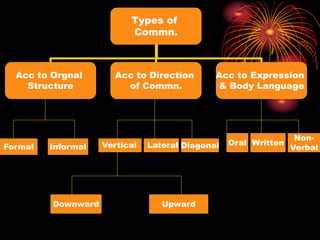
Types of
Commn.
Acc to Orgnal
Structure
Acc to Direction
of Commn.
Acc to Expression
& Body Language
Formal Diagonal Oral Written
Non-
Verbal
Informal
Downward Upward
Vertical Lateral
Formal Communication
• Associated with formal
organization structure
• Travel through proper channels-
officially recognized positions
• Communications are mostly black
& white
• Through proper channel
• Orders, instructions, decisions or
intensions etc of the superior
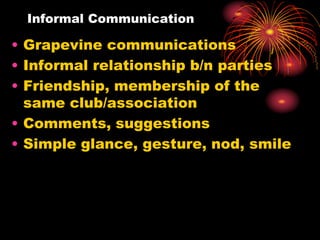
Informal Communication
• Grapevine communications
• Informal relationship b/n parties
• Friendship, membership of the
same club/association
• Comments, suggestions
• Simple glance, gesture, nod, smile
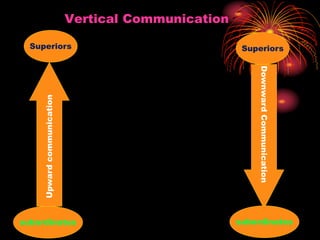
Vertical Communication
Downward
Communication
Superiors
subordinates
Upward
communication
Superiors
subordinates
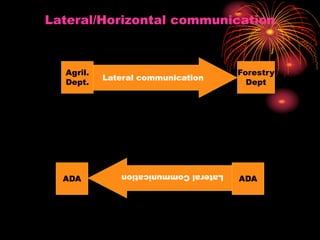
Lateral/Horizontal communication
Lateral communication
Lateral
Communication
Agril.
Dept.
ADA
ADA
Forestry
Dept
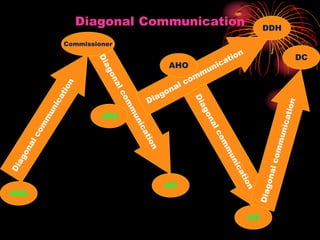
Diagonal Communication
ADA
Commissioner
JDA
DDH
AHO
AO
DC
AO
Oral/verbal Communication
• Exchange ideas through oral
words
• Face-to-face communication
• Telephone
• Meetings. Conferences, lectures,
interviews
Written Communication
• Black & white
• Written words, graphs, diagrams,
pictures
• Circulars, notes, manuals, reports,
posters, memos
Non-verbal Communication
• Body language
• Receiver observes non-verbal
communication 55 % of the time
Barriers to Organizational Communication
1. External Barriers
2. Organizational Barriers
3. Personal Barriers
1. Semantic Barriers
 Obstructions caused in the process of receiving/
understanding a message during the process of
encoding/decoding it into words & ideas.
 Linguistic capacity of two parties may have some
limitations
 Symbols used may be ambiguous. It may have several
meanings and leads to misunderstanding.
 Since inferences gives a wrong signal, one should be
aware of them & analyze them carefully.
 In case of any doubt, more feedback may be sought.
 Symbols may be classified as
a) Language
b) Picture
c) Action
External Barriers
a) Language
 In written/verbal communication, words used are
important. Words may have meanings
 In face-to-face communication, it is easy to seek
clarification of words used.
 Effective communication is idea-centered rather than
word-centered.
 The communication may be decoded correctly by the
receiver if the context is known to him.
 Without context, language is just like an eyesore that
irritates our senses & interfere with our perceptions.
 Lack of clarity & precision in a message makes it difficult
to understand.
 Poorly chosen & incorrect words & phrases, careless
omissions, lack of coherence, bad organization of ideas,
awkward sentence structure, inadequate vocabulary,
platitudes, numbing repetitions found in poor commn.
Picture
 Pictures are visual aids worth-thousands of
words.
 Organization makes extensive use of pictures
like blueprints, charts, maps, graphs, films,
models.
 Viewer may come to understand the whole
story when he sees them.
 Sometimes, a picture creates confusion in the
mind of the observer; it may be ambiguous if it
is not supplemented by words or actions.
Action
 If a sub-ordinate does a good job. Patting & non-
patting on his back by the superior.
 Patting may inspire him to do a better job again
& non-patting may make him disappointed.
 Action speaks louder than words; if a person
says something & does another, there is a
credibility gap. He will loose confidence of his
subordinates.
Emotional/psychological Barriers
 Arise from motives, attitudes, judgment, sentiments,
emotions, & social values of participants.
 These creates a psychological distance that hinders
the communication.
a) Premature evaluation
b) Loss in transmission & retention
c) Distrust of communicator
d) Failure to communicate
e) Undue reliance on the written word
f) Inattention
Premature evaluation
 Tendency to evaluate communication prematurely.
 This barrier can be remedied by empathy & non-
evaluative listening.
Loss in transmission & retention
 A part of information is lost in transit.
 About 30% of the information is lost in each
transmission.
 Research reveals that workers retain 50% of information
& supervisors retain 60% of it.
Distrust of communicator
 If he lacks self confidence /less competent in his works,
he makes illogical decisions and fails to implement them.
 Repeated experience of this kind gradually conditions
the receiver to delay action.
Failure to communicate
 Sometimes, managers do not communicate
the needed messages to their
subordinates.
 This may be because of laziness/arbitrary
assumption that everybody has got the
information/ they deliberately hide to
embarrass the subordinates.
Undue reliance on the written word
 Hesitate in accepting the face-to-face oral
verbal communication of their superiors.
Inattention
 Preoccupied mind & resultant non-listening
 People fail to react to bulletins, notices,
minutes & reports.
Organizational Barriers
a) Organization policy
b) Organizational rules &
regulations
c) Status relationship
d) Complexity in organization
structure
e) Organizational facilities
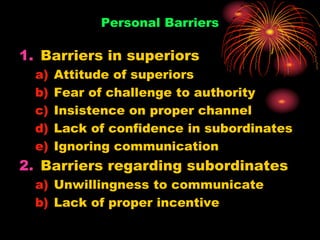
Personal Barriers
1. Barriers in superiors
a) Attitude of superiors
b) Fear of challenge to authority
c) Insistence on proper channel
d) Lack of confidence in subordinates
e) Ignoring communication
2. Barriers regarding subordinates
a) Unwillingness to communicate
b) Lack of proper incentive
7 C’s
C’s Relevance
1. Credibility Builds trust
2. Courtesy Improves relationships
3. Clarity Makes comprehension
easier
4. Correctness Builds confidence
5. Consistency Introduces stability
6. Concreteness Reinforces confidence
7. conciseness Saves time
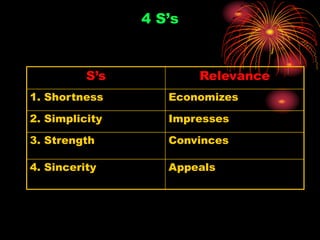
4 S’s
S’s Relevance
1. Shortness Economizes
2. Simplicity Impresses
3. Strength Convinces
4. Sincerity Appeals
Organizational communication

Organizational communication

  • 1.
  • 2.
    Organizational Communication  Commn.is vital ingredient of an orgn.  Orgn. is a group of persons constituted to achieve specific objectives.  This depends upon proper coordination & integration of human effort in an orgn.  This is possible only if there is effective system of communication in the orgn.  Commn. is the nervous system of an orgn.  Commn. is the life blood of an orgn.
  • 3.
    Concept of Orgn. Acc to Allen, orgn. may be defined “ as the process of identifying & grouping the work to be performed, defining & delegating responsibility & authority & establishing relationship for the purpose of enabling people to work most effectively together in accomplishing objectives.  Acc to Harold koontz & O’Donnell- “organizing involves the grouping of activities necessary to accomplish goals & plans, the assignment of these activities to appropriate departments & the provision for authority delegation & co-ordination”  Acc to Prof. Haiman “organization is the process of defining & grouping the activities of the enterprise & establishing the authority relationship among them”  In the words of Chester Barnard- “ system of cooperative activities of two or more persons is called organization
  • 4.
    Types of Commn. Acc toOrgnal Structure Acc to Direction of Commn. Acc to Expression & Body Language Formal Diagonal Oral Written Non- Verbal Informal Downward Upward Vertical Lateral
  • 5.
    Formal Communication • Associatedwith formal organization structure • Travel through proper channels- officially recognized positions • Communications are mostly black & white • Through proper channel • Orders, instructions, decisions or intensions etc of the superior
  • 6.
    Informal Communication • Grapevinecommunications • Informal relationship b/n parties • Friendship, membership of the same club/association • Comments, suggestions • Simple glance, gesture, nod, smile
  • 7.
  • 8.
  • 9.
  • 10.
    Oral/verbal Communication • Exchangeideas through oral words • Face-to-face communication • Telephone • Meetings. Conferences, lectures, interviews
  • 11.
    Written Communication • Black& white • Written words, graphs, diagrams, pictures • Circulars, notes, manuals, reports, posters, memos
  • 12.
    Non-verbal Communication • Bodylanguage • Receiver observes non-verbal communication 55 % of the time
  • 13.
    Barriers to OrganizationalCommunication 1. External Barriers 2. Organizational Barriers 3. Personal Barriers
  • 14.
    1. Semantic Barriers Obstructions caused in the process of receiving/ understanding a message during the process of encoding/decoding it into words & ideas.  Linguistic capacity of two parties may have some limitations  Symbols used may be ambiguous. It may have several meanings and leads to misunderstanding.  Since inferences gives a wrong signal, one should be aware of them & analyze them carefully.  In case of any doubt, more feedback may be sought.  Symbols may be classified as a) Language b) Picture c) Action External Barriers
  • 15.
    a) Language  Inwritten/verbal communication, words used are important. Words may have meanings  In face-to-face communication, it is easy to seek clarification of words used.  Effective communication is idea-centered rather than word-centered.  The communication may be decoded correctly by the receiver if the context is known to him.  Without context, language is just like an eyesore that irritates our senses & interfere with our perceptions.  Lack of clarity & precision in a message makes it difficult to understand.  Poorly chosen & incorrect words & phrases, careless omissions, lack of coherence, bad organization of ideas, awkward sentence structure, inadequate vocabulary, platitudes, numbing repetitions found in poor commn.
  • 16.
    Picture  Pictures arevisual aids worth-thousands of words.  Organization makes extensive use of pictures like blueprints, charts, maps, graphs, films, models.  Viewer may come to understand the whole story when he sees them.  Sometimes, a picture creates confusion in the mind of the observer; it may be ambiguous if it is not supplemented by words or actions.
  • 17.
    Action  If asub-ordinate does a good job. Patting & non- patting on his back by the superior.  Patting may inspire him to do a better job again & non-patting may make him disappointed.  Action speaks louder than words; if a person says something & does another, there is a credibility gap. He will loose confidence of his subordinates.
  • 18.
    Emotional/psychological Barriers  Arisefrom motives, attitudes, judgment, sentiments, emotions, & social values of participants.  These creates a psychological distance that hinders the communication. a) Premature evaluation b) Loss in transmission & retention c) Distrust of communicator d) Failure to communicate e) Undue reliance on the written word f) Inattention
  • 19.
    Premature evaluation  Tendencyto evaluate communication prematurely.  This barrier can be remedied by empathy & non- evaluative listening. Loss in transmission & retention  A part of information is lost in transit.  About 30% of the information is lost in each transmission.  Research reveals that workers retain 50% of information & supervisors retain 60% of it. Distrust of communicator  If he lacks self confidence /less competent in his works, he makes illogical decisions and fails to implement them.  Repeated experience of this kind gradually conditions the receiver to delay action.
  • 20.
    Failure to communicate Sometimes, managers do not communicate the needed messages to their subordinates.  This may be because of laziness/arbitrary assumption that everybody has got the information/ they deliberately hide to embarrass the subordinates. Undue reliance on the written word  Hesitate in accepting the face-to-face oral verbal communication of their superiors. Inattention  Preoccupied mind & resultant non-listening  People fail to react to bulletins, notices, minutes & reports.
  • 21.
    Organizational Barriers a) Organizationpolicy b) Organizational rules & regulations c) Status relationship d) Complexity in organization structure e) Organizational facilities
  • 22.
    Personal Barriers 1. Barriersin superiors a) Attitude of superiors b) Fear of challenge to authority c) Insistence on proper channel d) Lack of confidence in subordinates e) Ignoring communication 2. Barriers regarding subordinates a) Unwillingness to communicate b) Lack of proper incentive
  • 23.
    7 C’s C’s Relevance 1.Credibility Builds trust 2. Courtesy Improves relationships 3. Clarity Makes comprehension easier 4. Correctness Builds confidence 5. Consistency Introduces stability 6. Concreteness Reinforces confidence 7. conciseness Saves time
  • 24.
    4 S’s S’s Relevance 1.Shortness Economizes 2. Simplicity Impresses 3. Strength Convinces 4. Sincerity Appeals