Communicating at Work Chapter 1
Presenters:
Learning Objectives: Identify changes in the workplace and the importance of communication skills Describe the process of communication Discuss barriers to interpersonal communication and the means of overcoming those barriers Analyze the functions and procedures of communication in organizations Assess the flow of communication in organizations including barriers and methods of overcoming those barriers List the goals of ethical business communication and describe important tools for doing the right thing
COMMUNICATION
 
You cannot not communicate! You cannot  un-communicate!
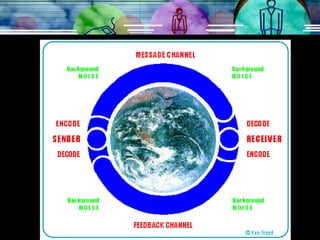
HUMAN COMMUNICATION:  ACTION
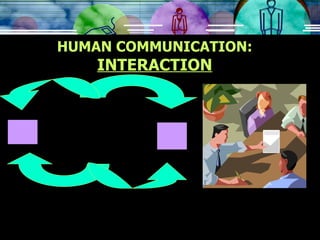
HUMAN COMMUNICATION:  INTERACTION
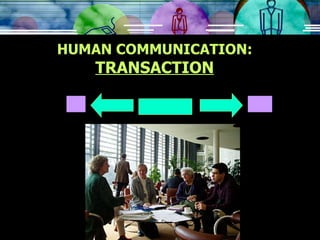
HUMAN COMMUNICATION:  TRANSACTION
 
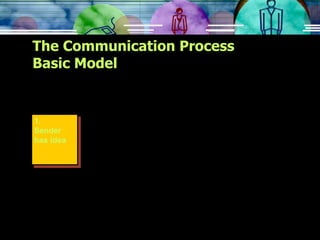
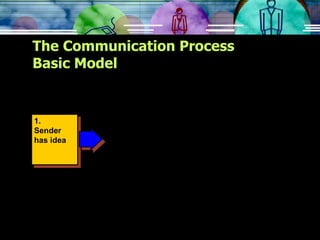
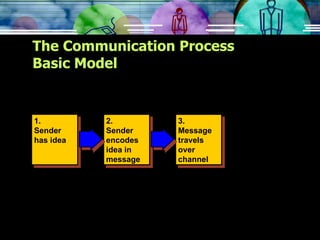
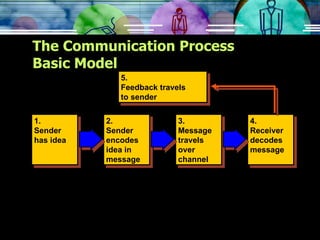
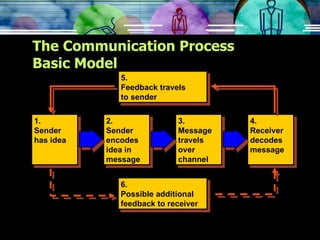
The Communication Process Basic Model
The Communication Process Basic Model 1. Sender has idea
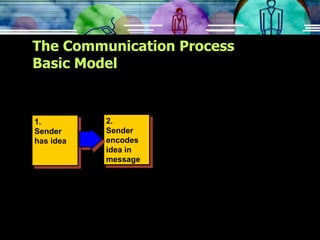
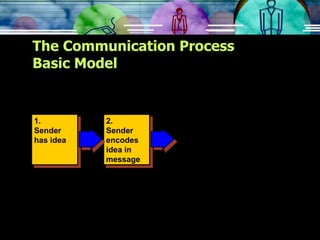
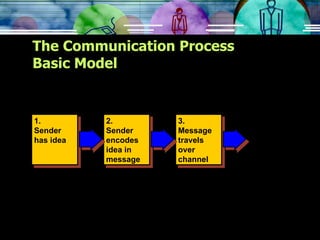
The Communication Process Basic Model 2. Sender encodes idea in message 1. Sender has idea
The Communication Process Basic Model 3. Message travels over channel 2. Sender encodes idea in message 1. Sender has idea
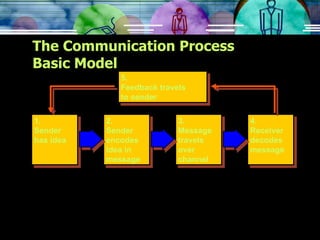
The Communication Process Basic Model 2. Sender encodes idea in message 3. Message travels over channel 1. Sender has idea
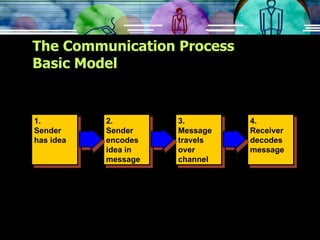
The Communication Process Basic Model 2. Sender encodes idea in message 3. Message travels over channel 1. Sender has idea 4. Receiver decodes message
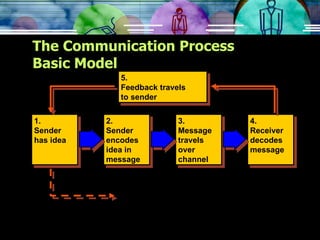
The Communication Process Basic Model 2. Sender encodes idea in message 3. Message travels over channel 1. Sender has idea 4. Receiver decodes message 5. Feedback travels to sender
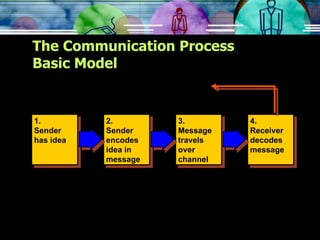
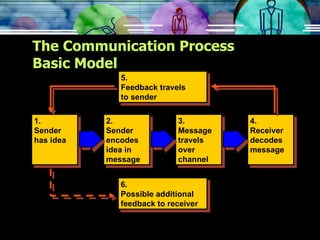
The Communication Process Basic Model 2. Sender encodes idea in message 3. Message travels over channel 1. Sender has idea 4. Receiver decodes message 6. Possible additional feedback to receiver 5. Feedback travels to sender
 
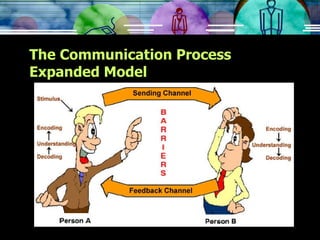
The Communication Process Expanded Model
 
Barriers to Interpersonal  Communication Bypassing Limited frame of reference Lack of language skills Lack of listening skills Emotional interference Physical distractions
Communication climate Context and setting Background, experiences Knowledge, mood Values, beliefs, culture Understanding is shaped by
Barriers That Block the Flow of Information in Organizations Closed communication climate Top-heavy organizational structure Long lines of communication Lack of trust between management and employees Competition for power, status, rewards
Additional Communication Barriers  Fear of reprisal for honest communication Differing frames of reference among communicators Lack of communication skills Ego involvement Turf wars
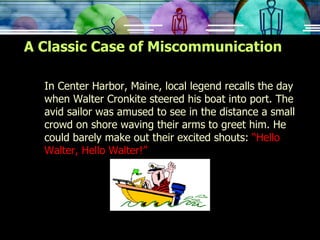
A Classic Case of Miscommunication In Center Harbor, Maine, local legend recalls the day when Walter Cronkite steered his boat into port. The avid sailor was amused to see in the distance a small crowd on shore waving their arms to greet him. He could barely make out their excited shouts:  “Hello Walter, Hello Walter!”
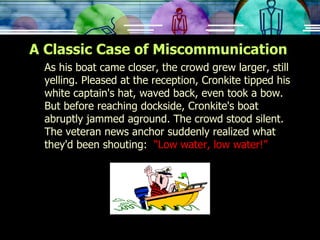
A Classic Case of Miscommunication As his boat came closer, the crowd grew larger, still yelling. Pleased at the reception, Cronkite tipped his white captain's hat, waved back, even took a bow. But before reaching dockside, Cronkite's boat abruptly jammed aground. The crowd stood silent. The veteran news anchor suddenly realized what they'd been shouting:  “Low water, low water!”
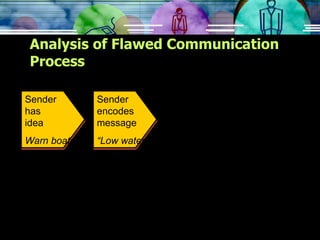
Analysis of Flawed Communication Process
Analysis of Flawed Communication Process Sender  has  idea Warn boater
Analysis of Flawed Communication Process Sender  has  idea Warn boater Sender encodes message “ Low water!”
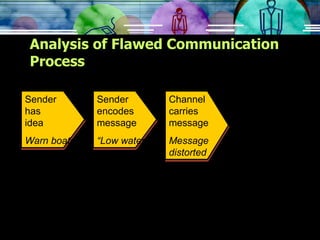
Analysis of Flawed Communication Process Sender  has  idea Warn boater Sender encodes message “ Low water!” Channel carries message Message distorted
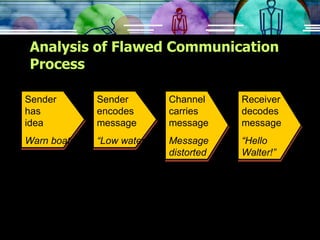
Analysis of Flawed Communication Process Sender  has  idea Warn boater Sender encodes message “ Low water!” Channel carries message Message distorted Receiver decodes message “ Hello Walter!”
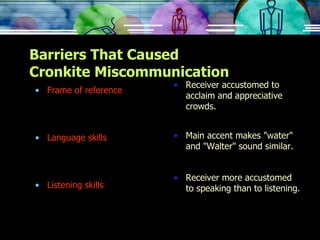
Barriers That Caused Cronkite Miscommunication Frame of reference Language skills Listening skills Receiver accustomed to acclaim and appreciative crowds. Main accent makes "water" and "Walter" sound similar. Receiver more accustomed to speaking than to listening.
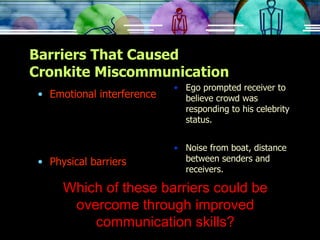
Barriers That Caused Cronkite Miscommunication Emotional interference Physical barriers Ego prompted receiver to believe crowd was responding to his celebrity status. Noise from boat, distance between senders and receivers. Which of these barriers could be overcome through improved communication skills?
Overcoming Communication Barriers Realize that communication is imperfect. Adapt the message to the receiver. Improve your language and listening skills. Question your preconceptions. Plan for feedback.
 
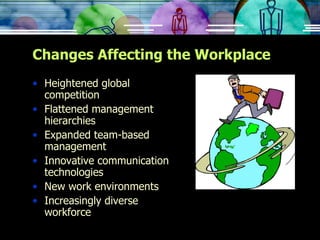
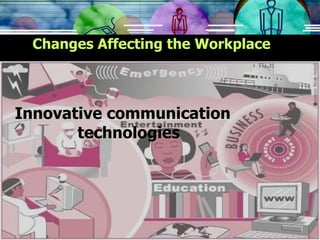
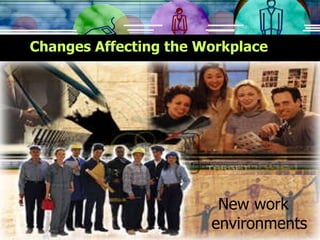
Changes Affecting the Workplace Heightened global  competition Flattened management  hierarchies Expanded team-based  management Innovative communication technologies New work environments Increasingly diverse workforce
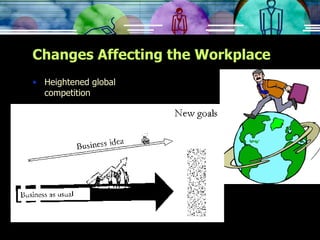
Changes Affecting the Workplace Heightened global  competition
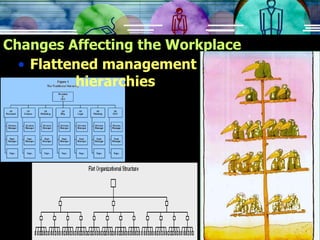
Changes Affecting the Workplace Flattened management  hierarchies
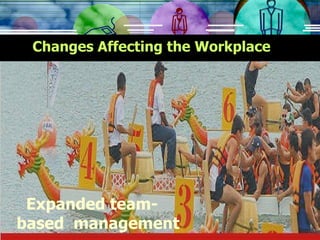
Changes Affecting the Workplace Expanded team-based  management
Changes Affecting the Workplace Innovative communication technologies
Changes Affecting the Workplace New work environments
Changes Affecting the Workplace Increasingly diverse workforce
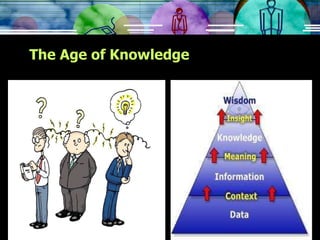
The Age of Knowledge
Success for  YOU  in the new global and diverse  workplace requires excellent communication skills!
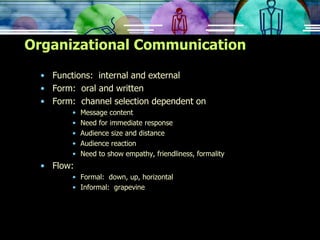
Organizational Communication Functions:  internal and external Form:  oral and written Form:  channel selection dependent on  Message content Need for immediate response Audience size and distance Audience reaction Need to show empathy, friendliness, formality Flow: Formal:  down, up, horizontal Informal:  grapevine
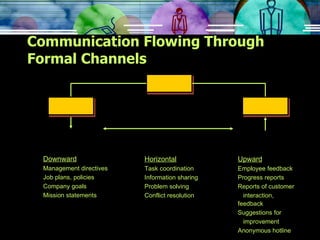
Communication Flowing Through Formal Channels Downward Management directives Job plans, policies Company goals Mission statements Horizontal Task coordination Information sharing Problem solving Conflict resolution Upward Employee feedback Progress reports Reports of customer interaction, feedback Suggestions for  improvement Anonymous hotline
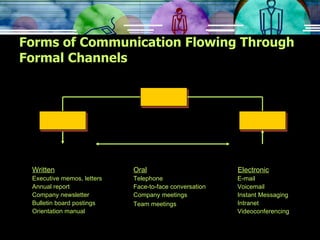
Forms of Communication Flowing Through Formal Channels Written Executive memos, letters Annual report Company newsletter Bulletin board postings Orientation manual Electronic E-mail Voicemail Instant Messaging Intranet Videoconferencing Oral Telephone Face-to-face conversation Company meetings Team meetings
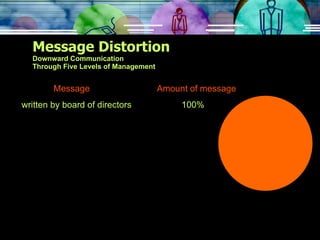
Message Distortion Downward Communication Through Five Levels of Management Message   Amount of message  written by board of directors 100%
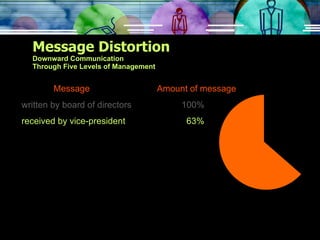
Message Distortion Downward Communication Through Five Levels of Management Message   Amount of message written by board of directors 100% received by vice-president   63%
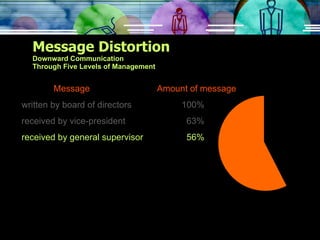
Message Distortion Downward Communication Through Five Levels of Management Message   Amount of message written by board of directors 100% received by vice-president   63% received by general supervisor   56%
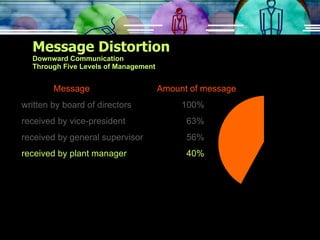
Message Distortion Downward Communication Through Five Levels of Management Message   Amount of message written by board of directors 100% received by vice-president   63% received by general supervisor   56% received by plant manager   40%
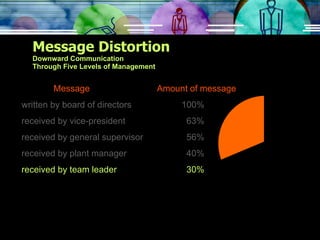
Message Distortion Downward Communication Through Five Levels of Management Message   Amount of message written by board of directors 100% received by vice-president   63% received by general supervisor   56% received by plant manager   40% received by team leader   30%
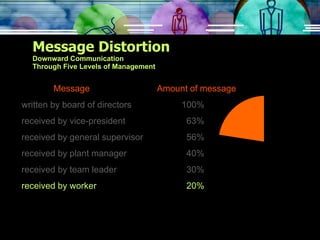
Message Distortion Downward Communication Through Five Levels of Management Message   Amount of message written by board of directors 100% received by vice-president   63% received by general supervisor   56% received by plant manager   40% received by team leader   30% received by worker   20%
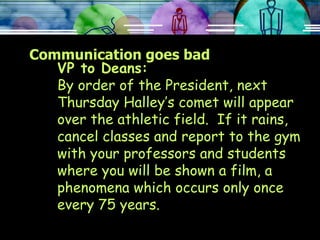
Communication goes bad VP to Deans: By order of the President, next Thursday Halley’s comet will appear over the athletic field.  If it rains, cancel classes and report to the gym with your professors and students where you will be shown a film, a phenomena which occurs only once every 75 years.
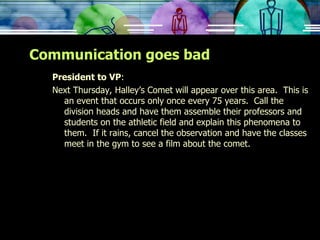
Communication goes bad President to VP : Next Thursday, Halley’s Comet will appear over this area.  This is an event that occurs only once every 75 years.  Call the division heads and have them assemble their professors and students on the athletic field and explain this phenomena to them.  If it rains, cancel the observation and have the classes meet in the gym to see a film about the comet.
Communication goes bad Deans to Professors: By order of the Phenomenal President, next Thursday Halley’s Comet will appear in the gym.  In case of rain over the athletic field, the President will give another order, something which occurs once every 75 years.
Communications goes bad Professors to Students: Next Thursday, the President will appear in the gym with Halley’s Comet, something which occurs every 75 years.  If it rains, the President will cancel the comet and order us all to our phenomenal athletic field.
Communications goes bad Student writing to parents: When it rains next Thursday over the school athletic field, the phenomenal 75 year-old President will cancel all classes and appear before the whole school in the gym accompanied by Bill Halley and the Comets.
Surmounting Organizational Barriers Encourage open environment for interaction and feedback. Flatten the organizational structure. Promote horizontal communication. Provide hotline for anonymous feedback.  Provide sufficient information through formal channels.
 
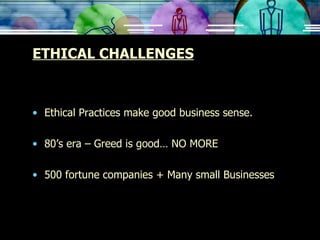
ETHICAL CHALLENGES Ethical Practices make good business sense. 80’s era – Greed is good… NO MORE 500 fortune companies + Many small Businesses
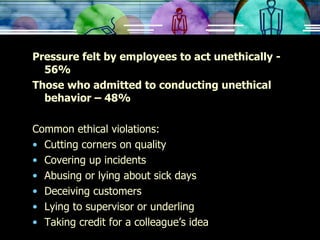
Pressure felt by employees to act unethically - 56% Those who admitted to conducting unethical behavior – 48% Common ethical violations: Cutting corners on quality Covering up incidents Abusing or lying about sick days Deceiving customers Lying to supervisor or underling Taking credit for a colleague’s idea
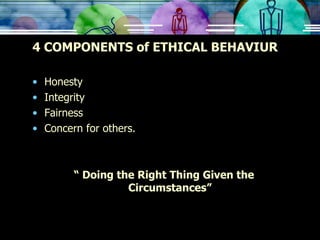
4 COMPONENTS of ETHICAL BEHAVIUR Honesty Integrity Fairness Concern for others. “  Doing the Right Thing Given the Circumstances”
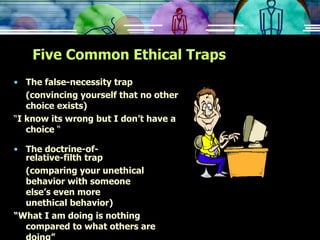
Five Common Ethical Traps The false-necessity trap (convincing yourself that no other choice exists) “ I know its wrong but I don’t have a choice  “ The doctrine-of- relative-filth trap (comparing your unethical  behavior with someone  else’s even more  unethical behavior) “ What I am doing is nothing compared to what others are doing”
Five Common Ethical Traps The rationalization trap (justifying unethical actions with excuses) “ I’ll be in working late anyways, I deserve a longer lunch break now.” The self-deception trap (persuading yourself, for example, that a lie is not really a lie) “ I was running the whole show, without me the company would have collapsed” The ends-justify-the-means trap (using unethical methods to accomplish a desirable goal)  “ So what if I had to bribe the supplier… I saved the company money in the long run!”
Goals of Ethical Business Communication Telling the truth Labeling opinions Being objective Communicating clearly Giving credit
Accomplishing These Goals Think before you act Being in other person’s shoe There must be a different solution Discuss your dilemma with a trust worthy or an experienced person Imagine the shame if your friends and family found out about what you had been upto!!
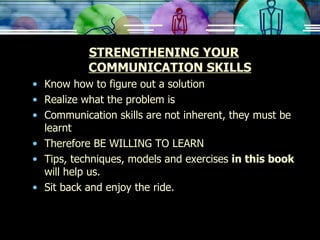
STRENGTHENING YOUR COMMUNICATION SKILLS Know how to figure out a solution Realize what the problem is Communication skills are not inherent, they must be learnt Therefore BE WILLING TO LEARN Tips, techniques, models and exercises  in this book  will help us. Sit back and enjoy the ride.
End
Click to add Title Click to add text

Communicating at work chapter 1 (buss. English)

  • 1.
  • 2.
  • 3.
    Learning Objectives: Identifychanges in the workplace and the importance of communication skills Describe the process of communication Discuss barriers to interpersonal communication and the means of overcoming those barriers Analyze the functions and procedures of communication in organizations Assess the flow of communication in organizations including barriers and methods of overcoming those barriers List the goals of ethical business communication and describe important tools for doing the right thing
  • 4.
  • 5.
  • 6.
    You cannot notcommunicate! You cannot un-communicate!
  • 7.
  • 8.
  • 9.
  • 10.
  • 11.
  • 12.
    The Communication ProcessBasic Model 1. Sender has idea
  • 13.
    The Communication ProcessBasic Model 1. Sender has idea
  • 14.
    The Communication ProcessBasic Model 2. Sender encodes idea in message 1. Sender has idea
  • 15.
    The Communication ProcessBasic Model 2. Sender encodes idea in message 1. Sender has idea
  • 16.
    The Communication ProcessBasic Model 3. Message travels over channel 2. Sender encodes idea in message 1. Sender has idea
  • 17.
    The Communication ProcessBasic Model 2. Sender encodes idea in message 3. Message travels over channel 1. Sender has idea
  • 18.
    The Communication ProcessBasic Model 2. Sender encodes idea in message 3. Message travels over channel 1. Sender has idea 4. Receiver decodes message
  • 19.
    The Communication ProcessBasic Model 2. Sender encodes idea in message 3. Message travels over channel 1. Sender has idea 4. Receiver decodes message
  • 20.
    The Communication ProcessBasic Model 2. Sender encodes idea in message 3. Message travels over channel 1. Sender has idea 4. Receiver decodes message 5. Feedback travels to sender
  • 21.
    The Communication ProcessBasic Model 2. Sender encodes idea in message 3. Message travels over channel 1. Sender has idea 4. Receiver decodes message 5. Feedback travels to sender
  • 22.
    The Communication ProcessBasic Model 2. Sender encodes idea in message 3. Message travels over channel 1. Sender has idea 4. Receiver decodes message 5. Feedback travels to sender
  • 23.
    The Communication ProcessBasic Model 2. Sender encodes idea in message 3. Message travels over channel 1. Sender has idea 4. Receiver decodes message 6. Possible additional feedback to receiver 5. Feedback travels to sender
  • 24.
    The Communication ProcessBasic Model 2. Sender encodes idea in message 3. Message travels over channel 1. Sender has idea 4. Receiver decodes message 6. Possible additional feedback to receiver 5. Feedback travels to sender
  • 25.
  • 26.
  • 27.
  • 28.
    Barriers to Interpersonal Communication Bypassing Limited frame of reference Lack of language skills Lack of listening skills Emotional interference Physical distractions
  • 29.
    Communication climate Contextand setting Background, experiences Knowledge, mood Values, beliefs, culture Understanding is shaped by
  • 30.
    Barriers That Blockthe Flow of Information in Organizations Closed communication climate Top-heavy organizational structure Long lines of communication Lack of trust between management and employees Competition for power, status, rewards
  • 31.
    Additional Communication Barriers Fear of reprisal for honest communication Differing frames of reference among communicators Lack of communication skills Ego involvement Turf wars
  • 32.
    A Classic Caseof Miscommunication In Center Harbor, Maine, local legend recalls the day when Walter Cronkite steered his boat into port. The avid sailor was amused to see in the distance a small crowd on shore waving their arms to greet him. He could barely make out their excited shouts: “Hello Walter, Hello Walter!”
  • 33.
    A Classic Caseof Miscommunication As his boat came closer, the crowd grew larger, still yelling. Pleased at the reception, Cronkite tipped his white captain's hat, waved back, even took a bow. But before reaching dockside, Cronkite's boat abruptly jammed aground. The crowd stood silent. The veteran news anchor suddenly realized what they'd been shouting: “Low water, low water!”
  • 34.
    Analysis of FlawedCommunication Process
  • 35.
    Analysis of FlawedCommunication Process Sender has idea Warn boater
  • 36.
    Analysis of FlawedCommunication Process Sender has idea Warn boater Sender encodes message “ Low water!”
  • 37.
    Analysis of FlawedCommunication Process Sender has idea Warn boater Sender encodes message “ Low water!” Channel carries message Message distorted
  • 38.
    Analysis of FlawedCommunication Process Sender has idea Warn boater Sender encodes message “ Low water!” Channel carries message Message distorted Receiver decodes message “ Hello Walter!”
  • 39.
    Barriers That CausedCronkite Miscommunication Frame of reference Language skills Listening skills Receiver accustomed to acclaim and appreciative crowds. Main accent makes "water" and "Walter" sound similar. Receiver more accustomed to speaking than to listening.
  • 40.
    Barriers That CausedCronkite Miscommunication Emotional interference Physical barriers Ego prompted receiver to believe crowd was responding to his celebrity status. Noise from boat, distance between senders and receivers. Which of these barriers could be overcome through improved communication skills?
  • 41.
    Overcoming Communication BarriersRealize that communication is imperfect. Adapt the message to the receiver. Improve your language and listening skills. Question your preconceptions. Plan for feedback.
  • 42.
  • 43.
    Changes Affecting theWorkplace Heightened global competition Flattened management hierarchies Expanded team-based management Innovative communication technologies New work environments Increasingly diverse workforce
  • 44.
    Changes Affecting theWorkplace Heightened global competition
  • 45.
    Changes Affecting theWorkplace Flattened management hierarchies
  • 46.
    Changes Affecting theWorkplace Expanded team-based management
  • 47.
    Changes Affecting theWorkplace Innovative communication technologies
  • 48.
    Changes Affecting theWorkplace New work environments
  • 49.
    Changes Affecting theWorkplace Increasingly diverse workforce
  • 50.
    The Age ofKnowledge
  • 51.
    Success for YOU in the new global and diverse workplace requires excellent communication skills!
  • 52.
    Organizational Communication Functions: internal and external Form: oral and written Form: channel selection dependent on Message content Need for immediate response Audience size and distance Audience reaction Need to show empathy, friendliness, formality Flow: Formal: down, up, horizontal Informal: grapevine
  • 53.
    Communication Flowing ThroughFormal Channels Downward Management directives Job plans, policies Company goals Mission statements Horizontal Task coordination Information sharing Problem solving Conflict resolution Upward Employee feedback Progress reports Reports of customer interaction, feedback Suggestions for improvement Anonymous hotline
  • 54.
    Forms of CommunicationFlowing Through Formal Channels Written Executive memos, letters Annual report Company newsletter Bulletin board postings Orientation manual Electronic E-mail Voicemail Instant Messaging Intranet Videoconferencing Oral Telephone Face-to-face conversation Company meetings Team meetings
  • 55.
    Message Distortion DownwardCommunication Through Five Levels of Management Message Amount of message written by board of directors 100%
  • 56.
    Message Distortion DownwardCommunication Through Five Levels of Management Message Amount of message written by board of directors 100% received by vice-president 63%
  • 57.
    Message Distortion DownwardCommunication Through Five Levels of Management Message Amount of message written by board of directors 100% received by vice-president 63% received by general supervisor 56%
  • 58.
    Message Distortion DownwardCommunication Through Five Levels of Management Message Amount of message written by board of directors 100% received by vice-president 63% received by general supervisor 56% received by plant manager 40%
  • 59.
    Message Distortion DownwardCommunication Through Five Levels of Management Message Amount of message written by board of directors 100% received by vice-president 63% received by general supervisor 56% received by plant manager 40% received by team leader 30%
  • 60.
    Message Distortion DownwardCommunication Through Five Levels of Management Message Amount of message written by board of directors 100% received by vice-president 63% received by general supervisor 56% received by plant manager 40% received by team leader 30% received by worker 20%
  • 61.
    Communication goes badVP to Deans: By order of the President, next Thursday Halley’s comet will appear over the athletic field. If it rains, cancel classes and report to the gym with your professors and students where you will be shown a film, a phenomena which occurs only once every 75 years.
  • 62.
    Communication goes badPresident to VP : Next Thursday, Halley’s Comet will appear over this area. This is an event that occurs only once every 75 years. Call the division heads and have them assemble their professors and students on the athletic field and explain this phenomena to them. If it rains, cancel the observation and have the classes meet in the gym to see a film about the comet.
  • 63.
    Communication goes badDeans to Professors: By order of the Phenomenal President, next Thursday Halley’s Comet will appear in the gym. In case of rain over the athletic field, the President will give another order, something which occurs once every 75 years.
  • 64.
    Communications goes badProfessors to Students: Next Thursday, the President will appear in the gym with Halley’s Comet, something which occurs every 75 years. If it rains, the President will cancel the comet and order us all to our phenomenal athletic field.
  • 65.
    Communications goes badStudent writing to parents: When it rains next Thursday over the school athletic field, the phenomenal 75 year-old President will cancel all classes and appear before the whole school in the gym accompanied by Bill Halley and the Comets.
  • 66.
    Surmounting Organizational BarriersEncourage open environment for interaction and feedback. Flatten the organizational structure. Promote horizontal communication. Provide hotline for anonymous feedback. Provide sufficient information through formal channels.
  • 67.
  • 68.
    ETHICAL CHALLENGES EthicalPractices make good business sense. 80’s era – Greed is good… NO MORE 500 fortune companies + Many small Businesses
  • 69.
    Pressure felt byemployees to act unethically - 56% Those who admitted to conducting unethical behavior – 48% Common ethical violations: Cutting corners on quality Covering up incidents Abusing or lying about sick days Deceiving customers Lying to supervisor or underling Taking credit for a colleague’s idea
  • 70.
    4 COMPONENTS ofETHICAL BEHAVIUR Honesty Integrity Fairness Concern for others. “ Doing the Right Thing Given the Circumstances”
  • 71.
    Five Common EthicalTraps The false-necessity trap (convincing yourself that no other choice exists) “ I know its wrong but I don’t have a choice “ The doctrine-of- relative-filth trap (comparing your unethical behavior with someone else’s even more unethical behavior) “ What I am doing is nothing compared to what others are doing”
  • 72.
    Five Common EthicalTraps The rationalization trap (justifying unethical actions with excuses) “ I’ll be in working late anyways, I deserve a longer lunch break now.” The self-deception trap (persuading yourself, for example, that a lie is not really a lie) “ I was running the whole show, without me the company would have collapsed” The ends-justify-the-means trap (using unethical methods to accomplish a desirable goal) “ So what if I had to bribe the supplier… I saved the company money in the long run!”
  • 73.
    Goals of EthicalBusiness Communication Telling the truth Labeling opinions Being objective Communicating clearly Giving credit
  • 74.
    Accomplishing These GoalsThink before you act Being in other person’s shoe There must be a different solution Discuss your dilemma with a trust worthy or an experienced person Imagine the shame if your friends and family found out about what you had been upto!!
  • 75.
    STRENGTHENING YOUR COMMUNICATIONSKILLS Know how to figure out a solution Realize what the problem is Communication skills are not inherent, they must be learnt Therefore BE WILLING TO LEARN Tips, techniques, models and exercises in this book will help us. Sit back and enjoy the ride.
  • 76.
  • 77.
    Click to addTitle Click to add text

Editor's Notes