An Outside Perspective: Looking Internally at Communications Tom Petersen Presentation to the National Association of Cancer Centers Development Officers May 4, 2008
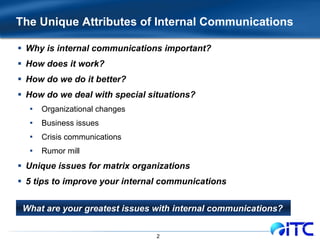
The Unique Attributes of Internal Communications  Why is internal communications important? How does it work? How do we do it better? How do we deal with special situations? Organizational changes Business issues Crisis communications Rumor mill Unique issues for matrix organizations 5 tips to improve your internal communications What are your greatest issues with internal communications?
Tom Petersen  Currently Director – Communications for ITC Midwest Subsidiary of ITC Holdings Corp. (NYSE:ITC) nation’s largest independent electric transmission company Until December 2007, was Director – Corporate Communications for Alliant Energy Vertically-integrated electric and natural gas utility serving 1 million customers in Iowa, Minnesota and Wisconsin Former public relations agency assistant vice president and account supervisor Former newspaper reporter Former congressional campaign staffer Husband of a Hodgkin’s survivor Tom Petersen Director – Communications ITC Midwest 201 Third Avenue SE, Suite 300 Cedar Rapids IA 52401 (319) 297-6793 tpetersen@itctransco.com
The Role of Internal Communications Internal communications is critical to achieving organizational goals Internal audience needs to know what’s going on for their own purposes: So they know how to make the decisions that align with company direction So they know what tactics need to be done so they can perform them So they can decide their level of commitment to the organization Internal audience needs to know what’s going on because they are a critical channel to external audiences Formal contact (customers, regulators, vendors) Informal contact (family, neighbors, community)
How Internal Communications Works Internal communications is a big mystery to many organizations “Why didn’t employees know that?” “Why don’t they ask questions if they don’t know?” “Why don’t they believe us?” “Why don’t they do what we want them to do?” “Why do they continue to spread rumors that aren’t true?” “Why do they complain?” “Why do they hate us? (We pay their paychecks!)” So easy to fall into the “us vs. them” mindset
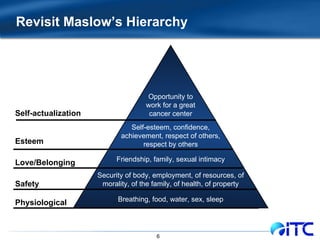
Revisit Maslow’s Hierarchy Breathing, food, water, sex, sleep Security of body, employment, of resources, of morality, of the family, of health, of property Friendship, family, sexual intimacy Self-esteem, confidence, achievement, respect of others, respect by others Opportunity to work for a great cancer center Esteem Self-actualization Love/Belonging Safety Physiological
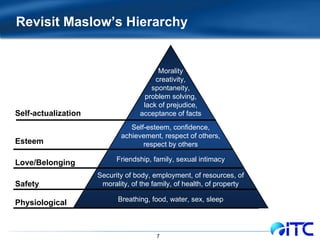
Revisit Maslow’s Hierarchy Breathing, food, water, sex, sleep Security of body, employment, of resources, of morality, of the family, of health, of property Friendship, family, sexual intimacy Self-esteem, confidence, achievement, respect of others, respect by others Morality creativity, spontaneity, problem solving, lack of prejudice, acceptance of facts Esteem Self-actualization Love/Belonging Safety Physiological
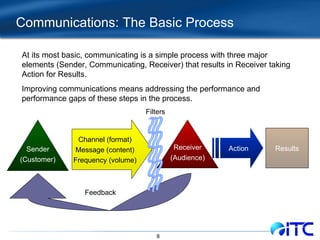
Sender (Customer) Receiver (Audience) Action Channel (format) Message (content) Frequency (volume) Feedback Results At its most basic, communicating is a simple process with three major elements (Sender, Communicating, Receiver) that results in Receiver taking Action for Results.  Improving communications means addressing the performance and performance gaps of these steps in the process. Filters Communications: The Basic Process
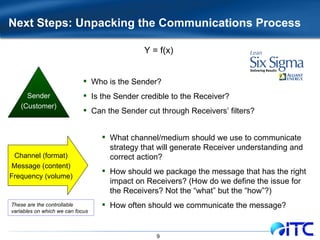
Next Steps: Unpacking the Communications Process Sender (Customer) Channel (format) Message (content) Frequency (volume) Who is the Sender? Is the Sender credible to the Receiver? Can the Sender cut through Receivers’ filters? What channel/medium should we use to communicate strategy that will generate Receiver understanding and correct action? How should we package the message that has the right impact on Receivers? (How do we define the issue for the Receivers? Not the “what” but the “how”?) How often should we communicate the message? Y = f(x)  These are the controllable variables on which we can focus
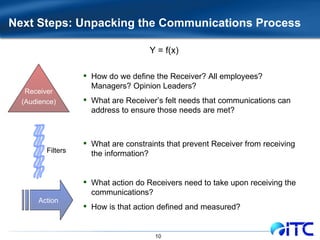
Next Steps: Unpacking the Communications Process Receiver (Audience) Action How do we define the Receiver? All employees? Managers? Opinion Leaders?  What are Receiver’s felt needs that communications can address to ensure those needs are met? What are constraints that prevent Receiver from receiving the information? What action do Receivers need to take upon receiving the communications? How is that action defined and measured? Y = f(x)  Filters
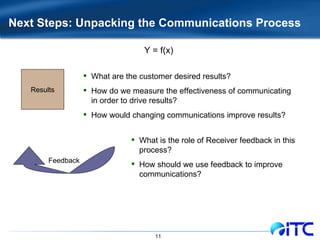
Next Steps: Unpacking the Communications Process Feedback Results What are the customer desired results? How do we measure the effectiveness of communicating in order to drive results? How would changing communications improve results? What is the role of Receiver feedback in this process? How should we use feedback to improve communications? Y = f(x)
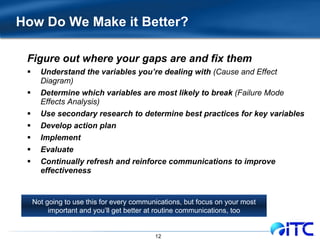
Figure out where your gaps are and fix them Understand the variables you’re dealing with  (Cause and Effect Diagram) Determine which variables are most likely to break  (Failure Mode Effects Analysis) Use secondary research to determine best practices for key variables Develop action plan Implement Evaluate  Continually refresh and reinforce communications to improve effectiveness How Do We Make it Better?  Not going to use this for every communications, but focus on your most important and you’ll get better at routine communications, too
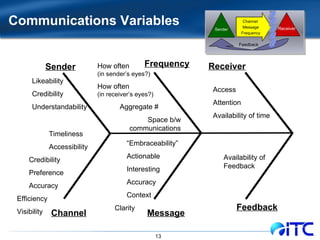
Communications Variables Sender Channel Frequency Message Receiver Feedback Likeability Credibility Understandability How often  (in sender’s eyes?) How often  (in receiver’s eyes?) Aggregate # Space b/w communications Access Attention Availability of time Timeliness Accessibility Credibility Preference Accuracy Efficiency Visibility  “ Embraceability” Actionable Interesting Accuracy Context Clarity Availability of  Feedback Sender Receiver Channel  Message Frequency Feedback
Dealing with Special Situations Organizational changes Business issues Crisis communications Rumor mill
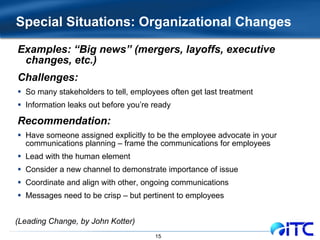
Special Situations: Organizational Changes Examples: “Big news” (mergers, layoffs, executive changes, etc.) Challenges: So many stakeholders to tell, employees often get last treatment Information leaks out before you’re ready Recommendation: Have someone assigned explicitly to be the employee advocate in your communications planning – frame the communications for employees Lead with the human element Consider a new channel to demonstrate importance of issue Coordinate and align with other, ongoing communications Messages need to be crisp – but pertinent to employees (Leading Change, by John Kotter)
Special Situations: Business Issues Examples: Organization direction, regulatory or financial developments, operating changes, etc. Challenges: May not be intuitive that employees need to know Issue may not affect employees’ day-to-day activities Information leaks out before you’re ready Recommendation: Assume you need to communicate business issues to employees – first mover advantage Use channel commensurate with nature of communications
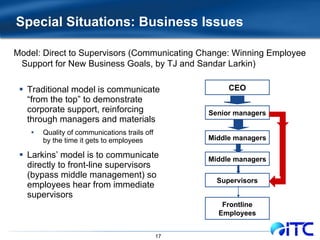
Special Situations: Business Issues Traditional model is communicate “from the top” to demonstrate corporate support, reinforcing through managers and materials Quality of communications trails off by the time it gets to employees Larkins’ model is to communicate directly to front-line supervisors (bypass middle management) so employees hear from immediate supervisors Model: Direct to Supervisors (Communicating Change: Winning Employee Support for New Business Goals, by TJ and Sandar Larkin) CEO Senior managers Middle managers Middle managers Supervisors Frontline Employees
Special Situations: Crisis Communications Examples: Traumatic event, employee malfeasance, etc. Challenges: Will undoubtedly catch you off guard – can never anticipate what or when Time is your worst enemy Overwhelms the system Tendency to circle the wagons and pull up the drawbridge Recommendation: Don’t forget employees – they see crisis as “moment of truth” It’s 25% plan, 75% practice Lead with the human element Be disciplined enough to define audience, message and the facts You get points for speed
Special Situations: Rumor Mill Examples: Organic or intentional information that moves informally through the organization Challenges: Can’t identify where it started or where it is at any time Tendency to want to wait, hoping it will go away Executives often respond emotionally, rather that looking at why Recommendation: Make an analytical decision – something that needs a response? You get points for acknowledging what’s on peoples’ minds Best bet: Proactively seek out what the rumors are (personally, not passively) If you’re really good, you can use the rumor mill to your benefit (No, really!) Any other situations you have to deal with?
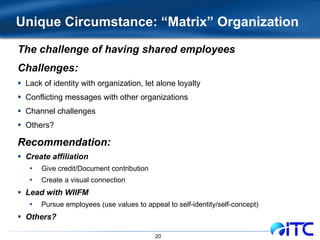
Unique Circumstance: “Matrix” Organization The challenge of having shared employees Challenges: Lack of identity with organization, let alone loyalty Conflicting messages with other organizations Channel challenges Others? Recommendation: Create affiliation Give credit/Document contribution Create a visual connection Lead with WIIFM Pursue employees (use values to appeal to self-identity/self-concept) Others?
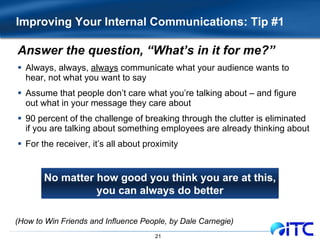
Improving Your Internal Communications: Tip #1 Answer the question, “What’s in it for me?” Always, always,  always  communicate what your audience wants to hear, not what you want to say Assume that people don’t care what you’re talking about – and figure out what in your message they care about 90 percent of the challenge of breaking through the clutter is eliminated if you are talking about something employees are already thinking about For the receiver, it’s all about proximity No matter how good you think you are at this, you can always do better (How to Win Friends and Influence People, by Dale Carnegie)
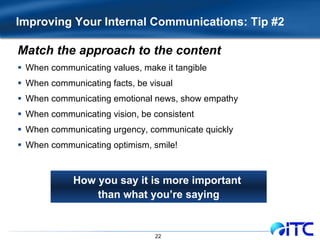
Improving Your Internal Communications: Tip #2 Match the approach to the content When communicating values, make it tangible When communicating facts, be visual When communicating emotional news, show empathy When communicating vision, be consistent When communicating urgency, communicate quickly When communicating optimism, smile! How you say it is more important  than what you’re saying
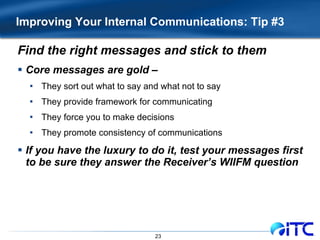
Improving Your Internal Communications: Tip #3 Find the right messages and stick to them Core messages are gold –  They sort out what to say and what not to say They provide framework for communicating They force you to make decisions They promote consistency of communications If you have the luxury to do it, test your messages first to be sure they answer the Receiver’s WIIFM question
Improving Your Internal Communications: Tip #4 Avoid the temptation to tell everyone everything There’s always an urge to share lots of information that someone thinks is important  But don’t forget Tip#2 – WIIFM? There is such a thing as too much communications Telling everyone everything means nothing will get through Find the right channels to segment information
Improving Your Internal Communications: Tip #5 Move from Repetition model to Interest model Ignore the “7 times” guideline Instead, focus on cutting through the clutter SUCCESS   (“Made to Stick: Why Some Ideas Survive and Others Die,” by Chip and Dan Heath) Simplicity Unexpectedness Concreteness Credibility Emotions Stories
Discussion Tom Petersen Director – Communications ITC Midwest 201 Third Avenue SE, Suite 300 Cedar Rapids IA 52401 (319) 297-6793 tpetersen@itctransco.com

Internal communication

  • 1.
    An Outside Perspective:Looking Internally at Communications Tom Petersen Presentation to the National Association of Cancer Centers Development Officers May 4, 2008
  • 2.
    The Unique Attributesof Internal Communications Why is internal communications important? How does it work? How do we do it better? How do we deal with special situations? Organizational changes Business issues Crisis communications Rumor mill Unique issues for matrix organizations 5 tips to improve your internal communications What are your greatest issues with internal communications?
  • 3.
    Tom Petersen Currently Director – Communications for ITC Midwest Subsidiary of ITC Holdings Corp. (NYSE:ITC) nation’s largest independent electric transmission company Until December 2007, was Director – Corporate Communications for Alliant Energy Vertically-integrated electric and natural gas utility serving 1 million customers in Iowa, Minnesota and Wisconsin Former public relations agency assistant vice president and account supervisor Former newspaper reporter Former congressional campaign staffer Husband of a Hodgkin’s survivor Tom Petersen Director – Communications ITC Midwest 201 Third Avenue SE, Suite 300 Cedar Rapids IA 52401 (319) 297-6793 tpetersen@itctransco.com
  • 4.
    The Role ofInternal Communications Internal communications is critical to achieving organizational goals Internal audience needs to know what’s going on for their own purposes: So they know how to make the decisions that align with company direction So they know what tactics need to be done so they can perform them So they can decide their level of commitment to the organization Internal audience needs to know what’s going on because they are a critical channel to external audiences Formal contact (customers, regulators, vendors) Informal contact (family, neighbors, community)
  • 5.
    How Internal CommunicationsWorks Internal communications is a big mystery to many organizations “Why didn’t employees know that?” “Why don’t they ask questions if they don’t know?” “Why don’t they believe us?” “Why don’t they do what we want them to do?” “Why do they continue to spread rumors that aren’t true?” “Why do they complain?” “Why do they hate us? (We pay their paychecks!)” So easy to fall into the “us vs. them” mindset
  • 6.
    Revisit Maslow’s HierarchyBreathing, food, water, sex, sleep Security of body, employment, of resources, of morality, of the family, of health, of property Friendship, family, sexual intimacy Self-esteem, confidence, achievement, respect of others, respect by others Opportunity to work for a great cancer center Esteem Self-actualization Love/Belonging Safety Physiological
  • 7.
    Revisit Maslow’s HierarchyBreathing, food, water, sex, sleep Security of body, employment, of resources, of morality, of the family, of health, of property Friendship, family, sexual intimacy Self-esteem, confidence, achievement, respect of others, respect by others Morality creativity, spontaneity, problem solving, lack of prejudice, acceptance of facts Esteem Self-actualization Love/Belonging Safety Physiological
  • 8.
    Sender (Customer) Receiver(Audience) Action Channel (format) Message (content) Frequency (volume) Feedback Results At its most basic, communicating is a simple process with three major elements (Sender, Communicating, Receiver) that results in Receiver taking Action for Results. Improving communications means addressing the performance and performance gaps of these steps in the process. Filters Communications: The Basic Process
  • 9.
    Next Steps: Unpackingthe Communications Process Sender (Customer) Channel (format) Message (content) Frequency (volume) Who is the Sender? Is the Sender credible to the Receiver? Can the Sender cut through Receivers’ filters? What channel/medium should we use to communicate strategy that will generate Receiver understanding and correct action? How should we package the message that has the right impact on Receivers? (How do we define the issue for the Receivers? Not the “what” but the “how”?) How often should we communicate the message? Y = f(x) These are the controllable variables on which we can focus
  • 10.
    Next Steps: Unpackingthe Communications Process Receiver (Audience) Action How do we define the Receiver? All employees? Managers? Opinion Leaders? What are Receiver’s felt needs that communications can address to ensure those needs are met? What are constraints that prevent Receiver from receiving the information? What action do Receivers need to take upon receiving the communications? How is that action defined and measured? Y = f(x) Filters
  • 11.
    Next Steps: Unpackingthe Communications Process Feedback Results What are the customer desired results? How do we measure the effectiveness of communicating in order to drive results? How would changing communications improve results? What is the role of Receiver feedback in this process? How should we use feedback to improve communications? Y = f(x)
  • 12.
    Figure out whereyour gaps are and fix them Understand the variables you’re dealing with (Cause and Effect Diagram) Determine which variables are most likely to break (Failure Mode Effects Analysis) Use secondary research to determine best practices for key variables Develop action plan Implement Evaluate Continually refresh and reinforce communications to improve effectiveness How Do We Make it Better? Not going to use this for every communications, but focus on your most important and you’ll get better at routine communications, too
  • 13.
    Communications Variables SenderChannel Frequency Message Receiver Feedback Likeability Credibility Understandability How often (in sender’s eyes?) How often (in receiver’s eyes?) Aggregate # Space b/w communications Access Attention Availability of time Timeliness Accessibility Credibility Preference Accuracy Efficiency Visibility “ Embraceability” Actionable Interesting Accuracy Context Clarity Availability of Feedback Sender Receiver Channel Message Frequency Feedback
  • 14.
    Dealing with SpecialSituations Organizational changes Business issues Crisis communications Rumor mill
  • 15.
    Special Situations: OrganizationalChanges Examples: “Big news” (mergers, layoffs, executive changes, etc.) Challenges: So many stakeholders to tell, employees often get last treatment Information leaks out before you’re ready Recommendation: Have someone assigned explicitly to be the employee advocate in your communications planning – frame the communications for employees Lead with the human element Consider a new channel to demonstrate importance of issue Coordinate and align with other, ongoing communications Messages need to be crisp – but pertinent to employees (Leading Change, by John Kotter)
  • 16.
    Special Situations: BusinessIssues Examples: Organization direction, regulatory or financial developments, operating changes, etc. Challenges: May not be intuitive that employees need to know Issue may not affect employees’ day-to-day activities Information leaks out before you’re ready Recommendation: Assume you need to communicate business issues to employees – first mover advantage Use channel commensurate with nature of communications
  • 17.
    Special Situations: BusinessIssues Traditional model is communicate “from the top” to demonstrate corporate support, reinforcing through managers and materials Quality of communications trails off by the time it gets to employees Larkins’ model is to communicate directly to front-line supervisors (bypass middle management) so employees hear from immediate supervisors Model: Direct to Supervisors (Communicating Change: Winning Employee Support for New Business Goals, by TJ and Sandar Larkin) CEO Senior managers Middle managers Middle managers Supervisors Frontline Employees
  • 18.
    Special Situations: CrisisCommunications Examples: Traumatic event, employee malfeasance, etc. Challenges: Will undoubtedly catch you off guard – can never anticipate what or when Time is your worst enemy Overwhelms the system Tendency to circle the wagons and pull up the drawbridge Recommendation: Don’t forget employees – they see crisis as “moment of truth” It’s 25% plan, 75% practice Lead with the human element Be disciplined enough to define audience, message and the facts You get points for speed
  • 19.
    Special Situations: RumorMill Examples: Organic or intentional information that moves informally through the organization Challenges: Can’t identify where it started or where it is at any time Tendency to want to wait, hoping it will go away Executives often respond emotionally, rather that looking at why Recommendation: Make an analytical decision – something that needs a response? You get points for acknowledging what’s on peoples’ minds Best bet: Proactively seek out what the rumors are (personally, not passively) If you’re really good, you can use the rumor mill to your benefit (No, really!) Any other situations you have to deal with?
  • 20.
    Unique Circumstance: “Matrix”Organization The challenge of having shared employees Challenges: Lack of identity with organization, let alone loyalty Conflicting messages with other organizations Channel challenges Others? Recommendation: Create affiliation Give credit/Document contribution Create a visual connection Lead with WIIFM Pursue employees (use values to appeal to self-identity/self-concept) Others?
  • 21.
    Improving Your InternalCommunications: Tip #1 Answer the question, “What’s in it for me?” Always, always, always communicate what your audience wants to hear, not what you want to say Assume that people don’t care what you’re talking about – and figure out what in your message they care about 90 percent of the challenge of breaking through the clutter is eliminated if you are talking about something employees are already thinking about For the receiver, it’s all about proximity No matter how good you think you are at this, you can always do better (How to Win Friends and Influence People, by Dale Carnegie)
  • 22.
    Improving Your InternalCommunications: Tip #2 Match the approach to the content When communicating values, make it tangible When communicating facts, be visual When communicating emotional news, show empathy When communicating vision, be consistent When communicating urgency, communicate quickly When communicating optimism, smile! How you say it is more important than what you’re saying
  • 23.
    Improving Your InternalCommunications: Tip #3 Find the right messages and stick to them Core messages are gold – They sort out what to say and what not to say They provide framework for communicating They force you to make decisions They promote consistency of communications If you have the luxury to do it, test your messages first to be sure they answer the Receiver’s WIIFM question
  • 24.
    Improving Your InternalCommunications: Tip #4 Avoid the temptation to tell everyone everything There’s always an urge to share lots of information that someone thinks is important But don’t forget Tip#2 – WIIFM? There is such a thing as too much communications Telling everyone everything means nothing will get through Find the right channels to segment information
  • 25.
    Improving Your InternalCommunications: Tip #5 Move from Repetition model to Interest model Ignore the “7 times” guideline Instead, focus on cutting through the clutter SUCCESS (“Made to Stick: Why Some Ideas Survive and Others Die,” by Chip and Dan Heath) Simplicity Unexpectedness Concreteness Credibility Emotions Stories
  • 26.
    Discussion Tom PetersenDirector – Communications ITC Midwest 201 Third Avenue SE, Suite 300 Cedar Rapids IA 52401 (319) 297-6793 tpetersen@itctransco.com