Barriers in Communication

                  Prof Aparna Rao
                         25-06-12
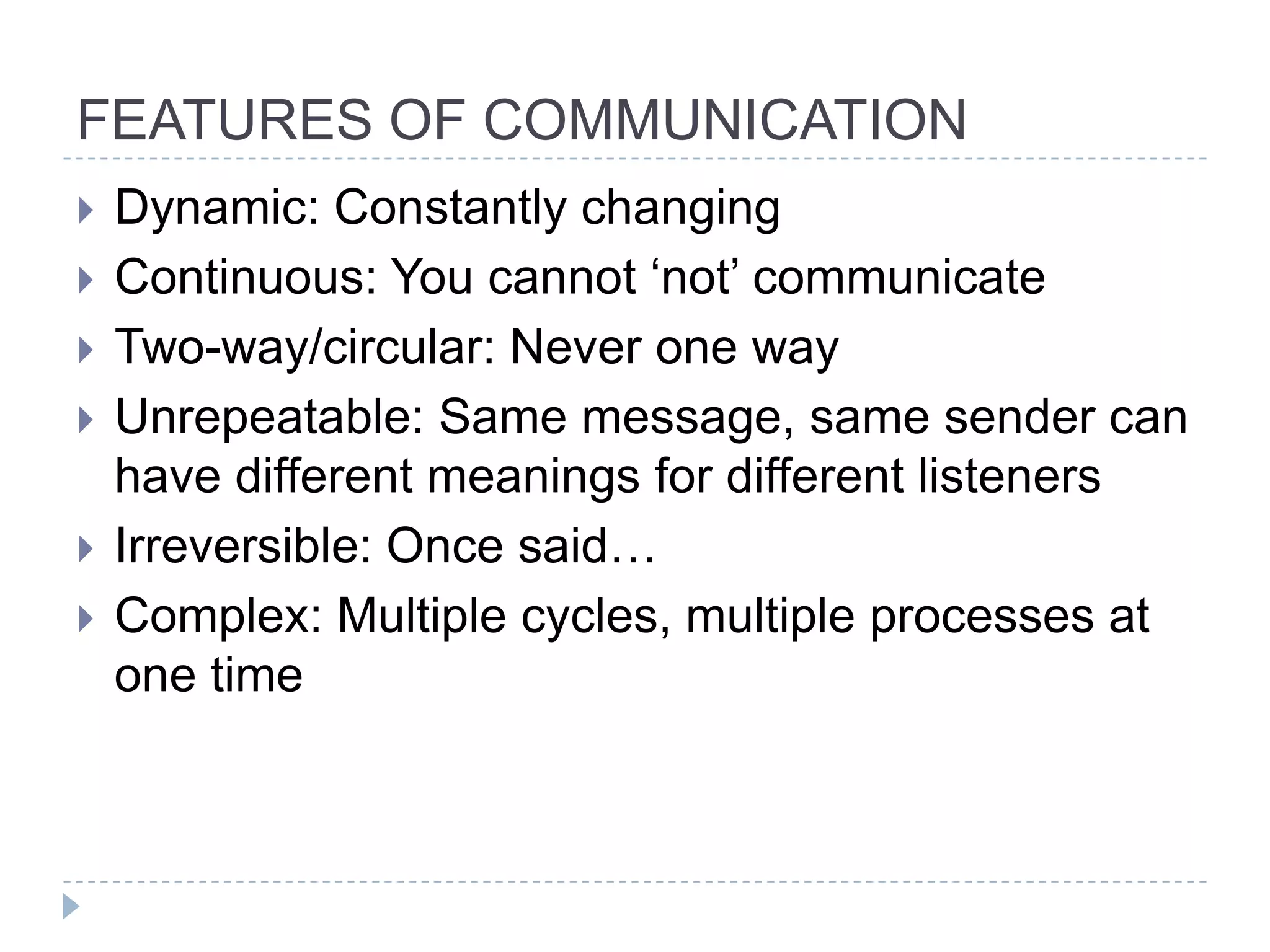
FEATURES OF COMMUNICATION
   Dynamic: Constantly changing
   Continuous: You cannot ‘not’ communicate
   Two-way/circular: Never one way
   Unrepeatable: Same message, same sender can
    have different meanings for different listeners
   Irreversible: Once said…
   Complex: Multiple cycles, multiple processes at
    one time
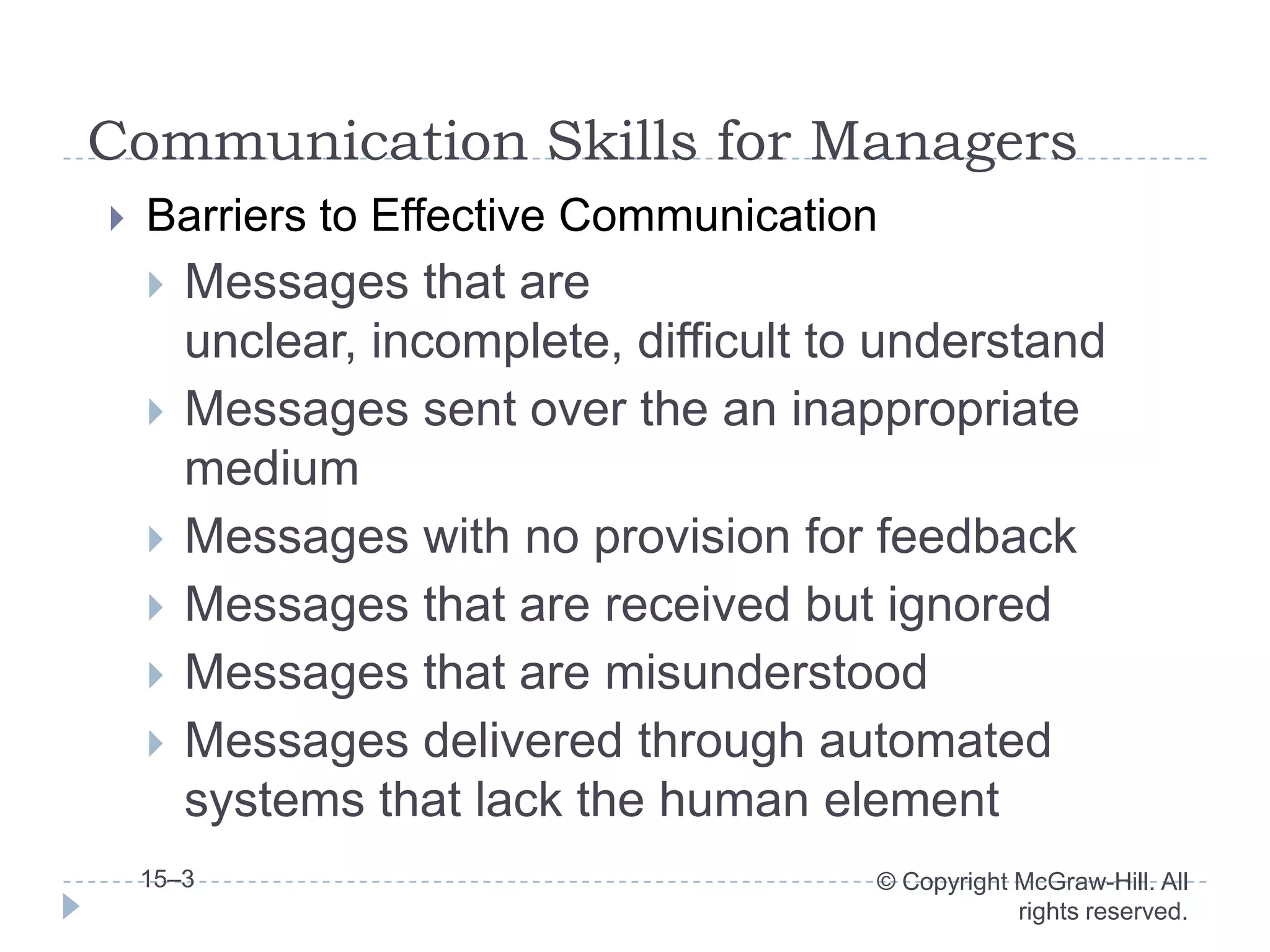
Communication Skills for Managers
   Barriers to Effective Communication
       Messages that are
        unclear, incomplete, difficult to understand
       Messages sent over the an inappropriate
        medium
       Messages with no provision for feedback
       Messages that are received but ignored
       Messages that are misunderstood
       Messages delivered through automated
        systems that lack the human element
    15–3                                 © Copyright McGraw-Hill. All
                                                     rights reserved.
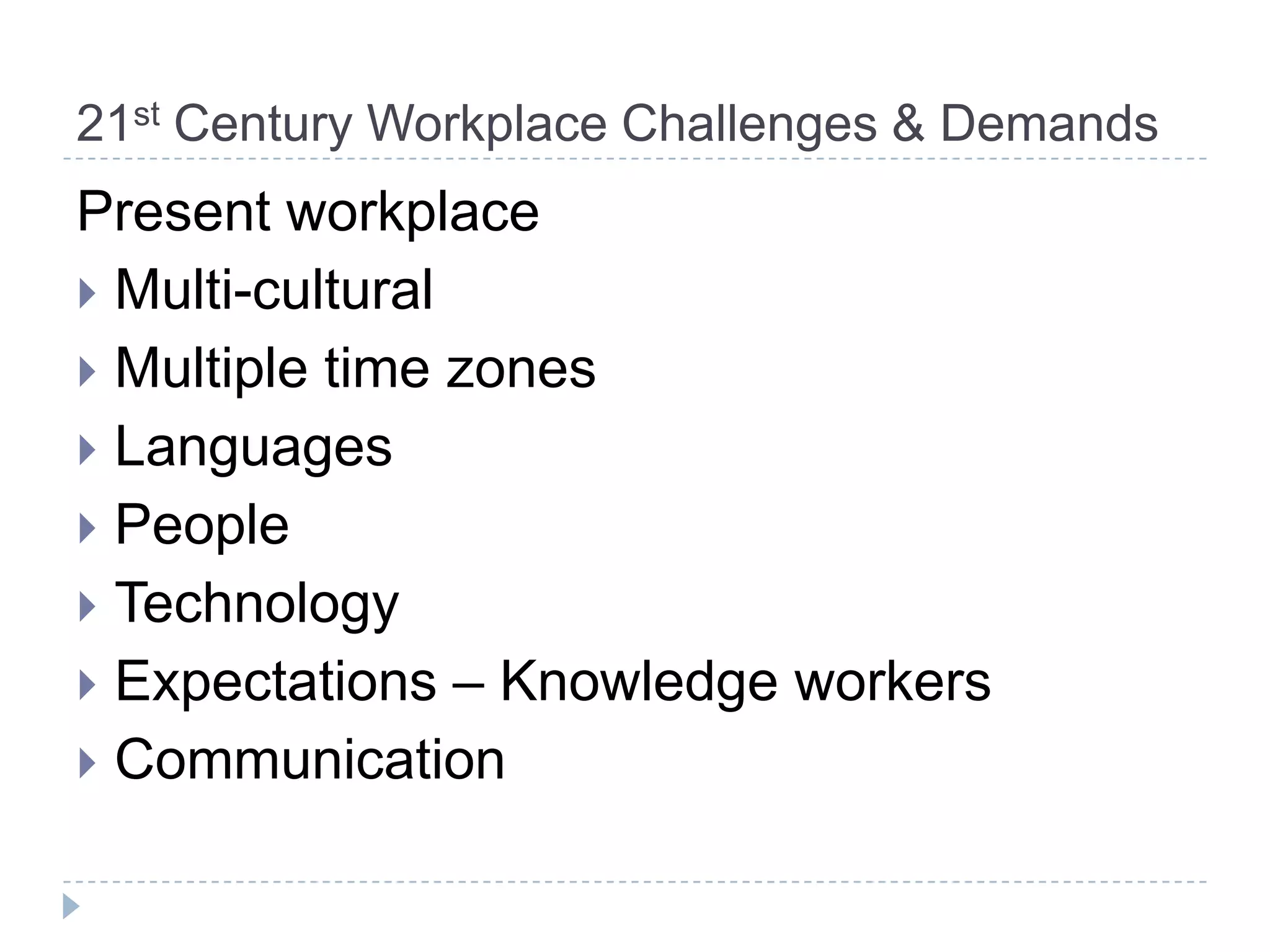
21st Century Workplace Challenges & Demands
Present workplace
 Multi-cultural
 Multiple time zones
 Languages
 People
 Technology
 Expectations – Knowledge workers
 Communication
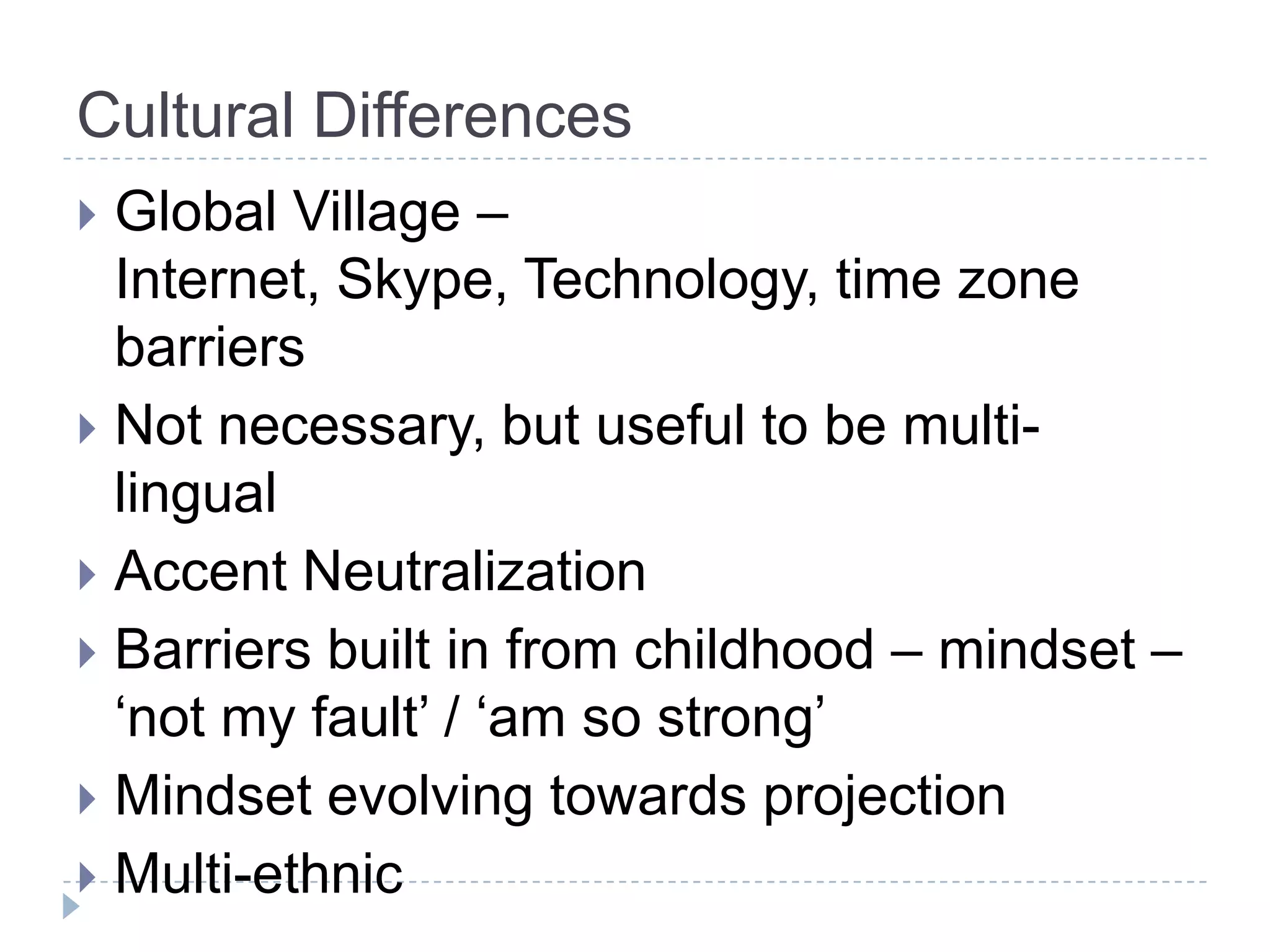
Cultural Differences
 Global Village –
  Internet, Skype, Technology, time zone
  barriers
 Not necessary, but useful to be multi-
  lingual
 Accent Neutralization
 Barriers built in from childhood – mindset –
  ‘not my fault’ / ‘am so strong’
 Mindset evolving towards projection
 Multi-ethnic
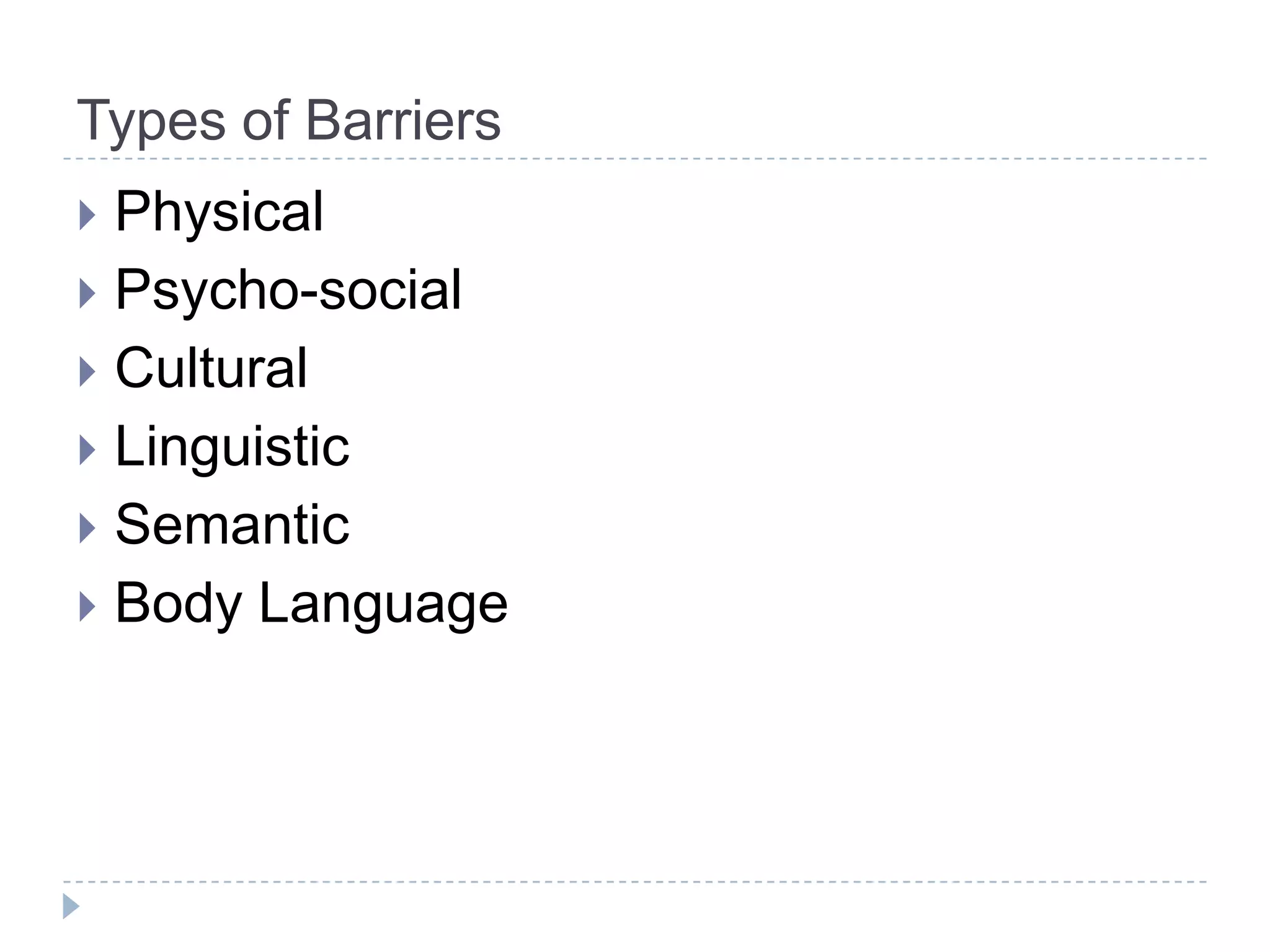
Types of Barriers
 Physical
 Psycho-social
 Cultural
 Linguistic
 Semantic
 Body Language
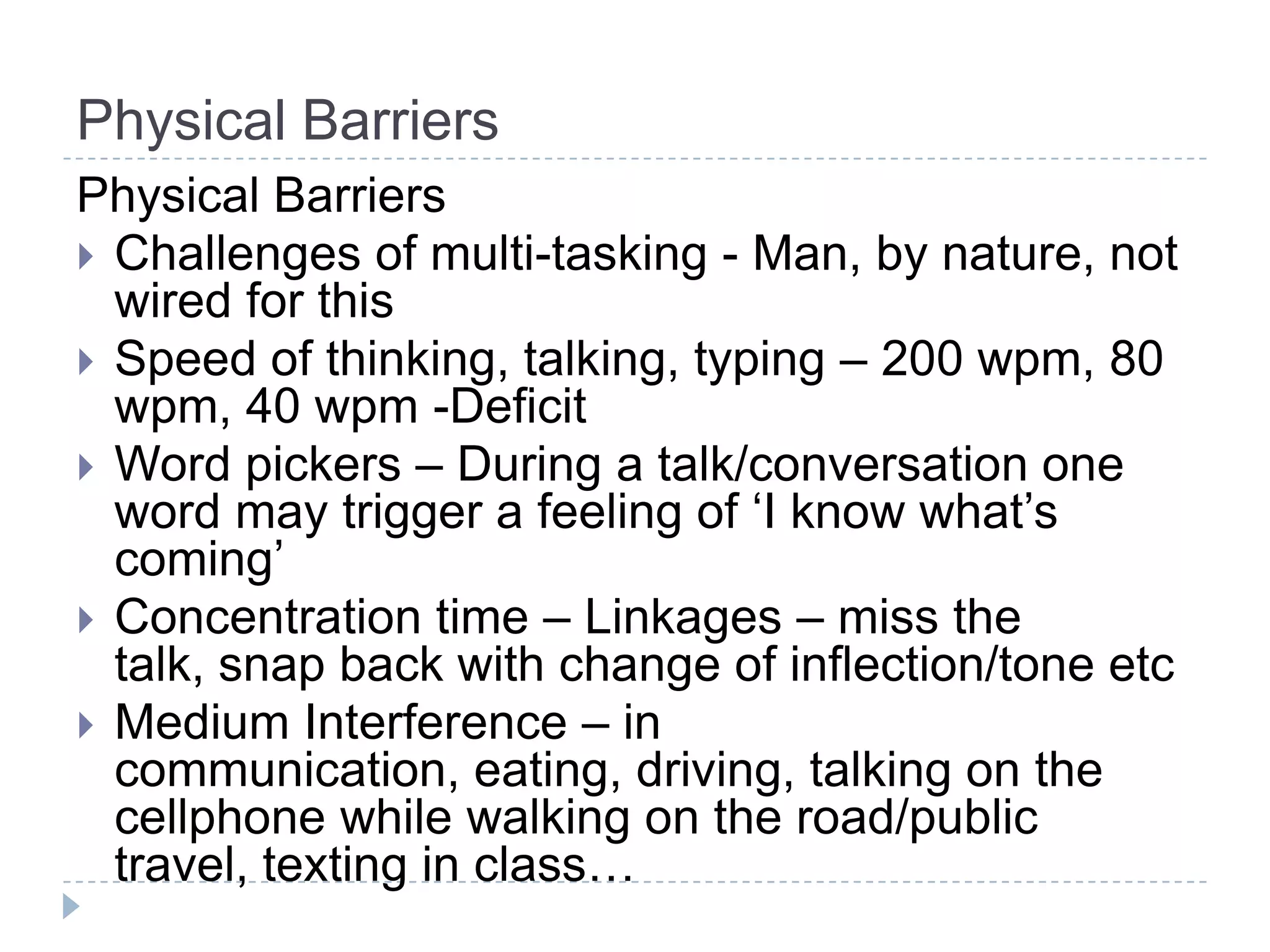
Physical Barriers
Physical Barriers
 Challenges of multi-tasking - Man, by nature, not
  wired for this
 Speed of thinking, talking, typing – 200 wpm, 80
  wpm, 40 wpm -Deficit
 Word pickers – During a talk/conversation one
  word may trigger a feeling of ‘I know what’s
  coming’
 Concentration time – Linkages – miss the
  talk, snap back with change of inflection/tone etc
 Medium Interference – in
  communication, eating, driving, talking on the
  cellphone while walking on the road/public
  travel, texting in class…
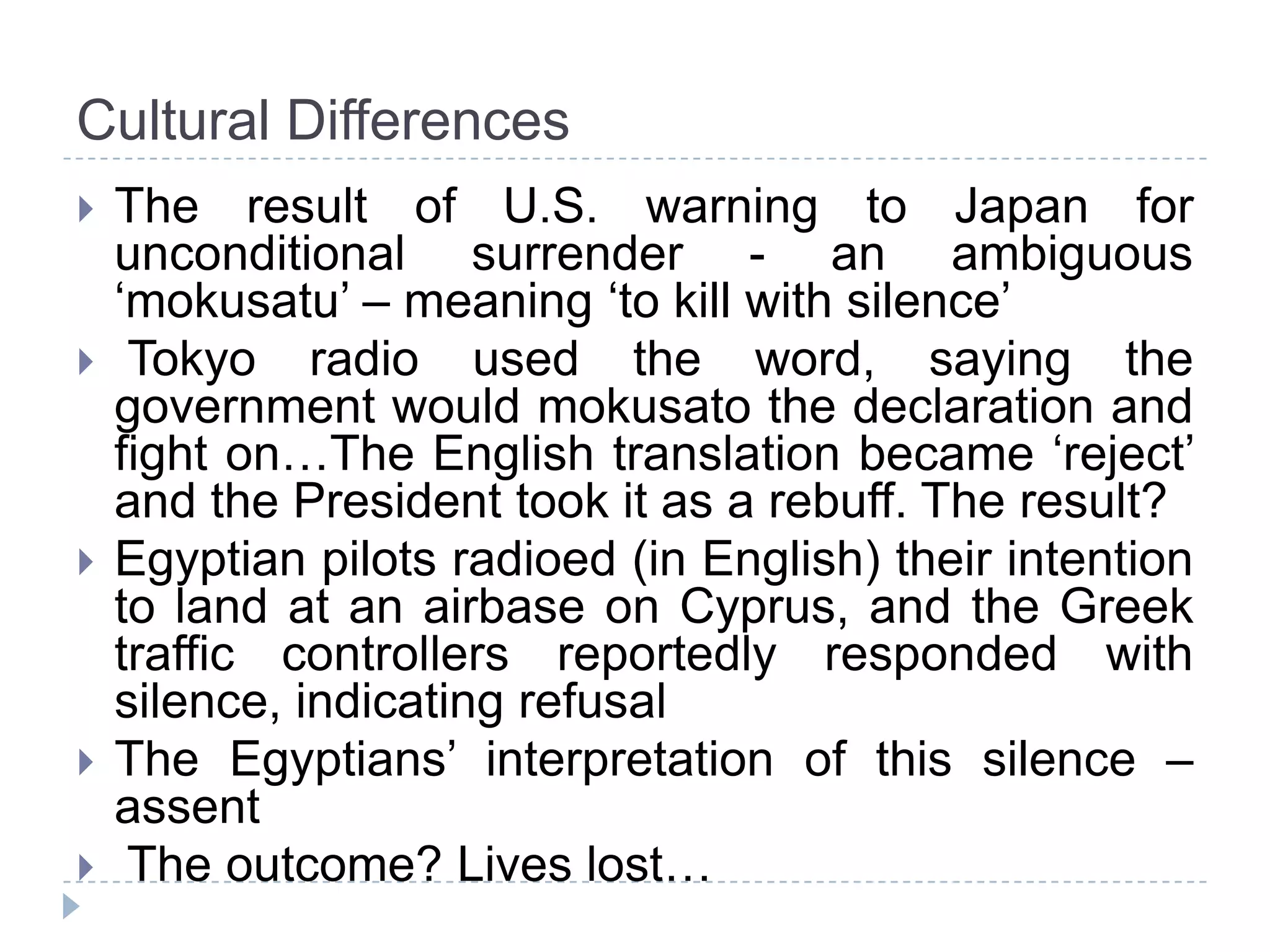
Cultural Differences
   The result of U.S. warning to Japan for
    unconditional surrender - an ambiguous
    ‘mokusatu’ – meaning ‘to kill with silence’
    Tokyo radio used the word, saying the
    government would mokusato the declaration and
    fight on…The English translation became ‘reject’
    and the President took it as a rebuff. The result?
   Egyptian pilots radioed (in English) their intention
    to land at an airbase on Cyprus, and the Greek
    traffic controllers reportedly responded with
    silence, indicating refusal
   The Egyptians’ interpretation of this silence –
    assent
    The outcome? Lives lost…
Cultural Differences
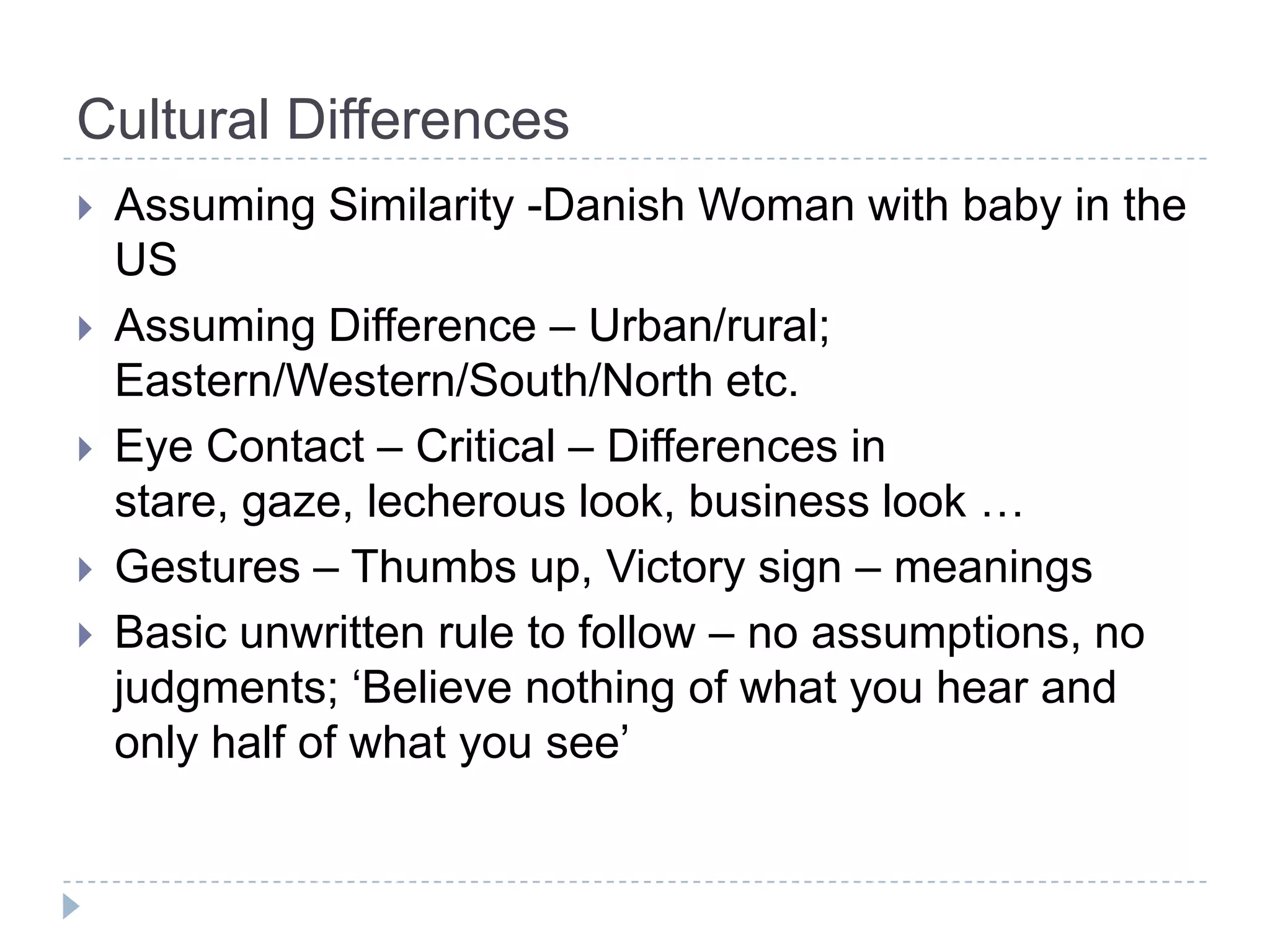
   Assuming Similarity -Danish Woman with baby in the
    US
   Assuming Difference – Urban/rural;
    Eastern/Western/South/North etc.
   Eye Contact – Critical – Differences in
    stare, gaze, lecherous look, business look …
   Gestures – Thumbs up, Victory sign – meanings
   Basic unwritten rule to follow – no assumptions, no
    judgments; ‘Believe nothing of what you hear and
    only half of what you see’
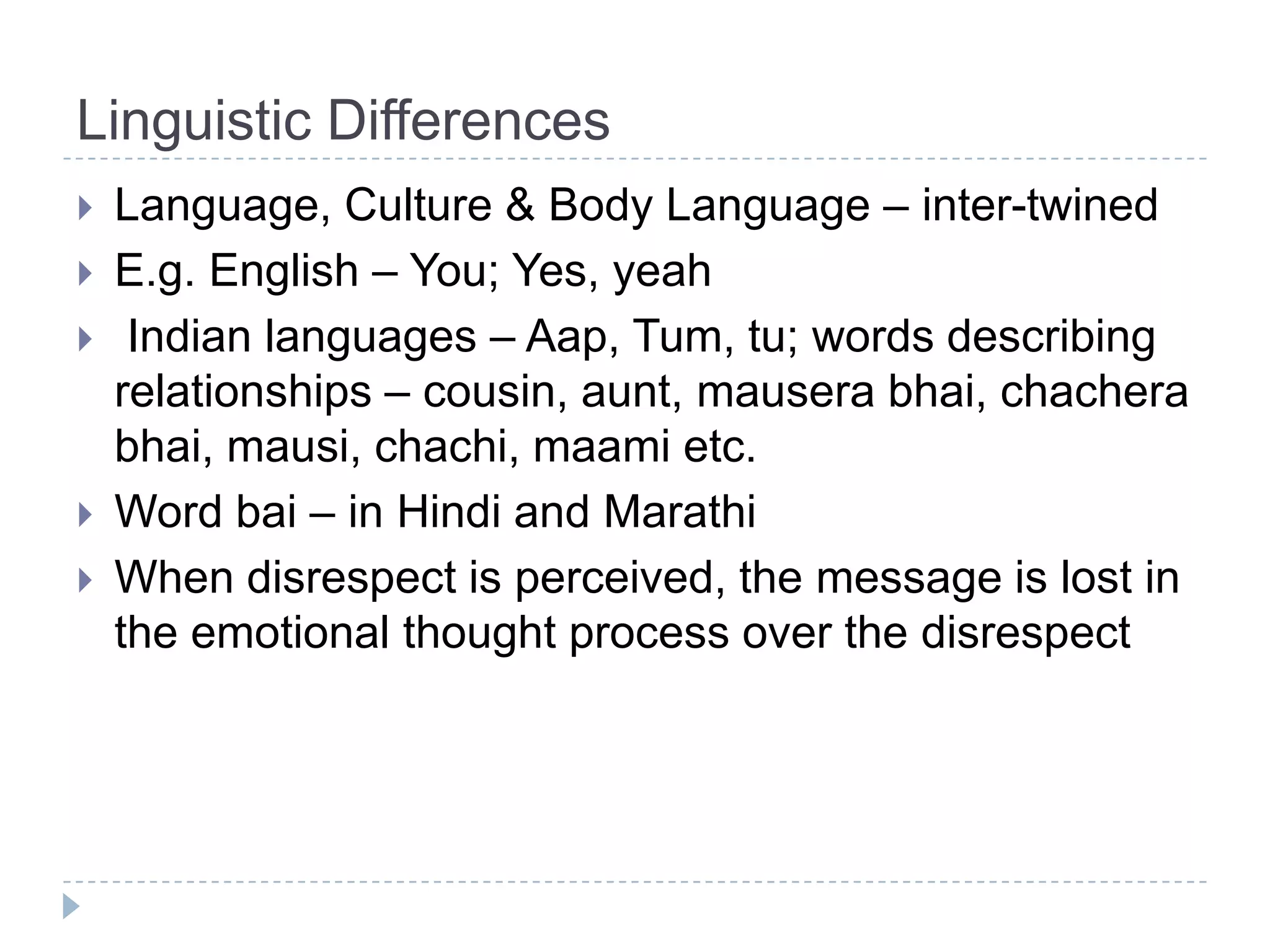
Linguistic Differences
   Language, Culture & Body Language – inter-twined
   E.g. English – You; Yes, yeah
    Indian languages – Aap, Tum, tu; words describing
    relationships – cousin, aunt, mausera bhai, chachera
    bhai, mausi, chachi, maami etc.
   Word bai – in Hindi and Marathi
   When disrespect is perceived, the message is lost in
    the emotional thought process over the disrespect
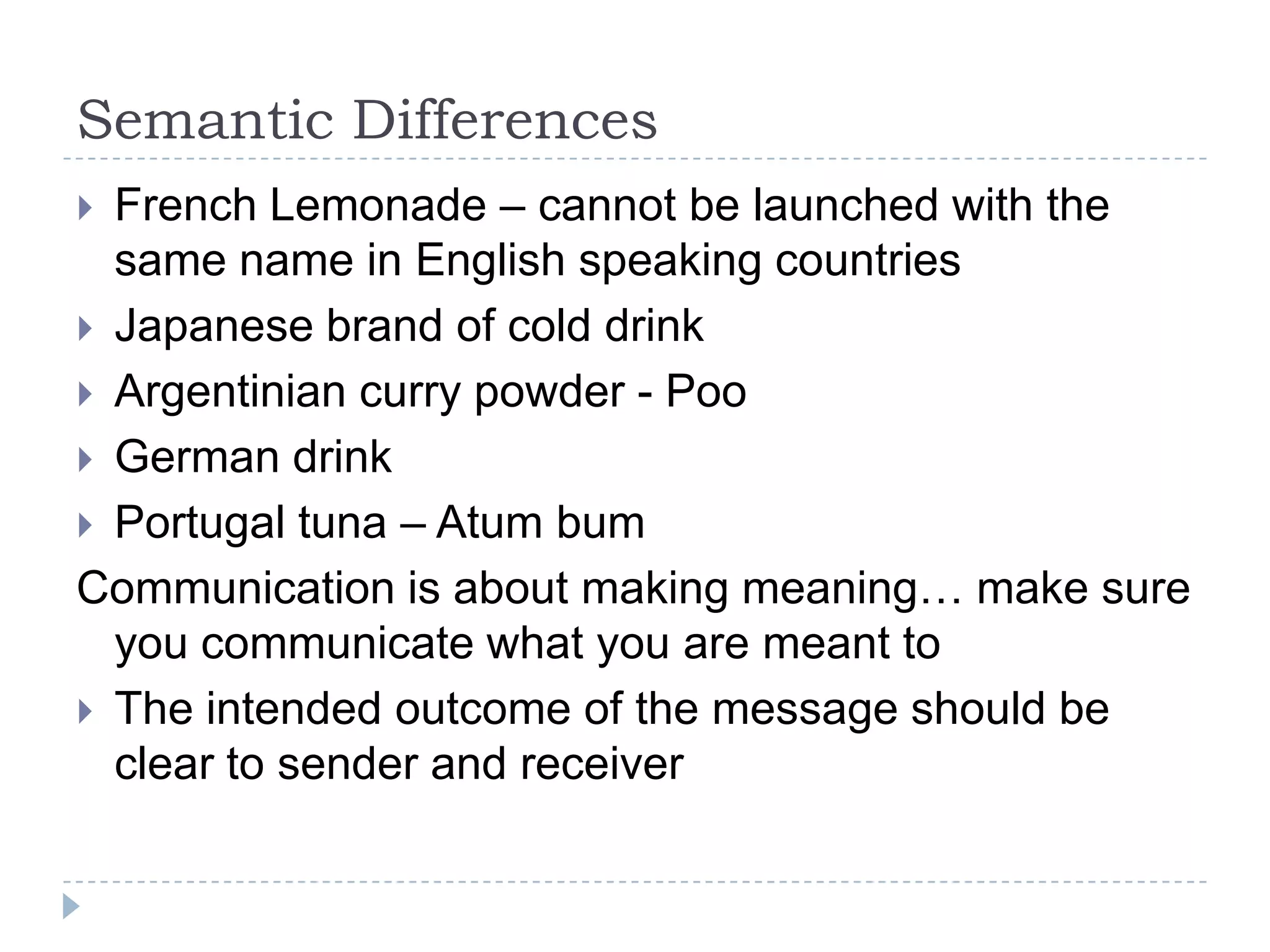
Semantic Differences
 French Lemonade – cannot be launched with the
  same name in English speaking countries
 Japanese brand of cold drink
 Argentinian curry powder - Poo
 German drink
 Portugal tuna – Atum bum
Communication is about making meaning… make sure
  you communicate what you are meant to
 The intended outcome of the message should be
  clear to sender and receiver
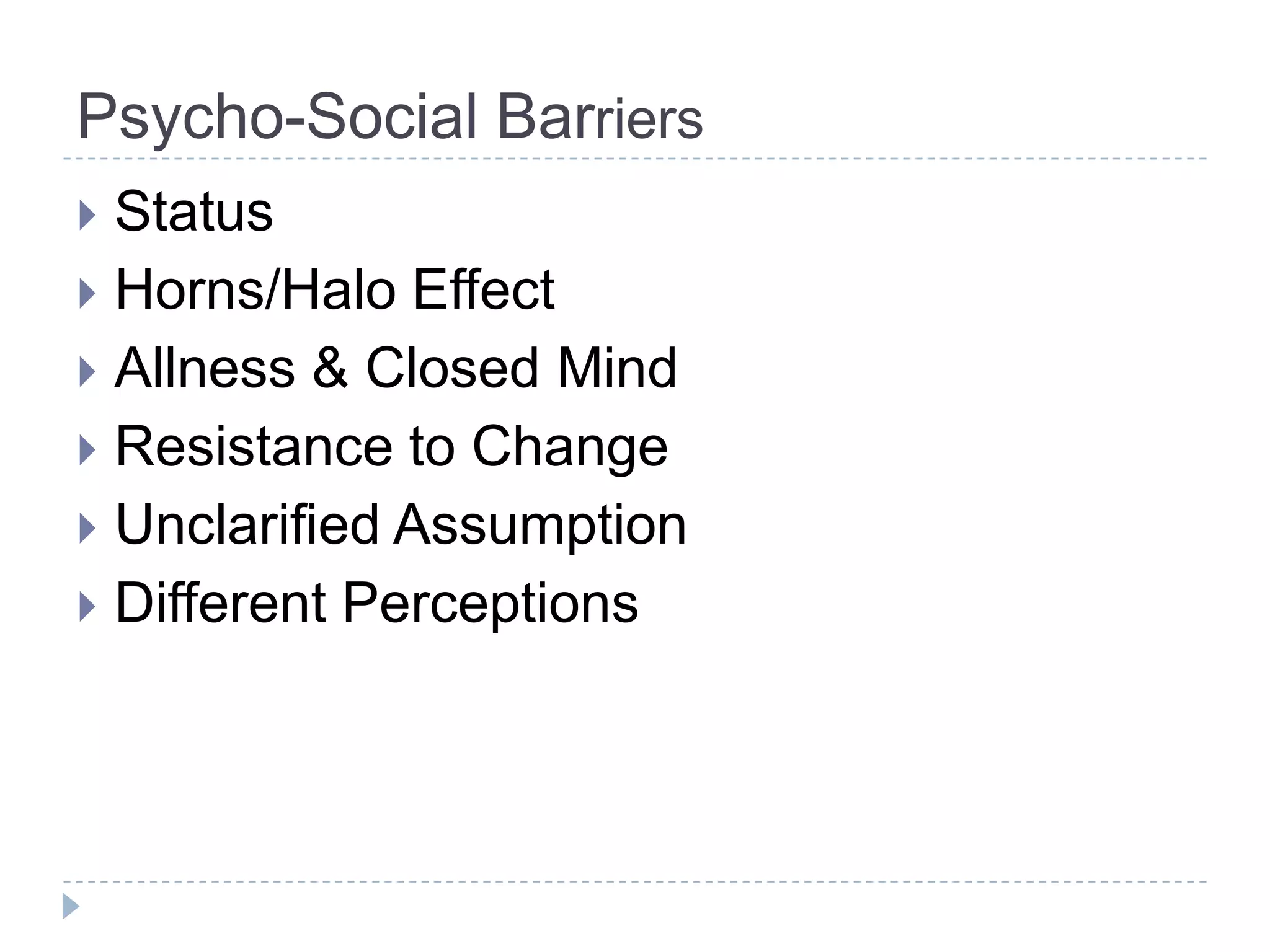
Psycho-Social Barriers
 Status
 Horns/Halo Effect
 Allness & Closed Mind
 Resistance to Change
 Unclarified Assumption
 Different Perceptions
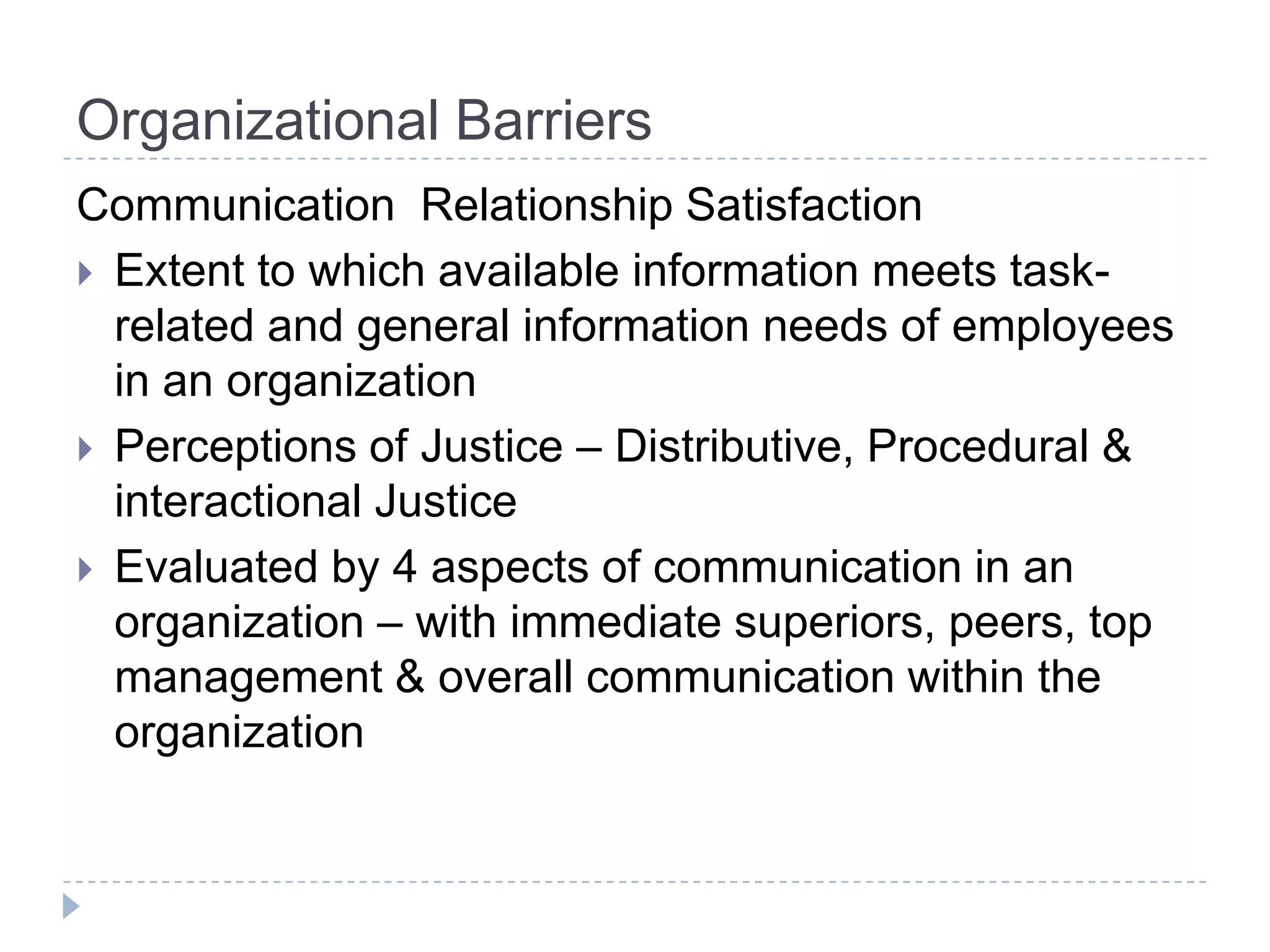
Organizational Barriers
Communication Relationship Satisfaction
 Extent to which available information meets task-
  related and general information needs of employees
  in an organization
 Perceptions of Justice – Distributive, Procedural &
  interactional Justice
 Evaluated by 4 aspects of communication in an
  organization – with immediate superiors, peers, top
  management & overall communication within the
  organization
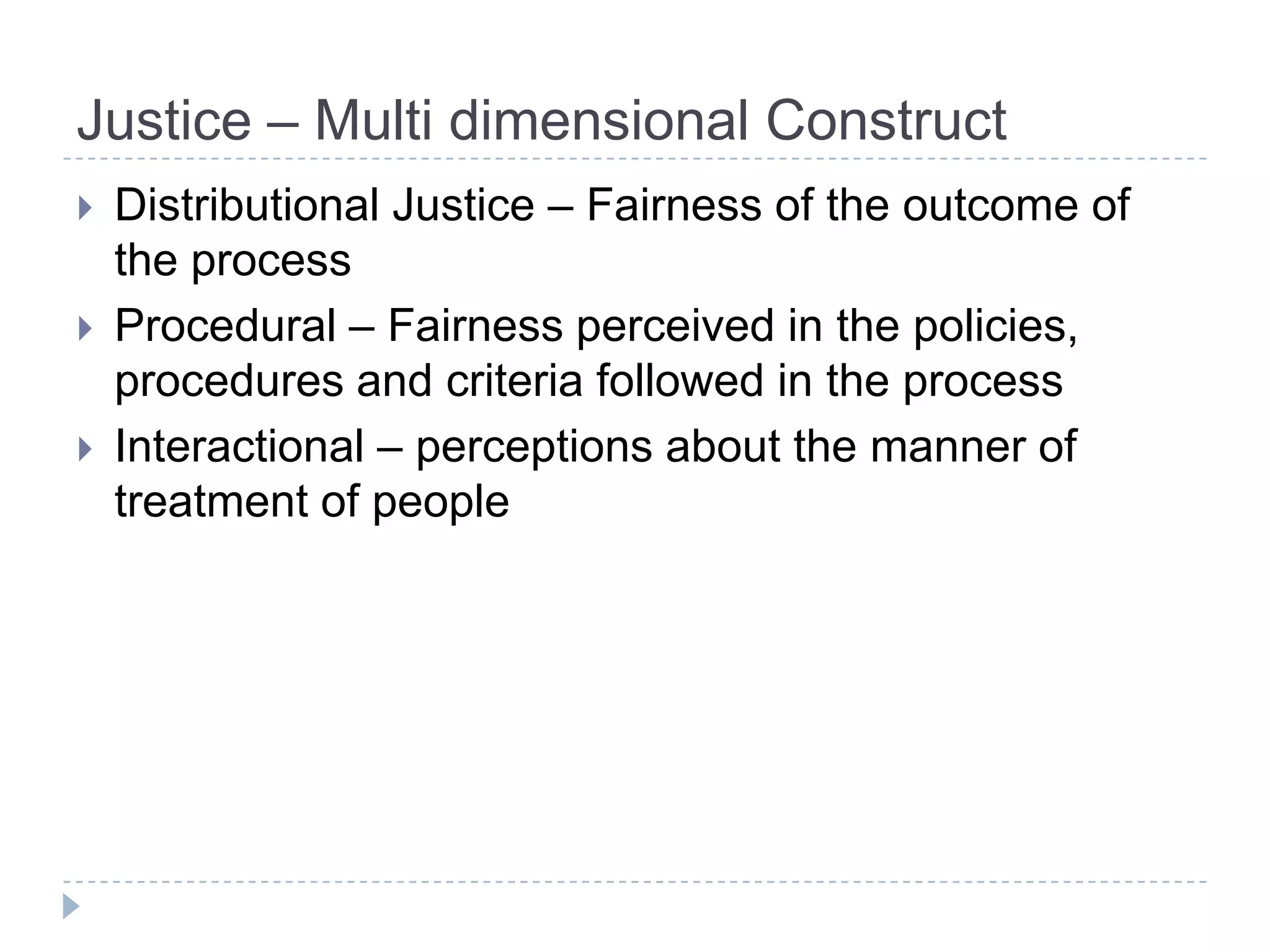
Justice – Multi dimensional Construct
   Distributional Justice – Fairness of the outcome of
    the process
   Procedural – Fairness perceived in the policies,
    procedures and criteria followed in the process
   Interactional – perceptions about the manner of
    treatment of people
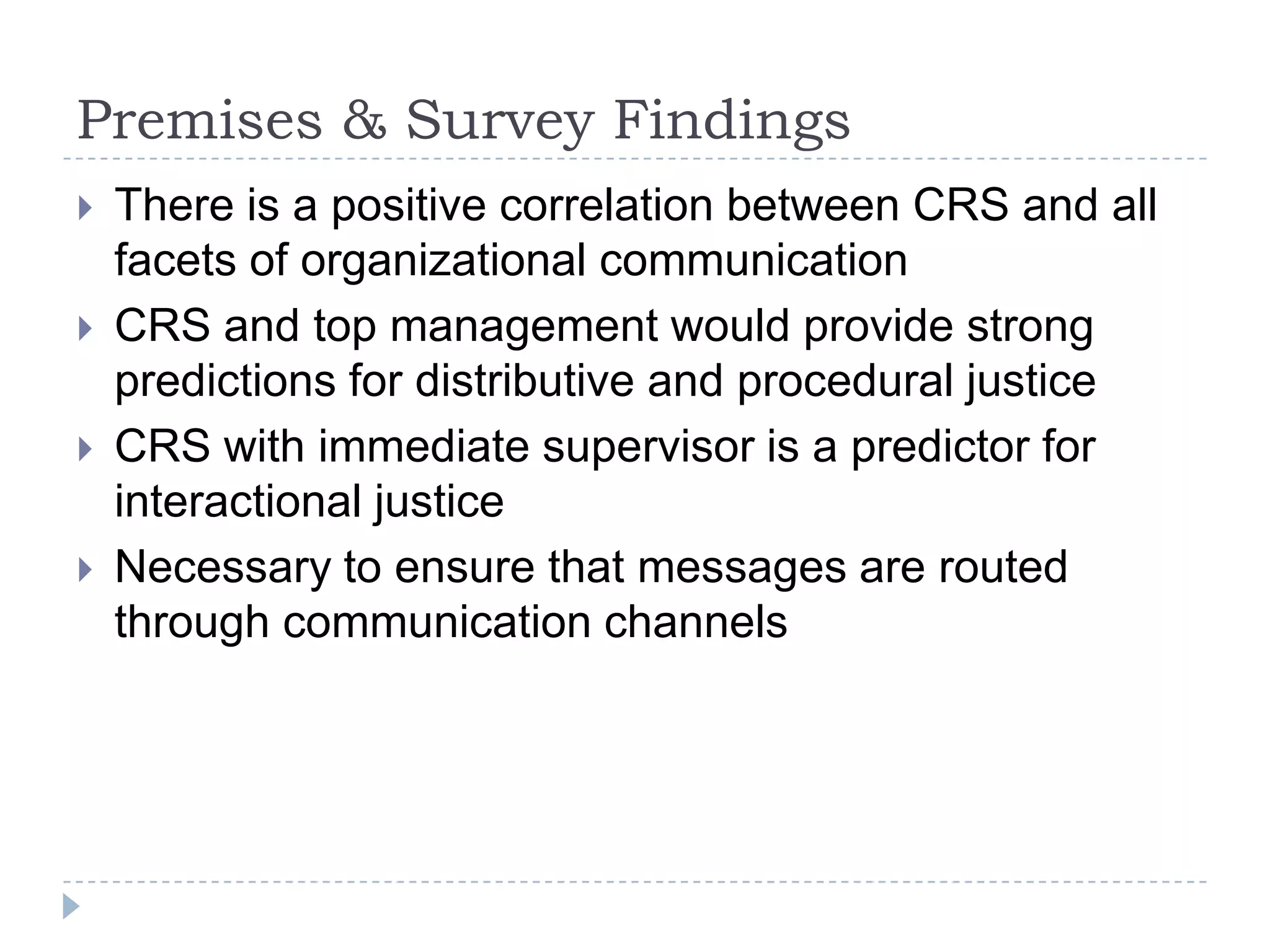
Premises & Survey Findings
   There is a positive correlation between CRS and all
    facets of organizational communication
   CRS and top management would provide strong
    predictions for distributive and procedural justice
   CRS with immediate supervisor is a predictor for
    interactional justice
   Necessary to ensure that messages are routed
    through communication channels
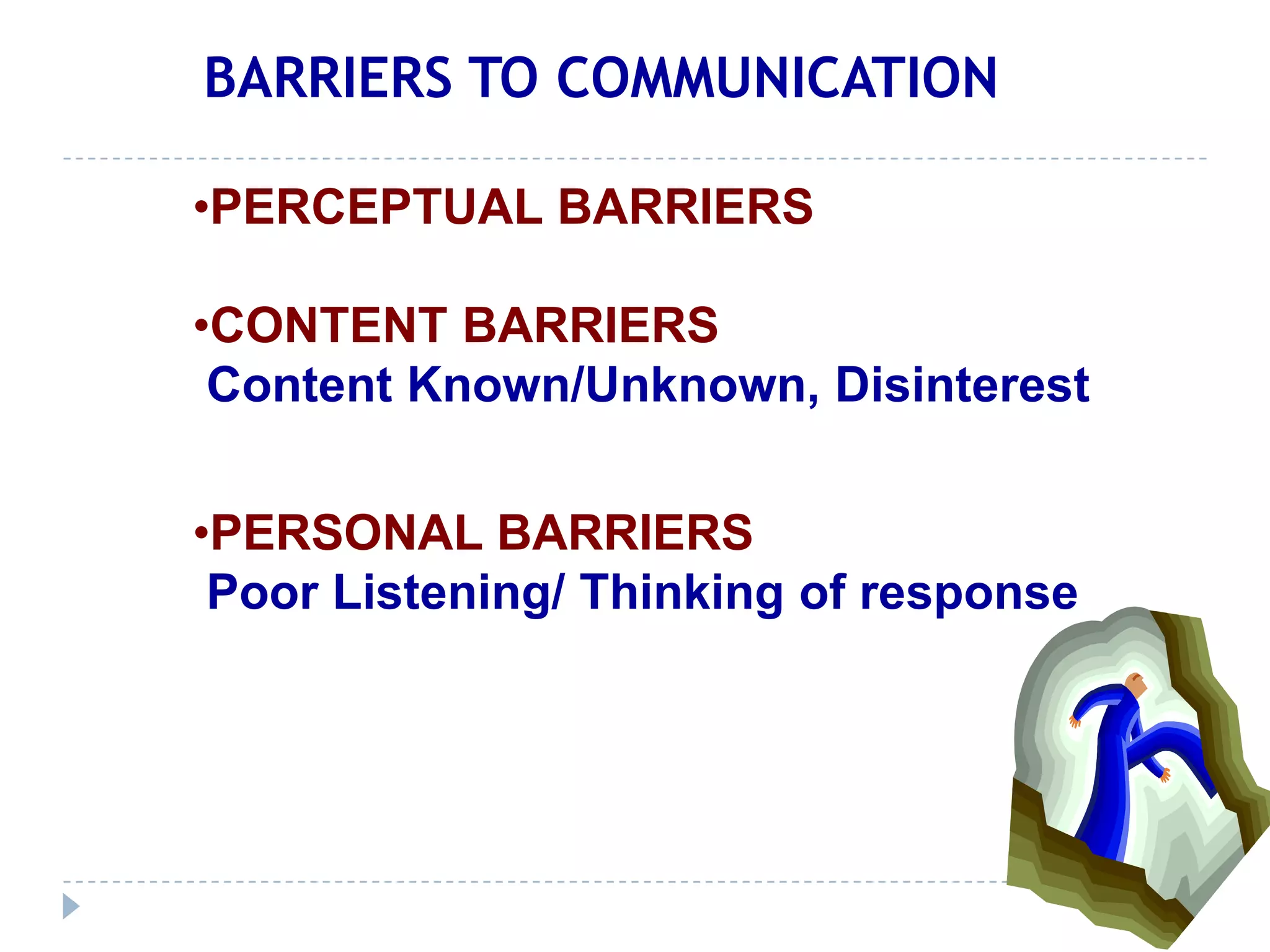
BARRIERS TO COMMUNICATION

•PERCEPTUAL BARRIERS

•CONTENT BARRIERS
 Content Known/Unknown, Disinterest


•PERSONAL BARRIERS
 Poor Listening/ Thinking of response
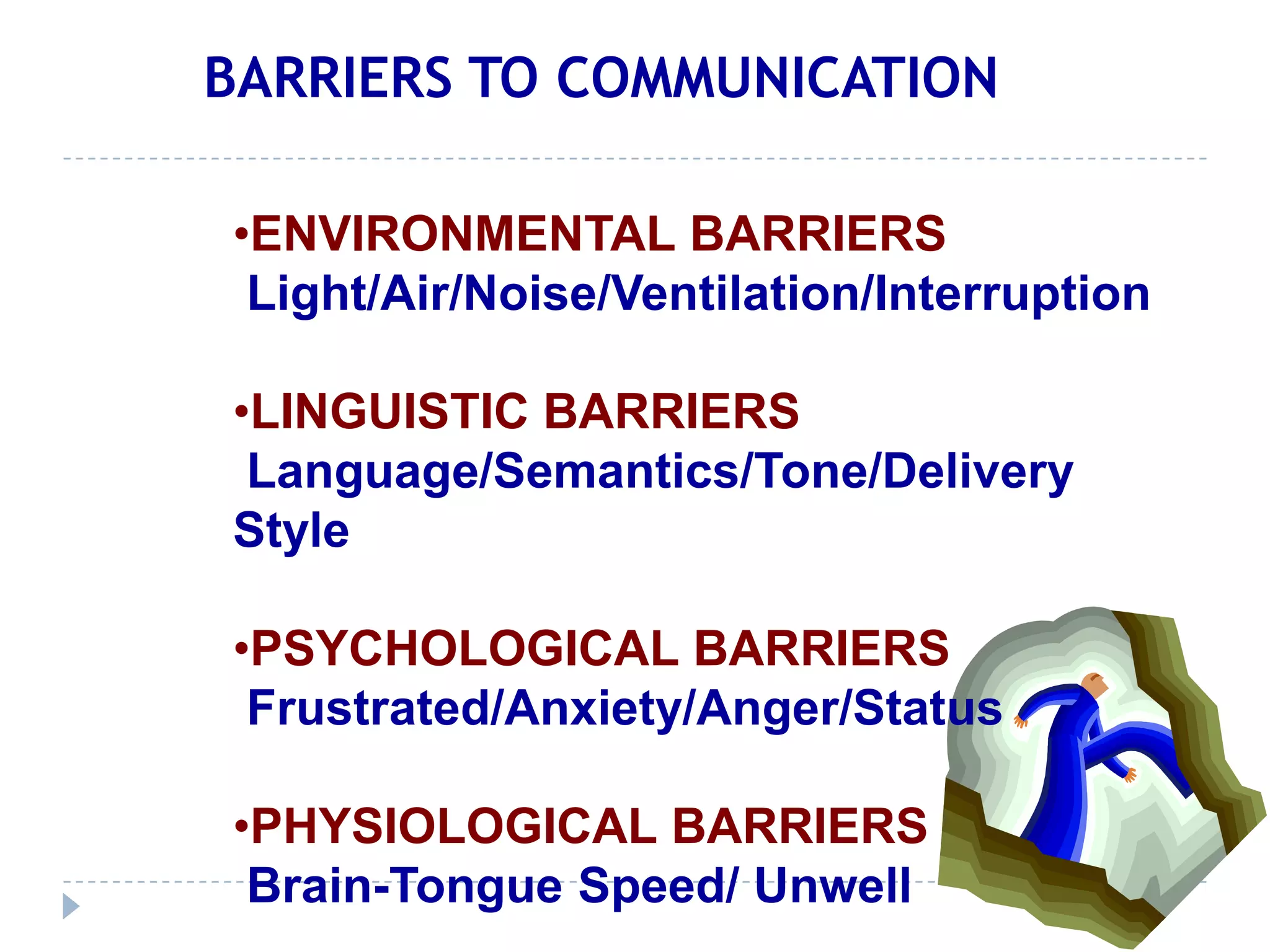
BARRIERS TO COMMUNICATION

•ENVIRONMENTAL BARRIERS
 Light/Air/Noise/Ventilation/Interruption

•LINGUISTIC BARRIERS
 Language/Semantics/Tone/Delivery
Style

•PSYCHOLOGICAL BARRIERS
 Frustrated/Anxiety/Anger/Status

•PHYSIOLOGICAL BARRIERS
 Brain-Tongue Speed/ Unwell
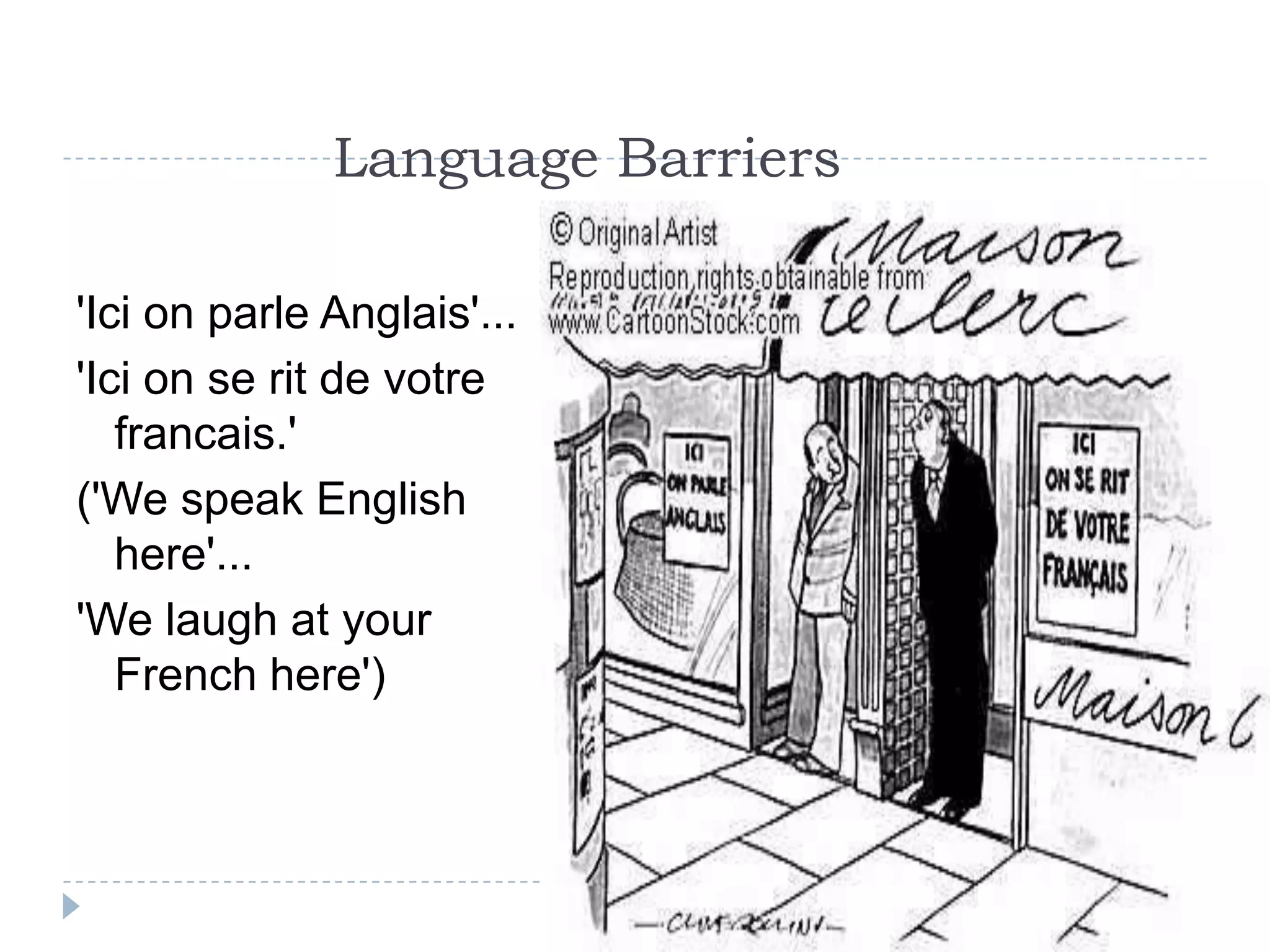
Language Barriers

'Ici on parle Anglais'...
'Ici on se rit de votre
   francais.'
('We speak English
   here'...
'We laugh at your
   French here')
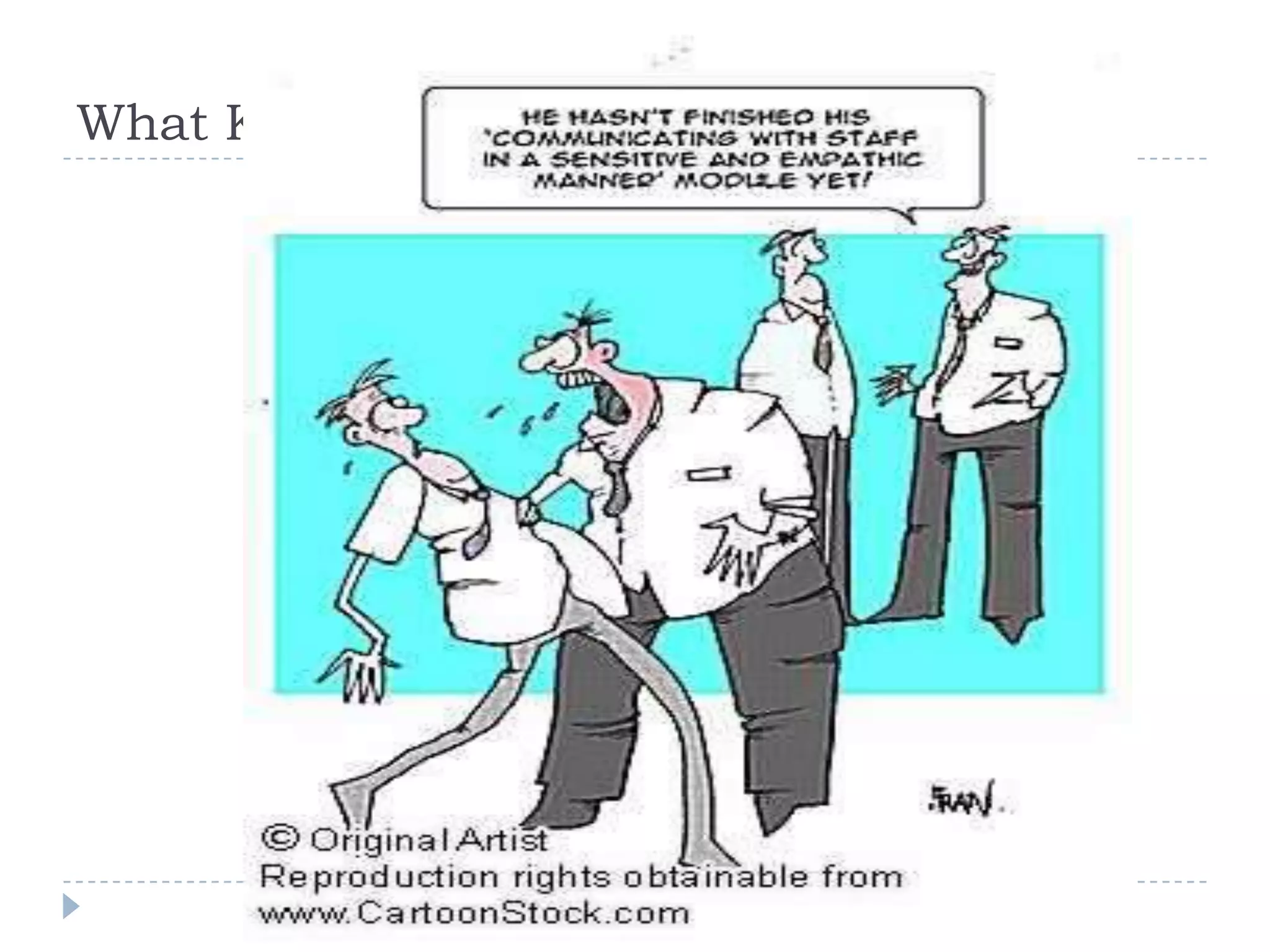
What Kind of Barriers Do You See Here?
Types of Barriers
 Interpersonal –
Takes into account uniqueness of individuals due to
  age, perceptions, experiences, education, culture, pe
  rsonality – interpretation differs – e.g.???
Causes – Wrong assumptions, varied
  perceptions, wrong inferences, differing
  background, blocked categories
Prevent or overcome – ‘You’ attitude, audience
  oriented choice of words, technical words to be
  explained, avoid oversimplification
Prevent or Overcome Organizational
Barriers

   Keep receiver in mind
   Open communication environment
   Avoid too many transfer stations
   Avoid communication when emotionally
    disturbed
   Be aware of diversity in culture, language etc.
   Use appropriate non-verbal cues
   Select most suitable medium
   Analyse feedback
Additional Reading
   http://cte.uwaterloo.ca/teaching_resources/tips/effective_
    communication_barriers_and_strategies.html - Strategies
   http://www.radford.edu/~kvharring/docs/HRMDocs/5com
    m.pdf - Communication across cultural barriers
   http://healthadmin.jbpub.com/Borkowski/chapter4.pdf -
    Workplace Communication
   http://www.diversity-matters.net/publications-gestures.pdf
    - Gestures
   http://www.languagetrainers.co.uk/blog/2007/09/24/top-
    10-hand-gestures/ - Hand gestures to avoid
   www.vikalpa.com/pdf/articles/2010/page-vol-35-55-65.pdf
Thank You

Barriers in organizational communication

  • 1.
    Barriers in Communication Prof Aparna Rao 25-06-12
  • 2.
    FEATURES OF COMMUNICATION  Dynamic: Constantly changing  Continuous: You cannot ‘not’ communicate  Two-way/circular: Never one way  Unrepeatable: Same message, same sender can have different meanings for different listeners  Irreversible: Once said…  Complex: Multiple cycles, multiple processes at one time
  • 3.
    Communication Skills forManagers  Barriers to Effective Communication  Messages that are unclear, incomplete, difficult to understand  Messages sent over the an inappropriate medium  Messages with no provision for feedback  Messages that are received but ignored  Messages that are misunderstood  Messages delivered through automated systems that lack the human element 15–3 © Copyright McGraw-Hill. All rights reserved.
  • 4.
    21st Century WorkplaceChallenges & Demands Present workplace  Multi-cultural  Multiple time zones  Languages  People  Technology  Expectations – Knowledge workers  Communication
  • 5.
    Cultural Differences  GlobalVillage – Internet, Skype, Technology, time zone barriers  Not necessary, but useful to be multi- lingual  Accent Neutralization  Barriers built in from childhood – mindset – ‘not my fault’ / ‘am so strong’  Mindset evolving towards projection  Multi-ethnic
  • 6.
    Types of Barriers Physical  Psycho-social  Cultural  Linguistic  Semantic  Body Language
  • 7.
    Physical Barriers Physical Barriers Challenges of multi-tasking - Man, by nature, not wired for this  Speed of thinking, talking, typing – 200 wpm, 80 wpm, 40 wpm -Deficit  Word pickers – During a talk/conversation one word may trigger a feeling of ‘I know what’s coming’  Concentration time – Linkages – miss the talk, snap back with change of inflection/tone etc  Medium Interference – in communication, eating, driving, talking on the cellphone while walking on the road/public travel, texting in class…
  • 8.
    Cultural Differences  The result of U.S. warning to Japan for unconditional surrender - an ambiguous ‘mokusatu’ – meaning ‘to kill with silence’  Tokyo radio used the word, saying the government would mokusato the declaration and fight on…The English translation became ‘reject’ and the President took it as a rebuff. The result?  Egyptian pilots radioed (in English) their intention to land at an airbase on Cyprus, and the Greek traffic controllers reportedly responded with silence, indicating refusal  The Egyptians’ interpretation of this silence – assent  The outcome? Lives lost…
  • 9.
    Cultural Differences  Assuming Similarity -Danish Woman with baby in the US  Assuming Difference – Urban/rural; Eastern/Western/South/North etc.  Eye Contact – Critical – Differences in stare, gaze, lecherous look, business look …  Gestures – Thumbs up, Victory sign – meanings  Basic unwritten rule to follow – no assumptions, no judgments; ‘Believe nothing of what you hear and only half of what you see’
  • 10.
    Linguistic Differences  Language, Culture & Body Language – inter-twined  E.g. English – You; Yes, yeah  Indian languages – Aap, Tum, tu; words describing relationships – cousin, aunt, mausera bhai, chachera bhai, mausi, chachi, maami etc.  Word bai – in Hindi and Marathi  When disrespect is perceived, the message is lost in the emotional thought process over the disrespect
  • 11.
    Semantic Differences  FrenchLemonade – cannot be launched with the same name in English speaking countries  Japanese brand of cold drink  Argentinian curry powder - Poo  German drink  Portugal tuna – Atum bum Communication is about making meaning… make sure you communicate what you are meant to  The intended outcome of the message should be clear to sender and receiver
  • 12.
    Psycho-Social Barriers  Status Horns/Halo Effect  Allness & Closed Mind  Resistance to Change  Unclarified Assumption  Different Perceptions
  • 13.
    Organizational Barriers Communication RelationshipSatisfaction  Extent to which available information meets task- related and general information needs of employees in an organization  Perceptions of Justice – Distributive, Procedural & interactional Justice  Evaluated by 4 aspects of communication in an organization – with immediate superiors, peers, top management & overall communication within the organization
  • 14.
    Justice – Multidimensional Construct  Distributional Justice – Fairness of the outcome of the process  Procedural – Fairness perceived in the policies, procedures and criteria followed in the process  Interactional – perceptions about the manner of treatment of people
  • 15.
    Premises & SurveyFindings  There is a positive correlation between CRS and all facets of organizational communication  CRS and top management would provide strong predictions for distributive and procedural justice  CRS with immediate supervisor is a predictor for interactional justice  Necessary to ensure that messages are routed through communication channels
  • 16.
    BARRIERS TO COMMUNICATION •PERCEPTUALBARRIERS •CONTENT BARRIERS Content Known/Unknown, Disinterest •PERSONAL BARRIERS Poor Listening/ Thinking of response
  • 17.
    BARRIERS TO COMMUNICATION •ENVIRONMENTALBARRIERS Light/Air/Noise/Ventilation/Interruption •LINGUISTIC BARRIERS Language/Semantics/Tone/Delivery Style •PSYCHOLOGICAL BARRIERS Frustrated/Anxiety/Anger/Status •PHYSIOLOGICAL BARRIERS Brain-Tongue Speed/ Unwell
  • 19.
    Language Barriers 'Ici onparle Anglais'... 'Ici on se rit de votre francais.' ('We speak English here'... 'We laugh at your French here')
  • 20.
    What Kind ofBarriers Do You See Here?
  • 21.
    Types of Barriers Interpersonal – Takes into account uniqueness of individuals due to age, perceptions, experiences, education, culture, pe rsonality – interpretation differs – e.g.??? Causes – Wrong assumptions, varied perceptions, wrong inferences, differing background, blocked categories Prevent or overcome – ‘You’ attitude, audience oriented choice of words, technical words to be explained, avoid oversimplification
  • 22.
    Prevent or OvercomeOrganizational Barriers  Keep receiver in mind  Open communication environment  Avoid too many transfer stations  Avoid communication when emotionally disturbed  Be aware of diversity in culture, language etc.  Use appropriate non-verbal cues  Select most suitable medium  Analyse feedback
  • 23.
    Additional Reading  http://cte.uwaterloo.ca/teaching_resources/tips/effective_ communication_barriers_and_strategies.html - Strategies  http://www.radford.edu/~kvharring/docs/HRMDocs/5com m.pdf - Communication across cultural barriers  http://healthadmin.jbpub.com/Borkowski/chapter4.pdf - Workplace Communication  http://www.diversity-matters.net/publications-gestures.pdf - Gestures  http://www.languagetrainers.co.uk/blog/2007/09/24/top- 10-hand-gestures/ - Hand gestures to avoid  www.vikalpa.com/pdf/articles/2010/page-vol-35-55-65.pdf
  • 24.