BUSINESS COMMUNICATION
SEMINAR PRESENTATION
ON
STRATEGIC COMMUNICATION:A MODEL FOR
COMMUNICATION IN THE INFORMATION
AGE
MEGHA SUNNY
1ST SEM MBA
ROLL NO:23
DCMS
INTRODUCTION
The information age demands that communication be planned carefully
because there are so many new options to consider in the creation and the
transmission of messages
To succeed in this age we need to know how to integrate technology with
communication skills and how to communicate with people who have diverse
back ground and a wide range of goals and expectations
To make the most of our business career we need to present our selves as a
competent communicator because our communication skills will be our best
selling point in job interviews, sales meetings, and the company presentations
To be an effective communicator or for fruitful communication we need.........
STRATEGIC
COMMUNICATION
MEANING
• Strategic Communication refers to policy-making and guidance
for consistent information activity within an organization and
between organizations.
• It teaches you the ways in which organizations communicate in
order to accomplish a goal and includes courses that examine
communication through public relations, marketing
communication, advertising, persuasion and public theory, and
communication campaigns.
• Corporations, non-profit agencies and government agencies use
significant resources to communicate effectively with
employees, publics and other audiences.
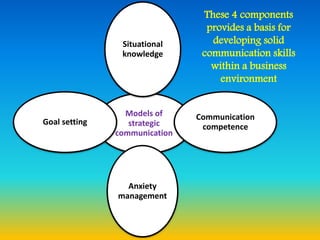
Model of strategic communication
Model of strategic communication involves
FOUR components, they are;
• Situational knowledge
• Goal setting
• Communication competence
• Anxiety management
Models of
strategic
communication
Situational
knowledge
Communication
competence
Anxiety
management
Goal setting
These 4 components
provides a basis for
developing solid
communication skills
within a business
environment
1.SITUATIONAL KNOWLEDGE
Situational knowledge is the information or facts
we use in devising an effective communication
strategy
In the organisational context, situational
knowledge also refers to employees awareness of
the communication issues involved in their jobs
We can increase our communication
effectiveness by gathering a thou rough knowledge
of the person or people with whom you are
communicating
BUILDING PILLARS OF SITUATIONAL
KNOWLEDGE
1.Values and ethics
2.Organisational structure
3.Organisational learning
4.On the job training
5.politics
6.Communication climate
VALUES AND ETHICS
Values are the principles and the ideas that
people or the organizations strongly believe in
and consider important.
When people are in doubt about decisions,
they frequently rely on deep seated values to
help them make the right choice
VALUES
Organisational values vary depending on the nature of business
or profession. Values found in a large number of organisation
include
Primacy of the customer
Honesty and integrity
Respect for others
Importance of every person
Maintenance of high professional standards
Fair treatment
Innovative thinking
Quality service
creativity
Reliance on ethical standard
Profitable returns to share holders
ETHICS
Ethics is the code of behaviour that that is
expected from the people/organisation
while communicating with others
ETHICAL GUIDELINES
Maintain candor
Keep messages accurate
Avoid deception
Behave consistently
Keep confidences
Ensure timeliness of communication
Confront unethical behaviour
Cultivate empathic listening
ORGANISATIONAL STRUCTURE
• Each organisations ability to respond to
challenges depends on its structure
• Organisational structure consist of actual
environment where the organisation is
located.
• An organisation’s physical structure has a
strong effect on its communication style
THREE TYPES OF ORGANISATIONAL
STRUCTURE
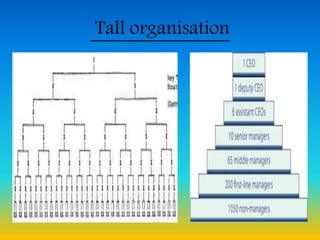
• TALL ORGANISATION
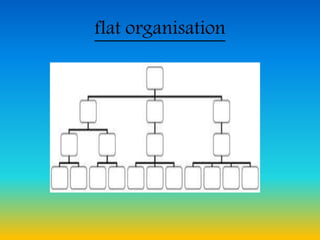
• FLAT ORGANISATION
• VIRTUAL ORGANISATION
Tall organisation
flat organisation
Virtual organisation
ORGANISATIONAL LEARNING
• To communicate effectively, people in the
business have traditionally thought it best to
know as much as possible about the organisation
and its environment
• Employees who monitor the organisation and
environment for new information are in the best
position to make informed decisions about the
communication but the demands of the
information age have altered how such
monitoring takes place.
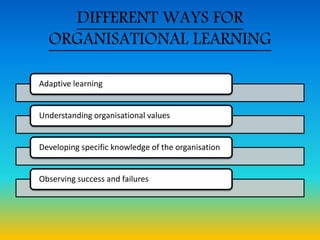
DIFFERENT WAYS FOR
ORGANISATIONAL LEARNING
Adaptive learning
Understanding organisational values
Developing specific knowledge of the organisation
Observing success and failures
ON THE JOB TRAINNING
• Communication can also be developed by the
time of engaging in the work
WAYS OF DEVELOPING COMMUNICATION
THROUGH ON THE JOB TRIANNING
• Chain of command
• Brain storming session
• Annual business meetings
• Relationship among the departments
• Seminars and work shops
• Informal meeting with immediate supervisor
• Performance appraisal interviews
POLITICS
• Knowledge of an organisation is incomplete
without the awareness of the organisation as a
political entity.
• All the organisation are political system
because they organise and distribute
powers,resources,and rewards in the pursuits
of specific goals.
• organisational politics is usually described as
the exercise or negotiation of power
PERSPECTIVES OF POLITICS
As negative and destructive
behaviours that should be
avoided
As important aspect of
communication that must be
accounted for in a strategic
communication plan
POLITICAL STRATEGIES APPLIED IN
THE WORK PLACE
Controlling agenda of meeting
Coalitition building
Trading favours
Policies adheration
Sensitivity to dress
Right associations
Appearing at official function
Assuming seating positions
COMMUNICATION CLIMATE
• It is one of the aspect of character
• Climate is the function of interactions and the
social process that occur in the work place.
• Climate may change depending on how
communication changes in the organisation
FIVE DIMENSIONS OF AN IDEAL
COMMUNICATION CLIMATE
supportiveness
Participative decision making
Trust, confidence and credibility
Openness and candor
High performance goal
ADVANTAGES OF SITUATIONAL
KNOWLEDGE
Achievement of personal and the
organisational plan
Evaluation of ideas
coordination
Employee development
2.GOAL SETTING
MEANING
• It is one of the four parts of strategic model of
communication
• Once we feel knowledgeable about the
organisation’s values, we will be able to work on
the appropriate goals for our communication.
• it is not enough simply to set positive sounding
goals, particular goal must be set with particular
criteria in mind
• Setting specific and high goals in our best
interest when you anticipate a communication
encounter
GOAL SETTING PROCESS
Identify the problem
Map out a strategy
Set a performance goal
Identify resources
Recognize contingencies
Obtain feedback
BENEFITS OF GOAL SETTING
High performance level
Useful in mobilising the effort you need to
perform at peak levels
Helps to persist in our effort overtime
Holds us to specific goals/results within
specific time
Helps in developing relevant and innovative
strategies
3.COMMUNICATION COPETENCE
MEANING
• It is the ability to communicate both appropriately
and effectively with other people.
• Communication strategies can be effective
without being appropriate
FOUR FACTORS OF
COMMUNICATION COMPETENCE
messages
Internal communication
External communication
channel
1.MESSAGES
• Messages are the ideas we wish to communicate,
whether instructive, informative, persuasive,
houmourous,complementory, or critical, a
message must be effective and appropriate to be
competent
2.INTERNAL COMMNICATION
• Messages that are sent and received within the boundaries of
company are called internal communication
Three types of
internal
communication
Downward
communication
Horizontal
communication
Informal
networks
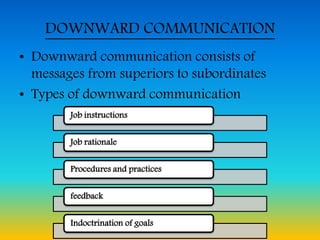
DOWNWARD COMMUNICATION
• Downward communication consists of
messages from superiors to subordinates
• Types of downward communication
Job instructions
Job rationale
Procedures and practices
feedback
Indoctrination of goals
HORIZONTAL COMMUNICATION
• Horizontal communication consist of the messages
that are exchanged at same hierarchical level in an
organisation
• Functions of horizontal communication
Facilitate problem solving
Allows information sharing across different
work group
Promotes task coordination between
department or teams
Enhances morale
Affords a means for resolving conflicts
INFORMAL NETWORKS
• Informal networks frequently open up outside
of official path of communication.
• Often called grapevine, informal networks are
a substitute for formal downward,upward,or
horizontal communication
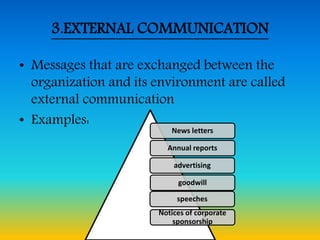
3.EXTERNAL COMMUNICATION
• Messages that are exchanged between the
organization and its environment are called
external communication
• Examples:
News letters
Annual reports
advertising
goodwill
speeches
Notices of corporate
sponsorship
4.CHANNEL
• Channels are the media that carry messages to
the receivers.
• channel richness is the ability of the
communication channel to handle
information or convey the meaning contained
in a message
FACTORS IN SELECTING THE PROPER
CHANNEL
• Speed
• Accuracy
• accountability
• feedback
• Selectivity
• acceptability
• appropriateness
• cost
4.ANXIETY MANAGEMENT
MEANING
• Anxiety management is the ability to control
nervousness, fears, stress and worries
associated with a communication event.
• Each person handles the anxiety associated
with communication episodes differently
CAUSES OF COMMUNICATION
ANXIETY
novelty
formality
Subordinate status
conspicuousness
Large groups
Lack of skills
Past experience
evaluation
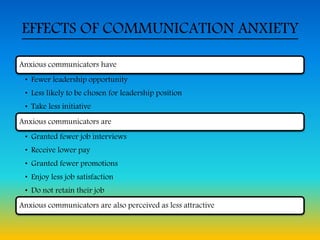
EFFECTS OF COMMUNICATION ANXIETY
Anxious communicators have
• Fewer leadership opportunity
• Less likely to be chosen for leadership position
• Take less initiative
Anxious communicators are
• Granted fewer job interviews
• Receive lower pay
• Granted fewer promotions
• Enjoy less job satisfaction
• Do not retain their job
Anxious communicators are also perceived as less attractive
MANAGING COMMUNICATION ANXIETY
• Management of anxiety depends an the
managers/employees by converting their
threats and anxiety and to an opportunities
and use that opportunity to increase their
effectiveness and succeed in their work
CONCLUSION
The model of strategic communication presents a
practical perspective on communicating in the
organization. It also offers tools for dealing
with the effects on the business of globalisation
and the dependence on information
THANK YOU........

BC

  • 1.
    BUSINESS COMMUNICATION SEMINAR PRESENTATION ON STRATEGICCOMMUNICATION:A MODEL FOR COMMUNICATION IN THE INFORMATION AGE MEGHA SUNNY 1ST SEM MBA ROLL NO:23 DCMS
  • 2.
    INTRODUCTION The information agedemands that communication be planned carefully because there are so many new options to consider in the creation and the transmission of messages To succeed in this age we need to know how to integrate technology with communication skills and how to communicate with people who have diverse back ground and a wide range of goals and expectations To make the most of our business career we need to present our selves as a competent communicator because our communication skills will be our best selling point in job interviews, sales meetings, and the company presentations To be an effective communicator or for fruitful communication we need.........
  • 3.
  • 4.
    MEANING • Strategic Communicationrefers to policy-making and guidance for consistent information activity within an organization and between organizations. • It teaches you the ways in which organizations communicate in order to accomplish a goal and includes courses that examine communication through public relations, marketing communication, advertising, persuasion and public theory, and communication campaigns. • Corporations, non-profit agencies and government agencies use significant resources to communicate effectively with employees, publics and other audiences.
  • 5.
    Model of strategiccommunication Model of strategic communication involves FOUR components, they are; • Situational knowledge • Goal setting • Communication competence • Anxiety management
  • 6.
    Models of strategic communication Situational knowledge Communication competence Anxiety management Goal setting These4 components provides a basis for developing solid communication skills within a business environment
  • 7.
  • 8.
    Situational knowledge isthe information or facts we use in devising an effective communication strategy In the organisational context, situational knowledge also refers to employees awareness of the communication issues involved in their jobs We can increase our communication effectiveness by gathering a thou rough knowledge of the person or people with whom you are communicating
  • 9.
    BUILDING PILLARS OFSITUATIONAL KNOWLEDGE 1.Values and ethics 2.Organisational structure 3.Organisational learning 4.On the job training 5.politics 6.Communication climate
  • 10.
    VALUES AND ETHICS Valuesare the principles and the ideas that people or the organizations strongly believe in and consider important. When people are in doubt about decisions, they frequently rely on deep seated values to help them make the right choice VALUES
  • 11.
    Organisational values varydepending on the nature of business or profession. Values found in a large number of organisation include Primacy of the customer Honesty and integrity Respect for others Importance of every person Maintenance of high professional standards Fair treatment Innovative thinking Quality service creativity Reliance on ethical standard Profitable returns to share holders
  • 12.
    ETHICS Ethics is thecode of behaviour that that is expected from the people/organisation while communicating with others
  • 13.
    ETHICAL GUIDELINES Maintain candor Keepmessages accurate Avoid deception Behave consistently Keep confidences Ensure timeliness of communication Confront unethical behaviour Cultivate empathic listening
  • 14.
    ORGANISATIONAL STRUCTURE • Eachorganisations ability to respond to challenges depends on its structure • Organisational structure consist of actual environment where the organisation is located. • An organisation’s physical structure has a strong effect on its communication style
  • 15.
    THREE TYPES OFORGANISATIONAL STRUCTURE • TALL ORGANISATION • FLAT ORGANISATION • VIRTUAL ORGANISATION
  • 16.
  • 17.
  • 18.
  • 19.
    ORGANISATIONAL LEARNING • Tocommunicate effectively, people in the business have traditionally thought it best to know as much as possible about the organisation and its environment • Employees who monitor the organisation and environment for new information are in the best position to make informed decisions about the communication but the demands of the information age have altered how such monitoring takes place.
  • 20.
    DIFFERENT WAYS FOR ORGANISATIONALLEARNING Adaptive learning Understanding organisational values Developing specific knowledge of the organisation Observing success and failures
  • 21.
    ON THE JOBTRAINNING • Communication can also be developed by the time of engaging in the work
  • 22.
    WAYS OF DEVELOPINGCOMMUNICATION THROUGH ON THE JOB TRIANNING • Chain of command • Brain storming session • Annual business meetings • Relationship among the departments • Seminars and work shops • Informal meeting with immediate supervisor • Performance appraisal interviews
  • 23.
    POLITICS • Knowledge ofan organisation is incomplete without the awareness of the organisation as a political entity. • All the organisation are political system because they organise and distribute powers,resources,and rewards in the pursuits of specific goals. • organisational politics is usually described as the exercise or negotiation of power
  • 24.
    PERSPECTIVES OF POLITICS Asnegative and destructive behaviours that should be avoided As important aspect of communication that must be accounted for in a strategic communication plan
  • 25.
    POLITICAL STRATEGIES APPLIEDIN THE WORK PLACE Controlling agenda of meeting Coalitition building Trading favours Policies adheration Sensitivity to dress Right associations Appearing at official function Assuming seating positions
  • 26.
    COMMUNICATION CLIMATE • Itis one of the aspect of character • Climate is the function of interactions and the social process that occur in the work place. • Climate may change depending on how communication changes in the organisation
  • 27.
    FIVE DIMENSIONS OFAN IDEAL COMMUNICATION CLIMATE supportiveness Participative decision making Trust, confidence and credibility Openness and candor High performance goal
  • 28.
    ADVANTAGES OF SITUATIONAL KNOWLEDGE Achievementof personal and the organisational plan Evaluation of ideas coordination Employee development
  • 29.
  • 30.
    MEANING • It isone of the four parts of strategic model of communication • Once we feel knowledgeable about the organisation’s values, we will be able to work on the appropriate goals for our communication. • it is not enough simply to set positive sounding goals, particular goal must be set with particular criteria in mind • Setting specific and high goals in our best interest when you anticipate a communication encounter
  • 31.
    GOAL SETTING PROCESS Identifythe problem Map out a strategy Set a performance goal Identify resources Recognize contingencies Obtain feedback
  • 32.
    BENEFITS OF GOALSETTING High performance level Useful in mobilising the effort you need to perform at peak levels Helps to persist in our effort overtime Holds us to specific goals/results within specific time Helps in developing relevant and innovative strategies
  • 33.
  • 34.
    MEANING • It isthe ability to communicate both appropriately and effectively with other people. • Communication strategies can be effective without being appropriate
  • 35.
    FOUR FACTORS OF COMMUNICATIONCOMPETENCE messages Internal communication External communication channel
  • 36.
    1.MESSAGES • Messages arethe ideas we wish to communicate, whether instructive, informative, persuasive, houmourous,complementory, or critical, a message must be effective and appropriate to be competent
  • 37.
    2.INTERNAL COMMNICATION • Messagesthat are sent and received within the boundaries of company are called internal communication Three types of internal communication Downward communication Horizontal communication Informal networks
  • 38.
    DOWNWARD COMMUNICATION • Downwardcommunication consists of messages from superiors to subordinates • Types of downward communication Job instructions Job rationale Procedures and practices feedback Indoctrination of goals
  • 39.
    HORIZONTAL COMMUNICATION • Horizontalcommunication consist of the messages that are exchanged at same hierarchical level in an organisation • Functions of horizontal communication Facilitate problem solving Allows information sharing across different work group Promotes task coordination between department or teams Enhances morale Affords a means for resolving conflicts
  • 40.
    INFORMAL NETWORKS • Informalnetworks frequently open up outside of official path of communication. • Often called grapevine, informal networks are a substitute for formal downward,upward,or horizontal communication
  • 41.
    3.EXTERNAL COMMUNICATION • Messagesthat are exchanged between the organization and its environment are called external communication • Examples: News letters Annual reports advertising goodwill speeches Notices of corporate sponsorship
  • 42.
    4.CHANNEL • Channels arethe media that carry messages to the receivers. • channel richness is the ability of the communication channel to handle information or convey the meaning contained in a message
  • 43.
    FACTORS IN SELECTINGTHE PROPER CHANNEL • Speed • Accuracy • accountability • feedback • Selectivity • acceptability • appropriateness • cost
  • 44.
  • 45.
    MEANING • Anxiety managementis the ability to control nervousness, fears, stress and worries associated with a communication event. • Each person handles the anxiety associated with communication episodes differently
  • 46.
    CAUSES OF COMMUNICATION ANXIETY novelty formality Subordinatestatus conspicuousness Large groups Lack of skills Past experience evaluation
  • 47.
    EFFECTS OF COMMUNICATIONANXIETY Anxious communicators have • Fewer leadership opportunity • Less likely to be chosen for leadership position • Take less initiative Anxious communicators are • Granted fewer job interviews • Receive lower pay • Granted fewer promotions • Enjoy less job satisfaction • Do not retain their job Anxious communicators are also perceived as less attractive
  • 48.
    MANAGING COMMUNICATION ANXIETY •Management of anxiety depends an the managers/employees by converting their threats and anxiety and to an opportunities and use that opportunity to increase their effectiveness and succeed in their work
  • 49.
    CONCLUSION The model ofstrategic communication presents a practical perspective on communicating in the organization. It also offers tools for dealing with the effects on the business of globalisation and the dependence on information
  • 50.