Communication
Presented by:-
sumit behura
Copyright © 2005 by South-Western, a division of Thomson Learning. All rights reserved.
2
Communication
 In today’s turbulent environment, crisis
communication is at the top of
everyone’s needed-skills list.
 Effective communication, both within the
organization and with people outside the
company, is a major challenge and
responsibility for managers
Copyright © 2005 by South-Western, a division of Thomson Learning. All rights reserved.
3
Communication
 How manager’s job require communication
 Communication process model
 Interpersonal aspects of communication
 Organization as a whole
 Keeping channels open
 Manager’s role - keeping open; turbulent times
 Barriers to communication
Copyright © 2005 by South-Western, a division of Thomson Learning. All rights reserved.
4
What is Communication?
 Process by which information is exchanged
and understood by two or more people, usually
with the intent to motivate or influence behavior
Manager = 80% every working day in direct
communication with others – 48 min/hour
Manager = 20% every work day in communication
in the form of reading and writing -12 min/hour
Copyright © 2005 by South-Western, a division of Thomson Learning. All rights reserved.
5
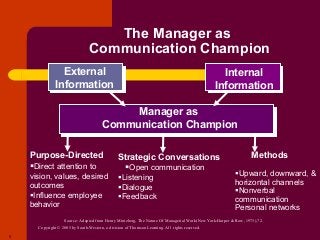
The Manager as
Communication Champion
Source: Adapted from Henry Mintzberg, The Nature Of Managerial Work(New York:Harper & Row, 1973),72.
External
Information
Internal
Information
Manager as
Communication Champion
Purpose-Directed
Direct attention to
vision, values, desired
outcomes
Influence employee
behavior
Strategic Conversations
Open communication
Listening
Dialogue
Feedback
Methods
Upward, downward, &
horizontal channels
Nonverbal
communication
Personal networks
Copyright © 2005 by South-Western, a division of Thomson Learning. All rights reserved.
6
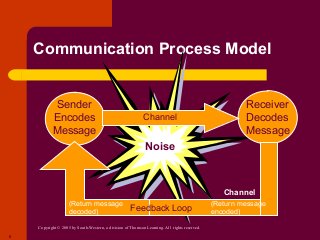
Communication Process Model
Noise
Sender
Encodes
Message
Receiver
Decodes
Message
Channel
Feedback Loop
(Return message
decoded)
(Return message
encoded)
Channel
Copyright © 2005 by South-Western, a division of Thomson Learning. All rights reserved.
7
Persuasion and Influence
 Businesses are run largely by cross-
functional teams who are actively involved
in making decisions
 Ability to persuade and influence others is
even more critical today than ever before
 To persuade and influence, managers
have to communicate frequently and easily
with others
Experiential Exercise: Personal Assessment of Communication Apprehension
Copyright © 2005 by South-Western, a division of Thomson Learning. All rights reserved.
8
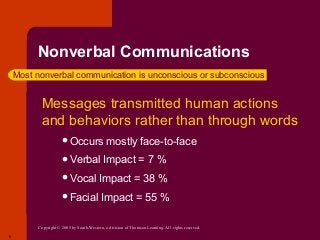
Nonverbal Communications
Messages transmitted human actions
and behaviors rather than through words
Occurs mostly face-to-face
Verbal Impact = 7 %
Vocal Impact = 38 %
Facial Impact = 55 %
Most nonverbal communication is unconscious or subconscious
Copyright © 2005 by South-Western, a division of Thomson Learning. All rights reserved.
9
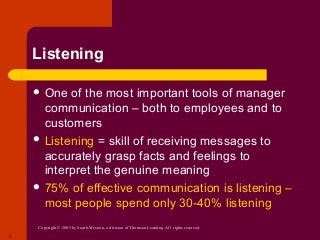
Listening
 One of the most important tools of manager
communication – both to employees and to
customers
 Listening = skill of receiving messages to
accurately grasp facts and feelings to
interpret the genuine meaning
 75% of effective communication is listening –
most people spend only 30-40% listening
Copyright © 2005 by South-Western, a division of Thomson Learning. All rights reserved.
10
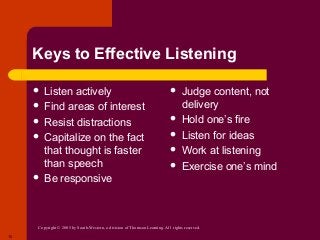
Keys to Effective Listening
 Listen actively
 Find areas of interest
 Resist distractions
 Capitalize on the fact
that thought is faster
than speech
 Be responsive
 Judge content, not
delivery
 Hold one’s fire
 Listen for ideas
 Work at listening
 Exercise one’s mind
Copyright © 2005 by South-Western, a division of Thomson Learning. All rights reserved.
11
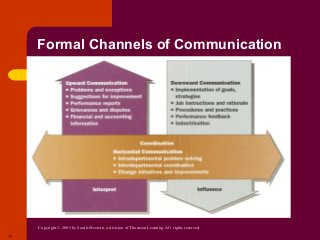
Formal Channels of Communication
Source: Adapted from Richard L. Daft and Richard M. Steers, Organizations: A Micro/Macro Approach, 538. Copyright © 1986 by Scott, and Company. Used by
permission.
Copyright © 2005 by South-Western, a division of Thomson Learning. All rights reserved.
12
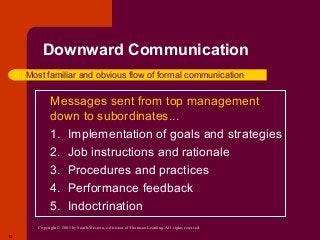
Downward Communication
 Messages sent from top management
down to subordinates...
 1. Implementation of goals and strategies
2. Job instructions and rationale
3. Procedures and practices
4. Performance feedback
5. Indoctrination
Most familiar and obvious flow of formal communication
Copyright © 2005 by South-Western, a division of Thomson Learning. All rights reserved.
13
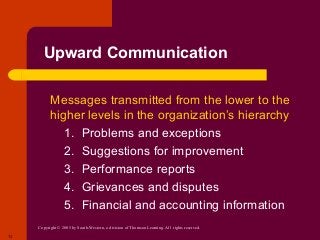
Upward Communication
 Messages transmitted from the lower to the
higher levels in the organization’s hierarchy
1. Problems and exceptions
2. Suggestions for improvement
3. Performance reports
4. Grievances and disputes
5. Financial and accounting information
Copyright © 2005 by South-Western, a division of Thomson Learning. All rights reserved.
14
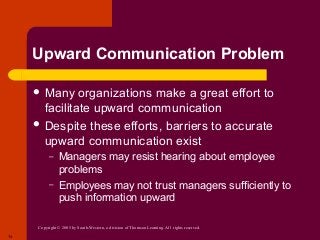
Upward Communication Problem
 Many organizations make a great effort to
facilitate upward communication
 Despite these efforts, barriers to accurate
upward communication exist
– Managers may resist hearing about employee
problems
– Employees may not trust managers sufficiently to
push information upward
Copyright © 2005 by South-Western, a division of Thomson Learning. All rights reserved.
15
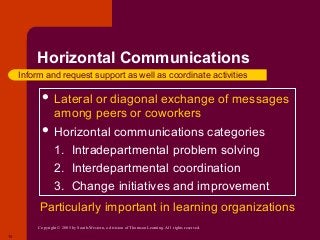
Horizontal Communications
 Lateral or diagonal exchange of messages
among peers or coworkers
 Horizontal communications categories
1. Intradepartmental problem solving
2. Interdepartmental coordination
3. Change initiatives and improvement
Inform and request support as well as coordinate activities
Particularly important in learning organizations
Copyright © 2005 by South-Western, a division of Thomson Learning. All rights reserved.
16
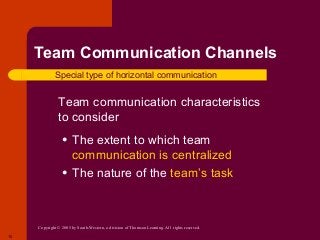
Team Communication Channels
 Team communication characteristics
to consider
● The extent to which team
communication is centralized
● The nature of the team’s task
Special type of horizontal communication
Copyright © 2005 by South-Western, a division of Thomson Learning. All rights reserved.
17
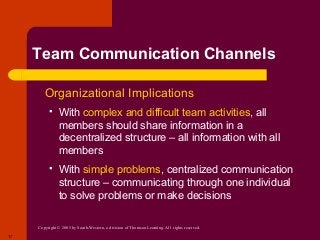
Team Communication Channels
 Organizational Implications
 With complex and difficult team activities, all
members should share information in a
decentralized structure – all information with all
members
 With simple problems, centralized communication
structure – communicating through one individual
to solve problems or make decisions
Copyright © 2005 by South-Western, a division of Thomson Learning. All rights reserved.
18
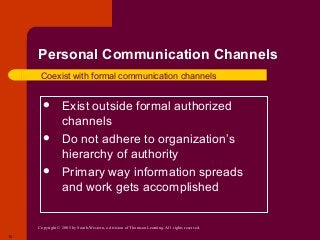
Personal Communication Channels
 Exist outside formal authorized
channels
 Do not adhere to organization’s
hierarchy of authority
 Primary way information spreads
and work gets accomplished
Coexist with formal communication channels
Copyright © 2005 by South-Western, a division of Thomson Learning. All rights reserved.
19
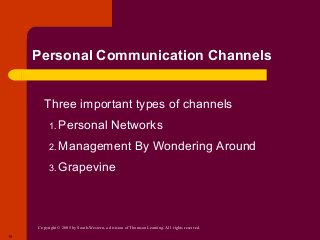
Personal Communication Channels
 Three important types of channels
1. Personal Networks
2. Management By Wondering Around
3. Grapevine
Copyright © 2005 by South-Western, a division of Thomson Learning. All rights reserved.
20
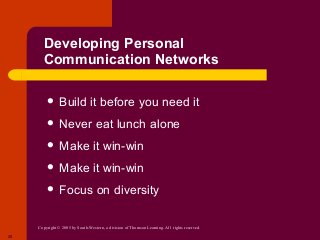
Developing Personal
Communication Networks
 Build it before you need it
 Never eat lunch alone
 Make it win-win
 Make it win-win
 Focus on diversity
Copyright © 2005 by South-Western, a division of Thomson Learning. All rights reserved.
21
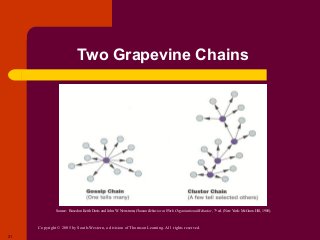
Two Grapevine Chains
Source: Based on Keith Davis and John W. Newstrom, Human Behavior at Work: Organizational Behavior, 7th
ed. (New York: McGraw-Hill, 1985).
Copyright © 2005 by South-Western, a division of Thomson Learning. All rights reserved.
22
Open Communication
 Sharing all types of information throughout
the company, across functional and
hierarchical levels
 Recent trend - reflects manager’s increased
emphasis on
– Empowering employees
– Building trust and commitment
– Enhancing collaboration
Copyright © 2005 by South-Western, a division of Thomson Learning. All rights reserved.
23
Feedback and Learning
 Feedback –
– Enables managers to determine whether they have been
successful in communicating with others
– Is often neglected
– Giving & receiving feedback is typically difficult –both for
managers & employees
 Successful managers focus their feedback
– To help develop the capacities of subordinates
– To teach the organization how to better reach its goals
Managers use evaluation & communication to help individuals
Copyright © 2005 by South-Western, a division of Thomson Learning. All rights reserved.
24
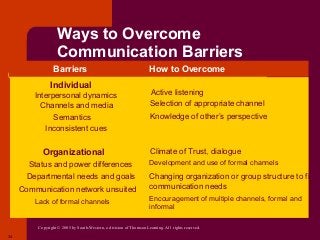
Ways to Overcome
Communication Barriers
Active listening
Selection of appropriate channel
Knowledge of other’s perspective
Climate of Trust, dialogue
Development and use of formal channels
Changing organization or group structure to fit
communication needs
Encouragement of multiple channels, formal and
informal
Individual
Interpersonal dynamics
Channels and media
Semantics
Inconsistent cues
Organizational
Status and power differences
Departmental needs and goals
Communication network unsuited
Lack of formal channels
How to OvercomeBarriers
Copyright © 2005 by South-Western, a division of Thomson Learning. All rights reserved.
25
Semantics
 Meaning of words and the
way they are used
Ethical Dilemma: The Voice of Authority

Communication for managers

  • 1.
  • 2.
    Copyright © 2005by South-Western, a division of Thomson Learning. All rights reserved. 2 Communication  In today’s turbulent environment, crisis communication is at the top of everyone’s needed-skills list.  Effective communication, both within the organization and with people outside the company, is a major challenge and responsibility for managers
  • 3.
    Copyright © 2005by South-Western, a division of Thomson Learning. All rights reserved. 3 Communication  How manager’s job require communication  Communication process model  Interpersonal aspects of communication  Organization as a whole  Keeping channels open  Manager’s role - keeping open; turbulent times  Barriers to communication
  • 4.
    Copyright © 2005by South-Western, a division of Thomson Learning. All rights reserved. 4 What is Communication?  Process by which information is exchanged and understood by two or more people, usually with the intent to motivate or influence behavior Manager = 80% every working day in direct communication with others – 48 min/hour Manager = 20% every work day in communication in the form of reading and writing -12 min/hour
  • 5.
    Copyright © 2005by South-Western, a division of Thomson Learning. All rights reserved. 5 The Manager as Communication Champion Source: Adapted from Henry Mintzberg, The Nature Of Managerial Work(New York:Harper & Row, 1973),72. External Information Internal Information Manager as Communication Champion Purpose-Directed Direct attention to vision, values, desired outcomes Influence employee behavior Strategic Conversations Open communication Listening Dialogue Feedback Methods Upward, downward, & horizontal channels Nonverbal communication Personal networks
  • 6.
    Copyright © 2005by South-Western, a division of Thomson Learning. All rights reserved. 6 Communication Process Model Noise Sender Encodes Message Receiver Decodes Message Channel Feedback Loop (Return message decoded) (Return message encoded) Channel
  • 7.
    Copyright © 2005by South-Western, a division of Thomson Learning. All rights reserved. 7 Persuasion and Influence  Businesses are run largely by cross- functional teams who are actively involved in making decisions  Ability to persuade and influence others is even more critical today than ever before  To persuade and influence, managers have to communicate frequently and easily with others Experiential Exercise: Personal Assessment of Communication Apprehension
  • 8.
    Copyright © 2005by South-Western, a division of Thomson Learning. All rights reserved. 8 Nonverbal Communications Messages transmitted human actions and behaviors rather than through words Occurs mostly face-to-face Verbal Impact = 7 % Vocal Impact = 38 % Facial Impact = 55 % Most nonverbal communication is unconscious or subconscious
  • 9.
    Copyright © 2005by South-Western, a division of Thomson Learning. All rights reserved. 9 Listening  One of the most important tools of manager communication – both to employees and to customers  Listening = skill of receiving messages to accurately grasp facts and feelings to interpret the genuine meaning  75% of effective communication is listening – most people spend only 30-40% listening
  • 10.
    Copyright © 2005by South-Western, a division of Thomson Learning. All rights reserved. 10 Keys to Effective Listening  Listen actively  Find areas of interest  Resist distractions  Capitalize on the fact that thought is faster than speech  Be responsive  Judge content, not delivery  Hold one’s fire  Listen for ideas  Work at listening  Exercise one’s mind
  • 11.
    Copyright © 2005by South-Western, a division of Thomson Learning. All rights reserved. 11 Formal Channels of Communication Source: Adapted from Richard L. Daft and Richard M. Steers, Organizations: A Micro/Macro Approach, 538. Copyright © 1986 by Scott, and Company. Used by permission.
  • 12.
    Copyright © 2005by South-Western, a division of Thomson Learning. All rights reserved. 12 Downward Communication  Messages sent from top management down to subordinates...  1. Implementation of goals and strategies 2. Job instructions and rationale 3. Procedures and practices 4. Performance feedback 5. Indoctrination Most familiar and obvious flow of formal communication
  • 13.
    Copyright © 2005by South-Western, a division of Thomson Learning. All rights reserved. 13 Upward Communication  Messages transmitted from the lower to the higher levels in the organization’s hierarchy 1. Problems and exceptions 2. Suggestions for improvement 3. Performance reports 4. Grievances and disputes 5. Financial and accounting information
  • 14.
    Copyright © 2005by South-Western, a division of Thomson Learning. All rights reserved. 14 Upward Communication Problem  Many organizations make a great effort to facilitate upward communication  Despite these efforts, barriers to accurate upward communication exist – Managers may resist hearing about employee problems – Employees may not trust managers sufficiently to push information upward
  • 15.
    Copyright © 2005by South-Western, a division of Thomson Learning. All rights reserved. 15 Horizontal Communications  Lateral or diagonal exchange of messages among peers or coworkers  Horizontal communications categories 1. Intradepartmental problem solving 2. Interdepartmental coordination 3. Change initiatives and improvement Inform and request support as well as coordinate activities Particularly important in learning organizations
  • 16.
    Copyright © 2005by South-Western, a division of Thomson Learning. All rights reserved. 16 Team Communication Channels  Team communication characteristics to consider ● The extent to which team communication is centralized ● The nature of the team’s task Special type of horizontal communication
  • 17.
    Copyright © 2005by South-Western, a division of Thomson Learning. All rights reserved. 17 Team Communication Channels  Organizational Implications  With complex and difficult team activities, all members should share information in a decentralized structure – all information with all members  With simple problems, centralized communication structure – communicating through one individual to solve problems or make decisions
  • 18.
    Copyright © 2005by South-Western, a division of Thomson Learning. All rights reserved. 18 Personal Communication Channels  Exist outside formal authorized channels  Do not adhere to organization’s hierarchy of authority  Primary way information spreads and work gets accomplished Coexist with formal communication channels
  • 19.
    Copyright © 2005by South-Western, a division of Thomson Learning. All rights reserved. 19 Personal Communication Channels  Three important types of channels 1. Personal Networks 2. Management By Wondering Around 3. Grapevine
  • 20.
    Copyright © 2005by South-Western, a division of Thomson Learning. All rights reserved. 20 Developing Personal Communication Networks  Build it before you need it  Never eat lunch alone  Make it win-win  Make it win-win  Focus on diversity
  • 21.
    Copyright © 2005by South-Western, a division of Thomson Learning. All rights reserved. 21 Two Grapevine Chains Source: Based on Keith Davis and John W. Newstrom, Human Behavior at Work: Organizational Behavior, 7th ed. (New York: McGraw-Hill, 1985).
  • 22.
    Copyright © 2005by South-Western, a division of Thomson Learning. All rights reserved. 22 Open Communication  Sharing all types of information throughout the company, across functional and hierarchical levels  Recent trend - reflects manager’s increased emphasis on – Empowering employees – Building trust and commitment – Enhancing collaboration
  • 23.
    Copyright © 2005by South-Western, a division of Thomson Learning. All rights reserved. 23 Feedback and Learning  Feedback – – Enables managers to determine whether they have been successful in communicating with others – Is often neglected – Giving & receiving feedback is typically difficult –both for managers & employees  Successful managers focus their feedback – To help develop the capacities of subordinates – To teach the organization how to better reach its goals Managers use evaluation & communication to help individuals
  • 24.
    Copyright © 2005by South-Western, a division of Thomson Learning. All rights reserved. 24 Ways to Overcome Communication Barriers Active listening Selection of appropriate channel Knowledge of other’s perspective Climate of Trust, dialogue Development and use of formal channels Changing organization or group structure to fit communication needs Encouragement of multiple channels, formal and informal Individual Interpersonal dynamics Channels and media Semantics Inconsistent cues Organizational Status and power differences Departmental needs and goals Communication network unsuited Lack of formal channels How to OvercomeBarriers
  • 25.
    Copyright © 2005by South-Western, a division of Thomson Learning. All rights reserved. 25 Semantics  Meaning of words and the way they are used Ethical Dilemma: The Voice of Authority