LCAP
Communications Workshop
Amie Hall
Development Officer
What is communication?
“Communication is the transfer of information
from one person to another person. It is a way of
reaching others by transmitting ideas, facts,
thoughts, feelings and Values. – John W.
Newstrom.
Communication is the process of sharing our ideas, thoughts, and feelings with other people
and having those ideas, thoughts, and feelings understood by the people we are talking
with. When we communicate we speak, listen, and observe.
Communication is the process of transmitting information and understanding. It is the
transference of meaning between individuals and the means of reaching, understanding and
influencing others.
Skill to communicate depends on the capacity of an individual to convey ideas and feelings to
another to evolve a desired response. In management, communication is a mixture of
personal attributes and organisational aspects.
Verbal communication – Verbal communication (vocal included) contributes to 45% of our
communication. It involves the use of language and meaning (either oral or written).
Non-verbal Communication – Non verbal communication is the conscious and
unconscious body movements in communication that couple with physical and
environmental surroundings. Non verbal communications are those which are not
expressed orally or in writing and includes human elements associated with
communication. E.g. Social media, emails, written letters etc.
Listening & Feedback – Listening which comprises of hearing, attending, understanding
and remembering can facilitate the effectiveness of communication. Listening can be
pleasurable, discriminative or critical depending on the degree of application of mind.
Listener has to employ the appropriate type of listening depending on the situation and
nature of the message.
Effective
communication • A good working definition for effective communication is to
share meaning and understanding between the person sending
the message and the person receiving the message.
• The success of an individual in a team depends greatly on the
extent to which he/she can engage in effective communication.
• Effective communication is an essential component of
organisational success at all levels. Numerous employee
surveys have found that many problems in any organisation can
be traced back to one primary cause: poor communication.
• Faulty communication in organisations can lead to lowered
efficiency and effectiveness at the organisational as well as
individual level. Also most of the interpersonal friction can be
traced to faulty communication.
What do you think effective
communication is?
Team
Communication
What are the key factors in team
communications?
Teams are groups of individuals who work together to
accomplish a task/project. Team effectiveness is dependent upon
team communication. The quality of the team's work, to a large
extent, depends upon the quality of the information shared.
The ability of team members to understand and communicate
information enables them to work together collaboratively.
Understanding the components and barriers of communication,
as well as giving and receiving feedback are essential elements
of effective team communication.
These tips and guidelines will assist team members in
developing open channels of communication where team
members can learn and grow from each other, thereby becoming
more effective in the achievement of their shared goals.
Activity 1
What are the barriers in
communication?
What problems do you
encounter?
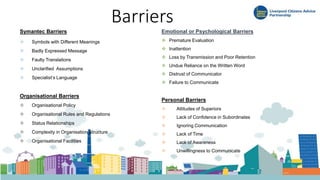
Barriers
Symantec Barriers
 Symbols with Different Meanings
 Badly Expressed Message
 Faulty Translations
 Unclarified Assumptions
 Specialist’s Language
Organisational Barriers
 Organisational Policy
 Organisational Rules and Regulations
 Status Relationships
 Complexity in Organisation Structure
 Organisational Facilities
Emotional or Psychological Barriers
 Premature Evaluation
 Inattention
 Loss by Transmission and Poor Retention
 Undue Reliance on the Written Word
 Distrust of Communicator
 Failure to Communicate
Personal Barriers
 Attitudes of Superiors
 Lack of Confidence in Subordinates
 Ignoring Communication
 Lack of Time
 Lack of Awareness
 Unwillingness to Communicate
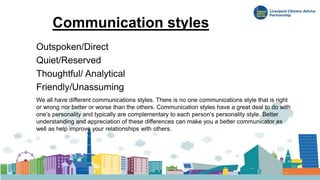
Communication styles
Outspoken/Direct
Quiet/Reserved
Thoughtful/ Analytical
Friendly/Unassuming
We all have different communications styles. There is no one communications style that is right
or wrong nor better or worse than the others. Communication styles have a great deal to do with
one’s personality and typically are complementary to each person’s personality style. Better
understanding and appreciation of these differences can make you a better communicator as
well as help improve your relationships with others.
Activity 2
The Listening Dilemma
• We speak at a rate of about 150 words per minute (wpm).
• But we can hear at a rate of about 1,000 wpm.
• This gives us a lot of extra time!
• What do we do with this time?
We could:
-Concentrate on what the other person is saying, notice body language, tone and pace.
-Try not to think about your response to the other person
-Make sure you don’t interrupt!
-Interact non-verbally to show engagement, be aware of your own body language!
Listening means not only hearing sound
signals, decoding and interpretation but
also their integration into their system of
thought.
Barriers to good listening:
Overload message and focus on all data
Lack of attention
Distraction
Miss understanding
Personal judgement/assumption
Engaged and active listening:
Being fully engaged in communications
involves listening to the other persons
views, feelings, interruptions, values, etc.
In engaged listening both parties are given
the opportunity to fully express their views,
feelings and ideas.
Activity 3
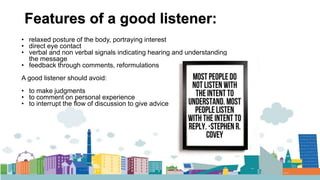
Features of a good listener:
• relaxed posture of the body, portraying interest
• direct eye contact
• verbal and non verbal signals indicating hearing and understanding
the message
• feedback through comments, reformulations
A good listener should avoid:
• to make judgments
• to comment on personal experience
• to interrupt the flow of discussion to give advice
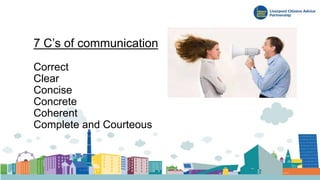
7 C’s of communication
Correct
Clear
Concise
Concrete
Coherent
Complete and Courteous
Circles of Communication
Must communications is information that employees must have
in order to perform their job. This level of communication is
typically achieved. If not, people wouldn’t be able to do their
jobs. If a problem exists at this level, it typically gets corrected
quickly.
The next level is information that an employee should know
but doesn’t have to in order to perform the job. However,
receiving this information can help an employee perform better,
and they also appreciate being in the “know” about this type of
information. There is no guarantee that this level of
communications is always achieved since employees don’t
have to have this information to do their jobs. This level of
information may just help them perform their jobs.
The next circle is information that is simply nice to know. This
communication could be on any subject and not necessarily
directly or indirectly related to the job. This is simply telling
people about things that may be of general interest to them but
that they don’t really need to know. This information could be
about organisational changes, personnel announcement,
business updates, or anything that may be appropriate but not
necessary to share with them.
Must
Should
Nice to
know
Activity 4
Communication involves a number of
skills and no one is a complete –
effective communicator. Each
individual can become a better
communicator by sharpening his
skills through learning and practice

LCAP- Comms workshop presentation

  • 1.
  • 3.
    What is communication? “Communicationis the transfer of information from one person to another person. It is a way of reaching others by transmitting ideas, facts, thoughts, feelings and Values. – John W. Newstrom.
  • 4.
    Communication is theprocess of sharing our ideas, thoughts, and feelings with other people and having those ideas, thoughts, and feelings understood by the people we are talking with. When we communicate we speak, listen, and observe. Communication is the process of transmitting information and understanding. It is the transference of meaning between individuals and the means of reaching, understanding and influencing others. Skill to communicate depends on the capacity of an individual to convey ideas and feelings to another to evolve a desired response. In management, communication is a mixture of personal attributes and organisational aspects.
  • 5.
    Verbal communication –Verbal communication (vocal included) contributes to 45% of our communication. It involves the use of language and meaning (either oral or written). Non-verbal Communication – Non verbal communication is the conscious and unconscious body movements in communication that couple with physical and environmental surroundings. Non verbal communications are those which are not expressed orally or in writing and includes human elements associated with communication. E.g. Social media, emails, written letters etc. Listening & Feedback – Listening which comprises of hearing, attending, understanding and remembering can facilitate the effectiveness of communication. Listening can be pleasurable, discriminative or critical depending on the degree of application of mind. Listener has to employ the appropriate type of listening depending on the situation and nature of the message.
  • 6.
    Effective communication • Agood working definition for effective communication is to share meaning and understanding between the person sending the message and the person receiving the message. • The success of an individual in a team depends greatly on the extent to which he/she can engage in effective communication. • Effective communication is an essential component of organisational success at all levels. Numerous employee surveys have found that many problems in any organisation can be traced back to one primary cause: poor communication. • Faulty communication in organisations can lead to lowered efficiency and effectiveness at the organisational as well as individual level. Also most of the interpersonal friction can be traced to faulty communication. What do you think effective communication is?
  • 7.
    Team Communication What are thekey factors in team communications? Teams are groups of individuals who work together to accomplish a task/project. Team effectiveness is dependent upon team communication. The quality of the team's work, to a large extent, depends upon the quality of the information shared. The ability of team members to understand and communicate information enables them to work together collaboratively. Understanding the components and barriers of communication, as well as giving and receiving feedback are essential elements of effective team communication. These tips and guidelines will assist team members in developing open channels of communication where team members can learn and grow from each other, thereby becoming more effective in the achievement of their shared goals.
  • 8.
  • 9.
    What are thebarriers in communication? What problems do you encounter?
  • 10.
    Barriers Symantec Barriers  Symbolswith Different Meanings  Badly Expressed Message  Faulty Translations  Unclarified Assumptions  Specialist’s Language Organisational Barriers  Organisational Policy  Organisational Rules and Regulations  Status Relationships  Complexity in Organisation Structure  Organisational Facilities Emotional or Psychological Barriers  Premature Evaluation  Inattention  Loss by Transmission and Poor Retention  Undue Reliance on the Written Word  Distrust of Communicator  Failure to Communicate Personal Barriers  Attitudes of Superiors  Lack of Confidence in Subordinates  Ignoring Communication  Lack of Time  Lack of Awareness  Unwillingness to Communicate
  • 11.
    Communication styles Outspoken/Direct Quiet/Reserved Thoughtful/ Analytical Friendly/Unassuming Weall have different communications styles. There is no one communications style that is right or wrong nor better or worse than the others. Communication styles have a great deal to do with one’s personality and typically are complementary to each person’s personality style. Better understanding and appreciation of these differences can make you a better communicator as well as help improve your relationships with others.
  • 12.
  • 13.
    The Listening Dilemma •We speak at a rate of about 150 words per minute (wpm). • But we can hear at a rate of about 1,000 wpm. • This gives us a lot of extra time! • What do we do with this time?
  • 14.
    We could: -Concentrate onwhat the other person is saying, notice body language, tone and pace. -Try not to think about your response to the other person -Make sure you don’t interrupt! -Interact non-verbally to show engagement, be aware of your own body language!
  • 15.
    Listening means notonly hearing sound signals, decoding and interpretation but also their integration into their system of thought. Barriers to good listening: Overload message and focus on all data Lack of attention Distraction Miss understanding Personal judgement/assumption Engaged and active listening: Being fully engaged in communications involves listening to the other persons views, feelings, interruptions, values, etc. In engaged listening both parties are given the opportunity to fully express their views, feelings and ideas.
  • 16.
  • 17.
    Features of agood listener: • relaxed posture of the body, portraying interest • direct eye contact • verbal and non verbal signals indicating hearing and understanding the message • feedback through comments, reformulations A good listener should avoid: • to make judgments • to comment on personal experience • to interrupt the flow of discussion to give advice
  • 18.
    7 C’s ofcommunication Correct Clear Concise Concrete Coherent Complete and Courteous
  • 19.
    Circles of Communication Mustcommunications is information that employees must have in order to perform their job. This level of communication is typically achieved. If not, people wouldn’t be able to do their jobs. If a problem exists at this level, it typically gets corrected quickly. The next level is information that an employee should know but doesn’t have to in order to perform the job. However, receiving this information can help an employee perform better, and they also appreciate being in the “know” about this type of information. There is no guarantee that this level of communications is always achieved since employees don’t have to have this information to do their jobs. This level of information may just help them perform their jobs. The next circle is information that is simply nice to know. This communication could be on any subject and not necessarily directly or indirectly related to the job. This is simply telling people about things that may be of general interest to them but that they don’t really need to know. This information could be about organisational changes, personnel announcement, business updates, or anything that may be appropriate but not necessary to share with them. Must Should Nice to know
  • 20.
  • 21.
    Communication involves anumber of skills and no one is a complete – effective communicator. Each individual can become a better communicator by sharpening his skills through learning and practice

Editor's Notes

  • #2 Introductions of attendee’s and housekeeping
  • #3 Ask group to write on sticky notes what they want to get out of the session and place on flip chart
  • #7 Refer to point 1 in comms protocol
  • #10 Group discussion: What do you think are the barriers to communication are in and out of the workplace? Discuss communication shut down comments- handout
  • #11 Refer to point 4 in comms protocol
  • #14 Group discussion- what do we think we do with this ‘free time’? What could we do to stay focused on what the other person is saying?
  • #16 Discussion: Ask group to share when they have experienced times of frustration in or out of work through lack of listening. Also times when listening has worked and what was the outcome.
  • #20 Does anyone use this structure internally? Do you have priority ‘labels’ when sending information? There is another type of information not shown on this communications model. This is information that you can’t share. One of the most difficult communications challenges for a supervisor or manager is when employees ask about information that must remain confidential and that you consequently cannot share. Employees will be more accepting that there is certain information that they shouldn’t know if the other communications levels from the model have been achieved. Simply telling employees that the information is confidential will be much better accepted if you have built communication trust by sharing whatever information you can with them.
  • #21 Hand out circles picture and split into 3 groups- each group to write examples for allocated communication label on flip chart paper. Discuss and present back to the group.
  • #22 Provide hand out of LCAP communications protocol- ask staff to refer to this. Use on a daily basis and be mindful of communication within the workplace.