ORAL HYPOGLYCEMICS
        AND INSULIN


    Free Powerpoint Templates   Page 1
DIABETES


• A chronic metabolic disorder characterised
  by a high blood glucose concentration-
  hyperglycaemia
• fasting plasma glucose > 7.0 mmol/l, or
  plasma glucose> 11.1 mmol/l 2 hours after
  a meal
• caused by
  – insulin deficiency
  – insulin resistance

                  Free Powerpoint Templates   Page 2
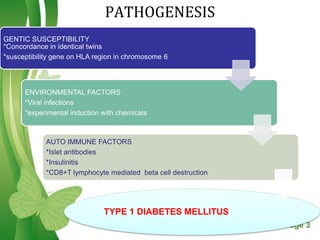
PATHOGENESIS
GENTIC SUSCEPTIBILITY
*Concordance in identical twins
*susceptibility gene on HLA region in chromosome 6


      ENVIRONMENTAL FACTORS
      *Viral infections
      *experimental induction with chemicals


            AUTO IMMUNE FACTORS
            *Islet antibodies
            *Insulinitis
            *CD8+T lymphocyte mediated beta cell destruction


                              TYPE 1 DIABETES MELLITUS
                                   Free Powerpoint Templates   Page 3
PATHOGENESIS
 GENETIC FACTORS              CONSTITUTIONAL             DECREASED INSULIN
                                  FACTORS                     SECRETION
*conordance in identical
          twin                     *obesity                    *lipotoxicity
 *both parents diabetic         *hypertension            *Glucose toxicity of islet
   50% risk to child         *low physical activity                cells


INSULIN RESISTANCE
   *Receptor & post
    receptor defects        INCREASED HEPATIC
                            GLUCOSE SYNTHESIS             HYPERGLYCAEMIA
  *Impaired glucose
       utilisation


                                   TYPE 2 DIABETES
                                      MELLITUS

                             Free Powerpoint Templates                    Page 4
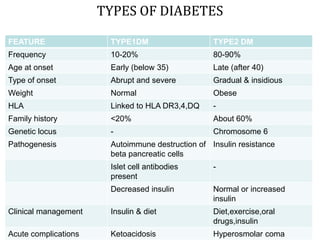
TYPES OF DIABETES

FEATURE                TYPE1DM                    TYPE2 DM
Frequency              10-20%                     80-90%
Age at onset           Early (below 35)           Late (after 40)
Type of onset          Abrupt and severe          Gradual & insidious
Weight                 Normal                     Obese
HLA                    Linked to HLA DR3,4,DQ     -
Family history         <20%                       About 60%
Genetic locus          -                          Chromosome 6
Pathogenesis           Autoimmune destruction of Insulin resistance
                       beta pancreatic cells
                       Islet cell antibodies      -
                       present
                       Decreased insulin          Normal or increased
                                                  insulin
Clinical management    Insulin & diet             Diet,exercise,oral
                                                  drugs,insulin
Acute complications    Ketoacidosis               Hyperosmolar coma
SIGNS & SYMPTOMS OF DM


• Insulin deficiency causes hyperglycaemia
  leading to glycosuria
                             KETOACIDOSIS
• Increased catabolism:
  – increased lipolysis(in adipose tissue)
  – Increased fatty acids (in plasma)
  – Oxidation(in liver)
• Decreased anabolism:                DIABETIC
                                        COMA
  – Osmotic diuresis
  – Dehydration & loss of electrolytes
                  Free Powerpoint Templates      Page 6
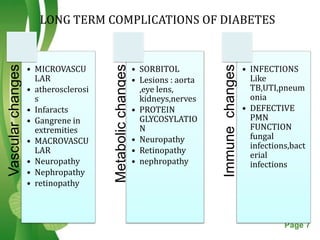
LONG TERM COMPLICATIONS OF DIABETES


                   • MICROVASCU                           • SORBITOL                           • INFECTIONS


                                      Metabolic changes
Vascular changes


                                                                              Immune changes
                     LAR                                  • Lesions : aorta                      Like
                   • atherosclerosi                         ,eye lens,                           TB,UTI,pneum
                     s                                      kidneys,nerves                       onia
                   • Infaracts                            • PROTEIN                            • DEFECTIVE
                   • Gangrene in                            GLYCOSYLATIO                         PMN
                     extremities                            N                                    FUNCTION
                                                          • Neuropathy                           fungal
                   • MACROVASCU
                                                                                                 infections,bact
                     LAR                                  • Retinopathy
                                                                                                 erial
                   • Neuropathy                           • nephropathy                          infections
                   • Nephropathy
                   • retinopathy


                                            Free Powerpoint Templates                                     Page 7
Oral hypoglycemics
• Agents that are given orally to reduce the blood
  glucose levels in diabetic patients
• Five types of oral antidiabetic drugs are currently
  in use:
• Biguanides :metformin
• Sulfonylureas: glimepiride,
  glyburide,tolbutamide,glibenclamide,glipizide
• Meglitinides : nateglinide, repaglinide
• Thiazolidinediones : pioglitazone, rosiglitazone
• Alpha -glucosidase inhibitors: acarbose, miglitol

                   Free Powerpoint Templates       Page 8
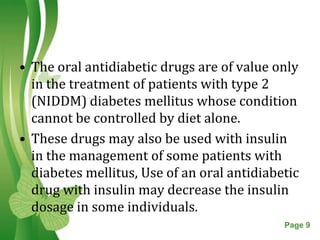
• The oral antidiabetic drugs are of value only
  in the treatment of patients with type 2
  (NIDDM) diabetes mellitus whose condition
  cannot be controlled by diet alone.
• These drugs may also be used with insulin
  in the management of some patients with
  diabetes mellitus, Use of an oral antidiabetic
  drug with insulin may decrease the insulin
  dosage in some individuals.
                 Free Powerpoint Templates   Page 9
Biguanides

• Metformin : is the only drug of this class presently
  available in market
• It does not cause hypoglycaemia
• MOA : They increase glucose uptake and
  utilisation in skeletal muscle (thereby reducing
  insulin resistance) and reduce hepatic glucose
  production (gluconeogenesis).
• Pharmacokinetic aspects : Metformin has a half-life
  of about 3 hours and is excreted unchanged in the
  urine.
                   Free Powerpoint Templates       Page 10
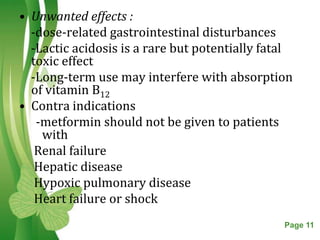
• Unwanted effects :
  -dose-related gastrointestinal disturbances
  -Lactic acidosis is a rare but potentially fatal
  toxic effect
  -Long-term use may interfere with absorption
  of vitamin B12
• Contra indications
   -metformin should not be given to patients
    with
   Renal failure
   Hepatic disease
   Hypoxic pulmonary disease
   Heart failure or shock
                  Free Powerpoint Templates     Page 11
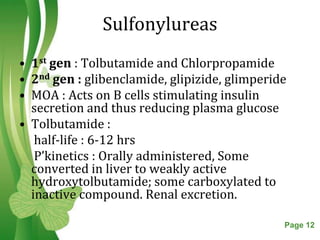
Sulfonylureas
• 1st gen : Tolbutamide and Chlorpropamide
• 2nd gen : glibenclamide, glipizide, glimperide
• MOA : Acts on B cells stimulating insulin
  secretion and thus reducing plasma glucose
• Tolbutamide :
   half-life : 6-12 hrs
   P’kinetics : Orally administered, Some
  converted in liver to weakly active
  hydroxytolbutamide; some carboxylated to
  inactive compound. Renal excretion.

                  Free Powerpoint Templates    Page 12
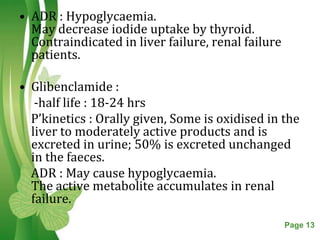
• ADR : Hypoglycaemia.
  May decrease iodide uptake by thyroid.
  Contraindicated in liver failure, renal failure
  patients.

• Glibenclamide :
   -half life : 18-24 hrs
  P’kinetics : Orally given, Some is oxidised in the
  liver to moderately active products and is
  excreted in urine; 50% is excreted unchanged
  in the faeces.
  ADR : May cause hypoglycaemia.
  The active metabolite accumulates in renal
  failure.
                  Free Powerpoint Templates         Page 13
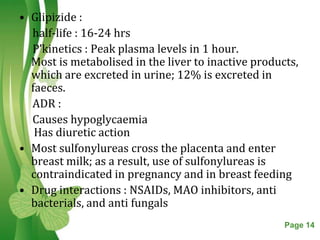
• Glipizide :
  half-life : 16-24 hrs
  P’kinetics : Peak plasma levels in 1 hour.
  Most is metabolised in the liver to inactive products,
  which are excreted in urine; 12% is excreted in
  faeces.
  ADR :
  Causes hypoglycaemia
   Has diuretic action
• Most sulfonylureas cross the placenta and enter
  breast milk; as a result, use of sulfonylureas is
  contraindicated in pregnancy and in breast feeding
• Drug interactions : NSAIDs, MAO inhibitors, anti
  bacterials, and anti fungals
                    Free Powerpoint Templates        Page 14
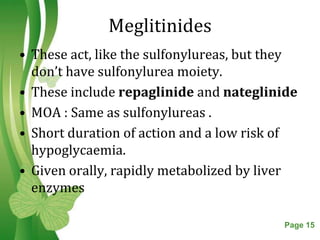
Meglitinides
• These act, like the sulfonylureas, but they
  don’t have sulfonylurea moiety.
• These include repaglinide and nateglinide
• MOA : Same as sulfonylureas .
• Short duration of action and a low risk of
  hypoglycaemia.
• Given orally, rapidly metabolized by liver
  enzymes

                Free Powerpoint Templates   Page 15
Glitazones
• Currently marketed thiazolidinediones:
  Rosiglitazone and Pioglitazone
• MOA : Bind to a nuclear receptor called the
  peroxisome proliferator-activated receptor-γ
  (PPARγ), which is complexed with retinoid X
  receptor (RXR).
• PPARγ-RXR complex bind to DNA, promoting
  transcription of several genes with products that
  are important in insulin signalling.
• P’kinetics : A-Orally, highly plasma protein
  bound, peak plasma concentration-within 2 hrs
  M- liver enzymes. E- Rosiglitazone metabolites in
  urine, Pioglitazone metabolites in bile
                    Free Powerpoint Templates     Page 16
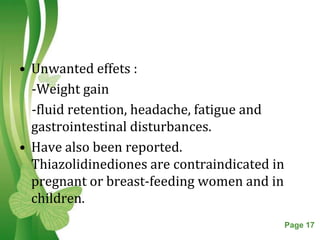
• Unwanted effets :
  -Weight gain
  -fluid retention, headache, fatigue and
  gastrointestinal disturbances.
• Have also been reported.
  Thiazolidinediones are contraindicated in
  pregnant or breast-feeding women and in
  children.
                Free Powerpoint Templates     Page 17
α-Glucosidase inhibitors
• Acarbose : An inhibitor of intestinal α-
  glucosidase, is used in type 2 diabetes.
• MOA : It delays carbohydrate absorption,
  reducing the postprandial increase in blood
  glucose .
• Unwanted effects : flatulence, loose stools or
  diarrhoea, and abdominal pain and bloating.
• Like metformin, it may be particularly helpful in
  obese type 2 patients, and it can be
  coadministered with metformin.
                  Free Powerpoint Templates      Page 18
RECENT DRUGS
                 PEPTIDE ANALOGS
• Injectable Incretin mimetics
  (insulin secretagogues)
• Molecules that fulfill criteria for being an
  incretin are glucagon-like peptide-1 (GLP-1) and
  gastric inhibitory peptide (glucose-dependent
  insulinotropic peptide, GIP)
• Both GLP-1 and GIP are rapidly inactivated by
  the enzyme dipeptidyl peptidase-4 (DPP-4).

                  Free Powerpoint Templates     Page 19
FDA APPROVED DRUGS:

• Exenatide (first GLP-1 agonist)
• Liraglutide (a once-daily human analogue 97%
  homology)
• Taspoglutide (phase III clinical trials with
  Hoffman-La Roche)

 Side-effects:
    -decreased gastric motility
    -nausea
    -weight loss Free Powerpoint Templates   Page 20
DIPEPTIDYL PEPTIDASE-4 INHIBITORS
•   Increase blood concentration of the incretin GLP-1
    by inhibiting its degradation by dipeptidyl
    peptidase-4.
•   Examples:
•   vildagliptin (Galvus) EU Approved 2008
•   sitagliptin (Januvia) FDA approved Oct 2006
•   saxagliptin (Onglyza) FDA Approved July 2009
•   Linagliptin (Tradjenta) FDA Approved May 2, 2011

• DPP-4 inhibitors lowered haemoglobin A1C values
  by 0.74%, comparable to other anti-diabetic drugs.
                   Free Powerpoint Templates      Page 21
Inhibition of DPP-4 Increases Active
                   GLP-1
    Mixed
    meal
               Intestinal
                 GLP-1
                release


                                GLP-1
                              GLP-1 (7-36)
                                active
                                active


                                                     DPP-4


                                          DPP-4
                                                                     GLP-1
                                         inhibitor                  inactive


                                Free Powerpoint Templates
Adapted from Rothenberg P, et al. Diabetes. 2000;49(suppl 1):A39.              Page 22
Overview of insulin secretion
       Free Powerpoint Templates   Page 23
Pharmacokinetics

    Sitagliptin :
•   Well absorbed through GIT
•   80% excreted unchanged in the urine
•   half-life :8 to 14 hours
•   Renal clearance: 388 mL/min


                   Free Powerpoint Templates   Page 24
INJECTABLE AMYLIN ANALOGUES


• Actions:
   – Slow gastric emptying
   – Suppress glucagon.
• Pramlintide (the only clinically available amylin
  analogue: administered by subcutaneous
  injection)
• Adverse effect :nausea
• Typical reductions in A1C values are 0.5–1.0%.

                  Free Powerpoint Templates      Page 25
INSULIN
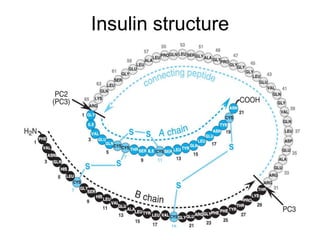
• A polypeptide hormone with two peptide chains
  that are connected by disulfide bonds.
• Synthesized as a precursor (pro-insulin) that
  undergoes proteolytic cleavage to form insulin and
  C peptide, both of which are secreted by the ß cells
  of the pancreas triggered by high blood glucose..
• Insulin and glucagon regulate blood glucose levels.
   ACTIONS :
• Controls intermediary metabolism, having actions
  on liver, muscle and fat.
• Conserves fuel by facilitating the uptake and
  storage of glucose, amino acids and fats after a
                    Free Powerpoint Templates        Page 26
  meal
Insulin structure
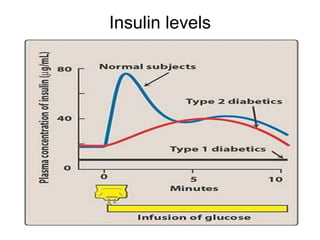
Insulin levels
• Sources of insulin :
   Human insulin is produced by recombinant
  DNA technology using special strains of
  Escherichia coli or yeast that have been
  genetically altered to contain the gene for
  human insulin.

• MOA :
   Acts on insulin receptors on liver cells ,fat
  cells and stimulates glucose transport
  across membrane by ATP dependent
  transporters like GLUT 4 &GLUT 1
                  Free Powerpoint Templates    Page 29
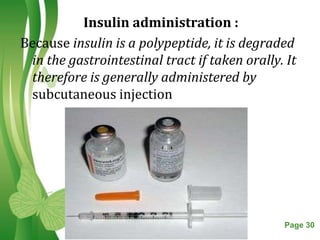
Insulin administration :
Because insulin is a polypeptide, it is degraded
 in the gastrointestinal tract if taken orally. It
 therefore is generally administered by
 subcutaneous injection


                  Free Powerpoint Templates    Page 30
• TYPES OF INSULIN PREPARATIONS :
1. Rapid-acting and short-acting insulin
    preparations :
  Regular insulin, insulin lispro, insulin aspart, and
  insulin glulisine
 -these insulin preparations reach peak plasma
  concentration in 30-90 mins.
• Insulin lispro is an insulin analogue in which
    a lysine and a proline residue are 'switched'


                   Free Powerpoint Templates     Page 31
2. Intermediate-acting insulin : Neutral protamine
   Hagedorn (NPH) insulin is a suspension of crystalline
   zinc insulin combined at neutral pH with a positively
   charged polypeptide, protamine
• Delayed absorption of the insulin because of its
   conjugation with protamine, forming a less-soluble
   complex

3.Long-acting insulin preparations :
a. Insulin glargine
b. Insulin detemir
    The length of time to onset is three to four hours and
   the maximum duration is 20 to 24 hours.
                   Free Powerpoint Templates        Page 32
(4)Regular Human Insulin

– A short-acting preparation
– FDA approved to treat type 1 and type 2 diabetes
  and for hyperglycemia (abnormally high blood
  sugar) experienced during pregnancy.
– Administered subcutaneously as with other insulins
  (the only preparation that also may be administered
  intramuscularly and intravenously)
– This insulin acts within 15 to 30 minutes and lasts
  from one to 12 hours.


                  Free Powerpoint Templates     Page 33
Pharmacokinetics of Insulin
• Destroyed in the gastrointestinal tract, and
  must be given parenterally-usually
  subcutaneously, but intravenously or
  occasionally intramuscularly in emergencies
• Insulin should be administered 15-20 mins
  prior to meal
• Adverse reactions to insulin :
  -Hypoglycemia (most serious and common)
  -Others: weight gain, lipodystrophy (less
  common with human insulin), allergic
  reactions, and local reactions at site of injection
                   Free Powerpoint Templates      Page 34
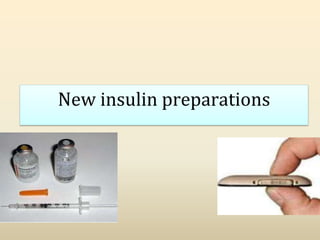
New insulin preparations
Newer insulin delivery devices

• INSULIN SYRINGES:Prefilled disposible syringes
  with regular or modified insulins
• PEN DEVICES:Fountain pen like :insulin cartridges
• INHALED INSULIN:Fine powder delivered through
  nebuliser,rapid absorption
• INSULIN PUMPS:Portable infusion devices
  connected to subcutaneously placed
  cannula(continuous insulin infusion)
• INSULIN PATCH-PEN: A small (two inches long, one
  inch wide and ¼ inch thick) plastic device is
  designed to be worn on the skin like a bandage
                   Free Powerpoint Templates     Page 36
•
• IMPLANTABLE PUMPS:electromechanical
  mechanism regulates insulin delivery from
  percutaneously refillable reservoir
• Mechanical pumps,fluorocarbon propellants
  &osmotic pumps are also being developed
• OTHER ROUTES:
   – Oral(liposome/impermeable polymer coating)
   – Rectal
   – Nasal
   – Intraperitoneal
                 Free Powerpoint Templates   Page 37
Alternative medicine
• Medicinal plants have been studied for the
  treatment of diabetes, however there is
  insufficient evidence to determine their
  effectiveness
• Examples:
Cinnamon
Chromium supplements
Vanadyl sulfate a salt of vanadium
Thiamine
               Free Powerpoint Templates   Page 38
Thank You…
 Free Powerpoint Templates   Page 39

Oral hypoglycemics

  • 1.
    ORAL HYPOGLYCEMICS AND INSULIN Free Powerpoint Templates Page 1
  • 2.
    DIABETES • A chronicmetabolic disorder characterised by a high blood glucose concentration- hyperglycaemia • fasting plasma glucose > 7.0 mmol/l, or plasma glucose> 11.1 mmol/l 2 hours after a meal • caused by – insulin deficiency – insulin resistance Free Powerpoint Templates Page 2
  • 3.
    PATHOGENESIS GENTIC SUSCEPTIBILITY *Concordance inidentical twins *susceptibility gene on HLA region in chromosome 6 ENVIRONMENTAL FACTORS *Viral infections *experimental induction with chemicals AUTO IMMUNE FACTORS *Islet antibodies *Insulinitis *CD8+T lymphocyte mediated beta cell destruction TYPE 1 DIABETES MELLITUS Free Powerpoint Templates Page 3
  • 4.
    PATHOGENESIS GENETIC FACTORS CONSTITUTIONAL DECREASED INSULIN FACTORS SECRETION *conordance in identical twin *obesity *lipotoxicity *both parents diabetic *hypertension *Glucose toxicity of islet 50% risk to child *low physical activity cells INSULIN RESISTANCE *Receptor & post receptor defects INCREASED HEPATIC GLUCOSE SYNTHESIS HYPERGLYCAEMIA *Impaired glucose utilisation TYPE 2 DIABETES MELLITUS Free Powerpoint Templates Page 4
  • 5.
    TYPES OF DIABETES FEATURE TYPE1DM TYPE2 DM Frequency 10-20% 80-90% Age at onset Early (below 35) Late (after 40) Type of onset Abrupt and severe Gradual & insidious Weight Normal Obese HLA Linked to HLA DR3,4,DQ - Family history <20% About 60% Genetic locus - Chromosome 6 Pathogenesis Autoimmune destruction of Insulin resistance beta pancreatic cells Islet cell antibodies - present Decreased insulin Normal or increased insulin Clinical management Insulin & diet Diet,exercise,oral drugs,insulin Acute complications Ketoacidosis Hyperosmolar coma
  • 6.
    SIGNS & SYMPTOMSOF DM • Insulin deficiency causes hyperglycaemia leading to glycosuria KETOACIDOSIS • Increased catabolism: – increased lipolysis(in adipose tissue) – Increased fatty acids (in plasma) – Oxidation(in liver) • Decreased anabolism: DIABETIC COMA – Osmotic diuresis – Dehydration & loss of electrolytes Free Powerpoint Templates Page 6
  • 7.
    LONG TERM COMPLICATIONSOF DIABETES • MICROVASCU • SORBITOL • INFECTIONS Metabolic changes Vascular changes Immune changes LAR • Lesions : aorta Like • atherosclerosi ,eye lens, TB,UTI,pneum s kidneys,nerves onia • Infaracts • PROTEIN • DEFECTIVE • Gangrene in GLYCOSYLATIO PMN extremities N FUNCTION • Neuropathy fungal • MACROVASCU infections,bact LAR • Retinopathy erial • Neuropathy • nephropathy infections • Nephropathy • retinopathy Free Powerpoint Templates Page 7
  • 8.
    Oral hypoglycemics • Agentsthat are given orally to reduce the blood glucose levels in diabetic patients • Five types of oral antidiabetic drugs are currently in use: • Biguanides :metformin • Sulfonylureas: glimepiride, glyburide,tolbutamide,glibenclamide,glipizide • Meglitinides : nateglinide, repaglinide • Thiazolidinediones : pioglitazone, rosiglitazone • Alpha -glucosidase inhibitors: acarbose, miglitol Free Powerpoint Templates Page 8
  • 9.
    • The oralantidiabetic drugs are of value only in the treatment of patients with type 2 (NIDDM) diabetes mellitus whose condition cannot be controlled by diet alone. • These drugs may also be used with insulin in the management of some patients with diabetes mellitus, Use of an oral antidiabetic drug with insulin may decrease the insulin dosage in some individuals. Free Powerpoint Templates Page 9
  • 10.
    Biguanides • Metformin :is the only drug of this class presently available in market • It does not cause hypoglycaemia • MOA : They increase glucose uptake and utilisation in skeletal muscle (thereby reducing insulin resistance) and reduce hepatic glucose production (gluconeogenesis). • Pharmacokinetic aspects : Metformin has a half-life of about 3 hours and is excreted unchanged in the urine. Free Powerpoint Templates Page 10
  • 11.
    • Unwanted effects: -dose-related gastrointestinal disturbances -Lactic acidosis is a rare but potentially fatal toxic effect -Long-term use may interfere with absorption of vitamin B12 • Contra indications -metformin should not be given to patients with Renal failure Hepatic disease Hypoxic pulmonary disease Heart failure or shock Free Powerpoint Templates Page 11
  • 12.
    Sulfonylureas • 1st gen: Tolbutamide and Chlorpropamide • 2nd gen : glibenclamide, glipizide, glimperide • MOA : Acts on B cells stimulating insulin secretion and thus reducing plasma glucose • Tolbutamide : half-life : 6-12 hrs P’kinetics : Orally administered, Some converted in liver to weakly active hydroxytolbutamide; some carboxylated to inactive compound. Renal excretion. Free Powerpoint Templates Page 12
  • 13.
    • ADR :Hypoglycaemia. May decrease iodide uptake by thyroid. Contraindicated in liver failure, renal failure patients. • Glibenclamide : -half life : 18-24 hrs P’kinetics : Orally given, Some is oxidised in the liver to moderately active products and is excreted in urine; 50% is excreted unchanged in the faeces. ADR : May cause hypoglycaemia. The active metabolite accumulates in renal failure. Free Powerpoint Templates Page 13
  • 14.
    • Glipizide : half-life : 16-24 hrs P’kinetics : Peak plasma levels in 1 hour. Most is metabolised in the liver to inactive products, which are excreted in urine; 12% is excreted in faeces. ADR : Causes hypoglycaemia Has diuretic action • Most sulfonylureas cross the placenta and enter breast milk; as a result, use of sulfonylureas is contraindicated in pregnancy and in breast feeding • Drug interactions : NSAIDs, MAO inhibitors, anti bacterials, and anti fungals Free Powerpoint Templates Page 14
  • 15.
    Meglitinides • These act,like the sulfonylureas, but they don’t have sulfonylurea moiety. • These include repaglinide and nateglinide • MOA : Same as sulfonylureas . • Short duration of action and a low risk of hypoglycaemia. • Given orally, rapidly metabolized by liver enzymes Free Powerpoint Templates Page 15
  • 16.
    Glitazones • Currently marketedthiazolidinediones: Rosiglitazone and Pioglitazone • MOA : Bind to a nuclear receptor called the peroxisome proliferator-activated receptor-γ (PPARγ), which is complexed with retinoid X receptor (RXR). • PPARγ-RXR complex bind to DNA, promoting transcription of several genes with products that are important in insulin signalling. • P’kinetics : A-Orally, highly plasma protein bound, peak plasma concentration-within 2 hrs M- liver enzymes. E- Rosiglitazone metabolites in urine, Pioglitazone metabolites in bile Free Powerpoint Templates Page 16
  • 17.
    • Unwanted effets: -Weight gain -fluid retention, headache, fatigue and gastrointestinal disturbances. • Have also been reported. Thiazolidinediones are contraindicated in pregnant or breast-feeding women and in children. Free Powerpoint Templates Page 17
  • 18.
    α-Glucosidase inhibitors • Acarbose: An inhibitor of intestinal α- glucosidase, is used in type 2 diabetes. • MOA : It delays carbohydrate absorption, reducing the postprandial increase in blood glucose . • Unwanted effects : flatulence, loose stools or diarrhoea, and abdominal pain and bloating. • Like metformin, it may be particularly helpful in obese type 2 patients, and it can be coadministered with metformin. Free Powerpoint Templates Page 18
  • 19.
    RECENT DRUGS PEPTIDE ANALOGS • Injectable Incretin mimetics (insulin secretagogues) • Molecules that fulfill criteria for being an incretin are glucagon-like peptide-1 (GLP-1) and gastric inhibitory peptide (glucose-dependent insulinotropic peptide, GIP) • Both GLP-1 and GIP are rapidly inactivated by the enzyme dipeptidyl peptidase-4 (DPP-4). Free Powerpoint Templates Page 19
  • 20.
    FDA APPROVED DRUGS: •Exenatide (first GLP-1 agonist) • Liraglutide (a once-daily human analogue 97% homology) • Taspoglutide (phase III clinical trials with Hoffman-La Roche) Side-effects: -decreased gastric motility -nausea -weight loss Free Powerpoint Templates Page 20
  • 21.
    DIPEPTIDYL PEPTIDASE-4 INHIBITORS • Increase blood concentration of the incretin GLP-1 by inhibiting its degradation by dipeptidyl peptidase-4. • Examples: • vildagliptin (Galvus) EU Approved 2008 • sitagliptin (Januvia) FDA approved Oct 2006 • saxagliptin (Onglyza) FDA Approved July 2009 • Linagliptin (Tradjenta) FDA Approved May 2, 2011 • DPP-4 inhibitors lowered haemoglobin A1C values by 0.74%, comparable to other anti-diabetic drugs. Free Powerpoint Templates Page 21
  • 22.
    Inhibition of DPP-4Increases Active GLP-1 Mixed meal Intestinal GLP-1 release GLP-1 GLP-1 (7-36) active active DPP-4 DPP-4 GLP-1 inhibitor inactive Free Powerpoint Templates Adapted from Rothenberg P, et al. Diabetes. 2000;49(suppl 1):A39. Page 22
  • 23.
    Overview of insulinsecretion Free Powerpoint Templates Page 23
  • 24.
    Pharmacokinetics Sitagliptin : • Well absorbed through GIT • 80% excreted unchanged in the urine • half-life :8 to 14 hours • Renal clearance: 388 mL/min Free Powerpoint Templates Page 24
  • 25.
    INJECTABLE AMYLIN ANALOGUES •Actions: – Slow gastric emptying – Suppress glucagon. • Pramlintide (the only clinically available amylin analogue: administered by subcutaneous injection) • Adverse effect :nausea • Typical reductions in A1C values are 0.5–1.0%. Free Powerpoint Templates Page 25
  • 26.
    INSULIN • A polypeptidehormone with two peptide chains that are connected by disulfide bonds. • Synthesized as a precursor (pro-insulin) that undergoes proteolytic cleavage to form insulin and C peptide, both of which are secreted by the ß cells of the pancreas triggered by high blood glucose.. • Insulin and glucagon regulate blood glucose levels. ACTIONS : • Controls intermediary metabolism, having actions on liver, muscle and fat. • Conserves fuel by facilitating the uptake and storage of glucose, amino acids and fats after a Free Powerpoint Templates Page 26 meal
  • 27.
  • 28.
  • 29.
    • Sources ofinsulin : Human insulin is produced by recombinant DNA technology using special strains of Escherichia coli or yeast that have been genetically altered to contain the gene for human insulin. • MOA : Acts on insulin receptors on liver cells ,fat cells and stimulates glucose transport across membrane by ATP dependent transporters like GLUT 4 &GLUT 1 Free Powerpoint Templates Page 29
  • 30.
    Insulin administration : Becauseinsulin is a polypeptide, it is degraded in the gastrointestinal tract if taken orally. It therefore is generally administered by subcutaneous injection Free Powerpoint Templates Page 30
  • 31.
    • TYPES OFINSULIN PREPARATIONS : 1. Rapid-acting and short-acting insulin preparations : Regular insulin, insulin lispro, insulin aspart, and insulin glulisine -these insulin preparations reach peak plasma concentration in 30-90 mins. • Insulin lispro is an insulin analogue in which a lysine and a proline residue are 'switched' Free Powerpoint Templates Page 31
  • 32.
    2. Intermediate-acting insulin: Neutral protamine Hagedorn (NPH) insulin is a suspension of crystalline zinc insulin combined at neutral pH with a positively charged polypeptide, protamine • Delayed absorption of the insulin because of its conjugation with protamine, forming a less-soluble complex 3.Long-acting insulin preparations : a. Insulin glargine b. Insulin detemir The length of time to onset is three to four hours and the maximum duration is 20 to 24 hours. Free Powerpoint Templates Page 32
  • 33.
    (4)Regular Human Insulin –A short-acting preparation – FDA approved to treat type 1 and type 2 diabetes and for hyperglycemia (abnormally high blood sugar) experienced during pregnancy. – Administered subcutaneously as with other insulins (the only preparation that also may be administered intramuscularly and intravenously) – This insulin acts within 15 to 30 minutes and lasts from one to 12 hours. Free Powerpoint Templates Page 33
  • 34.
    Pharmacokinetics of Insulin •Destroyed in the gastrointestinal tract, and must be given parenterally-usually subcutaneously, but intravenously or occasionally intramuscularly in emergencies • Insulin should be administered 15-20 mins prior to meal • Adverse reactions to insulin : -Hypoglycemia (most serious and common) -Others: weight gain, lipodystrophy (less common with human insulin), allergic reactions, and local reactions at site of injection Free Powerpoint Templates Page 34
  • 35.
  • 36.
    Newer insulin deliverydevices • INSULIN SYRINGES:Prefilled disposible syringes with regular or modified insulins • PEN DEVICES:Fountain pen like :insulin cartridges • INHALED INSULIN:Fine powder delivered through nebuliser,rapid absorption • INSULIN PUMPS:Portable infusion devices connected to subcutaneously placed cannula(continuous insulin infusion) • INSULIN PATCH-PEN: A small (two inches long, one inch wide and ¼ inch thick) plastic device is designed to be worn on the skin like a bandage Free Powerpoint Templates Page 36 •
  • 37.
    • IMPLANTABLE PUMPS:electromechanical mechanism regulates insulin delivery from percutaneously refillable reservoir • Mechanical pumps,fluorocarbon propellants &osmotic pumps are also being developed • OTHER ROUTES: – Oral(liposome/impermeable polymer coating) – Rectal – Nasal – Intraperitoneal Free Powerpoint Templates Page 37
  • 38.
    Alternative medicine • Medicinalplants have been studied for the treatment of diabetes, however there is insufficient evidence to determine their effectiveness • Examples: Cinnamon Chromium supplements Vanadyl sulfate a salt of vanadium Thiamine Free Powerpoint Templates Page 38
  • 39.
    Thank You… FreePowerpoint Templates Page 39