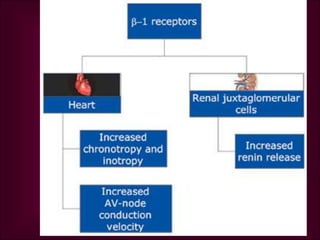
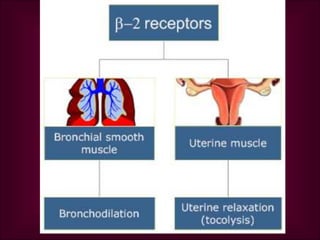
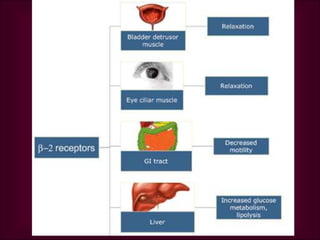
Beta blockers
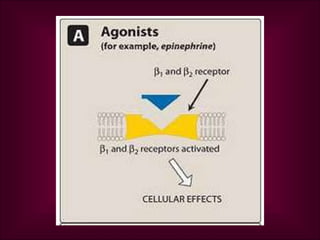
 Catecholamines produce their action
by direct combination with receptors
located on cell membrane
 Outcome of this drug receptor
combination is either ↑ or ↓ in tissue
activity
 Ahlquist 1948
 Alpha & beta receptors
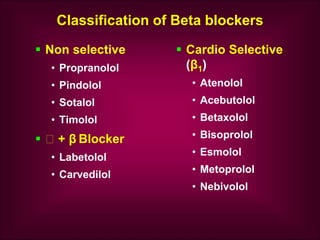
Classification of Beta blockers
 Non selective
• Propranolol
• Pindolol
• Sotalol
• Timolol
 + β Blocker
• Labetolol
• Carvedilol
 Cardio Selective
(β1)
• Atenolol
• Acebutolol
• Betaxolol
• Bisoprolol
• Esmolol
• Metoprolol
• Nebivolol
 Without intrinsic sympathomimetic
action:
 Propranolol
 Timolol
 Sotalol
 With intrinsic sympathomimetic action:
 Pindolol
 Acebutolol
 With membrane stabilizing action:
 Propranolol, oxprenolol, acebutolol
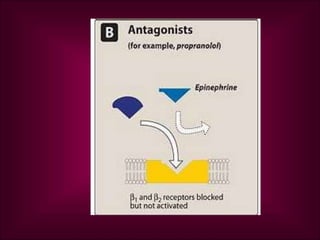
Propranolol
Non selective beta blocker also
an inverse agonist
Pharmacological actions
 Effects of  blockade
 No marked effect on normal heart in
subject at rest
 In presence of ↑ sympathetic tone
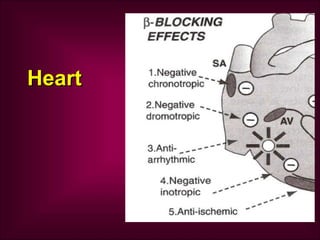
• ↓ automaticity and prevents rise in HR
• ↓ Myocardial contractility, cardiac output
and stroke work
• Slows AV conduction
• ↓ myocardial oxygen requirement &
improves exercise tolerance
Heart
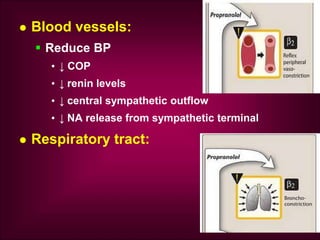
 Blood vessels:
 Reduce BP
• ↓ COP
• ↓ renin levels
• ↓ central sympathetic outflow
• ↓ NA release from sympathetic terminal
 Respiratory tract:
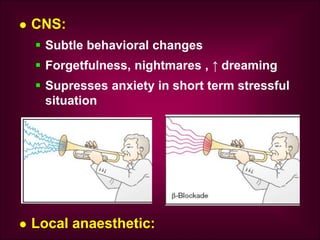
 CNS:
 Subtle behavioral changes
 Forgetfulness, nightmares , ↑ dreaming
 Supresses anxiety in short term stressful
situation
 Local anaesthetic:
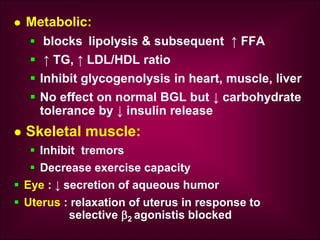
 Metabolic:
 blocks lipolysis & subsequent ↑ FFA
 ↑ TG, ↑ LDL/HDL ratio
 Inhibit glycogenolysis in heart, muscle, liver
 No effect on normal BGL but ↓ carbohydrate
tolerance by ↓ insulin release
 Skeletal muscle:
 Inhibit tremors
 Decrease exercise capacity
 Eye : ↓ secretion of aqueous humor
 Uterus : relaxation of uterus in response to
selective 2 agonistis blocked
To summarize the
pharmacological actions
 Heart
 Respiratory
 CNS
 Local anaesthetic
 Metabolic
 Skeletal muscle
 Eye
 Uterus
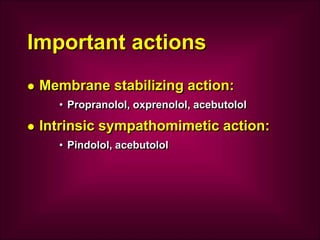
Important actions
 Membrane stabilizing action:
• Propranolol, oxprenolol, acebutolol
 Intrinsic sympathomimetic action:
• Pindolol, acebutolol
Significance of intrinsic
sympathomimetic action
 Less bradycardia & depression of
contractility
 Less likely withdrawl symptoms
 Lipid profile less worsened
 Not effective in migraine prophylaxis
 Not suitable for secondary prophylaxis
of MI
 Cardioselectivity:
 Metoprolol, acebutolol, atenolol,bisoprolol
 More potent Beta 1 blockade than beta2
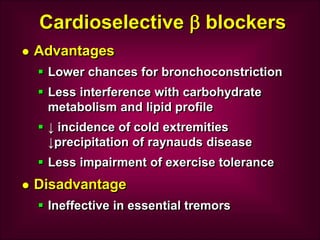
Cardioselective  blockers
 Advantages
 Lower chances for bronchoconstriction
 Less interference with carbohydrate
metabolism and lipid profile
 ↓ incidence of cold extremities
↓precipitation of raynauds disease
 Less impairment of exercise tolerance
 Disadvantage
 Ineffective in essential tremors
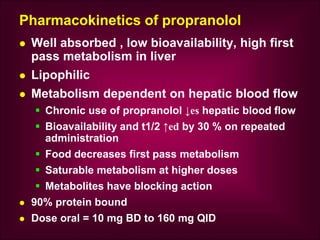
Pharmacokinetics of propranolol
 Well absorbed , low bioavailability, high first
pass metabolism in liver
 Lipophilic
 Metabolism dependent on hepatic blood flow
 Chronic use of propranolol ↓es hepatic blood flow
 Bioavailability and t1/2 ↑ed by 30 % on repeated
administration
 Food decreases first pass metabolism
 Saturable metabolism at higher doses
 Metabolites have blocking action
 90% protein bound
 Dose oral = 10 mg BD to 160 mg QID
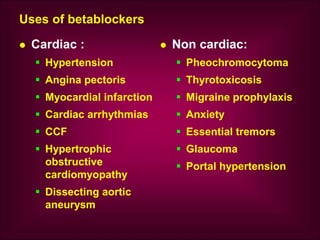
Uses of betablockers
 Cardiac :
 Hypertension
 Angina pectoris
 Myocardial infarction
 Cardiac arrhythmias
 CCF
 Hypertrophic
obstructive
cardiomyopathy
 Dissecting aortic
aneurysm
 Non cardiac:
 Pheochromocytoma
 Thyrotoxicosis
 Migraine prophylaxis
 Anxiety
 Essential tremors
 Glaucoma
 Portal hypertension
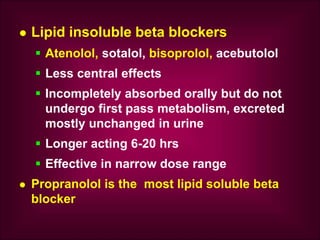
 Lipid insoluble beta blockers
 Atenolol, sotalol, bisoprolol, acebutolol
 Less central effects
 Incompletely absorbed orally but do not
undergo first pass metabolism, excreted
mostly unchanged in urine
 Longer acting 6-20 hrs
 Effective in narrow dose range
 Propranolol is the most lipid soluble beta
blocker
Adverse effects & contraindications
1. Can accenuate myocardial insufficiency &
precipitate CHF by blocking sympathetic
support to heart in CVS stress
2. Bradycardia
3. COPD, Bronchial asthma
4. Exacerbates variant, prinzmetal angina
5. Impairment of carbohydrate tolerance in
prediabetics
6. Increase TG & LDL/HDL ratio
7. Rebound hypertension, angina on withdrawl
Adverse effects & contraindication
8. Contraindicated in partial & complete heart
block – arrest may occur
9. Tiredness , decreased exercise capacity
10. Cold hands & feet – worsening of PVD due
to blockade of vasodilator Beta 2
11. Adverse events not due to beta blockade:
GIT upset, lack of drive, night mares, forgetfulness,
rarely hallucination , sexual distress
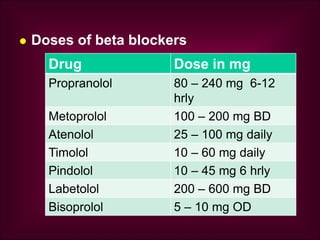
 Doses of beta blockers
Drug Dose in mg
Propranolol 80 – 240 mg 6-12
hrly
Metoprolol 100 – 200 mg BD
Atenolol 25 – 100 mg daily
Timolol 10 – 60 mg daily
Pindolol 10 – 45 mg 6 hrly
Labetolol 200 – 600 mg BD
Bisoprolol 5 – 10 mg OD
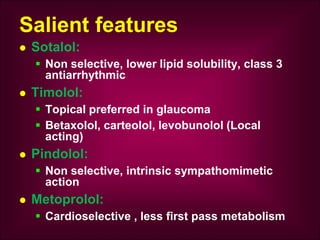
Salient features
 Sotalol:
 Non selective, lower lipid solubility, class 3
antiarrhythmic
 Timolol:
 Topical preferred in glaucoma
 Betaxolol, carteolol, levobunolol (Local
acting)
 Pindolol:
 Non selective, intrinsic sympathomimetic
action
 Metoprolol:
 Cardioselective , less first pass metabolism
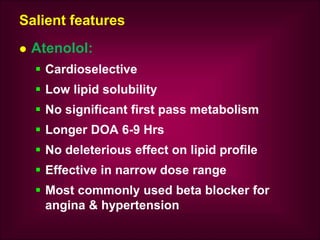
Salient features
 Atenolol:
 Cardioselective
 Low lipid solubility
 No significant first pass metabolism
 Longer DOA 6-9 Hrs
 No deleterious effect on lipid profile
 Effective in narrow dose range
 Most commonly used beta blocker for
angina & hypertension
Salient features
 Acebutolol:
 Cardioselective
 Partial agonist & membrane stabilising action
 Bisoprolol:
 OD administration in angina , hypertension, CHF
 Esmolol:
 Ultrashortacting
 Celiprolol, nebivolol:
 vasodilatory release nitric oxide
Uses of betablockers
 Cardiac :
 Hypertension
 Angina pectoris
 Myocardial infarction
 Cardiac arrhythmias
 CCF
 Hypertrophic
obstructive
cardiomyopathy
 Dissecting aortic
aneurysm
 Non cardiac:
 Pheochromocytoma
 Thyrotoxicosis
 Migraine prophylaxis
 Anxiety
 Essential tremors
 Glaucoma
 Portal hypertension
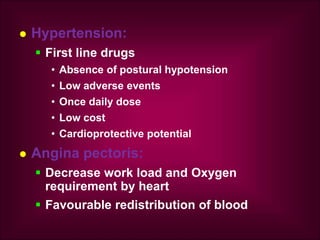
 Hypertension:
 First line drugs
• Absence of postural hypotension
• Low adverse events
• Once daily dose
• Low cost
• Cardioprotective potential
 Angina pectoris:
 Decrease work load and Oxygen
requirement by heart
 Favourable redistribution of blood
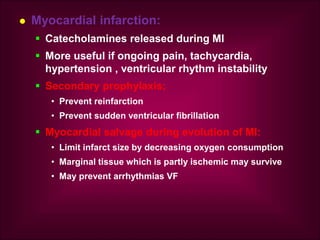
 Myocardial infarction:
 Catecholamines released during MI
 More useful if ongoing pain, tachycardia,
hypertension , ventricular rhythm instability
 Secondary prophylaxis;
• Prevent reinfarction
• Prevent sudden ventricular fibrillation
 Myocardial salvage during evolution of MI:
• Limit infarct size by decreasing oxygen consumption
• Marginal tissue which is partly ischemic may survive
• May prevent arrhythmias VF
 Cardiac arrhythmias
 Supress tachycardias & extrasystoles
mediated by adrenergic system
 Control ventricular rate in Atrial fibrillation &
flutter
 Esmolol alternative drug for paroxysmal
supraventricular tachycardia
 Dissecting aortic aneurysm:
 Decrease contractile force & aortic pulsation
 Hypertrophic obstructive cardiomyopathy
 Decrease LV outflow obstruction
 Congestive cardiac failure:
 Negative ionotropic effect? Worsen
ventricular function
 1970 waagstein & associates found improved
exercise tolerance & improvement in several
measures of ventricular function.
 Immediately after starting beta blockers
• Decrease in systolic function as reflected by
decrease in ejection fraction however continued
treatment over 2-4 months systolic function
gradually improves
 This is due to prevention of adverse
effects of NA on myocardium that are
mediated by beta adrenergic receptors
 Thyrotoxicosis:
 Migraine prophylaxis:
 Anxiety:
 Pheochromocytoma:
 Essential tremor:
 Glaucoma
 Portal hypertension:
Alpha + beta blocker
 Labetolol:
 5 times more potent for beta receptors
 Has weak beta 2 agonist action also
 Decrease blood pressure by 3 mechanisms
 Orally effective but extensive first pass
metabolism
 Uses: hypertension, pheochromocytoma,
clonidine withdrawl,
 Side effects: postural hypotension, failure of
ejaculation, other side effects of alpha & beta
blockers
 Carvedilol:
 1, β1, β2 blocker
 Vasodilation: alpha 1 + calcium channel
blockade
 Antioxidant property
 Use:
• Hypertension
• Cardioprotective in congestive heart failure
 Oral bioavailabilty – 30%
 T1/2 = 6-8 Hrs

Beta blockers

  • 1.
  • 2.
     Catecholamines producetheir action by direct combination with receptors located on cell membrane  Outcome of this drug receptor combination is either ↑ or ↓ in tissue activity  Ahlquist 1948  Alpha & beta receptors
  • 3.
    Classification of Betablockers  Non selective • Propranolol • Pindolol • Sotalol • Timolol  + β Blocker • Labetolol • Carvedilol  Cardio Selective (β1) • Atenolol • Acebutolol • Betaxolol • Bisoprolol • Esmolol • Metoprolol • Nebivolol
  • 4.
     Without intrinsicsympathomimetic action:  Propranolol  Timolol  Sotalol  With intrinsic sympathomimetic action:  Pindolol  Acebutolol  With membrane stabilizing action:  Propranolol, oxprenolol, acebutolol
  • 8.
    Propranolol Non selective betablocker also an inverse agonist
  • 9.
    Pharmacological actions  Effectsof  blockade  No marked effect on normal heart in subject at rest  In presence of ↑ sympathetic tone • ↓ automaticity and prevents rise in HR • ↓ Myocardial contractility, cardiac output and stroke work • Slows AV conduction • ↓ myocardial oxygen requirement & improves exercise tolerance
  • 10.
  • 11.
     Blood vessels: Reduce BP • ↓ COP • ↓ renin levels • ↓ central sympathetic outflow • ↓ NA release from sympathetic terminal  Respiratory tract:
  • 12.
     CNS:  Subtlebehavioral changes  Forgetfulness, nightmares , ↑ dreaming  Supresses anxiety in short term stressful situation  Local anaesthetic:
  • 13.
     Metabolic:  blockslipolysis & subsequent ↑ FFA  ↑ TG, ↑ LDL/HDL ratio  Inhibit glycogenolysis in heart, muscle, liver  No effect on normal BGL but ↓ carbohydrate tolerance by ↓ insulin release  Skeletal muscle:  Inhibit tremors  Decrease exercise capacity  Eye : ↓ secretion of aqueous humor  Uterus : relaxation of uterus in response to selective 2 agonistis blocked
  • 15.
  • 16.
     Heart  Respiratory CNS  Local anaesthetic  Metabolic  Skeletal muscle  Eye  Uterus
  • 17.
    Important actions  Membranestabilizing action: • Propranolol, oxprenolol, acebutolol  Intrinsic sympathomimetic action: • Pindolol, acebutolol
  • 18.
    Significance of intrinsic sympathomimeticaction  Less bradycardia & depression of contractility  Less likely withdrawl symptoms  Lipid profile less worsened  Not effective in migraine prophylaxis  Not suitable for secondary prophylaxis of MI
  • 22.
     Cardioselectivity:  Metoprolol,acebutolol, atenolol,bisoprolol  More potent Beta 1 blockade than beta2
  • 23.
    Cardioselective  blockers Advantages  Lower chances for bronchoconstriction  Less interference with carbohydrate metabolism and lipid profile  ↓ incidence of cold extremities ↓precipitation of raynauds disease  Less impairment of exercise tolerance  Disadvantage  Ineffective in essential tremors
  • 24.
    Pharmacokinetics of propranolol Well absorbed , low bioavailability, high first pass metabolism in liver  Lipophilic  Metabolism dependent on hepatic blood flow  Chronic use of propranolol ↓es hepatic blood flow  Bioavailability and t1/2 ↑ed by 30 % on repeated administration  Food decreases first pass metabolism  Saturable metabolism at higher doses  Metabolites have blocking action  90% protein bound  Dose oral = 10 mg BD to 160 mg QID
  • 25.
    Uses of betablockers Cardiac :  Hypertension  Angina pectoris  Myocardial infarction  Cardiac arrhythmias  CCF  Hypertrophic obstructive cardiomyopathy  Dissecting aortic aneurysm  Non cardiac:  Pheochromocytoma  Thyrotoxicosis  Migraine prophylaxis  Anxiety  Essential tremors  Glaucoma  Portal hypertension
  • 26.
     Lipid insolublebeta blockers  Atenolol, sotalol, bisoprolol, acebutolol  Less central effects  Incompletely absorbed orally but do not undergo first pass metabolism, excreted mostly unchanged in urine  Longer acting 6-20 hrs  Effective in narrow dose range  Propranolol is the most lipid soluble beta blocker
  • 27.
    Adverse effects &contraindications 1. Can accenuate myocardial insufficiency & precipitate CHF by blocking sympathetic support to heart in CVS stress 2. Bradycardia 3. COPD, Bronchial asthma 4. Exacerbates variant, prinzmetal angina 5. Impairment of carbohydrate tolerance in prediabetics 6. Increase TG & LDL/HDL ratio 7. Rebound hypertension, angina on withdrawl
  • 28.
    Adverse effects &contraindication 8. Contraindicated in partial & complete heart block – arrest may occur 9. Tiredness , decreased exercise capacity 10. Cold hands & feet – worsening of PVD due to blockade of vasodilator Beta 2 11. Adverse events not due to beta blockade: GIT upset, lack of drive, night mares, forgetfulness, rarely hallucination , sexual distress
  • 30.
     Doses ofbeta blockers Drug Dose in mg Propranolol 80 – 240 mg 6-12 hrly Metoprolol 100 – 200 mg BD Atenolol 25 – 100 mg daily Timolol 10 – 60 mg daily Pindolol 10 – 45 mg 6 hrly Labetolol 200 – 600 mg BD Bisoprolol 5 – 10 mg OD
  • 31.
    Salient features  Sotalol: Non selective, lower lipid solubility, class 3 antiarrhythmic  Timolol:  Topical preferred in glaucoma  Betaxolol, carteolol, levobunolol (Local acting)  Pindolol:  Non selective, intrinsic sympathomimetic action  Metoprolol:  Cardioselective , less first pass metabolism
  • 32.
    Salient features  Atenolol: Cardioselective  Low lipid solubility  No significant first pass metabolism  Longer DOA 6-9 Hrs  No deleterious effect on lipid profile  Effective in narrow dose range  Most commonly used beta blocker for angina & hypertension
  • 33.
    Salient features  Acebutolol: Cardioselective  Partial agonist & membrane stabilising action  Bisoprolol:  OD administration in angina , hypertension, CHF  Esmolol:  Ultrashortacting  Celiprolol, nebivolol:  vasodilatory release nitric oxide
  • 34.
    Uses of betablockers Cardiac :  Hypertension  Angina pectoris  Myocardial infarction  Cardiac arrhythmias  CCF  Hypertrophic obstructive cardiomyopathy  Dissecting aortic aneurysm  Non cardiac:  Pheochromocytoma  Thyrotoxicosis  Migraine prophylaxis  Anxiety  Essential tremors  Glaucoma  Portal hypertension
  • 35.
     Hypertension:  Firstline drugs • Absence of postural hypotension • Low adverse events • Once daily dose • Low cost • Cardioprotective potential  Angina pectoris:  Decrease work load and Oxygen requirement by heart  Favourable redistribution of blood
  • 36.
     Myocardial infarction: Catecholamines released during MI  More useful if ongoing pain, tachycardia, hypertension , ventricular rhythm instability  Secondary prophylaxis; • Prevent reinfarction • Prevent sudden ventricular fibrillation  Myocardial salvage during evolution of MI: • Limit infarct size by decreasing oxygen consumption • Marginal tissue which is partly ischemic may survive • May prevent arrhythmias VF
  • 37.
     Cardiac arrhythmias Supress tachycardias & extrasystoles mediated by adrenergic system  Control ventricular rate in Atrial fibrillation & flutter  Esmolol alternative drug for paroxysmal supraventricular tachycardia  Dissecting aortic aneurysm:  Decrease contractile force & aortic pulsation  Hypertrophic obstructive cardiomyopathy  Decrease LV outflow obstruction
  • 38.
     Congestive cardiacfailure:  Negative ionotropic effect? Worsen ventricular function  1970 waagstein & associates found improved exercise tolerance & improvement in several measures of ventricular function.  Immediately after starting beta blockers • Decrease in systolic function as reflected by decrease in ejection fraction however continued treatment over 2-4 months systolic function gradually improves  This is due to prevention of adverse effects of NA on myocardium that are mediated by beta adrenergic receptors
  • 39.
     Thyrotoxicosis:  Migraineprophylaxis:  Anxiety:  Pheochromocytoma:  Essential tremor:  Glaucoma  Portal hypertension:
  • 40.
    Alpha + betablocker  Labetolol:  5 times more potent for beta receptors  Has weak beta 2 agonist action also  Decrease blood pressure by 3 mechanisms  Orally effective but extensive first pass metabolism  Uses: hypertension, pheochromocytoma, clonidine withdrawl,  Side effects: postural hypotension, failure of ejaculation, other side effects of alpha & beta blockers
  • 41.
     Carvedilol:  1,β1, β2 blocker  Vasodilation: alpha 1 + calcium channel blockade  Antioxidant property  Use: • Hypertension • Cardioprotective in congestive heart failure  Oral bioavailabilty – 30%  T1/2 = 6-8 Hrs

Editor's Notes

  • #5 NON equilibrium type: phenoxybenzamine Equilibrium type (competitive) Non selective- ergotamine, ergotoxine, dihydroergotamine and dihydroergotoxine , tolazoline, phentolamine Alpha1 selective: prazosin, terazosin, doxazosin, Tamsulosin Alpha2 selective- Yohimbine Uses of alpha blockers: pheochromocytoma hypertension benign hypertrophy of prostrate secondary shock peripheral vascular disease congestive cardiac failure papaverine / phentolamine induced penile erection therapy for impotence
  • #6 Powell & slater - Dichloro-isoproterenol 1958 first beta blocker having agonistic action Pronethalol first pure beta blocker but caused thymic tumors in mice by sir james black Propranolol has equal affinity for beta1 and beta2 receptors it is a pure antagonist
  • #8 Local anaesthetics like procaine prevent the increase in permeability of cell membrane to sodium ion which is the first event in depolarization (sodium channel block) thus an action potential is not generated. This action affecting the process of depolarization leading to failure of propogation of impulse without affecting resting potential is known as membrane stabilizing effect.
  • #13 Cardiac response to exercise and to other situations in which sympathetic activity is increased is attenuated Total coronary blood flow is decreased which is largely restricted to subepicardial region , while subendocardial area which is site for ishemia in angina patients is not affected over all effect in angina is
  • #15 Some beta blockers have additional actional through NO production (celiprolol, carteolol), calcium channel blocking- carvedilol , potassium channel opening tilisolol Increase the bronchial muscle tone in asthamatics in normal persons no effect because sympathetic bronchodilator tone is minimal. In asthamatics condition is consistently worsened and severe attack may be precipitated
  • #16 No overt central effects are produced Propranolol is a potent local anaesthetic agent but cannot be used because of its irritant activity
  • #17 Inhibits adrenergically mediated tremor Decrease exercise capacity by attenuating the blood supply to muscles and by limiting glycogenolysis and lipolysis, which provide fuel to working muscles. No consistent effect on pupillary size or accomodation
  • #28 Oral : parenteral dose ratio 40:1 Metabolite of propranolol hydroxypropranolol makes frequency of administration BD possible
  • #30 Plasma half life of drugs mostly metabolized by liver is short 2-3 Hrs whereas drugs excreted unchanged by kidneys have long 8 to 12 hrs half life The plasma half life does not corelate well with duration of therapeutic effects of beta blockers which is relatively long lasting. This is because plasma levels decline exponentially following forst order kinetics while effect decreases linearly following zero order kinetics. Hence ,ost peparations can be given orally at much longer intervals than suggested by their plasma half lives
  • #32 Chlorpromazine increased bioavailability by retarding metabolism