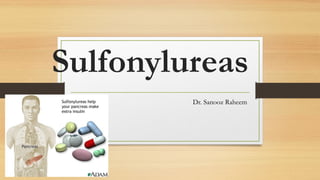
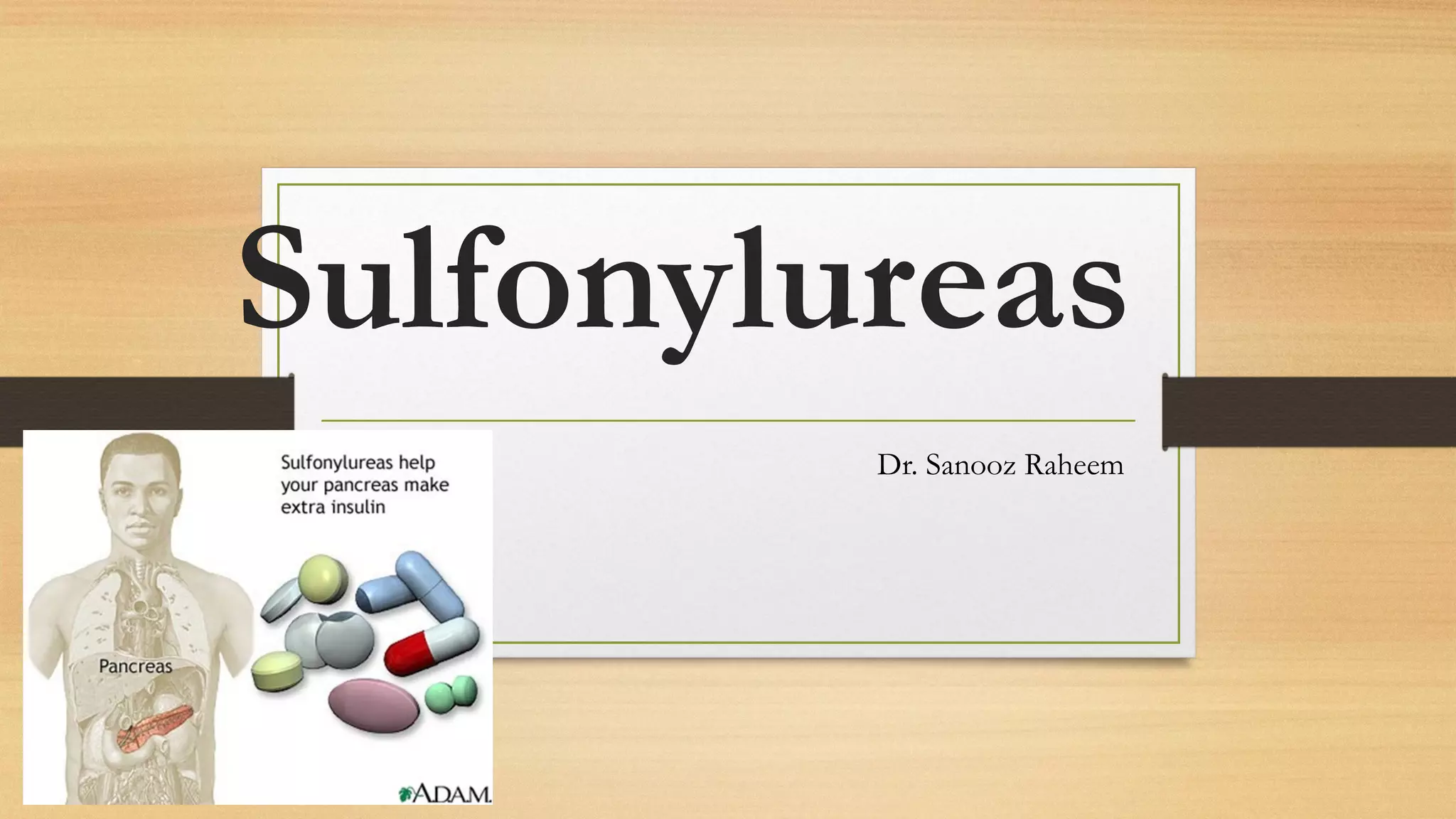
Sulfonylureas
Dr. Sanooz Raheem
Objectives:
•List examples, mechanism of action,
adverse effects and clinical uses of
sulfonyl ureas
Introduction
• Oral drugs used for type2 DM
• Energy restriction + carbohydrate restriction + physical activity
• Insulin added if not controlled with oral therapy
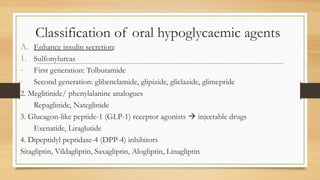
Classification of oral hypoglycaemic agents
A. Enhance insulin secretion:
1. Sulfonylureas
- First generation: Tolbutamide
- Second generation: glibenclamide, glipizide, gliclazide, glimepride
2. Meglitinide/ phenylalanine analogues
Repaglinide, Nateglinide
3. Glucagon-like peptide-1 (GLP-1) receptor agonists  injectable drugs
Exenatide, Liraglutide
4. Dipeptidyl peptidase-4 (DPP-4) inhibitors
Sitagliptin, Vildagliptin, Saxagliptin, Alogliptin, Linagliptin
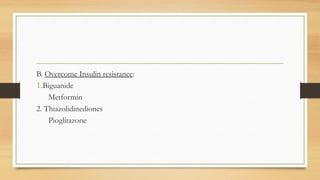
B. Overcome Insulin resistance:
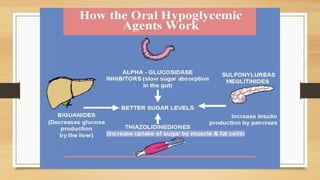
1.Biguanide
Metformin
2. Thiazolidinediones
Pioglitazone
C. Miscellaneous antidiabetic drugs:
1.alpha-Glucosidase inhibitors
Acarbose, Miglitol, Voglibose
2. Amylin analogue
Pramlintide
3. Dopamine-D2 receptor agonist
Bromocriptin
4. Sodium-glucose cotransport-2 (SGLT-2) inhibitor
Dapagliflozin
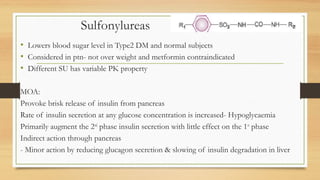
Sulfonylureas
• Lowers blood sugar level in Type2 DM and normal subjects
• Considered in ptn- not over weight and metformin contraindicated
• Different SU has variable PK property
MOA:
Provoke brisk release of insulin from pancreas
Rate of insulin secretion at any glucose concentration is increased- Hypoglycaemia
Primarily augment the 2nd
phase insulin secretion with little effect on the 1st
phase
Indirect action through pancreas
- Minor action by reducing glucagon secretion & slowing of insulin degradation in liver
Extrapancreatic action:
Insulinaemic action of SU declines by few months
-Due to down regulation of sulfonylurea receptors on beta cells
-But improvement in the glucose tolerance maintained
SU sensitize the target tissue to Insulin
- Due to increases insulin receptor or post receptor action
MOA at pancreas
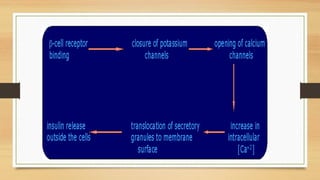
• SU block the SU receptor
• ATP sensitive K+ channel is blocked in the pancreatic beta cells
• Inward movement of potassium restricted
• Intracellular potassium falls and membrane partially depolarized
• Opening of calcium channel augmented
• Release of calcium from intracellular stores
• Calcium ion promotes fusion of insulin containing intracellular granules with plasma
membrane and exocytosis
Pharmacokinetic properties
• All SU well absorbed orally
• 90% or more bound to plasma protein
• Low volume of distribution
• Primarily metabolized – active metabolite
• Active/ inactive metabolites excreted in urine
• Caution in kidney or liver disease
Interactions
Drugs enhance SU action:
-Displace from protein binding:-
Ex: phenylbutazone, sulfinpyrazone, salicylates, sulfonamides
-Inhibit metabolism/excretion:-
Ex: cimetidine, ketoconazole, sulfonamides, warfarin, chloramphenicol, acute alcohol
intake
-Synergize with/ prolong pharmacodynamics action:-
Ex: salicylates, propranolol, sympatholytic antihypertensives, lithium, theophylline,
alcohol
Drugs that decrease SU action:
-Induce metabolism: phenobarbitone, phenytoin, rifampicin, chronic
alcoholism
-Opposite actions/ suppress insulin release: corticosteroids, thiazides,
furosemide, OCP
Adverse effects
- Hypoglycaemia :
commonest problem
may last for several hours
may be severe and fatal
common in elderly, liver and renal disease / potentiating drugs added
Tolbutamide- lower risk ( low potency and shorter duration of action)
- Nonspecific side effects:
weight gain
nausea, vomiting, flatulence, diarrhea/constipation, headache, paresthesia
- Hypersensitivity:
rashes, photosensitivity, purpura, transient leukopenia, raraely
agranulocytosis
flushing and disulfiram like reaction with alcohol
- Occasionally disturb liver function  jaundice, hepatitis, hepatic failure
Chlorpropamide :-
1st
SU
Discontinued due to long duration of action and hypoglycaemia
Also causes dilutional hyponatraemia, cholestatic jaundice
Individual SU
Glibenclamide :
T1/2: 2-4 hours
Duration of action: 24 hours
Potent but slow acting
Active metabolite and sequestration in beta cells
Dose – initially 5mg daily
adjust dose according to response
max 15mg/day
Gliclazide :
T ½ : 8-20 hours
Duration of action: 12-24 hours
Inactive metabolites
Has antiplatelet action
initially 40-80 mg/day
adjust according to dose
upto 160mg as single dose
max 320mg/day
Glimepiride:
T ½ : 5-7 hours
Duration of action: 24 hours
Long acting
Inactive metabolites
Extrapancreatic action
Lower incidence of hypoglycaemia
initially 1mg/day
adjust 1mg each step 1-2 wk intervals
max dose 6mg/day
taken with meal/short before
Glipizide:
T ½ : 3-5 hours
Duration of action – 12 hours
Fast and shorter acting
Hypoglycaemia and weight gain less likely
Preferred in elderly
initially 2.5-5mg short before breakfast/ lunch
adjust with response
max 20mg/day
upto 15mg as single dose
Tolbutamide:
t1/2- 6 hours
duration of action : 6-8 hours
0.5-1.5g daily in divided dose with/ immediately after meals /
as single dose with/ immediately after breakfast
max 2g
safer in elderly
Choosing a sulfonylurea
• Side effects
• Duration of action
• Patient’s age
• Renal function
- Glibenclamide a longer acting one and should be avoided in elderly
- Shorter acting gliclazide and tolbutamide are alternatives
Special situations
• Advice on hypoglycaemia when another glucose lowering drug is prescribed
• Replace with insulin during acute illness
• Omit on the morning of surgery and replace with insulin
Caution :
Caution in elderly
Contra-indications:
Avoid in acute porphyria
Contra-indicated in DKA
Hepatic impairment:
Reduce dose/ avoid risk of hypoglycaemia and jaundice
Renal impairment:
use with care in mild to moderate RF hypoglycaemia
Avoid in severe RF
If necessary shorter acting tolbutamide can be used with close monitoring in lower dose
Pregnancy and breast-feeding:
Should be avoided generally risk of hypoglycaemia
In GDM- SU can be resumed in 2nd
and 3rd
trimester
Generally avoided in breast-feeding risk of hypoglycaemia (glibenclamide
unlicensed usage in breast-feeding)
Meglitinide / D-phenylalanine analogues
Quick and short lasting insulinaemic action
Repaglinide:
Normalize meal time glucose extrusions
Quickly absorbed and quickly metabolized
Fast onset short lasting insulin release
Administered before major meal control postprandial hyperglycaemia
Omit if meals missed
SE: mild headache, dyspepsia, arthralgia, weight gain
Indication: type 2 DM with pronounced postprandial hyperglycaemia / supplement
metformin/long-acting insulin
Nateglinide:
Stimulates 1st
phase insulin secretion
Faster and shorter acting than previous
Taken 10min before meal
No late phase hypoglycaemia
Little effect on FBS
SE: dizzy, nausea, flu like symptoms, joint pain
Use: type2DM with other antidiabetics to control postprandial blood glucose
Glucagon-like peptide-1 receptor agonists
• GLP-1 incretin released from gut in response to ingested glucose
- Induce insulin release, inhibit glucagon release, slow gastric emptying, suppress appetite
- Promote beta cell health aswell
- Tx preserve the beta cell function
- Natural GLP-1 not stable and not clinically used
- Synthetic analogues available
- Given SC injections
Ex: Exenatide ( T ½ ~ 3hrs, inactive orally, add on drug with metformin, SU,pioglit..,
lowers PPBS, FBS, body weight)
Liraglutide (longer acting than above)
Dipeptidyl peptidase-4 (DPP-4) inhibitors
• DPP-4 responsible for degradation of GLP-1
• Orally active inhibitors of DDP-4
• Indirectly acting insulin secretagogues
• Important adjunct drug in type 2 DM
Ex: Sitagliptin, Vildagliptin, Saxagliptin
Sitagliptin
• Competitive and selective DPP-4 inhibitor
• Boost post prandial insulin release, reduce glucagon secretion and lowers meal time blood
sugar and FBS
• No effect on gastric emptying and appetite
• Low risk of hypoglycaemia if given alone
• Recommended as monotherapy when metformin cannot be used
• Commonly used as adjunct drug
• Pk: well absorbed orally, little metabolized, excreted unchanged mainly in urine, T ½ - 12
hours
Vildagliptin
• Binds to the enzyme covalently
• Slow dissociation and persistent DPP-4 inhibition
• Longer duration of action (12-24 hours)
• T ½ : 2-4 hours
• Mainly eliminated by liver
• 20- 25 % excreted unchanged in urine
• Hepatotoxicity has been reported
THANK YOU

Sulfonylureas

  • 1.
  • 2.
    Objectives: •List examples, mechanismof action, adverse effects and clinical uses of sulfonyl ureas
  • 3.
    Introduction • Oral drugsused for type2 DM • Energy restriction + carbohydrate restriction + physical activity • Insulin added if not controlled with oral therapy
  • 4.
    Classification of oralhypoglycaemic agents A. Enhance insulin secretion: 1. Sulfonylureas - First generation: Tolbutamide - Second generation: glibenclamide, glipizide, gliclazide, glimepride 2. Meglitinide/ phenylalanine analogues Repaglinide, Nateglinide 3. Glucagon-like peptide-1 (GLP-1) receptor agonists  injectable drugs Exenatide, Liraglutide 4. Dipeptidyl peptidase-4 (DPP-4) inhibitors Sitagliptin, Vildagliptin, Saxagliptin, Alogliptin, Linagliptin
  • 5.
    B. Overcome Insulinresistance: 1.Biguanide Metformin 2. Thiazolidinediones Pioglitazone
  • 6.
    C. Miscellaneous antidiabeticdrugs: 1.alpha-Glucosidase inhibitors Acarbose, Miglitol, Voglibose 2. Amylin analogue Pramlintide 3. Dopamine-D2 receptor agonist Bromocriptin 4. Sodium-glucose cotransport-2 (SGLT-2) inhibitor Dapagliflozin
  • 8.
    Sulfonylureas • Lowers bloodsugar level in Type2 DM and normal subjects • Considered in ptn- not over weight and metformin contraindicated • Different SU has variable PK property MOA: Provoke brisk release of insulin from pancreas Rate of insulin secretion at any glucose concentration is increased- Hypoglycaemia Primarily augment the 2nd phase insulin secretion with little effect on the 1st phase Indirect action through pancreas - Minor action by reducing glucagon secretion & slowing of insulin degradation in liver
  • 9.
    Extrapancreatic action: Insulinaemic actionof SU declines by few months -Due to down regulation of sulfonylurea receptors on beta cells -But improvement in the glucose tolerance maintained SU sensitize the target tissue to Insulin - Due to increases insulin receptor or post receptor action
  • 10.
    MOA at pancreas •SU block the SU receptor • ATP sensitive K+ channel is blocked in the pancreatic beta cells • Inward movement of potassium restricted • Intracellular potassium falls and membrane partially depolarized • Opening of calcium channel augmented • Release of calcium from intracellular stores • Calcium ion promotes fusion of insulin containing intracellular granules with plasma membrane and exocytosis
  • 12.
    Pharmacokinetic properties • AllSU well absorbed orally • 90% or more bound to plasma protein • Low volume of distribution • Primarily metabolized – active metabolite • Active/ inactive metabolites excreted in urine • Caution in kidney or liver disease
  • 13.
    Interactions Drugs enhance SUaction: -Displace from protein binding:- Ex: phenylbutazone, sulfinpyrazone, salicylates, sulfonamides -Inhibit metabolism/excretion:- Ex: cimetidine, ketoconazole, sulfonamides, warfarin, chloramphenicol, acute alcohol intake -Synergize with/ prolong pharmacodynamics action:- Ex: salicylates, propranolol, sympatholytic antihypertensives, lithium, theophylline, alcohol
  • 14.
    Drugs that decreaseSU action: -Induce metabolism: phenobarbitone, phenytoin, rifampicin, chronic alcoholism -Opposite actions/ suppress insulin release: corticosteroids, thiazides, furosemide, OCP
  • 15.
    Adverse effects - Hypoglycaemia: commonest problem may last for several hours may be severe and fatal common in elderly, liver and renal disease / potentiating drugs added Tolbutamide- lower risk ( low potency and shorter duration of action) - Nonspecific side effects: weight gain nausea, vomiting, flatulence, diarrhea/constipation, headache, paresthesia
  • 16.
    - Hypersensitivity: rashes, photosensitivity,purpura, transient leukopenia, raraely agranulocytosis flushing and disulfiram like reaction with alcohol - Occasionally disturb liver function  jaundice, hepatitis, hepatic failure
  • 17.
    Chlorpropamide :- 1st SU Discontinued dueto long duration of action and hypoglycaemia Also causes dilutional hyponatraemia, cholestatic jaundice
  • 18.
    Individual SU Glibenclamide : T1/2:2-4 hours Duration of action: 24 hours Potent but slow acting Active metabolite and sequestration in beta cells Dose – initially 5mg daily adjust dose according to response max 15mg/day
  • 19.
    Gliclazide : T ½: 8-20 hours Duration of action: 12-24 hours Inactive metabolites Has antiplatelet action initially 40-80 mg/day adjust according to dose upto 160mg as single dose max 320mg/day
  • 20.
    Glimepiride: T ½ :5-7 hours Duration of action: 24 hours Long acting Inactive metabolites Extrapancreatic action Lower incidence of hypoglycaemia initially 1mg/day adjust 1mg each step 1-2 wk intervals max dose 6mg/day taken with meal/short before
  • 21.
    Glipizide: T ½ :3-5 hours Duration of action – 12 hours Fast and shorter acting Hypoglycaemia and weight gain less likely Preferred in elderly initially 2.5-5mg short before breakfast/ lunch adjust with response max 20mg/day upto 15mg as single dose
  • 22.
    Tolbutamide: t1/2- 6 hours durationof action : 6-8 hours 0.5-1.5g daily in divided dose with/ immediately after meals / as single dose with/ immediately after breakfast max 2g safer in elderly
  • 23.
    Choosing a sulfonylurea •Side effects • Duration of action • Patient’s age • Renal function - Glibenclamide a longer acting one and should be avoided in elderly - Shorter acting gliclazide and tolbutamide are alternatives
  • 24.
    Special situations • Adviceon hypoglycaemia when another glucose lowering drug is prescribed • Replace with insulin during acute illness • Omit on the morning of surgery and replace with insulin
  • 25.
    Caution : Caution inelderly Contra-indications: Avoid in acute porphyria Contra-indicated in DKA Hepatic impairment: Reduce dose/ avoid risk of hypoglycaemia and jaundice Renal impairment: use with care in mild to moderate RF hypoglycaemia Avoid in severe RF If necessary shorter acting tolbutamide can be used with close monitoring in lower dose
  • 26.
    Pregnancy and breast-feeding: Shouldbe avoided generally risk of hypoglycaemia In GDM- SU can be resumed in 2nd and 3rd trimester Generally avoided in breast-feeding risk of hypoglycaemia (glibenclamide unlicensed usage in breast-feeding)
  • 27.
    Meglitinide / D-phenylalanineanalogues Quick and short lasting insulinaemic action Repaglinide: Normalize meal time glucose extrusions Quickly absorbed and quickly metabolized Fast onset short lasting insulin release Administered before major meal control postprandial hyperglycaemia Omit if meals missed SE: mild headache, dyspepsia, arthralgia, weight gain Indication: type 2 DM with pronounced postprandial hyperglycaemia / supplement metformin/long-acting insulin
  • 28.
    Nateglinide: Stimulates 1st phase insulinsecretion Faster and shorter acting than previous Taken 10min before meal No late phase hypoglycaemia Little effect on FBS SE: dizzy, nausea, flu like symptoms, joint pain Use: type2DM with other antidiabetics to control postprandial blood glucose
  • 29.
    Glucagon-like peptide-1 receptoragonists • GLP-1 incretin released from gut in response to ingested glucose - Induce insulin release, inhibit glucagon release, slow gastric emptying, suppress appetite - Promote beta cell health aswell - Tx preserve the beta cell function - Natural GLP-1 not stable and not clinically used - Synthetic analogues available - Given SC injections Ex: Exenatide ( T ½ ~ 3hrs, inactive orally, add on drug with metformin, SU,pioglit.., lowers PPBS, FBS, body weight) Liraglutide (longer acting than above)
  • 30.
    Dipeptidyl peptidase-4 (DPP-4)inhibitors • DPP-4 responsible for degradation of GLP-1 • Orally active inhibitors of DDP-4 • Indirectly acting insulin secretagogues • Important adjunct drug in type 2 DM Ex: Sitagliptin, Vildagliptin, Saxagliptin
  • 31.
    Sitagliptin • Competitive andselective DPP-4 inhibitor • Boost post prandial insulin release, reduce glucagon secretion and lowers meal time blood sugar and FBS • No effect on gastric emptying and appetite • Low risk of hypoglycaemia if given alone • Recommended as monotherapy when metformin cannot be used • Commonly used as adjunct drug • Pk: well absorbed orally, little metabolized, excreted unchanged mainly in urine, T ½ - 12 hours
  • 32.
    Vildagliptin • Binds tothe enzyme covalently • Slow dissociation and persistent DPP-4 inhibition • Longer duration of action (12-24 hours) • T ½ : 2-4 hours • Mainly eliminated by liver • 20- 25 % excreted unchanged in urine • Hepatotoxicity has been reported
  • 33.