Extraction from natural system
   Required large quantities
      80 μg of, the pure and biologically-active human hormone
      secretin, would require 3000 kg of bovine intestine.

   Difficult to meet the demand
       The quantity of purified insulin obtained from one pig
       satisfies the requirements of one diabetic person for three day
   Contamination
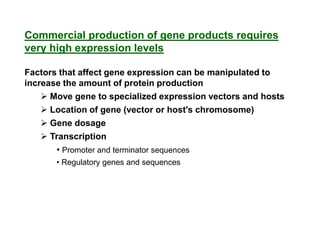
Commercial production of gene products requires
very high expression levels

Factors that affect gene expression can be manipulated to
increase the amount of protein production
     Move gene to specialized expression vectors and hosts
     Location of gene (vector or host's chromosome)
     Gene dosage
     Transcription
       • Promoter and terminator sequences
       • Regulatory genes and sequences
 Translation
   • Ribosome binding site (Shine-Delgarno sequence)
   • Codon optimization to match host's codon bias
 Final location of gene product
   • Cytoplasmic or extracellular (secreted out of cell)
 Protein stability
   • Degradation by host proteases (fusion protein)
   • Formation of insoluble aggregates
Transcription
Promoters and enhancers are two major regulatory regions
that controlled the transcription.
Promoter contains specific DNA sequences that act as
‘molecular switches’ to turn on transcription, in the upstream
direction of the genes.
Eukaryotic genes have enhancers in addition to promoters.
Enhancers enhances transcription and are functional in any
orientation.
Types of promoter to regulate gene expression
Constitutive promoters
   Direct expression in virtually all tissues and are largely, if not
   entirely, independent of environmental factors.

Tissue-specific promoters
   Direct expression of a gene in specific tissue or at certain
   stages of development.
Chemical-inducible promoters
   Their performance can be controlled artificially
Synthetic promoters
   Made of the primary elements of a promoter region
The most commonly used promoters in E. coli
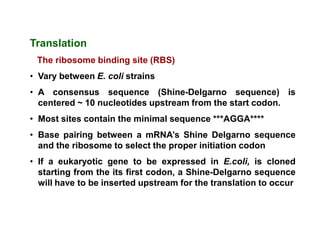
Translation
 The ribosome binding site (RBS)
• Vary between E. coli strains
• A consensus sequence (Shine-Delgarno sequence) is
  centered ~ 10 nucleotides upstream from the start codon.
• Most sites contain the minimal sequence ***AGGA****
• Base pairing between a mRNA’s Shine Delgarno sequence
  and the ribosome to select the proper initiation codon
• If a eukaryotic gene to be expressed in E.coli, is cloned
  starting from the its first codon, a Shine-Delgarno sequence
  will have to be inserted upstream for the translation to occur
Codon Optimization
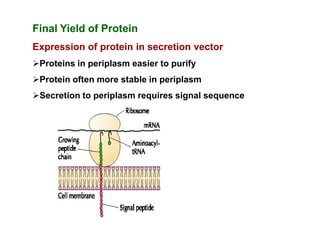
Final Yield of Protein
Expression of protein in secretion vector
Proteins in periplasm easier to purify
Protein often more stable in periplasm
Secretion to periplasm requires signal sequence
Protein stability: Fusion Proteins


              Recover from
  DNA         culture medium
              and purify
  peptide
                        protein of interest

mRNA         Maltose-binding protein
Fusion Proteins
Poor expression ?
Presence of introns in eukaryotes : has been solved by using cDNA
prepared from mRNA
Degradation of foreign proteins: prevented by using protease
deficient strain or by fusion protein technique.
Incorrect folding:
leading to insoluble protein aggregates (inclusion bodies).
Fusing to E. coli protein thioredoxin can increase solubility up to 40%
of total cellular protein
Insoluble proteins are not a curse
                The blessings of inclusion bodies

• Easy to segregate proteins in inclusion bodies by centrifugation.
• Inclusion bodies protect protein from proteases.
• Toxic proteins won’t kill the host cells before enough is
  expressed to be useful.

                      On the other hand
• Protein must be dissolved out of the inclusion bodies to be
  purified.
• Inclusion body proteins are usually not folded completely;
  finishing the job can be a challenge.
• Refolding is seldom complete and the portion of the protein
  which is active may be very low at best.
Problems with E. coli

 Endotoxins contamination
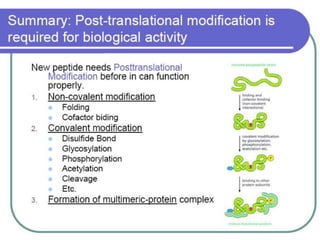
 Not able to do post-translational modifications like


Glycosylation
                                         Required for,
Fatty acid acylation                     Proper folding of the
                                         secondary, tertiary and
Phosphorylation and
                                         quaternary structures of
Disulfide-bond formation                 interested proteins


                These modifications can affect the
bioactivity, function, structure, solubility, stability, half-life,
protease resistance, and compartmentalization of the
functional proteins.
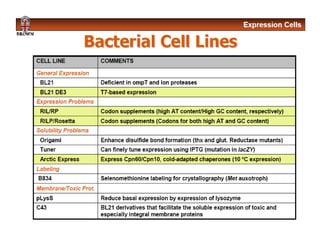
Expression systems
Expression systems
Expression systems
Expression systems
Expression systems
Expression systems
Expression systems

Expression systems

  • 3.
    Extraction from naturalsystem Required large quantities 80 μg of, the pure and biologically-active human hormone secretin, would require 3000 kg of bovine intestine. Difficult to meet the demand The quantity of purified insulin obtained from one pig satisfies the requirements of one diabetic person for three day Contamination
  • 12.
    Commercial production ofgene products requires very high expression levels Factors that affect gene expression can be manipulated to increase the amount of protein production  Move gene to specialized expression vectors and hosts  Location of gene (vector or host's chromosome)  Gene dosage  Transcription • Promoter and terminator sequences • Regulatory genes and sequences
  • 13.
     Translation • Ribosome binding site (Shine-Delgarno sequence) • Codon optimization to match host's codon bias  Final location of gene product • Cytoplasmic or extracellular (secreted out of cell)  Protein stability • Degradation by host proteases (fusion protein) • Formation of insoluble aggregates
  • 14.
    Transcription Promoters and enhancersare two major regulatory regions that controlled the transcription. Promoter contains specific DNA sequences that act as ‘molecular switches’ to turn on transcription, in the upstream direction of the genes. Eukaryotic genes have enhancers in addition to promoters. Enhancers enhances transcription and are functional in any orientation.
  • 15.
    Types of promoterto regulate gene expression Constitutive promoters Direct expression in virtually all tissues and are largely, if not entirely, independent of environmental factors. Tissue-specific promoters Direct expression of a gene in specific tissue or at certain stages of development. Chemical-inducible promoters Their performance can be controlled artificially Synthetic promoters Made of the primary elements of a promoter region
  • 16.
    The most commonlyused promoters in E. coli
  • 17.
    Translation The ribosomebinding site (RBS) • Vary between E. coli strains • A consensus sequence (Shine-Delgarno sequence) is centered ~ 10 nucleotides upstream from the start codon. • Most sites contain the minimal sequence ***AGGA**** • Base pairing between a mRNA’s Shine Delgarno sequence and the ribosome to select the proper initiation codon • If a eukaryotic gene to be expressed in E.coli, is cloned starting from the its first codon, a Shine-Delgarno sequence will have to be inserted upstream for the translation to occur
  • 18.
  • 20.
    Final Yield ofProtein Expression of protein in secretion vector Proteins in periplasm easier to purify Protein often more stable in periplasm Secretion to periplasm requires signal sequence
  • 21.
    Protein stability: FusionProteins Recover from DNA culture medium and purify peptide protein of interest mRNA Maltose-binding protein
  • 22.
  • 24.
    Poor expression ? Presenceof introns in eukaryotes : has been solved by using cDNA prepared from mRNA Degradation of foreign proteins: prevented by using protease deficient strain or by fusion protein technique. Incorrect folding: leading to insoluble protein aggregates (inclusion bodies). Fusing to E. coli protein thioredoxin can increase solubility up to 40% of total cellular protein
  • 25.
    Insoluble proteins arenot a curse The blessings of inclusion bodies • Easy to segregate proteins in inclusion bodies by centrifugation. • Inclusion bodies protect protein from proteases. • Toxic proteins won’t kill the host cells before enough is expressed to be useful. On the other hand • Protein must be dissolved out of the inclusion bodies to be purified. • Inclusion body proteins are usually not folded completely; finishing the job can be a challenge. • Refolding is seldom complete and the portion of the protein which is active may be very low at best.
  • 26.
    Problems with E.coli Endotoxins contamination Not able to do post-translational modifications like Glycosylation Required for, Fatty acid acylation Proper folding of the secondary, tertiary and Phosphorylation and quaternary structures of Disulfide-bond formation interested proteins These modifications can affect the bioactivity, function, structure, solubility, stability, half-life, protease resistance, and compartmentalization of the functional proteins.