Optimization Using
Evolutionary Computing
Techniques
Prof. (Dr.) Pravat Kumar Rout
Department of EEE, ITER
Siksha ‘O’ Anusandhan (Deemed to be
University),
Bhubaneswar, Odisha, India
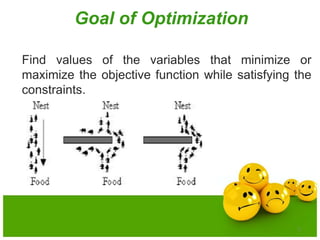
Goal of Optimization
Find values of the variables that minimize or
maximize the objective function while satisfying the
constraints.
2
?
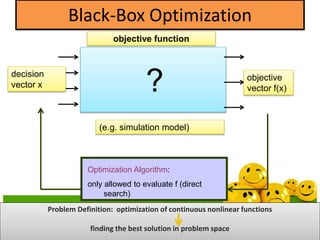
Black-Box Optimization
Optimization Algorithm:
only allowed to evaluate f (direct
search)
decision
vector x
objective
vector f(x)
objective function
(e.g. simulation model)
Problem Definition: optimization of continuous nonlinear functions
finding the best solution in problem space
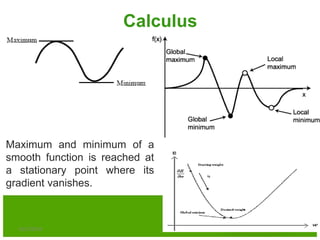
Calculus
Maximum and minimum of a
smooth function is reached at
a stationary point where its
gradient vanishes.
6/21/2013 4
6/21/2013 5
Why Evolutionary Computation
Exact Mathematical Expression (Not being applicable to
certain class of objective functions in case of classical
techniques)
 Derivative Free
Global Optimization(Not trapped at local minima in case
of classical technique)
Less Computational Complexity
Other class of Heuristics
Inspired By Nature
 Evolutionary Algorithms (EA)
– All methods inspired by the evolution
 Swarm Intelligence (SI)
– All methods inspired by collective intelligence
 Geographical Nature Algorithm (GNA)
– All methods inspired by geographical structure of the
environment/ earth
66/21/2013
6/21/2013 7
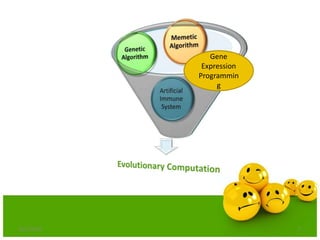
Gene
Expression
Programmin
g
6/21/2013 8
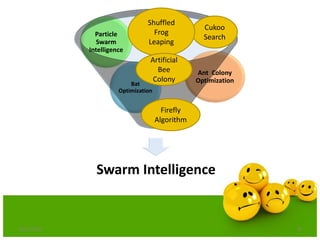
Swarm Intelligence
Bat
Optimization
Particle
Swarm
Intelligence
Ant Colony
Optimization
Firefly
Algorithm
Cukoo
Search
Shuffled
Frog
Leaping
Artificial
Bee
Colony
6/21/2013 9
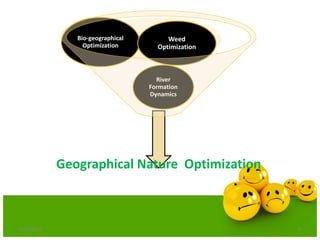
Geographical Nature Optimization
River
Formation
Dynamics
Bio-geographical
Optimization
Weed
Optimization
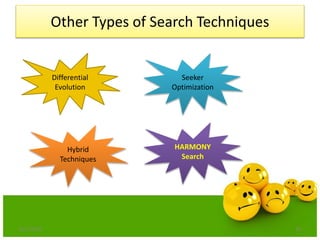
Other Types of Search Techniques
6/21/2013 10
Differential
Evolution
Seeker
Optimization
Hybrid
Techniques
HARMONY
Search
Component of Optimization Problem
• Objective Function: An objective function which we want to
minimize or maximize.
• In clustering problem to fix the cluster center such that
maximize inter cluster distance and minimize intra cluster
distance.
• For example, in a manufacturing process, we might want to
maximize the profit or minimize the cost.
• In fitting experimental data to a user-defined model, we might
minimize the total deviation of observed data from predictions
based on the model.
• In designing an inductor, we might want to maximize the Quality
Factor and minimize the area.
6/21/2013 11
Component of Optimization Problem
• Design Variables: A set of unknowns or variables which affect
the value of the objective function.
• In clustering problem it may be the number of features which
define the center of the cluster
• In the manufacturing problem, the variables might include the
amounts of different resources used or the time spent on each
activity.
• In fitting-the-data problem, the unknowns are the parameters
that define the model.
• In the inductor design problem, the variables used define the
layout geometry of the panel.
6/21/2013 12
Component of Optimization Problem
• Constraints: A set of constraints that allow the unknowns to take
on certain values but exclude others.
• The limits of the features value in the clustering problem
• For the manufacturing problem, it does not make sense to spend a
negative amount of time on any activity, so we constrain all the
"time" variables to be non-negative.
• In the inductor design problem, we would probably want to limit
the upper and lower value of layout parameters and to target an
inductance value within the tolerance level.
6/21/2013 13
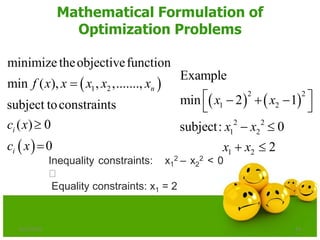
Mathematical Formulation of
Optimization Problems
 
 
1 2
minimizetheobjectivefunction
min ( ), , ,.......,
subject toconstraints
( ) 0
0
n
i
i
f x x x x x
c x
c x



   
2 2
1 2
2 2
1 2
1 2
Example
min 2 1
subject: 0
2
x x
x x
x x
   
 
 
 
6/21/2013 14
Inequality constraints: x1
2 – x2
2 < 0
Equality constraints: x1 = 2
6/21/2013 15
How can birds or fish exhibit
such a coordinated
collective behavior?
Origin of PSO
Concept:
based on bird
flocks and fish
schools
Swarm: a large or dense group
of flying insects.
6/21/2013 16
•In PSO, each single solution is a "bird" in the search space. Call it
"particle".
•All of particles have fitness values
•which are evaluated by the fitness function to be optimized, and
•have velocities
•which direct the flying of the particles.
•The particles fly through the problem space by following the current
optimum particles.
What is PSO?
Particle Swarm Optimization: Specific
Characteristics
• It was developed in 1995 by James Kennedy and Russell Eberhart
• A “swarm” is an apparently disorganized collection (population) of moving
individuals that tend to cluster together while each individual seems to be moving
in a random direction
6/21/2013 17
Meta-heuristics are strategies that guide the search process.
1. The goal is to efficiently explore the search space in order to find near–optimal
solutions.
2. Techniques which constitute meta-heuristic algorithms range from simple local
search procedures to complex learning processes.
3. Meta-heuristic algorithms are approximate and usually non-deterministic.
4. Meta-heuristics are not problem-specific.
Continued…
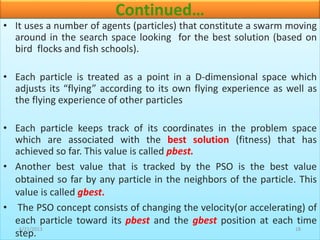
• It uses a number of agents (particles) that constitute a swarm moving
around in the search space looking for the best solution (based on
bird flocks and fish schools).
• Each particle is treated as a point in a D-dimensional space which
adjusts its “flying” according to its own flying experience as well as
the flying experience of other particles
• Each particle keeps track of its coordinates in the problem space
which are associated with the best solution (fitness) that has
achieved so far. This value is called pbest.
• Another best value that is tracked by the PSO is the best value
obtained so far by any particle in the neighbors of the particle. This
value is called gbest.
• The PSO concept consists of changing the velocity(or accelerating) of
each particle toward its pbest and the gbest position at each time
step.
6/21/2013 18
PSO Basic Mathematical Equations
pi
vt
xt pg
xt+1
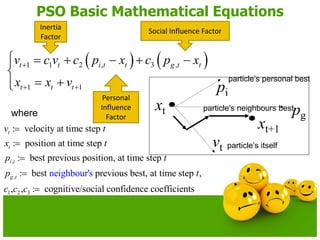
   1 1 2 , 3 ,
1 1
t t i t t g t t
t t t
v c v c p x c p x
x x v

 
     

 
,
,
1 2 3
: velocity at time step
: position at time step
: best previous position, at time step
: best previous best, at time step ,
, , : co
neighbour'
gnitive/social
s
t
t
i t
g t
v t
x t
p t
p t
c c c




 confidence coefficients
where
particle’s itself
particle’s personal best
particle’s neighbours best
Inertia
Factor
Personal
Influence
Factor
Social Influence Factor
20
PSO Velocity Update Equations Using
Constriction Factor Method
0.729)Kso4.1,set towas(
4,
42
2
)]()([
21
2
2211









cc
K
vxx
xprandcxprandcvKv
new
id
old
id
new
id
idgdidid
old
id
new
id
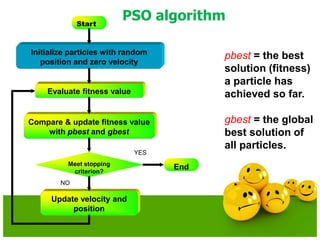
PSO algorithm
Initialize particles with random
position and zero velocity
Evaluate fitness value
Compare & update fitness value
with pbest and gbest
Meet stopping
criterion?
Update velocity and
position
Start
End
YES
NO
pbest = the best
solution (fitness)
a particle has
achieved so far.
gbest = the global
best solution of
all particles.
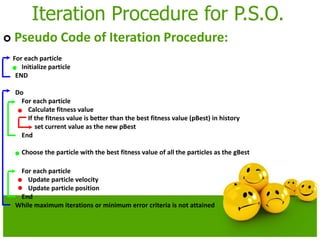
 Pseudo Code of Iteration Procedure:
For each particle
Initialize particle
END
Do
For each particle
Calculate fitness value
If the fitness value is better than the best fitness value (pBest) in history
set current value as the new pBest
End
Choose the particle with the best fitness value of all the particles as the gBest
For each particle
Update particle velocity
Update particle position
End
While maximum iterations or minimum error criteria is not attained
Iteration Procedure for P.S.O.
Advantages Over Other Optimization Technique
• It is derivative free technique unlike many conventional technique
• It has the flexibility to integrated with other optimization techniques to form
hybrid tools
• It is less sensitive to the nature of the objective function that is convexity or
continuity
• It has less parameters to adjust unlike many other competing evolutionary
techniques
• It has the ability to escape the local minima
• It is easy to implement and program with basic mathematical and logic
operations
• It does not require a good initial solution to start its iteration process
• It can handle objective functions with stochastic nature, like in the case of
representing one of the optimization variables as random
6/21/2013 23
Disadvantages of PSO
• Lack of solid mathematical background
• failure to assure global optimal solution
• the social influence aspect of the algorithm
• generalized rules in how to tune its parameters to suit
different optimization problems
• coefficient adjustment not clear methodology
6/21/2013 24
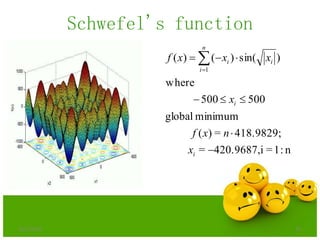
Schwefel's function
n:1=i420.9687,=
418.9829;=)(
minimumglobal
500500
where
)sin()()(
1



 
i
i
n
i
ii
x
nxf
x
xxxf
6/21/2013 25
DECLARATION OF VARIABLES AND THEIR
MEANING
% itermax: Maximum Iteration Number
% c1, c2 : Two parameters for PSO algorithm
% wmax, wmin : these are the maximum and minimum value
of the parameter w
% population_size: Size of the population/number of particles
% var_max : maximum value of the variable
% var_min : minimum value of the variable
% var_size : total number of variables
% population: matrix of value of all the particles/ solutions
6/21/2013 26
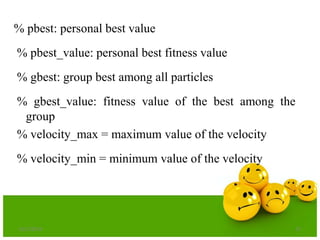
% pbest: personal best value
% pbest_value: personal best fitness value
% gbest: group best among all particles
% gbest_value: fitness value of the best among the
group
% velocity_max = maximum value of the velocity
% velocity_min = minimum value of the velocity
6/21/2013 27
Step-1: INITIALIZATION OF VARIABLES
itermax = 100;
c1 = 2;
c2 = 2;
wmax = 0.9;
wmin = 0.4;
population_size = 20;
var_max = [5.12 5.12];
var_min = [-5.12 -5.12];
velocity_max = var_max;
velocity_min = var_min;
var_size =
length(var_max);
6/21/2013 28
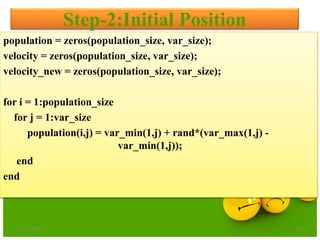
Step-2:Initial Position
population = zeros(population_size, var_size);
velocity = zeros(population_size, var_size);
velocity_new = zeros(population_size, var_size);
for i = 1:population_size
for j = 1:var_size
population(i,j) = var_min(1,j) + rand*(var_max(1,j) -
var_min(1,j));
end
end
6/21/2013 29
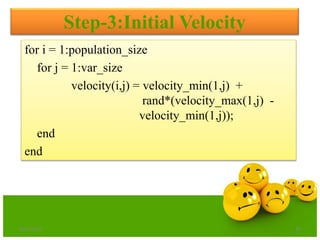
for i = 1:population_size
for j = 1:var_size
velocity(i,j) = velocity_min(1,j) +
rand*(velocity_max(1,j) -
velocity_min(1,j));
end
end
Step-3:Initial Velocity
6/21/2013 30
fitness = objective_function(population);
pbest = population;
pbest_value = fitness;
[ xx yy] = min(fitness);
gbest = population(yy,:);
gbest_value = xx ;
Step-4:Determination of Pbest & Gbest
6/21/2013 31
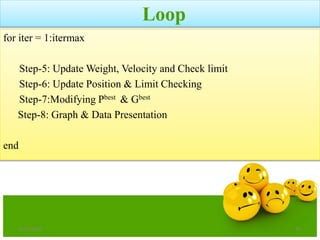
Loop
for iter = 1:itermax
Step-5: Update Weight, Velocity and Check limit
Step-6: Update Position & Limit Checking
Step-7:Modifying Pbest & Gbest
Step-8: Graph & Data Presentation
end
6/21/2013 32
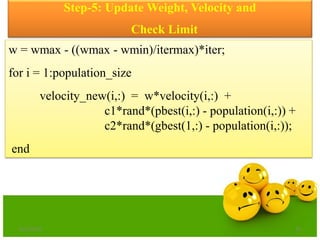
w = wmax - ((wmax - wmin)/itermax)*iter;
for i = 1:population_size
velocity_new(i,:) = w*velocity(i,:) +
c1*rand*(pbest(i,:) - population(i,:)) +
c2*rand*(gbest(1,:) - population(i,:));
end
Step-5: Update Weight, Velocity and
Check Limit
6/21/2013 33
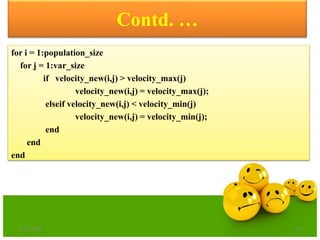
Contd. …
for i = 1:population_size
for j = 1:var_size
if velocity_new(i,j) > velocity_max(j)
velocity_new(i,j) = velocity_max(j);
elseif velocity_new(i,j) < velocity_min(j)
velocity_new(i,j) = velocity_min(j);
end
end
end
6/21/2013 34
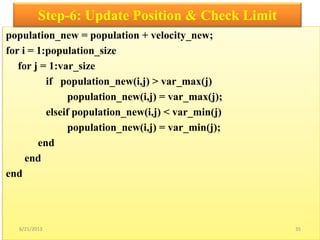
population_new = population + velocity_new;
for i = 1:population_size
for j = 1:var_size
if population_new(i,j) > var_max(j)
population_new(i,j) = var_max(j);
elseif population_new(i,j) < var_min(j)
population_new(i,j) = var_min(j);
end
end
end
Step-6: Update Position & Check Limit
6/21/2013 35
Step-7: Modifying Pbest
fitness_new = objective_function(population_new);
[ x y] = min(fitness_new);
for i = 1:population_size
if fitness_new(i)< pbest_value
pbest(i,:) = population_new(i,:);
pbest_value(i) = fitness_new(i);
end
end
6/21/2013 36
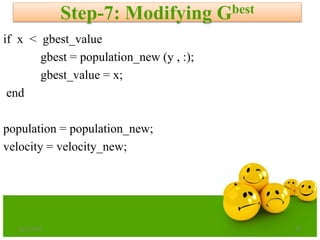
if x < gbest_value
gbest = population_new (y , :);
gbest_value = x;
end
population = population_new;
velocity = velocity_new;
Step-7: Modifying Gbest
6/21/2013 37
Step-8: Graphs & Data Presentation
best_value(iter) = gbest_value;
drawnow
plot(best_value);
6/21/2013 38
Objective Function
function fitness = objective_function(population)
[row_population col_population] = size(population);
for i = 1: row_population
for j = 1: col_population
xx(j) = population(i,j);
end
fitness(i) = 20 + xx(1)^2 + xx(2)^2 -
10*(cos(2*pi*xx(1))+cos(2*pi*xx(2)));
end
6/21/2013 39
40
What is Genetic Algorithms?
• Inverted by Prof. John Holland at the university of Michigan in 1975
• A genetic algorithm (or short GA) is a search technique used in
computing to find true or approximate solutions to optimization and
search problems.
• It uses two basic processes from evolution: “inheritance”(passing of
features from one generation to next) and competition ,“survival of
the fittest” (weeding out the bad features from individuals in the
populations).
41
Why Genetic Algorithms?
• A Robust Search Technique
• Suitable for parallel processing
• Can use a noise fitness function
• Fairly simple to develop
• GAs will produce "close" to optimal results in a "reasonable"
amount of time.
• Probability and randomness are essential parts of GA
• They are adaptive and learn from experience
43
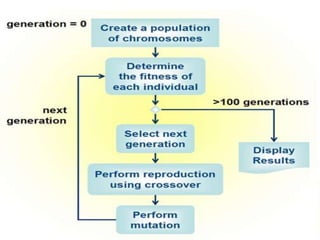
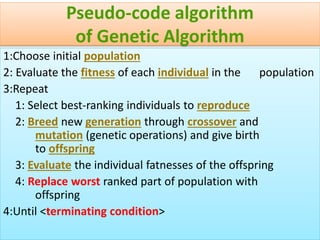
Pseudo-code algorithm
of Genetic Algorithm
1:Choose initial population
2: Evaluate the fitness of each individual in the population
3:Repeat
1: Select best-ranking individuals to reproduce
2: Breed new generation through crossover and
mutation (genetic operations) and give birth
to offspring
3: Evaluate the individual fatnesses of the offspring
4: Replace worst ranked part of population with
offspring
4:Until <terminating condition>
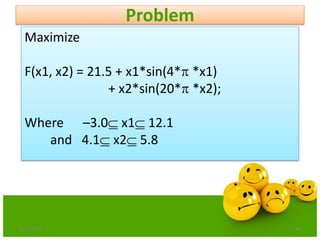
Problem
6/21/2013 44
Maximize
F(x1, x2) = 21.5 + x1*sin(4* *x1)
+ x2*sin(20* *x2);
Where –3.0 x1 12.1
and 4.1 x2 5.8
45
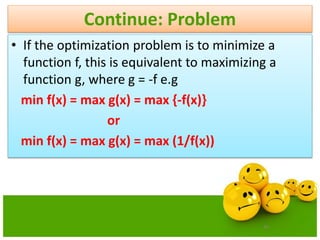
Continue: Problem
• If the optimization problem is to minimize a
function f, this is equivalent to maximizing a
function g, where g = -f e.g
min f(x) = max g(x) = max {-f(x)}
or
min f(x) = max g(x) = max (1/f(x))
Step:1 Representation
6/21/2013 46
Assume the required precision for each variable is upto
four decimal places.
The variable x1 has length 15.1 e.g [12.1 –3.0]
 The precision requirement implies that the range[-3.0,
12.1] should be divided into at least 15.1*10000 equal size
ranges.
This means that 18 bits are required for the first part of the
chromosome.
 217< 151000 <218
47
Continue: Representation
• The domain of variable x2 has length 1.7 e.g.[5.8-4.1]
• The precision requirement implies that the range [4.1,
5.8] should be divided into at least 1.7*10000 equal size
ranges.
• This means that 15 bits are required as the second part
of the chromosome.
214< 17000 <215
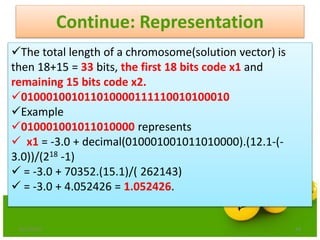
Continue: Representation
6/21/2013 48
The total length of a chromosome(solution vector) is
then 18+15 = 33 bits, the first 18 bits code x1 and
remaining 15 bits code x2.
010001001011010000111110010100010
Example
010001001011010000 represents
 x1 = -3.0 + decimal(010001001011010000).(12.1-(-
3.0))/(218 -1)
 = -3.0 + 70352.(15.1)/( 262143)
 = -3.0 + 4.052426 = 1.052426.
49
Continue: Representation
• The next 15 bits 111110010100010 represents
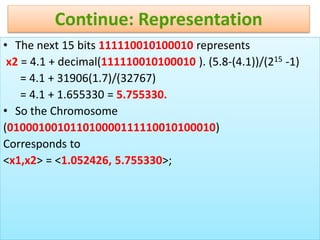
x2 = 4.1 + decimal(111110010100010 ). (5.8-(4.1))/(215 -1)
= 4.1 + 31906(1.7)/(32767)
= 4.1 + 1.655330 = 5.755330.
• So the Chromosome
(010001001011010000111110010100010)
Corresponds to
<x1,x2> = <1.052426, 5.755330>;
50
Continue: Representation
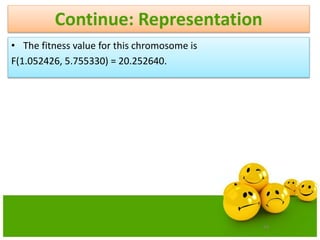
• The fitness value for this chromosome is
F(1.052426, 5.755330) = 20.252640.
51
Step-2 Population
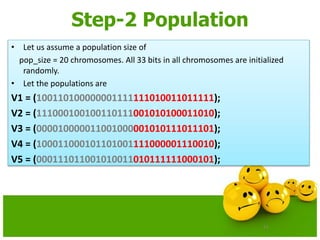
• Let us assume a population size of
pop_size = 20 chromosomes. All 33 bits in all chromosomes are initialized
randomly.
• Let the populations are
V1 = (100110100000001111111010011011111);
V2 = (111000100100110111001010100011010);
V3 = (000010000011001000001010111011101);
V4 = (100011000101101001111000001110010);
V5 = (000111011001010011010111111000101);
52
Continue: Population
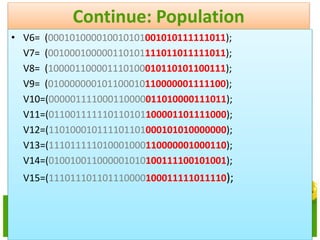
• V6= (000101000010010101001010111111011);
V7= (001000100000110101111011011111011);
V8= (100001100001110100010110101100111);
V9= (010000000101100010110000001111100);
V10=(000001111000110000011010000111011);
V11=(011001111110110101100001101111000);
V12=(110100010111101101000101010000000);
V13=(111011111010001000110000001000110);
V14=(010010011000001010100111100101001);
V15=(111011101101110000100011111011110);
53
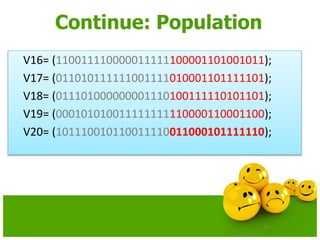
Continue: Population
V16= (110011110000011111100001101001011);
V17= (011010111111001111010001101111101);
V18= (011101000000001110100111110101101);
V19= (000101010011111111110000110001100);
V20= (101110010110011110011000101111110);
54
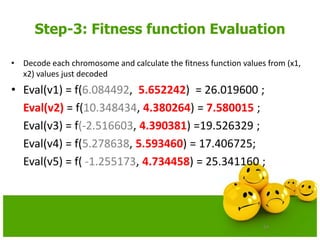
Step-3: Fitness function Evaluation
• Decode each chromosome and calculate the fitness function values from (x1,
x2) values just decoded
• Eval(v1) = f(6.084492, 5.652242) = 26.019600 ;
Eval(v2) = f(10.348434, 4.380264) = 7.580015 ;
Eval(v3) = f(-2.516603, 4.390381) =19.526329 ;
Eval(v4) = f(5.278638, 5.593460) = 17.406725;
Eval(v5) = f( -1.255173, 4.734458) = 25.341160 ;
55
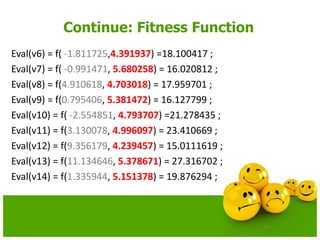
Continue: Fitness Function
Eval(v6) = f( -1.811725,4.391937) =18.100417 ;
Eval(v7) = f( -0.991471, 5.680258) = 16.020812 ;
Eval(v8) = f(4.910618, 4.703018) = 17.959701 ;
Eval(v9) = f(0.795406, 5.381472) = 16.127799 ;
Eval(v10) = f( -2.554851, 4.793707) =21.278435 ;
Eval(v11) = f(3.130078, 4.996097) = 23.410669 ;
Eval(v12) = f(9.356179, 4.239457) = 15.0111619 ;
Eval(v13) = f(11.134646, 5.378671) = 27.316702 ;
Eval(v14) = f(1.335944, 5.151378) = 19.876294 ;
56
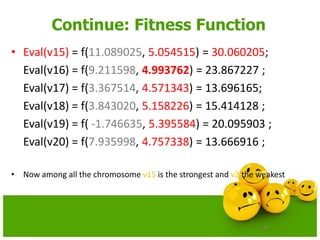
Continue: Fitness Function
• Eval(v15) = f(11.089025, 5.054515) = 30.060205;
Eval(v16) = f(9.211598, 4.993762) = 23.867227 ;
Eval(v17) = f(3.367514, 4.571343) = 13.696165;
Eval(v18) = f(3.843020, 5.158226) = 15.414128 ;
Eval(v19) = f( -1.746635, 5.395584) = 20.095903 ;
Eval(v20) = f(7.935998, 4.757338) = 13.666916 ;
• Now among all the chromosome v15 is the strongest and v2 the weakest
57
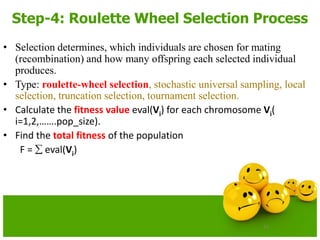
Step-4: Roulette Wheel Selection Process
• Selection determines, which individuals are chosen for mating
(recombination) and how many offspring each selected individual
produces.
• Type: roulette-wheel selection, stochastic universal sampling, local
selection, truncation selection, tournament selection.
• Calculate the fitness value eval(Vi) for each chromosome Vi(
i=1,2,…….pop_size).
• Find the total fitness of the population
F =  eval(Vi)
58
Continue: Roulette Wheel
• Calculate the probability of a selection pi for each chromosome Vi
(I,2,……pop_size).
pi = eval(Vi)/ F
• Calculate the cumulative probability qi
for each chromosome Vi(I = 1,2,… pop_size);
qi =  pj where j varies from 1 to i
• Generate a random (float) number r from the range [0..1]
• If r<q1then select the first chromosome(v1); otherwise select the ith
chromosome Vi (2 i pop_size) such that q i-1 < r  qi.
59
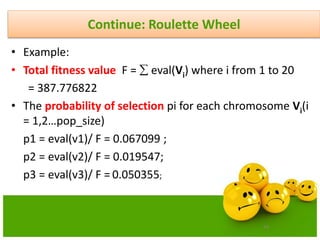
Continue: Roulette Wheel
• Example:
• Total fitness value F =  eval(Vi) where i from 1 to 20
= 387.776822
• The probability of selection pi for each chromosome Vi(i
= 1,2…pop_size)
p1 = eval(v1)/ F = 0.067099 ;
p2 = eval(v2)/ F = 0.019547;
p3 = eval(v3)/ F = 0.050355;
60
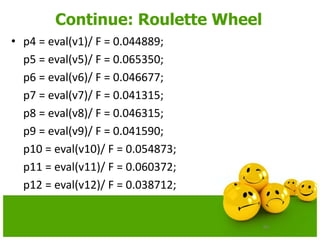
Continue: Roulette Wheel
• p4 = eval(v1)/ F = 0.044889;
p5 = eval(v5)/ F = 0.065350;
p6 = eval(v6)/ F = 0.046677;
p7 = eval(v7)/ F = 0.041315;
p8 = eval(v8)/ F = 0.046315;
p9 = eval(v9)/ F = 0.041590;
p10 = eval(v10)/ F = 0.054873;
p11 = eval(v11)/ F = 0.060372;
p12 = eval(v12)/ F = 0.038712;
61
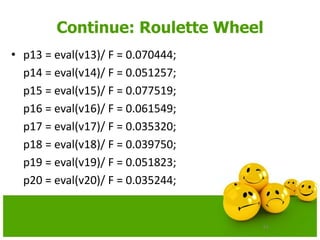
Continue: Roulette Wheel
• p13 = eval(v13)/ F = 0.070444;
p14 = eval(v14)/ F = 0.051257;
p15 = eval(v15)/ F = 0.077519;
p16 = eval(v16)/ F = 0.061549;
p17 = eval(v17)/ F = 0.035320;
p18 = eval(v18)/ F = 0.039750;
p19 = eval(v19)/ F = 0.051823;
p20 = eval(v20)/ F = 0.035244;
62
Continue: Roulette Wheel
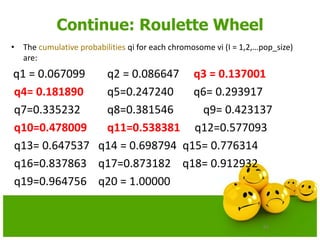
• The cumulative probabilities qi for each chromosome vi (I = 1,2,…pop_size)
are:
q1 = 0.067099 q2 = 0.086647 q3 = 0.137001
q4= 0.181890 q5=0.247240 q6= 0.293917
q7=0.335232 q8=0.381546 q9= 0.423137
q10=0.478009 q11=0.538381 q12=0.577093
q13= 0.647537 q14 = 0.698794 q15= 0.776314
q16=0.837863 q17=0.873182 q18= 0.912932
q19=0.964756 q20 = 1.00000
63
Continue: Roulette Wheel
• Let us assume that a (random) sequence of 20 numbers from the
range[0..1]is:
0.513870 0.175741 0.308652 0.534534 0.947628
0.171736 0.702231 0.226431 0.494773 0.424720
0.703899 0.389647 0.277226 0.368071 0.983437
0.005398 0.765682 0.646473 0.767139 0.780237
64
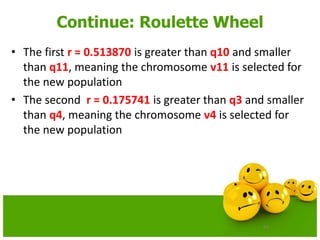
Continue: Roulette Wheel
• The first r = 0.513870 is greater than q10 and smaller
than q11, meaning the chromosome v11 is selected for
the new population
• The second r = 0.175741 is greater than q3 and smaller
than q4, meaning the chromosome v4 is selected for
the new population
65
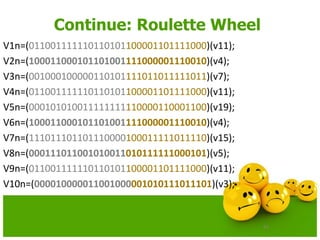
Continue: Roulette Wheel
V1n=(011001111110110101100001101111000)(v11);
V2n=(100011000101101001111000001110010)(v4);
V3n=(001000100000110101111011011111011)(v7);
V4n=(011001111110110101100001101111000)(v11);
V5n=(000101010011111111110000110001100)(v19);
V6n=(100011000101101001111000001110010)(v4);
V7n=(111011101101110000100011111011110)(v15);
V8n=(000111011001010011010111111000101)(v5);
V9n=(011001111110110101100001101111000)(v11);
V10n=(000010000011001000001010111011101)(v3);
66
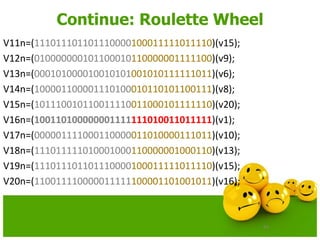
Continue: Roulette Wheel
V11n=(111011101101110000100011111011110)(v15);
V12n=(010000000101100010110000001111100)(v9);
V13n=(000101000010010101001010111111011)(v6);
V14n=(100001100001110100010110101100111)(v8);
V15n=(101110010110011110011000101111110)(v20);
V16n=(100110100000001111111010011011111)(v1);
V17n=(000001111000110000011010000111011)(v10);
V18n=(111011111010001000110000001000110)(v13);
V19n=(111011101101110000100011111011110)(v15);
V20n=(110011110000011111100001101001011)(v16);
Step-5:Recombination(Crossover )
6/21/2013 67
Recombination produces new individuals in combining
the information contained in the parents (parents - mating
population).
 Type: Discrete recombination
Real valued recombination,
Binary valued recombination,
single-point / double-point /multi-point crossover,
uniform crossover,
shuffle crossover,
crossover with reduced surrogate,
68
Continue: Crossover
• Assume the probability of crossover Pc.
• This probability gives us the expected number Pc*
pop_size of chromosomes which undergo the
crossover operation.
• Generate a random(float) number r from the
range[0..1]
• If r<Pc, select the given chromosome for
crossover
69
Continue: crossover
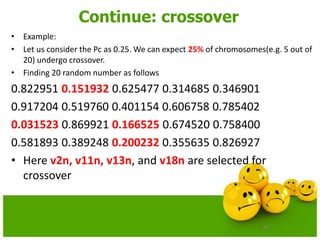
• Example:
• Let us consider the Pc as 0.25. We can expect 25% of chromosomes(e.g. 5 out of
20) undergo crossover.
• Finding 20 random number as follows
0.822951 0.151932 0.625477 0.314685 0.346901
0.917204 0.519760 0.401154 0.606758 0.785402
0.031523 0.869921 0.166525 0.674520 0.758400
0.581893 0.389248 0.200232 0.355635 0.826927
• Here v2n, v11n, v13n, and v18n are selected for
crossover
70
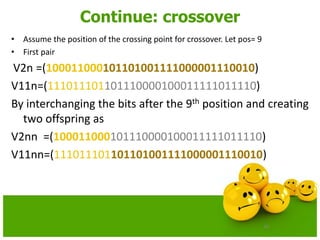
Continue: crossover
• Assume the position of the crossing point for crossover. Let pos= 9
• First pair
V2n =(100011000101101001111000001110010)
V11n=(111011101101110000100011111011110)
By interchanging the bits after the 9th position and creating
two offspring as
V2nn =(100011000101110000100011111011110)
V11nn=(111011101101101001111000001110010)
71
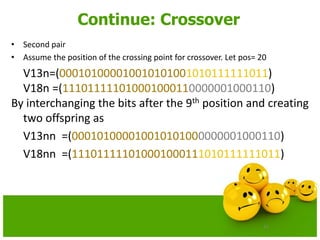
Continue: Crossover
• Second pair
• Assume the position of the crossing point for crossover. Let pos= 20
V13n=(000101000010010101001010111111011)
V18n =(111011111010001000110000001000110)
By interchanging the bits after the 9th position and creating
two offspring as
V13nn =(000101000010010101000000001000110)
V18nn =(111011111010001000111010111111011)
72
Continue: Crossover
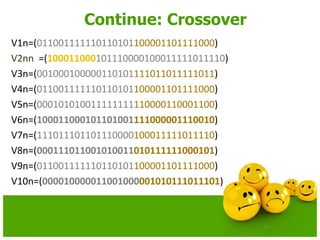
V1n=(011001111110110101100001101111000)
V2nn =(100011000101110000100011111011110)
V3n=(001000100000110101111011011111011)
V4n=(011001111110110101100001101111000)
V5n=(000101010011111111110000110001100)
V6n=(100011000101101001111000001110010)
V7n=(111011101101110000100011111011110)
V8n=(000111011001010011010111111000101)
V9n=(011001111110110101100001101111000)
V10n=(000010000011001000001010111011101)
73
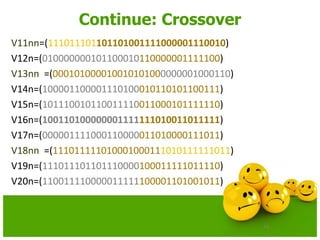
Continue: Crossover
V11nn=(111011101101101001111000001110010)
V12n=(010000000101100010110000001111100)
V13nn =(000101000010010101000000001000110)
V14n=(100001100001110100010110101100111)
V15n=(101110010110011110011000101111110)
V16n=(100110100000001111111010011011111)
V17n=(000001111000110000011010000111011)
V18nn =(111011111010001000111010111111011)
V19n=(111011101101110000100011111011110)
V20n=(110011110000011111100001101001011)
Step-6: Mutation
6/21/2013 74
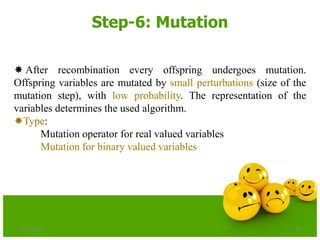
 After recombination every offspring undergoes mutation.
Offspring variables are mutated by small perturbations (size of the
mutation step), with low probability. The representation of the
variables determines the used algorithm.
Type:
Mutation operator for real valued variables
Mutation for binary valued variables
75
Continue: Mutation
• Mutation is performed bit-by-bit basis
• Assume the probability of Mutation Pm.
• This probability gives us the expected number of
mutated bits Pm* pop_size.
• Generate a random(float) number r from the
range[0..1]
• If r<Pm, mutate the bit
76
Continue: Mutation
• Example:
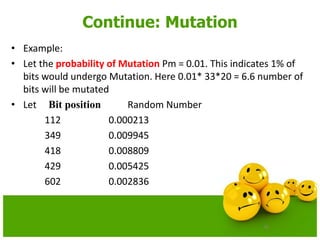
• Let the probability of Mutation Pm = 0.01. This indicates 1% of
bits would undergo Mutation. Here 0.01* 33*20 = 6.6 number of
bits will be mutated
• Let Bit position Random Number
112 0.000213
349 0.009945
418 0.008809
429 0.005425
602 0.002836
77
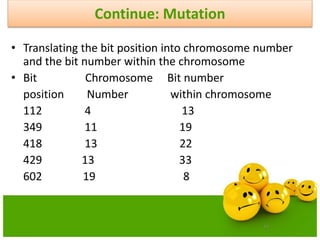
Continue: Mutation
• Translating the bit position into chromosome number
and the bit number within the chromosome
• Bit Chromosome Bit number
position Number within chromosome
112 4 13
349 11 19
418 13 22
429 13 33
602 19 8
78
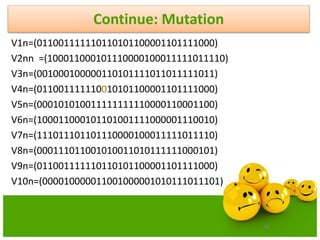
Continue: Mutation
V1n=(011001111110110101100001101111000)
V2nn =(100011000101110000100011111011110)
V3n=(001000100000110101111011011111011)
V4n=(011001111110010101100001101111000)
V5n=(000101010011111111110000110001100)
V6n=(100011000101101001111000001110010)
V7n=(111011101101110000100011111011110)
V8n=(000111011001010011010111111000101)
V9n=(011001111110110101100001101111000)
V10n=(000010000011001000001010111011101)
79
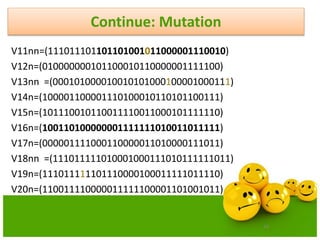
Continue: Mutation
V11nn=(111011101101101001011000001110010)
V12n=(010000000101100010110000001111100)
V13nn =(000101000010010101000100001000111)
V14n=(100001100001110100010110101100111)
V15n=(101110010110011110011000101111110)
V16n=(100110100000001111111010011011111)
V17n=(000001111000110000011010000111011)
V18nn =(111011111010001000111010111111011)
V19n=(111011111101110000100011111011110)
V20n=(110011110000011111100001101001011)
80
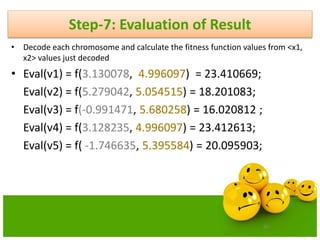
Step-7: Evaluation of Result
• Decode each chromosome and calculate the fitness function values from <x1,
x2> values just decoded
• Eval(v1) = f(3.130078, 4.996097) = 23.410669;
Eval(v2) = f(5.279042, 5.054515) = 18.201083;
Eval(v3) = f(-0.991471, 5.680258) = 16.020812 ;
Eval(v4) = f(3.128235, 4.996097) = 23.412613;
Eval(v5) = f( -1.746635, 5.395584) = 20.095903;
81
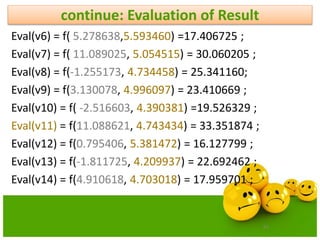
continue: Evaluation of Result
Eval(v6) = f( 5.278638,5.593460) =17.406725 ;
Eval(v7) = f( 11.089025, 5.054515) = 30.060205 ;
Eval(v8) = f(-1.255173, 4.734458) = 25.341160;
Eval(v9) = f(3.130078, 4.996097) = 23.410669 ;
Eval(v10) = f( -2.516603, 4.390381) =19.526329 ;
Eval(v11) = f(11.088621, 4.743434) = 33.351874 ;
Eval(v12) = f(0.795406, 5.381472) = 16.127799 ;
Eval(v13) = f(-1.811725, 4.209937) = 22.692462 ;
Eval(v14) = f(4.910618, 4.703018) = 17.959701 ;
82
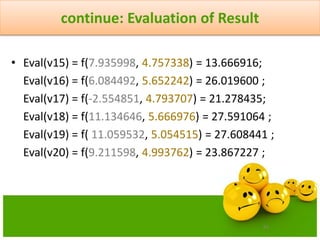
continue: Evaluation of Result
• Eval(v15) = f(7.935998, 4.757338) = 13.666916;
Eval(v16) = f(6.084492, 5.652242) = 26.019600 ;
Eval(v17) = f(-2.554851, 4.793707) = 21.278435;
Eval(v18) = f(11.134646, 5.666976) = 27.591064 ;
Eval(v19) = f( 11.059532, 5.054515) = 27.608441 ;
Eval(v20) = f(9.211598, 4.993762) = 23.867227 ;
83
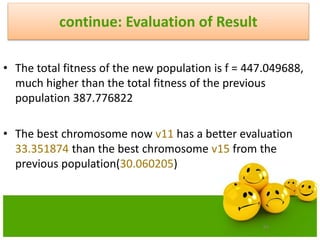
continue: Evaluation of Result
• The total fitness of the new population is f = 447.049688,
much higher than the total fitness of the previous
population 387.776822
• The best chromosome now v11 has a better evaluation
33.351874 than the best chromosome v15 from the
previous population(30.060205)
84
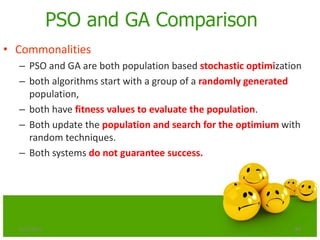
PSO and GA Comparison
• Commonalities
– PSO and GA are both population based stochastic optimization
– both algorithms start with a group of a randomly generated
population,
– both have fitness values to evaluate the population.
– Both update the population and search for the optimium with
random techniques.
– Both systems do not guarantee success.
6/21/2013
85
PSO and GA Comparison
• Differences
– PSO does not have genetic operators like crossover and
mutation. Particles update themselves with the internal
velocity.
– They also have memory, which is important to the algorithm.
– Particles do not die
– the information sharing mechanism in PSO is significantly
different
• Info from best to others, GA population moves together
6/21/2013
86
• PSO has a memory
not “what” that best solution was, but “where” that best solution
was
• Quality: population responds to quality factors pbest and gbest
• Diverse response: responses allocated between pbest and gbest
• Stability: population changes state only when gbest changes
• Adaptability: population does change state when gbest changes
6/21/2013
87
• There is no selection in PSO
all particles survive for the length of the run
PSO is the only EA that does not remove candidate population
members
• In PSO, topology is constant; a neighbor is a neighbor
• Population size: 20-40
6/21/2013
Multi-objective Optimization: Concepts
and Application to Data mining
Multi-objective Optimization
• “Multiobjective optimization is the process of simultaneously
optimizing two or more conflicting objectives subject to
certain constraints.”
Examples:
– Maximizing profit and minimizing the cost of a product.
– Maximizing performance and minimizing fuel consumption of
a vehicle.
– Minimizing weight while maximizing the strength of a
particular component
6/21/2013 90
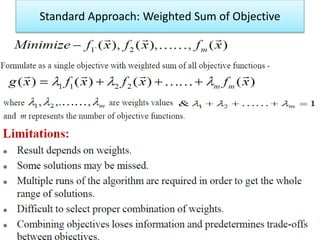
]10,0[
2010
;)10()(
;)(
2
2
2
1




x
utionOptimalSol
x
where
xxf
xxf
Minimize
Standard Approach: Weighted Sum of Objective
6/21/2013 91
Difference
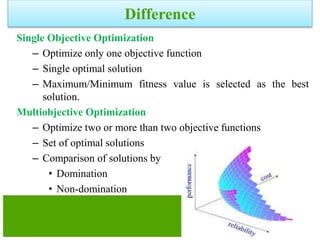
Single Objective Optimization
– Optimize only one objective function
– Single optimal solution
– Maximum/Minimum fitness value is selected as the best
solution.
Multiobjective Optimization
– Optimize two or more than two objective functions
– Set of optimal solutions
– Comparison of solutions by
• Domination
• Non-domination
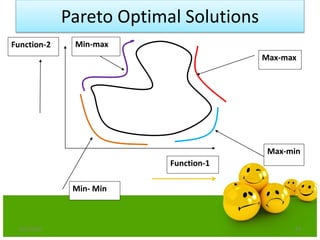
Pareto Optimal Solutions
6/21/2013 93
Max-max
Max-min
Function-1
Function-2 Min-max
Min- Min
Flowchart of NSGA-II
Definitions
Domination: One solution is said to
dominate another if it is better in all
objectives.
Non-Domination[Pareto points]: A solution
is said to be non-dominated if it is better
than other solutions in at least one
objective
•A dominates B (better in both ƒ1 and ƒ2)
•A dominates C (same in ƒ2 but better in ƒ1)
•A does not dominate D (non-dominated points)
•A and D are in the “Pareto optimal front”
•These non-dominated solutions are called Pareto optimal solutions.
•This non-dominated curve is said to be Pareto front.
Desirable MOEA features
• Convergence: Convergence refers to how close is the
approximation to the Optimal Pareto Front.
• Diversity: Diversity refers to how well distributed are the elements
of the approximation among the Pareto Front
A multi-objective optimization
algorithm must achieve:
1. Guide the search towards the
global Pareto-Optimal front.(By
non-domination ranking )
2. Maintain solution diversity in
the Pareto-Optimal front. ( by
Crowding Distance)
Non Dominated Sorting based Genetic
Algorithm II (NSGA-II)
• Famous for Fast non-dominated search.
• Fitness assignment-Ranking based on non-domination sorting.
• Diversity mechanism is based on Crowding distance.
• Uses Elitism (A practical variant of the general process of
constructing a new population is to allow the best organism(s)
from the current generation to carry over to the next, unaltered.
This strategy is known as elitist selection and guarantees that the
solution quality obtained by the GA will not decrease from one
generation to the next)
Initialize Population
6/21/2013 98
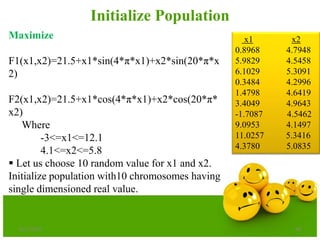
Maximize
F1(x1,x2)=21.5+x1*sin(4*π*x1)+x2*sin(20*π*x
2)
F2(x1,x2)=21.5+x1*cos(4*π*x1)+x2*cos(20*π*
x2)
Where
-3<=x1<=12.1
4.1<=x2<=5.8
 Let us choose 10 random value for x1 and x2.
Initialize population with10 chromosomes having
single dimensioned real value.
x1 x2
0.8968 4.7948
5.9829 4.5458
6.1029 5.3091
0.3484 4.2996
1.4798 4.6419
3.4049 4.9643
-1.7087 4.5462
9.0953 4.1497
11.0257 5.3416
4.3780 5.0835
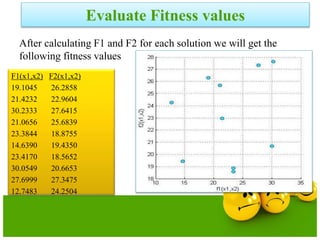
Evaluate Fitness values
F1(x1,x2) F2(x1,x2)
19.1045 26.2858
21.4232 22.9604
30.2333 27.6415
21.0656 25.6839
23.3844 18.8755
14.6390 19.4350
23.4170 18.5652
30.0549 20.6653
27.6999 27.3475
12.7483 24.2504
After calculating F1 and F2 for each solution we will get the
following fitness values
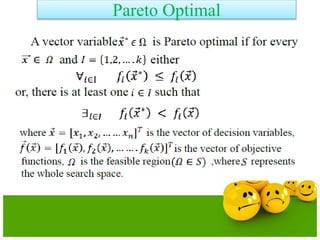
Pareto Optimal
  ii uvni  :,,1 
6/21/2013 101
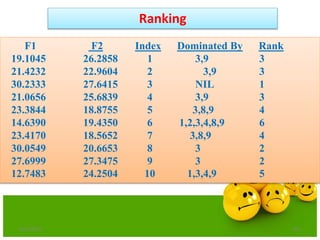
F1 F2 Index Dominated By Rank
19.1045 26.2858 1 3,9 3
21.4232 22.9604 2 3,9 3
30.2333 27.6415 3 NIL 1
21.0656 25.6839 4 3,9 3
23.3844 18.8755 5 3,8,9 4
14.6390 19.4350 6 1,2,3,4,8,9 6
23.4170 18.5652 7 3,8,9 4
30.0549 20.6653 8 3 2
27.6999 27.3475 9 3 2
12.7483 24.2504 10 1,3,4,9 5
Ranking
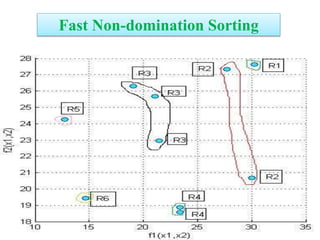
Fast Non-domination Sorting
Crowding Distance Assignment
• To get an estimate of density of
solutions surrounding a particular
solution in population.
• Choose individuals having large
crowding distance.
• Help for obtaining uniformly
distribution
where ƒ[i]m represent objective function value of solution. and are
the maximum and minimum value of the objective function.
Crowding Distance Assignment
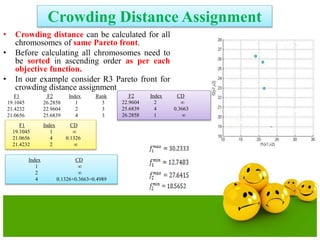
• Crowding distance can be calculated for all
chromosomes of same Pareto front.
• Before calculating all chromosomes need to
be sorted in ascending order as per each
objective function.
• In our example consider R3 Pareto front for
crowding distance assignment
F1 F2 Index Rank
19.1045 26.2858 1 3
21.4232 22.9604 2 3
21.0656 25.6839 4 3
F1 Index CD
19.1045 1 ∞
21.0656 4 0.1326
21.4232 2 ∞
F2 Index CD
22.9604 2 ∞
25.6839 4 0.3663
26.2858 1 ∞
Index CD
1 ∞
2 ∞
4 0.1326+0.3663=0.4989
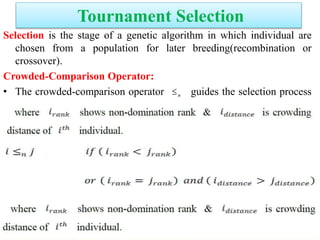
Tournament Selection
Selection is the stage of a genetic algorithm in which individual are
chosen from a population for later breeding(recombination or
crossover).
Crowded-Comparison Operator:
• The crowded-comparison operator guides the selection process
at the various stages of the algorithm toward a uniformly spread-out
Pareto optimal front.
n
6/21/2013 106
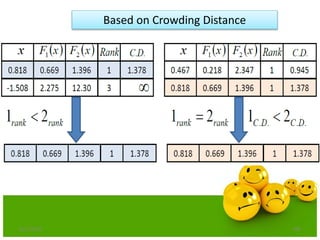
Based on Crowding Distance
New Generation Formation
• After sorting as per non-domination all solutions will go
through binary selection, Recombination and mutation to
generate Qt.
• Unite old population Pt and present population Qt (Elitism is
preserved). Now we have 2N number of solutions.
• So these 2N solutions are again to be sorted as per non-
domination to bring the better solutions to higher front.
Contd…
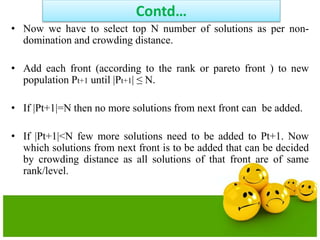
• Now we have to select top N number of solutions as per non-
domination and crowding distance.
• Add each front (according to the rank or pareto front ) to new
population Pt+1 until |Pt+1| ≤ N.
• If |Pt+1|=N then no more solutions from next front can be added.
• If |Pt+1|<N few more solutions need to be added to Pt+1. Now
which solutions from next front is to be added that can be decided
by crowding distance as all solutions of that front are of same
rank/level.
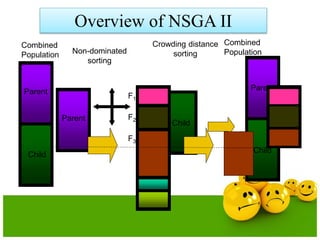
Parent
Child
Parent
Child
Combined
PopulationNon-dominated
sorting
Crowding distance
sorting
F1
F2
F3
Parent
Child
Combined
Population
Overview of NSGA II
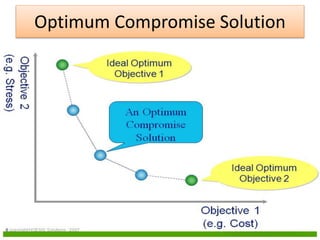
Optimum Compromise Solution
6/21/2013 110
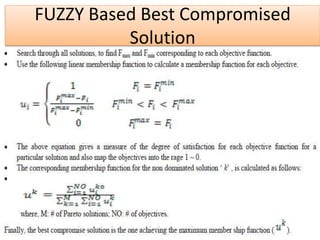
FUZZY Based Best Compromised
Solution
6/21/2013 111
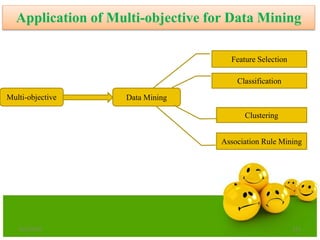
Application of Multi-objective for Data Mining
6/21/2013 112
Multi-objective Data Mining
Feature Selection
Classification
Clustering
Association Rule Mining
6/21/2013 113

Optimization Using Evolutionary Computing Techniques

  • 1.
    Optimization Using Evolutionary Computing Techniques Prof.(Dr.) Pravat Kumar Rout Department of EEE, ITER Siksha ‘O’ Anusandhan (Deemed to be University), Bhubaneswar, Odisha, India
  • 2.
    Goal of Optimization Findvalues of the variables that minimize or maximize the objective function while satisfying the constraints. 2
  • 3.
    ? Black-Box Optimization Optimization Algorithm: onlyallowed to evaluate f (direct search) decision vector x objective vector f(x) objective function (e.g. simulation model) Problem Definition: optimization of continuous nonlinear functions finding the best solution in problem space
  • 4.
    Calculus Maximum and minimumof a smooth function is reached at a stationary point where its gradient vanishes. 6/21/2013 4
  • 5.
    6/21/2013 5 Why EvolutionaryComputation Exact Mathematical Expression (Not being applicable to certain class of objective functions in case of classical techniques)  Derivative Free Global Optimization(Not trapped at local minima in case of classical technique) Less Computational Complexity
  • 6.
    Other class ofHeuristics Inspired By Nature  Evolutionary Algorithms (EA) – All methods inspired by the evolution  Swarm Intelligence (SI) – All methods inspired by collective intelligence  Geographical Nature Algorithm (GNA) – All methods inspired by geographical structure of the environment/ earth 66/21/2013
  • 7.
  • 8.
    6/21/2013 8 Swarm Intelligence Bat Optimization Particle Swarm Intelligence AntColony Optimization Firefly Algorithm Cukoo Search Shuffled Frog Leaping Artificial Bee Colony
  • 9.
    6/21/2013 9 Geographical NatureOptimization River Formation Dynamics Bio-geographical Optimization Weed Optimization
  • 10.
    Other Types ofSearch Techniques 6/21/2013 10 Differential Evolution Seeker Optimization Hybrid Techniques HARMONY Search
  • 11.
    Component of OptimizationProblem • Objective Function: An objective function which we want to minimize or maximize. • In clustering problem to fix the cluster center such that maximize inter cluster distance and minimize intra cluster distance. • For example, in a manufacturing process, we might want to maximize the profit or minimize the cost. • In fitting experimental data to a user-defined model, we might minimize the total deviation of observed data from predictions based on the model. • In designing an inductor, we might want to maximize the Quality Factor and minimize the area. 6/21/2013 11
  • 12.
    Component of OptimizationProblem • Design Variables: A set of unknowns or variables which affect the value of the objective function. • In clustering problem it may be the number of features which define the center of the cluster • In the manufacturing problem, the variables might include the amounts of different resources used or the time spent on each activity. • In fitting-the-data problem, the unknowns are the parameters that define the model. • In the inductor design problem, the variables used define the layout geometry of the panel. 6/21/2013 12
  • 13.
    Component of OptimizationProblem • Constraints: A set of constraints that allow the unknowns to take on certain values but exclude others. • The limits of the features value in the clustering problem • For the manufacturing problem, it does not make sense to spend a negative amount of time on any activity, so we constrain all the "time" variables to be non-negative. • In the inductor design problem, we would probably want to limit the upper and lower value of layout parameters and to target an inductance value within the tolerance level. 6/21/2013 13
  • 14.
    Mathematical Formulation of OptimizationProblems     1 2 minimizetheobjectivefunction min ( ), , ,......., subject toconstraints ( ) 0 0 n i i f x x x x x c x c x        2 2 1 2 2 2 1 2 1 2 Example min 2 1 subject: 0 2 x x x x x x           6/21/2013 14 Inequality constraints: x1 2 – x2 2 < 0 Equality constraints: x1 = 2
  • 15.
    6/21/2013 15 How canbirds or fish exhibit such a coordinated collective behavior? Origin of PSO Concept: based on bird flocks and fish schools Swarm: a large or dense group of flying insects.
  • 16.
    6/21/2013 16 •In PSO,each single solution is a "bird" in the search space. Call it "particle". •All of particles have fitness values •which are evaluated by the fitness function to be optimized, and •have velocities •which direct the flying of the particles. •The particles fly through the problem space by following the current optimum particles. What is PSO?
  • 17.
    Particle Swarm Optimization:Specific Characteristics • It was developed in 1995 by James Kennedy and Russell Eberhart • A “swarm” is an apparently disorganized collection (population) of moving individuals that tend to cluster together while each individual seems to be moving in a random direction 6/21/2013 17 Meta-heuristics are strategies that guide the search process. 1. The goal is to efficiently explore the search space in order to find near–optimal solutions. 2. Techniques which constitute meta-heuristic algorithms range from simple local search procedures to complex learning processes. 3. Meta-heuristic algorithms are approximate and usually non-deterministic. 4. Meta-heuristics are not problem-specific.
  • 18.
    Continued… • It usesa number of agents (particles) that constitute a swarm moving around in the search space looking for the best solution (based on bird flocks and fish schools). • Each particle is treated as a point in a D-dimensional space which adjusts its “flying” according to its own flying experience as well as the flying experience of other particles • Each particle keeps track of its coordinates in the problem space which are associated with the best solution (fitness) that has achieved so far. This value is called pbest. • Another best value that is tracked by the PSO is the best value obtained so far by any particle in the neighbors of the particle. This value is called gbest. • The PSO concept consists of changing the velocity(or accelerating) of each particle toward its pbest and the gbest position at each time step. 6/21/2013 18
  • 19.
    PSO Basic MathematicalEquations pi vt xt pg xt+1    1 1 2 , 3 , 1 1 t t i t t g t t t t t v c v c p x c p x x x v             , , 1 2 3 : velocity at time step : position at time step : best previous position, at time step : best previous best, at time step , , , : co neighbour' gnitive/social s t t i t g t v t x t p t p t c c c      confidence coefficients where particle’s itself particle’s personal best particle’s neighbours best Inertia Factor Personal Influence Factor Social Influence Factor
  • 20.
    20 PSO Velocity UpdateEquations Using Constriction Factor Method 0.729)Kso4.1,set towas( 4, 42 2 )]()([ 21 2 2211          cc K vxx xprandcxprandcvKv new id old id new id idgdidid old id new id
  • 21.
    PSO algorithm Initialize particleswith random position and zero velocity Evaluate fitness value Compare & update fitness value with pbest and gbest Meet stopping criterion? Update velocity and position Start End YES NO pbest = the best solution (fitness) a particle has achieved so far. gbest = the global best solution of all particles.
  • 22.
     Pseudo Codeof Iteration Procedure: For each particle Initialize particle END Do For each particle Calculate fitness value If the fitness value is better than the best fitness value (pBest) in history set current value as the new pBest End Choose the particle with the best fitness value of all the particles as the gBest For each particle Update particle velocity Update particle position End While maximum iterations or minimum error criteria is not attained Iteration Procedure for P.S.O.
  • 23.
    Advantages Over OtherOptimization Technique • It is derivative free technique unlike many conventional technique • It has the flexibility to integrated with other optimization techniques to form hybrid tools • It is less sensitive to the nature of the objective function that is convexity or continuity • It has less parameters to adjust unlike many other competing evolutionary techniques • It has the ability to escape the local minima • It is easy to implement and program with basic mathematical and logic operations • It does not require a good initial solution to start its iteration process • It can handle objective functions with stochastic nature, like in the case of representing one of the optimization variables as random 6/21/2013 23
  • 24.
    Disadvantages of PSO •Lack of solid mathematical background • failure to assure global optimal solution • the social influence aspect of the algorithm • generalized rules in how to tune its parameters to suit different optimization problems • coefficient adjustment not clear methodology 6/21/2013 24
  • 25.
  • 26.
    DECLARATION OF VARIABLESAND THEIR MEANING % itermax: Maximum Iteration Number % c1, c2 : Two parameters for PSO algorithm % wmax, wmin : these are the maximum and minimum value of the parameter w % population_size: Size of the population/number of particles % var_max : maximum value of the variable % var_min : minimum value of the variable % var_size : total number of variables % population: matrix of value of all the particles/ solutions 6/21/2013 26
  • 27.
    % pbest: personalbest value % pbest_value: personal best fitness value % gbest: group best among all particles % gbest_value: fitness value of the best among the group % velocity_max = maximum value of the velocity % velocity_min = minimum value of the velocity 6/21/2013 27
  • 28.
    Step-1: INITIALIZATION OFVARIABLES itermax = 100; c1 = 2; c2 = 2; wmax = 0.9; wmin = 0.4; population_size = 20; var_max = [5.12 5.12]; var_min = [-5.12 -5.12]; velocity_max = var_max; velocity_min = var_min; var_size = length(var_max); 6/21/2013 28
  • 29.
    Step-2:Initial Position population =zeros(population_size, var_size); velocity = zeros(population_size, var_size); velocity_new = zeros(population_size, var_size); for i = 1:population_size for j = 1:var_size population(i,j) = var_min(1,j) + rand*(var_max(1,j) - var_min(1,j)); end end 6/21/2013 29
  • 30.
    for i =1:population_size for j = 1:var_size velocity(i,j) = velocity_min(1,j) + rand*(velocity_max(1,j) - velocity_min(1,j)); end end Step-3:Initial Velocity 6/21/2013 30
  • 31.
    fitness = objective_function(population); pbest= population; pbest_value = fitness; [ xx yy] = min(fitness); gbest = population(yy,:); gbest_value = xx ; Step-4:Determination of Pbest & Gbest 6/21/2013 31
  • 32.
    Loop for iter =1:itermax Step-5: Update Weight, Velocity and Check limit Step-6: Update Position & Limit Checking Step-7:Modifying Pbest & Gbest Step-8: Graph & Data Presentation end 6/21/2013 32
  • 33.
    w = wmax- ((wmax - wmin)/itermax)*iter; for i = 1:population_size velocity_new(i,:) = w*velocity(i,:) + c1*rand*(pbest(i,:) - population(i,:)) + c2*rand*(gbest(1,:) - population(i,:)); end Step-5: Update Weight, Velocity and Check Limit 6/21/2013 33
  • 34.
    Contd. … for i= 1:population_size for j = 1:var_size if velocity_new(i,j) > velocity_max(j) velocity_new(i,j) = velocity_max(j); elseif velocity_new(i,j) < velocity_min(j) velocity_new(i,j) = velocity_min(j); end end end 6/21/2013 34
  • 35.
    population_new = population+ velocity_new; for i = 1:population_size for j = 1:var_size if population_new(i,j) > var_max(j) population_new(i,j) = var_max(j); elseif population_new(i,j) < var_min(j) population_new(i,j) = var_min(j); end end end Step-6: Update Position & Check Limit 6/21/2013 35
  • 36.
    Step-7: Modifying Pbest fitness_new= objective_function(population_new); [ x y] = min(fitness_new); for i = 1:population_size if fitness_new(i)< pbest_value pbest(i,:) = population_new(i,:); pbest_value(i) = fitness_new(i); end end 6/21/2013 36
  • 37.
    if x <gbest_value gbest = population_new (y , :); gbest_value = x; end population = population_new; velocity = velocity_new; Step-7: Modifying Gbest 6/21/2013 37
  • 38.
    Step-8: Graphs &Data Presentation best_value(iter) = gbest_value; drawnow plot(best_value); 6/21/2013 38
  • 39.
    Objective Function function fitness= objective_function(population) [row_population col_population] = size(population); for i = 1: row_population for j = 1: col_population xx(j) = population(i,j); end fitness(i) = 20 + xx(1)^2 + xx(2)^2 - 10*(cos(2*pi*xx(1))+cos(2*pi*xx(2))); end 6/21/2013 39
  • 40.
    40 What is GeneticAlgorithms? • Inverted by Prof. John Holland at the university of Michigan in 1975 • A genetic algorithm (or short GA) is a search technique used in computing to find true or approximate solutions to optimization and search problems. • It uses two basic processes from evolution: “inheritance”(passing of features from one generation to next) and competition ,“survival of the fittest” (weeding out the bad features from individuals in the populations).
  • 41.
    41 Why Genetic Algorithms? •A Robust Search Technique • Suitable for parallel processing • Can use a noise fitness function • Fairly simple to develop • GAs will produce "close" to optimal results in a "reasonable" amount of time. • Probability and randomness are essential parts of GA • They are adaptive and learn from experience
  • 43.
    43 Pseudo-code algorithm of GeneticAlgorithm 1:Choose initial population 2: Evaluate the fitness of each individual in the population 3:Repeat 1: Select best-ranking individuals to reproduce 2: Breed new generation through crossover and mutation (genetic operations) and give birth to offspring 3: Evaluate the individual fatnesses of the offspring 4: Replace worst ranked part of population with offspring 4:Until <terminating condition>
  • 44.
    Problem 6/21/2013 44 Maximize F(x1, x2)= 21.5 + x1*sin(4* *x1) + x2*sin(20* *x2); Where –3.0 x1 12.1 and 4.1 x2 5.8
  • 45.
    45 Continue: Problem • Ifthe optimization problem is to minimize a function f, this is equivalent to maximizing a function g, where g = -f e.g min f(x) = max g(x) = max {-f(x)} or min f(x) = max g(x) = max (1/f(x))
  • 46.
    Step:1 Representation 6/21/2013 46 Assumethe required precision for each variable is upto four decimal places. The variable x1 has length 15.1 e.g [12.1 –3.0]  The precision requirement implies that the range[-3.0, 12.1] should be divided into at least 15.1*10000 equal size ranges. This means that 18 bits are required for the first part of the chromosome.  217< 151000 <218
  • 47.
    47 Continue: Representation • Thedomain of variable x2 has length 1.7 e.g.[5.8-4.1] • The precision requirement implies that the range [4.1, 5.8] should be divided into at least 1.7*10000 equal size ranges. • This means that 15 bits are required as the second part of the chromosome. 214< 17000 <215
  • 48.
    Continue: Representation 6/21/2013 48 Thetotal length of a chromosome(solution vector) is then 18+15 = 33 bits, the first 18 bits code x1 and remaining 15 bits code x2. 010001001011010000111110010100010 Example 010001001011010000 represents  x1 = -3.0 + decimal(010001001011010000).(12.1-(- 3.0))/(218 -1)  = -3.0 + 70352.(15.1)/( 262143)  = -3.0 + 4.052426 = 1.052426.
  • 49.
    49 Continue: Representation • Thenext 15 bits 111110010100010 represents x2 = 4.1 + decimal(111110010100010 ). (5.8-(4.1))/(215 -1) = 4.1 + 31906(1.7)/(32767) = 4.1 + 1.655330 = 5.755330. • So the Chromosome (010001001011010000111110010100010) Corresponds to <x1,x2> = <1.052426, 5.755330>;
  • 50.
    50 Continue: Representation • Thefitness value for this chromosome is F(1.052426, 5.755330) = 20.252640.
  • 51.
    51 Step-2 Population • Letus assume a population size of pop_size = 20 chromosomes. All 33 bits in all chromosomes are initialized randomly. • Let the populations are V1 = (100110100000001111111010011011111); V2 = (111000100100110111001010100011010); V3 = (000010000011001000001010111011101); V4 = (100011000101101001111000001110010); V5 = (000111011001010011010111111000101);
  • 52.
    52 Continue: Population • V6=(000101000010010101001010111111011); V7= (001000100000110101111011011111011); V8= (100001100001110100010110101100111); V9= (010000000101100010110000001111100); V10=(000001111000110000011010000111011); V11=(011001111110110101100001101111000); V12=(110100010111101101000101010000000); V13=(111011111010001000110000001000110); V14=(010010011000001010100111100101001); V15=(111011101101110000100011111011110);
  • 53.
    53 Continue: Population V16= (110011110000011111100001101001011); V17=(011010111111001111010001101111101); V18= (011101000000001110100111110101101); V19= (000101010011111111110000110001100); V20= (101110010110011110011000101111110);
  • 54.
    54 Step-3: Fitness functionEvaluation • Decode each chromosome and calculate the fitness function values from (x1, x2) values just decoded • Eval(v1) = f(6.084492, 5.652242) = 26.019600 ; Eval(v2) = f(10.348434, 4.380264) = 7.580015 ; Eval(v3) = f(-2.516603, 4.390381) =19.526329 ; Eval(v4) = f(5.278638, 5.593460) = 17.406725; Eval(v5) = f( -1.255173, 4.734458) = 25.341160 ;
  • 55.
    55 Continue: Fitness Function Eval(v6)= f( -1.811725,4.391937) =18.100417 ; Eval(v7) = f( -0.991471, 5.680258) = 16.020812 ; Eval(v8) = f(4.910618, 4.703018) = 17.959701 ; Eval(v9) = f(0.795406, 5.381472) = 16.127799 ; Eval(v10) = f( -2.554851, 4.793707) =21.278435 ; Eval(v11) = f(3.130078, 4.996097) = 23.410669 ; Eval(v12) = f(9.356179, 4.239457) = 15.0111619 ; Eval(v13) = f(11.134646, 5.378671) = 27.316702 ; Eval(v14) = f(1.335944, 5.151378) = 19.876294 ;
  • 56.
    56 Continue: Fitness Function •Eval(v15) = f(11.089025, 5.054515) = 30.060205; Eval(v16) = f(9.211598, 4.993762) = 23.867227 ; Eval(v17) = f(3.367514, 4.571343) = 13.696165; Eval(v18) = f(3.843020, 5.158226) = 15.414128 ; Eval(v19) = f( -1.746635, 5.395584) = 20.095903 ; Eval(v20) = f(7.935998, 4.757338) = 13.666916 ; • Now among all the chromosome v15 is the strongest and v2 the weakest
  • 57.
    57 Step-4: Roulette WheelSelection Process • Selection determines, which individuals are chosen for mating (recombination) and how many offspring each selected individual produces. • Type: roulette-wheel selection, stochastic universal sampling, local selection, truncation selection, tournament selection. • Calculate the fitness value eval(Vi) for each chromosome Vi( i=1,2,…….pop_size). • Find the total fitness of the population F =  eval(Vi)
  • 58.
    58 Continue: Roulette Wheel •Calculate the probability of a selection pi for each chromosome Vi (I,2,……pop_size). pi = eval(Vi)/ F • Calculate the cumulative probability qi for each chromosome Vi(I = 1,2,… pop_size); qi =  pj where j varies from 1 to i • Generate a random (float) number r from the range [0..1] • If r<q1then select the first chromosome(v1); otherwise select the ith chromosome Vi (2 i pop_size) such that q i-1 < r  qi.
  • 59.
    59 Continue: Roulette Wheel •Example: • Total fitness value F =  eval(Vi) where i from 1 to 20 = 387.776822 • The probability of selection pi for each chromosome Vi(i = 1,2…pop_size) p1 = eval(v1)/ F = 0.067099 ; p2 = eval(v2)/ F = 0.019547; p3 = eval(v3)/ F = 0.050355;
  • 60.
    60 Continue: Roulette Wheel •p4 = eval(v1)/ F = 0.044889; p5 = eval(v5)/ F = 0.065350; p6 = eval(v6)/ F = 0.046677; p7 = eval(v7)/ F = 0.041315; p8 = eval(v8)/ F = 0.046315; p9 = eval(v9)/ F = 0.041590; p10 = eval(v10)/ F = 0.054873; p11 = eval(v11)/ F = 0.060372; p12 = eval(v12)/ F = 0.038712;
  • 61.
    61 Continue: Roulette Wheel •p13 = eval(v13)/ F = 0.070444; p14 = eval(v14)/ F = 0.051257; p15 = eval(v15)/ F = 0.077519; p16 = eval(v16)/ F = 0.061549; p17 = eval(v17)/ F = 0.035320; p18 = eval(v18)/ F = 0.039750; p19 = eval(v19)/ F = 0.051823; p20 = eval(v20)/ F = 0.035244;
  • 62.
    62 Continue: Roulette Wheel •The cumulative probabilities qi for each chromosome vi (I = 1,2,…pop_size) are: q1 = 0.067099 q2 = 0.086647 q3 = 0.137001 q4= 0.181890 q5=0.247240 q6= 0.293917 q7=0.335232 q8=0.381546 q9= 0.423137 q10=0.478009 q11=0.538381 q12=0.577093 q13= 0.647537 q14 = 0.698794 q15= 0.776314 q16=0.837863 q17=0.873182 q18= 0.912932 q19=0.964756 q20 = 1.00000
  • 63.
    63 Continue: Roulette Wheel •Let us assume that a (random) sequence of 20 numbers from the range[0..1]is: 0.513870 0.175741 0.308652 0.534534 0.947628 0.171736 0.702231 0.226431 0.494773 0.424720 0.703899 0.389647 0.277226 0.368071 0.983437 0.005398 0.765682 0.646473 0.767139 0.780237
  • 64.
    64 Continue: Roulette Wheel •The first r = 0.513870 is greater than q10 and smaller than q11, meaning the chromosome v11 is selected for the new population • The second r = 0.175741 is greater than q3 and smaller than q4, meaning the chromosome v4 is selected for the new population
  • 65.
  • 66.
  • 67.
    Step-5:Recombination(Crossover ) 6/21/2013 67 Recombinationproduces new individuals in combining the information contained in the parents (parents - mating population).  Type: Discrete recombination Real valued recombination, Binary valued recombination, single-point / double-point /multi-point crossover, uniform crossover, shuffle crossover, crossover with reduced surrogate,
  • 68.
    68 Continue: Crossover • Assumethe probability of crossover Pc. • This probability gives us the expected number Pc* pop_size of chromosomes which undergo the crossover operation. • Generate a random(float) number r from the range[0..1] • If r<Pc, select the given chromosome for crossover
  • 69.
    69 Continue: crossover • Example: •Let us consider the Pc as 0.25. We can expect 25% of chromosomes(e.g. 5 out of 20) undergo crossover. • Finding 20 random number as follows 0.822951 0.151932 0.625477 0.314685 0.346901 0.917204 0.519760 0.401154 0.606758 0.785402 0.031523 0.869921 0.166525 0.674520 0.758400 0.581893 0.389248 0.200232 0.355635 0.826927 • Here v2n, v11n, v13n, and v18n are selected for crossover
  • 70.
    70 Continue: crossover • Assumethe position of the crossing point for crossover. Let pos= 9 • First pair V2n =(100011000101101001111000001110010) V11n=(111011101101110000100011111011110) By interchanging the bits after the 9th position and creating two offspring as V2nn =(100011000101110000100011111011110) V11nn=(111011101101101001111000001110010)
  • 71.
    71 Continue: Crossover • Secondpair • Assume the position of the crossing point for crossover. Let pos= 20 V13n=(000101000010010101001010111111011) V18n =(111011111010001000110000001000110) By interchanging the bits after the 9th position and creating two offspring as V13nn =(000101000010010101000000001000110) V18nn =(111011111010001000111010111111011)
  • 72.
  • 73.
  • 74.
    Step-6: Mutation 6/21/2013 74 After recombination every offspring undergoes mutation. Offspring variables are mutated by small perturbations (size of the mutation step), with low probability. The representation of the variables determines the used algorithm. Type: Mutation operator for real valued variables Mutation for binary valued variables
  • 75.
    75 Continue: Mutation • Mutationis performed bit-by-bit basis • Assume the probability of Mutation Pm. • This probability gives us the expected number of mutated bits Pm* pop_size. • Generate a random(float) number r from the range[0..1] • If r<Pm, mutate the bit
  • 76.
    76 Continue: Mutation • Example: •Let the probability of Mutation Pm = 0.01. This indicates 1% of bits would undergo Mutation. Here 0.01* 33*20 = 6.6 number of bits will be mutated • Let Bit position Random Number 112 0.000213 349 0.009945 418 0.008809 429 0.005425 602 0.002836
  • 77.
    77 Continue: Mutation • Translatingthe bit position into chromosome number and the bit number within the chromosome • Bit Chromosome Bit number position Number within chromosome 112 4 13 349 11 19 418 13 22 429 13 33 602 19 8
  • 78.
  • 79.
  • 80.
    80 Step-7: Evaluation ofResult • Decode each chromosome and calculate the fitness function values from <x1, x2> values just decoded • Eval(v1) = f(3.130078, 4.996097) = 23.410669; Eval(v2) = f(5.279042, 5.054515) = 18.201083; Eval(v3) = f(-0.991471, 5.680258) = 16.020812 ; Eval(v4) = f(3.128235, 4.996097) = 23.412613; Eval(v5) = f( -1.746635, 5.395584) = 20.095903;
  • 81.
    81 continue: Evaluation ofResult Eval(v6) = f( 5.278638,5.593460) =17.406725 ; Eval(v7) = f( 11.089025, 5.054515) = 30.060205 ; Eval(v8) = f(-1.255173, 4.734458) = 25.341160; Eval(v9) = f(3.130078, 4.996097) = 23.410669 ; Eval(v10) = f( -2.516603, 4.390381) =19.526329 ; Eval(v11) = f(11.088621, 4.743434) = 33.351874 ; Eval(v12) = f(0.795406, 5.381472) = 16.127799 ; Eval(v13) = f(-1.811725, 4.209937) = 22.692462 ; Eval(v14) = f(4.910618, 4.703018) = 17.959701 ;
  • 82.
    82 continue: Evaluation ofResult • Eval(v15) = f(7.935998, 4.757338) = 13.666916; Eval(v16) = f(6.084492, 5.652242) = 26.019600 ; Eval(v17) = f(-2.554851, 4.793707) = 21.278435; Eval(v18) = f(11.134646, 5.666976) = 27.591064 ; Eval(v19) = f( 11.059532, 5.054515) = 27.608441 ; Eval(v20) = f(9.211598, 4.993762) = 23.867227 ;
  • 83.
    83 continue: Evaluation ofResult • The total fitness of the new population is f = 447.049688, much higher than the total fitness of the previous population 387.776822 • The best chromosome now v11 has a better evaluation 33.351874 than the best chromosome v15 from the previous population(30.060205)
  • 84.
    84 PSO and GAComparison • Commonalities – PSO and GA are both population based stochastic optimization – both algorithms start with a group of a randomly generated population, – both have fitness values to evaluate the population. – Both update the population and search for the optimium with random techniques. – Both systems do not guarantee success. 6/21/2013
  • 85.
    85 PSO and GAComparison • Differences – PSO does not have genetic operators like crossover and mutation. Particles update themselves with the internal velocity. – They also have memory, which is important to the algorithm. – Particles do not die – the information sharing mechanism in PSO is significantly different • Info from best to others, GA population moves together 6/21/2013
  • 86.
    86 • PSO hasa memory not “what” that best solution was, but “where” that best solution was • Quality: population responds to quality factors pbest and gbest • Diverse response: responses allocated between pbest and gbest • Stability: population changes state only when gbest changes • Adaptability: population does change state when gbest changes 6/21/2013
  • 87.
    87 • There isno selection in PSO all particles survive for the length of the run PSO is the only EA that does not remove candidate population members • In PSO, topology is constant; a neighbor is a neighbor • Population size: 20-40 6/21/2013
  • 88.
  • 89.
    Multi-objective Optimization • “Multiobjectiveoptimization is the process of simultaneously optimizing two or more conflicting objectives subject to certain constraints.” Examples: – Maximizing profit and minimizing the cost of a product. – Maximizing performance and minimizing fuel consumption of a vehicle. – Minimizing weight while maximizing the strength of a particular component
  • 90.
  • 91.
    Standard Approach: WeightedSum of Objective 6/21/2013 91
  • 92.
    Difference Single Objective Optimization –Optimize only one objective function – Single optimal solution – Maximum/Minimum fitness value is selected as the best solution. Multiobjective Optimization – Optimize two or more than two objective functions – Set of optimal solutions – Comparison of solutions by • Domination • Non-domination
  • 93.
    Pareto Optimal Solutions 6/21/201393 Max-max Max-min Function-1 Function-2 Min-max Min- Min
  • 94.
  • 95.
    Definitions Domination: One solutionis said to dominate another if it is better in all objectives. Non-Domination[Pareto points]: A solution is said to be non-dominated if it is better than other solutions in at least one objective •A dominates B (better in both ƒ1 and ƒ2) •A dominates C (same in ƒ2 but better in ƒ1) •A does not dominate D (non-dominated points) •A and D are in the “Pareto optimal front” •These non-dominated solutions are called Pareto optimal solutions. •This non-dominated curve is said to be Pareto front.
  • 96.
    Desirable MOEA features •Convergence: Convergence refers to how close is the approximation to the Optimal Pareto Front. • Diversity: Diversity refers to how well distributed are the elements of the approximation among the Pareto Front A multi-objective optimization algorithm must achieve: 1. Guide the search towards the global Pareto-Optimal front.(By non-domination ranking ) 2. Maintain solution diversity in the Pareto-Optimal front. ( by Crowding Distance)
  • 97.
    Non Dominated Sortingbased Genetic Algorithm II (NSGA-II) • Famous for Fast non-dominated search. • Fitness assignment-Ranking based on non-domination sorting. • Diversity mechanism is based on Crowding distance. • Uses Elitism (A practical variant of the general process of constructing a new population is to allow the best organism(s) from the current generation to carry over to the next, unaltered. This strategy is known as elitist selection and guarantees that the solution quality obtained by the GA will not decrease from one generation to the next)
  • 98.
    Initialize Population 6/21/2013 98 Maximize F1(x1,x2)=21.5+x1*sin(4*π*x1)+x2*sin(20*π*x 2) F2(x1,x2)=21.5+x1*cos(4*π*x1)+x2*cos(20*π* x2) Where -3<=x1<=12.1 4.1<=x2<=5.8 Let us choose 10 random value for x1 and x2. Initialize population with10 chromosomes having single dimensioned real value. x1 x2 0.8968 4.7948 5.9829 4.5458 6.1029 5.3091 0.3484 4.2996 1.4798 4.6419 3.4049 4.9643 -1.7087 4.5462 9.0953 4.1497 11.0257 5.3416 4.3780 5.0835
  • 99.
    Evaluate Fitness values F1(x1,x2)F2(x1,x2) 19.1045 26.2858 21.4232 22.9604 30.2333 27.6415 21.0656 25.6839 23.3844 18.8755 14.6390 19.4350 23.4170 18.5652 30.0549 20.6653 27.6999 27.3475 12.7483 24.2504 After calculating F1 and F2 for each solution we will get the following fitness values
  • 100.
    Pareto Optimal  ii uvni  :,,1 
  • 101.
    6/21/2013 101 F1 F2Index Dominated By Rank 19.1045 26.2858 1 3,9 3 21.4232 22.9604 2 3,9 3 30.2333 27.6415 3 NIL 1 21.0656 25.6839 4 3,9 3 23.3844 18.8755 5 3,8,9 4 14.6390 19.4350 6 1,2,3,4,8,9 6 23.4170 18.5652 7 3,8,9 4 30.0549 20.6653 8 3 2 27.6999 27.3475 9 3 2 12.7483 24.2504 10 1,3,4,9 5 Ranking
  • 102.
  • 103.
    Crowding Distance Assignment •To get an estimate of density of solutions surrounding a particular solution in population. • Choose individuals having large crowding distance. • Help for obtaining uniformly distribution where ƒ[i]m represent objective function value of solution. and are the maximum and minimum value of the objective function.
  • 104.
    Crowding Distance Assignment •Crowding distance can be calculated for all chromosomes of same Pareto front. • Before calculating all chromosomes need to be sorted in ascending order as per each objective function. • In our example consider R3 Pareto front for crowding distance assignment F1 F2 Index Rank 19.1045 26.2858 1 3 21.4232 22.9604 2 3 21.0656 25.6839 4 3 F1 Index CD 19.1045 1 ∞ 21.0656 4 0.1326 21.4232 2 ∞ F2 Index CD 22.9604 2 ∞ 25.6839 4 0.3663 26.2858 1 ∞ Index CD 1 ∞ 2 ∞ 4 0.1326+0.3663=0.4989
  • 105.
    Tournament Selection Selection isthe stage of a genetic algorithm in which individual are chosen from a population for later breeding(recombination or crossover). Crowded-Comparison Operator: • The crowded-comparison operator guides the selection process at the various stages of the algorithm toward a uniformly spread-out Pareto optimal front. n
  • 106.
    6/21/2013 106 Based onCrowding Distance
  • 107.
    New Generation Formation •After sorting as per non-domination all solutions will go through binary selection, Recombination and mutation to generate Qt. • Unite old population Pt and present population Qt (Elitism is preserved). Now we have 2N number of solutions. • So these 2N solutions are again to be sorted as per non- domination to bring the better solutions to higher front.
  • 108.
    Contd… • Now wehave to select top N number of solutions as per non- domination and crowding distance. • Add each front (according to the rank or pareto front ) to new population Pt+1 until |Pt+1| ≤ N. • If |Pt+1|=N then no more solutions from next front can be added. • If |Pt+1|<N few more solutions need to be added to Pt+1. Now which solutions from next front is to be added that can be decided by crowding distance as all solutions of that front are of same rank/level.
  • 109.
  • 110.
  • 111.
    FUZZY Based BestCompromised Solution 6/21/2013 111
  • 112.
    Application of Multi-objectivefor Data Mining 6/21/2013 112 Multi-objective Data Mining Feature Selection Classification Clustering Association Rule Mining
  • 113.