PART-2
Robust Active Power Filter Controller Design
for Microgrid and Electric Vehicle Application
BUDDHADEVA SAHOO
Registration No. 1781001006
Department of Electrical Engineering
Institute of Technical Education & Research
Siksha ‘O’ Anusandhan
(Deemed to be University)
Bhubaneswar-751030, Odisha, India
2021
Robust Active Power Filter Controller Design
for Microgrid and Electric Vehicle Application
Thesis submitted in partial fulfilment of the requirements
for the degree of
Doctor of Philosophy in Engineering
by
Buddhadeva Sahoo
Registration No. 1781001006
CSIR ACK No: 143460/2K19/1
Supervisor
Prof. (Dr.) Sangram Keshari Routray
Associate Professor
Electrical and Electronics Engineering Department,
Siksha ‘O’ Anusandhan (Deemed to be) University, Bhubaneswar, Odisha, India
Co-supervisor
Prof. (Dr.) Pravat Kumar Rout
Professor
Electrical and Electronics Engineering Department,
Siksha ‘O’ Anusandhan (Deemed to be) University, Bhubaneswar, Odisha, India
Department of Electrical Engineering
Institute of Technical Education and Research (ITER)
SIKSHA ‘O’ ANUSANDHAN (Deemed to be University)
Bhubaneswar, Odisha, India
2021
Dedicated to my
Grandmother.
COUNCIL OF SCIENTIFIC AND INDUSTRIAL RESEARCH
HUMAN RESOURCE DEVELOPMENT GROUP
(Extra Mural Research Division)
CSIR Complex, Library Avenue, Pusa, New Delhi-110012
Tele:25842074/25841701/25842729/25842704
http://www.csirhrdg.res.in
File No: 09/0969(11117)/2021-EMR-I Date: 07/06/2021
Sir/Madam,
On the basis of your submission of Joining Report cum Undertaking & Attestation form CSIR now
makes a formal offer of award of SRF-DIRECT as per details as given below :
MR BUDDHADEVA - SAHOO
DR SANGRAM KESHARI ROUTRAY
ELECTRICAL AND ELECTRONICS DEPARTMENT
SIKSHA O ANUSANDHAN DEEMED TO BE UNIVERSITY,KHORDHA ORISSA - 751030
Date Of Examination : 01/12/2020
Roll Number : 143460/2K19/1
AWARD LETTER
Name of the Fellowship SRF-DIRECT
Name of the Supervisor DR SANGRAM KESHARI ROUTRAY
Department ELECTRICAL AND ELECTRONICS
DEPARTMENT
University/Institute SIKSHA O ANUSANDHAN DEEMED TO
BE UNIVERSITY,KHORDHA ORISSA
University Code 09/0969
Date Of Joining 01/04/2021
Stipend Rate(monthly) Rs. 35000/- PM
Contingency Rate(yearly) Rs. 20000/- PA
Grant Sanction upto 31/03/2022
Stipend Amount Rs. 420000/- Pro-rata
Contingency Amount Rs. 20000/- Pro-rata
Total Amount Rs. 440000/-
Yours Faithfully,
SECTION OFFICER EMR-|
Date: 07/06/2021
In addition to stipend & contingency as indicated above, you will also be entitled to House Rent
allowance payable as per Central Govt norms. Guidelines governing the CSIR fellowship are available
on Human Resource Development Group website http://www.csirhrdg.res.in.
SRF-DIRECT Award is initially for 2 years from date of joining. More details is available on
website www.csirhrdg.res.in.The above mentioned File No. must be quoted in all future correspondence.
You may send the grant-in-aid bill in enclosed proforma through the University/ Institute mentioned
above.
The award of CSIR Fellowship does not imply any assurance or guarantee to subsequent
employment by CSIR.
You are kindly advised to visit the HRDG(CSIR) website (www.csirhrdg.res.in) for rules/regulations
governing the fellowship/associateship. You are also advised to submit Annual Progress Report
alongwith other requisite documents well in time. Non-compliance of CSIR norms for submission of
annual progress report alongwith other requisite documents within six months after completion of yearly
tenure may result in termination of fellowship/associateship.
1. Registrar,
SIKSHA O ANUSANDHAN DEEMED TO BE UNIVERSITY, KHORDHA ,
Pincode: 751030
With the request to send the following documents to this office consolidated bill claiming grants in
respect of new awardees showing their names, awrad numbers, date of joining and the amount
admissible, in triplicate as per enclosed bill form. The Grant sanctioned in this letter must be claimed
within 15 days of the issue of this letter.Sanctions beyond 31/03/2022 will be sent through renewals.
2. F&A.O.(EMR): The expenditure will be debitable to the Budget Head P-81-101
3. Scientist in charge(EMR-1)
3. Bill File
5. Computer Seciton :
6. Office copy
7. debiswas@rediffmail.com
Note: This is a computer generated document and signature is not required.
CERTIFICATE
This is to certify that the thesis entitled "Robust Active Power Filter Controller
Design for Microgrid and Electric Vehicle Application" submitted by Mr.
Buddhadeva Sahoo, Registration No:1781001006, for the award of Doctor of
Philosophy from Siksha *0' Anusandhan (Deemed to be University) is a record of
an independent research work done by him under our supervision and guidance. This
work is original. This has not been submitted elsewhere to any other University or
Institution for the award of any degree or diploma. In our opinion, the thesis has
fulfilled the requirements according to the regulation and has reached the standard
necessary for submission.
To the best of our knowledge, Mr. Buddhadeva Sahoo bears a good moral
character and descent behavior.
Prof. (Dr.) Sargram Keshari Routray
Associate Professor
Dept of Etectrical &Electronics Engg.
ITER, SOA Deemed to be University
Bhubaneswar, india-751030
Supervisor
Prof. (Dr.) Sangram Keshari Routray
Associate Projessor,
Electrical and Electronics Engineering Department,
Siksha O Anusandhan (Deemed to be University), Bhubaneswar, Odisha, India
Prof.(Dr.) Pravat Kumar Rout
EEE Department
Siksha '0' Anusandhan
(Deemed to be University)
Co-supervisor
Prof. (Dr.) Pravat Kumar Rout
Professor,
Electrical and Electronics Engineering Department,
Siksha O Anusandhan (Deemed to be University), Bhubaneswar, Odisha, india
APPROVAL SHEET
Title of Dissertation: Robust Active Power Filter Controller Design for
Microgrid and Electric Vehicle Application
We the bellow signed, after checking the dissertation mentioned above and the official
record book(s) of the student, hereby state our approval of the dissertation submitted in
partial fulillment of the requirement of the degree of Doctor of Philosophy in
Engineering at Electrical Department under Siksha "0' Anusandhan (Deemed to be
University), Bhubaneswar. We are satisfied with the volume, quality, correctness, and
originality of the work.
Examiners
DS.Smtasa KeoD
NITwaampal-so6&oy
Supervisor(s)
Prof. (Dr.) Sangram Keshar Routray-
Ascociate Piofcrsor HOR
Dept. of Ejectrica &Electronics ncg-
TER, SOA Dcen ed to be Uiiversity
8huhaneswai, india-751030
Pqt avatKumar Rout
EE Department
Siksha 'O' Anusandhan
T®eemed to be University)
Ph.D.Chairman
Dr. Renu'
Shama
Professor &FHea
Denariment oi Etectrica! Engineedng
HEA SADgemgdiohoiloiversity
Bnubanes, 751030
Date:19»)202|
Place:
ii
DECLARATION
1, Mr. Buddhadeva Sahoo do hereby declare that the thesis entitled "Robust Active
Power Filter Controller Design for Microgrid and Electric Vehicle
Application" being submitted to the Siksha 0' Anusandhan (Deemed to be
University) for the partial fulfillment of the requirements for the degree of Doctor of
Philosophy in Electrical Engineering represents my ideas in my own words and
where others' ideas or words have been included, I have cited and referenced the
original source files. I also declare that I have adhered to all principles of academic
honesty and integrity and have not misrepresented or fabricated or falsified any
idea/data/fact/source in my submission. I understand that any violation of the above
will cause disciplinary action by the Institute and can also evoke penal action from
the sources which have thus not been properly cited or from those whose proper
permission has not been taken when needed.
veldhacown laho
Buddhadeva Sahoo
Registration No: 1781001006,
Department ofElectrical Engineering
Siksha O Anusandhan (Deemed to be University),
Bhubaneswar, Odisha, India
Date: 12 202
Place: hnbaniiD
ACKNOWLEDGEMENTS
Firstly. I thank CGod (Gopal Bhai) for letting me through all the difficulties and standing
with me every time. I have experienced His guidance and support day by day.
I want to thank my supervisor Prof. (Dr.) Sangram Keshari Routray, ITER, for his
valuable guidance and support. I appreciate him for their valuable contribution of time and
ideas to make my Ph.D. experience and stimulating. The joy and enthusiasm for his research
were contagious and motivational for me even during the tough times in the Ph.D. pursuit.
At the same time, with much pride and delight, I express my heartfelt sense of gratitude
and am indecbted to my co-supervisor Prof. (Dr.) Pravat Kumar Rout, ITER, for his
valuabie guidance, supervision, and cncouragement throughout the tenure. I am privileged
to have him as my co-supervisor. He has spared much of his valuable time for discussion
pertaining not only to this study but also for most of his empirical findings of the inverter
design and control application in the microgrid problem.
I would like to thank the Council of Scientific and Industrial Research, Govt of India,
and SOA Deemed to be University for providing me the fellowship (SRF-Direct, File no.
09/969(11117/2021-EMR-I) during the Ph.D. Journey.
I would also like to thank my committee members Dr. Manohar Mishra, Dr. Manoj
Debnath, and Dr. S.N Bhunya for serving as my DAC member. I am thankful to Prof. (Dr.)
J.K Nath.Dean Research for his valuable suggestion and providing official support during
my work. I am also thankful to the Head of Electrical department, Prof (Dr.) Renu Sharma
for her support during the work of the thesis.
I am deeply indebted to my father Mr. Basudeva Sahoo and Smt. Jyotsna Sahoo for
their blessing, prayer, and mental support, which enabled me to carry out this research. I
would like to extend my heartiest thank to Smt. Prativa Mohanty for insisting on me to do
a Ph.D., blessing, and mental support to carry out this research. I would like to thank my
brother Jayadeva Sahoo and sister Swapna Mohanty for their emotional deprivation during
the entire period of work.
Lastly, but not least,
support from my friends Soumya Mohanty, S. Priyadarshini, Sairam Mishra, and Dr.
Shetal Chandak. I thank them for their emotional and mental support during the entire
period of research.
could not complete this work without the love, affection, and
ndhaclrala lahr
BuddhadevaSahoo
Registration No: 1781001006,
Department ofElectrical Engineering
Siksha O Anusandhan (Deemed to be Universiry),
Bhubaneswar, Odisha, India
iV
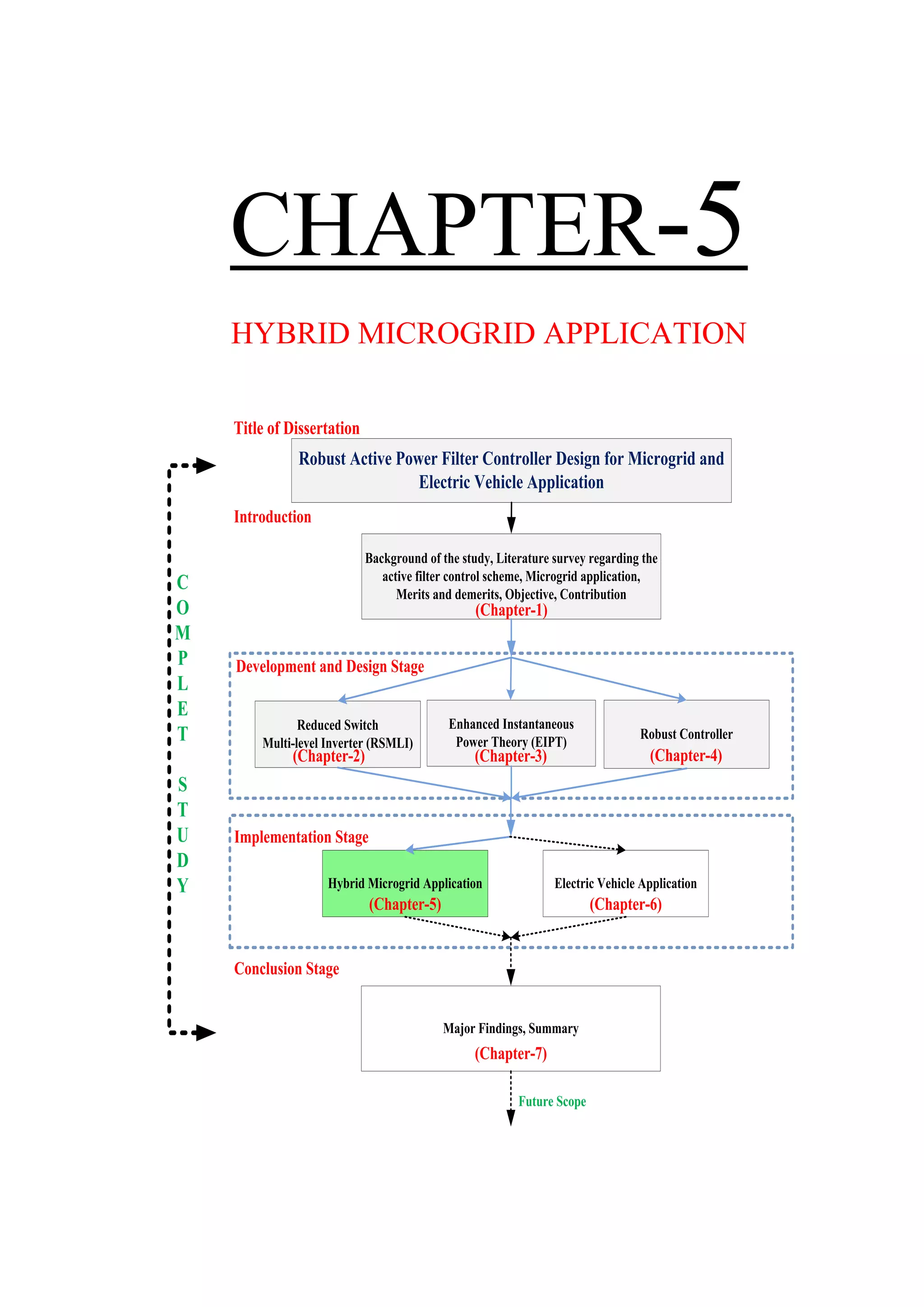
CHAPTER-5
HYBRID MICROGRID APPLICATION
Robust Active Power Filter Controller Design for Microgrid and
Electric Vehicle Application
Background of the study, Literature survey regarding the
active filter control scheme, Microgrid application,
Merits and demerits, Objective, Contribution
Introduction
(Chapter-1)
Robust Controller
(Chapter-4)
Major Findings, Summary
(Chapter-7)
Development and Design Stage
Implementation Stage
Conclusion Stage
Future Scope
C
O
M
P
L
E
T
S
T
U
D
Y
Reduced Switch
Multi-level Inverter (RSMLI)
Enhanced Instantaneous
Power Theory (EIPT)
(Chapter-2) (Chapter-3)
Hybrid Microgrid Application Electric Vehicle Application
(Chapter-5) (Chapter-6)
Title of Dissertation
CHAPTER-5
HYBRID MICROGRID APPLICATION
To support the overall objectives of Chapter-5, two individual studies are
formulated. The proposed test studies are:
1. Study-1: A Robust Control Approach for the Integration of DC-grid
based Wind Energy Conversion System (Section-5.2.1)
2. Study-2: A Novel Centralized Energy Management Approach for Power
Quality Improvement (Section-5.2.2)
Chapter-5
HYBRID MICROGRID APPLICATION
5.1 Introduction
High energy demand and increased population conditions motivate many electrical power
experts to get different sustainable solutions for an appropriate amount of energy production
by reducing the dependency on traditional energy production [154]. To regulate the PQ and
power reliability, solar array and wind energy-based distributed generators (DGs) are
prominent because of their smart characteristics such as availability, technological growth,
reduced installation cost, and environment-friendly nature [289]. However, the output results
of the hybrid microgrid systems (HMSs) are distorted due to the varying in atmospheric
conditions such as irradiance and temperature, and wind speed conditions [212]. Therefore,
to extract optimum power from the solar array and wind energy-based HMS, it is necessary
to emphasize the appropriate selection of the maximum power tracking (MPT) method.
Further, to suppress the voltage sag and swell conditions during the transient conditions, a
novel BES device-based energy management control technique is also required for HMS
operation.
Due to the advanced power electronic devices, BES, and infiltration of DC distributed
generations (DGs) like photovoltaic cells and fuel cells, the research is gaining interest in
DC-grid based systems. Many similar DC-grid based research outcomes are presented in
[290]. A novel design for a DC-grid based WECS is presented by comprised with a matrix
converter, high-frequency transformer and a single-phase ac/DC converter in [290-291].
However, for three-phase applications, the system complexity is increased exponentially
along with the cost. In [292], a DC-grid based wind farm is proposed with a cluster of four
WTs as a group and making each group attached to a converter for grid integration. However,
the sudden shutdown of one converter affects all the WTs performances and the system loses
its voltage and frequency synchronization. In [94,293-294], a hybrid ac-DC grid WECS is
suggested with both ac and DC networks attached by a bidirectional converter for similar
applications. Various hierarchical algorithms are implemented for the smoother power
transfer between ac and DC microgrid. However, the stoppage of one bidirectional converter
operation leads to the disconnection between ac and DC microgrid. Therefore, there is a
requirement for further study by which the ac output of WTs in a poultry farm is connected
to a common voltage at the DC-grid based microgrid for smooth and reliable operation.
241
Chapter-5 HYBRID MICROGRID APPLICATION
Multilevel inverter (MLI) plays a significant role in the case of high power and DG
applications. MLI facilitates sinusoidal output voltage with reduced harmonics, better
voltage regulation, and better power quality, mainly for its wider output voltage levels [295-
296]. Particularly to BES based on DG integration with the grid through MLIs; a lot of
research is devoted in recent times. In [297], the integration of multiple isolated DC-sources
by using a cascaded H-bridge inverter is proposed for generating a wider voltage level with
plasma stabilization. The issues regarding the integration of multiple rectifiers and balancing
the capacitor voltage are analyzed in [298]. A detailed study is presented in [15] for a wider
range of voltage levels and the load current switched through the capacitors. In this case, the
capacitor voltages are balanced to a required value by adjusting the path of load current
through the capacitor by choosing the redundant states for equal pole voltage. By combining
the concepts of [297] and [223], a floating cascaded inverter is presented in [299]. In [300],
the idea of cascading FCI with a neutral clamped inverter (NCI) is presented. Later it is
shown that the FCI generates more voltage levels by using the different combinations of
capacitors and switches [301-302]. However, in [301-302] the voltages of the capacitors are
not balanced instantaneously and the voltages are stable only for the fundamental
frequencies. Considering the above-related issues this study attempts with an objective to
design an HCMLI for distributed microgrid systems.
Recently, many power engineers have suggested different sustainable solutions for
designing an appropriate power management control (PMC) technique for HMS operation,
and among those literature few prominent techniques are discussed as follows. In [303], a
PMC approach is suggested for achieving a stable voltage and frequency operation in the
hybrid wind-solar battery system. However, the PMC approach is proposed for only single-
phase applications and also not focused on the reactive power support provision essential for
voltage regulation. In [304], for the similar hybrid wind-solar battery system, a different
PMC approach is suggested for optimizing the cost and size of the solar array and BES
without focusing the voltage and frequency stabilization. However, this technique has a
major limitation of requiring large historical data of the past 30 years to compute the power
production capability of wind and solar systems. In [223], as an improvement to [304], a
novel optimization technique is suggested for the wind-solar battery system. However, both
[304] and [223] give more emphasis on the size and cost estimation rather than the optimal
control strategy for better power regulation and synchronization with the grid. A novel PMC
technique based on the droop control strategy is suggested for availing better load sharing
operation between a similar solar-battery unit and other load stations [305]. In [306], as an
improvement to [305], a modified control technique is proposed by using different generating
power units. Though [305-306] successfully supplies the power demand with an improved
power regulation in the grid-forming mode of operation but fails to emphasize on the energy
supervision factor among the generation and load. Moreover, the above approaches are also
not considered DC-grid and load. Ref [307] suggests a supervised control strategy for the
hybrid solar-battery-hydropower system, in which the ac-grid voltage is regulated through
hydropower unit, and active and reactive power demand is fulfilled through solar-battery unit
respectively. A similar control strategy is also suggested for the solar-battery-diesel system
242
Chapter-5 HYBRID MICROGRID APPLICATION
[287]. However, in both [307, 287], the control technique is silent about the voltage and
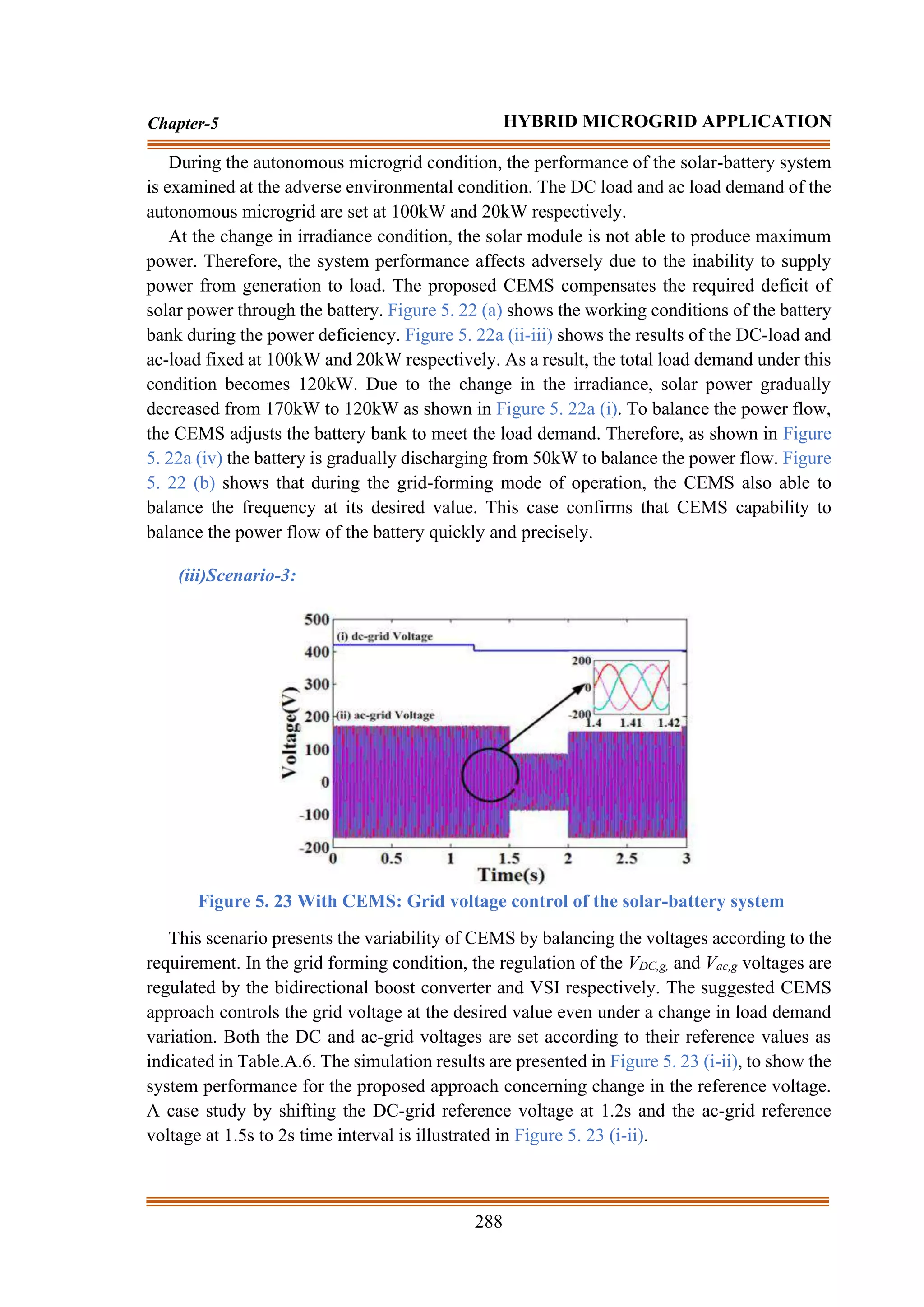
frequency control during the failure of the hydro/diesel power. During an autonomous solar
system, a distributed control approach for the above issues is studied during grid forming
mode conditions [308]. The above method is used to solve the load sharing problem with
multiple generators and battery stations. Similarly, in [309], a modified approach is used to
regulate the single-phase low voltage microgrid application during grid forming conditions.
None of the above-discussed proposals are considered the hybrid grid (ac/DC) conditions for
power-sharing between the ac/DC grid and the main grid. In [310], a centralized approach
based on one-day forecasting data is suggested for a grid following HMS. The integration of
the solar and battery to the ac-grid through a decentralized VSI is dissimilar from the
undertaken system arrangement in this study. An attempt based on dynamic controller and
ANN technique has been made in [310-312] for appropriate power prediction of the DGs and
better power management. In [313], for a similar solar-battery based system, low pass filter
(LPF) or high pass filter (HPF) and bandpass filter (BPF) devices are used to decrease the
lower order harmonics and extracts the fundamental component. However, as per the real-
application point of view, these solutions are not promising solutions to offer faster dynamic
and smoother filtering conditions. For better power regulation and quality, a novel inverter-
based technique is discussed with the traditional control techniques [314]. In [286-315], a
robust current shaping technique is suggested to offer optimum power regulation and power
quality in a hybrid microgrid system. However, the proposed approach fails to provide a
better energy management system looking at the SOC of the battery condition. In addition to
that, the proposed approach does not consider the effects of environmental change
conditions. In [316], optimal planning and design of HMS are used to compute the real power
losses during the weekday and weekend requirements. However, the proposed hybrid system
does not consider the DC-grid and the power transfer capability of the system. Due to the
absence of DC-grid, the direct connection of DC-load is impossible. With a motivation to
result in better power regulation and quality, by considering the above limitations for an
HMS, this study is extended further to design an appropriate centralized coordinated control
technique for better power management in both grid following and grid forming mode of
operation.
Therefore, this chapter is divided into three individual studies as study-1, and study-2, by
focusing on the main aim of RSMLI design and its control strategy through a robust
controller. By using the developed RSMLI and its control strategy, the RES-based hybrid
microgrid system is designed and its performances are also studied at different state
conditions. To test the performance of the designed parameters like inverter and robust
controller, HMSs are the best test systems during non-linear load applications. The main
contribution to the individual studies is presented as follows.
243
Chapter-5 HYBRID MICROGRID APPLICATION
Study-1: A Robust Control Approach for the Integration of DC-grid based
Wind Energy Conversion System
Major contribution:
• To design a novel control strategy based on an IPT control approach for computing the
optimal reference current for HCMLI operation.
• To design an advanced current decomposition control approach for computing separately
the unbalanced and decoupled component for harmonic mitigation.
• To integrate HCMLI in a battery-WECS based poultry farm for better power quality and
voltage regulation.
• To generate the required 17-level voltage through HCMLI by using a single DC-supply
and to offer back to back operation in the microgrid applications.
• To achieve multiple parallel operations of the WTs in the DC-grid based WECS for
poultry farm application.
Study-2: A Novel Centralized Energy Management Approach for Power
Quality Improvement
Major contribution:
• A novel CEMS is suggested to facilitate reliable and efficient power regulation in a solar-
battery based HMS.
• A novel control approach is suggested to offer a smooth power transfer in between during
the transition period, and quickly balance the energy flow in HMS.
• To extract optimum solar output power and compensate the power deficit situations, two
novel controllers as DGC and ESC are proposed respectively.
• To reduce the lower order harmonics, a mathematical approach is suggested for average
power calculation rather than using LPF, HPF, and BPF.
• A novel VFC for a solar-battery based HMS is suggested to facilitate the bidirectional
active and reactive power support by which the coordination between the voltage and
frequency with the consumer load variation is improved.
• A DC-grid based system is proposed for direct DC-load integration.
5.2 Detailed Modeling and Performance Study
In this section, the detailed mathematical modeling and design of the above-discussed
advanced controller and RSMLI topologies are applied for the hybrid microgrid system. The
hybrid microgrid is designed by combining the ac and DC microgrid applications. The
detailed system modeling and power flow studies are discussed in the following sections
during non-linear and unbalanced load integration. In addition to that, the major findings of
the proposed undertaken studies are also discussed below.
244
Chapter-5 HYBRID MICROGRID APPLICATION
5.2.1 Study-1: A Robust Control Approach for the Integration of DC-grid based Wind
Energy Conversion System
5.2.1.1 Detailed Modelling of Complete System
(a) System Organization:
0.575kV
0.575kV/22kV
22kV/120kV
22kV
30km
Wind Turbine (WT)
AC Distribution Grid (DG)
Grid
Converter-1
10kW
PMSG-1
10kW
PMSG-2
10kW
PMSG-3
10kW
PMSG-4
Battery
HCMLI
HCMLI
Non-linear
Load-2
40kW
MLI-1
40kW
MLI-2
40Kw Buck-Boost
converter
22kV
22kV/
0.575kV
Trnsformer
R
R
R
R
Y
Y
Y
Y
B
B
B
B
S11 S15
S13
S14 S16 S12
S21 S23 S25
S24 S26
S22
S31 S33 S35
S34 S36 S32
S41 S43 S45
S44 S46 S42
Sb1
Sb2
C1
C2
C3
C4
Vdc1
Vdc2
Vdc3
Vdc4
Lf1
Lf2
Cf1
Cf2
DC-grid
C5
CB
CB
Sw
Lb
Ig,abc
IL1,abc
IL2,abc
Iinv1,abc
Iinv2,abc
PCC
Ib
LL RL
CB
Converter-2
Converter-3
Converter-4
Non-linear
Load-1
Complete system
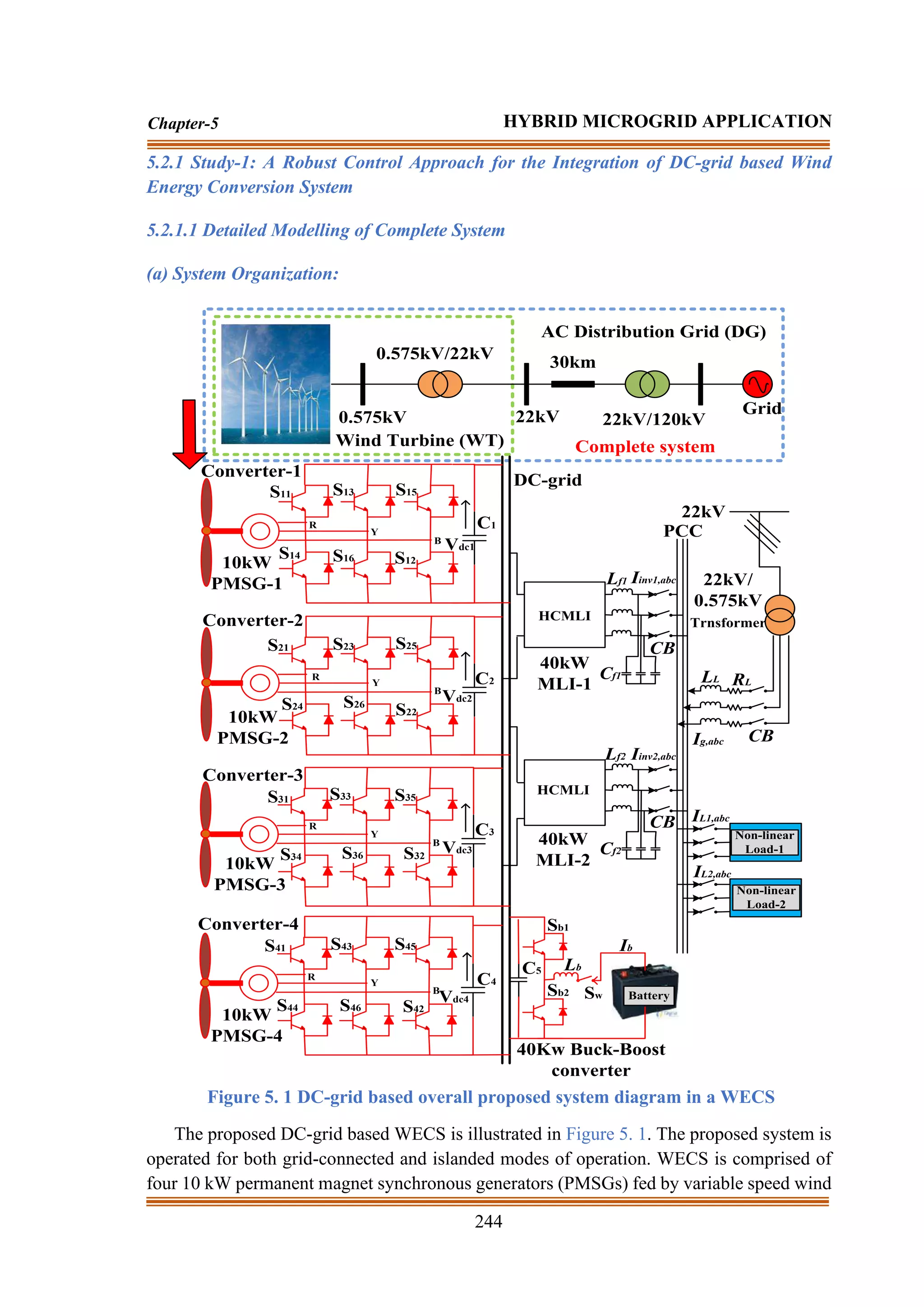
Figure 5. 1 DC-grid based overall proposed system diagram in a WECS
The proposed DC-grid based WECS is illustrated in Figure 5. 1. The proposed system is
operated for both grid-connected and islanded modes of operation. WECS is comprised of
four 10 kW permanent magnet synchronous generators (PMSGs) fed by variable speed wind
245
Chapter-5 HYBRID MICROGRID APPLICATION
turbines (WTs), four three-phase ac-DC voltage source converters connected to each of the
PMSG outputs (converters 1, 2, 3, and 4), and two HCMLI (HCMLI-1, and HCMLI-2)
having the maximum 20kW capability each. A PMSG based WECS is chosen considering
the less cost factor, easy real-time implementation, and simple control structure due to the
absence of any DC excitation system. Proposed WECS decreases the requirements of
numerous inverters at the generating stations. The coordination of the power electronic
devices is monitored by the centralized energy management system (CEMS). Through a
centralized server, the CEMS checks and monitors the generation of wind power and
consumption of load power. CEMS also monitors and regulates both the inverter voltages to
an equal desired value for preventing excess circulating currents in between them. In addition
to that, CEMS is also responsible for other aspects of power management like unit
commitment, load forecasting, economic load dispatch, and better power quality, etc.
All key data like measuring the total area of the installation system by using smart meters,
tap positions of the transformers, and the movements of the circuit breakers (CBs) are sent
to the CEMS by using wire-line or wireless communications. The maximum wind power
(Popt,w) from each of the WTs is obtained as follows[212].
3
r
,
opt
opt
w
,
opt )
(
*
K
P 
= (5.1)
3
opt
opt
,
P
opt )
R
(
A
C
2
1
K


= (5.2)
R
v
*
opt
r
,
opt

 = (5.3)
where ‘Kopt’ is the optimum constant parameters, ‘ r
,
opt
 ’ is the optimum speed of the WT,
‘ opt
,
P
C ’ is the optimum turbine power coefficient, ‘  ’ is the density of air, ‘A’ is the swept
area of the rotor blade, ‘ opt
 ’ is the optimized tip speed ratio, ‘v’ is the speed of the wind,
and ‘R’ is the radius of the blade.
As shown in Fig.1 for the islanding mode of operation (IMO), a BES is integrated with
the WECS. The size of the battery is chosen as 80 Ah and linked with the DC-grid through
a 40kW bidirectional buck-boost converter [273]. The battery charging and discharging
operational mode is achieved during the grid-connected and islanded mode of operation
respectively. The energy constraint of the storage device is calculated based on state-of-
charge (SOC) limits and represented as:
SOCmin<SOC<SOCmax (5.4)
As presented in [317] and [274], the SOC of the BES is calculated through an estimation
method. During the fewer load demand, the battery will be charged by using the surplus
charge of the WTs and at high load demand or islanding conditions, the power is transmitted
from the battery.
246
Chapter-5 HYBRID MICROGRID APPLICATION
(b)Operation of the System:
During the grid-connected mode of operation (GMO), the WTs are responsible for
supplying the generated power to the loads without giving an extra burden to the distribution
grid. BES can be controlled to attain the load side requirement depending on the time of use
of electricity and the SOC of the battery [278-279].
During the islanded mode of operation (IMO), the CB is used to detach the microgrid
from the grid. In this case, the WTs and battery are the only existing sources to fulfill the
load demand. To balance the power, the battery is used to supply the deficit of active power
into the system. The power balance equations are represented as:
PWTs + Pbat = PL, syst + PL (5.5)
where PWTs is the active power of the WT. Pbat is the battery active power which is subjected
to the constraints of the battery maximum power (Pbat,max) that can be distributed at the
discharging mode of operation (Pbat<Pbat,max ). PL,syst and PL denote the power loss, and load
power respectively.
(c) Proposed HCMLI Topology:
SA1 SA2 SA3 SA4 SA5 SA6 SA7 SA8
SA1` SA2` SA3` SA4` SA5` SA6` SA7` SA8`
SB1 SB2 SB3 SB4 SB5 SB6 SB7 SB8
SB1` SB2` SB3` SB4` SB5` SB6` SB7` SB8`
SC1 SC2 SC3 SC4 SC5 SC6 SC7 SC8
SC1` SC2` SC3` SC4` SC5` SC6` SC7` SC8`
AC1 AC2 AC3 AC4
BC1 BC2 BC3 BC4
CC1 CC2 CC3 CC4
2
/
Vdc
2
/
Vdc
2
/
Vdc
4
/
Vdc
4
/
Vdc
4
/
Vdc
8
/
Vdc 16
/
Vdc
8
/
Vdc
8
/
Vdc
16
/
Vdc
16
/
Vdc
Lf
dc
V
Figure 5. 2 Schematic diagram of proposed HCMLI
The proposed HCMLI is designed with cascading a 3-level FCI and three floating
capacitor H-bridges. The 3-phase17-level HCMLI schematic diagram is illustrated in Figure
5. 2. As shown in Figure 5. 2, phase-A contains the switch pairs as [( 1
SA , 
1
SA ), ( 2
SA , 
2
SA ),
( 3
SA , 
3
SA ), ( 4
SA , 
4
SA ), ( 5
SA , 
5
SA ), ( 6
SA , 
6
SA ), ( 7
SA , 
7
SA ) and ( 8
SA , 
8
SA )], phase-B
contains the switch pairs as [( 1
SB , 
1
SB ), ( 2
SB , 
2
SB ), ( 3
SB , 
3
SB ), ( 4
SB , 
4
SB ), ( 5
SB , 
5
SB ), ( 6
SB ,

6
SB ), ( 7
SB , 
7
SB ) and ( 8
SB , 
8
SB )], and phase-C contains the switch pairs 9 as [( 1
SC , 
1
SC ), ( 2
SC ,
247
Chapter-5 HYBRID MICROGRID APPLICATION

2
SC ), ( 3
SC , 
3
SC ), ( 4
SC , 
4
SC ), ( 5
SC , 
5
SC ), ( 6
SC , 
6
SC ), ( 7
SC , 
7
SC ) and ( 8
SC , 
8
SC )] respectively.
The proposed hybrid inverter contains four capacitors in each phase like ( 1
AC , 2
AC , 3
AC , and
4
AC ), ( 1
BC , 2
BC , 3
BC , and 4
BC ), and ( 1
CC , 2
CC , 3
CC , and 4
CC ) respectively. As indicated in
Figure 5. 2, the pole voltages of the capacitors 1
AC , 1
BC , and 1
CC are fixed at the voltage level
of VDC/2, capacitors 2
AC , 2
BC , and 2
CC are fixed at the voltage level of VDC/4, capacitors 3
AC ,
3
BC , and 3
CC are fixed at the voltage level of VDC/8, and capacitors 4
AC , 4
BC , and 4
CC are
fixed at the voltage level of VDC/16 respectively.
In this topology, each of the cascaded H-bridges (CHBs) voltages can be added or
subtracted to the voltage of the previous stage. HCMLI voltage levels are determined by
adding the voltages of each stage of the inverter. Each pair of the switch contains two
different logic states as the top device are ON (indicated as ‘✓’) and the bottom device is
OFF (indicated as ‘’). For the above switching states, there are 256 (28
) switching
combinations are possible for the inverter operation. The voltage levels of HCMLI can be
determined by using one or more switching combinations (pole voltage redundancies). In the
case of the same pole voltages, by using the redundant switching combinations, the
capacitor’s current can be changed and the voltages of the capacitors can be controlled to
their set values. By using the above combinations, the balanced capacitor voltages at all load
currents and power factors instantly have been studied for 17 voltage levels. The voltage
levels are 0, VDC/16, 2VDC/16, 3VDC/16, 4VDC/16, 5VDC/16, 6VDC/16, 7VDC/16, 8VDC/16,
9VDC/16, 10VDC/16, 11VDC/16, 12VDC/16, 13VDC/16, 14VDC/16, 15VDC/16, and VDC.
The HCMLI generates the 17-level output voltage by using 82 switching arrangements
as indicated in Chapter-5 Appendix-1 (Table.A.5). For positive current, the effect of 82
switching arrangements on every capacitor charging and discharging conditions (during that
period the pole is the source current as indicated in Figure 5. 3) is illustrated in the Chapter-
5 Appendix-1 (Table.A.5). For the negative current, the switching arrangements on the
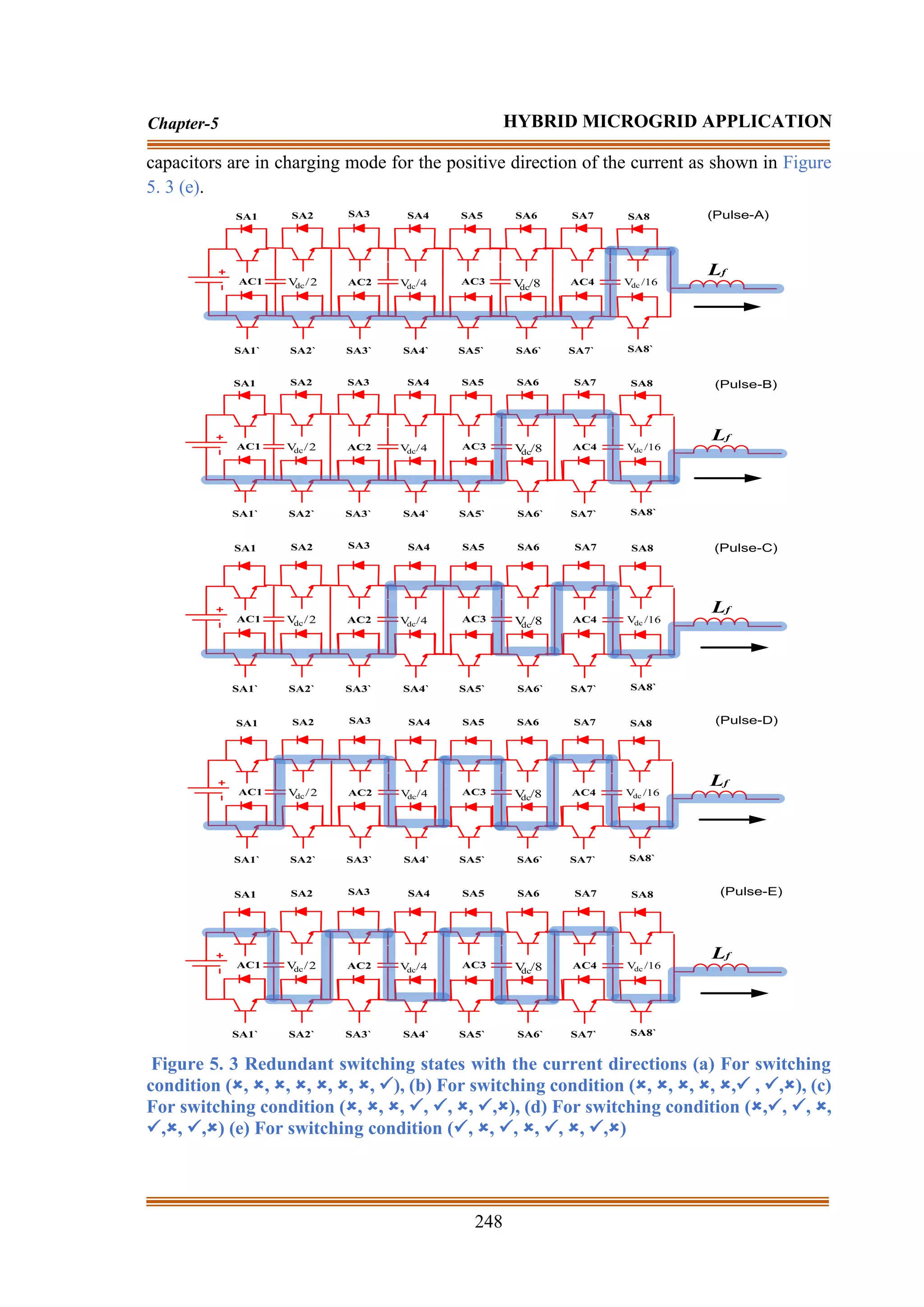
capacitors are changed accordingly. For example, while the controller needs a pole voltage
of VDC/16, in HCMLI five unlike redundant switching arrangements are possible as indicated
in Figure 5. 3. Each switching arrangement has a different outcome on the state charge of the
capacitors. In Figure 5. 3 (a), at (, , , , , , , ✓) switching state (as shown in
Table.A.5), the capacitor C4 is at discharging mode. To balance the C4 voltage and to fetch
the voltage at its set value (VDC/16), one of the other four switching arrangements is selected
as shown in Figure 5. 3 (b-e). As shown in Figure 5. 3 (b), for (, , , , , ✓, ✓, )
switching state, the current direction of C4 is reversed and the capacitor C4 is charged.
However, due to the above switching state, the capacitor C3 is discharged. As illustrated in
Figure 5. 3 (c), to charge C3 and to balance the pole voltage, the switching redundancy (,
, , ✓, ✓, , ✓,) is chosen. Similarly, due to the charging of C3, C2 is discharged. Based
on the C1 charging condition, to charge C2 one of the switching arrangements is chosen
between Figure 5. 3 (d) and Figure 5. 3 (e). If the switching arrangement is (,✓, ✓, , ✓,,
✓,), the C1 is in the discharging mode and the state of charge of all other capacitors is shown
in Figure 5. 3 (d). Finally, for the switching combinations (✓,,✓, , ✓, , ✓,), all the
248
Chapter-5 HYBRID MICROGRID APPLICATION
capacitors are in charging mode for the positive direction of the current as shown in Figure
5. 3 (e).
SA1 SA2 SA3 SA4 SA5 SA6 SA7 SA8
SA1` SA2` SA3` SA4` SA5` SA6` SA7` SA8`
AC1 AC2 AC3 AC4
2
/
V
dc 4
/
V
dc 8
/
V
dc
16
/
V
dc
Lf
(Pulse-A)
SA1 SA2 SA3 SA4 SA5 SA6 SA7 SA8
SA1` SA2` SA3` SA4` SA5` SA6` SA7` SA8`
AC1 AC2 AC3 AC4
2
/
V
dc 4
/
V
dc 8
/
V
dc
16
/
V
dc
Lf
(Pulse-B)
SA1` SA2` SA3` SA4` SA5` SA6` SA7` SA8`
AC1 AC2 AC3 AC4
2
/
V
dc 4
/
V
dc 8
/
V
dc
16
/
V
dc
Lf
SA1 SA2 SA3 SA4 SA5 SA6 SA7 SA8 (Pulse-C)
SA1` SA2` SA3` SA4` SA5` SA6` SA7` SA8`
AC1 AC2 AC3 AC4
2
/
V
dc 4
/
V
dc 8
/
V
dc
16
/
V
dc
Lf
SA1 SA2 SA3 SA4 SA5 SA6 SA7 SA8 (Pulse-D)
SA1` SA2` SA3` SA4` SA5` SA6` SA7` SA8`
AC1 AC2 AC3 AC4
2
/
V
dc 4
/
V
dc 8
/
V
dc
16
/
V
dc
Lf
SA1 SA2 SA3 SA4 SA5 SA6 SA7 SA8 (Pulse-E)
Figure 5. 3 Redundant switching states with the current directions (a) For switching
condition (, , , , , , , ✓), (b) For switching condition (, , , , ,✓ , ✓,), (c)
For switching condition (, , , ✓, ✓, , ✓,), (d) For switching condition (,✓, ✓, ,
✓,, ✓,) (e) For switching condition (✓, , ✓, , ✓, , ✓,)
249
Chapter-5 HYBRID MICROGRID APPLICATION
To achieve a positive current direction through the redundant switching arrangement at
VDC/16 pole voltage, all the capacitors pole voltage maintain at their set values. If all the
capacitors need to be at discharging mode, at first C4 is discharged. Then the rest of the
capacitors are discharged during successive switching sequences and during that time C4 is
at the charging state. For a negative current direction, the capacitor voltage is in the opposite
direction. Similarly, for all the pole voltages, the switching arrangements are illustrated in
Chapter-5 Appendix-1 (Table.A.5).
5.2.1.2 Control Approach:
As shown in Figure 5. 1, by using HCMLI and NIPT approach, the DC-grid based WECS
offers the parallel operation of multiple WGs. The proposed approach is controlled in a
coordinated manner. All the system parameters such as inverter, converter, and battery
storage devices are co-ordinately operated to control the system performance. The planned
system control depends upon the three coordinated control strategies such as ac-DC converter
control, battery storage device control, and HCMLI control. The respective coordinated
control strategies are analyzed below.
(a) Control Approach for the ac-DC Converter:
PI
Regulator
dc
V
+
_
a
,
g
I
LPF
ref
,
dc
V
b
,
g
I
c
,
g
I
abc
dq
+
_
+
_
0
I*
q =
dq
abc
PI
Regulator PWM
*
d
I
act
d
I
act
q
I
d
I

q
I

e
,
dc
V
ac-grid current
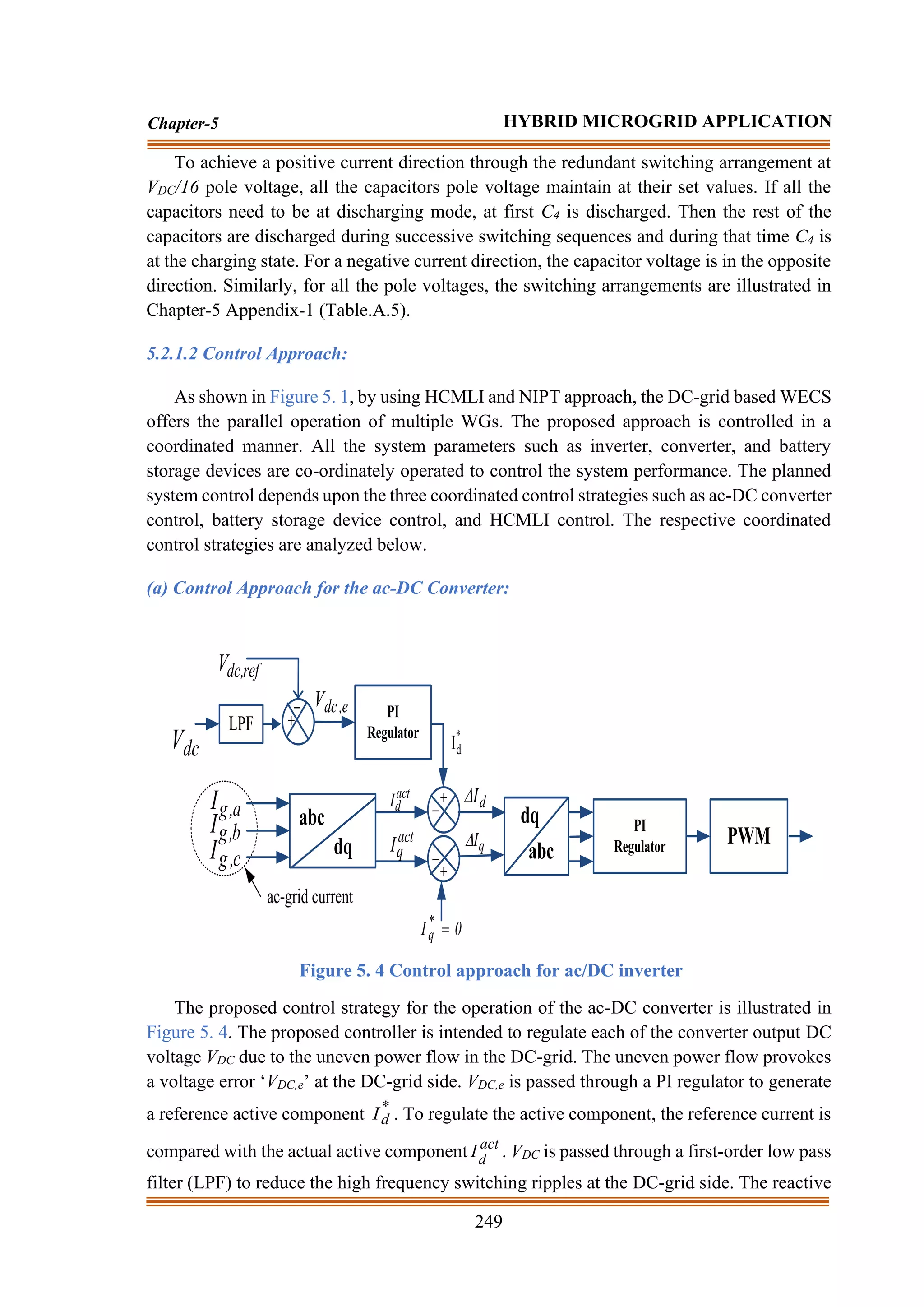
Figure 5. 4 Control approach for ac/DC inverter
The proposed control strategy for the operation of the ac-DC converter is illustrated in
Figure 5. 4. The proposed controller is intended to regulate each of the converter output DC
voltage VDC due to the uneven power flow in the DC-grid. The uneven power flow provokes
a voltage error ‘VDC,e’ at the DC-grid side. VDC,e is passed through a PI regulator to generate
a reference active component *
d
I . To regulate the active component, the reference current is
compared with the actual active component act
d
I . VDC is passed through a first-order low pass
filter (LPF) to reduce the high frequency switching ripples at the DC-grid side. The reactive
250
Chapter-5 HYBRID MICROGRID APPLICATION
current is controlled to be zero by which the PMSG can deliver only active power. By
analyzing the reference and the actual values of current, the current error signal d
I
 and q
I

are computed. Then by using the dq-abc transformation, the corresponding error signal is
given as input to the repetitive controller to produce the appropriate pulse width modulation
(PWM) signal [154]. Due to the use of a constant wind speed ventilation fan, the wind speed
is constant all the time. Therefore, the proposed ac-DC converter approach easily eliminates
the need of maximum power point (MPP) strategies for the regulation of speed and
electromagnetic torque of the wind turbine. Due to the elimination of MPP strategies, the ac-
DC converter control strategies become simpler and reduce the computational burden easily.
(b) Control Approach for Battery Energy Storage (BES) Device:
*
bat
P
bat
P
+
-
+
-
demand
,
g
P
*
g
P
*
g
demand
,
g Q
Q =
2
gq
2
gd
gq
*
gd
*
*
q
2
gq
2
gd
gq
*
gd
*
*
d
V
V
V
P
V
Q
I
V
V
V
Q
V
P
I
+
−
=
+
−
=
*
d
I
*
q
I
+
-
abc
,
g
V
abc
dq
gd
V
gq
V
Total
,
WT
P
+
-
ref
,
dcg
V
+
-
LPF
g
,
dc
V
PI
abc
dq
PWM
1
S
2
S
e
,
dc
V
d
I
e
,
d
I
rest
P
e
,
b
P
Figure 5. 5 Control approach for BES
The BES control strategies mostly depend upon the DC-link voltage of the DC-grid, battery
SOC conditions, and grid/load demand. The complete control structure of BES is presented
in Figure 5. 5. Therefore, to increase battery durability, it is necessary to regulate the SOC
of the battery during GMO and IMO conditions. The detailed SOC management schemes are
presented in [273-278]. In the proposed approach, the reference battery power ( *
bat
P ) is
selected as per the SOC limit during both GMO and IMO conditions. At first, the grid active
and reactive power demand ( demand
,
g
P ) is fulfilled by the total generated power ( Total
,
WT
P
) of the wind turbine. According to the higher and lower limit of battery SOC, the charging
and discharging conditions are set. By comparing the rest power demand ( rest
P ) and battery
power error ( e
,
b
P ), the reference active grid power ( *
g
P ) is computed. The reactive power
demand ( demand
,
g
Q ) of the grid is equal to the reference reactive power ( *
g
Q ) of the system.
251
Chapter-5 HYBRID MICROGRID APPLICATION
After getting reference active and reactive power, the obtained powers are converted to
reference dq current component ( *
d
I and *
q
I ) [278]. The ac-load is connected to the ac-grid.
At the time of IMO, the ac-grid is detached from the main grid. To properly avail the charging
and discharging condition, the DC-grid information is also essential. Therefore, DC-grid
voltage ( g
,
dc
V ) is compared with the total DC-grid reference ref
,
dcg
V voltage, to generate
the appropriate voltage error ( e
,
dc
V ). e
,
dc
V is passed through the PI regulator, to generate
the linear active current component ( d
I ). The d
I is compared with *
d
I , to generate the error
in the active current component ( e
,
d
I ). After generating e
,
d
I and *
q
I component, the current
components are transformed to abc current component for generating appropriate pulses for
the battery converter operation.
(c) Control Approach for a DC-ac Inverter:
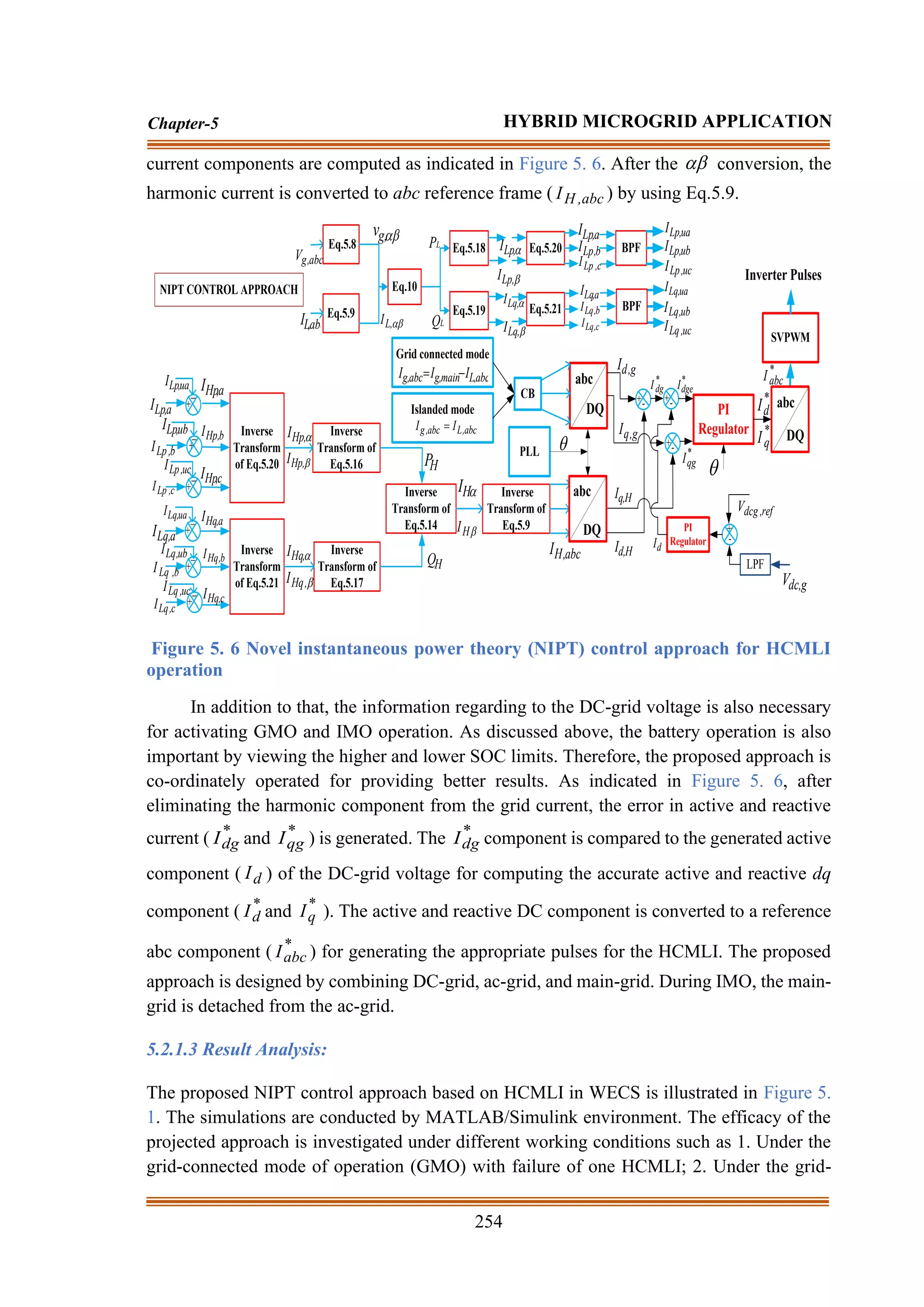
The proposed NIPT approach is adopted for the inverter operation by generating the
actual reference current signal. The proposed approach easily separates the harmonics and
unbalanced components as shown in Figure 5. 6. After easily separating the oscillating
component, the positive sequence current component is used to generate the pulses for
HCMLI operation. The current component of the load and the voltage component of the grid
is transformed by the 
−
abc transformation as follows.










=




























−
−
−
=
0
g
g
g
0
0
g
g
g
abc
,
g
V
V
V
C
V
V
V
2
1
2
3
2
1
2
1
2
3
2
1
2
1
0
1
3
2
V 




(5.6)










=
0
,
L
,
L
,
L
0
abc
,
L
I
I
I
C
I 

 (5.7)
The  component of the grid voltage ( 
,
g
V , 
,
g
V ), and the load current ( 
,
l
I , 
,
l
I ) are
computed by neglecting the zero sequence components and represented as:










=






















−
−
−
=





 −
c
,
g
b
,
g
a
,
g
1
c
,
g
b
,
g
a
,
g
,
g
,
g
V
V
V
C
V
V
V
2
3
2
3
0
2
1
2
1
1
3
2
V
V



(5.8)










=





 −
c
,
L
b
,
L
a
,
L
1
,
L
,
L
I
I
I
C
I
I



(5.9)
252
Chapter-5 HYBRID MICROGRID APPLICATION
Neglecting the zero sequence components, the voltage V and current I vector of the
system can be expressed as:

 jV
V
V +
= (5.10)

 jI
I
I +
= (5.11)
The instantaneous power is obtained as:
)
I
V
I
V
(
j
)
I
V
I
V
(
)
jI
I
(
)
jV
V
(
I
V
S *
PQ 










 −
+
+
=
−
+
+
=

= (5.12)
From the above equation, the instantaneous active ( inst
P ) and reactive power ( inst
Q )
component of the system is determined by:












−
=












I
I
V
V
V
V
Q
P
inst
inst
(5.13)
Inverse transform of Eq.5.13 results as:












−
+
=






inst
inst
2
2 Q
P
V
V
V
V
V
V
1
I
I








(5.14)
The right side of Eq.5.14 can be represented as:












−
+
+












−
+
=






inst
2
2
inst
2
2 Q
0
V
V
V
V
V
V
1
0
P
V
V
V
V
V
V
1
I
I














(5.15)
The active current component ‘ 
,
P
I and 
,
P
I ’ and the reactive current component ‘

,
Q
I and 
,
Q
I ’ can be calculated as:












−
+
=






0
P
V
V
V
V
V
V
1
I
I inst
2
2
,
P
,
P








(5.16)












−
+
=






inst
2
2
,
Q
,
Q
Q
0
V
V
V
V
V
V
1
I
I








(5.17)
By using the source voltage abc
,
g
V and load current from the non-linear load abc
,
L
I , the
oscillating active power L
P and reactive power L
Q are computed from Eq.5.13. The active
 oscillating load current ( 
,
LP
I and 
,
LP
I ) and reactive oscillating load current ( 
,
LQ
I
and 
,
LQ
I ) components are computed from Eq.5.16 and Eq.5.17 respectively. The 
,
LP
I ,

,
LP
I , 
,
LQ
I and 
,
LQ
I can be represented as:












−
+
=






0
P
V
V
V
V
V
V
1
I
I L
,
g
,
g
,
g
,
g
2
2
,
LP
,
LP








(5.18)












−
+
=






L
,
g
,
g
,
g
,
g
2
2
,
LQ
,
LQ
Q
0
V
V
V
V
V
V
1
I
I








(5.19)
253
Chapter-5 HYBRID MICROGRID APPLICATION
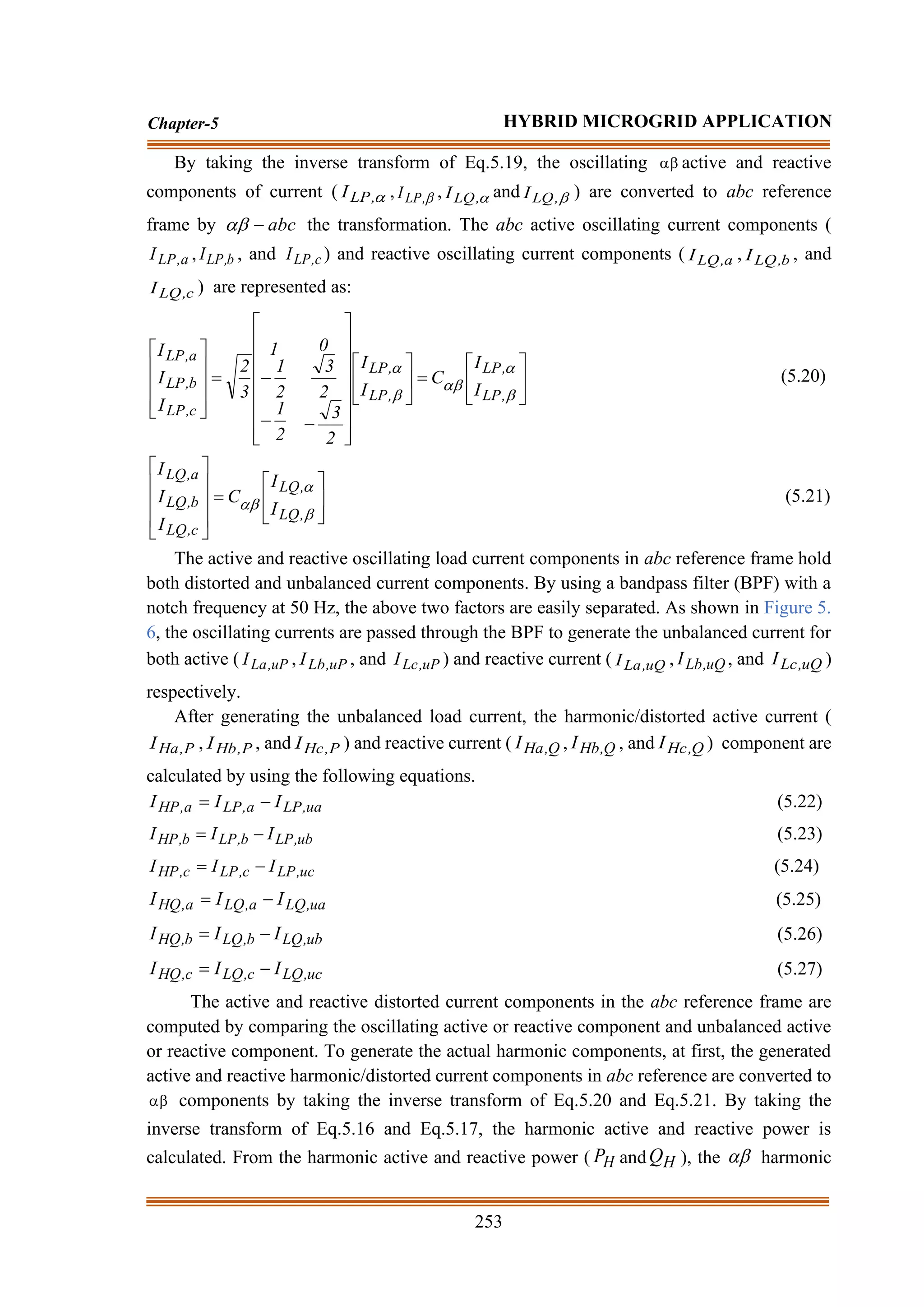
By taking the inverse transform of Eq.5.19, the oscillating  active and reactive
components of current ( 
,
LP
I , 
,
LP
I , 
,
LQ
I and 
,
LQ
I ) are converted to abc reference
frame by abc
−
 the transformation. The abc active oscillating current components (
a
,
LP
I , b
,
LP
I , and c
,
LP
I ) and reactive oscillating current components ( a
,
LQ
I , b
,
LQ
I , and
c
,
LQ
I ) are represented as:






=






















−
−
−
=















,
LP
,
LP
,
LP
,
LP
c
,
LP
b
,
LP
a
,
LP
I
I
C
I
I
2
3
2
3
0
2
1
2
1
1
3
2
I
I
I
(5.20)






=













,
LQ
,
LQ
c
,
LQ
b
,
LQ
a
,
LQ
I
I
C
I
I
I
(5.21)
The active and reactive oscillating load current components in abc reference frame hold
both distorted and unbalanced current components. By using a bandpass filter (BPF) with a
notch frequency at 50 Hz, the above two factors are easily separated. As shown in Figure 5.
6, the oscillating currents are passed through the BPF to generate the unbalanced current for
both active ( uP
,
La
I , uP
,
Lb
I , and uP
,
Lc
I ) and reactive current ( uQ
,
La
I , uQ
,
Lb
I , and uQ
,
Lc
I )
respectively.
After generating the unbalanced load current, the harmonic/distorted active current (
P
,
Ha
I , P
,
Hb
I , and P
,
Hc
I ) and reactive current ( Q
,
Ha
I , Q
,
Hb
I , and Q
,
Hc
I ) component are
calculated by using the following equations.
ua
,
LP
a
,
LP
a
,
HP I
I
I −
= (5.22)
ub
,
LP
b
,
LP
b
,
HP I
I
I −
= (5.23)
uc
,
LP
c
,
LP
c
,
HP I
I
I −
= (5.24)
ua
,
LQ
a
,
LQ
a
,
HQ I
I
I −
= (5.25)
ub
,
LQ
b
,
LQ
b
,
HQ I
I
I −
= (5.26)
uc
,
LQ
c
,
LQ
c
,
HQ I
I
I −
= (5.27)
The active and reactive distorted current components in the abc reference frame are
computed by comparing the oscillating active or reactive component and unbalanced active
or reactive component. To generate the actual harmonic components, at first, the generated
active and reactive harmonic/distorted current components in abc reference are converted to
 components by taking the inverse transform of Eq.5.20 and Eq.5.21. By taking the
inverse transform of Eq.5.16 and Eq.5.17, the harmonic active and reactive power is
calculated. From the harmonic active and reactive power ( H
P and H
Q ), the  harmonic
254
Chapter-5 HYBRID MICROGRID APPLICATION
current components are computed as indicated in Figure 5. 6. After the  conversion, the
harmonic current is converted to abc reference frame ( abc
,
H
I ) by using Eq.5.9.
Grid connected mode
Eq.5.9
abc
,
L
I 
L,
I
PL
QL
a
,
Lp
I
a
,
Lq
I
b
,
Lq
I
c
,
Lq
I
+
_
+
_
+
_
+
_
+
_
ua
,
Lp
I
ub
,
Lp
I
uc
,
Lp
I
ua
,
Lq
I
ub
,
Lq
I
uc
,
Lq
I
+
b
,
Lp
I
c
,
Lp
I
a
,
Hp
I
c
,
Hp
I
b
,
Hp
I
a
,
Hq
I
b
,
Hq
I
c
,
Hq
I
Inverse
Transform
of Eq.5.20
Inverse
Transform
of Eq.5.21
Inverse
Transform of
Eq.5.16
Inverse
Transform of
Eq.5.17

,
Hp
I

,
Hp
I

,
Hq
I

,
Hq
I
_
abc
,
g
V
Eq.5.8

g,
v
Eq.10
Eq.5.18
Eq.5.19

,
Lp
I

,
Lp
I

,
Lq
I

,
Lq
I
Eq.5.20
Eq.5.21
BPF
Inverse
Transform of
Eq.5.9
abc
,
H
I
Inverse
Transform of
Eq.5.14

H
I

H
I
abc
,
L
main
,
g
abc
,
g I
I
I −
=
ua
,
Lp
I
ub
,
Lp
I
uc
,
Lp
I
ua
,
Lq
I
ub
,
Lq
I
uc
,
Lq
I
a
,
Lp
I
b
,
Lp
I
c
,
Lp
I
a
,
Lq
I
b
,
Lq
I
c
,
Lq
I
BPF
DQ
abc
DQ
abc
PLL 
+-
+-
PI
Regulator
H
,
d
I
H
,
q
I
g
,
q
I
g
,
d
I

SVPWM
abc
DQ
Inverter Pulses
NIPT CONTROL APPROACH
*
q
I
*
d
I
*
abc
I
H
P
H
Q
g
,
dc
V
LPF
ref
,
dcg
V
+
-
PI
Regulator
+-
Islanded mode
abc
,
L
abc
,
g I
I =
CB
*
dg
I
*
qg
I
*
dge
I
d
I
Figure 5. 6 Novel instantaneous power theory (NIPT) control approach for HCMLI
operation
In addition to that, the information regarding to the DC-grid voltage is also necessary
for activating GMO and IMO operation. As discussed above, the battery operation is also
important by viewing the higher and lower SOC limits. Therefore, the proposed approach is
co-ordinately operated for providing better results. As indicated in Figure 5. 6, after
eliminating the harmonic component from the grid current, the error in active and reactive
current ( *
dg
I and *
qg
I ) is generated. The *
dg
I component is compared to the generated active
component ( d
I ) of the DC-grid voltage for computing the accurate active and reactive dq
component ( *
d
I and *
q
I ). The active and reactive DC component is converted to a reference
abc component ( *
abc
I ) for generating the appropriate pulses for the HCMLI. The proposed
approach is designed by combining DC-grid, ac-grid, and main-grid. During IMO, the main-
grid is detached from the ac-grid.
5.2.1.3 Result Analysis:
The proposed NIPT control approach based on HCMLI in WECS is illustrated in Figure 5.
1. The simulations are conducted by MATLAB/Simulink environment. The efficacy of the
projected approach is investigated under different working conditions such as 1. Under the
grid-connected mode of operation (GMO) with failure of one HCMLI; 2. Under the grid-
255
Chapter-5 HYBRID MICROGRID APPLICATION
connected mode of operation with the integration of AC-DC converter; 3. Under the islanded
mode of operation (IMO). The system parameters considered in the simulation are
enumerated in the Appendix. The detailed data related to the distribution line are taken from
[287].
(a) First Scenario:
(a)
256
Chapter-5 HYBRID MICROGRID APPLICATION
(b)
(c)
257
Chapter-5 HYBRID MICROGRID APPLICATION
(d)
(e)
258
Chapter-5 HYBRID MICROGRID APPLICATION
(f)
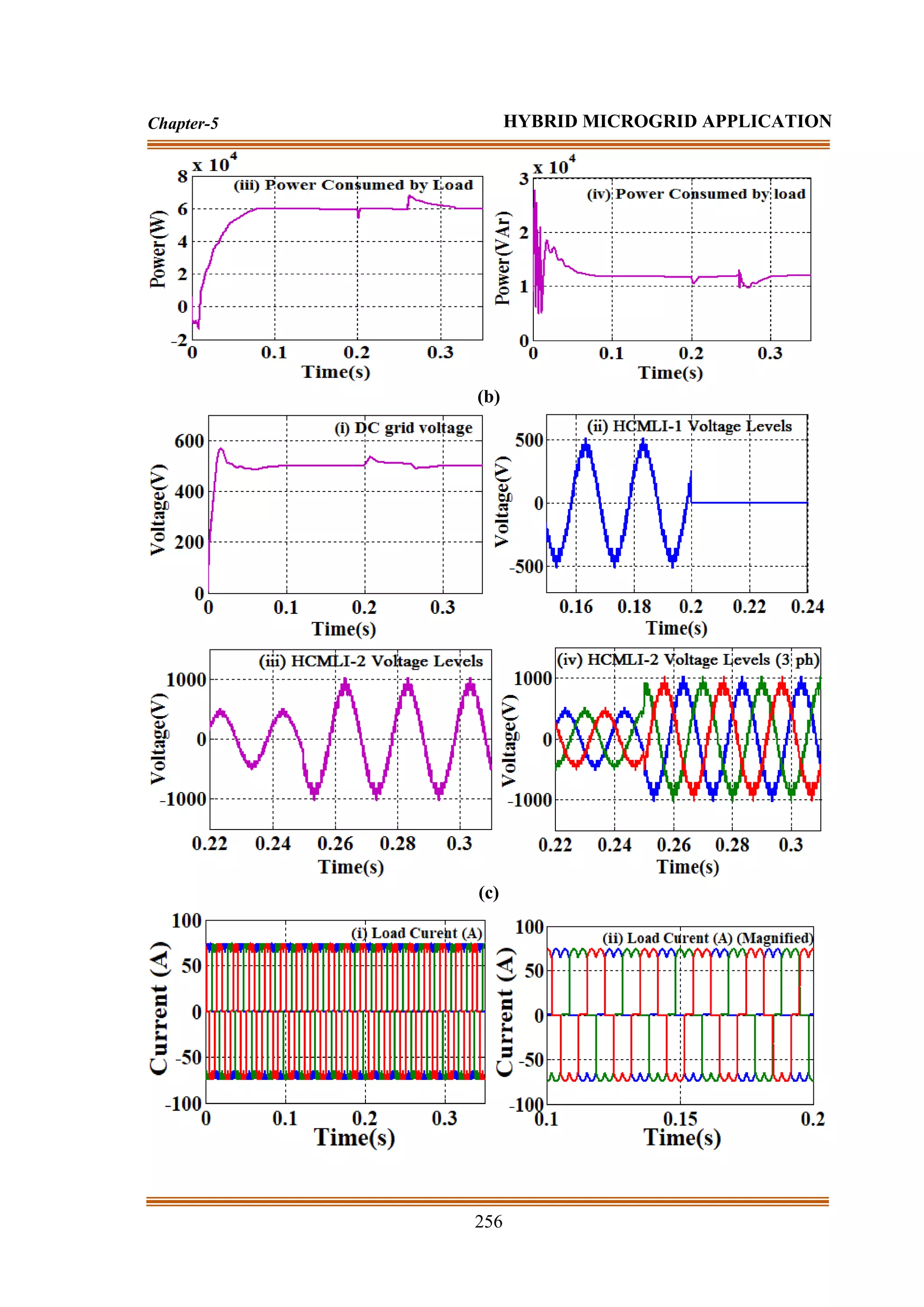
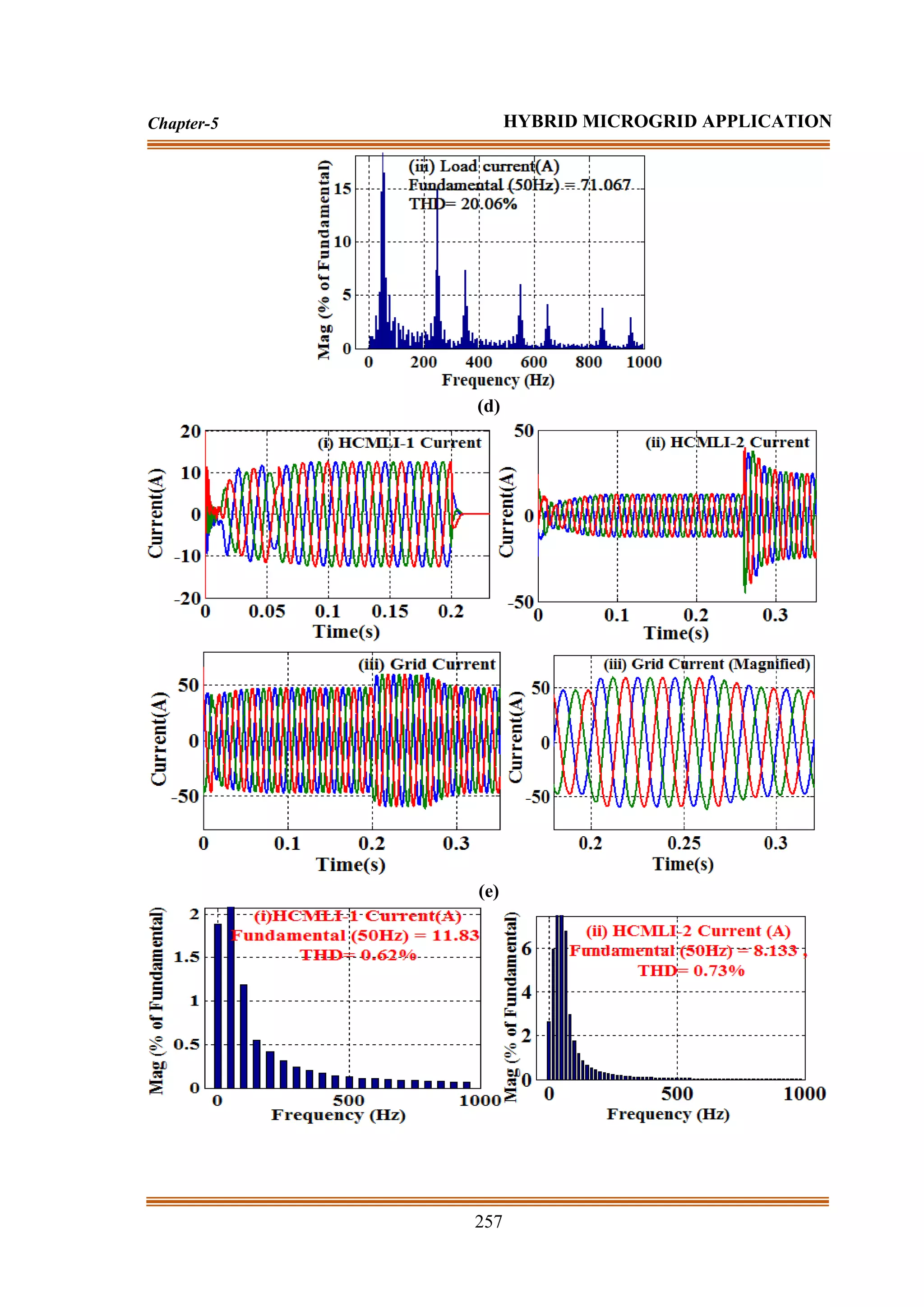
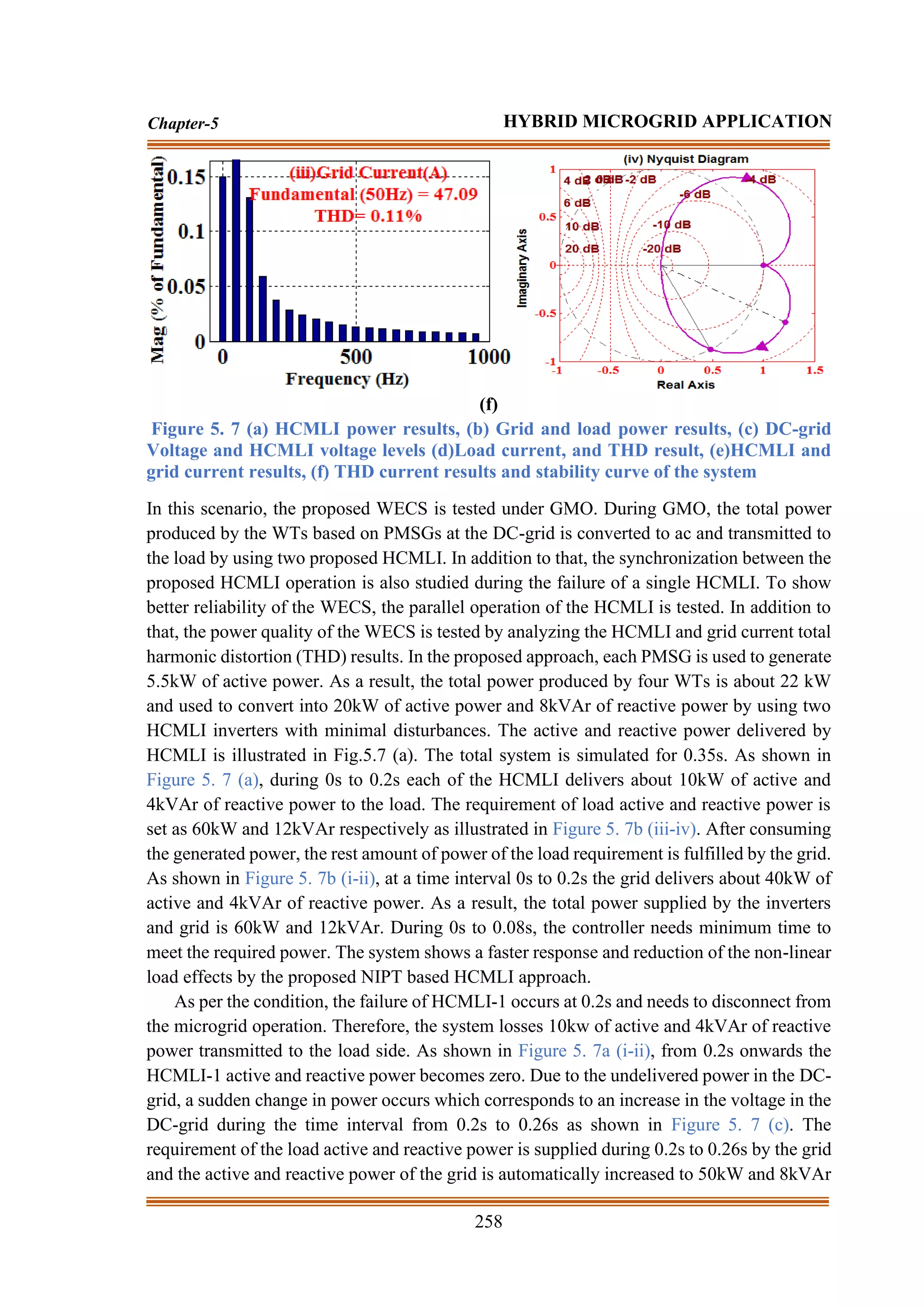
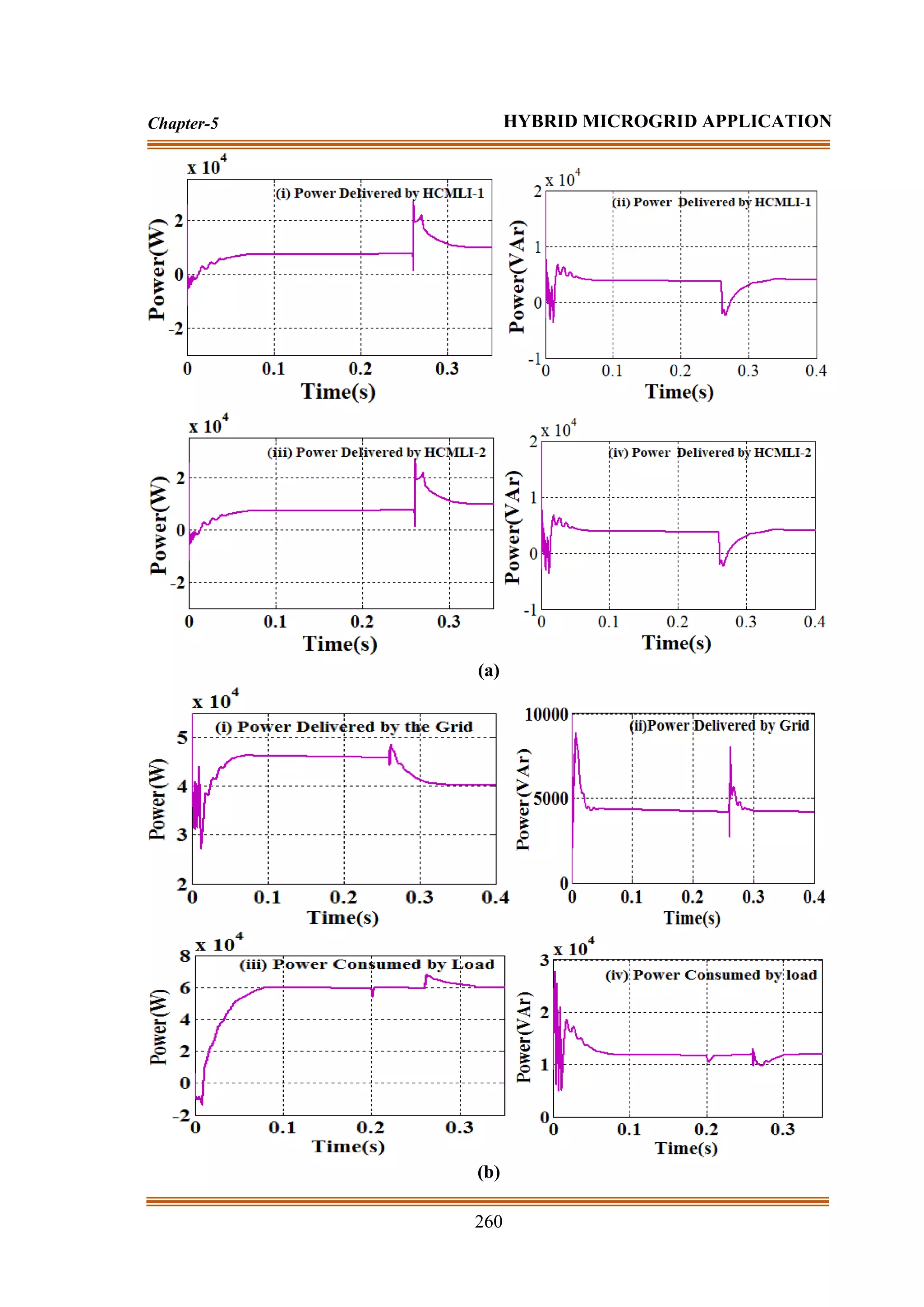
Figure 5. 7 (a) HCMLI power results, (b) Grid and load power results, (c) DC-grid
Voltage and HCMLI voltage levels (d)Load current, and THD result, (e)HCMLI and
grid current results, (f) THD current results and stability curve of the system
In this scenario, the proposed WECS is tested under GMO. During GMO, the total power
produced by the WTs based on PMSGs at the DC-grid is converted to ac and transmitted to
the load by using two proposed HCMLI. In addition to that, the synchronization between the
proposed HCMLI operation is also studied during the failure of a single HCMLI. To show
better reliability of the WECS, the parallel operation of the HCMLI is tested. In addition to
that, the power quality of the WECS is tested by analyzing the HCMLI and grid current total
harmonic distortion (THD) results. In the proposed approach, each PMSG is used to generate
5.5kW of active power. As a result, the total power produced by four WTs is about 22 kW
and used to convert into 20kW of active power and 8kVAr of reactive power by using two
HCMLI inverters with minimal disturbances. The active and reactive power delivered by
HCMLI is illustrated in Fig.5.7 (a). The total system is simulated for 0.35s. As shown in
Figure 5. 7 (a), during 0s to 0.2s each of the HCMLI delivers about 10kW of active and
4kVAr of reactive power to the load. The requirement of load active and reactive power is
set as 60kW and 12kVAr respectively as illustrated in Figure 5. 7b (iii-iv). After consuming
the generated power, the rest amount of power of the load requirement is fulfilled by the grid.
As shown in Figure 5. 7b (i-ii), at a time interval 0s to 0.2s the grid delivers about 40kW of
active and 4kVAr of reactive power. As a result, the total power supplied by the inverters
and grid is 60kW and 12kVAr. During 0s to 0.08s, the controller needs minimum time to
meet the required power. The system shows a faster response and reduction of the non-linear
load effects by the proposed NIPT based HCMLI approach.
As per the condition, the failure of HCMLI-1 occurs at 0.2s and needs to disconnect from
the microgrid operation. Therefore, the system losses 10kw of active and 4kVAr of reactive
power transmitted to the load side. As shown in Figure 5. 7a (i-ii), from 0.2s onwards the
HCMLI-1 active and reactive power becomes zero. Due to the undelivered power in the DC-
grid, a sudden change in power occurs which corresponds to an increase in the voltage in the
DC-grid during the time interval from 0.2s to 0.26s as shown in Figure 5. 7 (c). The
requirement of the load active and reactive power is supplied during 0.2s to 0.26s by the grid
and the active and reactive power of the grid is automatically increased to 50kW and 8kVAr
259
Chapter-5 HYBRID MICROGRID APPLICATION
respectively as shown in Figure 5. 7b (i-ii). To fulfill the requirement of HCMLI-1, the
CEMS of the WECS boosts the reference active and reactive power of HCMLI-2 to 20kW
and 8kVAr respectively as illustrated in Figure 5. 7a (iii-iv). A delay of three cycles is
initiated to tackle the loss of HCMLI-1 of the microgrid. Due to the boost in power of
HCMLI-2, the grid active and reactive power automatically decreased to 40kW and 4kVAr
respectively as shown in Figure 5. 7b (i-ii). The system power is restored to its actual value
in the microgrid after 0.26s. For the increase in power of HCMLI-2 as shown in Figure 5. 7c
(i), the DC-grid voltage is decreased to 500V at 0.26s. The HCMLI-1 and HCMLI-2 voltage
levels are shown in Figure 5. 7c (ii-iii) and the figures indicate that the inverter is well capable
to generate 17 voltage levels during their conduction mode. As shown in Figure 5. 7c (ii-iii),
both HCMLI-1and HCMLI-2 generates the required voltage 500V during 0s to 0.2s. After
0.2s when HCMLI-1 fails, the HCMLI-2 increases the voltage 500V to 1000V to meet the
load requirement as indicated in Figure 5. 7c (ii-iii). For better visibility, the three-phase 17-
level voltage result is shown in Fig. 5.7c (iv). After successful testing of the reliable operation
of WECS, the power quality operation of the system is tested by analyzing the current results.
Figure 5. 7d (i-ii) shows the results of non-linear load current and magnified version of load
current. The nonlinear load current results are indicating that the harmonic contained is more.
Due to the proposed NIPT approach, the linear HCMLI and grid current results are illustrated
in Figure 5. 7d (i-ii). To compute the percentage of harmonic contained in the current
waveforms, the current results are passed through fast Fourier transform (FFT) analysis.
During the FFT analysis, it is found that the non-linear load current contains 20.06% of
harmonics as indicated in Figure 5. 7d (iii). However, due to the proposed NIPT and inverter
approach, the percentage of harmonic contained in the inverter and grid current contains
fewer harmonics as illustrated in Figure 5. 7f (i-iii). To test the stability of the proposed
WECS, the Nyquist plot of the proposed system is presented in Figure 5. 7f (iv).
(b) Second Scenario:
The major advantage of the planned DC-grid based WECS with the NIPT control
approach is that it facilitates the integration of PMSGs to the DC-grid without any
synchronization of the voltage and frequency. The above conditions are tested and verified
in this test case.
As shown in Figure 5. 1, to verify the reliability of the planed approach during 0s to 0.25s,
the PMSG-1 is disconnected. As a result, the rest three PMSGs (PMSG-2, PMSG-3, and
PMSG-4) are produced a total of 16.5kW (5.5kW*3) at the DC grid. By using the HCMLI-
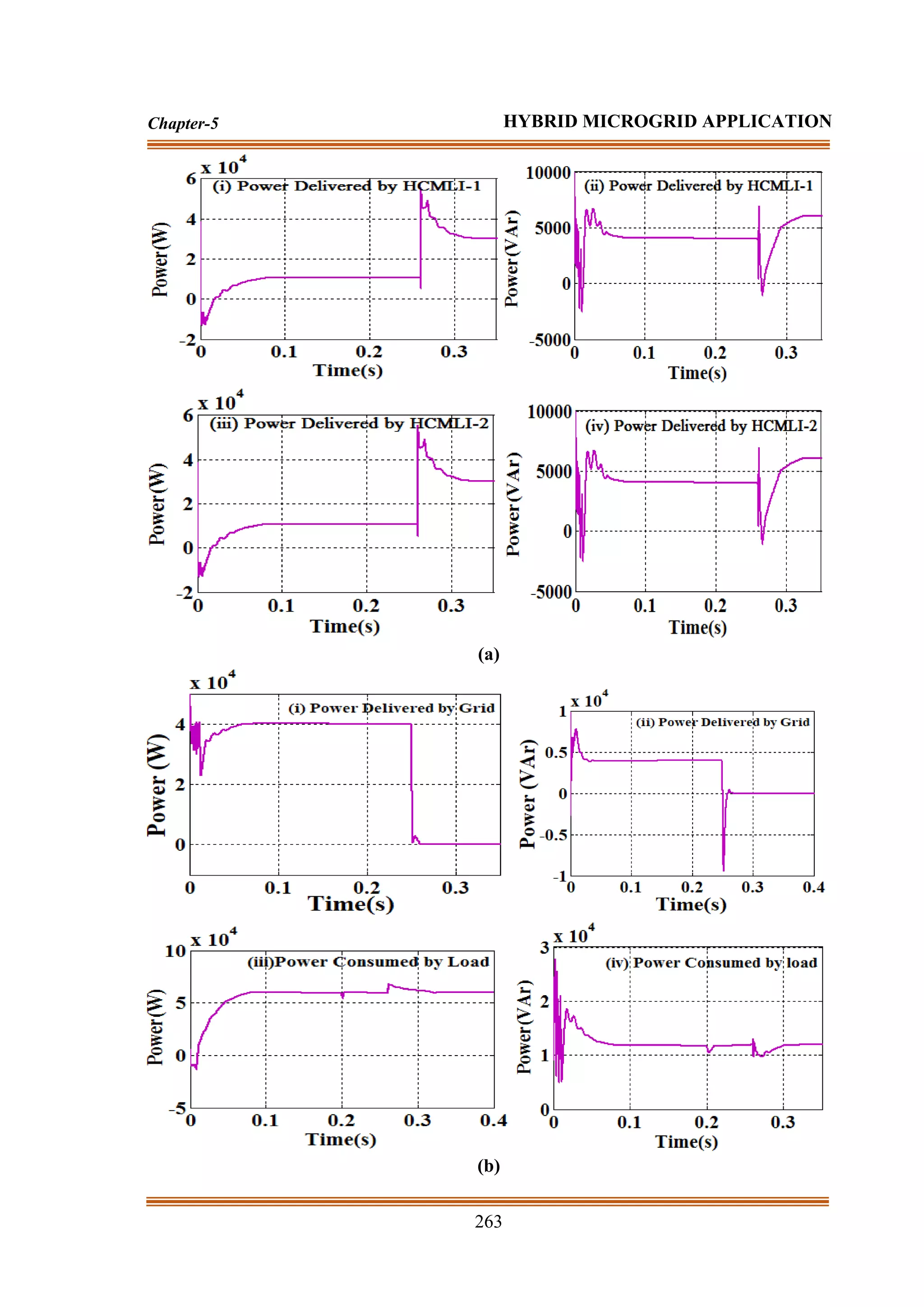
1 and HCMLI-2, the total DC-grid power is converted to 14kW of active power and 8kVAr
of reactive power as illustrated in Figure 5. 8 (a). As indicated in Figure 5. 8a (i-iv) during
0s to 0.25s, to generate 14kW of active and 5.8kVAr of reactive power, each of the inverters
produced 7kW of active and 4kW of reactive power respectively. To fulfill the load
requirements, the rest power is transmitted from the grid side as demonstrated in Figure 5.
8b (i-iv). In Figure 5. 8a (i-ii), the active and reactive power supplied by the grid is 46kW
and 4kVAr respectively. Due to the power supplied by the HCMLI and grid, the desired
amount of active and reactive power of the load is satisfied as shown in Figure 5. 8b (iii-iv).
260
Chapter-5 HYBRID MICROGRID APPLICATION
(a)
(b)
261
Chapter-5 HYBRID MICROGRID APPLICATION
(c)
(d)
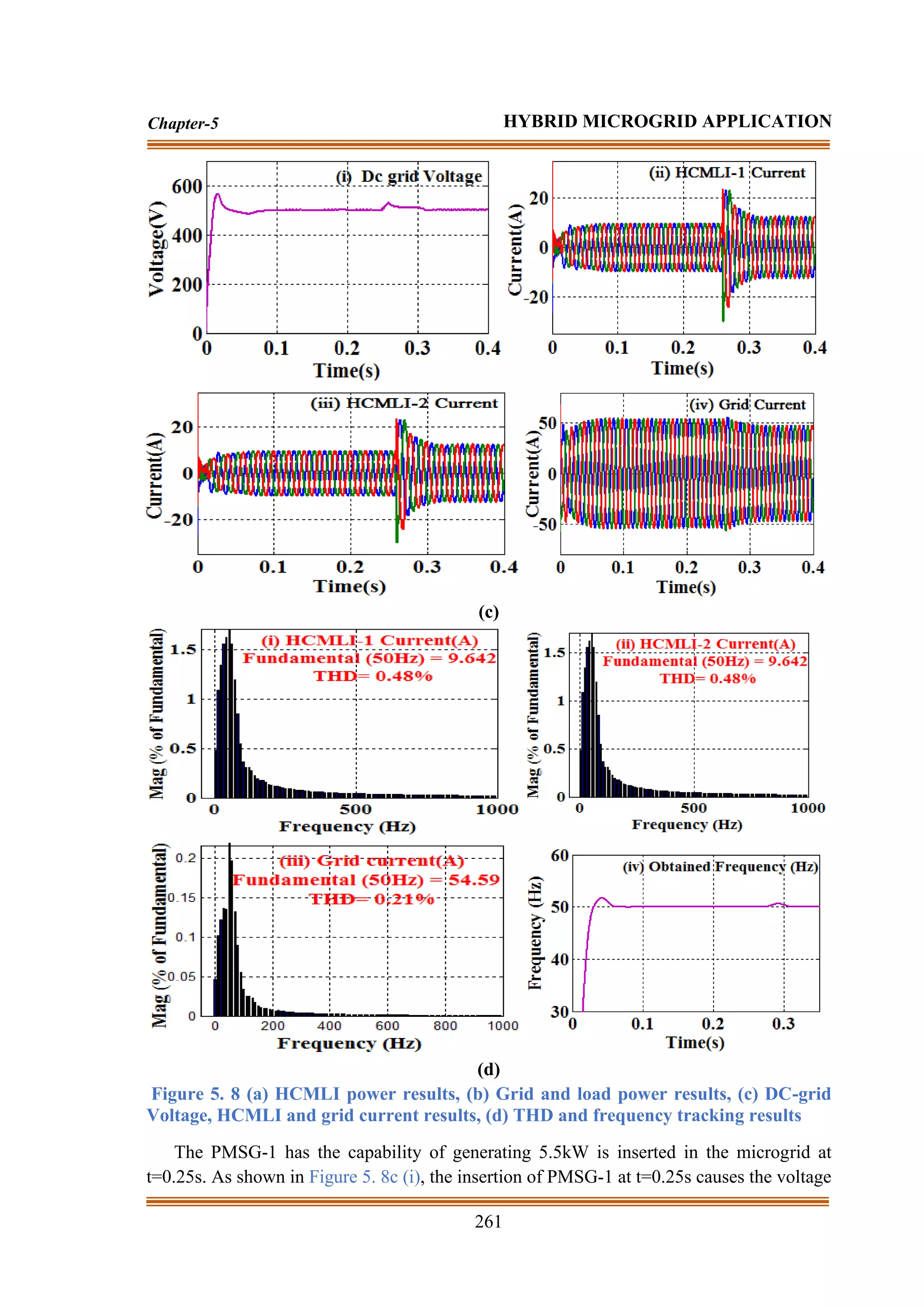
Figure 5. 8 (a) HCMLI power results, (b) Grid and load power results, (c) DC-grid
Voltage, HCMLI and grid current results, (d) THD and frequency tracking results
The PMSG-1 has the capability of generating 5.5kW is inserted in the microgrid at
t=0.25s. As shown in Figure 5. 8c (i), the insertion of PMSG-1 at t=0.25s causes the voltage
262
Chapter-5 HYBRID MICROGRID APPLICATION
surge at the DC-grid and as a result, the voltage waveform at the DC-grid is also increased.
Without changing the reactive power of the inverter, the CEMS boosts only the active power
of the inverter to 10kW each from 0.26s to 0.35s. Therefore, during 0.26s to 0.35s time
interval, the active power and reactive power of each HCMLI becomes 10kW and 4kVAr
respectively as indicated in Figure 5. 8a (i-iv). Due to the impact of active and reactive power
of the inverter at t=0.26, the DC-grid voltage decreases and is fixed at its nominal voltage at
500V during 0.26s to 0.35s. During that period to fulfill the load demand, the real and reactive
power delivered by the grid regain its nominal power 40kW and 4kVAr respectively as
indicated in Figure 5. 8b (i-iv). After successful testing of the reliable operation of WECS,
the power quality operation of the system is tested by analyzing the current results. The linear
HCMLI and grid current results are illustrated in Figure 5. 8c (ii-iv). The current results are
tested through FFT analysis and show that the respective results are containing fewer
harmonic components as illustrated in Figure 5. 8d (i-iii). The obtained frequency result is
shown in Figure 5. 8d (iv).
(c) Third Scenario:
In this test case, the proposed WECS is tested under IMO. Due to the IMO, the PMSGs
based WECS is not capable to meet the load demand. Under this situation, for a stable and
reliable operation of the microgrid system, the BES device is used to meet the load demand.
The power quality of the WECS is tested by analyzing the HCMLI and grid current total
harmonic distortion (THD) results.
Initially, during 0s to 0.25s, the grid is connected to the microgrid and transmits the
required active and reactive power to the load. During that period to fulfill the load demand,
the proposed HCMLI by using the NIPT control approach generates each 10kW of active
and 4kVAr of reactive power respectively Figure 5. 9a (i-iv). As a result, during GMO, the
load demand is fulfilled by both grid and the inverter as illustrated in Figure 5. 9 (a)and
Figure 5. 9 (b). Due to the occurrence of a fault in the upstream network of the grid, to
protect the system the circuit breaker (CB) is used to disconnect the grid from the system. In
Figure 5. 9a (i-ii), it is clearly shown that the CB completely separates the system and the
grid, which results in the active and reactive power supplied by the grid becomes zero at the
time interval of 0.25s to 0.35s. During IMO, the power fluctuation in between the generating
station and the load is analyzed by the CEMS. To resolve the power fluctuations, the CEMS
activates the battery to transmit the necessary power to the load. At t=0.25s, the battery
transmits 40kw of active power to the load to meet the load demand as shown in Figure 5.
9c (ii). During that period by using the proposed strategy, the CEMS increased the active and
reactive power for each of HCMLI to 30kW and 6kVAr respectively as illustrated in Figure
5. 9a (i-iv). The load active and reactive power is illustrated in Figure 5. 9b (iii-iv). Figure 5.
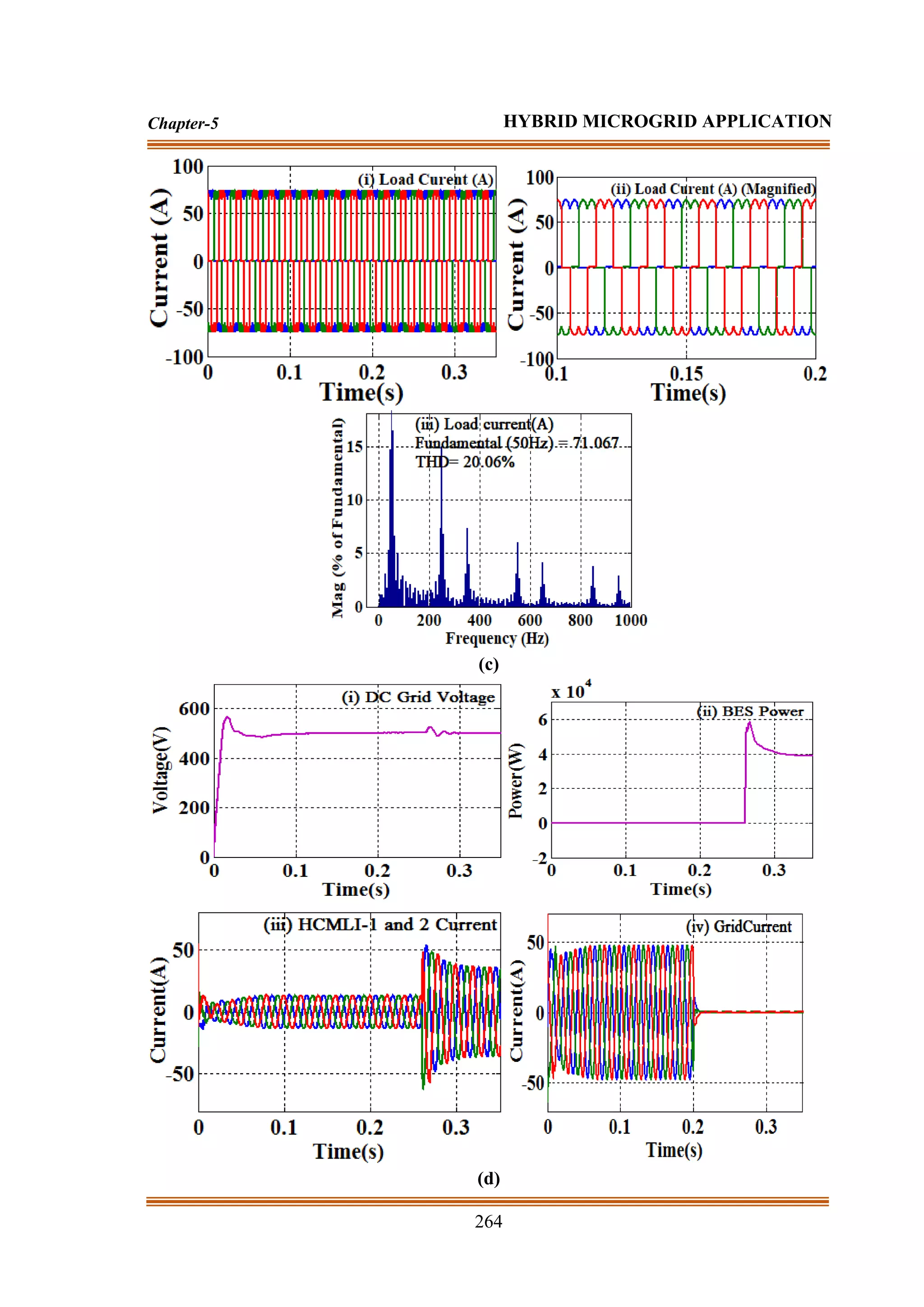
9c (i-ii) shows that the non-linear load current and magnified version of the load current is
presented. The nonlinear load current results indicate that the harmonic contained is more.
Figure 5. 9d (i) shows that there is a slight change in the DC-grid voltage at t=0.26s.
263
Chapter-5 HYBRID MICROGRID APPLICATION
(a)
(b)
264
Chapter-5 HYBRID MICROGRID APPLICATION
(c)
(d)
265
Chapter-5 HYBRID MICROGRID APPLICATION
(e)
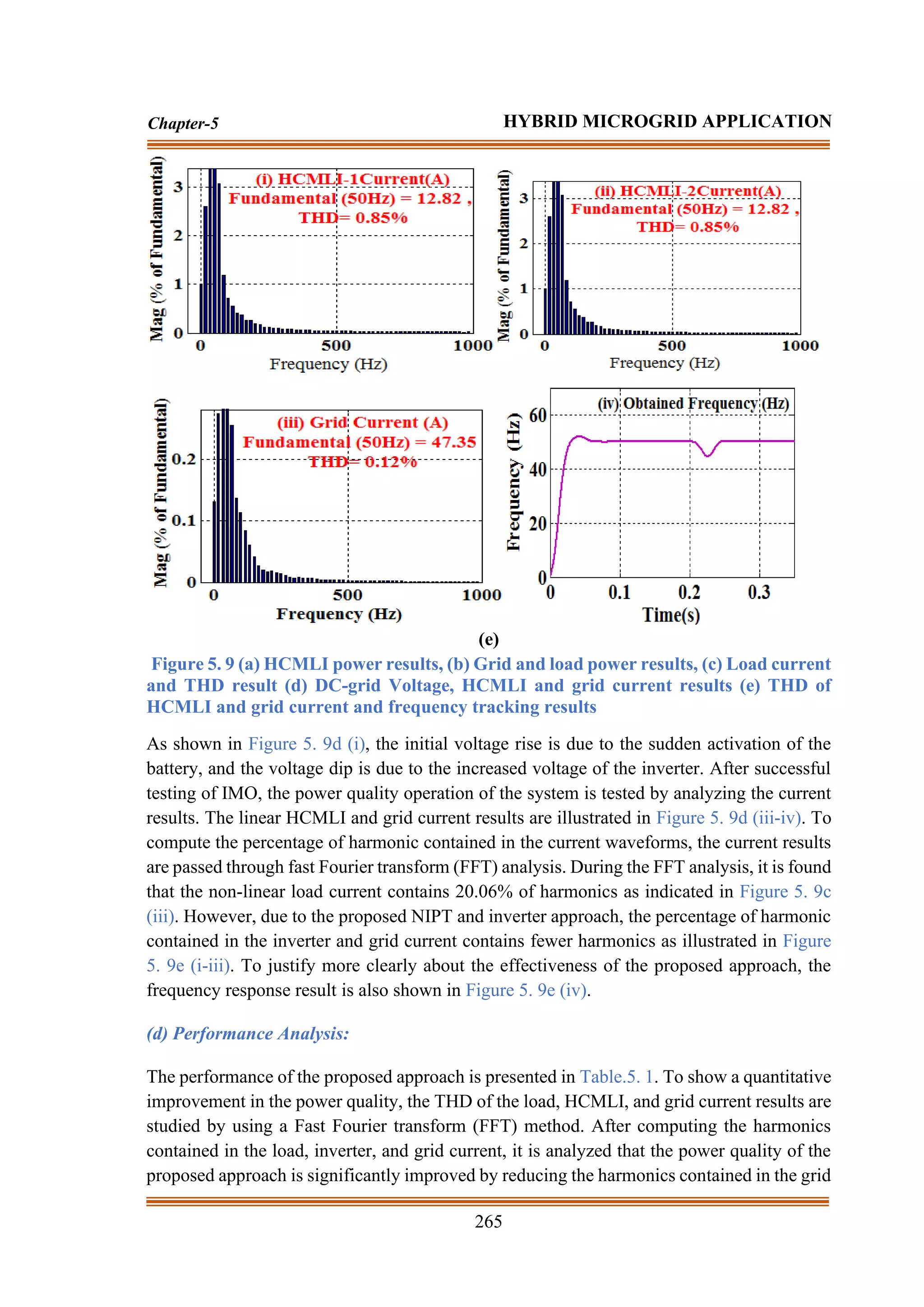
Figure 5. 9 (a) HCMLI power results, (b) Grid and load power results, (c) Load current
and THD result (d) DC-grid Voltage, HCMLI and grid current results (e) THD of
HCMLI and grid current and frequency tracking results
As shown in Figure 5. 9d (i), the initial voltage rise is due to the sudden activation of the
battery, and the voltage dip is due to the increased voltage of the inverter. After successful
testing of IMO, the power quality operation of the system is tested by analyzing the current
results. The linear HCMLI and grid current results are illustrated in Figure 5. 9d (iii-iv). To
compute the percentage of harmonic contained in the current waveforms, the current results
are passed through fast Fourier transform (FFT) analysis. During the FFT analysis, it is found
that the non-linear load current contains 20.06% of harmonics as indicated in Figure 5. 9c
(iii). However, due to the proposed NIPT and inverter approach, the percentage of harmonic
contained in the inverter and grid current contains fewer harmonics as illustrated in Figure
5. 9e (i-iii). To justify more clearly about the effectiveness of the proposed approach, the
frequency response result is also shown in Figure 5. 9e (iv).
(d) Performance Analysis:
The performance of the proposed approach is presented in Table.5. 1. To show a quantitative
improvement in the power quality, the THD of the load, HCMLI, and grid current results are
studied by using a Fast Fourier transform (FFT) method. After computing the harmonics
contained in the load, inverter, and grid current, it is analyzed that the power quality of the
proposed approach is significantly improved by reducing the harmonics contained in the grid
266
Chapter-5 HYBRID MICROGRID APPLICATION
and inverter current. Table.5. 1 shows that the load current harmonics contained is 20.06%.
Due to the higher harmonics contained in the load current, the system power quality is hugely
affected. Therefore, the role of the proposed NIPT and inverter topology is significantly
necessary for the improvement of power quality. By using the proposed NIPT and HCMLI
approach, the inverter and grid current results contain fewer harmonics as per the IEEE-1541
and IEEE-519 standards. Not only in the power quality improvement but also to improve the
power reliability of the system, the proposed technique shows its importance by lesser
settling time.
Table.5. 1 Performance analysis of the proposed approach
Test
Conditions
Conditions Load
Current
HCMLI-1 Current HCMLI-2 Current Grid Current
Case-1 THD (%) 20.06% 0.62% 0.73% 0.11%
Settling
Time
NA Starting Transient Starting Transient Starting Transient
0.07s 0.03s 0.06s 0.05s 0.03s 0.02s
Case-2 THD (%) 20.06% 0.48% 0.48% 0.21%
Settling
Time
NA Starting Transient Starting Transient Starting Transient
0.04s 0.05s 0.04s 0.05s 0.03s 0.04s
Case-3 THD (%) 20.06% 0.85% 0.85% 0.12%
Settling
Time
NA Starting Transient Starting Transient Starting Transient
0.06s 0.04s 0.06s 0.04s 0.04s 0.02s
5.2.1.4 Major findings:
• This study results with a novel IPT control approach for better power quality of a
DC-grid based WECS in a poultry farm.
• Not only the proposed approach only focuses on the power quality issues, but also it
offers the smooth parallel operation of multiple DGs. Due to the above facility, at
any time as per the requirement to increase the capacity or decrease the capacity, the
system adds or subtracts the DGs.
• The proposed WECS eliminates the requirement of voltage and frequency
synchronization, as a result of which the proposed approach adds or subtracts any
WTs with minimum disturbances.
• Further, to increase the power quality, a 17-level HCMLI is proposed for the
microgrid operation offering more voltage levels with less nonlinearity. The HCMLI
approach can generate all the voltage levels from a single DC-link voltage, by which
the system also enables the back to back operation.
• Moreover, for attaining better power management in the islanded mode of operation,
the BES device is integrated in the WECS.
• The obtained and analyzed simulated test results serve as a basis of a novel IPT
control approach for the DC-grid based WECS in a real-time microgrid application.
267
Chapter-5 HYBRID MICROGRID APPLICATION
5.2.2 Study-2: A Novel Centralized Energy Management Approach for Power Quality
Improvement
5.2.1.1 Detailed operation of centralised management system (CEMS):
Solar
PV
S1
Boost Converter
DS D1
CS
L1
Lb
Vdc
S3
S2
C2
Battery
C1
Cb
Ib
Vdc
Buck-Boost Converter
S11 S13 S15
S14 S16 S12
Lf
Cf
CB
Voltage Source Inverter
dc-grid ac-grid
Centralized Energy Management Approach (CEMA)
Dc-load
Ac-load
Boost
Converter Pulses
Buck-Boost
Converter Pulses
Inverter Pulses
CB
CB
Ls Rs
ac-distribution
Grid
Transformer
P l
,
dc
P l
,
ac
Ps
Pb
Vs Is
Vs Is Ib
Vb
Vb SOC CB Ps Pb P l
,
dc P l
,
ac
Pg
Pg
Pac
Pac
V abc
,
g
V abc
,
g
Point of common
coupling (PCC)
Figure 5. 10 Proposed CEMS for solar-battery based microgrid
A typical arrangement of a combined solar-battery based hybrid grid (ac/DC) system is
demonstrated in Figure 5. 10. The proposed HMS is comprised of a solar array, BES device,
a bidirectional VSI, a DC-DC boost converter (BC), and a bidirectional buck-boost converter
(BBC) [318-319]. To extract optimum power, a BC is directly connected to the solar array,
and to avail optimal charging and discharging condition, a BBC is connected to the BES. For
the reliable power supply, a centralized DC-ac VSI is integrated between the ac and DC
microgrid. The DC and ac grid-based HMS facilitate the direct integration of the DC and ac
load without requiring any conversion device. From a real-time application point of view,
the DC-load examples are hybrid electric vehicles, laptop batteries, adapters, batteries,
268
Chapter-5 HYBRID MICROGRID APPLICATION
chargers, and office buildings, etc. The designed hybrid system is connected to the utility
grid through a (208V:1.2kV) step-up transformer. To avail both grid-following and grid-
forming mode, a circuit breaker (CB) is connected to the HMS. During the severe fault at the
ac-grid, the CB may open to avoid the back feeding of current from the utility grid [320].
The projected HMS shown in Fig.1 is worked both grid-following and grid-forming
conditions. A similar type of undertaken system configuration is also widely employed and
tested in [315-316]. In this proposed approach, the projected CEMS is worked as a supervised
control module which regulates the active parameters such as solar voltage (Vs), solar current
(Is), battery current (Ib), battery voltage (Vb), grid voltage (Vg), state of charge (SOC), circuit
breaker (CB), solar power (Ps), battery power (Pb), ac-grid power (Pg), DC-load power
(PDC,l), and ac-load power (Pac,l), etc. As per the desired conditions, the proposed CEMS
selects appropriate control architecture to tackle the deteriorations and to provide a reliable
power supply. Though the proposed CEMS is modeled by using a solar-battery HMS as
indicated in Figure 5. 10, with proper modifications and appropriate technique there are also
other possibilities like decentralized VSI design or multiple energy storage device
integration. For both operating conditions, the detailed control architecture flow charts of the
proposed CEMS are demonstrated in Figure 5. 11(a-b).
As presented in Figure 5. 10, the solar-battery based microgrid system is connected to the
utility grid through a CB. According to the requirement, deteriorations, and the plans of both
microgrid and utility, the CEMS decides by which mode and control technique the hybrid
system to be operated. As illustrated in Figure 5. 11(a-b), to avail a smooth power transfer in
both of the modes, the battery SOC functions such as higher
SOC
SOC  ,
higher
lower SOC
SOC
SOC 
 , and lower
SOC
SOC  are necessary to monitor. The higher
(90%) and lower (10%) values of SOC are regularly monitored, to avoid overcharging and
discharging conditions for increasing the life cycle of the battery [321].
(a) Grid-following Mode Architecture:
Figure 5. 11(a) illustrates the grid following mode architecture flow chart by which the
projected CEMS regulates the undertaken HMS. A detailed description of the flowchart is
presented below.
(i) During higher
SOC
SOC  Condition:
During that period, there are two possibilities to regulate the HMS such as energy reference
condition (ERC) in Eq.5.28 and MPT condition in Eq.5.29. To avail the real power flow from
source to load and grid, the HMS must operate according to Eq.5.28.
g
l
,
ac
l
,
dc
s P
P
P
P +
+
 (5.28)
If Eq.5.28 condition satisfies then the HMS is operated in ERF condition otherwise the
system is operated in MPT condition and the battery is used to start discharging. In MPT
conditions to fulfill the desired load demand, the HMS must operate according to Eq.5.29.
s
g
l
,
ac
l
,
dc
ref
,
b P
P
P
P
P −
+
+
= (5.29)
269
Chapter-5 HYBRID MICROGRID APPLICATION
If Pb,max is lesser than the total demand as illustrated in Eq.5.30, then there are also two
possibilities arise as the reference battery power (Pb,ref) is equal to maximum battery power
(Pb,max) in Eq.4 or it is operated in MPT condition in Eq.5.31.
s
g
l
,
ac
l
,
dc
max
,
b P
P
P
P
P −
+
+
 (5.30)
ref
,
b
max
,
b P
P = (5.31)
During Eq.5.31 condition, the CEMS reduces the load or grid demand as illustrated in Figure
5. 11(a).
Grid Following Mode
higher
lower SOC
SOC
SOC 

higher
SOC
SOC  lower
SOC
SOC 
l
,
ac
l
,
dc
s
P
P
P
+

DG in MPT Condition
g
l
,
ac
l
,
dc
b
s P
P
P
P
P +
+
=
+
BES
Discharging
max
,
b
g
l
,
ac
l
,
dc
s
P
P
P
P
P

−
−
−
?
NO
YES
max
,
b
ref
,
b P
P =
max
,
b
ref
,
b P
P =
Surplus power delivered to
the utility grid
YES
NO
DG in Energy reference Condition
g
l
,
ac
l
,
dc
ref
,
s P
P
P
P +
+

DG in MPT Condition
BES in discharging state
s
g
l
,
ac
l
,
dc
ref
,
b P
P
P
P
P −
+
+
=
NO
NO
YES
max
,
b
ref
,
b P
P =
YES
• Reduce the requirement of
load and main grid
• Demand energy from the
utility grid
NO
DG in MPT Condition
P
P
P
P
P g
l
,
ac
l
,
dc
s
max
,
b −
−
−
=
P
P
P
P
P
g
l
,
ac
l
,
dc
s
max
,
b
−
−
−

YES
NO
YES
Reduce the requirement
of load and main grid
Reduce the requirement
of load and main grid
BES in discharging state
g
l
,
ac
l
,
dc
s
P
P
P
P
+
+

max
,
b
s
g
l
,
ac
l
,
dc
P
P
-
P
P
P

+
+
(a)
270
Chapter-5 HYBRID MICROGRID APPLICATION
Grid Forming Mode
higher
lower SOC
SOC
SOC 

higher
SOC
SOC  lower
SOC
SOC 
l
,
ac
l
,
dc
s
P
P
P
+

l
,
ac
l
,
dc
s
P
P
P
+

DG in MPT Condition
l
,
ac
l
,
dc
b
s P
P
P
P +
=
+
BES
charging
l
,
ac
l
,
dc
s
max
,
b
P
P
P
P
−
−

NO
YES
YES
NO
YES
Reduce the loads
NO
DG in MPT Condition
BES in charging state
P
P
P
P l
,
ac
l
,
dc
s
ref
,
b −
−
=
max
,
b
l
,
ac
l
,
dc
s
P
P
P
P

−
−
YES
NO
YES
DG in Energy reference Condition
max
,
b
l
,
ac
l
,
dc
ref
,
s P
P
P
P +
+
=
DG in MPT Condition
max
,
b
b P
P =
DG in Energy reference Cond.
max
,
b
l
,
ac
l
,
dc
ref
,
s P
P
P
P +
+
=
0
P ref
,
b =
l
,
ac
l
,
dc
ref
,
s P
P
P +
=
DG in Energy reference Condition
NO
(b)
Figure 5. 11 (a) Flow chart architecture of CEMS operation for (a) Grid following
mode, (b) Grid forming mode
(ii) During higher
lower SOC
SOC
SOC 
 Condition:
g
l
,
ac
l
,
dc
s
max
,
b P
P
P
P
P −
−
−
 (5.32)
After feeding the load and grid demand if the solar power is greater than the Pb,max, then there
are also two possibilities to regulate the hybrid system as MPT condition indicated in Eq.5.33
or discharging condition. If Eq.5.32 condition doesn’t arise then CEMS selects MPT
condition otherwise it selects discharging condition.
g
l
,
ac
l
,
dc
b
s P
P
P
P
P +
+
=
+ (5.33)
271
Chapter-5 HYBRID MICROGRID APPLICATION
If a discharging condition arises then reduce the load and grid demand, otherwise send excess
power to the grid as illustrated in Figure 5. 11 (a).
(iii)During lower
SOC
SOC  Condition:
l
,
ac
l
,
dc
s P
P
P +
 (5.34)
If Eq. 5.34 satisfies then CEMS selects MPT condition, otherwise, it decreases the load and
grid demand. In MPT condition as illustrated in Eq.5.30, it also facilitates the battery
charging condition. In this condition, there is also other possibilities where Pb,max decrease as
compared to other power sources. This condition is similar to Eq.5.32. If Eq.5.32 satisfies
then reduce the load and grid demand, otherwise it is operated in the MPT mode of operation.
(b) Grid-forming Mode Architecture:
Similarly, Figure 5. 11 (b) illustrates the grid forming mode architecture flow chart by which
the projected CEMS regulates the undertaken HMS. The detailed description of the flowchart
is presented below.
(i) During higher
SOC
SOC  Condition:
l
,
ac
l
,
dc
s P
P
P +
 (5.35)
If Eq.5.35 arises then CEMS operates the HMS at ERC. In ERC, the renewable power
generation is equal to the sum of ac and DC load power presented in Eq.5.36. In this
condition, Pb,ref is equal to zero, to avoid overcharging condition.
l
,
ac
l
,
dc
s P
P
P +
= (5.36)
(ii) During higher
lower SOC
SOC
SOC 
 Condition:
l
,
ac
l
,
dc
s
max
,
b P
P
P
P −
−
 (5.37)
After feeding the load demand, if Pb,max is greater than the solar power, then there are also
two possibilities to regulate the hybrid system as MPT condition indicated in Eq.5.38 or
charging condition. If Eq.5.37 doesn’t arise then CEMS selects MPT condition otherwise it
selects charging condition.
l
,
ac
l
,
dc
b
s P
P
P
P +
=
+ (5.38)
If charging condition arises then Pb,ref is equal to the Pb,max, otherwise Pb,ref is equal to zero.
The related flow chart is illustrated in Figure 5. 11(b).
(iii) During lower
SOC
SOC  Condition:
l
,
ac
l
,
dc
s P
P
P +
 (5.39)
If Eq.5.39 satisfies then CEMS operates the system in MPT mode where the battery is used
to charge as presented in Eq.5.40, otherwise CEMS reduces the load demand.
l
,
ac
l
,
dc
s
max
,
b P
P
P
P −
−
= (5.40)
max
,
b
l
,
ac
l
,
dc
s P
P
P
P 
−
− (5.41)
There is also another possibility as presented in Eq.5.41. If Eq.5.41 satisfies then CEMS
operates the hybrid system in ERC mode as presented in Eq.5.42, otherwise the system is
272
Chapter-5 HYBRID MICROGRID APPLICATION
operated in MPT mode as presented in Eq.5.40. The detailed flowcharts of the above
conditions are illustrated in Figure 5. 11(a-b).
g
l
,
ac
max
,
b
ref
,
s P
P
P
P +
+
= (5.42)
The Pg demand may be computed based on forecasting data. For offering a smooth transition,
the CEMS coordinates the voltages between the utility grid and ac-grid. By balancing the
appropriate power flow and voltages, the CEMS facilitates a continuous power flow on both
DC and ac-grid according to the load demand and also regulates the switching operation of
the inverter. The DC-loads are directly integrated into the DC grid without requiring any
additional converters. The suggested solar-battery system also provides the requisite reactive
power support for smooth operation. By combining all the possible conditions as presented
Eq.5.28-Eq.5.42, the detailed control architecture of the proposed HMS is designed and
presented in the controller design section. In the presented flowchart, the detailed possible
conditions are accumulated.
5.2.2.2 Control Architecture of CEMS:
The operation of CEMS is regulated through three base controller designs as distributed
generation controller (DGC), energy storage controller (ESC), and voltage and frequency
controller (VFC). The suggested controllers are based on the flowchart and presented in
subsequent sections as follows.
(a) Distribution Generation Controller (DGC):
I&C Based
MPPT method
obt
,
s
V
obt
,
s
I
+
-
s
P
ref
,
s
P
PI
regulator
PWM
PWM
+
-
g
,
dc
V
ref
,
dc
V
PWM
1
0
1
0 Boost Converter
Pulses
dc-reference
control (Dcrefc)
energy-reference
control (Erefc)
+
-
s
V
obt
,
s
V
se
V
PI
regulator
PI
regulator
se
P
e
,
dc
V
1= Activate Condition
0= Deactivate Condition
Figure 5. 12 Control architecture of DGC
Figure 5. 10 shows that the solar-system based DG is linked with the DC-grid through a
boost converter. Still, as per the oscillating nature of the solar array and environment
condition, the solar system achieves different optimum power point (MPP) conditions for
different working conditions of the solar array. Figure 5. 12 illustrates the control architecture
of DG for tracking the MPP voltage and power. Therefore, to achieve the optimum MPP
273
Chapter-5 HYBRID MICROGRID APPLICATION
condition, the Incremental Conductance (IC) based MPT algorithm is used [154,289,212] to
track maximum power under different irradiance and temperature condition [1]. The
instantaneous voltage and current result of the solar is denoted as Vs,obt, and Is,obt respectively.
The energy-reference control (Erefc) mode is activated by comparing the Ps and the reference
of solar power (Ps,ref). The DC-reference control (DCrefc) mode is activated by comparing the
DC-grid voltage (VDC,g) and the reference DC-grid voltage (VDC,ref). Depending on the test
scenarios, the proposed DGC controller is operated by considering three important factors
such as MPT control, Erefc, and DCrefc mode. After comparing the instantaneous signals with
the reference signals, the error signals such as an error in power (Pse), error in solar voltage
(Vse), and error in DC grid voltage (VDC,e) are passed through the PI regulator to linearize the
outputs and used to provide the necessary pulses for the converter operation.
For example, in Grid forming mode, if l
ac,
l
dc,
mpp
,
s P
P
P +
 and the BES is fully charged
(Pb >Pb,max), the proposed CEMS generates the control commands such that the Erefc = 1, and
DCrefc = 0. As shown in Figure 5. 11(a-b), due to the above command the solar array is set to
work in the Erefc mode to produce the pulses for boost converter operation. In this case, to
balance the power flow, the CEMS will choose the appropriate Ps,ref for the solar array by
selecting the proper Vs,obt. The Vs,obt is lying in between the open-circuit voltage (Voc) and the
MPP voltage (Vs). As VDC,g is controlled through the energy storage device buck-boost
converter then in this condition, the voltage across the grid is maintained constant even under
solar power fluctuation situations. In addition to that when the battery is inactive (under fault
condition), the boost converter has shifted the power flow to maintain the DC-grid voltage
for a continuous power supply to the load by giving the command Erefc=0 and DCrefc =1.
Therefore, in this condition, only DCrefc is activated. In the MPP case, the proposed CEMS
generates the control commands Erefc= 0 and DCrefc=0, where the real-time voltage (Vs.obt)
and current (Is,obt) values of the solar array are computed and sent to the MPT module for
generating the maximum power point voltage (Vs). The DGC controller is designed by
considering the above three conditions as illustrated in Figure 5. 12. Note that the
simultaneous activation of Erefc and DCrefc is not relevant.
(b) Energy Storage Controller (ESC):
>0?
ref
,
b
P
Y
N
0
T
,
1
T 2
1 =
=
1
T
,
0
T 2
1 =
=
+
-
+-
b
P 0
1
PI
Controller
PWM
g
,
dc
V
ref
,
dc
V
1
T
2
T
2
S
3
S
dc-reference
control (Dcrefc)
1= Activate Condition
0= Deactivate Condition
Figure 5. 13 Control architecture of ESC
274
Chapter-5 HYBRID MICROGRID APPLICATION
In this control architecture, the BES device is essential for maintaining the power flow during
the low power generation. Figure 5. 10 illustrates that the BES device is connected to the
DC-grid through a buck-boost converter. The BES charging and discharging process is
occurred through two switches such as S2 and S3 as indicated in Figure 5. 10. The total control
architecture of the ESC is illustrated in Figure 5. 13. In grid-following mode, CEMS sets the
DCrefc=0. The buck-boost converter controls the battery power flow (Pb). For availing the
charging state, Pb must be greater than 0 (Pb>0) and for availing the discharging state, Pb
must be less than 0 (Pb<0). Therefore, the absolute output of the ESC must be a two-
dimensional switching signal (S2 and S3). In grid-forming mode, CEMS sets the DCrefc=1, by
which the switches of the converter operate in voltage control approach. The output voltage
of the converter is equal to the VDC,g. The output voltage of the converter is controlled to
track the appropriate VDC,ref by which the voltage at the DC-grid is regulated. To improve the
life cycle of the battery, the CEMS sets the higher and lower limit of the energy storage
device SOC (SOChigher= 90% and SOClower=10%). Note that the conditions of SOC don’t
influence the system as well as ESC performance. As illustrated in Figure 5. 13, if Pb,ref > 0
then T1 is activated, otherwise T2 is activated. By analyzing the requirement or demand, the
activated signals are multiplied with the generated PWM signals to generate the appropriate
switching signals for the inverter (S2 and S3). The control architecture is designed by
considering the flow chart illustrated in Figure 5. 11(a-b).
(c) Voltage and Frequency Controller (VFC):
A three-phase decentralized VSI is integrated between the DC-grid and ac-grid to convert
DC-power to ac-power. Similar to the above converter control approaches, the VFC is also
operated in both grid-following and grid-forming mode. As indicated in Figure 5. 14, to
generate the angle ‘ ’ a phase-locked loop (PLL) is connected to the utility grid voltage
(Vg,abc). But in the grid-forming mode, ‘ ’ is computed locally by changing 0 to 
2
frequency ‘F’. To generate the appropriate reference signals for the VFC, it is necessary to
generate the reference grid active ( *
abc
,
d
I ) and reactive ( *
abc
,
q
I ) current components. In this
proposed approach, *
abc
,
d
I is regulated by the frequency control approach and *
abc
,
q
I is
regulated by the voltage control approach.
(i) Active Current Component Generation
In the frequency control approach, the error in the frequency (Fe) is computed by
comparing the instantaneous frequency (F) due to the load and the reference frequency (F*
).
The frequency error is passed through the PI regulator to extract the controlled power (Pc).
The power error (Pe) is computed by comparing the Pc and the filtered load power (PL,f).
*
abc
,
d
I is obtained by dividing the Pe with the terminal voltage (Vter) of the system. The
instantaneous load power (PL) is computed by using abc to transformation and can be
presented as follows.
275
Chapter-5 HYBRID MICROGRID APPLICATION
)
V
2
1
V
2
1
V
(
3
2
V c
,
L
b
,
L
a
,
L
L −
−
=
 (5.43)
)
V
2
3
V
2
3
(
3
2
V c
,
L
b
,
L
L −
=
 (5.44)
)
I
2
1
I
2
1
I
(
3
2
I c
,
L
b
,
L
a
,
L
L −
−
=
 (5.45)
)
I
2
3
I
2
3
(
3
2
I c
,
L
b
,
L
L −
=
 (5.46)



 L
L
L
L
L I
V
I
V
P +
= (5.47)
To supress the limitations of the numerical LPF, in the proposed approach a mathematical
average technique (MAT) is suggested to obtain the filtered DC load power (PL,f). The
proposed MAT is presented as follows.

=
T
0
L
f
,
L dt
P
T
1
P (5.48)
T denotes the total time duration of the circuit operation. As illustrated in Figure 5. 14, the
VL,abc is passed through PLL to produce the F. F*
of the system is chosen as 50Hz. Fe is
computed as:
)
n
(
F
)
n
(
F
)
n
(
F *
e −
= (5.49)
For nth
sampling instant, the output of frequency error is passed through the PI controller to
generate PC as follows.
)
n
(
F
K
)}
1
n
(
F
)
n
(
F
{
K
)
1
n
(
P
)
n
(
P e
IF
e
e
PF
C
C +
−
−
+
−
= (5.50)
where KPF and KIF denote as the proportional and integral frequency constant of the PI
controller respectively. The detailed controller design procedure is presented in [3], [5], and
[25]. The instantaneous load terminal voltage (Vter) is computed as:
2
1
2
c
,
L
2
b
,
L
2
a
,
L
ter )
V
V
V
(
3
2
V






+
+
= (5.51)
By using the PC, PL,f, and Vter, the active current component (Idt) is computed as:
ter
C
f
,
L
dt
V
3
)
P
P
(
2
I
−
= (5.52)
The active unity amplitude parameters (dL,a, dL,b, and dL,c) depend upon the instantaneous
load voltage (VL,abc) and the terminal amplitude load voltage (Vter).
The unity amplitude parameters are presented as:
ter
a
,
L
a
,
L
V
V
d = ;
ter
b
,
L
b
,
L
V
V
d = ; and
ter
c
,
L
c
,
L
V
V
d = (5.53)
From Eq.5.38, the generated instantaneous reference active current can be computed as:
a
dt
*
da d
I
I = ; b
dt
*
db d
I
I = ; and c
dt
*
dc d
I
I = (5.54)
276
Chapter-5 HYBRID MICROGRID APPLICATION
Frequency
Measurement
By using PLL
Active power
calculation by
using Eq.5.47
By using
Eq.5.48
abc
,
L
V
abc
,
L
V
abc
,
L
I
Hz
50
F*
=
+
-
F
Mathematical approach to
calculate filtered power
+
-
By using
Eq.5.50
L
P
f
,
L
P
C
P
Frequency Control approach
e
P

)
V
V
V
(
3
2 2
c
,
L
2
b
,
L
2
a
,
L +
+
ter
V
  
a
,
L
V b
,
L
V c
,
L
V
Active current
computation by
using Eq.5.54
a
,
L
d b
,
L
d c
,
L
d
+
-
*
ter
V
Controller Design
By using
Eq.5.56
e
,
ter
V
*
abc
,
d
I
Voltage Control
approach
Quadrature unit
vector computation
by using Eq.5.58,
5.59 and 5.60
a
,
L
d b
,
L
d c
,
L
d
Quadrature current
computation by
using Eq.5.57
a
,
L
q b
,
L
q c
,
L
q
++
*
abc
,
q
I
*
abc
,
g
I
1
0
-
+
1
0
ref
,
dc
V
dc
V
PI
Controller
ref
,
d
V
dg
V
ref
,
q
V
qg
V
Coordinate
-
+
ac
,
d
V
-
+
ac
,
q
V
1
0
ref
Q
ac
,
d
ref
ref
,
q
V
3
Q
2
I −
=
PI
Controller
1
0
Grid-forming mode
dt
I
d
I
q
I
dq
Cos
,
Sin
abc
abc
,
g
I
-+
abc
,
g
I
e
abc
,
g
I
PWM
Generator
inv
S
For operating the CEMS at different operating condition
abc
,
g
V
PLL
dq
Cos
,
Sin
abc

dg
V
qg
V
Figure 5. 14 Control architecture of VFC
(ii) Reactive Current Component Generation ( *
abc
,
q
I )
The terminal voltage error (Vter,e) for the nth
interval is computed by comparing the actual
terminal voltage (Vter(n)) and reference terminal voltage ( *
)
n
(
ter
V ) as follows.
)
n
(
ter
*
)
n
(
ter
)
n
(
e
,
ter V
V
V −
= (5.55)
277
Chapter-5 HYBRID MICROGRID APPLICATION
The terminal voltage error for the nth
instant is passed through the PI controller, to produce
the reactive current (Iq,t(n)). Iq,t(n) can be expressed as:
)
n
(
e
,
ter
I
)
1
n
(
e
,
ter
)
n
(
e
,
ter
P
)
1
n
(
qt
)
n
(
qt V
K
}
V
V
{
K
I
I +
−
+
= −
− (5.56)
where KP and KI denote the proportional and integral gain parameters of the PI regulator
respectively. The Vter,e(n) and Vter,e(n-1) are the terminal voltage errors for nth
and (n-1)th
instant
respectively and Iqt (n-1) is the reactive current component for (n-1)th
instant.
The instantaneous reference reactive current components ( *
abc
,
q
I ) is computed as:
a
,
L
qt
*
qa q
I
I = ; b
,
L
qt
*
qb q
I
I = ; c
,
L
qt
*
qc q
I
I = (5.57)
where qL,a, qL,b, and qL,c is the set of reactive amplitude current shifted their phase by 
90 with
respect to the active unit amplitude currents dL,a, dL,b, and dL,c respectively. The reactive unit
amplitude current components are computed as follows.
3
d
3
d
q c
,
L
b
,
L
a
,
L +
−
= (5.58)
3
2
)
d
d
(
2
d
3
q c
,
L
b
,
L
a
,
L
b
,
L
−
+
= (5.59)
3
2
)
d
d
(
2
d
3
q c
,
L
b
,
L
a
,
L
c
,
L
−
+
−
= (5.60)
(iii) Reference Current Generation for the Inverter Operation:
By combining *
abc
,
d
I and *
abc
,
q
I , the reference grid current ( *
abc
,
g
I ) is computed and
presented as follows.
*
abc
,
q
*
abc
,
d
*
abc
,
g I
I
I +
= (5.61)
As per the working conditions, the above regulators choose and regulate the unlike sets of
the control variable.
Grid-forming condition:
During this case, the suggested CEMS sets the signal as grid-forming = 1, by which the
converter is forced to regulate the ac-grid voltage Vd,ac, and Vq,ac. The ac-grid system
frequency is set to 50Hz. The integration of the solar-battery system is possible by closing
the CB when the ac-grid voltage is synchronized with the utility grid. In this condition, the
signal “Coordination” is set to zero, by which the suggested CEMS can fully regulate the ac-
grid voltage through the reference voltages ( ref
,
d
V and ref
,
q
V ).
Grid-following condition:
In this mode of operation, the suggested CEMS sets the signal as grid-forming =0, by
which the inverter is forced to control the VDC,g, and to regulate the reactive power
transmission from DC to ac grid. However, for ensuring smooth operation, the signal
“Coordination” is set to one, by which the CEMS coordinate the ac-grid and utility grid
voltage right before closing the breaker. To convert the dq components of utility grid voltage
278
Chapter-5 HYBRID MICROGRID APPLICATION
(Vdg and Vqg), the angle  is generated by using the PLL block. After the breaker operation
as shown in Figure 5. 14, Vdg and Vqg are chosen as the reference voltage for the ac-grid
voltage.
To avoid the overloading condition, it is essential to regulate the dq current component (Id
and Iq). After generating the proper Id and Iq current component, it is converted to abc current
component (Ig,abc). As discussed above, the reference current signal ( *
abc
,
g
I ) is produced.
To generate the error signal ( e
abc
,
g
I ), the Ig,abc, and *
abc
,
g
I currents are compared and passed
through a PWM controller to produce the appropriate pulses for inverter operation.
5.2.2.3 Result Analysis:
To examine the performance of the proposed HMS and CEMS, different case studies are
carried out through the MATLAB/ Simulink environment. The overall configuration of the
designed system model is shown in Figure 5. 10. The solar system is tested under a standard
testing condition (STC) of irradiance =1000W/m2
and temperature = C
25
. The size of the
nickel-cadmium (Ni-cd) characteristics-based battery is chosen according to the IEEE 1562-
2007 standard [322]. The battery is chosen such that it can facilitate 5 days of independent
operation for 150kW load capacity under changing environmental conditions. The
undertaken simulated parameters of the proposed HMS are presented in Chapter-5
Appendix-1 (Table.A.6). The suggested CEMS regulates the system performance and
operates the data according to the requirement as shown in Figure 5. 11 (a-b). As per the
situation raised, CEMS regulates the switches of the inverter and converter to facilitate the
system operation for both grid-following and grid-forming mode as illustrated in Figure 5.
11 (a-b) flowchart. The proposed approach provides a complete solution to maintain the
continuity of power flow as per the requirement. The designed HMS model is tested by using
CEMS and without CEMS. The obtained results are compared with each other to show the
existence of proposed CEMS over without CEMS.
(a) Grid-following Operating Condition:
(i) Scenario-1:
This scenario is studied for the normal grid-following condition when the battery is used to
regulate the power within the SOC limit (10% < SOC< 90%) as illustrated in Figure 5. 11
(a). According to the proposed DGC, the maximum voltage reference (Vs) and maximum
power (Pmax) are tracked by using the I&C MPT algorithm. The DC-loads and ac-loads are
supplied from the DC-grid and ac-grid respectively. In this condition, the DC-load and ac-
load are set 50kW and 10kW respectively. To show the variability of the supervised control
strategy and BES working conditions, the grid demand is intentionally varying from 110kW-
85kW-70kW at a specific time interval. According to the ESC, the battery power is balanced
by absorbing and releasing the power as per the generation, load, and utility grid demand.
279
Chapter-5 HYBRID MICROGRID APPLICATION
(a) (b) (c)
(d) (e)
Figure 5. 15 Without CEMS: (a) Grid power results, With CEMS: (b) Power flow
results, (c) DC-grid voltage and ac-grid voltage, (d) Stability analysis, (e) Frequency
response
In Figure 5. 15 (a), without using CEMS, the utility grid power results are presented. As
illustrated in Figure 5. 15 (a), the grid power result takes more time to settle during the
transition period. By using CEMS, in Figure 5. 15 (b-c), the output power and voltage results
at the respective grids are illustrated. As shown in Figure 5. 15 (b-c), at the normal mode of
operation, the solar-battery based HMS is well capable to fulfill the load, and grid demand.
Fig.5.15b (i) shows that under the MPT mode as indicated in Figure 5. 11 (a), the solar system
generates a maximum of 170kW of solar power. As per the condition, Figure 5. 15b (iii-iv)
shows that the DC-load and ac-load demand are fulfilled by providing 50kW and 10kW
power respectively. Figure 5. 15b (ii) shows that during 0s to 2.6s time interval, the grid
demand is 110kW. After fulfilling the load demand, the rest power is supplied to the utility
grid and during that period the battery is under the ideal condition as shown in Fig.5.15b (ii
and v). Figure 5. 15b (ii) shows that during 2.6s to 3.2s, as per the set condition the utility
grid demand is decreased from 110kW to 85kW. Due to the decrease in demand, the extra
15kW power is used to charge the battery as shown in Figure 5. 15b (v). After 3.2s, the
demand for the utility grid power is further decreased to 70kW and by which the battery
power is gradually increased to 30kW for charging as indicated in Figure 5. 15b (ii and v).
280
Chapter-5 HYBRID MICROGRID APPLICATION
As indicated in Figure 5. 15c (i-ii), the CEMS maintains the DC-grid and ac-grid voltage
around 420V and 170V respectively. To verify the stability Nyquist diagram of the proposed
solar-battery system is illustrated in Figure 5. 15 (d). Figure 5. 15 (e) shows that during the
grid-following mode of operation, the CEMS also able to balance the frequency at its desired
value. From the above-computed results, it is concluded that the proposed CEMS offers
better power and voltage regulation, and able to provide stable and synchronized operation
within less time.
(ii) Scenario-2:
(a) (b) (c)
Figure 5. 16 Without CEMS: (a) Grid and battery power results, With CEMS: (b)
Power flow results, (c) Frequency response results
This scenario presents the normal grid-following mode of operation under a full battery-
charged condition. As per the flowchart illustrated in Figure 5. 11 (a), when the SOC of the
battery is more than 90% ( higher
SOC
SOC  ), the suggested CEMS will discontinue the BES
charging condition and supply the excess power to the utility grid. If the requirement of the
load is increased at a certain time interval, the BES will discharge to balance the power
deficiency. In this scenario, the DC and ac load demand are set 105kW and 25kW
respectively. To verify the ESC operation during higher
SOC
SOC  the condition, the utility
grid demand of the hybrid system intentionally varied from 0kW-50kW-95kW within a
specific time limit.
In Figure 5. 16 (a), without using CEMS, the utility grid and battery power results are
presented. As illustrated in Figure 5. 16 (a), the grid and battery power results take more time
to settle during the transition periods. By using the CEMS, the related HMS power and
frequency response results are indicated in Figure 5. 16 (b-c). As indicated in Figure 5. 16b
(ii-iii), according to the desired condition the DC-load and ac-load demand are fulfilled by
providing 105kW and 25kW power respectively. Figure 5. 16b (i) shows that the solar system
operates at its MPP condition to generate optimum 170kW solar power. During 0s to 2s, as
the grid power demand is set to zero, after fulfilling the load demand the rest 40kW power is
281
Chapter-5 HYBRID MICROGRID APPLICATION
used to charge the battery. As per the condition after 2s, the battery achieved at its maximum
charging state. To protect the battery from overcharging conditions, the proposed CEMS sets
Pb,ref to zero. Therefore, the battery tracks the reference signals and supplies surplus power
to the grid, by which the grid power is increased to 50kW at 2s as indicated in Figure 5. 16b
(iv). As per the requirement, at 3 sec the grid demand is further increased to 95kW. During
that period, the generating power is inadequate to supply the load and grid demand.
Therefore, to achieve the balanced power condition, the battery is supplied 55kW of real
power as shown in Figure 5. 16b (v). After 3s onwards, due to the BES power supply, the
battery SOC is decreased to its higher limit. Figure 5. 16 (c) shows that during the grid-
following mode of operation, the CEMS also able to balance the frequency at its desired
value. Therefore, after this time the proposed HMS is operated similar to Scenario-1
condition. After analyzing the above-obtained results, it is suggested to operate the proposed
system under CEMS control architecture for faster response during real-time applications.
(iii)Scenario-3:
This scenario is studied to show the variability of the CEMS by balancing the power flow
during full battery charge and the inability to absorb the excess grid power condition. In this
scenario, HMS operation is studied at 90% upper limit of the SOC and the generated power
of the solar array is more than the demand and load. The DC and ac load power are set at
50kW and 25kW respectively. The major focus of this scenario is to show the smooth
transition between two operating conditions such as MPT conditions and energy reference
conditions.
In Figure 5. 17 (a), without using CEMS, the solar power and utility grid results are
presented. As illustrated in Figure 5. 17 (a), the solar and grid power results take more time
to settle during the transition periods. By using the CEMS, the related HMS power and
frequency response results are shown in Figure 5. 17 (b-c). As per the set condition, the
battery is in full charged condition and the grid is not able to absorb the excess power from
the solar-battery system. In this circumstance, the suggested CEMS selects to operate at ERC
instead of MPT condition for balancing the power flow. To show the justification of the
system performance, the power output results of this scenario are presented in Figure 5. 17
(b). Before 2 sec, due to the change in irradiance condition and ERC mode of operation, the
solar power (Ps) is decreased to 160kW from 170kW, and battery power (Pb) is set to 0 kW
for avoiding overcharging condition as indicated in Figure 5. 17b (i and v). As per the set
condition, the HMS is fulfilling the 50kW DC and 25kW ac load power respectively as
shown in Figure 5. 17b (ii-iii). After fulfilling the load demand, Figure 5. 17b (ii) shows that
the remaining power around 85kW sent to the utility grid. As presented in Figure 5. 11 (a),
in the ERC mode, the CEMS reduces power generation as compared to the MPT conditions.
Therefore, Figure 5. 17b (i) shows that the reference solar power is changed from 170kW to
120kW during the time interval from 2s to 3s. According to solar power, the CEMS regulates
the power flow to the grid. Figure 5. 17b (ii) shows that due to the reduction of the power
generation the power flow of the utility grid is also decreased to 45kW during that period.
As illustrated in Figure 5. 17b (i-ii), after 3s the power generation and the grid demand restore
282
Chapter-5 HYBRID MICROGRID APPLICATION
to its previous condition. The obtained figures indicate that CEMS takes only one-two cycles
to restore power during the transition period. Figure 5. 17c (i-ii) shows the stable solar and
DC-grid voltage during the conversion between MPT and energy reference conditions. Solar
array voltage (Vpv) is greater than Vs and less than VOC in ERC. Further, the solar setpoint
depends upon the value of the ERC. By analyzing this test scenario, it is suggested to operate
the solar-battery system under CEMS control architecture.
(a) (b) (c)
Figure 5. 17 Without CEMS: (a)Solar and grid power result, With CEMS: (a) Power
flow results, (b) DC-grid and solar module voltage
(iv)Scenario-4:
This scenario examines the bidirectional power flow capability of the inverter as well as
the solar-battery system. To balance the power flow, CEMS reverses the power flow of the
system through the VSI during excess utility grid power. When the SOC of the battery is less
than or equal to its lower value (10%) ( lower
SOC
SOC  ), the battery stops to release power by
considering the protection and increase the durability reasons. To justify the scenario the DC-
load is varied from 100kW to 140kW and ac-load is varied from 50kW to 80kW respectively.
In Figure 5. 18 (a), without using CEMS, the DC-load, ac-load power, and utility grid results
are presented. As illustrated in Figure 5. 18 (a), the respective power results take more time
to settle during the transition periods. By using the CEMS, the related HMS test results are
presented in Figure 5. 18 (b-d). During lower
SOC
SOC  , the battery power results are shown
in Figure 5. 18b (v). During the time interval from 0s to 2s, Figure 5. 18b (ii-iii) shows the
DC-load and ac-load demand as 100kW and 50 kW respectively. The solar system generates
170kW real power as indicated in Figure 5. 18b (i). Subsequently, after fulfilling the load
demand, the rest 20kW power is supplied to the grid as shown in Figure 5. 18b (iv). However,
after 2s the DC-load demand is allowed to increase suddenly from 100kW to 140kw. Under
this condition, the solar power is not enough to supply the load demand. Therefore, to fulfill
the load demands the grid releases around 20kW power. As a result, the grid power becomes
negative due to reverse power flow. At 3s, the ac-load power is allowed to increase to 80kW
as shown in Figure 5. 18b (iii). After 3s onwards, it is found that the total load demands
further increases150kW to 220kW due to the increase of ac load power. Therefore, the grid
283
Chapter-5 HYBRID MICROGRID APPLICATION
releases more power to fulfill the total load demand as shown in Figure 5. 18b (iv), and the
grid power becomes more negative as compared to the previous position. Figure 5. 18 (c-d)
shows that during the grid-following mode of operation, the CEMS is also able to balance
the power factor and frequency at its desired value. By analyzing this scenario, it is concluded
that the proposed CEMS facilitates bidirectional power flow with a minimum time interval.
(a) (b)
(c) (d)
Figure 5. 18 Without CEMS: (a) DC, ac, and utility grid power results, With CEMS:
(b) Bidirectional power flow results, (c) power factor result (d) Frequency response
(v) Scenario-5:
In this scenario, the ability of VFC is examined by regulating the DC-link voltage and
providing reactive power support to the grid. To test the system performance the grid reactive
power demand (Qg) suddenly rises from 0kVAr to 70kVAr by maintaining the 50kW active
power (Pg) demand. In this condition, the solar system is operated at its MPP condition. The
ac-load and DC-load demand are fixed at 20kW and 10kW respectively. However, due to the
sudden reactive power demand on the grid side, the proposed CEMS discharges the battery.
The battery cannot directly supply reactive power.
284
Chapter-5 HYBRID MICROGRID APPLICATION
(a) (b) (c)
(d) (e)
(f)
Figure 5. 19 Without CEMS: (a) Battery, active and reactive power, With CEMS: (b)
Power flow results, (c) Grid power result, (d) DC and ac-grid voltage, (e) Utility grid
voltage result, (f) Utility grid current result
The conventional and proposed power flow results are illustrated in Figure 5. 19 (a-b).
By using the proposed VFC approach, the CEMS can generate the required reactive power
through the decentralized inverter as indicated in Figure 5. 19 (c). The above results indicate
that the real power flow is not affected regardless of reactive power variation. Figure 5. 19c
(ii) shows the need for reactive power support to the grid is gradually increased after 4s for
maintaining the DC-link voltage within a certain value. The stable DC-grid and ac-grid
voltage results are illustrated in Figure 5. 19 (d). Figure 5. 19 (e) illustrates that the utility
grid voltage is not affected during the transition period. However, due to the proposed
approach, the system provides an appropriate grid current to meet the reactive power demand.
285
Chapter-5 HYBRID MICROGRID APPLICATION
The related grid current results with a magnified version are illustrated in Figure 5. 19 (f).
The voltage and current results are much linear and contain lesser harmonics as per the IEEE-
1541 standards. This scenario shows that the proposed control architecture is also able to
provide appropriate reactive power support without affecting the grid active power demand
and regulates the harmonic.
(vi)Scenario-6:
`
(a) (b)
Figure 5. 20 With CEMS: (a) Switching from grid-following condition to grid-forming
condition, (b) Frequency response
As discussed in Figure 5. 11 (a-b), that the proposed solar-battery system may operate in
both grid-following and grid-forming conditions. In this scenario, the above conditions are
generated and studied the efficacy of CEMS architecture.
For example, when the utility grid is disturbed for any uncertainty or occurrence of a severe
fault, the CEMS changes the system working conditions from grid-following mode to grid-
forming condition through CB. After the CB operation, the main objective of VFC is to
regulate the ac-grid voltage and frequency as indicated in Figure 5. 20. In addition to that, the
DC-grid voltage is regulated by the BES devices through a bidirectional converter as
presented in ESC architecture. Figure 5. 20 (a) shows the dynamic performance of the DC-
grid and ac-grid voltage during the transition between two operating conditions. The
operating condition of the solar-battery system is allowed to change from grid-following to
grid-forming conditions at 1.4s. Figure 5. 20 (b) shows that the CEMS is also able to balance
the frequency at its desired value. It is found that the suggested CEMS takes less than 0.05s
to settle the DC-grid and ac-grid voltage, and settle the oscillation in frequency with
minimum time. Therefore, it is suggested to operate the HMS through the proposed CEMS.
286
Chapter-5 HYBRID MICROGRID APPLICATION
(b) Grid-forming Operating Condition:
(i) Scenario-1:
This scenario is studied for the normal grid-forming condition when the battery is used to
balance the power within the SOC limit (10% < SOC< 90%). To track the maximum voltage
reference (Vs) and to achieve the maximum power (Pmax), the HMS is operated at MPT
condition. The DC-load and ac-load are supplied from the DC-grid and ac-grid respectively.
In this condition, the DC-load is intentionally varied from 100kW to160kW and the ac-load
is varied from 20kW to 40kW at a certain time interval. The battery power is balanced by
absorbing and releasing power according to the generation and load demand.
(a) (b) (c)
(d) (e)
Figure 5. 21 Without CEMS: (a) DC-load, ac-load, and battery power, With CEMS: (b)
Power flow results, (c) DC-grid and ac-grid voltage, (d) Frequency response, (e)
Stability result
In Figure 5. 21 (a), without using CEMS, the DC-load, ac-load, and battery power results are
presented. As illustrated in Figure 5. 21 (a), the respective power results take more time to
settle during the transition periods. By using the CEMS, the related HMS test results are
287
Chapter-5 HYBRID MICROGRID APPLICATION
presented in Figure 5. 21 (b-e). During the grid forming condition as mentioned in Eq.5.38;
the load demand is fulfilled by the solar-battery system only. Under normal conditions,
during which the SOC of the battery is within the 10% to 90% limit, the solar array tracks
maximum voltage (Vs) through the MPT module to support the load demand. By considering
the load demand and generation as per the flow chart shown in Figure 5. 11 (b), the
bidirectional converter facilitates both battery charging and discharging condition. Figure 5.
21 (b) illustrates the results of power exchange between the generating stations and battery
conditions. During 0s to 1.2s, the DC-load and ac-load demand are set at 100kW and 20 kW
respectively, as shown in Fig.5.20b (ii-iii). During that period the solar array operates at its
MPT condition and generates 170kW real power as shown in Figure 5. 21b (i). Figure 5. 21b
(iv) shows that after fulfilling the load demand, the rest amount of the power around 50 kW
is used to charge the battery. At 1.2s onwards, the ac-load demand is slightly increased to
40kW as shown in Figure 5. 21b (iii). Due to the increase of ac-load, the total load demand
is increased to 140kW. Figure 5. 21 (iv) shows that the battery charging power is reduced to
around 30kW as per the increase of the load demand. At 2.5s onwards, the DC-load demand
is increased to 160kW as shown in Figure 5. 21 (ii). The total load demand is increased to
200 kW. The solar power is insufficient to meet the entire load in this condition. Therefore,
the battery discharges 30kW power for balancing the power supply as shown in Figure 5. 21
(iv). Figure 5. 21c (i-ii) shows that the DC-grid and ac-grid voltage also provide a stable
response. Figure 5. 21 (d) shows that during the grid-forming mode of operation, the CEMS
also able to balance the frequency at its desired value. Figure 5. 21 (e) provides the stability
curve of the proposed system. The above results justify the fact that the suggested CEMS
functions well during the grid-forming condition.
(ii) Scenario-2:
(a) (b)
Figure 5. 22 With CEMS: (a) Power flow results during varying irradiance (b)
Frequency results
288
Chapter-5 HYBRID MICROGRID APPLICATION
During the autonomous microgrid condition, the performance of the solar-battery system
is examined at the adverse environmental condition. The DC load and ac load demand of the
autonomous microgrid are set at 100kW and 20kW respectively.
At the change in irradiance condition, the solar module is not able to produce maximum
power. Therefore, the system performance affects adversely due to the inability to supply
power from generation to load. The proposed CEMS compensates the required deficit of
solar power through the battery. Figure 5. 22 (a) shows the working conditions of the battery
bank during the power deficiency. Figure 5. 22a (ii-iii) shows the results of the DC-load and
ac-load fixed at 100kW and 20kW respectively. As a result, the total load demand under this
condition becomes 120kW. Due to the change in the irradiance, solar power gradually
decreased from 170kW to 120kW as shown in Figure 5. 22a (i). To balance the power flow,
the CEMS adjusts the battery bank to meet the load demand. Therefore, as shown in Figure
5. 22a (iv) the battery is gradually discharging from 50kW to balance the power flow. Figure
5. 22 (b) shows that during the grid-forming mode of operation, the CEMS also able to
balance the frequency at its desired value. This case confirms that CEMS capability to
balance the power flow of the battery quickly and precisely.
(iii)Scenario-3:
Figure 5. 23 With CEMS: Grid voltage control of the solar-battery system
This scenario presents the variability of CEMS by balancing the voltages according to the
requirement. In the grid forming condition, the regulation of the VDC,g, and Vac,g voltages are
regulated by the bidirectional boost converter and VSI respectively. The suggested CEMS
approach controls the grid voltage at the desired value even under a change in load demand
variation. Both the DC and ac-grid voltages are set according to their reference values as
indicated in Table.A.6. The simulation results are presented in Figure 5. 23 (i-ii), to show the
system performance for the proposed approach concerning change in the reference voltage.
A case study by shifting the DC-grid reference voltage at 1.2s and the ac-grid reference
voltage at 1.5s to 2s time interval is illustrated in Figure 5. 23 (i-ii).
289
Chapter-5 HYBRID MICROGRID APPLICATION
(iv)Scenario-4:
As discussed in grid-following mode (Scenario-6) that the disconnection of the microgrid
from the utility grid occurs may be due to uncertainty or the fault condition. However, the
reconnection of the solar-battery system to the main grid is tested in this scenario. In this
scenario, the system performance is analyzed under the condition that occurred due to the
CB disconnection at the PCC which in turn disconnects the solar-battery system from the
utility grid. After reconnection, the coordination between the ac-grid and utility grid is the
major factor of the study.
For achieving a smooth operation for the rest part of the system the ac-grid voltage and
utility grid voltage has to be focused to bring to the desired value. The synchronization has
to be done between the ac-grid voltage and controlled utility voltage quickly after the closing
of CB. Figure 5. 24 indicates the above two unsynchronized voltage conditions before the
closing of CB during 0s to 1.2s. It is also demonstrated the quick synchronization occurred
at 1.2s. The proposed approach only takes one/two-cycle to synchronize and also facilitates
a steady power delivery to the ac-grid loads at the time of transition from grid-forming
condition to grid-following condition. The above result shows that the proposed CEMS also
avail resynchronization and restoration possibility with less time.
By viewing the above-obtained results, the proposed CEMS works efficiently for HMS in
both grid following and grid forming conditions. As compared to the previously discussed
HMS and control approach, the CEMS shows its importance by providing better power
management and substantial harmonic reduction. In addition to that, during the transition
period also the CEMS takes minimum time to restore the voltage and power with lesser time.
Therefore, for the real-application point of view, it is suggested to operate the HMS by using
the supervised CEMS based control strategy.
Figure 5. 24 Scenario-4: Synchronized and unsynchronized voltage during CB
operation
(c) Comparative Study:
For showing the improved performance of the CEMS based HMS, the proposed HMS results
are compared with the absence of CEMS results. From the above result analysis, it is
290
Chapter-5 HYBRID MICROGRID APPLICATION
concluded that the proposed approach results have faster settled as compared to the
traditional approach results. Due to the faster settling responses, the system offers better
synchronization as compared to the traditional absence of CEMS. To show the proposed
approach effectiveness, a comparison between without CEMS and with CEMS based HMS
is presented in Table.5. 2. From Table.5. 2, it is clearly illustrated that the responses of the
proposed approach are a faster settling time according to IEEE-1541 and IEEE 1562-2007
standards [28]. From the results and comparative table, it is concluded that the proposed
HMS achieves better power quality and power reliability by producing linear results and
faster settling time during both normal and transient conditions.
Table.5. 2 Comparative study
Grid following mode Without CEMS With CEMS
Duration Duration
Transition Condition Initial 2.5s 3.2s Initial 2.5s 3.2s
Scenario-1 Grid power 1.1s 2.65s 3.4s 0.1s 2.51s 3.22s
Duration Duration
Transition Condition Initial 2s 3s Initial 2s 3s
Scenario-2 Grid power 0.1s 2.75s 3.35s 0.1s 2.4s 3.2s
Battery power 0.9s 2.8s 3.5s 0.1s 2.4s 3.15s
Duration Duration
Transition Condition Initial 2s 3s Initial 2s 3s
Scenario-3 Solar power 0.82s 2.7s 3.25s 0.1s 2.1s 3.15s
Grid power 0.813s 2.62s 3.22s 0.1s 2.25s 3.16s
Duration Duration
Transition Condition Initial 2s 3s Initial 2s 3s
Scenario-4 Grid power 0.65s 2.7s 3.5s 0.1s 2.5s 3.2s
Transition Condition Duration=2.5s Duration=2.5s
ac-load power 3.3s 3s
Transition Condition Duration=2s Duration=2s
DC-load
power
2.5s 2.23s
Duration Duration
Transition Condition Initial 4s 6.2s Initial 4s 6.2s
Scenario-5 Battery power 0.98s 4.25s 6.5s 0.1s 4.05s 6.21s
Active power 1.1s - - - - -
Reactive
power
0.1s 4.5s 6.35s 0.1s 4.2s 6.23s
Grid forming mode Without CEMS With CEMS
Duration Duration
Transition Condition Initial 1.2s 2.5s Initial 1.2s 2.5s
Scenario-1 Battery power 0.75s 1.5s 2.9s 0.1s 1.21s 2.51s
Transition Condition Duration=2.5s Duration=2.5s
DC-load
power
2.75s 2.52s
Transition Condition Duration=1.2s Duration=1.2s
ac-load power 1.8s 1.56s
291
Chapter-5 HYBRID MICROGRID APPLICATION
5.2.2.4 Major Findings of Study-2:
• The suggested novel centralized energy management approach improves the power
quality and reliability in a solar-battery based HMS during both grid following and
grid forming conditions.
• The proposed novel controllers such as DGC and ESC are proposed to generate
maximum power from the solar array and compensate the power deficit situation
through BES respectively.
• In addition to the above, a novel VFC is proposed for regulating the DC-grid and ac-
grid voltage of a solar-battery integrated HMS.
• The CEMS also facilitates the bidirectional active and reactive power flow by which
the system coordinates the voltage and frequency with the consumer ac and DC load
variation. Moreover, CEMS flexibly manages the power flow of the inverter and also
balances the power flow in between the utility and hybrid grid.
• Furthermore, CEMS offers an efficient power supply to the HMS even under solar
power variation due to the environmental condition or solar power unavailability due
to the fault conditions. Even during the transitions between two operating modes the
suggested CEMS facilitate stable voltage condition for both ac and DC load and takes
minimum time to restore its original position.
• This proposed approach allows the system to operate even under extra loads without
requiring extra converters, performance degradation, and cost. Not only power
management but also the proposed VFC controller also efficiently regulates the
harmonics.

• The results reveal the robust control and management of the proposed CEMS
approach justifying its viability of real-time application particularly to a solar-battery
based HMS.
5.3 Conclusion
• From the above studies, it is concluded that the proposed hybrid microgrid system
offers excellent power quality and reliability to circumvent the recent research
problems.
• The combined ac and DC grid-based approach offer direct integration of ac and DC
load without requiring an additional component such as converter, inverter, resistor,
and inductor etc.
• Due to the proposed RSMLI and robust control approach, the proposed system can
add or subtract the load without any voltage and frequency synchronization.
• The proposed hybrid microgrid system working conditions are evaluated during both
grid-connected and grid forming conditions.
• The developed controller and inverter are capable to mitigate the harmonics, voltage
sag, swell, and transient condition.
292
Chapter-5 HYBRID MICROGRID APPLICATION
• The 17-level RSMLI facilitates both single-stage and two-stage operation during a
hybrid microgrid system. Undoubtedly, the two-stage operations provide more
reliable operations. However, looking at the microgrid cost, size, and complexity,
RSMLI is used for single-stage operation during solar-PV applications. In addition
to that, RSMLI is also applicable for the wind energy conversion system during back-
to-back connections. To tackle the change in wind speed and rotor speed problems,
RSMLI is chosen as the best solution for wind energy systems.
• The RSMLI based hybrid microgrid system also behaves as a shunt active filter and
hybrid active filter, by which it can easily eliminate the harmonics during non-linear
load applications. In addition to that, it can provide active and reactive power support
to the load.
• The selected I&C and P&O-based MPPT algorithms is also enough capable to
produce maximum power operation and regulate the modulation index of the RSMLI.
• By using the centralised management control and robust controller, an appropriate
switching signal is generated, by which the harmonics can be eliminated. Due to the
proper harmonic elimination, the power quality, reliability, and stability of the system
significantly improved.
• Due to the combined ac and DC-grid based approach, the system reduces the cost,
and complexity of the system.
• The evaluated and estimated results served as a basis of an appropriate RSMLI model
design for non-linear load and renewable energy-based microgrid system
applications.
5.4 Need for Further Research
By analyzing the above studies, it can be visualized that by using the designed RSMLI
and controller, the complex hybrid microgrid system performance is improved.
Therefore, looking at the advancement and effectiveness, the proposed RSMLI and
controller are suggested for real-time applications to improve the stability, power
quality, and power reliability. Similar to the hybrid microgrid system, another complex
system known as the electric car model is designed and tested by using the proposed
approach. The related contribution and testing methods are done in the next chapter
to show and justify the importance of the proposed inverter and controller during
complex system applications.
CHAPTER-6
ELECTRIC VEHICLE APPLICATION
Active Power Filter Control For Inverter Based DGs On
Microgrid Application
Background of the study, Literature survey regarding the
active filter control scheme, Microgrid application,
Merits and demerits, Objective, Contribution
Title of the Thesis
Introduction
(Chapter-1)
Robust Controller
(Chapter-4)
Major Findings, Summary
(Chapter-7)
Development and Design Stage
Implementation Stage
Conclusion Stage
Future Scope
C
O
M
P
L
E
T
S
T
U
D
Y
Reduced Switch
Multi-level Inverter (RSMLI)
Enhanced Instantaneous
Power Theory (EIPT)
(Chapter-2) (Chapter-3)
Hybrid Microgrid Application Electric Vehicle Application
(Chapter-5) (Chapter-6)
CHAPTER-6
ELECTRIC VEHICLE APPLICATION
To support the overall objectives of Chapter-2, three individual studies are
formulated. The proposed test studies are:
1. Study-1: A Novel Speed and Current Control Approach for Dynamic
Electric Car Modelling (Section-6.2.1)
2. Study-2: Robust Control Approach for Stability and Power Quality
Improvement in Electric Car (Section-6.2.2)
Chapter-6
ELECTRIC VEHICLE APPLICATION
6.1 Introduction
Looking at the environmental condition and the awareness of energy conservation,
researchers are paying more attention to the design of zero-polluting ECs. Recently, the
improvement with regards to EC/Hybrid-EC modeling is gaining interest on an augmented
pace [323]. Particularly, the lesser weight ECs are becoming popular in many applications
like patrolling and smaller distance transportation cars. Lots of EC modeling techniques are
suggested to offer a larger driving range and linear operation [324]. Generally, the EC
modeling is designed by considering two subsystems like electric motors (EM) as a drive
system and the car platform as indicated in Fig.1. The main components of EC are battery
energy storage (BES) devices, central control structures, tachometer, and voltage source
converter (VSCs) that convert dc-ac power. To drive the EC wheel, single EM is used for
each of the wheels [325]. However, the increasing cost and complex modeling, [326] lose its
attraction during real-time applications. By viewing the simplicity and easier control action,
dc EM is popularly selected for the traction of ECs [327]. In addition to that dc-motors also
supply high starting torque. Therefore, for availing a robust/lighter model with high
efficiency, and reduced cost EC, it is necessary to derive an appropriate mathematical model
of EC and EM for both steady and dynamic state operations.
Simple EC design leads to a simple control strategy that decreases the overall cost of
the vehicle. However, the development of the simple EC model is difficult because of the
uncertainty and non-linearity present in the environmental, wheel, and road conditions [328-
212]. Mostly, the disturbances are categorized into two types such as (1) parametric non-
linearities and (2) inner/outer disturbances. The first type of disturbance is raised due to the
lack of appropriate information regarding the EC modeling, friction modeling, and parameter
fault conditions, and the second type of disturbance is generated due to the unidentified
effects of existing physical constraints in the environment [329-330]. Therefore, there is a
necessity to design improved mathematical modeling of EC by considering the possible real-
time disturbances.
Normally, the ECs are recognized as ‘MCMM’ [331-332]. Therefore, there is a
necessity to develop a coordinated electrical and mechanical control approach for facilitating
satisfactory driving performance and smoother operation by optimally consuming power
294
Chapter-6 ELECTRIC VEHICLE APPLICATION
[287]. Due to the tremendous growth of the microprocessors/microchips, it is easier to
develop the complex controller for MCMM based EC operation [333]. By using the above
controller, the stability and safety of the EC are significantly improved during different state
conditions [334]. Many researchers have proposed different adaptive techniques to overcome
the first type of problems [335]. However, during the non-linear and disturbance conditions,
the adaptive techniques lag their performance by increasing the torque ripples. As a solution,
different adaptive techniques are proposed to overcome the nonlinearity present in the
environment by increasing the stability and safety of the system [336-338]. In [223], direct
torque control (DTC) for the synchronous machine has gained a lot of attention in the field
of industrial drive application specifically to EC operation. However, due to the excess use
of the hysteresis band controller, the DTC scheme lags their performance by increasing the
torque ripple during the transient condition. In [339], a robust control approach is proposed
to obtain faster ripple-free torque action for eliminating the problems related to the
mechanical transmission of the electrical traction chain. In [340], a novel control technique
for the synchronous machine-based EC wheel is proposed to increase the dynamic DTC
performance and decrease the ripple torque by using a model predictive direct torque control
(MPDTC) with an enhanced cost function during steady-state operation. However, for
MCMS based EC operation, the predictive torque control is not providing a suitable solution
during dynamic state conditions like slippery road conditions. To reduce the ripple torque
problem and disturbance conditions, adaptive feedback linearization approaches are
proposed for guessing an approximate disturbance component [341]. However, the offline
non-linearity identification control techniques are not well suited for MCMS because the
disturbances change over time. Therefore, there is a necessity to develop a suitable online
adaptation technique for generating lesser ripples torque components.
In addition to the above, for improving the EC stability and safety condition, it is
necessary to regulate the electric machines according to the road and wheel position. To
achieve this, there is a requirement for better synchronization between ECA and MCA. For
achieving better synchronization and full utilization of the electric motor application, a
control law is required to formulate. By tracking the appropriate EC speed, the electrical
torque, wheel torque, road condition, and operating time, the control law for the MCMS
system is proposed for accelerating and deaccelerating the EC [342]. For improving the
stability and safety of the EC during slippery road conditions, the formulation of a suitable
control is considered as one of the major aspects of the study.
Furthermore, recently in automotive applications, there is a novel active control
technique used to improvise safety and provide antiskid operation during the EC riding and
handling conditions. Special control techniques are developed and applied for different parts
of the EC applications [343]. One of the special techniques like the traction control technique
(TCA) is a very classic and unique technique used for improving the EC stability and
reliability problem [154]. TCA is a control approach which prevents the skidding of wheels
during slippery road condition [286]. By doing a technical literature survey, it is found that
TCA is alternatively termed as an acceleration slip regulation (ASR) [344]. To design TCA,
295
Chapter-6 ELECTRIC VEHICLE APPLICATION
different control schemes are suggested by many researchers, and few of them are discussed
below.
In [334], a Fuzzy-PI based ASR scheme for appropriate estimation of wheel torque is
proposed. However, the above-proposed technique lags their performance and stability due
to the absence of the antiskid function. As a solution in [345], to improve the stability and
vehicle safety, an FLC based antiskid control technique is suggested. In addition to that, a
sliding mode control-based wheel slip controller is suggested for MCMM [346]. A model
predictive controller is suggested for wheel slip control for four in-wheel machines of EC
[311]. However, the above-proposed technique lags their tracking performance due to the
use of a predictive controller, low pass filters, complex control structures, and excess use of
the hysteresis band controller. Therefore, there is a necessity to develop a simple and robust
controller for providing appropriate breaking operations during slippery road conditions.
Looking at the above problems, this chapter is divided into two individual studies as
Study-1, and Study-2, for the appropriate design and control of the electric car through an
appropriate inverter model and novel control strategy. By using the developed RSMLI and
its control strategy, the proposed electric vehicle is designed and its performances are also
studied at different state conditions. In addition to that, the PQ and PR of the proposed
systems are also studied during external disturbance conditions. The main contribution to the
individual studies is presented as follows.
Study-1: A Novel Speed and Current Control Approach for Dynamic Electric
Car Modelling
Major contribution:
• For designing a lighter weight and reduced cost electric car (EC) system, the detailed
mathematical modeling of EC and electric machine (EM) are developed.
• By viewing the inner and outer uncertainty/disturbances, two load models are
designed. Due to the load model, the system gets an appropriate idea about the real
uncertainty conditions.
• Different subsystem transfer functions of EC components such as the battery,
inverter, and motor model are developed to obtain an appropriate idea of the EC
model.
• Improved control models are designed by using different geometrical methods by
using the sensitivity gain of both current sensors and tachometer.
• For offering linear output and linear EC operation, a combined PI control-based outer
speed and inner current control approach is suggested.
• Looking at the real-time conditions, different EC models are suggested for different
operations and applications.
296
Chapter-6 ELECTRIC VEHICLE APPLICATION
Study-2: Robust Control Approach for Stability and Power Quality
Improvement in Electric Car
Major contribution:
• For improving the electric car (EC) stability and safety, appropriate mathematical
modeling of the EC is developed by considering road-wheel conditions, different
internal and external forces, gear trains, and mechanical coupling.
• A combined electric control approach (ECA) and mechanical control approach
(MCA) is developed for EC operation.
• To design the ECA and to improve the power quality of the EC, an Fuzzy logic
control (FLC) based robust controller is suggested. Due to that the EC speed and
angle of the machine are regulated efficiently.
• To design the MCA and improving the EC stability, a novel torque model approach
(TMA) is suggested by considering a rigid antiskid function. This concept is regulated
through an inverse mathematical approach.
• After computing appropriate electrical torque from the ECA approach and wheel
torque from the MCA approach, the appropriate active and reactive current is passed
through FLC to generate appropriate pulses for inverter operation.
6.2 Detailed Modeling and Performance Study
In this section, the detailed mathematical modeling and design of the above-discussed
advanced controller and inverter model is applied for the complex electric vehicle system.
The complex electric vehicle systems are designed by accumulating all the developed
constraints like inverter, battery, machine, gear, and control strategies. In addition to that
during the design of the vehicle, additional external constraints like the force acting upon the
vehicle and road conditions are also considered. The detailed system modeling and power
flow studies are discussed in the following sections during external and internal disturbance
conditions. Moreover, the major findings of the proposed undertaken studies are also
discussed below.
6.2.1 Study-1: A Robust Control Approach for the Integration of DC-grid Based Wind
Energy Conversion System
6.2.1.1 Detailed Modelling of Complete System
Figure 6. 1 shows the complete system architecture of the Electric car (EC) model. The basic
model of EC is designed by focusing on two subsystems such as dynamic modeling of an
electric motor (DMEM) and dynamic modeling of an electric car (DMEC). The modeled EC
is coupled with the wheel rotational speed through an EM to achieve the desired speed. In
addition to that, the actual performance of EC also depends upon the force acting on it.
Therefore, by considering all of the above factors, there is a necessity to develop an
297
Chapter-6 ELECTRIC VEHICLE APPLICATION
appropriate EC model carefully. By computing the appropriate torque and power model, the
detailed dynamic modeling of respective EM and EC is presented below.
(a) Dynamic Modelling of Electric Motor (DMEM):
The main role of an electric motor (EM) is to provide necessary force for the EC speed
regulation as indicated in Figure 6. 2. Therefore, appropriate mathematical modeling of the
EM is much more important for the EC operation. To assure a suitable speed-up time, the
driving EM necessitates an excess torque output under slower speed and lesser torque output
under higher speed operation. In addition to that, to achieve a higher speed time, driving EM
is necessary to attain a certain power output at high-speed operation [347]. The appropriate
dynamic equation of EM is obtained by combining Newton’s law and Kirchhoff’s law.
Mechanical
Transmission
Mechanical
Coupling
Battery
Charger
Battery Charging point
Controller
Electric
Drivers
DC-AC
Power
inverter
Tachometer
Battery
Front Wheel
AC Motor
Overall diagram of
electric vehicle
Control architecture
of electric vehicle
Figure 6. 1 Complete system architecture of EC
The basic mathematical equations of any EM are presented as follows.
298
Chapter-6 ELECTRIC VEHICLE APPLICATION







+
=
+
+
=

+
=
)
i
i
(
L
)
i
i
(
L
i
L
dt
d
i
R
V
a
f
m
fm
a
f
m
f
f
f
f
f
f
f
f
s





(6.1)







+
=
+
+
=
−

+
=
)
i
i
(
L
)
i
i
(
L
i
L
)
(
dt
d
i
R
V
a
f
m
am
a
f
m
a
a
a
a
e
f
a
a
a
r






(6.2)
where s
V and Vr is the field and armature voltage of EM, f
R and f
L is the field resistance and
inductance of EM, a
R and a
L is the armature resistance and inductance of EM, Lm is the
mutual inductance of EM, f
 and a
 is the field and armature flux of EM, fm
 and am
 is
the mutual field and armature flux component, and If and Ia is the field and armature current
of EM respectively.
M M
J
M
B
M
T M

a
R a
L
b
E
f
R
f
L
r
V
s
V
a
I
Armature
Current
Stator
Current
Rotor
+
-
+
-
Electric component
of EM system
Mechanical component
of EM system
Electro-Mechanical component of EM system
Figure 6. 2 Simplified equivalent circuit of EM
Fig.6. 1 Simplified equivalent circuit of EM
A simplified equivalent circuit of EM is illustrated in Figure 6. 2. In Figure 6. 2, both
electrical and mechanical component of EM is illustrated. The detailed explanation about the
electrical and mechanical modeling of the motor is discussed below.
(i) Electrical Modelling of Motor:
As shown in Figure 6. 2, by providing an input voltage (Vin) to the EM, the EM coil generates
an electrical torque (Te) in the armature winding. The generated Te is computed by
multiplying the armature current (Ia) with the torque constant (Kt) and represented as:
a
t
e I
K
T 
= (6.3)
299
Chapter-6 ELECTRIC VEHICLE APPLICATION
During the armature action in between the stator field, the EM produces an electromotive
force (Eb) reverse to the direction of Ia. Eb is computed by multiplying the Eb constant (Kb)
with an angular speed of the motor ( e
 ) and represented as:
e
b
e
b
b K
dt
)
t
(
d
K
)
t
(
E 

=

= (6.4)
Applying Kirchhoff’s law to the electrical side of the motor, the total voltage (VT) is
computed as:
0
E
V
V
V
V
V b
L
R
in
T a
a
=
−
−
−
=
=  (6.5)
where a
R
V and a
L
V are denoted as the voltage drop across armature resistance and inductance
respectively. To armature current of the motor can be computed as:
dt
d
K
dt
dI
L
I
R
V b
a
a
a
a
in

+
+
= (6.6)
The Laplace transform of Eq.6.6 becomes:
)
s
(
K
)
s
(
sI
L
)
s
(
I
R
)
s
(
V e
b
a
a
a
a
in 
+
+
= (6.7)
)
s
L
R
(
)
s
(
K
)
s
(
V
)
s
(
I
a
a
e
b
in
a
+
−
=

(6.8)
(ii) Mechanical Modeling of Motor:
Due to the moment of inertia of motor (JM), damping motor friction constant (BM), and load,
the torque produced by the motor generates an angular speed ( dt
d M
M 
 = ). By
balancing the energy of the motor, the mathematical modeling describing the mechanical
characteristics of the motor can be presented as follows.
2
M
2
M
dt
d
J
T M

 
= (6.9)
a
t
M I
K
T 
= (6.10)
dt
d
B
T M
M
M

 = (6.11)
The total Torque (Tt) equation becomes:
0
T
T
T
T M
M
M
t =
−
−
=
 
 (6.12)
0
)
dt
d
(
B
dt
d
J
I
K
T M
M
2
M
2
M
a
t =
−

−

=


(6.13)
Taking Laplace of Eq.6.13,
0
)
s
(
s
B
)
s
(
s
J
)
s
(
I
K
)
s
(
T M
M
M
2
M
a
t =
−

−

= 
 (6.14)
t
M
M
M
a
K
)
s
(
s
)
B
sJ
(
)
s
(
I

+
= (6.15)
300
Chapter-6 ELECTRIC VEHICLE APPLICATION
(iii) Developing the Motor Open-loop Transfer Function:
From Eq.6.8 and Eq.6.15 the transfer function values are presented as follows.
)
s
L
R
(
1
)
s
(
K
)
s
(
V
)
s
(
I
a
a
e
b
in
a
+
=
− 
(6.16)
)
B
sJ
(
1
K
)
s
(
I
)
s
(
M
M
t
a
M
+
=

(6.17)
Substituting Eq.16 in Eq.14, the equation becomes:
)
s
(
s
)
B
s
J
(
)
s
L
R
(
)
s
(
K
)
s
(
V
K M
M
M
a
a
e
b
in
t 

+

=
+
−
(6.18)
Rearranging Eq.6.18 without load angle the open-loop transfer function (Ga(s)) related to the
input voltage (Vin), and output angle ( )
s
(
M
 ) of the motor can be computed as:
}
K
K
)
B
sJ
)(
R
sL
{(
s
K
)
s
(
V
)
s
(
)
s
(
G
b
t
M
M
a
a
t
in
M
a
+
+
+
=
=

(6.19)
Rearranging Eq.6.18, without load the speed open-loop transfer function (Gs(s)) related to
the input voltage (Vin), and output angular velocity ( )
s
(
M
 ) of the motor can be computed
as:
b
t
M
M
a
a
t
in
M
s
K
K
)
B
sJ
)(
R
sL
(
K
)
s
(
V
)
s
(
)
s
(
G
+
+
+
=
=

(6.20)
To design an appropriate open-loop transfer function for the EC operation, it is necessary to
compute all the moment of inertia for better results. Generally, the EC platform can be a
shape of cuboid or cubic shape. Therefore, the total moment of inertia (JT), total damping
factor (BT) at the armature of EM with gear ratio (n) is computed by using the conservation
principle.








+
=
m
l
L
M
T
N
N
B
B
B (6.21)








+
=
m
l
L
M
T
N
N
J
J
J (6.22)
2
M
2
T
L
V
M
J

= (6.23)
where JL is the load inertia, MT is the total mass of the system, Nl and Nm are defined as the
number of teeth presented in load and motor gear respectively. By considering the linear
velocity of EC (V), the angular speed of the motor ( M
 ), tire radius (r) and gear ratio (n);
the moment of inertia of load (JL) is computed as:
r
n
V
n
s
M

=

= 
 (6.24)
301
Chapter-6 ELECTRIC VEHICLE APPLICATION
n
r
V M 
=

(6.25)
Applying Eq.6.25 in Eq.6.23, the JL becomes,
2
2
T
L
n
r
M
J = (6.26)
By considering the above-discussed equations, the equivalent EC open-loop transfer function
( )
s
(
Gs ) can be presented as
b
t
T
T
a
a
t
in
M
s
K
K
)
B
sJ
)(
R
sL
(
n
K
)
s
(
V
)
s
(
)
s
(
G
+
+
+
=
=

(6.27)
By considering the armature voltage input (Vin), the output voltage of the tachometer (Vtach)
with the corresponding load torque (TL), the EC open-loop transfer function ( )
s
(
Go ) can be
presented as.
b
t
a
a
T
T
a
a
tach
t
in
M
tach
in
o
o
K
K
T
)
R
sL
(
)
B
sJ
)(
R
sL
(
K
K
)
s
(
V
)
s
(
K
)
s
(
V
)
s
(
V
)
s
(
G
+

+
+
+
+

=

=
=

(6.28)
where T is denoted as the disturbance torque including the Coulomb friction (TF). To track
the actual speed of the EC and fed it back to the control system, a tachometer is used in EC.
The tachometer dynamics and the corresponding transfer function is illustrated in Eq.6.29.
To achieve a linear speed of EC of 23m/s, the tachometer constant (Ktach) is selected as 0.4696
[28].
)
s
(
K
)
s
(
V
dt
)
t
(
d
K
)
t
(
V M
tach
o
M
tach
o 


=


= (6.29)
where o
V is denoted as the system output voltage.
(b) Dynamic Modelling of Electric Car (DMEC):
Force
Resistance
Rolling
FR =
Velocity
Vehicle
VEV =
Force
Wind
FW =
Vehicle
the
of
Force
nal
Gravitatio
Fg =
Force
Inertial
FI =
Force
Traction
FT =
Force
Normal
FN =
angle
driving
=

Figure 6. 3 Free body diagram of EC with different forces
Figure 6. 3 illustrates the overall motion diagram of the electric car by showing different
forces. By balancing the magneto and electromotive force (MMF and EMF) of electric motor
and operating resistive forces [28], the speed of the EC is decided. To derive an accurate
302
Chapter-6 ELECTRIC VEHICLE APPLICATION
DMEC, it is much more important to track the dynamics between the road, wheel condition
and the acting forces such as wind force (FW), inertia force (FI), rolling force (FR), traction
force (FT), and normal force (FN) upon the EC respectively. The EC torque disturbance is the
resultant torque produced by all the resistive forces acting upon the EC as presented below.


 


 





 



 



 


 


 

 


 

 





acc
_
a
W
R
N
g
I
F
C
2
W
C
F
2
W
C
f
d
W
C
F
r
F
C
C
F
C
F
C
C
T
V
r
J
M
)
V
V
(
A
C
2
1
)
V
V
(
sign
C
.
)
cos(
.
g
.
M
)
V
(
sign
)
sin(
.
g
.
M
V
M
F















+
+
+
+
+
+
+
=



(6.30)
2
a
acc
_
a
r
G
I
F 





= (6.31)
where MC is the mass of the car (kg), VC is the velocity of EC (m/s), C
V
 is the acceleration
of EC (m/s2
), g is the gravitational force on EC (m/s2
),  is the driving angle of EC (rad), Cr
is the rolling coefficient of EC,  is the density of air at 20°𝐶 , Cd is the drag coefficient of
EC, Af is the front area of EC, VW is the wind velocity (m/s), JW is the wheel moment of
inertia of EC, r is the radius of the wheel, G is the gear ratio, Ia is the armature current of the
motor, and Fa_acc is the angular acceleration force.
After computing the possible force acting on the EC model, it is necessary to design the
battery model. The battery is used only to provide the supply voltage for the EC operation.
Before computing the battery capacity of the EC, it is necessary to estimate the total
requirement of electrical energy for the EC operation. The power demand is measured in kW
and the power is used to regulate the speed of the EC. The electric power (Pe) is computed
by multiplying the total traction force (FT) and VC, and represented as follows.
C
T
C
e V
F
V
F
P 
=

=  (6.32)
The battery is the key element for the EC applications. In recent times, many different types
of battery like lead-acid, nickel hydride, and lithium-ion, etc., are used for different purposes
[28]. However, for real-time application point of view, lithium ion-based battery storage
device is selected due to relatively increase in specific energy and power [2-4].
(c) Battery Electric Model:
The equivalent model of the battery is illustrated in Figure 6. 4. As illustrated in Figure 6. 4,
the equivalent battery model is designed by using internal voltage source (Vbi), battery
voltage (Vb), charging and discharging diode (Dbc and Dbd), and charging and discharging
resistance (Rbc, and Rbd) respectively. Db is known as the forward diode of battery and Ib is
303
Chapter-6 ELECTRIC VEHICLE APPLICATION
known as the obtained battery current. The two diodes are generally ideal and only used to
facilitate both charging and discharging operations. The charging currents are denoted as ‘+’
sign and discharging currents are denoted as ‘-’ sign. The rating of Vbi, Rbd, and Rbc depends
upon the depth of battery discharge capability. As indicated in Figure 6. 4 equivalent circuit,
Vb is computed as follows.




−

−
=
0
I
R
V
0
I
R
V
V
b
bc
bi
b
bd
bi
b (6.33)
Internal
Battery
Voltage
Battery
Voltage
+
-
bd
R
bd
D
bc
D bc
R
bi
V
b
V
b
D
b
I
Figure 6. 4 Equivalent battery model
After generating the necessary electric power from the battery (Pe= VC*I) and power
available in the wheel of the EC (Pw), the driving angle ( ) of the EC is computed as follows.
C
C
e
w
V
M
P
P

−
=
 (6.34)
After the successful modeling of the battery and DMEC, to get a more accurate precision
about the disturbance force (FD) acting on the EC, some other factors are also taken into
consideration. By viewing the accuracy demand of the EC, different constraints like total
driving resistance force (Fdr) and EC dynamics are considered. For a smooth acceleration of
the EC, the electric motor of the EC is necessary to overcome the Fdr. The modeling of the
EC dynamics is simplified in [286 ,347-348] and the corresponding equations are presented
below. The detailed explanation of the following equations is presented in [311].
2
C
W
d
f
r
C
C
w
D )
V
V
(
r
C
A
2
1
grC
M
)
sin(
g
M
R
)
t
(
F +
+
+
= 
 (6.35)
r
C
C
2
D C
)
sin(
gr
M
2
1
dt
d
M
r
2
1
)
t
(
T 


+
+
= (6.36)
r
C
d
f
2
C
W
C
C
D grC
M
C
A
))
t
(
V
)
t
(
V
(
2
1
)
t
(
V
M
)
t
(
F +
+
+
= 
 (6.37)
)
cos(
gC
M
C
A
))
t
(
V
)
t
(
V
)(
sin(
g
M
2
1
a
K
M
)
t
(
F r
C
d
f
2
C
W
C
m
C
D 
 +
+
+
= (6.38)
where Rw is the wheel resistance, Km is the equilibrium constant, and ‘a’ is the acceleration
constant of the EC. Based on all the derived dynamic equations as presented in Eq.6.30,
Eq.6.35, Eq.6.36, Eq.6.37, and Eq.6.38, two load models are derived and presented in Figure
6. 5 (a) and Figure 6. 5 (b) respectively. To meet the accuracy level, all the related parameters
304
Chapter-6 ELECTRIC VEHICLE APPLICATION
as stated above are taken into consideration for the design of the accurate load model. The
combined load model for giving an actual idea about the disturbance torque (TD) as illustrated
in Figure 6. 6.
(a) Possible load model by using Eq.6.35- Eq.6.38
(b) Load model by using Eq.6.30
Figure 6. 5 Disturbance torque model of EC by considering different forces
t
b
a
a
e
a
a
r
a
a
C
2
a
a
e
t
tach
F
K
K
2
)
R
sL
(
J
2
)
R
sL
(
C
)
R
L
(
s
M
r
)
R
sL
(
s
B
2
K
K
2
)
s
(
G
+
+
+
+
+
+
+
+
= (6.39)
Simplifying Eq.39, GF(s) becomes,
305
Chapter-6 ELECTRIC VEHICLE APPLICATION
t
b
C
2
a
a
r
e
e
a
a
t
tach
F
K
K
2
M
r
)
R
L
(
s
)
C
s
B
2
J
2
)(
R
sL
(
K
K
2
)
s
(
G
+
+
+
+
+
+
= (6.40)
Depending upon all the derived force/torque equations, armature input voltage (Vin (s)), the
output voltage of the tachometer (Vtach) and by considering all the combined load parameters,
a simplified open-loop transfer (GF(s)) function for the EC model is presented in Eq.6.39.
The fundamental closed-loop transfer function Simulink model is illustrated in Figure 6. 9
(a) by considering DMEC, wheel rotational velocity, tachometer voltage, EM modeling, and
disturbance force acting on the system.
Figure 6. 6 Combined load model for the computation of disturbance torque
6.2.1.2 Result Analysis:
(a) Comparison and Validation of the Proposed Controller:
306
Chapter-6 ELECTRIC VEHICLE APPLICATION
In this section, the performance of the open-loop test model EC as presented in Eq.40 is
compared with the PI control-based EC model through different responses such as Frequency
response, Impulse response, Hankel singular values, and relative error between two systems
as shown in Figure 6. 7. As illustrated in Figure 6. 7 (a) bode diagram, the closed-loop PI
control-based EC model captures a resonance lesser than 50 rad/s. Although it looks
substantially impressive result, till the tracking of lower frequency region (<5 rad/s) is poor.
Because of the different load torque, the conventional PI control-based closed-loop model
does not fully track the dynamics of the proposed EC model within 30-50 rad/s. Due to that
a possibility of large error and lower gain EC model arises at lower frequencies range.
Therefore, large error at low frequency also contributes little to increase the overall error.
(a) (b)
(c) (d)
Figure 6. 7 (a) Bode diagram of EC, (b) Impulse response of EC, (c) Hankel singular
value response, (d) Relative error response of EC
(i) Solution:
To overcome the above-related problem, in this proposed approach a multiplicative error
method such as ‘bstmr’ is used. This technique emphasizes on relative error rather than the
307
Chapter-6 ELECTRIC VEHICLE APPLICATION
absolute error because this technique does not work under nearer to zero gain. Therefore, in
this approach, a minimum gain threshold is added to the original open-loop EC model. After
adding the gain, the open-loop model is converted to a closed-loop EC model by using a PI
controller. The PI controller-based model is not worried about the errors below at -100dB
gain. In addition to that, a minimum value nearer to 1e-5
is added to the gain for reducing the
error. For validating the system performance, a comparative impulsive response is presented
by using the above approach as illustrated in Figure 6. 7 (b). The impulsive response is plotted
in between the open-loop EC model and the proposed PI control-based EC model. Figure 6.
7 (b) shows that the settling time of the open-loop system is 10.7s and the settling time of the
PI control based closed-loop system is 6.8s. The illustrated impulsive response gives a clear
idea about the improvement of the PI control-based EC model (GF,closed) over the open-loop
EC model (GF,open) through the settling time.
(ii) Validation of Results:
Generally, all techniques offer bounds on the approximation error. In this approach, by using
additive-error methods like ‘balancmr’, the approximation error is measured through the
maximum peak gain (Pg,max) of the error model GF,closed across all frequencies. This Pg,max is
also identified as the 
H norm of the GF,closed. The error bound for the additive-error
technique is expressed as follows.

=
=

−
45
9
i
i
closed
,
F
open
,
F bound
error
2
G
G  (6.41)
where the sum is over all discarded Hankel singular values of GF,open (entries 9 through 45
of hsv_ GF,open ) as indicated in Figure 6. 7 (c). The Hankel singular value response illustrates
that there are four dominant modes in GF,open. However, the contribution of the remaining
modes is still significant. In this approach, a line is drawn at 8 states and discards the
remaining ones to find 8th
-order reduced GF,closed that best approximates the original
system response GF,open . From the relative error plot as indicated in Figure 6. 7 (d), there is
up to 65% relative error at 25.5 rad/s frequency and 8.54dB Pg,max, which may be more than
to accept and offering better response as compared to only GF,open. Therefore, in this proposed
approach, the combined load-based EC model is operated through both PI-controlled based
speed and current loop.
(b) Scenario-1: Open-loop Testing Model of EC:
By considering the developed system models, DMEM and DMEC, the overall mathematical
model of the EC is designed. Step input signals (Vin=36) and driving cycle-based reference
input signals are used to test the performance of the designed EC model. The driving cycle-
based input signal is modeled by considering the acceleration of EC at rated EC speed and
breaking of EC until the null velocity is achieved. This scenario is tested to show the
accurateness of the control system and the overall performance of the designed EC. The
detailed system data is presented in Appendix-1 (Table. A.7).
308
Chapter-6 ELECTRIC VEHICLE APPLICATION
Figure 6. 8 Output responses of EC modeling without PI controller
Figure 6. 8 shows the results of linear speed, armature current, motor torque, the angular
speed of the wheel, linear position, and almost linear acceleration of the EC. All the
characteristic responses show that the modeling of the EC rightly designed. The testing
model is tested by considering a disturbance load torque model and without any controlling
devices such as P, PI, and PID controller. Due to an open-loop EC model testing, the speed
of the EC is kept lower as 8m/s (around 28.8 km/h). It is shown that the linear speed of the
EC is achieved within 4s-5s time interval. During that period, the armature current and motor
torque responses are reached to a higher value during the starting of the vehicle and settle to
a constant value after a certain time interval. After a certain time, the angular speed of the
motor is also achieved at a constant value. However, due to the absence of any controller,
the speed of the EC is set to a lower value. It is clearly shown that due to the absence of any
controller, the acceleration of the EC is non-linear. Therefore, by seeing the necessity of
high-speed action, road condition, the weight of the EC, force acting on EC, and wheel
condition, it is necessary to design an appropriate suitable controller-based closed-loop EC
control action for offering a suitable and efficient operation of the EC.
(c) Scenario-2: Closed-loop Testing Model of EC (Single-Loop Control Approach for
Model-1)
The control system design of EC is not an easier task due to the design constraints of EC and
road conditions (varying in nature). Therefore, the design of a robust/adaptive controller is
essential for offering better driving operation, easy riding, null steady-state error, and
increase the tolerance capability of the EC during both steady and dynamic state conditions.
Generally, the EC speed regulator takes a constant input voltage from the battery energy
source (BES) and provides a variable output voltage for regulating the motor at variable
speed operation. The output voltage of EC is regulated by the control signal provided through
the accelerator according to the user requirement.
309
Chapter-6 ELECTRIC VEHICLE APPLICATION
(a)
(b)
(c)
Figure 6. 9 (a) Speed control model with tachometer sensitivity gain and PI controller,
(b) Output responses of speed control model with tachometer sensitivity gain and PI
controller by using driving profile input condition, (c) Output responses of speed
control model with tachometer sensitivity gain and PI controller by using step input
condition
310
Chapter-6 ELECTRIC VEHICLE APPLICATION
Due to the voltage regulation, the motor speed, as well as EC speed is regulated [349]. During
the operation of the EC accelerator, the battery discharges a specific amount of current to the
EM for achieving the required EC speed. In addition to that, the car sensors sense the actual
speed of the EC and send back it to the controller for offering a closed-loop control action.
As the battery supplies DC voltage and current, inverter plays an important role in dc-ac
voltage and current conversion for EM action. For appropriate voltage regulation, the inverter
switches are necessary to operate through the pulse width modulation (PWM) technique. By
using the PWM technique, the controller sends the required ac power pulses to the EM as a
ratio of thousand times per second. The shorter pulses slow down the motor speed and longer
pulses increase the motor speed. Different control strategies are suggested for the specific
operation of the EC with specific merits and demerits. In this proposed approach, the most
important controllers such as PI, PID, and PI with a deadbeat controller and prefilter is
selected for specific control structure design action.
Control structure design for EC (model-1): In this proposed approach, a single PID
regulator-based closed-loop control approach is used to regulate the total EC system. The
total control approach for the EC as illustrated in Figure 6. 9 (a) is known as a speed regulator.
In this test condition, both of the load torque model illustrated in Figure 6. 9 is attached to
the system.
Testing: During the testing of the model, two reference input signals such as step input
(Vin=36) and driving profile input signals are considered. The reference input signals are
manually operated through a manual switch as illustrated in Figure 6. 9 (a). To test the EC
performance, firstly the driving profile is taken as input for the closed-loop EC model. In this
test condition, the most preferred Proportional Integral and Derivative Controller (PIDC) is
selected for controlling the errors generated during the transient condition. Different
strategies like optimization, self-tuning operations, and Zeigler Nicolas are commonly used
to compute the constant parameters. However, during the transient condition, the
computation performances are not well performed [15]. Therefore, in this proposed
approach, the selection of the PID controller parameter is achieved by using the simple
mathematical closed and open-loop time-domain analysis. The detailed explanations to the
constant parameter such as proportional (KP), integral (KI), and derivative (KD) are presented
in [15] by showing the stability criteria of the system. Similar to [15], in this approach, the
Kp, KI, and KD values are computed as 6.734528, 9.652537, and 1.248723 respectively.
In this condition by using the PID controller, the system responses are shown in Figure 6. 9
(b). Figure 6. 9 (b) shows the linear responses of current, speed, torque, and power by
considering the driving profile input. Figure 6. 9 (b) shows that the EC system achieves a
linear speed of 23m/s (approximately 82.8km/h) within 5s-6s time interval. Due to the use
of the PID controller, the linear control output of the PI controller is shown in Figure 6. 9
(b). According to the input condition profile, the angular speed of the motor is computed.
The angular speed of EM is computed around 80 rad/s. By using the computed angular speed,
the linear position of the motor speed is achieved at its desired value. The derivative of the
linear speed generates linear acceleration of the EC.
311
Chapter-6 ELECTRIC VEHICLE APPLICATION
As indicated in Figure 6. 9 (b), during the linear speed operation the acceleration of the
EC is reached to zero and the responses are changed linearly at a certain time interval. The
linear system responses indicate that by using the controller the system error is significantly
minimized. However, the armature current and a load torque of the EM is increased to a
higher value around 250A. Due to the single loop control approach, the motor draws high
current and consumes more power. Therefore, high rating motors around 35kW are required
for the EC operation. Similar to the driving profile input, the single loop control approach is
also tested for step input responses. The corresponding linear response results are shown in
Figure 6. 9 (c). By evaluating the above two output responses, it is suggested to use the
single-loop control approach for smaller rating EC, robotic system operation, go-karts and
motionable power chairs for the disabled persons.
(d) Scenario-3: Closed-loop Testing Model of EC (Single-Loop Control Approach for
Model-2)
Similar to model-1, in this scenario also single loop speed control approach is used for
testing the EC model. Control structure design for EC model-2:
In this proposed approach, a step input (Vin=36V) is considered as an input reference signal
for the test model. In this case, a similar combined load condition is used to test the EC
model. To make the system faster as compare to model-1 response results, in model-2 the
current sensors are used. The complete system model diagram with the current sensor is
illustrated in Figure 6. 10 (a).
Testing: In EC design, the role of current sensors plays an important role by sensing the
accurate armature current. The main aim of the current sensor is to relate the load torque (TL)
with the motor torque (TM) by generating appropriate armature current (Ia) signals. TM is
computed by multiplying the torque constant Kt with Ia. After getting the torque constant, the
load torque is divided by the Kt, to generate appropriate current, and it is sensed by using the
current sensor. The current sensor is having a sensitivity gain (Ksc=0.00238). By using the
sensitivity gain, the current responses are becoming the voltage signals. By using the load
fluctuation constraints based on Eq.30 and Eq.38, the angular speed output of the motor is
considered to generate an appropriate voltage error component by multiplying the sensitivity
gain of the current sensor (Ksc) and tachometer sensitivity gain (Ktach). The generated load
voltage and tachometer voltage error is now added to generate optimum voltage error. After
generating the optimum voltage error, it is compared with the reference step input voltage
profile (Vin=36) and fed to the PID controller to generate an appropriate control signal for
the EC model. In this testing model, two test conditions such as the error voltage is computed
by using the current sensor and tachometer sensitivity constraints as indicated in Figure 6.
10 (a) and the error voltage is computed through tachometer sensitivity constraints as
indicated in Figure 6. 10 (b) are used to test the performance of the design model. During the
use of only tachometer sensitivity for computing the voltage error, the load torque is used to
compare with the motor torque responses. Evaluating both of the test responses as indicated
in Figure 6. 10 (b) and Figure 6. 10 (c), it is shown that by using the combined voltage error
approach, the control signal is settled with minimum time. Due to the faster control
312
Chapter-6 ELECTRIC VEHICLE APPLICATION
responses, the linear output responses such as the speed of EC, angular speed, linear position,
and linear acceleration is achieved with a minimum time interval. Therefore, it is suggested
to operate the EC model through the single loop speed control model with both current sensor
and tachometer sensitivity gain.
(a)
(b)
(c)
Figure 6. 10 (a) Single loop speed control EC model by using both current sensor and
tachometer sensitivity gain with step input profile, (b) Output responses of single loop
speed control model with current sensor and tachometer sensitivity gain, (c) Output
responses of single loop speed control model with only tachometer sensitivity gain
313
Chapter-6 ELECTRIC VEHICLE APPLICATION
(e) Scenario-4: Closed-loop Testing model of EC (Two-loop Control Approach for Model-
1)
As per the previously discussed scenarios, all of the above methods draw high armature
current. However, due to the high current drawn, the electrical motor rating of the EC is
increased to a higher value. The increase in motor rating also increases the weight and cost
of the EC. As a solution to the above high current drawn problems, two control loop
approaches such as inner current regulator and outer speed regulator approach is suggested
for model-1 of EC.
The two control loops are required two PI controllers for the speed and current regulation.
According to the EC current demand, the inner loop controls the current and EC speed
demand, and the outer loop controls the speed of the EM. In this proposed approach, the
current and speed regulator is separately modeled because two different subsystems are used
to regulate EC with different characteristics. The combined two control approach of a single
machine electric car test case is illustrated in Figure 6. 11. The following regulator models
are presented in the following sections.
+
-
+
-
s
s
sT
1
sT +
c
c
sT
1
sT + +
+
1
sT
K
sw
pwm
+ a
a R
sL
1
+ B
js
1
+
ps
K
pc
K
b
K
tach
K
t
K
n
1
r
l
K
Current Regulator
Step Input
36
to
0
Vin =
Speed Regulator
PID controller
For Current Regulator
PID controller
For Speed Regulator
Inverter
Transfer function
Armature side
Transfer function
Mechanical part
Transfer function
Gear ratio
Back EMF Gain
EC angular Gain
Load Gain
Torque
Gain
Current
Gain
Speed
Gain
Angular
Speed
Linear
Speed
Wheel
Radius
Figure 6. 11 Single Machine Electric Car (SMEC) model with inner current and outer
speed regulator
(i) Current Regulator:
As shown in Figure 6. 11, the current regulator is the inner loop attached to the stator (field
winding) of EM in a SMEC system. The proposed current regulator is used to regulate the
current within a certain limit through an inductor during the variation in load. In this proposed
approach, to design an inner current control loop PID/PI regulator is chosen for offering
small peak overshoot, and better tracking performance of current control in the type-1
system.
The transfer function of the PI regulator ( )
s
(
Gc ) is presented below.
c
c
pc
c
sT
1
sT
K
)
s
(
G
+

= (6.42)
314
Chapter-6 ELECTRIC VEHICLE APPLICATION
where Kpc is known as the proportional gain (nearer to 1.68), Kic is known as the integral
gain. Tc is denoted as the time constant of the PI regulator (near to 0.08 for faster action).
During the controller design, it is assumed that the proposed inner loop operates faster than
the outer loop. During the controller action, the PIzero (Z0=-Kic/Kpc) factor inversely affects
the system performance. Therefore, to eliminate the Z0 factor a prefilter is used in the SMEC
system. The transfer function of the prefilter ( )
s
(
Gp ) is presented as follows.
1
sT
1
z
s
z
)
s
(
G
c
0
0
p
+
=
+
= (6.43)
(ii) Speed Regulator:
As shown in Figure 6. 11, the speed regulator is the outer loop of the SMEC model. The
proposed speed regulator loop offers smooth and comfortable riding, zero steady-state error,
and reduces the disturbance during the transient conditions. In this proposed approach, for
achieving a comfortable condition a PID/PI control-based speed regulator is suggested. The
transfer function of the PI regulator for the speed regulator ( )
s
(
Gs ) is presented as follows.








+

=
+

=








+
=
+
=
s
ps
s
s
ps
ps
is
ps
is
ps
s
sT
1
1
K
sT
sT
1
K
s
K
K
s
K
s
K
sK
)
s
(
G (6.44)
where Kps is known as the proportional gain, and Kis is known as the integral gain. Ts is
denoted as the time constant of the PI regulator. The parameters of the PI regulator computed
from the open-loop transfer function is presented as follows.
D
is
D
ps
T
4
J
K
,
T
2
J
K =
= (6.45)
where TD is denoted as the combination of time delay due to the outer loop. In outer loop
condition also the prefilter approach is used to cancel the Z0 factor.
(iii) Inverter Model:
In this approach, the input voltage (Vin) is equal to 36, which is fed to the inverter. The role
of the inverter is to convert the dc voltage to ac voltage. The conversion is dependent upon
the pulse width modulation (PWM) strategy. The output voltage of the system is regulated
through the duty ratio (D) of the PWM signal. The transfer function of the inverter model (
)
s
(
Gi ) and related detailed explanation is presented in [324-326] as shown in Eq.6.46. The
inner loop PI regulator regulates the inverter switching frequency to decrease the ripples in
the motor torque and current in a SMEC system.
1
sT
K
)
s
(
G
sw
pwm
i
+
= (6.46)
where Kpwm is known as the inverter gain (nearer or equal to 5), and Tsw is the switching time
constant of the PWM controller (nearer to 0.25ms).
315
Chapter-6 ELECTRIC VEHICLE APPLICATION
(a)
(b)
(c)
Figure 6. 12 (a) Output response of EC control model-1 by using both current sensor
and tachometer sensitivity gain with driving profile input, (b) Output response of EC
control model-1 by using both current and speed control loop with driving profile input,
(c) Output response of EC control model-1 by using both current and speed control
loop with step input profile
316
Chapter-6 ELECTRIC VEHICLE APPLICATION
(iv)Testing:
In this scenario, the testing of SMEC is occurred by considering both reference input and two
combined load torque system. The reference inputs are regulated through a manual switch.
In this scenario, the proposed approach is used to test the SMEC without using the current
sensors. As shown in Figure 6. 11, by using both outer and inner control loop, and applying
the driving profile input condition results in linear responses such as speed, angular speed,
armature current, motor torque, acceleration, and angular position, etc., as illustrated in
Figure 6. 12 (a). The same model-1 based SMEC system is tested by using the proposed
design structures such as load torque with current sensor sensitivity (Ksc), tachometer
sensitivity (Ktach), and corresponding voltages. The proposed system results in linear
responses such as speed, angular speed, armature current, motor torque, acceleration, and
angular position, etc., as illustrated in Figure 6. 12 (b). By comparing both of the Figure 6.
12 (a) and Figure 6. 12 (b), it is concluded that by using the proposed approach with both
sensitivity gain, the system tracks the required speed by drawing more than two times lesser
current (around 100A) as compared to the single loop-based SMEC armature current (240A).
A similar test is also applicable for the step input reference signal. The corresponding results
are also illustrated in Figure 6. 12 (c). Therefore, by analyzing the above results, it is
suggested to operate and design the systems by combining both current and speed loops with
the appropriate sensitivity gain of the current sensor and tachometer.
(f) Scenario-5: Closed-loop Testing Model of EC (Two-loop Control Approach for Model-
2)
Control structure design for EC model-2: In this proposed approach, the EC control model-
2 is designed by tracking the armature current through current sensors. The tracking current
is given as a feedback signal to the current control loop. The speed control loop is similar to
Scenario-4. As discussed previously, in model-2 a prefilter is connected and the performance
is studied by comparing it without prefilter model-2. Figure 6. 11 shows the EC model-2
diagram without prefilter and Figure 6. 14 shows the EC model-2 diagram with prefilter
design. The performance of both the control approach is tested by using both input conditions
such as step input and driving input profile.
Testing: By simulating the simulation model shown in Figure 6. 13 (a) with a step input
signal, the controller takes 4s to obtain the linear output responses like linear speed, angular
speed, and load torque. However, by using the proposed control approach, the system lags
its performance to achieve linear acceleration. Therefore, to solve the above problem a
prefilter is connected before the speed and current control loop as indicated in Figure 6. 14.
The modeled system is now simulated with both driving input and step input profile
responses, and the output responses are compared to the response of Figure 6. 11. The output
responses of model-2 during driving input profile and step input profile are illustrated in
Figure 6. 13 (b) and Figure 6. 13 (c) respectively. The results indicate that by using prefilters
the output responses have much linear, minimum overshoot, and offering excellent tracking
operation compared to without prefilter based EC model-2. Figure 6. 13 (c) shows that the
317
Chapter-6 ELECTRIC VEHICLE APPLICATION
settling time of the output responses is very less around 2.5s. Therefore, it is suggested to
design both prefilter based current and speed control loop for the EC to achieve better results.
(a)
(b)
(c)
Figure 6. 13 (a) EC control model-2 by using both current and speed control loop with
step input profile without prefilter, (b) EC control model-2 by using both current and
speed control loop with driving profile input with prefilter, (c) EC control model-2 by
using both current and speed control loop with step input profile and prefilter
6.2.1.3 Major Findings of Study-1:
• The control dynamics of the EC is complex and requires a huge number of
interconnected electrical systems to perform the desired operation. In order to achieve
the desired operation, firstly it is necessary to compute all the external disturbances
like force acting on EC, wind velocity, and wheel position, and internal disturbance
conditions like the battery, and motor conditions, etc. Therefore, by considering all
the possible disturbances the load model is designed.
318
Chapter-6 ELECTRIC VEHICLE APPLICATION
• By considering the combined load model, the EC performance is tested by using
different control strategies. The mathematical modeling of EC and the related control
strategies are designed by focusing on three major factors such as.
• Properly identifying all possible operating modes such as starting and stopping of
EC.
• Appropriately computing all probable transitions between the starting and stopping
conditions.
• The arbitration of the urgencies between the simultaneous transitions.
• By properly evaluating all of the above conditions in the proposed approach,
combined outer speed and inner current control loop are suggested and tested at
different input, control models, and disturbance conditions.
• In addition to that, the prefilter, current sensor, and tachometer sensitivity gain are
used to result an improved linear output response with robustness and adaptive
performance during both steady-state and dynamic conditions of the systems.
• To give a clear idea about the system and control approaches, detailed mathematical
modeling is presented. By using the proposed EC model, the system offers enhanced
performance in many angles as.
• An increase in torque at low speed for starting and uphill as well as offering high
power at high speed for traveling operation.
• A very wide choice of speed variation at persistent torque and power operation.
• A fast torque response.
• Increase in efficiency during high speed and torque range.
• Increase in efficiency and reliability during regenerative breaking.
• Affordable cost and simpler in design.
• In this proposed model, the obtained and analyzed simulated outcomes serve as a
basis of an appropriate robust and adaptive control approach for the EC model on a
real-time application.
Figure 6. 14 EC control model-2 by using both current and speed control loop with the
prefilter design
319
Chapter-6 ELECTRIC VEHICLE APPLICATION
6.2.2 Study-2: Robust Control Approach for Stability and Power Quality Improvement in
Electric Car
6.2.2.1 Detailed Modelling of Complete System
1
T 3
T 5
T
2
T
6
T
4
T
Inverter-2
1
dc
C
1
T 3
T 5
T
2
T
6
T
4
T
Inverter-1
Mechanical
Coupling
Mechanical
Coupling
Mechanical
Transmission
Mechanical
Transmission
Vehicle
Dynamics
Anti-slip
Control
Motor
Control-1
Motor
Control-2
Pulses for
Motor-1
Pulses for
Motor-2
Pulses for Motor-2
Pulses for Motor-1
+
-
Battery
t
F
*
V
1
w

2
w

*
1
w
T
*
2
w
T
2
dc
C
1
r

2
r

*
1
r

abc
,
1
r
I
abc
,
1
r
V
*
2
r

abc
,
2
r
I
abc
,
2
r
V
Inverter
Motor and Its
Control
Mechanical Load and
Anti-slip Control
Internal Structure
of Electric Car
Electric Car Model
Motor-1
Motor-2
Wheel-1
Wheel-2
• Offers better power quality and stability
• A detailed Mathematical modeling of both
ECA and MCA approach is Presented
• A novel TMA based antiskid control
strategy is proposed
Figure 6. 15 Overall block diagram of proposed EC
The complete structure of the proposed EC is illustrated in Figure 6. 15. As shown in Figure
6. 15, two machines are used to drive two wheels of the EC. The electric power is supplied
by using a battery energy source through two three-phase inverters. In this proposed
approach, to achieve improved stability, the traction system offers different torque to each of
the machines. However, the control method is divided into two sections as Electrical control
and mechanical control. The mechanical control is applied to track the reference torque. By
using the reference torque, the electrical control approach generates appropriate pulse
generation for inverter operation through fuzzy logic control (FLC). Due to external
disturbances like different external forces and road conditions, there is a necessity of
mechanical control to achieve extra safety during the EC skid condition.
320
Chapter-6 ELECTRIC VEHICLE APPLICATION
Force
Resistance
External
FR =
Velocity
Car
VC =
Vehicle
the
of
Force
nal
Gravitatio
Fg =
Force
Inertial
FI =
Force
Traction
FT =
Force
Normal
FN =
Surface
Driving
the
of
Angle
=

MMRC
W
V
T
F
C
V
T
F
MMGW
M

RM
T
W
V
T
F
(a) (b) (c)
Force
c
Aerodynami
FA =
MMRC
1
T
F
C
V
MMGW
1
M

1
RM
T
1
W
V
MRMC
MMRC
MMGW
2
M

2
RM
T
2
W
V
C
V
2
T
F
2
T
F
1
T
F
1
M
T
1
M

2
M

2
M
T
EF
C
V
R
F
Mechanical Coupling of EC
** 1 and 2 subscript is used for Machine-1 and
Machine-2 respectively
Machine-1
Machine-2
(d)
Figure 6. 16 Modelling figures (a)MMRC, (b)MMGW, (c) MMFC, (d) Mechanical
coupling of EC
(a) Mechanical Modeling of EC:
The mathematical modeling of EC is presented in the following sections.
(i) Mathematical modeling of road and EC contact (MMRC):
Traction force ( T
F ) between the EC and road is computed as.
F
a
T N
F 
=  (6.47)
where a
 is the adhesive coefficient, and F
N is the normal force acting on EC. The value of
a
 is completely dependent upon the slip ‘  ’ and wheel characteristics [333].  is
computed as.
321
Chapter-6 ELECTRIC VEHICLE APPLICATION
W
C
W
V
V
V −
=
 (6.48)
W
W
W R
V 

= (6.49)
where W
V is the wheel velocity, C
V is the car velocity, W
R is the radius of the wheel, and W

is the wheel speed. At 0
=
 , the EC is purely adhesive to the road and at 1
=
 , EC
completely skid on the road. The macroscopic representation (MR) of MMRC is illustrated
in Figure 6. 16 (a).
(ii) Mathematical modeling of gearbox of the wheel (MMGW):
The stability and performance of the EC model are affected due to the nonlinear adhesive
function. The nonlinear adhesive function and MGMW are presented in Eq.6.50-Eq.6.52
respectively.
T
W
RW F
R
T 
= (6.50)
M
g
W n 
 
= (6.51)
M
g
RM T
n
T 
= (6.52)
where RW
T is the resistive wheel torque acted upon the wheel shaft, g
n is the gear ratio, M

is the speed of the machine, M
T is the motor torque, and RM
T is the resistive motor torque
acted upon the machine shaft. The macroscopic representation (MR) of MMGW is illustrated
in Figure 6. 16 (b).
(iii)Mathematical modeling of different force acting on the EC (MMFC):
The possible different external force (EF) acting on the EC is illustrated in Figure 6. 16 (c).
The combination of all the external forces lead to an external resistance force ( R
F ) is
presented as.
s
roll
A
R F
F
F
F +
+
= (6.53)
where A
F is the aerodynamic force, roll
F is the rolling force, and s
F is the slope force acting
on the EC. The above forces are computed as follows.
g
M
F C
r
roll 
= (6.54)
2
C
F
d
a
A V
A
C
2
1
F 
= (6.55)
%)
S
(
g
M
F r
C
s = (6.56)
where r
 is the coefficient of rolling resistance, a
 is the air density, C
M is mass of the car,
g is the gravitational constant, d
C is the drag coefficient, F
A is frontal area of EC, and r
S
%
is the percentage of slip ratio.
322
Chapter-6 ELECTRIC VEHICLE APPLICATION
(iv)Macroscopic representation of the mechanical coupling (MRMC):
This modeling method enables the separation of energy accumulators from the MMRC.
Generally, the energy accumulator of the EC depends on the rotational inertial moment of
the EC. The MRMC is represented as.
M
m
RM
M
M
M F
T
T
dt
d
J 

 −
= (6.57)
R
2
T
1
T
C
C F
F
F
dt
dV
M −
−
= (6.58)
where M
J is the moment of inertia at each of the machines, m
F is the force acting on each
of the machines. 1
T
F and 2
T
F is the traction force generated from machine-1 and machine-2
respectively. The complete MR representation of the system is illustrated in Figure 6. 16 (d).
6.2.2.2 Control Architecture of EC:
To improve the power flow quality (PFQ), stability, and reliability, a coordinated electrical
and mechanical control approach is proposed. The proposed electrical control approach is
used to regulate the appropriate current flow through the voltage source inverter (VSI) during
both steady-state and dynamic state conditions. The proposed mechanical controller is used
to regulate the wheel torque at different slippery road conditions. This mechanical strategy
facilitates additional safety and improves stability by regulating the slip of the vehicle. The
proposed control architecture is presented in the following sections.
(a) Electrical Control Approach (ECA):
To design the ECA, it is necessary to compute all the related parameters of the machine
through appropriate mathematical modeling. The related machine modeling is presented in
the following section. The machine model is based on the stationary reference frame (SRF)
method as.


 E
RI
V +
= (6.59)


 E
RI
V +
= (6.60)
dt
d
E 


= (6.61)
dt
d
E



= (6.62)
where 
V , 
I , 
 , and 
E are the output voltages, output currents, flux linkages, and
back electromotive forces (EMF) respectively. ‘R’ is the winding resistance of the machine.
The flux linkages ( 
 ) of the machine are computed by using the winding inductance (

L ), maximum flux linkage ( m
 ), and rotor angle ( r
 ) of the machine respectively. The
mathematical modeling of the flux linkage becomes.
323
Chapter-6 ELECTRIC VEHICLE APPLICATION
r
m cos
I
L 

 

 +
= (6.63)
r
m cos
I
L 

 

 +
= (6.64)
For the above 
/
abc transformation, the slip angle ( s
θ ) is computed as.
r
e
s θ
θ
θ −
= (6.65)
By aligning the 
3 rotor current ( abc
,
r
I ) with the 
3 rotor voltage ( abc
,
r
V ), through the
phase-locked loop (PLL) the e
θ is computed. The rotor position r
θ is computed through an
encoder. The brushless motor is a non-salient machine and able to generate linear 
E .
Therefore, the 
L values are equal. For offering smoother operation, reduce the power
losses, sound, vibration, and noise, it is necessary to regulate the current results according to
the linear 
E . The generation of linear current responses for inverter action is possible by
computing the proper position of the rotor through 
E and proper rotor speed estimation.
The related mathematical modeling is presented in the following section.
The 
 of the machine is used to compute the angular position of the rotor. Particularly,
during steady-state conditions, the real 
 vector is synchronized with the rotor and the
position 
 is the actual rotor position. Still, due to the measurement errors, there is a
possibility of error occurred during the computation of appropriate phase angle and
magnitude of 
 respectively. The above problem is resolved by using a low pass filter
(LPF) as indicated in Figure 6. 17. The above indecisions are mainly dependent on the
machine speed and it rises during lower frequency motor operation as compared to the LPF
cut-off frequency operation. As a solution, there is a necessity of routine correction for the
correction of errors. However, the routine error correction is not possible during EC
operational conditions. To overcome the possible errors, the following solutions are
necessary to follow.
The 
 of the machine is computed by integrating the line current and phase voltage of the
machine. The related mathematical expression is presented as follows.

 −
=
= dt
)
RI
V
(
dt
E 



 (6.66)

 −
=
= dt
)
RI
V
(
dt
E 



 (6.67)
By using Eq.6.66 and Eq.6.67, the actual rotor angle ( a
 ) is computed as.








−
−
= −







LI
LI
tan 1
a (6.68)
By analyzing Eq.6.66 and Eq.6.67, due to the use of pure integrators, the EC suffers from
drift and saturation problems. Meanwhile, the pure integration necessitates an initial
condition at t=0s and the position of the rotor must be known during that period. However,
the possibility of knowing the actual rotor position is not computed during EC operation. As
a solution, to avoid the possibility of error, by using the fact presented in [9] that the position
324
Chapter-6 ELECTRIC VEHICLE APPLICATION
of 
 and 
 depend upon the sine and cosine function. Therefore, 
 and 
 is directly
computed from the back-EMFs ( 
E and 
E ) by using the following mathematical equations.

 

E
= (6.69)




E
−
= (6.70)
In this way, the problems occurred by the pure integrator are solved. Generally, the 
E and

E components contain a certain amount of dc-offset, which additionally raises the position
errors of the machine. As a solution, in this proposed approach, the 
E and 
E components
are passed through a low cut off frequency-based LPF. The filtered signal is subtracted from
the original 
E and 
E , to generate the dc-offset free back emf components ( 
E and 
E ) and
dc-offset free flux component as illustrated in Figure 6. 17.
By using Eq.6.69 and Eq.6.70, the rotor position is correctly estimated. In this proposed
approach, by using Eq.6.59, the speed of the machine is computed because the magnitude of

E ( m
E ) contains the speed quantity. The related equation is presented as.

term
3
2
m
term
2
m
term
1
2
2
2
2
2
rd
nd
st
E
cos
dt
dI
sin
dt
dI
LE
2
dt
dI
dt
dI
L
E
E
−
−
−
+








−
−








+
=
+




 




 


 

 








 (6.71)
where m
m
E 
= . Before the rated speed operation, the 1st
-term of Eq.25 contains only
5% of the total m
E as ‘L’ is very less and can be neglected. In addition to that, the 2nd
term of
Eq.25 contains 45% of rated speed and cannot be ignored. Therefore, when the machine
works relatively far from the rated speed, the following approximation is used for the
appropriate speed computation ( c
 ).
2
m
2
c
2
2
E
E 


 =
+ (6.72)
From Eq.6.72, the magnitude of the speed is computed by using the following equation.
2
m
2
2
c
E
E



 +
= (6.73)
where  is used to compensate the neglected term of Eq.6.73. It is also possible by using the
actual 
E component, the actual speed of the machine ( a
 ) can be computed. However,
the estimated a
 do not contain any information regarding the position of the machine.
Therefore, by using the filtered 
E component, the appropriate speed c
 is computed. By
using the above mathematical equations, the c
 of the machine is computed and illustrated
in Figure 6. 17.
325
Chapter-6 ELECTRIC VEHICLE APPLICATION
In this proposed approach, the reference speed ( *
r
 ) of the EC is set to 1750 rpm. By
comparing, the *
r
 with the c
 speed error e
 of the machine is generated. To compute the
linear electrical torque of the machine ( *
r
T ), the e
 is passed through an FLC controller.
From the proposed mechanical controller, the mechanical torque (
*
m
T ) is computed. To
generate an appropriate torque error (
*
e
T ), the *
r
T is compared with the
*
m
T respectively. By
using Eq.6.74, the reference reactive current component ( *
r
I  ) is computed [339].
dc
C
1
T 3
T
a
a I
,
V
2
T
6
T
4
T
Inverter Motor
b
b I
,
V c
c I
,
V
dc
V
5
T
e

r

+-
s

abc

Cos
_
Sin
abc

abc
V
abc
I

V

V

I

I
R
R
+-
+
-
LPF
LPF
+
+
+
-
+
-
m
1

a
1

a


E

E a
1













−
−
−






LI
LI
tan 1

I

I dt
d

c

+
- *
r

e

FLC
*
r
T
m
p
2
3
2

−
*
r
I 
+
-
abc


abc
,
r
I

r
I

e
I
+
-
dc
V
*
dc
V
+
-
p
I

r
I

e
I
Mechanical
Control
+
-
FLC e
,
dc
V
FLC
FLC

I

I
abc
 
SVPWM

Inverter
Pulses
Selector
abc
I
abc
I
abc
,
r
abc
,
r V
,
I
abc
,
s
abc
,
s V
,
I
r

r

m

s

Inverter Current Controller
2
E
2
E

E

E
*
m
T
*
e
T
Figure 6. 17 Control diagram of proposed ECA
The related mathematical equation is presented as.
*
m
_
r
r
s
m
*
r
e
I
2
p
2
3
)
i
I
(
L
L
2
p
2
3
T 


 


 −
=
−
= (6.74)
Similarly, the reference active current component ( p
I ) of the machine is computed by
comparing the reference and actual dc-link voltage (
*
dc
V and dc
V ) of the inverter. By using

−
abc transformation and computed value, the rotor current component is decomposed
326
Chapter-6 ELECTRIC VEHICLE APPLICATION
into the active and reactive current component ( 
r
I and 
r
I ) respectively. The obtained 
r
I
and 
r
I is compared with the reference p
I and *
r
I  current component to generate the
appropriate current error ( 
e
I and 
e
I ) respectively. To linearize 
e
I and 
e
I , it is passed
through the proposed FLC. The linearized current component ( 
I and 
I ) is transformed
into abc component for generating appropriate switching pulses for the inverter.
Table.6. 1 FLC rules
e
I
 Current Error ( e
I )
NB NM NS ZE PS PM PB
NB NB NB NB NM NS ZE PS
NM NB NB NB NM ZE PS PM
NS NB NB NM NS ZE PM PB
ZE NB NM NS ZE PS PM PB
PS NB NM ZE PS PM PB PB
PM NM NS ZE PM PB PB PB
PB NS ZE PS PM PB PB PB
(a) (b) (c)
Figure 6. 18 FLC results: seven linguistic variables based (a) Current input, (b) ∆-
current input, (c) Surface view of FLC
As discussed above, the ECA is used to regulate the current flow by properly regulating the
machine torque and speed through a fuzzy logic controller (FLC). To design the Mamdani
type FLC, the centroid method is used for defuzzification and Gaussian-2 membership
functions are used to design the input and output. Considering two input signals such as
current and ∆-current is used to design the FLC. Each of the input signals contains seven
linguistic variables as negative big (NB), negative medium (NM), negative small (NS), zero
(ZE), positive small (PS), positive medium (PM), and Positive big (PB). By combining two
input signals, to design the FLC 49-rules are selected and presented in Table.6. 1. Similarly,
for speed and dc-link voltage regulation, different 
I FLCs are used. The time range of the
inputs is set in between [-10 10] range. As per the requirement, the linguistic variables are
327
Chapter-6 ELECTRIC VEHICLE APPLICATION
varied within the predefined time range and the degree of the membership function is selected
as 1. The related input signals are illustrated in Figure 6. 18 (a-b). The surface view of the
FLC is illustrated in Figure 6. 18 (c). As illustrated in Figure 6. 18 (c), the controller gets
higher value during the higher match and lesser value during a lesser match of input.
(b) Mechanical Control Approach (MCA):
The MCA approach is suggested to achieve additional safety during skid of EC and this is
possible through the inversion principle. Therefore, the inversion principle is attached to the
mechanical model of EC. In the proposed approach, the main objective of the MCA is to
achieve the desired EC speed by regulating the machine torque of both wheels. The complete
structural model of the proposed MCA is illustrated in Figure 6. 20.
(i) Inversion Model:
To regulate the speed of the vehicle, it is necessary to compute the accurate traction force
(FT=FT1+FT2) of each of the EC wheels. This traction force is achieved by the driver through
proper regulation of the clause and accelerator of the vehicle. However, the main problem is
how to regulate FT equally between both of the wheels. As a solution, in this proposed
approach, a rigid condition ( *
1
T
F = *
2
T
F ) is added to the inversion of the actual conditions, by
analyzing the EC stability. The above condition relates to the imbalance force of the vehicle
wheel and fed the differential force according to the requirement of the EC wheel for
maintaining the EC stability. By inverting the MMRC modeling, the system obtains the
reference EC wheel speed responses from the reference traction forces ( *
1
T
F = *
2
T
F ). Now the
main problem is to balance the traction force present in each of the wheels. The regulation
of the traction force is depending upon the road and forces acting on the vehicle. In this
proposed approach, by using two antiskid methods such as antiskid control technique with
slip control and antiskid control technique with torque model architecture (TMA), the vehicle
stability and traction forces each of the wheel is achieved. The related explanations are
presented below.
(ii) Antiskid Control Technique with Slip:
In this condition, the reference velocity of the wheel (
*
W
V ) is computed by using the set
reference slip and rated vehicle speed condition. As stated in the MMGW strategy, the 
value of the vehicle varies from 0 (completely adhesive) and 1(completely skid). The
*
W
V is
computed by using the inversion of the MMGW strategy. The related explanation is
presented below.
328
Chapter-6 ELECTRIC VEHICLE APPLICATION
• Inversion of MMGW Strategy:
As discussed previously in the MMGW strategy, it is essential to compute the reference speed
and traction force acted upon each of the wheels to achieve maximum control operation for
improving the stability. The linear velocity of the vehicle is achieved by properly regulating
each of the vehicle wheel operations. In this proposed approach, the
*
W
V is computed as.
*
C
*
W
1
V
V

−
= (6.75)
The car velocity is selected as 80km/h. In this proposed approach, during the control
architecture design, the reference slip ( *
 ) of the vehicle is limited to 10% of the stable slip
and used as the actual antiskid function of the vehicle. The slip selection of the vehicle is
similar to both of the wheels.
(iii) Antiskid Torque Model Architecture (TMA) for Stability Improvement
The proposed TMA is used as an alternative to the robust control method. The major
objective of the proposed TMA is to compute the output of the real plant (process)for
appropriate tracking of the model behavior, through an adaptation method [23-24]. As
illustrated in Figure 6. 19, the adaptation regulator output is directly passing to the process
through the reference input. In the TMA approach, the adaptation method may be a simple
gain or a classical regulator [25]. In this proposed approach, the undertaken real plant model
is a nonlinear system. Therefore, a simple linear regulator is enough to regulate the related
parameters and to assume any operating condition. In this proposed approach a PI controller
is used.
Model
By using the Inverse model
and antiskid control Technique
Adaptation
Process
++
+
-
*
M
T
*
M
T

mod
,
M

M

M

Torque Model Approach
*
m
T
Figure 6. 19 Control diagram of proposed TMA
329
Chapter-6 ELECTRIC VEHICLE APPLICATION
• Design of the behavioural Model:
During the model design, the first priority is to set a behavioural model. In this study, a
mechanical model is selected without considering the slip, which is similar to the interaction
of the wheel and road in the area known as pseudo slip [26]. The developed model is
considered as an ideal model. Moreover, by using the inertia moment of the wheel speed (

Ĵ ) and weight of EC, the total inertia moment ( *
T
J ) of each motor can be computed as.
2
W
g
C
*
T )
R̂
n̂
(
M̂
Ĵ
J +
=  (6.76)
MMRC
1
T
F
MMGW
1
M

1
RM
T
1
W
V
MRMC
MMRC
MMGW
2
M

2
RM
T
2
W
V
C
V 2
T
F
2
T
F
1
T
F
1
M
T
1
M

2
M

2
M
T
EF
C
V
R
F
Machine-1
Machine-2
C
V
*
C
V
*
2
T
*
1
T F
F =
*
T
F
*
W
V
Control
MMGW
Inversion
Model
*
M

*
M
T
Model
Model
mod
,
M

,mod
M
T Control
MMGW
,mod
M
T
mod
,
W
V
mod
,
T
F
BMA
mod
,
M

BMA
Proposed
ECA
Proposed
ECA ++
+
+
BMA-2
BMA-1
Process
with
slip
Process
with
slip
Antiskid
Strategy
*
m
T
*
m
T
*
M
T

*
M
T

Figure 6. 20 Control diagram of proposed MCA
The dynamic modeling of the undertaken system becomes,
*
RM
*
M
*
M
*
T T
T
dt
d
J −
=

(6.77)
After developing the dynamic modeling, by considering the slip of the wheel the total
moment of inertia of the system is computed as.
2
W
g
C
T )
R
n
)(
1
(
M
J
J 
 −
+
= (6.78)
330
Chapter-6 ELECTRIC VEHICLE APPLICATION
After developing the appropriate behavioural model, it is applied to both of the wheels to
resolve the skid problems as discussed before. From Eq.29, the reference velocity of the
electric vehicle is computed. By analyzing Eq.6.49, Eq.6.50, and Eq.6.75, the reference speed
( *
M
 ) for each of the machines. As discussed in MRMC, by using Eq.6.57 and Eq.6.58, the
obtained
*
M
 is converted to the reference torque ( *
M
T ) for each of the machines. From
Figure 6. 19, it is visualized that the system is known about the *
M
T and actual output speed
of the machine ( M
 ) according to the road condition. As the system known the reference
torque value, it is passed through the developed behaviour model for computing the mod
,
M

according to the road and system condition. The main role of the TMA is to compute lesser
errors during the vehicle operation. Therefore, the error ( M
 ) in between the actual and
reference speed condition, is passed through the adaptation process to generate the change in
torque of the motor ( *
M
T
 ). As discussed previously, the adaption process is nothing but a
PI controller. This is used to eliminate the non-linear error signal and the obtained lesser
signal is compared with the reference torque signal to generate the appropriate torque (
*
m
T
) for the ECA operation. This is applied to both of the wheels. The complete structure of the
MCA is illustrated in Figure 6. 20.
6.2.2.3 Result Analysis:
To show the efficacy of the coordinated ECA and MCA, the designed EC model is simulated
through MATLAB/Simulink software by considering different test conditions. Each of the
EC machine models is controlled through antiskid approach-based speed and torque
controller. In this study, the improvement of PFQ and power reliability is achieved by using
the proposed ECA approach. Better stability, appropriate wheel torque emulation and by
providing additional safety during the slippery road condition is achieved by using the MCA
approach. To test the model at different road conditions like normal and slippery road
conditions are considered. All the test conditions are simulated for a longer period of almost
20s. To illustrate better PFQ, the proposed FLC based current results are compared with the
conventional-PI based current results. In addition to that, a comparative table is presented by
showing the improvement percentage (IP) of the proposed approach.
In this condition, to test the EC model normal road condition is selected, where both of the
wheels smoothly operate. During this test condition, the EC model is accelerated at 80km/h.
The simulated test condition results are illustrated in Fig.6.21. At a constant speed and normal
road conditions, both of the wheel speed is achieved equal speed as illustrated in Figure 6.
21 (a-b). Figure 6. 21 (c) shows that due to the constant wheel speed, the behaviour of the
two motor is also identical to the EC model.
331
Chapter-6 ELECTRIC VEHICLE APPLICATION
(a) Condition.1: During Normal Road Condition:
(a) (b) (c) (d)
(e) (f) (g) (h)
(i) (j) (k) (l)
(m) (n) (o) (p)
(q) (r)
Figure 6. 21 Simulate results of condition.1 (a) Linear speed, (b) Wheel speed, (c)
Machine speed, (d) Error%, (e) Slip ratio, (f) Traction force, (g) Electromagnetic
torque, (h) Imposed TMA and electromagnetic torque, (i) Resistive force, (j) Resistive
torque, (k) Machine-1 current, (l) Magnified machine-1 current, (m) Machine-2
current, (n) Magnified machine-2 current, (o) Conventional machine-1 current, (p)
Conventional machine-2 current, (q) Conventional current THD, (r) Proposed current
THD
332
Chapter-6 ELECTRIC VEHICLE APPLICATION
The error % of the respective speeds are computed as illustrated in Figure 6. 21 (d). Figure
6. 21 (d) illustrates that the error % is very less, which shows better stability operation of the
proposed EC model. Figure 6. 21 (e-f) illustrates that the slips of the wheels are presented in
the adhesive region and the traction force of the wheel also identical due to the equal speed
operation of the vehicle. The related identical electromagnetic torque (ETm) of the machine
is illustrated in Figure 6. 21 (g). During the normal road condition, the imposed torque of the
ETm and TMA torque is illustrated in Figure 6. 21 (h). It is clearly understood that due to the
normal condition, the TMA controller torque performance becomes zero. In addition to that,
the resistive force acted upon the vehicle, and resistive torque acted upon the motor results
are illustrated in Figure 6. 21 (i-j). The above study concludes that due to the proposed
approach, the power reliability and stability of the EC are improved.
To test the PFQ of the EC, the obtained both machine currents and the magnified current
results are illustrated in Figure 6. 21 (k-n). It is illustrated that during the initial condition, a
high amount of current is drawn by the motor and reduced to lesser value during stable/ linear
speed operation. In addition to that, the PI-control based current results are also presented in
Figure 6. 21 (o-p). From the figures, it is visualized that the FLC based current results are
much linear as compared to the conventional current results. To compute the harmonic
contained of the current results, the currents are passed through FFT analysis. It is computed
that by using the conventional-PI control and proposed FLC approach, Figure 6. 21 (q-r)
shows that the harmonic contained is 4.95% and 0.37% respectively. The above study also
concludes that due to the proposed approach, the PFQ of the EC is improved as compared to
the conventional approach.
(b) Condition.2: Adding a Skid Function at t=10s to wheel-1:
This test condition is formulated by adding a skid function to wheel-1 at t=10s and lasts for
the 20s. In this condition, the performance of the machine-1 is affected due to the
interconnection of wheel-1 at the rated speed 80km/h. The slipping of the EC is occurred
during the movement from a dry surface to the slippery surface and leads to the loss of
adherence. During the slippery road condition, the performance of the EC is tested by using
the proposed TMA based ECA approach.
As per the set condition, the simulated EC model results are illustrated in Figure 6. 22. Figure
6. 22 (a-d) illustrates that the EC achieves linear speed (80km/h) and wheel speed (85rad/s)
operation during the slippery road condition. The magnified figures of linear speed and wheel
speed clearly illustrate that by using the proposed TMA based ECA approach, the linear
speed and wheel speed of the wheel-1 is slightly increased at 10s, according to the change in
road condition and the slight changes are very less to hamper the system stability. During
that period, the machine speed of the EC also provides linear responses as illustrates in Figure
6. 22 (e). In Figure 6. 22 (f), the magnified machine speed figures also clearly show that
during the slippery condition, the machine-1 speed is slightly increased. The slight change in
machine speed is very less to hamper the EC performance. The less error % of the speeds are
computed as illustrated in Figure 6. 22 (g).
333
Chapter-6 ELECTRIC VEHICLE APPLICATION
(a) (b) (c) (d)
(e) (f) (g) (h)
(i) (j) (k) (l)
(m) (n) (o) (p)
(q) (r) (s) (t)
(u) (v) (w)
Figure 6. 22 Simulate results of condition.2 (a) Linear speed, (b) Magnified linear speed,
(c) Wheel speed, (d) Magnified wheel speed, (e) Machine speed, (f) Magnified machine
speed, (g) Error%, (h) Slip ratio, (i) Traction force, (j) Electromagnetic torque, (k)
Imposed TMA and electromagnetic torque, (l) Resistive force, (m) Resistive torque, (n)
Machine-1 current, (o) Magnified machine-1 current, (p) Machine-2 current, (q)
Magnified machine-2 current, (r) Conventional machine-1 current, (s) Conventional
machine-2 current, (t) Conventional current THD of machine-1, (u) Conventional
current THD of machine-2, (v) Proposed current THD of machine-1, (w) Proposed
current THD of machine-2
334
Chapter-6 ELECTRIC VEHICLE APPLICATION
Due to the slippery road condition, the wheel-1 loses the adherence on-road and decreases
the load torque acting upon the wheel-1. The decrease in load torque increases the wheel
speed. Because of the increase in speed, the slip of the wheel-2 is slightly changed as
illustrated in Figure 6. 22 (h). This leads to a temporary increase in the traction force of the
EC as illustrated in Figure 6. 22 (i). As a solution, to reduce the traction force at its desired
value, the proposed TMA based ECA approach activates self-regulation by decreasing the
electromagnetic torque of machine-1 and increasing the torque of machine-2 as illustrated in
Figure 6. 22 (j-k). During the slippery condition, the imposed torque of the ETm and TMA
torque is illustrated in Figure 6. 22 (k). In addition to that, the resistive force acted upon the
vehicle, and resistive torque acted upon the motor results are illustrated in Figure 6. 22 (l-m).
The above study concludes that due to the proposed TMA based ECA, the power reliability
and stability of the EC are improved.
To test the PFQ of the EC, the obtained machine current and the magnified current results
are illustrated in Figure 6. 22 (n-q). It is illustrated that during the initial condition, a high
amount of current is drawn by the motor and reduced to lesser value during stable/linear
speed operation. From Figure 6. 22 (n-p), it is found that the machine-1 currents are
decreased to a lower value and the machine-2 currents are increased to a higher value during
the skid condition. It shows that the proposed FLC based approach not only facilitates linear
response but also provides appropriate current flow to the machine. In addition to that, the
PI-control based current results are also presented in Figure 6. 22 (r-s). From the figures, it
is visualized that the FLC based current results are much linear as compared to the
conventional current results. To compute the harmonic contained of the current results, the
currents are passed through FFT analysis. By using the conventional-PI control approach,
the harmonic contained of machine-1 and machine-2 becomes 4.89% and 4.57% respectively
as illustrated in Figure 6. 22 (t-u). By using the proposed FLC approach, the harmonic
contained of machine-1 and machine-2 becomes 0.16% and 0.13% respectively as illustrated
in Figure 6. 22 (v-w). The above study also concludes that due to the proposed approach, the
PFQ of the EC is improved as compared to the conventional approach.
(c) Condition.3: By Adding a Skid Function at t=10s-16s to only Wheel-1:
This test condition is formulated by adding a skid function to wheel-1 at t=10s-16s. In this
condition, the performance of the machine-1 is affected due to the interconnection of wheel-
1 at the rated speed 80km/h. The slipping of the EC is occurred during the movement from a
dry surface to the slippery surface and leads to the loss of adherence. In this condition, the
EC performance is tested during both insertion and outcome of the wheel at slippery road
conditions. The coordination of the MCA and ECA is tested in this condition.
As per the set condition, the simulated EC model results are illustrated in Figure 6. 23. Figure
6. 23 (a-d) illustrates that the EC achieves linear speed (80km/h) and wheel speed (85rad/s)
operation during the slippery road condition. The magnified figures of linear speed and wheel
speed clearly illustrates that by using the proposed TMA based ECA approach the linear
speed and wheel speed of the wheel-1 is slightly increased at 10s and decrease at 16s,
335
Chapter-6 ELECTRIC VEHICLE APPLICATION
according to the change in road condition and the slight changes are very less to hamper the
system stability.
During that period, the machine speed of the EC also provides linear responses as illustrates
in Figure 6. 23 (e). In Figure 6. 23 (f), the magnified machine speed figures also clearly show
that during the insertion of slippery condition the machine-1 speed is slightly increased at
t=10s and during out from the slippery condition, the speed decreases at t=16s respectively.
The slight change in machine speed is very less to hamper the EC performance. The less
error % of the corresponding speeds are computed as illustrated in Figure 6. 23 (g). Due to
the slippery road condition, the wheel-1 loses the adherence on-road and decreases the load
torque acting upon the wheel-1 at t=10s and reestablish the synchronization at t=16s by using
the proposed TMA based ECA approach. The decrease in load torque increases the wheel-1
speed at 10s and perform the synchronized operation at t=16s. Due to the increase in speed,
the slip of the wheel-2 is slightly increased and due to the decrease in speed, the slip of the
wheel-2 restores to its original position as illustrated in Figure 6. 23 (h). This leads to a
temporary increase at 10s and decreases at 16s in the traction force of the EC as illustrated
in Figure 6. 23 (i). As a solution, to correctly operate the traction force at its desired value,
the proposed TMA based ECA approach activates self-regulation by decreasing and
increasing the electromagnetic torque of machine-1 and machine-2 as illustrated in Figure 6.
23 (j-k). During the insertion and out of the slippery condition, the imposed torque of the
ETm and TMA torque result is illustrated in Figure 6. 23 (k). In addition to that, the resistive
force acted upon the vehicle, and resistive torque acted upon the motor results are illustrated
in Figure 6. 23 (l-m). The above study concludes better coordination between the proposed
ECA and MCA approach and is achieved by providing improved power reliability and
stability of the EC.
To test the PFQ of the EC, the obtained both machine currents and the magnified current
results are illustrated in Figure 6. 23. It is illustrated that during the initial condition, a high
amount of current is drawn by the motor and reduced to lesser value during stable/linear
speed operation. From Figure 6. 23, it is found that machine-1 and machine-2 currents are
decreased to a low value and increased to rated value during the insertion and out of the skid
condition respectively. It shows that the proposed FLC based approach not only facilitates
linear response but also provides appropriate current flow to the machine as per the respective
condition. In addition to that, the PI-control based current results are also presented in Figure
6. 23 (r-s). From Figure 6. 23 (r-s), it is visualized that the FLC based current results are
much linear as compared to the conventional current results.
To compute the harmonic contained of the current results, the currents are passed through
FFT analysis. By using the conventional-PI control approach, the harmonic contained of
machine-1 and machine-2 becomes 4.83% and 4.57% respectively as illustrated in Figure 6.
23 (t-u). By using the proposed FLC approach, the harmonic contained of machine-1 and
machine-2 becomes 0.83% and 0.89% respectively as illustrated in Figure 6. 23 (v-w). The
above study also concludes that due to the proposed approach, the PFQ of the EC is improved
as compared to the conventional approach.
336
Chapter-6 ELECTRIC VEHICLE APPLICATION
(a) (b) (c) (d)
(e) (f) (g) (h)
(i) (j) (k) (l)
(m) (n) (o) (p)
(q) (r) (s) (t )
(u) (v) (w)
Figure 6. 23 Simulate results of condition.3 (a) Linear speed, (b) Magnified linear speed,
(c) Wheel speed, (d) Magnified wheel speed, (e) Machine speed, (f) Magnified machine
speed, (g) Error%, (h) Slip ratio, (i) Traction force, (j) Electromagnetic torque, (k)
Imposed TMA and electromagnetic torque, (l) Resistive force, (m) Resistive torque, (n)
Machine-1 current (o) Magnified machine-1 current, (p) Machine-2 current ,(q)
Magnified machine-2 current ,(r) Conventional machine-1 current, (s) Conventional
machine-2 current, (t) Conventional current THD of machine-1, (u) Conventional
337
Chapter-6 ELECTRIC VEHICLE APPLICATION
current THD of machine-2, (v) Proposed current THD of machine-1, (w) Proposed
current THD of machine-2
(d) Condition.4: By Adding Different Skid Function to both of the Wheels at a Different
Time Interval:
This test condition is formulated by adding different skid function to both of the wheels at a
different time interval. The skid function is applied to wheel-1 at 8s-12s, and wheel-2 at 14s-
18s respectively. In this condition, the performance of both of the machines is affected due
to the interconnection of both of the wheels at the rated speed 80km/h. In this condition, the
EC performance is tested during both insertion and outcome of both of the wheel at slippery
road conditions. The performance of the proposed antiskid control, PFQ, power reliability,
and stability condition of the proposed system is tested. As per the set condition, the
simulated EC model results are illustrated in Figure 6. 24. Similar to the above condition, in
this condition also the EC achieves linear speed (80km/h) and wheel speed (85rad/s)
operation during the slippery road condition as illustrated in Figure 6. 24. The magnified
figures of linear speed and wheel speed clearly illustrate that by using the proposed TMA
based ECA approach, the linear speed and wheel speed of both the wheels are slightly
increased/decreased as per the set slippery road condition. The slight changes are very less
to hamper the system stability. During that period, the machine speed of the EC also provides
linear responses as illustrated in Figure 6. 24 (e). In Figure 6. 24 (f), the magnified machine
speed figures also clearly show that during the insertion of slippery conditions, both of the
machine speed is slightly increased and during out from the slippery condition, the machine
speed decreased as per the set condition. The slight change in machine speed is also very less
to hamper the EC performance. The less error % of the corresponding speeds are computed
as illustrated in Figure 6. 24 (g). Due to the slippery road condition, the wheels lose the
adherence on-road and decrease the load torque acting upon the wheels and reestablish the
synchronization during out from the slippery condition by using the proposed antiskid control
based ECA approach. As per the set condition, the slip of both the wheels is
increased/decreased as indicated in Figure 6. 24 (h).
This leads to a temporary increase/decrease in the traction force of the EC as illustrated in
Figure 6. 24 (i). As a solution, to correctly operate the traction force at its desired value, the
proposed TMA based ECA approach activates self-regulation by decreasing and increasing
the electromagnetic torque of both the machines as illustrated in Figure 6. 24 (j-k). During
the insertion and out of the slippery condition, the imposed torque of the ETm and TMA
torque result is illustrated in Figure 6. 24 (k). In addition to that, the resistive force acted
upon the vehicle, and resistive torque acted upon the motor results are illustrated in Figure
6. 24 (l-m). The above study concludes better coordination between the proposed ECA and
MCA approach is achieved by providing improved power reliability and stable operation of
the EC. To test the PFQ of the EC, the obtained both machine currents and the magnified
current results are illustrated in Figure 6. 24 (n-q).
338
Chapter-6 ELECTRIC VEHICLE APPLICATION
(a) (b) (c) (d)
(e) (f) (g) (h)
(i) (j) (k) (l)
(m) (n) (o) (p)
(q) (r) (s) (t )
(u) (v) (w)
Figure 6. 24 Simulate results of condition.4, (a) Linear speed, (b) Magnified linear
speed, (c) Wheel speed, (d) Magnified wheel speed, (e) Machine speed, (f) Magnified
machine speed, (g) Error%, (h) Slip ratio, (i) Traction force, (j) Electromagnetic torque,
(k) Imposed TMA and electromagnetic torque, (l) Resistive force, (m) Resistive torque,
(n) Machine-1 current (o) Magnified machine-1 current, (p) Machine-2 current, (q)
339
Chapter-6 ELECTRIC VEHICLE APPLICATION
Magnified machine-2 current (r) Conventional machine-1 current, (s) Conventional
machine-2 current, (t) Conventional current THD of machine-1, (u) Conventional
current THD of machine-2, (v) Proposed current THD of machine-1, (w) Proposed
current THD of machine-2
It is illustrated that during the initial condition, a high amount of current is drawn by the
motor and reduced to lesser value during stable/linear speed operation. From Figure 6. 24 (n-
p), it is found that the machine-1 and machine-2 currents are decreased to a lower and
increased to a rated value during the insertion and out of the skid condition respectively. It
shows that the proposed FLC based approach not only facilitates linear response but also
provides appropriate current flow to the machine as per the respective condition. In addition
to that, the PI-control based current results are also presented in Figure 6. 24 (r-s). From
Figure 6. 24 (n-s), it is visualized that the FLC based current results are much linear as
compared to the conventional current results. To compute the harmonic contained current
results, the currents are passed through FFT analysis. By using the conventional-PI control
approach, the harmonic contained of machine-1 and machine-2 becomes 4.3% and 4.98%
respectively as illustrated in Figure 6. 24 (t-u). By using the proposed FLC approach, the
harmonic contained of machine-1 and machine-2 becomes 0.98% and 0.75% respectively as
illustrated in Figure 6. 24 (v-w). The above study also concludes that due to the proposed
approach, the PFQ of the EC is improved as compared to the conventional approach.
(e) Comparative Analysis:
Table.6. 2 Percentage of improvement
Power quality improvement in EC
Test
Conditions
Machine-1 Current Machine-2 Current Percentage of improvement
Conventional Proposed Conventional Proposed Machine-1 Machine-2
Condition-1 Ia=4.95% Ia=0.37% Ia=4.95% Ia=0.37% Ia=92.52% Ia=92.52%
Ib=4.92% Ib=0.41% Ib=4.91% Ib=0.43% Ib=91.66% Ib=91.24%
Ic=4.89% Ic=0.35% Ic=4.87% Ic=0.33% Ic=92.84% Ic=93.22%
Condition-2 Ia=4.89% Ia=0.16% Ia=4.57% Ia=0.13% Ia=96.72% Ia=97.15%
Ib=4.83% Ib=0.13% Ib=4.35% Ib=0.15% Ib=97.30% Ib=96.55%
Ic=4.95% Ic=0.19% Ic=4.67% Ic=0.12% Ic=96.16% Ic=97.4%
Condition-3 Ia=4.83% Ia=0.83% Ia=4.57% Ia=0.89% Ia=82.81% Ia=80.52%
Ib=4.66% Ib=0.85% Ib=4.59% Ib=0.92% Ib=81.75% Ib=79.95%
Ic=4.85% Ic=0.89% Ic=4.35% Ic=0.87% Ic=81.64% Ic=80%
Condition-4 Ia=4.3% Ia=0.98% Ia=4.98% Ia=0.75% Ia=77.20% Ia=84.93%
Ib=4.25% Ib=0.79% Ib=4.96% Ib=0.52% Ib=81.41% Ib=89.51%
Ic=4.31% Ic=0.82% Ic=4.62% Ic=0.67% Ic=80.97% Ic=86.09%
Overall percentage of improvement (OPI) 87.74% 89.09%
In this section, all the obtained current results are analyzed and the corresponding percentage
of improvement is computed by using the proposed approach. To analyze the performance,
a comparative table is presented in Table.6. 2. In this table, the proposed current results are
compared with the traditional PI control based current results through the FFT approach.
From Table.6. 2, it is visualized that the proposed controller improves the current output
results significantly as compared to conventional PI control results. In addition to that, the
overall percentage of improvement (OPI) of the proposed controller is computed as 87.74%
for machine-1 and 89.09% for machine-2 current respectively. The OPI of the proposed
340
Chapter-6 ELECTRIC VEHICLE APPLICATION
approach over the conventional PI control approach specifies the importance and requirement
of the proposed controller for improving the EC power quality.
6.2.2.4 Major Findings of Study-2:
• The combined proposed ECA and MCA approach improves the EC performance
significantly.
• The FLC based ECA approach improves the power quality by injecting appropriate
linear current to the motor by sensing both wheel and machine speed.
• In addition to that, MCA improves the power reliability of EC by generating the
appropriate reference torque during different road conditions. To generate the
reference torque, the TMA with antiskid function plays an important role.
• The combined ECA and MCA improve the EC stability during different road
conditions by providing appropriate adhesive force to the EC wheel. By using the
proposed EC model, the system facilitates improved performance in many angles as.
(i) To provide better mechanical and electrical regulation during slippery road
conditions.
(ii) To facilitate a wide range of speed variation at persistent torque and power
operation.
(iii) Results a fast torque response.
(iv) Increase in efficiency during high speed and torque range.
(v) Improve efficiency and reliability even during regenerative braking.
(vi) The design is simple and cost-effective
• In this proposed model, the obtained and analyzed simulated outcomes serve as a
basis of an appropriate robust and adaptive control approach for the EC model on a
real-time application.
6.3 Conclusion
From the above studies and major findings, it can be suggested that the proposed controller
and system design is applicable for real-time electric car applications during both internal
and external disturbance conditions. The related benefits of the proposed system and
controller design is presented in the following sections.
• Looking at the complex EC system, the proposed inverter and controller provides an
appropriate solution for the vehicle operation. The above two studies guaranteed that
by using the proposed design and controller, the car achieves better power quality
and stability during different external and internal disturbance conditions.
• To achieve better control operation, firstly it is necessary to compute all the external
disturbances like force acting on EC, wind velocity, and wheel position, and internal
disturbance conditions like the battery, and motor conditions, etc. Due to the complete
knowledge of the disturbance conditions, it is easier to regulate the problems
associated with the system. In this regard, the detailed explanation is presented in
study-1
341
Chapter-6 ELECTRIC VEHICLE APPLICATION
• In study-1, by considering the combined disturbance load model, the EC performance
is tested by using both inner current and outer speed loop control strategies. The
proper mathematical modeling of EC and the related control strategies are designed
by focusing on three major factors such as.
• Properly identifying all possible operating modes such as starting and stopping of
EC.
• Appropriately computing all probable transitions between the starting and stopping
conditions.
• The arbitration of the urgencies between the simultaneous transitions.
• In study-1, further to enhance the system performance with robustness and adaptive
performance during both steady-state and dynamic conditions of the systems, the
additional constraints such as prefilter, current sensor, and tachometer sensitivity gain
are used.
• An increase in torque at low speed for starting and uphill as well as offering high
power at high speed for traveling operation.
• A very wide choice of speed variation at persistent torque and power operation.
• A fast torque response.
• Increase in efficiency during high speed and torque range.
• Increase in efficiency and reliability during regenerative breaking.
• Affordable cost and simpler in design.
• From the similar vehicle conditions, in study-2, a novel ECA and MCA approach is
proposed to improve the stability and power quality of the vehicle.
• The FLC based ECA approach improves the power quality by injecting appropriate
linear current to the motor by sensing both wheel and machine speed.
• Further, MCA improves the power reliability of EC by generating the appropriate
reference torque during different road conditions. To generate the reference torque,
the TMA with antiskid function plays an important role.
• By using the combined ECA and MCA approach, the proposed system additional
adhesive force to the EC wheel during slippery road conditions and improves the
stability.
• In this proposed model, the obtained and analyzed simulated outcomes serve as a
basis of an appropriate robust and adaptive control approach for the EC model on a
real-time application.
6.4 Results
From the above findings it is concluded that by using the proposed inverter and
controller design, the complex system like electric vehicle and hybrid microgrid
performances are significantly improved. Therefore, it is suggested that the proposed
approaches can be used for complex real-time applications to achieve better power
quality and stability.
CHAPTER-7
CONCLUSION
Active Power Filter Control For Inverter Based DGs On
Microgrid Application
Background of the study, Literature survey regarding the
active filter control scheme, Microgrid application,
Merits and demerits, Objective, Contribution
Title of the Thesis
Introduction
(Chapter-1)
Robust Controller
(Chapter-4)
Major Findings, Summary
(Chapter-7)
Development and Design Stage
Implementation Stage
Conclusion Stage
Future Scope
C
O
M
P
L
E
T
S
T
U
D
Y
Reduced Switch
Multi-level Inverter (RSMLI)
Enhanced Instantaneous
Power Theory (EIPT)
(Chapter-2) (Chapter-3)
Hybrid Microgrid Application Electric Vehicle Application
(Chapter-5) (Chapter-6)
Chapter-7
CONCLUSION AND FUTURE SCOPE OF STUDY
The summary and critical appreciation of the entire research work are presented in this
chapter. The merits and demerits of the present investigation have been discussed and the
scope of future work in this field has been projected.
7.1 Summary
The work starts with planning in the direction of power quality, power reliability, and
stability improvement looking at the various problems that need to be focused for further
enhancement in the modern smart grid and microgrid-based distributed generation system.
In this regard, the extensive literature review provides a realization that the proper inverter
and controller design need prior analysis of excess distortion and circulating current due to
the impact of multiple renewable energy-based distributed generations and other related
components such as battery energy storage device, power electronic converter, non-linear
and unbalanced load applications. Looking at the above issues, the main objective of the
thesis is framed to offer an excellent solution during both steady-state and dynamic state
conditions such as nonlinear load, unbalanced load, voltage sag, voltage swell, and fault
conditions.
Due to the increased population and excess energy demand, the recent microgrid
system becomes more complex and difficult to operate by adding multiple energy generation
systems and excess power electronic devices. Therefore, in this work, similar to real-time
microgrid systems, different test microgrid systems are designed through
MATLAB/Simulink software, with an intention not to neglect the impact of the above factors
related to power quality, reliability, and stability. Secondly, to investigate the best method
among all the existing traditional methods and to conclude the necessity of modifications
during real-time applications. By properly analyzing the above test system design and control
problems, this presented work is devoted towards finding novel and robust solutions
regarding reduced switch multilevel inverter design and control solutions. Moreover, after
the accurate development of the inverter and controller, it is implemented and tested for
complex systems like hybrid microgrid and electric vehicle applications. The major
outcomes of the research will be a foundation to support the overall design and control of a
multi-energy source-based microgrid and smart grid related to power quality, power
reliability, and stable operation.
343
Chapter-7 CONCLUSION
Technological innovation and improvement are growing leaps and bounce in recent
times. The fruitful utilization of these approaches to other various fields assesses the actual
contribution of those techniques to engineering and technology. In this regard, the role of
advanced power electronic-based multi-level inverters is playing a vital role by facilitating
reduced switch, excess voltage levels, and the capability to handle transient conditions. By
using multilevel inverters, the recent microgrid and smart grid systems facilitate single-stage
operation. Due to the single-stage operation, the size, complexness, and cost of the system
significantly decreased and improves the transient handling capacity during dynamic state
conditions. In the recent microgrid systems, to overcome the traditional energy generation
problems, the renewable energy-based generation system is more focused. In addition to that,
to extract optimum power at varying environmental and temperature conditions, different
maximum power point tracking technique is designed and implemented in the test system.
Moreover, to control the system performances during both steady-state and dynamic state
conditions, the enhanced instantaneous power theory, sensorless operation, morphological
filter, and sliding mode control-based approaches are proposed and implemented in the test
systems. Furthermore, to validate and justify the above-developed constraints, it is applied
to complex system applications like hybrid microgrid and electric vehicle applications, and
also finds significant results. Therefore, the presented research work considered the above
technology and successfully finds satisfactory results during multi-renewable energy-based
distribution generation. The findings of powerful techniques and valuable result analysis are
justified the capability of the above-proposed techniques are the major outcomes of the work.
This research extensively exploited and explored various possibilities to find an appropriate
solution regarding power quality, power reliability, and stability.
7.2 Major Focus
The major focus of the thesis can be summarized as follows.
7.2.1 Problem Formulation:
In the recent smart microgrid system, due to the multiple energy integration, different power
sector problems such as power quality, power reliability, voltage, and frequency control
issues are identified. The above factors lessen the attraction of renewable energy-based smart
microgrid systems and decrease the quality of power supply. Looking at the demand and
necessity of SMG, there is a necessity to tackle the above issues and make the system
efficient. To make the microgrid smarter and offer excellent performances, the presented
thesis is planned to improve the controller and inverter modeling, avail maximum power
from the generation system, avail better energy management, better power quality operation,
excellent reactive power control, improve the stability, solve frequency and voltage
mismatch, generate an increased voltage level, and reduced switching losses, etc. The
primary objective of the thesis is to develop an appropriate test microgrid model by
considering the real-time problem and factors. Therefore, the actual RES and non-linear load-
344
Chapter-7 CONCLUSION
based model is tried to design through MATLAB/Simulink software by considering different
real-time problems.
7.2.2 Methodologies:
To handle the above problems, the following important factors are considered to construct
the proposed thesis. The details of the contribution are presented below.
• Shunt Active Filter Design:
Looking at the excess use of non-linear load, the role of shunt active filter design
is the first important contribution of the presented thesis. For harmonic elimination
and to provide reactive power support to the system, shunt active filter-based
systems are offering excellent solutions. However, the traditional inverters lag to
show optimum performances due to the larger size, excess component required and
cost. To overcome the above demerits, reduced switch multi-level inverter
applications are designed and implemented in renewable energy-based DG
systems. Further, to justify the proposed inverter performance, the developed
inverter model is compared with the traditional voltage source and multi-level
inverters at both steady and dynamic state conditions. The related study is
detailed in Chapter-2.
• Enhanced Instantaneous Power Theory:
From Chapter-2, it is concluded that only shunt active filters are not providing an
appropriate solution during smart microgrid applications. Therefore, to obtain an
efficient solution, the controller design is the second important contribution of
the thesis. Traditionally, PQ and IPT based current control theories offer the most
attractive solutions to the DGs. However, during dynamic and transient state
conditions, the performance of the traditional controller is decreased and affects the
system performance. Therefore, to overcome the above problems, appropriate
switching pulse generation, and reduce the complexity, the traditional control
systems are enhanced and named as enhanced instantaneous power theory
(EIPT)based controllers. Further, to justify the proposed approach performance,
the developed enhanced control model is compared with the traditional IPT and
PQ approaches during non-linear and unbalanced load applications. The related
study is detailed in Chapter-3.
• Robust Controller Design:
Looking at the increased energy demand, multiple energy generation, and storage
integration, the traditional control methods are not providing an appropriate
switching solution for better SHAF operation. Undoubtedly, the EIPT based control
345
Chapter-7 CONCLUSION
solutions offer an optimum solution with reduced cost and simpler design. However,
to improve power quality, power reliability, and stability, it is necessary to know
the actual information regarding the system model and grid disturbance condition.
Therefore, in this thesis presentation, the design of a robust controller is the third
important contribution. In the presented thesis, the robust controller is designed
by requiring reduced voltage and current sensors, filters, linear controller,
complexity, and proper mathematical analysis. The appropriate mathematical
modeling of the system gives actual information about the steady-state and dynamic
state condition of the system. In addition to that, in this section, a novel dc-link
voltage regulator is developed to improve the stability of the system. Further, to
validate the proposed controller-based system performance, the proposed system
is compared with the traditional controller-based systems. The related study is
presented in Chapter-4.
• Hybrid Microgrid Design and Application:
After properly designing the reduced switch inverter and advanced controller, the
designed model is implemented in the hybrid microgrid operation. Undoubtedly, the
developed model efficiently works under single ac-grid performance. However,
during a complex system application, the actual testing of the above-developed
models is justified. Therefore, to guaranteed better power quality, power reliability,
and stability of the system, the developed controller and RSMLIs are implemented
and tested during both ac and dc grid-based hybrid microgrid conditions. In this
section, the synchronization between all the model parameters is tested during
dynamic state conditions. This is the fourth important contribution of the thesis.
Further, to justify the proposed hybrid microgrid performance, it is compared
with the traditional hybrid microgrid performances at transient and non-linear
load conditions. The related study is presented in Chapter-5.
• Electrical Vehicle Design and Application:
Recently, due to excess vehicle demand and application, electric vehicle designs are
gaining interest. As the vehicle requires better coordination and operation between
the inverter and control model for better performances, there is a necessity to
develop an appropriate solution for availing better synchronization, improved
stability, and better power quality. Therefore, looking at the challenges, the
developed inverter, and control model performances are combined implemented to
design an appropriate vehicle model. After the successful design of the electric
vehicle, the power quality and stability performance is tested and compared with the
traditional vehicle performances. This is the fifth and last important contribution
of the thesis. The related study is presented in Chapter-6.
346
Chapter-7 CONCLUSION
7.2.3 Implementation and Performance:
• The performance of the proposed controller and inverter design is tested by using
various real-time microgrid systems, hybrid-microgrid systems, and electric
vehicle applications at steady-state and dynamic state conditions.
• By considering different IEEE microgrid design and implementation standards,
the test microgrid system is designed.
• During the testing, the performance of the proposed approach is justified by
showing their effectiveness as compared to the contemporary approaches
regarding power quality, power reliability, and stability conditions respectively.
• The improvement of power quality percentage is evaluated and checked to look at
IEEE-1541,1459- 519 and MIL-STD-704E standards.
• The attained outcomes are compared with the recent paper published in a similar
direction to date. The contribution of the thesis has resulted in several papers
published and under review at reputed international journals are presented in the
list of publication section.
7.3 Future Scope of the Thesis
The presented work and the related outcomes are helpful for recent microgrid and smart
grid applications at different uncertain and environmental conditions. The following are
specific conclusions and recommendations of this work for further enhancement and
extension.
• Reliability of larger SMG system:
Though different control techniques are suggested for appropriate voltage and frequency
control of the small test bench microgrid system. However, during larger test bench system
applications, the reliability of the used technique is not guaranteed. For example, in
communication-based strategies, the reliability factor is considered as a major problem with
increased failure points. Due to the above problem, in the hybrid SMG system, the failure of
multiple VSC becoming a major problem. As a solution, some redundancy is a necessity in
such cases. Looking at the above problems, it is recommended to use the improved control
techniques and wireless approach in this regard.
• Battery energy management:
In the modern power application, the implementation of battery energy storage (BES) devices
is increased with the deployment of a DG-based SMG system. DG-based SMG system is
used to compensate for the variation in power demand by using the renewable energy-based
generation system as a solar and wind system. By viewing the future aspects of the SMG, an
increased number of active and passive energy-based energy storage devices is used. In
recent days, hybrid vehicle applications are gaining interest and find their position in the
347
Chapter-7 CONCLUSION
SMG system. These hybrid vehicles are used as a manageable load as well as energy
production, providing support to the utility and maintaining a continuous power supply. In
this regard, it is recommended to design an appropriate control strategy for achieving better
stability and performance of the hybrid vehicle operation.
• Inertia factor:
Generally, the grid comprises an increasing number of SGs with larger inertia. However, the
hybrid SMG has moderately lesser inertia as compared to normal grid operation, and even a
small change in renewable energy (RE) also a great impact on frequency stability. There is a
necessity to focus on having larger inertia during the deviation in frequency and smaller
inertia during frequency regulation in the hybrid microgrid application.
• Increased SMG operation:
By dividing the DG sector into different small microgrid stations, the concept of increased
smart microgrid operation is proposed. The above approach is proposed for making the
microgrid as a smart grid by providing better resiliency, improved power quality, self-
healing, and facilitating intentional islanded conditions. Increased SMG action and control
is a novel research zone that is necessary for further study. In this regard, it is recommended
to focus on voltage control and Multi agent system-based energy storage controller for
availing better performance of the smart microgrid application.
• Dynamic load supervision:
The use of dynamic load integration affects the overall stability and power quality of SMG
applications. The load management functions are depending upon the utility grid systems.
Due to the disturbance in the grid also affects load supervision. To maintain stability and
avoid system failure, it is necessary to reduce the load demand. The above problem is solved
by using the active load supervision approach. This method can become the future aspect of
smart microgrid application by providing optimum generation, improving reliability,
correctly using the grid capacity, and availing more renewable energy sources integration.
• Soft switches integration:
The best example of soft switches integration is known as electronic switch-based
instruments such as converter, inverter, and back to back converter. For a reliable and optimal
solution, back-to-back converters are widely accepted for larger system integration. These
devices provide flexible real and reactive power support, voltage and frequency regulation,
fast fault isolation, and easy restoration. The devices are placed nearer to noncritical and
sensitive load for load equalizing and voltage profile enhancement. Therefore, looking at the
future demand, it is suggested to design smart microgrid systems by increasing the
interlinking converter capacity and control strategies.
REFERENCES
REFERENCES
[1] Zia, Muhammad Fahad, Elhoussin Elbouchikhi, and Mohamed Benbouzid.
"Microgrids energy management systems: A critical review on methods, solutions,
and prospects." Applied energy 222 (2018): 1033-1055.
[2] Kumar, Dinesh, Firuz Zare, and Arindam Ghosh. "DC microgrid technology: system
architectures, AC grid interfaces, grounding schemes, power quality, communication
networks, applications, and standardizations aspects." Ieee Access 5 (2017): 12230-
12256.
[3] Wu, Pan, et al. "A novel design of architecture and control for multiple microgrids
with hybrid AC/DC connection." Applied Energy 210 (2018): 1002-1016.
[4] Kumar, Mahesh, S. C. Srivastava, and S. N. Singh. "Control strategies of a DC
microgrid for grid connected and islanded operations." IEEE Transactions on Smart
Grid 6.4 (2015): 1588-1601.
[5] Serban, Iona. "A control strategy for microgrids: Seamless transfer based on a leading
inverter with supercapacitor energy storage system." Applied Energy 221 (2018):
490-507.
[6] Cagnano, A., E. De Tuglie, and P. Mancarella. "Microgrids: Overview and guidelines
for practical implementations and operation." Applied Energy 258 (2020): 114039.
[7] Wang, Hao, and Jianwei Huang. "Joint investment and operation of microgrid." IEEE
Transactions on Smart Grid 8.2 (2015): 833-845.
[8] Zenginis, Ioannis, et al. "Cooperation in microgrids through power exchange: An
optimal sizing and operation approach." Applied Energy 203 (2017): 972-981.
[9] Quashie, Mike, et al. "Optimal planning of microgrid power and operating reserve
capacity." Applied Energy 210 (2018): 1229-1236.
[10]Zenginis, Ioannis, et al. "Optimal power equipment sizing and management for
cooperative buildings in microgrids." IEEE Transactions on Industrial Informatics
15.1 (2018): 158-172.
[11]Edge, R., B. York, and N. Enbar. "Rolling out smart inverters: Assessing 1245 utility
strategies and approaches." Power Del. Utilization, Technical Results, Tech. Rep.
3002007047 (2015): 16.
[12]Seal, B., and B. Ealey. "Common functions for smart inverters." EPRI, Knoxville,
TN (2016).
[13]Nejabatkhah, Farzam, Yun Wei Li, and Hao Tian. "Power quality control of smart
hybrid AC/DC microgrids: An overview." IEEE Access 7 (2019): 52295-52318.
349
REFERENCES
[14]Photovoltaics, Distributed Generation, and Energy Storage. "IEEE standard for
interconnection and interoperability of distributed energy resources with associated
electric power systems interfaces." IEEE Std (2018): 1547-2018.
[15]Katiraei, Farid, et al. "Microgrids management." IEEE power and energy magazine
6.3 (2008): 54-65.
[16]Bidram, Ali, and Ali Davoudi. "Hierarchical structure of microgrids control system."
IEEE Transactions on Smart Grid 3.4 (2012): 1963-1976.
[17]Zamora, Ramon, and Anurag K. Srivastava. "Controls for microgrids with storage:
Review, challenges, and research needs." Renewable and Sustainable Energy
Reviews 14.7 (2010): 2009-2018.
[18]Hoevenaars, Eric J., and Curran A. Crawford. "Implications of temporal resolution
for modeling renewables-based power systems." Renewable Energy 41 (2012): 285-
293.
[19]Rikos, Evangelos, et al. "Stability and power quality issues in microgrids under
weather disturbances." IEEE Journal of Selected Topics in Applied Earth
Observations and Remote Sensing 1.3 (2008): 170-179.
[20]Salam, A. A., Azah Mohamed, and M. A. Hannan. "Technical challenges on
microgrids." ARPN Journal of engineering and applied sciences 3.6 (2008): 64-69.
[21]Eghtedarpour, Navid, and Ebrahim Farjah. "Power control and management in a
hybrid AC/DC microgrid." IEEE transactions on smart grid 5.3 (2014): 1494-1505.
[22]Wang, Wei, Rui Li, and J. C. Jiang. "Key issues and research prospects of distribution
system planning orienting to energy internet." High Volt Eng 42.7 (2016): 2028-2036.
[23]Mariam, Lubna, Malabika Basu, and Michael F. Conlon. "Microgrid: Architecture,
policy and future trends." Renewable and Sustainable Energy Reviews 64 (2016):
477-489.
[24]Zhao, Chen, et al. "New problem formulation for optimal demand side response in
hybrid ac/dc systems." IEEE Transactions on Smart Grid 9.4 (2016): 3154-3165.
[25]Lu, Xiaonan, et al. "Hierarchical control of parallel AC-DC converter interfaces for
hybrid microgrids." IEEE Transactions on Smart Grid 5.2 (2013): 683-692
[26]Nejabatkhah, Farzam, and Yun Wei Li. "Overview of power management strategies
of hybrid AC/DC microgrid." IEEE Transactions on Power Electronics 30.12 (2014):
7072-7089.
[27]Unamuno, Eneko, and Jon Andoni Barrena. "Hybrid ac/dc microgrids—Part I:
Review and classification of topologies." Renewable and Sustainable Energy
Reviews 52 (2015): 1251-1259.
[28]Lasseter, Robert H. "Microgrids and distributed generation." Journal of Energy
Engineering 133.3 (2007): 144-149.
[29]Series, I. R. E. "Microgrids and active distribution networks." The institution of
Engineering and Technology (2009).
[30] Micallef, Alexander, et al. "Mitigation of harmonics in grid-connected and islanded
microgrids via virtual admittances and impedances." IEEE Transactions on Smart
Grid 8.2 (2015): 651-661.
350
REFERENCES
[31] Guerrero, Josep M., Lijun Hang, and Javier Uceda. "Control of distributed
uninterruptible power supply systems." IEEE Transactions on Industrial Electronics
55.8 (2008): 2845-2859.
[32] Guerrero, Josep M., et al. "Control strategy for flexible microgrid based on parallel
line-interactive UPS systems." IEEE Transactions on industrial Electronics 56.3
(2008): 726-736.
[33] Yu, Kai, et al. "Analysis and optimization of droop controller for microgrid system
based on small-signal dynamic model." IEEE Transactions on Smart Grid 7.2 (2015):
695-705.
[34] Guerrero, Josep M., et al. "Hierarchical control of droop-controlled AC and DC
microgrids—A general approach toward standardization." IEEE Transactions on
industrial electronics 58.1 (2010): 158-172.
[35] Bidram, Ali, Frank L. Lewis, and Ali Davoudi. "Distributed control systems for
small-scale power networks: Using multiagent cooperative control theory." IEEE
Control Systems Magazine 34.6 (2014): 56-77.
[36] Wang, Xiongfei, et al. "A review of power electronics based microgrids." Journal of
Power Electronics 12.1 (2012): 181-192.
[37] Xu, Xialing, and Xiaoming Zha. "Overview of the researches on distributed
generation and microgrid." 2007 International Power Engineering Conference (IPEC
2007). IEEE, 2007.
[38] Chakraborty, Sudipta, Manoja D. Weiss, and M. Godoy Simoes. "Distributed
intelligent energy management system for a single-phase high-frequency AC
microgrid." IEEE Transactions on Industrial electronics 54.1 (2007): 97-109.
[39] Li, Xiaofei, Xin Ai, and Yonggang Wang. "Study of single-phase HFAC microgrid
based on Matlab/Simulink." 2011 4th International Conference on Electric Utility
Deregulation and Restructuring and Power Technologies (DRPT). IEEE, 2011.
[40] Driesen, Johan, and Farid Katiraei. "Design for distributed energy resources." IEEE
power and energy magazine 6.3 (2008): 30-40.
[41] Kjaer, Soeren Baekhoej, John K. Pedersen, and Frede Blaabjerg. "A review of single-
phase grid-connected inverters for photovoltaic modules." IEEE transactions on
industry applications 41.5 (2005): 1292-1306.
[42] Rahim, N. A., and A. M. Omar. "Three-phase single-stage high-voltage DC
converter." IEE Proceedings-Generation, Transmission and Distribution 149.5
(2002): 505-509.
[43] Ponnaluri, Srinivas, et al. "Comparison of single and two stage topologies for
interface of BESS or fuel cell system using the ABB standard power electronics
building blocks." 2005 European Conference on Power Electronics and
Applications. IEEE, 2005.
[44] Inoue, Shigenori, and Hirofumi Akagi. "A bidirectional isolated DC–DC converter
as a core circuit of the next-generation medium-voltage power conversion system."
IEEE Transactions on Power Electronics 22.2 (2007): 535-542.
351
REFERENCES
[45] Tsikalakis, Antonis G., and Nikos D. Hatziargyriou. "Centralized control for
optimizing microgrids operation." 2011 IEEE power and energy society general
meeting. IEEE, 2011.
[46] Wang, Shih-Ho, and E. J. Davison. "On the stabilization of decentralized control
systems." IEEE Transactions on Automatic Control 18.5 (1973): 473-478.
[47] Hou, Xiaochao, et al. "Distributed hierarchical control of AC microgrid operating in
grid-connected, islanded and their transition modes." Ieee Access 6 (2018): 77388-
77401.
[48] Singh, Harnek, et al. "A Review on Shunt Active Power Filter Control
Strategies." Int. J. Eng. Technol 7 (2018): 121-125.
[49] Chudamani, R., K. Vasudevan, and C. S. Ramalingam. "Non-linear least-squares-
based harmonic estimation algorithm for a shunt active power filter." IET Power
Electronics 2.2 (2009): 134-146.
[50] de Araujo Ribeiro, Ricardo Lúcio, et al. "A robust dc-link voltage control strategy to
enhance the performance of shunt active power filters without harmonic detection
schemes." IEEE Transactions on Industrial Electronics 62.2 (2014): 803-813.
[51] Verdelho, Pedro, and Gil D. Marques. "Four-wire current-regulated PWM voltage
converter." IEEE Transactions on Industrial Electronics 45.5 (1998): 761-770.
[52] Hoon, Yap, et al. "Shunt Active Power Filter: A Review on Phase Synchronization
Control Techniques." Electronics 8.7 (2019): 791.
[53] Baran, Mesut E., and Nikhil R. Mahajan. "Overcurrent protection on voltage-source-
converter-based multiterminal DC distribution systems." IEEE transactions on
power delivery 22.1 (2006): 406-412.
[54] Sainz, Luis, Juan Jose Mesas, and Albert Ferrer. "Characterization of non-linear load
behavior." Electric Power Systems Research 78.10 (2008): 1773-1783.
[55] Wilke, Hans-Joachim, et al. "Thiel-fixation preserves the non-linear load–
deformation characteristic of spinal motion segments, but increases their
flexibility." Journal of the Mechanical Behavior of Biomedical Materials 4.8 (2011):
2133-2137.
[56] Fauri, M. "Harmonic modelling of non-linear load by means of crossed frequency
admittance matrix." IEEE transactions on Power systems 12.4 (1997): 1632-1638.
[57] Santiprapan, P., K. L. Areerak, and K. N. Areerak. "Mathematical model and control
strategy on DQ frame for shunt active power filters." World Academy of Science,
Engineering and Technology 60 (2011): 353-361.
[58] Zhaoan, Yan Xiaoqing Yang Jun Wang. "The Mathematical Model and Stability
Analysis of Shunt Active Power Filter [J]." TRANSACTIONS OF CHINA
ELECTROTECHNICAL SOCIETY 1 (1998).
[59] Mu, Xiaobin, et al. "A modified multifrequency passivity-based control for shunt
active power filter with model-parameter-adaptive capability." IEEE Transactions on
Industrial Electronics 65.1 (2017): 760-769.
352
REFERENCES
[60] Jain, S. K., P. Agrawal, and H. O. Gupta. "Fuzzy logic-controlled shunt active power
filter for power quality improvement." IEE Proceedings-Electric Power
Applications 149.5 (2002): 317-328.
[61] Tao, L., and C. Schwaegerl. "Advanced architectures and control concepts for more
microgrids." EC Project, Tech. Rep. SES6–019864, Tech. Rep. (2009).
[62] Sarkar, Joydeep, and Pramod Yade. "Structuring DC Micro-Grid for Integrating
Renewable Energy in a DC Load Dominant Electrical Environment." International
Journal of Engineering Sciences & Research Technology 3 (2014): 609-613.
[63] Lasseter, Robert H. "Control and design of microgrid components." PSERC
Publication 06-03 (2006).
[64] Li, Yun Wei, and Ching-Nan Kao. "An accurate power control strategy for power-
electronics-interfaced distributed generation units operating in a low-voltage
multibus microgrid." IEEE Transactions on Power Electronics 24.12 (2009): 2977-
2988.
[65] Shuo, Yan, et al. "Electric spring for power quality improvement." 2014 IEEE
Applied Power Electronics Conference and Exposition-APEC 2014. IEEE, 2014.
[66] Shafiee, Qobad, Josep M. Guerrero, and Juan C. Vasquez. "Distributed secondary
control for islanded microgrids—A novel approach." IEEE Transactions on power
electronics 29.2 (2013): 1018-1031.
[67] Wu, Hongying, et al. "A current-mode control technique with instantaneous inductor-
current feedback for UPS inverters." APEC'99. Fourteenth Annual Applied Power
Electronics Conference and Exposition. 1999 Conference Proceedings (Cat. No.
99CH36285). Vol. 2. IEEE, 1999.
[68] Yazdanian, Mehrdad, and Ali Mehrizi-Sani. "Distributed control techniques in
microgrids." IEEE Transactions on Smart Grid 5.6 (2014): 2901-2909.
[69] Blaabjerg, Frede, et al. "Overview of control and grid synchronization for distributed
power generation systems." IEEE Transactions on industrial electronics 53.5 (2006):
1398-1409.
[70] Kazmierkowski, Marian P., and Luigi Malesani. "Current control techniques for
three-phase voltage-source PWM converters: A survey." IEEE Transactions on
industrial electronics 45.5 (1998): 691-703.
[71] Lu, Xiaonan, et al. "An improved droop control method for dc microgrids based on
low bandwidth communication with dc bus voltage restoration and enhanced current
sharing accuracy." IEEE Transactions on Power Electronics 29.4 (2013): 1800-1812.
[72] Lee, Chia-Tse, Chia-Chi Chu, and Po-Tai Cheng. "A new droop control method for
the autonomous operation of distributed energy resource interface converters." IEEE
Transactions on Power Electronics 28.4 (2012): 1980-1993.
[73] Lee, Chia-Tse, Ruei-Pei Jiang, and Po-Tai Cheng. "A grid synchronization method
for droop-controlled distributed energy resource converters." IEEE Transactions on
Industry Applications 49.2 (2013): 954-962.
353
REFERENCES
[74] Majumder, Ritwik, et al. "Angle droop versus frequency droop in a voltage source
converter based autonomous microgrid." 2009 IEEE Power & Energy Society
General Meeting. IEEE, 2009.
[75] Majumder, Ritwik, et al. "Droop control of converter-interfaced micro sources in
rural distributed generation." IEEE Transactions on Power Delivery 25.4 (2010):
2768-2778.
[76] Vasquez, Juan C., et al. "Adaptive droop control applied to voltage-source inverters
operating in grid-connected and islanded modes." IEEE transactions on industrial
electronics 56.10 (2009): 4088-4096.
[77] Li, Yan, and Yun Wei Li. "Power management of inverter interfaced autonomous
microgrid based on virtual frequency-voltage frame." IEEE Transactions on Smart
Grid 2.1 (2011): 30-40.
[78] Hooshmand, Ali, et al. "Stochastic model predictive control method for microgrid
management." 2012 IEEE PES Innovative Smart Grid Technologies (ISGT). IEEE,
2012.
[79] Parisio, Alessandra, and Luigi Glielmo. "Energy efficient microgrid management
using model predictive control." 2011 50th IEEE Conference on Decision and
Control and European Control Conference. IEEE, 2011.
[80] Larrinaga, Sergio Aurtenechea, et al. "Predictive control strategy for DC/AC
converters based on direct power control." IEEE Transactions on Industrial
Electronics 54.3 (2007): 1261-1271.
[81] Parisio, Alessandra, Evangelos Rikos, and Luigi Glielmo. "A model predictive
control approach to microgrid operation optimization." IEEE Transactions on
Control Systems Technology 22.5 (2014): 1813-1827.
[82] Xu, Yinliang, and Wenxin Liu. "Novel multiagent based load restoration algorithm
for microgrids." IEEE Transactions on Smart Grid 2.1 (2011): 152-161
[83] Meng, Lexuan, et al. "Distributed voltage unbalance compensation in islanded
microgrids by using a dynamic consensus algorithm." IEEE Transactions on Power
Electronics 31.1 (2015): 827-838.
[84] Mao, Meiqin, et al. "Multi agent-based hybrid energy management system for
microgrids." IEEE Transactions on Sustainable Energy 5.3 (2014): 938-946.
[85] Logenthiran, Thillainathan, Dipti Srinivasan, and David Wong. "Multi-agent
coordination for DER in MicroGrid." 2008 IEEE International Conference on
Sustainable Energy Technologies. IEEE, 2008.
[86] Dimeas, Aris, and Nikos Hatziargyriou. "A multi-agent system for microgrids."
Hellenic Conference on Artificial Intelligence. Springer, Berlin, Heidelberg, 2004.
[87] Negenborn, Rudy R., Bart De Schutter, and J. Hellendoorn. "Multi-agent model
predictive control: A survey." arXiv preprint arXiv:0908.1076 (2009).
[88] McArthur, Stephen DJ, et al. "Multi-agent systems for power engineering
applications—Part I: Concepts, approaches, and technical challenges." IEEE
Transactions on Power systems 22.4 (2007): 1743-1752.
354
REFERENCES
[89] Luo, Fengji, et al. "Multiagent-based cooperative control framework for microgrids’
energy imbalance." IEEE transactions on industrial informatics 13.3 (2016): 1046-
1056.
[90] Hammerstrom, Donald J. "AC versus DC distribution systemsdid we get it right?."
2007 IEEE Power Engineering Society General Meeting. IEEE, 2007.
[91] Mehrizi-Sani, Ali, and Reza Iravani. "Potential-function based control of a microgrid
in islanded and grid-connected modes." IEEE Transactions on Power Systems 25.4
(2010): 1883-1891.
[92] Sun, Kai, et al. "A distributed control strategy based on DC bus signaling for modular
photovoltaic generation systems with battery energy storage." IEEE Transactions on
Power Electronics 26.10 (2011): 3032-3045.
[93] Anand, Sandeep, Baylon G. Fernandes, and Josep Guerrero. "Distributed control to
ensure proportional load sharing and improve voltage regulation in low-voltage DC
microgrids." IEEE transactions on power electronics 28.4 (2012): 1900-1913.
[94] Liu, Xiong, Peng Wang, and Poh Chiang Loh. "A hybrid AC/DC microgrid and its
coordination control." IEEE Transactions on smart grid 2.2 (2011): 278-286.
[95] Lin, Whei-Min, Chih-Ming Hong, and Chiung-Hsing Chen. "Neural-network-based
MPPT control of a stand-alone hybrid power generation system." IEEE transactions
on power electronics 26.12 (2011): 3571-3581.
[96] Zhou, Tao, and Bruno François. "Energy management and power control of a hybrid
active wind generator for distributed power generation and grid integration." IEEE
transactions on industrial electronics 58.1 (2010): 95-104.
[97] Hamzeh, Mohsen, et al. "Integrating hybrid power source into an islanded MV
microgrid using CHB multilevel inverter under unbalanced and nonlinear load
conditions." IEEE Transactions on energy Conversion 28.3 (2013): 643-651.
[98] Loh, Poh Chiang, et al. "Autonomous operation of hybrid microgrid with AC and DC
subgrids." IEEE transactions on power electronics 28.5 (2012): 2214-2223.
[99] Akhtar, Zohaib, Balarko Chaudhuri, and Shu Yuen Ron Hui. "Smart loads for voltage
control in distribution networks." IEEE Transactions on Smart Grid 8.2 (2015): 937-
946.
[100] Hosseinzadeh, Mehdi, and Farzad Rajaei Salmasi. "Robust optimal power management
system for a hybrid AC/DC micro-grid." IEEE Transactions on Sustainable Energy 6.3
(2015): 675-687.
[101] Han, Junbiao, Sarika Khushalani Solanki, and Jignesh Solanki. "Coordinated
predictive control of a wind/battery microgrid system." IEEE Journal of emerging and
selected topics in power electronics 1.4 (2013): 296-305.
[102] Luna, Adriana C., et al. "Mixed-integer-linear-programming-based energy
management system for hybrid PV-wind-battery microgrids: Modeling, design, and
experimental verification." IEEE Transactions on Power Electronics 32.4 (2016):
2769-2783.
355
REFERENCES
[103] Rokrok, Ebrahim, and Mohamad Esmail Hamedani Golshan. "Adaptive voltage droop
scheme for voltage source converters in an islanded multibus microgrid." IET
generation, transmission & distribution 4.5 (2010): 562-578.
[104] Hui, Shu Yuen, Chi Kwan Lee, and Felix F. Wu. "Electric springs—A new smart grid
technology." IEEE Transactions on Smart Grid 3.3 (2012): 1552-1561.
[105] Sreekumar, Preetha, and Vinod Khadkikar. "A new virtual harmonic impedance
scheme for harmonic power sharing in an islanded microgrid." IEEE Transactions on
Power Delivery 31.3 (2015): 936-945.
[106] Jiang, Zhenhua. "Agent-based control framework for distributed energy resources
microgrids." 2006 IEEE/WIC/ACM International Conference on Intelligent Agent
Technology. IEEE, 2006.
[107] Shadmand, Mohammad B., Robert S. Balog, and Haitham Abu-Rub. "Model predictive
control of PV sources in a smart DC distribution system: Maximum power point
tracking and droop control." IEEE Transactions on Energy Conversion 29.4 (2014):
913-921.
[108] Lopes, JA Peças, C. L. Moreira, and A. G. Madureira. "Defining control strategies for
microgrids islanded operation." IEEE Transactions on power systems 21.2 (2006):
916-924.
[109] Guerrero, Josep M., et al. "Output impedance design of parallel-connected UPS
inverters with wireless load-sharing control." IEEE Transactions on industrial
electronics 52.4 (2005): 1126-1135.
[110] De Brabandere, Karel, et al. "A voltage and frequency droop control method for
parallel inverters." IEEE Transactions on power electronics 22.4 (2007): 1107-1115.
[111] He, Jinwei, et al. "An islanding microgrid power sharing approach using enhanced
virtual impedance control scheme." IEEE Transactions on Power Electronics 28.11
(2013): 5272-5282.
[112] Zhong, Qing-Chang. "Robust droop controller for accurate proportional load sharing
among inverters operated in parallel." IEEE Transactions on Industrial Electronics
60.4 (2011): 1281-1290.
[113] Mohamed, Yasser Abdel-Rady Ibrahim, and Ehab F. El-Saadany. "Adaptive
decentralized droop controller to preserve power sharing stability of paralleled
inverters in distributed generation microgrids." IEEE Transactions on Power
Electronics 23.6 (2008): 2806-2816.
[114] Harris, Fred, and Wade Lowdermilk. "Software defined radio: Part 22 in a series of
tutorials on instrumentation and measurement." IEEE instrumentation & measurement
magazine 13.1 (2010): 23-32.
[115] Hannan, Mahammad A., et al. "State-of-the-art and energy management system of
lithium-ion batteries in electric vehicle applications: Issues and recommendations."
Ieee Access 6 (2018): 19362-19378.
[116] Diaz, Nelson L., et al. "Intelligent distributed generation and storage units for DC
microgrids—A new concept on cooperative control without communications beyond
droop control." IEEE Transactions on Smart Grid 5.5 (2014): 2476-2485.
356
REFERENCES
[117] Schonberger, J., Richard Duke, and Simon D. Round. "DC-bus signaling: A distributed
control strategy for a hybrid renewable nanogrid." IEEE Transactions on Industrial
Electronics 53.5 (2006): 1453-1460.
[118] Abdelaziz, Morad Mohamed Abdelmageed, Hany E. Farag, and Ehab F. El-Saadany.
"Optimum droop parameter settings of islanded microgrids with renewable energy
resources." IEEE Transactions on Sustainable Energy 5.2 (2014): 434-445.
[119] Augustine, Sijo, Mahesh K. Mishra, and N. Lakshminarasamma. "Adaptive droop
control strategy for load sharing and circulating current minimization in low-voltage
standalone DC microgrid." IEEE Transactions on Sustainable Energy 6.1 (2014): 132-
141.
[120] Liu, Chen, et al. "Active identification method for line resistance in DC microgrid
based on single pulse injection." IEEE Transactions on Power Electronics 33.7 (2017):
5561-5564.
[121] Wang, Panbao, et al. "An improved distributed secondary control method for DC
microgrids with enhanced dynamic current sharing performance." IEEE Transactions
on Power Electronics 31.9 (2015): 6658-6673.
[122] Li, Xialin, et al. "Flexible interlinking and coordinated power control of multiple DC
microgrids clusters." IEEE Transactions on Sustainable Energy 9.2 (2017): 904-915.
[123] Tu, Chunming, et al. "Analysis and control of a novel modular-based energy router for
DC microgrid cluster." IEEE Journal of Emerging and Selected Topics in Power
Electronics 7.1 (2018): 331-342.
[124] Teleke, Sercan, et al. "Control strategies for battery energy storage for wind farm
dispatching." IEEE transactions on energy conversion 24.3 (2009): 725-732.
[125] Shafiee, Qobad, et al. "Hierarchical control for multiple DC-microgrids clusters." IEEE
Transactions on Energy Conversion 29.4 (2014): 922-933.
[126] Han, Renke, et al. "Stability analysis of primary plug-and-play and secondary leader-
based controllers for DC microgrid clusters." IEEE Transactions on Power Systems
34.3 (2018): 1780-1800.
[127] Prabhakaran, Prajof, Yogendra Goyal, and Vivek Agarwal. "A novel communication-
based average voltage regulation scheme for a droop-controlled DC microgrid." IEEE
Transactions on Smart Grid 10.2 (2017): 1250-1258.
[128] Dou, Chun-Xia, and Bin Liu. "Multi-agent based hierarchical hybrid control for smart
microgrid." IEEE transactions on smart grid 4.2 (2013): 771-778.
[129] Wang, Bo, et al. "Power system transient stability assessment based on big data and
the core vector machine." IEEE Transactions on Smart Grid 7.5 (2016): 2561-2570.
[130] Ustun, Taha Selim, and Reduan H. Khan. "Multiterminal hybrid protection of
microgrids over wireless communications network." IEEE Transactions on Smart Grid
6.5 (2015): 2493-2500.
[131] Hussain, Akhtar, Van-Hai Bui, and Hak-Man Kim. "Fuzzy logic-based operation of
battery energy storage systems (BESSs) for enhancing the resiliency of hybrid
microgrids." Energies 10.3 (2017): 271.
357
REFERENCES
[132] Yoo, Cheol-Hee, et al. "Intelligent control of battery energy storage for multi-agent
based microgrid energy management." Energies 6.10 (2013): 4956-4979.
[133] Chauhan, Rajeev Kumar, et al. "Design and analysis of PID and fuzzy-PID controller
for voltage control of DC microgrid." 2015 IEEE Innovative Smart Grid Technologies-
Asia (ISGT ASIA). IEEE, 2015.
[134] Lagorse, Jérémy, Marcelo G. Simões, and Abdellatif Miraoui. "A multiagent fuzzy-
logic-based energy management of hybrid systems." IEEE transactions on industry
applications 45.6 (2009): 2123-2129.
[135] Miao, Zhixin, et al. "An SOC-based battery management system for microgrids." Ieee
transactions on smart grid 5.2 (2013): 966-973.
[136] Hussein, Karime Farhood, Ikhlas Abdel-Qader, and Mohammed Khalil Hussain.
"Hybrid fuzzy PID controller for buck-boost converter in solar energy-battery
systems." 2015 IEEE International Conference on Electro/Information Technology
(EIT). IEEE, 2015.
[137] Fossati, Juan P., et al. "Optimal scheduling of a microgrid with a fuzzy logic controlled
storage system." International Journal of Electrical Power & Energy Systems 68
(2015): 61-70.
[138] Eldessouky, Ahmed S., and Hossam A. Gabbar. "Micro Grid stability enhancement
using SVC with fuzzy model reference learning controller algorithm." 2015 IEEE
International Conference on Smart Energy Grid Engineering (SEGE). IEEE, 2015.
[139] Hiyama, Takashi, Walid Hubbi, and Thomas H. Ortmeyer. "Fuzzy logic control
scheme with variable gain for static VAr compensator to enhance power system
stability." IEEE transactions on power systems 14.1 (1999): 186-191.
[140] Badar, Rabiah, and Laiq Khan. "Hybrid NeuroFuzzy B-spline Wavelet based SSSC
control for damping power system oscillations." 2012 15th International Multitopic
Conference (INMIC). IEEE, 2012.
[141] Kouba, Nour EL Yakine, et al. "Load frequency control in multi-area power system
based on fuzzy logic-PID controller." 2015 IEEE International Conference on Smart
Energy Grid Engineering (SEGE). IEEE, 2015.
[142] Tagare, Digambar M. Electricity power generation: the changing dimensions. Vol. 56.
John Wiley & Sons, 2011.
[143] Herbert, GM Joselin, S. Iniyan, and D. Amutha. "A review of technical issues on the
development of wind farms." Renewable and Sustainable Energy Reviews 32 (2014):
619-641.
[144] Munteanu, Iulian, et al. Optimal control of wind energy systems: towards a global
approach. Vol. 22. London: Springer, 2008.
[145] Zin, Abdullah Asuhaimi B. Mohd, et al. "An overview on doubly fed induction
generators′ controls and contributions to wind based electricity generation." Renewable
and Sustainable Energy Reviews 27 (2013): 692-708.
[146] Banos, Raul, et al. "Optimization methods applied to renewable and sustainable
energy: A review." Renewable and sustainable energy reviews 15.4 (2011): 1753-
1766.
358
REFERENCES
[147] Qiao, Wei, and Ronald G. Harley. "Grid connection requirements and solutions for
DFIG wind turbines." 2008 IEEE Energy 2030 Conference. IEEE, 2008.
[148] Muller, Set, M. Deicke, and Rik W. De Doncker. "Doubly fed induction generator
systems for wind turbines." IEEE Industry applications magazine 8.3 (2002): 26-33.
[149] Abdullah, Majid A., et al. "A review of maximum power point tracking algorithms for
wind energy systems." Renewable and sustainable energy reviews 16.5 (2012): 3220-
3227.
[150] Sera, Dezso, et al. "On the perturb-and-observe and incremental conductance MPPT
methods for PV systems." IEEE journal of photovoltaics 3.3 (2013): 1070-1078.
[151] Logeswaran, T., and A. SenthilKumar. "A review of maximum power point tracking
algorithms for photovoltaic systems under uniform and non-uniform
irradiances." Energy Procedia 54 (2014): 228-235.
[152] Toledo, Olga Moraes, Delly Oliveira Filho, and Antônia Sônia Alves Cardoso Diniz.
"Distributed photovoltaic generation and energy storage systems: A
review." Renewable and Sustainable Energy Reviews 14.1 (2010): 506-511.
[153] Salmi, Tarak, et al. "Matlab/simulink based modeling of photovoltaic
cell." International Journal of Renewable Energy Research (IJRER) 2.2 (2012): 213-
218.
[154] Sahoo, Buddhadeva, Sangram Keshari Routray, and Pravat Kumar Rout. "A new
topology with the repetitive controller of a reduced switch seven-level cascaded
inverter for a solar PV-battery based microgrid." Engineering science and technology,
an international journal 21.4 (2018): 639-653.
[155] Villalva, Marcelo Gradella, Jonas Rafael Gazoli, and Ernesto Ruppert Filho.
"Comprehensive approach to modeling and simulation of photovoltaic arrays." IEEE
Transactions on power electronics 24.5 (2009): 1198-1208.
[156] De Soto, Widalys, Sanford A. Klein, and William A. Beckman. "Improvement and
validation of a model for photovoltaic array performance." Solar energy 80.1 (2006):
78-88.
[157] Van Zeghbroeck, Bart. "Principles of semiconductor devices." Colarado University 34
(2004).
[158] Tsai, Huan-Liang, Ci-Siang Tu, and Yi-Jie Su. "Development of generalized
photovoltaic model using MATLAB/SIMULINK." Proceedings of the world congress
on Engineering and computer science. Vol. 2008. 2008.
[159] Koutroulis, Eftichios, Kostas Kalaitzakis, and Nicholas C. Voulgaris. "Development
of a microcontroller-based, photovoltaic maximum power point tracking control
system." IEEE Transactions on power electronics 16.1 (2001): 46-54.
[160] Chen, Yang, and Keyue Ma Smedley. "A cost-effective single-stage inverter with
maximum power point tracking." IEEE transactions on power electronics 19.5 (2004):
1289-1294.
[161] Chaves, Madalena, et al. "New approach in back-to-back m-level diode-clamped
multilevel converter modelling and direct current bus voltages balancing." IET Power
Electronics 3.4 (2010): 578-589.
359
REFERENCES
[162] Jain, Sandeep, and Vivek Agarwal. "Comparison of the performance of maximum
power point tracking schemes applied to single-stage grid-connected photovoltaic
systems." IET Electric Power Applications 1.5 (2007): 753-762.
[163] Abad, Gonzalo, et al. Doubly fed induction machine: modeling and control for wind
energy generation. Vol. 85. John Wiley & Sons, 2011.
[164] Hamouda, Noureddine, et al. "Type-2 fuzzy logic predictive control of a grid connected
wind power systems with integrated active power filter capabilities." Journal of Power
Electronics (JPE) 17.6 (2017): 1587-1599.
[165] Mortezaei, Ali, et al. "Multifunctional control strategy for asymmetrical cascaded H-
bridge inverter in microgrid applications." IEEE Transactions on Industry
Applications 53.2 (2016): 1538-1551.
[166] Pena, Ruben, J. C. Clare, and G. M. Asher. "Doubly fed induction generator using
back-to-back PWM converters and its application to variable-speed wind-energy
generation." IEE Proceedings-Electric power applications 143.3 (1996): 231-241.
[167] Sharma, S., and B. Singh. "Voltage and frequency control of asynchronous generator
for stand-alone wind power generation." IET power Electronics 4.7 (2011): 816-826.
[168] Lin, Xinchun, et al. "A new control strategy to balance neutral-point voltage in three-
level NPC inverter." 8th International Conference on Power Electronics-ECCE Asia.
IEEE, 2011.
[169] Wu, Jinn-Chang, and Chia-Wei Chou. "A solar power generation system with a seven-
level inverter." IEEE transactions on power electronics 29.7 (2013): 3454-3462.
[170] Babaei, Ebrahim, and Seyed Hossein Hosseini. "Charge balance control methods for
asymmetrical cascade multilevel converters." 2007 International Conference on
Electrical Machines and Systems (ICEMS). IEEE, 2007.
[171] Wang, Kui, et al. "Voltage balancing and fluctuation-suppression methods of floating
capacitors in a new modular multilevel converter." IEEE Transactions on Industrial
Electronics 60.5 (2012): 1943-1954.
[172] Ebrahimi, Javad, Ebrahim Babaei, and Goverg B. Gharehpetian. "A new topology of
cascaded multilevel converters with reduced number of components for high-voltage
applications." IEEE Transactions on power electronics 26.11 (2011): 3109-3118.
[173] Manjrekar, Madhav D., and Thomas A. Lipo. "A hybrid multilevel inverter topology
for drive applications." APEC'98 Thirteenth Annual Applied Power Electronics
Conference and Exposition. Vol. 2. IEEE, 1998.
[174] Babaei, Ebrahim, Somayeh Alilu, and Sara Laali. "A new general topology for
cascaded multilevel inverters with reduced number of components based on developed
H-bridge." IEEE Transactions on Industrial Electronics 61.8 (2013): 3932-3939.
[175] Sefa, I., et al. "Fuzzy PI controlled inverter for grid interactive renewable energy
systems." IET Renewable Power Generation 9.7 (2015): 729-738.
[176] Nagarajan, R., et al. "Implementation of PV-based boost converter using PI controller
with PSO algorithm." International Journal of Engineering and Computer Science
(IJECS) 6.3 (2017): 20479-20484.
360
REFERENCES
[177] Steinbuch, Maarten. "Repetitive control for systems with uncertain period-
time." Automatica 38.12 (2002): 2103-2109.
[178] Chen, Sufen, et al. "Optimal design of repetitive controller for harmonic elimination in
PWM voltage source inverters." INTELEC 07-29th International Telecommunications
Energy Conference. IEEE, 2007.
[179] Villalva, Marcelo Gradella, Jonas Rafael Gazoli, and Ernesto Ruppert Filho.
"Modeling and circuit-based simulation of photovoltaic arrays." 2009 Brazilian Power
Electronics Conference. IEEE, 2009.
[180] Wang, Fu Sheng, et al. "Zero-Sequence Circulating Current Reduction for Three-Phase
Three-Level Modular Photovoltaic Grid-Connected System." Applied Mechanics and
Materials. Vol. 339. Trans Tech Publications Ltd, 2013.
[181] Teymour, Hamid R., et al. "Solar PV and battery storage integration using a new
configuration of a three-level NPC inverter with advanced control strategy." IEEE
transactions on energy conversion 29.2 (2014): 354-365.
[182] Pereda, Javier, and Juan Dixon. "High-frequency link: A solution for using only one
DC source in asymmetric cascaded multilevel inverters." IEEE Transactions on
Industrial Electronics 58.9 (2011): 3884-3892.
[183] Chavarria, Javier, et al. "Energy-balance control of PV cascaded multilevel grid-
connected inverters under level-shifted and phase-shifted PWMs." IEEE Transactions
on industrial electronics 60.1 (2012): 98-111.
[184] Rodriguez, Jose, et al. "A survey on neutral-point-clamped inverters." IEEE
transactions on Industrial Electronics 57.7 (2009): 2219-2230.
[185] Reznik, Aleksandr, et al. "$ LCL $ filter design and performance analysis for grid-
interconnected systems." IEEE transactions on industry applications 50.2 (2013):
1225-1232.
[186] Dannehl, Joerg, Marco Liserre, and Friedrich Wilhelm Fuchs. "Filter-based active
damping of voltage source converters with $ LCL $ filter." IEEE Transactions on
Industrial Electronics 58.8 (2010): 3623-3633.
[187] Burusteta, Sendoa, et al. "Capacitor voltage balance limits in a multilevel-converter-
based energy storage system." Proceedings of the 2011 14th European Conference on
Power Electronics and Applications. IEEE, 2011.
[188] Jiang, Shuai, et al. "Grid-connected boost-half-bridge photovoltaic microinverter
system using repetitive current control and maximum power point tracking." IEEE
Transactions on power Electronics 27.11 (2012): 4711-4722.
[189] Boutoubat, M., L. Mokrani, and M. Machmoum. "Control of a wind energy conversion
system equipped by a DFIG for active power generation and power quality
improvement." Renewable Energy 50 (2013): 378-386.
[190] Rivas, Darwin, et al. "A simple control scheme for hybrid active power filter." IEE
Proceedings-Generation, Transmission and Distribution 149.4 (2002): 485-490.
[191] Artigao, Estefania, Andres Honrubia-Escribano, and Emilio Gomez-Lazaro. "Current
signature analysis to monitor DFIG wind turbine generators: A case study." Renewable
Energy 116 (2018): 5-14.
361
REFERENCES
[192] Yang, Yongheng, et al. "Design for reliability of power electronic systems." Power
electronics handbook. Butterworth-Heinemann, 2018. 1423-1440.
[193] Yang, Bo, et al. "Nonlinear maximum power point tracking control and modal analysis
of DFIG based wind turbine." International Journal of Electrical Power & Energy
Systems 74 (2016): 429-436.
[194] Tareen, Wajahat Ullah, et al. "Active power filter (APF) for mitigation of power quality
issues in grid integration of wind and photovoltaic energy conversion
system." Renewable and Sustainable Energy Reviews 70 (2017): 635-655.
[195] Khalid, S., and Bharti Dwivedi. "Power quality issues, problems, standards & their
effects in industry with corrective means." International Journal of Advances in
Engineering & Technology 1.2 (2011): 1.
[196] Zobaa, Ahmed F., Shady Aleem, and Murat Erhan Balci, eds. Power System
Harmonics: Analysis, Effects and Mitigation Solutions for Power Quality
Improvement. BoD–Books on Demand, 2018.
[197] Henderson, Robert D., and Patrick J. Rose. "Harmonics: the effects on power quality
and transformers." IEEE transactions on industry applications 30.3 (1994): 528-532.
[198] Swain, Sushree Diptimayee, Pravat Kumar Ray, and Kanungo Barada Mohanty.
"Improvement of power quality using a robust hybrid series active power filter." IEEE
Transactions on Power Electronics 32.5 (2016): 3490-3498.
[199] Dey, Papan, and Saad Mekhilef. "Current controllers of active power filter for power
quality improvement: A technical analysis." automatika 56.1 (2015): 42-54.
[200] Lei, Yazhou, et al. "Modeling of the wind turbine with a doubly fed induction generator
for grid integration studies." IEEE transactions on energy conversion 21.1 (2006):
257-264.
[201] Polinder, Henk, et al. "Comparison of direct-drive and geared generator concepts for
wind turbines." IEEE Transactions on energy conversion 21.3 (2006): 725-733.
[202] Huber, Jonas E., and Johann W. Kolar. "Volume/weight/cost comparison of a 1MVA
10 kV/400 V solid-state against a conventional low-frequency distribution
transformer." 2014 IEEE Energy Conversion Congress and Exposition (ECCE). IEEE,
2014.
[203] Trujillo, D. M. "ANALYSIS AND DESIGN." The Shock and Vibration Digest: A
Publication of the Shock and Vibration Information Center, Naval Research
Laboratory 14.7-12 (1982): 106.
[204] She, Xu, Alex Q. Huang, and Rolando Burgos. "Review of solid-state transformer
technologies and their application in power distribution systems." IEEE journal of
emerging and selected topics in power electronics 1.3 (2013): 186-198.
[205] She, Xu, et al. "Design and demonstration of a 3.6-kV–120-V/10-kVA solid-state
transformer for smart grid application." IEEE Transactions on Power Electronics 29.8
(2013): 3982-3996.
[206] She, Xu, et al. "Wind energy system with integrated functions of active power transfer,
reactive power compensation, and voltage conversion." IEEE Transactions on
Industrial Electronics 60.10 (2012): 4512-4524.
362
REFERENCES
[207] Tsili, Marina, and S. Papathanassiou. "A review of grid code technical requirements
for wind farms." IET Renewable power generation 3.3 (2009): 308-332.
[208] Singh, Bharat, and S. N. Singh. "Wind power interconnection into the power system:
A review of grid code requirements." The Electricity Journal 22.5 (2009): 54-63.
[209] Rodriguez, Jose, Jih-Sheng Lai, and Fang Zheng Peng. "Multilevel inverters: a survey
of topologies, controls, and applications." IEEE Transactions on industrial
electronics 49.4 (2002): 724-738.
[210] Soto, Diego, and Tim C. Green. "A comparison of high-power converter topologies for
the implementation of FACTS controllers." IEEE transactions on industrial
electronics 49.5 (2002): 1072-1080.
[211] Massoud, Ahmed M., et al. "Three-phase, three-wire, five-level cascaded shunt active
filter for power conditioning, using two different space vector modulation
techniques." IEEE Transactions on power delivery 22.4 (2007): 2349-2361.
[212] Sahoo, Buddhadeva, Sangram Keshari Routray, and Pravat Kumar Rout. "Repetitive
control and cascaded multilevel inverter with integrated hybrid active filter capability
for wind energy conversion system." Engineering Science and Technology, an
International Journal 22.3 (2019): 811-826.
[213] Bhattacharya, Avik, and Chandan Chakraborty. "A shunt active power filter with
enhanced performance using ANN-based predictive and adaptive controllers." IEEE
transactions on industrial electronics 58.2 (2010): 421-428.
[214] Eskandarian, Nasser, Yousef Alinejad Beromi, and Shahrokh Farhangi. "Improvement
of dynamic behavior of shunt active power filter using fuzzy instantaneous power
theory." Journal of power Electronics 14.6 (2014): 1303-1313.
[215] Monfared, Mohammad, Saeed Golestan, and Josep M. Guerrero. "A new synchronous
reference frame-based method for single-phase shunt active power filters." Journal of
power Electronics 13.4 (2013): 692-700.
[216] Hoon, Yap, et al. "A dual-function instantaneous power theory for operation of three-
level neutral-point-clamped inverter-based shunt active power filter." Energies 11.6
(2018): 1592.
[217] Sujitjorn, S., K-L. Areerak, and T. Kulworawanichpong. "The DQ axis with fourier
(DQF) method for harmonic identification." IEEE Transactions on Power
Delivery 22.1 (2006): 737-739.
[218] Vodyakho, Oleg, and Chris C. Mi. "Three-level inverter-based shunt active power filter
in three-phase three-wire and four-wire systems." IEEE transactions on power
electronics 24.5 (2009): 1350-1363.
[219] Chen, C. Lin, Chin-E. Lin, and C. L. Huang. "Reactive and harmonic current
compensation for unbalanced three-phase systems using the synchronous detection
method." Electric power systems research 26.3 (1993): 163-170.
[220] Bhuvaneswari, G., Manjula G. Nair, and Sathish Kumar Reddy. "Comparison of
Synchronous Detection and I. Cosϕ Shunt Active Filtering Algorithms." 2006
International Conference on Power Electronic, Drives and Energy Systems. IEEE,
2006.
363
REFERENCES
[221] Forghani, Mehdi, and Saeed Afsharnia. "Online wavelet transform-based control
strategy for UPQC control system." IEEE transactions on power delivery 22.1 (2006):
481-491.
[222] Radzi, Mohd Amran Mohd, and Nasrudin Abd Rahim. "Neural network and bandless
hysteresis approach to control switched capacitor active power filter for reduction of
harmonics." IEEE Transactions on Industrial Electronics 56.5 (2009): 1477-1484.
[223] Sahoo, Buddhadeva, Sangram Keshari Routray, and Pravat Kumar Rout. "Artificial
neural network-based PI-controlled reduced switch cascaded multilevel inverter
operation in wind energy conversion system with solid-state transformer." Iranian
Journal of Science and Technology, Transactions of Electrical Engineering 43.4
(2019): 1053-1073.
[224] Prabaharan, Natarajan, and Kaliannan Palanisamy. "Comparative analysis of
symmetric and asymmetric reduced switch MLI topologies using unipolar pulse width
modulation strategies." IET Power Electronics 9.15 (2016): 2808-2823.
[225] Biricik, Samet, et al. "Real-time control of shunt active power filter under distorted
grid voltage and unbalanced load condition using self-tuning filter." IET Power
Electronics 7.7 (2014): 1895-1905.
[226] Peng, Fang Zheng, and Jih-Sheng Lai. "Generalized instantaneous reactive power
theory for three-phase power systems." IEEE transactions on instrumentation and
measurement 45.1 (1996): 293-297.
[227] Akagi, Hirofumi, Yoshihira Kanazawa, and Akira Nabae. "Instantaneous reactive
power compensators comprising switching devices without energy storage
components." IEEE Transactions on industry applications 3 (1984): 625-630.
[228] Willems, Jacques L. "A new interpretation of the Akagi-Nabae power components for
nonsinusoidal three-phase situations." IEEE Transactions on instrumentation and
measurement 41.4 (1992): 523-527.
[229] Tenti, Paolo, Helmo Kelis Morales Paredes, and Paolo Mattavelli. "Conservative
power theory, a framework to approach control and accountability issues in smart
microgrids." IEEE Transactions on Power Electronics 26.3 (2010): 664-673.
[230] Simões, Marcelo Godoy, et al. "Interactive smart battery storage for a PV and wind
hybrid energy management control based on conservative power theory." International
Journal of Control 89.4 (2016): 850-870.
[231] Budeanu, C. I. "The different options and conceptions regarding active power in
nonsinusoidal systems." Instytut Romain de l’Energie 4 (1927).
[232] Kusters, N. L., and W. J. M. Moore. "On the definition of reactive power under non-
sinusoidal conditions." IEEE Transactions on Power Apparatus and Systems 5 (1980):
1845-1854.
[233] Singh, Brij N. "Sliding mode control technique for indirect current controlled active
filter." Annual Technical Conference IEEE Region 5, 2003. IEEE, 2003.
[234] Singh, Bhim, et al. "A review of single-phase improved power quality AC-DC
converters." IEEE Transactions on industrial electronics 50.5 (2003): 962-981.
364
REFERENCES
[235] Wang, Zheng, et al. "DC-link current ripple mitigation for current-source grid-
connected converters under unbalanced grid conditions." IEEE Transactions on
Industrial Electronics 63.8 (2016): 4967-4977.
[236] Wei, Qiang, et al. "Modulation schemes for medium-voltage PWM current source
converter-based drives: an overview." IEEE Journal of Emerging and Selected Topics
in Power Electronics 7.2 (2018): 1152-1161.
[237] Killi, Muralidhar, and Susovon Samanta. "Modified perturb and observe MPPT
algorithm for drift avoidance in photovoltaic systems." IEEE transactions on
Industrial Electronics 62.9 (2015): 5549-5559.
[238] Gali, Vijayakumar, and K. Hemakumar. "SEPIC converter based photovoltaic system
with particle swarm optimization MPPT." Int. J 1.1 (2013).
[239] Bal, Satarupa, et al. "Comprehensive analysis and experimental validation of an
improved mathematical modeling of photovoltaic array." Advances in power
Electronics 2015 (2015).
[240] Shankar, J. Gowri, and J. Belwin Edward. "A 15-level asymmetric cascaded H bridge
multilevel inverter with less number of switches for photovoltaic system." 2016
International Conference on Circuit, Power and Computing Technologies (ICCPCT).
IEEE, 2016.
[241] Wu, Fengjiang, et al. "Online variable topology-type photovoltaic grid-connected
inverter." IEEE Transactions on Industrial Electronics 62.8 (2015): 4814-4822.
[242] Basso, Thomas. IEEE 1547 and 2030 standards for distributed energy resources
interconnection and interoperability with the electricity grid. No. NREL/TP-5D00-
63157. National Renewable Energy Lab.(NREL), Golden, CO (United States), 2014.
[243] Hasanien, Hany M. "An adaptive control strategy for low voltage ride through
capability enhancement of grid-connected photovoltaic power plants." IEEE
Transactions on power systems 31.4 (2015): 3230-3237.
[244] Arshadi, Sayed Abbas, et al. "High step-up DC–AC inverter suitable for AC module
applications." IEEE Transactions on Industrial Electronics 63.2 (2015): 832-839.
[245] Sahoo, Sarat Kumar, Sukruedee Sukchai, and Franco Fernando Yanine. "Review and
comparative study of single-stage inverters for a PV system." Renewable and
Sustainable Energy Reviews 91 (2018): 962-986.
[246] Liu, Qianyi, et al. "Power quality management of PV power plant with transformer
integrated filtering method." IEEE Transactions on Power Delivery 34.3 (2018): 941-
949.
[247] Singh, Bhim, and Shailendra Kumar. "Grid integration of 3P4W solar PV system using
M-LWDF-based control technique." IET Renewable Power Generation 11.8 (2016):
1174-1181.
[248] Jiang, Yuncong, Jaber A. Abu Qahouq, and Tim A. Haskew. "Adaptive step size with
adaptive-perturbation-frequency digital MPPT controller for a single-sensor
photovoltaic solar system." IEEE transactions on power Electronics 28.7 (2012):
3195-3205.
365
REFERENCES
[249] Moré, Jerónimo J., et al. "Development and implementation of a supervisor strategy
and sliding mode control setup for fuel-cell-based hybrid generation systems." IEEE
Transactions on Energy Conversion 30.1 (2014): 218-225.
[250] Edardar, Mohamed, Xiaobo Tan, and Hassan K. Khalil. "Design and analysis of sliding
mode controller under approximate hysteresis compensation." IEEE Transactions on
Control Systems Technology 23.2 (2014): 598-608.
[251] Ferreira, Alejandra, Francisco Javier Bejarano, and Leonid M. Fridman. "Robust
control with exact uncertainties compensation: With or without chattering." IEEE
Transactions on Control Systems Technology 19.5 (2010): 969-975.
[252] Mishra, Rabi Narayan, and Kanungo Barada Mohanty. "Development of a hybrid fuel
cell system operated simplified neuro-fuzzy sliding-mode control-based IM drive
deploying linearization approach: An effort to enhance the performance." Journal of
Renewable and Sustainable Energy 9.6 (2017): 064701.
[253] Chen, Chih-Chiang, Sendren Sheng-Dong Xu, and Yew-Wen Liang. "Study of
nonlinear integral sliding mode fault-tolerant control." IEEE/ASME Transactions on
Mechatronics 21.2 (2015): 1160-1168.
[254] Xu, Qingsong. "Digital integral terminal sliding mode predictive control of
piezoelectric-driven motion system." IEEE Transactions on Industrial
Electronics 63.6 (2015): 3976-3984.
[255] Montoya, Daniel Gonzalez, Carlos Andres Ramos-Paja, and Roberto Giral. "Improved
design of sliding-mode controllers based on the requirements of MPPT
techniques." IEEE transactions on Power Electronics 31.1 (2015): 235-247.
[256] Akter, Md Parvez, et al. "Modified model predictive control of a bidirectional AC–DC
converter based on Lyapunov function for energy storage systems." IEEE Transactions
on industrial Electronics 63.2 (2015): 704-715.
[257] Deo, Sagar, Chinmay Jain, and Bhim Singh. "A PLL-less scheme for single-phase grid
interfaced load compensating solar PV generation system." IEEE Transactions on
industrial informatics 11.3 (2015): 692-699.
[258] Singh, Bhim, Ambrish Chandra, and Kamal Al-Haddad. Power quality: problems and
mitigation techniques. John Wiley & Sons, 2014.
[259] Dionise, Thomas J., and Visuth Lorch. "Voltage distortion on an electrical distribution
system." IEEE Industry Applications Magazine 16.2 (2010): 48-55.
[260] Wu, Chi-Jui, et al. "Investigation and mitigation of harmonic amplification problems
caused by single-tuned filters." IEEE transactions on power delivery 13.3 (1998): 800-
806.
[261] Devassy, Sachin, and Bhim Singh. "Design and performance analysis of three-phase
solar PV integrated UPQC." IEEE Transactions on Industry Applications 54.1 (2017):
73-81.
[262] Devassy, Sachin, and Bhim Singh. "Modified pq-theory-based control of solar-PV-
integrated UPQC-S." IEEE Transactions on Industry Applications 53.5 (2017): 5031-
5040.
366
REFERENCES
[263] Kolar, Johann W., and Thomas Friedli. "The essence of three-phase PFC rectifier
systems—Part I." IEEE Transactions on Power Electronics 28.1 (2013): 176-198.
[264] Noguchi, Toshihiko, et al. "Direct power control of PWM converter without power
source voltage sensors." IAS'96. Conference Record of the 1996 IEEE Industry
Applications Conference Thirty-First IAS Annual Meeting. Vol. 2. IEEE, 1996.
[265] Suul, Jon Are, et al. "Voltage-sensor-less synchronization to unbalanced grids by
frequency-adaptive virtual flux estimation." IEEE transactions ON industrial
electronics 59.7 (2012): 2910-2923.
[266] Hansen, S., et al. "Sensorless control strategy for PWM rectifier." 15th Annual IEEE
Applied Power Electronics Conference and Exposition, 2000.
[267] Bhowmik, Shibashis, et al. "Sensorless current control for active rectifiers." IAS'96.
Conference Record of the 1996 IEEE Industry Applications Conference Thirty-First
IAS Annual Meeting. Vol. 2. IEEE, 1996.
[268] Malinowski, Mariusz. "Sensorless control strategies for three-phase PWM
rectifiers." Politechnika Warszawska (2001).
[269] Norniella, Joaquín González, et al. "Improving the dynamics of virtual-flux-based
control of three-phase active rectifiers." IEEE transactions on industrial
electronics 61.1 (2014): 177-187.
[270] Ohnishi, Tokuo. "Three phase PWM converter/inverter by means of instantaneous
active and reactive power control." Proceedings IECON'91: 1991 International
Conference on Industrial Electronics, Control and Instrumentation. IEEE, 1991.
[271] Zhang, Yongchang, et al. "Performance improvement of direct power control of PWM
rectifier with simple calculation." IEEE Transactions on Power Electronics 28.7
(2013): 3428-3437.
[272] Zhang, Yongchang, et al. "Model predictive direct power control of a PWM rectifier
with duty cycle optimization." IEEE transactions on power electronics 28.11 (2013):
5343-5351.
[273] Chen, S. X., Hoay Beng Gooi, and MingQiang Wang. "Sizing of energy storage for
microgrids." IEEE Transactions on Smart Grid 3.1 (2012): 142-151.
[274] Coleman, Martin, et al. "State-of-charge determination from EMF voltage estimation:
Using impedance, terminal voltage, and current for lead-acid and lithium-ion
batteries." IEEE Transactions on industrial electronics 54.5 (2007): 2550-2557.
[275] Chen, Guozhu, and Keyue Ma Smedley. "Steady-state and dynamic study of one-cycle-
controlled three-phase power-factor correction." IEEE Transactions on industrial
electronics 52.2 (2005): 355-362.
[276] Ghodke, Dharmraj V., et al. "One-cycle-controlled bidirectional AC-to-DC converter
with constant power factor." IEEE Transactions on Industrial Electronics 56.5 (2009):
1499-1510.
[277] Chattopadhyay, Souvik, and V. Ramanarayanan. "Digital implementation of a line
current shaping algorithm for three phase high power factor boost rectifier without
input voltage sensing." IEEE Transactions on Power Electronics 19.3 (2004): 709-
721.
367
REFERENCES
[278] Kato, Takekazu, Kento Tamura, and Takashi Matsuyama. "Adaptive storage battery
management based on the energy on demand protocol." Smart Grid Communications
(SmartGridComm), 2012 IEEE Third International Conference on. IEEE, 2012.
[279] Xu, Lie, and Dong Chen. "Control and operation of a DC microgrid with variable
generation and energy storage." IEEE Transactions on Power Delivery 26.4 (2011):
2513-2522.
[280] Hill, Cody A., et al. "Battery energy storage for enabling integration of distributed solar
power generation." IEEE Transactions on smart grid 3.2 (2012): 850-857.
[281] Jacobina, Cursino Brandão, et al. "Current control of unbalanced electrical
systems." IEEE Transactions on industrial electronics 48.3 (2001): 517-525.
[282] Liu, Qianyi, et al. "A Transformer Integrated Filtering System for Power Quality
Improvement of Industrial DC Supply System." IEEE Transactions on Industrial
Electronics (2019).
[283] Wang, Xiao Fei, et al. "Disturbance detection method of power quality based on
mathematical morphology and lifting wavelet." Applied Mechanics and Materials.
Vol. 644. Trans Tech Publications Ltd, 2014.
[284] Sun, Xiao-qiang, and Wei-jie Mao. "H∞ control of asynchronous networked control
systems with Markov time delays." International Journal of Automation and
Control 13.5 (2019): 548-568.
[285] Ansarifar, G. R., H. Davilu, and H. A. Talebi. "Gain scheduled dynamic sliding mode
control for nuclear steam generators." Progress in nuclear energy 53.6 (2011): 651-
663.
[286] Sahoo, Buddhadeva, Sangram Keshari Routray, and Pravat Kumar Rout. "A novel
sensorless current shaping control approach for SVPWM inverter with voltage
disturbance rejection in a dc grid–based wind power generation system." Wind
Energy 23.4 (2020): 986-1005.
[287] Sahoo, Buddhadeva, Sangram Keshari Routray, and Pravat Kumar Rout. "A novel
control strategy based on hybrid instantaneous theory decoupled approach for PQ
improvement in PV systems with energy storage devices and cascaded multi-level
inverter." Sādhanā 45.1 (2020): 1-13.
[288] Matas, José, et al. "Feedback linearization of a single-phase active power filter via
sliding mode control." IEEE Transactions on Power Electronics 23.1 (2008): 116-125.
[289] Bhattacharjee, Ankur, et al. "Precision dynamic equivalent circuit model of a
Vanadium Redox Flow Battery and determination of circuit parameters for its optimal
performance in renewable energy applications." Journal of Power Sources 396 (2018):
506-518.
[290] Mogstad, Anne Berit, et al. "A power conversion system for offshore wind
parks." 2008 34th Annual Conference of IEEE Industrial Electronics. IEEE, 2008.
[291] Mogstad, Anne Berit, and Marta Molinas. "Power collection and integration on the
electric grid from offshore wind parks." Nordic Workshop on Power and Industrial
Electronics (NORPIE/2008), June 9-11, 2008, Espoo, Finland. Helsinki University of
Technology, 2008.
368
REFERENCES
[292] Jovcic, Dragan. "Offshore wind farm with a series multiterminal CSI HVDC." Electric
Power Systems Research 78.4 (2008): 747-755.
[293] Jin, Chi, et al. "Autonomous operation of hybrid AC-DC microgrids." 2010 IEEE
international conference on sustainable energy technologies (ICSET). IEEE, 2010.
[294] Loh, Poh Chiang, et al. "Autonomous operation of hybrid AC-DC microgrids with
progressive energy flow tuning." 2012 Twenty-Seventh Annual IEEE Applied Power
Electronics Conference and Exposition (APEC). IEEE, 2012.
[295] Massoud, Ahmed M., et al. "Evaluation of a multilevel cascaded-type dynamic voltage
restorer employing discontinuous space vector modulation." IEEE Transactions on
industrial electronics 57.7 (2010): 2398-2410.
[296] Rivera, Sebastian, et al. "Multilevel direct power control—A generalized approach for
grid-tied multilevel converter applications." IEEE Transactions on Power
Electronics 29.10 (2013): 5592-5604.
[297] Marchesoni, Mario, Maurizio Mazzucchelli, and Sandro Tenconi. "A nonconventional
power converter for plasma stabilization." IEEE Transactions on Power
Electronics 5.2 (1990): 212-219.
[298] Syed, Imran, and Vinod Khadkikar. "Replacing the grid interface transformer in wind
energy conversion system with solid-state transformer." IEEE Transactions on Power
Systems 32.3 (2016): 2152-2160.
[299] Du, Zhong, et al. "Hybrid cascaded H-bridges multilevel motor drive control for
electric vehicles." Power Electronics Specialists Conference, 2006. PESC'06. 37th
IEEE. IEEE, 2006.
[300] Barbosa, Peter, et al. "Active neutral-point-clamped multilevel converters." 2005 IEEE
36th Power Electronics Specialists Conference. IEEE, 2005.
[301] Chaudhuri, Toufann, Alfred Rufer, and Peter K. Steimer. "The common cross-
connected stage for the 5L ANPC medium voltage multilevel inverter." IEEE
Transactions on Industrial Electronics 57.7 (2009): 2279-2286.
[302] Glinka, M. "Prototype of multiphase modular-multilevel-converter with 2 MW power
rating and 17-level-output-voltage." 2004 IEEE 35th Annual Power Electronics
Specialists Conference (IEEE Cat. No. 04CH37551). Vol. 4. IEEE, 2004.
[303] Merabet, Adel, et al. "Energy management and control system for laboratory scale
microgrid based wind-PV-battery." IEEE transactions on sustainable energy 8.1
(2016): 145-154.
[304] Movahediyan, Zahra, and Alireza Askarzadeh. "Multi-objective optimization
framework of a photovoltaic-diesel generator hybrid energy system considering
operating reserve." Sustainable cities and society 41 (2018): 1-12.
[305] Sharma, Rishi Kant, and Sukumar Mishra. "Dynamic power management and control
of a PV PEM fuel-cell-based standalone ac/dc microgrid using hybrid energy
storage." IEEE Transactions on Industry Applications 54.1 (2017): 526-538.
[306] Mahmood, Hisham, Dennis Michaelson, and Jin Jiang. "Decentralized power
management of a PV/battery hybrid unit in a droop-controlled islanded
microgrid." IEEE Transactions on Power Electronics 30.12 (2015): 7215-7229.
369
REFERENCES
[307] Guan, Yajuan, et al. "Frequency stability of hierarchically controlled hybrid
photovoltaic-battery-hydropower microgrids." IEEE Transactions on Industry
Applications 51.6 (2015): 4729-4742.
[308] Philip, Jincy, et al. "Control and implementation of a standalone solar photovoltaic
hybrid system." IEEE Transactions on Industry Applications 52.4 (2016): 3472-3479.
[309] Mahmood, Hisham, Dennis Michaelson, and Jin Jiang. "A power management strategy
for PV/battery hybrid systems in islanded microgrids." IEEE Journal of Emerging and
Selected topics in Power electronics 2.4 (2014): 870-882.
[310] Golsorkhi, Mohammad S., et al. "A distributed control framework for integrated
photovoltaic-battery-based islanded microgrids." IEEE Transactions on Smart
Grid 8.6 (2016): 2837-2848.
[311] Sahoo, Buddhadeva, Sangram Keshari Routray, and Pravat Rout. "A Robust Control
Approach for the Integration of DC-grid based Wind Energy Conversion System." IET
Energy Systems Integration (2020).
[312] Brenna, Morris, et al. "Energy storage control for dispatching photovoltaic
power." IEEE Transactions on Smart Grid 9.4 (2016): 2419-2428.
[313] Teng, Jen-Hao, et al. "Optimal charging/discharging scheduling of battery storage
systems for distribution systems interconnected with sizeable PV generation
systems." IEEE Transactions on Power Systems 28.2 (2012): 1425-1433.
[314] Sahoo, Buddhadeva, Sangram Keshari Routray, and Pravat Kumar Rout. "Application
of mathematical morphology for power quality improvement in
microgrid." International Transactions on Electrical Energy Systems 30.5 (2020):
e12329.
[315] Zhu, Hongyu, et al. "A nonisolated three-port DC–DC converter and three-domain
control method for PV-battery power systems." IEEE Transactions on Industrial
Electronics 62.8 (2015): 4937-4947.
[316] Jung, Jaesung, and Michael Villaran. "Optimal planning and design of hybrid
renewable energy systems for microgrids." Renewable and Sustainable Energy
Reviews 75 (2017): 180-191.
[317] Dragicevic, Tomislav, et al. "Supervisory control of an adaptive-droop regulated DC
microgrid with battery management capability." IEEE Trans. Power Electron 29.2
(2014): 695-706.
[318] Degla, Aicha, et al. "Update battery model for photovoltaic application based on
comparative analysis and parameter identification of lead–acid battery models
behaviour." IET Renewable Power Generation 12.4 (2017): 484-493.
[319] Raj, M. Prabhu, et al. "FLC Based Reconfigurable Solar Converter for Induction Motor
Drive Hydraulic Pump." (2017).
[320] Wang, Peng, et al. "Hybrid ac/dc micro-grids: Solution for high efficient future power
systems." Sustainable Power Systems. Springer, Singapore, 2017. 23-40.
[321] Louie, Henry, and Peter Dauenhauer. "Effects of load estimation error on small-scale
off-grid photovoltaic system design, cost and reliability." Energy for Sustainable
Development 34 (2016): 30-43.
370
REFERENCES
[322] Wang, Trudie, Daniel O’Neill, and Haresh Kamath. "Dynamic control and
optimization of distributed energy resources in a microgrid." IEEE transactions on
smart grid 6.6 (2015): 2884-2894.
[323] Gao, Zhiming, et al. "The evaluation of developing vehicle technologies on the fuel
economy of long-haul trucks." Energy conversion and management 106 (2015): 766-
781.
[324] Bayram, Islam Safak, and Ali Tajer. Plug-in electric vehicle grid integration. Artech
House, 2017.
[325] Mohd, T. A. T., M. K. Hassan, and W. M. K. A. Aziz. "Mathematical modeling and
simulation of an electric vehicle." Journal of Mechanical Engineering and Sciences
8.1 (2015): 1312-1321.
[326] Kong, Hun, et al. "Power supply system and method for charging battery of vehicle."
U.S. Patent No. 9,321,359. 26 Apr. 2016.
[327] Mi, Chris, and M. Abul Masrur. Hybrid electric vehicles: principles and applications
with practical perspectives. John Wiley & Sons, 2017.
[328] Huang, Leitao, Yongming Li, and Shaocheng Tong. "Command filter-based adaptive
fuzzy backstepping control for a class of switched non-linear systems with input
quantisation." IET Control Theory & Applications 11.12 (2017): 1948-1958.
[329] Wang, Yaoyao, et al. "Adaptive super-twisting fractional-order nonsingular terminal
sliding mode control of cable-driven manipulators." ISA transactions 86 (2019): 163-
180.
[330] Sahoo, Buddhadeva, Sangram Keshari Routray, and Pravat Kumar Rout. "Integration
of wind power generation through an enhanced instantaneous power theory." IET
Energy Systems Integration (2020).
[331] Peng, Jiankun, Hongwen He, and Rui Xiong. "Rule based energy management strategy
for a series–parallel plug-in hybrid electric bus optimized by dynamic programming."
Applied Energy 185 (2017): 1633-1643.
[332] Taherzadeh, Erfan, et al. "A new efficient fuel optimization in blended charge
depletion/charge sustenance control strategy for plug-in hybrid electric vehicles." IEEE
Transactions on Intelligent Vehicles 3.3 (2018): 374-383.
[333] ZHANG, Chao, et al. "Switched Reluctance Motor Drive Control System Design
Based on DSP+ CPLD for Electric Vehicle [J]." Electric Machines & Control
Application 1 (2013).
[334] Routray, Sangram Keshari, Buddhadeva Sahoo, and Sudhansu Sekhar Dash. "A Novel
Control Approach for Multi-level Inverter-Based Microgrid." Advances in Electrical
Control and Signal Systems. Springer, Singapore, 2020. 983-996.
[335] Sahoo, Buddhadeva, Sangram Keshari Routray, and Pravat Kumar Rout. "Application
of mathematical morphology for power quality improvement in microgrid."
International Transactions on Electrical Energy Systems (2020): e12329.
[336] Zhang, Weihai, and Hang Su. "Fuzzy adaptive control of nonlinear MIMO systems
with unknown dead zone outputs." Journal of the Franklin Institute 355.13 (2018):
5690-5720.
371
REFERENCES
[337] Hasanpour Naseriyeh, Mohsen, et al. "Particle swarm optimization-tuned adaptive
fuzzy output feedback motion tracking control of piezo-positioning mechanism with
unknown hysteresis." Transactions of the Institute of Measurement and Control 41.10
(2019): 2897-2908.
[338] Yue, Hongyun, et al. "Dynamic surface control for a class of nonlinearly parameterized
systems with input time delay using neural network." Journal of the Franklin Institute
357.4 (2020): 1961-1986.
[339] Zhang, Chengjie, Guodong Yin, and Nan Chen. "The acceleration slip regulation
control for two-wheel independent driving electric vehicle based on dynamic torque
distribution." 2016 35th Chinese Control Conference (CCC). IEEE, 2016.
[340] Hartani, Kada, and Abdelkader Merah. "Electric vehicle longitudinal stability control
based on a new multimachine nonlinear model predictive direct torque
control." Journal of Advanced Transportation 2017 (2017).
[341] Perez Paredes, Marina Gabriela Sadith. "Study of electric vehicle modeling and
strategy of torque control for regenerative and anti-lock braking systems: Estudo de
modelagem de veículos elétricos e estratégia de controle de torque para sistemas de
frenagens regenerativa e antitravamento." (2018).
[342] Łebkowski, Andrzej. "Design, analysis of the location and materials of neodymium
magnets on the torque and power of in-wheel external rotor PMSM for electric
vehicles." Energies 11.9 (2018): 2293.
[343] Karogal, Indrasen, and Beshah Ayalew. Independent torque distribution strategies for
vehicle stability control. No. 2009-01-0456. SAE Technical Paper, 2009.
[344] Hartani, Kada, Yahia Miloud, and Abdellah Miloudi. "Improved direct torque control
of permanent magnet synchronous electrical vehicle motor with proportional-integral
resistance estimator." Journal of Electrical Engineering and Technology 5.3 (2010):
451-461
[345] Hartani, Kada, Abdelkader Merah, and Azeddine Draou. "Stability enhancement of
four-in-wheel motor-driven electric vehicles using an electric differential
system." Journal of Power Electronics 15.5 (2015): 1244-1255.
[346] De Castro, Ricardo, Rui Esteves Araújo, and Diamantino Freitas. "Wheel slip control
of EVs based on sliding mode technique with conditional integrators." IEEE
Transactions on Industrial Electronics 60.8 (2012): 3256-3271.
[347] Soylu, Seref, ed. Electric Vehicles: Modelling and Simulations. BoD–Books on
Demand, 2011.
[348] Sun, Kangkang, Shuai Sui, and Shaocheng Tong. "Optimal adaptive fuzzy FTC design
for strict-feedback nonlinear uncertain systems with actuator faults." Fuzzy Sets and
Systems 316 (2017): 20-34.
[349] Nagrath, I. J. Control systems engineering. New Age International, 2006.
[350] Zargarzadeh, H., T. Dierks, and S. Jagannathan. "Adaptive neural network‐based
optimal control of nonlinear continuous‐time systems in strict‐feedback
form." International Journal of Adaptive Control and Signal Processing 28.3-5
(2014): 305-324.
372
REFERENCES
[351] Sun, Jingliang, Chunsheng Liu, and Qing Ye. "Robust differential game guidance laws
design for uncertain interceptor-target engagement via adaptive dynamic
programming." International Journal of Control 90.5 (2017): 990-1004.
[352] Sun, Kangkang, Yongming Li, and Shaocheng Tong. "Fuzzy adaptive output feedback
optimal control design for strict-feedback nonlinear systems." IEEE Transactions on
Systems, Man, and Cybernetics: Systems 47.1 (2016): 33-44.
[353] Sun, Jingliang, Chunsheng Liu, and Xia Zhao. "Backstepping-based zero-sum
differential games for missile-target interception systems with input and output
constraints." IET Control Theory & Applications 12.2 (2018): 243-253.
APPENDICES
APPENDICES
Chapter-2
Study-1: (Appendix-1)
Table. A. 1 Overall system parameter
Solar system data (1000 W/m2, 25+273 K)
Characteristic Specifications
Typical max power (Pmax) 210.1W
Voltage at max power (Vmax) 37.5V
Current at max power (Imax) 5.602A
Short-circuit current (Isc) 6.04 A
Open circuit current (Voc) 44V
Series resistance (Rs) 0.221Ω
Parallel resistance (Rp) 415.405Ω
Boltzmann constant(K) 1.38065 * 10-23
J/K
Charge of electron (q) 1.602*10-11
C
Material band gap (Eg,ref) for silicon cell 1.12 eV
ideality factor (a) 1.3 eV
Temperature coefficient of short-circuit current (Ki) 0.0032 A/K
LCL filter data
Characteristic Specifications
line to line inverter output voltage (VLL) 143.66V
Phase to phase voltage (Vph) 117.3V
Rated active power (Pr) 558W
Switching frequency (Fsw) 40*103
Hz
Battery data
Characteristic Specifications
Battery voltage (Vbat) 60V
Battery inductor ( Bat
L ) 5mH
Study-2: (Appendix-2)
System parameters
DFIG/machine ratings: Rstator=1.32Ω, Lsm= 6.832 mH, Rrotor=1.708Ω, Lrm= 6.832 mH, Lm=
0.219H Pnominal= 3.7kW, Vnominal(rms) = 230V, Frequency = 50 Hz, Pmech = 3*1.5*103
W,
374
APPENDICES
Pbase = 3*1.5*103
/0.9 VA, Wind speed= 12 m/s, rotational speed= 1.2 p.u, L= 4e-3H, C= 1e-
6F.
Study-3: (Appendix-3)
Table. A. 2 Design parameters
Simulation parameters Ratings
Source voltage: Vs, Rs, Ls 300V(L-L), 0.01Ω, 3e-3H
Non-linear load: PL, C 5.2kW, 10e-6F
SAPF: Vdc, Lf, Cf , C1,C2 300V,1e-3F,240e-6F,2200e-6F,2200e-6F
Idf,ref 4 to 6A
PF, QF 1.5kW, 7kVAR
PWM frequency, operating frequency 12.8kHZ, 50HZ
Chapter-3
Study-1: (Appendix-1) [352-353]
Table. A. 3 System Parameter
Solar Module constraints (1000 W/m2, 25ºC)
Characteristics Specifications Characteristics Specifications
PV maximum power (Pmax) 210W Nonlinear load voltage 50V
Maximum Voltage (Vmax) 37.5V Nonlinear load current 8A
Maximum Current (Imax) 5.602A Rated real Power (Pr) 1050W
Short circuit current (Isc) 6.04A Inverter Frequency
(Fsw)
40000 Hz
Open circuit Voltage (Voc) 44V Battery Voltage (Vb) 60V
Series Resistance (Rs) 0.221Ω Battery Inductor (Lb) 5mH
Equivalent Resistance (Rp) 415.405 Ω Grid L-L voltage
(Vgrid)
50V
Boltzmann constant (K) 1.38065*10-
23
J/K
C1 and C2 1000µF
Electron charge (q) 1.602*10-11
C La, Lb, Lc 500µH
Band gap of Silicon cell 1.12ev Ld, Le, Lf 900µH
Study-2: (Appendix-2)
System data: Rated power (Prated) = 5 MVA, Number of wind turbines (WT) = 3.
Double fed induction generator data: Rated power (PW) = 1.5 MW, Operating wind speed
( r
 ) = 15 m/s, Apparent power (Papp)= 1.66 MVA, Rated voltage (Vrated) = 0.575 kV, Pole
number (Np) = 6, Operating frequency = 50 Hz, Turns ratio from Stator to rotor = 575/1975,
Stator resistance (Rstator) = 0.0023 p.u., Stator inductance (Lstator)= 0.18 p.u., Rotor resistance
(Rrotor) = 0.0016 p.u., Rotor inductance (Lrotor)= 0.16 p.u., Inertia constant = 0.685
375
APPENDICES
Solid state transformer data: Low bus dc-link voltage (Vdc,low) = 1.15 kV, Working
frequency = 3 kHz, Turns ratio of the high frequency transformer = 1:50, high Frequency
transformer inductance = 5.95 μH, High dc-link voltage (Vdc,high) = 50 kV.
Study-3: (Appendix-3)
System parameters
Wind Turbine data: Rated Power (Prated) = 3.7kW, Rated Wind Velocity (Prated) = 12m/s.
Generator data: Rated apparent Power (Papp)= 1.615 kVA, Rated Frequency (Frated) = 50 Hz,
Stator and rotor turns ratio (Nr/Ns)= ½, Generator data contd.: Stator Resistance (Rs) =1.32Ω,
Stator Inductance (Lm,s) =6.832mH, Rotor Resistance (Rr)= 1.708 Ω, Rotor Inductance
(Lm,r)= 6.832mH, Mutual inductance (Lm) =0.219H, Stator rated rms current=12A, Rotor
rated rms current=18A.
Chapter-4
Study-1: (Appendix-1) [157-159]
Table. A. 4 Projected system data’s
System data’s Specifications
Utility voltage Vs = 230V (Phase-Phase voltage)
dc-grid voltage Vdc-grid = 500V
Stator impedance of the synchronous machine Rstator= 0.3Ω, Lstator= 2.5mH
Line impedance (distribution sector) Rs = 7.5m Ω, Ls= 25.7µH
LC-filter (Lf and Cf ) Lf = 1.3mH, Cf = 20 µF
Capacitance of the converter Cdc=300 µF
Loss resistance of converter and inverter R= 1m Ω
First Linear load PL,1 and QL,1 = 35 kW and 8 kVAr
Second Linear load PL,2 and QL,2 = 25 kW and 4 kVAr
Study-2: (Appendix-2)
SPR-305 PV: STC Power rating (Pm) =305W, No. of Cells=96, NOCT = C
45
, Voltage at
maximum power (VMPP) = 54.7V, Current at maximum power (IMPP) = 5.58A, Short-circuit
current (Isc) = 5.96 A, Open circuit current (Voc) = 64.2V, Kb=1.38*10-23
J/K, To=298K,
A=1.2, VSI: Vdc= 500V, Cdc= F
25000 , LF =0.4mH, Grid measurement: Vg= 260V, F =
60Hz, Load measurement: 
3 current = 450A or 50A , 
1 current =50A
Study-3: (Appendix-3)
Utility parameters: Vg=220V, F=50Hz, Zg,abc=0.7Ω, 477µH, Sensitive Load: R-L based
rectifier=1.12kW, Dc-voltage: Vdc = 360V, Cdc = 3.4mF, SHAF and SEAF inductor: Lf =
376
APPENDICES
4.2mH, and Ls = 0.8mH, Solar Array: P=4.8kW, Voc= 415V, Isc = 14A, VMPP = 360.25V, IMPP
= 13.32A
Chapter-5
Study-1: (Appendix-1) [349-350]
System Parameter: Grid voltage:230V, dc-grid voltage: 500V, Stator impedance of PMSG:
Rstator= 0.3Ω, Lstator= 2.5mH, Line impedance of distribution system: Rline = 7.5m Ω, Lline=
25.7µH, LC -filter: Lfilter = 1.3mH, Cfilter= 20 µF, Capacitor of the ac-dc converter: C=300
µF, Loss resistance: R= 1m Ω, Nonlinear load: 60 kW and 12 kVAr
Table. A. 5 The switching states for different capacitor voltages
S.
No
Pole
Voltage
Switching States
(S1, S2, S3, S4, S5, S6, S7, S8) C1 C2 C3 C4
S.
No
Pole
Voltage
Switching States
(S1, S2, S3, S4, S5, S6, S7, S8) C1 C2 C3 C4
1 0    ✓ ✓    0 0 0 0 42 8Vdc/16 ✓        + 0 0 0
2 Vdc/16        ✓ 0 0 0 - 43 9Vdc/16  ✓      ✓ - 0 0 -
3      ✓ ✓  0 0 - + 44  ✓    ✓ ✓  - 0 - +
4    ✓ ✓  ✓  0 - + + 45  ✓  ✓ ✓  ✓  - - + +
5  ✓ ✓  ✓  ✓  - + + + 46 ✓       ✓ + 0 0 -
6 ✓  ✓  ✓  ✓  + + + + 47 ✓     ✓ ✓  + 0 - +
7 2Vdc/16      ✓   0 0 - 0 48 ✓   ✓ ✓  ✓  + - + +
8    ✓ ✓    0 - + 0 49 ✓ ✓ ✓  ✓  ✓  0 + + +
9  ✓ ✓  ✓    - + + 0 50 10Vdc/16  ✓    ✓   - 0 - 0
10 ✓  ✓  ✓    + + + 0 51  ✓  ✓ ✓    - - + 0
11 3Vdc/16      ✓  ✓ 0 0 - - 52 ✓     ✓   + 0 - 0
12    ✓   ✓  0 - 0 + 53 ✓   ✓ ✓    + - + 0
13    ✓ ✓   ✓ 0 - + - 54 ✓ ✓ ✓  ✓    0 + + 0
14  ✓ ✓    ✓  - + 0 + 55 11Vdc/16  ✓    ✓  ✓ - 0 - -
15  ✓ ✓  ✓   ✓ - + + - 56  ✓  ✓   ✓  - - 0 +
16 ✓  ✓    ✓  + + 0 + 57  ✓  ✓ ✓   ✓ - - + -
17 ✓  ✓  ✓   ✓ + + + - 58 ✓     ✓  ✓ + 0 - -
18 4Vdc/16    ✓     0 - 0 0 59 ✓   ✓   ✓  + - 0 +
19  ✓ ✓      - + 0 0 60 ✓   ✓ ✓   ✓ + - + -
20 ✓  ✓      + + 0 0 61 ✓ ✓ ✓    ✓  0 + 0 +
21 5Vdc/16    ✓    ✓ 0 - 0 - 62 ✓ ✓ ✓  ✓   ✓ 0 + + -
22    ✓  ✓ ✓  0 - - + 63 12Vdc/16  ✓  ✓     - - 0 0
23  ✓   ✓  ✓  - 0 + + 64 ✓   ✓     + - 0 0
24  ✓ ✓     ✓ - + 0 - 65 ✓ ✓ ✓      0 + 0 0
25  ✓ ✓   ✓ ✓  - + - + 66 13Vdc/16  ✓  ✓    ✓ - - 0 -
26 ✓    ✓  ✓  + 0 + + 67  ✓  ✓  ✓ ✓  - - - +
27 ✓  ✓     ✓ + + 0 - 68 ✓   ✓    ✓ + - 0 -
28 ✓  ✓   ✓ ✓  + + - + 69 ✓   ✓  ✓ ✓  + - - +
29 6Vdc/16    ✓  ✓   0 - - 0 70 ✓ ✓   ✓  ✓  0 0 + +
30  ✓   ✓    - 0 + 0 71 ✓ ✓ ✓     ✓ 0 + 0 -
31  ✓ ✓   ✓   - + - 0 72 ✓ ✓ ✓   ✓ ✓  0 + - +
32 ✓    ✓    + 0 + 0 73 14Vdc/16  ✓  ✓  ✓   - - - 0
33 ✓  ✓   ✓   + + - 0 74 ✓   ✓  ✓   + - - 0
34 7Vdc/16    ✓  ✓  ✓ 0 - - - 75 ✓ ✓   ✓    0 0 + 0
35  ✓     ✓  - 0 0 + 76 ✓ ✓ ✓   ✓   0 + - 0
36  ✓   ✓   ✓ - 0 + - 77 15Vdc/16  ✓  ✓  ✓  ✓ - - - -
37  ✓ ✓   ✓  ✓ - + - - 78 ✓   ✓  ✓  ✓ + - - -
38 ✓      ✓  + 0 0 + 79 ✓ ✓     ✓  0 0 0 +
39 ✓    ✓   ✓ + 0 + - 80 ✓ ✓   ✓   ✓ 0 0 + -
40 ✓  ✓   ✓  ✓ + + - - 81 ✓ ✓ ✓   ✓  ✓ 0 + - -
41 8Vdc/16  ✓       - 0 0 0 82 Vdc ✓ ✓       0 0 0 0
377
APPENDICES
Study-2: (Appendix-2)
Table. A. 6 HMS approach parameters under STC
Parameters Values
Maximum solar power (Ps) 170kW
Maximum solar voltage (Vs) 122V
BES capacity 45 kAh
Battery fully charge voltage 412.5V
Battery maximum charging and discharging power 150kW
dc-grid voltage (Vdc,g) 420V
ac-grid voltage (Vac,g) 200V
Transformer rating 208V:1.2kV
Chapter-6
Study-1: (Appendix-1)
Table. A. 7 System Parameters
Load Parameter Symbol Values
Mass of the car MC 1000kg
Velocity of EC VC 82.8km/h
Driving angle  60deg
Rolling coefficient Cr 0.01
Drag coefficient Cd 0.8
Density of air at 20°𝐶  1.2041kg/m3
Front area Af 1.5m2
Moment of inertia JW 0.02kgm2
Radius of the wheel r 0.33
Machine Parameter Symbol Values
Input voltage Vin 36V
moment of inertia JM 0.02kgm2
damping friction BM 0.03N.m/rad.s
Armature resistance and
inductance
Ra, La 1Ω, 0.23H
Torque constant Kt 0.023N-m/A
Electromotive constant Kb 0.023 V-s/rad
Gear ratio n 3:1
Modelling parameter Symbol Values
Current sensor gain Ksc 0.00238
Tachometer gain Ktach 0.4696
PWM constant Kpwm 5
Switching time instant Tsw 0.0025
PUBLICATION
PUBLICATIONS
Published Journal:
1. Sahoo, Buddhadeva, Sangram Keshari Routray, and Pravat Kumar Rout. "Advanced
speed‐and‐current control approach for dynamic electric car modelling." IET
Electrical Systems in Transportation (2021). (IET) INSPEC/SCI/Scopus/IET
2. Sahoo, Buddhadeva, Sangram Keshari Routray, and Pravat Kumar Rout. "Integration
of wind power generation through an enhanced instantaneous power theory." IET
Energy Systems Integration 2.3 (2020): 196-206. (IET) INSPEC/IET
3. Sahoo, Buddhadeva, Sangram Keshari Routray, and Pravat Kumar Rout. "Robust
control approach for the integration of DC-grid based wind energy conversion
system." IET Energy Systems Integration 2.3 (2020): 215-225. (IET) INSPEC/IET
4. Sahoo, Buddhadeva, Sangram Keshari Routray, and Pravat Kumar Rout. "Hybrid
generalised power theory for power quality enhancement." IET Energy Systems
Integration 2.4 (2020): 404-414. (IET) INSPEC/IET
5. Sahoo, Buddhadeva, Sangram Keshari Routray, and Pravat Kumar Rout. "Execution
of advanced solar‐shunt active filter for renewable power application." Energy
Conversion and Economics (2021). (IET) INSPEC/IET
6. Sahoo, Buddhadeva, Sangram Keshari Routray, and Pravat Kumar Rout. "Complex
dual-tree wavelet transform and unified power management-based control
architecture for hybrid wind power system." Sustainable Energy Technologies and
Assessments 47 (2021): 101560. (Elsevier) SCI/SCOPUS-IF:5.353.
7. Sahoo, buddhadeva, Sangram Keshari Routray, and Pravat Kumar Rout. "Execution
of robust dynamic sliding mode control for smart photovoltaic
application." Sustainable energy technologies and assessments 45 (2021): 101150.
(Elsevier) SCI/SCOPUS-IF:5.353.
8. Sahoo, Buddhadeva, Sangram Keshari Routray, and Pravat Kumar Rout. "Repetitive
control and cascaded multilevel inverter with integrated hybrid active filter capability
for wind energy conversion system." Engineering Science and Technology, an
International Journal 22.3 (2019): 811-826. (Elsevier) SCI/SCOPUS-IF:4.36.
9. Sahoo, Buddhadeva, Sangram Keshari Routray, and Pravat Kumar Rout. "A new
topology with the repetitive controller of a reduced switch seven-level cascaded
inverter for a solar PV-battery based microgrid." Engineering science and
technology, an international journal 21.4 (2018): 639-653. (Elsevier) SCI/SCOPUS-
IF:4.36.
10. Sahoo, Buddhadeva, Sangram Keshari Routray, Pravat Kumar Rout, and Mohammed
M. Alhaider. "Mathematical Morphology-Based Artificial Technique for Renewable
Power Application." CMC-COMPUTERS MATERIALS & CONTINUA 69.2
(2021): 1851-1875. (Tech Science Press) SCI/SCOPUS-IF:3.77.
379
PUBLICATIONS
11. Sahoo, Buddhadeva, Sangram Keshari Routray, Pravat Kumar Rout, and Mohammed
M. Alhaider. "Neural network and fuzzy control based 11-level cascaded inverter
operation. CMC-COMPUTERS MATERIALS & CONTINUA 70.2 (2021): 2319-
2346. (Tech science Press) SCI/SCOPUS-IF:3.77.
12. Sahoo, Buddhadeva, Sangram Keshari Routray, and Pravat Kumar Rout. "A novel
sensorless current shaping control approach for SVPWM inverter with voltage
disturbance rejection in a dc grid–based wind power generation system." Wind
energy 23.4 (2020): 986-1005. (Willey) SCI/SCOPUS-IF:2.730
13. Sahoo, Buddhadeva, Sangram Keshari Routray, and Pravat Kumar Rout.
"Application of mathematical morphology for power quality improvement in
microgrid." International transactions on electrical energy systems 30.5 (2020):
e12329. (Willey) SCI/SCOPUS-IF:2.860
14. Sahoo, Buddhadeva, Sangram Keshari Routray, and Pravat Kumar Rout. "Robust
control approach for stability and power quality improvement in electric
car." International Transactions on Electrical Energy Systems 30.12 (2020): e12628.
(Willey) SCI/SCOPUS-IF:2.860
15. Sahoo, Buddhadeva, Sangram Keshari Routray, and Pravat Kumar Rout. "AC, DC,
and hybrid control strategies for smart microgrid application: A
review." International Transactions on Electrical Energy Systems 31.1 (2021):
e12683. (Willey) SCI/SCOPUS-IF:2.860
16. Sahoo, Buddhadeva, Sangram Keshari Routray, and Pravat Kumar Rout. "A novel
centralized energy management approach for power quality
improvement." International Transactions on Electrical Energy Systems 31.10
(2021): e12582. (Willey) SCI/SCOPUS-IF:2.860
17. Sahoo, Buddhadeva, Sangram Keshari Routray, and Pravat Kumar Rout. "Artificial
neural network-based PI-controlled reduced switch cascaded multilevel inverter
operation in wind energy conversion system with solid-state transformer." Iranian
Journal of Science and Technology, Transactions of Electrical Engineering 43.4
(2019): 1053-1073. (Springer) SCI/SCOPUS-IF:1.376
18. Sahoo, Buddhadeva, Sangram Keshari Routray, and Pravat Kumar Rout. "A novel
control strategy based on hybrid instantaneous theory decoupled approach for PQ
improvement in PV systems with energy storage devices and cascaded multi-level
inverter." Sādhanā 45.1 (2020): 1-13. (Springer) SCI/SCOPUS-IF:1.188
19. Sahoo, Buddhadeva, Sangram Keshari Routray, and Pravat Kumar Rout. “Modified
Sliding Mode Control for Universal Active Filter based Solar Microgrid System”
International Journal of Automation and Control. (2020) (Inderscience)
SCOPUS/ESCI
20. Sahoo, Buddhadeva, Sangram Keshari Routray, and Pravat Kumar Rout. "Fuzzy
logic-based hybrid active filter for compensating harmonic and reactive power in
distributed generation." International Journal of Power Electronics 14.4 (2021):
405-432. (Inderscience) SCOPUS
380
PUBLICATIONS
Book Chapter:
1. Sahoo, Buddhadeva, Sangram Keshari Routray, and Pravat Kumar Rout. "Robust
control and inverter approach for power quality improvement." Green technology for
smart city and society. Springer, Singapore, 2021. 143-156. (Springer) SCOPUS
(Best Paper award)
2. Sahoo, Buddhadeva, Sangram Keshari Routray, and Pravat Kumar Rout. "Execution
of Adaptive Transverse Filter for Power Quality Improvement." Advances in
Intelligent Computing and Communication. Springer, Singapore, 2021. 409-421.
(Springer) SCOPUS (Best Paper award)
3. Sahoo, Buddhadeva, Sangram Keshari Routray, Pravat Kumar Rout, and Mohammed
M. Alhaider. “Advanced Adaptive Filter based Control Strategy for Active Switch
Inverter Operation” IEPCCT (Springer) SCOPUS
4. Routray, Sangram Keshari, Buddhadeva Sahoo, and Sudhansu Sekhar Dash. "A
Novel Control Approach for Multi-level Inverter-Based Microgrid." Advances in
Electrical Control and Signal Systems. Springer, Singapore, 2020. 983-996.
(Springer) SCOPUS
5. Sheetal Chandak, Buddhadeva Sahoo, Pravat Kumar Rout, Sthitaprajna Mishra, and
Manohar Mishra. “A BRIEF ANALYSIS ON MICROGRID CONTROL”
Innovation in electrical power engineering, communication and computing
technology, 2021. (Springer) SCOPUS
International Conferences:
1. Sahoo, Buddhadeva, Sangram Keshari Routray, and Pravat Kumar Rout. "Advanced
Control Technique based Neutral Clamped Inverter Operation." 2021 1st Odisha
International Conference on Electrical Power Engineering, Communication and
Computing Technology (ODICON). IEEE, 2021. (IEEE)SCOPUS (Best Paper
award)
2. Sahoo, Buddhadeva, Sangram Keshari Routray, and Pravat Kumar Rout. "A
Modified Least Mean Square Technique for Harmonic Elimination." 2021 1st Odisha
International Conference on Electrical Power Engineering, Communication and
Computing Technology (ODICON). IEEE, 2021. (IEEE) SCOPUS
3. Sahoo, Buddhadeva, Sangram Keshari Routray, Pravat Kumar Rout, Mohammed M
Alhaider. “Neutral Clamped Three-level Inverter based Fractional Order Filter
Design for Power Quality Advancement” 1st
International Conference “Advances in
Power Signal and Information Technology (APSIT-2021)” (IEEE) SCOPUS
(Accepted) (Best Paper award)
4. Sahoo, Buddhadeva, Sangram Keshari Routray, Pravat Kumar Rout, Mohammed M
Alhaider. “Advanced Reactive Power Control Technique for Wind Power
Application” 1st
International Conference “Advances in Power Signal and
Information Technology (APSIT-2021)” (IEEE) SCOPUS (Accepted)

Robust Active Power Filter Controller Design for Microgrid and Electric Vehicle Applications part 2

  • 1.
    PART-2 Robust Active PowerFilter Controller Design for Microgrid and Electric Vehicle Application BUDDHADEVA SAHOO Registration No. 1781001006 Department of Electrical Engineering Institute of Technical Education & Research Siksha ‘O’ Anusandhan (Deemed to be University) Bhubaneswar-751030, Odisha, India 2021
  • 2.
    Robust Active PowerFilter Controller Design for Microgrid and Electric Vehicle Application Thesis submitted in partial fulfilment of the requirements for the degree of Doctor of Philosophy in Engineering by Buddhadeva Sahoo Registration No. 1781001006 CSIR ACK No: 143460/2K19/1 Supervisor Prof. (Dr.) Sangram Keshari Routray Associate Professor Electrical and Electronics Engineering Department, Siksha ‘O’ Anusandhan (Deemed to be) University, Bhubaneswar, Odisha, India Co-supervisor Prof. (Dr.) Pravat Kumar Rout Professor Electrical and Electronics Engineering Department, Siksha ‘O’ Anusandhan (Deemed to be) University, Bhubaneswar, Odisha, India Department of Electrical Engineering Institute of Technical Education and Research (ITER) SIKSHA ‘O’ ANUSANDHAN (Deemed to be University) Bhubaneswar, Odisha, India 2021
  • 3.
  • 4.
    COUNCIL OF SCIENTIFICAND INDUSTRIAL RESEARCH HUMAN RESOURCE DEVELOPMENT GROUP (Extra Mural Research Division) CSIR Complex, Library Avenue, Pusa, New Delhi-110012 Tele:25842074/25841701/25842729/25842704 http://www.csirhrdg.res.in File No: 09/0969(11117)/2021-EMR-I Date: 07/06/2021 Sir/Madam, On the basis of your submission of Joining Report cum Undertaking & Attestation form CSIR now makes a formal offer of award of SRF-DIRECT as per details as given below : MR BUDDHADEVA - SAHOO DR SANGRAM KESHARI ROUTRAY ELECTRICAL AND ELECTRONICS DEPARTMENT SIKSHA O ANUSANDHAN DEEMED TO BE UNIVERSITY,KHORDHA ORISSA - 751030 Date Of Examination : 01/12/2020 Roll Number : 143460/2K19/1 AWARD LETTER Name of the Fellowship SRF-DIRECT Name of the Supervisor DR SANGRAM KESHARI ROUTRAY Department ELECTRICAL AND ELECTRONICS DEPARTMENT University/Institute SIKSHA O ANUSANDHAN DEEMED TO BE UNIVERSITY,KHORDHA ORISSA University Code 09/0969 Date Of Joining 01/04/2021 Stipend Rate(monthly) Rs. 35000/- PM Contingency Rate(yearly) Rs. 20000/- PA Grant Sanction upto 31/03/2022 Stipend Amount Rs. 420000/- Pro-rata Contingency Amount Rs. 20000/- Pro-rata Total Amount Rs. 440000/- Yours Faithfully, SECTION OFFICER EMR-| Date: 07/06/2021 In addition to stipend & contingency as indicated above, you will also be entitled to House Rent allowance payable as per Central Govt norms. Guidelines governing the CSIR fellowship are available on Human Resource Development Group website http://www.csirhrdg.res.in. SRF-DIRECT Award is initially for 2 years from date of joining. More details is available on website www.csirhrdg.res.in.The above mentioned File No. must be quoted in all future correspondence. You may send the grant-in-aid bill in enclosed proforma through the University/ Institute mentioned above. The award of CSIR Fellowship does not imply any assurance or guarantee to subsequent employment by CSIR. You are kindly advised to visit the HRDG(CSIR) website (www.csirhrdg.res.in) for rules/regulations governing the fellowship/associateship. You are also advised to submit Annual Progress Report alongwith other requisite documents well in time. Non-compliance of CSIR norms for submission of annual progress report alongwith other requisite documents within six months after completion of yearly tenure may result in termination of fellowship/associateship.
  • 5.
    1. Registrar, SIKSHA OANUSANDHAN DEEMED TO BE UNIVERSITY, KHORDHA , Pincode: 751030 With the request to send the following documents to this office consolidated bill claiming grants in respect of new awardees showing their names, awrad numbers, date of joining and the amount admissible, in triplicate as per enclosed bill form. The Grant sanctioned in this letter must be claimed within 15 days of the issue of this letter.Sanctions beyond 31/03/2022 will be sent through renewals. 2. F&A.O.(EMR): The expenditure will be debitable to the Budget Head P-81-101 3. Scientist in charge(EMR-1) 3. Bill File 5. Computer Seciton : 6. Office copy 7. debiswas@rediffmail.com Note: This is a computer generated document and signature is not required.
  • 6.
    CERTIFICATE This is tocertify that the thesis entitled "Robust Active Power Filter Controller Design for Microgrid and Electric Vehicle Application" submitted by Mr. Buddhadeva Sahoo, Registration No:1781001006, for the award of Doctor of Philosophy from Siksha *0' Anusandhan (Deemed to be University) is a record of an independent research work done by him under our supervision and guidance. This work is original. This has not been submitted elsewhere to any other University or Institution for the award of any degree or diploma. In our opinion, the thesis has fulfilled the requirements according to the regulation and has reached the standard necessary for submission. To the best of our knowledge, Mr. Buddhadeva Sahoo bears a good moral character and descent behavior. Prof. (Dr.) Sargram Keshari Routray Associate Professor Dept of Etectrical &Electronics Engg. ITER, SOA Deemed to be University Bhubaneswar, india-751030 Supervisor Prof. (Dr.) Sangram Keshari Routray Associate Projessor, Electrical and Electronics Engineering Department, Siksha O Anusandhan (Deemed to be University), Bhubaneswar, Odisha, India Prof.(Dr.) Pravat Kumar Rout EEE Department Siksha '0' Anusandhan (Deemed to be University) Co-supervisor Prof. (Dr.) Pravat Kumar Rout Professor, Electrical and Electronics Engineering Department, Siksha O Anusandhan (Deemed to be University), Bhubaneswar, Odisha, india
  • 7.
    APPROVAL SHEET Title ofDissertation: Robust Active Power Filter Controller Design for Microgrid and Electric Vehicle Application We the bellow signed, after checking the dissertation mentioned above and the official record book(s) of the student, hereby state our approval of the dissertation submitted in partial fulillment of the requirement of the degree of Doctor of Philosophy in Engineering at Electrical Department under Siksha "0' Anusandhan (Deemed to be University), Bhubaneswar. We are satisfied with the volume, quality, correctness, and originality of the work. Examiners DS.Smtasa KeoD NITwaampal-so6&oy Supervisor(s) Prof. (Dr.) Sangram Keshar Routray- Ascociate Piofcrsor HOR Dept. of Ejectrica &Electronics ncg- TER, SOA Dcen ed to be Uiiversity 8huhaneswai, india-751030 Pqt avatKumar Rout EE Department Siksha 'O' Anusandhan T®eemed to be University) Ph.D.Chairman Dr. Renu' Shama Professor &FHea Denariment oi Etectrica! Engineedng HEA SADgemgdiohoiloiversity Bnubanes, 751030 Date:19»)202| Place: ii
  • 8.
    DECLARATION 1, Mr. BuddhadevaSahoo do hereby declare that the thesis entitled "Robust Active Power Filter Controller Design for Microgrid and Electric Vehicle Application" being submitted to the Siksha 0' Anusandhan (Deemed to be University) for the partial fulfillment of the requirements for the degree of Doctor of Philosophy in Electrical Engineering represents my ideas in my own words and where others' ideas or words have been included, I have cited and referenced the original source files. I also declare that I have adhered to all principles of academic honesty and integrity and have not misrepresented or fabricated or falsified any idea/data/fact/source in my submission. I understand that any violation of the above will cause disciplinary action by the Institute and can also evoke penal action from the sources which have thus not been properly cited or from those whose proper permission has not been taken when needed. veldhacown laho Buddhadeva Sahoo Registration No: 1781001006, Department ofElectrical Engineering Siksha O Anusandhan (Deemed to be University), Bhubaneswar, Odisha, India Date: 12 202 Place: hnbaniiD
  • 9.
    ACKNOWLEDGEMENTS Firstly. I thankCGod (Gopal Bhai) for letting me through all the difficulties and standing with me every time. I have experienced His guidance and support day by day. I want to thank my supervisor Prof. (Dr.) Sangram Keshari Routray, ITER, for his valuable guidance and support. I appreciate him for their valuable contribution of time and ideas to make my Ph.D. experience and stimulating. The joy and enthusiasm for his research were contagious and motivational for me even during the tough times in the Ph.D. pursuit. At the same time, with much pride and delight, I express my heartfelt sense of gratitude and am indecbted to my co-supervisor Prof. (Dr.) Pravat Kumar Rout, ITER, for his valuabie guidance, supervision, and cncouragement throughout the tenure. I am privileged to have him as my co-supervisor. He has spared much of his valuable time for discussion pertaining not only to this study but also for most of his empirical findings of the inverter design and control application in the microgrid problem. I would like to thank the Council of Scientific and Industrial Research, Govt of India, and SOA Deemed to be University for providing me the fellowship (SRF-Direct, File no. 09/969(11117/2021-EMR-I) during the Ph.D. Journey. I would also like to thank my committee members Dr. Manohar Mishra, Dr. Manoj Debnath, and Dr. S.N Bhunya for serving as my DAC member. I am thankful to Prof. (Dr.) J.K Nath.Dean Research for his valuable suggestion and providing official support during my work. I am also thankful to the Head of Electrical department, Prof (Dr.) Renu Sharma for her support during the work of the thesis. I am deeply indebted to my father Mr. Basudeva Sahoo and Smt. Jyotsna Sahoo for their blessing, prayer, and mental support, which enabled me to carry out this research. I would like to extend my heartiest thank to Smt. Prativa Mohanty for insisting on me to do a Ph.D., blessing, and mental support to carry out this research. I would like to thank my brother Jayadeva Sahoo and sister Swapna Mohanty for their emotional deprivation during the entire period of work. Lastly, but not least, support from my friends Soumya Mohanty, S. Priyadarshini, Sairam Mishra, and Dr. Shetal Chandak. I thank them for their emotional and mental support during the entire period of research. could not complete this work without the love, affection, and ndhaclrala lahr BuddhadevaSahoo Registration No: 1781001006, Department ofElectrical Engineering Siksha O Anusandhan (Deemed to be Universiry), Bhubaneswar, Odisha, India iV
  • 33.
    CHAPTER-5 HYBRID MICROGRID APPLICATION RobustActive Power Filter Controller Design for Microgrid and Electric Vehicle Application Background of the study, Literature survey regarding the active filter control scheme, Microgrid application, Merits and demerits, Objective, Contribution Introduction (Chapter-1) Robust Controller (Chapter-4) Major Findings, Summary (Chapter-7) Development and Design Stage Implementation Stage Conclusion Stage Future Scope C O M P L E T S T U D Y Reduced Switch Multi-level Inverter (RSMLI) Enhanced Instantaneous Power Theory (EIPT) (Chapter-2) (Chapter-3) Hybrid Microgrid Application Electric Vehicle Application (Chapter-5) (Chapter-6) Title of Dissertation
  • 34.
    CHAPTER-5 HYBRID MICROGRID APPLICATION Tosupport the overall objectives of Chapter-5, two individual studies are formulated. The proposed test studies are: 1. Study-1: A Robust Control Approach for the Integration of DC-grid based Wind Energy Conversion System (Section-5.2.1) 2. Study-2: A Novel Centralized Energy Management Approach for Power Quality Improvement (Section-5.2.2)
  • 35.
    Chapter-5 HYBRID MICROGRID APPLICATION 5.1Introduction High energy demand and increased population conditions motivate many electrical power experts to get different sustainable solutions for an appropriate amount of energy production by reducing the dependency on traditional energy production [154]. To regulate the PQ and power reliability, solar array and wind energy-based distributed generators (DGs) are prominent because of their smart characteristics such as availability, technological growth, reduced installation cost, and environment-friendly nature [289]. However, the output results of the hybrid microgrid systems (HMSs) are distorted due to the varying in atmospheric conditions such as irradiance and temperature, and wind speed conditions [212]. Therefore, to extract optimum power from the solar array and wind energy-based HMS, it is necessary to emphasize the appropriate selection of the maximum power tracking (MPT) method. Further, to suppress the voltage sag and swell conditions during the transient conditions, a novel BES device-based energy management control technique is also required for HMS operation. Due to the advanced power electronic devices, BES, and infiltration of DC distributed generations (DGs) like photovoltaic cells and fuel cells, the research is gaining interest in DC-grid based systems. Many similar DC-grid based research outcomes are presented in [290]. A novel design for a DC-grid based WECS is presented by comprised with a matrix converter, high-frequency transformer and a single-phase ac/DC converter in [290-291]. However, for three-phase applications, the system complexity is increased exponentially along with the cost. In [292], a DC-grid based wind farm is proposed with a cluster of four WTs as a group and making each group attached to a converter for grid integration. However, the sudden shutdown of one converter affects all the WTs performances and the system loses its voltage and frequency synchronization. In [94,293-294], a hybrid ac-DC grid WECS is suggested with both ac and DC networks attached by a bidirectional converter for similar applications. Various hierarchical algorithms are implemented for the smoother power transfer between ac and DC microgrid. However, the stoppage of one bidirectional converter operation leads to the disconnection between ac and DC microgrid. Therefore, there is a requirement for further study by which the ac output of WTs in a poultry farm is connected to a common voltage at the DC-grid based microgrid for smooth and reliable operation.
  • 36.
    241 Chapter-5 HYBRID MICROGRIDAPPLICATION Multilevel inverter (MLI) plays a significant role in the case of high power and DG applications. MLI facilitates sinusoidal output voltage with reduced harmonics, better voltage regulation, and better power quality, mainly for its wider output voltage levels [295- 296]. Particularly to BES based on DG integration with the grid through MLIs; a lot of research is devoted in recent times. In [297], the integration of multiple isolated DC-sources by using a cascaded H-bridge inverter is proposed for generating a wider voltage level with plasma stabilization. The issues regarding the integration of multiple rectifiers and balancing the capacitor voltage are analyzed in [298]. A detailed study is presented in [15] for a wider range of voltage levels and the load current switched through the capacitors. In this case, the capacitor voltages are balanced to a required value by adjusting the path of load current through the capacitor by choosing the redundant states for equal pole voltage. By combining the concepts of [297] and [223], a floating cascaded inverter is presented in [299]. In [300], the idea of cascading FCI with a neutral clamped inverter (NCI) is presented. Later it is shown that the FCI generates more voltage levels by using the different combinations of capacitors and switches [301-302]. However, in [301-302] the voltages of the capacitors are not balanced instantaneously and the voltages are stable only for the fundamental frequencies. Considering the above-related issues this study attempts with an objective to design an HCMLI for distributed microgrid systems. Recently, many power engineers have suggested different sustainable solutions for designing an appropriate power management control (PMC) technique for HMS operation, and among those literature few prominent techniques are discussed as follows. In [303], a PMC approach is suggested for achieving a stable voltage and frequency operation in the hybrid wind-solar battery system. However, the PMC approach is proposed for only single- phase applications and also not focused on the reactive power support provision essential for voltage regulation. In [304], for the similar hybrid wind-solar battery system, a different PMC approach is suggested for optimizing the cost and size of the solar array and BES without focusing the voltage and frequency stabilization. However, this technique has a major limitation of requiring large historical data of the past 30 years to compute the power production capability of wind and solar systems. In [223], as an improvement to [304], a novel optimization technique is suggested for the wind-solar battery system. However, both [304] and [223] give more emphasis on the size and cost estimation rather than the optimal control strategy for better power regulation and synchronization with the grid. A novel PMC technique based on the droop control strategy is suggested for availing better load sharing operation between a similar solar-battery unit and other load stations [305]. In [306], as an improvement to [305], a modified control technique is proposed by using different generating power units. Though [305-306] successfully supplies the power demand with an improved power regulation in the grid-forming mode of operation but fails to emphasize on the energy supervision factor among the generation and load. Moreover, the above approaches are also not considered DC-grid and load. Ref [307] suggests a supervised control strategy for the hybrid solar-battery-hydropower system, in which the ac-grid voltage is regulated through hydropower unit, and active and reactive power demand is fulfilled through solar-battery unit respectively. A similar control strategy is also suggested for the solar-battery-diesel system
  • 37.
    242 Chapter-5 HYBRID MICROGRIDAPPLICATION [287]. However, in both [307, 287], the control technique is silent about the voltage and frequency control during the failure of the hydro/diesel power. During an autonomous solar system, a distributed control approach for the above issues is studied during grid forming mode conditions [308]. The above method is used to solve the load sharing problem with multiple generators and battery stations. Similarly, in [309], a modified approach is used to regulate the single-phase low voltage microgrid application during grid forming conditions. None of the above-discussed proposals are considered the hybrid grid (ac/DC) conditions for power-sharing between the ac/DC grid and the main grid. In [310], a centralized approach based on one-day forecasting data is suggested for a grid following HMS. The integration of the solar and battery to the ac-grid through a decentralized VSI is dissimilar from the undertaken system arrangement in this study. An attempt based on dynamic controller and ANN technique has been made in [310-312] for appropriate power prediction of the DGs and better power management. In [313], for a similar solar-battery based system, low pass filter (LPF) or high pass filter (HPF) and bandpass filter (BPF) devices are used to decrease the lower order harmonics and extracts the fundamental component. However, as per the real- application point of view, these solutions are not promising solutions to offer faster dynamic and smoother filtering conditions. For better power regulation and quality, a novel inverter- based technique is discussed with the traditional control techniques [314]. In [286-315], a robust current shaping technique is suggested to offer optimum power regulation and power quality in a hybrid microgrid system. However, the proposed approach fails to provide a better energy management system looking at the SOC of the battery condition. In addition to that, the proposed approach does not consider the effects of environmental change conditions. In [316], optimal planning and design of HMS are used to compute the real power losses during the weekday and weekend requirements. However, the proposed hybrid system does not consider the DC-grid and the power transfer capability of the system. Due to the absence of DC-grid, the direct connection of DC-load is impossible. With a motivation to result in better power regulation and quality, by considering the above limitations for an HMS, this study is extended further to design an appropriate centralized coordinated control technique for better power management in both grid following and grid forming mode of operation. Therefore, this chapter is divided into three individual studies as study-1, and study-2, by focusing on the main aim of RSMLI design and its control strategy through a robust controller. By using the developed RSMLI and its control strategy, the RES-based hybrid microgrid system is designed and its performances are also studied at different state conditions. To test the performance of the designed parameters like inverter and robust controller, HMSs are the best test systems during non-linear load applications. The main contribution to the individual studies is presented as follows.
  • 38.
    243 Chapter-5 HYBRID MICROGRIDAPPLICATION Study-1: A Robust Control Approach for the Integration of DC-grid based Wind Energy Conversion System Major contribution: • To design a novel control strategy based on an IPT control approach for computing the optimal reference current for HCMLI operation. • To design an advanced current decomposition control approach for computing separately the unbalanced and decoupled component for harmonic mitigation. • To integrate HCMLI in a battery-WECS based poultry farm for better power quality and voltage regulation. • To generate the required 17-level voltage through HCMLI by using a single DC-supply and to offer back to back operation in the microgrid applications. • To achieve multiple parallel operations of the WTs in the DC-grid based WECS for poultry farm application. Study-2: A Novel Centralized Energy Management Approach for Power Quality Improvement Major contribution: • A novel CEMS is suggested to facilitate reliable and efficient power regulation in a solar- battery based HMS. • A novel control approach is suggested to offer a smooth power transfer in between during the transition period, and quickly balance the energy flow in HMS. • To extract optimum solar output power and compensate the power deficit situations, two novel controllers as DGC and ESC are proposed respectively. • To reduce the lower order harmonics, a mathematical approach is suggested for average power calculation rather than using LPF, HPF, and BPF. • A novel VFC for a solar-battery based HMS is suggested to facilitate the bidirectional active and reactive power support by which the coordination between the voltage and frequency with the consumer load variation is improved. • A DC-grid based system is proposed for direct DC-load integration. 5.2 Detailed Modeling and Performance Study In this section, the detailed mathematical modeling and design of the above-discussed advanced controller and RSMLI topologies are applied for the hybrid microgrid system. The hybrid microgrid is designed by combining the ac and DC microgrid applications. The detailed system modeling and power flow studies are discussed in the following sections during non-linear and unbalanced load integration. In addition to that, the major findings of the proposed undertaken studies are also discussed below.
  • 39.
    244 Chapter-5 HYBRID MICROGRIDAPPLICATION 5.2.1 Study-1: A Robust Control Approach for the Integration of DC-grid based Wind Energy Conversion System 5.2.1.1 Detailed Modelling of Complete System (a) System Organization: 0.575kV 0.575kV/22kV 22kV/120kV 22kV 30km Wind Turbine (WT) AC Distribution Grid (DG) Grid Converter-1 10kW PMSG-1 10kW PMSG-2 10kW PMSG-3 10kW PMSG-4 Battery HCMLI HCMLI Non-linear Load-2 40kW MLI-1 40kW MLI-2 40Kw Buck-Boost converter 22kV 22kV/ 0.575kV Trnsformer R R R R Y Y Y Y B B B B S11 S15 S13 S14 S16 S12 S21 S23 S25 S24 S26 S22 S31 S33 S35 S34 S36 S32 S41 S43 S45 S44 S46 S42 Sb1 Sb2 C1 C2 C3 C4 Vdc1 Vdc2 Vdc3 Vdc4 Lf1 Lf2 Cf1 Cf2 DC-grid C5 CB CB Sw Lb Ig,abc IL1,abc IL2,abc Iinv1,abc Iinv2,abc PCC Ib LL RL CB Converter-2 Converter-3 Converter-4 Non-linear Load-1 Complete system Figure 5. 1 DC-grid based overall proposed system diagram in a WECS The proposed DC-grid based WECS is illustrated in Figure 5. 1. The proposed system is operated for both grid-connected and islanded modes of operation. WECS is comprised of four 10 kW permanent magnet synchronous generators (PMSGs) fed by variable speed wind
  • 40.
    245 Chapter-5 HYBRID MICROGRIDAPPLICATION turbines (WTs), four three-phase ac-DC voltage source converters connected to each of the PMSG outputs (converters 1, 2, 3, and 4), and two HCMLI (HCMLI-1, and HCMLI-2) having the maximum 20kW capability each. A PMSG based WECS is chosen considering the less cost factor, easy real-time implementation, and simple control structure due to the absence of any DC excitation system. Proposed WECS decreases the requirements of numerous inverters at the generating stations. The coordination of the power electronic devices is monitored by the centralized energy management system (CEMS). Through a centralized server, the CEMS checks and monitors the generation of wind power and consumption of load power. CEMS also monitors and regulates both the inverter voltages to an equal desired value for preventing excess circulating currents in between them. In addition to that, CEMS is also responsible for other aspects of power management like unit commitment, load forecasting, economic load dispatch, and better power quality, etc. All key data like measuring the total area of the installation system by using smart meters, tap positions of the transformers, and the movements of the circuit breakers (CBs) are sent to the CEMS by using wire-line or wireless communications. The maximum wind power (Popt,w) from each of the WTs is obtained as follows[212]. 3 r , opt opt w , opt ) ( * K P  = (5.1) 3 opt opt , P opt ) R ( A C 2 1 K   = (5.2) R v * opt r , opt   = (5.3) where ‘Kopt’ is the optimum constant parameters, ‘ r , opt  ’ is the optimum speed of the WT, ‘ opt , P C ’ is the optimum turbine power coefficient, ‘  ’ is the density of air, ‘A’ is the swept area of the rotor blade, ‘ opt  ’ is the optimized tip speed ratio, ‘v’ is the speed of the wind, and ‘R’ is the radius of the blade. As shown in Fig.1 for the islanding mode of operation (IMO), a BES is integrated with the WECS. The size of the battery is chosen as 80 Ah and linked with the DC-grid through a 40kW bidirectional buck-boost converter [273]. The battery charging and discharging operational mode is achieved during the grid-connected and islanded mode of operation respectively. The energy constraint of the storage device is calculated based on state-of- charge (SOC) limits and represented as: SOCmin<SOC<SOCmax (5.4) As presented in [317] and [274], the SOC of the BES is calculated through an estimation method. During the fewer load demand, the battery will be charged by using the surplus charge of the WTs and at high load demand or islanding conditions, the power is transmitted from the battery.
  • 41.
    246 Chapter-5 HYBRID MICROGRIDAPPLICATION (b)Operation of the System: During the grid-connected mode of operation (GMO), the WTs are responsible for supplying the generated power to the loads without giving an extra burden to the distribution grid. BES can be controlled to attain the load side requirement depending on the time of use of electricity and the SOC of the battery [278-279]. During the islanded mode of operation (IMO), the CB is used to detach the microgrid from the grid. In this case, the WTs and battery are the only existing sources to fulfill the load demand. To balance the power, the battery is used to supply the deficit of active power into the system. The power balance equations are represented as: PWTs + Pbat = PL, syst + PL (5.5) where PWTs is the active power of the WT. Pbat is the battery active power which is subjected to the constraints of the battery maximum power (Pbat,max) that can be distributed at the discharging mode of operation (Pbat<Pbat,max ). PL,syst and PL denote the power loss, and load power respectively. (c) Proposed HCMLI Topology: SA1 SA2 SA3 SA4 SA5 SA6 SA7 SA8 SA1` SA2` SA3` SA4` SA5` SA6` SA7` SA8` SB1 SB2 SB3 SB4 SB5 SB6 SB7 SB8 SB1` SB2` SB3` SB4` SB5` SB6` SB7` SB8` SC1 SC2 SC3 SC4 SC5 SC6 SC7 SC8 SC1` SC2` SC3` SC4` SC5` SC6` SC7` SC8` AC1 AC2 AC3 AC4 BC1 BC2 BC3 BC4 CC1 CC2 CC3 CC4 2 / Vdc 2 / Vdc 2 / Vdc 4 / Vdc 4 / Vdc 4 / Vdc 8 / Vdc 16 / Vdc 8 / Vdc 8 / Vdc 16 / Vdc 16 / Vdc Lf dc V Figure 5. 2 Schematic diagram of proposed HCMLI The proposed HCMLI is designed with cascading a 3-level FCI and three floating capacitor H-bridges. The 3-phase17-level HCMLI schematic diagram is illustrated in Figure 5. 2. As shown in Figure 5. 2, phase-A contains the switch pairs as [( 1 SA ,  1 SA ), ( 2 SA ,  2 SA ), ( 3 SA ,  3 SA ), ( 4 SA ,  4 SA ), ( 5 SA ,  5 SA ), ( 6 SA ,  6 SA ), ( 7 SA ,  7 SA ) and ( 8 SA ,  8 SA )], phase-B contains the switch pairs as [( 1 SB ,  1 SB ), ( 2 SB ,  2 SB ), ( 3 SB ,  3 SB ), ( 4 SB ,  4 SB ), ( 5 SB ,  5 SB ), ( 6 SB ,  6 SB ), ( 7 SB ,  7 SB ) and ( 8 SB ,  8 SB )], and phase-C contains the switch pairs 9 as [( 1 SC ,  1 SC ), ( 2 SC ,
  • 42.
    247 Chapter-5 HYBRID MICROGRIDAPPLICATION  2 SC ), ( 3 SC ,  3 SC ), ( 4 SC ,  4 SC ), ( 5 SC ,  5 SC ), ( 6 SC ,  6 SC ), ( 7 SC ,  7 SC ) and ( 8 SC ,  8 SC )] respectively. The proposed hybrid inverter contains four capacitors in each phase like ( 1 AC , 2 AC , 3 AC , and 4 AC ), ( 1 BC , 2 BC , 3 BC , and 4 BC ), and ( 1 CC , 2 CC , 3 CC , and 4 CC ) respectively. As indicated in Figure 5. 2, the pole voltages of the capacitors 1 AC , 1 BC , and 1 CC are fixed at the voltage level of VDC/2, capacitors 2 AC , 2 BC , and 2 CC are fixed at the voltage level of VDC/4, capacitors 3 AC , 3 BC , and 3 CC are fixed at the voltage level of VDC/8, and capacitors 4 AC , 4 BC , and 4 CC are fixed at the voltage level of VDC/16 respectively. In this topology, each of the cascaded H-bridges (CHBs) voltages can be added or subtracted to the voltage of the previous stage. HCMLI voltage levels are determined by adding the voltages of each stage of the inverter. Each pair of the switch contains two different logic states as the top device are ON (indicated as ‘✓’) and the bottom device is OFF (indicated as ‘’). For the above switching states, there are 256 (28 ) switching combinations are possible for the inverter operation. The voltage levels of HCMLI can be determined by using one or more switching combinations (pole voltage redundancies). In the case of the same pole voltages, by using the redundant switching combinations, the capacitor’s current can be changed and the voltages of the capacitors can be controlled to their set values. By using the above combinations, the balanced capacitor voltages at all load currents and power factors instantly have been studied for 17 voltage levels. The voltage levels are 0, VDC/16, 2VDC/16, 3VDC/16, 4VDC/16, 5VDC/16, 6VDC/16, 7VDC/16, 8VDC/16, 9VDC/16, 10VDC/16, 11VDC/16, 12VDC/16, 13VDC/16, 14VDC/16, 15VDC/16, and VDC. The HCMLI generates the 17-level output voltage by using 82 switching arrangements as indicated in Chapter-5 Appendix-1 (Table.A.5). For positive current, the effect of 82 switching arrangements on every capacitor charging and discharging conditions (during that period the pole is the source current as indicated in Figure 5. 3) is illustrated in the Chapter- 5 Appendix-1 (Table.A.5). For the negative current, the switching arrangements on the capacitors are changed accordingly. For example, while the controller needs a pole voltage of VDC/16, in HCMLI five unlike redundant switching arrangements are possible as indicated in Figure 5. 3. Each switching arrangement has a different outcome on the state charge of the capacitors. In Figure 5. 3 (a), at (, , , , , , , ✓) switching state (as shown in Table.A.5), the capacitor C4 is at discharging mode. To balance the C4 voltage and to fetch the voltage at its set value (VDC/16), one of the other four switching arrangements is selected as shown in Figure 5. 3 (b-e). As shown in Figure 5. 3 (b), for (, , , , , ✓, ✓, ) switching state, the current direction of C4 is reversed and the capacitor C4 is charged. However, due to the above switching state, the capacitor C3 is discharged. As illustrated in Figure 5. 3 (c), to charge C3 and to balance the pole voltage, the switching redundancy (, , , ✓, ✓, , ✓,) is chosen. Similarly, due to the charging of C3, C2 is discharged. Based on the C1 charging condition, to charge C2 one of the switching arrangements is chosen between Figure 5. 3 (d) and Figure 5. 3 (e). If the switching arrangement is (,✓, ✓, , ✓,, ✓,), the C1 is in the discharging mode and the state of charge of all other capacitors is shown in Figure 5. 3 (d). Finally, for the switching combinations (✓,,✓, , ✓, , ✓,), all the
  • 43.
    248 Chapter-5 HYBRID MICROGRIDAPPLICATION capacitors are in charging mode for the positive direction of the current as shown in Figure 5. 3 (e). SA1 SA2 SA3 SA4 SA5 SA6 SA7 SA8 SA1` SA2` SA3` SA4` SA5` SA6` SA7` SA8` AC1 AC2 AC3 AC4 2 / V dc 4 / V dc 8 / V dc 16 / V dc Lf (Pulse-A) SA1 SA2 SA3 SA4 SA5 SA6 SA7 SA8 SA1` SA2` SA3` SA4` SA5` SA6` SA7` SA8` AC1 AC2 AC3 AC4 2 / V dc 4 / V dc 8 / V dc 16 / V dc Lf (Pulse-B) SA1` SA2` SA3` SA4` SA5` SA6` SA7` SA8` AC1 AC2 AC3 AC4 2 / V dc 4 / V dc 8 / V dc 16 / V dc Lf SA1 SA2 SA3 SA4 SA5 SA6 SA7 SA8 (Pulse-C) SA1` SA2` SA3` SA4` SA5` SA6` SA7` SA8` AC1 AC2 AC3 AC4 2 / V dc 4 / V dc 8 / V dc 16 / V dc Lf SA1 SA2 SA3 SA4 SA5 SA6 SA7 SA8 (Pulse-D) SA1` SA2` SA3` SA4` SA5` SA6` SA7` SA8` AC1 AC2 AC3 AC4 2 / V dc 4 / V dc 8 / V dc 16 / V dc Lf SA1 SA2 SA3 SA4 SA5 SA6 SA7 SA8 (Pulse-E) Figure 5. 3 Redundant switching states with the current directions (a) For switching condition (, , , , , , , ✓), (b) For switching condition (, , , , ,✓ , ✓,), (c) For switching condition (, , , ✓, ✓, , ✓,), (d) For switching condition (,✓, ✓, , ✓,, ✓,) (e) For switching condition (✓, , ✓, , ✓, , ✓,)
  • 44.
    249 Chapter-5 HYBRID MICROGRIDAPPLICATION To achieve a positive current direction through the redundant switching arrangement at VDC/16 pole voltage, all the capacitors pole voltage maintain at their set values. If all the capacitors need to be at discharging mode, at first C4 is discharged. Then the rest of the capacitors are discharged during successive switching sequences and during that time C4 is at the charging state. For a negative current direction, the capacitor voltage is in the opposite direction. Similarly, for all the pole voltages, the switching arrangements are illustrated in Chapter-5 Appendix-1 (Table.A.5). 5.2.1.2 Control Approach: As shown in Figure 5. 1, by using HCMLI and NIPT approach, the DC-grid based WECS offers the parallel operation of multiple WGs. The proposed approach is controlled in a coordinated manner. All the system parameters such as inverter, converter, and battery storage devices are co-ordinately operated to control the system performance. The planned system control depends upon the three coordinated control strategies such as ac-DC converter control, battery storage device control, and HCMLI control. The respective coordinated control strategies are analyzed below. (a) Control Approach for the ac-DC Converter: PI Regulator dc V + _ a , g I LPF ref , dc V b , g I c , g I abc dq + _ + _ 0 I* q = dq abc PI Regulator PWM * d I act d I act q I d I  q I  e , dc V ac-grid current Figure 5. 4 Control approach for ac/DC inverter The proposed control strategy for the operation of the ac-DC converter is illustrated in Figure 5. 4. The proposed controller is intended to regulate each of the converter output DC voltage VDC due to the uneven power flow in the DC-grid. The uneven power flow provokes a voltage error ‘VDC,e’ at the DC-grid side. VDC,e is passed through a PI regulator to generate a reference active component * d I . To regulate the active component, the reference current is compared with the actual active component act d I . VDC is passed through a first-order low pass filter (LPF) to reduce the high frequency switching ripples at the DC-grid side. The reactive
  • 45.
    250 Chapter-5 HYBRID MICROGRIDAPPLICATION current is controlled to be zero by which the PMSG can deliver only active power. By analyzing the reference and the actual values of current, the current error signal d I  and q I  are computed. Then by using the dq-abc transformation, the corresponding error signal is given as input to the repetitive controller to produce the appropriate pulse width modulation (PWM) signal [154]. Due to the use of a constant wind speed ventilation fan, the wind speed is constant all the time. Therefore, the proposed ac-DC converter approach easily eliminates the need of maximum power point (MPP) strategies for the regulation of speed and electromagnetic torque of the wind turbine. Due to the elimination of MPP strategies, the ac- DC converter control strategies become simpler and reduce the computational burden easily. (b) Control Approach for Battery Energy Storage (BES) Device: * bat P bat P + - + - demand , g P * g P * g demand , g Q Q = 2 gq 2 gd gq * gd * * q 2 gq 2 gd gq * gd * * d V V V P V Q I V V V Q V P I + − = + − = * d I * q I + - abc , g V abc dq gd V gq V Total , WT P + - ref , dcg V + - LPF g , dc V PI abc dq PWM 1 S 2 S e , dc V d I e , d I rest P e , b P Figure 5. 5 Control approach for BES The BES control strategies mostly depend upon the DC-link voltage of the DC-grid, battery SOC conditions, and grid/load demand. The complete control structure of BES is presented in Figure 5. 5. Therefore, to increase battery durability, it is necessary to regulate the SOC of the battery during GMO and IMO conditions. The detailed SOC management schemes are presented in [273-278]. In the proposed approach, the reference battery power ( * bat P ) is selected as per the SOC limit during both GMO and IMO conditions. At first, the grid active and reactive power demand ( demand , g P ) is fulfilled by the total generated power ( Total , WT P ) of the wind turbine. According to the higher and lower limit of battery SOC, the charging and discharging conditions are set. By comparing the rest power demand ( rest P ) and battery power error ( e , b P ), the reference active grid power ( * g P ) is computed. The reactive power demand ( demand , g Q ) of the grid is equal to the reference reactive power ( * g Q ) of the system.
  • 46.
    251 Chapter-5 HYBRID MICROGRIDAPPLICATION After getting reference active and reactive power, the obtained powers are converted to reference dq current component ( * d I and * q I ) [278]. The ac-load is connected to the ac-grid. At the time of IMO, the ac-grid is detached from the main grid. To properly avail the charging and discharging condition, the DC-grid information is also essential. Therefore, DC-grid voltage ( g , dc V ) is compared with the total DC-grid reference ref , dcg V voltage, to generate the appropriate voltage error ( e , dc V ). e , dc V is passed through the PI regulator, to generate the linear active current component ( d I ). The d I is compared with * d I , to generate the error in the active current component ( e , d I ). After generating e , d I and * q I component, the current components are transformed to abc current component for generating appropriate pulses for the battery converter operation. (c) Control Approach for a DC-ac Inverter: The proposed NIPT approach is adopted for the inverter operation by generating the actual reference current signal. The proposed approach easily separates the harmonics and unbalanced components as shown in Figure 5. 6. After easily separating the oscillating component, the positive sequence current component is used to generate the pulses for HCMLI operation. The current component of the load and the voltage component of the grid is transformed by the  − abc transformation as follows.           =                             − − − = 0 g g g 0 0 g g g abc , g V V V C V V V 2 1 2 3 2 1 2 1 2 3 2 1 2 1 0 1 3 2 V      (5.6)           = 0 , L , L , L 0 abc , L I I I C I    (5.7) The  component of the grid voltage (  , g V ,  , g V ), and the load current (  , l I ,  , l I ) are computed by neglecting the zero sequence components and represented as:           =                       − − − =       − c , g b , g a , g 1 c , g b , g a , g , g , g V V V C V V V 2 3 2 3 0 2 1 2 1 1 3 2 V V    (5.8)           =       − c , L b , L a , L 1 , L , L I I I C I I    (5.9)
  • 47.
    252 Chapter-5 HYBRID MICROGRIDAPPLICATION Neglecting the zero sequence components, the voltage V and current I vector of the system can be expressed as:   jV V V + = (5.10)   jI I I + = (5.11) The instantaneous power is obtained as: ) I V I V ( j ) I V I V ( ) jI I ( ) jV V ( I V S * PQ             − + + = − + + =  = (5.12) From the above equation, the instantaneous active ( inst P ) and reactive power ( inst Q ) component of the system is determined by:             − =             I I V V V V Q P inst inst (5.13) Inverse transform of Eq.5.13 results as:             − + =       inst inst 2 2 Q P V V V V V V 1 I I         (5.14) The right side of Eq.5.14 can be represented as:             − + +             − + =       inst 2 2 inst 2 2 Q 0 V V V V V V 1 0 P V V V V V V 1 I I               (5.15) The active current component ‘  , P I and  , P I ’ and the reactive current component ‘  , Q I and  , Q I ’ can be calculated as:             − + =       0 P V V V V V V 1 I I inst 2 2 , P , P         (5.16)             − + =       inst 2 2 , Q , Q Q 0 V V V V V V 1 I I         (5.17) By using the source voltage abc , g V and load current from the non-linear load abc , L I , the oscillating active power L P and reactive power L Q are computed from Eq.5.13. The active  oscillating load current (  , LP I and  , LP I ) and reactive oscillating load current (  , LQ I and  , LQ I ) components are computed from Eq.5.16 and Eq.5.17 respectively. The  , LP I ,  , LP I ,  , LQ I and  , LQ I can be represented as:             − + =       0 P V V V V V V 1 I I L , g , g , g , g 2 2 , LP , LP         (5.18)             − + =       L , g , g , g , g 2 2 , LQ , LQ Q 0 V V V V V V 1 I I         (5.19)
  • 48.
    253 Chapter-5 HYBRID MICROGRIDAPPLICATION By taking the inverse transform of Eq.5.19, the oscillating  active and reactive components of current (  , LP I ,  , LP I ,  , LQ I and  , LQ I ) are converted to abc reference frame by abc −  the transformation. The abc active oscillating current components ( a , LP I , b , LP I , and c , LP I ) and reactive oscillating current components ( a , LQ I , b , LQ I , and c , LQ I ) are represented as:       =                       − − − =                , LP , LP , LP , LP c , LP b , LP a , LP I I C I I 2 3 2 3 0 2 1 2 1 1 3 2 I I I (5.20)       =              , LQ , LQ c , LQ b , LQ a , LQ I I C I I I (5.21) The active and reactive oscillating load current components in abc reference frame hold both distorted and unbalanced current components. By using a bandpass filter (BPF) with a notch frequency at 50 Hz, the above two factors are easily separated. As shown in Figure 5. 6, the oscillating currents are passed through the BPF to generate the unbalanced current for both active ( uP , La I , uP , Lb I , and uP , Lc I ) and reactive current ( uQ , La I , uQ , Lb I , and uQ , Lc I ) respectively. After generating the unbalanced load current, the harmonic/distorted active current ( P , Ha I , P , Hb I , and P , Hc I ) and reactive current ( Q , Ha I , Q , Hb I , and Q , Hc I ) component are calculated by using the following equations. ua , LP a , LP a , HP I I I − = (5.22) ub , LP b , LP b , HP I I I − = (5.23) uc , LP c , LP c , HP I I I − = (5.24) ua , LQ a , LQ a , HQ I I I − = (5.25) ub , LQ b , LQ b , HQ I I I − = (5.26) uc , LQ c , LQ c , HQ I I I − = (5.27) The active and reactive distorted current components in the abc reference frame are computed by comparing the oscillating active or reactive component and unbalanced active or reactive component. To generate the actual harmonic components, at first, the generated active and reactive harmonic/distorted current components in abc reference are converted to  components by taking the inverse transform of Eq.5.20 and Eq.5.21. By taking the inverse transform of Eq.5.16 and Eq.5.17, the harmonic active and reactive power is calculated. From the harmonic active and reactive power ( H P and H Q ), the  harmonic
  • 49.
    254 Chapter-5 HYBRID MICROGRIDAPPLICATION current components are computed as indicated in Figure 5. 6. After the  conversion, the harmonic current is converted to abc reference frame ( abc , H I ) by using Eq.5.9. Grid connected mode Eq.5.9 abc , L I  L, I PL QL a , Lp I a , Lq I b , Lq I c , Lq I + _ + _ + _ + _ + _ ua , Lp I ub , Lp I uc , Lp I ua , Lq I ub , Lq I uc , Lq I + b , Lp I c , Lp I a , Hp I c , Hp I b , Hp I a , Hq I b , Hq I c , Hq I Inverse Transform of Eq.5.20 Inverse Transform of Eq.5.21 Inverse Transform of Eq.5.16 Inverse Transform of Eq.5.17  , Hp I  , Hp I  , Hq I  , Hq I _ abc , g V Eq.5.8  g, v Eq.10 Eq.5.18 Eq.5.19  , Lp I  , Lp I  , Lq I  , Lq I Eq.5.20 Eq.5.21 BPF Inverse Transform of Eq.5.9 abc , H I Inverse Transform of Eq.5.14  H I  H I abc , L main , g abc , g I I I − = ua , Lp I ub , Lp I uc , Lp I ua , Lq I ub , Lq I uc , Lq I a , Lp I b , Lp I c , Lp I a , Lq I b , Lq I c , Lq I BPF DQ abc DQ abc PLL  +- +- PI Regulator H , d I H , q I g , q I g , d I  SVPWM abc DQ Inverter Pulses NIPT CONTROL APPROACH * q I * d I * abc I H P H Q g , dc V LPF ref , dcg V + - PI Regulator +- Islanded mode abc , L abc , g I I = CB * dg I * qg I * dge I d I Figure 5. 6 Novel instantaneous power theory (NIPT) control approach for HCMLI operation In addition to that, the information regarding to the DC-grid voltage is also necessary for activating GMO and IMO operation. As discussed above, the battery operation is also important by viewing the higher and lower SOC limits. Therefore, the proposed approach is co-ordinately operated for providing better results. As indicated in Figure 5. 6, after eliminating the harmonic component from the grid current, the error in active and reactive current ( * dg I and * qg I ) is generated. The * dg I component is compared to the generated active component ( d I ) of the DC-grid voltage for computing the accurate active and reactive dq component ( * d I and * q I ). The active and reactive DC component is converted to a reference abc component ( * abc I ) for generating the appropriate pulses for the HCMLI. The proposed approach is designed by combining DC-grid, ac-grid, and main-grid. During IMO, the main- grid is detached from the ac-grid. 5.2.1.3 Result Analysis: The proposed NIPT control approach based on HCMLI in WECS is illustrated in Figure 5. 1. The simulations are conducted by MATLAB/Simulink environment. The efficacy of the projected approach is investigated under different working conditions such as 1. Under the grid-connected mode of operation (GMO) with failure of one HCMLI; 2. Under the grid-
  • 50.
    255 Chapter-5 HYBRID MICROGRIDAPPLICATION connected mode of operation with the integration of AC-DC converter; 3. Under the islanded mode of operation (IMO). The system parameters considered in the simulation are enumerated in the Appendix. The detailed data related to the distribution line are taken from [287]. (a) First Scenario: (a)
  • 51.
    256 Chapter-5 HYBRID MICROGRIDAPPLICATION (b) (c)
  • 52.
    257 Chapter-5 HYBRID MICROGRIDAPPLICATION (d) (e)
  • 53.
    258 Chapter-5 HYBRID MICROGRIDAPPLICATION (f) Figure 5. 7 (a) HCMLI power results, (b) Grid and load power results, (c) DC-grid Voltage and HCMLI voltage levels (d)Load current, and THD result, (e)HCMLI and grid current results, (f) THD current results and stability curve of the system In this scenario, the proposed WECS is tested under GMO. During GMO, the total power produced by the WTs based on PMSGs at the DC-grid is converted to ac and transmitted to the load by using two proposed HCMLI. In addition to that, the synchronization between the proposed HCMLI operation is also studied during the failure of a single HCMLI. To show better reliability of the WECS, the parallel operation of the HCMLI is tested. In addition to that, the power quality of the WECS is tested by analyzing the HCMLI and grid current total harmonic distortion (THD) results. In the proposed approach, each PMSG is used to generate 5.5kW of active power. As a result, the total power produced by four WTs is about 22 kW and used to convert into 20kW of active power and 8kVAr of reactive power by using two HCMLI inverters with minimal disturbances. The active and reactive power delivered by HCMLI is illustrated in Fig.5.7 (a). The total system is simulated for 0.35s. As shown in Figure 5. 7 (a), during 0s to 0.2s each of the HCMLI delivers about 10kW of active and 4kVAr of reactive power to the load. The requirement of load active and reactive power is set as 60kW and 12kVAr respectively as illustrated in Figure 5. 7b (iii-iv). After consuming the generated power, the rest amount of power of the load requirement is fulfilled by the grid. As shown in Figure 5. 7b (i-ii), at a time interval 0s to 0.2s the grid delivers about 40kW of active and 4kVAr of reactive power. As a result, the total power supplied by the inverters and grid is 60kW and 12kVAr. During 0s to 0.08s, the controller needs minimum time to meet the required power. The system shows a faster response and reduction of the non-linear load effects by the proposed NIPT based HCMLI approach. As per the condition, the failure of HCMLI-1 occurs at 0.2s and needs to disconnect from the microgrid operation. Therefore, the system losses 10kw of active and 4kVAr of reactive power transmitted to the load side. As shown in Figure 5. 7a (i-ii), from 0.2s onwards the HCMLI-1 active and reactive power becomes zero. Due to the undelivered power in the DC- grid, a sudden change in power occurs which corresponds to an increase in the voltage in the DC-grid during the time interval from 0.2s to 0.26s as shown in Figure 5. 7 (c). The requirement of the load active and reactive power is supplied during 0.2s to 0.26s by the grid and the active and reactive power of the grid is automatically increased to 50kW and 8kVAr
  • 54.
    259 Chapter-5 HYBRID MICROGRIDAPPLICATION respectively as shown in Figure 5. 7b (i-ii). To fulfill the requirement of HCMLI-1, the CEMS of the WECS boosts the reference active and reactive power of HCMLI-2 to 20kW and 8kVAr respectively as illustrated in Figure 5. 7a (iii-iv). A delay of three cycles is initiated to tackle the loss of HCMLI-1 of the microgrid. Due to the boost in power of HCMLI-2, the grid active and reactive power automatically decreased to 40kW and 4kVAr respectively as shown in Figure 5. 7b (i-ii). The system power is restored to its actual value in the microgrid after 0.26s. For the increase in power of HCMLI-2 as shown in Figure 5. 7c (i), the DC-grid voltage is decreased to 500V at 0.26s. The HCMLI-1 and HCMLI-2 voltage levels are shown in Figure 5. 7c (ii-iii) and the figures indicate that the inverter is well capable to generate 17 voltage levels during their conduction mode. As shown in Figure 5. 7c (ii-iii), both HCMLI-1and HCMLI-2 generates the required voltage 500V during 0s to 0.2s. After 0.2s when HCMLI-1 fails, the HCMLI-2 increases the voltage 500V to 1000V to meet the load requirement as indicated in Figure 5. 7c (ii-iii). For better visibility, the three-phase 17- level voltage result is shown in Fig. 5.7c (iv). After successful testing of the reliable operation of WECS, the power quality operation of the system is tested by analyzing the current results. Figure 5. 7d (i-ii) shows the results of non-linear load current and magnified version of load current. The nonlinear load current results are indicating that the harmonic contained is more. Due to the proposed NIPT approach, the linear HCMLI and grid current results are illustrated in Figure 5. 7d (i-ii). To compute the percentage of harmonic contained in the current waveforms, the current results are passed through fast Fourier transform (FFT) analysis. During the FFT analysis, it is found that the non-linear load current contains 20.06% of harmonics as indicated in Figure 5. 7d (iii). However, due to the proposed NIPT and inverter approach, the percentage of harmonic contained in the inverter and grid current contains fewer harmonics as illustrated in Figure 5. 7f (i-iii). To test the stability of the proposed WECS, the Nyquist plot of the proposed system is presented in Figure 5. 7f (iv). (b) Second Scenario: The major advantage of the planned DC-grid based WECS with the NIPT control approach is that it facilitates the integration of PMSGs to the DC-grid without any synchronization of the voltage and frequency. The above conditions are tested and verified in this test case. As shown in Figure 5. 1, to verify the reliability of the planed approach during 0s to 0.25s, the PMSG-1 is disconnected. As a result, the rest three PMSGs (PMSG-2, PMSG-3, and PMSG-4) are produced a total of 16.5kW (5.5kW*3) at the DC grid. By using the HCMLI- 1 and HCMLI-2, the total DC-grid power is converted to 14kW of active power and 8kVAr of reactive power as illustrated in Figure 5. 8 (a). As indicated in Figure 5. 8a (i-iv) during 0s to 0.25s, to generate 14kW of active and 5.8kVAr of reactive power, each of the inverters produced 7kW of active and 4kW of reactive power respectively. To fulfill the load requirements, the rest power is transmitted from the grid side as demonstrated in Figure 5. 8b (i-iv). In Figure 5. 8a (i-ii), the active and reactive power supplied by the grid is 46kW and 4kVAr respectively. Due to the power supplied by the HCMLI and grid, the desired amount of active and reactive power of the load is satisfied as shown in Figure 5. 8b (iii-iv).
  • 55.
    260 Chapter-5 HYBRID MICROGRIDAPPLICATION (a) (b)
  • 56.
    261 Chapter-5 HYBRID MICROGRIDAPPLICATION (c) (d) Figure 5. 8 (a) HCMLI power results, (b) Grid and load power results, (c) DC-grid Voltage, HCMLI and grid current results, (d) THD and frequency tracking results The PMSG-1 has the capability of generating 5.5kW is inserted in the microgrid at t=0.25s. As shown in Figure 5. 8c (i), the insertion of PMSG-1 at t=0.25s causes the voltage
  • 57.
    262 Chapter-5 HYBRID MICROGRIDAPPLICATION surge at the DC-grid and as a result, the voltage waveform at the DC-grid is also increased. Without changing the reactive power of the inverter, the CEMS boosts only the active power of the inverter to 10kW each from 0.26s to 0.35s. Therefore, during 0.26s to 0.35s time interval, the active power and reactive power of each HCMLI becomes 10kW and 4kVAr respectively as indicated in Figure 5. 8a (i-iv). Due to the impact of active and reactive power of the inverter at t=0.26, the DC-grid voltage decreases and is fixed at its nominal voltage at 500V during 0.26s to 0.35s. During that period to fulfill the load demand, the real and reactive power delivered by the grid regain its nominal power 40kW and 4kVAr respectively as indicated in Figure 5. 8b (i-iv). After successful testing of the reliable operation of WECS, the power quality operation of the system is tested by analyzing the current results. The linear HCMLI and grid current results are illustrated in Figure 5. 8c (ii-iv). The current results are tested through FFT analysis and show that the respective results are containing fewer harmonic components as illustrated in Figure 5. 8d (i-iii). The obtained frequency result is shown in Figure 5. 8d (iv). (c) Third Scenario: In this test case, the proposed WECS is tested under IMO. Due to the IMO, the PMSGs based WECS is not capable to meet the load demand. Under this situation, for a stable and reliable operation of the microgrid system, the BES device is used to meet the load demand. The power quality of the WECS is tested by analyzing the HCMLI and grid current total harmonic distortion (THD) results. Initially, during 0s to 0.25s, the grid is connected to the microgrid and transmits the required active and reactive power to the load. During that period to fulfill the load demand, the proposed HCMLI by using the NIPT control approach generates each 10kW of active and 4kVAr of reactive power respectively Figure 5. 9a (i-iv). As a result, during GMO, the load demand is fulfilled by both grid and the inverter as illustrated in Figure 5. 9 (a)and Figure 5. 9 (b). Due to the occurrence of a fault in the upstream network of the grid, to protect the system the circuit breaker (CB) is used to disconnect the grid from the system. In Figure 5. 9a (i-ii), it is clearly shown that the CB completely separates the system and the grid, which results in the active and reactive power supplied by the grid becomes zero at the time interval of 0.25s to 0.35s. During IMO, the power fluctuation in between the generating station and the load is analyzed by the CEMS. To resolve the power fluctuations, the CEMS activates the battery to transmit the necessary power to the load. At t=0.25s, the battery transmits 40kw of active power to the load to meet the load demand as shown in Figure 5. 9c (ii). During that period by using the proposed strategy, the CEMS increased the active and reactive power for each of HCMLI to 30kW and 6kVAr respectively as illustrated in Figure 5. 9a (i-iv). The load active and reactive power is illustrated in Figure 5. 9b (iii-iv). Figure 5. 9c (i-ii) shows that the non-linear load current and magnified version of the load current is presented. The nonlinear load current results indicate that the harmonic contained is more. Figure 5. 9d (i) shows that there is a slight change in the DC-grid voltage at t=0.26s.
  • 58.
    263 Chapter-5 HYBRID MICROGRIDAPPLICATION (a) (b)
  • 59.
    264 Chapter-5 HYBRID MICROGRIDAPPLICATION (c) (d)
  • 60.
    265 Chapter-5 HYBRID MICROGRIDAPPLICATION (e) Figure 5. 9 (a) HCMLI power results, (b) Grid and load power results, (c) Load current and THD result (d) DC-grid Voltage, HCMLI and grid current results (e) THD of HCMLI and grid current and frequency tracking results As shown in Figure 5. 9d (i), the initial voltage rise is due to the sudden activation of the battery, and the voltage dip is due to the increased voltage of the inverter. After successful testing of IMO, the power quality operation of the system is tested by analyzing the current results. The linear HCMLI and grid current results are illustrated in Figure 5. 9d (iii-iv). To compute the percentage of harmonic contained in the current waveforms, the current results are passed through fast Fourier transform (FFT) analysis. During the FFT analysis, it is found that the non-linear load current contains 20.06% of harmonics as indicated in Figure 5. 9c (iii). However, due to the proposed NIPT and inverter approach, the percentage of harmonic contained in the inverter and grid current contains fewer harmonics as illustrated in Figure 5. 9e (i-iii). To justify more clearly about the effectiveness of the proposed approach, the frequency response result is also shown in Figure 5. 9e (iv). (d) Performance Analysis: The performance of the proposed approach is presented in Table.5. 1. To show a quantitative improvement in the power quality, the THD of the load, HCMLI, and grid current results are studied by using a Fast Fourier transform (FFT) method. After computing the harmonics contained in the load, inverter, and grid current, it is analyzed that the power quality of the proposed approach is significantly improved by reducing the harmonics contained in the grid
  • 61.
    266 Chapter-5 HYBRID MICROGRIDAPPLICATION and inverter current. Table.5. 1 shows that the load current harmonics contained is 20.06%. Due to the higher harmonics contained in the load current, the system power quality is hugely affected. Therefore, the role of the proposed NIPT and inverter topology is significantly necessary for the improvement of power quality. By using the proposed NIPT and HCMLI approach, the inverter and grid current results contain fewer harmonics as per the IEEE-1541 and IEEE-519 standards. Not only in the power quality improvement but also to improve the power reliability of the system, the proposed technique shows its importance by lesser settling time. Table.5. 1 Performance analysis of the proposed approach Test Conditions Conditions Load Current HCMLI-1 Current HCMLI-2 Current Grid Current Case-1 THD (%) 20.06% 0.62% 0.73% 0.11% Settling Time NA Starting Transient Starting Transient Starting Transient 0.07s 0.03s 0.06s 0.05s 0.03s 0.02s Case-2 THD (%) 20.06% 0.48% 0.48% 0.21% Settling Time NA Starting Transient Starting Transient Starting Transient 0.04s 0.05s 0.04s 0.05s 0.03s 0.04s Case-3 THD (%) 20.06% 0.85% 0.85% 0.12% Settling Time NA Starting Transient Starting Transient Starting Transient 0.06s 0.04s 0.06s 0.04s 0.04s 0.02s 5.2.1.4 Major findings: • This study results with a novel IPT control approach for better power quality of a DC-grid based WECS in a poultry farm. • Not only the proposed approach only focuses on the power quality issues, but also it offers the smooth parallel operation of multiple DGs. Due to the above facility, at any time as per the requirement to increase the capacity or decrease the capacity, the system adds or subtracts the DGs. • The proposed WECS eliminates the requirement of voltage and frequency synchronization, as a result of which the proposed approach adds or subtracts any WTs with minimum disturbances. • Further, to increase the power quality, a 17-level HCMLI is proposed for the microgrid operation offering more voltage levels with less nonlinearity. The HCMLI approach can generate all the voltage levels from a single DC-link voltage, by which the system also enables the back to back operation. • Moreover, for attaining better power management in the islanded mode of operation, the BES device is integrated in the WECS. • The obtained and analyzed simulated test results serve as a basis of a novel IPT control approach for the DC-grid based WECS in a real-time microgrid application.
  • 62.
    267 Chapter-5 HYBRID MICROGRIDAPPLICATION 5.2.2 Study-2: A Novel Centralized Energy Management Approach for Power Quality Improvement 5.2.1.1 Detailed operation of centralised management system (CEMS): Solar PV S1 Boost Converter DS D1 CS L1 Lb Vdc S3 S2 C2 Battery C1 Cb Ib Vdc Buck-Boost Converter S11 S13 S15 S14 S16 S12 Lf Cf CB Voltage Source Inverter dc-grid ac-grid Centralized Energy Management Approach (CEMA) Dc-load Ac-load Boost Converter Pulses Buck-Boost Converter Pulses Inverter Pulses CB CB Ls Rs ac-distribution Grid Transformer P l , dc P l , ac Ps Pb Vs Is Vs Is Ib Vb Vb SOC CB Ps Pb P l , dc P l , ac Pg Pg Pac Pac V abc , g V abc , g Point of common coupling (PCC) Figure 5. 10 Proposed CEMS for solar-battery based microgrid A typical arrangement of a combined solar-battery based hybrid grid (ac/DC) system is demonstrated in Figure 5. 10. The proposed HMS is comprised of a solar array, BES device, a bidirectional VSI, a DC-DC boost converter (BC), and a bidirectional buck-boost converter (BBC) [318-319]. To extract optimum power, a BC is directly connected to the solar array, and to avail optimal charging and discharging condition, a BBC is connected to the BES. For the reliable power supply, a centralized DC-ac VSI is integrated between the ac and DC microgrid. The DC and ac grid-based HMS facilitate the direct integration of the DC and ac load without requiring any conversion device. From a real-time application point of view, the DC-load examples are hybrid electric vehicles, laptop batteries, adapters, batteries,
  • 63.
    268 Chapter-5 HYBRID MICROGRIDAPPLICATION chargers, and office buildings, etc. The designed hybrid system is connected to the utility grid through a (208V:1.2kV) step-up transformer. To avail both grid-following and grid- forming mode, a circuit breaker (CB) is connected to the HMS. During the severe fault at the ac-grid, the CB may open to avoid the back feeding of current from the utility grid [320]. The projected HMS shown in Fig.1 is worked both grid-following and grid-forming conditions. A similar type of undertaken system configuration is also widely employed and tested in [315-316]. In this proposed approach, the projected CEMS is worked as a supervised control module which regulates the active parameters such as solar voltage (Vs), solar current (Is), battery current (Ib), battery voltage (Vb), grid voltage (Vg), state of charge (SOC), circuit breaker (CB), solar power (Ps), battery power (Pb), ac-grid power (Pg), DC-load power (PDC,l), and ac-load power (Pac,l), etc. As per the desired conditions, the proposed CEMS selects appropriate control architecture to tackle the deteriorations and to provide a reliable power supply. Though the proposed CEMS is modeled by using a solar-battery HMS as indicated in Figure 5. 10, with proper modifications and appropriate technique there are also other possibilities like decentralized VSI design or multiple energy storage device integration. For both operating conditions, the detailed control architecture flow charts of the proposed CEMS are demonstrated in Figure 5. 11(a-b). As presented in Figure 5. 10, the solar-battery based microgrid system is connected to the utility grid through a CB. According to the requirement, deteriorations, and the plans of both microgrid and utility, the CEMS decides by which mode and control technique the hybrid system to be operated. As illustrated in Figure 5. 11(a-b), to avail a smooth power transfer in both of the modes, the battery SOC functions such as higher SOC SOC  , higher lower SOC SOC SOC   , and lower SOC SOC  are necessary to monitor. The higher (90%) and lower (10%) values of SOC are regularly monitored, to avoid overcharging and discharging conditions for increasing the life cycle of the battery [321]. (a) Grid-following Mode Architecture: Figure 5. 11(a) illustrates the grid following mode architecture flow chart by which the projected CEMS regulates the undertaken HMS. A detailed description of the flowchart is presented below. (i) During higher SOC SOC  Condition: During that period, there are two possibilities to regulate the HMS such as energy reference condition (ERC) in Eq.5.28 and MPT condition in Eq.5.29. To avail the real power flow from source to load and grid, the HMS must operate according to Eq.5.28. g l , ac l , dc s P P P P + +  (5.28) If Eq.5.28 condition satisfies then the HMS is operated in ERF condition otherwise the system is operated in MPT condition and the battery is used to start discharging. In MPT conditions to fulfill the desired load demand, the HMS must operate according to Eq.5.29. s g l , ac l , dc ref , b P P P P P − + + = (5.29)
  • 64.
    269 Chapter-5 HYBRID MICROGRIDAPPLICATION If Pb,max is lesser than the total demand as illustrated in Eq.5.30, then there are also two possibilities arise as the reference battery power (Pb,ref) is equal to maximum battery power (Pb,max) in Eq.4 or it is operated in MPT condition in Eq.5.31. s g l , ac l , dc max , b P P P P P − + +  (5.30) ref , b max , b P P = (5.31) During Eq.5.31 condition, the CEMS reduces the load or grid demand as illustrated in Figure 5. 11(a). Grid Following Mode higher lower SOC SOC SOC   higher SOC SOC  lower SOC SOC  l , ac l , dc s P P P +  DG in MPT Condition g l , ac l , dc b s P P P P P + + = + BES Discharging max , b g l , ac l , dc s P P P P P  − − − ? NO YES max , b ref , b P P = max , b ref , b P P = Surplus power delivered to the utility grid YES NO DG in Energy reference Condition g l , ac l , dc ref , s P P P P + +  DG in MPT Condition BES in discharging state s g l , ac l , dc ref , b P P P P P − + + = NO NO YES max , b ref , b P P = YES • Reduce the requirement of load and main grid • Demand energy from the utility grid NO DG in MPT Condition P P P P P g l , ac l , dc s max , b − − − = P P P P P g l , ac l , dc s max , b − − −  YES NO YES Reduce the requirement of load and main grid Reduce the requirement of load and main grid BES in discharging state g l , ac l , dc s P P P P + +  max , b s g l , ac l , dc P P - P P P  + + (a)
  • 65.
    270 Chapter-5 HYBRID MICROGRIDAPPLICATION Grid Forming Mode higher lower SOC SOC SOC   higher SOC SOC  lower SOC SOC  l , ac l , dc s P P P +  l , ac l , dc s P P P +  DG in MPT Condition l , ac l , dc b s P P P P + = + BES charging l , ac l , dc s max , b P P P P − −  NO YES YES NO YES Reduce the loads NO DG in MPT Condition BES in charging state P P P P l , ac l , dc s ref , b − − = max , b l , ac l , dc s P P P P  − − YES NO YES DG in Energy reference Condition max , b l , ac l , dc ref , s P P P P + + = DG in MPT Condition max , b b P P = DG in Energy reference Cond. max , b l , ac l , dc ref , s P P P P + + = 0 P ref , b = l , ac l , dc ref , s P P P + = DG in Energy reference Condition NO (b) Figure 5. 11 (a) Flow chart architecture of CEMS operation for (a) Grid following mode, (b) Grid forming mode (ii) During higher lower SOC SOC SOC   Condition: g l , ac l , dc s max , b P P P P P − − −  (5.32) After feeding the load and grid demand if the solar power is greater than the Pb,max, then there are also two possibilities to regulate the hybrid system as MPT condition indicated in Eq.5.33 or discharging condition. If Eq.5.32 condition doesn’t arise then CEMS selects MPT condition otherwise it selects discharging condition. g l , ac l , dc b s P P P P P + + = + (5.33)
  • 66.
    271 Chapter-5 HYBRID MICROGRIDAPPLICATION If a discharging condition arises then reduce the load and grid demand, otherwise send excess power to the grid as illustrated in Figure 5. 11 (a). (iii)During lower SOC SOC  Condition: l , ac l , dc s P P P +  (5.34) If Eq. 5.34 satisfies then CEMS selects MPT condition, otherwise, it decreases the load and grid demand. In MPT condition as illustrated in Eq.5.30, it also facilitates the battery charging condition. In this condition, there is also other possibilities where Pb,max decrease as compared to other power sources. This condition is similar to Eq.5.32. If Eq.5.32 satisfies then reduce the load and grid demand, otherwise it is operated in the MPT mode of operation. (b) Grid-forming Mode Architecture: Similarly, Figure 5. 11 (b) illustrates the grid forming mode architecture flow chart by which the projected CEMS regulates the undertaken HMS. The detailed description of the flowchart is presented below. (i) During higher SOC SOC  Condition: l , ac l , dc s P P P +  (5.35) If Eq.5.35 arises then CEMS operates the HMS at ERC. In ERC, the renewable power generation is equal to the sum of ac and DC load power presented in Eq.5.36. In this condition, Pb,ref is equal to zero, to avoid overcharging condition. l , ac l , dc s P P P + = (5.36) (ii) During higher lower SOC SOC SOC   Condition: l , ac l , dc s max , b P P P P − −  (5.37) After feeding the load demand, if Pb,max is greater than the solar power, then there are also two possibilities to regulate the hybrid system as MPT condition indicated in Eq.5.38 or charging condition. If Eq.5.37 doesn’t arise then CEMS selects MPT condition otherwise it selects charging condition. l , ac l , dc b s P P P P + = + (5.38) If charging condition arises then Pb,ref is equal to the Pb,max, otherwise Pb,ref is equal to zero. The related flow chart is illustrated in Figure 5. 11(b). (iii) During lower SOC SOC  Condition: l , ac l , dc s P P P +  (5.39) If Eq.5.39 satisfies then CEMS operates the system in MPT mode where the battery is used to charge as presented in Eq.5.40, otherwise CEMS reduces the load demand. l , ac l , dc s max , b P P P P − − = (5.40) max , b l , ac l , dc s P P P P  − − (5.41) There is also another possibility as presented in Eq.5.41. If Eq.5.41 satisfies then CEMS operates the hybrid system in ERC mode as presented in Eq.5.42, otherwise the system is
  • 67.
    272 Chapter-5 HYBRID MICROGRIDAPPLICATION operated in MPT mode as presented in Eq.5.40. The detailed flowcharts of the above conditions are illustrated in Figure 5. 11(a-b). g l , ac max , b ref , s P P P P + + = (5.42) The Pg demand may be computed based on forecasting data. For offering a smooth transition, the CEMS coordinates the voltages between the utility grid and ac-grid. By balancing the appropriate power flow and voltages, the CEMS facilitates a continuous power flow on both DC and ac-grid according to the load demand and also regulates the switching operation of the inverter. The DC-loads are directly integrated into the DC grid without requiring any additional converters. The suggested solar-battery system also provides the requisite reactive power support for smooth operation. By combining all the possible conditions as presented Eq.5.28-Eq.5.42, the detailed control architecture of the proposed HMS is designed and presented in the controller design section. In the presented flowchart, the detailed possible conditions are accumulated. 5.2.2.2 Control Architecture of CEMS: The operation of CEMS is regulated through three base controller designs as distributed generation controller (DGC), energy storage controller (ESC), and voltage and frequency controller (VFC). The suggested controllers are based on the flowchart and presented in subsequent sections as follows. (a) Distribution Generation Controller (DGC): I&C Based MPPT method obt , s V obt , s I + - s P ref , s P PI regulator PWM PWM + - g , dc V ref , dc V PWM 1 0 1 0 Boost Converter Pulses dc-reference control (Dcrefc) energy-reference control (Erefc) + - s V obt , s V se V PI regulator PI regulator se P e , dc V 1= Activate Condition 0= Deactivate Condition Figure 5. 12 Control architecture of DGC Figure 5. 10 shows that the solar-system based DG is linked with the DC-grid through a boost converter. Still, as per the oscillating nature of the solar array and environment condition, the solar system achieves different optimum power point (MPP) conditions for different working conditions of the solar array. Figure 5. 12 illustrates the control architecture of DG for tracking the MPP voltage and power. Therefore, to achieve the optimum MPP
  • 68.
    273 Chapter-5 HYBRID MICROGRIDAPPLICATION condition, the Incremental Conductance (IC) based MPT algorithm is used [154,289,212] to track maximum power under different irradiance and temperature condition [1]. The instantaneous voltage and current result of the solar is denoted as Vs,obt, and Is,obt respectively. The energy-reference control (Erefc) mode is activated by comparing the Ps and the reference of solar power (Ps,ref). The DC-reference control (DCrefc) mode is activated by comparing the DC-grid voltage (VDC,g) and the reference DC-grid voltage (VDC,ref). Depending on the test scenarios, the proposed DGC controller is operated by considering three important factors such as MPT control, Erefc, and DCrefc mode. After comparing the instantaneous signals with the reference signals, the error signals such as an error in power (Pse), error in solar voltage (Vse), and error in DC grid voltage (VDC,e) are passed through the PI regulator to linearize the outputs and used to provide the necessary pulses for the converter operation. For example, in Grid forming mode, if l ac, l dc, mpp , s P P P +  and the BES is fully charged (Pb >Pb,max), the proposed CEMS generates the control commands such that the Erefc = 1, and DCrefc = 0. As shown in Figure 5. 11(a-b), due to the above command the solar array is set to work in the Erefc mode to produce the pulses for boost converter operation. In this case, to balance the power flow, the CEMS will choose the appropriate Ps,ref for the solar array by selecting the proper Vs,obt. The Vs,obt is lying in between the open-circuit voltage (Voc) and the MPP voltage (Vs). As VDC,g is controlled through the energy storage device buck-boost converter then in this condition, the voltage across the grid is maintained constant even under solar power fluctuation situations. In addition to that when the battery is inactive (under fault condition), the boost converter has shifted the power flow to maintain the DC-grid voltage for a continuous power supply to the load by giving the command Erefc=0 and DCrefc =1. Therefore, in this condition, only DCrefc is activated. In the MPP case, the proposed CEMS generates the control commands Erefc= 0 and DCrefc=0, where the real-time voltage (Vs.obt) and current (Is,obt) values of the solar array are computed and sent to the MPT module for generating the maximum power point voltage (Vs). The DGC controller is designed by considering the above three conditions as illustrated in Figure 5. 12. Note that the simultaneous activation of Erefc and DCrefc is not relevant. (b) Energy Storage Controller (ESC): >0? ref , b P Y N 0 T , 1 T 2 1 = = 1 T , 0 T 2 1 = = + - +- b P 0 1 PI Controller PWM g , dc V ref , dc V 1 T 2 T 2 S 3 S dc-reference control (Dcrefc) 1= Activate Condition 0= Deactivate Condition Figure 5. 13 Control architecture of ESC
  • 69.
    274 Chapter-5 HYBRID MICROGRIDAPPLICATION In this control architecture, the BES device is essential for maintaining the power flow during the low power generation. Figure 5. 10 illustrates that the BES device is connected to the DC-grid through a buck-boost converter. The BES charging and discharging process is occurred through two switches such as S2 and S3 as indicated in Figure 5. 10. The total control architecture of the ESC is illustrated in Figure 5. 13. In grid-following mode, CEMS sets the DCrefc=0. The buck-boost converter controls the battery power flow (Pb). For availing the charging state, Pb must be greater than 0 (Pb>0) and for availing the discharging state, Pb must be less than 0 (Pb<0). Therefore, the absolute output of the ESC must be a two- dimensional switching signal (S2 and S3). In grid-forming mode, CEMS sets the DCrefc=1, by which the switches of the converter operate in voltage control approach. The output voltage of the converter is equal to the VDC,g. The output voltage of the converter is controlled to track the appropriate VDC,ref by which the voltage at the DC-grid is regulated. To improve the life cycle of the battery, the CEMS sets the higher and lower limit of the energy storage device SOC (SOChigher= 90% and SOClower=10%). Note that the conditions of SOC don’t influence the system as well as ESC performance. As illustrated in Figure 5. 13, if Pb,ref > 0 then T1 is activated, otherwise T2 is activated. By analyzing the requirement or demand, the activated signals are multiplied with the generated PWM signals to generate the appropriate switching signals for the inverter (S2 and S3). The control architecture is designed by considering the flow chart illustrated in Figure 5. 11(a-b). (c) Voltage and Frequency Controller (VFC): A three-phase decentralized VSI is integrated between the DC-grid and ac-grid to convert DC-power to ac-power. Similar to the above converter control approaches, the VFC is also operated in both grid-following and grid-forming mode. As indicated in Figure 5. 14, to generate the angle ‘ ’ a phase-locked loop (PLL) is connected to the utility grid voltage (Vg,abc). But in the grid-forming mode, ‘ ’ is computed locally by changing 0 to  2 frequency ‘F’. To generate the appropriate reference signals for the VFC, it is necessary to generate the reference grid active ( * abc , d I ) and reactive ( * abc , q I ) current components. In this proposed approach, * abc , d I is regulated by the frequency control approach and * abc , q I is regulated by the voltage control approach. (i) Active Current Component Generation In the frequency control approach, the error in the frequency (Fe) is computed by comparing the instantaneous frequency (F) due to the load and the reference frequency (F* ). The frequency error is passed through the PI regulator to extract the controlled power (Pc). The power error (Pe) is computed by comparing the Pc and the filtered load power (PL,f). * abc , d I is obtained by dividing the Pe with the terminal voltage (Vter) of the system. The instantaneous load power (PL) is computed by using abc to transformation and can be presented as follows.
  • 70.
    275 Chapter-5 HYBRID MICROGRIDAPPLICATION ) V 2 1 V 2 1 V ( 3 2 V c , L b , L a , L L − − =  (5.43) ) V 2 3 V 2 3 ( 3 2 V c , L b , L L − =  (5.44) ) I 2 1 I 2 1 I ( 3 2 I c , L b , L a , L L − − =  (5.45) ) I 2 3 I 2 3 ( 3 2 I c , L b , L L − =  (5.46)     L L L L L I V I V P + = (5.47) To supress the limitations of the numerical LPF, in the proposed approach a mathematical average technique (MAT) is suggested to obtain the filtered DC load power (PL,f). The proposed MAT is presented as follows.  = T 0 L f , L dt P T 1 P (5.48) T denotes the total time duration of the circuit operation. As illustrated in Figure 5. 14, the VL,abc is passed through PLL to produce the F. F* of the system is chosen as 50Hz. Fe is computed as: ) n ( F ) n ( F ) n ( F * e − = (5.49) For nth sampling instant, the output of frequency error is passed through the PI controller to generate PC as follows. ) n ( F K )} 1 n ( F ) n ( F { K ) 1 n ( P ) n ( P e IF e e PF C C + − − + − = (5.50) where KPF and KIF denote as the proportional and integral frequency constant of the PI controller respectively. The detailed controller design procedure is presented in [3], [5], and [25]. The instantaneous load terminal voltage (Vter) is computed as: 2 1 2 c , L 2 b , L 2 a , L ter ) V V V ( 3 2 V       + + = (5.51) By using the PC, PL,f, and Vter, the active current component (Idt) is computed as: ter C f , L dt V 3 ) P P ( 2 I − = (5.52) The active unity amplitude parameters (dL,a, dL,b, and dL,c) depend upon the instantaneous load voltage (VL,abc) and the terminal amplitude load voltage (Vter). The unity amplitude parameters are presented as: ter a , L a , L V V d = ; ter b , L b , L V V d = ; and ter c , L c , L V V d = (5.53) From Eq.5.38, the generated instantaneous reference active current can be computed as: a dt * da d I I = ; b dt * db d I I = ; and c dt * dc d I I = (5.54)
  • 71.
    276 Chapter-5 HYBRID MICROGRIDAPPLICATION Frequency Measurement By using PLL Active power calculation by using Eq.5.47 By using Eq.5.48 abc , L V abc , L V abc , L I Hz 50 F* = + - F Mathematical approach to calculate filtered power + - By using Eq.5.50 L P f , L P C P Frequency Control approach e P  ) V V V ( 3 2 2 c , L 2 b , L 2 a , L + + ter V    a , L V b , L V c , L V Active current computation by using Eq.5.54 a , L d b , L d c , L d + - * ter V Controller Design By using Eq.5.56 e , ter V * abc , d I Voltage Control approach Quadrature unit vector computation by using Eq.5.58, 5.59 and 5.60 a , L d b , L d c , L d Quadrature current computation by using Eq.5.57 a , L q b , L q c , L q ++ * abc , q I * abc , g I 1 0 - + 1 0 ref , dc V dc V PI Controller ref , d V dg V ref , q V qg V Coordinate - + ac , d V - + ac , q V 1 0 ref Q ac , d ref ref , q V 3 Q 2 I − = PI Controller 1 0 Grid-forming mode dt I d I q I dq Cos , Sin abc abc , g I -+ abc , g I e abc , g I PWM Generator inv S For operating the CEMS at different operating condition abc , g V PLL dq Cos , Sin abc  dg V qg V Figure 5. 14 Control architecture of VFC (ii) Reactive Current Component Generation ( * abc , q I ) The terminal voltage error (Vter,e) for the nth interval is computed by comparing the actual terminal voltage (Vter(n)) and reference terminal voltage ( * ) n ( ter V ) as follows. ) n ( ter * ) n ( ter ) n ( e , ter V V V − = (5.55)
  • 72.
    277 Chapter-5 HYBRID MICROGRIDAPPLICATION The terminal voltage error for the nth instant is passed through the PI controller, to produce the reactive current (Iq,t(n)). Iq,t(n) can be expressed as: ) n ( e , ter I ) 1 n ( e , ter ) n ( e , ter P ) 1 n ( qt ) n ( qt V K } V V { K I I + − + = − − (5.56) where KP and KI denote the proportional and integral gain parameters of the PI regulator respectively. The Vter,e(n) and Vter,e(n-1) are the terminal voltage errors for nth and (n-1)th instant respectively and Iqt (n-1) is the reactive current component for (n-1)th instant. The instantaneous reference reactive current components ( * abc , q I ) is computed as: a , L qt * qa q I I = ; b , L qt * qb q I I = ; c , L qt * qc q I I = (5.57) where qL,a, qL,b, and qL,c is the set of reactive amplitude current shifted their phase by  90 with respect to the active unit amplitude currents dL,a, dL,b, and dL,c respectively. The reactive unit amplitude current components are computed as follows. 3 d 3 d q c , L b , L a , L + − = (5.58) 3 2 ) d d ( 2 d 3 q c , L b , L a , L b , L − + = (5.59) 3 2 ) d d ( 2 d 3 q c , L b , L a , L c , L − + − = (5.60) (iii) Reference Current Generation for the Inverter Operation: By combining * abc , d I and * abc , q I , the reference grid current ( * abc , g I ) is computed and presented as follows. * abc , q * abc , d * abc , g I I I + = (5.61) As per the working conditions, the above regulators choose and regulate the unlike sets of the control variable. Grid-forming condition: During this case, the suggested CEMS sets the signal as grid-forming = 1, by which the converter is forced to regulate the ac-grid voltage Vd,ac, and Vq,ac. The ac-grid system frequency is set to 50Hz. The integration of the solar-battery system is possible by closing the CB when the ac-grid voltage is synchronized with the utility grid. In this condition, the signal “Coordination” is set to zero, by which the suggested CEMS can fully regulate the ac- grid voltage through the reference voltages ( ref , d V and ref , q V ). Grid-following condition: In this mode of operation, the suggested CEMS sets the signal as grid-forming =0, by which the inverter is forced to control the VDC,g, and to regulate the reactive power transmission from DC to ac grid. However, for ensuring smooth operation, the signal “Coordination” is set to one, by which the CEMS coordinate the ac-grid and utility grid voltage right before closing the breaker. To convert the dq components of utility grid voltage
  • 73.
    278 Chapter-5 HYBRID MICROGRIDAPPLICATION (Vdg and Vqg), the angle  is generated by using the PLL block. After the breaker operation as shown in Figure 5. 14, Vdg and Vqg are chosen as the reference voltage for the ac-grid voltage. To avoid the overloading condition, it is essential to regulate the dq current component (Id and Iq). After generating the proper Id and Iq current component, it is converted to abc current component (Ig,abc). As discussed above, the reference current signal ( * abc , g I ) is produced. To generate the error signal ( e abc , g I ), the Ig,abc, and * abc , g I currents are compared and passed through a PWM controller to produce the appropriate pulses for inverter operation. 5.2.2.3 Result Analysis: To examine the performance of the proposed HMS and CEMS, different case studies are carried out through the MATLAB/ Simulink environment. The overall configuration of the designed system model is shown in Figure 5. 10. The solar system is tested under a standard testing condition (STC) of irradiance =1000W/m2 and temperature = C 25 . The size of the nickel-cadmium (Ni-cd) characteristics-based battery is chosen according to the IEEE 1562- 2007 standard [322]. The battery is chosen such that it can facilitate 5 days of independent operation for 150kW load capacity under changing environmental conditions. The undertaken simulated parameters of the proposed HMS are presented in Chapter-5 Appendix-1 (Table.A.6). The suggested CEMS regulates the system performance and operates the data according to the requirement as shown in Figure 5. 11 (a-b). As per the situation raised, CEMS regulates the switches of the inverter and converter to facilitate the system operation for both grid-following and grid-forming mode as illustrated in Figure 5. 11 (a-b) flowchart. The proposed approach provides a complete solution to maintain the continuity of power flow as per the requirement. The designed HMS model is tested by using CEMS and without CEMS. The obtained results are compared with each other to show the existence of proposed CEMS over without CEMS. (a) Grid-following Operating Condition: (i) Scenario-1: This scenario is studied for the normal grid-following condition when the battery is used to regulate the power within the SOC limit (10% < SOC< 90%) as illustrated in Figure 5. 11 (a). According to the proposed DGC, the maximum voltage reference (Vs) and maximum power (Pmax) are tracked by using the I&C MPT algorithm. The DC-loads and ac-loads are supplied from the DC-grid and ac-grid respectively. In this condition, the DC-load and ac- load are set 50kW and 10kW respectively. To show the variability of the supervised control strategy and BES working conditions, the grid demand is intentionally varying from 110kW- 85kW-70kW at a specific time interval. According to the ESC, the battery power is balanced by absorbing and releasing the power as per the generation, load, and utility grid demand.
  • 74.
    279 Chapter-5 HYBRID MICROGRIDAPPLICATION (a) (b) (c) (d) (e) Figure 5. 15 Without CEMS: (a) Grid power results, With CEMS: (b) Power flow results, (c) DC-grid voltage and ac-grid voltage, (d) Stability analysis, (e) Frequency response In Figure 5. 15 (a), without using CEMS, the utility grid power results are presented. As illustrated in Figure 5. 15 (a), the grid power result takes more time to settle during the transition period. By using CEMS, in Figure 5. 15 (b-c), the output power and voltage results at the respective grids are illustrated. As shown in Figure 5. 15 (b-c), at the normal mode of operation, the solar-battery based HMS is well capable to fulfill the load, and grid demand. Fig.5.15b (i) shows that under the MPT mode as indicated in Figure 5. 11 (a), the solar system generates a maximum of 170kW of solar power. As per the condition, Figure 5. 15b (iii-iv) shows that the DC-load and ac-load demand are fulfilled by providing 50kW and 10kW power respectively. Figure 5. 15b (ii) shows that during 0s to 2.6s time interval, the grid demand is 110kW. After fulfilling the load demand, the rest power is supplied to the utility grid and during that period the battery is under the ideal condition as shown in Fig.5.15b (ii and v). Figure 5. 15b (ii) shows that during 2.6s to 3.2s, as per the set condition the utility grid demand is decreased from 110kW to 85kW. Due to the decrease in demand, the extra 15kW power is used to charge the battery as shown in Figure 5. 15b (v). After 3.2s, the demand for the utility grid power is further decreased to 70kW and by which the battery power is gradually increased to 30kW for charging as indicated in Figure 5. 15b (ii and v).
  • 75.
    280 Chapter-5 HYBRID MICROGRIDAPPLICATION As indicated in Figure 5. 15c (i-ii), the CEMS maintains the DC-grid and ac-grid voltage around 420V and 170V respectively. To verify the stability Nyquist diagram of the proposed solar-battery system is illustrated in Figure 5. 15 (d). Figure 5. 15 (e) shows that during the grid-following mode of operation, the CEMS also able to balance the frequency at its desired value. From the above-computed results, it is concluded that the proposed CEMS offers better power and voltage regulation, and able to provide stable and synchronized operation within less time. (ii) Scenario-2: (a) (b) (c) Figure 5. 16 Without CEMS: (a) Grid and battery power results, With CEMS: (b) Power flow results, (c) Frequency response results This scenario presents the normal grid-following mode of operation under a full battery- charged condition. As per the flowchart illustrated in Figure 5. 11 (a), when the SOC of the battery is more than 90% ( higher SOC SOC  ), the suggested CEMS will discontinue the BES charging condition and supply the excess power to the utility grid. If the requirement of the load is increased at a certain time interval, the BES will discharge to balance the power deficiency. In this scenario, the DC and ac load demand are set 105kW and 25kW respectively. To verify the ESC operation during higher SOC SOC  the condition, the utility grid demand of the hybrid system intentionally varied from 0kW-50kW-95kW within a specific time limit. In Figure 5. 16 (a), without using CEMS, the utility grid and battery power results are presented. As illustrated in Figure 5. 16 (a), the grid and battery power results take more time to settle during the transition periods. By using the CEMS, the related HMS power and frequency response results are indicated in Figure 5. 16 (b-c). As indicated in Figure 5. 16b (ii-iii), according to the desired condition the DC-load and ac-load demand are fulfilled by providing 105kW and 25kW power respectively. Figure 5. 16b (i) shows that the solar system operates at its MPP condition to generate optimum 170kW solar power. During 0s to 2s, as the grid power demand is set to zero, after fulfilling the load demand the rest 40kW power is
  • 76.
    281 Chapter-5 HYBRID MICROGRIDAPPLICATION used to charge the battery. As per the condition after 2s, the battery achieved at its maximum charging state. To protect the battery from overcharging conditions, the proposed CEMS sets Pb,ref to zero. Therefore, the battery tracks the reference signals and supplies surplus power to the grid, by which the grid power is increased to 50kW at 2s as indicated in Figure 5. 16b (iv). As per the requirement, at 3 sec the grid demand is further increased to 95kW. During that period, the generating power is inadequate to supply the load and grid demand. Therefore, to achieve the balanced power condition, the battery is supplied 55kW of real power as shown in Figure 5. 16b (v). After 3s onwards, due to the BES power supply, the battery SOC is decreased to its higher limit. Figure 5. 16 (c) shows that during the grid- following mode of operation, the CEMS also able to balance the frequency at its desired value. Therefore, after this time the proposed HMS is operated similar to Scenario-1 condition. After analyzing the above-obtained results, it is suggested to operate the proposed system under CEMS control architecture for faster response during real-time applications. (iii)Scenario-3: This scenario is studied to show the variability of the CEMS by balancing the power flow during full battery charge and the inability to absorb the excess grid power condition. In this scenario, HMS operation is studied at 90% upper limit of the SOC and the generated power of the solar array is more than the demand and load. The DC and ac load power are set at 50kW and 25kW respectively. The major focus of this scenario is to show the smooth transition between two operating conditions such as MPT conditions and energy reference conditions. In Figure 5. 17 (a), without using CEMS, the solar power and utility grid results are presented. As illustrated in Figure 5. 17 (a), the solar and grid power results take more time to settle during the transition periods. By using the CEMS, the related HMS power and frequency response results are shown in Figure 5. 17 (b-c). As per the set condition, the battery is in full charged condition and the grid is not able to absorb the excess power from the solar-battery system. In this circumstance, the suggested CEMS selects to operate at ERC instead of MPT condition for balancing the power flow. To show the justification of the system performance, the power output results of this scenario are presented in Figure 5. 17 (b). Before 2 sec, due to the change in irradiance condition and ERC mode of operation, the solar power (Ps) is decreased to 160kW from 170kW, and battery power (Pb) is set to 0 kW for avoiding overcharging condition as indicated in Figure 5. 17b (i and v). As per the set condition, the HMS is fulfilling the 50kW DC and 25kW ac load power respectively as shown in Figure 5. 17b (ii-iii). After fulfilling the load demand, Figure 5. 17b (ii) shows that the remaining power around 85kW sent to the utility grid. As presented in Figure 5. 11 (a), in the ERC mode, the CEMS reduces power generation as compared to the MPT conditions. Therefore, Figure 5. 17b (i) shows that the reference solar power is changed from 170kW to 120kW during the time interval from 2s to 3s. According to solar power, the CEMS regulates the power flow to the grid. Figure 5. 17b (ii) shows that due to the reduction of the power generation the power flow of the utility grid is also decreased to 45kW during that period. As illustrated in Figure 5. 17b (i-ii), after 3s the power generation and the grid demand restore
  • 77.
    282 Chapter-5 HYBRID MICROGRIDAPPLICATION to its previous condition. The obtained figures indicate that CEMS takes only one-two cycles to restore power during the transition period. Figure 5. 17c (i-ii) shows the stable solar and DC-grid voltage during the conversion between MPT and energy reference conditions. Solar array voltage (Vpv) is greater than Vs and less than VOC in ERC. Further, the solar setpoint depends upon the value of the ERC. By analyzing this test scenario, it is suggested to operate the solar-battery system under CEMS control architecture. (a) (b) (c) Figure 5. 17 Without CEMS: (a)Solar and grid power result, With CEMS: (a) Power flow results, (b) DC-grid and solar module voltage (iv)Scenario-4: This scenario examines the bidirectional power flow capability of the inverter as well as the solar-battery system. To balance the power flow, CEMS reverses the power flow of the system through the VSI during excess utility grid power. When the SOC of the battery is less than or equal to its lower value (10%) ( lower SOC SOC  ), the battery stops to release power by considering the protection and increase the durability reasons. To justify the scenario the DC- load is varied from 100kW to 140kW and ac-load is varied from 50kW to 80kW respectively. In Figure 5. 18 (a), without using CEMS, the DC-load, ac-load power, and utility grid results are presented. As illustrated in Figure 5. 18 (a), the respective power results take more time to settle during the transition periods. By using the CEMS, the related HMS test results are presented in Figure 5. 18 (b-d). During lower SOC SOC  , the battery power results are shown in Figure 5. 18b (v). During the time interval from 0s to 2s, Figure 5. 18b (ii-iii) shows the DC-load and ac-load demand as 100kW and 50 kW respectively. The solar system generates 170kW real power as indicated in Figure 5. 18b (i). Subsequently, after fulfilling the load demand, the rest 20kW power is supplied to the grid as shown in Figure 5. 18b (iv). However, after 2s the DC-load demand is allowed to increase suddenly from 100kW to 140kw. Under this condition, the solar power is not enough to supply the load demand. Therefore, to fulfill the load demands the grid releases around 20kW power. As a result, the grid power becomes negative due to reverse power flow. At 3s, the ac-load power is allowed to increase to 80kW as shown in Figure 5. 18b (iii). After 3s onwards, it is found that the total load demands further increases150kW to 220kW due to the increase of ac load power. Therefore, the grid
  • 78.
    283 Chapter-5 HYBRID MICROGRIDAPPLICATION releases more power to fulfill the total load demand as shown in Figure 5. 18b (iv), and the grid power becomes more negative as compared to the previous position. Figure 5. 18 (c-d) shows that during the grid-following mode of operation, the CEMS is also able to balance the power factor and frequency at its desired value. By analyzing this scenario, it is concluded that the proposed CEMS facilitates bidirectional power flow with a minimum time interval. (a) (b) (c) (d) Figure 5. 18 Without CEMS: (a) DC, ac, and utility grid power results, With CEMS: (b) Bidirectional power flow results, (c) power factor result (d) Frequency response (v) Scenario-5: In this scenario, the ability of VFC is examined by regulating the DC-link voltage and providing reactive power support to the grid. To test the system performance the grid reactive power demand (Qg) suddenly rises from 0kVAr to 70kVAr by maintaining the 50kW active power (Pg) demand. In this condition, the solar system is operated at its MPP condition. The ac-load and DC-load demand are fixed at 20kW and 10kW respectively. However, due to the sudden reactive power demand on the grid side, the proposed CEMS discharges the battery. The battery cannot directly supply reactive power.
  • 79.
    284 Chapter-5 HYBRID MICROGRIDAPPLICATION (a) (b) (c) (d) (e) (f) Figure 5. 19 Without CEMS: (a) Battery, active and reactive power, With CEMS: (b) Power flow results, (c) Grid power result, (d) DC and ac-grid voltage, (e) Utility grid voltage result, (f) Utility grid current result The conventional and proposed power flow results are illustrated in Figure 5. 19 (a-b). By using the proposed VFC approach, the CEMS can generate the required reactive power through the decentralized inverter as indicated in Figure 5. 19 (c). The above results indicate that the real power flow is not affected regardless of reactive power variation. Figure 5. 19c (ii) shows the need for reactive power support to the grid is gradually increased after 4s for maintaining the DC-link voltage within a certain value. The stable DC-grid and ac-grid voltage results are illustrated in Figure 5. 19 (d). Figure 5. 19 (e) illustrates that the utility grid voltage is not affected during the transition period. However, due to the proposed approach, the system provides an appropriate grid current to meet the reactive power demand.
  • 80.
    285 Chapter-5 HYBRID MICROGRIDAPPLICATION The related grid current results with a magnified version are illustrated in Figure 5. 19 (f). The voltage and current results are much linear and contain lesser harmonics as per the IEEE- 1541 standards. This scenario shows that the proposed control architecture is also able to provide appropriate reactive power support without affecting the grid active power demand and regulates the harmonic. (vi)Scenario-6: ` (a) (b) Figure 5. 20 With CEMS: (a) Switching from grid-following condition to grid-forming condition, (b) Frequency response As discussed in Figure 5. 11 (a-b), that the proposed solar-battery system may operate in both grid-following and grid-forming conditions. In this scenario, the above conditions are generated and studied the efficacy of CEMS architecture. For example, when the utility grid is disturbed for any uncertainty or occurrence of a severe fault, the CEMS changes the system working conditions from grid-following mode to grid- forming condition through CB. After the CB operation, the main objective of VFC is to regulate the ac-grid voltage and frequency as indicated in Figure 5. 20. In addition to that, the DC-grid voltage is regulated by the BES devices through a bidirectional converter as presented in ESC architecture. Figure 5. 20 (a) shows the dynamic performance of the DC- grid and ac-grid voltage during the transition between two operating conditions. The operating condition of the solar-battery system is allowed to change from grid-following to grid-forming conditions at 1.4s. Figure 5. 20 (b) shows that the CEMS is also able to balance the frequency at its desired value. It is found that the suggested CEMS takes less than 0.05s to settle the DC-grid and ac-grid voltage, and settle the oscillation in frequency with minimum time. Therefore, it is suggested to operate the HMS through the proposed CEMS.
  • 81.
    286 Chapter-5 HYBRID MICROGRIDAPPLICATION (b) Grid-forming Operating Condition: (i) Scenario-1: This scenario is studied for the normal grid-forming condition when the battery is used to balance the power within the SOC limit (10% < SOC< 90%). To track the maximum voltage reference (Vs) and to achieve the maximum power (Pmax), the HMS is operated at MPT condition. The DC-load and ac-load are supplied from the DC-grid and ac-grid respectively. In this condition, the DC-load is intentionally varied from 100kW to160kW and the ac-load is varied from 20kW to 40kW at a certain time interval. The battery power is balanced by absorbing and releasing power according to the generation and load demand. (a) (b) (c) (d) (e) Figure 5. 21 Without CEMS: (a) DC-load, ac-load, and battery power, With CEMS: (b) Power flow results, (c) DC-grid and ac-grid voltage, (d) Frequency response, (e) Stability result In Figure 5. 21 (a), without using CEMS, the DC-load, ac-load, and battery power results are presented. As illustrated in Figure 5. 21 (a), the respective power results take more time to settle during the transition periods. By using the CEMS, the related HMS test results are
  • 82.
    287 Chapter-5 HYBRID MICROGRIDAPPLICATION presented in Figure 5. 21 (b-e). During the grid forming condition as mentioned in Eq.5.38; the load demand is fulfilled by the solar-battery system only. Under normal conditions, during which the SOC of the battery is within the 10% to 90% limit, the solar array tracks maximum voltage (Vs) through the MPT module to support the load demand. By considering the load demand and generation as per the flow chart shown in Figure 5. 11 (b), the bidirectional converter facilitates both battery charging and discharging condition. Figure 5. 21 (b) illustrates the results of power exchange between the generating stations and battery conditions. During 0s to 1.2s, the DC-load and ac-load demand are set at 100kW and 20 kW respectively, as shown in Fig.5.20b (ii-iii). During that period the solar array operates at its MPT condition and generates 170kW real power as shown in Figure 5. 21b (i). Figure 5. 21b (iv) shows that after fulfilling the load demand, the rest amount of the power around 50 kW is used to charge the battery. At 1.2s onwards, the ac-load demand is slightly increased to 40kW as shown in Figure 5. 21b (iii). Due to the increase of ac-load, the total load demand is increased to 140kW. Figure 5. 21 (iv) shows that the battery charging power is reduced to around 30kW as per the increase of the load demand. At 2.5s onwards, the DC-load demand is increased to 160kW as shown in Figure 5. 21 (ii). The total load demand is increased to 200 kW. The solar power is insufficient to meet the entire load in this condition. Therefore, the battery discharges 30kW power for balancing the power supply as shown in Figure 5. 21 (iv). Figure 5. 21c (i-ii) shows that the DC-grid and ac-grid voltage also provide a stable response. Figure 5. 21 (d) shows that during the grid-forming mode of operation, the CEMS also able to balance the frequency at its desired value. Figure 5. 21 (e) provides the stability curve of the proposed system. The above results justify the fact that the suggested CEMS functions well during the grid-forming condition. (ii) Scenario-2: (a) (b) Figure 5. 22 With CEMS: (a) Power flow results during varying irradiance (b) Frequency results
  • 83.
    288 Chapter-5 HYBRID MICROGRIDAPPLICATION During the autonomous microgrid condition, the performance of the solar-battery system is examined at the adverse environmental condition. The DC load and ac load demand of the autonomous microgrid are set at 100kW and 20kW respectively. At the change in irradiance condition, the solar module is not able to produce maximum power. Therefore, the system performance affects adversely due to the inability to supply power from generation to load. The proposed CEMS compensates the required deficit of solar power through the battery. Figure 5. 22 (a) shows the working conditions of the battery bank during the power deficiency. Figure 5. 22a (ii-iii) shows the results of the DC-load and ac-load fixed at 100kW and 20kW respectively. As a result, the total load demand under this condition becomes 120kW. Due to the change in the irradiance, solar power gradually decreased from 170kW to 120kW as shown in Figure 5. 22a (i). To balance the power flow, the CEMS adjusts the battery bank to meet the load demand. Therefore, as shown in Figure 5. 22a (iv) the battery is gradually discharging from 50kW to balance the power flow. Figure 5. 22 (b) shows that during the grid-forming mode of operation, the CEMS also able to balance the frequency at its desired value. This case confirms that CEMS capability to balance the power flow of the battery quickly and precisely. (iii)Scenario-3: Figure 5. 23 With CEMS: Grid voltage control of the solar-battery system This scenario presents the variability of CEMS by balancing the voltages according to the requirement. In the grid forming condition, the regulation of the VDC,g, and Vac,g voltages are regulated by the bidirectional boost converter and VSI respectively. The suggested CEMS approach controls the grid voltage at the desired value even under a change in load demand variation. Both the DC and ac-grid voltages are set according to their reference values as indicated in Table.A.6. The simulation results are presented in Figure 5. 23 (i-ii), to show the system performance for the proposed approach concerning change in the reference voltage. A case study by shifting the DC-grid reference voltage at 1.2s and the ac-grid reference voltage at 1.5s to 2s time interval is illustrated in Figure 5. 23 (i-ii).
  • 84.
    289 Chapter-5 HYBRID MICROGRIDAPPLICATION (iv)Scenario-4: As discussed in grid-following mode (Scenario-6) that the disconnection of the microgrid from the utility grid occurs may be due to uncertainty or the fault condition. However, the reconnection of the solar-battery system to the main grid is tested in this scenario. In this scenario, the system performance is analyzed under the condition that occurred due to the CB disconnection at the PCC which in turn disconnects the solar-battery system from the utility grid. After reconnection, the coordination between the ac-grid and utility grid is the major factor of the study. For achieving a smooth operation for the rest part of the system the ac-grid voltage and utility grid voltage has to be focused to bring to the desired value. The synchronization has to be done between the ac-grid voltage and controlled utility voltage quickly after the closing of CB. Figure 5. 24 indicates the above two unsynchronized voltage conditions before the closing of CB during 0s to 1.2s. It is also demonstrated the quick synchronization occurred at 1.2s. The proposed approach only takes one/two-cycle to synchronize and also facilitates a steady power delivery to the ac-grid loads at the time of transition from grid-forming condition to grid-following condition. The above result shows that the proposed CEMS also avail resynchronization and restoration possibility with less time. By viewing the above-obtained results, the proposed CEMS works efficiently for HMS in both grid following and grid forming conditions. As compared to the previously discussed HMS and control approach, the CEMS shows its importance by providing better power management and substantial harmonic reduction. In addition to that, during the transition period also the CEMS takes minimum time to restore the voltage and power with lesser time. Therefore, for the real-application point of view, it is suggested to operate the HMS by using the supervised CEMS based control strategy. Figure 5. 24 Scenario-4: Synchronized and unsynchronized voltage during CB operation (c) Comparative Study: For showing the improved performance of the CEMS based HMS, the proposed HMS results are compared with the absence of CEMS results. From the above result analysis, it is
  • 85.
    290 Chapter-5 HYBRID MICROGRIDAPPLICATION concluded that the proposed approach results have faster settled as compared to the traditional approach results. Due to the faster settling responses, the system offers better synchronization as compared to the traditional absence of CEMS. To show the proposed approach effectiveness, a comparison between without CEMS and with CEMS based HMS is presented in Table.5. 2. From Table.5. 2, it is clearly illustrated that the responses of the proposed approach are a faster settling time according to IEEE-1541 and IEEE 1562-2007 standards [28]. From the results and comparative table, it is concluded that the proposed HMS achieves better power quality and power reliability by producing linear results and faster settling time during both normal and transient conditions. Table.5. 2 Comparative study Grid following mode Without CEMS With CEMS Duration Duration Transition Condition Initial 2.5s 3.2s Initial 2.5s 3.2s Scenario-1 Grid power 1.1s 2.65s 3.4s 0.1s 2.51s 3.22s Duration Duration Transition Condition Initial 2s 3s Initial 2s 3s Scenario-2 Grid power 0.1s 2.75s 3.35s 0.1s 2.4s 3.2s Battery power 0.9s 2.8s 3.5s 0.1s 2.4s 3.15s Duration Duration Transition Condition Initial 2s 3s Initial 2s 3s Scenario-3 Solar power 0.82s 2.7s 3.25s 0.1s 2.1s 3.15s Grid power 0.813s 2.62s 3.22s 0.1s 2.25s 3.16s Duration Duration Transition Condition Initial 2s 3s Initial 2s 3s Scenario-4 Grid power 0.65s 2.7s 3.5s 0.1s 2.5s 3.2s Transition Condition Duration=2.5s Duration=2.5s ac-load power 3.3s 3s Transition Condition Duration=2s Duration=2s DC-load power 2.5s 2.23s Duration Duration Transition Condition Initial 4s 6.2s Initial 4s 6.2s Scenario-5 Battery power 0.98s 4.25s 6.5s 0.1s 4.05s 6.21s Active power 1.1s - - - - - Reactive power 0.1s 4.5s 6.35s 0.1s 4.2s 6.23s Grid forming mode Without CEMS With CEMS Duration Duration Transition Condition Initial 1.2s 2.5s Initial 1.2s 2.5s Scenario-1 Battery power 0.75s 1.5s 2.9s 0.1s 1.21s 2.51s Transition Condition Duration=2.5s Duration=2.5s DC-load power 2.75s 2.52s Transition Condition Duration=1.2s Duration=1.2s ac-load power 1.8s 1.56s
  • 86.
    291 Chapter-5 HYBRID MICROGRIDAPPLICATION 5.2.2.4 Major Findings of Study-2: • The suggested novel centralized energy management approach improves the power quality and reliability in a solar-battery based HMS during both grid following and grid forming conditions. • The proposed novel controllers such as DGC and ESC are proposed to generate maximum power from the solar array and compensate the power deficit situation through BES respectively. • In addition to the above, a novel VFC is proposed for regulating the DC-grid and ac- grid voltage of a solar-battery integrated HMS. • The CEMS also facilitates the bidirectional active and reactive power flow by which the system coordinates the voltage and frequency with the consumer ac and DC load variation. Moreover, CEMS flexibly manages the power flow of the inverter and also balances the power flow in between the utility and hybrid grid. • Furthermore, CEMS offers an efficient power supply to the HMS even under solar power variation due to the environmental condition or solar power unavailability due to the fault conditions. Even during the transitions between two operating modes the suggested CEMS facilitate stable voltage condition for both ac and DC load and takes minimum time to restore its original position. • This proposed approach allows the system to operate even under extra loads without requiring extra converters, performance degradation, and cost. Not only power management but also the proposed VFC controller also efficiently regulates the harmonics. • The results reveal the robust control and management of the proposed CEMS approach justifying its viability of real-time application particularly to a solar-battery based HMS. 5.3 Conclusion • From the above studies, it is concluded that the proposed hybrid microgrid system offers excellent power quality and reliability to circumvent the recent research problems. • The combined ac and DC grid-based approach offer direct integration of ac and DC load without requiring an additional component such as converter, inverter, resistor, and inductor etc. • Due to the proposed RSMLI and robust control approach, the proposed system can add or subtract the load without any voltage and frequency synchronization. • The proposed hybrid microgrid system working conditions are evaluated during both grid-connected and grid forming conditions. • The developed controller and inverter are capable to mitigate the harmonics, voltage sag, swell, and transient condition.

  • 87.
    292 Chapter-5 HYBRID MICROGRIDAPPLICATION • The 17-level RSMLI facilitates both single-stage and two-stage operation during a hybrid microgrid system. Undoubtedly, the two-stage operations provide more reliable operations. However, looking at the microgrid cost, size, and complexity, RSMLI is used for single-stage operation during solar-PV applications. In addition to that, RSMLI is also applicable for the wind energy conversion system during back- to-back connections. To tackle the change in wind speed and rotor speed problems, RSMLI is chosen as the best solution for wind energy systems. • The RSMLI based hybrid microgrid system also behaves as a shunt active filter and hybrid active filter, by which it can easily eliminate the harmonics during non-linear load applications. In addition to that, it can provide active and reactive power support to the load. • The selected I&C and P&O-based MPPT algorithms is also enough capable to produce maximum power operation and regulate the modulation index of the RSMLI. • By using the centralised management control and robust controller, an appropriate switching signal is generated, by which the harmonics can be eliminated. Due to the proper harmonic elimination, the power quality, reliability, and stability of the system significantly improved. • Due to the combined ac and DC-grid based approach, the system reduces the cost, and complexity of the system. • The evaluated and estimated results served as a basis of an appropriate RSMLI model design for non-linear load and renewable energy-based microgrid system applications. 5.4 Need for Further Research By analyzing the above studies, it can be visualized that by using the designed RSMLI and controller, the complex hybrid microgrid system performance is improved. Therefore, looking at the advancement and effectiveness, the proposed RSMLI and controller are suggested for real-time applications to improve the stability, power quality, and power reliability. Similar to the hybrid microgrid system, another complex system known as the electric car model is designed and tested by using the proposed approach. The related contribution and testing methods are done in the next chapter to show and justify the importance of the proposed inverter and controller during complex system applications.
  • 88.
    CHAPTER-6 ELECTRIC VEHICLE APPLICATION ActivePower Filter Control For Inverter Based DGs On Microgrid Application Background of the study, Literature survey regarding the active filter control scheme, Microgrid application, Merits and demerits, Objective, Contribution Title of the Thesis Introduction (Chapter-1) Robust Controller (Chapter-4) Major Findings, Summary (Chapter-7) Development and Design Stage Implementation Stage Conclusion Stage Future Scope C O M P L E T S T U D Y Reduced Switch Multi-level Inverter (RSMLI) Enhanced Instantaneous Power Theory (EIPT) (Chapter-2) (Chapter-3) Hybrid Microgrid Application Electric Vehicle Application (Chapter-5) (Chapter-6)
  • 89.
    CHAPTER-6 ELECTRIC VEHICLE APPLICATION Tosupport the overall objectives of Chapter-2, three individual studies are formulated. The proposed test studies are: 1. Study-1: A Novel Speed and Current Control Approach for Dynamic Electric Car Modelling (Section-6.2.1) 2. Study-2: Robust Control Approach for Stability and Power Quality Improvement in Electric Car (Section-6.2.2)
  • 90.
    Chapter-6 ELECTRIC VEHICLE APPLICATION 6.1Introduction Looking at the environmental condition and the awareness of energy conservation, researchers are paying more attention to the design of zero-polluting ECs. Recently, the improvement with regards to EC/Hybrid-EC modeling is gaining interest on an augmented pace [323]. Particularly, the lesser weight ECs are becoming popular in many applications like patrolling and smaller distance transportation cars. Lots of EC modeling techniques are suggested to offer a larger driving range and linear operation [324]. Generally, the EC modeling is designed by considering two subsystems like electric motors (EM) as a drive system and the car platform as indicated in Fig.1. The main components of EC are battery energy storage (BES) devices, central control structures, tachometer, and voltage source converter (VSCs) that convert dc-ac power. To drive the EC wheel, single EM is used for each of the wheels [325]. However, the increasing cost and complex modeling, [326] lose its attraction during real-time applications. By viewing the simplicity and easier control action, dc EM is popularly selected for the traction of ECs [327]. In addition to that dc-motors also supply high starting torque. Therefore, for availing a robust/lighter model with high efficiency, and reduced cost EC, it is necessary to derive an appropriate mathematical model of EC and EM for both steady and dynamic state operations. Simple EC design leads to a simple control strategy that decreases the overall cost of the vehicle. However, the development of the simple EC model is difficult because of the uncertainty and non-linearity present in the environmental, wheel, and road conditions [328- 212]. Mostly, the disturbances are categorized into two types such as (1) parametric non- linearities and (2) inner/outer disturbances. The first type of disturbance is raised due to the lack of appropriate information regarding the EC modeling, friction modeling, and parameter fault conditions, and the second type of disturbance is generated due to the unidentified effects of existing physical constraints in the environment [329-330]. Therefore, there is a necessity to design improved mathematical modeling of EC by considering the possible real- time disturbances. Normally, the ECs are recognized as ‘MCMM’ [331-332]. Therefore, there is a necessity to develop a coordinated electrical and mechanical control approach for facilitating satisfactory driving performance and smoother operation by optimally consuming power
  • 91.
    294 Chapter-6 ELECTRIC VEHICLEAPPLICATION [287]. Due to the tremendous growth of the microprocessors/microchips, it is easier to develop the complex controller for MCMM based EC operation [333]. By using the above controller, the stability and safety of the EC are significantly improved during different state conditions [334]. Many researchers have proposed different adaptive techniques to overcome the first type of problems [335]. However, during the non-linear and disturbance conditions, the adaptive techniques lag their performance by increasing the torque ripples. As a solution, different adaptive techniques are proposed to overcome the nonlinearity present in the environment by increasing the stability and safety of the system [336-338]. In [223], direct torque control (DTC) for the synchronous machine has gained a lot of attention in the field of industrial drive application specifically to EC operation. However, due to the excess use of the hysteresis band controller, the DTC scheme lags their performance by increasing the torque ripple during the transient condition. In [339], a robust control approach is proposed to obtain faster ripple-free torque action for eliminating the problems related to the mechanical transmission of the electrical traction chain. In [340], a novel control technique for the synchronous machine-based EC wheel is proposed to increase the dynamic DTC performance and decrease the ripple torque by using a model predictive direct torque control (MPDTC) with an enhanced cost function during steady-state operation. However, for MCMS based EC operation, the predictive torque control is not providing a suitable solution during dynamic state conditions like slippery road conditions. To reduce the ripple torque problem and disturbance conditions, adaptive feedback linearization approaches are proposed for guessing an approximate disturbance component [341]. However, the offline non-linearity identification control techniques are not well suited for MCMS because the disturbances change over time. Therefore, there is a necessity to develop a suitable online adaptation technique for generating lesser ripples torque components. In addition to the above, for improving the EC stability and safety condition, it is necessary to regulate the electric machines according to the road and wheel position. To achieve this, there is a requirement for better synchronization between ECA and MCA. For achieving better synchronization and full utilization of the electric motor application, a control law is required to formulate. By tracking the appropriate EC speed, the electrical torque, wheel torque, road condition, and operating time, the control law for the MCMS system is proposed for accelerating and deaccelerating the EC [342]. For improving the stability and safety of the EC during slippery road conditions, the formulation of a suitable control is considered as one of the major aspects of the study. Furthermore, recently in automotive applications, there is a novel active control technique used to improvise safety and provide antiskid operation during the EC riding and handling conditions. Special control techniques are developed and applied for different parts of the EC applications [343]. One of the special techniques like the traction control technique (TCA) is a very classic and unique technique used for improving the EC stability and reliability problem [154]. TCA is a control approach which prevents the skidding of wheels during slippery road condition [286]. By doing a technical literature survey, it is found that TCA is alternatively termed as an acceleration slip regulation (ASR) [344]. To design TCA,
  • 92.
    295 Chapter-6 ELECTRIC VEHICLEAPPLICATION different control schemes are suggested by many researchers, and few of them are discussed below. In [334], a Fuzzy-PI based ASR scheme for appropriate estimation of wheel torque is proposed. However, the above-proposed technique lags their performance and stability due to the absence of the antiskid function. As a solution in [345], to improve the stability and vehicle safety, an FLC based antiskid control technique is suggested. In addition to that, a sliding mode control-based wheel slip controller is suggested for MCMM [346]. A model predictive controller is suggested for wheel slip control for four in-wheel machines of EC [311]. However, the above-proposed technique lags their tracking performance due to the use of a predictive controller, low pass filters, complex control structures, and excess use of the hysteresis band controller. Therefore, there is a necessity to develop a simple and robust controller for providing appropriate breaking operations during slippery road conditions. Looking at the above problems, this chapter is divided into two individual studies as Study-1, and Study-2, for the appropriate design and control of the electric car through an appropriate inverter model and novel control strategy. By using the developed RSMLI and its control strategy, the proposed electric vehicle is designed and its performances are also studied at different state conditions. In addition to that, the PQ and PR of the proposed systems are also studied during external disturbance conditions. The main contribution to the individual studies is presented as follows. Study-1: A Novel Speed and Current Control Approach for Dynamic Electric Car Modelling Major contribution: • For designing a lighter weight and reduced cost electric car (EC) system, the detailed mathematical modeling of EC and electric machine (EM) are developed. • By viewing the inner and outer uncertainty/disturbances, two load models are designed. Due to the load model, the system gets an appropriate idea about the real uncertainty conditions. • Different subsystem transfer functions of EC components such as the battery, inverter, and motor model are developed to obtain an appropriate idea of the EC model. • Improved control models are designed by using different geometrical methods by using the sensitivity gain of both current sensors and tachometer. • For offering linear output and linear EC operation, a combined PI control-based outer speed and inner current control approach is suggested. • Looking at the real-time conditions, different EC models are suggested for different operations and applications.
  • 93.
    296 Chapter-6 ELECTRIC VEHICLEAPPLICATION Study-2: Robust Control Approach for Stability and Power Quality Improvement in Electric Car Major contribution: • For improving the electric car (EC) stability and safety, appropriate mathematical modeling of the EC is developed by considering road-wheel conditions, different internal and external forces, gear trains, and mechanical coupling. • A combined electric control approach (ECA) and mechanical control approach (MCA) is developed for EC operation. • To design the ECA and to improve the power quality of the EC, an Fuzzy logic control (FLC) based robust controller is suggested. Due to that the EC speed and angle of the machine are regulated efficiently. • To design the MCA and improving the EC stability, a novel torque model approach (TMA) is suggested by considering a rigid antiskid function. This concept is regulated through an inverse mathematical approach. • After computing appropriate electrical torque from the ECA approach and wheel torque from the MCA approach, the appropriate active and reactive current is passed through FLC to generate appropriate pulses for inverter operation. 6.2 Detailed Modeling and Performance Study In this section, the detailed mathematical modeling and design of the above-discussed advanced controller and inverter model is applied for the complex electric vehicle system. The complex electric vehicle systems are designed by accumulating all the developed constraints like inverter, battery, machine, gear, and control strategies. In addition to that during the design of the vehicle, additional external constraints like the force acting upon the vehicle and road conditions are also considered. The detailed system modeling and power flow studies are discussed in the following sections during external and internal disturbance conditions. Moreover, the major findings of the proposed undertaken studies are also discussed below. 6.2.1 Study-1: A Robust Control Approach for the Integration of DC-grid Based Wind Energy Conversion System 6.2.1.1 Detailed Modelling of Complete System Figure 6. 1 shows the complete system architecture of the Electric car (EC) model. The basic model of EC is designed by focusing on two subsystems such as dynamic modeling of an electric motor (DMEM) and dynamic modeling of an electric car (DMEC). The modeled EC is coupled with the wheel rotational speed through an EM to achieve the desired speed. In addition to that, the actual performance of EC also depends upon the force acting on it. Therefore, by considering all of the above factors, there is a necessity to develop an
  • 94.
    297 Chapter-6 ELECTRIC VEHICLEAPPLICATION appropriate EC model carefully. By computing the appropriate torque and power model, the detailed dynamic modeling of respective EM and EC is presented below. (a) Dynamic Modelling of Electric Motor (DMEM): The main role of an electric motor (EM) is to provide necessary force for the EC speed regulation as indicated in Figure 6. 2. Therefore, appropriate mathematical modeling of the EM is much more important for the EC operation. To assure a suitable speed-up time, the driving EM necessitates an excess torque output under slower speed and lesser torque output under higher speed operation. In addition to that, to achieve a higher speed time, driving EM is necessary to attain a certain power output at high-speed operation [347]. The appropriate dynamic equation of EM is obtained by combining Newton’s law and Kirchhoff’s law. Mechanical Transmission Mechanical Coupling Battery Charger Battery Charging point Controller Electric Drivers DC-AC Power inverter Tachometer Battery Front Wheel AC Motor Overall diagram of electric vehicle Control architecture of electric vehicle Figure 6. 1 Complete system architecture of EC The basic mathematical equations of any EM are presented as follows.
  • 95.
    298 Chapter-6 ELECTRIC VEHICLEAPPLICATION        + = + + =  + = ) i i ( L ) i i ( L i L dt d i R V a f m fm a f m f f f f f f f f s      (6.1)        + = + + = −  + = ) i i ( L ) i i ( L i L ) ( dt d i R V a f m am a f m a a a a e f a a a r       (6.2) where s V and Vr is the field and armature voltage of EM, f R and f L is the field resistance and inductance of EM, a R and a L is the armature resistance and inductance of EM, Lm is the mutual inductance of EM, f  and a  is the field and armature flux of EM, fm  and am  is the mutual field and armature flux component, and If and Ia is the field and armature current of EM respectively. M M J M B M T M  a R a L b E f R f L r V s V a I Armature Current Stator Current Rotor + - + - Electric component of EM system Mechanical component of EM system Electro-Mechanical component of EM system Figure 6. 2 Simplified equivalent circuit of EM Fig.6. 1 Simplified equivalent circuit of EM A simplified equivalent circuit of EM is illustrated in Figure 6. 2. In Figure 6. 2, both electrical and mechanical component of EM is illustrated. The detailed explanation about the electrical and mechanical modeling of the motor is discussed below. (i) Electrical Modelling of Motor: As shown in Figure 6. 2, by providing an input voltage (Vin) to the EM, the EM coil generates an electrical torque (Te) in the armature winding. The generated Te is computed by multiplying the armature current (Ia) with the torque constant (Kt) and represented as: a t e I K T  = (6.3)
  • 96.
    299 Chapter-6 ELECTRIC VEHICLEAPPLICATION During the armature action in between the stator field, the EM produces an electromotive force (Eb) reverse to the direction of Ia. Eb is computed by multiplying the Eb constant (Kb) with an angular speed of the motor ( e  ) and represented as: e b e b b K dt ) t ( d K ) t ( E   =  = (6.4) Applying Kirchhoff’s law to the electrical side of the motor, the total voltage (VT) is computed as: 0 E V V V V V b L R in T a a = − − − = =  (6.5) where a R V and a L V are denoted as the voltage drop across armature resistance and inductance respectively. To armature current of the motor can be computed as: dt d K dt dI L I R V b a a a a in  + + = (6.6) The Laplace transform of Eq.6.6 becomes: ) s ( K ) s ( sI L ) s ( I R ) s ( V e b a a a a in  + + = (6.7) ) s L R ( ) s ( K ) s ( V ) s ( I a a e b in a + − =  (6.8) (ii) Mechanical Modeling of Motor: Due to the moment of inertia of motor (JM), damping motor friction constant (BM), and load, the torque produced by the motor generates an angular speed ( dt d M M   = ). By balancing the energy of the motor, the mathematical modeling describing the mechanical characteristics of the motor can be presented as follows. 2 M 2 M dt d J T M    = (6.9) a t M I K T  = (6.10) dt d B T M M M   = (6.11) The total Torque (Tt) equation becomes: 0 T T T T M M M t = − − =    (6.12) 0 ) dt d ( B dt d J I K T M M 2 M 2 M a t = −  −  =   (6.13) Taking Laplace of Eq.6.13, 0 ) s ( s B ) s ( s J ) s ( I K ) s ( T M M M 2 M a t = −  −  =   (6.14) t M M M a K ) s ( s ) B sJ ( ) s ( I  + = (6.15)
  • 97.
    300 Chapter-6 ELECTRIC VEHICLEAPPLICATION (iii) Developing the Motor Open-loop Transfer Function: From Eq.6.8 and Eq.6.15 the transfer function values are presented as follows. ) s L R ( 1 ) s ( K ) s ( V ) s ( I a a e b in a + = −  (6.16) ) B sJ ( 1 K ) s ( I ) s ( M M t a M + =  (6.17) Substituting Eq.16 in Eq.14, the equation becomes: ) s ( s ) B s J ( ) s L R ( ) s ( K ) s ( V K M M M a a e b in t   +  = + − (6.18) Rearranging Eq.6.18 without load angle the open-loop transfer function (Ga(s)) related to the input voltage (Vin), and output angle ( ) s ( M  ) of the motor can be computed as: } K K ) B sJ )( R sL {( s K ) s ( V ) s ( ) s ( G b t M M a a t in M a + + + = =  (6.19) Rearranging Eq.6.18, without load the speed open-loop transfer function (Gs(s)) related to the input voltage (Vin), and output angular velocity ( ) s ( M  ) of the motor can be computed as: b t M M a a t in M s K K ) B sJ )( R sL ( K ) s ( V ) s ( ) s ( G + + + = =  (6.20) To design an appropriate open-loop transfer function for the EC operation, it is necessary to compute all the moment of inertia for better results. Generally, the EC platform can be a shape of cuboid or cubic shape. Therefore, the total moment of inertia (JT), total damping factor (BT) at the armature of EM with gear ratio (n) is computed by using the conservation principle.         + = m l L M T N N B B B (6.21)         + = m l L M T N N J J J (6.22) 2 M 2 T L V M J  = (6.23) where JL is the load inertia, MT is the total mass of the system, Nl and Nm are defined as the number of teeth presented in load and motor gear respectively. By considering the linear velocity of EC (V), the angular speed of the motor ( M  ), tire radius (r) and gear ratio (n); the moment of inertia of load (JL) is computed as: r n V n s M  =  =   (6.24)
  • 98.
    301 Chapter-6 ELECTRIC VEHICLEAPPLICATION n r V M  =  (6.25) Applying Eq.6.25 in Eq.6.23, the JL becomes, 2 2 T L n r M J = (6.26) By considering the above-discussed equations, the equivalent EC open-loop transfer function ( ) s ( Gs ) can be presented as b t T T a a t in M s K K ) B sJ )( R sL ( n K ) s ( V ) s ( ) s ( G + + + = =  (6.27) By considering the armature voltage input (Vin), the output voltage of the tachometer (Vtach) with the corresponding load torque (TL), the EC open-loop transfer function ( ) s ( Go ) can be presented as. b t a a T T a a tach t in M tach in o o K K T ) R sL ( ) B sJ )( R sL ( K K ) s ( V ) s ( K ) s ( V ) s ( V ) s ( G +  + + + +  =  = =  (6.28) where T is denoted as the disturbance torque including the Coulomb friction (TF). To track the actual speed of the EC and fed it back to the control system, a tachometer is used in EC. The tachometer dynamics and the corresponding transfer function is illustrated in Eq.6.29. To achieve a linear speed of EC of 23m/s, the tachometer constant (Ktach) is selected as 0.4696 [28]. ) s ( K ) s ( V dt ) t ( d K ) t ( V M tach o M tach o    =   = (6.29) where o V is denoted as the system output voltage. (b) Dynamic Modelling of Electric Car (DMEC): Force Resistance Rolling FR = Velocity Vehicle VEV = Force Wind FW = Vehicle the of Force nal Gravitatio Fg = Force Inertial FI = Force Traction FT = Force Normal FN = angle driving =  Figure 6. 3 Free body diagram of EC with different forces Figure 6. 3 illustrates the overall motion diagram of the electric car by showing different forces. By balancing the magneto and electromotive force (MMF and EMF) of electric motor and operating resistive forces [28], the speed of the EC is decided. To derive an accurate
  • 99.
    302 Chapter-6 ELECTRIC VEHICLEAPPLICATION DMEC, it is much more important to track the dynamics between the road, wheel condition and the acting forces such as wind force (FW), inertia force (FI), rolling force (FR), traction force (FT), and normal force (FN) upon the EC respectively. The EC torque disturbance is the resultant torque produced by all the resistive forces acting upon the EC as presented below.                                                 acc _ a W R N g I F C 2 W C F 2 W C f d W C F r F C C F C F C C T V r J M ) V V ( A C 2 1 ) V V ( sign C . ) cos( . g . M ) V ( sign ) sin( . g . M V M F                + + + + + + + =    (6.30) 2 a acc _ a r G I F       = (6.31) where MC is the mass of the car (kg), VC is the velocity of EC (m/s), C V  is the acceleration of EC (m/s2 ), g is the gravitational force on EC (m/s2 ),  is the driving angle of EC (rad), Cr is the rolling coefficient of EC,  is the density of air at 20°𝐶 , Cd is the drag coefficient of EC, Af is the front area of EC, VW is the wind velocity (m/s), JW is the wheel moment of inertia of EC, r is the radius of the wheel, G is the gear ratio, Ia is the armature current of the motor, and Fa_acc is the angular acceleration force. After computing the possible force acting on the EC model, it is necessary to design the battery model. The battery is used only to provide the supply voltage for the EC operation. Before computing the battery capacity of the EC, it is necessary to estimate the total requirement of electrical energy for the EC operation. The power demand is measured in kW and the power is used to regulate the speed of the EC. The electric power (Pe) is computed by multiplying the total traction force (FT) and VC, and represented as follows. C T C e V F V F P  =  =  (6.32) The battery is the key element for the EC applications. In recent times, many different types of battery like lead-acid, nickel hydride, and lithium-ion, etc., are used for different purposes [28]. However, for real-time application point of view, lithium ion-based battery storage device is selected due to relatively increase in specific energy and power [2-4]. (c) Battery Electric Model: The equivalent model of the battery is illustrated in Figure 6. 4. As illustrated in Figure 6. 4, the equivalent battery model is designed by using internal voltage source (Vbi), battery voltage (Vb), charging and discharging diode (Dbc and Dbd), and charging and discharging resistance (Rbc, and Rbd) respectively. Db is known as the forward diode of battery and Ib is
  • 100.
    303 Chapter-6 ELECTRIC VEHICLEAPPLICATION known as the obtained battery current. The two diodes are generally ideal and only used to facilitate both charging and discharging operations. The charging currents are denoted as ‘+’ sign and discharging currents are denoted as ‘-’ sign. The rating of Vbi, Rbd, and Rbc depends upon the depth of battery discharge capability. As indicated in Figure 6. 4 equivalent circuit, Vb is computed as follows.     −  − = 0 I R V 0 I R V V b bc bi b bd bi b (6.33) Internal Battery Voltage Battery Voltage + - bd R bd D bc D bc R bi V b V b D b I Figure 6. 4 Equivalent battery model After generating the necessary electric power from the battery (Pe= VC*I) and power available in the wheel of the EC (Pw), the driving angle ( ) of the EC is computed as follows. C C e w V M P P  − =  (6.34) After the successful modeling of the battery and DMEC, to get a more accurate precision about the disturbance force (FD) acting on the EC, some other factors are also taken into consideration. By viewing the accuracy demand of the EC, different constraints like total driving resistance force (Fdr) and EC dynamics are considered. For a smooth acceleration of the EC, the electric motor of the EC is necessary to overcome the Fdr. The modeling of the EC dynamics is simplified in [286 ,347-348] and the corresponding equations are presented below. The detailed explanation of the following equations is presented in [311]. 2 C W d f r C C w D ) V V ( r C A 2 1 grC M ) sin( g M R ) t ( F + + + =   (6.35) r C C 2 D C ) sin( gr M 2 1 dt d M r 2 1 ) t ( T    + + = (6.36) r C d f 2 C W C C D grC M C A )) t ( V ) t ( V ( 2 1 ) t ( V M ) t ( F + + + =   (6.37) ) cos( gC M C A )) t ( V ) t ( V )( sin( g M 2 1 a K M ) t ( F r C d f 2 C W C m C D   + + + = (6.38) where Rw is the wheel resistance, Km is the equilibrium constant, and ‘a’ is the acceleration constant of the EC. Based on all the derived dynamic equations as presented in Eq.6.30, Eq.6.35, Eq.6.36, Eq.6.37, and Eq.6.38, two load models are derived and presented in Figure 6. 5 (a) and Figure 6. 5 (b) respectively. To meet the accuracy level, all the related parameters
  • 101.
    304 Chapter-6 ELECTRIC VEHICLEAPPLICATION as stated above are taken into consideration for the design of the accurate load model. The combined load model for giving an actual idea about the disturbance torque (TD) as illustrated in Figure 6. 6. (a) Possible load model by using Eq.6.35- Eq.6.38 (b) Load model by using Eq.6.30 Figure 6. 5 Disturbance torque model of EC by considering different forces t b a a e a a r a a C 2 a a e t tach F K K 2 ) R sL ( J 2 ) R sL ( C ) R L ( s M r ) R sL ( s B 2 K K 2 ) s ( G + + + + + + + + = (6.39) Simplifying Eq.39, GF(s) becomes,
  • 102.
    305 Chapter-6 ELECTRIC VEHICLEAPPLICATION t b C 2 a a r e e a a t tach F K K 2 M r ) R L ( s ) C s B 2 J 2 )( R sL ( K K 2 ) s ( G + + + + + + = (6.40) Depending upon all the derived force/torque equations, armature input voltage (Vin (s)), the output voltage of the tachometer (Vtach) and by considering all the combined load parameters, a simplified open-loop transfer (GF(s)) function for the EC model is presented in Eq.6.39. The fundamental closed-loop transfer function Simulink model is illustrated in Figure 6. 9 (a) by considering DMEC, wheel rotational velocity, tachometer voltage, EM modeling, and disturbance force acting on the system. Figure 6. 6 Combined load model for the computation of disturbance torque 6.2.1.2 Result Analysis: (a) Comparison and Validation of the Proposed Controller:
  • 103.
    306 Chapter-6 ELECTRIC VEHICLEAPPLICATION In this section, the performance of the open-loop test model EC as presented in Eq.40 is compared with the PI control-based EC model through different responses such as Frequency response, Impulse response, Hankel singular values, and relative error between two systems as shown in Figure 6. 7. As illustrated in Figure 6. 7 (a) bode diagram, the closed-loop PI control-based EC model captures a resonance lesser than 50 rad/s. Although it looks substantially impressive result, till the tracking of lower frequency region (<5 rad/s) is poor. Because of the different load torque, the conventional PI control-based closed-loop model does not fully track the dynamics of the proposed EC model within 30-50 rad/s. Due to that a possibility of large error and lower gain EC model arises at lower frequencies range. Therefore, large error at low frequency also contributes little to increase the overall error. (a) (b) (c) (d) Figure 6. 7 (a) Bode diagram of EC, (b) Impulse response of EC, (c) Hankel singular value response, (d) Relative error response of EC (i) Solution: To overcome the above-related problem, in this proposed approach a multiplicative error method such as ‘bstmr’ is used. This technique emphasizes on relative error rather than the
  • 104.
    307 Chapter-6 ELECTRIC VEHICLEAPPLICATION absolute error because this technique does not work under nearer to zero gain. Therefore, in this approach, a minimum gain threshold is added to the original open-loop EC model. After adding the gain, the open-loop model is converted to a closed-loop EC model by using a PI controller. The PI controller-based model is not worried about the errors below at -100dB gain. In addition to that, a minimum value nearer to 1e-5 is added to the gain for reducing the error. For validating the system performance, a comparative impulsive response is presented by using the above approach as illustrated in Figure 6. 7 (b). The impulsive response is plotted in between the open-loop EC model and the proposed PI control-based EC model. Figure 6. 7 (b) shows that the settling time of the open-loop system is 10.7s and the settling time of the PI control based closed-loop system is 6.8s. The illustrated impulsive response gives a clear idea about the improvement of the PI control-based EC model (GF,closed) over the open-loop EC model (GF,open) through the settling time. (ii) Validation of Results: Generally, all techniques offer bounds on the approximation error. In this approach, by using additive-error methods like ‘balancmr’, the approximation error is measured through the maximum peak gain (Pg,max) of the error model GF,closed across all frequencies. This Pg,max is also identified as the  H norm of the GF,closed. The error bound for the additive-error technique is expressed as follows.  = =  − 45 9 i i closed , F open , F bound error 2 G G  (6.41) where the sum is over all discarded Hankel singular values of GF,open (entries 9 through 45 of hsv_ GF,open ) as indicated in Figure 6. 7 (c). The Hankel singular value response illustrates that there are four dominant modes in GF,open. However, the contribution of the remaining modes is still significant. In this approach, a line is drawn at 8 states and discards the remaining ones to find 8th -order reduced GF,closed that best approximates the original system response GF,open . From the relative error plot as indicated in Figure 6. 7 (d), there is up to 65% relative error at 25.5 rad/s frequency and 8.54dB Pg,max, which may be more than to accept and offering better response as compared to only GF,open. Therefore, in this proposed approach, the combined load-based EC model is operated through both PI-controlled based speed and current loop. (b) Scenario-1: Open-loop Testing Model of EC: By considering the developed system models, DMEM and DMEC, the overall mathematical model of the EC is designed. Step input signals (Vin=36) and driving cycle-based reference input signals are used to test the performance of the designed EC model. The driving cycle- based input signal is modeled by considering the acceleration of EC at rated EC speed and breaking of EC until the null velocity is achieved. This scenario is tested to show the accurateness of the control system and the overall performance of the designed EC. The detailed system data is presented in Appendix-1 (Table. A.7).
  • 105.
    308 Chapter-6 ELECTRIC VEHICLEAPPLICATION Figure 6. 8 Output responses of EC modeling without PI controller Figure 6. 8 shows the results of linear speed, armature current, motor torque, the angular speed of the wheel, linear position, and almost linear acceleration of the EC. All the characteristic responses show that the modeling of the EC rightly designed. The testing model is tested by considering a disturbance load torque model and without any controlling devices such as P, PI, and PID controller. Due to an open-loop EC model testing, the speed of the EC is kept lower as 8m/s (around 28.8 km/h). It is shown that the linear speed of the EC is achieved within 4s-5s time interval. During that period, the armature current and motor torque responses are reached to a higher value during the starting of the vehicle and settle to a constant value after a certain time interval. After a certain time, the angular speed of the motor is also achieved at a constant value. However, due to the absence of any controller, the speed of the EC is set to a lower value. It is clearly shown that due to the absence of any controller, the acceleration of the EC is non-linear. Therefore, by seeing the necessity of high-speed action, road condition, the weight of the EC, force acting on EC, and wheel condition, it is necessary to design an appropriate suitable controller-based closed-loop EC control action for offering a suitable and efficient operation of the EC. (c) Scenario-2: Closed-loop Testing Model of EC (Single-Loop Control Approach for Model-1) The control system design of EC is not an easier task due to the design constraints of EC and road conditions (varying in nature). Therefore, the design of a robust/adaptive controller is essential for offering better driving operation, easy riding, null steady-state error, and increase the tolerance capability of the EC during both steady and dynamic state conditions. Generally, the EC speed regulator takes a constant input voltage from the battery energy source (BES) and provides a variable output voltage for regulating the motor at variable speed operation. The output voltage of EC is regulated by the control signal provided through the accelerator according to the user requirement.
  • 106.
    309 Chapter-6 ELECTRIC VEHICLEAPPLICATION (a) (b) (c) Figure 6. 9 (a) Speed control model with tachometer sensitivity gain and PI controller, (b) Output responses of speed control model with tachometer sensitivity gain and PI controller by using driving profile input condition, (c) Output responses of speed control model with tachometer sensitivity gain and PI controller by using step input condition
  • 107.
    310 Chapter-6 ELECTRIC VEHICLEAPPLICATION Due to the voltage regulation, the motor speed, as well as EC speed is regulated [349]. During the operation of the EC accelerator, the battery discharges a specific amount of current to the EM for achieving the required EC speed. In addition to that, the car sensors sense the actual speed of the EC and send back it to the controller for offering a closed-loop control action. As the battery supplies DC voltage and current, inverter plays an important role in dc-ac voltage and current conversion for EM action. For appropriate voltage regulation, the inverter switches are necessary to operate through the pulse width modulation (PWM) technique. By using the PWM technique, the controller sends the required ac power pulses to the EM as a ratio of thousand times per second. The shorter pulses slow down the motor speed and longer pulses increase the motor speed. Different control strategies are suggested for the specific operation of the EC with specific merits and demerits. In this proposed approach, the most important controllers such as PI, PID, and PI with a deadbeat controller and prefilter is selected for specific control structure design action. Control structure design for EC (model-1): In this proposed approach, a single PID regulator-based closed-loop control approach is used to regulate the total EC system. The total control approach for the EC as illustrated in Figure 6. 9 (a) is known as a speed regulator. In this test condition, both of the load torque model illustrated in Figure 6. 9 is attached to the system. Testing: During the testing of the model, two reference input signals such as step input (Vin=36) and driving profile input signals are considered. The reference input signals are manually operated through a manual switch as illustrated in Figure 6. 9 (a). To test the EC performance, firstly the driving profile is taken as input for the closed-loop EC model. In this test condition, the most preferred Proportional Integral and Derivative Controller (PIDC) is selected for controlling the errors generated during the transient condition. Different strategies like optimization, self-tuning operations, and Zeigler Nicolas are commonly used to compute the constant parameters. However, during the transient condition, the computation performances are not well performed [15]. Therefore, in this proposed approach, the selection of the PID controller parameter is achieved by using the simple mathematical closed and open-loop time-domain analysis. The detailed explanations to the constant parameter such as proportional (KP), integral (KI), and derivative (KD) are presented in [15] by showing the stability criteria of the system. Similar to [15], in this approach, the Kp, KI, and KD values are computed as 6.734528, 9.652537, and 1.248723 respectively. In this condition by using the PID controller, the system responses are shown in Figure 6. 9 (b). Figure 6. 9 (b) shows the linear responses of current, speed, torque, and power by considering the driving profile input. Figure 6. 9 (b) shows that the EC system achieves a linear speed of 23m/s (approximately 82.8km/h) within 5s-6s time interval. Due to the use of the PID controller, the linear control output of the PI controller is shown in Figure 6. 9 (b). According to the input condition profile, the angular speed of the motor is computed. The angular speed of EM is computed around 80 rad/s. By using the computed angular speed, the linear position of the motor speed is achieved at its desired value. The derivative of the linear speed generates linear acceleration of the EC.
  • 108.
    311 Chapter-6 ELECTRIC VEHICLEAPPLICATION As indicated in Figure 6. 9 (b), during the linear speed operation the acceleration of the EC is reached to zero and the responses are changed linearly at a certain time interval. The linear system responses indicate that by using the controller the system error is significantly minimized. However, the armature current and a load torque of the EM is increased to a higher value around 250A. Due to the single loop control approach, the motor draws high current and consumes more power. Therefore, high rating motors around 35kW are required for the EC operation. Similar to the driving profile input, the single loop control approach is also tested for step input responses. The corresponding linear response results are shown in Figure 6. 9 (c). By evaluating the above two output responses, it is suggested to use the single-loop control approach for smaller rating EC, robotic system operation, go-karts and motionable power chairs for the disabled persons. (d) Scenario-3: Closed-loop Testing Model of EC (Single-Loop Control Approach for Model-2) Similar to model-1, in this scenario also single loop speed control approach is used for testing the EC model. Control structure design for EC model-2: In this proposed approach, a step input (Vin=36V) is considered as an input reference signal for the test model. In this case, a similar combined load condition is used to test the EC model. To make the system faster as compare to model-1 response results, in model-2 the current sensors are used. The complete system model diagram with the current sensor is illustrated in Figure 6. 10 (a). Testing: In EC design, the role of current sensors plays an important role by sensing the accurate armature current. The main aim of the current sensor is to relate the load torque (TL) with the motor torque (TM) by generating appropriate armature current (Ia) signals. TM is computed by multiplying the torque constant Kt with Ia. After getting the torque constant, the load torque is divided by the Kt, to generate appropriate current, and it is sensed by using the current sensor. The current sensor is having a sensitivity gain (Ksc=0.00238). By using the sensitivity gain, the current responses are becoming the voltage signals. By using the load fluctuation constraints based on Eq.30 and Eq.38, the angular speed output of the motor is considered to generate an appropriate voltage error component by multiplying the sensitivity gain of the current sensor (Ksc) and tachometer sensitivity gain (Ktach). The generated load voltage and tachometer voltage error is now added to generate optimum voltage error. After generating the optimum voltage error, it is compared with the reference step input voltage profile (Vin=36) and fed to the PID controller to generate an appropriate control signal for the EC model. In this testing model, two test conditions such as the error voltage is computed by using the current sensor and tachometer sensitivity constraints as indicated in Figure 6. 10 (a) and the error voltage is computed through tachometer sensitivity constraints as indicated in Figure 6. 10 (b) are used to test the performance of the design model. During the use of only tachometer sensitivity for computing the voltage error, the load torque is used to compare with the motor torque responses. Evaluating both of the test responses as indicated in Figure 6. 10 (b) and Figure 6. 10 (c), it is shown that by using the combined voltage error approach, the control signal is settled with minimum time. Due to the faster control
  • 109.
    312 Chapter-6 ELECTRIC VEHICLEAPPLICATION responses, the linear output responses such as the speed of EC, angular speed, linear position, and linear acceleration is achieved with a minimum time interval. Therefore, it is suggested to operate the EC model through the single loop speed control model with both current sensor and tachometer sensitivity gain. (a) (b) (c) Figure 6. 10 (a) Single loop speed control EC model by using both current sensor and tachometer sensitivity gain with step input profile, (b) Output responses of single loop speed control model with current sensor and tachometer sensitivity gain, (c) Output responses of single loop speed control model with only tachometer sensitivity gain
  • 110.
    313 Chapter-6 ELECTRIC VEHICLEAPPLICATION (e) Scenario-4: Closed-loop Testing model of EC (Two-loop Control Approach for Model- 1) As per the previously discussed scenarios, all of the above methods draw high armature current. However, due to the high current drawn, the electrical motor rating of the EC is increased to a higher value. The increase in motor rating also increases the weight and cost of the EC. As a solution to the above high current drawn problems, two control loop approaches such as inner current regulator and outer speed regulator approach is suggested for model-1 of EC. The two control loops are required two PI controllers for the speed and current regulation. According to the EC current demand, the inner loop controls the current and EC speed demand, and the outer loop controls the speed of the EM. In this proposed approach, the current and speed regulator is separately modeled because two different subsystems are used to regulate EC with different characteristics. The combined two control approach of a single machine electric car test case is illustrated in Figure 6. 11. The following regulator models are presented in the following sections. + - + - s s sT 1 sT + c c sT 1 sT + + + 1 sT K sw pwm + a a R sL 1 + B js 1 + ps K pc K b K tach K t K n 1 r l K Current Regulator Step Input 36 to 0 Vin = Speed Regulator PID controller For Current Regulator PID controller For Speed Regulator Inverter Transfer function Armature side Transfer function Mechanical part Transfer function Gear ratio Back EMF Gain EC angular Gain Load Gain Torque Gain Current Gain Speed Gain Angular Speed Linear Speed Wheel Radius Figure 6. 11 Single Machine Electric Car (SMEC) model with inner current and outer speed regulator (i) Current Regulator: As shown in Figure 6. 11, the current regulator is the inner loop attached to the stator (field winding) of EM in a SMEC system. The proposed current regulator is used to regulate the current within a certain limit through an inductor during the variation in load. In this proposed approach, to design an inner current control loop PID/PI regulator is chosen for offering small peak overshoot, and better tracking performance of current control in the type-1 system. The transfer function of the PI regulator ( ) s ( Gc ) is presented below. c c pc c sT 1 sT K ) s ( G +  = (6.42)
  • 111.
    314 Chapter-6 ELECTRIC VEHICLEAPPLICATION where Kpc is known as the proportional gain (nearer to 1.68), Kic is known as the integral gain. Tc is denoted as the time constant of the PI regulator (near to 0.08 for faster action). During the controller design, it is assumed that the proposed inner loop operates faster than the outer loop. During the controller action, the PIzero (Z0=-Kic/Kpc) factor inversely affects the system performance. Therefore, to eliminate the Z0 factor a prefilter is used in the SMEC system. The transfer function of the prefilter ( ) s ( Gp ) is presented as follows. 1 sT 1 z s z ) s ( G c 0 0 p + = + = (6.43) (ii) Speed Regulator: As shown in Figure 6. 11, the speed regulator is the outer loop of the SMEC model. The proposed speed regulator loop offers smooth and comfortable riding, zero steady-state error, and reduces the disturbance during the transient conditions. In this proposed approach, for achieving a comfortable condition a PID/PI control-based speed regulator is suggested. The transfer function of the PI regulator for the speed regulator ( ) s ( Gs ) is presented as follows.         +  = +  =         + = + = s ps s s ps ps is ps is ps s sT 1 1 K sT sT 1 K s K K s K s K sK ) s ( G (6.44) where Kps is known as the proportional gain, and Kis is known as the integral gain. Ts is denoted as the time constant of the PI regulator. The parameters of the PI regulator computed from the open-loop transfer function is presented as follows. D is D ps T 4 J K , T 2 J K = = (6.45) where TD is denoted as the combination of time delay due to the outer loop. In outer loop condition also the prefilter approach is used to cancel the Z0 factor. (iii) Inverter Model: In this approach, the input voltage (Vin) is equal to 36, which is fed to the inverter. The role of the inverter is to convert the dc voltage to ac voltage. The conversion is dependent upon the pulse width modulation (PWM) strategy. The output voltage of the system is regulated through the duty ratio (D) of the PWM signal. The transfer function of the inverter model ( ) s ( Gi ) and related detailed explanation is presented in [324-326] as shown in Eq.6.46. The inner loop PI regulator regulates the inverter switching frequency to decrease the ripples in the motor torque and current in a SMEC system. 1 sT K ) s ( G sw pwm i + = (6.46) where Kpwm is known as the inverter gain (nearer or equal to 5), and Tsw is the switching time constant of the PWM controller (nearer to 0.25ms).
  • 112.
    315 Chapter-6 ELECTRIC VEHICLEAPPLICATION (a) (b) (c) Figure 6. 12 (a) Output response of EC control model-1 by using both current sensor and tachometer sensitivity gain with driving profile input, (b) Output response of EC control model-1 by using both current and speed control loop with driving profile input, (c) Output response of EC control model-1 by using both current and speed control loop with step input profile
  • 113.
    316 Chapter-6 ELECTRIC VEHICLEAPPLICATION (iv)Testing: In this scenario, the testing of SMEC is occurred by considering both reference input and two combined load torque system. The reference inputs are regulated through a manual switch. In this scenario, the proposed approach is used to test the SMEC without using the current sensors. As shown in Figure 6. 11, by using both outer and inner control loop, and applying the driving profile input condition results in linear responses such as speed, angular speed, armature current, motor torque, acceleration, and angular position, etc., as illustrated in Figure 6. 12 (a). The same model-1 based SMEC system is tested by using the proposed design structures such as load torque with current sensor sensitivity (Ksc), tachometer sensitivity (Ktach), and corresponding voltages. The proposed system results in linear responses such as speed, angular speed, armature current, motor torque, acceleration, and angular position, etc., as illustrated in Figure 6. 12 (b). By comparing both of the Figure 6. 12 (a) and Figure 6. 12 (b), it is concluded that by using the proposed approach with both sensitivity gain, the system tracks the required speed by drawing more than two times lesser current (around 100A) as compared to the single loop-based SMEC armature current (240A). A similar test is also applicable for the step input reference signal. The corresponding results are also illustrated in Figure 6. 12 (c). Therefore, by analyzing the above results, it is suggested to operate and design the systems by combining both current and speed loops with the appropriate sensitivity gain of the current sensor and tachometer. (f) Scenario-5: Closed-loop Testing Model of EC (Two-loop Control Approach for Model- 2) Control structure design for EC model-2: In this proposed approach, the EC control model- 2 is designed by tracking the armature current through current sensors. The tracking current is given as a feedback signal to the current control loop. The speed control loop is similar to Scenario-4. As discussed previously, in model-2 a prefilter is connected and the performance is studied by comparing it without prefilter model-2. Figure 6. 11 shows the EC model-2 diagram without prefilter and Figure 6. 14 shows the EC model-2 diagram with prefilter design. The performance of both the control approach is tested by using both input conditions such as step input and driving input profile. Testing: By simulating the simulation model shown in Figure 6. 13 (a) with a step input signal, the controller takes 4s to obtain the linear output responses like linear speed, angular speed, and load torque. However, by using the proposed control approach, the system lags its performance to achieve linear acceleration. Therefore, to solve the above problem a prefilter is connected before the speed and current control loop as indicated in Figure 6. 14. The modeled system is now simulated with both driving input and step input profile responses, and the output responses are compared to the response of Figure 6. 11. The output responses of model-2 during driving input profile and step input profile are illustrated in Figure 6. 13 (b) and Figure 6. 13 (c) respectively. The results indicate that by using prefilters the output responses have much linear, minimum overshoot, and offering excellent tracking operation compared to without prefilter based EC model-2. Figure 6. 13 (c) shows that the
  • 114.
    317 Chapter-6 ELECTRIC VEHICLEAPPLICATION settling time of the output responses is very less around 2.5s. Therefore, it is suggested to design both prefilter based current and speed control loop for the EC to achieve better results. (a) (b) (c) Figure 6. 13 (a) EC control model-2 by using both current and speed control loop with step input profile without prefilter, (b) EC control model-2 by using both current and speed control loop with driving profile input with prefilter, (c) EC control model-2 by using both current and speed control loop with step input profile and prefilter 6.2.1.3 Major Findings of Study-1: • The control dynamics of the EC is complex and requires a huge number of interconnected electrical systems to perform the desired operation. In order to achieve the desired operation, firstly it is necessary to compute all the external disturbances like force acting on EC, wind velocity, and wheel position, and internal disturbance conditions like the battery, and motor conditions, etc. Therefore, by considering all the possible disturbances the load model is designed.
  • 115.
    318 Chapter-6 ELECTRIC VEHICLEAPPLICATION • By considering the combined load model, the EC performance is tested by using different control strategies. The mathematical modeling of EC and the related control strategies are designed by focusing on three major factors such as. • Properly identifying all possible operating modes such as starting and stopping of EC. • Appropriately computing all probable transitions between the starting and stopping conditions. • The arbitration of the urgencies between the simultaneous transitions. • By properly evaluating all of the above conditions in the proposed approach, combined outer speed and inner current control loop are suggested and tested at different input, control models, and disturbance conditions. • In addition to that, the prefilter, current sensor, and tachometer sensitivity gain are used to result an improved linear output response with robustness and adaptive performance during both steady-state and dynamic conditions of the systems. • To give a clear idea about the system and control approaches, detailed mathematical modeling is presented. By using the proposed EC model, the system offers enhanced performance in many angles as. • An increase in torque at low speed for starting and uphill as well as offering high power at high speed for traveling operation. • A very wide choice of speed variation at persistent torque and power operation. • A fast torque response. • Increase in efficiency during high speed and torque range. • Increase in efficiency and reliability during regenerative breaking. • Affordable cost and simpler in design. • In this proposed model, the obtained and analyzed simulated outcomes serve as a basis of an appropriate robust and adaptive control approach for the EC model on a real-time application. Figure 6. 14 EC control model-2 by using both current and speed control loop with the prefilter design
  • 116.
    319 Chapter-6 ELECTRIC VEHICLEAPPLICATION 6.2.2 Study-2: Robust Control Approach for Stability and Power Quality Improvement in Electric Car 6.2.2.1 Detailed Modelling of Complete System 1 T 3 T 5 T 2 T 6 T 4 T Inverter-2 1 dc C 1 T 3 T 5 T 2 T 6 T 4 T Inverter-1 Mechanical Coupling Mechanical Coupling Mechanical Transmission Mechanical Transmission Vehicle Dynamics Anti-slip Control Motor Control-1 Motor Control-2 Pulses for Motor-1 Pulses for Motor-2 Pulses for Motor-2 Pulses for Motor-1 + - Battery t F * V 1 w  2 w  * 1 w T * 2 w T 2 dc C 1 r  2 r  * 1 r  abc , 1 r I abc , 1 r V * 2 r  abc , 2 r I abc , 2 r V Inverter Motor and Its Control Mechanical Load and Anti-slip Control Internal Structure of Electric Car Electric Car Model Motor-1 Motor-2 Wheel-1 Wheel-2 • Offers better power quality and stability • A detailed Mathematical modeling of both ECA and MCA approach is Presented • A novel TMA based antiskid control strategy is proposed Figure 6. 15 Overall block diagram of proposed EC The complete structure of the proposed EC is illustrated in Figure 6. 15. As shown in Figure 6. 15, two machines are used to drive two wheels of the EC. The electric power is supplied by using a battery energy source through two three-phase inverters. In this proposed approach, to achieve improved stability, the traction system offers different torque to each of the machines. However, the control method is divided into two sections as Electrical control and mechanical control. The mechanical control is applied to track the reference torque. By using the reference torque, the electrical control approach generates appropriate pulse generation for inverter operation through fuzzy logic control (FLC). Due to external disturbances like different external forces and road conditions, there is a necessity of mechanical control to achieve extra safety during the EC skid condition.
  • 117.
    320 Chapter-6 ELECTRIC VEHICLEAPPLICATION Force Resistance External FR = Velocity Car VC = Vehicle the of Force nal Gravitatio Fg = Force Inertial FI = Force Traction FT = Force Normal FN = Surface Driving the of Angle =  MMRC W V T F C V T F MMGW M  RM T W V T F (a) (b) (c) Force c Aerodynami FA = MMRC 1 T F C V MMGW 1 M  1 RM T 1 W V MRMC MMRC MMGW 2 M  2 RM T 2 W V C V 2 T F 2 T F 1 T F 1 M T 1 M  2 M  2 M T EF C V R F Mechanical Coupling of EC ** 1 and 2 subscript is used for Machine-1 and Machine-2 respectively Machine-1 Machine-2 (d) Figure 6. 16 Modelling figures (a)MMRC, (b)MMGW, (c) MMFC, (d) Mechanical coupling of EC (a) Mechanical Modeling of EC: The mathematical modeling of EC is presented in the following sections. (i) Mathematical modeling of road and EC contact (MMRC): Traction force ( T F ) between the EC and road is computed as. F a T N F  =  (6.47) where a  is the adhesive coefficient, and F N is the normal force acting on EC. The value of a  is completely dependent upon the slip ‘  ’ and wheel characteristics [333].  is computed as.
  • 118.
    321 Chapter-6 ELECTRIC VEHICLEAPPLICATION W C W V V V − =  (6.48) W W W R V   = (6.49) where W V is the wheel velocity, C V is the car velocity, W R is the radius of the wheel, and W  is the wheel speed. At 0 =  , the EC is purely adhesive to the road and at 1 =  , EC completely skid on the road. The macroscopic representation (MR) of MMRC is illustrated in Figure 6. 16 (a). (ii) Mathematical modeling of gearbox of the wheel (MMGW): The stability and performance of the EC model are affected due to the nonlinear adhesive function. The nonlinear adhesive function and MGMW are presented in Eq.6.50-Eq.6.52 respectively. T W RW F R T  = (6.50) M g W n    = (6.51) M g RM T n T  = (6.52) where RW T is the resistive wheel torque acted upon the wheel shaft, g n is the gear ratio, M  is the speed of the machine, M T is the motor torque, and RM T is the resistive motor torque acted upon the machine shaft. The macroscopic representation (MR) of MMGW is illustrated in Figure 6. 16 (b). (iii)Mathematical modeling of different force acting on the EC (MMFC): The possible different external force (EF) acting on the EC is illustrated in Figure 6. 16 (c). The combination of all the external forces lead to an external resistance force ( R F ) is presented as. s roll A R F F F F + + = (6.53) where A F is the aerodynamic force, roll F is the rolling force, and s F is the slope force acting on the EC. The above forces are computed as follows. g M F C r roll  = (6.54) 2 C F d a A V A C 2 1 F  = (6.55) %) S ( g M F r C s = (6.56) where r  is the coefficient of rolling resistance, a  is the air density, C M is mass of the car, g is the gravitational constant, d C is the drag coefficient, F A is frontal area of EC, and r S % is the percentage of slip ratio.
  • 119.
    322 Chapter-6 ELECTRIC VEHICLEAPPLICATION (iv)Macroscopic representation of the mechanical coupling (MRMC): This modeling method enables the separation of energy accumulators from the MMRC. Generally, the energy accumulator of the EC depends on the rotational inertial moment of the EC. The MRMC is represented as. M m RM M M M F T T dt d J    − = (6.57) R 2 T 1 T C C F F F dt dV M − − = (6.58) where M J is the moment of inertia at each of the machines, m F is the force acting on each of the machines. 1 T F and 2 T F is the traction force generated from machine-1 and machine-2 respectively. The complete MR representation of the system is illustrated in Figure 6. 16 (d). 6.2.2.2 Control Architecture of EC: To improve the power flow quality (PFQ), stability, and reliability, a coordinated electrical and mechanical control approach is proposed. The proposed electrical control approach is used to regulate the appropriate current flow through the voltage source inverter (VSI) during both steady-state and dynamic state conditions. The proposed mechanical controller is used to regulate the wheel torque at different slippery road conditions. This mechanical strategy facilitates additional safety and improves stability by regulating the slip of the vehicle. The proposed control architecture is presented in the following sections. (a) Electrical Control Approach (ECA): To design the ECA, it is necessary to compute all the related parameters of the machine through appropriate mathematical modeling. The related machine modeling is presented in the following section. The machine model is based on the stationary reference frame (SRF) method as.    E RI V + = (6.59)    E RI V + = (6.60) dt d E    = (6.61) dt d E    = (6.62) where  V ,  I ,   , and  E are the output voltages, output currents, flux linkages, and back electromotive forces (EMF) respectively. ‘R’ is the winding resistance of the machine. The flux linkages (   ) of the machine are computed by using the winding inductance (  L ), maximum flux linkage ( m  ), and rotor angle ( r  ) of the machine respectively. The mathematical modeling of the flux linkage becomes.
  • 120.
    323 Chapter-6 ELECTRIC VEHICLEAPPLICATION r m cos I L       + = (6.63) r m cos I L       + = (6.64) For the above  / abc transformation, the slip angle ( s θ ) is computed as. r e s θ θ θ − = (6.65) By aligning the  3 rotor current ( abc , r I ) with the  3 rotor voltage ( abc , r V ), through the phase-locked loop (PLL) the e θ is computed. The rotor position r θ is computed through an encoder. The brushless motor is a non-salient machine and able to generate linear  E . Therefore, the  L values are equal. For offering smoother operation, reduce the power losses, sound, vibration, and noise, it is necessary to regulate the current results according to the linear  E . The generation of linear current responses for inverter action is possible by computing the proper position of the rotor through  E and proper rotor speed estimation. The related mathematical modeling is presented in the following section. The   of the machine is used to compute the angular position of the rotor. Particularly, during steady-state conditions, the real   vector is synchronized with the rotor and the position   is the actual rotor position. Still, due to the measurement errors, there is a possibility of error occurred during the computation of appropriate phase angle and magnitude of   respectively. The above problem is resolved by using a low pass filter (LPF) as indicated in Figure 6. 17. The above indecisions are mainly dependent on the machine speed and it rises during lower frequency motor operation as compared to the LPF cut-off frequency operation. As a solution, there is a necessity of routine correction for the correction of errors. However, the routine error correction is not possible during EC operational conditions. To overcome the possible errors, the following solutions are necessary to follow. The   of the machine is computed by integrating the line current and phase voltage of the machine. The related mathematical expression is presented as follows.   − = = dt ) RI V ( dt E      (6.66)   − = = dt ) RI V ( dt E      (6.67) By using Eq.6.66 and Eq.6.67, the actual rotor angle ( a  ) is computed as.         − − = −        LI LI tan 1 a (6.68) By analyzing Eq.6.66 and Eq.6.67, due to the use of pure integrators, the EC suffers from drift and saturation problems. Meanwhile, the pure integration necessitates an initial condition at t=0s and the position of the rotor must be known during that period. However, the possibility of knowing the actual rotor position is not computed during EC operation. As a solution, to avoid the possibility of error, by using the fact presented in [9] that the position
  • 121.
    324 Chapter-6 ELECTRIC VEHICLEAPPLICATION of   and   depend upon the sine and cosine function. Therefore,   and   is directly computed from the back-EMFs (  E and  E ) by using the following mathematical equations.     E = (6.69)     E − = (6.70) In this way, the problems occurred by the pure integrator are solved. Generally, the  E and  E components contain a certain amount of dc-offset, which additionally raises the position errors of the machine. As a solution, in this proposed approach, the  E and  E components are passed through a low cut off frequency-based LPF. The filtered signal is subtracted from the original  E and  E , to generate the dc-offset free back emf components (  E and  E ) and dc-offset free flux component as illustrated in Figure 6. 17. By using Eq.6.69 and Eq.6.70, the rotor position is correctly estimated. In this proposed approach, by using Eq.6.59, the speed of the machine is computed because the magnitude of  E ( m E ) contains the speed quantity. The related equation is presented as.  term 3 2 m term 2 m term 1 2 2 2 2 2 rd nd st E cos dt dI sin dt dI LE 2 dt dI dt dI L E E − − − +         − −         + = +                             (6.71) where m m E  = . Before the rated speed operation, the 1st -term of Eq.25 contains only 5% of the total m E as ‘L’ is very less and can be neglected. In addition to that, the 2nd term of Eq.25 contains 45% of rated speed and cannot be ignored. Therefore, when the machine works relatively far from the rated speed, the following approximation is used for the appropriate speed computation ( c  ). 2 m 2 c 2 2 E E     = + (6.72) From Eq.6.72, the magnitude of the speed is computed by using the following equation. 2 m 2 2 c E E     + = (6.73) where  is used to compensate the neglected term of Eq.6.73. It is also possible by using the actual  E component, the actual speed of the machine ( a  ) can be computed. However, the estimated a  do not contain any information regarding the position of the machine. Therefore, by using the filtered  E component, the appropriate speed c  is computed. By using the above mathematical equations, the c  of the machine is computed and illustrated in Figure 6. 17.
  • 122.
    325 Chapter-6 ELECTRIC VEHICLEAPPLICATION In this proposed approach, the reference speed ( * r  ) of the EC is set to 1750 rpm. By comparing, the * r  with the c  speed error e  of the machine is generated. To compute the linear electrical torque of the machine ( * r T ), the e  is passed through an FLC controller. From the proposed mechanical controller, the mechanical torque ( * m T ) is computed. To generate an appropriate torque error ( * e T ), the * r T is compared with the * m T respectively. By using Eq.6.74, the reference reactive current component ( * r I  ) is computed [339]. dc C 1 T 3 T a a I , V 2 T 6 T 4 T Inverter Motor b b I , V c c I , V dc V 5 T e  r  +- s  abc  Cos _ Sin abc  abc V abc I  V  V  I  I R R +- + - LPF LPF + + + - + - m 1  a 1  a   E  E a 1              − − −       LI LI tan 1  I  I dt d  c  + - * r  e  FLC * r T m p 2 3 2  − * r I  + - abc   abc , r I  r I  e I + - dc V * dc V + - p I  r I  e I Mechanical Control + - FLC e , dc V FLC FLC  I  I abc   SVPWM  Inverter Pulses Selector abc I abc I abc , r abc , r V , I abc , s abc , s V , I r  r  m  s  Inverter Current Controller 2 E 2 E  E  E * m T * e T Figure 6. 17 Control diagram of proposed ECA The related mathematical equation is presented as. * m _ r r s m * r e I 2 p 2 3 ) i I ( L L 2 p 2 3 T         − = − = (6.74) Similarly, the reference active current component ( p I ) of the machine is computed by comparing the reference and actual dc-link voltage ( * dc V and dc V ) of the inverter. By using  − abc transformation and computed value, the rotor current component is decomposed
  • 123.
    326 Chapter-6 ELECTRIC VEHICLEAPPLICATION into the active and reactive current component (  r I and  r I ) respectively. The obtained  r I and  r I is compared with the reference p I and * r I  current component to generate the appropriate current error (  e I and  e I ) respectively. To linearize  e I and  e I , it is passed through the proposed FLC. The linearized current component (  I and  I ) is transformed into abc component for generating appropriate switching pulses for the inverter. Table.6. 1 FLC rules e I  Current Error ( e I ) NB NM NS ZE PS PM PB NB NB NB NB NM NS ZE PS NM NB NB NB NM ZE PS PM NS NB NB NM NS ZE PM PB ZE NB NM NS ZE PS PM PB PS NB NM ZE PS PM PB PB PM NM NS ZE PM PB PB PB PB NS ZE PS PM PB PB PB (a) (b) (c) Figure 6. 18 FLC results: seven linguistic variables based (a) Current input, (b) ∆- current input, (c) Surface view of FLC As discussed above, the ECA is used to regulate the current flow by properly regulating the machine torque and speed through a fuzzy logic controller (FLC). To design the Mamdani type FLC, the centroid method is used for defuzzification and Gaussian-2 membership functions are used to design the input and output. Considering two input signals such as current and ∆-current is used to design the FLC. Each of the input signals contains seven linguistic variables as negative big (NB), negative medium (NM), negative small (NS), zero (ZE), positive small (PS), positive medium (PM), and Positive big (PB). By combining two input signals, to design the FLC 49-rules are selected and presented in Table.6. 1. Similarly, for speed and dc-link voltage regulation, different  I FLCs are used. The time range of the inputs is set in between [-10 10] range. As per the requirement, the linguistic variables are
  • 124.
    327 Chapter-6 ELECTRIC VEHICLEAPPLICATION varied within the predefined time range and the degree of the membership function is selected as 1. The related input signals are illustrated in Figure 6. 18 (a-b). The surface view of the FLC is illustrated in Figure 6. 18 (c). As illustrated in Figure 6. 18 (c), the controller gets higher value during the higher match and lesser value during a lesser match of input. (b) Mechanical Control Approach (MCA): The MCA approach is suggested to achieve additional safety during skid of EC and this is possible through the inversion principle. Therefore, the inversion principle is attached to the mechanical model of EC. In the proposed approach, the main objective of the MCA is to achieve the desired EC speed by regulating the machine torque of both wheels. The complete structural model of the proposed MCA is illustrated in Figure 6. 20. (i) Inversion Model: To regulate the speed of the vehicle, it is necessary to compute the accurate traction force (FT=FT1+FT2) of each of the EC wheels. This traction force is achieved by the driver through proper regulation of the clause and accelerator of the vehicle. However, the main problem is how to regulate FT equally between both of the wheels. As a solution, in this proposed approach, a rigid condition ( * 1 T F = * 2 T F ) is added to the inversion of the actual conditions, by analyzing the EC stability. The above condition relates to the imbalance force of the vehicle wheel and fed the differential force according to the requirement of the EC wheel for maintaining the EC stability. By inverting the MMRC modeling, the system obtains the reference EC wheel speed responses from the reference traction forces ( * 1 T F = * 2 T F ). Now the main problem is to balance the traction force present in each of the wheels. The regulation of the traction force is depending upon the road and forces acting on the vehicle. In this proposed approach, by using two antiskid methods such as antiskid control technique with slip control and antiskid control technique with torque model architecture (TMA), the vehicle stability and traction forces each of the wheel is achieved. The related explanations are presented below. (ii) Antiskid Control Technique with Slip: In this condition, the reference velocity of the wheel ( * W V ) is computed by using the set reference slip and rated vehicle speed condition. As stated in the MMGW strategy, the  value of the vehicle varies from 0 (completely adhesive) and 1(completely skid). The * W V is computed by using the inversion of the MMGW strategy. The related explanation is presented below.
  • 125.
    328 Chapter-6 ELECTRIC VEHICLEAPPLICATION • Inversion of MMGW Strategy: As discussed previously in the MMGW strategy, it is essential to compute the reference speed and traction force acted upon each of the wheels to achieve maximum control operation for improving the stability. The linear velocity of the vehicle is achieved by properly regulating each of the vehicle wheel operations. In this proposed approach, the * W V is computed as. * C * W 1 V V  − = (6.75) The car velocity is selected as 80km/h. In this proposed approach, during the control architecture design, the reference slip ( *  ) of the vehicle is limited to 10% of the stable slip and used as the actual antiskid function of the vehicle. The slip selection of the vehicle is similar to both of the wheels. (iii) Antiskid Torque Model Architecture (TMA) for Stability Improvement The proposed TMA is used as an alternative to the robust control method. The major objective of the proposed TMA is to compute the output of the real plant (process)for appropriate tracking of the model behavior, through an adaptation method [23-24]. As illustrated in Figure 6. 19, the adaptation regulator output is directly passing to the process through the reference input. In the TMA approach, the adaptation method may be a simple gain or a classical regulator [25]. In this proposed approach, the undertaken real plant model is a nonlinear system. Therefore, a simple linear regulator is enough to regulate the related parameters and to assume any operating condition. In this proposed approach a PI controller is used. Model By using the Inverse model and antiskid control Technique Adaptation Process ++ + - * M T * M T  mod , M  M  M  Torque Model Approach * m T Figure 6. 19 Control diagram of proposed TMA
  • 126.
    329 Chapter-6 ELECTRIC VEHICLEAPPLICATION • Design of the behavioural Model: During the model design, the first priority is to set a behavioural model. In this study, a mechanical model is selected without considering the slip, which is similar to the interaction of the wheel and road in the area known as pseudo slip [26]. The developed model is considered as an ideal model. Moreover, by using the inertia moment of the wheel speed (  Ĵ ) and weight of EC, the total inertia moment ( * T J ) of each motor can be computed as. 2 W g C * T ) R̂ n̂ ( M̂ Ĵ J + =  (6.76) MMRC 1 T F MMGW 1 M  1 RM T 1 W V MRMC MMRC MMGW 2 M  2 RM T 2 W V C V 2 T F 2 T F 1 T F 1 M T 1 M  2 M  2 M T EF C V R F Machine-1 Machine-2 C V * C V * 2 T * 1 T F F = * T F * W V Control MMGW Inversion Model * M  * M T Model Model mod , M  ,mod M T Control MMGW ,mod M T mod , W V mod , T F BMA mod , M  BMA Proposed ECA Proposed ECA ++ + + BMA-2 BMA-1 Process with slip Process with slip Antiskid Strategy * m T * m T * M T  * M T  Figure 6. 20 Control diagram of proposed MCA The dynamic modeling of the undertaken system becomes, * RM * M * M * T T T dt d J − =  (6.77) After developing the dynamic modeling, by considering the slip of the wheel the total moment of inertia of the system is computed as. 2 W g C T ) R n )( 1 ( M J J   − + = (6.78)
  • 127.
    330 Chapter-6 ELECTRIC VEHICLEAPPLICATION After developing the appropriate behavioural model, it is applied to both of the wheels to resolve the skid problems as discussed before. From Eq.29, the reference velocity of the electric vehicle is computed. By analyzing Eq.6.49, Eq.6.50, and Eq.6.75, the reference speed ( * M  ) for each of the machines. As discussed in MRMC, by using Eq.6.57 and Eq.6.58, the obtained * M  is converted to the reference torque ( * M T ) for each of the machines. From Figure 6. 19, it is visualized that the system is known about the * M T and actual output speed of the machine ( M  ) according to the road condition. As the system known the reference torque value, it is passed through the developed behaviour model for computing the mod , M  according to the road and system condition. The main role of the TMA is to compute lesser errors during the vehicle operation. Therefore, the error ( M  ) in between the actual and reference speed condition, is passed through the adaptation process to generate the change in torque of the motor ( * M T  ). As discussed previously, the adaption process is nothing but a PI controller. This is used to eliminate the non-linear error signal and the obtained lesser signal is compared with the reference torque signal to generate the appropriate torque ( * m T ) for the ECA operation. This is applied to both of the wheels. The complete structure of the MCA is illustrated in Figure 6. 20. 6.2.2.3 Result Analysis: To show the efficacy of the coordinated ECA and MCA, the designed EC model is simulated through MATLAB/Simulink software by considering different test conditions. Each of the EC machine models is controlled through antiskid approach-based speed and torque controller. In this study, the improvement of PFQ and power reliability is achieved by using the proposed ECA approach. Better stability, appropriate wheel torque emulation and by providing additional safety during the slippery road condition is achieved by using the MCA approach. To test the model at different road conditions like normal and slippery road conditions are considered. All the test conditions are simulated for a longer period of almost 20s. To illustrate better PFQ, the proposed FLC based current results are compared with the conventional-PI based current results. In addition to that, a comparative table is presented by showing the improvement percentage (IP) of the proposed approach. In this condition, to test the EC model normal road condition is selected, where both of the wheels smoothly operate. During this test condition, the EC model is accelerated at 80km/h. The simulated test condition results are illustrated in Fig.6.21. At a constant speed and normal road conditions, both of the wheel speed is achieved equal speed as illustrated in Figure 6. 21 (a-b). Figure 6. 21 (c) shows that due to the constant wheel speed, the behaviour of the two motor is also identical to the EC model.
  • 128.
    331 Chapter-6 ELECTRIC VEHICLEAPPLICATION (a) Condition.1: During Normal Road Condition: (a) (b) (c) (d) (e) (f) (g) (h) (i) (j) (k) (l) (m) (n) (o) (p) (q) (r) Figure 6. 21 Simulate results of condition.1 (a) Linear speed, (b) Wheel speed, (c) Machine speed, (d) Error%, (e) Slip ratio, (f) Traction force, (g) Electromagnetic torque, (h) Imposed TMA and electromagnetic torque, (i) Resistive force, (j) Resistive torque, (k) Machine-1 current, (l) Magnified machine-1 current, (m) Machine-2 current, (n) Magnified machine-2 current, (o) Conventional machine-1 current, (p) Conventional machine-2 current, (q) Conventional current THD, (r) Proposed current THD
  • 129.
    332 Chapter-6 ELECTRIC VEHICLEAPPLICATION The error % of the respective speeds are computed as illustrated in Figure 6. 21 (d). Figure 6. 21 (d) illustrates that the error % is very less, which shows better stability operation of the proposed EC model. Figure 6. 21 (e-f) illustrates that the slips of the wheels are presented in the adhesive region and the traction force of the wheel also identical due to the equal speed operation of the vehicle. The related identical electromagnetic torque (ETm) of the machine is illustrated in Figure 6. 21 (g). During the normal road condition, the imposed torque of the ETm and TMA torque is illustrated in Figure 6. 21 (h). It is clearly understood that due to the normal condition, the TMA controller torque performance becomes zero. In addition to that, the resistive force acted upon the vehicle, and resistive torque acted upon the motor results are illustrated in Figure 6. 21 (i-j). The above study concludes that due to the proposed approach, the power reliability and stability of the EC are improved. To test the PFQ of the EC, the obtained both machine currents and the magnified current results are illustrated in Figure 6. 21 (k-n). It is illustrated that during the initial condition, a high amount of current is drawn by the motor and reduced to lesser value during stable/ linear speed operation. In addition to that, the PI-control based current results are also presented in Figure 6. 21 (o-p). From the figures, it is visualized that the FLC based current results are much linear as compared to the conventional current results. To compute the harmonic contained of the current results, the currents are passed through FFT analysis. It is computed that by using the conventional-PI control and proposed FLC approach, Figure 6. 21 (q-r) shows that the harmonic contained is 4.95% and 0.37% respectively. The above study also concludes that due to the proposed approach, the PFQ of the EC is improved as compared to the conventional approach. (b) Condition.2: Adding a Skid Function at t=10s to wheel-1: This test condition is formulated by adding a skid function to wheel-1 at t=10s and lasts for the 20s. In this condition, the performance of the machine-1 is affected due to the interconnection of wheel-1 at the rated speed 80km/h. The slipping of the EC is occurred during the movement from a dry surface to the slippery surface and leads to the loss of adherence. During the slippery road condition, the performance of the EC is tested by using the proposed TMA based ECA approach. As per the set condition, the simulated EC model results are illustrated in Figure 6. 22. Figure 6. 22 (a-d) illustrates that the EC achieves linear speed (80km/h) and wheel speed (85rad/s) operation during the slippery road condition. The magnified figures of linear speed and wheel speed clearly illustrate that by using the proposed TMA based ECA approach, the linear speed and wheel speed of the wheel-1 is slightly increased at 10s, according to the change in road condition and the slight changes are very less to hamper the system stability. During that period, the machine speed of the EC also provides linear responses as illustrates in Figure 6. 22 (e). In Figure 6. 22 (f), the magnified machine speed figures also clearly show that during the slippery condition, the machine-1 speed is slightly increased. The slight change in machine speed is very less to hamper the EC performance. The less error % of the speeds are computed as illustrated in Figure 6. 22 (g).
  • 130.
    333 Chapter-6 ELECTRIC VEHICLEAPPLICATION (a) (b) (c) (d) (e) (f) (g) (h) (i) (j) (k) (l) (m) (n) (o) (p) (q) (r) (s) (t) (u) (v) (w) Figure 6. 22 Simulate results of condition.2 (a) Linear speed, (b) Magnified linear speed, (c) Wheel speed, (d) Magnified wheel speed, (e) Machine speed, (f) Magnified machine speed, (g) Error%, (h) Slip ratio, (i) Traction force, (j) Electromagnetic torque, (k) Imposed TMA and electromagnetic torque, (l) Resistive force, (m) Resistive torque, (n) Machine-1 current, (o) Magnified machine-1 current, (p) Machine-2 current, (q) Magnified machine-2 current, (r) Conventional machine-1 current, (s) Conventional machine-2 current, (t) Conventional current THD of machine-1, (u) Conventional current THD of machine-2, (v) Proposed current THD of machine-1, (w) Proposed current THD of machine-2
  • 131.
    334 Chapter-6 ELECTRIC VEHICLEAPPLICATION Due to the slippery road condition, the wheel-1 loses the adherence on-road and decreases the load torque acting upon the wheel-1. The decrease in load torque increases the wheel speed. Because of the increase in speed, the slip of the wheel-2 is slightly changed as illustrated in Figure 6. 22 (h). This leads to a temporary increase in the traction force of the EC as illustrated in Figure 6. 22 (i). As a solution, to reduce the traction force at its desired value, the proposed TMA based ECA approach activates self-regulation by decreasing the electromagnetic torque of machine-1 and increasing the torque of machine-2 as illustrated in Figure 6. 22 (j-k). During the slippery condition, the imposed torque of the ETm and TMA torque is illustrated in Figure 6. 22 (k). In addition to that, the resistive force acted upon the vehicle, and resistive torque acted upon the motor results are illustrated in Figure 6. 22 (l-m). The above study concludes that due to the proposed TMA based ECA, the power reliability and stability of the EC are improved. To test the PFQ of the EC, the obtained machine current and the magnified current results are illustrated in Figure 6. 22 (n-q). It is illustrated that during the initial condition, a high amount of current is drawn by the motor and reduced to lesser value during stable/linear speed operation. From Figure 6. 22 (n-p), it is found that the machine-1 currents are decreased to a lower value and the machine-2 currents are increased to a higher value during the skid condition. It shows that the proposed FLC based approach not only facilitates linear response but also provides appropriate current flow to the machine. In addition to that, the PI-control based current results are also presented in Figure 6. 22 (r-s). From the figures, it is visualized that the FLC based current results are much linear as compared to the conventional current results. To compute the harmonic contained of the current results, the currents are passed through FFT analysis. By using the conventional-PI control approach, the harmonic contained of machine-1 and machine-2 becomes 4.89% and 4.57% respectively as illustrated in Figure 6. 22 (t-u). By using the proposed FLC approach, the harmonic contained of machine-1 and machine-2 becomes 0.16% and 0.13% respectively as illustrated in Figure 6. 22 (v-w). The above study also concludes that due to the proposed approach, the PFQ of the EC is improved as compared to the conventional approach. (c) Condition.3: By Adding a Skid Function at t=10s-16s to only Wheel-1: This test condition is formulated by adding a skid function to wheel-1 at t=10s-16s. In this condition, the performance of the machine-1 is affected due to the interconnection of wheel- 1 at the rated speed 80km/h. The slipping of the EC is occurred during the movement from a dry surface to the slippery surface and leads to the loss of adherence. In this condition, the EC performance is tested during both insertion and outcome of the wheel at slippery road conditions. The coordination of the MCA and ECA is tested in this condition. As per the set condition, the simulated EC model results are illustrated in Figure 6. 23. Figure 6. 23 (a-d) illustrates that the EC achieves linear speed (80km/h) and wheel speed (85rad/s) operation during the slippery road condition. The magnified figures of linear speed and wheel speed clearly illustrates that by using the proposed TMA based ECA approach the linear speed and wheel speed of the wheel-1 is slightly increased at 10s and decrease at 16s,
  • 132.
    335 Chapter-6 ELECTRIC VEHICLEAPPLICATION according to the change in road condition and the slight changes are very less to hamper the system stability. During that period, the machine speed of the EC also provides linear responses as illustrates in Figure 6. 23 (e). In Figure 6. 23 (f), the magnified machine speed figures also clearly show that during the insertion of slippery condition the machine-1 speed is slightly increased at t=10s and during out from the slippery condition, the speed decreases at t=16s respectively. The slight change in machine speed is very less to hamper the EC performance. The less error % of the corresponding speeds are computed as illustrated in Figure 6. 23 (g). Due to the slippery road condition, the wheel-1 loses the adherence on-road and decreases the load torque acting upon the wheel-1 at t=10s and reestablish the synchronization at t=16s by using the proposed TMA based ECA approach. The decrease in load torque increases the wheel-1 speed at 10s and perform the synchronized operation at t=16s. Due to the increase in speed, the slip of the wheel-2 is slightly increased and due to the decrease in speed, the slip of the wheel-2 restores to its original position as illustrated in Figure 6. 23 (h). This leads to a temporary increase at 10s and decreases at 16s in the traction force of the EC as illustrated in Figure 6. 23 (i). As a solution, to correctly operate the traction force at its desired value, the proposed TMA based ECA approach activates self-regulation by decreasing and increasing the electromagnetic torque of machine-1 and machine-2 as illustrated in Figure 6. 23 (j-k). During the insertion and out of the slippery condition, the imposed torque of the ETm and TMA torque result is illustrated in Figure 6. 23 (k). In addition to that, the resistive force acted upon the vehicle, and resistive torque acted upon the motor results are illustrated in Figure 6. 23 (l-m). The above study concludes better coordination between the proposed ECA and MCA approach and is achieved by providing improved power reliability and stability of the EC. To test the PFQ of the EC, the obtained both machine currents and the magnified current results are illustrated in Figure 6. 23. It is illustrated that during the initial condition, a high amount of current is drawn by the motor and reduced to lesser value during stable/linear speed operation. From Figure 6. 23, it is found that machine-1 and machine-2 currents are decreased to a low value and increased to rated value during the insertion and out of the skid condition respectively. It shows that the proposed FLC based approach not only facilitates linear response but also provides appropriate current flow to the machine as per the respective condition. In addition to that, the PI-control based current results are also presented in Figure 6. 23 (r-s). From Figure 6. 23 (r-s), it is visualized that the FLC based current results are much linear as compared to the conventional current results. To compute the harmonic contained of the current results, the currents are passed through FFT analysis. By using the conventional-PI control approach, the harmonic contained of machine-1 and machine-2 becomes 4.83% and 4.57% respectively as illustrated in Figure 6. 23 (t-u). By using the proposed FLC approach, the harmonic contained of machine-1 and machine-2 becomes 0.83% and 0.89% respectively as illustrated in Figure 6. 23 (v-w). The above study also concludes that due to the proposed approach, the PFQ of the EC is improved as compared to the conventional approach.
  • 133.
    336 Chapter-6 ELECTRIC VEHICLEAPPLICATION (a) (b) (c) (d) (e) (f) (g) (h) (i) (j) (k) (l) (m) (n) (o) (p) (q) (r) (s) (t ) (u) (v) (w) Figure 6. 23 Simulate results of condition.3 (a) Linear speed, (b) Magnified linear speed, (c) Wheel speed, (d) Magnified wheel speed, (e) Machine speed, (f) Magnified machine speed, (g) Error%, (h) Slip ratio, (i) Traction force, (j) Electromagnetic torque, (k) Imposed TMA and electromagnetic torque, (l) Resistive force, (m) Resistive torque, (n) Machine-1 current (o) Magnified machine-1 current, (p) Machine-2 current ,(q) Magnified machine-2 current ,(r) Conventional machine-1 current, (s) Conventional machine-2 current, (t) Conventional current THD of machine-1, (u) Conventional
  • 134.
    337 Chapter-6 ELECTRIC VEHICLEAPPLICATION current THD of machine-2, (v) Proposed current THD of machine-1, (w) Proposed current THD of machine-2 (d) Condition.4: By Adding Different Skid Function to both of the Wheels at a Different Time Interval: This test condition is formulated by adding different skid function to both of the wheels at a different time interval. The skid function is applied to wheel-1 at 8s-12s, and wheel-2 at 14s- 18s respectively. In this condition, the performance of both of the machines is affected due to the interconnection of both of the wheels at the rated speed 80km/h. In this condition, the EC performance is tested during both insertion and outcome of both of the wheel at slippery road conditions. The performance of the proposed antiskid control, PFQ, power reliability, and stability condition of the proposed system is tested. As per the set condition, the simulated EC model results are illustrated in Figure 6. 24. Similar to the above condition, in this condition also the EC achieves linear speed (80km/h) and wheel speed (85rad/s) operation during the slippery road condition as illustrated in Figure 6. 24. The magnified figures of linear speed and wheel speed clearly illustrate that by using the proposed TMA based ECA approach, the linear speed and wheel speed of both the wheels are slightly increased/decreased as per the set slippery road condition. The slight changes are very less to hamper the system stability. During that period, the machine speed of the EC also provides linear responses as illustrated in Figure 6. 24 (e). In Figure 6. 24 (f), the magnified machine speed figures also clearly show that during the insertion of slippery conditions, both of the machine speed is slightly increased and during out from the slippery condition, the machine speed decreased as per the set condition. The slight change in machine speed is also very less to hamper the EC performance. The less error % of the corresponding speeds are computed as illustrated in Figure 6. 24 (g). Due to the slippery road condition, the wheels lose the adherence on-road and decrease the load torque acting upon the wheels and reestablish the synchronization during out from the slippery condition by using the proposed antiskid control based ECA approach. As per the set condition, the slip of both the wheels is increased/decreased as indicated in Figure 6. 24 (h). This leads to a temporary increase/decrease in the traction force of the EC as illustrated in Figure 6. 24 (i). As a solution, to correctly operate the traction force at its desired value, the proposed TMA based ECA approach activates self-regulation by decreasing and increasing the electromagnetic torque of both the machines as illustrated in Figure 6. 24 (j-k). During the insertion and out of the slippery condition, the imposed torque of the ETm and TMA torque result is illustrated in Figure 6. 24 (k). In addition to that, the resistive force acted upon the vehicle, and resistive torque acted upon the motor results are illustrated in Figure 6. 24 (l-m). The above study concludes better coordination between the proposed ECA and MCA approach is achieved by providing improved power reliability and stable operation of the EC. To test the PFQ of the EC, the obtained both machine currents and the magnified current results are illustrated in Figure 6. 24 (n-q).
  • 135.
    338 Chapter-6 ELECTRIC VEHICLEAPPLICATION (a) (b) (c) (d) (e) (f) (g) (h) (i) (j) (k) (l) (m) (n) (o) (p) (q) (r) (s) (t ) (u) (v) (w) Figure 6. 24 Simulate results of condition.4, (a) Linear speed, (b) Magnified linear speed, (c) Wheel speed, (d) Magnified wheel speed, (e) Machine speed, (f) Magnified machine speed, (g) Error%, (h) Slip ratio, (i) Traction force, (j) Electromagnetic torque, (k) Imposed TMA and electromagnetic torque, (l) Resistive force, (m) Resistive torque, (n) Machine-1 current (o) Magnified machine-1 current, (p) Machine-2 current, (q)
  • 136.
    339 Chapter-6 ELECTRIC VEHICLEAPPLICATION Magnified machine-2 current (r) Conventional machine-1 current, (s) Conventional machine-2 current, (t) Conventional current THD of machine-1, (u) Conventional current THD of machine-2, (v) Proposed current THD of machine-1, (w) Proposed current THD of machine-2 It is illustrated that during the initial condition, a high amount of current is drawn by the motor and reduced to lesser value during stable/linear speed operation. From Figure 6. 24 (n- p), it is found that the machine-1 and machine-2 currents are decreased to a lower and increased to a rated value during the insertion and out of the skid condition respectively. It shows that the proposed FLC based approach not only facilitates linear response but also provides appropriate current flow to the machine as per the respective condition. In addition to that, the PI-control based current results are also presented in Figure 6. 24 (r-s). From Figure 6. 24 (n-s), it is visualized that the FLC based current results are much linear as compared to the conventional current results. To compute the harmonic contained current results, the currents are passed through FFT analysis. By using the conventional-PI control approach, the harmonic contained of machine-1 and machine-2 becomes 4.3% and 4.98% respectively as illustrated in Figure 6. 24 (t-u). By using the proposed FLC approach, the harmonic contained of machine-1 and machine-2 becomes 0.98% and 0.75% respectively as illustrated in Figure 6. 24 (v-w). The above study also concludes that due to the proposed approach, the PFQ of the EC is improved as compared to the conventional approach. (e) Comparative Analysis: Table.6. 2 Percentage of improvement Power quality improvement in EC Test Conditions Machine-1 Current Machine-2 Current Percentage of improvement Conventional Proposed Conventional Proposed Machine-1 Machine-2 Condition-1 Ia=4.95% Ia=0.37% Ia=4.95% Ia=0.37% Ia=92.52% Ia=92.52% Ib=4.92% Ib=0.41% Ib=4.91% Ib=0.43% Ib=91.66% Ib=91.24% Ic=4.89% Ic=0.35% Ic=4.87% Ic=0.33% Ic=92.84% Ic=93.22% Condition-2 Ia=4.89% Ia=0.16% Ia=4.57% Ia=0.13% Ia=96.72% Ia=97.15% Ib=4.83% Ib=0.13% Ib=4.35% Ib=0.15% Ib=97.30% Ib=96.55% Ic=4.95% Ic=0.19% Ic=4.67% Ic=0.12% Ic=96.16% Ic=97.4% Condition-3 Ia=4.83% Ia=0.83% Ia=4.57% Ia=0.89% Ia=82.81% Ia=80.52% Ib=4.66% Ib=0.85% Ib=4.59% Ib=0.92% Ib=81.75% Ib=79.95% Ic=4.85% Ic=0.89% Ic=4.35% Ic=0.87% Ic=81.64% Ic=80% Condition-4 Ia=4.3% Ia=0.98% Ia=4.98% Ia=0.75% Ia=77.20% Ia=84.93% Ib=4.25% Ib=0.79% Ib=4.96% Ib=0.52% Ib=81.41% Ib=89.51% Ic=4.31% Ic=0.82% Ic=4.62% Ic=0.67% Ic=80.97% Ic=86.09% Overall percentage of improvement (OPI) 87.74% 89.09% In this section, all the obtained current results are analyzed and the corresponding percentage of improvement is computed by using the proposed approach. To analyze the performance, a comparative table is presented in Table.6. 2. In this table, the proposed current results are compared with the traditional PI control based current results through the FFT approach. From Table.6. 2, it is visualized that the proposed controller improves the current output results significantly as compared to conventional PI control results. In addition to that, the overall percentage of improvement (OPI) of the proposed controller is computed as 87.74% for machine-1 and 89.09% for machine-2 current respectively. The OPI of the proposed
  • 137.
    340 Chapter-6 ELECTRIC VEHICLEAPPLICATION approach over the conventional PI control approach specifies the importance and requirement of the proposed controller for improving the EC power quality. 6.2.2.4 Major Findings of Study-2: • The combined proposed ECA and MCA approach improves the EC performance significantly. • The FLC based ECA approach improves the power quality by injecting appropriate linear current to the motor by sensing both wheel and machine speed. • In addition to that, MCA improves the power reliability of EC by generating the appropriate reference torque during different road conditions. To generate the reference torque, the TMA with antiskid function plays an important role. • The combined ECA and MCA improve the EC stability during different road conditions by providing appropriate adhesive force to the EC wheel. By using the proposed EC model, the system facilitates improved performance in many angles as. (i) To provide better mechanical and electrical regulation during slippery road conditions. (ii) To facilitate a wide range of speed variation at persistent torque and power operation. (iii) Results a fast torque response. (iv) Increase in efficiency during high speed and torque range. (v) Improve efficiency and reliability even during regenerative braking. (vi) The design is simple and cost-effective • In this proposed model, the obtained and analyzed simulated outcomes serve as a basis of an appropriate robust and adaptive control approach for the EC model on a real-time application. 6.3 Conclusion From the above studies and major findings, it can be suggested that the proposed controller and system design is applicable for real-time electric car applications during both internal and external disturbance conditions. The related benefits of the proposed system and controller design is presented in the following sections. • Looking at the complex EC system, the proposed inverter and controller provides an appropriate solution for the vehicle operation. The above two studies guaranteed that by using the proposed design and controller, the car achieves better power quality and stability during different external and internal disturbance conditions. • To achieve better control operation, firstly it is necessary to compute all the external disturbances like force acting on EC, wind velocity, and wheel position, and internal disturbance conditions like the battery, and motor conditions, etc. Due to the complete knowledge of the disturbance conditions, it is easier to regulate the problems associated with the system. In this regard, the detailed explanation is presented in study-1
  • 138.
    341 Chapter-6 ELECTRIC VEHICLEAPPLICATION • In study-1, by considering the combined disturbance load model, the EC performance is tested by using both inner current and outer speed loop control strategies. The proper mathematical modeling of EC and the related control strategies are designed by focusing on three major factors such as. • Properly identifying all possible operating modes such as starting and stopping of EC. • Appropriately computing all probable transitions between the starting and stopping conditions. • The arbitration of the urgencies between the simultaneous transitions. • In study-1, further to enhance the system performance with robustness and adaptive performance during both steady-state and dynamic conditions of the systems, the additional constraints such as prefilter, current sensor, and tachometer sensitivity gain are used. • An increase in torque at low speed for starting and uphill as well as offering high power at high speed for traveling operation. • A very wide choice of speed variation at persistent torque and power operation. • A fast torque response. • Increase in efficiency during high speed and torque range. • Increase in efficiency and reliability during regenerative breaking. • Affordable cost and simpler in design. • From the similar vehicle conditions, in study-2, a novel ECA and MCA approach is proposed to improve the stability and power quality of the vehicle. • The FLC based ECA approach improves the power quality by injecting appropriate linear current to the motor by sensing both wheel and machine speed. • Further, MCA improves the power reliability of EC by generating the appropriate reference torque during different road conditions. To generate the reference torque, the TMA with antiskid function plays an important role. • By using the combined ECA and MCA approach, the proposed system additional adhesive force to the EC wheel during slippery road conditions and improves the stability. • In this proposed model, the obtained and analyzed simulated outcomes serve as a basis of an appropriate robust and adaptive control approach for the EC model on a real-time application. 6.4 Results From the above findings it is concluded that by using the proposed inverter and controller design, the complex system like electric vehicle and hybrid microgrid performances are significantly improved. Therefore, it is suggested that the proposed approaches can be used for complex real-time applications to achieve better power quality and stability.
  • 139.
    CHAPTER-7 CONCLUSION Active Power FilterControl For Inverter Based DGs On Microgrid Application Background of the study, Literature survey regarding the active filter control scheme, Microgrid application, Merits and demerits, Objective, Contribution Title of the Thesis Introduction (Chapter-1) Robust Controller (Chapter-4) Major Findings, Summary (Chapter-7) Development and Design Stage Implementation Stage Conclusion Stage Future Scope C O M P L E T S T U D Y Reduced Switch Multi-level Inverter (RSMLI) Enhanced Instantaneous Power Theory (EIPT) (Chapter-2) (Chapter-3) Hybrid Microgrid Application Electric Vehicle Application (Chapter-5) (Chapter-6)
  • 140.
    Chapter-7 CONCLUSION AND FUTURESCOPE OF STUDY The summary and critical appreciation of the entire research work are presented in this chapter. The merits and demerits of the present investigation have been discussed and the scope of future work in this field has been projected. 7.1 Summary The work starts with planning in the direction of power quality, power reliability, and stability improvement looking at the various problems that need to be focused for further enhancement in the modern smart grid and microgrid-based distributed generation system. In this regard, the extensive literature review provides a realization that the proper inverter and controller design need prior analysis of excess distortion and circulating current due to the impact of multiple renewable energy-based distributed generations and other related components such as battery energy storage device, power electronic converter, non-linear and unbalanced load applications. Looking at the above issues, the main objective of the thesis is framed to offer an excellent solution during both steady-state and dynamic state conditions such as nonlinear load, unbalanced load, voltage sag, voltage swell, and fault conditions. Due to the increased population and excess energy demand, the recent microgrid system becomes more complex and difficult to operate by adding multiple energy generation systems and excess power electronic devices. Therefore, in this work, similar to real-time microgrid systems, different test microgrid systems are designed through MATLAB/Simulink software, with an intention not to neglect the impact of the above factors related to power quality, reliability, and stability. Secondly, to investigate the best method among all the existing traditional methods and to conclude the necessity of modifications during real-time applications. By properly analyzing the above test system design and control problems, this presented work is devoted towards finding novel and robust solutions regarding reduced switch multilevel inverter design and control solutions. Moreover, after the accurate development of the inverter and controller, it is implemented and tested for complex systems like hybrid microgrid and electric vehicle applications. The major outcomes of the research will be a foundation to support the overall design and control of a multi-energy source-based microgrid and smart grid related to power quality, power reliability, and stable operation.
  • 141.
    343 Chapter-7 CONCLUSION Technological innovationand improvement are growing leaps and bounce in recent times. The fruitful utilization of these approaches to other various fields assesses the actual contribution of those techniques to engineering and technology. In this regard, the role of advanced power electronic-based multi-level inverters is playing a vital role by facilitating reduced switch, excess voltage levels, and the capability to handle transient conditions. By using multilevel inverters, the recent microgrid and smart grid systems facilitate single-stage operation. Due to the single-stage operation, the size, complexness, and cost of the system significantly decreased and improves the transient handling capacity during dynamic state conditions. In the recent microgrid systems, to overcome the traditional energy generation problems, the renewable energy-based generation system is more focused. In addition to that, to extract optimum power at varying environmental and temperature conditions, different maximum power point tracking technique is designed and implemented in the test system. Moreover, to control the system performances during both steady-state and dynamic state conditions, the enhanced instantaneous power theory, sensorless operation, morphological filter, and sliding mode control-based approaches are proposed and implemented in the test systems. Furthermore, to validate and justify the above-developed constraints, it is applied to complex system applications like hybrid microgrid and electric vehicle applications, and also finds significant results. Therefore, the presented research work considered the above technology and successfully finds satisfactory results during multi-renewable energy-based distribution generation. The findings of powerful techniques and valuable result analysis are justified the capability of the above-proposed techniques are the major outcomes of the work. This research extensively exploited and explored various possibilities to find an appropriate solution regarding power quality, power reliability, and stability. 7.2 Major Focus The major focus of the thesis can be summarized as follows. 7.2.1 Problem Formulation: In the recent smart microgrid system, due to the multiple energy integration, different power sector problems such as power quality, power reliability, voltage, and frequency control issues are identified. The above factors lessen the attraction of renewable energy-based smart microgrid systems and decrease the quality of power supply. Looking at the demand and necessity of SMG, there is a necessity to tackle the above issues and make the system efficient. To make the microgrid smarter and offer excellent performances, the presented thesis is planned to improve the controller and inverter modeling, avail maximum power from the generation system, avail better energy management, better power quality operation, excellent reactive power control, improve the stability, solve frequency and voltage mismatch, generate an increased voltage level, and reduced switching losses, etc. The primary objective of the thesis is to develop an appropriate test microgrid model by considering the real-time problem and factors. Therefore, the actual RES and non-linear load-
  • 142.
    344 Chapter-7 CONCLUSION based modelis tried to design through MATLAB/Simulink software by considering different real-time problems. 7.2.2 Methodologies: To handle the above problems, the following important factors are considered to construct the proposed thesis. The details of the contribution are presented below. • Shunt Active Filter Design: Looking at the excess use of non-linear load, the role of shunt active filter design is the first important contribution of the presented thesis. For harmonic elimination and to provide reactive power support to the system, shunt active filter-based systems are offering excellent solutions. However, the traditional inverters lag to show optimum performances due to the larger size, excess component required and cost. To overcome the above demerits, reduced switch multi-level inverter applications are designed and implemented in renewable energy-based DG systems. Further, to justify the proposed inverter performance, the developed inverter model is compared with the traditional voltage source and multi-level inverters at both steady and dynamic state conditions. The related study is detailed in Chapter-2. • Enhanced Instantaneous Power Theory: From Chapter-2, it is concluded that only shunt active filters are not providing an appropriate solution during smart microgrid applications. Therefore, to obtain an efficient solution, the controller design is the second important contribution of the thesis. Traditionally, PQ and IPT based current control theories offer the most attractive solutions to the DGs. However, during dynamic and transient state conditions, the performance of the traditional controller is decreased and affects the system performance. Therefore, to overcome the above problems, appropriate switching pulse generation, and reduce the complexity, the traditional control systems are enhanced and named as enhanced instantaneous power theory (EIPT)based controllers. Further, to justify the proposed approach performance, the developed enhanced control model is compared with the traditional IPT and PQ approaches during non-linear and unbalanced load applications. The related study is detailed in Chapter-3. • Robust Controller Design: Looking at the increased energy demand, multiple energy generation, and storage integration, the traditional control methods are not providing an appropriate switching solution for better SHAF operation. Undoubtedly, the EIPT based control
  • 143.
    345 Chapter-7 CONCLUSION solutions offeran optimum solution with reduced cost and simpler design. However, to improve power quality, power reliability, and stability, it is necessary to know the actual information regarding the system model and grid disturbance condition. Therefore, in this thesis presentation, the design of a robust controller is the third important contribution. In the presented thesis, the robust controller is designed by requiring reduced voltage and current sensors, filters, linear controller, complexity, and proper mathematical analysis. The appropriate mathematical modeling of the system gives actual information about the steady-state and dynamic state condition of the system. In addition to that, in this section, a novel dc-link voltage regulator is developed to improve the stability of the system. Further, to validate the proposed controller-based system performance, the proposed system is compared with the traditional controller-based systems. The related study is presented in Chapter-4. • Hybrid Microgrid Design and Application: After properly designing the reduced switch inverter and advanced controller, the designed model is implemented in the hybrid microgrid operation. Undoubtedly, the developed model efficiently works under single ac-grid performance. However, during a complex system application, the actual testing of the above-developed models is justified. Therefore, to guaranteed better power quality, power reliability, and stability of the system, the developed controller and RSMLIs are implemented and tested during both ac and dc grid-based hybrid microgrid conditions. In this section, the synchronization between all the model parameters is tested during dynamic state conditions. This is the fourth important contribution of the thesis. Further, to justify the proposed hybrid microgrid performance, it is compared with the traditional hybrid microgrid performances at transient and non-linear load conditions. The related study is presented in Chapter-5. • Electrical Vehicle Design and Application: Recently, due to excess vehicle demand and application, electric vehicle designs are gaining interest. As the vehicle requires better coordination and operation between the inverter and control model for better performances, there is a necessity to develop an appropriate solution for availing better synchronization, improved stability, and better power quality. Therefore, looking at the challenges, the developed inverter, and control model performances are combined implemented to design an appropriate vehicle model. After the successful design of the electric vehicle, the power quality and stability performance is tested and compared with the traditional vehicle performances. This is the fifth and last important contribution of the thesis. The related study is presented in Chapter-6.
  • 144.
    346 Chapter-7 CONCLUSION 7.2.3 Implementationand Performance: • The performance of the proposed controller and inverter design is tested by using various real-time microgrid systems, hybrid-microgrid systems, and electric vehicle applications at steady-state and dynamic state conditions. • By considering different IEEE microgrid design and implementation standards, the test microgrid system is designed. • During the testing, the performance of the proposed approach is justified by showing their effectiveness as compared to the contemporary approaches regarding power quality, power reliability, and stability conditions respectively. • The improvement of power quality percentage is evaluated and checked to look at IEEE-1541,1459- 519 and MIL-STD-704E standards. • The attained outcomes are compared with the recent paper published in a similar direction to date. The contribution of the thesis has resulted in several papers published and under review at reputed international journals are presented in the list of publication section. 7.3 Future Scope of the Thesis The presented work and the related outcomes are helpful for recent microgrid and smart grid applications at different uncertain and environmental conditions. The following are specific conclusions and recommendations of this work for further enhancement and extension. • Reliability of larger SMG system: Though different control techniques are suggested for appropriate voltage and frequency control of the small test bench microgrid system. However, during larger test bench system applications, the reliability of the used technique is not guaranteed. For example, in communication-based strategies, the reliability factor is considered as a major problem with increased failure points. Due to the above problem, in the hybrid SMG system, the failure of multiple VSC becoming a major problem. As a solution, some redundancy is a necessity in such cases. Looking at the above problems, it is recommended to use the improved control techniques and wireless approach in this regard. • Battery energy management: In the modern power application, the implementation of battery energy storage (BES) devices is increased with the deployment of a DG-based SMG system. DG-based SMG system is used to compensate for the variation in power demand by using the renewable energy-based generation system as a solar and wind system. By viewing the future aspects of the SMG, an increased number of active and passive energy-based energy storage devices is used. In recent days, hybrid vehicle applications are gaining interest and find their position in the
  • 145.
    347 Chapter-7 CONCLUSION SMG system.These hybrid vehicles are used as a manageable load as well as energy production, providing support to the utility and maintaining a continuous power supply. In this regard, it is recommended to design an appropriate control strategy for achieving better stability and performance of the hybrid vehicle operation. • Inertia factor: Generally, the grid comprises an increasing number of SGs with larger inertia. However, the hybrid SMG has moderately lesser inertia as compared to normal grid operation, and even a small change in renewable energy (RE) also a great impact on frequency stability. There is a necessity to focus on having larger inertia during the deviation in frequency and smaller inertia during frequency regulation in the hybrid microgrid application. • Increased SMG operation: By dividing the DG sector into different small microgrid stations, the concept of increased smart microgrid operation is proposed. The above approach is proposed for making the microgrid as a smart grid by providing better resiliency, improved power quality, self- healing, and facilitating intentional islanded conditions. Increased SMG action and control is a novel research zone that is necessary for further study. In this regard, it is recommended to focus on voltage control and Multi agent system-based energy storage controller for availing better performance of the smart microgrid application. • Dynamic load supervision: The use of dynamic load integration affects the overall stability and power quality of SMG applications. The load management functions are depending upon the utility grid systems. Due to the disturbance in the grid also affects load supervision. To maintain stability and avoid system failure, it is necessary to reduce the load demand. The above problem is solved by using the active load supervision approach. This method can become the future aspect of smart microgrid application by providing optimum generation, improving reliability, correctly using the grid capacity, and availing more renewable energy sources integration. • Soft switches integration: The best example of soft switches integration is known as electronic switch-based instruments such as converter, inverter, and back to back converter. For a reliable and optimal solution, back-to-back converters are widely accepted for larger system integration. These devices provide flexible real and reactive power support, voltage and frequency regulation, fast fault isolation, and easy restoration. The devices are placed nearer to noncritical and sensitive load for load equalizing and voltage profile enhancement. Therefore, looking at the future demand, it is suggested to design smart microgrid systems by increasing the interlinking converter capacity and control strategies.
  • 146.
  • 147.
    REFERENCES [1] Zia, MuhammadFahad, Elhoussin Elbouchikhi, and Mohamed Benbouzid. "Microgrids energy management systems: A critical review on methods, solutions, and prospects." Applied energy 222 (2018): 1033-1055. [2] Kumar, Dinesh, Firuz Zare, and Arindam Ghosh. "DC microgrid technology: system architectures, AC grid interfaces, grounding schemes, power quality, communication networks, applications, and standardizations aspects." Ieee Access 5 (2017): 12230- 12256. [3] Wu, Pan, et al. "A novel design of architecture and control for multiple microgrids with hybrid AC/DC connection." Applied Energy 210 (2018): 1002-1016. [4] Kumar, Mahesh, S. C. Srivastava, and S. N. Singh. "Control strategies of a DC microgrid for grid connected and islanded operations." IEEE Transactions on Smart Grid 6.4 (2015): 1588-1601. [5] Serban, Iona. "A control strategy for microgrids: Seamless transfer based on a leading inverter with supercapacitor energy storage system." Applied Energy 221 (2018): 490-507. [6] Cagnano, A., E. De Tuglie, and P. Mancarella. "Microgrids: Overview and guidelines for practical implementations and operation." Applied Energy 258 (2020): 114039. [7] Wang, Hao, and Jianwei Huang. "Joint investment and operation of microgrid." IEEE Transactions on Smart Grid 8.2 (2015): 833-845. [8] Zenginis, Ioannis, et al. "Cooperation in microgrids through power exchange: An optimal sizing and operation approach." Applied Energy 203 (2017): 972-981. [9] Quashie, Mike, et al. "Optimal planning of microgrid power and operating reserve capacity." Applied Energy 210 (2018): 1229-1236. [10]Zenginis, Ioannis, et al. "Optimal power equipment sizing and management for cooperative buildings in microgrids." IEEE Transactions on Industrial Informatics 15.1 (2018): 158-172. [11]Edge, R., B. York, and N. Enbar. "Rolling out smart inverters: Assessing 1245 utility strategies and approaches." Power Del. Utilization, Technical Results, Tech. Rep. 3002007047 (2015): 16. [12]Seal, B., and B. Ealey. "Common functions for smart inverters." EPRI, Knoxville, TN (2016). [13]Nejabatkhah, Farzam, Yun Wei Li, and Hao Tian. "Power quality control of smart hybrid AC/DC microgrids: An overview." IEEE Access 7 (2019): 52295-52318.
  • 148.
    349 REFERENCES [14]Photovoltaics, Distributed Generation,and Energy Storage. "IEEE standard for interconnection and interoperability of distributed energy resources with associated electric power systems interfaces." IEEE Std (2018): 1547-2018. [15]Katiraei, Farid, et al. "Microgrids management." IEEE power and energy magazine 6.3 (2008): 54-65. [16]Bidram, Ali, and Ali Davoudi. "Hierarchical structure of microgrids control system." IEEE Transactions on Smart Grid 3.4 (2012): 1963-1976. [17]Zamora, Ramon, and Anurag K. Srivastava. "Controls for microgrids with storage: Review, challenges, and research needs." Renewable and Sustainable Energy Reviews 14.7 (2010): 2009-2018. [18]Hoevenaars, Eric J., and Curran A. Crawford. "Implications of temporal resolution for modeling renewables-based power systems." Renewable Energy 41 (2012): 285- 293. [19]Rikos, Evangelos, et al. "Stability and power quality issues in microgrids under weather disturbances." IEEE Journal of Selected Topics in Applied Earth Observations and Remote Sensing 1.3 (2008): 170-179. [20]Salam, A. A., Azah Mohamed, and M. A. Hannan. "Technical challenges on microgrids." ARPN Journal of engineering and applied sciences 3.6 (2008): 64-69. [21]Eghtedarpour, Navid, and Ebrahim Farjah. "Power control and management in a hybrid AC/DC microgrid." IEEE transactions on smart grid 5.3 (2014): 1494-1505. [22]Wang, Wei, Rui Li, and J. C. Jiang. "Key issues and research prospects of distribution system planning orienting to energy internet." High Volt Eng 42.7 (2016): 2028-2036. [23]Mariam, Lubna, Malabika Basu, and Michael F. Conlon. "Microgrid: Architecture, policy and future trends." Renewable and Sustainable Energy Reviews 64 (2016): 477-489. [24]Zhao, Chen, et al. "New problem formulation for optimal demand side response in hybrid ac/dc systems." IEEE Transactions on Smart Grid 9.4 (2016): 3154-3165. [25]Lu, Xiaonan, et al. "Hierarchical control of parallel AC-DC converter interfaces for hybrid microgrids." IEEE Transactions on Smart Grid 5.2 (2013): 683-692 [26]Nejabatkhah, Farzam, and Yun Wei Li. "Overview of power management strategies of hybrid AC/DC microgrid." IEEE Transactions on Power Electronics 30.12 (2014): 7072-7089. [27]Unamuno, Eneko, and Jon Andoni Barrena. "Hybrid ac/dc microgrids—Part I: Review and classification of topologies." Renewable and Sustainable Energy Reviews 52 (2015): 1251-1259. [28]Lasseter, Robert H. "Microgrids and distributed generation." Journal of Energy Engineering 133.3 (2007): 144-149. [29]Series, I. R. E. "Microgrids and active distribution networks." The institution of Engineering and Technology (2009). [30] Micallef, Alexander, et al. "Mitigation of harmonics in grid-connected and islanded microgrids via virtual admittances and impedances." IEEE Transactions on Smart Grid 8.2 (2015): 651-661.
  • 149.
    350 REFERENCES [31] Guerrero, JosepM., Lijun Hang, and Javier Uceda. "Control of distributed uninterruptible power supply systems." IEEE Transactions on Industrial Electronics 55.8 (2008): 2845-2859. [32] Guerrero, Josep M., et al. "Control strategy for flexible microgrid based on parallel line-interactive UPS systems." IEEE Transactions on industrial Electronics 56.3 (2008): 726-736. [33] Yu, Kai, et al. "Analysis and optimization of droop controller for microgrid system based on small-signal dynamic model." IEEE Transactions on Smart Grid 7.2 (2015): 695-705. [34] Guerrero, Josep M., et al. "Hierarchical control of droop-controlled AC and DC microgrids—A general approach toward standardization." IEEE Transactions on industrial electronics 58.1 (2010): 158-172. [35] Bidram, Ali, Frank L. Lewis, and Ali Davoudi. "Distributed control systems for small-scale power networks: Using multiagent cooperative control theory." IEEE Control Systems Magazine 34.6 (2014): 56-77. [36] Wang, Xiongfei, et al. "A review of power electronics based microgrids." Journal of Power Electronics 12.1 (2012): 181-192. [37] Xu, Xialing, and Xiaoming Zha. "Overview of the researches on distributed generation and microgrid." 2007 International Power Engineering Conference (IPEC 2007). IEEE, 2007. [38] Chakraborty, Sudipta, Manoja D. Weiss, and M. Godoy Simoes. "Distributed intelligent energy management system for a single-phase high-frequency AC microgrid." IEEE Transactions on Industrial electronics 54.1 (2007): 97-109. [39] Li, Xiaofei, Xin Ai, and Yonggang Wang. "Study of single-phase HFAC microgrid based on Matlab/Simulink." 2011 4th International Conference on Electric Utility Deregulation and Restructuring and Power Technologies (DRPT). IEEE, 2011. [40] Driesen, Johan, and Farid Katiraei. "Design for distributed energy resources." IEEE power and energy magazine 6.3 (2008): 30-40. [41] Kjaer, Soeren Baekhoej, John K. Pedersen, and Frede Blaabjerg. "A review of single- phase grid-connected inverters for photovoltaic modules." IEEE transactions on industry applications 41.5 (2005): 1292-1306. [42] Rahim, N. A., and A. M. Omar. "Three-phase single-stage high-voltage DC converter." IEE Proceedings-Generation, Transmission and Distribution 149.5 (2002): 505-509. [43] Ponnaluri, Srinivas, et al. "Comparison of single and two stage topologies for interface of BESS or fuel cell system using the ABB standard power electronics building blocks." 2005 European Conference on Power Electronics and Applications. IEEE, 2005. [44] Inoue, Shigenori, and Hirofumi Akagi. "A bidirectional isolated DC–DC converter as a core circuit of the next-generation medium-voltage power conversion system." IEEE Transactions on Power Electronics 22.2 (2007): 535-542.
  • 150.
    351 REFERENCES [45] Tsikalakis, AntonisG., and Nikos D. Hatziargyriou. "Centralized control for optimizing microgrids operation." 2011 IEEE power and energy society general meeting. IEEE, 2011. [46] Wang, Shih-Ho, and E. J. Davison. "On the stabilization of decentralized control systems." IEEE Transactions on Automatic Control 18.5 (1973): 473-478. [47] Hou, Xiaochao, et al. "Distributed hierarchical control of AC microgrid operating in grid-connected, islanded and their transition modes." Ieee Access 6 (2018): 77388- 77401. [48] Singh, Harnek, et al. "A Review on Shunt Active Power Filter Control Strategies." Int. J. Eng. Technol 7 (2018): 121-125. [49] Chudamani, R., K. Vasudevan, and C. S. Ramalingam. "Non-linear least-squares- based harmonic estimation algorithm for a shunt active power filter." IET Power Electronics 2.2 (2009): 134-146. [50] de Araujo Ribeiro, Ricardo Lúcio, et al. "A robust dc-link voltage control strategy to enhance the performance of shunt active power filters without harmonic detection schemes." IEEE Transactions on Industrial Electronics 62.2 (2014): 803-813. [51] Verdelho, Pedro, and Gil D. Marques. "Four-wire current-regulated PWM voltage converter." IEEE Transactions on Industrial Electronics 45.5 (1998): 761-770. [52] Hoon, Yap, et al. "Shunt Active Power Filter: A Review on Phase Synchronization Control Techniques." Electronics 8.7 (2019): 791. [53] Baran, Mesut E., and Nikhil R. Mahajan. "Overcurrent protection on voltage-source- converter-based multiterminal DC distribution systems." IEEE transactions on power delivery 22.1 (2006): 406-412. [54] Sainz, Luis, Juan Jose Mesas, and Albert Ferrer. "Characterization of non-linear load behavior." Electric Power Systems Research 78.10 (2008): 1773-1783. [55] Wilke, Hans-Joachim, et al. "Thiel-fixation preserves the non-linear load– deformation characteristic of spinal motion segments, but increases their flexibility." Journal of the Mechanical Behavior of Biomedical Materials 4.8 (2011): 2133-2137. [56] Fauri, M. "Harmonic modelling of non-linear load by means of crossed frequency admittance matrix." IEEE transactions on Power systems 12.4 (1997): 1632-1638. [57] Santiprapan, P., K. L. Areerak, and K. N. Areerak. "Mathematical model and control strategy on DQ frame for shunt active power filters." World Academy of Science, Engineering and Technology 60 (2011): 353-361. [58] Zhaoan, Yan Xiaoqing Yang Jun Wang. "The Mathematical Model and Stability Analysis of Shunt Active Power Filter [J]." TRANSACTIONS OF CHINA ELECTROTECHNICAL SOCIETY 1 (1998). [59] Mu, Xiaobin, et al. "A modified multifrequency passivity-based control for shunt active power filter with model-parameter-adaptive capability." IEEE Transactions on Industrial Electronics 65.1 (2017): 760-769.
  • 151.
    352 REFERENCES [60] Jain, S.K., P. Agrawal, and H. O. Gupta. "Fuzzy logic-controlled shunt active power filter for power quality improvement." IEE Proceedings-Electric Power Applications 149.5 (2002): 317-328. [61] Tao, L., and C. Schwaegerl. "Advanced architectures and control concepts for more microgrids." EC Project, Tech. Rep. SES6–019864, Tech. Rep. (2009). [62] Sarkar, Joydeep, and Pramod Yade. "Structuring DC Micro-Grid for Integrating Renewable Energy in a DC Load Dominant Electrical Environment." International Journal of Engineering Sciences & Research Technology 3 (2014): 609-613. [63] Lasseter, Robert H. "Control and design of microgrid components." PSERC Publication 06-03 (2006). [64] Li, Yun Wei, and Ching-Nan Kao. "An accurate power control strategy for power- electronics-interfaced distributed generation units operating in a low-voltage multibus microgrid." IEEE Transactions on Power Electronics 24.12 (2009): 2977- 2988. [65] Shuo, Yan, et al. "Electric spring for power quality improvement." 2014 IEEE Applied Power Electronics Conference and Exposition-APEC 2014. IEEE, 2014. [66] Shafiee, Qobad, Josep M. Guerrero, and Juan C. Vasquez. "Distributed secondary control for islanded microgrids—A novel approach." IEEE Transactions on power electronics 29.2 (2013): 1018-1031. [67] Wu, Hongying, et al. "A current-mode control technique with instantaneous inductor- current feedback for UPS inverters." APEC'99. Fourteenth Annual Applied Power Electronics Conference and Exposition. 1999 Conference Proceedings (Cat. No. 99CH36285). Vol. 2. IEEE, 1999. [68] Yazdanian, Mehrdad, and Ali Mehrizi-Sani. "Distributed control techniques in microgrids." IEEE Transactions on Smart Grid 5.6 (2014): 2901-2909. [69] Blaabjerg, Frede, et al. "Overview of control and grid synchronization for distributed power generation systems." IEEE Transactions on industrial electronics 53.5 (2006): 1398-1409. [70] Kazmierkowski, Marian P., and Luigi Malesani. "Current control techniques for three-phase voltage-source PWM converters: A survey." IEEE Transactions on industrial electronics 45.5 (1998): 691-703. [71] Lu, Xiaonan, et al. "An improved droop control method for dc microgrids based on low bandwidth communication with dc bus voltage restoration and enhanced current sharing accuracy." IEEE Transactions on Power Electronics 29.4 (2013): 1800-1812. [72] Lee, Chia-Tse, Chia-Chi Chu, and Po-Tai Cheng. "A new droop control method for the autonomous operation of distributed energy resource interface converters." IEEE Transactions on Power Electronics 28.4 (2012): 1980-1993. [73] Lee, Chia-Tse, Ruei-Pei Jiang, and Po-Tai Cheng. "A grid synchronization method for droop-controlled distributed energy resource converters." IEEE Transactions on Industry Applications 49.2 (2013): 954-962.
  • 152.
    353 REFERENCES [74] Majumder, Ritwik,et al. "Angle droop versus frequency droop in a voltage source converter based autonomous microgrid." 2009 IEEE Power & Energy Society General Meeting. IEEE, 2009. [75] Majumder, Ritwik, et al. "Droop control of converter-interfaced micro sources in rural distributed generation." IEEE Transactions on Power Delivery 25.4 (2010): 2768-2778. [76] Vasquez, Juan C., et al. "Adaptive droop control applied to voltage-source inverters operating in grid-connected and islanded modes." IEEE transactions on industrial electronics 56.10 (2009): 4088-4096. [77] Li, Yan, and Yun Wei Li. "Power management of inverter interfaced autonomous microgrid based on virtual frequency-voltage frame." IEEE Transactions on Smart Grid 2.1 (2011): 30-40. [78] Hooshmand, Ali, et al. "Stochastic model predictive control method for microgrid management." 2012 IEEE PES Innovative Smart Grid Technologies (ISGT). IEEE, 2012. [79] Parisio, Alessandra, and Luigi Glielmo. "Energy efficient microgrid management using model predictive control." 2011 50th IEEE Conference on Decision and Control and European Control Conference. IEEE, 2011. [80] Larrinaga, Sergio Aurtenechea, et al. "Predictive control strategy for DC/AC converters based on direct power control." IEEE Transactions on Industrial Electronics 54.3 (2007): 1261-1271. [81] Parisio, Alessandra, Evangelos Rikos, and Luigi Glielmo. "A model predictive control approach to microgrid operation optimization." IEEE Transactions on Control Systems Technology 22.5 (2014): 1813-1827. [82] Xu, Yinliang, and Wenxin Liu. "Novel multiagent based load restoration algorithm for microgrids." IEEE Transactions on Smart Grid 2.1 (2011): 152-161 [83] Meng, Lexuan, et al. "Distributed voltage unbalance compensation in islanded microgrids by using a dynamic consensus algorithm." IEEE Transactions on Power Electronics 31.1 (2015): 827-838. [84] Mao, Meiqin, et al. "Multi agent-based hybrid energy management system for microgrids." IEEE Transactions on Sustainable Energy 5.3 (2014): 938-946. [85] Logenthiran, Thillainathan, Dipti Srinivasan, and David Wong. "Multi-agent coordination for DER in MicroGrid." 2008 IEEE International Conference on Sustainable Energy Technologies. IEEE, 2008. [86] Dimeas, Aris, and Nikos Hatziargyriou. "A multi-agent system for microgrids." Hellenic Conference on Artificial Intelligence. Springer, Berlin, Heidelberg, 2004. [87] Negenborn, Rudy R., Bart De Schutter, and J. Hellendoorn. "Multi-agent model predictive control: A survey." arXiv preprint arXiv:0908.1076 (2009). [88] McArthur, Stephen DJ, et al. "Multi-agent systems for power engineering applications—Part I: Concepts, approaches, and technical challenges." IEEE Transactions on Power systems 22.4 (2007): 1743-1752.
  • 153.
    354 REFERENCES [89] Luo, Fengji,et al. "Multiagent-based cooperative control framework for microgrids’ energy imbalance." IEEE transactions on industrial informatics 13.3 (2016): 1046- 1056. [90] Hammerstrom, Donald J. "AC versus DC distribution systemsdid we get it right?." 2007 IEEE Power Engineering Society General Meeting. IEEE, 2007. [91] Mehrizi-Sani, Ali, and Reza Iravani. "Potential-function based control of a microgrid in islanded and grid-connected modes." IEEE Transactions on Power Systems 25.4 (2010): 1883-1891. [92] Sun, Kai, et al. "A distributed control strategy based on DC bus signaling for modular photovoltaic generation systems with battery energy storage." IEEE Transactions on Power Electronics 26.10 (2011): 3032-3045. [93] Anand, Sandeep, Baylon G. Fernandes, and Josep Guerrero. "Distributed control to ensure proportional load sharing and improve voltage regulation in low-voltage DC microgrids." IEEE transactions on power electronics 28.4 (2012): 1900-1913. [94] Liu, Xiong, Peng Wang, and Poh Chiang Loh. "A hybrid AC/DC microgrid and its coordination control." IEEE Transactions on smart grid 2.2 (2011): 278-286. [95] Lin, Whei-Min, Chih-Ming Hong, and Chiung-Hsing Chen. "Neural-network-based MPPT control of a stand-alone hybrid power generation system." IEEE transactions on power electronics 26.12 (2011): 3571-3581. [96] Zhou, Tao, and Bruno François. "Energy management and power control of a hybrid active wind generator for distributed power generation and grid integration." IEEE transactions on industrial electronics 58.1 (2010): 95-104. [97] Hamzeh, Mohsen, et al. "Integrating hybrid power source into an islanded MV microgrid using CHB multilevel inverter under unbalanced and nonlinear load conditions." IEEE Transactions on energy Conversion 28.3 (2013): 643-651. [98] Loh, Poh Chiang, et al. "Autonomous operation of hybrid microgrid with AC and DC subgrids." IEEE transactions on power electronics 28.5 (2012): 2214-2223. [99] Akhtar, Zohaib, Balarko Chaudhuri, and Shu Yuen Ron Hui. "Smart loads for voltage control in distribution networks." IEEE Transactions on Smart Grid 8.2 (2015): 937- 946. [100] Hosseinzadeh, Mehdi, and Farzad Rajaei Salmasi. "Robust optimal power management system for a hybrid AC/DC micro-grid." IEEE Transactions on Sustainable Energy 6.3 (2015): 675-687. [101] Han, Junbiao, Sarika Khushalani Solanki, and Jignesh Solanki. "Coordinated predictive control of a wind/battery microgrid system." IEEE Journal of emerging and selected topics in power electronics 1.4 (2013): 296-305. [102] Luna, Adriana C., et al. "Mixed-integer-linear-programming-based energy management system for hybrid PV-wind-battery microgrids: Modeling, design, and experimental verification." IEEE Transactions on Power Electronics 32.4 (2016): 2769-2783.
  • 154.
    355 REFERENCES [103] Rokrok, Ebrahim,and Mohamad Esmail Hamedani Golshan. "Adaptive voltage droop scheme for voltage source converters in an islanded multibus microgrid." IET generation, transmission & distribution 4.5 (2010): 562-578. [104] Hui, Shu Yuen, Chi Kwan Lee, and Felix F. Wu. "Electric springs—A new smart grid technology." IEEE Transactions on Smart Grid 3.3 (2012): 1552-1561. [105] Sreekumar, Preetha, and Vinod Khadkikar. "A new virtual harmonic impedance scheme for harmonic power sharing in an islanded microgrid." IEEE Transactions on Power Delivery 31.3 (2015): 936-945. [106] Jiang, Zhenhua. "Agent-based control framework for distributed energy resources microgrids." 2006 IEEE/WIC/ACM International Conference on Intelligent Agent Technology. IEEE, 2006. [107] Shadmand, Mohammad B., Robert S. Balog, and Haitham Abu-Rub. "Model predictive control of PV sources in a smart DC distribution system: Maximum power point tracking and droop control." IEEE Transactions on Energy Conversion 29.4 (2014): 913-921. [108] Lopes, JA Peças, C. L. Moreira, and A. G. Madureira. "Defining control strategies for microgrids islanded operation." IEEE Transactions on power systems 21.2 (2006): 916-924. [109] Guerrero, Josep M., et al. "Output impedance design of parallel-connected UPS inverters with wireless load-sharing control." IEEE Transactions on industrial electronics 52.4 (2005): 1126-1135. [110] De Brabandere, Karel, et al. "A voltage and frequency droop control method for parallel inverters." IEEE Transactions on power electronics 22.4 (2007): 1107-1115. [111] He, Jinwei, et al. "An islanding microgrid power sharing approach using enhanced virtual impedance control scheme." IEEE Transactions on Power Electronics 28.11 (2013): 5272-5282. [112] Zhong, Qing-Chang. "Robust droop controller for accurate proportional load sharing among inverters operated in parallel." IEEE Transactions on Industrial Electronics 60.4 (2011): 1281-1290. [113] Mohamed, Yasser Abdel-Rady Ibrahim, and Ehab F. El-Saadany. "Adaptive decentralized droop controller to preserve power sharing stability of paralleled inverters in distributed generation microgrids." IEEE Transactions on Power Electronics 23.6 (2008): 2806-2816. [114] Harris, Fred, and Wade Lowdermilk. "Software defined radio: Part 22 in a series of tutorials on instrumentation and measurement." IEEE instrumentation & measurement magazine 13.1 (2010): 23-32. [115] Hannan, Mahammad A., et al. "State-of-the-art and energy management system of lithium-ion batteries in electric vehicle applications: Issues and recommendations." Ieee Access 6 (2018): 19362-19378. [116] Diaz, Nelson L., et al. "Intelligent distributed generation and storage units for DC microgrids—A new concept on cooperative control without communications beyond droop control." IEEE Transactions on Smart Grid 5.5 (2014): 2476-2485.
  • 155.
    356 REFERENCES [117] Schonberger, J.,Richard Duke, and Simon D. Round. "DC-bus signaling: A distributed control strategy for a hybrid renewable nanogrid." IEEE Transactions on Industrial Electronics 53.5 (2006): 1453-1460. [118] Abdelaziz, Morad Mohamed Abdelmageed, Hany E. Farag, and Ehab F. El-Saadany. "Optimum droop parameter settings of islanded microgrids with renewable energy resources." IEEE Transactions on Sustainable Energy 5.2 (2014): 434-445. [119] Augustine, Sijo, Mahesh K. Mishra, and N. Lakshminarasamma. "Adaptive droop control strategy for load sharing and circulating current minimization in low-voltage standalone DC microgrid." IEEE Transactions on Sustainable Energy 6.1 (2014): 132- 141. [120] Liu, Chen, et al. "Active identification method for line resistance in DC microgrid based on single pulse injection." IEEE Transactions on Power Electronics 33.7 (2017): 5561-5564. [121] Wang, Panbao, et al. "An improved distributed secondary control method for DC microgrids with enhanced dynamic current sharing performance." IEEE Transactions on Power Electronics 31.9 (2015): 6658-6673. [122] Li, Xialin, et al. "Flexible interlinking and coordinated power control of multiple DC microgrids clusters." IEEE Transactions on Sustainable Energy 9.2 (2017): 904-915. [123] Tu, Chunming, et al. "Analysis and control of a novel modular-based energy router for DC microgrid cluster." IEEE Journal of Emerging and Selected Topics in Power Electronics 7.1 (2018): 331-342. [124] Teleke, Sercan, et al. "Control strategies for battery energy storage for wind farm dispatching." IEEE transactions on energy conversion 24.3 (2009): 725-732. [125] Shafiee, Qobad, et al. "Hierarchical control for multiple DC-microgrids clusters." IEEE Transactions on Energy Conversion 29.4 (2014): 922-933. [126] Han, Renke, et al. "Stability analysis of primary plug-and-play and secondary leader- based controllers for DC microgrid clusters." IEEE Transactions on Power Systems 34.3 (2018): 1780-1800. [127] Prabhakaran, Prajof, Yogendra Goyal, and Vivek Agarwal. "A novel communication- based average voltage regulation scheme for a droop-controlled DC microgrid." IEEE Transactions on Smart Grid 10.2 (2017): 1250-1258. [128] Dou, Chun-Xia, and Bin Liu. "Multi-agent based hierarchical hybrid control for smart microgrid." IEEE transactions on smart grid 4.2 (2013): 771-778. [129] Wang, Bo, et al. "Power system transient stability assessment based on big data and the core vector machine." IEEE Transactions on Smart Grid 7.5 (2016): 2561-2570. [130] Ustun, Taha Selim, and Reduan H. Khan. "Multiterminal hybrid protection of microgrids over wireless communications network." IEEE Transactions on Smart Grid 6.5 (2015): 2493-2500. [131] Hussain, Akhtar, Van-Hai Bui, and Hak-Man Kim. "Fuzzy logic-based operation of battery energy storage systems (BESSs) for enhancing the resiliency of hybrid microgrids." Energies 10.3 (2017): 271.
  • 156.
    357 REFERENCES [132] Yoo, Cheol-Hee,et al. "Intelligent control of battery energy storage for multi-agent based microgrid energy management." Energies 6.10 (2013): 4956-4979. [133] Chauhan, Rajeev Kumar, et al. "Design and analysis of PID and fuzzy-PID controller for voltage control of DC microgrid." 2015 IEEE Innovative Smart Grid Technologies- Asia (ISGT ASIA). IEEE, 2015. [134] Lagorse, Jérémy, Marcelo G. Simões, and Abdellatif Miraoui. "A multiagent fuzzy- logic-based energy management of hybrid systems." IEEE transactions on industry applications 45.6 (2009): 2123-2129. [135] Miao, Zhixin, et al. "An SOC-based battery management system for microgrids." Ieee transactions on smart grid 5.2 (2013): 966-973. [136] Hussein, Karime Farhood, Ikhlas Abdel-Qader, and Mohammed Khalil Hussain. "Hybrid fuzzy PID controller for buck-boost converter in solar energy-battery systems." 2015 IEEE International Conference on Electro/Information Technology (EIT). IEEE, 2015. [137] Fossati, Juan P., et al. "Optimal scheduling of a microgrid with a fuzzy logic controlled storage system." International Journal of Electrical Power & Energy Systems 68 (2015): 61-70. [138] Eldessouky, Ahmed S., and Hossam A. Gabbar. "Micro Grid stability enhancement using SVC with fuzzy model reference learning controller algorithm." 2015 IEEE International Conference on Smart Energy Grid Engineering (SEGE). IEEE, 2015. [139] Hiyama, Takashi, Walid Hubbi, and Thomas H. Ortmeyer. "Fuzzy logic control scheme with variable gain for static VAr compensator to enhance power system stability." IEEE transactions on power systems 14.1 (1999): 186-191. [140] Badar, Rabiah, and Laiq Khan. "Hybrid NeuroFuzzy B-spline Wavelet based SSSC control for damping power system oscillations." 2012 15th International Multitopic Conference (INMIC). IEEE, 2012. [141] Kouba, Nour EL Yakine, et al. "Load frequency control in multi-area power system based on fuzzy logic-PID controller." 2015 IEEE International Conference on Smart Energy Grid Engineering (SEGE). IEEE, 2015. [142] Tagare, Digambar M. Electricity power generation: the changing dimensions. Vol. 56. John Wiley & Sons, 2011. [143] Herbert, GM Joselin, S. Iniyan, and D. Amutha. "A review of technical issues on the development of wind farms." Renewable and Sustainable Energy Reviews 32 (2014): 619-641. [144] Munteanu, Iulian, et al. Optimal control of wind energy systems: towards a global approach. Vol. 22. London: Springer, 2008. [145] Zin, Abdullah Asuhaimi B. Mohd, et al. "An overview on doubly fed induction generators′ controls and contributions to wind based electricity generation." Renewable and Sustainable Energy Reviews 27 (2013): 692-708. [146] Banos, Raul, et al. "Optimization methods applied to renewable and sustainable energy: A review." Renewable and sustainable energy reviews 15.4 (2011): 1753- 1766.
  • 157.
    358 REFERENCES [147] Qiao, Wei,and Ronald G. Harley. "Grid connection requirements and solutions for DFIG wind turbines." 2008 IEEE Energy 2030 Conference. IEEE, 2008. [148] Muller, Set, M. Deicke, and Rik W. De Doncker. "Doubly fed induction generator systems for wind turbines." IEEE Industry applications magazine 8.3 (2002): 26-33. [149] Abdullah, Majid A., et al. "A review of maximum power point tracking algorithms for wind energy systems." Renewable and sustainable energy reviews 16.5 (2012): 3220- 3227. [150] Sera, Dezso, et al. "On the perturb-and-observe and incremental conductance MPPT methods for PV systems." IEEE journal of photovoltaics 3.3 (2013): 1070-1078. [151] Logeswaran, T., and A. SenthilKumar. "A review of maximum power point tracking algorithms for photovoltaic systems under uniform and non-uniform irradiances." Energy Procedia 54 (2014): 228-235. [152] Toledo, Olga Moraes, Delly Oliveira Filho, and Antônia Sônia Alves Cardoso Diniz. "Distributed photovoltaic generation and energy storage systems: A review." Renewable and Sustainable Energy Reviews 14.1 (2010): 506-511. [153] Salmi, Tarak, et al. "Matlab/simulink based modeling of photovoltaic cell." International Journal of Renewable Energy Research (IJRER) 2.2 (2012): 213- 218. [154] Sahoo, Buddhadeva, Sangram Keshari Routray, and Pravat Kumar Rout. "A new topology with the repetitive controller of a reduced switch seven-level cascaded inverter for a solar PV-battery based microgrid." Engineering science and technology, an international journal 21.4 (2018): 639-653. [155] Villalva, Marcelo Gradella, Jonas Rafael Gazoli, and Ernesto Ruppert Filho. "Comprehensive approach to modeling and simulation of photovoltaic arrays." IEEE Transactions on power electronics 24.5 (2009): 1198-1208. [156] De Soto, Widalys, Sanford A. Klein, and William A. Beckman. "Improvement and validation of a model for photovoltaic array performance." Solar energy 80.1 (2006): 78-88. [157] Van Zeghbroeck, Bart. "Principles of semiconductor devices." Colarado University 34 (2004). [158] Tsai, Huan-Liang, Ci-Siang Tu, and Yi-Jie Su. "Development of generalized photovoltaic model using MATLAB/SIMULINK." Proceedings of the world congress on Engineering and computer science. Vol. 2008. 2008. [159] Koutroulis, Eftichios, Kostas Kalaitzakis, and Nicholas C. Voulgaris. "Development of a microcontroller-based, photovoltaic maximum power point tracking control system." IEEE Transactions on power electronics 16.1 (2001): 46-54. [160] Chen, Yang, and Keyue Ma Smedley. "A cost-effective single-stage inverter with maximum power point tracking." IEEE transactions on power electronics 19.5 (2004): 1289-1294. [161] Chaves, Madalena, et al. "New approach in back-to-back m-level diode-clamped multilevel converter modelling and direct current bus voltages balancing." IET Power Electronics 3.4 (2010): 578-589.
  • 158.
    359 REFERENCES [162] Jain, Sandeep,and Vivek Agarwal. "Comparison of the performance of maximum power point tracking schemes applied to single-stage grid-connected photovoltaic systems." IET Electric Power Applications 1.5 (2007): 753-762. [163] Abad, Gonzalo, et al. Doubly fed induction machine: modeling and control for wind energy generation. Vol. 85. John Wiley & Sons, 2011. [164] Hamouda, Noureddine, et al. "Type-2 fuzzy logic predictive control of a grid connected wind power systems with integrated active power filter capabilities." Journal of Power Electronics (JPE) 17.6 (2017): 1587-1599. [165] Mortezaei, Ali, et al. "Multifunctional control strategy for asymmetrical cascaded H- bridge inverter in microgrid applications." IEEE Transactions on Industry Applications 53.2 (2016): 1538-1551. [166] Pena, Ruben, J. C. Clare, and G. M. Asher. "Doubly fed induction generator using back-to-back PWM converters and its application to variable-speed wind-energy generation." IEE Proceedings-Electric power applications 143.3 (1996): 231-241. [167] Sharma, S., and B. Singh. "Voltage and frequency control of asynchronous generator for stand-alone wind power generation." IET power Electronics 4.7 (2011): 816-826. [168] Lin, Xinchun, et al. "A new control strategy to balance neutral-point voltage in three- level NPC inverter." 8th International Conference on Power Electronics-ECCE Asia. IEEE, 2011. [169] Wu, Jinn-Chang, and Chia-Wei Chou. "A solar power generation system with a seven- level inverter." IEEE transactions on power electronics 29.7 (2013): 3454-3462. [170] Babaei, Ebrahim, and Seyed Hossein Hosseini. "Charge balance control methods for asymmetrical cascade multilevel converters." 2007 International Conference on Electrical Machines and Systems (ICEMS). IEEE, 2007. [171] Wang, Kui, et al. "Voltage balancing and fluctuation-suppression methods of floating capacitors in a new modular multilevel converter." IEEE Transactions on Industrial Electronics 60.5 (2012): 1943-1954. [172] Ebrahimi, Javad, Ebrahim Babaei, and Goverg B. Gharehpetian. "A new topology of cascaded multilevel converters with reduced number of components for high-voltage applications." IEEE Transactions on power electronics 26.11 (2011): 3109-3118. [173] Manjrekar, Madhav D., and Thomas A. Lipo. "A hybrid multilevel inverter topology for drive applications." APEC'98 Thirteenth Annual Applied Power Electronics Conference and Exposition. Vol. 2. IEEE, 1998. [174] Babaei, Ebrahim, Somayeh Alilu, and Sara Laali. "A new general topology for cascaded multilevel inverters with reduced number of components based on developed H-bridge." IEEE Transactions on Industrial Electronics 61.8 (2013): 3932-3939. [175] Sefa, I., et al. "Fuzzy PI controlled inverter for grid interactive renewable energy systems." IET Renewable Power Generation 9.7 (2015): 729-738. [176] Nagarajan, R., et al. "Implementation of PV-based boost converter using PI controller with PSO algorithm." International Journal of Engineering and Computer Science (IJECS) 6.3 (2017): 20479-20484.
  • 159.
    360 REFERENCES [177] Steinbuch, Maarten."Repetitive control for systems with uncertain period- time." Automatica 38.12 (2002): 2103-2109. [178] Chen, Sufen, et al. "Optimal design of repetitive controller for harmonic elimination in PWM voltage source inverters." INTELEC 07-29th International Telecommunications Energy Conference. IEEE, 2007. [179] Villalva, Marcelo Gradella, Jonas Rafael Gazoli, and Ernesto Ruppert Filho. "Modeling and circuit-based simulation of photovoltaic arrays." 2009 Brazilian Power Electronics Conference. IEEE, 2009. [180] Wang, Fu Sheng, et al. "Zero-Sequence Circulating Current Reduction for Three-Phase Three-Level Modular Photovoltaic Grid-Connected System." Applied Mechanics and Materials. Vol. 339. Trans Tech Publications Ltd, 2013. [181] Teymour, Hamid R., et al. "Solar PV and battery storage integration using a new configuration of a three-level NPC inverter with advanced control strategy." IEEE transactions on energy conversion 29.2 (2014): 354-365. [182] Pereda, Javier, and Juan Dixon. "High-frequency link: A solution for using only one DC source in asymmetric cascaded multilevel inverters." IEEE Transactions on Industrial Electronics 58.9 (2011): 3884-3892. [183] Chavarria, Javier, et al. "Energy-balance control of PV cascaded multilevel grid- connected inverters under level-shifted and phase-shifted PWMs." IEEE Transactions on industrial electronics 60.1 (2012): 98-111. [184] Rodriguez, Jose, et al. "A survey on neutral-point-clamped inverters." IEEE transactions on Industrial Electronics 57.7 (2009): 2219-2230. [185] Reznik, Aleksandr, et al. "$ LCL $ filter design and performance analysis for grid- interconnected systems." IEEE transactions on industry applications 50.2 (2013): 1225-1232. [186] Dannehl, Joerg, Marco Liserre, and Friedrich Wilhelm Fuchs. "Filter-based active damping of voltage source converters with $ LCL $ filter." IEEE Transactions on Industrial Electronics 58.8 (2010): 3623-3633. [187] Burusteta, Sendoa, et al. "Capacitor voltage balance limits in a multilevel-converter- based energy storage system." Proceedings of the 2011 14th European Conference on Power Electronics and Applications. IEEE, 2011. [188] Jiang, Shuai, et al. "Grid-connected boost-half-bridge photovoltaic microinverter system using repetitive current control and maximum power point tracking." IEEE Transactions on power Electronics 27.11 (2012): 4711-4722. [189] Boutoubat, M., L. Mokrani, and M. Machmoum. "Control of a wind energy conversion system equipped by a DFIG for active power generation and power quality improvement." Renewable Energy 50 (2013): 378-386. [190] Rivas, Darwin, et al. "A simple control scheme for hybrid active power filter." IEE Proceedings-Generation, Transmission and Distribution 149.4 (2002): 485-490. [191] Artigao, Estefania, Andres Honrubia-Escribano, and Emilio Gomez-Lazaro. "Current signature analysis to monitor DFIG wind turbine generators: A case study." Renewable Energy 116 (2018): 5-14.
  • 160.
    361 REFERENCES [192] Yang, Yongheng,et al. "Design for reliability of power electronic systems." Power electronics handbook. Butterworth-Heinemann, 2018. 1423-1440. [193] Yang, Bo, et al. "Nonlinear maximum power point tracking control and modal analysis of DFIG based wind turbine." International Journal of Electrical Power & Energy Systems 74 (2016): 429-436. [194] Tareen, Wajahat Ullah, et al. "Active power filter (APF) for mitigation of power quality issues in grid integration of wind and photovoltaic energy conversion system." Renewable and Sustainable Energy Reviews 70 (2017): 635-655. [195] Khalid, S., and Bharti Dwivedi. "Power quality issues, problems, standards & their effects in industry with corrective means." International Journal of Advances in Engineering & Technology 1.2 (2011): 1. [196] Zobaa, Ahmed F., Shady Aleem, and Murat Erhan Balci, eds. Power System Harmonics: Analysis, Effects and Mitigation Solutions for Power Quality Improvement. BoD–Books on Demand, 2018. [197] Henderson, Robert D., and Patrick J. Rose. "Harmonics: the effects on power quality and transformers." IEEE transactions on industry applications 30.3 (1994): 528-532. [198] Swain, Sushree Diptimayee, Pravat Kumar Ray, and Kanungo Barada Mohanty. "Improvement of power quality using a robust hybrid series active power filter." IEEE Transactions on Power Electronics 32.5 (2016): 3490-3498. [199] Dey, Papan, and Saad Mekhilef. "Current controllers of active power filter for power quality improvement: A technical analysis." automatika 56.1 (2015): 42-54. [200] Lei, Yazhou, et al. "Modeling of the wind turbine with a doubly fed induction generator for grid integration studies." IEEE transactions on energy conversion 21.1 (2006): 257-264. [201] Polinder, Henk, et al. "Comparison of direct-drive and geared generator concepts for wind turbines." IEEE Transactions on energy conversion 21.3 (2006): 725-733. [202] Huber, Jonas E., and Johann W. Kolar. "Volume/weight/cost comparison of a 1MVA 10 kV/400 V solid-state against a conventional low-frequency distribution transformer." 2014 IEEE Energy Conversion Congress and Exposition (ECCE). IEEE, 2014. [203] Trujillo, D. M. "ANALYSIS AND DESIGN." The Shock and Vibration Digest: A Publication of the Shock and Vibration Information Center, Naval Research Laboratory 14.7-12 (1982): 106. [204] She, Xu, Alex Q. Huang, and Rolando Burgos. "Review of solid-state transformer technologies and their application in power distribution systems." IEEE journal of emerging and selected topics in power electronics 1.3 (2013): 186-198. [205] She, Xu, et al. "Design and demonstration of a 3.6-kV–120-V/10-kVA solid-state transformer for smart grid application." IEEE Transactions on Power Electronics 29.8 (2013): 3982-3996. [206] She, Xu, et al. "Wind energy system with integrated functions of active power transfer, reactive power compensation, and voltage conversion." IEEE Transactions on Industrial Electronics 60.10 (2012): 4512-4524.
  • 161.
    362 REFERENCES [207] Tsili, Marina,and S. Papathanassiou. "A review of grid code technical requirements for wind farms." IET Renewable power generation 3.3 (2009): 308-332. [208] Singh, Bharat, and S. N. Singh. "Wind power interconnection into the power system: A review of grid code requirements." The Electricity Journal 22.5 (2009): 54-63. [209] Rodriguez, Jose, Jih-Sheng Lai, and Fang Zheng Peng. "Multilevel inverters: a survey of topologies, controls, and applications." IEEE Transactions on industrial electronics 49.4 (2002): 724-738. [210] Soto, Diego, and Tim C. Green. "A comparison of high-power converter topologies for the implementation of FACTS controllers." IEEE transactions on industrial electronics 49.5 (2002): 1072-1080. [211] Massoud, Ahmed M., et al. "Three-phase, three-wire, five-level cascaded shunt active filter for power conditioning, using two different space vector modulation techniques." IEEE Transactions on power delivery 22.4 (2007): 2349-2361. [212] Sahoo, Buddhadeva, Sangram Keshari Routray, and Pravat Kumar Rout. "Repetitive control and cascaded multilevel inverter with integrated hybrid active filter capability for wind energy conversion system." Engineering Science and Technology, an International Journal 22.3 (2019): 811-826. [213] Bhattacharya, Avik, and Chandan Chakraborty. "A shunt active power filter with enhanced performance using ANN-based predictive and adaptive controllers." IEEE transactions on industrial electronics 58.2 (2010): 421-428. [214] Eskandarian, Nasser, Yousef Alinejad Beromi, and Shahrokh Farhangi. "Improvement of dynamic behavior of shunt active power filter using fuzzy instantaneous power theory." Journal of power Electronics 14.6 (2014): 1303-1313. [215] Monfared, Mohammad, Saeed Golestan, and Josep M. Guerrero. "A new synchronous reference frame-based method for single-phase shunt active power filters." Journal of power Electronics 13.4 (2013): 692-700. [216] Hoon, Yap, et al. "A dual-function instantaneous power theory for operation of three- level neutral-point-clamped inverter-based shunt active power filter." Energies 11.6 (2018): 1592. [217] Sujitjorn, S., K-L. Areerak, and T. Kulworawanichpong. "The DQ axis with fourier (DQF) method for harmonic identification." IEEE Transactions on Power Delivery 22.1 (2006): 737-739. [218] Vodyakho, Oleg, and Chris C. Mi. "Three-level inverter-based shunt active power filter in three-phase three-wire and four-wire systems." IEEE transactions on power electronics 24.5 (2009): 1350-1363. [219] Chen, C. Lin, Chin-E. Lin, and C. L. Huang. "Reactive and harmonic current compensation for unbalanced three-phase systems using the synchronous detection method." Electric power systems research 26.3 (1993): 163-170. [220] Bhuvaneswari, G., Manjula G. Nair, and Sathish Kumar Reddy. "Comparison of Synchronous Detection and I. Cosϕ Shunt Active Filtering Algorithms." 2006 International Conference on Power Electronic, Drives and Energy Systems. IEEE, 2006.
  • 162.
    363 REFERENCES [221] Forghani, Mehdi,and Saeed Afsharnia. "Online wavelet transform-based control strategy for UPQC control system." IEEE transactions on power delivery 22.1 (2006): 481-491. [222] Radzi, Mohd Amran Mohd, and Nasrudin Abd Rahim. "Neural network and bandless hysteresis approach to control switched capacitor active power filter for reduction of harmonics." IEEE Transactions on Industrial Electronics 56.5 (2009): 1477-1484. [223] Sahoo, Buddhadeva, Sangram Keshari Routray, and Pravat Kumar Rout. "Artificial neural network-based PI-controlled reduced switch cascaded multilevel inverter operation in wind energy conversion system with solid-state transformer." Iranian Journal of Science and Technology, Transactions of Electrical Engineering 43.4 (2019): 1053-1073. [224] Prabaharan, Natarajan, and Kaliannan Palanisamy. "Comparative analysis of symmetric and asymmetric reduced switch MLI topologies using unipolar pulse width modulation strategies." IET Power Electronics 9.15 (2016): 2808-2823. [225] Biricik, Samet, et al. "Real-time control of shunt active power filter under distorted grid voltage and unbalanced load condition using self-tuning filter." IET Power Electronics 7.7 (2014): 1895-1905. [226] Peng, Fang Zheng, and Jih-Sheng Lai. "Generalized instantaneous reactive power theory for three-phase power systems." IEEE transactions on instrumentation and measurement 45.1 (1996): 293-297. [227] Akagi, Hirofumi, Yoshihira Kanazawa, and Akira Nabae. "Instantaneous reactive power compensators comprising switching devices without energy storage components." IEEE Transactions on industry applications 3 (1984): 625-630. [228] Willems, Jacques L. "A new interpretation of the Akagi-Nabae power components for nonsinusoidal three-phase situations." IEEE Transactions on instrumentation and measurement 41.4 (1992): 523-527. [229] Tenti, Paolo, Helmo Kelis Morales Paredes, and Paolo Mattavelli. "Conservative power theory, a framework to approach control and accountability issues in smart microgrids." IEEE Transactions on Power Electronics 26.3 (2010): 664-673. [230] Simões, Marcelo Godoy, et al. "Interactive smart battery storage for a PV and wind hybrid energy management control based on conservative power theory." International Journal of Control 89.4 (2016): 850-870. [231] Budeanu, C. I. "The different options and conceptions regarding active power in nonsinusoidal systems." Instytut Romain de l’Energie 4 (1927). [232] Kusters, N. L., and W. J. M. Moore. "On the definition of reactive power under non- sinusoidal conditions." IEEE Transactions on Power Apparatus and Systems 5 (1980): 1845-1854. [233] Singh, Brij N. "Sliding mode control technique for indirect current controlled active filter." Annual Technical Conference IEEE Region 5, 2003. IEEE, 2003. [234] Singh, Bhim, et al. "A review of single-phase improved power quality AC-DC converters." IEEE Transactions on industrial electronics 50.5 (2003): 962-981.
  • 163.
    364 REFERENCES [235] Wang, Zheng,et al. "DC-link current ripple mitigation for current-source grid- connected converters under unbalanced grid conditions." IEEE Transactions on Industrial Electronics 63.8 (2016): 4967-4977. [236] Wei, Qiang, et al. "Modulation schemes for medium-voltage PWM current source converter-based drives: an overview." IEEE Journal of Emerging and Selected Topics in Power Electronics 7.2 (2018): 1152-1161. [237] Killi, Muralidhar, and Susovon Samanta. "Modified perturb and observe MPPT algorithm for drift avoidance in photovoltaic systems." IEEE transactions on Industrial Electronics 62.9 (2015): 5549-5559. [238] Gali, Vijayakumar, and K. Hemakumar. "SEPIC converter based photovoltaic system with particle swarm optimization MPPT." Int. J 1.1 (2013). [239] Bal, Satarupa, et al. "Comprehensive analysis and experimental validation of an improved mathematical modeling of photovoltaic array." Advances in power Electronics 2015 (2015). [240] Shankar, J. Gowri, and J. Belwin Edward. "A 15-level asymmetric cascaded H bridge multilevel inverter with less number of switches for photovoltaic system." 2016 International Conference on Circuit, Power and Computing Technologies (ICCPCT). IEEE, 2016. [241] Wu, Fengjiang, et al. "Online variable topology-type photovoltaic grid-connected inverter." IEEE Transactions on Industrial Electronics 62.8 (2015): 4814-4822. [242] Basso, Thomas. IEEE 1547 and 2030 standards for distributed energy resources interconnection and interoperability with the electricity grid. No. NREL/TP-5D00- 63157. National Renewable Energy Lab.(NREL), Golden, CO (United States), 2014. [243] Hasanien, Hany M. "An adaptive control strategy for low voltage ride through capability enhancement of grid-connected photovoltaic power plants." IEEE Transactions on power systems 31.4 (2015): 3230-3237. [244] Arshadi, Sayed Abbas, et al. "High step-up DC–AC inverter suitable for AC module applications." IEEE Transactions on Industrial Electronics 63.2 (2015): 832-839. [245] Sahoo, Sarat Kumar, Sukruedee Sukchai, and Franco Fernando Yanine. "Review and comparative study of single-stage inverters for a PV system." Renewable and Sustainable Energy Reviews 91 (2018): 962-986. [246] Liu, Qianyi, et al. "Power quality management of PV power plant with transformer integrated filtering method." IEEE Transactions on Power Delivery 34.3 (2018): 941- 949. [247] Singh, Bhim, and Shailendra Kumar. "Grid integration of 3P4W solar PV system using M-LWDF-based control technique." IET Renewable Power Generation 11.8 (2016): 1174-1181. [248] Jiang, Yuncong, Jaber A. Abu Qahouq, and Tim A. Haskew. "Adaptive step size with adaptive-perturbation-frequency digital MPPT controller for a single-sensor photovoltaic solar system." IEEE transactions on power Electronics 28.7 (2012): 3195-3205.
  • 164.
    365 REFERENCES [249] Moré, JerónimoJ., et al. "Development and implementation of a supervisor strategy and sliding mode control setup for fuel-cell-based hybrid generation systems." IEEE Transactions on Energy Conversion 30.1 (2014): 218-225. [250] Edardar, Mohamed, Xiaobo Tan, and Hassan K. Khalil. "Design and analysis of sliding mode controller under approximate hysteresis compensation." IEEE Transactions on Control Systems Technology 23.2 (2014): 598-608. [251] Ferreira, Alejandra, Francisco Javier Bejarano, and Leonid M. Fridman. "Robust control with exact uncertainties compensation: With or without chattering." IEEE Transactions on Control Systems Technology 19.5 (2010): 969-975. [252] Mishra, Rabi Narayan, and Kanungo Barada Mohanty. "Development of a hybrid fuel cell system operated simplified neuro-fuzzy sliding-mode control-based IM drive deploying linearization approach: An effort to enhance the performance." Journal of Renewable and Sustainable Energy 9.6 (2017): 064701. [253] Chen, Chih-Chiang, Sendren Sheng-Dong Xu, and Yew-Wen Liang. "Study of nonlinear integral sliding mode fault-tolerant control." IEEE/ASME Transactions on Mechatronics 21.2 (2015): 1160-1168. [254] Xu, Qingsong. "Digital integral terminal sliding mode predictive control of piezoelectric-driven motion system." IEEE Transactions on Industrial Electronics 63.6 (2015): 3976-3984. [255] Montoya, Daniel Gonzalez, Carlos Andres Ramos-Paja, and Roberto Giral. "Improved design of sliding-mode controllers based on the requirements of MPPT techniques." IEEE transactions on Power Electronics 31.1 (2015): 235-247. [256] Akter, Md Parvez, et al. "Modified model predictive control of a bidirectional AC–DC converter based on Lyapunov function for energy storage systems." IEEE Transactions on industrial Electronics 63.2 (2015): 704-715. [257] Deo, Sagar, Chinmay Jain, and Bhim Singh. "A PLL-less scheme for single-phase grid interfaced load compensating solar PV generation system." IEEE Transactions on industrial informatics 11.3 (2015): 692-699. [258] Singh, Bhim, Ambrish Chandra, and Kamal Al-Haddad. Power quality: problems and mitigation techniques. John Wiley & Sons, 2014. [259] Dionise, Thomas J., and Visuth Lorch. "Voltage distortion on an electrical distribution system." IEEE Industry Applications Magazine 16.2 (2010): 48-55. [260] Wu, Chi-Jui, et al. "Investigation and mitigation of harmonic amplification problems caused by single-tuned filters." IEEE transactions on power delivery 13.3 (1998): 800- 806. [261] Devassy, Sachin, and Bhim Singh. "Design and performance analysis of three-phase solar PV integrated UPQC." IEEE Transactions on Industry Applications 54.1 (2017): 73-81. [262] Devassy, Sachin, and Bhim Singh. "Modified pq-theory-based control of solar-PV- integrated UPQC-S." IEEE Transactions on Industry Applications 53.5 (2017): 5031- 5040.
  • 165.
    366 REFERENCES [263] Kolar, JohannW., and Thomas Friedli. "The essence of three-phase PFC rectifier systems—Part I." IEEE Transactions on Power Electronics 28.1 (2013): 176-198. [264] Noguchi, Toshihiko, et al. "Direct power control of PWM converter without power source voltage sensors." IAS'96. Conference Record of the 1996 IEEE Industry Applications Conference Thirty-First IAS Annual Meeting. Vol. 2. IEEE, 1996. [265] Suul, Jon Are, et al. "Voltage-sensor-less synchronization to unbalanced grids by frequency-adaptive virtual flux estimation." IEEE transactions ON industrial electronics 59.7 (2012): 2910-2923. [266] Hansen, S., et al. "Sensorless control strategy for PWM rectifier." 15th Annual IEEE Applied Power Electronics Conference and Exposition, 2000. [267] Bhowmik, Shibashis, et al. "Sensorless current control for active rectifiers." IAS'96. Conference Record of the 1996 IEEE Industry Applications Conference Thirty-First IAS Annual Meeting. Vol. 2. IEEE, 1996. [268] Malinowski, Mariusz. "Sensorless control strategies for three-phase PWM rectifiers." Politechnika Warszawska (2001). [269] Norniella, Joaquín González, et al. "Improving the dynamics of virtual-flux-based control of three-phase active rectifiers." IEEE transactions on industrial electronics 61.1 (2014): 177-187. [270] Ohnishi, Tokuo. "Three phase PWM converter/inverter by means of instantaneous active and reactive power control." Proceedings IECON'91: 1991 International Conference on Industrial Electronics, Control and Instrumentation. IEEE, 1991. [271] Zhang, Yongchang, et al. "Performance improvement of direct power control of PWM rectifier with simple calculation." IEEE Transactions on Power Electronics 28.7 (2013): 3428-3437. [272] Zhang, Yongchang, et al. "Model predictive direct power control of a PWM rectifier with duty cycle optimization." IEEE transactions on power electronics 28.11 (2013): 5343-5351. [273] Chen, S. X., Hoay Beng Gooi, and MingQiang Wang. "Sizing of energy storage for microgrids." IEEE Transactions on Smart Grid 3.1 (2012): 142-151. [274] Coleman, Martin, et al. "State-of-charge determination from EMF voltage estimation: Using impedance, terminal voltage, and current for lead-acid and lithium-ion batteries." IEEE Transactions on industrial electronics 54.5 (2007): 2550-2557. [275] Chen, Guozhu, and Keyue Ma Smedley. "Steady-state and dynamic study of one-cycle- controlled three-phase power-factor correction." IEEE Transactions on industrial electronics 52.2 (2005): 355-362. [276] Ghodke, Dharmraj V., et al. "One-cycle-controlled bidirectional AC-to-DC converter with constant power factor." IEEE Transactions on Industrial Electronics 56.5 (2009): 1499-1510. [277] Chattopadhyay, Souvik, and V. Ramanarayanan. "Digital implementation of a line current shaping algorithm for three phase high power factor boost rectifier without input voltage sensing." IEEE Transactions on Power Electronics 19.3 (2004): 709- 721.
  • 166.
    367 REFERENCES [278] Kato, Takekazu,Kento Tamura, and Takashi Matsuyama. "Adaptive storage battery management based on the energy on demand protocol." Smart Grid Communications (SmartGridComm), 2012 IEEE Third International Conference on. IEEE, 2012. [279] Xu, Lie, and Dong Chen. "Control and operation of a DC microgrid with variable generation and energy storage." IEEE Transactions on Power Delivery 26.4 (2011): 2513-2522. [280] Hill, Cody A., et al. "Battery energy storage for enabling integration of distributed solar power generation." IEEE Transactions on smart grid 3.2 (2012): 850-857. [281] Jacobina, Cursino Brandão, et al. "Current control of unbalanced electrical systems." IEEE Transactions on industrial electronics 48.3 (2001): 517-525. [282] Liu, Qianyi, et al. "A Transformer Integrated Filtering System for Power Quality Improvement of Industrial DC Supply System." IEEE Transactions on Industrial Electronics (2019). [283] Wang, Xiao Fei, et al. "Disturbance detection method of power quality based on mathematical morphology and lifting wavelet." Applied Mechanics and Materials. Vol. 644. Trans Tech Publications Ltd, 2014. [284] Sun, Xiao-qiang, and Wei-jie Mao. "H∞ control of asynchronous networked control systems with Markov time delays." International Journal of Automation and Control 13.5 (2019): 548-568. [285] Ansarifar, G. R., H. Davilu, and H. A. Talebi. "Gain scheduled dynamic sliding mode control for nuclear steam generators." Progress in nuclear energy 53.6 (2011): 651- 663. [286] Sahoo, Buddhadeva, Sangram Keshari Routray, and Pravat Kumar Rout. "A novel sensorless current shaping control approach for SVPWM inverter with voltage disturbance rejection in a dc grid–based wind power generation system." Wind Energy 23.4 (2020): 986-1005. [287] Sahoo, Buddhadeva, Sangram Keshari Routray, and Pravat Kumar Rout. "A novel control strategy based on hybrid instantaneous theory decoupled approach for PQ improvement in PV systems with energy storage devices and cascaded multi-level inverter." Sādhanā 45.1 (2020): 1-13. [288] Matas, José, et al. "Feedback linearization of a single-phase active power filter via sliding mode control." IEEE Transactions on Power Electronics 23.1 (2008): 116-125. [289] Bhattacharjee, Ankur, et al. "Precision dynamic equivalent circuit model of a Vanadium Redox Flow Battery and determination of circuit parameters for its optimal performance in renewable energy applications." Journal of Power Sources 396 (2018): 506-518. [290] Mogstad, Anne Berit, et al. "A power conversion system for offshore wind parks." 2008 34th Annual Conference of IEEE Industrial Electronics. IEEE, 2008. [291] Mogstad, Anne Berit, and Marta Molinas. "Power collection and integration on the electric grid from offshore wind parks." Nordic Workshop on Power and Industrial Electronics (NORPIE/2008), June 9-11, 2008, Espoo, Finland. Helsinki University of Technology, 2008.

  • 167.
    368 REFERENCES [292] Jovcic, Dragan."Offshore wind farm with a series multiterminal CSI HVDC." Electric Power Systems Research 78.4 (2008): 747-755. [293] Jin, Chi, et al. "Autonomous operation of hybrid AC-DC microgrids." 2010 IEEE international conference on sustainable energy technologies (ICSET). IEEE, 2010. [294] Loh, Poh Chiang, et al. "Autonomous operation of hybrid AC-DC microgrids with progressive energy flow tuning." 2012 Twenty-Seventh Annual IEEE Applied Power Electronics Conference and Exposition (APEC). IEEE, 2012. [295] Massoud, Ahmed M., et al. "Evaluation of a multilevel cascaded-type dynamic voltage restorer employing discontinuous space vector modulation." IEEE Transactions on industrial electronics 57.7 (2010): 2398-2410. [296] Rivera, Sebastian, et al. "Multilevel direct power control—A generalized approach for grid-tied multilevel converter applications." IEEE Transactions on Power Electronics 29.10 (2013): 5592-5604. [297] Marchesoni, Mario, Maurizio Mazzucchelli, and Sandro Tenconi. "A nonconventional power converter for plasma stabilization." IEEE Transactions on Power Electronics 5.2 (1990): 212-219. [298] Syed, Imran, and Vinod Khadkikar. "Replacing the grid interface transformer in wind energy conversion system with solid-state transformer." IEEE Transactions on Power Systems 32.3 (2016): 2152-2160. [299] Du, Zhong, et al. "Hybrid cascaded H-bridges multilevel motor drive control for electric vehicles." Power Electronics Specialists Conference, 2006. PESC'06. 37th IEEE. IEEE, 2006. [300] Barbosa, Peter, et al. "Active neutral-point-clamped multilevel converters." 2005 IEEE 36th Power Electronics Specialists Conference. IEEE, 2005. [301] Chaudhuri, Toufann, Alfred Rufer, and Peter K. Steimer. "The common cross- connected stage for the 5L ANPC medium voltage multilevel inverter." IEEE Transactions on Industrial Electronics 57.7 (2009): 2279-2286. [302] Glinka, M. "Prototype of multiphase modular-multilevel-converter with 2 MW power rating and 17-level-output-voltage." 2004 IEEE 35th Annual Power Electronics Specialists Conference (IEEE Cat. No. 04CH37551). Vol. 4. IEEE, 2004. [303] Merabet, Adel, et al. "Energy management and control system for laboratory scale microgrid based wind-PV-battery." IEEE transactions on sustainable energy 8.1 (2016): 145-154. [304] Movahediyan, Zahra, and Alireza Askarzadeh. "Multi-objective optimization framework of a photovoltaic-diesel generator hybrid energy system considering operating reserve." Sustainable cities and society 41 (2018): 1-12. [305] Sharma, Rishi Kant, and Sukumar Mishra. "Dynamic power management and control of a PV PEM fuel-cell-based standalone ac/dc microgrid using hybrid energy storage." IEEE Transactions on Industry Applications 54.1 (2017): 526-538. [306] Mahmood, Hisham, Dennis Michaelson, and Jin Jiang. "Decentralized power management of a PV/battery hybrid unit in a droop-controlled islanded microgrid." IEEE Transactions on Power Electronics 30.12 (2015): 7215-7229.
  • 168.
    369 REFERENCES [307] Guan, Yajuan,et al. "Frequency stability of hierarchically controlled hybrid photovoltaic-battery-hydropower microgrids." IEEE Transactions on Industry Applications 51.6 (2015): 4729-4742. [308] Philip, Jincy, et al. "Control and implementation of a standalone solar photovoltaic hybrid system." IEEE Transactions on Industry Applications 52.4 (2016): 3472-3479. [309] Mahmood, Hisham, Dennis Michaelson, and Jin Jiang. "A power management strategy for PV/battery hybrid systems in islanded microgrids." IEEE Journal of Emerging and Selected topics in Power electronics 2.4 (2014): 870-882. [310] Golsorkhi, Mohammad S., et al. "A distributed control framework for integrated photovoltaic-battery-based islanded microgrids." IEEE Transactions on Smart Grid 8.6 (2016): 2837-2848. [311] Sahoo, Buddhadeva, Sangram Keshari Routray, and Pravat Rout. "A Robust Control Approach for the Integration of DC-grid based Wind Energy Conversion System." IET Energy Systems Integration (2020). [312] Brenna, Morris, et al. "Energy storage control for dispatching photovoltaic power." IEEE Transactions on Smart Grid 9.4 (2016): 2419-2428. [313] Teng, Jen-Hao, et al. "Optimal charging/discharging scheduling of battery storage systems for distribution systems interconnected with sizeable PV generation systems." IEEE Transactions on Power Systems 28.2 (2012): 1425-1433. [314] Sahoo, Buddhadeva, Sangram Keshari Routray, and Pravat Kumar Rout. "Application of mathematical morphology for power quality improvement in microgrid." International Transactions on Electrical Energy Systems 30.5 (2020): e12329. [315] Zhu, Hongyu, et al. "A nonisolated three-port DC–DC converter and three-domain control method for PV-battery power systems." IEEE Transactions on Industrial Electronics 62.8 (2015): 4937-4947. [316] Jung, Jaesung, and Michael Villaran. "Optimal planning and design of hybrid renewable energy systems for microgrids." Renewable and Sustainable Energy Reviews 75 (2017): 180-191. [317] Dragicevic, Tomislav, et al. "Supervisory control of an adaptive-droop regulated DC microgrid with battery management capability." IEEE Trans. Power Electron 29.2 (2014): 695-706. [318] Degla, Aicha, et al. "Update battery model for photovoltaic application based on comparative analysis and parameter identification of lead–acid battery models behaviour." IET Renewable Power Generation 12.4 (2017): 484-493. [319] Raj, M. Prabhu, et al. "FLC Based Reconfigurable Solar Converter for Induction Motor Drive Hydraulic Pump." (2017). [320] Wang, Peng, et al. "Hybrid ac/dc micro-grids: Solution for high efficient future power systems." Sustainable Power Systems. Springer, Singapore, 2017. 23-40. [321] Louie, Henry, and Peter Dauenhauer. "Effects of load estimation error on small-scale off-grid photovoltaic system design, cost and reliability." Energy for Sustainable Development 34 (2016): 30-43.
  • 169.
    370 REFERENCES [322] Wang, Trudie,Daniel O’Neill, and Haresh Kamath. "Dynamic control and optimization of distributed energy resources in a microgrid." IEEE transactions on smart grid 6.6 (2015): 2884-2894. [323] Gao, Zhiming, et al. "The evaluation of developing vehicle technologies on the fuel economy of long-haul trucks." Energy conversion and management 106 (2015): 766- 781. [324] Bayram, Islam Safak, and Ali Tajer. Plug-in electric vehicle grid integration. Artech House, 2017. [325] Mohd, T. A. T., M. K. Hassan, and W. M. K. A. Aziz. "Mathematical modeling and simulation of an electric vehicle." Journal of Mechanical Engineering and Sciences 8.1 (2015): 1312-1321. [326] Kong, Hun, et al. "Power supply system and method for charging battery of vehicle." U.S. Patent No. 9,321,359. 26 Apr. 2016. [327] Mi, Chris, and M. Abul Masrur. Hybrid electric vehicles: principles and applications with practical perspectives. John Wiley & Sons, 2017. [328] Huang, Leitao, Yongming Li, and Shaocheng Tong. "Command filter-based adaptive fuzzy backstepping control for a class of switched non-linear systems with input quantisation." IET Control Theory & Applications 11.12 (2017): 1948-1958. [329] Wang, Yaoyao, et al. "Adaptive super-twisting fractional-order nonsingular terminal sliding mode control of cable-driven manipulators." ISA transactions 86 (2019): 163- 180. [330] Sahoo, Buddhadeva, Sangram Keshari Routray, and Pravat Kumar Rout. "Integration of wind power generation through an enhanced instantaneous power theory." IET Energy Systems Integration (2020). [331] Peng, Jiankun, Hongwen He, and Rui Xiong. "Rule based energy management strategy for a series–parallel plug-in hybrid electric bus optimized by dynamic programming." Applied Energy 185 (2017): 1633-1643. [332] Taherzadeh, Erfan, et al. "A new efficient fuel optimization in blended charge depletion/charge sustenance control strategy for plug-in hybrid electric vehicles." IEEE Transactions on Intelligent Vehicles 3.3 (2018): 374-383. [333] ZHANG, Chao, et al. "Switched Reluctance Motor Drive Control System Design Based on DSP+ CPLD for Electric Vehicle [J]." Electric Machines & Control Application 1 (2013). [334] Routray, Sangram Keshari, Buddhadeva Sahoo, and Sudhansu Sekhar Dash. "A Novel Control Approach for Multi-level Inverter-Based Microgrid." Advances in Electrical Control and Signal Systems. Springer, Singapore, 2020. 983-996. [335] Sahoo, Buddhadeva, Sangram Keshari Routray, and Pravat Kumar Rout. "Application of mathematical morphology for power quality improvement in microgrid." International Transactions on Electrical Energy Systems (2020): e12329. [336] Zhang, Weihai, and Hang Su. "Fuzzy adaptive control of nonlinear MIMO systems with unknown dead zone outputs." Journal of the Franklin Institute 355.13 (2018): 5690-5720.
  • 170.
    371 REFERENCES [337] Hasanpour Naseriyeh,Mohsen, et al. "Particle swarm optimization-tuned adaptive fuzzy output feedback motion tracking control of piezo-positioning mechanism with unknown hysteresis." Transactions of the Institute of Measurement and Control 41.10 (2019): 2897-2908. [338] Yue, Hongyun, et al. "Dynamic surface control for a class of nonlinearly parameterized systems with input time delay using neural network." Journal of the Franklin Institute 357.4 (2020): 1961-1986. [339] Zhang, Chengjie, Guodong Yin, and Nan Chen. "The acceleration slip regulation control for two-wheel independent driving electric vehicle based on dynamic torque distribution." 2016 35th Chinese Control Conference (CCC). IEEE, 2016. [340] Hartani, Kada, and Abdelkader Merah. "Electric vehicle longitudinal stability control based on a new multimachine nonlinear model predictive direct torque control." Journal of Advanced Transportation 2017 (2017). [341] Perez Paredes, Marina Gabriela Sadith. "Study of electric vehicle modeling and strategy of torque control for regenerative and anti-lock braking systems: Estudo de modelagem de veículos elétricos e estratégia de controle de torque para sistemas de frenagens regenerativa e antitravamento." (2018). [342] Łebkowski, Andrzej. "Design, analysis of the location and materials of neodymium magnets on the torque and power of in-wheel external rotor PMSM for electric vehicles." Energies 11.9 (2018): 2293. [343] Karogal, Indrasen, and Beshah Ayalew. Independent torque distribution strategies for vehicle stability control. No. 2009-01-0456. SAE Technical Paper, 2009. [344] Hartani, Kada, Yahia Miloud, and Abdellah Miloudi. "Improved direct torque control of permanent magnet synchronous electrical vehicle motor with proportional-integral resistance estimator." Journal of Electrical Engineering and Technology 5.3 (2010): 451-461 [345] Hartani, Kada, Abdelkader Merah, and Azeddine Draou. "Stability enhancement of four-in-wheel motor-driven electric vehicles using an electric differential system." Journal of Power Electronics 15.5 (2015): 1244-1255. [346] De Castro, Ricardo, Rui Esteves Araújo, and Diamantino Freitas. "Wheel slip control of EVs based on sliding mode technique with conditional integrators." IEEE Transactions on Industrial Electronics 60.8 (2012): 3256-3271. [347] Soylu, Seref, ed. Electric Vehicles: Modelling and Simulations. BoD–Books on Demand, 2011. [348] Sun, Kangkang, Shuai Sui, and Shaocheng Tong. "Optimal adaptive fuzzy FTC design for strict-feedback nonlinear uncertain systems with actuator faults." Fuzzy Sets and Systems 316 (2017): 20-34. [349] Nagrath, I. J. Control systems engineering. New Age International, 2006. [350] Zargarzadeh, H., T. Dierks, and S. Jagannathan. "Adaptive neural network‐based optimal control of nonlinear continuous‐time systems in strict‐feedback form." International Journal of Adaptive Control and Signal Processing 28.3-5 (2014): 305-324.
  • 171.
    372 REFERENCES [351] Sun, Jingliang,Chunsheng Liu, and Qing Ye. "Robust differential game guidance laws design for uncertain interceptor-target engagement via adaptive dynamic programming." International Journal of Control 90.5 (2017): 990-1004. [352] Sun, Kangkang, Yongming Li, and Shaocheng Tong. "Fuzzy adaptive output feedback optimal control design for strict-feedback nonlinear systems." IEEE Transactions on Systems, Man, and Cybernetics: Systems 47.1 (2016): 33-44. [353] Sun, Jingliang, Chunsheng Liu, and Xia Zhao. "Backstepping-based zero-sum differential games for missile-target interception systems with input and output constraints." IET Control Theory & Applications 12.2 (2018): 243-253.
  • 172.
  • 173.
    APPENDICES Chapter-2 Study-1: (Appendix-1) Table. A.1 Overall system parameter Solar system data (1000 W/m2, 25+273 K) Characteristic Specifications Typical max power (Pmax) 210.1W Voltage at max power (Vmax) 37.5V Current at max power (Imax) 5.602A Short-circuit current (Isc) 6.04 A Open circuit current (Voc) 44V Series resistance (Rs) 0.221Ω Parallel resistance (Rp) 415.405Ω Boltzmann constant(K) 1.38065 * 10-23 J/K Charge of electron (q) 1.602*10-11 C Material band gap (Eg,ref) for silicon cell 1.12 eV ideality factor (a) 1.3 eV Temperature coefficient of short-circuit current (Ki) 0.0032 A/K LCL filter data Characteristic Specifications line to line inverter output voltage (VLL) 143.66V Phase to phase voltage (Vph) 117.3V Rated active power (Pr) 558W Switching frequency (Fsw) 40*103 Hz Battery data Characteristic Specifications Battery voltage (Vbat) 60V Battery inductor ( Bat L ) 5mH Study-2: (Appendix-2) System parameters DFIG/machine ratings: Rstator=1.32Ω, Lsm= 6.832 mH, Rrotor=1.708Ω, Lrm= 6.832 mH, Lm= 0.219H Pnominal= 3.7kW, Vnominal(rms) = 230V, Frequency = 50 Hz, Pmech = 3*1.5*103 W,
  • 174.
    374 APPENDICES Pbase = 3*1.5*103 /0.9VA, Wind speed= 12 m/s, rotational speed= 1.2 p.u, L= 4e-3H, C= 1e- 6F. Study-3: (Appendix-3) Table. A. 2 Design parameters Simulation parameters Ratings Source voltage: Vs, Rs, Ls 300V(L-L), 0.01Ω, 3e-3H Non-linear load: PL, C 5.2kW, 10e-6F SAPF: Vdc, Lf, Cf , C1,C2 300V,1e-3F,240e-6F,2200e-6F,2200e-6F Idf,ref 4 to 6A PF, QF 1.5kW, 7kVAR PWM frequency, operating frequency 12.8kHZ, 50HZ Chapter-3 Study-1: (Appendix-1) [352-353] Table. A. 3 System Parameter Solar Module constraints (1000 W/m2, 25ºC) Characteristics Specifications Characteristics Specifications PV maximum power (Pmax) 210W Nonlinear load voltage 50V Maximum Voltage (Vmax) 37.5V Nonlinear load current 8A Maximum Current (Imax) 5.602A Rated real Power (Pr) 1050W Short circuit current (Isc) 6.04A Inverter Frequency (Fsw) 40000 Hz Open circuit Voltage (Voc) 44V Battery Voltage (Vb) 60V Series Resistance (Rs) 0.221Ω Battery Inductor (Lb) 5mH Equivalent Resistance (Rp) 415.405 Ω Grid L-L voltage (Vgrid) 50V Boltzmann constant (K) 1.38065*10- 23 J/K C1 and C2 1000µF Electron charge (q) 1.602*10-11 C La, Lb, Lc 500µH Band gap of Silicon cell 1.12ev Ld, Le, Lf 900µH Study-2: (Appendix-2) System data: Rated power (Prated) = 5 MVA, Number of wind turbines (WT) = 3. Double fed induction generator data: Rated power (PW) = 1.5 MW, Operating wind speed ( r  ) = 15 m/s, Apparent power (Papp)= 1.66 MVA, Rated voltage (Vrated) = 0.575 kV, Pole number (Np) = 6, Operating frequency = 50 Hz, Turns ratio from Stator to rotor = 575/1975, Stator resistance (Rstator) = 0.0023 p.u., Stator inductance (Lstator)= 0.18 p.u., Rotor resistance (Rrotor) = 0.0016 p.u., Rotor inductance (Lrotor)= 0.16 p.u., Inertia constant = 0.685
  • 175.
    375 APPENDICES Solid state transformerdata: Low bus dc-link voltage (Vdc,low) = 1.15 kV, Working frequency = 3 kHz, Turns ratio of the high frequency transformer = 1:50, high Frequency transformer inductance = 5.95 μH, High dc-link voltage (Vdc,high) = 50 kV. Study-3: (Appendix-3) System parameters Wind Turbine data: Rated Power (Prated) = 3.7kW, Rated Wind Velocity (Prated) = 12m/s. Generator data: Rated apparent Power (Papp)= 1.615 kVA, Rated Frequency (Frated) = 50 Hz, Stator and rotor turns ratio (Nr/Ns)= ½, Generator data contd.: Stator Resistance (Rs) =1.32Ω, Stator Inductance (Lm,s) =6.832mH, Rotor Resistance (Rr)= 1.708 Ω, Rotor Inductance (Lm,r)= 6.832mH, Mutual inductance (Lm) =0.219H, Stator rated rms current=12A, Rotor rated rms current=18A. Chapter-4 Study-1: (Appendix-1) [157-159] Table. A. 4 Projected system data’s System data’s Specifications Utility voltage Vs = 230V (Phase-Phase voltage) dc-grid voltage Vdc-grid = 500V Stator impedance of the synchronous machine Rstator= 0.3Ω, Lstator= 2.5mH Line impedance (distribution sector) Rs = 7.5m Ω, Ls= 25.7µH LC-filter (Lf and Cf ) Lf = 1.3mH, Cf = 20 µF Capacitance of the converter Cdc=300 µF Loss resistance of converter and inverter R= 1m Ω First Linear load PL,1 and QL,1 = 35 kW and 8 kVAr Second Linear load PL,2 and QL,2 = 25 kW and 4 kVAr Study-2: (Appendix-2) SPR-305 PV: STC Power rating (Pm) =305W, No. of Cells=96, NOCT = C 45 , Voltage at maximum power (VMPP) = 54.7V, Current at maximum power (IMPP) = 5.58A, Short-circuit current (Isc) = 5.96 A, Open circuit current (Voc) = 64.2V, Kb=1.38*10-23 J/K, To=298K, A=1.2, VSI: Vdc= 500V, Cdc= F 25000 , LF =0.4mH, Grid measurement: Vg= 260V, F = 60Hz, Load measurement:  3 current = 450A or 50A ,  1 current =50A Study-3: (Appendix-3) Utility parameters: Vg=220V, F=50Hz, Zg,abc=0.7Ω, 477µH, Sensitive Load: R-L based rectifier=1.12kW, Dc-voltage: Vdc = 360V, Cdc = 3.4mF, SHAF and SEAF inductor: Lf =
  • 176.
    376 APPENDICES 4.2mH, and Ls= 0.8mH, Solar Array: P=4.8kW, Voc= 415V, Isc = 14A, VMPP = 360.25V, IMPP = 13.32A Chapter-5 Study-1: (Appendix-1) [349-350] System Parameter: Grid voltage:230V, dc-grid voltage: 500V, Stator impedance of PMSG: Rstator= 0.3Ω, Lstator= 2.5mH, Line impedance of distribution system: Rline = 7.5m Ω, Lline= 25.7µH, LC -filter: Lfilter = 1.3mH, Cfilter= 20 µF, Capacitor of the ac-dc converter: C=300 µF, Loss resistance: R= 1m Ω, Nonlinear load: 60 kW and 12 kVAr Table. A. 5 The switching states for different capacitor voltages S. No Pole Voltage Switching States (S1, S2, S3, S4, S5, S6, S7, S8) C1 C2 C3 C4 S. No Pole Voltage Switching States (S1, S2, S3, S4, S5, S6, S7, S8) C1 C2 C3 C4 1 0    ✓ ✓    0 0 0 0 42 8Vdc/16 ✓        + 0 0 0 2 Vdc/16        ✓ 0 0 0 - 43 9Vdc/16  ✓      ✓ - 0 0 - 3      ✓ ✓  0 0 - + 44  ✓    ✓ ✓  - 0 - + 4    ✓ ✓  ✓  0 - + + 45  ✓  ✓ ✓  ✓  - - + + 5  ✓ ✓  ✓  ✓  - + + + 46 ✓       ✓ + 0 0 - 6 ✓  ✓  ✓  ✓  + + + + 47 ✓     ✓ ✓  + 0 - + 7 2Vdc/16      ✓   0 0 - 0 48 ✓   ✓ ✓  ✓  + - + + 8    ✓ ✓    0 - + 0 49 ✓ ✓ ✓  ✓  ✓  0 + + + 9  ✓ ✓  ✓    - + + 0 50 10Vdc/16  ✓    ✓   - 0 - 0 10 ✓  ✓  ✓    + + + 0 51  ✓  ✓ ✓    - - + 0 11 3Vdc/16      ✓  ✓ 0 0 - - 52 ✓     ✓   + 0 - 0 12    ✓   ✓  0 - 0 + 53 ✓   ✓ ✓    + - + 0 13    ✓ ✓   ✓ 0 - + - 54 ✓ ✓ ✓  ✓    0 + + 0 14  ✓ ✓    ✓  - + 0 + 55 11Vdc/16  ✓    ✓  ✓ - 0 - - 15  ✓ ✓  ✓   ✓ - + + - 56  ✓  ✓   ✓  - - 0 + 16 ✓  ✓    ✓  + + 0 + 57  ✓  ✓ ✓   ✓ - - + - 17 ✓  ✓  ✓   ✓ + + + - 58 ✓     ✓  ✓ + 0 - - 18 4Vdc/16    ✓     0 - 0 0 59 ✓   ✓   ✓  + - 0 + 19  ✓ ✓      - + 0 0 60 ✓   ✓ ✓   ✓ + - + - 20 ✓  ✓      + + 0 0 61 ✓ ✓ ✓    ✓  0 + 0 + 21 5Vdc/16    ✓    ✓ 0 - 0 - 62 ✓ ✓ ✓  ✓   ✓ 0 + + - 22    ✓  ✓ ✓  0 - - + 63 12Vdc/16  ✓  ✓     - - 0 0 23  ✓   ✓  ✓  - 0 + + 64 ✓   ✓     + - 0 0 24  ✓ ✓     ✓ - + 0 - 65 ✓ ✓ ✓      0 + 0 0 25  ✓ ✓   ✓ ✓  - + - + 66 13Vdc/16  ✓  ✓    ✓ - - 0 - 26 ✓    ✓  ✓  + 0 + + 67  ✓  ✓  ✓ ✓  - - - + 27 ✓  ✓     ✓ + + 0 - 68 ✓   ✓    ✓ + - 0 - 28 ✓  ✓   ✓ ✓  + + - + 69 ✓   ✓  ✓ ✓  + - - + 29 6Vdc/16    ✓  ✓   0 - - 0 70 ✓ ✓   ✓  ✓  0 0 + + 30  ✓   ✓    - 0 + 0 71 ✓ ✓ ✓     ✓ 0 + 0 - 31  ✓ ✓   ✓   - + - 0 72 ✓ ✓ ✓   ✓ ✓  0 + - + 32 ✓    ✓    + 0 + 0 73 14Vdc/16  ✓  ✓  ✓   - - - 0 33 ✓  ✓   ✓   + + - 0 74 ✓   ✓  ✓   + - - 0 34 7Vdc/16    ✓  ✓  ✓ 0 - - - 75 ✓ ✓   ✓    0 0 + 0 35  ✓     ✓  - 0 0 + 76 ✓ ✓ ✓   ✓   0 + - 0 36  ✓   ✓   ✓ - 0 + - 77 15Vdc/16  ✓  ✓  ✓  ✓ - - - - 37  ✓ ✓   ✓  ✓ - + - - 78 ✓   ✓  ✓  ✓ + - - - 38 ✓      ✓  + 0 0 + 79 ✓ ✓     ✓  0 0 0 + 39 ✓    ✓   ✓ + 0 + - 80 ✓ ✓   ✓   ✓ 0 0 + - 40 ✓  ✓   ✓  ✓ + + - - 81 ✓ ✓ ✓   ✓  ✓ 0 + - - 41 8Vdc/16  ✓       - 0 0 0 82 Vdc ✓ ✓       0 0 0 0
  • 177.
    377 APPENDICES Study-2: (Appendix-2) Table. A.6 HMS approach parameters under STC Parameters Values Maximum solar power (Ps) 170kW Maximum solar voltage (Vs) 122V BES capacity 45 kAh Battery fully charge voltage 412.5V Battery maximum charging and discharging power 150kW dc-grid voltage (Vdc,g) 420V ac-grid voltage (Vac,g) 200V Transformer rating 208V:1.2kV Chapter-6 Study-1: (Appendix-1) Table. A. 7 System Parameters Load Parameter Symbol Values Mass of the car MC 1000kg Velocity of EC VC 82.8km/h Driving angle  60deg Rolling coefficient Cr 0.01 Drag coefficient Cd 0.8 Density of air at 20°𝐶  1.2041kg/m3 Front area Af 1.5m2 Moment of inertia JW 0.02kgm2 Radius of the wheel r 0.33 Machine Parameter Symbol Values Input voltage Vin 36V moment of inertia JM 0.02kgm2 damping friction BM 0.03N.m/rad.s Armature resistance and inductance Ra, La 1Ω, 0.23H Torque constant Kt 0.023N-m/A Electromotive constant Kb 0.023 V-s/rad Gear ratio n 3:1 Modelling parameter Symbol Values Current sensor gain Ksc 0.00238 Tachometer gain Ktach 0.4696 PWM constant Kpwm 5 Switching time instant Tsw 0.0025
  • 178.
  • 179.
    PUBLICATIONS Published Journal: 1. Sahoo,Buddhadeva, Sangram Keshari Routray, and Pravat Kumar Rout. "Advanced speed‐and‐current control approach for dynamic electric car modelling." IET Electrical Systems in Transportation (2021). (IET) INSPEC/SCI/Scopus/IET 2. Sahoo, Buddhadeva, Sangram Keshari Routray, and Pravat Kumar Rout. "Integration of wind power generation through an enhanced instantaneous power theory." IET Energy Systems Integration 2.3 (2020): 196-206. (IET) INSPEC/IET 3. Sahoo, Buddhadeva, Sangram Keshari Routray, and Pravat Kumar Rout. "Robust control approach for the integration of DC-grid based wind energy conversion system." IET Energy Systems Integration 2.3 (2020): 215-225. (IET) INSPEC/IET 4. Sahoo, Buddhadeva, Sangram Keshari Routray, and Pravat Kumar Rout. "Hybrid generalised power theory for power quality enhancement." IET Energy Systems Integration 2.4 (2020): 404-414. (IET) INSPEC/IET 5. Sahoo, Buddhadeva, Sangram Keshari Routray, and Pravat Kumar Rout. "Execution of advanced solar‐shunt active filter for renewable power application." Energy Conversion and Economics (2021). (IET) INSPEC/IET 6. Sahoo, Buddhadeva, Sangram Keshari Routray, and Pravat Kumar Rout. "Complex dual-tree wavelet transform and unified power management-based control architecture for hybrid wind power system." Sustainable Energy Technologies and Assessments 47 (2021): 101560. (Elsevier) SCI/SCOPUS-IF:5.353. 7. Sahoo, buddhadeva, Sangram Keshari Routray, and Pravat Kumar Rout. "Execution of robust dynamic sliding mode control for smart photovoltaic application." Sustainable energy technologies and assessments 45 (2021): 101150. (Elsevier) SCI/SCOPUS-IF:5.353. 8. Sahoo, Buddhadeva, Sangram Keshari Routray, and Pravat Kumar Rout. "Repetitive control and cascaded multilevel inverter with integrated hybrid active filter capability for wind energy conversion system." Engineering Science and Technology, an International Journal 22.3 (2019): 811-826. (Elsevier) SCI/SCOPUS-IF:4.36. 9. Sahoo, Buddhadeva, Sangram Keshari Routray, and Pravat Kumar Rout. "A new topology with the repetitive controller of a reduced switch seven-level cascaded inverter for a solar PV-battery based microgrid." Engineering science and technology, an international journal 21.4 (2018): 639-653. (Elsevier) SCI/SCOPUS- IF:4.36. 10. Sahoo, Buddhadeva, Sangram Keshari Routray, Pravat Kumar Rout, and Mohammed M. Alhaider. "Mathematical Morphology-Based Artificial Technique for Renewable Power Application." CMC-COMPUTERS MATERIALS & CONTINUA 69.2 (2021): 1851-1875. (Tech Science Press) SCI/SCOPUS-IF:3.77.
  • 180.
    379 PUBLICATIONS 11. Sahoo, Buddhadeva,Sangram Keshari Routray, Pravat Kumar Rout, and Mohammed M. Alhaider. "Neural network and fuzzy control based 11-level cascaded inverter operation. CMC-COMPUTERS MATERIALS & CONTINUA 70.2 (2021): 2319- 2346. (Tech science Press) SCI/SCOPUS-IF:3.77. 12. Sahoo, Buddhadeva, Sangram Keshari Routray, and Pravat Kumar Rout. "A novel sensorless current shaping control approach for SVPWM inverter with voltage disturbance rejection in a dc grid–based wind power generation system." Wind energy 23.4 (2020): 986-1005. (Willey) SCI/SCOPUS-IF:2.730 13. Sahoo, Buddhadeva, Sangram Keshari Routray, and Pravat Kumar Rout. "Application of mathematical morphology for power quality improvement in microgrid." International transactions on electrical energy systems 30.5 (2020): e12329. (Willey) SCI/SCOPUS-IF:2.860 14. Sahoo, Buddhadeva, Sangram Keshari Routray, and Pravat Kumar Rout. "Robust control approach for stability and power quality improvement in electric car." International Transactions on Electrical Energy Systems 30.12 (2020): e12628. (Willey) SCI/SCOPUS-IF:2.860 15. Sahoo, Buddhadeva, Sangram Keshari Routray, and Pravat Kumar Rout. "AC, DC, and hybrid control strategies for smart microgrid application: A review." International Transactions on Electrical Energy Systems 31.1 (2021): e12683. (Willey) SCI/SCOPUS-IF:2.860 16. Sahoo, Buddhadeva, Sangram Keshari Routray, and Pravat Kumar Rout. "A novel centralized energy management approach for power quality improvement." International Transactions on Electrical Energy Systems 31.10 (2021): e12582. (Willey) SCI/SCOPUS-IF:2.860 17. Sahoo, Buddhadeva, Sangram Keshari Routray, and Pravat Kumar Rout. "Artificial neural network-based PI-controlled reduced switch cascaded multilevel inverter operation in wind energy conversion system with solid-state transformer." Iranian Journal of Science and Technology, Transactions of Electrical Engineering 43.4 (2019): 1053-1073. (Springer) SCI/SCOPUS-IF:1.376 18. Sahoo, Buddhadeva, Sangram Keshari Routray, and Pravat Kumar Rout. "A novel control strategy based on hybrid instantaneous theory decoupled approach for PQ improvement in PV systems with energy storage devices and cascaded multi-level inverter." Sādhanā 45.1 (2020): 1-13. (Springer) SCI/SCOPUS-IF:1.188 19. Sahoo, Buddhadeva, Sangram Keshari Routray, and Pravat Kumar Rout. “Modified Sliding Mode Control for Universal Active Filter based Solar Microgrid System” International Journal of Automation and Control. (2020) (Inderscience) SCOPUS/ESCI 20. Sahoo, Buddhadeva, Sangram Keshari Routray, and Pravat Kumar Rout. "Fuzzy logic-based hybrid active filter for compensating harmonic and reactive power in distributed generation." International Journal of Power Electronics 14.4 (2021): 405-432. (Inderscience) SCOPUS
  • 181.
    380 PUBLICATIONS Book Chapter: 1. Sahoo,Buddhadeva, Sangram Keshari Routray, and Pravat Kumar Rout. "Robust control and inverter approach for power quality improvement." Green technology for smart city and society. Springer, Singapore, 2021. 143-156. (Springer) SCOPUS (Best Paper award) 2. Sahoo, Buddhadeva, Sangram Keshari Routray, and Pravat Kumar Rout. "Execution of Adaptive Transverse Filter for Power Quality Improvement." Advances in Intelligent Computing and Communication. Springer, Singapore, 2021. 409-421. (Springer) SCOPUS (Best Paper award) 3. Sahoo, Buddhadeva, Sangram Keshari Routray, Pravat Kumar Rout, and Mohammed M. Alhaider. “Advanced Adaptive Filter based Control Strategy for Active Switch Inverter Operation” IEPCCT (Springer) SCOPUS 4. Routray, Sangram Keshari, Buddhadeva Sahoo, and Sudhansu Sekhar Dash. "A Novel Control Approach for Multi-level Inverter-Based Microgrid." Advances in Electrical Control and Signal Systems. Springer, Singapore, 2020. 983-996. (Springer) SCOPUS 5. Sheetal Chandak, Buddhadeva Sahoo, Pravat Kumar Rout, Sthitaprajna Mishra, and Manohar Mishra. “A BRIEF ANALYSIS ON MICROGRID CONTROL” Innovation in electrical power engineering, communication and computing technology, 2021. (Springer) SCOPUS International Conferences: 1. Sahoo, Buddhadeva, Sangram Keshari Routray, and Pravat Kumar Rout. "Advanced Control Technique based Neutral Clamped Inverter Operation." 2021 1st Odisha International Conference on Electrical Power Engineering, Communication and Computing Technology (ODICON). IEEE, 2021. (IEEE)SCOPUS (Best Paper award) 2. Sahoo, Buddhadeva, Sangram Keshari Routray, and Pravat Kumar Rout. "A Modified Least Mean Square Technique for Harmonic Elimination." 2021 1st Odisha International Conference on Electrical Power Engineering, Communication and Computing Technology (ODICON). IEEE, 2021. (IEEE) SCOPUS 3. Sahoo, Buddhadeva, Sangram Keshari Routray, Pravat Kumar Rout, Mohammed M Alhaider. “Neutral Clamped Three-level Inverter based Fractional Order Filter Design for Power Quality Advancement” 1st International Conference “Advances in Power Signal and Information Technology (APSIT-2021)” (IEEE) SCOPUS (Accepted) (Best Paper award) 4. Sahoo, Buddhadeva, Sangram Keshari Routray, Pravat Kumar Rout, Mohammed M Alhaider. “Advanced Reactive Power Control Technique for Wind Power Application” 1st International Conference “Advances in Power Signal and Information Technology (APSIT-2021)” (IEEE) SCOPUS (Accepted)