Swarm Intelligence
1
Outline
• Swarm Intelligence
• Metahuristics
• Particle Swarm Optimization (PSO)
• Ant Colony Optimization (ACO)
• Case Study: Data Clustering Using PSO
• Conclusion
2
Swarm Intelligence
“The emergent collective intelligence
of groups of simple agents.”
(Bonabeau et al, 1999)
Characteristics of Swarms
• Composed of many individuals
• Individuals are homogeneous
• Local interaction based on simple rules
• Self-organization ( No centralized Control)
Swarm Intelligence Algorithms
•Particle Swarm Optimization (PSO)
•Ant Colony Optimization
•Artificial Bee Colony Algorithm
•Artificial Immune Systems Algorithm
Search Techniques
• Deterministic Search Techniques
• Branch and Bound
• Steepest Descent
• Newton-Raphson
• Simplex based Technique
• Stochastic or Random Search Techniques
• Swarm Intelligence
• Genetic Algorithm
• Differential Evolution
• Simulated Annealing
6
Components of Search Techniques
• Initial solution
• Search direction
• Update criteria
• Stopping criteria
• All above elements can be either
• Deterministic or Stochastic
• Single points or population based
7
Heuristics
• Heuristic (or approximate) algorithms aim to find a good
solution to a problem in a reasonable amount of computation
time – but with no guarantee of “goodness” or “efficiency” (cf.
exact or complete algorithms).
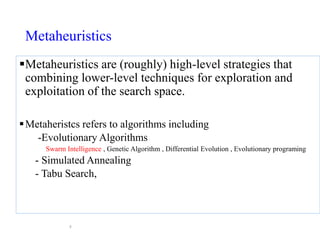
• Heuristic is used to solve NP-Complete Problem , a class of
decision problem.
Every decision problem has equivalent optimization problem
8
Metaheuristics
Metaheuristics are (roughly) high-level strategies that
combining lower-level techniques for exploration and
exploitation of the search space.
Metaheristcs refers to algorithms including
-Evolutionary Algorithms
Swarm Intelligence , Genetic Algorithm , Differential Evolution , Evolutionary programing
- Simulated Annealing
- Tabu Search,
9
Fundamental Properties of Metaheuristics
• Metaheuristics are strategies that “guide” the search process.
• The goal is to efficiently explore the search space in order to
find (near-)optimal solutions.
• Metaheuristic algorithms are approximate and usually non-
deterministic.
• Metaheuristics are not problem-specific.
10
Outline
• Swarm Intelligence
• Metahuristics
• Particle Swarm Optimization (PSO)
• Ant Colony Optimization (ACO)
• Case Study: Data Clustering Using PSO
• Conclusion
11
Particle Swarm Optimization
12
Particle Swarm Optimization (PSO)
13
 PSO is stochastic optimization technique proposed
by Kennedy and Eberhart ( 1995) [2].
 A population based search method with position of
particle is representing solution and Swarm of
particles as searching agent.
 PSO is a robust evolutionary optimization technique
based on the movement and intelligence of swarms.
PSO find the minimum value for the function.
Particle Swarm Optimization (PSO)
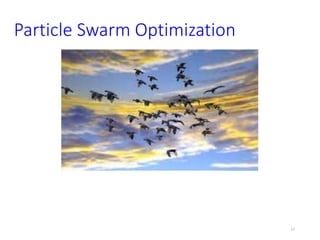
• The idea is similar to bird flocks searching for food.
• Bird = a particle, Food = a solution
• pbest = the best solution (fitness) a particle has achieved so far.
• gbest = the global best solution of all particles within the swarm
14
PSO Search Scheme
15
- pbest : the best solution achieved so far by that particle.
- gbest : the best value obtained so far by any particle in the
neighborhood of that particle.
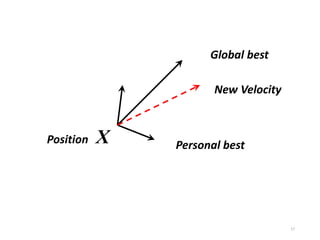
- The basic concept of PSO lies in accelerating each
particle toward its pbest and the gbest locations, with a
random weighted acceleration at each time.
PSO Search Scheme
16
- Each particle is treated as a point (candidate solution)
in a N-dimensional space which adjusts its “flying”
according to its own flying experience as well as the
flying experience of other particles.
- PSO uses a number of agents, i.e., particles, that
constitute a swarm flying in the search space looking for
the best solution.
New Velocity
Position X Personal best
Global best
17
Particle Swarm Optimization (PSO)
18
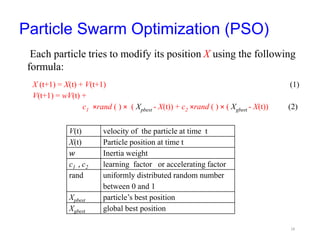
X (t+1) = X(t) + V(t+1) (1)
V(t+1) = wV(t) +
c1 ×rand ( ) × ( Xpbest - X(t)) + c2 ×rand ( ) × ( Xgbest - X(t)) (2)
V(t) velocity of the particle at time t
X(t) Particle position at time t
w Inertia weight
c1 , c2 learning factor or accelerating factor
rand uniformly distributed random number
between 0 and 1
Xpbest particle’s best position
Xgbest global best position
Each particle tries to modify its position X using the following
formula:
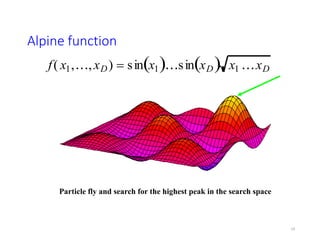
Alpine function
19
f( x1, ,xD)  sin x1
  sin xD
  x1 xD
Particle fly and search for the highest peak in the search space
PSO Algorithm
20
The PSO algorithm pseudocode [2] as following:
Input: Randomly initialized position and velocity of Particles:
Xi (0) andVi (0)
Output: Position of the approximate global minimum X*
1: while terminating condition is not reached do
2: for i = 1 to number of particles do
3: Calculate the fitness function f
4: Update personal best and global best of each particle
5: Update velocity of the particle using Equation 2
6: Update the position of the particle using equation 1
7: end for
8: end while

11-Optimization algorithm with swarm.pptx

  • 1.
  • 2.
    Outline • Swarm Intelligence •Metahuristics • Particle Swarm Optimization (PSO) • Ant Colony Optimization (ACO) • Case Study: Data Clustering Using PSO • Conclusion 2
  • 3.
    Swarm Intelligence “The emergentcollective intelligence of groups of simple agents.” (Bonabeau et al, 1999)
  • 4.
    Characteristics of Swarms •Composed of many individuals • Individuals are homogeneous • Local interaction based on simple rules • Self-organization ( No centralized Control)
  • 5.
    Swarm Intelligence Algorithms •ParticleSwarm Optimization (PSO) •Ant Colony Optimization •Artificial Bee Colony Algorithm •Artificial Immune Systems Algorithm
  • 6.
    Search Techniques • DeterministicSearch Techniques • Branch and Bound • Steepest Descent • Newton-Raphson • Simplex based Technique • Stochastic or Random Search Techniques • Swarm Intelligence • Genetic Algorithm • Differential Evolution • Simulated Annealing 6
  • 7.
    Components of SearchTechniques • Initial solution • Search direction • Update criteria • Stopping criteria • All above elements can be either • Deterministic or Stochastic • Single points or population based 7
  • 8.
    Heuristics • Heuristic (orapproximate) algorithms aim to find a good solution to a problem in a reasonable amount of computation time – but with no guarantee of “goodness” or “efficiency” (cf. exact or complete algorithms). • Heuristic is used to solve NP-Complete Problem , a class of decision problem. Every decision problem has equivalent optimization problem 8
  • 9.
    Metaheuristics Metaheuristics are (roughly)high-level strategies that combining lower-level techniques for exploration and exploitation of the search space. Metaheristcs refers to algorithms including -Evolutionary Algorithms Swarm Intelligence , Genetic Algorithm , Differential Evolution , Evolutionary programing - Simulated Annealing - Tabu Search, 9
  • 10.
    Fundamental Properties ofMetaheuristics • Metaheuristics are strategies that “guide” the search process. • The goal is to efficiently explore the search space in order to find (near-)optimal solutions. • Metaheuristic algorithms are approximate and usually non- deterministic. • Metaheuristics are not problem-specific. 10
  • 11.
    Outline • Swarm Intelligence •Metahuristics • Particle Swarm Optimization (PSO) • Ant Colony Optimization (ACO) • Case Study: Data Clustering Using PSO • Conclusion 11
  • 12.
  • 13.
    Particle Swarm Optimization(PSO) 13  PSO is stochastic optimization technique proposed by Kennedy and Eberhart ( 1995) [2].  A population based search method with position of particle is representing solution and Swarm of particles as searching agent.  PSO is a robust evolutionary optimization technique based on the movement and intelligence of swarms. PSO find the minimum value for the function.
  • 14.
    Particle Swarm Optimization(PSO) • The idea is similar to bird flocks searching for food. • Bird = a particle, Food = a solution • pbest = the best solution (fitness) a particle has achieved so far. • gbest = the global best solution of all particles within the swarm 14
  • 15.
    PSO Search Scheme 15 -pbest : the best solution achieved so far by that particle. - gbest : the best value obtained so far by any particle in the neighborhood of that particle. - The basic concept of PSO lies in accelerating each particle toward its pbest and the gbest locations, with a random weighted acceleration at each time.
  • 16.
    PSO Search Scheme 16 -Each particle is treated as a point (candidate solution) in a N-dimensional space which adjusts its “flying” according to its own flying experience as well as the flying experience of other particles. - PSO uses a number of agents, i.e., particles, that constitute a swarm flying in the search space looking for the best solution.
  • 17.
    New Velocity Position XPersonal best Global best 17
  • 18.
    Particle Swarm Optimization(PSO) 18 X (t+1) = X(t) + V(t+1) (1) V(t+1) = wV(t) + c1 ×rand ( ) × ( Xpbest - X(t)) + c2 ×rand ( ) × ( Xgbest - X(t)) (2) V(t) velocity of the particle at time t X(t) Particle position at time t w Inertia weight c1 , c2 learning factor or accelerating factor rand uniformly distributed random number between 0 and 1 Xpbest particle’s best position Xgbest global best position Each particle tries to modify its position X using the following formula:
  • 19.
    Alpine function 19 f( x1,,xD)  sin x1   sin xD   x1 xD Particle fly and search for the highest peak in the search space
  • 20.
    PSO Algorithm 20 The PSOalgorithm pseudocode [2] as following: Input: Randomly initialized position and velocity of Particles: Xi (0) andVi (0) Output: Position of the approximate global minimum X* 1: while terminating condition is not reached do 2: for i = 1 to number of particles do 3: Calculate the fitness function f 4: Update personal best and global best of each particle 5: Update velocity of the particle using Equation 2 6: Update the position of the particle using equation 1 7: end for 8: end while