PARTICLE SWARM
OPTIMIZATION

MIDHULA VIJAYAN
ROLL NO:50
S7 CSE

1


INTRODUCTION



PSO ALGORITHM



MULTI OBJECTIVE PSO



NEW PARTICLE SWARM OPTIMIZATION



APPLICATION



ADVANTAGES



CONCLUSION



REFERENCES
2
 Developed in 1995 by James Kennedy and Russ Eberhart

Applied to a variety of search and optimization problems.
Swarm of n individuals communicate directly or indirectly

PSO is a simple but powerful search technique.
Applies to concept of social interaction to problem solving.

3
(cntd...)
Each particle is treated as a point in a N-dimensional space .
Swarm moving around in the search space looking for the best solution
Robust technique based on movement & intelligence of swarms
BASIC IDEA
Each particle is searching for the optimum
Each particle is moving , and hence has a velocity.
Each particle remembers the position ,where it had its best result so far
4
BASIC IDEA 2




(cntd…)

The particles in the swarm co-operate.
In basic PSO


A particle has a neighbourhood associated with it.



particle knows the fitnesses of those in its

neighbourhood


Position is simply used to adjust the particle’s velocity

5
Particle tries to modify its position using the informations


The current position



The current velocities



The distance between the current position and pbest



The distance between the current position and the gbest.

6
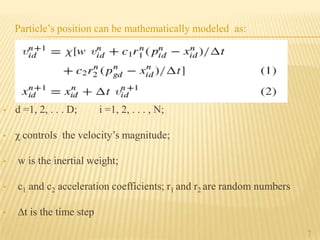
Particle’s position can be mathematically modeled as:

•

d =1, 2, . . . D;

i =1, 2, . . . , N;

•

χ controls the velocity’s magnitude;

•

w is the inertial weight;

•

c1 and c2 acceleration coefficients; r1 and r2 are random numbers

•

∆t is the time step
7
PARTICLE SWARM OPTIMIZATION (PSO)
y

sk+1

vk
vk+1
sk

vgbest
vpbest

x
Fig.1 Concept of modification of a searching point by PSO
sk : current searching point.
sk+1: modified searching point.
vk: current velocity.
vk+1: modified velocity.
vpbest : velocity based on pbest.
vgbest : velocity based on gbest
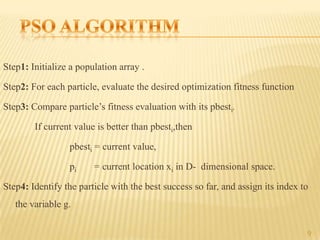
Step1: Initialize a population array .
Step2: For each particle, evaluate the desired optimization fitness function
Step3: Compare particle’s fitness evaluation with its pbesti.
If current value is better than pbesti,then
pbesti = current value,
pi

= current location xi in D- dimensional space.

Step4: Identify the particle with the best success so far, and assign its index to
the variable g.
9
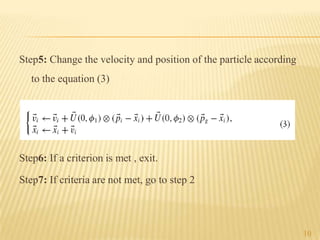
Step5: Change the velocity and position of the particle according
to the equation (3)

Step6: If a criterion is met , exit.
Step7: If criteria are not met, go to step 2

10




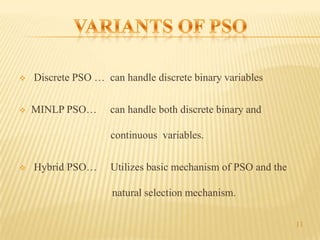
Discrete PSO … can handle discrete binary variables
MINLP PSO…

can handle both discrete binary and
continuous variables.



Hybrid PSO…

Utilizes basic mechanism of PSO and the
natural selection mechanism.
11


Used in multi objective systems



Two approaches
1. Each particle evaluate for one objective function at a
time

1.1 Determine the best position by normal PSO
2.Evaluate all objective functions for each particle
2.1 It produce leader,guide the particle
12


Particle adjust its position according to its previous worst solution.



Adjust its position according to groups worst solution.





It avoid worst solutions
NPSO find better solution than PSO.

13


Function optimization



Artificial neural network training



Identification of Parkinson’s disease



Extraction of rules from fuzzy networks



Image recognition



Areas where GA can be applied.

14
(cntd…)



Optimization of electric power distribution networks

Structural optimization
+Optimal shape and sizing design
+Topology optimization



Process biochemistry



System identification in biomechanics

15


Simple implementation



Easily parallelized for concurrent processing



Derivative free



Very few algorithm parameters



Very efficient global search algorithm

16


PSO can be effectively used for continuous optimization
problems.



Particle swarm optimization is a viable tool for objective
analysis and decision making.



It can be used in any practical solution.



NPSO is much better than PSO.

17
1) Y. Shi and R. C. Eberhart, “A modified particle swarm optimizer,” in
Proc. IEEE Congr. Evol. Comput., 1998, pp. 69–73.
2) Clerc, M. and Kennedy, J.: The particle swarm-explosion, stability
and convergence in a multidimensional complex space.
IEEE Trans. Evol. Comput. Vol.6, no.2, pp.58-73, Feb. 2002.
3) Kennedy, J., and Mendes, R. (2002). Population structure and
particle swarm performance. Proc. of the 2002 World
Congress on Computational Intelligence.
4) T. Krink, J. S. Vesterstroem, and J. Riget, “Particle swarm
optimization with spatial particle extension,” in Proc. Congr.
Evolut. Comput., Honolulu, HI, 2002, pp. 1474–1479.
5) M. Lovbjerg and T. Krink, “Extending particle swarm optimizers
with self-organized criticality,” in Proc. Congr. Evol.
Comput., Honolulu, HI, 2002, pp. 1588–1593.
18
19
20

Particle Swarm optimization

  • 1.
  • 2.
     INTRODUCTION  PSO ALGORITHM  MULTI OBJECTIVEPSO  NEW PARTICLE SWARM OPTIMIZATION  APPLICATION  ADVANTAGES  CONCLUSION  REFERENCES 2
  • 3.
     Developed in1995 by James Kennedy and Russ Eberhart Applied to a variety of search and optimization problems. Swarm of n individuals communicate directly or indirectly PSO is a simple but powerful search technique. Applies to concept of social interaction to problem solving. 3
  • 4.
    (cntd...) Each particle istreated as a point in a N-dimensional space . Swarm moving around in the search space looking for the best solution Robust technique based on movement & intelligence of swarms BASIC IDEA Each particle is searching for the optimum Each particle is moving , and hence has a velocity. Each particle remembers the position ,where it had its best result so far 4
  • 5.
    BASIC IDEA 2   (cntd…) Theparticles in the swarm co-operate. In basic PSO  A particle has a neighbourhood associated with it.  particle knows the fitnesses of those in its neighbourhood  Position is simply used to adjust the particle’s velocity 5
  • 6.
    Particle tries tomodify its position using the informations  The current position  The current velocities  The distance between the current position and pbest  The distance between the current position and the gbest. 6
  • 7.
    Particle’s position canbe mathematically modeled as: • d =1, 2, . . . D; i =1, 2, . . . , N; • χ controls the velocity’s magnitude; • w is the inertial weight; • c1 and c2 acceleration coefficients; r1 and r2 are random numbers • ∆t is the time step 7
  • 8.
    PARTICLE SWARM OPTIMIZATION(PSO) y sk+1 vk vk+1 sk vgbest vpbest x Fig.1 Concept of modification of a searching point by PSO sk : current searching point. sk+1: modified searching point. vk: current velocity. vk+1: modified velocity. vpbest : velocity based on pbest. vgbest : velocity based on gbest
  • 9.
    Step1: Initialize apopulation array . Step2: For each particle, evaluate the desired optimization fitness function Step3: Compare particle’s fitness evaluation with its pbesti. If current value is better than pbesti,then pbesti = current value, pi = current location xi in D- dimensional space. Step4: Identify the particle with the best success so far, and assign its index to the variable g. 9
  • 10.
    Step5: Change thevelocity and position of the particle according to the equation (3) Step6: If a criterion is met , exit. Step7: If criteria are not met, go to step 2 10
  • 11.
      Discrete PSO …can handle discrete binary variables MINLP PSO… can handle both discrete binary and continuous variables.  Hybrid PSO… Utilizes basic mechanism of PSO and the natural selection mechanism. 11
  • 12.
     Used in multiobjective systems  Two approaches 1. Each particle evaluate for one objective function at a time 1.1 Determine the best position by normal PSO 2.Evaluate all objective functions for each particle 2.1 It produce leader,guide the particle 12
  • 13.
     Particle adjust itsposition according to its previous worst solution.  Adjust its position according to groups worst solution.   It avoid worst solutions NPSO find better solution than PSO. 13
  • 14.
     Function optimization  Artificial neuralnetwork training  Identification of Parkinson’s disease  Extraction of rules from fuzzy networks  Image recognition  Areas where GA can be applied. 14
  • 15.
    (cntd…)   Optimization of electricpower distribution networks Structural optimization +Optimal shape and sizing design +Topology optimization  Process biochemistry  System identification in biomechanics 15
  • 16.
     Simple implementation  Easily parallelizedfor concurrent processing  Derivative free  Very few algorithm parameters  Very efficient global search algorithm 16
  • 17.
     PSO can beeffectively used for continuous optimization problems.  Particle swarm optimization is a viable tool for objective analysis and decision making.  It can be used in any practical solution.  NPSO is much better than PSO. 17
  • 18.
    1) Y. Shiand R. C. Eberhart, “A modified particle swarm optimizer,” in Proc. IEEE Congr. Evol. Comput., 1998, pp. 69–73. 2) Clerc, M. and Kennedy, J.: The particle swarm-explosion, stability and convergence in a multidimensional complex space. IEEE Trans. Evol. Comput. Vol.6, no.2, pp.58-73, Feb. 2002. 3) Kennedy, J., and Mendes, R. (2002). Population structure and particle swarm performance. Proc. of the 2002 World Congress on Computational Intelligence. 4) T. Krink, J. S. Vesterstroem, and J. Riget, “Particle swarm optimization with spatial particle extension,” in Proc. Congr. Evolut. Comput., Honolulu, HI, 2002, pp. 1474–1479. 5) M. Lovbjerg and T. Krink, “Extending particle swarm optimizers with self-organized criticality,” in Proc. Congr. Evol. Comput., Honolulu, HI, 2002, pp. 1588–1593. 18
  • 19.
  • 20.