J.B.INSTITUTE OF ENGINEERING AND TECHNOLOGY


  Design and Implementation of Lossless DWT/IDWT (Discrete
   Wavelet Transform & Inverse Discrete Wavelet Transform)

                            BY
                      PIYUSH SETHIA
                        08671A0463
                          (E.C.E)


INTERNAL GUIDE                                     H.O.D
 SYED MOHD ALI                        S. P. VENU MADHAVA RAO
OVERVIEW
1.   Introduction
2.   Literature review
3.   Discrete wavelet transform
4.   Lifting scheme
5.   Simulation results
6.   Conclusion
7.   Future scope
Introduction
Why Discrete wavelet transform?

Inherent multi-resolution nature,
wavelet-coding schemes
for applications where scalability and tolerable
degradation are important.
What is wavelets?
• Wavelet transform decomposes a signal into a
  set of basis functions. These basis functions
  are called wavelets


  What is Discrete wavelet transform?
• Discrete wavelet transform (DWT), which
  transforms a discrete time signal to a discrete
  wavelet representation.
Introduction (cont..)
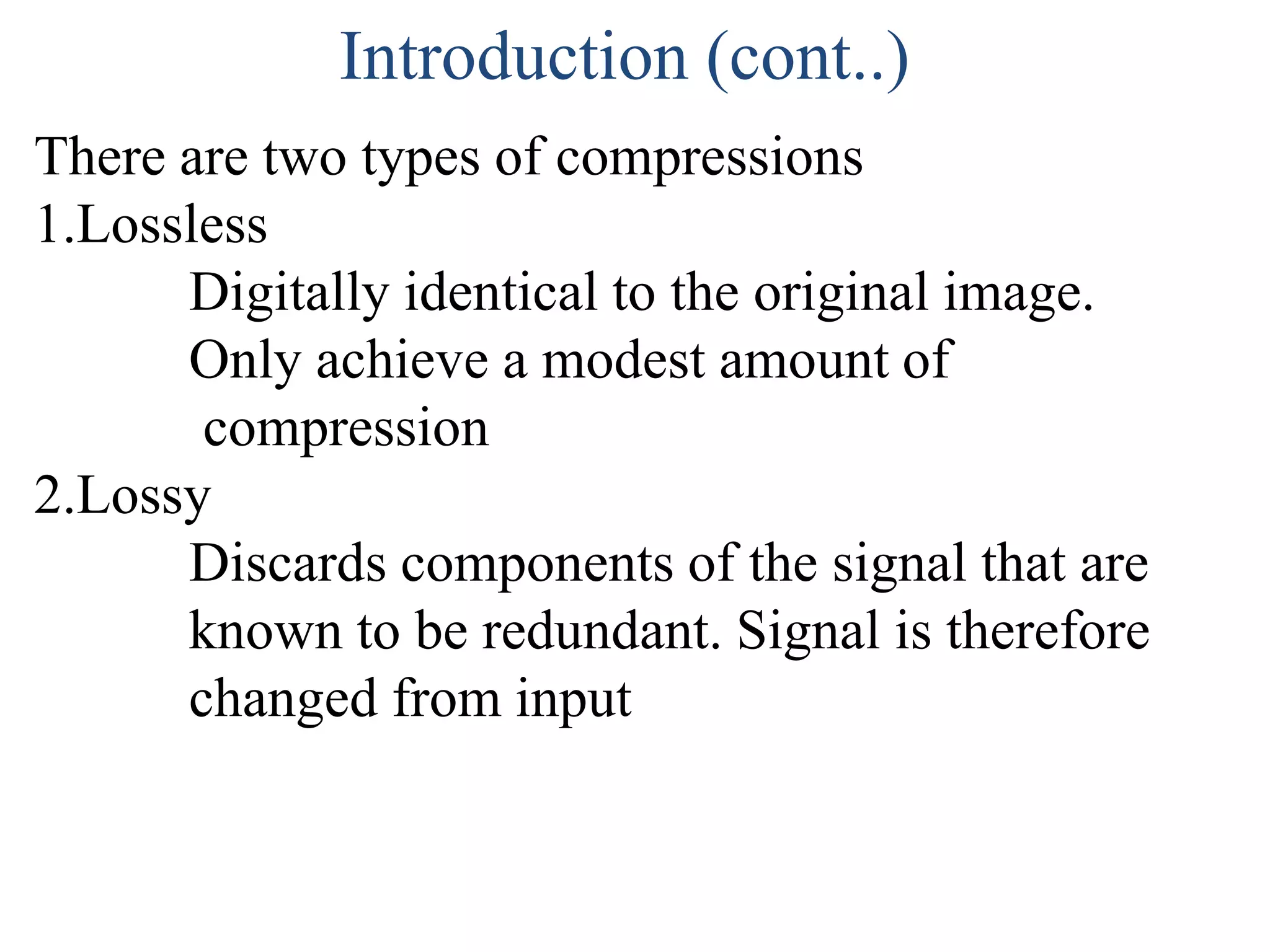
There are two types of compressions
1.Lossless
      Digitally identical to the original image.
      Only achieve a modest amount of
       compression
2.Lossy
      Discards components of the signal that are
      known to be redundant. Signal is therefore
      changed from input
Introduction (cont..)
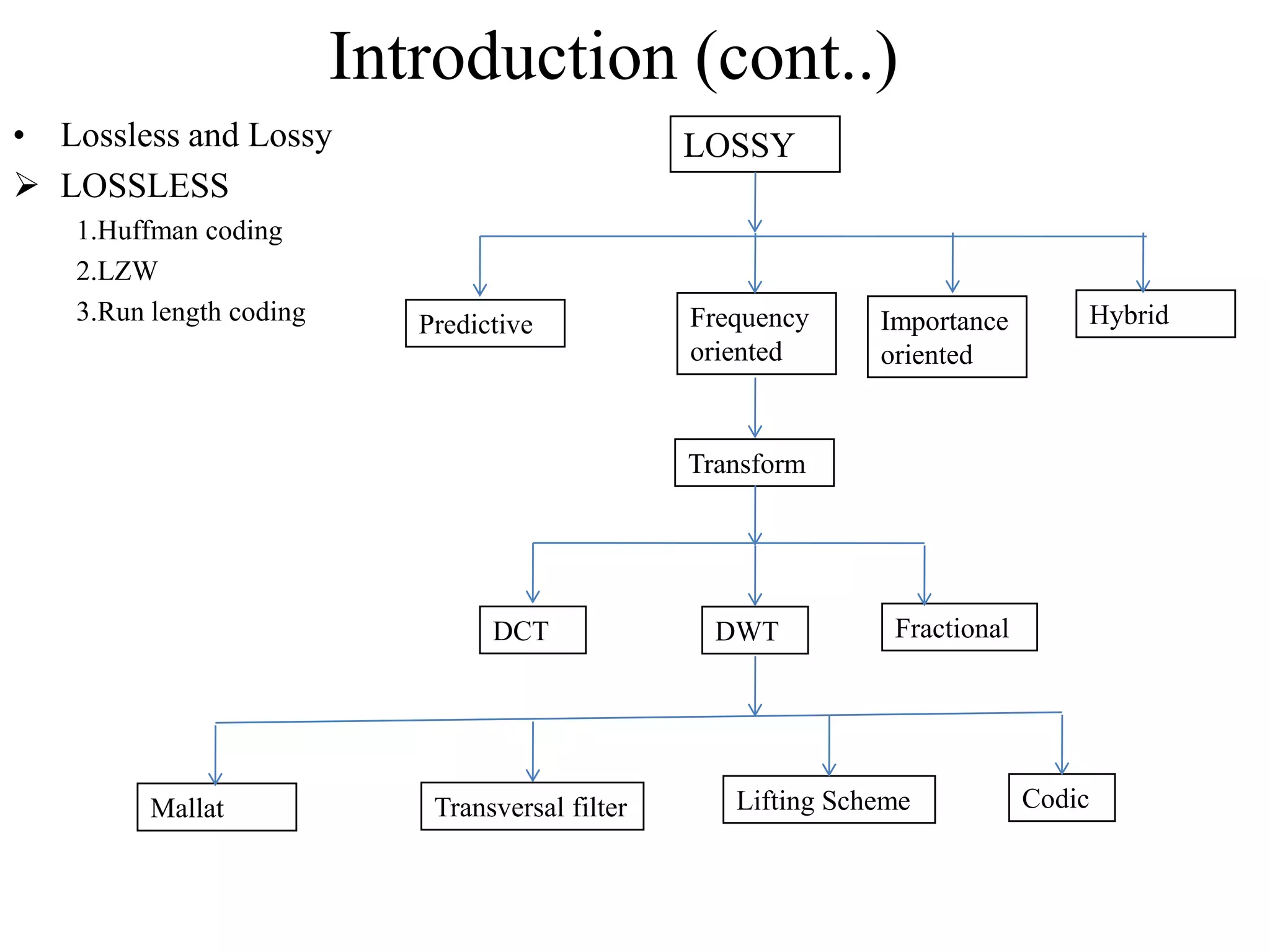
• Lossless and Lossy                              LOSSY
 LOSSLESS
   1.Huffman coding
   2.LZW
   3.Run length coding      Predictive            Frequency     Importance        Hybrid
                                                  oriented      oriented


                                                  Transform


                                  DCT               DWT          Fractional


         Mallat              Transversal filter      Lifting Scheme           Codic
Literature Review
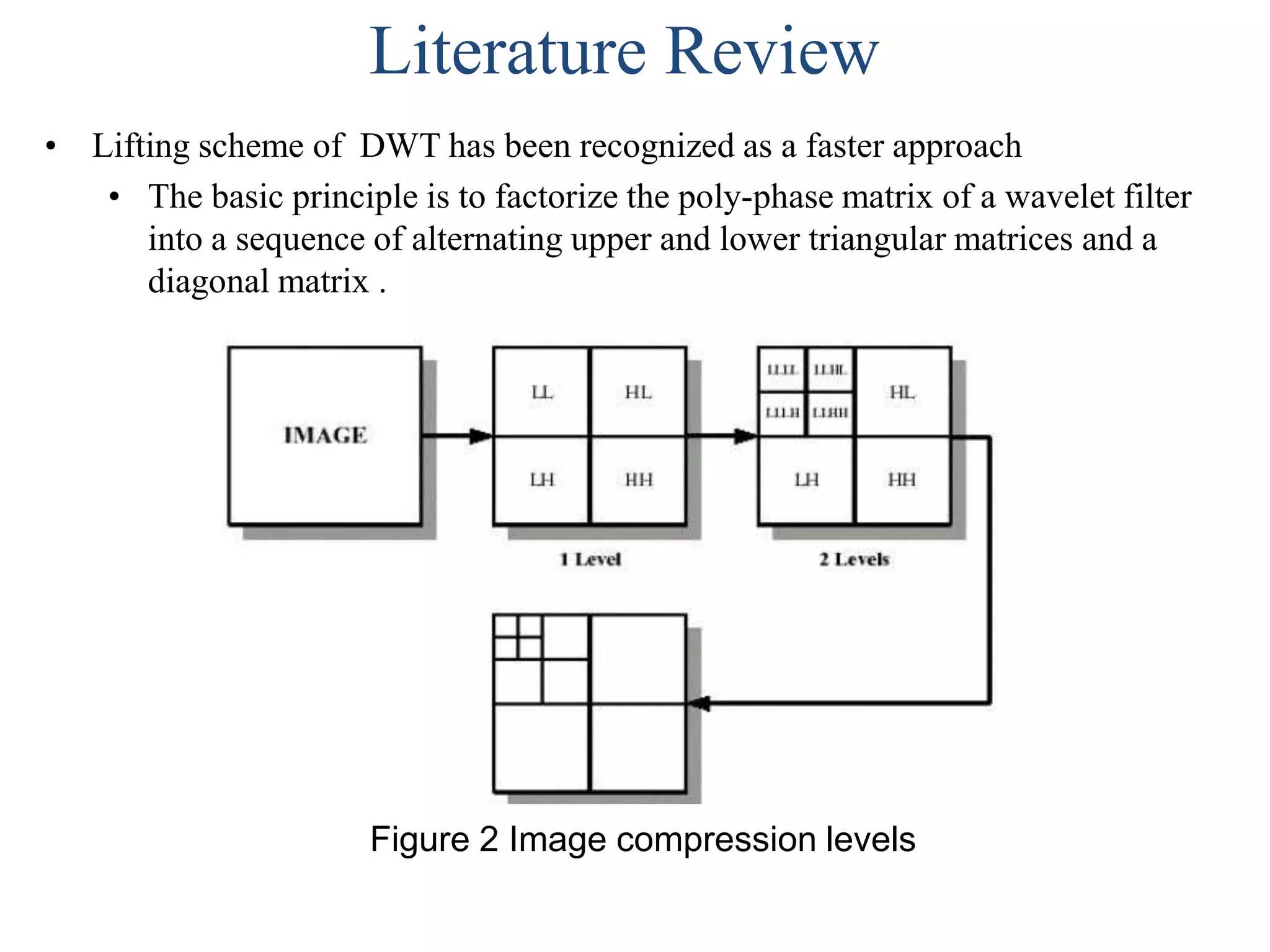
• Lifting scheme of DWT has been recognized as a faster approach
   • The basic principle is to factorize the poly-phase matrix of a wavelet filter
      into a sequence of alternating upper and lower triangular matrices and a
      diagonal matrix .


                       Figure 2 Image compression levels
Literature Review (cont..)
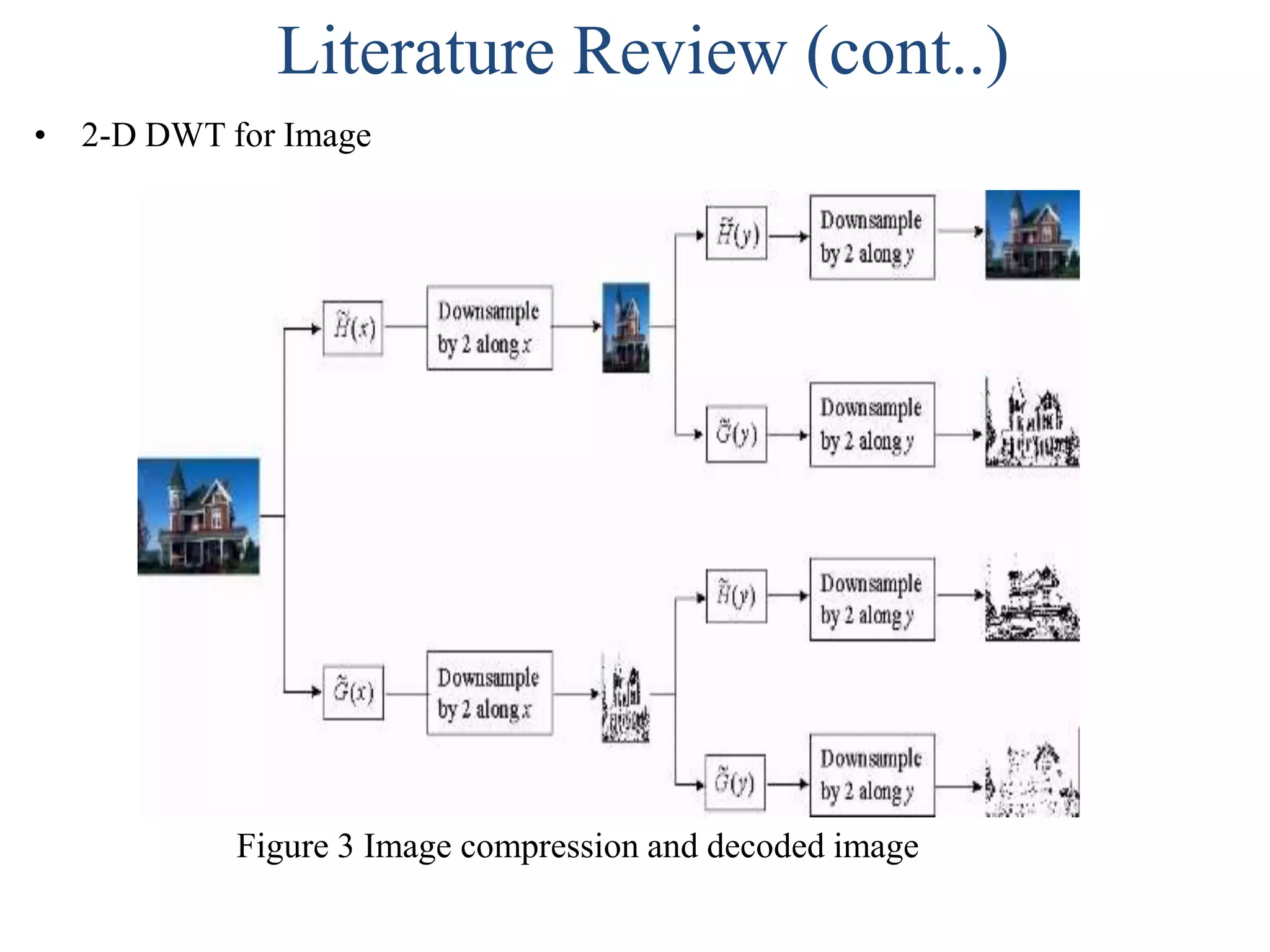
• 2-D DWT for Image


           Figure 3 Image compression and decoded image
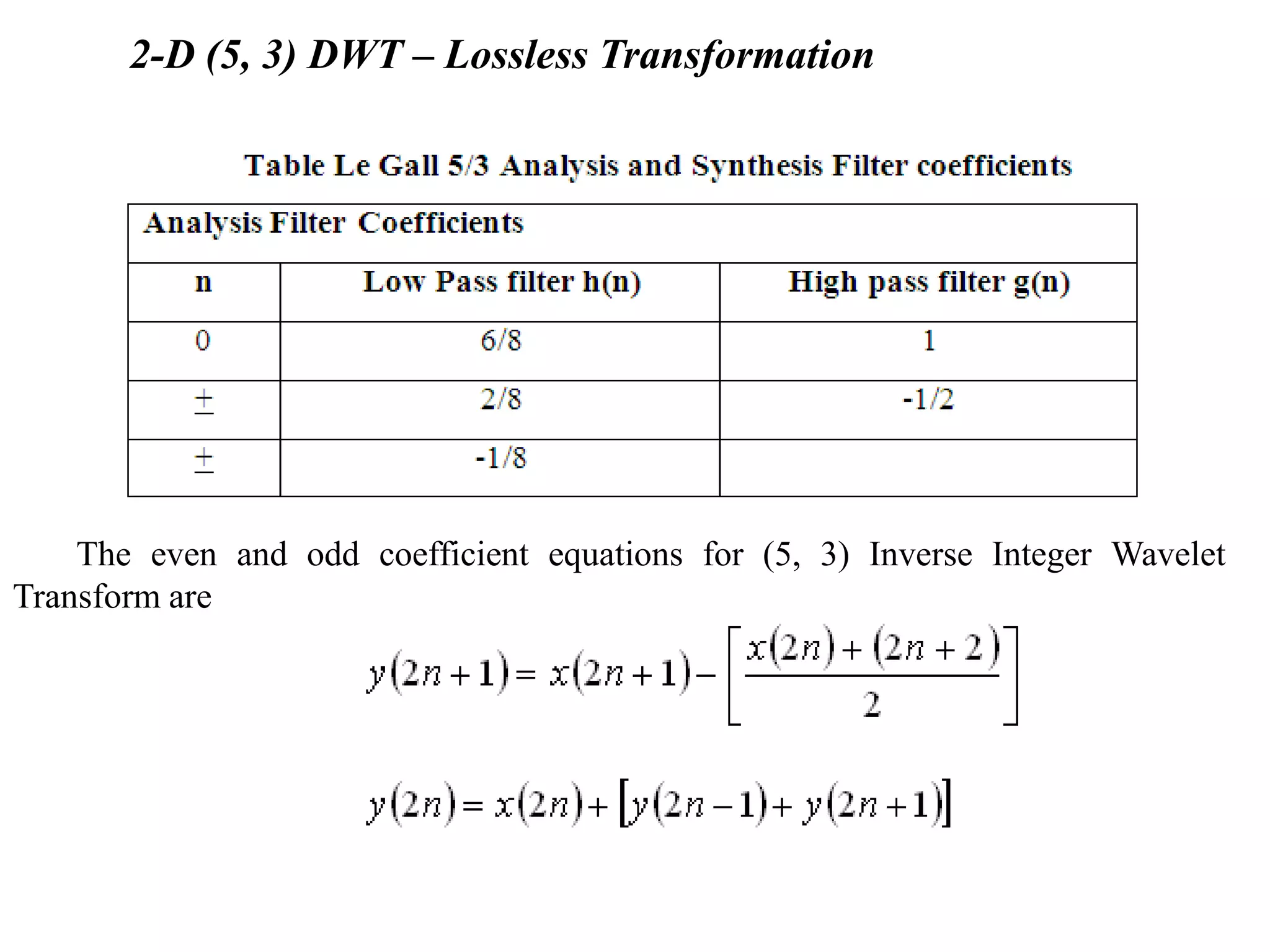
2-D (5, 3) DWT – Lossless Transformation


    The even and odd coefficient equations for (5, 3) Inverse Integer Wavelet
Transform are
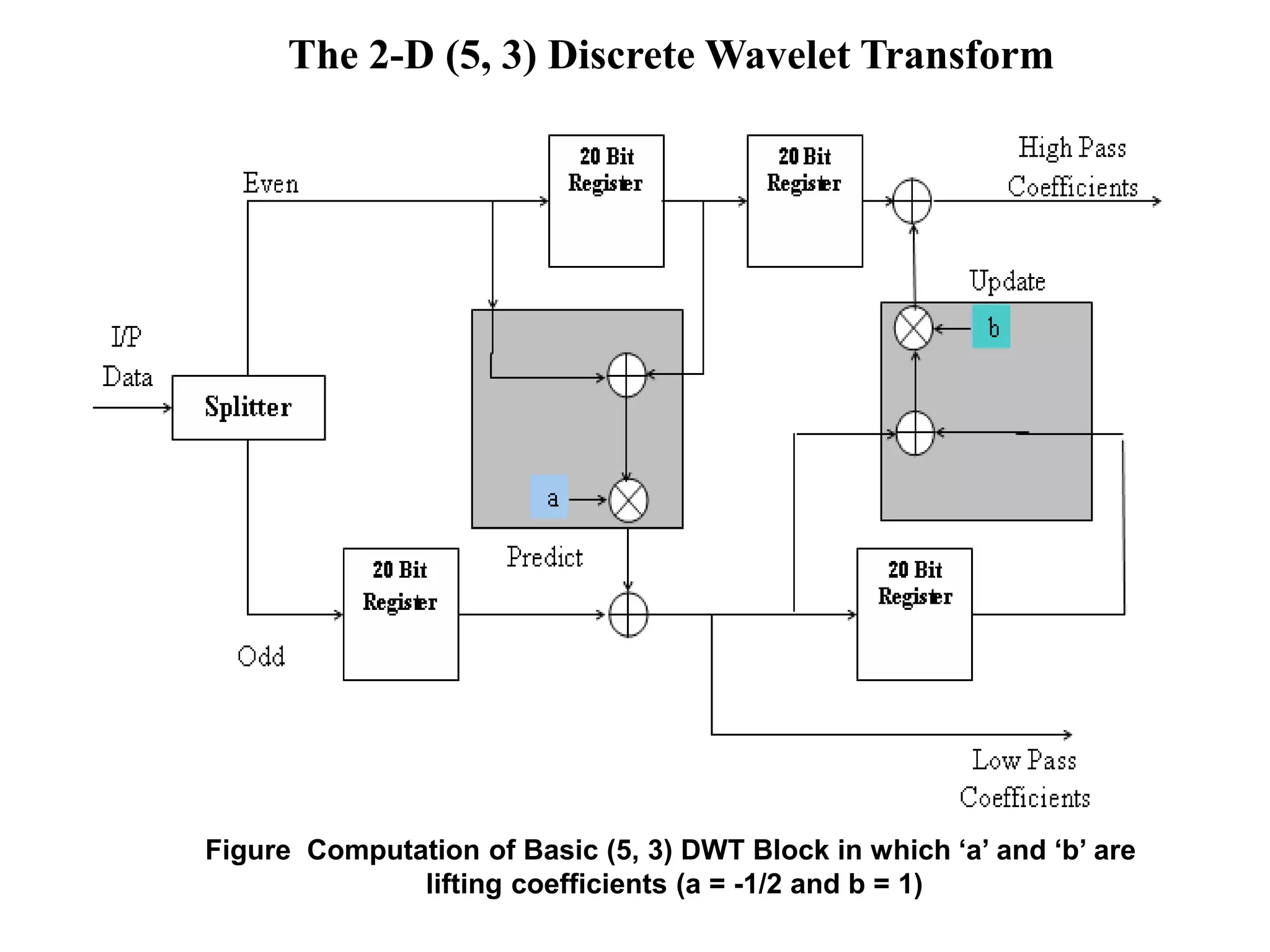
The 2-D (5, 3) Discrete Wavelet Transform


Figure Computation of Basic (5, 3) DWT Block in which ‘a’ and ‘b’ are
              lifting coefficients (a = -1/2 and b = 1)
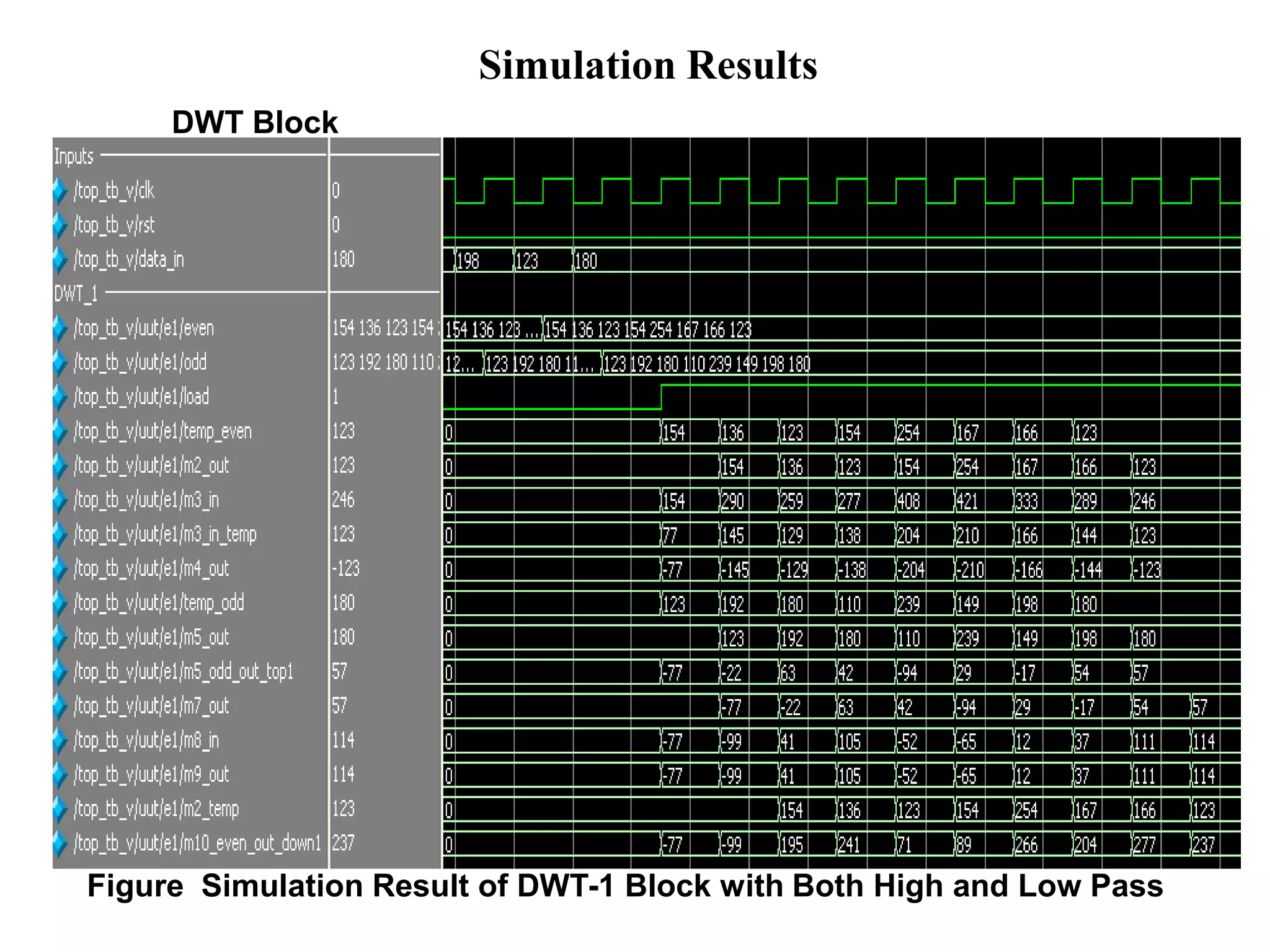
Simulation Results
     DWT Block


Figure Simulation Result of DWT-1 Block with Both High and Low Pass
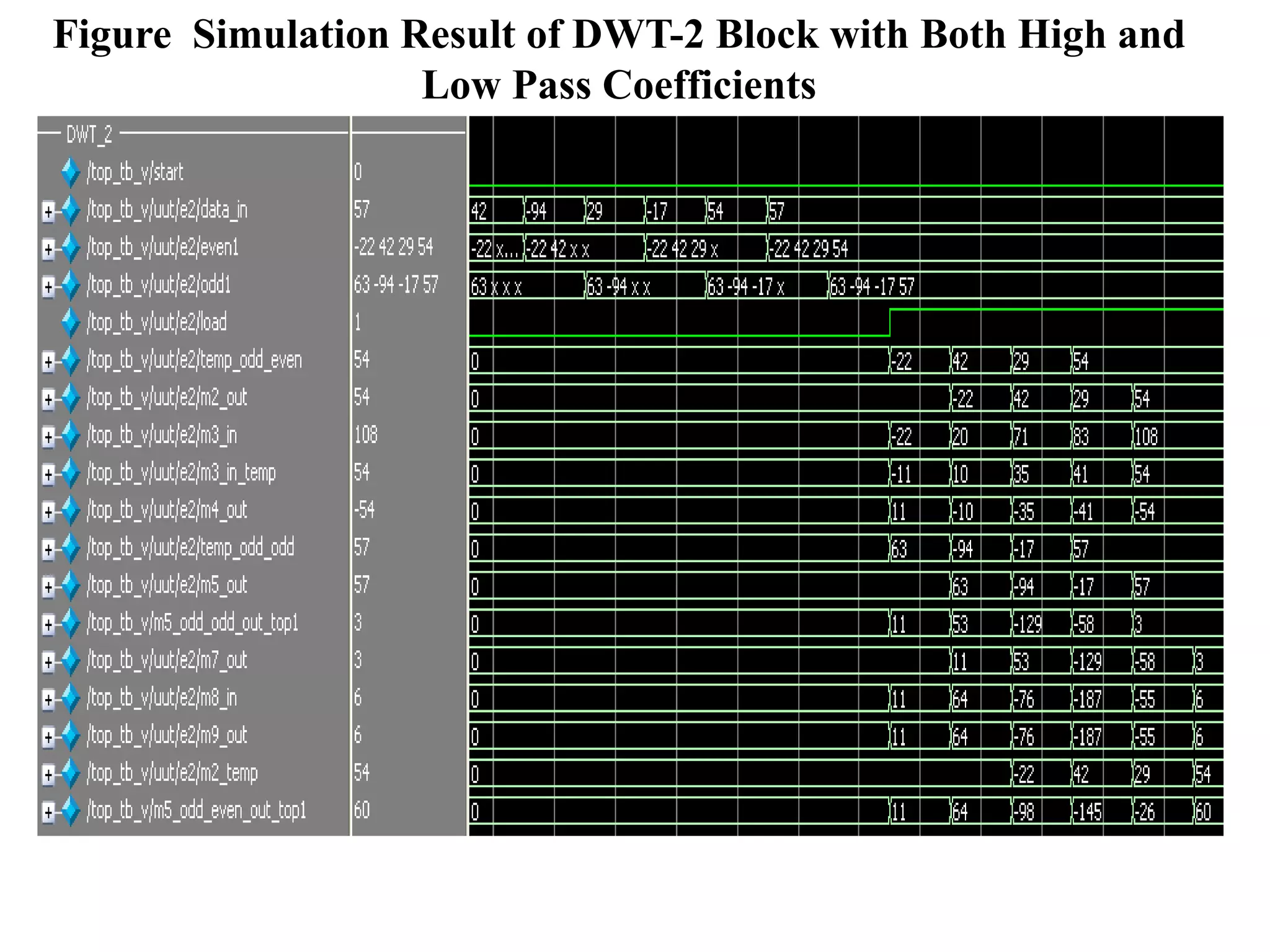
Figure Simulation Result of DWT-2 Block with Both High and
                   Low Pass Coefficients
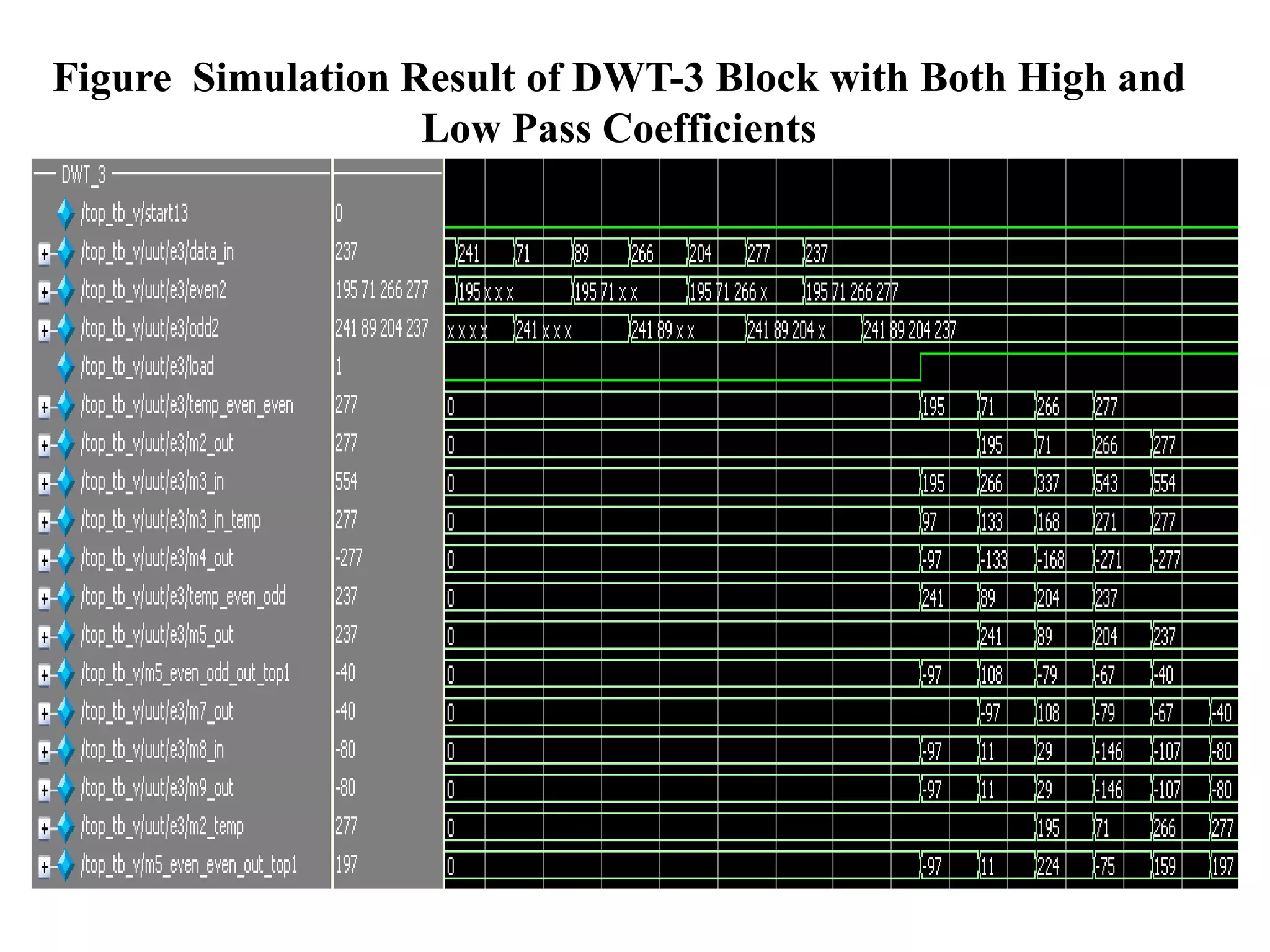
Figure Simulation Result of DWT-3 Block with Both High and
                   Low Pass Coefficients
Applications of the project

•   Medical application
•   Signal de-noising
•   Data compression
•   Image processing
Conclusion
• Basically the medical images need more accuracy
  without loss of information. The Discrete Wavelet
  Transform (DWT) was based on time-scale
  representation, which provides efficient multi-
  resolution.
• It has been analyzed that the discrete wavelet
  transform (DWT) operates at a maximum clock
  frequency of 99.197 MHz respectively.
Future scope of the Work
As future work,
• This work can be extended in order to increase
  the accuracy by increasing the level of
  transformations.
• This can be used as a part of the block in the
  full fledged application, i.e., by using these
  DWT, the applications can be developed such
  as compression, watermarking, etc.
THANK YOU

discrete wavelet transform

  • 1.
    J.B.INSTITUTE OF ENGINEERINGAND TECHNOLOGY Design and Implementation of Lossless DWT/IDWT (Discrete Wavelet Transform & Inverse Discrete Wavelet Transform) BY PIYUSH SETHIA 08671A0463 (E.C.E) INTERNAL GUIDE H.O.D SYED MOHD ALI S. P. VENU MADHAVA RAO
  • 2.
    OVERVIEW 1. Introduction 2. Literature review 3. Discrete wavelet transform 4. Lifting scheme 5. Simulation results 6. Conclusion 7. Future scope
  • 3.
    Introduction Why Discrete wavelettransform? Inherent multi-resolution nature, wavelet-coding schemes for applications where scalability and tolerable degradation are important.
  • 4.
    What is wavelets? •Wavelet transform decomposes a signal into a set of basis functions. These basis functions are called wavelets What is Discrete wavelet transform? • Discrete wavelet transform (DWT), which transforms a discrete time signal to a discrete wavelet representation.
  • 5.
    Introduction (cont..) There aretwo types of compressions 1.Lossless Digitally identical to the original image. Only achieve a modest amount of compression 2.Lossy Discards components of the signal that are known to be redundant. Signal is therefore changed from input
  • 6.
    Introduction (cont..) • Losslessand Lossy LOSSY  LOSSLESS 1.Huffman coding 2.LZW 3.Run length coding Predictive Frequency Importance Hybrid oriented oriented Transform DCT DWT Fractional Mallat Transversal filter Lifting Scheme Codic
  • 7.
    Literature Review • Liftingscheme of DWT has been recognized as a faster approach • The basic principle is to factorize the poly-phase matrix of a wavelet filter into a sequence of alternating upper and lower triangular matrices and a diagonal matrix . Figure 2 Image compression levels
  • 8.
    Literature Review (cont..) •2-D DWT for Image Figure 3 Image compression and decoded image
  • 9.
    2-D (5, 3)DWT – Lossless Transformation The even and odd coefficient equations for (5, 3) Inverse Integer Wavelet Transform are
  • 10.
    The 2-D (5,3) Discrete Wavelet Transform Figure Computation of Basic (5, 3) DWT Block in which ‘a’ and ‘b’ are lifting coefficients (a = -1/2 and b = 1)
  • 11.
    Simulation Results DWT Block Figure Simulation Result of DWT-1 Block with Both High and Low Pass
  • 12.
    Figure Simulation Resultof DWT-2 Block with Both High and Low Pass Coefficients
  • 13.
    Figure Simulation Resultof DWT-3 Block with Both High and Low Pass Coefficients
  • 14.
    Applications of theproject • Medical application • Signal de-noising • Data compression • Image processing
  • 15.
    Conclusion • Basically themedical images need more accuracy without loss of information. The Discrete Wavelet Transform (DWT) was based on time-scale representation, which provides efficient multi- resolution. • It has been analyzed that the discrete wavelet transform (DWT) operates at a maximum clock frequency of 99.197 MHz respectively.
  • 16.
    Future scope ofthe Work As future work, • This work can be extended in order to increase the accuracy by increasing the level of transformations. • This can be used as a part of the block in the full fledged application, i.e., by using these DWT, the applications can be developed such as compression, watermarking, etc.
  • 17.