Particle Swarm
Optimization
Origin
 Inspired from the nature social behavior and dynamic movements with
communications of insects, birds and fish.
Origin
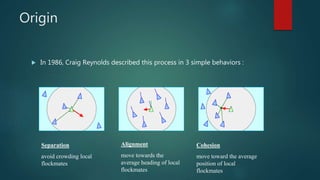
 In 1986, Craig Reynolds described this process in 3 simple behaviors :
Separation
avoid crowding local
flockmates
Alignment
move towards the
average heading of local
flockmates
Cohesion
move toward the average
position of local
flockmates
Origin
 Application to optimization: Particle Swarm Optimization
 Proposed by James Kennedy & Russell Eberhart (1995)
 Combines self-experiences with social experiences
Concept
 Uses a number of agents (particles) that constitute a
swarm moving around in the search space looking for
the best solution
 Each particle in search space adjusts its “flying”
according to its own flying experience as well as the
flying experience of other particles
Concept
 Collection of flying particles (swarm) - Changing solutions
 Search area - Possible solutions
 Movement towards a promising area to get the global optimum
 Each particle keeps track:
 its best solution, personal best, pbest
 the best value of any particle, global best, gbest
Concept
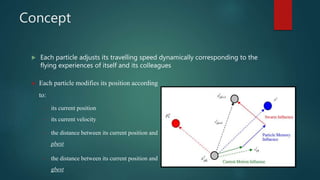
 Each particle adjusts its travelling speed dynamically corresponding to the
flying experiences of itself and its colleagues
 Each particle modifies its position according
to:
• its current position
• its current velocity
• the distance between its current position and
pbest
• the distance between its current position and
gbest
Algorithm - Neighborhood
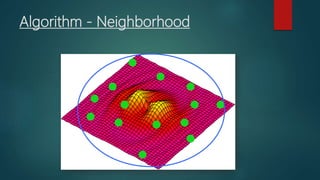
geographical
social
Algorithm - Neighborhood
Algorithm - Parameters
 Algorithm parameters
 A : Population of agents
 pi : Position of agent ai in the solution space
 f : Objective function
 vi : Velocity of agent’s ai
 V(ai) : Neighborhood of agent ai (fixed)
 The neighborhood concept in PSO is not the same as the
one used in other meta-heuristics search, since in PSO each
particle’s neighborhood never changes (is fixed)
Algorithm
Algorithm
 Particle update rule
p = p + v
 with
v = v + c1 * rand * (pBest – p) + c2 * rand * (gBest – p)
 where
• p: particle’s position
• v: path direction
• c1: weight of local information
• c2: weight of global information
• pBest: best position of the particle
• gBest: best position of the swarm
• rand: random variable
Algorithm - Parameters
 Number of particles usually between 10 and 50
 C1 is the importance of personal best value
 C2 is the importance of neighborhood best value
 Usually C1 + C2 = 4 (empirically chosen value)
 If velocity is too low → algorithm too slow
 If velocity is too high → algorithm too unstable
Algorithm
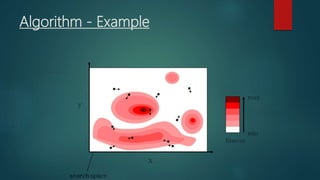
1. Create a ‘population’ of agents (particles) uniformly distributed over
X
2. Evaluate each particle’s position according to the objective function
3. If a particle’s current position is better than its previous best position,
update it
4. Determine the best particle (according to the particle’s previous best
positions)
Algorithm
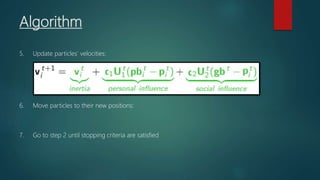
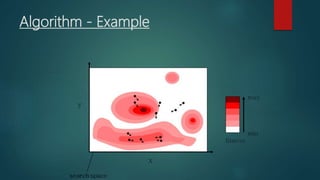
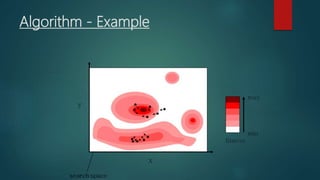
5. Update particles’ velocities:
6. Move particles to their new positions:
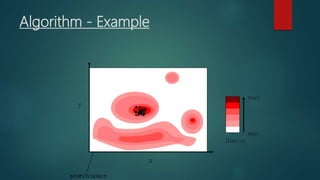
7. Go to step 2 until stopping criteria are satisfied
Algorithm
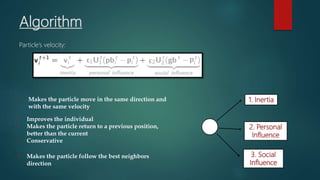
Particle’s velocity:
1. Inertia
2. Personal
Influence
3. Social
Influence
• Makes the particle move in the same direction and
with the same velocity
• Improves the individual
• Makes the particle return to a previous position,
better than the current
• Conservative
• Makes the particle follow the best neighbors
direction
Algorithm
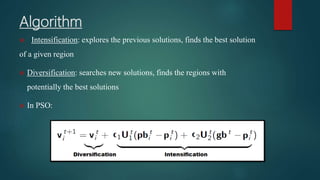
 Intensification: explores the previous solutions, finds the best solution
of a given region
 Diversification: searches new solutions, finds the regions with
potentially the best solutions
 In PSO:
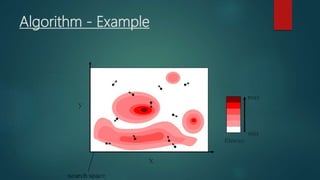
Algorithm - Example
Algorithm - Example
Algorithm - Example
Algorithm - Example
Algorithm - Example
Algorithm - Example
Algorithm - Example
Algorithm - Example
Algorithm Characteristics
Advantages
Insensitive to scaling of design variables
Simple implementation
Easily parallelized for concurrent processing
Derivative free
Very few algorithm parameters
Very efficient global search algorithm
Disadvantages
Tendency to a fast and premature convergence in mid optimum points
Slow convergence in refined search stage (weak local search ability)
Conclusion
• The PSO is a is an efficient global optimizer for continuous
variable problems (structural applications)
• Easily implemented, with very little parameters to fine-tune
• Algorithm modifications improve PSO local search ability
• Can accommodate constraints by using a penalty method

Particle swarm optimization

  • 1.
  • 2.
    Origin  Inspired fromthe nature social behavior and dynamic movements with communications of insects, birds and fish.
  • 3.
    Origin  In 1986,Craig Reynolds described this process in 3 simple behaviors : Separation avoid crowding local flockmates Alignment move towards the average heading of local flockmates Cohesion move toward the average position of local flockmates
  • 4.
    Origin  Application tooptimization: Particle Swarm Optimization  Proposed by James Kennedy & Russell Eberhart (1995)  Combines self-experiences with social experiences
  • 5.
    Concept  Uses anumber of agents (particles) that constitute a swarm moving around in the search space looking for the best solution  Each particle in search space adjusts its “flying” according to its own flying experience as well as the flying experience of other particles
  • 6.
    Concept  Collection offlying particles (swarm) - Changing solutions  Search area - Possible solutions  Movement towards a promising area to get the global optimum  Each particle keeps track:  its best solution, personal best, pbest  the best value of any particle, global best, gbest
  • 7.
    Concept  Each particleadjusts its travelling speed dynamically corresponding to the flying experiences of itself and its colleagues  Each particle modifies its position according to: • its current position • its current velocity • the distance between its current position and pbest • the distance between its current position and gbest
  • 8.
  • 9.
  • 10.
    Algorithm - Parameters Algorithm parameters  A : Population of agents  pi : Position of agent ai in the solution space  f : Objective function  vi : Velocity of agent’s ai  V(ai) : Neighborhood of agent ai (fixed)  The neighborhood concept in PSO is not the same as the one used in other meta-heuristics search, since in PSO each particle’s neighborhood never changes (is fixed)
  • 11.
  • 12.
    Algorithm  Particle updaterule p = p + v  with v = v + c1 * rand * (pBest – p) + c2 * rand * (gBest – p)  where • p: particle’s position • v: path direction • c1: weight of local information • c2: weight of global information • pBest: best position of the particle • gBest: best position of the swarm • rand: random variable
  • 13.
    Algorithm - Parameters Number of particles usually between 10 and 50  C1 is the importance of personal best value  C2 is the importance of neighborhood best value  Usually C1 + C2 = 4 (empirically chosen value)  If velocity is too low → algorithm too slow  If velocity is too high → algorithm too unstable
  • 14.
    Algorithm 1. Create a‘population’ of agents (particles) uniformly distributed over X 2. Evaluate each particle’s position according to the objective function 3. If a particle’s current position is better than its previous best position, update it 4. Determine the best particle (according to the particle’s previous best positions)
  • 15.
    Algorithm 5. Update particles’velocities: 6. Move particles to their new positions: 7. Go to step 2 until stopping criteria are satisfied
  • 16.
    Algorithm Particle’s velocity: 1. Inertia 2.Personal Influence 3. Social Influence • Makes the particle move in the same direction and with the same velocity • Improves the individual • Makes the particle return to a previous position, better than the current • Conservative • Makes the particle follow the best neighbors direction
  • 17.
    Algorithm  Intensification: exploresthe previous solutions, finds the best solution of a given region  Diversification: searches new solutions, finds the regions with potentially the best solutions  In PSO:
  • 18.
  • 19.
  • 20.
  • 21.
  • 22.
  • 23.
  • 24.
  • 25.
  • 26.
    Algorithm Characteristics Advantages Insensitive toscaling of design variables Simple implementation Easily parallelized for concurrent processing Derivative free Very few algorithm parameters Very efficient global search algorithm Disadvantages Tendency to a fast and premature convergence in mid optimum points Slow convergence in refined search stage (weak local search ability)
  • 27.
    Conclusion • The PSOis a is an efficient global optimizer for continuous variable problems (structural applications) • Easily implemented, with very little parameters to fine-tune • Algorithm modifications improve PSO local search ability • Can accommodate constraints by using a penalty method