Particle Swarm Optimization
Jayanti Prasad
Inter-University Centre for Astronomy & Astrophysics
Pune, India (411007)
February 20, 2015
Jayanti Prasad (IUCAA-Pune) Particle Swarm Optimization February 20, 2015 1 / 12
Swarms in Nature
Jayanti Prasad (IUCAA-Pune) Particle Swarm Optimization February 20, 2015 2 / 12
E. O. Wilson (1929-)
“In theory at least, individual members of the school can profit from the
discoveries and previous experience of all other members of the school
during the search for food. This advantage can become decisive,
outweighing the disadvantages of competition for food items, whenever
the resource is unpedictably distributed in patches.”
Jayanti Prasad (IUCAA-Pune) Particle Swarm Optimization February 20, 2015 3 / 12
Introduction
What is Optimization ?
Find a vector X0 ∈ Rn for which:
f (X0) ≤ f (X), X ∈ [a, b] and a, b ∈ Rn
(1)
with or without constraints of the following kind:
gj (X) ≤ 0 for j = 1, .., M (inequality constrains)
hj (X) = 0 for j = 1, .., p (equality constrains) (2)
The function f (X) is called an “optimization function” or the “cost
function”.
Jayanti Prasad (IUCAA-Pune) Particle Swarm Optimization February 20, 2015 4 / 12
Introduction
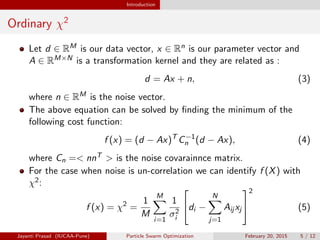
Ordinary χ2
Let d ∈ RM is our data vector, x ∈ Rn is our parameter vector and
A ∈ RM×N is a transformation kernel and they are related as :
d = Ax + n, (3)
where n ∈ RM is the noise vector.
The above equation can be solved by finding the minimum of the
following cost function:
f (x) = (d − Ax)T
C−1
n (d − Ax), (4)
where Cn =< nnT > is the noise covarainnce matrix.
For the case when noise is un-correlation we can identify f (X) with
χ2:
f (x) = χ2
=
1
M
M
X
i=1
1
σ2
i

di −
N
X
j=1
Aij xj


2
(5)
Jayanti Prasad (IUCAA-Pune) Particle Swarm Optimization February 20, 2015 5 / 12
Introduction
Common Optimization strategies
Deterministic:
Grid based search : Computational cost grows as exponentially with
the dimension N of the search.
Gradient based search : Newton-Raphson.
conjugate Gradient : when A is symmetric, positive definite.
Downhill-Simplex Methods.
Powell’s method.
Stochastic
Artificial Neural Networks (ANN).
Genetic Algorithm (GA).
Ant Colony Optimization (ACO), Particle Swarm Optimization (PSO),
Bat Algorithm (BA), Firefly Algorithm (FA), Bacteria Foraging
Optimization (BFO) etc.
Continuous Opinion Dynamics Optimizer (CODO) [Rishemjit Kaur &
Kapur (2013)].
Jayanti Prasad (IUCAA-Pune) Particle Swarm Optimization February 20, 2015 6 / 12
Particle Swarm Optimization (PSO)
PSO was presented by Kennedy & Eberhart in [Kennedy & Eberhart
(1995)] inspired by the work of E. O. Wilson [Wilson (1975)].
There are many good books [Kennedy & Eberhart (2001);
Engelbrecht (2002); Jun Sun & Wu (2012)] and review articles
available about PSO and a dedicated website
[http://www.swarmintelligence.org/].
PSO is a stochastic method for optimization of continuous nonlinear
functions motivated by the movement of organisms in a bird flock or
fish school.
In PSO, a ”team of particles” (computational agents) search for the
global maximum/minimum of a non-linear function (fitness/coast
function) exhibiting random motions.
Random motion of particles is governed by their ”personal
experience” (Pbest ) and ”social learning” (Gbest ).
Jayanti Prasad (IUCAA-Pune) Particle Swarm Optimization February 20, 2015 7 / 12
Particle Swarm Optimization (PSO)
PSO Applications
Applications of PSO in Engineering problems have been common
[Boeringer & Werne (2004); Robinson & Rahmat-Samii (2004)],
however, recently it has been used for Binary Inspiral parameter
estimation in gravitational wave studies [Wang & Mohanty (2010)],
Gravitational Lens Modeling [Rogers & Fiege (2011)], Semi-Analytic
Models of Galaxy Formation [Ruiz et al. (2015)], Cosmological
Parameter Estimation [Prasad & Souradeep (2012); Prasad (2014)],
Pulsar Timing Arrays [Taylor et al. (2012); Lentati et al. (2013)].
There are many variations of PSO some of them are Adaptive PSO
(APSO), landscape adaptive PSO (LAPSO), Distribution Vector PSO
(DVPSO), Constriction Factor PSO (CFPSO), Inertia Weight PSO
(IWPSO) [Yisu (2008)].
At present we will stick to the original version of PSO given in
[Kennedy & Eberhart (1995)].
Jayanti Prasad (IUCAA-Pune) Particle Swarm Optimization February 20, 2015 8 / 12
Particle Swarm Optimization (PSO)
PSO Variables
1 Xi (t) Position of ith particle at “time” t (discrete)
2 V i (t) “Velocity” of ith particle at “time” t
3 Pi Personal best “Pbest ” of ith particle
4 G Global best or “Gbest ”
5 [Xmin, Xmax] Search Range
6 Vmax Maximum Velocity
Note that X, V , P, G ∈ RN where N is the dimensionality of the
search space.
If f (Xi (t)) = f i (t) then we can define Pi and G in the following way:
Pbest : Pi
= Xi
(s) such that f i
(s) ≤ f i
(t) for 0 < s < t.
Gbest : G = Pk
such f (Pk
) ≤ f (Pi
).
Jayanti Prasad (IUCAA-Pune) Particle Swarm Optimization February 20, 2015 9 / 12
Particle Swarm Optimization (PSO)
Dynamics of PSO particles
Equation of Motion :
Xi
(t + 1) = Xi
(t) + V i
(t + 1) (6)
Velocity :
V i
(t + 1) = wV i
(t) + c1ξ1[Xi
Pbest − Xi
(t)] + c2
ξ2[XGbest Xi
(t)] (7)
where w (inertia weight), c1, c2 (acceleration coefficients) are PSO
design parameters. and ξ1 and ξ2 are uniform random numbers
(URN) in range [0 − 1].
Jayanti Prasad (IUCAA-Pune) Particle Swarm Optimization February 20, 2015 10 / 12
Particle Swarm Optimization (PSO)
Other Considerations
1 Fitness function f (X) and search space (Xmin, Xmax).
2 Initial conditions:
Xi
(t = 1) = Xmin + ξ3(Xmax − Xmin)
V i
(t = 1) = ξ4Vmax (8)
where
Vmax = cv (Xmax − Xmin) (9)
and ξ3 and ξ4 are URN in range [0, 1].
3 Boundary conditions (reflecting boundary):
V i
(t) = −V i
(t) and Xi
(t) =
(
Xmax, if Xi
(t) > Xmax
Xmin, if Xi
(t) < Xmin
(10)
4 Stopping criteria:
|f (XGbest (t + 1) − f (XGbest (t))| <  for t = 1, nstop (11)
Jayanti Prasad (IUCAA-Pune) Particle Swarm Optimization February 20, 2015 11 / 12
Particle Swarm Optimization (PSO)
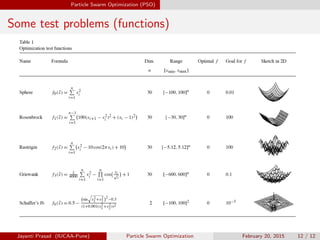
Some test problems (functions)
Jayanti Prasad (IUCAA-Pune) Particle Swarm Optimization February 20, 2015 12 / 12
References
References
Boeringer, D. W.,  Werne, D. H. 2004, IEEE Transc. on Antennas and
propagation, 52, 771
Engelbrecht, A. P. 2002, Computational Intelligence, An Introduction (John Wiley
 Son)
Jun Sun, C.-H. L.,  Wu, X.-J. 2012, Particle Swarm Optimization:Classical and
Quantum Perspectives (CRC)
Kennedy, J.,  Eberhart, R. C. 1995, IEEE International Conference on Neural
Networks, 4, 1992
—. 2001, Swarm Intelligence (Morgan Kufmann)
Lentati, L., Alexander, P., Hobson, M. P., Taylor, S., Gair, J., Balan, S. T.,  van
Haasteren, R. 2013, Phys. Rev. D , 87, 104021
Prasad, J. 2014, ArXiv e-prints
Prasad, J.,  Souradeep, T. 2012, Phys. Rev. D , 85, 123008
Rishemjit Kaur, Ritesh Kumar, A. P. B.,  Kapur, P. 2013, Scientific Reports, 3,
3008
Robinson, J.,  Rahmat-Samii, Y. 2004, IEEE Trans. on Ant. and Prop., 727, 397
Rogers, A.,  Fiege, J. D. 2011, Astrophys. J. , 727, 80
Jayanti Prasad (IUCAA-Pune) Particle Swarm Optimization February 20, 2015 12 / 12
Particle Swarm Optimization (PSO)
Ruiz, A. N., et al. 2015, Astrophys. J. , 801, 139
Taylor, S. R., Gair, J. R.,  Lentati, L. 2012, ArXiv e-prints
Wang, Y.,  Mohanty, S. D. 2010, Phys. Rev. D , 81, 063002
Wilson, E. O. 1975, Sociobiology (Harvard University Press)
Yisu, J. 2008, Applied Soft Computing, 8, 295
Jayanti Prasad (IUCAA-Pune) Particle Swarm Optimization February 20, 2015 12 / 12

pso2015.pdf

  • 1.
    Particle Swarm Optimization JayantiPrasad Inter-University Centre for Astronomy & Astrophysics Pune, India (411007) February 20, 2015 Jayanti Prasad (IUCAA-Pune) Particle Swarm Optimization February 20, 2015 1 / 12
  • 2.
    Swarms in Nature JayantiPrasad (IUCAA-Pune) Particle Swarm Optimization February 20, 2015 2 / 12
  • 3.
    E. O. Wilson(1929-) “In theory at least, individual members of the school can profit from the discoveries and previous experience of all other members of the school during the search for food. This advantage can become decisive, outweighing the disadvantages of competition for food items, whenever the resource is unpedictably distributed in patches.” Jayanti Prasad (IUCAA-Pune) Particle Swarm Optimization February 20, 2015 3 / 12
  • 4.
    Introduction What is Optimization? Find a vector X0 ∈ Rn for which: f (X0) ≤ f (X), X ∈ [a, b] and a, b ∈ Rn (1) with or without constraints of the following kind: gj (X) ≤ 0 for j = 1, .., M (inequality constrains) hj (X) = 0 for j = 1, .., p (equality constrains) (2) The function f (X) is called an “optimization function” or the “cost function”. Jayanti Prasad (IUCAA-Pune) Particle Swarm Optimization February 20, 2015 4 / 12
  • 5.
    Introduction Ordinary χ2 Let d∈ RM is our data vector, x ∈ Rn is our parameter vector and A ∈ RM×N is a transformation kernel and they are related as : d = Ax + n, (3) where n ∈ RM is the noise vector. The above equation can be solved by finding the minimum of the following cost function: f (x) = (d − Ax)T C−1 n (d − Ax), (4) where Cn =< nnT > is the noise covarainnce matrix. For the case when noise is un-correlation we can identify f (X) with χ2: f (x) = χ2 = 1 M M X i=1 1 σ2 i  di − N X j=1 Aij xj   2 (5) Jayanti Prasad (IUCAA-Pune) Particle Swarm Optimization February 20, 2015 5 / 12
  • 6.
    Introduction Common Optimization strategies Deterministic: Gridbased search : Computational cost grows as exponentially with the dimension N of the search. Gradient based search : Newton-Raphson. conjugate Gradient : when A is symmetric, positive definite. Downhill-Simplex Methods. Powell’s method. Stochastic Artificial Neural Networks (ANN). Genetic Algorithm (GA). Ant Colony Optimization (ACO), Particle Swarm Optimization (PSO), Bat Algorithm (BA), Firefly Algorithm (FA), Bacteria Foraging Optimization (BFO) etc. Continuous Opinion Dynamics Optimizer (CODO) [Rishemjit Kaur & Kapur (2013)]. Jayanti Prasad (IUCAA-Pune) Particle Swarm Optimization February 20, 2015 6 / 12
  • 7.
    Particle Swarm Optimization(PSO) Particle Swarm Optimization (PSO) PSO was presented by Kennedy & Eberhart in [Kennedy & Eberhart (1995)] inspired by the work of E. O. Wilson [Wilson (1975)]. There are many good books [Kennedy & Eberhart (2001); Engelbrecht (2002); Jun Sun & Wu (2012)] and review articles available about PSO and a dedicated website [http://www.swarmintelligence.org/]. PSO is a stochastic method for optimization of continuous nonlinear functions motivated by the movement of organisms in a bird flock or fish school. In PSO, a ”team of particles” (computational agents) search for the global maximum/minimum of a non-linear function (fitness/coast function) exhibiting random motions. Random motion of particles is governed by their ”personal experience” (Pbest ) and ”social learning” (Gbest ). Jayanti Prasad (IUCAA-Pune) Particle Swarm Optimization February 20, 2015 7 / 12
  • 8.
    Particle Swarm Optimization(PSO) PSO Applications Applications of PSO in Engineering problems have been common [Boeringer & Werne (2004); Robinson & Rahmat-Samii (2004)], however, recently it has been used for Binary Inspiral parameter estimation in gravitational wave studies [Wang & Mohanty (2010)], Gravitational Lens Modeling [Rogers & Fiege (2011)], Semi-Analytic Models of Galaxy Formation [Ruiz et al. (2015)], Cosmological Parameter Estimation [Prasad & Souradeep (2012); Prasad (2014)], Pulsar Timing Arrays [Taylor et al. (2012); Lentati et al. (2013)]. There are many variations of PSO some of them are Adaptive PSO (APSO), landscape adaptive PSO (LAPSO), Distribution Vector PSO (DVPSO), Constriction Factor PSO (CFPSO), Inertia Weight PSO (IWPSO) [Yisu (2008)]. At present we will stick to the original version of PSO given in [Kennedy & Eberhart (1995)]. Jayanti Prasad (IUCAA-Pune) Particle Swarm Optimization February 20, 2015 8 / 12
  • 9.
    Particle Swarm Optimization(PSO) PSO Variables 1 Xi (t) Position of ith particle at “time” t (discrete) 2 V i (t) “Velocity” of ith particle at “time” t 3 Pi Personal best “Pbest ” of ith particle 4 G Global best or “Gbest ” 5 [Xmin, Xmax] Search Range 6 Vmax Maximum Velocity Note that X, V , P, G ∈ RN where N is the dimensionality of the search space. If f (Xi (t)) = f i (t) then we can define Pi and G in the following way: Pbest : Pi = Xi (s) such that f i (s) ≤ f i (t) for 0 < s < t. Gbest : G = Pk such f (Pk ) ≤ f (Pi ). Jayanti Prasad (IUCAA-Pune) Particle Swarm Optimization February 20, 2015 9 / 12
  • 10.
    Particle Swarm Optimization(PSO) Dynamics of PSO particles Equation of Motion : Xi (t + 1) = Xi (t) + V i (t + 1) (6) Velocity : V i (t + 1) = wV i (t) + c1ξ1[Xi Pbest − Xi (t)] + c2 ξ2[XGbest Xi (t)] (7) where w (inertia weight), c1, c2 (acceleration coefficients) are PSO design parameters. and ξ1 and ξ2 are uniform random numbers (URN) in range [0 − 1]. Jayanti Prasad (IUCAA-Pune) Particle Swarm Optimization February 20, 2015 10 / 12
  • 11.
    Particle Swarm Optimization(PSO) Other Considerations 1 Fitness function f (X) and search space (Xmin, Xmax). 2 Initial conditions: Xi (t = 1) = Xmin + ξ3(Xmax − Xmin) V i (t = 1) = ξ4Vmax (8) where Vmax = cv (Xmax − Xmin) (9) and ξ3 and ξ4 are URN in range [0, 1]. 3 Boundary conditions (reflecting boundary): V i (t) = −V i (t) and Xi (t) = ( Xmax, if Xi (t) > Xmax Xmin, if Xi (t) < Xmin (10) 4 Stopping criteria: |f (XGbest (t + 1) − f (XGbest (t))| < for t = 1, nstop (11) Jayanti Prasad (IUCAA-Pune) Particle Swarm Optimization February 20, 2015 11 / 12
  • 12.
    Particle Swarm Optimization(PSO) Some test problems (functions) Jayanti Prasad (IUCAA-Pune) Particle Swarm Optimization February 20, 2015 12 / 12
  • 13.
    References References Boeringer, D. W., Werne, D. H. 2004, IEEE Transc. on Antennas and propagation, 52, 771 Engelbrecht, A. P. 2002, Computational Intelligence, An Introduction (John Wiley Son) Jun Sun, C.-H. L., Wu, X.-J. 2012, Particle Swarm Optimization:Classical and Quantum Perspectives (CRC) Kennedy, J., Eberhart, R. C. 1995, IEEE International Conference on Neural Networks, 4, 1992 —. 2001, Swarm Intelligence (Morgan Kufmann) Lentati, L., Alexander, P., Hobson, M. P., Taylor, S., Gair, J., Balan, S. T., van Haasteren, R. 2013, Phys. Rev. D , 87, 104021 Prasad, J. 2014, ArXiv e-prints Prasad, J., Souradeep, T. 2012, Phys. Rev. D , 85, 123008 Rishemjit Kaur, Ritesh Kumar, A. P. B., Kapur, P. 2013, Scientific Reports, 3, 3008 Robinson, J., Rahmat-Samii, Y. 2004, IEEE Trans. on Ant. and Prop., 727, 397 Rogers, A., Fiege, J. D. 2011, Astrophys. J. , 727, 80 Jayanti Prasad (IUCAA-Pune) Particle Swarm Optimization February 20, 2015 12 / 12
  • 14.
    Particle Swarm Optimization(PSO) Ruiz, A. N., et al. 2015, Astrophys. J. , 801, 139 Taylor, S. R., Gair, J. R., Lentati, L. 2012, ArXiv e-prints Wang, Y., Mohanty, S. D. 2010, Phys. Rev. D , 81, 063002 Wilson, E. O. 1975, Sociobiology (Harvard University Press) Yisu, J. 2008, Applied Soft Computing, 8, 295 Jayanti Prasad (IUCAA-Pune) Particle Swarm Optimization February 20, 2015 12 / 12