DIGITAL IMAGE PROCESSING
PART I
Thuong Nguyen1
CONTENT
 Digital image fundamentals
 Image transform
 Image enhancement
 Image restoration
 Image compression
2
I. DIGITAL FUNDAMENTAL
 Digital Image Processing System
 Sampling and Quantization
 Relationships between pixels
3
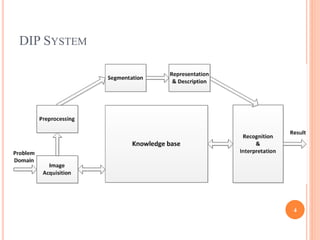
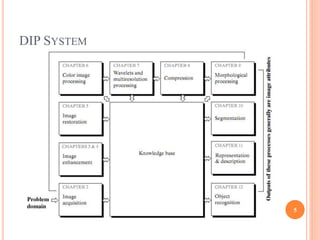
DIP SYSTEM
4
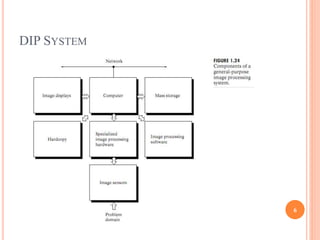
DIP SYSTEM
5
DIP SYSTEM
6
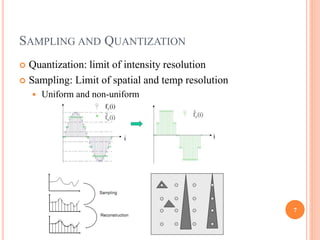
SAMPLING AND QUANTIZATION
 Quantization: limit of intensity resolution
 Sampling: Limit of spatial and temp resolution
 Uniform and non-uniform
7
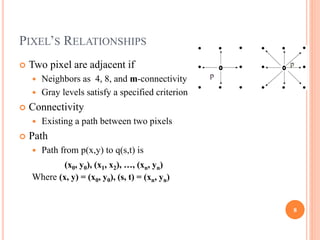
PIXEL’S RELATIONSHIPS
 Two pixel are adjacent if
 Neighbors as 4, 8, and m-connectivity
 Gray levels satisfy a specified criterion
 Connectivity
 Existing a path between two pixels
 Path
 Path from p(x,y) to q(s,t) is
Where (x, y) = (x0, y0), (s, t) = (xn, yn)
8
(x0, y0), (x1, x2), …, (xn, yn)
II. IMAGE ENHANCEMENT IN FREQ DOMAIN
 Discrete Fourier Transform
 Other Image Transform
 Hotelling Transform
9
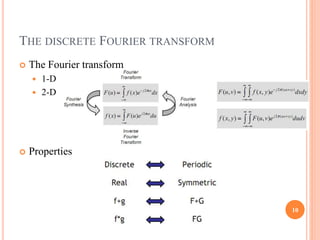
THE DISCRETE FOURIER TRANSFORM
 The Fourier transform
 1-D
 2-D
 Properties
10
THE DISCRETE FOURIER TRANSFORM
 Discrete Fourier transform pair
 One dimensional
 Two dimensional
11
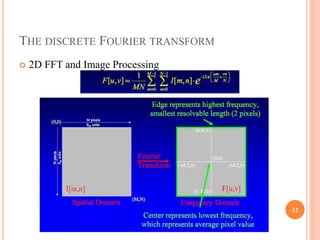
THE DISCRETE FOURIER TRANSFORM
 2D FFT and Image Processing
12
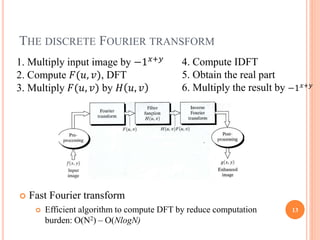
THE DISCRETE FOURIER TRANSFORM
1. Multiply input image by −1 𝑥+𝑦
2. Compute 𝐹(𝑢, 𝑣), DFT
3. Multiply 𝐹(𝑢, 𝑣) by 𝐻 𝑢, 𝑣
4. Compute IDFT
5. Obtain the real part
6. Multiply the result by −1 𝑥+𝑦
13
 Fast Fourier transform
 Efficient algorithm to compute DFT by reduce computation
burden: O(N2) – O(NlogN)
OTHER SEPARABLE IMAGE TRANSFORM
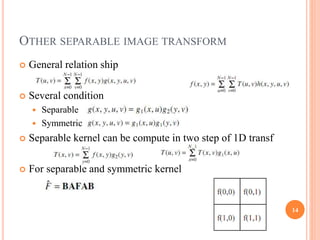
 General relation ship
 Several condition
 Separable
 Symmetric
 Separable kernel can be compute in two step of 1D transf
 For separable and symmetric kernel
14
OTHER SEPARABLE IMAGE TRANSFORM
 Walsh Transform
 Hadamard transform
 Discrete cosine transform
15
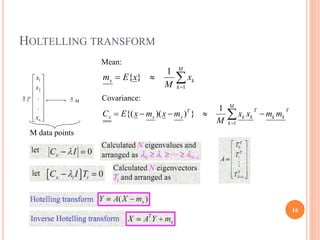
HOLTELLING TRANSFORM
16
1
2
.
.
n
x
x
x
x
 
 
 
 
 
 
  
1
1
{ }
M
x k
k
m E x x
M 
  
x,........,
M data points
1 M
1
1
{( )( ) }
M
T TT
x x x k k k k
k
C E x m x m x x m m
M 
    
Mean:
Covariance:
III. IMAGINE ENHANCEMENT
 Basic intensity functions
 Histogram processing
 Spatial Filtering
 Enhancement in the Frequency domain
 Color image processing
17
BASIC INTENSITY FUNCTIONS
 Spatial domain process
 Image negatives:
 intensity level in the range [0, L-1]
 s = L – 1 – r
 Log trans
 s = c log(1 + r)
 Power law (gramma) trans
 s = c r
 Piecewise-Linear Trans
 Contrast stretching
 Intensity level slicing
 Bit plane slicing
18
HISTOGRAM PROCESSING
 Histogram
 Histogram equalization:
 Histogram matching
 Local histogram processing
 Image subtraction
 Image averaging
19
SPATIAL FILTERING
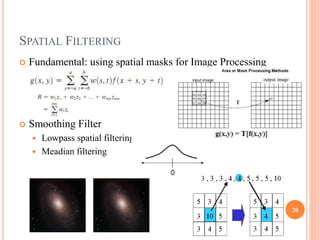
 Fundamental: using spatial masks for Image Processing
 Smoothing Filter
 Lowpass spatial filtering
 Meadian filtering
20
SPATIAL FILTERING
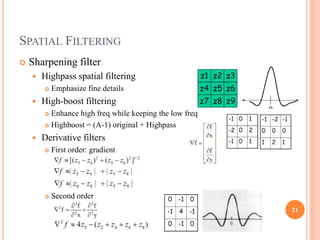
 Sharpening filter
 Highpass spatial filtering
 Emphasize fine details
 High-boost filtering
 Enhance high freq while keeping the low freq
 Highboost = (A-1) original + Highpass
 Derivative filters
 First order: gradient
 Second order
21
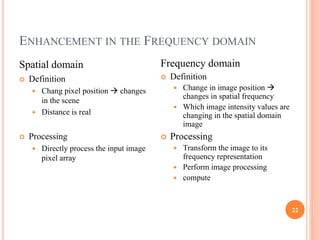
ENHANCEMENT IN THE FREQUENCY DOMAIN
Spatial domain
 Definition
 Chang pixel position  changes
in the scene
 Distance is real
 Processing
 Directly process the input image
pixel array
22
Frequency domain
 Definition
 Change in image position 
changes in spatial frequency
 Which image intensity values are
changing in the spatial domain
image
 Processing
 Transform the image to its
frequency representation
 Perform image processing
 compute
ENHANCEMENT IN THE FREQUENCY DOMAIN
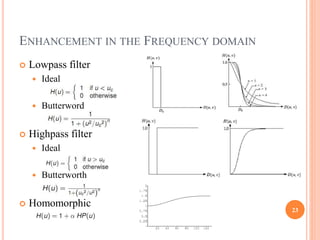
 Lowpass filter
 Ideal
 Butterword
 Highpass filter
 Ideal
 Butterworth
 Homomorphic
23
COLOR IMAGE PROCESSING
 Background
 Human can perceive thousands of colors
 Two major area: full color and pseudo color
 Color quantization: 8-bit or 24bit
 Color fundamental
 Result of light in the rentina: 400-700nm
 Characterization of light: monochromatic and gray level
 Radiance: total amount of energy emitted by light source
 Brightness: intensity
 Luminance: amount of energy perceived by obervers, in lumens
 Color characters
 Hue
 Saturation
 Birghtness 24
IV. IMAGE RESTORATION
 Degradation Model
 Diagonalization of Circulant & Block-Circulant Matrices
 Algebraic Approach
 Inverse Filtering
 Weiner Filter
 Constrained LS Restoration
 Interactive Restoration
 Restoration at Spatial Domain
 Geometric transform
25
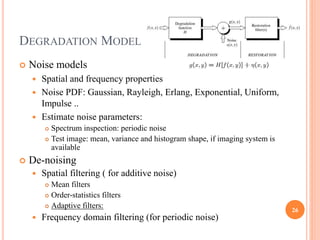
 Noise models
 Spatial and frequency properties
 Noise PDF: Gaussian, Rayleigh, Erlang, Exponential, Uniform,
Impulse ..
 Estimate noise parameters:
 Spectrum inspection: periodic noise
 Test image: mean, variance and histogram shape, if imaging system is
available
 De-noising
 Spatial filtering ( for additive noise)
 Mean filters
 Order-statistics filters
 Adaptive filters:
 Frequency domain filtering (for periodic noise)
DEGRADATION MODEL
26
V. IMAGE COMPRESSION
 Fundamentals
 Image Compression Models
 Elements of Information Theory
 Error-Free Compression
 Lossy Compression
 Image Compression standard
27
VI. IMAGE SEGMENTATION
 Detection of Discontiuties
 Edge Linking and Boundary Detection
 Thresholding
 Region-Oriented Segmentation
 Motion in Segmentation
28
VII. REPRESENTATION AND DESCRIPTION
 Representation Scheme
 Boundary Descriptors
 Regional Descriptors
 Morphology
 Relational Descriptors
29
VIII. RECOGNITION AND INTERPRETATION
 Elements of Image Analysis
 Patterns and Pattern Classes
 Decision-Theoretic Methods
 Structural Methods
 Interpretation
30

Ppt ---image processing

  • 1.
  • 2.
    CONTENT  Digital imagefundamentals  Image transform  Image enhancement  Image restoration  Image compression 2
  • 3.
    I. DIGITAL FUNDAMENTAL Digital Image Processing System  Sampling and Quantization  Relationships between pixels 3
  • 4.
  • 5.
  • 6.
  • 7.
    SAMPLING AND QUANTIZATION Quantization: limit of intensity resolution  Sampling: Limit of spatial and temp resolution  Uniform and non-uniform 7
  • 8.
    PIXEL’S RELATIONSHIPS  Twopixel are adjacent if  Neighbors as 4, 8, and m-connectivity  Gray levels satisfy a specified criterion  Connectivity  Existing a path between two pixels  Path  Path from p(x,y) to q(s,t) is Where (x, y) = (x0, y0), (s, t) = (xn, yn) 8 (x0, y0), (x1, x2), …, (xn, yn)
  • 9.
    II. IMAGE ENHANCEMENTIN FREQ DOMAIN  Discrete Fourier Transform  Other Image Transform  Hotelling Transform 9
  • 10.
    THE DISCRETE FOURIERTRANSFORM  The Fourier transform  1-D  2-D  Properties 10
  • 11.
    THE DISCRETE FOURIERTRANSFORM  Discrete Fourier transform pair  One dimensional  Two dimensional 11
  • 12.
    THE DISCRETE FOURIERTRANSFORM  2D FFT and Image Processing 12
  • 13.
    THE DISCRETE FOURIERTRANSFORM 1. Multiply input image by −1 𝑥+𝑦 2. Compute 𝐹(𝑢, 𝑣), DFT 3. Multiply 𝐹(𝑢, 𝑣) by 𝐻 𝑢, 𝑣 4. Compute IDFT 5. Obtain the real part 6. Multiply the result by −1 𝑥+𝑦 13  Fast Fourier transform  Efficient algorithm to compute DFT by reduce computation burden: O(N2) – O(NlogN)
  • 14.
    OTHER SEPARABLE IMAGETRANSFORM  General relation ship  Several condition  Separable  Symmetric  Separable kernel can be compute in two step of 1D transf  For separable and symmetric kernel 14
  • 15.
    OTHER SEPARABLE IMAGETRANSFORM  Walsh Transform  Hadamard transform  Discrete cosine transform 15
  • 16.
    HOLTELLING TRANSFORM 16 1 2 . . n x x x x               1 1 { } M x k k m E x x M     x,........, M data points 1 M 1 1 {( )( ) } M T TT x x x k k k k k C E x m x m x x m m M       Mean: Covariance:
  • 17.
    III. IMAGINE ENHANCEMENT Basic intensity functions  Histogram processing  Spatial Filtering  Enhancement in the Frequency domain  Color image processing 17
  • 18.
    BASIC INTENSITY FUNCTIONS Spatial domain process  Image negatives:  intensity level in the range [0, L-1]  s = L – 1 – r  Log trans  s = c log(1 + r)  Power law (gramma) trans  s = c r  Piecewise-Linear Trans  Contrast stretching  Intensity level slicing  Bit plane slicing 18
  • 19.
    HISTOGRAM PROCESSING  Histogram Histogram equalization:  Histogram matching  Local histogram processing  Image subtraction  Image averaging 19
  • 20.
    SPATIAL FILTERING  Fundamental:using spatial masks for Image Processing  Smoothing Filter  Lowpass spatial filtering  Meadian filtering 20
  • 21.
    SPATIAL FILTERING  Sharpeningfilter  Highpass spatial filtering  Emphasize fine details  High-boost filtering  Enhance high freq while keeping the low freq  Highboost = (A-1) original + Highpass  Derivative filters  First order: gradient  Second order 21
  • 22.
    ENHANCEMENT IN THEFREQUENCY DOMAIN Spatial domain  Definition  Chang pixel position  changes in the scene  Distance is real  Processing  Directly process the input image pixel array 22 Frequency domain  Definition  Change in image position  changes in spatial frequency  Which image intensity values are changing in the spatial domain image  Processing  Transform the image to its frequency representation  Perform image processing  compute
  • 23.
    ENHANCEMENT IN THEFREQUENCY DOMAIN  Lowpass filter  Ideal  Butterword  Highpass filter  Ideal  Butterworth  Homomorphic 23
  • 24.
    COLOR IMAGE PROCESSING Background  Human can perceive thousands of colors  Two major area: full color and pseudo color  Color quantization: 8-bit or 24bit  Color fundamental  Result of light in the rentina: 400-700nm  Characterization of light: monochromatic and gray level  Radiance: total amount of energy emitted by light source  Brightness: intensity  Luminance: amount of energy perceived by obervers, in lumens  Color characters  Hue  Saturation  Birghtness 24
  • 25.
    IV. IMAGE RESTORATION Degradation Model  Diagonalization of Circulant & Block-Circulant Matrices  Algebraic Approach  Inverse Filtering  Weiner Filter  Constrained LS Restoration  Interactive Restoration  Restoration at Spatial Domain  Geometric transform 25
  • 26.
     Noise models Spatial and frequency properties  Noise PDF: Gaussian, Rayleigh, Erlang, Exponential, Uniform, Impulse ..  Estimate noise parameters:  Spectrum inspection: periodic noise  Test image: mean, variance and histogram shape, if imaging system is available  De-noising  Spatial filtering ( for additive noise)  Mean filters  Order-statistics filters  Adaptive filters:  Frequency domain filtering (for periodic noise) DEGRADATION MODEL 26
  • 27.
    V. IMAGE COMPRESSION Fundamentals  Image Compression Models  Elements of Information Theory  Error-Free Compression  Lossy Compression  Image Compression standard 27
  • 28.
    VI. IMAGE SEGMENTATION Detection of Discontiuties  Edge Linking and Boundary Detection  Thresholding  Region-Oriented Segmentation  Motion in Segmentation 28
  • 29.
    VII. REPRESENTATION ANDDESCRIPTION  Representation Scheme  Boundary Descriptors  Regional Descriptors  Morphology  Relational Descriptors 29
  • 30.
    VIII. RECOGNITION ANDINTERPRETATION  Elements of Image Analysis  Patterns and Pattern Classes  Decision-Theoretic Methods  Structural Methods  Interpretation 30

Editor's Notes

  • #5 Image acquisition: acquire digital image by using sampling and quantization (lossy-compress) Preprocessing: enhancing contrast, remove noise… Segmentation: partition an image to its objects Rep & Des: Representation of image for suitable processing and select the interest of features. Recog & Interp: assign a label to an object and meaning to an ensemble of recognized object Knowledge: knowledge of problem domain is coded into an DIP
  • #6 Image acquisition: acquire digital image by using sampling and quantization (lossy-compress) Preprocessing: no-longer called, but use Image enhancement instead. The simplest technique of DIP Bring out the detail(which is obscured), highlight the certain features of interest subjective area (chu quan), Image restoration: improve the appearance of an image, unlike enhancement, it restoration based on image degradation Color image processing: every application now require color image: print, advertising, computer displays… Wavelets and multi-resolution processing: recent trans for easier compress, transmit and alyze Compression: reduce storage required to save an image. Morphological processing: extracting image component Segmentation: partition an image into its constituent parts or Rep & Des: Representation of image for suitable processing and select the interest of features. Knowledge: knowledge of problem domain is coded into an DIP
  • #8 - Aliasing: under-sampling, poor reconstruction (spatial aliasing, temporal aliasing) Gray level: 2^n, n is a positive integer
  • #9 To establish boundaries, components 4-adjacency: Two pixels p and q with values from V are 4-adjacent if q is in the set N4(p). 8-adjacency: Two pixels p and q with values from V are 8-adjacent if q is in the set N8(p). m-adjacency: Two pixels p and q with values from V are m-adjacent if, q is in N4(P). q is in ND(p) and the set of { N4(p) giao voi N4(q)} is emplty. Connectivity: To determine whether the pixels are adjacent in some sense. (N4, N8… )
  • #11 With finite area under the curve can be expressed as the integral of sines and/pr cosines multiplied by a weight function Requirement F(x) is piecewise continuous on every finite interval Fx is integrable
  • #12 Sincewearedealingwithimages,wewillbemore interestedinthediscrete FourierTransform(DFT)
  • #14  H(u,v) is transfer function Application: Noise removal Pattern or texture recognition
  • #15 T is the transform of f and g is the forward trans kernel H is the inverse transformation kernel Separable kernel can be computed in two steps, each requiring 1D transform Parameters: F^ is apprxomated imgae, B is inverse transformation matrix A is NxN transformation matrix F is NxN image matrix For example Calculation of Fourier transform of 2 pixel by 2 pixel 2 D
  • #16 Wash transform Hadamard transform was used because of its simplicity of implementation and faster than fft. For measuring randomess of a finite sequence Testing number sequences Solving first order partial differential equation, and integral equations Astronomical image processing, coding and filtering operation Discrete Cosine Transform: widely use in image compression, use in JPEC< MPECG< H261… Notice that the DCT is a real transform. The DCT has excellent energy compaction properties. There are fast algorithms to compute the DCT similar to the FFT.
  • #17 The rows of matrix A are the eigen vectors of the covarience matrix arranged in descending order (The first row corresponds to the eigen vector corresponding to the largest eigen value of C, ...)
  • #19 - f(x, y) denotes the input image and g(x,y) presents the processed image. T is an operator on f which defined over some neighborhood of (x,y). Negative Reversing the intensity level of an image Expand value of dark pixels, compressing higer level value Power law: the Same as log trans Piece wise: advantage – arbitrarily complex, disadvantage – require more user input. Contrast stretching: spans the range of intensity levels in an image to full intensity range. HOW – just scale with upper and lower limit Intensity level slicing: highlighting a specific range of intensities in an image. Bit plane slicing: high order bit give almost information
  • #20 Histogram: rk is the kth gray level and nk is number of pixels wich have the nk gray level Histogram Equalization: map from r to s, from poor dynamic rang to wider, but give only one result Histogram Matching: specify a particular histogram shape. Equalize levels of original image, then specify desired density fucntion to get G(z), and finally applu inverse trans to find z Local histogram: devise trans functions based on gray-level of distribution by using previous techniques and define a square or rectangular location The two properties call intensity mean and variance are frequently used --- Image Subtraction: the difference between the two image Image averaging : by consider the average of a set of image
  • #21 The word “filtering” has been borrowed from the frequency domain, defined by: (1) A neighborhood and (2) An operation that is performed on the pixels inside the neighborhood A filtered image is generated as the center of the mask moves to every pixel in the input image  Handling Pixels Close to Boundaries by zero padding or some other method Mask mxn, where m and. n is an odd positive integer. And the gray level in (x,y) pixel are replicated by R Smoothing filter: for blur and noise reduction, because of always got “snow” on the image Lowpass filter: averages out rapid changes in intensity Simplest low-pass: calculate the average of a pixel and all of its 8 immediate neighbors then replace the original pixel Replete for every pixel in the image. ( about the pixel in the edge?) Meadian filter Processing: sort differential value of one pixel and its nearest 8 pixels by ascending order. Pickup the middle value from sorted 9 values and replace value on the middle with the new value. d
  • #22 Sharpening filter: Enhance the edges of objects and adjust the contrast and the shade characteristics. Being detectors with threshold, sensitive to shut noise Highpass filter: make image appear sharper, emphasize fine details in the image but amplifies noise. Positive coefficients near its center, and negative in other which satisfy the sum of the coefficients is zero.- constant intensity Results may negative need scale or cutting Don’t take the absolute value of the response Not overdoing this, make degrade image quality, look grainy and unnatural, get a dark donuts around every points. High-boot filtering allows some of the low-frequencies back in  result looks more like the original with accents on the highpass Derivative filters:enhance contrast, detect edges and boundaries and also measure feature orientation. Can be taken by using the gradient First order: require the sum of the coefficient is equal zero Second order: Center pixel coefficient be positive Outercoefficient be negative Sum of coefficients be zero
  • #23 Frequencies means: High frequency - pixel values that change rapidly across the image (e.g: text, texture, leaves…) Strong low frequency  large scale feature in the image( e.g: single object that dominates the image) Any spatial or temporal signal has an equivalent frequency representation
  • #24 Low-pass filtering smooths a signal or image: low freq– gradual transitions and high freq = rapid transition Smoothing helps remove noise High pass filter only the brightest parts of the image – where SNR is highest
  • #25 Color fundamental Radiance: including spectral power distribution Brightness: visual sensation, which area appers to meit more or less light and cannot be meased quantitatively Lumiance: more tractable of brightness, mangniture of luminance propotional to physical power, b Color characters Hue: Dominant color as perceived by an observer (red, orange, or yellow) Saturation: Relative purity of color; pure spectrum colors are fully saturated, inversely proportional to amount of light Brightness: Achromatic notion of intensity
  • #26 Application: Scientific exploration, investigation, film making, image and video code/decoding Consumer photography
  • #27 Image enhancement: “improve” an image subjectively and Image restoration: remove distortion from image, to go back to the “original” -- objective process,  degradation is the degrade of image quality by some affect of noise. Noise Spatial and freq properties: define spatial characteristics of noise, There are several noise like: Periodic noise: made by electrical or electromechanical interference during the acquisition time. Reduced significantly via frequency domain filtering. Estimate noise: by fourier spectrum Spectrum inspection Test image Denoising Mean filters: arithmetic, geometric Order statistics filter: based on the ranking ò the pixels