Particle Swarm Optimization
1
Source https://encrypted-tbn0.gstatic.com/images?q=tbn:ANd9GcSKhLOQonxCPbIKl6GE0UWhaJJByuKpYFtWDUovH1Ss0HUaaWcq
Particle Swarm Optimization (PSO)
 PSO is stochastic optimization technique proposed
by Kennedy and Eberhart ( 1995) [2].
 A population based search method with position of
particle is representing solution and Swarm of
particles as searching agent.
 PSO is a robust evolutionary optimization
technique
based on the movement and intelligence of swarms.
PSO find the minimum value for the function. 2
Particle Swarm Optimization (PSO)
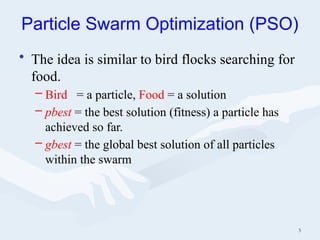
• The idea is similar to bird flocks searching for
food.
– Bird = a particle, Food = a solution
– pbest = the best solution (fitness) a particle has
achieved so far.
– gbest = the global best solution of all particles
within the swarm
3
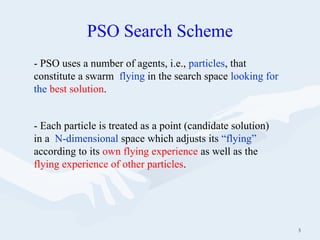
PSO Search Scheme
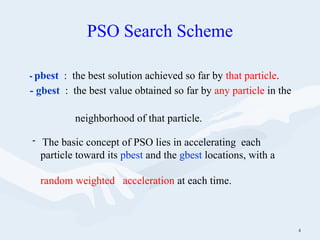
- pbest : the best solution achieved so far by that particle.
- gbest : the best value obtained so far by any particle in the
neighborhood of that particle.
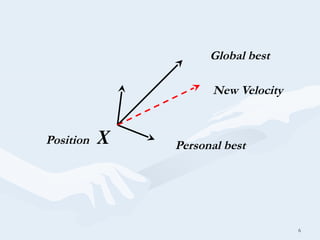
- The basic concept of PSO lies in accelerating each
particle toward its pbest and the gbest locations, with a
random weighted acceleration at each time.
4
PSO Search Scheme
5
- Each particle is treated as a point (candidate solution)
in a N-dimensional space which adjusts its “flying”
according to its own flying experience as well as the
flying experience of other particles.
- PSO uses a number of agents, i.e., particles, that
constitute a swarm flying in the search space looking for
the best solution.
New Velocity
Position X Personal best
Global best
6
Particle Swarm Optimization (PSO)
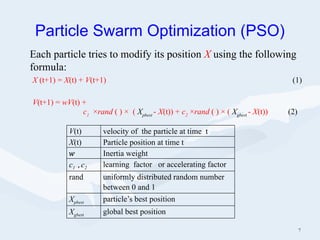
X (t+1) = X(t) + V(t+1) (1)
V(t+1) = wV(t) +
c1
×rand ( ) × ( Xpbest
- X(t)) + c2
×rand ( ) × ( Xgbest
- X(t)) (2)
V(t) velocity of the particle at time t
X(t) Particle position at time t
w Inertia weight
c1 , c2 learning factor or accelerating factor
rand uniformly distributed random number
between 0 and 1
Xpbest particle’s best position
Xgbest global best position
Each particle tries to modify its position X using the following
formula:
7
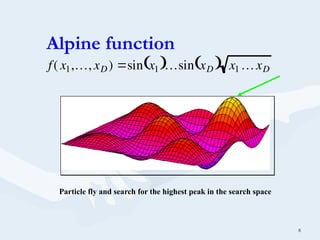
Alpine function

f( x1,, xD) sin x1
 sin xD
  x1 xD
8
Particle fly and search for the highest peak in the search space
PSO Algorithm
The PSO algorithm pseudocode [2] as following:
Input: Randomly initialized position and velocity of Particles:
Xi (0) andVi (0)
Output: Position of the approximate global minimum X*
1: while terminating condition is not reached do
2: for i = 1 to number of particles do
3: Calculate the fitness function f
4: Update personal best and global best of each particle
5: Update velocity of the particle using Equation 2
6: Update the position of the particle using equation 1
7: end for
8: end while
9
References
[1] Ant Colony Optimization website, http://iridia.ulb.ac.be/~mdorigo/ACO/about.html
[2] J. Kennedy and R.C. Eberhart, “Particle swarm optimization,” in IEEE Int. Conf.
on Neural Networks., Perth, Australia, vol. 4, 1995, pp. 1942-1948.
[3] J. Ham and M. Kamber, “Data mining: concepts and techniques (2nd edition,”
Morgan Kaufman Publishers, pp. 1-6, 2006.
[4] Van der Merwe, D. W. and Engelbrecht, A. P. “Data clustering using particle swarm
optimization”. Proceedings of IEEE Congress on Evolutionary Computation 2003
(CEC 2003), Canbella, Australia. pp. 215-220, 2003.
[5] E. Bonabeau, M. Dorigo, and G. Theraulaz. Swarm Intelligence: From Natural to
Artificial System. Oxford University Press, New York, 1999
10

PSO-ACO-Presentation Particle Swarm Optimization (PSO)

  • 1.
    Particle Swarm Optimization 1 Sourcehttps://encrypted-tbn0.gstatic.com/images?q=tbn:ANd9GcSKhLOQonxCPbIKl6GE0UWhaJJByuKpYFtWDUovH1Ss0HUaaWcq
  • 2.
    Particle Swarm Optimization(PSO)  PSO is stochastic optimization technique proposed by Kennedy and Eberhart ( 1995) [2].  A population based search method with position of particle is representing solution and Swarm of particles as searching agent.  PSO is a robust evolutionary optimization technique based on the movement and intelligence of swarms. PSO find the minimum value for the function. 2
  • 3.
    Particle Swarm Optimization(PSO) • The idea is similar to bird flocks searching for food. – Bird = a particle, Food = a solution – pbest = the best solution (fitness) a particle has achieved so far. – gbest = the global best solution of all particles within the swarm 3
  • 4.
    PSO Search Scheme -pbest : the best solution achieved so far by that particle. - gbest : the best value obtained so far by any particle in the neighborhood of that particle. - The basic concept of PSO lies in accelerating each particle toward its pbest and the gbest locations, with a random weighted acceleration at each time. 4
  • 5.
    PSO Search Scheme 5 -Each particle is treated as a point (candidate solution) in a N-dimensional space which adjusts its “flying” according to its own flying experience as well as the flying experience of other particles. - PSO uses a number of agents, i.e., particles, that constitute a swarm flying in the search space looking for the best solution.
  • 6.
    New Velocity Position XPersonal best Global best 6
  • 7.
    Particle Swarm Optimization(PSO) X (t+1) = X(t) + V(t+1) (1) V(t+1) = wV(t) + c1 ×rand ( ) × ( Xpbest - X(t)) + c2 ×rand ( ) × ( Xgbest - X(t)) (2) V(t) velocity of the particle at time t X(t) Particle position at time t w Inertia weight c1 , c2 learning factor or accelerating factor rand uniformly distributed random number between 0 and 1 Xpbest particle’s best position Xgbest global best position Each particle tries to modify its position X using the following formula: 7
  • 8.
    Alpine function  f( x1,,xD) sin x1  sin xD   x1 xD 8 Particle fly and search for the highest peak in the search space
  • 9.
    PSO Algorithm The PSOalgorithm pseudocode [2] as following: Input: Randomly initialized position and velocity of Particles: Xi (0) andVi (0) Output: Position of the approximate global minimum X* 1: while terminating condition is not reached do 2: for i = 1 to number of particles do 3: Calculate the fitness function f 4: Update personal best and global best of each particle 5: Update velocity of the particle using Equation 2 6: Update the position of the particle using equation 1 7: end for 8: end while 9
  • 10.
    References [1] Ant ColonyOptimization website, http://iridia.ulb.ac.be/~mdorigo/ACO/about.html [2] J. Kennedy and R.C. Eberhart, “Particle swarm optimization,” in IEEE Int. Conf. on Neural Networks., Perth, Australia, vol. 4, 1995, pp. 1942-1948. [3] J. Ham and M. Kamber, “Data mining: concepts and techniques (2nd edition,” Morgan Kaufman Publishers, pp. 1-6, 2006. [4] Van der Merwe, D. W. and Engelbrecht, A. P. “Data clustering using particle swarm optimization”. Proceedings of IEEE Congress on Evolutionary Computation 2003 (CEC 2003), Canbella, Australia. pp. 215-220, 2003. [5] E. Bonabeau, M. Dorigo, and G. Theraulaz. Swarm Intelligence: From Natural to Artificial System. Oxford University Press, New York, 1999 10

Editor's Notes

  • #8 This function is interesting for it has as many optima as we want, just by changing its definition area, and for we can easily compute exactly these optima. I hope you do recognize the French Mont-Blanc and the Côte d'Azur ...