OnLine Analytical Processing Seminar Presentation By IQxplorer Under the guidance of  Mr. Indraneel Mukhopadhyay
What is OLAP  OnLine Analytical Processing ia a technology that uses multidimensional view of aggregate data  for quicker access to strategic information.
How OLAP Helps  It helps in decision making, business modeling, and operations research activities by transforming raw Data warehouse data into strategic information
Four Main Characteristics of OLAP Use multidimensional data analysis techniques Provide advanced database support Provide easy-to-use end user interfaces Support client/server architecture
Multidimensional Data Analysis Techniques The processing of data in which data are viewed as part of a multidimensional structure. Multidimensional view allows end users to consolidate or aggregate data at different levels .
Multidimensional Data Analysis Relational databases contains lists of records whose information is organised into fields and is based on a row and column data format( one dimensional ). However some relational tables where there is more than a one-to-one relationship between the fields lends itself to multidiensional represtation .
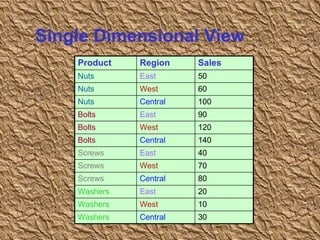
Single Dimensional View Product Region Sales Nuts East 50 Nuts West 60 Nuts Central 100 Bolts East 90 Bolts West 120 Bolts Central 140 Screws East 40 Screws West 70 Screws Central 80 Washers East 20 Washers West 10 Washers Central 30
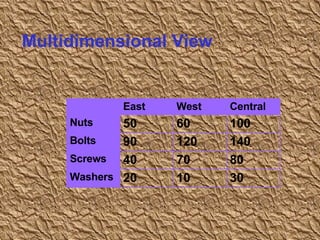
Multidimensional View East West Central Nuts 50 60 100 Bolts 90 120 140 Screws 40 70 80 Washers 20 10 30
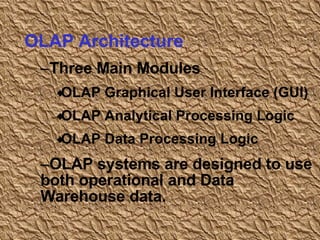
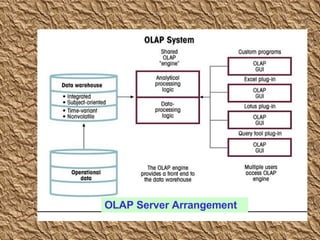
OLAP Architecture Three Main Modules OLAP Graphical User Interface (GUI) OLAP Analytical Processing Logic OLAP Data Processing Logic OLAP systems are designed to use both operational and Data Warehouse data.
OLAP Server Arrangement
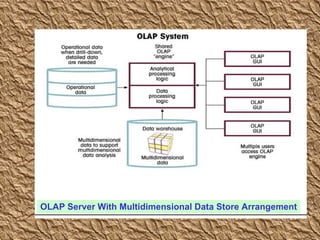
OLAP Server With Multidimensional Data Store Arrangement
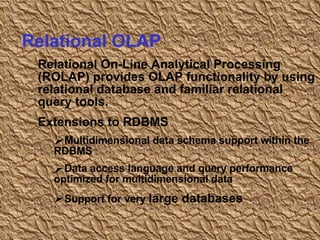
Relational OLAP Relational On-Line Analytical Processing (ROLAP) provides OLAP functionality by using relational database and familiar relational query tools. Extensions to RDBMS Multidimensional data schema support within the RDBMS Data access language and query performance optimized for multidimensional data Support for very  large databases
Multidimensional Data Schema Support within the RDBMS Normalization of tables in relational technology is seen as a stumbling block to its use in OLAP systems. DSS data tend to be non-normalized, duplicated, and pre-aggregated. ROLAP uses a special design technique to enable RDBMS technology to support multidimensional data representations, known as star schema. Star schema creates the near equivalent of a multidimensional database schema from the existing relational database
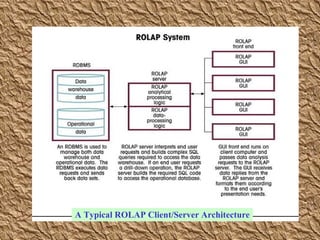
A Typical ROLAP Client/Server Architecture
The real limitation of OLAP databases is almost always the number of cells and not the number of dimensions. As the number of dimensions increases the number of cells increases expotentially so a 16 dimension database with 5 members in each has 152 billion cells. Most OLAP servers reach their limit in cell numbers before they hit their dimensions limit  LIMITATIONS
CONCLUSION In essence OLAP technology is fast, flexible data summarisation and analysis. OLAP servers are a superior technology for Business Intellgence applications. OLAP servers and relational databases can work in harmony to create an environment that delivers data quickly to perform the analysis needed to make the best business decisions.
THANK YOU

Online Analytical Processing

  • 1.
    OnLine Analytical ProcessingSeminar Presentation By IQxplorer Under the guidance of Mr. Indraneel Mukhopadhyay
  • 2.
    What is OLAP OnLine Analytical Processing ia a technology that uses multidimensional view of aggregate data for quicker access to strategic information.
  • 3.
    How OLAP Helps It helps in decision making, business modeling, and operations research activities by transforming raw Data warehouse data into strategic information
  • 4.
    Four Main Characteristicsof OLAP Use multidimensional data analysis techniques Provide advanced database support Provide easy-to-use end user interfaces Support client/server architecture
  • 5.
    Multidimensional Data AnalysisTechniques The processing of data in which data are viewed as part of a multidimensional structure. Multidimensional view allows end users to consolidate or aggregate data at different levels .
  • 6.
    Multidimensional Data AnalysisRelational databases contains lists of records whose information is organised into fields and is based on a row and column data format( one dimensional ). However some relational tables where there is more than a one-to-one relationship between the fields lends itself to multidiensional represtation .
  • 7.
    Single Dimensional ViewProduct Region Sales Nuts East 50 Nuts West 60 Nuts Central 100 Bolts East 90 Bolts West 120 Bolts Central 140 Screws East 40 Screws West 70 Screws Central 80 Washers East 20 Washers West 10 Washers Central 30
  • 8.
    Multidimensional View EastWest Central Nuts 50 60 100 Bolts 90 120 140 Screws 40 70 80 Washers 20 10 30
  • 9.
    OLAP Architecture ThreeMain Modules OLAP Graphical User Interface (GUI) OLAP Analytical Processing Logic OLAP Data Processing Logic OLAP systems are designed to use both operational and Data Warehouse data.
  • 10.
  • 11.
    OLAP Server WithMultidimensional Data Store Arrangement
  • 12.
    Relational OLAP RelationalOn-Line Analytical Processing (ROLAP) provides OLAP functionality by using relational database and familiar relational query tools. Extensions to RDBMS Multidimensional data schema support within the RDBMS Data access language and query performance optimized for multidimensional data Support for very large databases
  • 13.
    Multidimensional Data SchemaSupport within the RDBMS Normalization of tables in relational technology is seen as a stumbling block to its use in OLAP systems. DSS data tend to be non-normalized, duplicated, and pre-aggregated. ROLAP uses a special design technique to enable RDBMS technology to support multidimensional data representations, known as star schema. Star schema creates the near equivalent of a multidimensional database schema from the existing relational database
  • 14.
    A Typical ROLAPClient/Server Architecture
  • 15.
    The real limitationof OLAP databases is almost always the number of cells and not the number of dimensions. As the number of dimensions increases the number of cells increases expotentially so a 16 dimension database with 5 members in each has 152 billion cells. Most OLAP servers reach their limit in cell numbers before they hit their dimensions limit LIMITATIONS
  • 16.
    CONCLUSION In essenceOLAP technology is fast, flexible data summarisation and analysis. OLAP servers are a superior technology for Business Intellgence applications. OLAP servers and relational databases can work in harmony to create an environment that delivers data quickly to perform the analysis needed to make the best business decisions.
  • 17.