OLAP
Online Analytical Processing
PRESENTED BY:
NURMEEN RAFIQUE
ANIK MALIK
SYED AIENULLAH
Includes:
 Introduction
 Invented by
 Olap server and database
 Cubes
 How it works
 Types of OLAP
 Comparison
What does mean by Olap
 OLAP (online analytical processing) is computer processing that enables a user
to easily and selectively extract and view data from different points of view
 OLAP is a powerful technology for data discovery
 OLAP products are typically designed for multiple-user environments
 OLAP applications are widely used by Data Mining techniques
Who invented this:
Codd’s 12 Rules for Relational Database Management
 Edgar F. Codd wrote a paper in 1985 defining rules for Relational Database Management
Systems (RDBMS), which revolutionized the IT industry.
 In 1993, Codd and colleagues worked up these 12 rules for defining OLAP (Online Analytical
Processing),
 an industry of software and data processing which allows consolidation and analysis of data in
a multidimensional space.
OLAP server and database
OLAP Server
 The chief component of OLAP is the OLAP server,
 which sits between a client and a database management systems (DBMS).
 The OLAP server understands how data is organized in the database and has special
functions for analyzing the data.
 There are OLAP servers available for nearly all the major database systems
OLAP database
 In OLAP database there data, stored in multi-dimensional schemas (usually star schema).
 Data can be imported from existing relational databases to create a multidimensional
database for OLAP.
Cubes
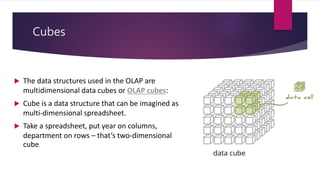
 The data structures used in the OLAP are
multidimensional data cubes or OLAP cubes:
 Cube is a data structure that can be imagined as
multi-dimensional spreadsheet.
 Take a spreadsheet, put year on columns,
department on rows – that’s two-dimensional
cube.
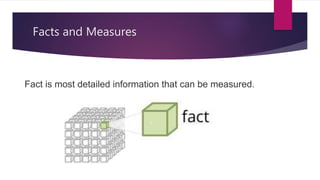
Facts and Measures
Fact is most detailed information that can be measured.
Dimensions
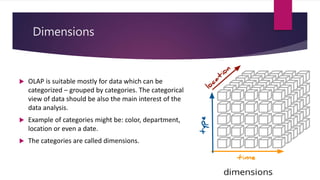
 OLAP is suitable mostly for data which can be
categorized – grouped by categories. The categorical
view of data should be also the main interest of the
data analysis.
 Example of categories might be: color, department,
location or even a date.
 The categories are called dimensions.
How it works
 OLAP (online analytical processing) is computer processing that enables a user to easily and
selectively extract and view data from different points of view.
For example,
 a user can request that data be analyzed to display a spreadsheet showing all of a company's
beach ball products sold in Florida in the month of July, compare revenue figures with those for
the same products in September, and then see a comparison of other product sales in Florida in
the same time period.
 To facilitate this kind of analysis, OLAP data is stored in a multidimensional database. Whereas
a relational database can be thought of as two-dimensional, a multidimensional database
considers each data attribute (such as product, geographic sales region, and time period) as a
separate "dimension."
 OLAP software can locate the intersection of dimensions (all products sold in the Eastern region
above a certain price during a certain time period) and display them. Attributes such as time
periods can be broken down into sub attributes.
Types of OLAP
 Cubes in a data warehouse are stored in three
different modes.
 Multidimensional Online Analytical processing
mode
 Relational Online Analytical Processing mode
 Hybrid Online Analytical Processing mode.
MOLAP
ROLAP
HOLAP
MOLAP
 In MOLAP data is stored in form of multidimensional cubes and not in relational databases
 The advantages of this mode is that it provides excellent query performance and the cubes
are built for fast data retrieval.
 All calculations are pre-generated when the cube is created and can be easily applied while
querying data.
 The disadvantages of this model are that it can handle only a limited amount of data
ROLAP
 The underlying data in this model is stored in relational databases.
 Since the data is stored in relational databases this model gives the appearance of
traditional OLAP’s slicing and dicing functionality.
 The advantages of this model is it can handle a large amount of data and can leverage
all the functionalities of the relational database.
 The disadvantages are that the performance is slow and each ROLAP report is an SQL
query with all the limitations.
HOLAP
 HOLAP technology tries to combine the strengths of the above two
models.
 For summary type information HOLAP leverages cube technology and for
drilling down into details it uses the ROLAP model.
Comparing the use of MOLAP and HOLAP
MOLAP
 Cube browsing is fastest when using MOLAP
 MOLAP storage takes up more space as data
is copied and at very low levels of aggregation
 All data is stored in the cube in MOLAP and
data can be viewed even when the original
data source is not available.
ROLAP
 Processing time is slower in ROLAP
 ROLAP takes almost no storage
space as data is not duplicated.
 In ROLAP data cannot be viewed
unless connected to the data source.
That’s all

Online analytical processing

  • 1.
    OLAP Online Analytical Processing PRESENTEDBY: NURMEEN RAFIQUE ANIK MALIK SYED AIENULLAH
  • 2.
    Includes:  Introduction  Inventedby  Olap server and database  Cubes  How it works  Types of OLAP  Comparison
  • 3.
    What does meanby Olap  OLAP (online analytical processing) is computer processing that enables a user to easily and selectively extract and view data from different points of view  OLAP is a powerful technology for data discovery  OLAP products are typically designed for multiple-user environments  OLAP applications are widely used by Data Mining techniques
  • 4.
    Who invented this: Codd’s12 Rules for Relational Database Management  Edgar F. Codd wrote a paper in 1985 defining rules for Relational Database Management Systems (RDBMS), which revolutionized the IT industry.  In 1993, Codd and colleagues worked up these 12 rules for defining OLAP (Online Analytical Processing),  an industry of software and data processing which allows consolidation and analysis of data in a multidimensional space.
  • 5.
    OLAP server anddatabase OLAP Server  The chief component of OLAP is the OLAP server,  which sits between a client and a database management systems (DBMS).  The OLAP server understands how data is organized in the database and has special functions for analyzing the data.  There are OLAP servers available for nearly all the major database systems OLAP database  In OLAP database there data, stored in multi-dimensional schemas (usually star schema).  Data can be imported from existing relational databases to create a multidimensional database for OLAP.
  • 6.
    Cubes  The datastructures used in the OLAP are multidimensional data cubes or OLAP cubes:  Cube is a data structure that can be imagined as multi-dimensional spreadsheet.  Take a spreadsheet, put year on columns, department on rows – that’s two-dimensional cube.
  • 7.
    Facts and Measures Factis most detailed information that can be measured.
  • 8.
    Dimensions  OLAP issuitable mostly for data which can be categorized – grouped by categories. The categorical view of data should be also the main interest of the data analysis.  Example of categories might be: color, department, location or even a date.  The categories are called dimensions.
  • 9.
    How it works OLAP (online analytical processing) is computer processing that enables a user to easily and selectively extract and view data from different points of view. For example,  a user can request that data be analyzed to display a spreadsheet showing all of a company's beach ball products sold in Florida in the month of July, compare revenue figures with those for the same products in September, and then see a comparison of other product sales in Florida in the same time period.  To facilitate this kind of analysis, OLAP data is stored in a multidimensional database. Whereas a relational database can be thought of as two-dimensional, a multidimensional database considers each data attribute (such as product, geographic sales region, and time period) as a separate "dimension."  OLAP software can locate the intersection of dimensions (all products sold in the Eastern region above a certain price during a certain time period) and display them. Attributes such as time periods can be broken down into sub attributes.
  • 10.
    Types of OLAP Cubes in a data warehouse are stored in three different modes.  Multidimensional Online Analytical processing mode  Relational Online Analytical Processing mode  Hybrid Online Analytical Processing mode. MOLAP ROLAP HOLAP
  • 11.
    MOLAP  In MOLAPdata is stored in form of multidimensional cubes and not in relational databases  The advantages of this mode is that it provides excellent query performance and the cubes are built for fast data retrieval.  All calculations are pre-generated when the cube is created and can be easily applied while querying data.  The disadvantages of this model are that it can handle only a limited amount of data
  • 12.
    ROLAP  The underlyingdata in this model is stored in relational databases.  Since the data is stored in relational databases this model gives the appearance of traditional OLAP’s slicing and dicing functionality.  The advantages of this model is it can handle a large amount of data and can leverage all the functionalities of the relational database.  The disadvantages are that the performance is slow and each ROLAP report is an SQL query with all the limitations.
  • 13.
    HOLAP  HOLAP technologytries to combine the strengths of the above two models.  For summary type information HOLAP leverages cube technology and for drilling down into details it uses the ROLAP model.
  • 14.
    Comparing the useof MOLAP and HOLAP MOLAP  Cube browsing is fastest when using MOLAP  MOLAP storage takes up more space as data is copied and at very low levels of aggregation  All data is stored in the cube in MOLAP and data can be viewed even when the original data source is not available. ROLAP  Processing time is slower in ROLAP  ROLAP takes almost no storage space as data is not duplicated.  In ROLAP data cannot be viewed unless connected to the data source.
  • 15.