CONTENTS
History
Introduction
Types of OLAP
Working of OLAP
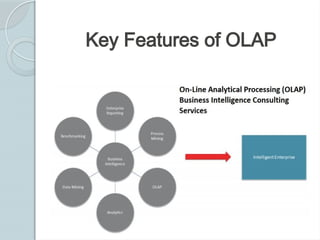
Key Features of OLAP
Future Scope
Applications of OLAP
Advantages & Disadvantages
Conclusion
3.
History
1990s: OLAP, asa term, gained popularity in the early to mid-
1990s. It was coined by Dr. Edgar F.Codd, a computer scientist
known for his work on relational databases.
OLAP systems were designed to facilitate interactive analysis of
multidimensional data from different perspectives.
4.
Introduction
Online analytical processing(OLAP) software executes detailed
analysis on massive volumes of business data, drawn from
sources such as data lakes or deep storage.
End users, such as analysts, executives, and engineers, use
OLAP platforms to dissect data around operational performance
and profitability, access critical business insights or product
strategy.
5.
Types of OLAP
Multidimensional OLAP(MOLAP):
In MOLAP systems, data is stored in a multidimensional array
(or cube) format.
MOLAP systems are optimized for fast query performance
and are well-suited for scenarios where response time is
critical.
6.
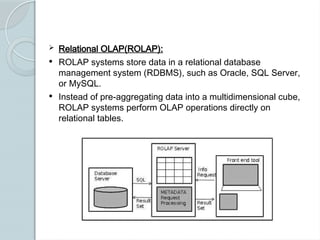
Relational OLAP(ROLAP):
ROLAP systems store data in a relational database
management system (RDBMS), such as Oracle, SQL Server,
or MySQL.
Instead of pre-aggregating data into a multidimensional cube,
ROLAP systems perform OLAP operations directly on
relational tables.
7.
Hybrid OLAP(HOLAP):
HOLAP systems combine elements of both MOLAP and
ROLAP approaches.
They store summary data (aggregates) in a multidimensional
format for fast query performance, while detailed data is
stored in a relational database for flexibility.
Real-Time OLAP(ROLAP):
Real-Time OLAP (RTOLAP) systems focus on providing real-time
or near-real-time access to operational data for analysis.
These systems are designed to handle continuous streams of data
and support ad-hoc queries with minimal latency.
8.
Working
Here's how OLAPtypically works:-
Data Acquisition
Dimensional Modeling
Data Cubes
OLAP Operations
Query and Analysis
Aggregation and Calculations
Result Presentation
Performance Optimization
Future Scope
Future Scopeof OLAP :-
Big data Integration
Cloud Based OLAP
AI And Machine Learning Integration
Enhanced visualization and
11.
Applications of OLAP
Somecommon applications of OLAP include:
Business Intelligence(BI)
Financial Analysis and Planning
Sales And Market Analytics
Customer Relationship Management(CRM)
12.
Advantages of OLAP
Somekey advantages of OLAP include:
Multidimensional Analysis
Fast Query Performance
Aggregation and Drill Down
Hierarchical Navigation
Data Visualization
13.
Disadvantages of OLAP
Someof the key disadvantages of OLAP include:
Complexity of Implementation
Data Latency
Storage Requirements:
Limited Detailed Level
Performance Degradation With Complex Queries
14.
Conclusion
OLAP systems allowsflexible and dynamic questions to be
asked of big data. By combining OLAP with multicriteria
decision-making techniques, we can allow business executives
to incorporate insights from real-world data into the systematic
evaluation of different business options







![[DSC Europe 25] Srba Markovic - From Pilot to Production: Overcoming AI Deplo...](https://cdn.slidesharecdn.com/ss_thumbnails/yjjmrtytmwbalxlba7px-4-srba-markovic-from-pilot-to-production-overcoming-ai-deployment-blockers-with-260114111931-4a892d44-thumbnail.jpg?width=640&height=640&fit=bounds)

![[DSC Europe 25] Stefan Brankovic - #ResumeIsDead. AI-Powered Interviews and C...](https://cdn.slidesharecdn.com/ss_thumbnails/qnmbsv0xq3uysdrq3sev-2-stefan-brankovic-job-bolt-260114111931-a065aa3d-thumbnail.jpg?width=640&height=640&fit=bounds)

![[DSC Europe 25] Mijat Kustudic - Building Financial Intelligence with AI Agen...](https://cdn.slidesharecdn.com/ss_thumbnails/38y2lb5lse6wstegtvas-3-mijat-kustudic-building-financial-intelligence-with-ai-agents-260114111931-1a4783ce-thumbnail.jpg?width=640&height=640&fit=bounds)


![[DSC Europe 25] Ivica Milaric - The Future of Gaming and AI Tools.pptx](https://cdn.slidesharecdn.com/ss_thumbnails/tijgzsmgse2kj2y5pzzp-5-ivica-milaric-the-future-of-gaming-x-ai-tools-260114111931-87c2b3ac-thumbnail.jpg?width=640&height=640&fit=bounds)
![[DSC Europe 25] Nikola Vasiljevic - Player segmentation by combat playstyles ...](https://cdn.slidesharecdn.com/ss_thumbnails/mnvbf0yvrwaqsipzrrv3-2-nikola-vasiljevic-player-segmentation-by-playstyles-in-action-shooter-games-260114111931-b4d766cd-thumbnail.jpg?width=640&height=640&fit=bounds)