DELL CASE STUDY


 SUBMITTED TO:              SUBMITTED BY:
Mr. Supratik Ghatak       RAMINDER PAL SINGH
                             12030141033
INTRODUCTION
Dell was founded in 1984 by Michael Dell, the computer
industry's longest-tenured chief executive officer, on a simple
concept: that by selling computer systems directly to
customers, Dell could best understand their needs and
efficiently provide the most effective computing solutions to
meet those needs. This direct business model eliminates
retailers that add unnecessary time and cost, or can diminish
Dell's understanding of customer expectations. The direct
model allows the company to build every system to order and
offer customers powerful, richly-configured systems at
competitive prices. Dell also introduces the latest relevant
technology much more quickly than companies with slow-
moving, indirect distribution channels, turning over inventory
every three days on average.
HISTORY OF DELL
• Dell grew through the 1980s and 1990s to
  become at one stage the largest seller of PCs and
  servers
• In 1992 , Dell entered into the Fortune 500 list
• In 1996 , Dell began selling computers via its web
  site(Dell.com), generating $1 million in sales per
  day just six months after site is live.
• In 1999 , Dell overtook Compaq to become the
  largest seller of personal computers in US
• In 2006 , Dell was 25th in Fortune 500 list
COMPETITION IN PC INDUSTRY
• The PC industry is driven by rapid technological
  improvements in components, particularly
  microprocessors, other semiconductors, and
  storage devices
• Two factors come into play in determining the
  ability of PC companies to manage inventory and
  introduce new products.
• The traditional distribution system of the PC
  industry is an indirect model often referred to as
  “the channel”
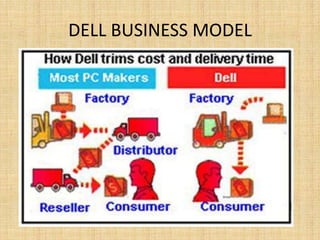
DELL BUSINESS MODEL
DELL BUSINESS MODEL
• Dell operated as a pioneer in the “configure to order”
  approach to manufacturing - delivering individual PC
  configured to customer specifications
• To minimize the delay between purchase and delivery,
  Dell has a general policy of manufacturing its products
  close to its customers.
• This also allows for implementing a just-in-time (JIT)
  manufacturing approach, which minimizes inventory
  costs
• Low inventory is another signature of the Dell business
  model - a critical consideration in an industry where
  components depreciate very rapidly.
Comparison b/w Compaq and Dell
         sales model
DELL’s value web model
Component supplier
- The high-tech components, such as
microprocessors and software are
provided by firms as Intel and Microsoft,
they rely on big players.
- The low-tech components are provided
by small multiple players who compete on
prices and availability

Original Equipment Manufacturer (OEM)
The OEMs traditionally would receive all
the parts from their suppliers, assemble
the computers in their production lines
and ship them over to their distributors,
or Corporate resellers.
DELL’s value web model
Distributors
- They generally supply to corporate
resellers and other distributors
- They carry large quantities of different
products to increase their leverage when
dealing with their customers
- They also provide specific software,
peripherals, furniture,as well as service
- For example: Ingram Micro, Tech Data,
Computer 2000, and Santech.
Corporate resellers / System integrators
-The corporate resellers or system
integrators buy systems directly from
manufacturers and install these systems
at their corporate clients
- These are firms whose main purpose is
to provide customization to their clients
Benefits by implementing this model
• DELL
  - Cash :Dell maintains a negative cash conversion cycle, that means the
  payment receive for the product before it has to pay for the material
  - Cost :Dell´s direct sales and build-to-order model has achieved superior
  performance in the PC industry in terms of inventory turnover, reduced
  overhead, cash conversion, and return on investment. Bypassing the
  reseller channel that causes further cost reduction to the company
  - CRM :Direct customer relationship is the key to Dell´s business model,
  and provides distinct advantages over the indirect sales model
  -Demand forecast: Dell has additional advantages over PC vendors who
  must try to forecast demand and ship products based on those forecasts
• CUSTOMERS
  - Tailored offerings from Dell in terms of add-on products and services
  - Very customizable systems at an affordable rate, since Dell
  manufacturing builds specifically for each customer
Customer Driven Innovation at Dell
• Dell has continued to provide distinctiveness to the industry, giving new
  products, pioneering critical developments and innovations in home, small
  business and enterprise computing.
• Dell’s R&D efforts now extend to all over other industries, driven by some
  of the industry’s leading product designers and engineers.
• The focus point of Dell’s innovation approach remains an unwavering
  commitment to delivering new and better solutions that directly address
  customer needs.
• Dell start their innovation process with asking their customers, “What
  would you really want this thing to do? Is there a different way to
  accomplish that?” Then they meet with their suppliers and ask, “Can we
  do this in a different way?”
Customer Driven Innovation at Dell
They learn from the feedback from customers and suppliers.
• Listen
      • Dell understands the necessity directly through tens of thousands of
        customer interactions, organized events, social media venues such as
        communities and customer panels.
• Impact
      • Many innovations commence in-house, led by a global team of top
        engineers, product designers and technical experts. Others begin as a
        team effort with Dell’s strategic partners.
      • The mission is to deliver innovative and cost-effective solutions that
        meet today’s real-life customer challenges and work seamlessly in
        existing environments and with other products.
• Solve
      • Dell is uniquely positioned to impact industry trends. We maintain
        strong internal development capabilities. We associate, rather than
        compete, with top industry technology suppliers and original
        development manufacturers.
Dell’s Latest Experiment
•   To reach the customer through social media eg. Twitter , facebook , linked in etc.
Dell Case Study

Dell Case Study

  • 1.
    DELL CASE STUDY SUBMITTED TO: SUBMITTED BY: Mr. Supratik Ghatak RAMINDER PAL SINGH 12030141033
  • 2.
    INTRODUCTION Dell was foundedin 1984 by Michael Dell, the computer industry's longest-tenured chief executive officer, on a simple concept: that by selling computer systems directly to customers, Dell could best understand their needs and efficiently provide the most effective computing solutions to meet those needs. This direct business model eliminates retailers that add unnecessary time and cost, or can diminish Dell's understanding of customer expectations. The direct model allows the company to build every system to order and offer customers powerful, richly-configured systems at competitive prices. Dell also introduces the latest relevant technology much more quickly than companies with slow- moving, indirect distribution channels, turning over inventory every three days on average.
  • 3.
    HISTORY OF DELL •Dell grew through the 1980s and 1990s to become at one stage the largest seller of PCs and servers • In 1992 , Dell entered into the Fortune 500 list • In 1996 , Dell began selling computers via its web site(Dell.com), generating $1 million in sales per day just six months after site is live. • In 1999 , Dell overtook Compaq to become the largest seller of personal computers in US • In 2006 , Dell was 25th in Fortune 500 list
  • 4.
    COMPETITION IN PCINDUSTRY • The PC industry is driven by rapid technological improvements in components, particularly microprocessors, other semiconductors, and storage devices • Two factors come into play in determining the ability of PC companies to manage inventory and introduce new products. • The traditional distribution system of the PC industry is an indirect model often referred to as “the channel”
  • 5.
  • 6.
    DELL BUSINESS MODEL •Dell operated as a pioneer in the “configure to order” approach to manufacturing - delivering individual PC configured to customer specifications • To minimize the delay between purchase and delivery, Dell has a general policy of manufacturing its products close to its customers. • This also allows for implementing a just-in-time (JIT) manufacturing approach, which minimizes inventory costs • Low inventory is another signature of the Dell business model - a critical consideration in an industry where components depreciate very rapidly.
  • 7.
    Comparison b/w Compaqand Dell sales model
  • 8.
    DELL’s value webmodel Component supplier - The high-tech components, such as microprocessors and software are provided by firms as Intel and Microsoft, they rely on big players. - The low-tech components are provided by small multiple players who compete on prices and availability Original Equipment Manufacturer (OEM) The OEMs traditionally would receive all the parts from their suppliers, assemble the computers in their production lines and ship them over to their distributors, or Corporate resellers.
  • 9.
    DELL’s value webmodel Distributors - They generally supply to corporate resellers and other distributors - They carry large quantities of different products to increase their leverage when dealing with their customers - They also provide specific software, peripherals, furniture,as well as service - For example: Ingram Micro, Tech Data, Computer 2000, and Santech. Corporate resellers / System integrators -The corporate resellers or system integrators buy systems directly from manufacturers and install these systems at their corporate clients - These are firms whose main purpose is to provide customization to their clients
  • 10.
    Benefits by implementingthis model • DELL - Cash :Dell maintains a negative cash conversion cycle, that means the payment receive for the product before it has to pay for the material - Cost :Dell´s direct sales and build-to-order model has achieved superior performance in the PC industry in terms of inventory turnover, reduced overhead, cash conversion, and return on investment. Bypassing the reseller channel that causes further cost reduction to the company - CRM :Direct customer relationship is the key to Dell´s business model, and provides distinct advantages over the indirect sales model -Demand forecast: Dell has additional advantages over PC vendors who must try to forecast demand and ship products based on those forecasts • CUSTOMERS - Tailored offerings from Dell in terms of add-on products and services - Very customizable systems at an affordable rate, since Dell manufacturing builds specifically for each customer
  • 11.
    Customer Driven Innovationat Dell • Dell has continued to provide distinctiveness to the industry, giving new products, pioneering critical developments and innovations in home, small business and enterprise computing. • Dell’s R&D efforts now extend to all over other industries, driven by some of the industry’s leading product designers and engineers. • The focus point of Dell’s innovation approach remains an unwavering commitment to delivering new and better solutions that directly address customer needs. • Dell start their innovation process with asking their customers, “What would you really want this thing to do? Is there a different way to accomplish that?” Then they meet with their suppliers and ask, “Can we do this in a different way?”
  • 12.
    Customer Driven Innovationat Dell They learn from the feedback from customers and suppliers. • Listen • Dell understands the necessity directly through tens of thousands of customer interactions, organized events, social media venues such as communities and customer panels. • Impact • Many innovations commence in-house, led by a global team of top engineers, product designers and technical experts. Others begin as a team effort with Dell’s strategic partners. • The mission is to deliver innovative and cost-effective solutions that meet today’s real-life customer challenges and work seamlessly in existing environments and with other products. • Solve • Dell is uniquely positioned to impact industry trends. We maintain strong internal development capabilities. We associate, rather than compete, with top industry technology suppliers and original development manufacturers.
  • 13.
    Dell’s Latest Experiment • To reach the customer through social media eg. Twitter , facebook , linked in etc.